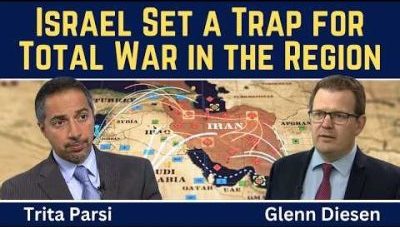
How will the Trump years in office play out in the history books? Recently, a number of unthinkable scenarios have taken place which will mark Trump and 2026 out as a seismic watershed moment in America’s history which will change the country’s identity and standing in the world forever. The decision by Trump to strike Iran on February 28th was remarkable in that it was a decision that Trump more or less took while disregarding his chief of staff and most of the cabal of decision makers around him, in preference for what Israel was insisting was a quick, winnable weekend war.
If we are to believe the explosive expletives though which were delivered by Trump to Netanyahu in a telephone call, it would appear that the greatest nightmare the world has about America – that it is run entirely these days by Israel – has come true. The anger and frustration by Trump might be real, even though what was reported might have been exaggerated for political purposes but the reality is that Israel is blocking any deal that Trump might believe he can pull off with Iran. And worse than just blocking it, based on Netanyahu’s statement about Lebanon, Bibi has not “turned back” IDF troops from making the south of Lebanon a new Gaza. The killing goes on, the systematic destruction of property and the war with Hezbollah has not been halted which puts Trump in an even tighter corner than he might have imagined he was in just a couple of weeks ago. He himself is unable to strike Iran as GCC partners have critically denied his military the support it would need, but in reality those governments and their elites – in particular MbS of Saudi Arabia – have played the safety lever role on Trump’s madness that Washington couldn’t pull off itself. Trump’s firing of all chiefs of staff from Biden’s days and surrounding himself with under qualified yes men has resulted in Trump himself being able to cultivate the maddest ideas and it is only leaders of the middle east who can tell him no. Enough is enough.
Presently, what we are witnessing in the region is the division of GCC countries – those who are allied to Israel via the Abraham Accords – and those who have formed a new anti Israel alliance with its own nuclear deterrent, a group made up of Turkey, Saudi Arabia and Pakistan which doesn’t have a name but is now an informal pact.
And in the middle of all this madness, comes more. Now we are hearing plans for Israel to move ahead with plans which would guarantee its annual 3.8 bn USD military gift from the U.S. for the next 20 years, shrouded in even more secrecy through a bill in congress which would essentially merge the Israeli government with the Washington apparatus making the IDF one with the U.S. military.
This fusion of the IDF and U.S. forces comes when Israel is sensing that future governments and congress will demand more accountability of how the annual defence gratuity is spent and Israel’s intentions in future wars. It also comes when public opinion seems to be against America’s support for Israel and its regional goals.
For example, according to Al Jazeera, a survey this month from The New York Times and Siena College found that 57 percent of U.S. voters opposed providing Israel with additional economic and military support.
Moreover, 62 percent said they disapproved of the Israeli-Palestinian conflict. Israel’s genocidal war against Gaza, which started in 2023, has killed more than 75,000 people, prompting widespread condemnation, Al Jazeera claims.
There is some kickback from both houses against the so called Section 244 although those who have opposed it have predictably been called ‘anti semitic’.
But the very fact that Israel is using its leverage with congressmen which it has on its payroll to push through a bill which would ‘co-ordinate’ all military action that both the U.S. and Israel are involved in shows just how advanced Israel is with its absolute control of Washington. We’ve reached a new high-water mark of servility and it’s the Trump second term which has been a catalyst to this new world order which is going to make any deal with Iran even harder – first of all to get signed, but more importantly to implement, which of course the Iranians know, which explains their lethargic pace in the negotiations compared to Trump’s panicky buffoonery.
To Trump’s credit, he at least presented some resistance to U.S. forces being sent to their deaths when Israel turned up the heat and insisted on getting dug into a longer, drawn out deeper conflict with Iran. Sceptics rush to point out that Israel will only use a closer union to sell on the open market all of America’s military secrets, the bigger point is being over looked. If this article 244 gets through, it will only be a matter of time before an Israeli PM can simply order U.S. troops to fight any battle it wants. The days of heated arguments, threats or even blackmail will be looked back upon almost nostalgically as a golden era where a U.S. president still had the final call on whether to send in American troops. Netanyahu’s identity for three decades has been built on him bragging that he and Israel have been running America but the claim has been largely uncontested until now. Are we now about to enter a new phase?
“He’ll do whatever I want him to do,” Donald Trump declared recently about Israeli Prime Minister Benjamin Netanyahu.
The statement may be one of the most revealing statements Trump has ever made—not for what it says about Netanyahu, but for what it reveals about Trump’s psychology. It was intended as a display of strength. Instead, it exposed the opposite.
Trump has built a political persona around hyperbole, self-aggrandizement, and declarations of superiority to cover up for an oversized inferiority complex, he only knows its extent. When he insists that Netanyahu is acting at his command, he is projecting an authority he does not possess. The louder the boast, the more apparent the insecurity beneath it.
If there is one lesson since the election of Trump, it is that Netanyahu, not Trump, has consistently dictated the pace of America’s wars in the Middle East. Trump may occupy the White House, issue ultimatums, and proclaim himself the master negotiator, but the facts on the ground tell a different story. Again and again, Netanyahu acts, and Trump adjusts.
For years, Netanyahu worked relentlessly to pull the U. S. into another made-for-Israel war, this time against Iran. Successive administrations, despite their deference to Israel, stopped short of falling for the scheme. Trump, however, proved far more susceptible to the influence of his Israel-first donors and to Netanyahu’s chicanery. Yet he continues to portray himself as the one calling the shots.
This week, Trump proudly recounted a phone call in which he supposedly instructed Netanyahu to halt a planned Israeli attack on Beirut. It took little time after Trump’s statement for Israel’s defense minister to announce that military operations “will continue under all circumstances.” True to that pledge, Israel launched fresh attacks on hospitals and villages in southern Lebanon, killing and wounding civilians despite the so-called Trump’s war cessation.
Two days later, on Wednesday June 3rd, Lebanese and Israeli delegations meeting in Washington announced another ceasefire. The third such extension since last April. One day after reaching the agreement, Israel resumed strikes on South Lebanon and said it would neither withdraw nor allow Lebanese civilians back to their homes in the south.
It is almost certain, when the Lebanese resistance eventually counters the repeated Israeli violations, Trump—as he has done before—will condemn the retaliation rather than the provocation. To save face and avoid appearing weak before Netanyahu, he will once again blame the Lebanese side while ignoring the Israeli occupation and military actions that triggered the response.
The same pattern is evident in the negotiations with Iran. For months, Trump’s stated objective was to prevent Iran from developing a nuclear weapon—a framework which aligns with Tehran’s declared position. But nuclear-armed Israel, which never signed the Non-Proliferation Treaty that Iran did, has different goals entirely. Netanyahu’s government will not be satisfied with anything short of the destruction of knowledge and the reduction of Iran to a failed state, precisely the fate that befell Iraq and Libya after both countries agreed to surrender their nuclear ambitions.
For Israel, a negotiated agreement between the U.S. and Iran, may be far less desirable than the continuation of regional turmoil. For its objective is the preservation of a strategic environment that sustains military and geopolitical dominance. Zionism has long viewed the emergence of democratic, technologically advanced, and self-reliant neighboring states as a threat. Fragmentation and disorder in surrounding countries serve that objective by limiting the rise of independent regional powers that could one day, potentially challenge Israeli primacy. In this case, Israel may be unique among nations: it derives strategic advantage not from a stable and prosperous region, but from entropy, and has built a regional doctrine whose success depends on propagating chaos.
The cost to ordinary Americans is tangible, and personal. They feel it every time they fuel their cars, pay inflated prices for goods, or watch Congress cut healthcare or financial student aid for Americans in order to finance another military aid package for Israel.
Americans are not only financing Israel’s wars through tax dollars and weapons transfers. They are also paying what amounts to an Israeli surcharge tax at the pump.
Treasury Secretary Scott Bessent has been trying for weeks to assure consumers that gas will hover around $3 a gallon between June and September, as if it is acceptable for Americans to pay elevated prices until Netanyahu deigns to approve a ceasefire, especially when Trump boasts that America is a net oil exporter.
Gaza is another front in Israel’s endless wars. Trump personally signed the ceasefire agreement in Sharm el-Sheikh in October 2025, chirping “we have peace in the Middle East.” He had since watched in silence as Israel systematically dismantled every commitment it had made. During the “ceasefire,” it maintained a starvation diet blockade, murdered more than 800 and wounded thousands.
Under Phase One of the agreement, Israeli forces were required to withdraw to approximately 53 percent of Gaza. Phase two stipulated further withdrawal. Instead, Netanyahu ordered the seizure of an additional 32 percent, increasing total Israeli military occupation to 70 percent of the besieged territory, confining 2.3 million Palestinians to 30 percent, or roughly 50,000 human beings per each square mile of rubble.
On all fronts, Trump did not merely follow Netanyahu’s lead. He enabled it, funded it, armed it, and defended it diplomatically. Then, standing before television cameras, he attempted to compensate for this reality by insisting that he was the one in control.
To that end, and following recent Republican primary elections, lame-duck Republican members of Congress have already begun treating the Trump administration as a lame-duck presidency, long before the midterm elections. The recent congressional vote to limit presidential war powers is a telling sign that Trump’s political capital is eroding far sooner than expected.
Nevertheless, Americans may be witnessing a historic inflection point in the decades-long power of Israel-first Zionist influence over American political life. It is clear the political landscape is shifting, and the assumptions that long governed Washington’s relationship with Israel no longer appear as immutable as they once did. From growing dissent within the Democratic Party—and among Republican influencers—to deepening unease across the Washington Beltway, genuine cracks are appearing in a system that for generations treated Israel as a sacred cow. Eight decades of unquestioned manipulation and political leverage over American leaders is now facing resistance from constituencies that were once among its most reliable friends.
Hence, no amount of presidential bravado or social-media posturing can obscure what has become undeniable: under Donald Trump, American foreign policy has served Netanyahu’s Israel-first agenda, not America’s. And when the history of this era is written, this odd couple may be remembered for ushering in the sunset of Israel-first Zionist dominance over the U.S. government.
Netanyahu and Trump are conditioning the end of the war in Iran on the condition that all countries in the region sign the Abraham Accords, a tacit submission to Israel. Drawing on Daniel Levy, Omer Bartov, and the Pew Survey, I address the reasons, the urgency, and the limits of Netanyahu’s simultaneous battles on several fronts in the quest for a Greater Israel project.
When Israeli Finance Minister Bezalel Smotrich talks about expanding Israel’s reach “to Damascus,” or Prime Minister Benjamin Netanyahu expresses personal attachment to broad territorial ambitions or Israel being not only a “regional superpower” but “in some respects, a global superpower,” these are not just messianic daydreams. They reflect a deliberate, and deeply destabilizing strategic doctrine. For years, the idea of Greater Israel was dismissed by Western analysts as the rhetoric of a few Israeli hardliners. Sustaining this dismissive position is no longer possible.
Daniel Levy, a former Israeli peace negotiator and now head of the U.S./Middle East Project, offers a sharp analytical lens for understanding today’s events. He suggests that Greater Israel isn’t just about land—it’s about Israel aiming to establish itself as the dominant hard-power player across the Middle East. As Levy puts it, this is about seeing how far Israel can extend its reach and consolidate its role as the region’s unrivaled hegemon.
Territorial control—occupying the Golan, reasserting presence in southern Lebanon, pushing forward with West Bank annexation, and the continuation of the genocide in Gaza—is only the most visible layer. The deeper game is about forging new regional alliances, as the one with the UAE, systematically weakening rival states, and building webs of hard-power dependency that lock neighboring governments into Israel’s orbit.
The ideological consolidation of this project was the 2018 Jewish Nation-State Basic Law, which constitutionally defined Israel as “the national home of the Jewish people.” For many, including the PLO’s Saeb Erekat, this law was the moment when a Zionist aspiration became a formal legal reality, and for critics, a codification of a system of apartheid. What was once an ambition is now written into the legal foundations of the state.
Omer Bartov, a leading scholar on genocide and Israeli history, traces this shift with a heavy sense of loss. In his book Israel: What Went Wrong?, he shows how Zionism, once rooted in the humanitarian ideals of 19th-century Jewish emancipation, has been transformed into a state project of ethno-nationalism, exclusion, and, in the end, violence. As Bartov puts it, what began as a struggle for Jewish liberation has become a machinery for dominating Palestinians, with all the tragedy that implies.
The Logic of Urgency
The pace and simultaneity of Israeli military operations in recent years demand careful analysis. In just two years, Israel has bombed Gaza, Iran, Syria, Iraq, Lebanon, Qatar and Yemen; it has occupied the Golan Heights, Gaza, the West Bank, and parts of southern Lebanon. Israel even succeeded in drawing the United States into a direct conflict with Iran, a move that, as Secretary of State Marco Rubio accidentally admitted, was driven more by Israeli rather than American priorities. As for Netanyahu, this is a posture of someone convinced that the window for reshaping the region is closing fast, and determined to act before it closes.
Levy describes the current moment as the “Pax Greater Israel” era, a time when the old constraints of American power, the so-called Pax Americana, have faded. With a more pliable U.S. administration, Israel’s room to maneuver has expanded. Iran still hasn’t rebuilt the deterrence it once had before Israel and America struck last year. The region’s strategic balance is more fluid—and more precarious—than it’s been in a generation.
While there’s international outrage over Israel’s actions in Gaza, Iran, and Lebanon, Israel has not suffered any punishment. The European Union, which heralds itself as the guardian of morals and Western values, has seen these values undermined by Israel, yet no single action has been taken. Netanyahu, who has piloted Israeli politics for nearly two decades, is unlikely to let an opportunity like this slip by.
Netanyahu’s sense of urgency isn’t just strategic. It is also deeply personal and political. He faces criminal charges, widespread public disapproval (polls showed most Israelis wanted him out even before the Gaza war), and an election looming in 2026. His personal survival and his political project are now intertwined. History teaches us that war often delays accountability, and Netanyahu knows that he has survived through wars.
By keeping the nation in a constant state of crisis, Netanyahu postpones his own reckoning while pushing forward his broader regional ambitions. There is always a danger when embattled leaders manipulate the machinery of state.
The Collapse of the Impunity Consensus
For decades, Israel benefited from an unspoken Western consensus that gave it extraordinary complacency on international law. UN resolutions could be swept aside, settlements could expand, human rights abuses against Palestinians could be perpetrated, and the memory of the Holocaust—too often used as a diplomatic shield—offered a kind of moral immunity no other state enjoyed. That consensus is now breaking down, even if its institutional traces remain stubbornly in place.
The visibility of the Gaza war and its horrendous violence has triggered a generational break like never before and a breakdown of this consensus. According to an April 2026 Pew survey, 60% of Americans have unfavorable views of Israel and 37% favorable ones. This becomes more important, as it is the first in history. The same survey also showed Netanyahu’s administration with 27% approval and 59% disapproval. In the last Global Country Perceptions Survey, Israel ranked in the last position, several points behind North Korea and Afghanistan.
The generational divide is even sharper among young people, many of whom reject any complicity in what prominent scholars, including Bartov, now formally call genocide. Netanyahu’s act of tearing up the UN Charter at the General Assembly, followed by a mass walkout, was more than symbolism. It marked the end of an era for both Netanyahu and Israel. Criticism of Israel or Zionism is no longer quickly conflated with antisemitism, especially among the younger generations.
And yet the institutional lag is severe. The European Union, bound by Article 2 of its Association Agreement with Israel, which explicitly conditions the relationship on respect for human rights, has consistently refused to act on its own legal framework. The cost of this cowardice is not merely moral. The EU, having lost industrial competitiveness, seeks its international influence as a regulatory and normative superpower. This claim rests on credibility. A bloc that intends to police the digital practices of technology companies but cannot enforce a human rights clause in its own trade agreement with a small state faces difficulties in imposing itself as a normative power, and the Global South has drawn that conclusion because of the lack of moral authority and double standard.
The pro-Israel lobby in the United States, sensing the tide turning, has responded by intensifying rather than moderating. More money is being spent, more countries are being pressured, more political careers are being threatened or terminated, as was the case with Thomas Massie and Marjorie Taylor Greene, and more communication and online platforms are being acquired; censorship is being imposed, especially on platforms such as Facebook and YouTube, and algorithms are being “re-educated,” as Mr. Larry Ellison said when he acquired TikTok. The main lobby, AIPAC, has, in great measure, turned into a politically toxic brand, according to The Intercept.
But Levy is right to note the structural limits of this approach. Lobbying is most effective when it moves with the current of public opinion or when it operates in the dark. It is least effective when it operates openly against an overwhelming public majority, against a country’s perceived national interest, and against the values of the rising generation. The lobby is fighting a rearguard action — powerful, well-resourced, and increasingly desperate.
The Next Iran and the Regional Order
It’s no accident that Israeli security officials—from Naftali Bennett to the current establishment—have started designating Türkiye as “the next Iran.” This isn’t just rhetoric; it is also part of “Greater Israel” strategy. Three decades ago, Israel argued that Iran was the existential threat that had to be contained before it led the region. Now, the same logic and language are applied to Türkiye: any regional power capable of building a new security order outside Israeli influence is seen as a threat to be isolated or confronted before it can consolidate.
But Türkiye is a different kind of challenge. As a NATO member with the largest NATO army in Europe, a strong economy, and the anchor of a coalition with Saudi Arabia, Egypt, and Pakistan, Türkiye is not easily marginalized. Recent agreements point to a regional bloc that aims to build security frameworks explicitly outside Israeli (and, by extension, Western) dominance. This coalition news has not pleased Israel and soon reached the EU, with Ursula von der Leyen declaring, “We do not want to live under the influence of China, Russia, or Türkiye.”
The regional threat map has changed. For much of the Arab world and for Türkiye’s Erdoğan, Israel—not Iran—is now seen as the chief destabilizer. This shift in perception has real geopolitical consequences, and it’s not something American air power can easily undo.
Are we at the point of no return? In some ways, yes. The two-state solution, no matter how often it’s invoked in diplomatic statements, is functionally dead. It wasn’t killed by a single act, but by decades of illegal settlements, legal discrimination, disproportionate violence, and the systematic fragmentation of Palestinian territory. The ethnostate is already a reality on the ground. Bartov’s assessment is sobering but direct: unless there is sustained, structural pressure and actions from the international community, a real course correction is unlikely, and so far, that pressure hasn’t materialized.
But in another sense, we’re not quite past the point of no return for Netanyahu’s grand project. The conditions that have enabled the Greater Israel strategy are starting to slip away. American public opinion is shifting faster than the country’s political leaders; the support for Palestine is now higher than the support for Israel. A new regional bloc—with Turkey, Saudi Arabia, Pakistan, and Egypt—offers a real counterweight. Iran, for all its setbacks, still possesses significant strategic resources and has the backing of China and Russia. And inside Israel, recent polling shows that a large majority (71%) support replacing the current Basic Laws with a formal constitution. Beneath the surface noise of hardline politics, there’s evidence that Israeli society hasn’t wholly given in to the ethnonationalist vision Bartov describes.
One thing is clear: this current trajectory of forever war and continued violence and humiliation of Palestinians can’t last forever. As Levy notes, Netanyahu is playing a high-stakes game of “use it or lose it.” The real question isn’t whether this moment will end — sure it will — but what the aftermath will look like. Will the region be forcibly remade in the image of Greater Israel, or will a new order, forged through painful resistance, emerge in its place? The stakes for Israelis, Palestinians, and the broader Middle East couldn’t be higher.
Ricardo Martins – Doctor of Sociology, specialist in European and international politics as well as geopolitics
On May 18, Israeli commandos attacked 54 civilian boats carrying food and medical supplies to Gaza. The boats were near Cypress, nearly 300 miles from Gaza, in international waters.
The Israelis fired at the boats and kidnapped 428 unarmed humanitarian activists. Those people were never charged with any crime. How could they be? When kidnapped, they were exercising their right to sail in international waters. It was the Israelis who were committing the crime of maritime piracy, which carries a penalty of 20 years’ imprisonment.
But piracy and kidnapping were just the initial crimes. Sexual assault, rape, and torture followed. It began almost as soon as the Israeli pirates boarded the victims’ boats. According to Dropsite News, “The flotilla says at least 12 sexual assaults were documented aboard the vessel alone, including anal rape and forcible penetration with a handgun.”
The kidnapping victims were subjected to sadistic sexual abuse in the form of strip-searches accompanied by sexual taunting and groping. Many were raped. Participants described “rubber bullets fired at close range, tasers used on the face and upper body, stun grenades thrown into groups of detainees (and) prolonged stress positions under permanent bright light.” The activists were brutally beaten, emerging with “broken ribs (and) fractures to the torso, shoulders, and back.”
The kidnappers took their victims to the Israeli port of Ashdod for “further beatings, sexual humiliation, prolonged interrogations, and torture.” Israel responded to the media outcry and formal diplomatic protests from twelve governments, including Spain and Italy, by having extremist minister Itamar Ben-Gvir film himself participating in the abuse of the kidnapped civilians. After Ben-Gvir proudly posted his torture selfies on social media, even the US, UK, and Canada protested. Facing universal condemnation, the Israelis finally released their victims four days after the kidnapping, sending most of them on deportation flights to Turkey.
The kidnapped and tortured activists pointed out that the four days of hell they experienced were nothing compared to what Palestinian prisoners endure every single day. They called attention to the fact that Israel is currently imprisoning more than 400 Palestinian children, and that almost three-quarters of the children kidnapped by Israel report experiencing sexual violence or abuse.
Israel’s crimes against the flotilla activists were shocking but not surprising. Israel, after all, is a nation that trains dogs to rape prisoners, as reported by The New York Times. It is a nation with a “right to rape” movement that makes national heroes of prison guards who sodomize people to death. In his article “Israel Is the Global Rape Capital” Elias Akleh describes how “Sadistic sexual rape seems to be an endemic character of the whole Israeli society, making Israel the rape capital of the world, where sexual abuse and rape are not restricted against Palestinians only, but against Jewish Israeli girls in general.”
All of this is just the proverbial tip of an iceberg of evidence that Israel is a nation of sadistic sex criminals. Depraved, violent, sadistic sexual abuse is even part of Israeli Orthodox Jewish religious rituals, as reported by the Jerusalem Post(6/3/2025). Social media is full of pictures posted by Israeli soldiers who murder Palestinian women, dress up in their victims’ bras and underwear, and take selfies.
In relatively normal societies, it is estimated that two per cent or less of the population consists of clinical psychopaths, while 98% are non-psychopathic. Among the Israeli Jewish population, it seems, that ratio is reversed. Polls show that the vast majority of Israeli Jews support the genocide of Gaza, which has featured the murders of tens of thousands of innocent women and children, most of whom have been slowly crushed to death beneath the rubble of their own houses.
None of these crimes could happen without the roughly ten trillion dollars of support Israel has received from American taxpayers. That money has been bestowed on the Dog Rape Nation by our politicians, who are bribed or blackmailed by Israeli agents like Jeffrey Epstein, himself a shining example of Jewish-Israeli sexual psychopathy.
Epstein described himself as “Donald (Trump’s) closest friend for ten years.” But it gets worse. In his 20s, Trump was the protegé of Jewish-Zionist gangster Roy Cohn, a sadistic homosexual pedophile who, according to journalist Anthony Summers, ran an Epstein-style blackmail operation that filmed powerful men, including J. Edgar Hoover, abusing little boys.
And it isn’t just Trump. Our whole political class is compromised. Just look at how they vote on Israel-related issues.
The USA desperately needs a serious, French Revolution style housecleaning.
See Also:
"Sexual violence against young boys and girls. Things that are done in the name of a religious ritual… These rituals, most of which are ancient rituals from the days of Ba'al worship, have not vanished from the world".
Slamming US-Israeli acts of nuclear terrorism, Iran says the international community must adopt a “zero-tolerance policy” towards any armed attack on peaceful nuclear installations and promote binding international norms on the inviolability of such facilities.
Iran’s Permanent Mission to the United Nations Office and other International Organizations in Vienna made the call in a statement during the Special Meeting of the International Atomic Energy Agency (IAEA) Board of Governors in Vienna on Friday.
It said military strikes against civilian nuclear energy sites constitute a fundamental violation of the very objects and purposes of the Treaty on the Non-Proliferation of Nuclear Weapons (NPT) and the IAEA Statute.
Such attacks also weaken the legitimacy and credibility of the international non-proliferation framework, particularly the IAEA’s safeguards system, and deteriorate the very basis of global peace and security, it added.
It emphasized that the most relevant resolutions of the IAEA General Conference banning strikes on nuclear installations are resolutions 444 and 533, both put forward by Iran. Conversely, the United States rejected both.
The statement urged the international community to stop these attacks on nuclear facilities from becoming a normal occurrence, warning, “Otherwise, in addition to our security, the main victim would be the peaceful uses of nuclear energy.”
The mission insisted that efforts to prevent such normalization must be carried out in a systematic manner, free from political manipulation, biased approach, or double standard.
“We must adopt a ‘zero-tolerance policy’ towards such attacks. We must promote the adherence to, and effectiveness of, the existing norms on the inviolability of peaceful nuclear activities,” it pointed out.
It further stressed the need to establish international norms where necessary aim to “absolutely prohibit attacks or threats against safeguarded nuclear installations under any and all circumstances.”
According to the statement, Iran believes that it is entirely reasonable to expect the IAEA Director General — especially given his candidacy for UN Secretary-General — to follow officially recognized UN terminology and to use the official names of geographical features as reflected in relevant UN documents and also historical documents.
“Such consistency is important for preserving the impartiality, professionalism, and credibility expected of senior international officials,” it emphasized as IAEA head has refused to explicitly condemn US-Israeli attacks on Iran’s nuclear facilities during two rounds of US-Israeli aggression on Iran in June 2025 and January to April 2026.
The mission further noted that the “gravest, most extensive and unprecedented” armed attacks against IAEA-monitored nuclear sites in the Agency’s history have been carried out against Iranian facilities.
“In their illegal acts of aggression in 2025 and 2026, the US-a nuclear-weapon State-and the Israeli regime – an outlaw nuclear-weapon-possessor – carried out 17 waves of multiple attacks against Iranian safeguarded nuclear facilities,” it said.
According to the statement, one of the “gravest” attacks targeted a structure located just 350 meters away from the reactor of the Bushehr Nuclear Power Plant, resulting in human casualties.
It added, “After all, US high-ranking officials had publicly threatened to attack Iranian nuclear power plants! This Plant hosts thousands of kilograms of nuclear materials, and as the IAEA DG stated, a direct hit thereto could result in a ‘very high release of radioactivity to the environment’.”
The mission declared that any such attack constitutes a “material breach of a peremptory norm of international law, namely, the prohibition of aggression” and warned that both the crime of aggression and war crimes carry international liability as well as individual criminal accountability for the perpetrators.
It further reminded the meeting that the first time the IAEA considered such acts was after the Israeli regime’s attack on an Iraqi nuclear installation in 1981 and said that in its resolution adopted on 12 June 1981, the UN nuclear agency’s Board of Governors strongly condemned the attack and recommended suspending any assistance to the Israeli regime as well as its membership.
The General Conference later described the attack as “an attack against the Agency and its safeguards” and suspended the provision of assistance to Israel, though it fell short of suspending the regime’s membership, it added.
However, the mission noted, declassified US documents have since revealed that American pressure and threats to cut the IAEA budget had been the main cause behind the failure to fully suspend Israel’s membership.
“Moreover, in a number of resolutions and decisions adopted from 1981 to 2009, the General Conference reaffirmed that any attack or threat against safeguarded nuclear facilities constitute a violation of UN Charter, international law and IAEA Statute,” it said.
Thousands of people took to the streets of Tirana on Thursday for a fourth consecutive day of protests against a controversial coastal tourism project reportedly linked to Jared Kushner, the son-in-law of US President Donald Trump.
Demonstrators gathered in the Albanian capital carrying banners demanding the resignation of Prime Minister Edi Rama, while others displayed images depicting Rama handing keys to Ivanka Trump, Kushner’s wife, and the US president’s daughter.
The protests center on a proposed $1.2 billion tourism development in the protected Vjosa-Narta area along Albania’s southern coast. Opponents argue that the project, which includes plans for luxury hotels and tourism infrastructure, would cause significant environmental damage to one of the country’s most sensitive ecosystems.
According to the development plan presented two years ago, Kushner intended to transform Sazan Island, a former secret communist-era military base, into a high-end tourist destination. The proposal also included the construction of a luxury hotel in the Vjosa-Narta area, with an estimated project value of around 1.4 billion euros ($1.2 billion).
Protesters demand legal changes
Public anger intensified after footage emerged showing bulldozers and preparatory construction work near the protected area, while reports circulated of security guards assaulting a man close to the project site.
Protesters are demanding the repeal of Albania’s Strategic Investor Act, which facilitates major investment projects, as well as amendments to the Protected Areas Act that permit tourism developments within conservation zones.
Albania currently designates approximately 22% of its territory as protected land.
Speaking at the demonstration, human rights activist Luciana Kokaj said concerns extended beyond individual property disputes and focused on preserving the country’s natural heritage for future generations.
Another protester, Etleva Merko, rejected government claims that demonstrators oppose economic development, saying protesters support investment but object to construction projects in protected environmental areas and are demanding greater transparency.
The demonstrations come as Albania’s Special Prosecutor’s Office against Corruption and Organized Crime confirmed it had opened an investigation into the project earlier this week, though officials have not disclosed further details.
While Washington’s media class was loudly hyperventilating over Section 224 of the defense bill, the brazen attempt to weld the U.S. and Israeli militaries into a single high-tech fighting force, a far more consequential power shift was quietly advancing through the Senate with almost no resistance.
Section 622 of S. 4615, the Intelligence Authorisation Act for Fiscal Year 2027, is not some routine bureaucratic tweak. It is a calculated, multi-year project to permanently embed Israeli strategic priorities into the bloodstream of American intelligence.
Where Section 224 focuses on tanks, jets, and joint weapons production and AI, Section 622 targets the invisible nervous system that often matters more: raw intelligence flows, surveillance capabilities, cyber operations, data streams, and regional early-warning networks. And it has moved forward with almost zero public debate.
The bill doesn’t politely encourage closer ties. It mandates them. It orders the Director of National Intelligence (DNI) to aggressively expand intelligence sharing with Israel across cyber threats, sanctions evasion, missile and drone attacks, non-state actors, and air-and-space domains. It then extends this integration to the Arab states that signed the Abraham Accords, effectively building a U.S.-backed, Israel-centred intelligence bloc across the region.
This is a five-year strategic lockdown, with Congress demanding annual reports tracking “seamless integration” of Israel into regional air and missile defense architectures, full interoperability of technology networks between the U.S., Israel, and Abraham Accords partners, and detailed catalogs of every remaining legal, technical, policy, counterintelligence, and security barrier still in the way. At this stage, one could assume that lawmakers aren’t overseeing the relationship; they’re issuing marching orders to keep deepening it.
To block any future president tempted to pull back, the bill installs heavy procedural padlocks. Section 622 prohibits any suspension, reduction, or material limitation of intelligence cooperation with Israel except in the narrow case of a “specific and identifiable national security concern,” with mandatory 15-day advance notice to Congress. Another section in the same bill adds a second tripwire, naming Israel (alongside Ukraine and Taiwan) as one of the privileged few countries that trigger immediate congressional alarm bells if support is ever curtailed.
The double standard is glaring. In Section 620, Congress carefully wrote an explicit off-ramp for Ukraine, allowing intelligence support to be limited in cases of human rights violations, atrocities, or breaches of the laws of armed conflict. For Israel, they wrote nothing of the sort. No human-rights conditions. No equivalent brake. Only extra layers of statutory armor. This was not haste or oversight but a deliberate hierarchy in which Israel First is now codified in law.
The bill doubles down on the fusion elsewhere. It expands private-sector intelligence pipelines, shields those exchanges from FOIA and public scrutiny, rolls back reporting requirements on privacy, civil liberties, and oversight risks, and accelerates artificial intelligence tools for targeting and surveillance. All of this while Israel’s notorious private surveillance industry stands ready at the receiving end.
Chief among them is NSO Group and its infamous Pegasus spyware — military-grade malware repeatedly deployed against journalists, human rights defenders, dissidents, and political opponents. The Pegasus Project, Amnesty International, Citizen Lab, and others have documented its use on targets ranging from associates of Jamal Khashoggi to reporters and activists worldwide. In 2025, a U.S. court ordered NSO Group to pay more than $167 million in damages to WhatsApp for unlawfully hacking over 1,400 devices. Congress is widening the pipes that feed into this ecosystem while simultaneously weakening transparency and accountability.
The timing sharpens the cynicism. These binding commitments are being locked in just as Bill Pulte, a Trump loyalist pulled from housing finance with zero intelligence experience, has been installed as acting Director of National Intelligence. The architecture is being built, the guardrails are being removed, and the keys are handed to someone chosen for loyalty rather than expertise.
Section 224 and Section 622 together reveal the full picture. One noisy fight over military fusion, one stealth operation over intelligence fusion. Both push the same way, tightening integration, raising barriers to reversal, and triggering a tilt that puts Israeli security and regional dominance ahead of independent American judgment.
This is not standard alliance maintenance. It is legislative entrenchment of a one-sided special relationship at a moment when the costs, risks, and moral hazards have never been more urgent. Critics like Lara Friedman of the Foundation for Middle East Peace have sounded the alarm for good reason.
If this is what “America First” looks like in practice, the fine print exposes something much closer to Israel First, hard-coded into U.S. statute, insulated from democratic accountability, and engineered to survive any future attempt at course correction.
At the University of Vienna, an independently organized student assembly voted by a large majority in favor of an academic boycott of Israeli educational institutions, according to the activist group, University of Vienna for Palestine, which announced the result on Instagram, Anadolu reports.
Previously, over 1,000 students at the university had signed a petition to convene a student assembly “from below,” which organizers described as the first of its kind in Austria.
The students’ resolution is explicitly directed against the strategic partnership between the University of Vienna and the Hebrew University of Jerusalem, which has been in place since 2015.
The first core motion adopted by the assembly was titled “Academic Boycott Instead of Complicity in Genocide.”
The initiators accuse the partner university in Jerusalem of direct cooperation with the Israeli military.
Other demands made by the participants include the introduction of a university “civil clause” prohibiting military research, as well as the withdrawal of security forces and the Austrian domestic intelligence service from the campus grounds.
READ: ‘We are not part of Trump’s chaotic policy,’ including with US overflights: Austria’s vice chancellor
According to “University of Vienna for Palestine,” approximately 400 eligible students attended the meeting.
One of the university’s largest lecture halls, Lecture Hall I in the New Institute Building, was reportedly filled beyond capacity.
At the start of the gathering, South African author Andrew Feinstein, who worked for the African National Congress (ANC) under Nelson Mandela, gave a speech in which he emphasized the historical significance of the gathering.
In his address, Feinstein also highlighted the historical necessity of the international “Boycott, Divestment & Sanctions” (BDS) campaign.
However, from a legal standpoint, the assembly’s vote is non-binding and symbolic, as it is an independent activist assembly and not an official body of the university administration or the legally established student council.
A House committee summarily struck down an amendment to strip a measure from the massive annual defense policy bill that would provideIsrael “a higher level of military-industrial integration” with the U.S. than Washington has “with any other country in the world.”
Pro-Israel voices on the House Armed Services Committee argued that reports about Section 224 — that Congress was trying to integrate U.S. and Israeli military systems as a way to entrench aid without proper oversight — were disingenuous and wrong.
In fact, members claimed that these were “existing initiatives” and that Section 224 “actually improves oversight and accountability of these programs by designating a single official responsible for them,” according to Chairman Mike Rogers, (R-Ala.)
Not quite true, said the Quincy Institute’s Ben Freeman, who broke the initial story of Section 224 for RS last week. “Members of Congress supporting the proposal laid out caricatures of critiques against Section 224. And when they did actually talk about the provision itself they spread half-truths and outright inaccuracies about how far this provision will go to integrate the U.S. and Israeli defense sectors.”
According to Freeman, as reported in these pages, Section 224 would lay the groundwork for:
… bilateral research and development, co-production of weapons, joint ventures, licensing agreements, and seemingly every manner of U.S.-Israeli military-industrial complex cooperation. The U.S. and Israel already work together heavily on missile defense, but this provision would greatly expand coordination to seemingly every area of defense tech, including AI, quantum, autonomous systems, directed energy, cyber, biotech, and many more. It also proposes “network integration” and “data fusion.” In other words, the U.S. military’s data could soon be the Israeli military’s data.
Critically, it would shift the annual $3.8 billion the U.S. now gives Israel (a 10-year memorandum of understanding soon up for renewal) to these programs and partnerships, i.e. “co-production” and other “fusion” deep inside Pentagon procurement and acquisitions process, where sunlight is rare and often fleeting. A perfect solution — which is, by the way, endorsed by Prime Minister Benjamin Netanyahu — to the dwindling American support for Israel’s wars and U.S. military assistance for them.
In his remarks on Section 224, Khanna spoke vociferously against what he saw as a blank check at a time when a majority of Americans say they do not want to send more military aid to Israel.
“The American people are tired of the arrogance and insolence of Prime Minister Netanyahu telling America what we should do. The entire country of Israel has a GDP that is less than a single town in my district, yet somehow Netanyahu thinks he could tell the American people what we should do,” he charged.
“I am for Team America. I am for the interests of this country, and I believe that’s what Donald Trump ran on. That includes American interests against any foreign country,” Khanna said. “We should have American sovereignty and make it clear that we strike 224. If we want to give aid to Israel, if we want to sell them weapons, that should be a vote for the entire Congress.”
Unfortunately for Khanna, the majority on the committee did not agree. According to several members, not only is Israel the only friend we have in the region, it helped us create new technologies and capabilities, and we would only benefit from a deeper relationship.
“This is a win-win relationship. We have Silicon Valley, Israel has Tel Aviv, and it’s like Silicon Valley number two. We have gained so much technology advantages from our partnership with Israel, and vice versa,” declared Rep. Don Bacon (R-Neb). “They gain as well, and this is what we’re trying to do, is create that synergy. They support our foreign policy, they’ve been the most supportive of us in the U.N. They’re the only democracy in Middle East, and so I’ll oppose the amendment.”
Rep. Ronny Jackson (R-Texas) warned that American national security would be at risk if such synergy didn’t occur. After “the bad actors” of the world go after Israel they will then “exercise their free will against us,” he charged.
Rep. Adam Smith (D-Wash.) took the line that the reports about Section 224 were overblown. “It’s not a new framework at all. We have three existing programs right now where we do military cooperation with Israel to develop technologies. Those programs already exist,” he said.
“This amendment … suggests some other areas where maybe we should look at opportunities, and as the chairman noted, we had somebody now appointed to coordinate those programs.”
He said he, too, was “frustrated with Netanyahu’s leadership” and Israel’s support for a “war with Iran that has strengthened Iran and weakened our position,” but he disagrees that Section 224 “is Congress just bowing to what Netanyahu wants — this is to our benefit.” In fact, such sharing should occur with Ukraine, too, he added.
Rep. Sara Jacobs (D-Calif.) was the only other member who spoke out in favor of Khanna’s amendment, pointing out that current laws prohibit transfers of weapons to countries committing war crimes and violating international law, but Section 224 makes no such provisions, and takes oversight away, despite what some of her colleagues were arguing on Thursday.
She raised the issue of Israeli-owned Pegasus spyware, which was blacklisted for its use against Americans. “Two administrations from both parties left it on that list, and that same company is right now trying to buy its way into the American market, fusing our defense and technology sectors together permanently,” she said.
A proposal “with no conditions in the exact area where we have already been burned (Section 224) is reckless on its own terms, and it would do it through a must-pass bill with almost no oversight and with none of the human rights conditions that govern the rest of security assistance.”
Next steps: Rep. Thomas Massie (R-Ky.) says he will work with Khanna to strip the language from the final House NDAA. If the parade of voices that insist Israel must have this relationship with the U.S. military is any indication, it will be a hard road ahead.
Kelley Beaucar Vlahos is the Editor-in-Chief of Responsible Statecraft.
Iranian Supreme Leader Ayatollah Seyed Mojtaba Khamenei said that the US and Israel had suffered a humiliating defeat.
In a statement published on Thursday, Khamenei said the US and Israel’s “system of domination” has suffered a historic defeat. He explained that Washington and Tehran had shifted to targeting Iranian society through psychological warfare.
“The vile enemy, having suffered defeat at the hands of your brave sons in the armed forces, and having experienced a profound and meaningful humiliation — both on the military battlefield and in the streets.” The statement continued, “Which has visibly caused countries to drift away from it, has now focused its hybrid war on two points: breaking the people’s endurance and creating errors in the calculations of the country’s officials.”
Khamenei’s remarks came after President Donald Trump expressed that he wanted to meet with the Iranian leader. In an interview with the New York Times released on Wednesday, Trump said that he is “getting along quite well” with Khamenei. The President added, “I’d like to meet him. I’d love to meet everybody.”
It’s unclear whether Trump’s remarks are rooted in reality, as the US and Iran have not engaged in direct meetings but have instead exchanged messages through Lebanon. Additionally, Khamenei’s father was assassinated on the first day of the war.
Notably, Trump suggested that Khamenei is running Iran. The President told the New York Post that Khamenei has “absolutely” been involved in talks and other Iranian leaders have a lot of respect for him.” Trump continued, “They say he is approving, because that’s the way it has been for a long, long time. His father and then him, I guess it’s a succession. But we seem to be getting along quite well.”
US officials previously suggested that Khamenei was incapacitated, and the government was fractured. Trump claimed the Iranian leader was “not doing well” and “missing a lot of parts.”
The rare statement from Khamenei comes as the ceasefire appears on the brink of collapse.
The Islamic Revolution Guards Corps has stated that no peace will be established in the region without the withdrawal of Israel from occupied territories in Lebanon, as it condemns ongoing Israeli attacks on Lebanese civilians.
In a statement issued on the recent events in Lebanon on Thursday, the IRGC declared that international condemnations and expressions of disgust from countries and nations around the world have had no effect on the behavior of Tel Aviv’s “bloodthirsty rulers.”
“The arrogant American regime, under the pretext of establishing peace, has only increased crime and genocide through its interventions,” the statement read.
The IRGC described the Israeli army as “cowardly and incapable,” stating that it tries to compensate for its battlefield defeats by killing civilians and destroying homes, hospitals, and schools.
“This racist regime, despite unlimited support from America and European countries, has not even been able to win the hearts of the people of a single occupied village during its shameful existence,” the statement said.
“Its skill is merely ruling over burned lands, and every day we witness the destruction of the homes of the oppressed people of Palestine and Lebanon at the hands of this aggressor regime,” it further said.
The IRGC asserted that the Lebanese nation will not allow the occupying regime to achieve through a forced agreement what it could not achieve through war, even with the support of the “child-killing American regime.”
“Our primary condition for accepting a ceasefire in the regional war has been a ceasefire on all fronts, including Lebanon,” the statement said.
The IRGC stated that the enemy must urgently halt its attacks on the Lebanese people, immediately withdraw from occupied Lebanese territories back behind international borders, and recognize Lebanon’s territorial integrity.
“The Lebanese nation is the pride of the Ummah and a symbol of the honor of the region’s peoples. We will support them with all our being. No peace will be established in the region without withdrawal from the occupied territories of Lebanon,” it said.
On Monday, Israeli prime minister Benjamin Netanyahu said he had ordered strikes on the Dahiyeh area, a predominantly Shia district in Beirut’s southern suburbs, and issued evacuation orders covering the entire area.
In response, Iran’s central military command warned that if Israel carried out its threat to bomb southern Beirut, Iranian forces would retaliate against the northern occupied territories.
Iran’s Foreign Ministry also said Tehran was ready to help Lebanon resist the “illegal aggression,” adding that a Lebanon ceasefire is “an integral part of any ceasefire and any final agreement” with the United States.
Shortly after Iran’s warning, US President Donald Trump said on social media that he had intervened, claiming he had held a “very productive conversation” with Netanyahu that prevented further escalation.
He also said he had reached an understanding with Hezbollah through senior representatives, stating that the resistance group had agreed to halt attacks in exchange for Israel refraining from strikes.
A Pakistan-brokered ceasefire between Tehran and Washington, which also covers Lebanon, has been in place since early April, though Israel has continued carrying out daily attacks on the Arab country in violation of the truce.
Iran has repeatedly said that any ceasefire must be comprehensive, covering all fronts, including Lebanon, and has warned it will not tolerate continued Israeli attacks on the country.
By Donald Neff | Washington Report On Middle East Affairs | January 1996
On January 4, 1948, Jewish terrorists drove a truck loaded with explosives into the center of the all Arab city of Jaffa and detonated it, killing 26 and wounding around 100 Palestinian men, women and children.[1] The attack was the work of the Irgun Zvai Leumi – the “National Military Organization,” also known by the Hebrew letters Etzel – the largest Jewish terrorist group in Palestine. The Irgun was headed by Revisionist Zionist Menachem Begin and had been killing and maiming Arabs, Britons and even Jews for the previous ten years in its efforts to establish a Jewish state.
This terror campaign meant that at the core of Revisionist Zionism there existed a philosophical embrace of violence. … continue
This site is provided as a research and reference tool. Although we make every reasonable effort to ensure that the information and data provided at this site are useful, accurate, and current, we cannot guarantee that the information and data provided here will be error-free. By using this site, you assume all responsibility for and risk arising from your use of and reliance upon the contents of this site.
This site and the information available through it do not, and are not intended to constitute legal advice. Should you require legal advice, you should consult your own attorney.
Nothing within this site or linked to by this site constitutes investment advice or medical advice.
Materials accessible from or added to this site by third parties, such as comments posted, are strictly the responsibility of the third party who added such materials or made them accessible and we neither endorse nor undertake to control, monitor, edit or assume responsibility for any such third-party material.
The posting of stories, commentaries, reports, documents and links (embedded or otherwise) on this site does not in any way, shape or form, implied or otherwise, necessarily express or suggest endorsement or support of any of such posted material or parts therein.
The word “alleged” is deemed to occur before the word “fraud.” Since the rule of law still applies. To peasants, at least.
Fair Use
This site contains copyrighted material the use of which has not always been specifically authorized by the copyright owner. We are making such material available in our efforts to advance understanding of environmental, political, human rights, economic, democracy, scientific, and social justice issues, etc. We believe this constitutes a ‘fair use’ of any such copyrighted material as provided for in section 107 of the US Copyright Law. In accordance with Title 17 U.S.C. Section 107, the material on this site is distributed without profit to those who have expressed a prior interest in receiving the included information for research and educational purposes. For more info go to: http://www.law.cornell.edu/uscode/17/107.shtml. If you wish to use copyrighted material from this site for purposes of your own that go beyond ‘fair use’, you must obtain permission from the copyright owner.
DMCA Contact
This is information for anyone that wishes to challenge our “fair use” of copyrighted material.
If you are a legal copyright holder or a designated agent for such and you believe that content residing on or accessible through our website infringes a copyright and falls outside the boundaries of “Fair Use”, please send a notice of infringement by contacting atheonews@gmail.com.
We will respond and take necessary action immediately.
If notice is given of an alleged copyright violation we will act expeditiously to remove or disable access to the material(s) in question.
All 3rd party material posted on this website is copyright the respective owners / authors. Aletho News makes no claim of copyright on such material.