Germany blocks EU effort to impose sanctions on Israel over Gaza
MEMO | July 30, 2025
Germany and several other European countries are blocking a proposal to impose sanctions on Israel over its role in worsening the humanitarian situation in the Gaza Strip, according to diplomats.
EU member states’ permanent representatives convened in Brussels but failed to reach a consensus to initiate the formal decision-making process.
Diplomats said countries, including Germany, called for more time and further analysis of the situation on the ground.
Some delegations also raised concerns that sanctions might harm essential dialogue with the Israeli authorities.
Under EU rules, any proposal must be backed by at least 15 of the 27-member states, representing at least 65 per cent of the EU population, to proceed.
Germany and Italy are considered key players in the talks, while all other major European countries, along with several smaller ones, have shown openness to the idea of imposing sanctions.
TikTok hires ex-Israeli military associate to censor anti-Zionist content
Press TV – July 29, 2025
TikTok has appointed a new “hate speech” manager with long-standing ties to the Israeli regime amid mounting pressure to curb anti-Israel content on the social media platform.
Erica Mindel, who previously served as an instructor in Israel’s military, has been tasked with shaping TikTok’s stance on what the company refers to as “anti-Semitism,” according to TikTok officials.
Mindel will “develop and drive the company’s positions on hate speech,” seek to “influence legislative and regulatory frameworks,” and “analyze hate speech trends,” with a particular focus on “antisemitic content,” according to an official job description shared by TikTok.
Her appointment to the post comes as the platform faces growing scrutiny over a surge in posts critical of the Israeli regime, particularly since its genocidal war on the Gaza Strip. This has sparked renewed concerns over the censorship of pro-Palestinian content on TikTok.
According to a 2023 survey cited by the Jewish Federations of North America, users who spend more than 30 minutes a day on TikTok are 17 percent more likely to hold critical views of Israel.
That gap reportedly widened after Israel launched its devastating war on the Gaza Strip on October 7, 2023, prompting calls for a national ban over content that according to US lawmakers fuels “hatred” against the Zionist regime.
Settlers kill Palestinian in Masafer Yatta
International Solidarity Movement – Palestine | July 28, 2025
 Israeli settlers murdered activist and dear friend Awda Hathaleen and critically injured Ahmad Hathaleen today during a settler invasion on the village of Umm al-Khair. Another member of the community, Ibrahim Al-Faqir also died as a result of a severe stroke during the attack.
The deadly attack took place after illegal Israeli settlers, including internationally sanctioned settler Yinon Levi, invaded the Bedouin village, located in the Masafer Yatta region. They were using an excavator in an attempt to destroy Palestinian infrastructure, including the communities’ water pipes. When residents gathered to stop the demolition, the excavator intentionally hit Ahmad in the head, causing serious injury and loss of consciousness.
Eyewitnesses said Levi then shot Awda in the chest causing critical injuries. He was evacuated to the Soroka Medical Center, where he was pronounce dead on arrival. A relative of Awda confirmed his death to the International Solidarity Movement.
Israeli forces later arrived at the scene, arresting 7 Palestinians and 2 internationals at the request of Levi.
Levi is under international sactions for crimes against Palestinian communities. In January of this year, Donald Trump reversed US sanctions on Levi and other settlers. Israel has never brought criminal proceedings against him despite years of violence and terrorizing Palesitian communties.
Awda, 31 years old, was a teaching staff member at al-Saray’a Secondary School in the Bedouin desert of Masafer Yatta. He was a father of three children, the eldest of whom is 6 years old.
On behalf of his community, Awda was relentless in his pursuit to tell the world of Israel’s campaign of ethnic cleansing and violence against the people of Umm al-Khair, including the confiscation of land, choking of water supplies and poisoning of trees and livestock.
For many years the ISM has stood in solidarity with the Bedouin community in Masafer Yatta, who live under constant threat of ethnic cleansing. Umm al-Khair is one of the many villages in Area C under total Israeli control, meaning almost every structure has a demolition order. Meanwhile Israel provides the neighbouring illegal settlement of Carmel with running water from pipes built over Umm al-Khair land. An ISM spokesperson said: “Awda was an incredibly kind friend and couragous member of his community. He was forced to live his short life under the constant threat of violence and displacement, yet he never gave up hope for justice and a free Palestine.”
In the hours before he was killed, Awda sent an urgent call to action, “If they cut the pipe the community here will literally be without a drop of water”. The international community must now take up Awda’s call to take action to protect the village of Umm al-Khair and the residents of the wider Masafer Yatta region against Israel’s escalating campaign of ethnic cleansing. Settlers generally walk free, and continue to harass Palestinian communities. Sanctions against individual violent settlers are not enough. The international community must demand accountability.
Is Europe pushing for Palestinian statehood or Palestinian surrender?
By Malek al-Khoury | The Cradle | July 28, 2025
Since its inception in 1948, Israel has never operated within fixed borders. Expansion has always been its doctrine – not constrained by law, but propelled by force and endorsed by unwavering western support. Israel has refused to define its boundaries for almost eight decades because its very identity is rooted in a colonial ambition that has never truly ended.
From the Nakba (Catastrophe) to the Naksa (Setback), from territorial invasions to the annexation of Jerusalem, the Golan Heights, and the West Bank, the occupation state has continued to redraw its borders according to power, not legitimacy.
This expansionist project has only grown stronger with the rise of the messianic-nationalist current inside Israel, which sees full control over “Greater Israel” as a historical right that cannot be compromised.
Today, 77 years since the Nakba, Israel has advanced to full-throttle expansion mode – dispossessing Palestinians, destroying entire towns and villages, entrenching illegal Jewish settlements, and enforcing apartheid. Yet paradoxically, European states like France and the UK are preparing to recognize a “Palestinian state” precisely when Palestinian political geography is at its most fragmented, and when the Zionist project is at its most aggressive.
So what does this recognition actually mean? Is it a strategic achievement for Palestinians, or a diplomatic ruse that rebrands surrender as success?
A state without borders, a project without restraint
The 1917 Balfour Declaration marked the formal launch of a settler-colonial project in Palestine. What followed was not immigration but calculated dispossession – from British-facilitated land seizures and massacres, to the mass expulsions of the 1948 Nakba, which ethnically cleansed over 750,000 Palestinians.
This was not mere colonialism. It was ethnic replacement: Land was seized under imperial protection, then militarily conquered. This campaign never ended. It continued with the occupation of Gaza, Jerusalem, and the West Bank, and escalated after 1967. Israel’s goal has never been coexistence. It has always been Jewish supremacy.
The 1947 UN Partition Plan (Resolution 181) granted over 55 percent of historic Palestine to the Zionist movement, despite Jews owning just six percent of the land. The Zionist movement accepted this on paper to gain international legitimacy, then immediately violated its terms, occupying 78 percent of the territory by force.
To this day, the occupation state has not adopted a formal constitution, and the reason is that basing itself on the Partition Plan would have constrained its expansionist ambitions. The Zionist doctrine never recognized final borders, instead establishing a state with no official frontiers – because its ambitions stretch beyond Palestinian geography to include parts of Jordan, Syria, Lebanon, and Egypt.
The internal debate in Israel over declaring a “Jewish state” is not merely a legal argument, but an attempt to solidify an exclusionary and replacement-based identity – one that legally enshrines racial discrimination and denies Palestinians their status as an indigenous people.
Resistance realignment: 7 October and the Two-State shift
The earthquake triggered by Operation Al-Aqsa Flood shook not only Israel but also the political discourse of the Palestinian movement. Strikingly, Palestinian factions – including Hamas – have begun explicitly voicing support for the “Two-State Solution” after years of insisting on liberating historic Palestine in its entirety.
In an unprecedented statement, senior Hamas official Khalil al-Hayya said in May 2024:
“We are ready to engage positively with any serious initiative for a two-state solution, provided it entails a real Palestinian state on the 1967 borders with Jerusalem as its capital and without settlements.”
This tactical adaptation signals a significant shift. Key Palestinian actors are now openly considering a truncated state. Is this a reflection of changing power dynamics? Or an imposed realignment under regional and international duress?
Recognition as Leverage: France, Saudi Arabia, and normalization
Last week, in a post on X, French President Emmanuel Macron said:
“Consistent with its historic commitment to a just and lasting peace in the Middle East, I have decided that France will recognize the State of Palestine. I will make this solemn announcement before the United Nations General Assembly this coming September … We need an immediate ceasefire, the release of all hostages, and massive humanitarian aid for the people of Gaza. We must also ensure the demilitarization of Hamas, secure and rebuild Gaza. And finally, we must build the State of Palestine, guarantee its viability, and ensure that by accepting its demilitarization and fully recognizing Israel, it contributes to the security of all in the region. There is no alternative.”
France’s anticipated recognition of a Palestinian state in September is not driven by principle, but is a hard, cold geopolitical maneuver. It would appear that Paris is seeking closer ties with Riyadh, which has tethered normalization with Tel Aviv to progress on the Palestinian file. French recognition is thus a calculated signal to Saudi Arabia – not a gesture of solidarity with Palestinians.
In this equation, Palestine becomes currency. Its statehood is not affirmed as a right, but dangled as a precondition in normalization deals between Arab monarchies and the occupation state.
Strategic alignments: The Ankara–London Axis
With a third of MPs calling on British Prime Minister Keir Starmer to recognize Palestine, pressure is also piling on London.
In a statement, Starmer said:
“Alongside our closest allies, I am working on a pathway to peace in the region, focused on the practical solutions that will make a real difference to the lives of those that are suffering in this war. That pathway will set out the concrete steps needed to turn the ceasefire so desperately needed, into a lasting peace. Recognition of a Palestinian state has to be one of those steps. I am unequivocal about that.”
Britain, too, is not moving toward recognition out of moral clarity, but to reinforce its post-Brexit strategic axis with Turkiye. Ankara, a key trading partner of Israel and political backer of Hamas, views the recognition of Palestine as a tool to elevate its regional stature and energy leverage. For London, deepening ties with Turkiye promises economic and geopolitical dividends. The result is a converging Paris–Riyadh and Ankara–London recognition track.
Thus, two informal axes are forming: Paris–Riyadh and Ankara–London, both converging on the recognition of a Palestinian state. Yet neither axis approaches it from a principled belief in Palestinian rights, but rather through the lens of power, influence, and realpolitik.
The Palestinian state: Recognition without sovereignty
Even if every European country were to recognize Palestine, it would amount to little more than symbolism without enforcement. There would be no defined borders for the state, no control over its own territory, and no halt to the settlement expansion or annexation policies pursued by the occupation state.
Tel Aviv rejects the premise entirely. Israeli Prime Minister Benjamin Netanyahu has insisted that any future Palestinian state would be “a platform to destroy Israel,” and that sovereign security control must remain with Israel. He has repeatedly ruled out a return to the conditions that existed prior to 7 October.
The reality is that 68 percent of the West Bank, classified as Area C, remains under full Israeli control. More than 750,000 settlers are embedded across that territory, under the full protection of the occupation army. How can a state exist on occupied, fragmented land, under constant siege, and without sovereignty?
“I’ve just returned from a lecture tour around the world, and I can confidently say Israel’s global image and position are at their lowest point in history,” writes Israeli journalist Ben-Dror Yemini.
Yet despite this, Netanyahu’s far-right government is doubling down – pushing for full annexation of the occupied West Bank, eyeing new territorial footholds in Sinai, southern Syria, even Jordan, while maintaining military positions in south Lebanon.
Israel’s global brand may be eroding, but its strategic project is advancing.
If Israel is expanding and entrenching, while the Palestinian movement scales back demands and regional states normalize ties, what exactly has been achieved?
Resistance factions that once rejected Tel Aviv’s existence now propose statehood on its terms. European recognition comes with no teeth. Settlements grow. Displacement continues. This is not liberation. It is the burial of the dream under the guise of diplomacy.
The interim solution will become the final arrangement. The Palestinian “state” becomes a diplomatic euphemism – an empty structure praised in speeches, but denied on the ground.
Genocidal Accelerationism
By Kevin Barrett | July 27, 2025
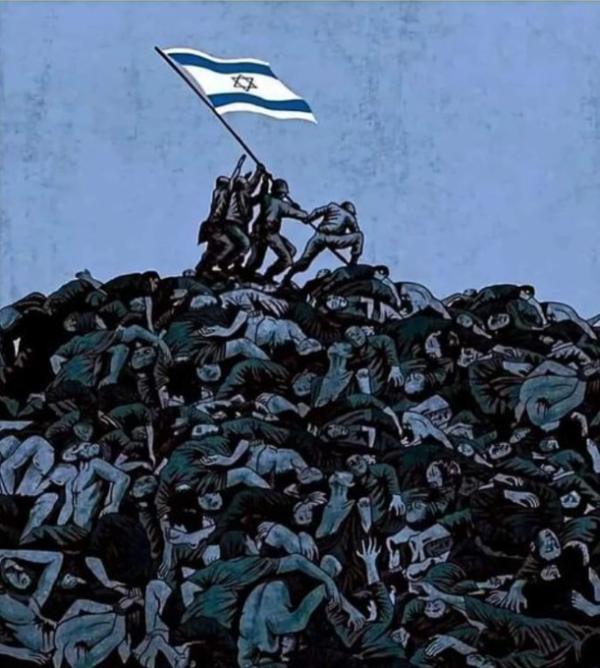
This week Israel accelerated its genocide of Gaza, intensifying the ongoing mass starvation, shooting hundreds of starving people as they lined up for food, attacking the last standing city in Gaza, Deir al-Balah, and shocking even Caitlin Johnstone by having snipers shoot kids in the genitals one day, the head in the next, and so on. These people have a genius for being cartoonishly evil.
Bibi thinks he’s accelerating towards some kind of victory. But he’s actually zooming off a cliff. As the reality of the Gaza genocide sinks in, the people of the region, and the world, will find a way to excise the Zionist cancer from West Asia and the planet. It could come through the ongoing Resistance strategy of imposing death from a thousand cuts, as the world collectively withdraws support from Israel and throws its weight behind Palestine. But we might also see nukes going off in Occupied Palestine, or the release of biological weapons targeting Ashkenazi Jews. By now, people are angry enough to try just about anything.
Israel’s genocide strategy is accelerationist in the sense of “let’s make things worse in hopes that it will somehow magically make things better.” The original accelerationists were left-wingers who wanted to intensify the ravages of techno-capitalism in hopes of provoking revolution. In recent decades the alt right has appropriated the concept to mean “let’s burn down society so our ethnonationalist utopia can emerge from its ashes.” Israel, for its part, wants to burn down West Asia, and with it the world, so Biblical prophecy can be fulfilled as a Jewish Messiah arises to rule the world from a rebuilt blood sacrifice temple in Jerusalem.
This kind of millennialist messianic madness isn’t new. Historian Norman Cohn’s The Pursuit of the Millennium gives us the pro-Jewish version, casting Christians as the main villains and Jews as innocent scapegoats. But since Christian and Muslim millenarianists agree that Jesus, the Prince of Peace and avatar of pure spirituality and universalist brotherly love, is the one true Messiah, whereas Jews loathe Jesus and yearn for a bloody Jewish conquerer to subjugate, exterminate, and enslave all non-Jews under a global Jewish dictatorship, it’s easy to understand why the Jewish version of messianic millenarianism is even more toxic than the Christian cults analyzed by Cohn.
About 375 years ago, Zionism was born in the ravings of the lunatic satanist Shabtai Tzvi as polished by his publicist, Nathan of Gaza. Together, the pair convinced the plurality of European, North African, and West Asian Jews to at least provisionally accept Tzvi as the Messiah who would lead them to conquer the Holy Land and following that, the world. While Tzvi’s career culminated ignominiously in the propitious year 1666, when he led his followers into nominal conversions to Islam in a successful attempt to convince the Ottoman sultan to spare his life, Tzvi’s brand of satanic antinomian Zionism sparked the movement that unleashed genocide on Palestine in 1948 and is accelerating it today.
Tzvi’s movement crashed and burned. Unsurprisingly, it elicited “persecution” of Jewish communities. (Naturally enough, Christian and Muslim rulers were wary of maniacal outbreaks of Jewish fanaticism, especially since the fanatics’ goal was to conquer and exterminate Christians and Muslims and enslave the survivors.)
There have been countless similar cases of Jewish excesses leading to “persecutions.” When Jewish predation (or parasitism if you will) reaches a certain point, the victims have nothing to lose and rise up in pogroms. If usurers who are also tax collectors and blackmailers and sellers of alcohol, drugs, and whores reduce whole communities to penury, those communities have been known to respond, naturally enough, with torches and pitchforks. Throw in the minoritarian but very real practice of black magic using the blood of Christian children, among other abominations, and you have a perfect blueprint for becoming the world’s most unpopular minority.
When Bibi’s genocidal plan to conquer West Asia river-to-river fails, and Jews return to the status they have always enjoyed (barring a brief post-World War II interlude) as the most hated people on the planet, there will doubtless be wailing and gnashing of teeth. But maybe that’s the whole point. Maybe tribalist Jews are actually masochists who love being hated, and who torment the goyim precisely so they can find themselves “persecuted.” That’s what one of my favorite ex-Israelis, Alon Mizrahi, suggests in his latest Substack note:
In case you were wondering what the Israeli plan was, let me share with you that plan in great detail: it doesn’t exist.
There is no Israeli plan. There is no future arrangement they seek to achieve, or a finite situation.
Their plan is to keep escalating until they are forced to stop either by a devastating war, crippling sanctions, internal collapse, or a civil war (preferably: all at once).
That is the plan. Believe me: this, and only this, is the plan.
–
Zionists are notoriously braindead, souldead, and deluded, but they know that they cannot take over the Middle East and subjugate all of humanity to their rule, which is the only way they could censor ‘criticism of Israel’ and contain resistance forever. They know it’s impossible (unless god steps in and intervenes on their psychopathic behalf).
Their plan is not to achieve this; the plan is to die or get arrested trying. It is not a plan, but a yearning that cannot be controlled to fail in something big and then mourn the destruction and failure, like Ashkenazi Jews love to do so much.
They made mourning and complaints against humanity the center of their culture and identity, and that’s precisely the mental space they want to return to. This is the only space where they will feel safe and at home: when they are hated and everything they built has been destroyed. For them, a scenario like this is the ultimate proof that they are really god’s chosen.
I know it sounds psychotic, and it is. Nevertheless, that’s the collective yearning: to try big, to fail big, and to fall back to the comforting sense of persecution and hate.
–
This is why they’re doing all these counterintuitive things (from a self-preservation point of view). They want to be stopped. They long to be vilified and hated. They relish that hatred. It comforts and soothes them. When they are hated, in their mind, they become eternal Jews, fulfilling the decrees of an ancient Jewish existence.
They don’t hate being hated. They love it. Once you realize this, things will start making sense to you.
–
God bless Alon Mizrohi for escaping from the Israeli prison, and the Jewish-tribalist mind-prison. Like Gilad Atzmon and Miko Peled, he’s living proof that being born Jewish in Israel doesn’t necessarily prevent a person from uttering prophetic truths.
Zionist spies innovate AI sexual blackmail tech

By Kit Klarenberg | Al Mayadeen | July 27, 2025
On July 19th, Ynet announced Israeli artificial intelligence startup Decart “has unveiled a groundbreaking real-time video transformation technology, setting a new benchmark in the fast-evolving field of generative media”, following “months of anticipation and extensive fundraising”. Dubbed Mirage, it “allows continuous transformation of live or pre-recorded video content without interruption, maintaining high quality and impressive stability throughout”. The obvious suspicion arises that the tech’s true purpose is to concoct convincing, fabricated kompromat on targets, with no risk of Zionist intelligence being publicly exposed.
Such an interpretation isn’t immediately obvious from the description of Mirage offered by Ynet. The outlet states the tech “transforms the very definition of video – from a static, pre-recorded format to a living, flexible, and interactive medium”. This reportedly opens up “new business models for content creators, brands, and platforms”. For example, “broadcasters and advertisers” could “generate multiple versions of a single piece of content during a live transmission…[tailoring] content in real-time to different audience segments.”
Yet, buried in the Ynet report is reference to how Decart was forged in 2023 by Dean Leitersdorf and Moshe Shalev, while they were serving in the Zionist Occupation Forces’ fearsome Unit 8200. The shadowy spying cell conducts clandestine operations, signals intelligence collection, code decryption, counterintelligence, cyberwarfare, and surveillance. Many of its veterans have established major tech companies, frequently operating in Silicon Valley. Decart generated enormous early interest among investors, raising $53 million just two months after official launch, and securing a $500 million valuation.
Among those investors is Zeev Ventures, founded by Israeli-American Oren Zeev. Its other investments include Israeli firm Riverside, an audio and video recording service. Its staff is riddled with ZOF veterans. Moreover, Decart has thoroughly impressed Technion – the Israel Institute of Technology. The pair have announced a joint AI research center, “to strengthen academic research, knowledge development, and technological innovation”. Under its auspices, the Institute’s elite honours program will be renamed the “Technion-Decart Honors Program”.
Technion has an extensive and deplorable history of direct complicity in the Zionist entity’s erasure of the Palestinian people. The Institute maintains formal partnerships with multiple Israeli weapons manufacturers and security and intelligence firms, including infamous Elbit Systems. Its assorted faculties have helped innovate numerous monstrous resources, such as remote control capabilities for the Caterpillar D9 armored bulldozer, used by Tel Aviv to demolish Palestinian homes. Benefits such as academic credits and scholarships are specifically awarded to Institute students based on their ZOF service.
Markedly, numerous Technion alumni – among them individuals who previously served in Unit 8200 – have gone on to work for Toka, which has patented technology capable of locating security cameras and webcams, hacking into them, then altering their live feeds without trace. Toka was founded by former Israeli premier Ehud Barak – a close associate of Jeffrey Epstein. Given ample indications Epstein was collating sexual blackmail material on powerful figures for intelligence agencies, comments made by Mirage cofounder Dean Leitersdorf to Ynet take on a chilling character:
“Mirage marks the dawn of a new era in video. Content is no longer fixed or closed – it’s alive, adaptive and created in real time in collaboration with the user. Anyone can become a creator and give visual form to their imagination. This opens up endless possibilities for creation, communication and a new relationship between people and technology.”
‘Video Platforms’
A January Ynet report sheds considerable further light on the significance of Unit 8200 to Decart’s founding, and its chiefs’ intelligence backgrounds. Leitersdorf, described as the company’s “central figure” who “grew up immersed in the world of high-tech and business”, hails from “Israel’s old-money aristocracy”. His close relatives are all major players in the entity’s finance and ‘defence’ sectors. Moreover, Leitersdorf completed his bachelor’s, master’s, and doctoral degrees at Technion, in just five-and-a-half years, all while serving in the ZOF. He explained:
“I’d work from 9 am to 7 pm in Unit 8200, and then squeeze in a few hours of studying before bed.”
Moshe Shalev, a 14-year Unit 8200 veteran, told Ynet that towards the end of his ZOF service he “wanted to explore the world of research”, and crossed paths with Leitersdorf. When they started chatting, Shalev realised he’d “found someone who could tell me what was possible and what wasn’t”, and “knew all the technologies of 8200”. He described the experience as “mind-blowing”, and they began meeting regularly, discussing how to apply their experiences of working in the Unit to the commercial sphere.
So it was in late 2024, Decart released a “cute demo” dubbed Oasis, demonstrating the company’s AI capabilities. The app lets users explore an ever-changing virtual environment, which is influenced in real-time based on their keystrokes and mouse movement, purely via artificial intelligence. Leitersdorf claims, “we thought a few people might play with it… [but] we were stunned by how fast it blew up”. Oasis went viral across multiple platforms, exceeding one million users in just three days.
While Mirage was unmentioned in the January Ynet report, Leitersdorf talked a big game of Decart’s ambitions to create a suite of products that would attract up to a billion users, which “doesn’t solve a single problem but solves thousands of problems”. Still, “the ability to turn imagination into video” loomed large in the company’s stated vision, and “to that end”, the firm is “establishing one of the most advanced AI labs in the world, recruiting the best minds Israeli tech has to offer”:
“Decart has a bold and ambitious goal: to reinvent AI from the ground up and become the technological backbone for anyone in the world who wishes to use it.”
In July, Ynet suggested Decart’s real-time video editing software would be of enormous utility on “social platforms”, allowing users to use Mirage “to change their appearance in real time, create clips or livestream with custom visual effects – all without relying on professional editing tools”. The technology was said to support image generation “at 20 frames per second with live-broadcast-quality resolution”, and “future updates are expected to support Full HD and even 4K, the standard for most video platforms and televisions.”
The obvious interest of such tech to intelligence agencies was unmentioned. This was despite Mirage evidently being spawned directly from the founders’ experience toiling in Unit 8200. The enormous mainstream hype elicited by the tool, launched by hitherto unknown figures, and vast sums of money pumped into the fledgling company instantly upon its emergence, may also be illuminating. For every dollar invested in a startup by the CIA’s little-known venture capital wing In-Q-Tel, the private sector injects $18.
‘Sex Trafficking’
Intelligence services the world over are notorious for using sexual blackmail to force targets into doing their bidding. Moreover, agencies, including the CIA have extensive histories of forging sex tapes and compromising photos of “enemy” leaders to discredit them. Witnesses and victims alike have claimed Jeffrey Epstein’s numerous lavish residences – purchased with uncertain wealth – were equipped with hidden cameras and microphones, used to record sexual assaults and rapes by countless politicians and high-profile figures he counted as close friends.
Following Epstein’s arrest in July 2019 for sex trafficking of minors, veteran reporter on intelligence affairs Eric Margolis came forward to recount his attendance at a grand lunch convened in the shadowy financier’s New York mansion during the late 1990s, at which all attendees “sang the praises of Israel”. Immediately upon arrival, a butler invited him to enjoy “an intimate massage” courtesy of a “pretty young girl”. The offer “seemed so out of place and weird to me that I swiftly declined”, Margolis reported:
“More important than indelicacy, as an old observer of intelligence affairs, to me this offer reeked of ye old honey trap, a tactic to ensnare and blackmail people… A discreet room with massage table, lubricants and, no doubt, cameras stood ready off the main lobby.”
Margolis subsequently told mainstream media outlets he didn’t “believe for a moment” Epstein committed suicide, and it was “more likely he was killed”, as “he was a man who knew too much” – “the old pirate line of ‘dead men tell no tales’ certainly applied to Epstein”. Today, controversy around Epstein’s death endures. Polls indicate just 16% of US citizens believe he took his own life in prison, with almost 90% supporting disclosure of all information related to Epstein’s prosecution.
Donald Trump’s reneging on his promises to unseal classified documents related to Epstein’s crimes has prompted mass public backlash, even among the President’s most fervent supporters. Meanwhile, US lawmakers are engaged in a bipartisan push to compel Washington to release all federally-gathered evidence identifying those “involved in the sex trafficking that Epstein led.” Despite operating with impunity for decades, and being protected from legal repercussions as he “belonged to intelligence”, Epstein was eventually caught, raising the risk of his targets and paymasters being publicly exposed.
The real-time, AI-powered video creation and editing technology honed by Toka and Decart removes the troublesome human elements inherent in old-fashioned intelligence agency “honey traps”. We are thus left to ponder whether these firms are being enthusiastically promoted because they “solve the problem” of sexual blackmail requiring real-life individuals to oversee such operations, and targets to take the bait. The “possibilities” of such technologies to transform users’ “imagination” into realistic video content are, after all, avowedly “endless”.
In numbers: Arab people don’t want to normalize with ‘Israel’

Al Mayadeen | July 27, 2025
Almost 80 years after Israeli occupation of Palestine, the great majority of the Arab public refuses to normalise with “Israel”, with fresh polling data revealing a dramatic decline in support for normalization after the Israeli war on Gaza following October 7, 2023.
According to the latest Arab Barometer surveys conducted between 2023 and 2024, support for Arab normalization with the Israeli regime has plummeted to historic lows. In none of the eight surveyed West Asian and North African countries did public backing exceed 13%.
The Arab Barometer’s Wave VIII surveys, which covered Iraq, Jordan, Kuwait, Lebanon, Mauritania, Morocco, Palestine, and Tunisia, showed a consistent regional downturn in normalization sentiment. Morocco saw a drop from 31% in 2022 to 13% post-October 7; Lebanon from 17% to 12%; Iraq from 14% to 13%; Mauritania from 8% to 4%; and Jordan from 5% to 3%.
Prior to the 2020 normalization accords, support for normalization with “Israel” was already limited. In a 2018–2019 survey, Sudan recorded the highest level at 32%, while Yemen had the lowest at 5%.
‘Israel’ is the primary regional threat
Across the region, “Israel” was most frequently cited as the leading threat to regional stability. Lebanon had the highest perception at 79%, followed by Palestine at 63%, Egypt at 54%, Jordan at 42%, and Morocco at 27%.
In Egypt and Jordan, younger respondents were notably less likely to see “Israel” as the main threat, while in Palestine, the younger demographic showed heightened concern.
Protest movements
Public sentiment against normalization translated into protest activity across the region, per Foreign Affairs. In April 2025, Morocco’s largest labor union urged the government to prohibit the entry of such ships into Moroccan waters and organized a series of protests in solidarity with Gaza.
Jordan experienced daily protests since October 7, with authorities recalling their ambassador from “Israel” and enforcing a ban on the Muslim Brotherhood.
In Kuwait, where protests were restricted, 84% of citizens boycotted pro-Israel companies, 62% donated to Gaza, and many shared solidarity messages online.
Low favorability of ‘Israel’s’ allies, too
Public sentiment toward Western allies of “Israel” deteriorated sharply. Approval of the United States dropped by 23 points in Jordan and 19 in Mauritania. France’s favorability fell 20 points in Lebanon and 17 in Mauritania.
The United Kingdom experienced the steepest decline in Morocco, with a 38-point drop. In contrast, China saw a significant boost in public opinion: 16 points in Jordan, 15 in Morocco, 10 in Iraq, and 6 in Lebanon.
The Arab Barometer Wave VIII data was collected across nine countries between September 2023 and July 2024, with most surveys completed by March 2024. This timing means the findings do not capture Arab public opinion following several significant regional developments, including “Israel’s” war on Lebanon and later on Iran, and the Israeli aggression on Syria.
The survey data therefore represents public sentiment during the initial nine months following October 7, 2023, but predates these subsequent escalations that may have further influenced regional attitudes toward “Israel.”
France’s recognition of Palestine risks helping Israel — Indonesia should rethink its applause
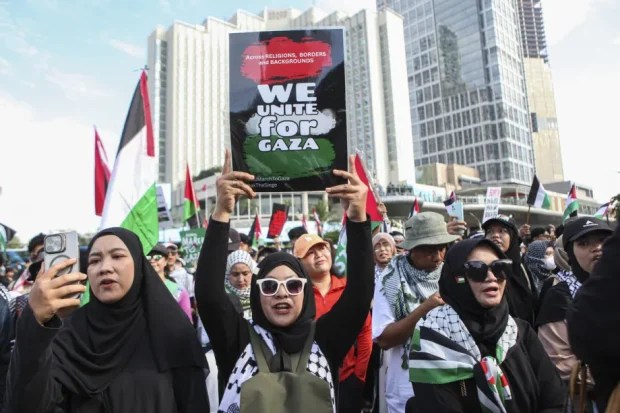
Activists at a solidarity march for the Palestinians in Jakarta, Indonesia, on June 15, 2025. [Agoes Rudianto – Anadolu Agency]
By Dr. Muhammad Zulfikar Rakhmat | MEMO | July 27, 2025
This week, Indonesia welcomed France’s decision to recognise the State of Palestine as a “positive step” toward peace. On its surface, this diplomatic endorsement may appear aligned with Indonesia’s long-standing support for Palestinian self-determination. But behind France’s gesture lies a deeper, more dangerous calculus—one that does not just ignore the reality on the ground, but actively entrenches it.
What France proposes is not justice. It is not freedom. It is an updated version of the same illusion that has kept Palestinians caged and dispossessed for decades: the so-called two-state solution.
In Jakarta’s official statement, the French move was praised for supporting a “sovereign and independent” Palestinian state based on 1967 borders, with East Jerusalem as its capital. But President Emmanuel Macron made clear what kind of state he envisions: a demilitarized Palestine that fully recognizes Israel. No mention of dismantling settlements, no restitution for occupied land, no accountability for war crimes in Gaza. Only submission, in return for a diplomatic label.
This is not a step toward peace—it’s a framework for permanent subjugation.
France’s position not only lacks balance, it weaponizes it. Macron calls for the “demilitarization of Hamas,” the rebuilding of Gaza, and regional stability—but with no demands for Israeli disarmament, no consequences for its mass killing of civilians, no guarantees of actual sovereignty for Palestinians. Instead, Palestinians are asked to disavow resistance, while the occupying power faces no requirement to end its occupation.
Indonesia, by praising this deal without reservation, is endorsing a framework that surrenders Palestinian rights under the language of diplomacy. In doing so, it becomes complicit in a process that allows Israel to continue its long project of expansion and erasure.
Because that is exactly what we are witnessing: not just war, but erasure.
Israel’s leaders have shed any pretense of restraint. Finance Minister Bezalel Smotrich has declared that Gaza should be “completely flattened.” Members of the Knesset and senior military figures have called to “wipe out” the territory. Starvation, siege, and bombing are not incidental—they are deliberate. The goal is not merely to punish, but to depopulate.
And this genocidal ambition is not new. It is part of a larger ideological blueprint long championed by elements of Israel’s far-right: the “Greater Israel” project. This vision seeks to claim not just the full expanse of historic Palestine—from the Jordan River to the Mediterranean Sea—but in some renditions, territory beyond it. It is a dream of exclusive ethnic control over a vast swath of the region. Palestinians, in this model, are not citizens or neighbors—they are obstacles to be removed.
This is the context in which France’s recognition must be understood: not as a bold shift in policy, but as a stabilizing gesture for an apartheid regime facing global criticism. And by embracing it, Indonesia—whether intentionally or not—is lending moral cover to that regime.
It is tempting, in the face of so much suffering, to welcome any sign of progress. But symbolic recognition without structural change only reinforces the status quo. A demilitarized Palestine, hemmed in by Israeli checkpoints, with no right of return and no means of defense, is not a state—it’s an open-air prison with a flag.
What is needed now is not more applause for diplomatic theater, but a refusal to accept false solutions. The two-state framework, as currently constructed, is not a path to justice. It is a political tool that enables colonization while pretending to end it.
Indonesia has long stood as a voice for the oppressed. It must not dilute that legacy by celebrating a plan that leaves Palestinians with a flag and no freedom. Instead of encouraging other nations to follow France’s lead, Indonesia should be demanding accountability: for the destruction of Gaza, for the daily violence in the West Bank, and for the decades of displacement.
This is not a time for symbolic victories. It is a time for moral clarity.
France’s vision, and Indonesia’s uncritical support of it, may win applause in diplomatic circles. But on the ground, in Gaza and the West Bank, it enables a project whose end goal is not peace, but erasure. If Indonesia truly believes in justice for Palestine, it must reject this illusion—and instead, insist on the one thing Palestinians have never been offered: freedom on their own terms.
The AMIA case: The untold story
By Raphael Machado | Strategic Culture Foundation | July 27, 2025
On the morning of July 18, 1994, a bomb exploded at the headquarters of the Argentine Israelite Mutual Association (AMIA) in downtown Buenos Aires, leveling the building and killing 85 people, with over 300 injured.
The attack occurred two years after the bombing of the Israeli embassy in Argentina, which left 22 dead and 242 wounded. Both attacks took place during the presidency of Carlos Menem, a government that was pivotal for Argentina as it marked a transition to neoliberalism, featuring mass privatizations and a partial dollarization of the economy.
But on the geopolitical front, the Menem administration is more remembered for the apparent “secret war” that unfolded within the country, involving intelligence agencies and subversive groups from various nations.
The most widely accepted version of the AMIA case goes as follows: To retaliate against the cancellation of a nuclear technology transfer agreement between Argentina and Iran, the Iranian government (then under President Akbar Rafsanjani) orchestrated an act of revenge, with operatives from the Lebanese Hezbollah carrying it out.
This narrative, elevated to “official truth,” was supported by intelligence reports from the U.S. and Israel. It led to Argentina designating Hezbollah as a terrorist organization and the rupture of previously friendly relations between Argentina and Iran.
But what if this popular version is wrong?
Recently, a former aide to Judge Juan José Galeano—who oversaw the investigation and trial from 1994 to 2005—revealed details that cast doubt on the established narrative. According to Claudio Lifschitz, Galeano’s former assistant and a former Argentine security official, no concrete evidence linking the Iranian government to the attack was ever found. On the contrary, Lifschitz claims that the evidence increasingly pointed toward elements within Argentina’s intelligence service, SIDE.
Lifschitz first entered the public eye in this case when he released a video recording of a meeting between Galeano and Carlos Telleldín, in which the judge allegedly offered money to the supposed supplier of the van used in the attack—in exchange for confessing that he had sold it to Mohsen Rabbani, the cultural attaché at the Iranian Embassy in Buenos Aires. According to Lifschitz, one of the key pieces of evidence that could exonerate Iran is the fact that SIDE had illegally wiretapped—without a court order—the Iranian Embassy and the Iranian Cultural Center in Buenos Aires, amassing thousands of hours of recordings without a single indication that any Iranians frequenting these places had prior knowledge of the attack.
The real mastermind, Lifschitz alleges, was Jaime Stiuso, deputy chief of SIDE’s counterintelligence division (Section 85) and the officer in charge of intelligence investigations for the AMIA case. According to Lifschitz, Telleldín had actually sold the van used in the attack to a SIDE agent. Furthermore, Stiuso—who had close ties to Mossad and the CIA—was allegedly responsible for constructing the accusation made by prosecutor Alberto Nisman that then-President Cristina Kirchner had sought to cover up Iranian involvement in the case.
The former Argentine intelligence agent claims he heard directly from Stiuso that Mossad was the real force behind the attacks—though it remains difficult to verify whether this conversation actually took place.
The case remains relevant today because it is being leveraged by Javier Milei’s government to justify closer ties with Israel, to the point where the Argentine president has labeled Iran as an “enemy state of Argentina.”
Tucker Carlson & Darryl Cooper: Jeffrey Epstein and the culture of corruption
If Americans Knew | July 25, 2025
Tucker Carlson and podcaster Darryl Cooper discuss the Jeffrey Epstein case and its roots in a convoluted culture of corruption at the top of our political system. These are excerpts from an almost three-hour interview streamed live on July 17, 2025.
See the full interview: iakn.org/rottenDC
Wall Street Journal article: iakn.org/WSJEpsteinCalendar
Glen Greenwald video on Epstein’s ties to Israeli intelligence: iakn.org/EpsteinMossad
Darryl Cooper is the creator of The Martyr Made Podcast, and is the co-host of The Unraveling w/Jocko Willink, and Provoked w/Scott Horton. He lives with his family on his farm in Idaho.
Featured Video

The 1964 Coup in Brazil
or go to
Aletho News Archives – Video-Images
Free Book
Vicious

Lies are Unbekoming | January 25, 2026
The waiting room is clean. The receptionist is polite. The forms ask reasonable questions. Nothing in the physical environment suggests danger. The magazines are current. The hand sanitizer dispenser works. Someone has chosen calming colors for the walls.
A pregnant woman sits in a chair designed for her comfort. She has been told to be here. Not ordered—no one orders. Recommended. Strongly recommended. Everyone does this. Her mother did this. Her friends did this. The women in her prenatal group compare notes about their appointments the way they compare notes about nursery furniture. Which provider did you choose? What tests have you had? The questions assume the answers. The answers assume the questions.
She will be offered things today. Offered is the word used. The offers will come with information sheets that list risks and benefits in tabular form. She will sign consent documents. Everything will be voluntary in the legal sense. No one will hold her down. No one will threaten her. She will choose, and her choices will feel like choices, and she will leave feeling she has done the responsible thing.
What she will not feel is the weight of what has been arranged before she arrived. … continue
Blog Roll
Recent Comments
seversonebcfb985d9 on French court jails pro-Palesti… eddieb on Fourteen Incredible Facts Abou… Bill Francis on European leaders’ shift in the… seversonebcfb985d9 on Villains of Judea: Philip Esfo… loongtip on Report warns that ‘Jewish terr… Craig Nelms on New study shows that toxic gas… loongtip on A Funny Thing Happened on the… loongtip on EU free trade pact on hold as… John Edward Kendrick on Regime Change In Iran Is The F… Bill Francis on Australia Passes New Hate Spee… seversonebcfb985d9 on Australia Passes New Hate Spee… Bill Francis on Britain’s AI Policing Plan Tur…


 Aletho News
- Donald Trump Is No Peace President
- Vicious
- Germany to build 10GW of baseload gas plants (disguised as “future” hydrogen plants)
- French court jails pro-Palestine activist and mother over Gaza genocide speech
- Shot, amputated, and imprisoned: Palestinian man seeks to rebuild life after being maimed and tortured by Israeli forces
- Building Disney Land on the Moon More Likely than Kushner’s Gaza Plan
- U.S. Funds Continue to Flow to Ecuadorian Groups Despite Trump-Era Suspension
- A pro-EU regime is moving to suppress this proud nation. Will they be able to withstand it?
- US-Russia Arms Control May Face ‘Very Dark Period’ – Scott Ritter
- Israel moves to restrict Palestinian re-entry to Gaza, ‘encourage outflow’: Report
- If Americans Knew
- Will Rafah crossing be opened at last? – Not a ceasefire Day 108
- Israeli drone strike kills two children collecting firewood in Gaza – Not a ceasefire Day 107
- Another Gaza baby freezes to death on Netanyahu’s watch – Not a ceasefire Day 106
- Oppose Israel’s Abuses While You Still Can
- UNRWA Heads Tell Ha’aretz: ‘We Don’t Radicalize Palestinians – Their Lived Existence Does’
- Plans Call for “New Rafah” Built in Israel’s Image — Without Palestinians
- Posing as priest, reporter is spat at many times, highlighting anti-Christian sentiment in Israel
- Leaked Documents: “Planned Community” in Rafah Would Force Palestinians Into Israeli Panopticon
- ‘Permits of Humiliation’: How Israel Strangles Christian Education in Jerusalem
- “The world sees death, destruction and injustice – and they see dollar signs” – Not a ceasefire Day 105
- No Tricks Zone
- Germany’s Natural Gas Crisis Escalates … One Storage Site Near Empty …Government Silent
- Polar Colding…Antarctica Saw Its Coldest October In 44 Years!
- New Study: Sea Levels Rose 20 Times The Modern Rate During The Roman Warm Period
- As German Gas Storage Dips Dangerously Low…Shortage Hardly Avoidable
- New Study: Brazil’s Relative Sea Level Was 2+ Meters Higher And SSTs 3-4°C Warmer 6000 Years Ago
- Philosopher Schopenhauer: Climate Science Certainty Stems From Stupidity, Ignorance
- New Study: Species Extinction Rates Declining Since 1980 – ‘Climate Change Is Not An Important Threat’
- Denmark Places Climate Protection Above Animal Welfare, Poisoning And Culling Cows
- New Study: Greenland Was 3-7°C Warmer And Far Less Glaciated Than Today 6000-8000 Years Ago
- German Media Report That Current Frigid Weather Can Be Explained By Arctic Warming!
 Aletho News