Israel pours $730m into global propaganda machine as reputation collapses
The Cradle | May 1, 2026
Israeli lawmakers last month approved a sharp increase in the 2026 public diplomacy budget, allocating roughly $730 million to the global messaging apparatus, also known as “Hasbara,” according to a report by the Jerusalem Post on 29 April.
Surveys point to a deepening collapse in international support, as Israel’s genocide in Gaza and continued aggression toward its neighboring countries have sent the Tel Aviv’s reputation into freefall on the global stage.
The funding accounts for more than four times the previous year’s allocation, and forms part of a broader push led by Israeli Foreign Minister Gideon Saar, who characterized the effort as a strategic imperative, saying it should be treated “like investing in jets, bombs, and missile interceptors” and calling it “an existential issue.”
The campaign spans large-scale digital outreach and political engagement aimed at bending perceptions and influencing narratives around Israel.
Around $50 million is being funneled into social media advertising, and roughly $40 million is going toward flying in foreign delegations such as politicians, clergy, and influencers as part of the outreach effort.
Officials insist the strategy improves perceptions abroad, with Israel’s consul general in Los Angeles, Israel Bachar, claiming that “Everyone who returns from the country understands better and is more supportive. But you have to fly out a lot of people.”
However, polling data cited in the reports shows a sharp collapse in public opinion towards Israel, particularly in the US.
A Pew Research Center survey found that 60 percent of US respondents now view Israel unfavorably, with declines cutting across political, religious, and demographic groups.
Analysts and researchers dismiss the spending outright, arguing it cannot offset the impact of Israel’s actions on the ground.
Communication scholar Nicholas Cull said, “Our conclusion was, it’s the policy, stupid,” referring to Israel’s policy of genocide and apartheid, and its broader military conduct as a central pillar of its expansionist agenda.
“Yes, you can do a lot with public diplomacy, and there are strategies that could help on the margins. But they’re only going to affect a small percentage, because the bulk of the impressions on issues that people care about are shaped by the actual policies, not how well you sell those policies.”
“The problem is that people don’t believe the state anymore,” said Ilan Manor, another expert cited in the report, warning that increased funding may expand reach but will not restore trust.
That push is reinforced by what Israeli officials describe as a parallel “Eighth Front” – a so-called “Digital Iron Dome” that combines mass reporting campaigns, AI-driven targeting, and coordinated influencer networks to suppress dissenting content and flood platforms with state-approved narratives in real time.
Israel had invested millions in coordinated digital influence campaigns, including a $6-million contract to shape AI outputs, targeted Gen Z messaging, and large-scale ad buys, in an effort to control online narratives and counter declining public support in the US.
The country’s propaganda arm had previously deployed a large network of at least hundreds of fake social media accounts and fabricated news sites to spread unverified claims linking UNRWA to Hamas’s 7 October Operation Al-Aqsa Flood in order to undermine its humanitarian mission in Palestine.
Zionists Are Gunning for Your Freedom of Speech
By Jack Hunter | The Libertarian Institute | May 1, 2026
The First Amendment of the Bill of Rights in the Constitution of the United States guarantees the right to free speech. This right has long differentiated the United States from other Western nations like the United Kingdom and Canada where laws against so-called “hate speech” laws exist and are enforced.
Thankfully, America is different. In our country, even alleged hate speech is protected speech to ensure democratic principles and debate.
In a 1929 dissenting opinion, Supreme Court Justice Oliver Wendell Holmes said that the Constitution secured “freedom for the thought that we hate.” In 2011, Chief Justice John Roberts said in a ruling that the First Amendment serves “to protect even hurtful speech on public issues to ensure that we do not stifle public debate.”
This constitutional protection has been increasingly threatened recently, particularly by pro-Israeli forces that have tried to frame any criticism of that government as “anti-Semitism” and thus hate speech punishable by law. This has included everything from arrests, to squashing campus debate to buying TikTok to an attempt to cover up human rights absuses in Gaza. President Donald Trump has even issued executive orders that use vague definitions of what constitutes “anti-Semitism” that comes with criminal penalties.
Mark Levin is an American-born Zionist radio host who is an outspoken advocate for Israel’s government, regularly calling anyone who criticizes the U.S.-Israeli war with Iran and conflict in Gaza “Nazis.”
Toward this agenda, Levin recently appeared to not agree with his own country’s free speech rights. On his latest Sunday Fox News program, unironically called Life, Liberty and Levin, the neoconservative pundit explained why free speech liberties in the U.S. have gone too far.
Seemingly worried that certain speech is protected in the United States, Levin said in the wake of the Secret Service taking down a shooter at the White House Correspondents Dinner on Friday, “First time things like this have happened, but it really is problematic because so much of it is protected.”
“And you hear people say, don’t you believe in the First Amendment?” Levin said. “They don’t even know what the First Amendment believes.”
Certain “speech” is “problematic” because “so much of it is protected.” You could see where this was headed.
Levin then explained what he believes “the First Amendment believes.” “Do you want to de-platform people?” he ranted. “You know, the libs do that. I don’t have any problem with de-platforming Nazis or jihadis.”
“Nazis,” Levin says. Levin uses this term loosely, all the time, and that’s putting it mildly.
Prominent libertarian personality Josie Glabach, known most popularly as “The Libertarian Redhead,” made a telling list of the many people and groups Levin has called Nazis since 2024:
- The Democrats
- The Democrat media
- An Australian bakery
- The Pakistani defense minister
- Libertarian Institute Director Scott Horton
- The entire Libertarian Party
- College students
- MMA fighter Jake Shields
- Nick Fuentes
- Putin’s buddies
- Influencer Dan Bilzarian
- The Houthis
- Comedian and libertarian personality Dave Smith
- Anyone who associates with Dave Smith
- Tucker Carlson
- Beirut
- Hezbollah
- A veteran who asked Mark to be more tolerant
- Influencer Myron Gaines
- The city of London
- Hamas
- The New York Times
- New York Times columnist Thomas Friedman
- A New York Times correspondent
- Terrorists;
- The “woke reich”
- Maine Democratic Senate candidate Graham Platner
- The United Nations
- Harvard University
- The city of Amsterdam
- Columbia University students
- Iterations of the “Iranian Nazi regime,” the “Islamic Nazi regime,” the “Islamo Nazi regime,” the “Islamist Nazi regime,” and “All of Iran (the new Nazis)”
- The Ayatollah (presumably of Iran)
- Former Iranian President Ebrahim Raisi
- A protestor on a subway
- Congresswoman Rashida Tlaib (D-MI)
- President Joe Biden’s entire State Department
- Turkish Preisdent Recep Erdoğan
- College basketball analyst Bruce Pearl
- Certain Arab, liberals and journalists
- Reporter Lulu Garcia-Navarro
- ISIS
- Seventeen random Twitter users
This eclectic group of entities great and small, many of whom are regular critics of Israel’s government, are “Nazis” in Levin’s view. As Libertarian Institute Senior Fellow Tom Woods succinctly put it, “Nazis’ includes everyone who mocks Levin.”
Levin continued his Sunday rant against “Nazis”:
“I don’t have any problem with de-platforming them. What does that mean, de-platforming them? A government law? No. It means that X or Twitter or Facebook or Amazon with Twitch and someone says you know what? You’re a low life we’re not paying, you know, get off our platform. What’s wrong with that?”
The neocon pundit appeared to say that private platforms should police speech according to the political views of Mark Levin. He is right that this is no violation of the First Amendment. Private companies can allow or restrict speech as they please. “It’s called private enterprise,” he said. “I got no problem with that.”
Then Levin basically said such speech was no different than pornography, which is not protected under the First Amendment. Levin continued, “I mean, what if they have this horrific pornography on? Is that okay? No, it’s not okay.”
“Because our kids have access to it,” he said. “People who are impressionable have access to it. “What if they had people screaming at the top of the lungs saying, assassinate this guy and assassinate that guy? Well, they shouldn’t do that.”
“Why? What’s the standard?” Levin went on. “You need to have a standard. What should the law be? What does the Constitution say?”
The Constitution says that all speech is protected, but “true threats” and obscenity are not.
But political opinions about Israel that go against Levin’s views are protected, whether he likes it or not.
That’s when Levin basically outright said that speech that criticizes Israel should be forbidden just like pornography. “I just think we’ve taken this too far because we’re not even talking about political speech, which is the most protected of all speech,” Levin said.
“We do limit speech,” he insisted. “We limit speech, pornography. We limit speech.”
What Levin, like so many other Zionists, truly want is for the First Amendment to be amended itself. They believe, whether they say it forthright or not (and Levin appears to be doing just that), that this legal provision designed by the Founders precisely to protect political speech should no longer protect speech that is critical of Israel’s government.
Americans have historically valued their free speech. American Zionists like Levin now want a carve out.
But the free speech guarantee enshrined in the United States’s governing charter is so integral to the American experience, to gut it for any reason would be to drastically alter the DNA of the soon to be 250-year-old country.
As an American, Mark Levin doesn’t seem to have a problem with doing just that—all in the service of a foreign country.
It might be better for Americans to instead wish other nations well, yet solely concentrate on our own affairs at home, and perhaps just as important, to stop listening to American pundits whose primary allegiance seems to be countries other than their own.
Hidden costs of US Iran war push total far beyond $25bn Pentagon claim
Al Mayadeen | April 30, 2026
The Pentagon’s declared $25 billion cost of the war on Iran is likely a significant understatement of the war’s true financial burden, Bloomberg reported, citing analysts. Senior US defense officials disclosed the figure during testimony at a contentious congressional hearing on Wednesday, outlining the total cost incurred so far.
Calculations by Bloomberg, based on Pentagon data, suggest that the cost of certain munitions, destroyed equipment, and operational expenses alone amounts to around $14 billion. This includes $8 billion for munitions, $5 billion to replace lost aircraft and damaged equipment, and approximately $1 billion in operational costs for deploying two aircraft carriers and 16 destroyers over 39 days of near-continuous strikes.
The estimate does not account for the cost of repairing damaged facilities across the region, such as the US Navy’s Fifth Fleet headquarters in Bahrain, which has been repeatedly targeted in Iranian attacks. It also excludes the operational costs of all ships and aircraft involved in the military buildup prior to February 28, as well as those currently engaged in the ongoing blockade.
Pentagon figure represents narrow estimate, omits lots of costs
“It is clear that the Pentagon’s $25 billion figure represents a narrow estimate of the cost of waging war,” said Kelly Grieco, a senior fellow at the Stimson Center. “It doesn’t even include damage to bases, broader operational costs, or the Pentagon’s rising fuel bills.”
Earlier this month, Senator Richard Blumenthal told Bloomberg Television that even estimates presented to him of $2 billion per day were “a low number.” Meanwhile, the Center for Strategic and International Studies has estimated that the cost of munitions alone could reach approximately $25 billion.
During the hearing, Acting Pentagon Comptroller Jules Hurst said the $25 billion figure includes both expended munitions and operational costs but declined to provide a detailed breakdown. His remarks prompted a heated exchange between War Secretary Pete Hegseth and Representative Maggie Goodlander, a Democrat from New Hampshire, who repeatedly pressed for greater transparency.
“It is gross negligence to sit here and be unable to justify spending billions of dollars,” Goodlander said.
US losses add billions to the bill
The United States has reportedly lost dozens of aircraft during combat operations, including MQ-9 Reaper drones, F-15E strike fighters, an E-3 airborne warning and control aircraft, KC-135 aerial refueling tankers, one A-10 attack aircraft, and two MC-130J multi-mission transport planes.
Replacing these systems is expected to cost billions of dollars, while damaged or destroyed radar systems, each worth hundreds of millions, will add further to the total.
Operating costs have also mounted significantly. Aircraft carriers cost around $4.9 million per day to run, while destroyers cost approximately $600,000 daily. A carrier air wing adds another $3.8 million per day.
According to analysis by Bloomberg Economics Defense Lead Becca Wasser, the 39 days of combat alone would run about $1 billion for just two carriers and their air wings, and 16 destroyers.
Iran has launched more than 1,850 ballistic missiles at targets across the region, requiring the use of roughly 4,000 interceptor missiles in response, according to the report. While the PAC-3 missile system remains the backbone of ballistic missile defense in the region, most interceptor launches were carried out by Gulf states. Standard missile defense doctrine typically requires firing at least two interceptors per incoming target, further driving up costs.
Israeli strikes kill 10 in southern Lebanon, including 3 rescue workers
Press TV – April 29, 2026
At least ten people, including three rescue workers, have been killed in Israeli airstrikes against residential neighborhoods in southern Lebanon, marking the latest violations of a ceasefire that began on April 16 after weeks of fighting between the Tel Aviv regime and Hezbollah.
Lebanon’s official National News Agency (NNA) reported that an Israeli aerial raid destroyed a four-storey building in the village of Jabchit in the Nabatieh district on Tuesday night, killing Mohammad Jawad Bahja, his wife Lotfiya, as well as Amani Jaber and her daughters.
Lebanon’s Ministry of Public Health announced in a statement that at least 13 people also sustained injuries in the attack.
Separately, two successive Israeli strikes on a building in the town of Majdal Zoun on Tuesday killed five people, including three rescue workers who went to help those injured in the initial Israeli attack on the targeted building.
The three Lebanese civil defense rescue workers were later identified as Hussein Ghadbouri, Hussein Sati and Hadi Daher.
Prime Minister Nawaf Salam strongly condemned the deadly Israeli strike.“Targeting elements of the Civil Defense in Majdal Zoun, and their killing while carrying out their humanitarian duty, constitutes a new and described war crime perpetrated by Israel,” he wrote in a post on social media.
“It represents a flagrant violation of the principles and rules of international humanitarian law,” Salam said.
“The government will spare no effort to condemn this heinous crime in international forums and to mobilize all efforts to compel Israel to cease its ongoing violations of the ceasefire agreement.”
Israeli forces also shelled the towns of Mansouri, Chehabiyeh, Tiri, Jouaiyya, Touline and Khirbet Selm. There were no immediate reports about possible casualties and the extent of damage caused.
The occupation troops also dropped white phosphorus shells on Yohmor al-Shaqif village.
Elsewhere in Naqoura region, Israeli forces pressed ahead with their demolition activities. Residents of adjacent municipalities felt a strong tremor as the occupation troops set off a considerable amount of explosives to flatten designated buildings.
On Wednesday, kamikaze drones launched by Hezbollah resistance fighters targeted and destroyed two Israeli Merkava battle tanks in Naqoura.
Hezbollah said in a brief statement that the operation was carried out in defense of Lebanon as well as its nation, and in response to the Israeli aggression against villages in southern Lebanon.
Israeli military ‘failed on all fronts’: Poll
The Cradle | April 28, 2026
A poll published by Israel’s Public Broadcaster (KAN) on 28 April found that a majority of Israelis believe the state has failed to secure victory in any war since October 2023.
According to the survey, 57 percent of respondents said no victory had been achieved, while 28 percent believed success had been reached in at least one arena, and a further 15 percent said they were unsure.
The findings come after more than two years of Israel’s genocide in Gaza – which Israel threatens to reignite – during which Tel Aviv waged multiple offensive military campaigns against Gaza, Lebanon, and Iran, alongside attacks in Yemen and Syria and a campaign of destruction and displacement in the occupied West Bank.
Confidence levels across all the fronts remain low, with only 17 percent viewing operations in Syria as successful and 16 percent saying the same for Gaza and Iran.
Perceptions dropped further on the Lebanese front at 14 percent, followed by Yemen at 12 percent and the occupied West Bank at 11 percent.
The poll also points to persistent security concerns, with a total of 73 percent of respondents saying the continued armed presence of Hamas and Hezbollah poses a direct threat of a repeat of a 7 October-style event.
Only 10 percent dismissed that possibility, while 17 percent remained uncertain.
On the ground, Israel has reportedly begun withdrawing troops from southern Lebanon. Israeli outlet Maariv described the campaign as ending in “failure” and “bitterness,” as forces pull back under continued Hezbollah attacks, including drone strikes that exposed major gaps in Israeli preparedness.
The poll also showed divisions over Netanyahu’s legal status, with a majority – 56 percent – supporting a pardon for his corruption charges, while 26 percent opposed the move and 18 percent remained undecided.
Netanyahu had requested a presidential pardon on 30 November without admitting guilt or stepping down from office, despite Israeli law requiring an admission of guilt for such a measure.
He is currently facing trial in three separate corruption cases involving fraud, bribery, and abuse of power, with court proceedings ongoing since 2020 after charges were filed in 2019.
Netanyahu’s court testimony was delayed once again on 27 April over a “serious” security incident in southern Lebanon, as the prime minister seeks to prolong the wars to keep his corruption trial from moving forward.
At the same time, the International Criminal Court (ICC) has listed Netanyahu as wanted since 2024, issuing arrest warrants for him and former defense minister Yoav Gallant over their direct involvement and orchestration of the genocide in Gaza, as well as war crimes and crimes against humanity, including the use of starvation as a weapon.
Trump eager for off-ramp in war on Iran, but Netanyahu has him trapped: Former official
By Alireza Kamandi | Press TV | April 29, 2026
Donald Trump is eager to find an off-ramp, declare “victory,” and end the war against Iran – but Benjamin Netanyahu is not, leaving Trump trapped, says a former chief of staff to the US Secretary of State.
In an interview with the Press TV website, Colonel Lawrence Wilkerson – former chief of staff to Colin Powell from 2002 to 2005 – said that as tensions with Iran simmer following the recent US-Israeli war against the country, a complex picture is emerging of a Washington administration caught between tactical necessity and political traps.
He said the central question surrounding the White House’s strategy is whether the Trump administration is using the lull in hostilities to rebuild its military capacity.
“There is an ongoing effort to replace critical munitions, expedite repair of warships in maintenance, and alert and prepare more land forces for possible action,” he said, adding that this logistical surge extends to Tel Aviv, where efforts are underway to replenish munitions and call up more reservists.
As for the Trump administration’s self-declared “maritime blockade” of Iranian ports, the timeline is elastic, Wilkerson said, adding that the US can sustain the pressure indefinitely, but only as long as necessary to secure an agreement with Tehran on what constitutes the end of war.
“However, this is where the internal rift becomes critical. President Trump is eager to find an exit, to declare ‘victory’, and to end the conflict, but Netanyahu is not. So, Trump is trapped,” he said.
The former official noted this dynamic suggests that the duration of the blockade depends heavily on the outcome of upcoming Israeli elections and who ultimately emerges as the winner there.
For now, the US finds itself locked into a maritime strategy whose off-ramp is controlled by Israel with conflicting war aims, he told the Press TV website.
When asked how long Israel could sustain a war against Iran without direct US military intervention, the answer was stark: “Not very long—probably less than a month.”
The reason is not a lack of will, but sheer logistics, he stated.
“The supply of fuel, oil, munitions, and even material not available because of the deterioration of Israel’s economy, would be non-existent,” he remarked.
Wilkerson emphasized that the most profound geopolitical consequence of the US-Israeli strikes on Iran will be felt thousands of miles away, in Asia and the Persian Gulf states.
Asian nations are already reassessing their military cooperation with Washington.
“The perception of the United States as a stabilizing, reliable anchor is fracturing. For the Persian Gulf monarchies that have long relied on the US security umbrella, and for Asian powers concerned about energy security and trade routes,” he noted.
On events unfolding inside the US and the recent shooting during the White House correspondents’ dinner, he said these things happen in the Empire, but more frequently with Trump, as he is “a very controversial president.”
“One wonders as well if one or two of the attempts were not staged, such as the one in Pennsylvania and the one on the golf course. Staged to build sympathy for a president who loves the limelight and being ‘loved’,” he stated.
He attributed the violence to a deeply fractured US administration and the American Empire.
“A great many people loathe Donald Trump, believe him directly involved in the Epstein scandal, and do not care for his style of ‘leadership’, plus, wars overseas tend to come home, i.e., violence in war creates violence at home,” he told the Press TV website.
Nuclear Apartheid: Iran’s Rise Exposes the NPT Fraud and the West’s Israel Exception
By Freddie Ponton – 21st Century Wire – April 29, 2026
The fight over Iran’s vice presidency at the 2026 NPT Review Conference looked procedural only if one ignored the history that walked into the room with it. The United States, the United Kingdom, speaking for France and Germany, Australia, and the United Arab Emirates objected to Iran’s appointment, yet Iran kept the post after a Non-Aligned Movement nomination and no blocking vote was forced, exposing a basic fact that now hangs over the treaty system. The United Arab Emirates did not merely object but formally and unequivocally disassociated itself from Iran’s election, while citing Tehran’s continuous violations of its safeguards obligations.
That moment is crucial because it revealed a shrinking gap between Western power and Western authority. The states that still dominate military alliances, financial coercion, and media narratives could denounce Tehran in New York, but they could not turn denunciation into institutional compliance, and they could not persuade the wider diplomatic field that their understanding of non-proliferation deserved automatic deference. What looked like a dispute over one vice presidency was in fact a public measure of a much deeper revolt against selective enforcement.
The bargain they broke
The deeper story begins in 1995, when the NPT was indefinitely extended on the basis of a broader political package that included the Resolution on the Middle East. That resolution called on all states in the region that had not yet done so to join the treaty and place their nuclear facilities under full-scope IAEA safeguards, and the UN Secretariat background paper explicitly records that the resolution was an essential element of the outcome on which indefinite extension was secured.
The 2010 Review Conference reaffirmed that point in unusually clear language. It said the 1995 resolution remained valid until its goals were achieved, recalled the importance of Israel’s accession to the treaty and the placement of all its nuclear facilities under comprehensive safeguards, and endorsed concrete steps toward a 2012 conference on a Middle East zone free of nuclear weapons and other weapons of mass destruction. The conference never delivered what it promised, and Algeria’s 2026 working paper now states bluntly that Israel’s stance helped render the 1995 resolution “devoid of substance,” while the UN Secretariat paper records that many states saw the failure of implementation as seriously undermining the treaty itself.
The Israeli exception
That is why so much of the Global South reads the current crisis through Israel rather than through Iran alone. The UN Secretariat background paper states in neutral terms that all states of the Middle East except Israel are parties to the NPT and that all states in the region except Israel have undertaken to accept comprehensive IAEA safeguards, giving documentary form to the asymmetry that the Non-Aligned Movement (NAM) and Arab states have been protesting for decades.
NAM’s own recent language is harsher because the political implications are harsher. At the 2024 IAEA General Conference record, Uganda speaking on behalf of NAM warned that a selective approach undermined the viability of the safeguards regime, expressed great concern over Israel’s acquisition of nuclear capability, and called for a total prohibition on nuclear-related transfers and assistance to Israel, while the April 2026 NAM statement to the UN Disarmament Commission again demanded that Israel renounce nuclear weapons, accede to the NPT without precondition or delay, and place all its facilities under full-scope safeguards.
That continuity was reaffirmed in the Kampala Declaration, which carried the same line through 2025 and closed the institutional bridge to the April 2026 NAM position. For the movement, this is not a side file or an ideological hobbyhorse. It is the living proof that the rules are preached as universal and applied as political.
The South’s quiet revolt
Once that history is acknowledged, the so-called silence of NAM and many Global South states on Iran’s vice presidency stops looking like ambiguity and starts looking like discipline. They did not need to issue sentimental declarations of love for Tehran in order to refuse a Western effort to re-police multilateral legitimacy, because the issue before them was larger than Iran’s image and deeper than one nomination. It was whether the same powers that had tolerated, normalized, or materially shielded the Middle East’s only non-NPT nuclear exception would now be allowed to decide who is morally disqualified from procedural office inside the treaty system.
That is why the resistance was institutional rather than theatrical. After dismissing the objections as baseless and politically motivated, Iran disassociated itself from the election of the United States as vice president, and according to one contemporaneous account, from Australia’s as well, turning the confrontation into a mirror held up to the old order. The 2025 report of the sixth session of the conference on a Middle East zone free of nuclear weapons and other weapons of mass destruction said Israel’s refusal to join the NPT and submit all its facilities and activities to comprehensive safeguards undermined the credibility of the non-proliferation regime and imposed additional burdens on regional states, while the same report condemned attacks on Iran’s safeguarded nuclear facilities as a grave threat to the credibility of the NPT and the integrity of the entire IAEA safeguards regime.
In that setting, refusing to let Washington, London, Paris, Berlin, and Canberra define the boundaries of legitimacy was not indulgence toward Iran, but a defense of sovereign equality against a one-sided nuclear order.
What their objection revealed
The objections from the United States, the E3, and Australia therefore boomeranged. They were intended to isolate Iran, but they instead illuminated the moral exhaustion of a bloc that speaks in the language of non-proliferation while presiding over an order in which disarmament obligations are endlessly deferred, nuclear sharing and modernization continue, and Israel’s opaque arsenal remains politically protected from the universality routinely demanded of others. The analysis from the European Journal of International Law (EJIL) long ago captured the pattern by showing how NAM kept international attention on Israel’s nuclear status and how double standards around Israel helped fuel resistance inside the regime, and the documents gathered since then show that this reading did not fade but hardened.
Australia’s place in this picture is revealing precisely because it is less central than Washington or the E3 and yet moved in lockstep with them against Iran’s vice presidency. That choice placed Canberra inside a camp that could still object loudly but could no longer command consent, and it tied Australia to a diplomatic posture that much of the Global South now experiences as selective guardianship rather than principled stewardship. The same is true of the E3, whose claim to defend the treaty sounds increasingly thin when the documentary record shows decades of unfinished obligations on the Middle East file and continued Western insistence that the burden of credibility falls primarily on disfavored treaty members rather than on the region’s protected exception.
A treaty stripped bare
What emerged in New York, then, was not simply a quarrel over Iran. In fact, we all witnessed the exposure of a treaty order whose founding compromise on the Middle East has been repeatedly postponed, diluted, and evaded, until many of the states asked to keep faith with the system now see the system itself as compromised at the core. The 2026 UN Secretariat paper, the 2026 Algeria submission, the April 2026 NAM statement, the 2024 IAEA record, and the 2025 IAEA safeguards resolution all converge on the same underlying reality that Israel’s non-accession, unsafeguarded status, and continuing exceptional treatment have become inseparable from the crisis of NPT credibility.
That is why Iran’s vice presidency is so significant, because it marks the point at which a large part of the non-aligned world stopped pretending that the greatest danger to the treaty’s legitimacy begins and ends in Tehran, and instead used procedure to register a quieter but more consequential judgment that the deeper non-proliferation crisis lies in a regime that punishes some, excuses others, and then demands respect for the imbalance it created.
On April 27th, the West could still denounce, but could no longer decide; and that, more than the vice presidency itself, is the message now being sent from the Global South to Washington, the E3, and Australia.
“Trump’s presidency is at risk of being destroyed” Col Douglas Macgregor
ANI News | April 28, 2026
Iran has legal right to act in Hormuz, holds US responsible for disruptions: UN mission
Press TV – April 28, 2026
Iran, which is not a party to the 1982 UN Convention on the Law of the Sea, asserts its legal right to take “necessary and proportionate measures” in the Strait of Hormuz, and holds the United States responsible for any disruptions to maritime transport in the vital waterway, the country’s permanent mission to the United Nations said.
The mission said on Tuesday that US actions in the Strait of Hormuz have severely compromised international maritime safety. The mission made the remarks in two posts on X, a day after Iran addressed at a meeting of the United Nations Security Council (UNSC) on Maritime safety.
The mission pointed out that Iran is not a party to the 1982 Convention on the Law of the Sea and therefore does not regard its provisions as binding.
As the principal coastal state, Iran retains the legal authority to implement necessary measures within the Strait of Hormuz to address security threats and to prevent any military or hostile exploitation of this vital passage, it said.
Iran’s mission further noted that the Islamic Republic reserves the right to ensure safe passage in the Strait of Hormuz and to protect its national interests against hostile activities.
It further asserted that the US has engaged in unlawful actions that disrupt maritime transport, such as the imposition of a maritime blockade, the illegal seizure of Iranian vessels, and the detention of their crews.
Such actions not only violate international law and the UN Charter but also constitute acts of piracy.
As tensions escalate in the region, the Iranian government says that the US’s aggressive maritime policies pose a direct threat to international navigation and regional stability.
The Iranian mission further called for accountability regarding US transgressions.
Tensions have been running high over a so-called naval blockade the US has enforced on Iranian ports and ships, as well as American attempts to conduct mine-sweeping operations in the Strait of Hormuz.
Iranian officials have said the blockade is unlawful and a breach of a two-week ceasefire that took effect on April 8 and was again unilaterally extended by US President Donald Trump hours before it was set to expire on April 22.
Have the US and Israel killed non-proliferation?
Ashes of Pompeii | April 28, 2026
The United Nations has elected Iran as one of the thirty-four vice presidents of the 2026 Nuclear Non-Proliferation Treaty Review Conference, proceeding despite formal objections from the United States, the United Kingdom, France, Germany, Australia, and the United Arab Emirates. Rather than a mere procedural footnote, this appointment signals a pronounced structural realignment and underscores the increasing diplomatic isolation of Western capitals within multilateral governance.
For decades, nuclear restraint was widely regarded as a stabilizing imperative, a framework endorsed by practically all nations, including Iran, who consistently endorsed this through state doctrine and a longstanding religious fatwa explicitly prohibiting the pursuit of atomic armaments. The Iranian prohibition was the foundation of the JCPOA agreement allowing internation inspection of Iranian nuclear sites. It is important to note that it was the USA who withdrew from the JCPOA agreement and not Iran, and Iran seems to have respected the terms even after this withdrawal.
This is the context for the current situation. Iran has been attacked by the USA and Israel because of the perceived threat that Iran might, despite the inspections and the conclusions of the American intelligence agencies, cross the nuclear threshold. Please note the contrast: Iran was attacked because it might develop nuclear weapons, whereas North Korea enjoys relative security precisely because it has nuclear weapons. That is to say, non-proliferation treaty compliance would seem to correlate with heightened vulnerability.
Whatever one might think of Kim Jong Un, the caricatures propagated regarding North Korea’s leadership as erratic, epitomized by the “Rocketman” epithet, are increasingly untenable when subjected to rigorous strategic analysis. Evaluating outcomes rather than rhetoric, it becomes evident that Pyongyang’s leadership was methodically positioned ahead of other global policymakers. While other regimes face coercive diplomacy or military intervention, North Korea’s deterrent has insulated it from external operations. We can assume other countries have noticed this, that non-proliferation or strategic ambiguity offer far less protection than verified atomic capability.
And this realization is coming at a time when America itself is coming to be seen as more erratic, and potentially a less reliable partner than it was perceived to be in the past. Can America’s allies still feel secure under America’s nuclear umbrella? Is an “America First” America going to risk nuclear conflageration to defend its allies? Many will have calculated that it might not.
Washington and Jerusalem have long justified their confrontational posture toward Tehran by citing the purported threat of an Iranian breakout, even as Israel maintains an arsenal that, though officially unacknowledged, is universally understood by all. If the recent campaigns against Iranian military and energy infrastructure were to be assessed through a deterrence lens, it can be argued that the absence of an atomic shield rendered Tehran strategically exposed. Had Iran possessed a credible second-strike capability, those operations would likely have been deemed too escalatory to execute.
Consequently, the international community can probably anticipate a quiet reassessment of nuclear thresholds. Governments are not yet explicitly announcing an intention to seek atomic weapons, but it does seem evident that more will be seriously considering it, whether because they no longer trust America as ally or because they see that nuclear deterrance has been successful for North Korea. For now, it seems likely that these nuclear intentions will remain under wraps, but who can doubt that, at the very least, multiple feasability studies will have been undertaken across the world.
The strategic calculus advanced by the Trump administration and the Netanyahu government has effectively engineered an environment where non-proliferation is, at best, a diminishing paradigm, and at worst, an existential error for a sovereign state. Therefore, the eventual deployment of tactical or strategic nuclear assets across multiple countries becomes increasingly probable.
The profound irony, of course, is that given the stated justifications for the launch of the US/Israeli war on Iran, that Israel will be a highly plausible future target within the very security vacuum it helped to normalize.
Iran says EU’s insistence on sanctions hastens its ‘embarrassing descent into irrelevance’
Press TV – April 28, 2026
Iran’s Foreign Ministry spokesperson says the EU’s insistence on inhumane sanctions against Iran demonstrates Europe’s double standards and hastens its “embarrassing descent into irrelevance.”
On Monday, European Commission President Ursula Vonder Leyen said at a press brief in Berlin that “it is too early to talk about lifting sanctions on Iran.”
In a post on X late Monday, Esmaeil Baghaei strongly criticized the European Commission president’s insistence on maintaining sanctions against Iran under the guise of human rights, calling the stance hypocritical and disgraceful.
“The EU’s inhumane sanctions on Iran were never about ‘human rights’ — they were designed to trample the basic rights of ordinary Iranians,” Baghaei wrote. “No one is buying this tired moral theater.”
He added that such posturing will not earn Europe or its constituency “an ounce of credibility on the world stage.”
“If anything, it only further demonstrates Europe’s ruling class’ double-standard & hypocrisy, and hastens Europe’s embarrassing descent into irrelevance,” the spokesperson further said.
Iranian officials have consistently condemned EU sanctions, arguing they are not about human rights but are a form of collective punishment designed to harm ordinary citizens and serve the political interests of Western powers.
Featured Video
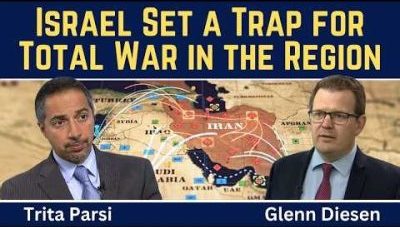
Trita Parsi: Israel Set a Trap for Total War in the Region
or go to
Aletho News Archives – Video-Images
From the Archive
Zionism’s Violent Legacy
By Donald Neff | Washington Report On Middle East Affairs | January 1996
On January 4, 1948, Jewish terrorists drove a truck loaded with explosives into the center of the all Arab city of Jaffa and detonated it, killing 26 and wounding around 100 Palestinian men, women and children.[1] The attack was the work of the Irgun Zvai Leumi – the “National Military Organization,” also known by the Hebrew letters Etzel – the largest Jewish terrorist group in Palestine. The Irgun was headed by Revisionist Zionist Menachem Begin and had been killing and maiming Arabs, Britons and even Jews for the previous ten years in its efforts to establish a Jewish state.
This terror campaign meant that at the core of Revisionist Zionism there existed a philosophical embrace of violence. … continue
Blog Roll
 Aletho News
- Trita Parsi: Israel Set a Trap for Total War in the Region
- Trump’s Iran war is on an Israeli leash
- Saudi oil boss issues global supply warning
- Riyadh Says Its Oil System Is Intact. The Numbers Say Otherwise.
- Trump and Netanyahu Want to “Finish the Job” on Iran
- US ‘one-sided dictation’ not Iran’s beliefs makes rational talks impossible: Baghaei
- Iran’s Next Strike May Not Explode. It Could Shut You Down /Col Doug Macgregor
- Iran: US political targets legitimate if assassinations return
- Iraq shuts key border crossing with Iran under US pressure: Report
- Undersea Internet cables could be targeted in retaliation for attacks on Iran: IRGC deputy chief
- If Americans Knew
- The Israel Lobby’s Changing Fortunes
- AIPAC has become such a political liability that it’s shifting to a more “nimble” approach to buying politicians
- At least 160 Israeli settler attacks in 2 weeks
- Will Gaza’s Ancient Christian Community Disappear Forever?
- Israel’s vision of regional security rests on keeping Arab states weak
- Heidi Levine recounts how Palestinian youths helped save her in settler attack
- DAILY UPDATE: Latest essential news on Palestine, Israel, & region
- Trump’s Intensifying Sabotage of the ICC, for Israel’s Sake
- Israeli military detain US and UK volunteers in West Bank including Democratic NY politician Brad Lander
- Americans at National Conservatism Conference held in Israel this year criticize Israel
- No Tricks Zone
- E-Cars Reduce CO2 Emissions By Only 41% Compared To Internal Combustion Engine Vehicles
- Predictions Made By Renowned Climate Professor Over Past Decades Have Been Proven To Be Poor
- New Study Suggests Large Regions Of The Pacific Ocean Have Been Cooling For The Last 80 Years
- Germany’s Green Energy Debacle: High Energy Costs Force Kahla Porzellan to Close After 182 Years!
- New Study: 50 Years Of The Most Aggressive ‘Net Zero’ Policies Can Only Affect The Global Climate By 0.03°C
- US September “Heat” Was No Record…Many Records Set Decades Ago
- Latest European Green Energy Debacle; Portugal’s Largest Flagship Solar Park Insolvent!
- Green Energy Debacle: German Expert Professor Fritz Vahrenholt Warns Of Severe Economic And Social Consequences
- Two More Paleo Reconstructions Affirm Meters-Higher Sea Levels Across Ireland, Brazil 7000-6000 Years Ago
- New Study: Earth And Venus Surface Warmth Largely Explained By Convection And Lapse Rate, Not CO2 Or Radiation

