Report: Israeli forces detained 420 Palestinians in February

Ma’an – March 4, 2017
RAMALLAH – Israeli forces detained 420 Palestinians during the month of February, including 70 minors and 22 women and girls, according to a statement released on Saturday by the Palestinian Prisoners’ Center for Studies.
The center said in its monthly report that 12 of the detentions were carried out in the besieged Gaza Strip, including five fishermen whose boats were destroyed by Israeli forces before their detention, two who were detained at the Beit Hanoun crossing, and five who were detained after Israel alleged they attempted to cross the border fence between the besieged enclave and Israel.
A journalist was also among the detainees, identified by the center as Humam Muhammad Hantash from the southern occupied West Bank district of Hebron. He was sentenced to Israel’s widely condemned policy of administrative detention — imprisonment without charge or trial based on undisclosed evidence.
The center added that 88 administrative detention orders were issued by Israeli courts in the same period, 23 of which were issued for the first time, while 65 were renewed orders. Meanwhile, 32 administrative detention orders were issued against Palestinians from Hebron.
While Israeli authorities claim the withholding of evidence during administrative detention, which allows detention for three- to six-month renewable intervals, is essential for state security concerns, rights groups have instead claimed that the policy allows Israeli authorities to hold Palestinians for an indefinite period of time without showing any evidence that could justify their detentions.
Rights groups say that Israel’s administrative detention policy has also been used as an attempt to disrupt Palestinian political and social processes, notably targeting Palestinian politicians, activists, and journalists.
According to Addameer, as of January, 6,500 Palestinians were being held in Israeli prisons, 536 of whom were being held under administrative detention.
New hotel in Bethlehem by British artist Banksy offers ‘worst view in the world’ overlooking Israeli Wall
IMEMC News – March 4, 2017
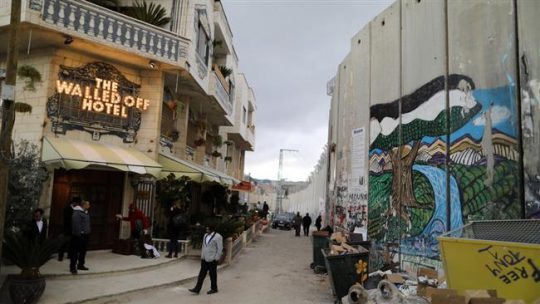
The British artist Banksy, who has painted a number of famous murals on the Israeli Annexation Wall in Bethlehem, has taken his art activism to a new level by opening a boutique hotel just next to the Wall in Bethlehem.
The building used for the “Walled Off” Hotel sits just across the street from the Israeli Annexation Wall in an area known to Palestinians and Israelis alike as ‘Rachel’s Tomb’, in the northern part of the city of Bethlehem.
Bethlehem is known to Christians worldwide as the birthplace of Jesus, but the city has suffered tremendously over the past fifteen years as the Israeli occupation authorities have imposed a stranglehold on their local economy.
Through the construction of the Annexation Wall, which began in 2003, the economy of Bethlehem, largely dependent on tourists and religious pilgrims, has plummeted.
Banksy’s new hotel is an attempt, according to the artist and hotel staff, to both support the local economy of Bethlehem while bringing international attention to the plight of the Palestinians in the city, who live walled off from the world in what they have termed a ‘ghetto’ due to the Israeli Annexation Wall.
The hotel features art that symbolizes the Israeli Occupation of Palestine, including paintings that are imprisoned behind steel bars, a portrait of Jesus with drones overhead and a laser sight on his forehead, and a display of surveillance cameras overlooking patrons to the hotel bar.
In an interview with hotel manager Wisam Salsaa, a reporter from the British Channel 4 News asked Salsaa how Banksy managed to secretly put together such a large undertaking. Salsaa replied simply, “Well, he’s Banksy!”
‘Killing and maiming children’: Watchlist calls UN to blacklist IDF
RT | March 3, 2017
The global network of humanitarian organisations that defends children’s rights across the world has called on the UN to blacklist the Israeli Defence Forces, for multiple violations of children rights. Various human rights organisations have noted a number of incidents in the recent past where Israeli forces have applied psychological pressure on children.
‘Jewish Power Never Sleeps’–Another Billboard Taken Down
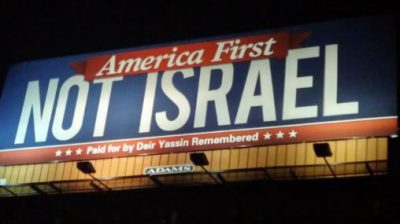
Fig Trees and Vineyards | March 2, 2017
The following is an email sent out recently by Deir Yassin Remembered announcing the take-down of one of their billboards.
The taken-down DYR “America First” billboard, the Southern Poverty Law Centre and a quote from Elie Wiesel – what could they have in common? Henry Herskovitz tells us more:
Jewish Power Never Sleeps
Like Michigan rust on vehicles, Jewish Power remains relentless at getting its way. Just when Witness for Peace was to announce the installation of a local billboard – sponsored by sister organization Deir Yassin Remembered and carrying our message “America First, Not Israel” – we get “the call”. The billboard pictured was taken down by Adams Outdoor Advertising one week after installation, effectively terminating a three-month contract.
That’s how long it took for Jewish Power to pressure Adams’ executives into seeing things their way. The call came from General Manager Mike Cannon, who admitted to receiving phone calls asking that the billboard be taken down. Mike claimed he was not the one who made the decision, and provided the phone number of Vice President of Human Resources
Brian Grant to field my questions.Brian developed a mantra for the conversation we shared: “the decision to remove the billboard was a collective decision and was made because the message did not meet Adams’ company standards. We removed the billboard and refunded your money. And that’s all I can say.” Brian fell back on this mantra at least a half dozen times during our 20-minute discussion. And reminded me that, since a clause in the contract allowed Adams to terminate at any time, there was no “breach of contract”.
Q: What were the company standards?
A: [Brian was not going to go into that.]
Q: How do you square the fact that the message was initially approved by Adams?
A: It should not have been approved; due diligence was not applied.
Q: Who were the people complaining about the billboard?
A: [Would not answer that.]
Q: What were the organizations calling for the billboard to be taken down?
A: [See above.]
Q: Would the decision to pull the billboard have been the same had the message been simply America First?
A: Well, you’re asking a hypothetical.
Q: You mean Adams would NOT run a billboard saying America First?
A: [No answer.]And so it goes. By deception shall you make war. DYR and WfP lose the round; Jewish Power wins. We move on.
Ann Arbor placed on SPLC “Hate” Map
The Southern Poverty Law Center exercises its own brand of Jewish Power by placing Deir Yassin Remembered (and its satellite office in Ann Arbor) on its “hate” map. This information came to us, not by direct communication from the SPLC, but through an article appearing in the Rochester, NY Democrat and Chronicle, entitled: “Rochester area makes SPLC Hate Map”
Defining “hate” proves difficult. A friend asks if forming a group which hates “hate” groups is in itself a “hate” group? Hmmm. The only clear example of hate speech that has come across this writer’s desk belongs to Holocaust icon Elie Wiesel:
“Every Jew, somewhere in his being, should set apart a zone of hate — healthy, virile hate — for what the German personifies and for what persists in the German.”
Henry Herskovitz
Deir Yassin Remembered / Witnesses for Peace
Christian Zionists Target US Aid to Palestinian Authority
By Richard Edmondson | Fig Trees and Vineyards | March 2, 2017
A few days ago, We Hold These Truths posted a podcast entitled “Christian Zionism is a War Based Religion,” which includes a discussion on the so-called “just war” theological doctrine often used by Christian leaders to justify their support for US wars.
I am referring, of course, to Christian leaders such as John Hagee, of Christians United for Israel, or CUFI.
Back in 2003, Hagee supported the US war in Iraq, and even later, after it became glaringly apparent there never had been any weapons of mass destruction and that Bush had lied about the war, he continued to be a vocal supporter of the US aggression.
“Christian Zionism is a war based, political religion wrapped around the notion that the modern state of Israel is a fulfillment of Biblical prophecy,” reads the podcast description put up by We Hold These Truths. You can go here to listen to the podcast. It’s a fairly interesting discussion.
I mention it because just today CUFI, which is the largest Christian Zionist organization in America, sent out an appeal to its email subscribers calling for an end to US financial aid to the Palestinian Authority. A friend of mine who is on their email list forwarded it to me.
What exactly has the PA done that has so upset the CUFI? You’ll read about it in the text of the email, which I reproduce below, but basically it comes down to support for the families of Palestinians who have been either killed or imprisoned by Israel–people the CUFI views as “terrorists.”
Of course, anyone who gets killed by an Israeli soldier automatically has to be labeled a “terrorist,” and there have been reports of soldiers planting knives on the bodies of their victims. Apparently this is of no concern to CUFI, however. It isn’t mentioned in their email.
The illegal settlements, the ongoing 50-year occupation of the West Bank, the targeting of residential buildings and hospitals in Israel’s periodic attacks upon Gaza–all these things, too, go unmentioned.
Another key point is that under international law people have a right to resist occupation. By this measure, attacks by Palestinians against Israeli soldiers are not acts of terrorism. To make the assertion that they are would be the equivalent of branding the founding fathers of America as terrorist leaders.
But perhaps the main thing to keep in mind is that this appeal is being made by an organization that supported the US war in Iraq, and which has yet to apologize or concede that the war was fought under false pretenses or that Christian support for it was a terrible mistake. Another thing you might also want to reflect upon, just as a matter of interest, is that the executive director of Christians United for Israel, David Brog, is not in fact a Christian–he is Jewish.
The CUFI communique includes the following graphic at the top of the email:

The text then reads as follows:
Dear _______,
Since September of 2015, the beginning of the so-called “stabbing intifada,” Palestinian terrorists have murdered more than 50 innocent people and wounded hundreds more.
The media often describes these terrorists as “lone wolves” completely disconnected from Mahmoud Abbas and his Palestinian Authority (PA). But the fact is that the Palestinian Authority makes generous lifetime payments to every Palestinian imprisoned for killing Israelis. And if the terrorist dies during his attack, his family receives these payments. This financial support for terrorism is actually required under legislation passed by the Palestinian legislature.
The United States provides the PA with approximately $300 million in aid each year. The PA makes approximately $300 million in payments to terrorists and their families every year. There is no way around this troubling reality: our taxpayer dollars are being used to fund terrorism. This must end!
Earlier this week, Sen. Lindsey Graham re-introduced a critical piece of legislation–the Taylor Force Act. Representatives Lamborn and Zeldin introduced similar legislation in the House of Representatives. This bill requires that we cut all U.S. aid to the PA until it stops funding terrorism.
This bill is named after Taylor Force, a West Point graduate who who survived tours of duty in Iraq and Afghanistan only to be murdered in Israel by a Palestinian terrorist.
Today we ask you to stand up for Taylor Force. We ask you to stand up for Israel. And we ask you to take a stand against terrorism.
Click here now to ask your members of Congress to co-sponsor the Taylor Force Act.
Help us end the PA’s Pay to Slay policy today!
Blessings to you and those you love,
Pastor John Hagee
National ChairmanDavid Brog
Director
The appeal ends with the following words written in large white letters on a red background:
“NO MONEY FOR MURDER”
While I am not a big fan of the PA, one thing that might be said in their favor is that they do not have a lobby in Washington to speak of, and that we have never fought a war on their behalf. I have my doubts as to whether this bill will be passed or signed into law, however. It is necessary for Israel to maintain the diplomatic pretense that Palestinians in the Occupied Territories exercise some measure of self-determination, no matter how small. It is the PA that provides this fig leaf. Take away the fig leaf and Israel stands exposed as an apartheid state for all the world to see. My guess is this is probably one of the only reasons aid to the PA was ever begun in the first place.
‘UK curbing academic free speech on Israel’
Press TV – March 2, 2017
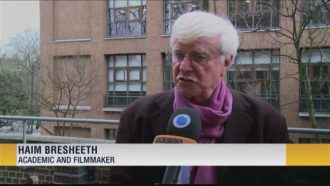 The British government is helping universities across the UK suppress the right to criticize Israel over its human rights violations in Palestine, says a Jewish professor, vowing to never give in to the pressure.
“They are trying to stop us talking about Palestinian rights, and about peace and we will just not shut up,” Dr. Haim Bresheeth, a Jewish academic and filmmaker, told Press TV on Wednesday.
“Unfortunately the government has helped the universities that want to shut up free speech by accepting a definition of anti-Semitism that makes anti-Semitism any criticism of Israel,” he added.
The scholar was referring to the International Holocaust Remembrance Alliance (IHRA)’s definition that was adopted by the government of Prime Minister Theresa May last year.
It was based on IHRA’s definition that the University of Exeter and the University of Central Lancashire (UCLan) cancelled an annual pro-Palestinian event on Monday, which was aimed at raising awareness about human rights violations in the occupied territories.
Following the move, some 250 academics at dozens of universities across the UK penned an open letter, condemning the Tory government’s attempts to curb their right to free speech by banning criticism of Israel.
The professors said in their letter that the government’s definition of anti-Semitism is too broad and can include any criticism of Israel with regards to its occupation of Palestinian lands.
“The government has ‘adopted’ the International Holocaust Remembrance Alliance definition of anti-Semitism, which can be and is being read as extending to criticism of Israel and support for Palestinian rights, an entirely separate issue, as prima facie evidence of anti-Semitism,” read the letter, sent to the Guardian.
“This definition seeks to conflate criticism of Israel with anti-Semitism,” the academics charged, accusing universities minister Jo Johnson of asking for the definition to be “disseminated” throughout the higher education system.
In his interview with Press TV, Bersheeth said the definition sought to protect “Zionism and Israel” from criticism.
“You can criticize and you should criticize every political institution that you wish,” he argued. “We are told now that Jews who criticize Israel like me are anti-Semitic. This is nonsense.”
Leeds University Union Threaten to Ban Craig Murray Speech on Palestine
By Craig Murray – March 1, 2017
I am giving a talk entitled “Palestine/Israel: A Unitary Secular State or a Bantustan Solution” in Leeds University tomorrow. I have just been told by Leeds University Union I will not be allowed to speak unless I submit what I am going to say for pre-vetting.
I am truly appalled that such a gross restriction on freedom of speech should be imposed anywhere, let alone in a university where intellectual debate is meant to be an essential part of the learning experience. I really do not recognise today’s United Kingdom as the same society I grew up in. The common understanding that the values of a liberal democracy are the foundation of society appears to have evaporated.
As regular readers know well, I do not write speeches in advance but always speak extempore. My opinions on Israel and Palestine are very well documented on this blog and elsewhere. I want to see a single, unitary state in Israel/Palestine, encompassing everyone who currently lives in those territories, as a secular democracy blind to ethnicity and religion. This includes an acceptance that further forced large population movements by anybody are not desirable and the Palestinians should receive more compensation than restitution. If I am not permitted to express this view within a University, I find that truly shocking.
I should be equally shocked if anybody who held views very different to my own were not permitted to express them.
I think that if people like me are now being prevented from speaking, society has crossed a very dangerous line indeed.
Israel clears Palestinians and homes so its military can practice

Defense for Children International | February 6, 2017
Ramallah – Evictions, demolitions, and UXO are constant risks for Palestinian children living in areas of the Jordan Valley that Israel has declared as “firing zones,” where Israeli battalions regularly assemble to hone their combat skills. Before tanks can shoot off missile rounds and soldiers can carry out practice missions, goats are removed, animal pens and tents dismantled.
“During 2016, we were forced to evacuate our houses around 30 times,” said Abdulaziz Abu Kbash, a father of seven. Abu Kbash lives with his family in a makeshift metal structure near Homsa, which is part of the West Bank governorate of Tubas, in the northern Jordan Valley.
In the summer, home evictions during Israeli military practices put children at risk of dehydration and prolonged sun exposure. “We wait in the sun for hours,” said Abu Kbash. “The children get very tired from being outdoors.”
Winter, with rain and lower temperatures, is not much better. After Abu Kbash’s family had been forced to stay outside during an Israeli drill in February 2016, his daughter fell ill for several days.
Even more frightening are the UXO the Israeli soldiers leave in their wake. “Tanks, live ammunition, and shells are used in drills not that far from our houses,” said Abu Kbash. “When we return, we find shell shrapnel and some other remnants near the houses. Our biggest fear is that one of the foreign objects could explode and hurt our children.
Animals, the primary source of livelihood for Abu Kbash’s family, are not immune to Israel’s military activities in the Jordan Valley, either. Extra time animals spend walking or waiting in hot temperatures cost the family in water, which they have to purchase from cities approximately 9 miles away.

Palestinians herd their flocks during a temporary eviction order for the purpose of Israeli military exercises outside Tubas, in the northern Jordan Valley. (Photo: DCIP / Cody O’Rourke)
Makeshift homes like Abu Kbash’s dot the length of the mostly arid strip of land known as the Jordan Valley that stretches along the Jordanian border. Against this often challenging landscape, Bedouin and other livestock-based communities have long practiced their way of life.
Israel’s military annexation and subsequent occupation of the West Bank in 1967 represented a significant interruption to these remote communities’ customs and livelihoods.
Although comprising 30 percent of the total West Bank Palestinian land space, the bulk of the Jordan Valley now falls under Area C, “virtually of which is prohibited for Palestinian use, earmarked instead for the use of the Israeli military or under the jurisdiction of Israeli settlements,” according to the Office for the Coordination of Humanitarian Affairs (OCHA).
Approximately 3,400 Palestinians live in the especially restrictive closed military or “firing zones.” These ill-defined areas on and around Palestinian communities are used by Israeli military personnel for training purposes. Ahead of planned military exercises, Israeli authorities clear people, animals and structures from the area.
When Defense for Children International – Palestine visited Abu Kbash in late September of 2016, he had recently received a temporary eviction notice. On September 16, the Israeli civil administration ordered all the families in the vicinity, including 51 children, out of their homes between 7 a.m. and 11 a.m. on September 22, 29, and 30.

Mahmoud Ayyoub stands where he and his family of 15 lived before Israeli forces demolished their homes in Ein Al-Beida, near Tubas, in the Jordan Valley. (Photo: DCIP / Cody O’Rourke)
Even when drills are not actively in progress, Palestinian children residing near or inside firing zones live under the constant threat of displacement.
On September 27, 2016, Mahmoud Ayyoub was at a Jenin hospital with one of his children when he received a troubling phone call. Israeli forces had entered his village, Ein Al-Beida, located on the northern tip of the Jordan Valley, the caller said. He learned that the makeshift homes and tents that provided shelter to his seven adult children and 15 grandchildren had all been demolished.
“I was told that soldiers came at around 8:30 a.m. and threw all our belongings outside. They kicked the women and children out in their sleeping clothes without explaining the reason for the demolition,” said Ayyoub, who has lived in Ein Al-Beida for 15 years.
Now, Ayyoub says, the Israeli army is preventing him from rebuilding. He told DCIP that soldiers regularly monitor the area to ensure that no rebuilding has occurred.

Odai al-Faqeer, 5, Daifallah’s youngest son, sits on broken concrete blocks and twisted, steel where his home once was in Aqaba, Tubas governorate. (Photo: DCIP / Cody O’Rourke)
Earlier in the month, on September 7, Daifallah al-Faqeer’s six children watched two Israeli bulldozers destroy their home in Aqaba, a few miles east of Tubas. “My children were really terrified by the soldiers, who smashed everything in front of them,” their father told DCIP.
“It was a difficult time for all of us to see everything we had built being torn down,” al-Faqeer said.
Al-Faqeer was only given two hours notice that three housing and four animal structures would be demolished because they lacked the necessary permits. His family rushed to save what they could before the demolition started.
“We stayed in the open until some residents in the neighboring area gave us some tents to live in,” said al-Faqeer. “I am currently trying to rebuild what has been destroyed.”

Israeli army vehicles park next to a Palestinian family compound during Israeli military training in the Jordan valley, West Bank, on December 8, 2016. (Photo: ActiveStills / Keren Manor)
In the months since DCIP visited these three families, Israel carried out at least four evictions or demolitions in the northern Palestinian villages of the Jordan Valley. Residents of Khirbet Al-Ras Al-Ahmar were evacuated in October and November, Khirbet Ibziq in December of 2016, and Khirbet al-Kurzaliya in January of this year.
Since 1967, Israel has pursued a discriminatory policy of demolishing Palestinian homes and essential structures, including water systems, livestock pens, solar panels, and even tents and shelters provided by international aid organizations throughout the West Bank, including East Jerusalem.
In 2016, Israel’s demolition rates were the highest ever recorded since OCHA began tracking the issue in 2009. Altogether, Israel demolished, dismantled, or othrwise confiscated 1,089 Palestinian-owned structures in the West Bank, including East Jerusalem, displacing 1,593 people. OCHA’s Demolitions Database shows that 15 of these incidents took place in Area C of the Jordan Valley, impacting 98 structures and 124 children.
Demolitions and evictions deny Palestinians the right to live securely and deny children an adequate standard of living, education, health, and psychological well-being.
Israel’s Anti-Semitism Smears Backfire
By Ann Wright | Consortium News | March 1, 2017
An often-used tactic to squelch criticism of Israeli state policies toward the Palestinians is to call the criticism anti-Semitic. The sponsors of the event become afraid of the label, anti-Semitism, false as it is, and cancel the event to avoid any controversy. The tactic is used widely across Europe and the United States.
This week, the talk that I was to give in a room at the Rome City Hall about the Women’s Boat to Gaza and the conditions in Gaza was cancelled 24 hours before the event by the council member who had agreed to arrange for the room. His staff revealed that he had gotten intense pressure from the Israeli Embassy and Rome’s Jewish Community Association to stop the presentation.
But that was not the end of the story. In a fast-moving media blitz, organized by Italy’s Boycott, Divestment and Sanctions program, two of Rome’s newspapers wrote of the cancellation and several radio stations reported on it. BDS Italy scheduled a press conference about the cancellation in the plaza in front of the City Hall at the time the talk was scheduled. About 20 representatives of the news media attended, a much larger number than would have attended the talk itself.
Due to the number of media and the questions concerning the cancellation, Marcello de Vito, President of the Rome City Council, invited three of us to come into the City Hall to discuss the cancellation. This invitation provided us with the opportunity to discuss the conditions in Gaza and the West Bank and the nonviolent tactics such as BDS and Boats to Gaza to bring international attention to the harmful policies of the State of Israel.
From the questions, it was apparent that the President, another City Council member and their staff knew little about the Israeli blockade of Gaza, the illegal settlements, the apartheid wall, the numbers of Palestinian children and youth held in Israeli jails, and the theft of Palestinian resources by Israeli companies.
Something similar happened last year in Bayreuth, Germany, when the prize for Tolerance and Peace, which had been awarded to CODEPINK: Women for Peace, was cancelled by the Mayor after two reporters, known for writing spurious articles, alleged that CODEPINK was an anti-Semitic organization. Following an extensive letter-writing campaign from members of the German Parliament and others who know that CODEPINK’s actions challenging the policies of the State of Israel are not anti-Semitic, the Bayreuth City Council voted to reinstate the award amid much publicity.
Also, last year, a conference in which grandmothers who had been through World War II were to speak was cancelled because of similar allegations. Defenders of Israeli policies targeted 90-year old Hedie Esptein, a vocal critic of Israeli treatment of Palestinians, although her parents had been killed in the Holocaust and she had survived by being sent to England as a part of the Kindertransport,
Responding quickly to false allegations of anti-Semitism is key to blunting the Israeli government’s offensive toward those who challenge the illegal and inhumane policies toward Palestinians. In the case of the Rome cancellation, the pushback from BDS Italy created more publicity about the plight of the Palestinians than the event itself would have.
Ann Wright served 29 years in the U.S. Army/Army Reserves and retired as a Colonel. She was a U.S. diplomat and served in U.S. embassies in Nicaragua, Grenada, Somalia, Uzbekistan, Kyrgyzstan, Sierra Leone, Micronesia, Afghanistan and Mongolia. She resigned from the U.S. government in March, 2003 in opposition to President Bush’s war on Iraq.
Featured Video

Liberty Cannot Exist Inside a Panopticon
or go to
Aletho News Archives – Video-Images
From the Archives
Left-leaning despisers of 9/11 Truth movement: Do you really believe in miracles?
David Ray Griffin | Global Research | 06 Jul 2010
An Open Letter to Terry Allen, Noam Chomsky, Alexander Cockburn, David Corn, Chris Hayes, George Monbiot, Matthew Rothschild, and Matt Taibbi.
[1]According to several left-leaning critics of the 9/11 Truth Movement, some of its central claims, especially about the destruction of the World Trade Center, show its members to be scientifically challenged. In the opinion of some of these critics, moreover, claims made by members of this movement are sometimes unscientific in the strongest possible sense, implying an acceptance of magic and miracles. … Full article
Blog Roll
 Aletho News
- EU sending ‘biased’ observers to interfere in Serbian election – president
- White House envoy declares kinetic action against Yemen ‘fruitless’
- Ukraine deployed thousands of microdrones in Iraqi Kurdistan: Tasnim
- Iran calls for emergency UNSC meeting over Trump’s ‘brazen’ bomb talk, Israeli threats
- Iranian sources reveal details of Russia-China Hormuz proposal
- Plan for more US-Israel integration puts our military tech at risk
- Another Round Against Iran Will Break What Is Left of the Gulf
- SVR Report on Ukraine’s Mexican Drug Gang Links Could Pressure Zelensky, Won’t Change US Policy
- British Government Employees Were Fact-Checking the News at the BBC. Nobody Told You.
- Albania on fire: who’s behind the riots?
- If Americans Knew
- Mysterious bot accounts reportedly spread fake ‘man on the street’ videos for Michigan Senate candidate
- Israeli Defense Minister Katz Says Over 60 Lebanon Villages Have Been Destroyed
- Why Is Israel Running TV Ads in Iowa Ahead of the Midterms?
- Hind Rajab’s Alleged Killer Is in the United States. HRF Demands His Arrest.
- US Officials Face Fresh Pressure After Another American ‘Brutalized’ by Israeli Settlers in West Bank
- Israel-Backed Palestinian Militias Terrorize Displaced Families in Gaza
- FBI subpoenas pro-Palestine activists over Israeli weapons plant disruption
- Fourth winter arrives in wartorn Gaza, too early – Daily Update
- More on how Bari Weiss is using CBS on behalf of Israel
- What the UK Is Doing to Pro-Palestine Novelist Sally Rooney Is an Act of Orwellian Villainy
- No Tricks Zone
- Predictions Made By Renowned Climate Proifessor Over Past Decades Have Been Proven To Be Poor
- New Study Suggests Large Regions Of The Pacific Ocean Have Been Cooling For The Last 80 Years
- Germany’s Green Energy Debacle: High Energy Costs Force Kahla Porzellan to Close After 182 Years!
- New Study: 50 Years Of The Most Aggressive ‘Net Zero’ Policies Can Only Affect The Global Climate By 0.03°C
- US September “Heat” Was No Record…Many Records Set Decades Ago
- Latest European Green Energy Debacle; Portugal’s Largest Flagship Solar Park Insolvent!
- Green Energy Debacle: German Expert Professor Fritz Vahrenholt Warns Of Severe Economic And Social Consequences
- Two More Paleo Reconstructions Affirm Meters-Higher Sea Levels Across Ireland, Brazil 7000-6000 Years Ago
- New Study: Earth And Venus Surface Warmth Largely Explained By Convection And Lapse Rate, Not CO2 Or Radiation
- 2025 Nature Paper Claiming Worsening Global Drought Gets RETRACTED …Heavily Flawed

