2nd Jewish Cemetery Vandalized; But Those Shedding Tears Seem to have Short Memories
By Richard Edmondson | Fig Trees and Vineyards | February 28, 2017
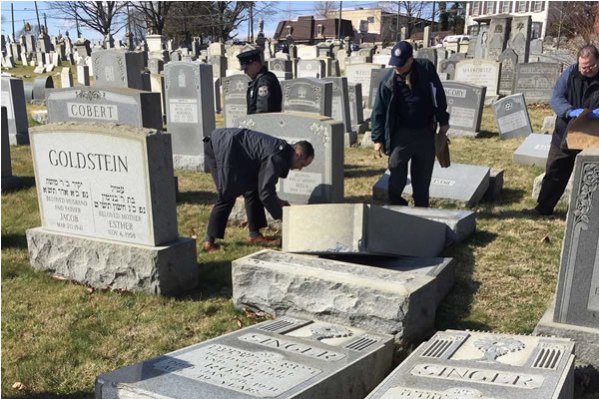
Another Jewish cemetery has been vandalized. According to news reports, some 75-100 headstones were knocked over at the Mount Carmel cemetery in Philadelphia sometime either Saturday night or early Sunday morning.
It is the second vandalization of a Jewish cemetery in a week. The previous one took place at the Chesed Shel Emeth Cemetery, near St. Louis, an incident I reported on in a post several days ago.
“We are horrified by the desecration at Mount Carmel Cemetery,” said Nancy K. Baron-Baer, a regional director for the ADL, in commenting on the latest attack.
Other Jews seem to be equally horrified. The Anne Frank Center, headquartered in New York with an additional office just opened in Los Angeles, issued a statement similarly impassioned–if not more so.
“WE ARE SICKENED, SICKENED, SICKENED,” read read the group’s rather unrestrained outpouring posted on Twitter. “More Jewish gravestones were found vandalized today, this time in Philadelphia.”
Jewish graves in Philadelphia now vandalized. Stop this incubator of #Antisemitism and other hate. WE BEG YOU @POTUS @realDonaldTrump pic.twitter.com/RHuIjdE2Yg
— AnneFrankCenter(US) (@AnneFrankCenter) February 26, 2017
//platform.twitter.com/widgets.js
In its mission statement, the Anne Frank Center “calls out prejudice, counters discrimination and advocates for the kinder and fairer world of which Anne Frank dreamed.”
And as for the ADL, so horrified and sickened are its officials by recent events they have even put up a $10,000 reward for information leading to the arrest and conviction of the vandals.
“This act is cowardly and unconscionable, and is all the more despicable coming on the heels of a similar vandalism at another Jewish cemetery in St. Louis last week,” said Baron-Baer. “We urge anyone with information on this crime to report it immediately to the Philadelphia Police Department at 215-686-TIPS.”
“I’m so upset,” said Millard Braunstein, who went to the cemetery Monday morning and discovered his mother’s headstone is one of those that had been knocked down.”This is such a terrible thing.”
“It’s just very disheartening that such a thing would take place,” said Aaron Mallin, another man with a relative buried in the cemetery.
And a Philadelphia rabbi who has also visited the cemetery and seen the damaged grave sites seems particularly heavy of heart.
“After you start walking from row to row it quickly moves from a random act of vandalism to something with larger intentions and a systematic approach to things,” said Shawn Zevit, the rabbi at the Mishkan Shalom synagogue.
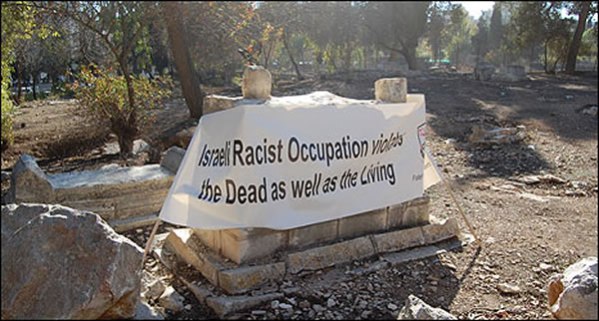
While desecration of a cemetery is a despicable act, one wonders if any of these people bothered to voice their concerns over the desecration and paving under of a Muslim cemetery in Jerusalem. And if Zevit is concerned about the “systematic approach” taken by the vandals in Philadelphia (who damaged a mere 100 graves) he should stop and reflect that it doesn’t even begin to hold a candle to the “systematic approach” taken by the Israelis at the Mamilla Cemetery. Here is a bit from Wikipedia:
Mamilla Cemetery is a historic Muslim cemetery located just to the west of the walls of the Old City of Jerusalem, Israel.[1][2]The cemetery, at the center of which lies the Mamilla Pool, contains the remains of figures from the early Islamic period,[3]several Sufi shrines and Mamluk-era tombs.[1] The cemetery grounds also contain the bodies of thousands of Christians killed in the pre-Islamic era, as well as several tombs from the time of the Crusades.
Its identity as an Islamic cemetery is noted by Arab and Persian writers as early as the 11th century.[4] It was used as a burial site up until 1927 when the Supreme Muslim Council decided to preserve it as a historic site.[1]
Following the 1948 Arab–Israeli War, the cemetery and other waqf properties in West Jerusalem fell under the control of Israeli governmental bodies.[5] A number of buildings, a road and other public facilities, such as a park, a parking lot and public lavatories have since been constructed on the cemetery grounds, destroying grave markers and tombs. A plan to build a Museum of Tolerance on part of the cemetery grounds, announced in 2004, aroused much controversy and faced several stop work orders before being given final approval in July 2011.
The “Musem of Tolerance” mentioned by Wikipedia is a facility the Simon Wiesenthal Center is seeking to build in Jerusalem as a companion to its museum of the same name in Los Angeles. Ironically the Simon Wiesenthal Center is among those now expressing concern over the vandalization of Jewish cemeteries in the US.
“Attacking a cemetery, especially one that is all-Jewish, all-Catholic, or whatever it is, is basically an attack on the culture, the identity of the people that cemetery represents,” Aaron Brietbart, a Simon Wiesenthal researcher, told the Washington Post following the attack on the Jewish cemetery in Missouri.
Compare Brietbart’s remarks to those of another Simon Wiesenthal official, Rabbi Marvin Hier, who insisted to the BBC in 2008 that construction of the Museum of Tolerance–on top of the Mamilla Cemetery–was an appropriate use of “derelict land.”
“Jerusalem is a city built on top of thousands of bones – Jewish and Muslim,” Hier said. “If we declared the whole of Jerusalem one huge cemetery, we’d never be able to build anything.”
The Museum of Tolerance seems to be rather aptly named–since what we are being ordered to show tolerance for in large part is the Simon Wiesenthal Center’s hypocrisy.
You’ll also note–in the tweet above–that the Anne Frank Center demands President Trump “deliver a prime-time nationally televised speech, live from the Oval Office, on how you intend to combat not only #Antisemitism and #Islamophobia and other rising forms of hate.”
All well and good perhaps, but why doesn’t the Anne Frank Center seem concerned about the Islamophobia running rampant in the state of Israel? Surely apartheid, walls, occupation, home demolitions, and cemetery desecrations are not part of the “kinder and fairer world of which Anne Frank dreamed.”
Perhaps instead of delivering a live speech from the Oval Office on anti-Semitism or Islamophobia, Trump should call his advisors together to develop a national strategy for dealing with the Jewish inability to self-reflect.
And finally, one other point before closing: the fact that Muslims in America have raised money to help pay for damage done by vandals at Jewish cemeteries is, in light of attacks upon the Mamilla Cemetery in Jerusalem, ironic to say the least. After the destruction at the cemetery in Missouri, US Muslims rallied with a very successful crowdfunding campaign. Now it seems they are doing it again. Here is what is being reported by CNN:
Once again, dozens of Jewish headstones have been vandalized, stoking fears of heightened anti-Semitism. And once again, members of the Muslim community are rallying to help.
The latest spate of destruction came over the weekend at the Mount Carmel Cemetery in Philadelphia, where 75 to 100 tombstones were toppled over. A week earlier, at least 170 headstones were damaged at a Jewish cemetery in St. Louis.
Muslim activist Tarek El-Messidi, who had started a fund-raising campaign to help clean up the St. Louis cemetery, sprung to action again after the Philadelphia attack.
“I want to ask all Muslims to reach out to your Jewish brothers and sisters and stand together against this bigotry,” he wrote on Facebook.
“Last week, our Muslim community raised money for the vandalized Jewish Cemetery in St Louis. Since we raised well above the goal, we can now use extra funds to help here in Philadelphia.”
As of Tuesday morning, the campaign had raised $138,000 — nearly seven times the original goal of $20,000.
El-Messidi said he immediately visited the Philadelphia Jewish cemetery and offered his support after hearing the news. After all, Muslims can relate to the feeling of racial intolerance.
And here is a little more from the Wikipedia article on Mamilla Cemetery:
At the time of Israel’s assertion of control over West Jerusalem in 1948, the cemetery, which contained thousands of grave markers, came under the administration of the Israeli Custodian of Absentee Property and the Muslim Affairs Department of Israel’s Ministry of Religious Affairs.[1][5][28] By the end of the 1967 war that resulted in the Israeli occupation of East Jerusalem, only a handful of broken grave markers remained standing.[1] A large part of the cemetery was bulldozed and converted into a parking lot in 1964 and a public lavatory was also built on the cemetery grounds.[19][29][30]
In the 1950s, the Ministry of Foreign Affairs, sensitive to how the treatment of waqf properties would be viewed internationally, criticized government policy towards the cemetery.[28] A ministry representative described the vandalism to tombstones, including their use by the guard appointed by the Religious Ministry to build a henhouse beside his shelter in the cemetery, and the destruction of ancient tombs by bulldozers cleaning the Mamilla Pool.[28] Noting the site constituted waqf property and lay within sight of the American Consulate, the ministry said it viewed the situation, which included plans for new roads and the parceling out of portions to private landowners as compensation for other properties confiscated by the state, with deep regret.[28]
Israeli authorities bulldozed several tombs in the cemetery, including some of those identified as Frankish by Clermont-Ganneau, to establish Mamilla Park (or Independence Park) in 1955.[22] Two of the largest and finest tombs survived, though the lid of one was overturned when it moved from its original spot.[22] The other is the Mamluk era funerary chapel known as al-Kebekiyeh (or Zawiya Kubakiyya), now located in the eastern end of Independence Park.[22][23]
Besides Independence Park, other parts of downtown Jerusalem erected on the cemetery grounds include the Experimental School, Agron Street, Beit Agron, and Kikar Hahatulot (Cats’ Square), among others.[18] Government buildings on the cemetery grounds include the main headquarters of the Israeli Ministry of Trade and Industry,[1] and the Customs Department building, which is said to be located on what was once the site of the chapel dedicated to St. Mamilla.[31]
In 1992, the Custodian of Absentee Property sold the cemetery grounds to the Jerusalem Municipality, a sale the Mufti of Jerusalem, Ikrema Sabri, said they had no right to make.[32] The Israeli Electricity Company destroyed more tombs on 15 January 2005 in order to lay some cables.[1]
A major protest against attacks upon the cemetery took place in Jerusalem in 2008. Here is what the BBC reported:
Earlier this week hundreds of Muslims – young and old – marched through the centre of Jerusalem towards the city’s Mamilla cemetery.
Police helicopters flew overhead and security was tight. The focus of the march, and of increasing Muslim anger, was the Israeli Supreme Court decision to sanction a controversial new building on part of the Muslim cemetery.
And finally a bit more from Wikipedia:
On 9 August 2010, 300 Muslim gravestones in the cemetery were bulldozed by the Israel Lands Administration (ILA) in an area US Jewish human rights activists said was very close to the planned site for the Museum of Tolerance.[41][42] A reporter from Agence France Presse witnessed the destruction of 200 graves until the work was briefly suspended while the court heard a stop work petition it rejected, allowing demolitions to continue that same day.[41] The judge later issued an order prohibiting harm to ancient graves and mandating that the ILA coordinate work with the Israel Antiquities Authority and representatives of the Islamic Movement.[42]
The Jerusalem city council issued its first official response in a written statement on 12 August, saying that, “The municipality and the (Israel Lands) Authority destroyed around 300 dummy gravestones which were set up illegally in Independence Park on public land.” It said these “fake” gravestones were not erected over any human remains and were placed in the park in an effort to “illegally take over state land.”[41]
Mahmud Abu Atta, a spokesman for the Al-Aqsa Foundation, denied the city council’s claim that new tombs were added illegally. He said that between 500 and 600 tombs had been renovated in total “with the municipality’s agreement,” that “some of the tombs had to be totally rebuilt,” but that “all the tombs that we built or renovated contain bodies.”[41]
Twenty graves were completely destroyed or had their tombstones removed by vandals in January 2011.[43] On the night of 25–26 June 2011, about 100 gravestones in an intact part of the cemetery were destroyed by Israeli bulldozers.[19][44] Footage filmed by local media and activists appeared on Al Arabiya and Al Jazeera and showed the bulldozers pulling out quickly after realizing they were being filmed; Israeli officials made no comment on the incident.[45]
Later that same year, fifteen gravestones in the cemetery were spray painted red with racist slogans reading “Death to the Arabs”, as well as “price tag” and “Givat Asaf“, the name of an Israeli outpost slated for demolition.

The Mamilla graveyard (shown in the background) as it appeared in 1948
Though the statements from the Anne Frank Center and some of the other Jews quoted in this article are rather amazing, perhaps the Academy Award for hypocrisy goes to an Israeli official by the name of Emmanuel Nahshon. A spokesperson for the Israeli Foreign Ministry, Nahshon tweeted the following in response to the attack on the cemetery in Philadelphia:
#Philadelphia Jewish cemetery desecration is shocking and a source of worry . Full confidence #US authorities catch and punish culprits .
— Emmanuel Nahshon (@EmmanuelNahshon) February 26, 2017
Two British universities halt pro-Palestinian events
Press TV – February 28, 2017
Two British universities have been accused of undermining freedom of speech after cancelling an annual pro-Palestinian event aimed at raising awareness about human rights violations in the occupied territories.
The accusation was leveled on Monday after the University of Exeter and the University of Central Lancashire (UCLan) announced the cancellation of a pro-Palestinian student-run event called Israel Apartheid Week.
Students at Exeter were barred from giving a street theater performance called Mock Checkpoint, in which some participants were to dress up as Israeli soldiers while others performed the roles of Palestinian victims.
The event had been approved by the student union at the university but was banned for “safety and security reasons” less than 48 hours before commencement. An appeal against the decision was also refused.
Members of Friends of Palestine Society at Exeter accused the university of censoring students, saying, “They are not allowing freedom of speech – by cancelling an event that was in support of Palestinian activism and for Palestinian rights; they are directly censoring us.”
Professors react
The move prompted almost 250 academics, including 100 professors, to sign a letter denouncing attempts by university officials to silence campus discussion about Israel and its treatment of Palestinians.
“These are outrageous interferences with free expression, and are direct attacks on academic freedom,” the letter noted. “As academics with positions at UK universities, we wish to express our dismay at this attempt to silence campus discussion about Israel, including its violation of the rights of Palestinians for over 50 years.
“It is with disbelief that we witness explicit political interference in university affairs in the interests of Israel under the thin disguise of concern about anti-semitism,” it added.
More than half a million Israelis live in over 230 illegal settlements built since the 1967 Israeli occupation of the Palestinian territories of the West Bank and East Jerusalem al-Quds.
Much of the international community regards the Israeli settlements as illegal because the territories they are built on were captured by Israel in a war and are hence subject to the Geneva Conventions, which forbid construction on occupied lands.
Nevertheless, the Israeli regime continues to build more settlements and expand the existing ones.
Fatah movement says Facebook shut down the movement’s official page
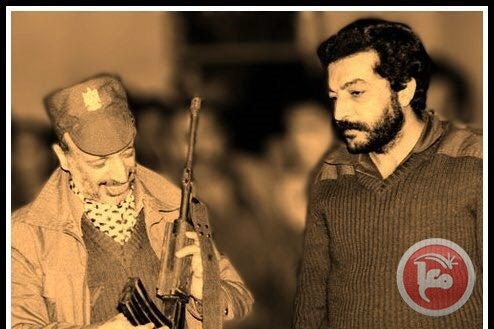
The photo which reportedly led Facebook to close Fatah’s official page
Ma’an – February 27, 2017
RAMALLAH – The official Facebook page of the Palestinian Authority’s (PA) ruling party Fatah was shut down by Facebook Inc. on Monday, according to an official statement from the Fatah movement.
Munir al-Jaghoub, a Fatah official and the “administrator” of the page said in the statement that Facebook closed the Fatah’s official page after the group posted a photo of the late Palestinian President and Fatah leader Yasser Arafat alongside the current deputy chairman of the movement Mahmoud al-Aloul.
Arafat appears in the photo handing a rifle to al-Aloul. According to the statement, the rifle belonged to Israeli soldiers and was captured by Fatah militants in southern Lebanon during the 1982 Lebanon war.
The statement added that Monday’s incident was the second time Facebook has closed the Fatah movement’s official Facebook page.
In recent months, Israel has detained scores of Palestinians for social media activity, alleging that a wave of unrest that swept the occupied Palestinian territory in October 2015 was encouraged largely by online “incitement.”
In September, Facebook agreed to work with the Israeli government to “minimize online anti-Semitic incitement” — in an effort to pressure the social media site to coordinate to remove content considered to promote “terrorism.”
Israel had previously blamed Facebook outright for the perceived proliferation of incitement, with Public Security Minister Gilad Erdan reportedly saying that Facebook chairman and cofounder Mark Zuckerberg had “blood on his hands” for not adequately cooperating with Israel to remove content.
Earlier this year, the controversial “Facebook bill” passed the first reading in the Knesset, which would allow Israeli officials to force the social media giant to remove certain content through a court order if there are suspicions of “incitement.”
Despite Facebook complying with 95 percent of the Israeli government’s removal requests in recent months, some members of the Knesset have expressed indignation that Facebook has not taken enough action to remove content inciting “acts of terror against Jews.”
Meanwhile, Palestinians have instead pointed chiefly to the frustration and despair brought on by Israel’s nearly 50-year military occupation of the Palestinian territory and the absence of a political horizon as reasons for the outbreak of violence. Many Palestinians have also pointed out that Israeli violence has continued to shape everyday life in the occupied territory, regardless of any recent “upticks” in clashes or attacks.
Palestinian woman shot, injured by Israeli forces at Qalandiya checkpoint
Ma’an – February 27, 2017
BETHLEHEM – A Palestinian woman was shot and injured by Israeli security guards at the Qalandiya checkpoint between the occupied West Bank and occupied East Jerusalem on Monday afternoon, as Israeli police claimed she was carrying a bag in a “suspicious manner.”
Israeli police spokeswoman Luba al-Samri said in a statement that a “suspicious” Palestinian woman entered the vehicle lane of the checkpoint “seemingly carrying an object.”
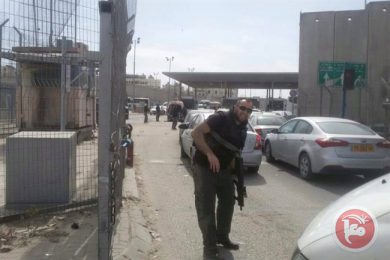 “The security guards noticed her and instructed her to stop but she ignored the instructions,” al-Samri said.
“The guards then started arrest procedures and neutralized the woman,” al-Samri added, using an Israeli forces term to indicate that a Palestinian was shot without specifying whether they were injured or killed.
Al-Samri later clarified that the woman had been “lightly injured,” and that she had been “carrying a bag” in a way that raised the security guards’ suspicions.
The police spokeswoman said that the Palestinian was in her thirties and was a resident of the village of Kafr Aqab in the West Bank district of Jerusalem with a Jerusalem ID.
The Qalandiya checkpoint is notorious for being confusing to navigate.
According to Ma’an documentation, five Palestinians were killed at the checkpoint in 2016, including two Palestinian siblings — Maram Salih Hassan Abu Ismail who was 23 years old and five months pregnant, and her 16-year-old brother Ibrahim — in April after Israeli officials claimed the two were attempting to carry out a stabbing attack.
However, witnesses said that the brother and sister posed no threat at the time of their death. Yet the Israeli Justice Ministry later dropped its probe into the killings after it was revealed that a contractor, not a member of the police, had killed the Abu Ismails.
Former prisoner Ihsan Dababseh seized once more by Israeli occupation forces

Samidoun Palestinian Prisoner Solidarity Network – February 27, 2017
Former Palestinian prisoner Ihsan Dababseh was seized by Israeli occupation forces in a pre-dawn raid on her home in the town of Nuba south of al-Khalil on Monday, 27 February; they took her to the Etzion interrogation center, reported Asra Voice.
The home of Dababseh, 30, has been raided on multiple occasions over the last weeks with demands that she report for interrogation. During these raids, her family home was ransacked and belongings torn apart.
Dababseh is one of ten Palestinian women prisoners whose story is featured in “For the Love of Palestine: Stories of Women, Imprisonment and Resistance,” created by members of the Prison, Labor and Academic Delegation to Palestine.
Dababseh was released after 21 months in Israeli prison on 10 July 2016; she had been imprisoned since 13 October 2014 on charges of membership in a prohibited organization, in her case the Palestinian Islamic Jihad movement. She previously spent two years in Israeli prison from 2007 to 2009 on similar charges. All major Palestinian political parties are labeled prohibited organizations by the Israeli occupation. During her imprisonment she had been isolated with four other Palestinian women as punishment for raising the Palestinian flag on the anniversary of the Nakba.
In 2014, Reham Alhelsi reported, “Israeli occupation soldiers raided her house several times, sent her 4 summons and threatened to blow up her house of she didn’t come to interrogation center. She went with her mother to detention center and was detained and her personal computer was confiscated, while her mother told to leave.”
During her prior arrest from 2007 to 2009, the Israeli occupation soldiers who had arrested and blindfolded her made a video of themselves dancing around her as she was blindfolded and held against the wall, which they distributed.
Palestinian children attend class in the street after Israel shuts down school
Ma’an – February 26, 2017
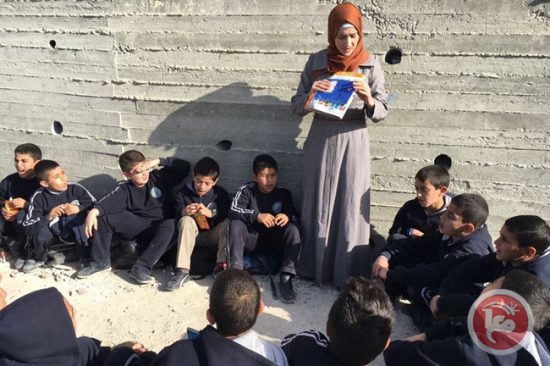
JERUSALEM – After Israeli authorities shut down a Palestinian elementary school in the occupied East Jerusalem town of Sur Bahir last Thursday over alleged “incitement” in its study materials, students attended class in the street on Sunday and protested against Israel’s decision to close the school.
Children who were enrolled at al-Nukhba (“the elite” in Arabic) arrived to the campus with their parents in an action organized by the parent committees of Sur Bahir’s schools, holding posters expressing support for al-Nukhba and denouncing Israel’s closure of educational institutions as “tyrannical.”
Last Thursday, head of the school Luay Jamal Bkirat and the school’s financial manager Nasser Hamed were summoned to an Israeli police station for interrogation, when Israeli intelligence officials informed them that the school was being shut down for carrying inciting content in the teaching materials used at the school.
Bkirat denied the claims, saying that al-Nukhba school was “teaching the Palestinian curriculum used in all schools in Jerusalem and that no one of the faculty had ever been summoned for interrogation before over incitement.”
He added that the school — which serves 250 boys from kindergarten to grade six — was opened last year and gained a temporary operating license from the Jerusalem municipality, and that the license was revoked in November for unknown reasons.
Bkirat condemned the decision and said that he would “conduct procedures to stop this decision which aims to destroy education.”
The Times of Israel reported that the school was shut down for being a “Hamas front,” after a months-long joint probe by Israel’s Education Ministry, Jerusalem police, and Israeli intelligence, the Shin Bet.
Israeli authorities from the education ministry claimed the school was established by Hamas with the aim of teaching “content that undermines the sovereignty of Israel,” and that the school’s aims were “consistent with the ideology of the terror organization, which calls for the destruction of Israel,” the Times of Israel said.
According to the Israeli news outlet, the ministry ordered the school not to open in September “and when it continued to operate, issued the closure order.”
Israeli Jews and Palestinians study in separate school systems in occupied East Jerusalem, with the Palestinian schools run by either Israel’s Jerusalem municipality, the Islamic Waqf and administered by the Palestinian Ministry of Education, private institutions, or UNRWA, the UN agency responsible for Palestinian refugees.
According to the Palestinian Ministry of Education, Palestinian children suffer from routine Israeli interference and political pressure to replace Palestinian curricula with an Israeli one in occupied East Jerusalem, where full Israeli military and civil control deprives students from proper and secure educational services.
A 2016 report by Israeli daily Haaretz also said that Palestinian schools in occupied East Jerusalem received less than half the funds that the Jerusalem municipality transferred to Jewish schools in West Jerusalem.
Though Sur Bahir lies beyond the periphery of occupied East Jerusalem, the town remained under full Israeli security and civil control within Israel’s Jerusalem municipality after the territory was illegally annexed in 1967.
A 2011 report by the Applied Research Institute – Jerusalem (ARIJ) said that due to a lack of some levels of education in Sur Bahir, many students were forced to attend schools in neighboring villages.
Elor Azaria verdict: a personal view
International Solidarity Movement | February 26, 2017
Hebron, occupied Palestine – Yesterday the Israeli soldier Elor Azaria was sentenced to 18 months in prison for the extra-judicial killing of Abdel Fattah al-Sharif, which happened last year in Hebron. Everybody in Hebron was waiting for the sentence. Everybody knew by one o’clock what it was. Everyone was heavy hearted. Palestinian friends compared a sentence of two years for stone throwing with Azaria’s eighteen months for murder. The implications here on the ground for what soldiers can do with impunity is also clear to all.
We at ISM had been in touch with Imad Abu Shamsiya, the Palestinian who filmed the execution, in case he wanted our support if the settlers were angry at the sentence as he has experienced large amounts of threats and harassment from both soldiers and settlers for bringing this incident to light.
Today I get email from the UK with news of how the case was reported on the BBC flagship morning show:
‘… almost all of the piece consisted of a discussion with their Jerusalem correspondent about Israeli anger that Azaria had been jailed. The fact that Palestinians were angered at the brevity of the sentence was tacked on as an afterthought. It was not explained that the Israeli soldiers are an army of occupation that is protecting settlers who are in Hebron illegally. It was not explained that Abdel Fattah al-Sherif had been lying injured and motionless on the ground for ten minutes and presenting no threat to anyone before Azaria executed him. Al-Sherif was described as “an attacker”, Azaria as “a soldier”. The framing of what happened could have been scripted by the IDF. The impression given was of the IDF acting in support of the civil authorities and being subjected to a military assault by enemy combatants. The right-wing Israeli perspective that Azaria was an inexperienced conscript who acted in the heat of the moment in battle was reported unchallenged. The alternative view that al-Sharif had committed grievous bodily harm or some such criminal assault before being totally incapacitated and that he was then murdered in cold blood by a heavily-armed agent of an occupying power was not given.’
Shame.
The video so bravely filmed by Imad which led to the case being heard at all can be seen here.
White House Cautioned Against Designating Iran’s IRGC a Terrorist Organization
By Stephen Lendman | February 26, 2017
In early February, unnamed US officials told Reuters the Trump administration might designate Iran’s Islamic Revolutionary Guard Corp (IRGC) a terrorist organization.
The White House didn’t respond to a request for comment. Iran categorically denies involvement in terrorism. No evidence suggests it, just baseless allegations.
Reports now indicate the proposed action stalled, US defense, state, and intelligence officials warning it could backfire, undermining Trump’s pledge to combat ISIS, along with complicating enforcement of the Iran nuclear deal.
US NATO allies are against it. The designation was supposed to be announced this month. It’s unclear if it’s suspended or cancelled altogether.
IRGC involvement is important in combating regional terrorism in Syria, Iraq and perhaps Yemen.
The administration’s proposal was part of a broader scheme to get tougher on Iran – instead of responsibly working to end 38 years of US-instigated adversarial relations.
If implemented, it would be the first move of this kind under the 1996 Foreign Terrorist Organizations law against a foreign government – meant for al-Qaeda and likeminded groups.
It would likely initiate tougher sanctions on Iran, possibly undermining the nuclear deal, sabotaging what took years to agree on.
Iranian Foreign Minister Mohammad Javad Zarif praised the IRGC’s efforts in combating terrorism, saying:
“The entire world admits that the IRGC has rendered the utmost support to (Iran’s) neighboring countries in the face of terrorism” – warning of adverse consequences if Trump orders more sanctions on Iran.
Reports indicate he intended to designate the ICRG and Egypt’s Muslim Brotherhood terrorist organization on Monday – during a visit to CENTCOM’s Tampa headquarters.
It’s believed Israel, Saudi Arabia and other Gulf states urged him to target Iran’s IRGC. It’s now on hold.
Stephen Lendman can be reached at lendmanstephen@sbcglobal.net. His new book is titled Flashpoint in Ukraine: How the US Drive for Hegemony Risks WW III.
Palestinians face intense online hate from Israelis, say campaigners
Palestinian lawyers call for investigation of police minister as survey shows soaring levels of anti-Arab speech on Hebrew social media

By Jonathan Cook • Middle Eastern Eye • February 25, 2017
Israel’s 1.7 million Palestinian citizens are facing a tidal wave of incitement and hate speech on social media, including from government ministers, community leaders have warned.
They say the increasingly hostile political climate in Israel is stoking violence from the police and street gangs, and has laid the ground for a recent raft of racist legislative proposals.
The alert comes as a group of Palestinian lawyers demand that Israel’s attorney general investigates Gilad Erdan, the internal security minister, for incitement to racism.
Adalah, a legal group for Israel’s Palestinian minority, highlighted statements from Erdan blaming Palestinian citizens for “arson terrorism” last November after forest fires swept the country, despite their having been no prosecutions.
“Israel has experienced arson terrorism and I won’t let anyone sweep this fact under the rug,” he wrote on Facebook in December. “Why does it seem unrealistic that Arabs would attempt to harm Jews?”
Adalah argued Erdan’s comments were part of a wider government strategy to portray Palestinian citizens, about 20 per cent of Israel’s population, as a “fifth column”.
Although other government ministers had incited, the group said, Erdan’s statements were especially harmful because of his role overseeing the police. Adalah said he was bolstering a police culture that already treated Palestinian citizens as an “enemy within”.
“Incitement from Erdan is dangerous because it reinforces and sanctions existing prejudices in the police,” Nadim Shehadeh, a lawyer with Adalah, told Middle East Eye. “As a result, the police are likely to have an even lighter finger on the trigger.”
Concern about the effects of incitement from leading politicians has been underscored by a survey published this month that found rocketing levels of online abuse from Israeli Jews against Palestinians.
 7amleh, an organisation promoting social media rights for Palestinians, identified 675,000 posts in Hebrew last year expressing racism or hatred towards Palestinians – one every 46 seconds, and more than double the previous year’s figure.
“There are terrifying levels of hate speech online from Israeli Jews,” Nadim Nashef, 7amleh’s director, told MEE. “No one in Israel – politicians, the police, the courts and the social media companies – has shown any interest in doing something about it.
“But it’s worse than that. The politicians are fuelling the problem. It has become completely normal in Israel to incite against Palestinians. You find it everywhere. It is entirely mainstream.”
The research identified more than 50,000 Hebrew speakers as persistent offenders on social media, especially Facebook, said Nashef. Spikes in online abuse correlated with incitement from Israeli politicians and the media, he added.
Popular terms of abuse included threats to kill, rape, burn, expel, and assault Palestinians.
Both Adalah and 7amleh said incitement from Israeli Jews was rarely investigated or prosecuted. Palestinians in Israel and the occupied territories, on the other hand, had their accounts closed or were arrested and jailed over less serious online activity.
7amleh said its research showed that the brunt of online abuse was directed at leading Palestinian politicians in Israel.
The most common targets were Haneen Zoabi, one of only two Palestinian women in the parliament, and Ahmed Tibi, a former adviser to the late Palestinian leader Yasser Arafat, 7amleh said. Both Zoabi and Tibi have reported regular death threats.
According to the survey, they received more online abuse than the leader of the Palestinian Authority in the West Bank, Mahmoud Abbas.
“When we are targeted rather than the Palestinian leadership in the occupied territories, a clear message is sent to the [Jewish] public that we have no place in the parliament and those we represent have no right to be citizens,” Zoabi told MEE.
 The climate of incitement had very concrete effects, said Zoabi: “It gives a green light to police violence. It is converted into shootings and deaths.”
She said dozens of Palestinian citizens had died in unexplained circumstances at the hands of the police in the last 15 years.
Zoabi also pointed to the increasing reports of gangs chanting “Death to the Arabs!” in Israeli cities and Jerusalem, as well as a growing incidence of street assaults.
Polls have shown high levels of racial prejudice among Israeli Jews. A survey last year found 49 per cent would not live in the same building as a Palestinian citizen.
Another showed a similar number of 16 and 17-year-olds would deny Palestinian citizens the right to vote.
Adalah said constant incitement from government politicians had made possible the drafting of ever-more discriminatory and anti-democratic legislation.
Shehadeh noted that recent laws allowed the parliament to expel the minority’s legislators over their views, and hampered the work of human rights groups assisting Palestinians.
Zoabi agreed. “Every week we see bills being introduced, such as a ban on the mosque call to prayer, or moves to step up home demolitions in Palestinian communities. The political culture sanctions ever more violence through legislation.”
Nashef said a turning point in the levels of incitement could be traced to comments by Israel’s prime minister, Benjamin Netanyahu, at the last general election, in early 2015. Netanyahu posted a video on Facebook telling the Jewish public it was vital they voted because “Arab voters are coming out in droves to the polls”.
“When the prime minister talks like this, then everyone else understands that it is okay to do it too,” Nashef said.
7amleh’s survey showed a significant peak of online incitement and hate speech last November, as hundreds of fires broke out across Israel and the occupied territories, triggered by a prolonged drought and high winds.
Despite the exceptional weather conditions, Erdan led government ministers in accusing Palestinians, especially those in Israel, of being behind the fires.
Adalah cited Erdan’s Facebook post from early December. Dozens of Palestinian citizens were arrested by police, but none have been charged with “nationalist crimes” over the fires.
Nevertheless, Netanyahu has continued to make similar accusations, stating last month: “That fact that we can’t prove it [that the fires were terrorism] doesn’t mean it’s not what happened.”
 Nashef said: “These inciteful statements garner a lot of media attention and our research shows they have a powerful impact in shaping public attitudes. But few notice when they turn out to be based on lies or misinformation.”
Adalah also cited comments by Erdan justifying the fatal shooting of Yacoub Abu al-Qiyan by police last month during a demolition operation in Umm al-Hiran, a Bedouin community in Israel’s south.
A police video and post-mortem examination report indicated that Abu al-Qiyan lost control of his car after he was shot, and careered into a group of policemen, killing one of them.
According to Israeli media, a justice ministry report – due to published next month – has found no evidence that Abu al-Qiyan carried out an attack or belonged to an extremist organisation.
Nonetheless, said Shehadeh, Erdan and other government ministers repeatedly accused Abu al-Qiyan, without evidence, of being an Islamic State terrorist.
Erdan tweeted hours after the two deaths: “The terrorist sharply turned his wheel and quickly accelerated in order to run over a group of police officers.”
Netanyahu’s office similarly described the incident as a “car-ramming attack”. Implying that Abu al-Qiyan was part of global trend of Islamic terrorism, Netanyahu said Israel and the world were “fighting this murderous phenomenon”.
Adalah’s letter to the attorney general also pointed out that Erdan had repeatedly blamed the deaths in Umm al-Hiran on Palestinian legislators there to protest against the demolitions. Erdan singled out Ayman Odeh, the leader of the Joint List, the Palestinian coalition in the parliament.
In comments to the media, he said: “Ayman Odeh and the rest of the MKs from the Arab [sic] List who have come to enflame sentiments this morning: This blood is also on your hands. … You are a disgrace to the State of Israel.”
In Umm al-Hiran, Odeh was himself injured twice, including to the head, by sponge-tipped bullets fired at him by police.
Problem with Facebook
Nashef criticised Facebook, where most of the online hate speech was found, for contributing to the problem.
Last summer Facebook agreed to crack down on what Israel defines as incitement by Palestinians. Paradoxically, Erdan was the minister who met the tech companies.
According to reports, in the first half of 2016, a tenth of all content restrictions imposed by Facebook globally were at the Israeli government’s behest.
But Nashef said nothing was being done to deal with incitement and hate speech from the Jewish public.
“It is not reasonable that large numbers of Palestinians have their accounts shut down or are arrested and jailed for online hate speech, while Israeli Jews can engage in the same or worse activity and there are no consequences,” he said.
Neither the justice or police ministries were available for comment.
7amleh said the biggest peak in online abuse followed the arrest last March of army medic Elor Azaria. He was filmed executing a badly wounded Palestinian, Abdel Fattah al-Sharif. This week he was sentenced to 18 months’ jail for manslaughter.
Several government ministers, including Netanyahu, expressed strong support for Azaria.
The survey showed another outburst of online abuse followed attacks last September by the culture minister, Miri Regev, against two Palestinian cultural icons.
She described the late national poet Mahmoud Darwish as the “leader of the Palestinian industry of lies”, and accused a popular rapper, Tamer Nafar, of giving “legitimacy to terrorism”.
Israel to build touristic park on Mount of Azzeitun in Jerusalem

Mount of Azzeitun
Palestine Information Center – February 25, 2107
OCCUPIED JERUSALEM – The Israeli municipal authority in Occupied Jerusalem plans to seize a large tract of Palestinian land on Mount of Azzeitun (Olives) to carry out development of a touristic park.
According to a report published by Iroshalim newspaper, a master plan for the park was submitted recently to the district planning and building committee in Occupied Jerusalem to obtain approval.
The local residents in Azzeitun area, however, are deprived of using the land where the park project would take place for building homes or establishing projects for their own benefit.
The new project will be 6.3 kilometers long and extend to the Hebrew University on al-Masharif (Scopus) Mount.
It will overlook the Old City of Jerusalem and include roads, bistros, public toilets, an information center, a souvenir store, a parking lot and other structures.
Israel seeks to carry out many Judaization plans in Jerusalem as part of its effort to change the historical Arab character and identity of the city.
Castigated by the Southern Poverty Law Center
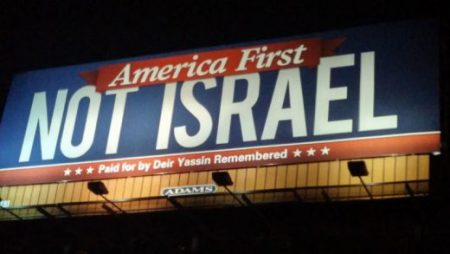
By Deir Yassin Remembered | Dissident Voice | February 24, 2017
The “public” that allegedly “protested” against this billboard in Ann Arbor, as reported by the Rochester Democrat and Chronicle, were not the only folks watching DYR.
The SPLC has now included DYR on its Hate Map.
Dan McGowan responds:
The Southern Poverty Law Center (SPLC) recently criticized Deir Yassin Remembered (DYR) by including it on the so-called Hate Map, purportedly for the high crime of Holocaust denial.
Apparently if the SPLC disagrees with you, it will label you as a racist or a hatemonger. There is no discussion, no defense, and no chance of winning a defamation suit against it.
The SPLC is the cash cow of the civil rights movement. Last year it took in over $58 million, some of which was added to its bloated endowment of over $328 million held in questionable investments, some in off shore accounts.
Its two chief executives together received over $800,000. Of its nine top executives, none come from minorities.
The SPLC claims to reject hate, embrace diversity, and respect differences. But often the SPLC and the people who believe their fear mongering behave exactly the opposite. The SPLC campaigns to deny free speech and freedom of association to groups of Americans with whom they disagree, often doing so to pander to other groups for more contributions all in the name of promoting “tolerance.” For example, if the British historian David Irving plans a lecture in Syracuse, the SPLC will protest any venue he might select, leaflet cars at his hotel saying, “There is a Nazi staying here,” and photograph and shout at anyone who might try to attend.
SPLC slime is not reserved solely for skinheads and members of the KKK. Dr. Ben Carson got a dose for opposing same sex marriage. SPLC later apologized but the charge never completely goes away, leading Carson to say that fear of being on the SPLC’s list serves to shut people up.
The SPLC makes money out of fear mongering and promoting the idea that Americans are inundated with hateful people, particularly on the radical right. The favorite target is the KKK and white supremacists.
The Baltimore Sun characterizes SPLC operations this way: “Its business is fundraising, and its success at raking in the cash is based on its ability to sell gullible people on the idea that present-day America is awash in white racism and anti-Semitism, which it will fight tooth-and-nail as the public interest law firm it purports to be.”1
It is understandable that the SPLC will run out of rocks under which to look for old KKK members and skinheads, but why criticize Deir Yassin Remembered, a small not-for-profit organization of Jews and non-Jews working to build a memorial for Palestinians murdered in 1948 on the west side of Jerusalem? DYR is certainly not the radical right. DYR practices and preaches tolerance; it has agreed to the advice of none other than the Latin Patriarch of Jerusalem that its memorial show the Christian tenet of forgiveness. Its advisory board boasts diversity; it is composed of half men, half women, half Jews, half non-Jews. It has worked continuously since 1994 for Palestinian human rights, including equal rights of citizenship, with no compensation for any executive and with less than $5,000 of reserves.
The answer lies in the writings of some of the DYR members who have questioned the use of the Holocaust as both the sword and shield of Israel. The Holocaust has been used to justify the need for a Jewish state and its expropriation of Palestinian land; the Holocaust is used to monopolize victimhood and defend Israel from criticism of its brutal and unending occupation.
But it is more than that. The Holocaust has morphed from a historical event to a religion, which must not be contradicted for fear of being branded an apostate or a hater or a denier or an anti-Semite. Religious faith is self-validating, impervious to reason, and regards proposals to scientifically validate its claims as profane in all senses of the word.
So, anyone who is skeptical about the number “six million,” about mass extermination in gas chambers, or about Nazi orders for extermination is to be named and shamed and hated. For this topic, there can be no diversity of opinion and no respect for inquiry or debate.
Don’t tell us that the United States government claimed Hitler murdered over 20 million people until the late 1970s when that number was officially revised downwards and carved in stone at 11 million. Don’t tell us that Jewish historians today claim the 5 million number of non-Jewish victims is overstated. Don’t remind us that the lampshade and the soap-from-human-fat stories were simple gruel propaganda and have no historical significance. Don’t remind us that Elie Wiesel took his violin to Auschwitz and that none of his family was gassed. Don’t remind us that Elie chose to retreat with the Nazis rather than be liberated from Auschwitz as was the father of Anne Frank.
Fear mongering and sliming little organizations like DYR is fake news. It is ridiculous disinformation to keep SPLC campaign money coming in. It foments hate and bigotry and intolerance by the very hypocrites who claim the opposite.
- “The truth about ʻhate crimesʼ and the racial justice racket” by Ron Smith, Baltimore Sun, December 3, 2008.
Deir Yassin Remembered seeks progress on behalf of the over 100 Palestinian men, women, and children who were victims of the Deir Yassin Massacre. Read other articles by Deir Yassin Remembered, or visit Deir Yassin Remembered’s website.
Featured Video

Liberty Cannot Exist Inside a Panopticon
or go to
Aletho News Archives – Video-Images
From the Archives
Left-leaning despisers of 9/11 Truth movement: Do you really believe in miracles?
David Ray Griffin | Global Research | 06 Jul 2010
An Open Letter to Terry Allen, Noam Chomsky, Alexander Cockburn, David Corn, Chris Hayes, George Monbiot, Matthew Rothschild, and Matt Taibbi.
[1]According to several left-leaning critics of the 9/11 Truth Movement, some of its central claims, especially about the destruction of the World Trade Center, show its members to be scientifically challenged. In the opinion of some of these critics, moreover, claims made by members of this movement are sometimes unscientific in the strongest possible sense, implying an acceptance of magic and miracles. … Full article
Blog Roll
 Aletho News
- EU sending ‘biased’ observers to interfere in Serbian election – president
- White House envoy declares kinetic action against Yemen ‘fruitless’
- Ukraine deployed thousands of microdrones in Iraqi Kurdistan: Tasnim
- Iran calls for emergency UNSC meeting over Trump’s ‘brazen’ bomb talk, Israeli threats
- Iranian sources reveal details of Russia-China Hormuz proposal
- Plan for more US-Israel integration puts our military tech at risk
- Another Round Against Iran Will Break What Is Left of the Gulf
- SVR Report on Ukraine’s Mexican Drug Gang Links Could Pressure Zelensky, Won’t Change US Policy
- British Government Employees Were Fact-Checking the News at the BBC. Nobody Told You.
- Albania on fire: who’s behind the riots?
- If Americans Knew
- Mysterious bot accounts reportedly spread fake ‘man on the street’ videos for Michigan Senate candidate
- Israeli Defense Minister Katz Says Over 60 Lebanon Villages Have Been Destroyed
- Why Is Israel Running TV Ads in Iowa Ahead of the Midterms?
- Hind Rajab’s Alleged Killer Is in the United States. HRF Demands His Arrest.
- US Officials Face Fresh Pressure After Another American ‘Brutalized’ by Israeli Settlers in West Bank
- Israel-Backed Palestinian Militias Terrorize Displaced Families in Gaza
- FBI subpoenas pro-Palestine activists over Israeli weapons plant disruption
- Fourth winter arrives in wartorn Gaza, too early – Daily Update
- More on how Bari Weiss is using CBS on behalf of Israel
- What the UK Is Doing to Pro-Palestine Novelist Sally Rooney Is an Act of Orwellian Villainy
- No Tricks Zone
- Predictions Made By Renowned Climate Proifessor Over Past Decades Have Been Proven To Be Poor
- New Study Suggests Large Regions Of The Pacific Ocean Have Been Cooling For The Last 80 Years
- Germany’s Green Energy Debacle: High Energy Costs Force Kahla Porzellan to Close After 182 Years!
- New Study: 50 Years Of The Most Aggressive ‘Net Zero’ Policies Can Only Affect The Global Climate By 0.03°C
- US September “Heat” Was No Record…Many Records Set Decades Ago
- Latest European Green Energy Debacle; Portugal’s Largest Flagship Solar Park Insolvent!
- Green Energy Debacle: German Expert Professor Fritz Vahrenholt Warns Of Severe Economic And Social Consequences
- Two More Paleo Reconstructions Affirm Meters-Higher Sea Levels Across Ireland, Brazil 7000-6000 Years Ago
- New Study: Earth And Venus Surface Warmth Largely Explained By Convection And Lapse Rate, Not CO2 Or Radiation
- 2025 Nature Paper Claiming Worsening Global Drought Gets RETRACTED …Heavily Flawed

