Israeli settlers torch mosque, copies of the Quran in West Bank
Al-Akhbar | November 12, 2014
A group of Israeli settlers broke in and torched a mosque in the Palestinian village of al-Mughayyir near Ramallah in the occupied West Bank early Wednesday, locals told Ma’an news agency, hours after settlers attempted to assault several Palestinian security officers in Nablus.
Witnesses, who went to the mosque at around 4:40 am to perform dawn prayer, said the settlers burnt 12 copies of the Quran, Islam’s holy book, and set the carpets of the first floor of the two-story building on fire.
Racist slogans were also spray painted on the walls of the mosque, witnesses added.
The same mosque has been targeted by Israeli settlers before, locals told Ma’an.
“Every time the mosque is torched, the (Israeli) occupation police conduct an investigation just for show, and never arrest a single settler,” one resident said.
The incident is the latest in a series of attacks carried out by the settlers against mosques in the occupied West Bank.
This year, in January and October, two mosques were set ablaze in the West Bank. Similarly, in 2012, settlers torched the entrance of a mosque near the city of Nablus.
The settlers also leave behind racist Hebrew script reading “price tag” or “Arabs out!” on the walls of the mosques.
On Tuesday, Israeli settlers smashed the windshields of more than 30 Palestinian vehicles and damaged other Palestinian properties during a rally on the main road south of Nablus in the northern West Bank.
Witnesses said that settlers also sprayed racist slogans, such as “No cars for Arabs” and “No terror attacks,” on a sidewalk.
Meanwhile, also on Tuesday, dozens of Israeli settlers from the Yitzhar settlement in southern Nablus attempted to assault several Palestinian security officers after they parked their car on the road at the entrance of the settlement.
Zakariya al-Sadda, a human rights activist with Rabbis for Human Rights, told Ma’an that Israeli settlers forced five officers from Palestinian security forces to stop while on their way to Ramallah to take part in a festival celebrating the anniversary of Yasser Arafat’s death.
The Palestinian Liaison Department intervened and solved the issue, Sadda said, adding that the Palestinian officers left the settlement’s entrance after dozens of settlers gathered and attempted to assault them.
Settler violence against Palestinians and their property is systematic and often abetted by Israeli authorities, who rarely intervene in the violent attacks or prosecute the perpetrators.
According to the UN Office for the Coordination of Humanitarian Affairs, there were at least 399 incidents of settler violence against Palestinians in the occupied West Bank in 2013.
Israeli authorities have also allowed Zionist settlers to take over homes in Palestinian neighborhoods both in annexed East Jerusalem and the West Bank, announced plans to build thousands of settlements strictly for Israeli settlers in East Jerusalem while ignoring Palestinian residents.
More than 500,000 Israeli settlers live in settlements across the West Bank and occupied East Jerusalem, in contravention of international law.
Israel occupied East Jerusalem and the West Bank during the 1967 Middle East War. It later annexed the holy city in 1980, claiming it as the capital of the self-proclaimed Zionist state – a move never recognized by the international community.
(Ma’an, Al-Akhbar)
Conflict Kitchen Responds to Pittsburgh Post Gazette Article of Nov. 6th

Conflict Kitchen | November 6, 2014
Post-Gazette writer Melissa McCart approached Conflict Kitchen with a set of questions of which were to be included in this article, published November 6, 2014. Unfortunately, Ms. McCart neglected to include any of Conflict Kitchen’s answers. Additionally, we specifically requested that Ms. McCart include the viewpoints of local Palestinians in this article, as well as her initial article on Conflict Kitchen’s Palestinian version. In both cases, she interviewed and did not include these very important voices.
Below are our responses to several of Ms. McCart’s questions to us, as well as statements made in the article.
MM: How have you responded to the criticism and the letter to The Heinz Endowments? Has there been any talk initiated by The Heinz Endowments of rescinding the grant to Conflict Kitchen?
CK: The Heinz Endowments has publicly made a statement to B’nai B’rith International disavowing their support for our current Palestinian version of the project. A press release posted by B’nai B’rith on their websites claims that The Heinz Endowments stated that this iteration of Conflict Kitchen “appears to be terribly at odds with [Heinz’s] mission of promoting understanding.”
Promoting understanding is at the core of Conflict Kitchen’s mission. We have demonstrated this in the past by presenting the food, culture, and viewpoints of Iranians, Afghans, Cubans, North Koreans, and Venezuelans. We believe that presenting the viewpoints of Palestinians promotes understanding of Palestinians.
Protecting freedom of expression from the influence of biased media and powerful political and lobbying groups is essential for the cultural and political health of a democratic society. We are extremely upset that one of Pittsburgh’s most important arts and culture funders would disavow their grant to us when seemingly pressured by strong outside forces.
MM: Has your programming been shaped by the accusations? If so, how?
CK: Conflict Kitchen’s goal is to increase the curiosity and understanding about the people who live in countries our government is in conflict with by directly exposing our customers to these cultures and viewpoints. Another goal is to raise the public profile of the minority Afghan, Iranian, Cuban, Venezuelan, and Palestinian communities who live and work in our region, thereby creating a more accurate depiction of Pittsburgh’s cultural diversity. These new accusations will not alter Conflict Kitchen’s goals with our current Palestinian version. Rather, they strengthen why our mission to increase curiosity and understanding is more important than ever before.
MM: And is your work serving its purpose in giving voice to Palestinians? Or has it surpassed your expectations?
CK: Yes, our customers have been incredibly interested in our food and the Palestinian viewpoints expressed in our printed materials and events, responding with sincere and thoughtful questions.
MM: When I went to the dinner, it was mentioned that Conflict Kitchen is feeding 300 to 400 people a day. Are you still feeding this many people a day? Is it more than any other country you’ve featured?
CK: The real story on our Palestinian version is that it is the most popular iteration to date, with 300-400 people a day coming to the restaurant. Our public is approaching us with trust, support, and open minds.
__________________
Responses to Pittsburgh Post-Gazette’s article and The Heinz Endowment’s statements:
Post-Gazette : John M. Ellis, senior director of communications with the Heinz Endowments, said, “There is another major issue at stake here concerning the rights of arts organizations to perform edgy and provocative programming. … That, in many ways, is the role of the arts, and while we may not always agree with the positions and opinions they express, we do support their right to express them.”
Conflict Kitchen: In a letter responding to B’nai B’rith, The Heinz Endowments President Grant Oliphant wrote: “I want to be especially clear that its current program on Palestine was not funded by the endowments and we would not fund such a program, precisely because it appears to be terribly at odds with the mission of promoting understanding.” Oliphant also wrote that “[the Endowments] emphatically does not agree with or support either the anti-Israel sentiments quoted on Conflict Kitchen’s food wrappers or the program’s refusal to incorporate Israeli or Jewish voices in its material.”
The Heinz Endowments cannot have it both ways.
Post-Gazette : John M. Ellis, senior director of communications with the Heinz Endowments states, “The grant was made to assist in the restaurant’s relocation from East Liberty to Schenley Plaza in Oakland.” Heinz Endowments president Grant Oliphant stated, “I want to be especially clear that its current program on Palestine was not funded by the endowments,”
Conflict Kitchen: The grant made to us was, as stated in the grant agreement, “To support Conflict Kitchen’s new programming and development at its new location in Schenley Plaza.”
Post-Gazette : “Each restaurant to-go order is wrapped in packaging designed with text from interviews with Palestinians living in the U.S. and Gaza.”
Conflict Kitchen: Palestine interviews, as stated on the wrapper, were conducted with Palestinians living in both Palestine and the U.S.” This includes both the West Bank and Gaza.
Post-Gazette : “One section homes in on what the restaurant identified as a Pennsylvania-based business.”
Conflict Kitchen: Quotes on wrapper are statements from Palestinians, not the voices of Conflict Kitchen.
__________________
The Post Gazette’s (and other media and lobbying groups‘) insistence on continually misrepresenting our food wrappers as “anti-Israeli messages,” shows a distinct lack of research into what is actually on the wrappers, a reinforcement of right-wing accusations made in other media, and thoughtlessness about our current situation.
Like we have done for four years with every other country of focus, our food wrappers contain the viewpoints of multiple people within our focus country on a wide variety of topics. Our Palestinian interviews are no different, they contain interviews on food, culture, the Palestinian Authority, settlements, dating, resistance olive trees, Nakba, movement and travel, and food customs. The interviews were done by us personally with Palestinians in Palestine, and in our own city. The thoughts and opinions that come through the interviews are informed by their personal context, experiences and histories as Palestinians. Perhaps it is hard for some people to hear that Palestinians are not happy with Israeli policies or the actions of some of its citizens, but to cast their viewpoints as simply anti-Israel is to reinforce the simplest, most polarizing, and dehumanizing reading of their lives and perpetuate the silencing of their voices.
We say read the ACTUAL wrapper, the whole thing. It is always on our website under Interviews (scroll down).
** Speaking of printed materials, we will soon be publishing a book of interviews with kids under 12 living throughout Palestine. See the version we did with Afghan kid’s earlier this year.
Iranian general accuses US of supplying ISIS with arms, aid
Al-Akhbar | November 9, 2014
The US delivered arms and aid supply to militants of the Islamic State of Iraq and Syria (ISIS) in eastern Iraq, Deputy Chief of Staff of the Iranian Armed Forces Brigadier claimed on Saturday, according to a report by the Iranian state news agency IRNA.
Describing the US’s fight against ISIS as a “lie,” General Massoud Jazayeri Jazayeri said “the US and the coalition air dropped weapons, ammunition, food and medical equipment to ISIS militants – which have been besieged by the Iraqi army – in Jalawla town of Diyala [in eastern Iraq] a few days ago.”
Jazayeri claimed that the US supported ISIS, currently in control of large swathes of territory in Iraq and Syria, since the beginning of the insurgency.
Iran and other critics opposed to US involvement in the conflict with ISIS have pointed out that Washington in partnership with its Gulf allies, including Saudi Arabia, played a role in the formation and expansion of extremist groups like ISIS by arming, financing and politically empowering armed opposition groups in Syria.
In a speech mid October, Iran’s supreme leader Ayatollah Ali Khamenei said that “America, Zionism, and especially the veteran expert of spreading divisions – the wicked government of Britain – created al-Qaeda and Da’esh (ISIS) in order to create divisions among Muslims.”
“A careful and analytic look at the developments reveals that the US and its allies, in efforts that are falsely termed countering Daesh, seek to create division and enmity among the Muslims rather to destroy the root causes of that (terrorist) current,” Khamenei said.
The US-led international coalition, which includes France, Germany, and Saudi Arabia, has carried out numerous airstrikes against ISIS in Iraq and Syria. However. the airstrikes have not been effective so far.
In September, Iranian President Hassan Rouhani told the United Nations that the West was responsible for “strategic blunders” in the Middle East and Central Asia that had created terror havens.
In a thinly veiled reference to the United States and Israel, Rouhani blamed the rise of violent extremists on outsiders.
“Certain intelligence agencies have put blades in the hand of madmen (ISIS’s extremists), who now spare no one,” he said.
Moreover, Iran believes US and Britain are using the Islamist threat to justify their renewed presence in the region.
“Experience of creation of al-Qaeda, Taliban and modern extremist groups demonstrated one can’t use extremist groups to counter an opposing state and remain impervious to the consequences of rising extremism,” he said. “The repetition of these mistakes despite many costly experiences is perplexing.”
Iran’s accusation appeared to be reference to Western support for the so-called rebel forces fighting the Syrian army and government.
Amongst the rebel forces, hardline Islamists are militarily the strongest.
Wasn’t Da’esh (ISIS) the same group who fought the Syrian government and the Syrian army? How is that they were not categorized as terrorists then?” and “Why is it that ISIS went from not-so-bad to extremely-bad depending on who they targeted in their terrorist operations?” Rouhani asked.
A study by the London-based small-arms research organization Conflict Armament Research revealed that ISIS jihadists in Syria as well appear to be using US military issue arms and weapons supplied to the so-called moderate rebels by Saudi Arabia.
(Anadolu, Al-Akhbar)
Israel to confiscate 3,200 acres of Palestinian land near Jerusalem
Ma’an – 08/11/2014
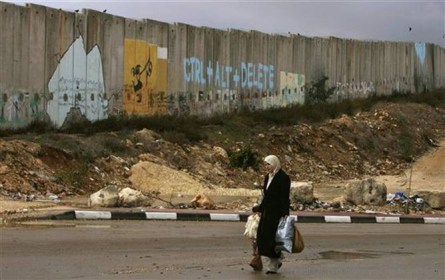
JERUSALEM – Israeli authorities have delivered orders to the village of Beit Iksa north of Jerusalem ordering the confiscation of 12,852 dunums (3,176 acres) of Palestinian land, locals said on Saturday.
Locals told Ma’an that soldiers deployed at the military checkpoint at the entrance to the village delivered confiscation orders signed by the Israeli military commander in the West Bank Nitzan Alon that gave them until Dec. 31, 2017 to remain on their land.
Villagers said that soldiers informed them that an official from the Israeli military liaison would arrive on Monday to specify which lands would be confiscated, adding that the lands confiscated would be used for “military purposes.”
If carried out, the confiscation would dramatically reduce the land available to Beit Iksa’s 1,700 people, the majority of whom are refugees who fled to the area in 1967 after the existing population of the village was forced to flee by Israeli authorities.
Although located immediately next to Jerusalem, the village’s lands have been progressively confiscated and the village is surrounded on all sides by the Israeli separation wall. Villagers can no longer travel to Jerusalem without permits, and Palestinians not resident in Beit Iksa cannot enter the single Israeli checkpoint that allows access to the village.
Ninety-three percent of the village is under full Israeli military control, and a majority of the total land of the village falls in areas outside of the separation wall, meaning they have been de facto confiscated, including about 1,500 dunums (371 acres) where Jewish-only settlements have been built.
The head of the Beit Iksa village council Saada al-Khatib told Ma’an that according to the order and the maps that soldiers had shown them Saturday, the lands that will be confiscated are between parcels 7 and 8 and include Haraeq al-Arab, Thahr Biddu, Numus, and Khatab areas around the village.
Al-Khatib added that the Israeli authorities claim that the confiscation order has been under way since 2012, and that the new order issued on Saturday only emphasizes the old order.
The order will prevent dozens of farmers from reaching their lands, he said, calling upon Palestinian ministries and national institutions to support the village of Beit Iksa and its neighbors.
He added that the order came after the Israeli municipality announced the approval of 244 housing units to be built in the Ramot settlement, which was previously built on lands confiscated from the settlement.
Al-Khatib warned that the land confiscation orders being issued to many villages include his own aim to carry out the “Judaization” of Beit Iksa after sealing the village shut and surrounding it with a checkpoint and the separation wall, turning it into an 2,500-dunum prison.
The Silence of the Israelis on ISIS
By Stephen J. Sniegoski | Consortium News | November 5, 2014
In the war on the Islamic State, the alleged scourge of humanity, little is heard about the position of America’s much-ballyhooed greatest ally in the Middle East, if not the world, Israel. Now the Islamic State has been conquering territory in very close proximity to the border of Israel. But Israel does not seem to be fearful and it is not taking any action.
And the Obama administration and American media pundits do not seem to be the least bit disturbed. This is quite in contrast to the complaints about other Middle East countries such as Turkey that are being harshly criticized for their failure to become actively involved in fighting the Islamic State.
For example, a New York Times editorial, “Mr. Erdogan’s Dangerous Game,” begins, “Turkey’s president, Recep Tayyip Erdogan, once aspired to lead the Muslim world. At this time of regional crisis, he has been anything but a leader. Turkish troops and tanks have been standing passively behind a chicken-wire border fence while a mile away in Syria, Islamic extremists are besieging the town of Kobani and its Kurdish population.”
An article in the Boston Globe read “Turkey has failed Kobani, Kurds.” An editorial in the USA Today was titled “Turkey waits as ISIL crushes Kobani.”
Neocon Charles Krauthammer in “Erdogan’s Double Game” compared Turkey’s failure to come to the defense of the Kurds in the surrounded border town of Kobani to Stalin’s unwillingness to aid the uprising of Polish nationalist forces in Warsaw in 1944, thus allowing the latter’s destruction at the hands of the Nazis.
“For almost a month, Kobani Kurds have been trying to hold off Islamic State fighters,” Krauthammer wrote. “Outgunned, outmanned, and surrounded on three sides, the defending Kurds have begged Turkey to allow weapons and reinforcements through the border. Erdogan has refused even that, let alone intervening directly.”
Even the normally antiwar Noam Chomsky expressed support for protecting the Kurds. “With regard to Kobani, it is a shocking situation,” Chomsky opined. “This morning’s newspaper described Turkish military operation against Kurds in Turkey, not against ISIS, a couple of kilometers across the border where they are in danger of being slaughtered. I think something should be done at the UN in terms of a strong resolution to call for a ceasefire.”
“It is hard to impose the use of force,” Chomsky continued, “but to the extent that it can be done try and protect Kobani from destruction at the hands of ISIS, which could be a major massacre with enormous consequences.” Chomsky added that “the strategic significance of the town in the Kurdish region is pretty obvious, and the Turkish role is critical in this.”
Israel’s Reticence
Returning to the issue of Israel, the fact of the matter is that Israel acts to protect its own national interests. At the current time, the primary goal of the Islamic State is to purify Islam rather than attack non-Muslims.
In response to Internet queries as to why the militant group wasn’t fighting Israel instead of killing Muslims in Iraq and Syria, its representatives responded: “We haven’t given orders to kill the Israelis and the Jews. The war against the nearer enemy, those who rebel against the faith, is more important. Allah commands us in the Koran to fight the hypocrites, because they are much more dangerous than those who are fundamentally heretics.”
As justification for this stance, the group cited the position of the first caliph, Abu Bakr, who began his caliphate by fighting against those he deemed apostates who still professed to be followers of Islam. (Shiites hold a negative view of Abu Bakr and his policies). Also cited was Saladin, who fought the Shiites in Egypt before conquering Christian-controlled Jerusalem.
Considering the Islamic State is targeting Muslims, the Israeli government does not see it as a significant enemy at this time. And it is reasonable for Israeli leaders to believe that the Islamic State would never move on to attack their country because it will never be able to conquer its major Islamic foes, though American military involvement would further secure Israel from any possible threat from the Islamic State.
Moreover, the fact of the matter is that the Islamic State actually benefits Israel by causing problems for those very states that do actively oppose Israel and support the Palestinians, such as Syria. What the Islamic State is causing in the Middle East is perfectly attuned with the view of the Israeli Right — as best articulated by Oded Yinon in 1982 — which sought to have Israel’s Middle East enemies fragmented and fighting among themselves in order to weaken the external threat to Israel.
Currently, these divisions are not only plaguing Syria and Iraq, but also Turkey, where ethnic Kurds are rioting because of the government’s unwillingness to help their brethren in Syria, and Lebanon, where the Shiite group Hezbollah — allied with Iran, Israel’s foremost enemy — is being assailed by the radical jihadist Nusra Front, which has the support of many Lebanese Sunnis. [See Jonathan Spyer, “The Shia-Sunni War Reaches Lebanon,” Jerusalem Post, Middle East Forum, Oct. 17, 2014.]
More than this, the Netanyahu government is trying to take advantage of the Islamic State’s aggression by falsely claiming that Hamas is its equivalent. In an address to the UN General Assembly on Sept. 29, Netanyahu asserted that “Hamas’s immediate goal is to destroy Israel. But Hamas has a broader objective. They also want a caliphate. Hamas shares the global ambitions of its fellow militant Islamists.”
Thus, Netanyahu claimed that it is wrong for countries to criticize Israel’s brutal treatment of the Palestinians in its conflict with Hamas, pointing out that “the same countries that now support confronting ISIS, opposed Israel for confronting Hamas. They evidently don’t understand that ISIS and Hamas are branches of the same poisonous tree. ISIS and Hamas share a fanatical creed, which they both seek to impose well beyond the territory under their control.”
In short, Netanyahu maintained that the Islamic State and Hamas were essentially identical, “when it comes to their ultimate goals, Hamas is ISIS and ISIS is Hamas.”
National Interest
Now there is nothing strange about Israel’s position here. It is simply acting in its own national interest. There is no reason to fight a group that doesn’t threaten it. Furthermore, it is in Israel’s interest to try to make it appear that it is acting for the good of all humanity when attacking Hamas, and though these arguments are unlikely to sway any UN members, the prime minister did provide ammunition to the Israel lobby and its supporters that could be used to persuade some gullible Americans.
It can be argued that if Israel openly entered the fray as a member of the anti-Islamic State coalition, it would be counterproductive. Since many Arabs see Israel as their major enemy, Israel’s involvement in the war would turn them against fighting the Islamic State and maybe even cause some of them to support that militant jihadist group as an enemy of Israel.
So it might be understandable that the United States would not demand that Israel participate in the war against the Islamic State, just as it did not expect Israel to fight against Saddam Hussein. Although this might be understandable, if true it would mean that Israel could not really be an ally of the United States in the Middle East because it could not participate in America’s wars in the region, which is the very raison d’état of an ally.
Conceivably, Israel could covertly support the enemies of Islamic State. Israel has been doing just that in regard to Syria. During the past two years it has launched airstrikes against Assad’s forces which has helped the rebels. Israel takes the position that any attacks on its territory from Syria are the responsibility of the Assad government even if they are made by the rebels.
Moreover, just like the United States, Israel has provided training for Syrian rebels. For example, Abdul-Ilah al-Bashir al-Noeimi, currently the Chief of Staff of the Supreme Military Council (SMC) of the Free Syrian Army, secretly trained in Israel in 2013 after being admitted into the country for medical treatment. [See “Report: Commander of Syrian Rebels Trained in Israel, Jewish Press News Briefs,” Feb. 24, 2014. In regard to Israeli participation in training Syrian rebels, see: Jason Ditz, “Report Claims US, Israeli Trained Rebels Moving Toward Damascus,” Antiwar.com, Aug. 25, 2013,; Jinan Mantash, “Israeli analyst confirms link between Israel, ‘moderate’ Syrian rebels,” Alakbar English, Oct. 17, 2014.]
Staying Out of the Fray
Israel’s pro-rebel activities in the Syrian conflict have not been counterproductive in that they have not caused any of Assad’s many Arab enemies to abandon their effort to remove his regime. But it is not apparent that Israel is taking any steps like this regarding the Islamic State, and the United States does not seem to be pressuring it to do so.
What this means is that Israel is not really any type of ally of the United States. It does not bend its foreign policy to aid the United States but only acts in its own interest. It takes actions against the Assad regime because the latter is an ally of Iran and provides a conduit for weapons being sent to Israeli’s enemy Hezbollah.
Israel’s inaction toward the Islamic State, despite its close proximity, should actually provide a model for the United States to emulate. It shows that the Islamic State should not be regarded as a threat to the faraway United States. And this lesson is further confirmed by the fact that the nearby Islamic countries, which should be far more endangered than the United States, do not seem to be fighting hard against it. It would seem that the fundamental way for the United States to face significant attacks from the Islamic State is to attack it first, which is exactly what it is now doing.
Considering Israel’s inactivity, it is ironic that in the United States it is the supporters of Israel, such as the neoconservatives, who have taken the lead in pushing for a hard-line American military position against the Islamic State. [See Jim Lobe, “Project for a New American Imbroglio,” LobeLog Foreign Policy, Aug. 28, 2014.]
Neocon Max Boot, for example, wrote about the need for “a politico-military strategy to annihilate ISIS rather than simply chip around the edges of its burgeoning empire,” which would “require a commitment of some 10,000 U.S. advisors and Special Operators, along with enhanced air power, to work with moderate elements in both Iraq and Syria.”
Fred and Kimberly Kagan have developed a strategic plan involving up to 25,000 American ground troops to combat the Islamic State, which I have already discussed at length. Some of the other noted members of the neocon war-on-the-Islamic-State chorus include Bill Kristol, John Podhoretz, Dan Senor, David Brooks, John Bolton, Richard Perle, Danielle Pletka (vice president for foreign and defense policy studies at the American Enterprise Institute), and, as noted earlier, Charles Krauthammer.
Needless to say, neither the neocons, nor any other mainstream commentators for that matter, have uttered a word about Israel’s inaction. As Scott McConnell wrote in August in The American Conservative, “over the past two generations thousands of articles have been written proclaiming that Israel is a ‘vital strategic ally’ of the United States, our best and only friend in the ‘volatile’ Middle East. The claim is a commonplace among serving and aspiring Congressmen. I may have missed it, but has anyone seen a hint that our vital regional ally could be of any assistance at all in the supposedly civilizational battle against ISIS?”
However, it would be far wiser for the United States to follow the example of Israel here — and, in fact, always follow the example of Israel by adhering to national interest (that of the United States, of course, not Israel) — than to follow the advice of those American supporters of Israel who have, because of their influence on American Middle East policy, involved the United States in endless wars creating a regional environment beneficial to Israel from the perspective of the Israeli Right.
Al-Arabiya echoes Zionist rhetoric in reporting about al-Aqsa
By Zeinab Hawi | Al-Akhbar | November 6, 2014
It was rather normal for Al-Arabiya news channel to retract its story about the unprecedented closure of al-Aqsa Mosque on October 28. The channel may have thought that the terminology it used would go unnoticed. However, Al-Arabiya later deleted the story from its website after having caused an online backlash for echoing Zionist rhetoric.
In an act further promoting Zionist terminology, the Saudi news channel replaced al-Aqsa Mosque with the “the holy compound,” a term usually reserved for Zionists in their reference to the holy site.
In fact, Israel had closed the mosque following the shooting of hardline Rabbi Yehuda Glick [allegedly] by Palestinian Mutaz Hijazi, with Al-Arabiya reporting the news as, “A right-wing Israeli activist was shot and wounded last night as he left a conference promoting a campaign to permit both Jews and Muslims to pray at the holy compound.”
The channel, hence, adopted the terminology used by Zionists. This caused an angry backlash over social media websites, with activists accusing Al-Arabiya of committing “political and religious treason” by adhering to the “Zionist plan” to Judaize Palestine.
However, after thoroughly reading Al-Arabiya’s report, one would notice that the channel not only resorted to Zionist terms, but framed the story in a manner that reflected the channel’s policy that complies with Zionism. The term “occupation” did not appear, not even by chance, and the channel opted to use “Israeli police” instead. Moreover, the story depicted Jewish hardliners present at al-Aqsa on an equal footing with Palestinians.
The story was hence reported as follows, “the Israeli police closed the Noble Sanctuary… in a rare step aiming to prevent clashes between Muslims and Jews.”
The hardline rabbi who was calling to “open the doors of the Noble Sanctuary for Jews” and promoting “prayers that gather both Muslims and Jews” is for Al-Arabiya a simple “right- wing Israeli activist.”
The scandalous coverage did not stop there; it also “reassured” that the Palestinian shooter – “the sole suspect” in the incident – was shot and killed by a police special force unit at his house in Abu al-Thuri neighborhood in Jerusalem.
Al-Arabiya did not settle for such biased reporting, it also quoted the director of Shaare Zedek Medical Center as saying that the rabbi is in “critical but stable” condition and that he underwent surgery after being shot in the chest and abdomen.
The closure of the al-Aqsa Mosque apparently meant nothing for the Saudi channel. It was more interested in reassuring the public about the health of the injured Zionist and making sure that the shooter “got what he deserved.”
In the end, it is not merely about adopting the Zionist settlers’ policy to change the understanding of the issue and the terminology used to define it, but it is about adopting a process aimed at wiping out the cause of not just a people but an entire nation, which the Saudi channel and its affiliates are slowly paving the way for.
Israeli forces demolish three houses, and several water pipes and roads in village near Nablus
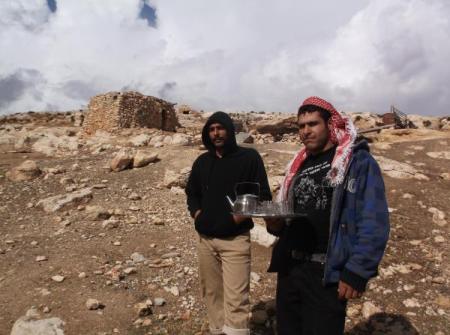
Sofian Maher and a local resident near their destroyed home near Khirbet Al-Tawil
International Solidarity Movement | November 4, 2014
Khirbet Al-Tawil, Occupied Palestine – Early on Monday morning, while the inhabitants of the village of Khirbet Al-Tawil, near Aqraba (Nablus), were sleeping, eight military vehicles, and 30-40 Israeli soldiers entered the village.
Within two hours the military had demolished three houses, and several water pipes and roads.
The water pipes destroyed were new and scheduled to be turned on Monday. The Aqraba community had funded these water pipes as part of the municipal water system.
Of their destruction, Sami Dariyah, stated: “They are trying to prevent people from living in this area. This is their clear policy.”
Due to the continuing demolition of houses, electricity lines, water lines and other living necessities, the farmers have fled to the city of Aqraba and departed their lands in Khirbet Al-Tawil. Sami Direyah grew up near Khirbet Al-Tawil and remembers the many houses and shops that used to be there.
Khirbet Al-Tawil is part of Area C (under full Israeli military civil and security control), which means the army can choose which buildings and activities are ‘allowed’. Sami wonders how their existing community, their farms and their 100-year-old houses, can suddenly become illegal.
Even though the three demolished houses were nearly 100 years old, dating back to the British occupation, they were all still active homes for families like the Mahers. The residents of the houses were not given any warning of the military’s planned visit. Sofian Maher, a former resident of one of these homes, spoke to ISM and explained that this is not the first time the military has paid a visit to Khirbet Al-Tawil. In May of this year the village’s Mosque was demolished, together with four houses, four cottages, and two barns. Less than one month ago the power line was cut by the military, leaving the village without electricity.
Sofian Maher explained to ISM that his family tried to rebuild their house after it was demolished in May. While rebuilding, Sofian’s family lived in a donated tent, which the army soon tore down. The family then moved into old stone huts that were built, long ago, to house animals while shepherding. Periodically the military returned and destroyed the newly rebuilt portions of their house.
The family is now trying to rebuild their home for the fourth time.
To further make the area uninhabitable, the military has destroyed large sections of the road leading to the remaining farms.
Featured Video

Racist Seinfeld Dances for Joy as Bibi Unveils His New Map
or go to
Aletho News Archives – Video-Images
TV Drama Review
Japanese drama projects Japan’s wartime atrocities onto Chinese characters

Global Times | October 25, 2026
By portraying Chinese characters as perpetrators of ruthless violence while casting Japanese Self-Defense Forces (SDF) intelligence operatives as defenders, the season 2 of the Japanese drama Vivant has recently drawn criticism from Chinese netizens, who argue that its depiction turns historical reality on its head while ignoring Japan’s wartime atrocities.
The TBS drama series – a spy suspense story in which an alleged unofficial intelligence unit of the SDF operates across the globe — has attracted a passionate fanbase. Its currently airing season 2 opened with a household rating of 18.8 percent, the highest for a TV drama this year, according toa commentary article by Japanese media Toyo Keizai.
What draws attention is the portrayal of the enemies in the series, the article noted. Scenes in which the Chinese organization subjects kidnapped members of the SDF unit to brutal torture are repeated with unrelenting intensity.
It is rare for Japanese TV dramas to explicitly portray a real-life country as the enemy, the article noted.
Japanese Prime Minister Sanae Takaichi also made a reference to the drama, saying that she has been recording Vivant and hopes to binge-watch it over the year-end and New Year holidays, according to Japanese media outlets.
China’s CCTV News report on Sunday revealed that the drama features scenes in which Chinese personnel cut off the fingers of and stab Japanese intelligence operatives in the abdomen. Such acts bear striking similarities to the torture inflicted on Chinese nationals by invading Japanese troops during the World War II.
The drama distorts the truth by attributing these atrocities to modern Chinese characters. Beneath the surface, it subtly glorifies Japan’s cross-border overseas operations, blurs the functional boundaries of the SDF and implicitly promotes an expansionist narrative, per CCTV News. … continue
Blog Roll
 Aletho News
- EU facing trillion-euro debt hole while seeking more cash for Kiev
- How US, Europe, Persian Gulf states exhausted missile stockpiles, splurged billions to defend Israel
- Up in arms… Koreans reject U.S. empire’s plan to make South Korea the next Ukraine
- Iran, Turkey, Pakistan, Saudi Arabia could advance region-led security framework in Tehran: FM spox
- Netizens condemn Japanese drama for projecting Japan’s wartime atrocities onto Chinese characters
- Racist Seinfeld Dances for Joy as Bibi Unveils His New Map
- A West Bank War for Netanyahu’s Election Campaign, Could It Backfire?
- Yemen denounces European Parliament’s ‘hypocritical’ push to blacklist Ansarullah
- Qalibaf: UAE’s UN bid aims to ‘clear the runway’ for ‘Greater Israel’, whitewash genocide
- Pakistan reopens Iran border after boosting security: Report
- If Americans Knew
- Why Israel’s latest assault on Hebron is so significant for the West Bank
- Israel Used “Where’s Daddy?” AI to Relentlessly Murder Palestinian Journalists and Their Families in Their Homes from October to December 2023
- DAILY UPDATE: Latest essential news on Palestine, Israel, & region
- Netanyahu Says Israel Must Prepare for Banking Sanctions, Floats Crypto as a Possible Bypass
- Latest updates from Israeli assault on West Bank
- Tourism Ministry launches free food truck tour in US
- “So Much Worse Than People Realize”: Never-Before-Seen Images Reveal Damage at U.S. Bases as Troops Describe Being Abandoned
- UK Bell Review Confirms Only Anti-Israel Attitudes Are Rising, Not Antisemitism
- DAILY UPDATE: Latest essential news on Palestine, Israel, & region
- DAILY UPDATE: Latest essential news on Palestine, Israel, & region
- No Tricks Zone
- Sudden Stratospheric Warming, Powerful El Niño Combination May Lead To Extreme Europe Cold, Energy Crisis!
- Two New Studies Find Thwaites Glacier Melt Cannot Be Driven By Human Activity Or A Warming Ocean
- E-Cars Reduce CO2 Emissions By Only 41% Compared To Internal Combustion Engine Vehicles
- Predictions Made By Renowned Climate Professor Over Past Decades Have Been Proven To Be Poor
- New Study Suggests Large Regions Of The Pacific Ocean Have Been Cooling For The Last 80 Years
- Germany’s Green Energy Debacle: High Energy Costs Force Kahla Porzellan to Close After 182 Years!
- New Study: 50 Years Of The Most Aggressive ‘Net Zero’ Policies Can Only Affect The Global Climate By 0.03°C
- US September “Heat” Was No Record…Many Records Set Decades Ago
- Latest European Green Energy Debacle; Portugal’s Largest Flagship Solar Park Insolvent!
- Green Energy Debacle: German Expert Professor Fritz Vahrenholt Warns Of Severe Economic And Social Consequences

