US House awards Gold Medal for war criminal Shimon Peres
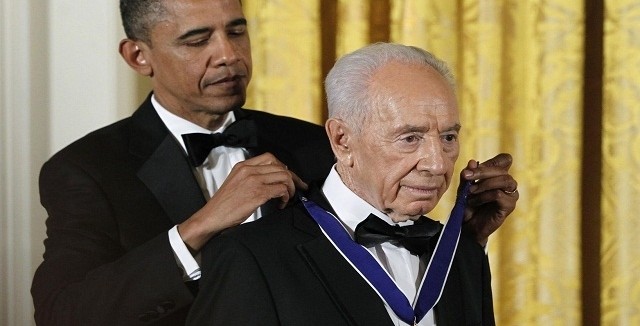
Photo – Sultan/thepoliticalforums.com
Aletho News | May 21, 2014
The US House of Representatives on Monday voted to give the Congressional Gold Medal to Israel’s outgoing president, Shimon Peres.
The bill which authorizes the creation of the gold medal and its award to Peres, HR 2939, is co-sponsored by Rep. Trent Franks (R-AZ) and Rep. Joe Kennedy (D-MA). It touts Peres’ “pivotal role in forging the strong and unbreakable bond between the United States and Israel” and states that “[b]y presenting the Congressional Gold Medal … Congress proclaims its unbreakable bond with Israel and reaffirms its continual support for Israel.”
The following excerpt from an open letter by the Palestinian Campaign for the Academic and Cultural Boycott of Israel recounts Peres’ career, emphasizing a record of war crimes:
On 18 April 1996, when Israel still occupied southern Lebanon, Shimon Peres was Prime Minister. He was in the midst of an election campaign, so he took a decision to do something to change his “dovish” image because doves are not respected in Israel. He launched “Operation Grapes of Wrath” causing 400,000 Lebanese to flee their homes, with almost 800 of them fleeing to a UN base in Qana, South Lebanon.
On 18 April the Israeli army shelled the UN shelter in Qana, killing 102 civilians, mainly women, children and the elderly. Many more were injured. Human Rights Watch, the UN and Amnesty International subsequently disproved the myth that the Israeli army did not deliberately intend to shell the UN base. Shimon Peres said at the time, “In my opinion, everything was done according to clear logic and in a responsible way. I am at peace.”
The Qana massacre led to Shimon Peres being denied the job he coveted at the time: that of UN Secretary-General. He should have been denied it anyway for being the architect of Israel’s nuclear programme — one which remains outside the scrutiny of the world even as Israel bays for the cessation of Iran’s pursuit of nuclear energy for civilian purposes.
Peres is on record for being responsible for other war crimes, from building colonies on occupied Arab land to endorsing a policy of extra-judicial killings, which murders Palestinians and other Arabs without the benefit of a trial or, in fact, any proof other than that provided by Israeli Intelligence, the Shin Bet. He also supports the siege on Gaza, the destruction of its airport, and the elaborate system of checkpoints all across the West Bank. He defends the demolition of Palestinian homes, and he justified the atrocities committed by the Israeli army in its recent war on Lebanon in 2006.
Peres is also on record for defending land gained during war, claiming that Israel has the right to the Golan Heights because it was gained during war.
A Senate version of the bill, co-sponsored by Sen. Michael Bennet (D-CO) and Sen. Kelly Ayotte (R-NH), passed by unanimous consent in March.
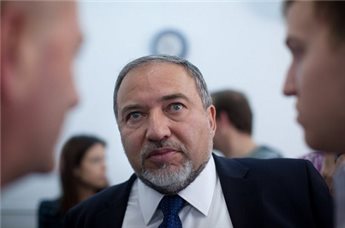
Israeli FM rejects “hypocritical” calls to investigate Palestinian teen killings
Al-Akhbar | May 21, 2014
Israeli Foreign Minister Avigdor Lieberman on Wednesday rejected as “hypocritical” world criticism and demands for an investigation into the killings of two Palestinian teenagers by occupation forces last week.
“I reject any demand” for an international investigation, he told reporters on a tour of the illegal West Bank settlement of Ariel.
“Such an incident will be investigated regardless of any demand,” he remarked, denouncing world criticism of the incident as “hypocrisy.”
His remarks came a day after calls by Washington and a top UN official for an immediate investigation into the circumstances of the two killings after video footage emerged showing the unprovoked shootings.
The closed-circuit footage, released on Monday by the NGOs Defence For Children International and B’Tselem, appeared to show separate incidents in which two youngsters were shot as they walked down the same street near Ramallah as Palestinians marked the 66th anniversary of the Nakba.
Although protests were taking place in the area on that day, there is no visible evidence of clashes in the footage.
Watch the footage:
The Palestinian leadership accused Israel of their “deliberate execution.”
But the Israeli army dismissed the footage as having been “edited,” and said it was investigating the incident.
Late on Wednesday, US State Department spokeswoman Jen Psaki said Washington expected the Israeli government “to conduct a prompt and transparent investigation to determine the facts surrounding this incident.”
And Oscar Fernandez-Taranco, assistant UN secretary general for political affairs, called for an “independent and transparent” probe.
He said it was “of serious concern that initial information appears to indicate that the two Palestinians killed were both unarmed and appeared to pose no direct threat.”
But Lieberman brushed off such calls.
“We don’t need an American demand” to launch an investigation, he said.
“We will do it as part our commitment to the Israeli army’s moral code.”
Israel had claimed that its occupation forces fired rubber bullets try to put down the protest, and denies using live bullets.
The the youths, identified as 16-year-old Mohammed Odeh Abu al-Thaher and 17-year-old Nadim Siyam Nawara.
In a separate development, the UN agency for Palestinian refugees on Wednesday published figures showing “a sharp increase” in the number of Palestinian refugees killed and injured by Israeli forces since the beginning of 2013.
According to UNRWA, there has also been a big increase in the numbers of those injured by live ammunition in 2014, with 43 wounded this year compared with 10 in the same period in 2013.
(AFP, Al-Akhbar)
Unlawful killing of two Palestinian teens outside Ofer
Al-Akhbar | May 20, 2014
Video footage obtained by a human rights group Monday showed the chilling shooting deaths of two Palestinian children by Israeli occupation forces last Thursday.
Israeli soldiers shot dead teenagers Mohammed Odeh Abu al-Thaher and Nadim Siyam Nawara during a protest coinciding with the 66th anniversary of the Nakba outside Israel’s Ofer prison near the West Bank city of Ramallah.
Israel had claimed it fired rubber bullets during the May 15 protest to disperse the protesters.
But footage released by the Defence for Children International (DCI) captured from a security camera at a nearby house shows the youths, believed to be aged 16 and 17, being shot dead as they calmly walked.
The video shows the first victim walking in the opposite direction of the occupation forces before he is struck by a bullet in the back. Onlookers immediately rushed to his aid.
The second victim is shot in the chest in the same location as he walked slowly. He falls to the ground and struggles to get back up as others assist him and signal for the occupation forces to cease fire.
Both children were unarmed.
“Israeli forces continue to use excessive force and recklessly fire live ammunition and rubber-coated metal bullets on unarmed protesters, including children, killing them with impunity,” Rifat Kassis, executive director of DCI-Palestine, said in a statement.
The report said a third, 15-year-old victim was shot in the back and left lung during the protest and is recovering at a Ramallah hospital.
International human rights groups have repeatedly condemned Israel’s use of deadly force against Palestinian protesters and civilians in the West Bank and Gaza.
The Holocaust Religion’s New Offshoot
By Richard Edmondson | Fig Trees and Vineyards | May 18, 2014
To considerable media fanfare, the National September 11 Memorial Museum held a dedication ceremony on Thursday, May 15 and plans to open its doors to the general public this coming Wednesday, May 21.
The new museum pledges itself to “demonstrating the consequences of terrorism on individual lives and its impact on communities at the local, national, and international levels”—and if 9/11 hasn’t already been elevated to the status of a full-blown religion in America, this should do it once and for all.
The new 9/11 religion will be devoted to endlessly remembering the events of 9/11 (“Never forget!”), and its main center of worship will be—where else?—“Ground Zero.” Ah, but the vast majority of the museum is not above ground, but rather below it. This was done so that visitors may “be in the very space where the Twin Towers once stood,” and also “because federal preservation law mandated that those remnants be publicly accessible.”
In some respects you could think of the new religion as an offshoot of the holocaust religion, and should you doubt the analogy, consider that the museum houses a 2,500 square foot repository in which are now stored the unidentified human remains—mostly bags of pulverized bone—of more than a thousand 9/11 victims…or…that no less than the president of the United States, along with the mayor of New York, have pronounced the ground upon which the museum sits to be “sacred.”
“A lot of family members have agreed that this is the right approach,” said Mayor Bill de Blasio, referring to the decision to store human remains on the site. “I’m confident this is being done respectfully after a lot of consultation with family members, and in a way that really dignifies this moment and the sacred ground we’re discussing.”
Consider also that, according to the museum’s website, “The National September 11 Memorial & Museum has partnered with the New York City Department of Education and the New Jersey Commission on Holocaust Education to develop a robust set of 9/11 lessons for K-12 classrooms.” It sounds almost like they’re planning to teach the kids the holocaust and 9/11 in the same lesson.
Built at a cost of $700 million, the museum features two “core” exhibition areas, both underground and located at the “archaeological heart of the World Trade Center site.” The exhibition halls are in proximity to what are known as the “Survivors’ Stairs,” and are packed with exhibits, including “artifacts, photographs, audio and video tapes” and much, much more.
But the possibility that Israel may have been one of the principle perpetrators behind the 9/11 attack doesn’t seem to be in the mix anywhere. At least there’s no mention of it on the official website, so if you do plan to visit the museum (admission $24), I wouldn’t count on seeing any exhibits on the luck of Larry Silverstein, the five dancing Israelis, Urban Moving Systems or its activities as a Mossad front operation, or a vast body of other evidence pointing to Israeli involvement in the attacks.
You will, however, should you show up on May 25—that’s four days after the main opening—get to attend a program entitled “9/11 Conspiracy Theories: Why They Exist and What Role They Play in Society,” featuring talks by Kathryn Olmstead and Michael Barkun. Both are noted academics, and both have authored books on the subject of conspiracy theories.
In fact, the 9/11 religion, as a main tenet of its faith, seems very much devoted to espousing the grandest conspiracy theory of them all—i.e. the official government narrative as determined by the 9/11 Commission, whose executive director, Philip Zelikow, is reportedly an Israeli/US dual citizen.
In that narrative, of course, we have 19 hijackers outwitting the intelligence agencies of the West, winging past NORAD defenses, ramming planes into the Twin Towers and the Pentagon, and accomplishing all this with relatively little flight training. And in case you should happen to forget, the 9/11 Museum seems quite intent on reminding you—these people were Muslims. One of the museum exhibits is to be a film entitled “The Rise of Al Qaeda,” which has set off a controversy (more about which below).
The 9/11 Memorial Museum consists of both the museum itself, as well as the 9/11 Memorial. The latter is located on the grounds above and around the museum, and its prominent features are two cascading reflection pools, each nearly an acre in size, bordering which the names of 9/11 victims are set in bronze.
The director of the museum is Alice Greenwald, while the CEO of the nonprofit overseeing both the museum and the memorial is Joseph Daniels. And then there is Clifford Chanin, who serves as the museum’s education director. Together the trio seems to be heavily involved in the day-to-day administration of the enterprise, and further they seem to be the three officials most often mentioned or quoted by the media.
In addition, all three—Chanin, Greenwald, and Daniels—are listed as having helped host a conference of the Council of American Jewish Museums that took place in March of 2013, while Chanin himself participated in one of the event’s panel discussions—entitled “Handle With Care: Sensitive Issues Surrounding Cultural Property”—along with Gabriel Goldstein, of Yeshiva University Museum, and Richard Freund, of the University of Hartford.
Chanin, by the way has also served as curator of the Legacy of Absence collection for the Illinois Holocaust Museum and Education Center, and reportedly also founded the Legacy Project, described as a nonprofit group “dedicated to documenting contemporary responses—in visual art, literature, film and public debates about memory—to historical traumas around the world.”
As you may imagine, obsessing over the holocaust— “in visual art, literature, film…” etc.—is a central preoccupation of the Legacy Project, but it seems Chanin has carried the same template into his work with the 9/11 Museum. On the official museum website, you can find an artists registry featuring a variety of artwork—from music and poetry to visual arts—with a 9/11 theme, plus information about the artists who created them.
One artist so featured is Lana Sokolov, an Israeli vocalist, choir conductor, and composer, who has a CD out entitled “Jewish Love Songs.” Ms. Sokolov is described as having been “active on the music scenes of Israel, Russia, and the US for the last 17 years,” and you can click here to watch a music video of her 9/11 song, “On That Day.”
Is there a continuum through all this? If Israelis were behind, or had a hand in, the destruction of the Twin Towers, then would it perhaps stand to reason that Israelis would also be behind (and profit from) the construction of the memorial built upon the same spot in their place?
The architect who designed the 9/11 Memorial, including its two pools, is Michael Arad, an Israeli/US dual national who previously served in the Israeli military. Reportedly Arad was chosen on the basis of having entered a competition, held back in 2003, in which contestants were invited to submit their designs for a 9/11 memorial. His design was selected out of a total of 5,201 entries, it was divulged.
“When I was in the Army, the unit I served in, you could never stop,” said Arad, speaking of his time served in the Israeli Army, which was during the first Intifada. “It was a volunteer unit, and there was a fairly high rate of attrition. The people stayed through are the people who were either great at it or the people who just didn’t know how to stop. And I fell into that second category.”
By all counts, Arad has an explosive temper, and he frequently clashed not only with other architects on the project, but also with the Lower Manhattan Development Corporation, the government agency overseeing the task. Especially rocky, it seems, was his relationship with architect Daniel Libeskind, who is also Jewish.
Libeskind drew up what has been referred to as the “ground zero master plan,” and it seems an habitual source of friction between the two men was Arad’s “significant departures,” in his own design for the memorial, from Libeskind’s overall master plan for the entire 16-acre site. (Two other architectural firms also involved in the project were Davis Brody Bond and Snøhetta, and reportedly there was considerable bickering between Arad and the rest).
“I will fight this!” Libeskind reportedly railed at one point. “I am the people’s architect!”
Perhaps the old adage about “two Jews and three opinions” is applicable here. But whatever the case, it seems the national memorial to the events of September 11 has been “hijacked,” in a manner of speaking, apparently in an effort to shape national perceptions—not only as they pertain to the substance and meaning of the tragic episode (tragic for the entire world), but also as to the character and distinctive traits of those purportedly behind the attacks.
As mentioned above, one of the museum exhibits is a film entitled “The Rise of Al Qaeda,” a short documentary—less than seven minutes long—but one over which there has been considerable controversy.
While it has not yet been made available to the general public, the video, narrated by NBC anchor Brian Willams, was screened before an interfaith advisory group, whose members have criticized it as inflammatory toward Muslims.
Their reactions are reported in an April 23, 2014 New York Times article, while two members of the group also registered their concerns in a letter to Greenwald, a letter which can be accessed in PDF form here.
As you know, many members of the Interfaith Advisory Group have expressed reservations about the narrative script for the documentary. Following our group’s request for a second viewing of the documentary and for a meeting with you, we expressed our concerns that, given the content of the video, museum visitors who do not have a very sophisticated understanding of the issues could easily come away equating al-Qaeda with Islam generally. We continue to posit that the video may very well leave viewers with the impression that all Muslims bear some collective guilt or responsibility for the actions of al-Qaeda, or even misinterpret its content to justify bigotry or even violence toward Muslims or those perceived to be Muslim (e.g., Sikhs). Equally troubling is Brian William’s narrative juxtaposed to the English translations. All American sources, news quotations and narrative are recorded in “Media English”, whereas translations from Middle Eastern sources were recorded in English or broken English with a heavy Middle Eastern accent.
The writers of the above are Peter Gudaitis, of New York Disaster Interfaith Services, and the Rev. Chloe Breyer, of the Interfaith Center of New York. According to the Times, they and other members of the group had been invited to take a pre-opening tour of the museum, to walk through and view its exhibits, and for the most part, says the Times, their impressions were favorable—that is, until they saw the film.
“As soon as it was over, everyone was just like, wow, you guys have got to be kidding me,” Gudaitis said.
Objections centered around the film’s use of such words as “Islamist” and “jihadist” without sufficient elaboration, possibly leaving the impression that Muslims in general condone terrorism. It was at this point that Gudaitis and Breyer wrote their letter to Greenwald—and yes, they did receive a reply from museum officials, but according to the Times, it was an unintentional one:
The response from the museum was immediate, though accidental: Clifford Chanin, the education director, inadvertently sent the group an email intended solely for the museum’s senior directors, indicating he was not overly concerned.
“I don’t see this as difficult to respond to, if any response is even needed,” he wrote.
A Muslim member of the interfaith group was so incensed over the matter he resigned from the panel.
“The screening of this film in its present state would greatly offend our local Muslim believers as well as any foreign Muslim visitor to the museum,” said Shiekh Mostafa Elazabawy, imam of Masjid Manhattan. “Unsophisticated visitors who do not understand the difference between Al Qaeda and Muslims may come away with a prejudiced view of Islam, leading to antagonism and even confrontation toward Muslim believers near the site.”
But the film has also been defended by Bernard Haykel, a professor of Near Eastern studies at Princeton University, who supposedly “vetted” the script.
“The critics who are going to say, ‘Let’s not talk about it as an Islamic or Islamist movement,’ could end up not telling the story at all, or diluting it so much that you wonder where Al Qaeda comes from,” said Haykel, whose father is a Lebanese Christian and whose mother is Jewish.
Gudaitis and Breyer, in their letter, suggested some re-editing prior to the museum’s opening, or, should that not be possible, a disclaimer, placed either at the front of the film or in the room where it is shown, reading:
“This video in no way intends to imply that the vast majority of Muslims agree with or support the attacks perpetrated by the members of al-Qaeda. Most Muslim leaders and Muslim organizations worldwide have disavowed the ideology and actions of Al Qaeda. The Museum’s documentation of Al-Qaeda-inspired terrorism should not be mistaken for any implicit or explicit justification for racial, religious or ethnic profiling.”
But their suggestion was rejected. You can go here to watch a video of Chanin interviewed by Megyn Kelly on Fox News and insisting that, “The film will be shown as we’ve developed it.”
The issue of the storage of human remains at the museum has also stirred up a controversy. Museum officials assert that the decision was made in conjunction with the family members of 9/11 victims, and that it was handled respectfully… but not all the families are in agreement on that matter.
On Saturday, May 10, in a ceremony that had all the flavor of a religious rite, the remains were transported from the medical examiner’s office, where they were stored in the past, to the museum, to be housed in the special, 2,500 foot repository. Accompanied by blinking red lights, the procession was a solemn one, with more than 7,900 bags of bones and other remnants of the deceased victims being carried in three large, flag-draped containers.
According to one report, officials have stressed that “the remains will not be part of the museum’s exhibit and that their lost relatives’ bones will not be subjected to ghoulish gawking by strangers.” Nonetheless, the procession was met with a protest by a group of family members, many of them wearing black ribbons tied around their mouths. One of the protesters, Jim Riches, is quoted at length in a report at Voice of Russia.
“He was the hero before 9/11 and he was the hero after 9/11,” said Riches, speaking of his son, a 29-year-old firefighter who died in the attack and whose remains are among those that have yet to be positively identified by DNA sample.
Riches said the families were never polled to find out what they thought about the placement of the remains. He said many families wanted the remains above ground in a place that could be visited at any time, not one that closes at night like the museum will. “People have to pay 24-dollars to go pay their respects; it’s ridiculous”, he said.
Riches called the museum “a cash cow”. He said the nonprofit that runs the museum has paid their top executive and director close to half-a-million dollars a year. He said he thinks it’s “double what people from the National Park Service would bring in to do the same job at other national memorials like Pearl Harbor, Gettysburg and Shankesville.
“These guys are thinking of this as a revenue generating tourist attraction rather than being a memorial to our loved ones that would tell the story of what happened that day. We’re outraged,” he said.
You can also go here to access a website put up by the family members.
The dedication ceremony, held last Thursday, was attended in the main by dignitaries, family members (though presumably not the same ones protesting), and the media. On hand to deliver a speech was Obama, who at one point referred to the museum as a “sacred place of healing and of hope.”
But is it really? What are we to make of this museum, its architectural finesses, and its $700 million aggrandizement of a national tragedy? How do we interpret the stubborn refusal to change the “Rise of Al Qaeda” video or to at least put up the altogether reasonable disclaimer requested by the interfaith group? The museum seems very much to have been built, at least in part, with the intention of buttressing the official 9/11 narrative.
“In the battle for the American mind, reinforcements are often needed to stem the tide of truth,” writes Kenny, of the blog Kenney’s Sideshow, in a post on the museum put up on the day of the dedication ceremony.
And that may be an apt way of looking at it. The official 9/11 narrative is unraveling. Increasing numbers of people all over the world, including here in the US, have come to realize that it simply does not hold water. Perhaps, then, “reinforcements” were put in place, $700 million worth, in an effort to keep the whole artifice from falling apart at the seams.
The events of 9/11 gave birth to something truly monstrous. Nearly 3,000 people lost their lives that day in New York, but it is a number relatively miniscule compared to the millions who perished in the wars which were fought afterward and which still go on to this day. At this point perhaps all one might do is ask the perennial question: Who benefited? The official mission of the 9/11 Memorial Museum, as defined on its website, is to “bear solemn witness” to the attacks, and also to “honor” the victims. Yet I wonder if this man…
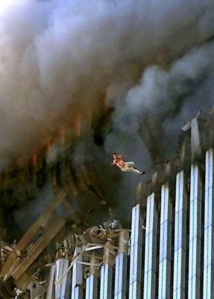
…would feel himself so honored had he known that one day, in his memory, rising up in place of the building from which he plummeted, would arrive what could perhaps be thought of as a festival of the victorious posing itself as a canto to the dead. They say that in such moments as this, captured in the frame above, your whole life passes in front of your eyes. And truly I can only believe that at some point on the way down, free-falling past the office windows one by one, there came over him a sense of heightened consciousness, a moment of consummate awareness, of celestial, perhaps even omniscient realization, when the question mark in his mind turned into… an exclamation point!
Emmanuel Eisenberg explains his right to disregard international law and destroy private property
Excavations continue on Abu Haikel Land
CPTnet | May 19, 2014
AL-KHALIL (HEBRON) – The Israeli Antiquity Authority (IAA) continues to expropriate Palestinian land in Hebron, on the Tel Rumeida hillside. On Sunday 18 May 2014, the IAA workforce, under the instruction of project coordinator Emmanuel Eisenberg, continued to cause structural damaged to the Abu Haikel land, deploying questionable and illegal archeological practices, while at the same time utilizing the Al Jobeh family’s land without the family’s consent.
The excavations are illegal under Israeli law, according to the Oslo Agreement, which Israel signed in the mid-90s— a process jointly agreed upon by Israel and Palestine as a vehicle to peace and stability. Article 2 of the Israeli-Palestinian Interim Agreement describes in detail how Israeli and Palestinians would jointly administer archeological projects in Palestinian territory. The IAA has not abided by this agreement in Tel Rumeida.
As previously reported, the IAA had verbally agreed to halt the archeological excavations on the land bordering the Abu Haikel plot until the borders of the property were properly demarcated. Despite the agreement, the IAA illegal activities continued onto the Abu Haikel’s property, eventually undermining a retaining wall, causing it to collapse and exposing the roots of a centuries-old olive tree to the elements. These breaches were not the first damage to the Abu Haikel land as a result of the excavations.
The disregard of both international law and Israeli law, combined with verbal and physical assaults of the families living on Tel Rumeida is not an isolated incident, but rather constitute a colonial methodology by the Jewish settler enterprise in Israel. These tactics were the same political instruments that led to the establishment and expansion of the Israeli settlement of Tel Rumeida.
Explaining how he could destroy the foundations of the Abu Haikel’s wall, Emmanuel Eisenberg said explicitly that he, “Doesn’t give a shit,” and articulated at length the nature of his work, in which he envisioned the site becoming a tourist destination with a kiosk or restaurant on the Palestinian lands. At one point during the dialogue, Eisenberg had attacked a human rights observer.
As has been chronicled by Israeli Jewish historian Illan Pappe, among others, forced displacement, harassment, and the suppression of basic rights has been the central component of Israeli policy toward the Palestinians. This reality is demonstrated with facts on the ground in Hebron specifically, with over a thousand Palestinian homes and shops evacuated, razed, or confiscated for the benefit, protection, and expansion of Jewish settlements.
Eisenberg’s work on Tel Rumeida is an extension of formal Israeli policy to settle in “Judea and Samaria” and another instrument of the settlement plan to force Palestinians to leave Hebron.

The gate to the Abu Haikal house
Israel postpones moving its ministries to Jerusalem for five years
MEMO | May 19, 2014
The Israeli government has decided to postpone moving its ministerial offices to Jerusalem for five additional years; Israel’s Haaretz newspaper reported.
The newspaper pointed out that the government took the decision during its weekly cabinet meeting, chaired by Prime Minister Benjamin Netanyahu, who endorsed the decision.
The paper noted that the government has decided to postpone the move due to two factors; one the fear of the international reaction possibly an angry nature and the need to prepare the city to receive the vast number of employees who will have to relocate their residence there.
Haaretz said that transferring the ministerial offices and headquarters to Jerusalem is one of the most dangerous settlement projects in the city and paves the way for increasing the number of settlers in East Jerusalem.
Meanwhile, Jerusalem mayor, Nir Barkat called to modify the resolution and move the government’s offices to Jerusalem soon, considering the government’s decision to postpone the move a serious insult to the city.
West Funds Insurgencies
By Felicity Arbuthnot | Dissident Voice | May 19, 2014
Thursday, May 15 marked Nakba Day, Yawm an-Nakba, “Day of Catastrophe”, the onset of the displacement of up to 800,000 Palestinians, at the time 67% of the population, followed by the destruction of over 500 villages since the establishment of the State of Israel in 1948, under the commitment agreed to by the then British Foreign Secretary, Lord Arthur Balfour, in November 1917.
This week: “Figures released by the Ramallah-based Central Bureau of Statistics … put the number of registered Palestinian refugees at 5.3 million. Those refugees live in 58 United Nations-run camps in Syria, Lebanon, Jordan, the West Bank and Gaza Strip.” Tragedy on a scale near unimaginable – ongoing.
Hardly the day to plan another one. However, undaunted, Britain’s current Foreign Secretary, William Hague (“I have been a Conservative Friend of Israel since I was sixteen”) hosted a meeting of the “Friends of Syria” group (Egypt, France, Germany, Italy, Jordan, Qatar, Saudi Arabia, Turkey, the United Arab Emirates, the UK and the US) to continue plotting to further decimate another Middle East country and overthrow yet another sovereign head of State.
As increasingly chilling, verified images appear of “opposition” – read insurgent – atrocities in Syria: beheadings, behandings, crucifixions, summary executions and, of course, cannibalism, Hague announced that: “the Syrian opposition would have its diplomatic status in the UK upgraded”, according to the BBC.
The Foreign Secretary was clearly following in his master’s footsteps since last week the Obama regime granted diplomatic foreign mission status to the “Syrian National Coalition” offices in New York and Washington, with a welcome present of a further promised $27 million increase in “non-lethal assistance to rebels fighting to oust President Bashar al-Assad.” This brings the total US support for the above crimes to $287 million.
Strangely, two days before the London meeting, it was announced that Israel’s Justice Minister Tzipi Livni was awarded “special mission” temporary diplomatic status to visit London, “to protect her against arrest and potential prosecution for alleged breaches of international law, including war crimes” relating to Israel’s attack on Gaza in December 2008-January 2009.
In December 2009 Livni cancelled a visit to Britain after an arrest warrant was issued by a London Court. “The British government subsequently changed the law on universal jurisdiction … in connection with international war crimes … Previously, citizens could apply directly to a Judge for an arrest warrant.”
Currently, London lawyers Hickman Rose working with Gaza’s Palestinian Centre for Human Rights (PCHR) had again been seeking a warrant for Livni’s arrest, Hickman Rose requesting that the Crown Prosecution Service advise the police to apprehend her: “for suspected war crimes and to liaise with the Attorney General to approve criminal charges.”
PCHR Director Raja Sourani commented of the Foreign Office’s stunt: “As lawyers for the victims of widespread suspected Israeli war crimes, PCHR is very concerned that these kind of political acts endorse the ‘rule of the jungle’ rather than the ‘rule of law.’” Indeed.
The Foreign Office is remarkably selective when it comes to alleged war criminals. Livni’s visit met “all the essential elements for a special mission, and for avoidance of any doubt on the matter, the Foreign and Commonwealth Office has confirmed consent to the visit as a special mission”, they commented.
The reason for Livni’s visit was shrouded in secrecy. What is known that the evening of the “Friends of Syria” meeting, she was to address a fund- raising dinner for the Jewish National Fund at London’s luxury Jumeirah Carlton Tower Hotel ($725 a night current lowest available rate, no wonder funds are needed.) But all those Foreign Office diplomatic sleights of hand to enable something she could have done by video-link?
Well, here’s a thought. Two days before Ms Livni’s arrival in London aided by the Foreign Office’s diplomatic goal post displacements, Major General Amos Yadlin, former Deputy Commander of the Israeli Air Force, who headed military intelligence between 2006-2010 said that “ Israel should weigh launching a military strike at Syria if the Assad regime uses chemical weapons against his civilian population …”
Preferable, though, mooted the General, would be a NATO led action led by the US, with Turkey the key country, establishing a no fly zone over Syria “at the very minimum.” Libya revisited. There should also be “standoff strikes” by NATO aircraft at strategic government targets.
“If Israel discovers that Assad is using chemical weapons against his people in mass attacks, it should intervene militarily”, said the representative of a regime who has used chemical weapons – not alone white phosphorous but also depleted uranium, both a chemical and radioactive weapon – against the Palestinians. Ironically, the article is headed: “Israel should punish Assad for killing civilians”, an expertise Israel has honed with impunity over sixty-six years.
Right on cue, on May 13th, in the lead to the London Conference, Human Rights Watch produced a report of “strong evidence” that Syrian government forces were using chlorine bombs.
Coincidentally, the previous day a letter had been sent to Kenneth Roth, Executive Director of Human Rights Watch, querying the organization’s seemingly extraordinarily partisan relationship with the US government.1
A flavour of the content is at paragraph 2:
For example, HRW’s Washington advocacy director, Tom Malinowski, previously served as a special assistant to President Bill Clinton and as a speechwriter to Secretary of State Madeleine Albright. In 2013, he left HRW after being nominated as Assistant Secretary of State for Democracy, Human Rights & Labor under John Kerry.
The letter was also signed by former UN Assistant Secretary General, Hans von Sponeck, current UN Special Rapporteur on Human Rights in the Palestinian Territories, Richard Falk and over one hundred scholars
John Kerry was, of course, also in London for the meeting, two days after he and President Obama had met with alleged former brothel owner Ahmed al-Jabra, who heads the “Syrian National Coalition”, in Washington. Jabra too had hopped on a ‘plane to London to attend the up-market plotting venue. A world away from the prison cell in Syria where he allegedly spent time for drug dealing.
Al-Akhbar has written regarding Ahmed al-Jabra of security records showing him:
“as a fugitive wanted for criminal offenses, including fraud, corruption, and even assassination plots that were not carried out. According to the source, records show that Riyadh handed over ‘the suspect Ahmad al-Jarba’ to Damascus in 2008, on charges of drug trafficking, in accordance with an extradition agreement between Saudi and Syrian security services … Jarba was tried and sentenced to a prison term at the time.”
Moreover:
“ … another entry involving Jarba, which the Qatari security services undoubtedly also have in their records. After the coup staged by the outgoing Emir of Qatar Hamad against his father Khalifa al-Thani, the latter’s Foreign Minister fled to Syria, where he became a vocal supporter for restoring the previous Emir. At the time, according to the records, Emir Hamad’s people asked Ahmad al-Jarba to assassinate the exiled Qatari Foreign Minister … Al-Jarba even received payment after accepting to carry out the mission, the source claimed.”2
Perhaps these most serious allegations regarding the man who now has upgraded diplomatic status in the US and UK have passed the State Department and Whitehall by. Whatever, they certainly seem to play fast and loose with awarding diplomatic credentials. In context, if the real reason for the action over Justice Minister Livni’s status change was not so she could attend the plotting against Syria – just over three weeks before the Syrian Presidential election on 3rd June, which President Assad is widely expected to win – it would be beyond astonishing.
Incidentally, at the Jewish National Fund cash-making bash, Livni told an illuminating tale:
“Recalling her family history, the minister also jokingly confided to the audience that as Justice Minister it was ‘embarrassing that my parents met while they were robbing a British money train to buy weapons to fight against the British army.’
“Ms Livni told her audience: ‘The first thing I want to emphasise is my parents were freedom fighters and not terrorists. I am not willing to accept any comparison with terrorists like Hamas who are looking for civilians to kill.’”
Clearly this was a week of triumph for selective perception.
Meanwhile, double standards at all levels are the order of the days. Obama, Kerry and Hague repeat the same words: “(President) Assad has no place in Syria’s future” (will any one ever ask what business it is of theirs?) Syria’s election has been declared a “farce”, but that of the US imposed fascist Junta in Ukraine on 25th May is regarded by as a “vote crucial to finding a way out of the crisis and preventing the country from tearing apart further …”
“The US and its allies are working ‘to send a unified message to pro-Russian separatists …’” that interference will not be tolerated. Whilst in sovereign Syria they are giving ever escalating $millions and arms to up to 80 groups of foreign terrorists led by an alleged serial criminal to bloodily interfere at mass murderous level.
In all there is only one consistency: illegal interference in nation states and barely believable levels of double standards. Incidentally Mr al-Jarba refers to the coming “new Syria.” For anyone looking at the ruins of the US’ “new Iraq” and “new Libya”, that should be enough to send all banging on government doors, emailing, telephoning, demonstrating: “Never, ever again.”
In Jewish religious ritual, settlers torch private Palestinian olive grove
Ma’an – 18/05/2014
 HEBRON – Israeli settlers set fire to a private Palestinian field in the Tel Rumeida neighborhood in the southern West Bank city of Hebron on Saturday night as part of a celebration for the Jewish holiday of Lag BaOmer.
Settlers circled around the field and watched as the fire burned olive trees, in a field that locals said belongs to the Iqneibi family.
Some of the settlers reportedly assaulted a cameraman who works for the Israeli daily newspaper Haaretz as he tried to take film the fire.
Lag BaOmer marks the the death of a 2nd century sage associated with Jewish mysticism, and is traditionally marked with bonfires.
Activist and co-founder of the Hebron activist group Youth against Settlements Issa Amro told Ma’an that Israeli settlers have recently been harassing and assaulting the Palestinian residents of Tel Rumeida in an attempt to scare them and get them to leave their houses and lands.
Hebron is a frequent site of tensions due to the presence of around 500 Israeli settlers in the Old City, many of whom have illegally occupied Palestinian houses and forcibly removed the original inhabitants.
Tel Rumeida hosts one of the most militant Jewish settlements in the city, and locals complain of near daily harassment and attacks by the groups, who are under heavy Israeli military protection.
Fighting for the history of Tel Rumeida

International Women’s Peace Service | May 17, 2014
Hebron, Occupied Palestine – The Israeli occupation uses many methods to take over land – from settlements and military camps to the nature reserve and political treaties. However, the Abu Haikal family of Tel Rumeida in Al-Khalil (Hebron), faces a much more unexpected enemy: archaeologists. Currently, the family home is completely surrounded by an Israeli archaeological excavation – there is only one gate into the property, which can be shut at any time, leaving the family isolated from the surrounding city.
At first glance, the presence of an archaeological site seems quite positive, or at the very least harmless, however a quick look at the politics surrounding the Tel Rumeida excavation shows that this is far more sinister than a simple historical inquisition.
Under the Oslo Accords, the Israeli Antiquities Authority (IAA) must coordinate all of their work in the West Bank with the Palestinian Ministry of Tourism and Antiquities. In Tel Rumeida, Palestinian officials have been denied entry.
IAA archaeologists – many of whom live in the surrounding illegal settlements – began digging in Tel Rumeida on January 5th, 2014. They claimed they were looking for the graves of Jesse and Ruth, figures from the Hebrew Bible. The IAA has also stated their intent to turn the area into a ‘Biblical Archaeological Park’, depending on what the dig turns up.
While no uniquely Jewish artifacts have been found, Palestinian officials confirmed that the settler-archaeologists have destroyed several Muslim graves that were found on the site. Residents of Tel Rumeida have reported that IAA employees are also in the process of bulldozing an ancient Canaanite retaining wall. For them, the deliberate annihilation of non-Jewish history in Hebron is anything but innocuous.
The Israeli Antiquities Authority has been a tool for settlement expansion and land grabs in the West Bank for a long time, including the East Jerusalem neighbourhood of Silwan, the town of Khirbet Susiya, and other settlements within Hebron. The strategy is simple: Archaeologists enter an area and search for signs of uniquely Jewish history. When a site or artifact is discovered – or possibly fabricated – the area is declared to be an integral part of the ‘Jewish State’. To ‘protect’ the land, a settlement is built on top of the site, driving away the Palestinian owners. – Video interview
Can the United States Come to Terms with an Independent, Technologically Sophisticated, and Truly Sovereign Iran?
By Flynt Leverett and Hillary Mann Leverett | Going to Tehran | May 16, 2014
As negotiations on a final nuclear deal between Iran and the P5+1 proceed, CCTV’s news talk program, The Heat, invited Hillary earlier this week to offer her perspective on the requirements for successful negotiations, click on the video above or see here. The program also included interview segments with Seyed Mohammad Marandi from the University of Tehran and with former Iranian diplomat and nuclear negotiator Seyed Hossein Mousavian. All three segments are worth watching. We want to highlight here some of Hillary’s more important points.
Hillary notes that, while the chances for diplomatic breakthrough between Washington and Tehran are “the best they have been for at least a decade,” gaps between the United States and Iran remain “wide” on key issues. Most importantly, “at this point, the United States doesn’t want Iran to have an industrial-scale nuclear program.”
In Hillary’s view, the “big picture” strategic challenge for the United States in pursuing a diplomatic opening with Iran is recognizing that the Islamic Republic “has sovereign rights, treaty rights, and can be treated like a normal state.” In the context of the nuclear talks, more specifically, the question is whether the United States “can countenance a country that will be strong, independent, and a real nuclear power—not a weapons power, but a real nuclear power.”
On this point, Seyed Mohammad Marandi says that, from an Iranian perspective, “the crux of the problem is the very notion that Western powers are in a position or they have the authority to determine what Iran is allowed to have and is not allowed to have. Iran is not going to accept anything less than its full rights within the framework of international law.”
Hillary describes how, to a considerable degree, Washington has been compelled to drop thirty-five years of rejecting the Islamic Republic’s very legitimacy and to consider cutting some sort of deal with it because of the erosion of U.S. military options vis-à-vis Iran and the strategic failure of American sanctions policy.
–With regard to military options, Hillary observes that “one of the things that has made these negotiations possible in a constructive manner is that, from August 2013, when President Obama declared that the United States would attack Syria after chemical weapons were used there, and then had to walk it back and say, “No, actually I can’t do that, Congress isn’t going to support me, no one around the world is going to support me’—with that, the United States’ ability to credibly threaten the effective use of force greatly diminished. So now you don’t hear President Obama say nearly as much, ‘all options are on the table’—not because the United States doesn’t want to have that [option], but because we don’t have it. We lost it over Syria, and over some of the other failed military interventions over the last decade.”
–While “the idea that sanctions have so crippled the Iranians, and especially the Iranian leadership, that they have come crawling to the table” is popular in American political discourse, this is a false assessment, “put out there to justify a policy that we have put in place for thirty-five years that has not brought down the Islamic Republic, has not overthrown its government, and has not weakened it. We’ve seen Iranian power rise and rise. And I think in some ways the Iranians are letting us have a bit of that narrative, to justify how sanctions have, in a way, let the United States come to the table…It’s a bit the reverse of what the American rhetoric is here, from Washington—it’s not so much that sanctions brought the Iranians to the table; they really brought the Americans to the table.”
Hillary explains that, because of these difficulties, the Obama administration has, over the last two years, determined that the United States might be able to “accept” the Islamic Republic—but “only if it can become part of a pro-American, U.S.-led security and political order in the Middle East.” To join such an order, “states in the region have to give up some elements of sovereign rights—to have a big, functioning military; to have full industrialization—and to have policies that support the United States. So I think what the U.S. team is really trying to test is whether the Islamic Republic of Iran can join this pro-American political and security order”—and, to show that the Islamic Republic could do this, whether Iran “would limit [its] ability to have a civilian nuclear program, according to American wishes.”
Hillary elaborates that, in broader perspective,
“The nuclear deal is almost like, when Nixon and Kissinger first went to China and the relationship opened, we had the Shanghai Communique. At the end of the day, it was just a piece of paper; it means nothing in the broader scheme of what has become a huge relationship between the United States and China. The nuclear deal between the U.S. and Iran would essentially serve that function; it would be the equivalent of the Shanghai Communique, to allow for this opening of a relationship between Iran and the United States.
Now the big difference is that the United States wants this relationship on terms that would shore up a pro-American political and security order throughout the region, throughout the Middle East. What Iran wants in that relationship is to maintain its independence, maintain its sovereignty, and to continue to have this ability to rise as an important power. Now it may be possible for those two goals to be met, but it’s going to be extremely difficult.”
This difference in fundamental goals is also manifested in U.S.-Iranian disagreements over sanctions, with the Iranians seeking to end sanctions while the Americans talk about suspending them, with specific triggers for re-imposing them. Hillary explains that the U.S. position grows out of Washington’s greater goal,
“which is to bring Iran into this pro-American political and security order in the region that allows the United States to punish states that don’t go along with U.S. policy preferences—including by the re-imposition or increasing of sanctions on them. So that is a big strategic goal for the United States.
For Iran, though, Iran has not had trade relations with the United States for thirty-five years. Their strategy is, if they can get all U.S. sanctions lifted, great. But the real goal is not this idea that the United States is somehow going to change overnight. But if the United States can at least get out of the way, stand to the side, not enforce those sanctions, waive those sanctions at least every six months, that would allow room for other states that Iran is very focused on—in Europe, in Asia, especially with China, and other countries—to allow them to trade and invest more freely (and without the constant threat of punishment from the United States), to allow them to invest in the Iranian economy. That’s the real economic prize; it’s not to open up U.S. trade or U.S. investment per se.”
Looking ahead to a prospective final agreement, Hillary cautions that negotiators “are going to try to have it as specific as possible, to really hold each side to account—not to build trust, but essentially to build in triggers to punish the other side if something goes wrong. That is not going to be a durable agreement.” Instead of this approach, Hillary argues that
“the most effective agreement that could come to fruition, whether its July 20 (the self-imposed deadline) or after that, will be something more vague. It will be something more along the lines of the Shanghai Communique between the United States and China, which essentially will say that Iran will be recognized as a sovereign state. There may be some interim period for confidence building, but that will be temporary, and after that interim period Iran will be recognized—especially by the United States, but by all of the P5+1—as a normal sovereign state exercising normal sovereign rights, including those for a civilian nuclear program…If they get bogged down in the details of exactly how many centrifuges Iran can run for exactly how much time, that’s a recipe for failure.”
The rest of Hillary’s interview is worth watching, as are the segments with Seyed Mohammad Marandi and Seyed Hossein Mousavian.
Featured Video
Matt Bracken: Hezbollah Re-Arming With Massive Help From Iran
or go to
Aletho News Archives – Video-Images
From the Archives
Examples of hate speech by Israel against Palestine
1. “There is a huge gap between us (Jews) and our enemies, not just in ability but in morality, culture, sanctity of life, and conscience. They are our neighbors here, but it seems as if at a distance of a few hundred meters away, there are people who do not belong to our continent, to our world, but actually belong to a different galaxy.” Israeli president Moshe Katsav. The Jerusalem Post, May 10, 2001
2. “The Palestinians are like crocodiles, the more you give them meat, they want more”…. Ehud Barak, Prime Minister of Israel at the time – August 28, 2000. Reported in the Jerusalem Post, August 30, 2000
3. ” [The Palestinians are] beasts walking on two legs.” Menahim Begin, speech to the Knesset, quoted in Amnon Kapeliouk, “Begin and the Beasts”. New Statesman, 25 June 1982.
4. “The Palestinians” would be crushed like grasshoppers … heads smashed against the boulders and walls.” Isreali Prime Minister (at the time) in a speech to Jewish settlers New York Times April 1, 1988
5. “When we have settled the land, all the Arabs will be able to do about it will be to scurry around like drugged cockroaches in a bottle.” Raphael Eitan, Chief of Staff of the Israeli Defence Forces, New York Times, 14 April 1983.
6. “How can we return the occupied territories? There is nobody to return them to.” Golda Maier, March 8, 1969.
… Continue
Blog Roll
 Aletho News
- Voters Don’t Want the Old GOP
- Former US officials who resigned over Gaza urge 2028 presidential candidates to reject architects of Biden-era policy
- Wired for War Crimes: Israeli spy-tech firm targeted Starlink users – researchers
- There is cautious optimism about ending the Ukraine war
- Here are the Bills Pushing Forward Authoritarian Control in Canada
- The accession of Ukraine could signal the collapse of the EU
- Italy puts Ukraine weapons package on hold – media
- US kills 5 in Pacific as unproven drug smuggling claims persist
- Iran Respects International Law, US & Israel are Rogue States
- Russia Helping Build a New Middle East /Trita Parsi
- If Americans Knew
- An error has occurred; the feed is probably down. Try again later.
- No Tricks Zone
- Germany’s Green Energy Transition Becoming Increasingly Expensive…Another 6 Trillion Euros!
- Sudden Stratospheric Warming, Powerful El Niño Combination May Lead To Extreme Europe Cold, Energy Crisis!
- Two New Studies Find Thwaites Glacier Melt Cannot Be Driven By Human Activity Or A Warming Ocean
- E-Cars Reduce CO2 Emissions By Only 41% Compared To Internal Combustion Engine Vehicles
- Predictions Made By Renowned Climate Professor Over Past Decades Have Been Proven To Be Poor
- New Study Suggests Large Regions Of The Pacific Ocean Have Been Cooling For The Last 80 Years
- Germany’s Green Energy Debacle: High Energy Costs Force Kahla Porzellan to Close After 182 Years!
- New Study: 50 Years Of The Most Aggressive ‘Net Zero’ Policies Can Only Affect The Global Climate By 0.03°C
- US September “Heat” Was No Record…Many Records Set Decades Ago
- Latest European Green Energy Debacle; Portugal’s Largest Flagship Solar Park Insolvent!

