Palestinians launch “Melh Al-Ard” campaign by reviving Ein Hijleh Village in the Jordan Valley
Popular Struggle Coordination Committee | February 1, 2014
Jordan Valley, Occupied Palestine – Hundreds of Palestinians announced today the launching of “Melh Al-Ard” (Salt of the Earth) campaign by reviving the village of Ein Hijleh in the Jordan Valley on land belonging to the Orthodox Church and St. Gerassimos monastery. The campaign is launched in refusal of Israeli policies aimed at Judaizing and annexing the Jordan Valley.
Campaign organizers and participants declared,
We, the daughters and sons of Palestine, announce today the revival of Ein Hijleh village as part of Melh Al-Ard campaign in the Jordan Valley. The action aims at refusing the political status quo, especially given futile negotiations destroying the rights of our people for liberation and claim to their land.
Accordingly we have decided to revive an old Palestinian Canaanite village in the Jordan Valley next to so called “Route 90″ linking the Dead Sea to Bisan. The action is part of a continuous step against the Israeli occupation’s plan to take over and annex the Jordan Valley. This step is a popular act against Israeli oppression of the Palestinian people and the constant Judaization of the land.
From the village of Ein Hijleh, we the participants announce that we hold tight to our right to all occupied Palestinian lands. We refuse Kerry’s Plan that will establish a disfigured Palestinian state and recognizes the Israeli entity as a Jewish State. Such a state will turn Palestinians living inside lands occupied in 1948 into residents and visitors that can be deported at anytime. We affirm the unity of our people and their struggle wherever they are for our inalienable rights.
Ein Hijleh village is located in what is called “Area C” in the Jordan Valley, which is under threat of annexation by Israeli policies and Kerry’s plan. Therefore, we have decided to take charge and call for a national action to protect the Jordan Valley and put an end to the constant Judaization of Palestinian lands.
Based on our support of the Boycott, Divestment and Sanctions Movement (BDS) we call upon our friends and international solidarity groups to stand with the demands of the Palestinian people and boycott all Israeli companies including Israeli factories and companies that work in the Jordan Valley and profit from Palestinian natural resources.
For instance, we ask you to boycott Mehadrin, the largest Israeli exporter of fruits and vegetables, some of which grown in the Jordan Valley. In addition, Hadiklaim, that exports dates produced by Israeli settlers in the Jordan Valley. We also call on you to boycott both Ahava and Premier, cosmetics companies that use Dead Sea minerals to produce its products.
Our Palestinian village is located near Deir Hijleh or St. Gerassimos monastery, on land that is property of the Orthodox monastery. The land mainly consists of few deserted old houses and palm trees. The white soil is highly concentrated with salt, and the area is surrounded by lands taken and used by Israeli settlers. An Israeli base is separating the land from Deir Hijleh monastery which owns a property of about 1000 dunams, some of which are taken by Israeli forces for the excuse of “security reasons.”
The campaign, “Melh Al-Ard” (Salt of the Earth), quotes a phrase from the bible, Matthew 13:5, which says, “You are the salt of the earth. But if the salt loses its saltiness, how can it be made salty again? It is no longer good for anything, except to be thrown out and trampled underfoot. “The name of our village, Ein Hijleh, is based on the original Canaanite name and the water spring (Ein) present there.
We the sons and daughters of Ein Hijleh call upon our people to join the struggle to revive the village and protect our rights, history, culture, and land. Daughters and sons of Palestine, be the salt of this earth and stay steadfast on it.

Gaza official: Israel ‘killed 6 Palestinians, injured 41’ in January
Ma’an – 01/02/2014
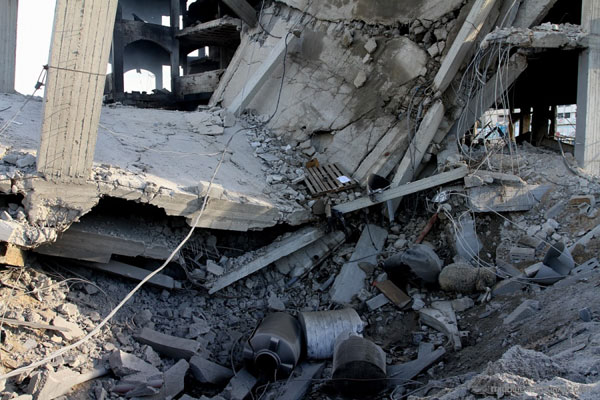 GAZA CITY – Israeli forces killed six Palestinians and injured 41 in attacks on Gaza in January, a ministry official said Saturday.
Ashraf al-Qidra, spokesman for Gaza’s Ministry of Health, said in a statement that “the Israeli occupation intensified airstrikes against unarmed civilians, particularly in the eastern Gaza Strip” in January.
The statement pointed out that a large number of the injured were children.
The health sector in the Strip has been suffering a severe shortage in medicines and medical equipment, al-Qidra added.
Over the past month, tensions have risen in and around Gaza after more than a year of relative calm following Israel’s war on the coastal territory in November 2012 which killed over 170 people, mainly civilians, and injured thousands.
Israeli army figures show nine rockets have struck Israeli territory since Jan. 1, and another five were intercepted by the Iron Dome anti-missile system. None of the rockets caused injuries.
Israeli airstrikes this year on targets in Gaza have injured dozens of people, mainly civilians.
A riot near Yizhar demonstrates the essence of Israeli occupation
The comedy, in whole
By Yossi Gurvitz | Yesh Din | January 31, 2014

Settlers hurl stones near the settlement of Yitzhar.
On April 25th, 2013, Raed Mahmoud Ahmad Sabah was in his house in the village of Urif, when he noticed three Israeli civilians, all wearing hoods, approaching his house from the settlement of Yizhar. Shortly afterwards, a settlement security vehicle arrived and joined the raiders, and out stepped a man who Sabah identified as a settlement security officer. Several minutes late, two IDF vehicles joined the group, out of which emerged a handful of soldiers. The squad of hooded Israelis were reinforced by more hooded Israelis, who also came from the direction of Yizhar. Together they began to hurl stones at Sabah’s home and at the neighboring houses. The group also started to uproot saplings. The Israeli soldiers, as well as the settlement security officer, stood about aimlessly, without bothering to stop the attack. The young men of Urif gathered to defend themselves and their property, and only then did the army spring into action. Large forces of the IDF and Border Police began firing tear gas canisters – at the Palestinians, naturally. Sabah would later count seven tear gas canisters in his courtyard. The Israeli rioters used the opportunity to sneak back home under cover of the gas screen. Needless to say, none of them were detained.
Yizhar is one of the most notorious settlements. Its municipal council recently resigned (Hebrew) after its residents? decided to stop cooperating with the IDF and appointed a suspected criminal, Boaz Albert (Hebrew) as their representative to the army. Last August, the Yizhar settlers denied Druze workers entry to the settlements. At the time, the army decided once more to retreat (Hebrew) and sent Jewish workers in their stead. Yizhar is home to the Od Yosef Khai Yeshiva (religious school), whose rabbis published the gentile-slaying manual, “Torat HaMelekh”. The yeshiva students operate the “HaKol HaYehudi” website, which several years ago published an article (Hebrew) by Yossi Elizur (one of the writers of Torah/torat? Hamelekh), which detailed the principles of “arvut hadadit,” the name given by the settlers at the time to the terror acts known as “price tag” attacks. The security system alleges that several Yizhar residents are involved in a series of “price tag” incidents, as well as daily terror attacks on Palestinians.
So, here was another story of the usual riot and collaboration by the army with the attackers. We’ve become inured to that. Our client, Sabah, possesses a sense of humor, so he complained to the Military Police Criminal Investigations Department (MPCID) about the behavior of the soldiers, and to the police against the settlers and settlement security officers. This, we should note, is his second complaint: three months earlier, Sabah lodged another complaint about a settler attack.
So, what did the police do with Sabah’s complaint? It did nothing. Just like Sabah’s earlier complaint, this case was also closed by the police on grounds of “perpetrator unknown.” The police did so even though Sabah presented it with a video showing the settlement security officer exiting the vehicle near the hooded settlers. Indeed, the only investigative action taken by the JSDP (Judea and Samaria Police District Police) was taking Sabah’s statement and watching his video.
As noted by our attorneys, Anu Lusky and Noa Amrami, there were quite a few actions the police could have taken. It could have interrogated Sabah’s neighbors; he said in his testimony that they, too, were attacked. The police didn’t do so. The JSDP could have interrogated the settlement’s security officer, but instead it was satisfied with a short question presented to him about the issue, which was dropped when he replied that he “did not remember” such an incident.
The police could have located the soldiers, who Palestinians testified were seen talking to the Israeli rioters during the incident, and interrogated them – but the investigators did not bother to find out who they were. In a handwritten memo, a police officer noted that he asked the security coordinator of Yizhar whether he could identify the rioters – but the officer didn’t even bother to write down the answer.
This is how it looks. First, you build a settlement. Then you let it turn into a base of attacks against the local villages and towns, while the army not only refrains from stopping the attacks but provides cover for them; and then comes the police and puts the investigation out to pasture. In the West Bank, this desolate state of affairs is masquerading as “the rule of law.”
We’ll repeat this again: the residents of the West Bank are protected persons according to the Geneva Conventions and the rulings of the Israeli High Court of Justice. When the army and the police refrain from providing them with this protection, they betray their basic duty. The words of Attorneys Lusky and Amrami in the appeal against the decision to close the case are worth quoting:
“We shall further remind you that according to Israeli law, as well as international law, the military commander and the police in the region are under an active duty to ensure the realization of the rights of the Palestinian residents and their protection. Hence, it is clear that our client is entitled to full protection by the JSDP, as has been ordered by the military commander in the region, particularly as this is not a single offense. […] This duty was blatantly violated in this case by the failure of the IDF troops and settlement security officials, who stood idly by and did not stop the violence started by [the settlement’s] residents, even though they were present at the scene in real time. This duty was violated once more, when a decision was made to close the case without fully investigating it.”
Israel should decide to which world it wants to belong: that which performs tikkun olam based on the rule of law and international law, or that of the rogue nations. Even though the question has never been presented to the citizens of Israel, the State’s actions in the West Bank provide a fitting answer.
Related articles
Israeli forces shoot, injure Palestinian youths at checkpoint
Ma’an – 31/01/2014
BETHLEHEM – Two Palestinian youths were shot and injured by Israeli forces early Friday at a checkpoint east of Jerusalem in the West Bank, witnesses said.
Witnesses told Ma’an that 19-year-old Jawhar Nasser Jawhar was injured by Israeli fire at al-Zaayyem checkpoint near Abu Dis.
Additionally, Adam Abd al-Raouf Halabiya, 17, was injured in the incident.
Jawhar remains in Israeli custody, and was not immediately given access to first aid, witnesses said.
His mother Svetlana, a Ukrainian citizen, said that her son was admitted to an Israeli hospital.
She spoke to Ma’an via telephone from the hospital, where she said she was being prevented from seeing her son. She said Israeli soldiers instructed doctors not to answer her questions about his health.
Israeli forces also threatened to deport her to Ukraine, she said.
An Israeli Border Police spokesman was unable to be reached for comment.
Related article

Two international activists arrested on visit to military court
International Solidarity Movement | January 29, 2014
Occupied Palestine – On Wednesday 29th January, 2014, two international human rights activists were arrested at Salem Military Court, in Jenin district. The activists, Norwegian and Canadian, were at the court to attend a hearing for Ahmad Atatreh, a 20-year-old Palestinian activist who had been arrested ten days earlier at a peaceful demonstration in the Jordan Valley.
Following the hearing, which the activists had attended in solidarity with Mr Atatreh and his family, Israeli soldiers violently pushed the defendant, who was in handcuffs, out of the courtroom. When the internationals asked why he was receiving this rough treatment, the soldiers took the passport from the Norwegian and arrested her on the accusation of having “slapped a soldier.”
The two remaining activists and the family of Mr Atatreh left the court facilities and were getting into a car outside when they were approached by another soldier, who subsequently arrested the Canadian, accusing him of “attempting to prevent an arrest.”
The activists were held overnight in the police station in the illegal settlement of Ariel. Under Israeli law they should be taken before a civil court judge within 24 hours of their arrest, although in recent cases the police have disregarded this, preferring to initiate deportation procedures without following due process.
The Canadian citizen was released on Thursday afternoon. The Norwegian citizen is being processed for deportation.
In the past month alone, five international human rights activists have been arrested, leading to concerns of a military crackdown on international solidarity with the Palestinian people.
With regard to the case of Ahmad Atatreh, who was arrested on the accusation of assaulting a soldier, the judge postponed the trial for a further month, in order to re-examine the evidence. The next time he appears in court he will have spent six weeks in administrative detention.
The Israeli military judicial system has been criticized by various human rights groups for their lack of fair trial guarantees and discrimination in procedural law. For more information on Israeli military courts see: http://www.addameer.org/etemplate.php?id=291

Salem Military Court
Related articles


An ugly ending to Oxfam-Johansson saga
By Jonathon Cook | January 30, 2014
Here is Oxfam’s official and very brief statement on the ending of its eight-year relationship with Scarlett Johansson, who served as a “global ambassador”. It seems clear that Oxfam – very belatedly – gave her an ultimatum following her recent decision to accept another ambassadorship, this time promoting SodaStream, whose factory is in an illegal settlement in the West Bank.
Oxfam states Johansson’s “role promoting the company SodaStream is incompatible with her role as an Oxfam Global Ambassador”. It was either us or them. Johansson stepped down, making clear she prefers to work for a company that breaks international law over an organisation concerned with humanitarian issues.
Oxfam’s dithering and its final efforts to allow Johansson to present this as a resignation rather than a dismissal reinforces the point I made yesterday about how money talks, even for Oxfam. The charity needs pretty ambassadors to raise funds and to gain media attention. Treating Johansson harshly, even now when the relationship is over, might put off other Hollywood starlets who hope to burnish their humanitarian credentials – at least as long as the work doesn’t interfere with their opportunities to make money, even when it comes at the expense of other people’s freedom.
No one comes out of this affair looking good.
www.oxfam.org/en/pressroom/reactions/oxfam-accepts-resignation-scarlett-johansson
Soldiers Invade Homes, Conduct Training, In West Bank Village

IMEMC & Agencies | January 30, 2014
At dawn on Thursday dozens of Israeli soldiers invaded Ein Shibli village, in the West Bank’s Central Plains, east of the northern West Bank city of Nablus, broke into several homes, and conducted military drills.
Resident Osama Abu Hatab said the soldiers violently searched several local families, and interrogated the residents before taking pictures of their ID cards.
Abu Hatab added that the soldiers violently banged on the doors, threatening to detonate them should the Palestinians refuse to open them, causing anxiety attacks among the children.
The families were then forced out in the cold for more than two hours, while the soldiers conducted training between the homes, wearing military combat gear.
In December of last year, the soldiers conducted three similar attacks and drills in Ein Shibli, An-Nassariyya, and Al-‘Aqrabaniyya villages, using military gear, army helicopters and various armored vehicles.
In related news, dozens of soldiers invaded Khirbet Um Al-Jamal village, in the Northern Plains of the occupied West Bank, and demolished tents and residencies that belong to 13 families.
Local sources said that army bulldozers demolished the sheds and structures, displacing the families, and also demolished barns.
‘Aref Daraghma, head of the Wady Al-Maleh local council, said the soldiers demolished more than 50 structures, including sheds, barns, wood fired ovens and tents.
Daraghma stated that the latest attack is part of numerous similar violations against the residents in the area, and that the army demolished dozens of structures over the last few months in the northern plains of the occupied West Bank.
“These violations are a continuation of war crimes carried out by the occupation”, he said. “The Palestinians are facing ongoing displacement, harassment, and are exposed to serious danger due to ongoing military training in the area”.
Related article
Palestinian man shot dead by Israeli forces near Ramallah
Ma’an – 29/01/2014
RAMALLAH – Israeli soldiers shot and killed a Palestinian man near the Ramallah village of Ein Siniya on Wednesday.
A Ma’an reporter identified the victim as Muhammad Mahmoud Mubarak, 22, from al-Jalazun refugee camp.
Israeli forces in the area denied Palestinian ambulances access to the body before medics were eventually allowed to transfer the man to Ramallah Medical Complex.
A Palestinian official in the military liaison department told Ma’an that Mubarak was shot dead by a soldier positioned in a military watchtower.
“A Palestinian terrorist opened fire at an IDF (army) post near Ofra. The soldiers responded immediately in order to eliminate the imminent threat to their lives and fired towards the terrorist, identifying a hit,” Israel’s army said.
Eyewitnesses in the area told Ma’an that Mubarak was a laborer working with the al-Tarifi company on a USAID funded project to refurbish the main road in Ein Siniya.
Earlier, he had been directing traffic in the area with a handheld sign.
“While he was doing his job, a number of Israeli soldiers arrived and started to harass him,” witnesses told Ma’an.
“They forced him to take off his clothes, then put them on again. Then they ordered him to take a few steps forward, then walk back, and finally they shot him and left him bleeding preventing ambulance and medics from reaching him.”
Coworkers and an executive from the al-Tarifi company were close-by when the shooting took place.
Last year, Israel’s army killed 27 Palestinians in the occupied West Bank, according to UN statistics.
Related article

Checkpoint – Jasiri X
jasirix · January 28, 2014
“Checkpoint” is based on the oppression and discrimination Jasiri X witnessed firsthand during his recent trip to Palestine and Israel “Checkpoint” is produced by Agent of Change, and directed by Haute Muslim. Download “Checkpoint” at https://jasirix.bandcamp.com/track/ch….
LYRICS
Journal of the hard times tales from the dark side
Evidence of the settlements on my hard drive
Man I swear my heart died at the end of that car ride
When I saw that checkpoint welcome to apartheid
Soldiers wear military green at the checkpoint
Automatic guns that’s machine at the checkpoint
Tavors not m16s at the checkpoint
Fingers on the trigger you’ll get leaned at the checkpoint
Little children grown adults or teens at the checkpoint
All ya papers better be clean at the checkpoint
You gotta but your finger on the screen at the checkpoint
And pray that red light turns green at the check point
If Martin Luther King had a dream of the checkpoint
He wake with loud screams from the scenes at the checkpoint
It’s Malcolm X by any means at the check point
Imagine if you daily routine was the checkpoint
Separation walls that’s surrounding the checkpoint
On top is barbwire like a crown on the checkpoint
Better have ya permits if your found at the checkpoint
Gunmen on the tower aiming down at the checkpoint
The idea is to keep you in fear of the checkpoint
You enter through the cage in the rear of the checkpoint
It feels like prison on a tier at the check point
I’d rather be anywhere but here at this checkpoint
Nelson Mandela wasn’t blind to the check point
He stood for free Palestine not a check point
Support BDS don’t give a dime to the checkpoint
This is international crime at the checkpoint
Arabs get treated like dogs at the checkpoint
Cause discrimination is the law at the checkpoint
Criminalized without a cause at the checkpoint
I’m just telling you what I saw at the checkpoint
Soldiers got bad attitudes at the checkpoint
Condescending and real rude at the checkpoint
Don’t look em in they eyes when they move at the checkpoint
They might strip a man or woman nude at the checkpoint
Soldiers might blow you out of ya shoes at the checkpoint
Gas you up and then light the fuse at the checkpoint
Everyday you stand to be accused at the checkpoint
Each time your life you could lose at the checkpoint
If Martin Luther King had a dream of the checkpoint
He wake with loud screams from the scenes at the checkpoint
It’s Malcolm X by any means at the check point
Imagine if you daily routine was the checkpoint
At the airport in Tel Aviv is a checkpoint
They pulled over our taxi at the checkpoint
Passport visa ID at the checkpoint
Soldiers going all through my things at the checkpoint
Said I was high risk security at the checkpoint
Because of the oppression I see at the checkpoint
Occupation in the 3rd degree at the checkpoint
All a nigga wanna do is leave fuck a checkpoint
Follow Jasiri X at https://twitter.com/jasiri_x
The Three-Legged Monster
By Gilad Atzmon • May 25th, 2009
Unlike her cosmopolitan brothers and sisters who spread Zionism and tribal racism using a liberal and progressive disguise, Melanie Philips is open about it all. The other day she defined what Zionism is in a very clear manner:
“Zionism,” writes Philips, “is simply the movement for the self-determination of the Jewish people. And its significance is greater than any other movement of national liberation because Judaism itself rests upon three legs — the people, the religion and the land. If one is lopped off by having its legitimacy denied, the whole thing collapses. That is why anti-Zionism is far more than an unpleasant political position. It is a direct attack on Judaism itself.”
Philips doesn’t leave much room for speculation. For her, not only is Zionism a legitimate national movement, ‘its significance is greater than any other movement’ because it rests upon ‘three legs’. Thinking about it for a second, it is indeed significant for something to rest upon three legs, I myself rest upon just two legs and a bit. Occasionally when I stand naked in front of the mirror I wish I were Zionism.
As Philips maintains, Zionism is indeed an amalgam of three Jewish ingredients: the people, the land and the religion. It is this very composition that makes Zionism into an epic victorious narrative. It is this very mixture that made Zionism into the 20th century collective symbolic identifier of the Jewish people. It is Zionism that has managed to reinvent the Jewish people as a nation with a lucid ideological, spiritual and geographical aspiration. Yet, as much as Zionism makes a lot of sense to very many Jews around the world, it makes less and less sense for those who fail to be chosen i.e., the rest of humanity. The reason is simple, Jews may be welcomed to celebrate their symptoms collectively but they are not exactly entitled to do so at the expense of anyone else.
Zionism has managed to interpret Judaism as a brutal license to plunder and kill. It transformed a spiritual text into a land registry. It primarily invented the Jews as nation. It then set for the newly born nation a task of immoral geographical aspiration with some devastating racist colonial implications.
One may wonder, how did Zionism manage to be so successful, how did it manage to get away with murder, and how has it done so for so long? At the end of the day, the lethal mixture of ‘land’-‘religion’-‘people’ stands in complete opposition to the post-war Western cultural and political narrative (cosmopolitan / multi-cultural / multi-faith / open borders).
I tend to believe that Philips’ equation Zionism = Judaism is the most effective Zionist tactic of them all. It leads towards a severe paralysis of most humanist opposition of Zionism. The reason is obvious, ordinary ethical beings do not know how to comb the knots out of this shattering formula that leads them to criticism of a religious belief system.
In fact one way around it is to dispute Philips’ equation. Zionism doesn’t equal Judaism. Zionism is a mere radical narrow interpretation of Judaism. It takes the biblical plunderous narrative and turns it into a daily practice. It takes the Judaic moral notion of chosenness and turns it into crude supremacist agenda. Rather than Judaism, Zionism is in fact the true genuine face of Jewish ideology. It is racist, it is chauvinist, it is seeking power; but it is different from Judaism, for Judaism is centred around the fear of God and Zionism is totally fearless. Accordingly, It will be right to argue that to oppose Zionism is to oppose Jewish ideology or what I myself define as ‘Jewishness’.
It must be said that Zionism regards itself as an enlightened rational movement. To a certain extent, as an ideology and praxis, it tries to understand itself, it seeks explanations or at least justifications in rational and historical terms (rather than ethical ones). Melanie Philips, it must be said, is offering a coherent argument. She says, ‘this is what we are’, taking this from us is a dismissal of our right to be.
I believe that Philips framework is correct, it is her terminology that is slightly confusing. It is not Zionism = religion but rather Zionism and Jewishness that are intrinsically connected. If we want to oppose Zionism for real, we set ourselves into an inevitable conflict with Jewish ideology. To oppose Zionism is to admit that we have a serious issue with Jewish nationalism, with Jewish tribalism, with Jewish racist ideology, with Jewish supremacy and Jewish collectivism. To oppose Zionism is to admit that we have a problem with the ‘Jewish thing’.
However, it may be noted that if Zionists such as Philips are entitled to suggest the equation between Zionism and Judaism, the opponent of Zionism should not be reluctant to do the same and to extend the critique of Zionism to Jewish ideology and beyond.
I mentioned numerous times in the past. As it happened, it is actually Zionists and Israeli dissidents who seem to push the anti-Zionist discourse ahead. The reason is pretty simple.
Israeli dissidents are far from being reluctant to expose or reflect on their collective past. Unlike the tribal Diaspora Jewish left activists that are quick to dismiss any complicity in Israeli crimes by shouting “not in my name,” some Israeli dissident voices tend to take direct responsibility. They understand the notion of guilt and they turn it into responsibility.
A month ago Haaretz published an article by Uri Avnery in its ‘Israeli Independence Day Special Edition. ‘Living With The Contradiction’ was an attempt of an Israeli humanist to face his own original sin within an historical perspective.
Avnery is an astonishing writer. Though I tend to disagree with him on various issues, the man is no doubt a leading voice of reason in that doomed state. Unlike Melanie Philips who supports Zionism from afar, Avnery was a commando soldier in 1948. He was himself personally involved in the creation of Israel. “We knew that if we won the war, there would be a state and that if we were defeated there would be no state – and that we would not be around, either.”
Unlike Melanie Philips who speaks about ‘a land’, Avnery was one of those who invaded the land and expelled its habitants.
“We left no Arabs behind our front line, and the Arabs did likewise,” and yet, Avnery, unlike Philips, realises that the Zionist amalgam People / Land / Religion leads towards disaster. Israel’s original sin is not is not exactly a recipe for peace.
“How then is it possible,” asks Avnery, “to reconcile the contradiction between our intentions and feelings at the time, when we established the state and paid for it with our blood, pure and simple, and the historic injustice we inflicted on the other side?”
He continues, “It is necessary for our mental health as a nation and as human beings, and it is the first step toward future reconciliation. We must admit and recognize the consequences of our actions and repair what can be repaired, without disavowing our past and youthful innocence.” Avnery goes out of his way to explain rather than justify the 1948 sin, yet he is searching for reconciliation. He understands that the Jewish state will be doomed unless it faces its past.
I wish that those who contribute to the Palestinian solidarity discourse would have the courage exhibited by Philips and Avnery. I wish that like Philips, we would have the courage to equate Zionism with Judaism yet to use it as a critical shift. I wish we could look at the Nakba like Avnery with fear and yet to draw the necessary conclusion, to demand the right of return.
Related articles
The Story of the Individual is Testimony to the Story of the Public
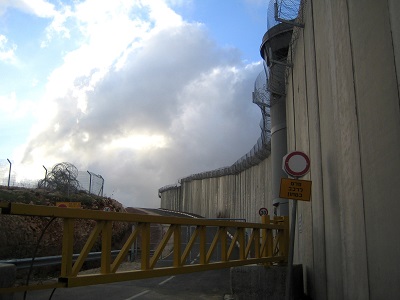
Here, right to freedom of movement is relative. (Photo: Tamar Fleishman)
Palestine Chronicle | January 27, 2014
We usually prefer to exit Palestine using Hizme checkpoint, where unlike other exit checkpoints, there are no long lines of cars, we aren’t detained and there is no need for identification or getting out of the vehicle to open and present the content of the trunk. You merely slow down by the soldier and answer a generic question like “how is it going?” with an “OK”. Sometimes even that isn’t required, just nod your head and that’s it, you can drive on.
But it’s different for us than for those who don’t pass the test examining the visage and accent of the driver. They, Palestinians from east Jerusalem, in spite of being permanent residents who have the right for freedom of movement (unlike their brothers who reside in the West Bank), are forced to stop, park their vehicle by the soldier’s post on the side of the road, identify themselves, exit the car and open the trunk so the solider can see inside.
Their right to freedom of movement is relative and they are subjected to the mercy and whims of the men in uniform.
The individual’s story is testimony to the story of the general public. The individual in this case was A who after visiting his family intended to drive through Hizme on his way back, with him were his wife, his baby son and someone he knew that said to him: “could you do me a favor, I need to get to Jerusalem, could I ride with you?”- So he did. A didn’t give him a thorough inspection, and had no idea what color his ID was and what was his address. He was just doing someone a favor. But the soldier at the checkpoint did perform an inspection and found out that A was giving a lift to someone who wasn’t permitted to pass through a checkpoint intended only for settlers, like Hizme checkpoint.
The man was arrested and taken away.
A was told to turn his engine off and to stay in the vehicle, in addition they took his car keys.
A, his wife and their child sat and waited. But the baby, who had yet to learn that a soldier’s order must be obeyed, began crying and wailing. The minutes that passed were long and the crying only grew stronger. But they couldn’t step out of the car, they couldn’t take the baby out of his booster, and he couldn’t be cradled in his mother’s arms. A tried getting out to reason with them, but was told to: “stay in the car!” and so he got back in.
After an hour his car keys were handed back to him and his wife and child were sent back home, while A was taken to the police station. There he waited for another hour, until he was given a summons to return on the next day.
Ever since he has been going back and forth to the police station, each day he waits for his name to be called, then he is taken into a room, the piece of paper he was handed on the previous day is taken from him and in return he is given a new paper summoning him to come back on the next day.
The time, the agitation, not to mention the money- all these are of no importance and are not taken into account.
Once he dared to ask why they weren’t handling his case and a policeman said to him: “I don’t have time for you, I’ve got lots of work”- “But my case is part of your work”, replied A, but instead of an answer he got a piece of paper in exchange for the one given to him on the previous day.
Yes, he will be back tomorrow, and perhaps even on the day after that.
This is how the representatives of the authority, who have unlimited power in their hands, handle people, whose rights are conditioned by circumstances.
(Translated by Ruth Fleishman)
Related articles


Permanent deal with Iran impossible: Netanyahu
Press TV – January 27, 2014
Israel’s prime minister says a permanent nuclear agreement between Iran and world powers is impossible as Tehran has made it clear that it will not dismantle its centrifuges.
Benjamin Netanyahu’s remarks came shortly after Iran’s President Hassan Rouhani stipulated that Tehran would not dismantle any of its existing centrifuges “under any circumstances,”.
“It is part of our national pride, and nuclear technology has become indigenous … And recently, we have managed to secure very considerable prowess with regards to the fabrication of centrifuges,” said Rouhani in an exclusive interview with CNN news network on Wednesday on the sidelines of the World Economic Forum (WEF) in Davos, Switzerland.
In a weekly cabinet meeting on Sunday, Netanyahu said, “If Iran stands by that statement that means that a permanent agreement – which is the goal of the entire diplomatic process with Iran – cannot succeed.”
He also added that US Secretary of State John Kerry has pledged Washington will maintain the existing sanctions against Tehran.
On November 24, 2013, Iran and the six major world powers – Russia, China, the US, France, Britain and Germany – inked the nuclear accord in the Swiss city of Geneva. The two sides started implementing the agreement as of January 20.
Under the Geneva deal, the six countries undertook to provide Iran with some sanctions relief in exchange for Iran agreeing to limit certain aspects of its nuclear activities including a voluntary suspension of its 20 percent uranium enrichment program.
Nuclear-armed Israel has publicly announced its opposition to the Geneva deal.
Featured Video

Weaponized Journalism: 2021 Sayer Ji Interview with NPR
or go to
Aletho News Archives – Video-Images
From the Archives
How Rothschild Banking Clan Uses Its Vast Wealth to Influence World Events and Control Governments

By Ilya Tsukanov – Sputnik – 15.09.2024
How powerful is the Rothschild banking family? How did they amass their fortune? Just how rich are they? Do they secretly control the world? Sputnik explores. … continue
Blog Roll
 Aletho News
- Dockworkers launch global strike against Israeli and US military shipments
- Europe facing gas price shock – Gazprom chief
- Ukraine continues recruiting people with disabilities
- Weaponized Journalism: 2021 Sayer Ji Interview with NPR
- Beyond Netanyahu: what Israel’s election means for Palestinians
- Lithuania plans universal conscription
- Lies, Damn Lies, and Ukraine News
- Financial Times rejects Nordic demands to correct Putin call story – media
- The Case for Less Unity in Europe
- Ukraine expands minority rights under EU pressure – but Russians remain excluded
- If Americans Knew
- An error has occurred; the feed is probably down. Try again later.
- No Tricks Zone
- Germany’s Green Energy Transition Becoming Increasingly Expensive…Another 6 Trillion Euros!
- Sudden Stratospheric Warming, Powerful El Niño Combination May Lead To Extreme Europe Cold, Energy Crisis!
- Two New Studies Find Thwaites Glacier Melt Cannot Be Driven By Human Activity Or A Warming Ocean
- E-Cars Reduce CO2 Emissions By Only 41% Compared To Internal Combustion Engine Vehicles
- Predictions Made By Renowned Climate Professor Over Past Decades Have Been Proven To Be Poor
- New Study Suggests Large Regions Of The Pacific Ocean Have Been Cooling For The Last 80 Years
- Germany’s Green Energy Debacle: High Energy Costs Force Kahla Porzellan to Close After 182 Years!
- New Study: 50 Years Of The Most Aggressive ‘Net Zero’ Policies Can Only Affect The Global Climate By 0.03°C
- US September “Heat” Was No Record…Many Records Set Decades Ago
- Latest European Green Energy Debacle; Portugal’s Largest Flagship Solar Park Insolvent!

