“Shabbat shalom” – no peace for Palestinians in Hebron this Saturday
International Solidarity Movement | July 28, 2013
Hebron, Occupied Palestine – Stone and egg-throwing, beating and kicking, headscarves torn off and an arrest based on two soldiers lying. This sunny Saturday in Hebron (Al-Khalil) was all about settler youth attacking innocent Palestinians and internationals while soldiers looked the other way.
Today, 27th of July, the Shabbat started as usual in Hebron with the settler tour through the Old City. A group of settlers surrounded by soldiers entered the Old City through the Peace Garden and went through the streets, preventing Palestinians from passing. The soldiers invaded several Palestinian houses in order to access the roofs. After an hour, the “tour” left the Old City through the entrance to Beit Romano settlement.
Later, at around 4pm, whilst walking down Shuhada Street international activists had stones thrown at them by two settler teenage boys. When they returned an hour later, they were attacked again by settler youths who jumped at them and violently pulled off their headscarves outside Beit Hadassah settlement. When the internationals complained to the soldier stationed at the nearby checkpoint, he showed no sympathy and said his job was only to protect the Jews living in Hebron.
About half an hour later, three international activists were passing by the Qurtoba School when a masked settler ran up the hill towards them, throwing eggs. One activist was hit in the face with two eggs whilst soldiers looked on from the watchtower above the school – they took no action against the settlers saying only “What do you want us to do?”
At around 6pm some settlers – who had previously been bathing in the Abraham spring close to the Islamic cemetery next to Shuhada Street whilst being guarded by a group of soldiers – tried to steal a home-made kite off two Palestinian kids. A Palestinian teenager managed to prevent them from taking it.
At around 6.30pm, a group of about thirty settler youths entered the property of the Abu Shamsiya family in Tel Rumeida. They threw stones at the family who were outside on the veranda preparing food for the iftaar fast-breaking meal. They also beat the 11-year old son of the family, Muhammad. When his father, Abu Shamsiya, went to the soldier stationed at the checkpoint just outside his house to complain and ask for help, the soldier simply told the settlers to go ahead and continue attacking the family.
A settler youth then ran up to Abu Shamsiya and violently kneed him in the stomach right in front of the soldier. Another soldier grabbed Abu Shamsiya’s wife Fayseh, who was filming the incident, by her hair and pulled her to the ground. The police, who happened to be parked in their car just up the road, finally decided to intervene. Abu Shamsiya complained against the two soldiers who had attacked him and his family and were complicit in the settler violence.
In a rare turn of events, the police believed Abu Shamsiya’s story – although the soldiers denied it – and took these two soldiers to the police station for further questioning. However, they did not arrest any of the settlers, who escaped into the Tel Rumeida settlement and the police chose not to follow them. The group of settler youths returned soon after and although Abu Shamsiya and various other eyewitnesses clearly pointed out the attackers to the police, they took no action.
Abu Shamsiya himself was later taken to the police station in order to file an official complaint and so that the police could examine his video footage of the incident. The Abu Shamsiya family were initially hopeful that this might lead to some positive result, but two hours later they got a phone call that Abu Shamsiya was now being detained in the police station on the charge of spitting at soldiers. Clearly the two soldiers whom he complained against wanted revenge and made up this story to incriminate him. His family is deeply worried and hopes he will be released by tomorrow.
During the same incident, which attracted a lot of onlookers outside Abu Shamsiya’s house, Palestinians, settlers and internationals alike, a settler woman who is notorious for being extremely aggressive and has attacked internationals and Palestinians on several occasions, started pushing and shouting at an international activist as well as pulling at her scarf to strangle her. This happened right in front of a group of soldiers who chose to just stand by and watch, and even mocked the international activist when she complained and asked whether they thought it was okay for her to get strangled in the middle of the street.
Although the settler attacks in Hebron are not always as numerous and severe as they were on this particular day, none of what happened today is new or unusual to the residents of Hebron. Hebron is the only West Bank city that has settlers living inside the city itself. It is home to a particularly extreme and aggressive settler community, numbering about 500, that constantly harasses, intimidates and attacks Palestinians with near impunity and the protection of about 2,500 Israeli occupation soldiers stationed in Hebron.
Update 28th July: Israeli authorities are demanding 1000NIS on bail to release Abu Shamsiya. He will have a court hearing soon (exact day still unknown).
Related articles
- Jabari family once again facing harassment from settlers and soldiers (alethonews.wordpress.com)
- Soldiers invade two Palestinian houses – for training only (alethonews.wordpress.com)
- Live ammunition shot at Youth Against Settlement house in Hebron (alethonews.wordpress.com)
- Palestinian activist detained in Israeli raid (alethonews.wordpress.com)
Another Journalist with Children in the Israeli Military
By ALISON WEIR | CounterPunch | July 26, 2013
The New York Times recently published a news brief, reporting that Israel is going to re-investigate an incident in which an American citizen, Tristan Anderson, was permanently maimed.
Anderson suffered extensive brain damage (part of his frontal lobe was destroyed) and paralysis, and was blinded in one eye, after Israeli soldiers shot him with a tear gas canister intended as a “barricade penetrator” from inappropriately close range. According to eyewitnesses, Anderson was shot as he was taking photographs in a Palestinian village after an unarmed protest against the illegal and extensive confiscation of village land.
Israeli forces have a history of shooting unarmed protesters with these canisters, which one expert likens to “a small missile.”
Yet the New York Times report, “Israel Reopens Inquiry Into Activist’s Injury” (July 11, 2013, P. 9) reveals few of these details.
The Times article states that Anderson was injured when he was hit in the head by a tear gas canister and is partly paralyzed and blind in one eye, but does not mention his extensive brain damage and that his paralysis is over half his body. It doesn’t reveal that the type of canister used is extraordinarily destructive or that it was fired at such close range.
The report also omits the fact that this incident is part of a pattern, even though Israeli forces have killed at least two Palestinians with these canisters, and shot out the eye of an American student with another. According to a report by an Israeli organization, Israeli forces “frequently fire tear-gas canisters directly at demonstrators.”
The Times report states that the protest was “against the extension of Israel’s separation barrier in the West Bank” without citing the villagers’ actual complaint — the confiscation of their land and, thus, livelihood by Israel. It similarly fails to mention that over previous decades Israel confiscated over 80 percent of the village land and now intends to take between a quarter and a third of what remains to build the “barrier.”
Finally, the Times report repeats, without attribution, the Israeli security forces’ claim that the shooting occurred “during a clash,” implying that it happened accidentally during a violent engagement, ignoring eyewitness testimony that the protest had dissipated and most people had gone home.
The byline on the Times report is Myra Noveck. Noveck has bylined a number of stories for both the New York Times and its European affiliate the International Herald Tribune, where ZoomInfo lists her as a contributor.
Noveck is frequently cited in New York Times news reports as a contributor to stories, and a prominent Israeli newspaper calls her the Times’ “deputy bureau chief” for the Times’ Jerusalem bureau, its bureau for covering Israel-Palestine.
From information she has posted online, it appears that Noveck is an American who moved to Israel after college. According to Torah in Motion, which promotes Jewish dialogue and speakers, two of her children were serving in the Israeli military as of 2012. It is unclear whether her children are currently still on active duty or whether they are now serving as Israeli reserve soldiers.
In either case, it appears that while Noveck has been writing and contributing to news reports about Israel and about the Israeli military, her children have been serving in it.
Such a situation appears to constitute a clear conflict of interest – even according to the Times’ own ethics standards – and should normally cause a journalist to be assigned to a different area of reporting.
When it came to light in 2010 that then chief of the Times’ Jerusalem bureau, Ethan Bronner, had a son in the Israeli military, even the Times’ own ombudsman concluded that Bronner should be reassigned.
In response to requests for information and interviews with Noveck and Times Executive Editor Jill Abramson, a Times spokesperson issued a written statement claiming that Noveck is “not a reporter,” but merely a “long-time news assistant in The Times’s bureau in Jerusalem.”
The statement went on to say: “She works under the direction of our bureau chief primarily doing translation and research. She is an Israeli citizen. If she has children and they are also Israeli citizens, presumably they would be required to serve in the military*. This situation would not constitute a ‘breach with impartiality.’”
I wrote back pointing out (1) that Times’ conflict of interest requirements include family members and (2) that Noveck’s byline appeared on a news report. The spokesperson then admitted that Noveck “on rare occasions received a byline” but still maintained that “she is not a reporter.”
However, the Times’ published ethics standards generally extend ethical requirements ”to all newsroom and editorial page employees, journalists and support staff alike.”
Reporters Frequently Have Ties to Israeli Military
This incident is part of a pattern of ethics violations concerning reporting on Israel.
Isabel Kershner, a senior Times reporter in the region, is an Israeli citizen whose husband, according to Fairness and Accuracy in Reporting (Fair) works for an Israeli organization, the Institute for National Security Studies (INSS), which has close ties to the Israeli military and is “tasked with shaping a positive image of Israel in the media.”
A FAIR study of articles that Kershner had written or contributed to since 2009 found they had overwhelmingly relied on the INSS for analysis about events in the region.
A multitude of journalists at the Times and elsewhere have had close personal and family ties to the Israeli military – almost none of them ever disclosed, including the previous Times bureau chief Ethan Bronner, as noted above.
Jonathan Cook, a British journalist based in Israel, quotes a Jerusalem bureau chief who stated: “… Bronner’s situation is ‘the rule, not the exception. I can think of a dozen foreign bureau chiefs, responsible for covering both Israel and the Palestinians, who have served in the Israeli army, and another dozen who like Bronner have kids in the Israeli army.”
Cook writes that the bureau chief explained: “It is common to hear Western reporters boasting to one another about their Zionist credentials, their service in the Israeli army or the loyal service of their children.”
For more information on journalists’ pro-Israel conflict of interest violations see ”US Media and Israeli Military: All in the Family,” “Jodi Rudoren, Another Member of the Family: Meet the New York Times’ New Israel-Palestine News Chief,” “Ethan Bronner’s Conflict With Impartiality,” and ”AP’s Matti Friedman: Israeli citizen and former Israeli soldier.”
It would appear from this pervasive pattern that many of the owners, editors, and journalists who determine U.S. reporting on Israel-Palestine believe that normal ethics requirements don’t apply in regard to Israel.
This situation holds serious consequences for the American public. American taxpayers give Israel over $8 million per day (more than to any other country) and, as a result, most of the world views Americans as responsible for Israeli actions, exposing us to escalating risks.
Osama Bin Laden and others have often cited U.S. support for Israeli crimes as a primary cause of hostility against us.
It is thus essential that Americans be accurately and fully informed. This is unlikely to happen while those reporting for American news media (whether “reporters” or “assistants”) have such close ties to Israel and its powerful military forces.
Witnesses Describe Soldiers Shooting Protesters with High-Speed Canisters
Anderson was shot in 2009 after a protest in the Palestinian village of Ni’lin in the West Bank. Since 2007 Ni’lin villagers and others have been demonstrating against the illegal Israeli confiscation of up to a third of the village’s land (following previous confiscations in which the majority of the village’s original land was taken by Israel).
Gabby Silverman, a witness to the shooting of Tristan Anderson, describes the incident: “Tristan had wandered off with his camera. I was looking at him. And out of nowhere, they opened fire on us. The first shot they fired, they got Tristan.”
Anderson is now in a wheelchair with permanent brain damage. He is hemiplegic (paralyzed on the left, formerly dominant, side of his body). He is blind in his right eye and part of his head and frontal lobe were destroyed.
The kind of canister Israeli forces shot at Anderson is particularly dangerous, according to their manufacturer itself. The shells have a range of several hundred meters, yet Israeli soldiers fired at Anderson from approximately 60 meters away.
The canisters’ manufacturer, Combined Systems, Inc. (CSI), classifies them as “barricade penetrators” and advises that they should not be fired at people. A spokesperson for an Israeli human rights organization says, “It’s like firing a small missile.” Because of an internal propulsion mechanism, they hurtle through the air at 122 meters per second.
CSI is reportedly the primary supplier of tear gas to Israel. A watchdog group reports that the company flew the Israeli flag at its Jamestown, Pennsylvania, headquarters until, in advance of a planned Martin Luther King Day demonstration, CSI took it down and replaced it with the Pennsylvania state flag.
According to an in-depth report on CSI by Pennsylvania professor Dr. Werner Lange, the company was founded by two Israelis, Jacob Kravel and Michael Brunn.
A month after Anderson was shot, a Palestinian nonviolence leader was killed by this same type of tear gas canister when an Israeli soldier shot it into the victim’s chest (the fifth Palestinian killed in Ni’lin by the Israeli military in a year and a half).
The next year Israeli forces fired a similar canister at a young American art student, Emily Henochowicz, destroying one eye. An eyewitness reported that an Israeli soldier intentionally aimed the canister at Henoschowitz while she was participating in a nonviolent demonstration.
In 2012 another Palestinian was killed when an Israeli soldier shot him in the face with what appears to have also been a long-range CSI canister.
The occupying Israeli forces have consistently suppressed the Ni’lin villagers’ unarmed protests against the stealing of their land. As of 2012, Israel had arrested more than 350 villagers, killed 5 – including a 10-year-old child – injured “multiple” protesters with live ammunition, and broken the bones of 15 people with tear gas projectiles, according to the villagers’ website, created to document the situation.
There are similar reports from other Palestinian villages, where several other protesters have died from tear gas fired by Israeli forces.
It is unfortunate that almost none of this was even hinted at in Myra Noveck’s New York Times report.
*While military service is required for both males and females in Israel, only about 50 percent actually serve; many Israelis have refused to serve in the Israeli military for reasons of conscience.
Alison Weir is executive director of If Americans Knew and president of the Council for the National Interest. She can be reached through contact@ifamericansknew.org.
For more information on Anderson, videos of the incident, and the latest updates go to http://www.justice4tristan.org/.
Ni’lin is also sometimes referred to as Nilin or Na’alin.
Related article
- Palestinian photographer who was shot in the cheek could be imprisoned yet again (alethonews.wordpress.com)
Live ammunition shot at Youth Against Settlement house in Hebron
International Solidarity Movement | July 26, 2013
Hebron, Occupied Palestine – Last night at 10 pm, a live ammunition bullet was fired at the headquarters of the human rights organisation Youth Against Settlements (YAS) in Hebron.
The spokesperson for YAS, Damer Atash, explains that a group of activists were sitting in front of the house headquarters when the bullet was fired. The bullet was shot from the nearby olive groves making it impossible to see the shooter, although two voices were heard. Luckily, the group of activists were not hurt, instead, the bullet bounced off the window right behind them. “At first we thought it was a stone but instead we found a bullet”, said one of the activists.
At 22:15 pm, the group called the Israeli police, who arrived some 40 minutes later at approximately 11 pm, after the police arrived the military joined them and stayed for about 20 minutes. However, none of them searched the premises for the bullet canister.
The shooter was not seen, but it is likely that it was an attack from one of the neighbouring settlers, as the bullet was bigger than those used by the army. Even though this is the first incident of shooting against YAS, this would not be the first time the house has been attacked by settlers. They have previously tried to burn the house, set the kitchen of the headquarters on fire and uprooted trees. In these incidents the Israeli army or police have not taken any action against the settlers.
Israeli army and police also participate in the harassment of YAS and its human rights organizers. On Wednesday alone, the army invaded the house three times during the evening and night for what it is believed to be a training exercise for the army.
The despair and fear this causes is not uncommon for the 35,000 Palestinians living under complete control of 1500 Israeli soldiers and police officers, and the constant harassment and violence from the 500 settlers illegally living in the Israeli controlled H2 area of Hebron.
Related articles
- Palestinian activist detained in Israeli raid (alethonews.wordpress.com)
- Jabari family once again facing harassment from settlers and soldiers (alethonews.wordpress.com)
- Shocking Video | Israeli Soldier Cooks Bird Alive! (occupiedpalestine.wordpress.com)
- Hebron man arrested for filing complaint about settler attack (imemc.org)
Netanyahu proposes new “Marshall Plan” for Egyptian economy to support coup
MEMO | July 26, 2013
Netanyahu hopes that his “Marshall Plan” would see the emergence of a new Arab middle class.
Israeli Prime Minister Benjamin Netanyahu is pushing for the West to adopt a new “Marshall Plan” for the Egyptian economy in order for the coup to succeed. He is being backed by US Republican Senator Rand Paul in his efforts. If successful, Netanyahu will regard the burying of the democratic process in the neighbouring country as the achievement of one of his most important strategic objectives.
The original Marshall Plan was America’s way of helping to rebuild Europe after the Second World War to stem the tide of revolutionary liberation. According to Maariv newspaper, Netanyahu’s plan proposes significant economic growth in the Arab world in order to prevent “radical” Islamic groups from rising to power.
The deputy head of Israel’s National Security Council, Eran Lerman, has been pushing the plan in recent meetings in Washington with Congress members. Netanyahu himself suggested such a plan during his own recent visit to the US; finance for the scheme would come from private sources, he claimed. The prime minister believes that Arab countries should be encouraged to have stable democracies free of Iranian influence and that the international community should work towards that objective. Maariv’s report claims that the Israeli officials are looking at possible funding for the project to come from Arab states such as Saudi Arabia and the UAE.
Netanyahu hopes that his plan would see the emergence of a new Arab middle class, presumably more ready to do business with Israel. His thinking follows the logic behind US Secretary of State John Kerry’s proposal for massive financial investment in the occupied West Bank to boost the Palestinian Authority’s standing. “The capitalist West thinks that throwing ever more money at a problem will solve it,” said MEMO’s Senior Editor Ibrahim Hewitt. “The natural aspiration of a people to be free of economic, political and military occupation doesn’t register with Western governments for whom economic growth is the Holy Grail.”
The newspaper pointed out that the Israeli government is also preparing to ask the US Department of Defence for an increase in military aid on the pretext of potential threats from the popular uprisings in the Arab region.
Related article
- Israel reacts positively to Egypt coup (rinf.com)
Anger at BBC’s insistence that all of Jerusalem is Israeli city
MEMO | July 25, 2013
The BBC’s insistence on describing Jerusalem as an Israeli city, despite such a status not being recognised under international law, has been condemned by Palestine Solidarity Campaign (PSC).
In a ruling delivered this week, the BBC Trust appears to have accepted Israel’s facts on the grounds, namely that Jerusalem is a united Israeli city.
Writing to PSC, the Trust quotes the BBC’s Senior Editorial Strategy Advisor, Leanne Buckle, in her assessment of the BBC’s decision to describe Jerusalem as an Israeli city.
The Trust writes: “The advisor [Buckle] acknowledged that Israel’s sovereignty over the whole of Jerusalem was not recognized under international law. However, she considered that Israel had de facto control over the entire city in a political, administrative and military sense. She also noted that Jerusalem was administered as a single entity by the Jerusalem municipal authority which made no distinction between East and West.”
Based on this, the Trust has said it will not consider a complaint by PSC that BBC journalists are breaching the BBC’s Editorial Guidelines on Accuracy when they refer to Jerusalem as an Israeli city.
Under international law, only West Jerusalem is considered to be under Israeli de facto control, not the whole of Jerusalem. East Jerusalem is described by the UN as Occupied Palestinian Territory that has been illegally occupied and annexed by Israel.
In recent months, items on the BBC’s Today and The World Tonight programmes have described the whole of Jerusalem as being an Israeli city. The country profile page for Israel on the BBC website states that Israel’s seat of government is ‘Jerusalem’.
To date, the BBC continues to insist that it will not change this entry to ‘West Jerusalem’.
Sarah Colborne, Director of PSC, said: “The BBC’s refusal to distinguish between East and West Jerusalem flies in the face of international law and international opinion.
“Instead, Leanne Buckle’s comments reveal that Israel’s illegal creation of facts on the ground appear to have been accepted in BBC newsrooms and by BBC senior management. What’s more, the BBC seems willing to elevate this illegality above international law in its reporting. This is extremely disturbing.”
Colborne added: “The status of Jerusalem is a sensitive issue, and all reporting relating to it should be subject to the highest standards of accuracy by responsible news organisations. The BBC appears to have thrown accuracy out of the window, along with international law. Moreover, it seems to have airbrushed Palestinians and East Jerusalem out of the picture.”
“All we’re asking is that the BBC inserts the word ‘West’ before ‘Jerusalem’ when referring to the part of the divided city that is recognised under international law as being under de facto Israeli control. It’s a question of accuracy. Why is the BBC fighting so hard against it?”
Related articles
- Siam family from Sheikh Jarrah, struggling against eviction order and not giving up (palsolidarity.org)
- New Israeli Ethnic Cleansing Policy in Jerusalem (ramyabdeljabbar.wordpress.com)
Soldiers invade two Palestinian houses – for training only
International Solidarity Movement | July 25, 2013
Hebron, Occupied Palestine – Last night, Israeli occupation soldiers invaded two houses in Tel Rumeida, Hebron, one being the Sumud house and the headquarters of the Palestinian human rights organisation Youth Against Settlements.
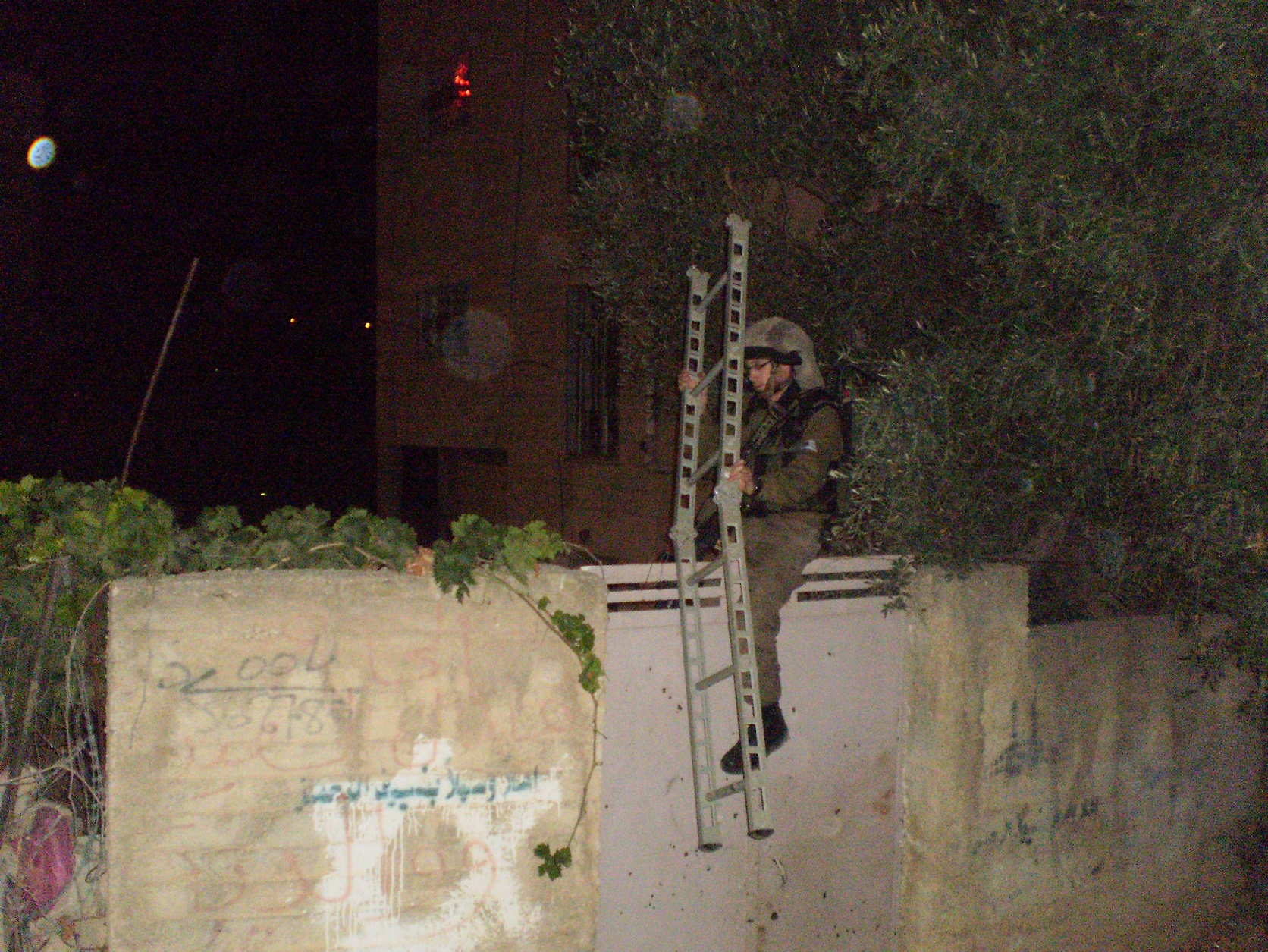
Israeli soldier climbing fence surrounding the Palestinian home. The door was unlocked the entire time (Photo by ISM)
At 21:15 pm three groups consisting of four Israeli soldiers each invaded the Sumud house from different directions. The heavily armed soldiers took the residents of the house completely by surprise, as they had been sneaking through the nearby olive groves. After harassing the people at the Sumud house and creating some mess, the soldiers retreated into the olive groves, only to invade the neighbouring house’s back-garden using the latter to climb over the wall surrounding the property. The aim of the exercise is unclear but soldiers seemed to have practised how to break into a house.
Activists from Youth Against Settlements as well as the International Solidarity Movement who were present at the scene strongly believe the invasion to have been a training exercise, as the soldiers could not show a court order justifying the invasion, nor did they arrest anyone. The precise goal and nature of the exercise remain unclear. By 22pm, all soldiers had gone, leaving a trail of confusion and broken property.
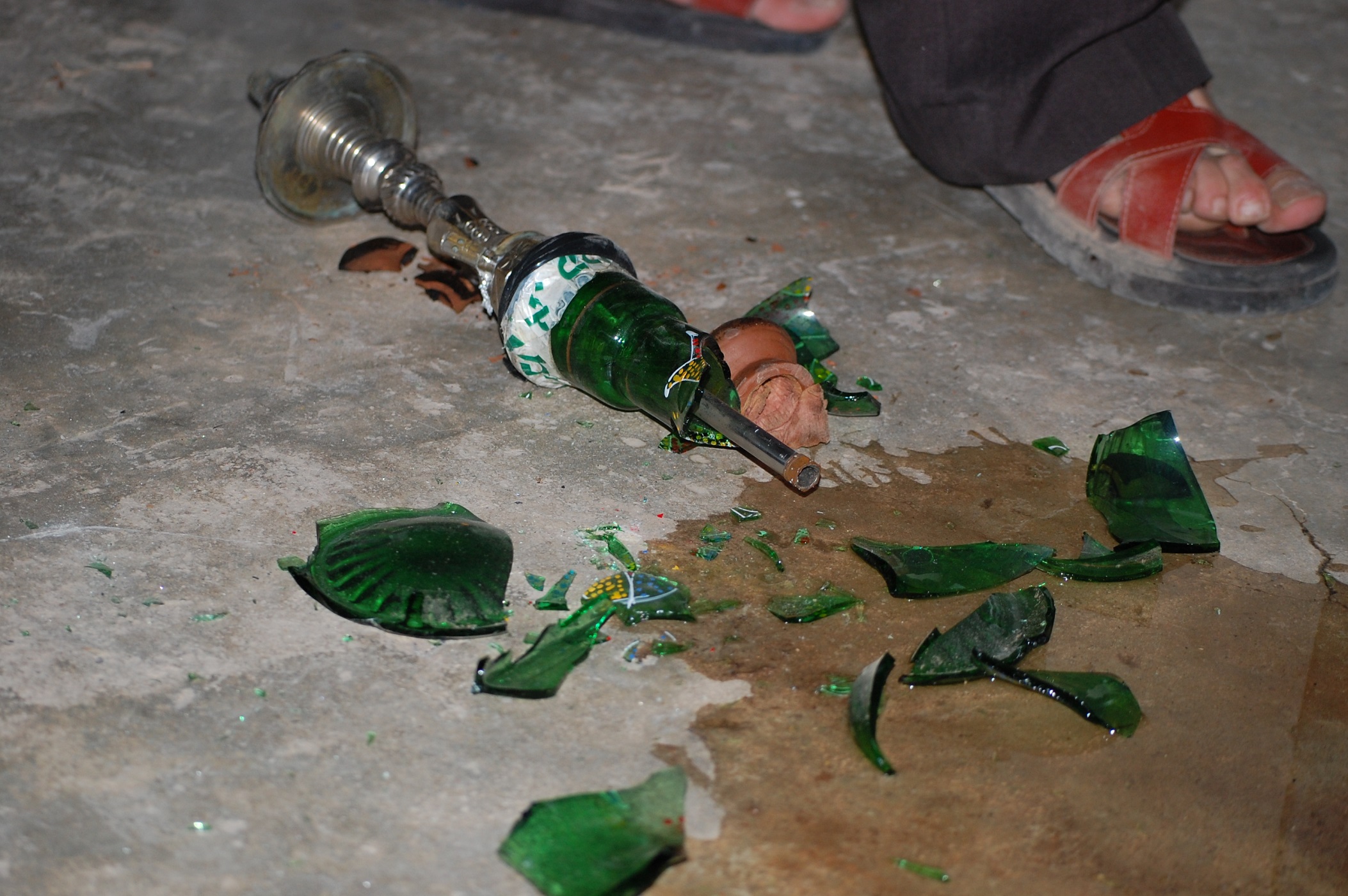
Among the broken property was the Sumud house Argile (Photo by ISM)
Although this is the first time the Sumud house has been targeted in what is clearly a training excersise, such incidents are not uncommon in the H2 area of Hebron, where 35,000 Palestinians live under the constant presence and control of a couple of thousand Israeli soldiers. “I am not training material. I am not an object,” local human rights activist Issa Amro commented after the incident. Amro subsequently called the Israeli DCO (District Coordination Office), which did not seem to know about the harassment and were unable to offer any explanation for the invasion of the two houses.
Related articles
- Father and 7-year-old son illegally detained in occupied Hebron (alethonews.wordpress.com)
- Jabari family once again facing harassment from settlers and soldiers (alethonews.wordpress.com)
Palestinian photographer who was shot in the cheek could be imprisoned yet again
By Shamus Slaunwhite | IMEMC & Agencies | July 24, 2013
In the middle of the night on June 30, Israeli forces invaded the Aida-area home of Palestinian photographer Mohamed Al-Azza, assaulted him and his family, and then arbitrarily detained him until July 11 when he was freed on a bail of 1,500 shekels. On July 25, an Israeli military court will rule on his case.

Palestinian photographer Mohammed Al-Azza recovering in hospital after being shot in the cheek (Photo by: Ryan Rodrick Beiler/Activestills.org)
After sustaining severe injuries during his arrest June 30, Al-Azza was transferred to a hospital for three days, and then sent back to prison. In an Israeli military court, the Israeli security forces charged that Al-Azza participated in “violent and illegal” activities. Reporters Without Borders reported that, “as a journalist, [Al-Azza] has covered demonstrations in support of detainees on hunger strike and protests against the November 2012 offensive in Gaza.”
On April 8, in the Aida refugee camp near Bethlehem, an Israeli soldier shot Al-Azza in the right cheekbone with a rubber-coated steel bullet. Al-Azza, who was working for Palestine News Network, sustained a broken right cheekbone, and underwent two surgeries to remove the bullet. Reporters Without Borders has urged the Israeli security forces to investigate this deliberate shooting of a journalist, to punish the soldier responsible, and to end “the complete impunity enjoyed by IDF soldiers responsible for violence against journalists.”
Related article
Israel bans teacher from Al-Aqsa Mosque
Ma’an – July 22, 2013
JERUSALEM – Israeli police on Monday banned a Palestinian woman from the Al-Aqsa Mosque, where she teaches, for three months.
Um Radwan told Ma’an that Israeli police telephoned her on Sunday, summoning her to the Russian Compound interrogation center.
She told police she was visiting a relative in hospital, and police went to the hospital and handed her a summons, which she refused to accept. More police arrived and detained Um Radwan.
Um Radwan was interrogated for two hours on and released with a summons to appear for further interrogation.
On Monday, Um Radwan was interrogated again at the Russian Compound for another two hours, and released with an order banning her from the Al-Aqsa Mosque for three months.
Um Radwan teaches the history of Jerusalem at the Al-Aqsa Mosque, and leads guided tours for students around the holy site.
The tours are part of a program sponsored by the Al-Aqsa Foundation.
Um Radwan said Israel had banned nine other women involved in the program from the mosque.
Earlier in July, 25-year-old Hussam Sidir, an employee of the foundation, was banned from the mosque for three months.
Um Radwan said Israel was trying to keep activists away from the mosque so Israeli settlers could enter more easily.
Related articles
- Israeli retired judge calls for performing Talmudic rituals in al-Aqsa mosque (ramyabdeljabbar.wordpress.com)
- Shin Bet officials call to accelerate Israeli control over al-Aqsa mosque (ramyabdeljabbar.wordpress.com)
- Israelis enter al-Aqsa on first day of Ramadan, chant anti-Arab slogans (theuglytruth.wordpress.com)
The Nakba Continues: Israel’s Bedouin Face Mass Displacement
By Nadia Ben-Youssef | New Left Project | July 15, 2013
I met Aziz Al-Touri nearly three years ago in a well-constructed tent of 2x4s and brightly-coloured tarp, erected next to the concrete remains of his family home and the exposed roots of hundreds of his olive trees. With the sound of crushing bulldozers and the sight of thousands of Israeli security forces still haunting the dreams of his five children, he spoke of his life in terms of before and after. Before and after 27 July 2010. Before and after the demolition of his entire village, Al-Araqib, one of 35 so-called “unrecognized villages” in the Negev desert in southern Israel. Today, when Aziz tells the story of his village, in an English that was completely foreign to his tongue three years ago, he corrects me when I say Al-Araqib has been demolished 52 times since July 2010. “That wasn’t the first demolition,” he says. “The first demolition was in 1948.”
Prior to the establishment of the State of Israel in 1948 (known as the Nakba or catastrophe in Arabic) some 92,000 Palestinian Bedouin lived in distinct and fixed villages and controlled 99% of the land in the Negev (Naqab). Land ownership and transactions were regulated within a sophisticated traditional system, and recognized by both the Ottoman Government and the British Mandate. Following the Nakba, and the mass expulsion of Palestinians from their homeland, the majority of the Bedouin community was forced to flee to neighbouring States; only 11,000 Bedouin remained, including a few families in the village of Al-Araqib. The remaining community was concentrated into a restricted military zone called the Siyag (Arabic for “fence”) by the Israeli Military Authority, with the internally displaced communities being told that they would be able to return to their own land within 6 months.
65 years later, none of the internally displaced Bedouin have been allowed to return, nor have they been given any proprietary rights to the land onto which they were moved. Similarly, the State did not recognize the land rights of the Bedouin communities that lived within the Siyag prior to the concentration. According to Israeli law, none of the Bedouin have any legal right to their ancestral land; the 1953 Land Acquisition Law (Actions and Compensation) declared all of the land of the Negev to be “state land.” With the passage of the law, the Bedouin were deemed “trespassers” and all of the Bedouin villages (both historic, and those created by the military government) were declared “illegal” and to this day have been denied recognition.
Successive Israeli governments have been faced with what the state regards as the “Bedouin problem.” This classification is all the more troubling when one considers that the Bedouin, like all Palestinians who remained in Israeli territory after the Nakba, were granted Israeli citizenship by 1954. The “problem” for the Jewish state is primarily one of demography. The Bedouin, who now number some 200,000 people, comprise around 32% of the population in the Negev; next to the Galilee, the Negev is the region in Israel with the highest percentage of non-Jewish citizens. Israel’s solutions, which are developed without community consultation, are often disguised as general regional development or described in patronising terms as benevolent attempts to “modernise” the Bedouin. However, all reflect the state’s acute anxiety about the “demographic threat” as well as the normalised discrimination against its Palestinian citizens.
Beginning in the late 1960s, the Israeli state’s first imposed solution was to urbanise its rural, pastoral citizens, creating seven urban townships over the next two decades. These urban townships are annually featured in the lowest socioeconomic bracket in Israel, and suffer from the highest rate of poverty, crime and unemployment. The forced urbanisation of traditional farmers and shepherds looks exactly as one would expect: bails of hay line the major roads, and herds of sheep, goats and camels are kept in pens attached to homes. Half of the Bedouin community, or roughly 100,000 people, live in these seven townships, though 85% of the residents are those who were internally displaced into the Siyag by the Israeli military government after the Nakba. Most of the Bedouin who were never moved from their ancestral land have remained in their historic villages, despite the fact that these villages are “unrecognized” by the State of Israel.
Unrecognized villages do not appear on any official maps, and their residents are denied access to all basic services including water, electricity, roads, sewage, schools and health clinics, in order to “encourage” them to abandon their homes. All of the structures in the villages are “illegal”, in that they were built without permits from the State, and are thus subject to frequent demolition (around 1,000 Bedouin homes were demolished in 2011). Beginning in 2003, after intensive efforts by an elected group of Bedouin leaders who formed the Regional Council of the Unrecognized Villages, 11 unrecognized villages were recognized. Though these villages do not face a future of mass demolition and displacement, ten years later they remain disconnected from all state infrastructure, and as there is no elected authority from which to request building permits, new or renovated buildings are also regularly demolished.
However, it is the remaining 35 unrecognized villages, home to some 70,000 Bedouin citizens of Israel, that are the target of the Prawer Plan, the government’s most recent “solution” for the Bedouin community. Named after the architect of the plan and former deputy chair of the National Security Council, Ehud Prawer, the Prawer Plan aims within three years to destroy the remaining villages, displace up to 70,000 Bedouin into the existing townships and recently-recognized villages, and resolve all outstanding Bedouin land claims (of which there are over 3,200, amounting to 5% of the land of the Negev) in favour of the State of Israel. If fully implemented, the Prawer Plan would result in the largest confiscation of Palestinian-owned land since the 1950s, and confine the Bedouin population to less than 1% of the Negev. Not only does the Prawer Plan officially deny Bedouin the rights to their land and their agency as citizens to determine where and how to live, it proposes a new discriminatory legal reality that applies only to the Bedouin community. According to the implementing legislation of the plan, the Prawer-Begin Bill, the process of judicial review is explicitly and severely restricted for Bedouin citizens of Israel by eliminating court-ordered and supervised demolitions and evictions in favour of speedy administrative orders. The Prawer-Begin Bill does not apply to Jewish citizens of Israel, for whom all constitutional protections remain intact.
The devastating plan was developed, as usual, without consultation with the Bedouin community and approved by the government in September 2011. Following considerable local and international pressure, the government conceded to holding a post-facto “public listening” process whereby Minister Benny Begin (a minister without portfolio in the Netanyahu administration) heard 1,000 Bedouin citizens and representatives. When Minister Begin finally presented his recommendations to the government a year later, it was clear that neither the grievances, nor the comprehensive planning alternatives proposed by the community in partnership with professional planners (in the form of an Alternative Master Plan to recognize the villages) had been incorporated into the Prawer Plan. Further, in the year that Minister Begin was writing his recommendations, the government silently approved the Regional Master Plan for the Be’er Sheva Metropolitan Area, which sets out the state’s “development” plans and outlines in concrete terms the state’s confiscation of Bedouin land and the eviction and destruction of most of the unrecognized villages.
The Regional Master Plan in some instances merely confirms already existing facts on the ground. In Al-Araqib for instance, the Master Plan grants legitimacy to two Jewish National Fund forests that are zoned for the area of the village, and today are almost entirely planted. In many other cases, however, the planting of new forests or park reserves, establishment of new Jewish settlements, and construction of new industrial parks, roads and military zones laid out in the Master Plan is hindered by the presence of the unrecognized villages. The Prawer Plan and the Prawer-Begin Bill enables the state to swiftly remove the villages and villagers to proceed with “development” projects that privilege state interests at the expense of its Bedouin citizens.
The Bedouin community and the Arab political leadership in Israel, together with civil society, have spent the last two years opposing and challenging the Prawer Plan and the Prawer-Begin bill. The community has organized mass protests in the Negev, and human rights organizations in Israel and around the world have mobilised thousands of people to speak out against the mass displacement. Meanwhile, the international community has condemned the discriminatory plan and the legislation, including the UN Committee on the Elimination of Racial Discrimination, the UN Special Rapporteur on Adequate Housing and the European Parliament in 2012. Yet, on 24 June 2013, the Prawer-Begin bill passed its first reading in the Israeli Knesset.
The Prawer-Begin bill joins a wave of discriminatory legislation directly targeting Palestinians living under Israeli control, both citizens of Israel and Palestinians living in the Occupied Palestinian Territory (OPT). 31 bills were proposed or passed during the 18th Knesset, and already in the first four months of the new 19th Knesset, 29 new discriminatory bills have been proposed that attack the rights of Palestinians. Normalised discrimination against Palestinians in Israel, fueled by widespread ignorance and misinformation, lends popular support to these legislative initiatives. In the case of the Prawer-Begin bill, it is likely that it will pass its second and third readings and be enacted into law before the closing of the Knesset session at the end of this month.
The approval of the Prawer-Begin bill only makes sense within this larger context, just as the 52 most recent demolitions of the village of Al-Araqib only make sense when one considers, as Aziz rightfully pointed out, the first demolition in 1948. Beneath the Prawer-Begin bill, and the discriminatory legislation that marks this era in the history of the Jewish state, lies a national project that has always sought to control for the Jewish people as much land with as few Palestinians as possible. The international community must intervene at the highest level to stop the Prawer-Begin bill. But the mass displacement of Israel’s Bedouin community is not just a problem; it is a symptom of the inherent contradiction between a state that defines itself in ethno-religious terms while also claiming to be a democracy. Where 1 in 5 Israeli citizens is excluded from full civic protection and participation simply for being Palestinian, and where a Palestinian Bedouin citizen of Israel and a Jewish citizen of Israel living in the Negev are treated according to different laws and policies, no democracy exists.
Nadia Ben-Youssef is a human rights lawyer living in the Naqab and serving as an international advocacy consultant for Adalah – The Legal Center for Arab Minority Rights in Israel.
Related articles
- Dozens injured in Jerusalem protest against the Prawer plan (alethonews.wordpress.com)
- Israeli extremists attack Negev village (altahrir.wordpress.com)
US, Israel launch joint aerial drill
Press TV – July 21, 2013
The United States and Israel have begun a joint aerial drill. According to a statement by the Israel military the two-week “Juniper Stallion 13” aerial exercise began Sunday morning.
An undisclosed number of F-15 and F-16 fighter jets from both sides are participating in the training event. It’s held at Uvda Base in the southern Negev Desert, during which pilots will practice air-to- air combat maneuvers, mid-air refueling, bombing runs and other missions.
The United States European Command (EUCOM) is involved in the aerial war games which will focus air-to- air combat maneuvers, mid-air refueling, bombing runs and other missions.
The exercise comes after a two-day visit to Israel on July 14 by EUCOM’s Commander General Philip M. Breedlove.
“The combined exercise is designed to improve the interoperability and cooperation between the Israeli and U.S. air forces, and has been planned for more than a year,” an Israeli military source told Xinhua.
The U.S. is Israel’s biggest ally and international supporter. It supports Tel Aviv financially, militarily and diplomatically. Washington is providing billions of dollars of military aid to Tel Aviv annually.
During Fiscal Year 2013, the U.S. is providing Israel with at least $8.5 million per day in military aid.
Meanwhile Times of Israel has reported that “Israel would receive $3.4 billion in total military aid under the 2014 U.S. budget proposal sent to Congress by President Barack Obama”. The proposal is inclusive of “$3.1 billion in general military aid for Israel, similar to 2013, plus a separate request for $220 million to finance the Iron Dome anti-rocket defense system.”
“Obama’s 2014 proposal also allocates $96 million for joint U.S.-Israel research and development projects, including the David’s Sling and Arrow missile defense systems. The overall budget proposal that Obama submitted to Congress on Wednesday totalled $3.8 trillion.”
The If Americans Knew website (http://ifamericansknew.org/stats/usaid.html) reports that “Beginning in 2007, the U.S. has increased military aid by $150 million each year. Beginning 2012, we will be sending Israel $3.1 billion a year (or an average of $8.5 million a day) and will continue to provide military aid at that level through 2018. U.S. tax dollars are subsidizing one of the most powerful foreign militaries.”
In Israel’s last two wars on the Gaza Strip alone, Operation Cast Lead (27 December 2008- 18 January 2009) and November 2012, hundreds of civilians, including many women and children were killed.
In addition to financial and military aid, the U.S. has vetoed over 40 UN resolutions that have been critical of Israel and its policies towards Palestine.
Israeli regime a replication of S. African apartheid?
Press TV – July 22, 2013
The Israeli regime has been accused of replicating the former South African Apartheid regime by the UN investigators, politicians and human rights groups.
Former South African leader Nelson Mandela once said “we know too well that our freedom is incomplete without the freedom of the Palestinians”.
Last month, Ismail Coovadia, outgoing South African ambassador to Tel Aviv, said the regime is a “replication of apartheid” and built on “stolen land”.
The relation between Tel Aviv and the Apartheid regime in South Africa has even become the subject of a book — “Unspoken Alliance; Israel’s Secret Relationship with Apartheid South Africa.
All these call for a look at the similarities between the two regimes and their cozy relations with Britain.
The Israeli regime is treating Palestinians, especially those living in the West Bank just like blacks, who were confined to Bantustans equal to West Bank enclaves and the besieged Gaza Strip by the Apartheid regime.
Palestinians are confined to security zones in the West Bank where they should have permits to pass military checkpoints while those in the Gaza Strip are under a military siege and have limited access to food, water, drugs and fuel, among others.
Palestinians are indeed under Israeli military occupation and face control of movement, physical separation from Zionists even on the roads and lack equal rights with them.
The physical separation, which is similar to the black Bantustans enforced by a variety of measures, is imposed on the Palestinians by creation of Israeli-only roads, limiting their access to lands and resources in the occupied territories and most recently by erecting of the separation barrier (otherwise known as the “Apartheid Wall”) in the West Bank.
Palestinians are also subjected to a totally different legal system than do Israeli occupiers to the extent that Palestinians are turned into secondary residents of their own lands by the occupiers, just like blacks versus white settlers during apartheid rule in South Africa.
In terms of equal rights, Palestinians also do not have the right to vote in the Israeli elections as was the case in the South African Apartheid regime.
They were given an illusion of a democracy by the Oslo Accords that enabled them to vote in the Palestinian Authority elections that brings to mind the local black polls for Bantustans, but that illusion was shattered in 2006 after Hamas won the PA elections but was not allowed to form a government.
The Israeli regime had also warm ties with the apartheid regime and the man behind the concept and implementation of apartheid, former South African Premier Hendrik Verwoerd, once said “Israel, like South Africa, is an apartheid state”.
The two regimes signed a military agreement in 1975 and the Zionist side helped the apartheid regime circumvent international sanctions until its end in the 1994, to the point that the UN General Assembly condemned Tel Aviv’s “collaboration with the racist regime of South Africa”.
The apartheid regime was also considered a close ally of Britain and London used its weight to prevent sanctions against the regime while maintaining extensive trade with South Africa especially by importing gold.
Later in the 1980’s, British Prime Minister Margaret Thatcher proved a staunch support of the racist regime describing the anti-apartheid Mandela as a terrorist in 1987.
Such a position is now clearly seen in the London-Tel Aviv ties and it goes without saying that Britain laid the cornerstone of a Zionist entity in the Palestinian lands in the first place.
In 2002, South African Archbishop Desmond Tutu wrote an article named “Apartheid in the Holy Land” that that his recent trip to Palestine had reminded him “so much of what happened to us black people in South Africa”.
He had earlier written in 1984 that the Bantustans, which were pretended to be self-governing homelands by the apartheid regime were deprived of “territorial integrity or any hope of economic viability”.
They were, he wrote, merely “fragmented and discontinuous territories, located in unproductive and marginal parts of the country” with “no control” over natural resources or access to “territorial waters”.
The description that appears to be a depiction of the occupied territories just now has been echoed by the UN Human Rights Rapporteur John Dugard, who is a South African legal professor and apartheid expert.
Dugard said “Israel’s laws and practices” in the Occupied Territories “certainly resemble aspects of apartheid”.
The analogy is also seen by British Labour MP Gerald Kaufman and former minister for international aid Clare Short who are pushing for sanctions against Tel Aviv.
The description of the situation in the occupied territories by Clare Short in the Commons back in June 26, 2007 is illuminating.
“I have followed developments in the Middle East carefully over many years, and I was well aware before my recent visit how bad things are for the Palestinian people. Nevertheless, I was deeply shocked by Israel’s blatant, brutal and systematic annexation of land, demolition of Palestinian homes, and deliberate creation of an apartheid system by which the Palestinians are enclosed in four Bantustans, surrounded by a wall, with massive checkpoints that control all Palestinian movements in and out of the ghettos,” she said.
A key difference, however, remains, that is apartheid rulers exploited blacks as cheap laborers while Zionists are ethnically cleansing Palestinians.
A South African newspaper editor, Mondli Makhanya, put it in a nutshell after a 2008 trip to the Middle East.
“It seems to me that the Israelis would like the Palestinians to disappear. There was never anything like that in our case. The whites did not want the blacks to disappear,” he said.
Featured Video
or go to
Aletho News Archives – Video-Images
Book Review
The Zeolite Book — First Edition, 2026, Paperback
The volcanic mineral medicine will not patent — for the toxic burden medicine will not name
Lies are Unbekoming – October 30, 2026
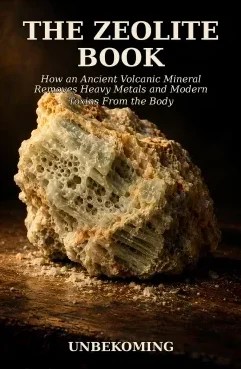 Zeolite is old. It is in Roman concrete that has held for two thousand years. It’s in the water filters of ancient cisterns. It’s in the stomachs of Pacific livestock whose keepers knew, somehow, that this grey crumbling rock made the animals healthier. It’s in Soviet clinical protocols from the 1960s. It’s in the standard emergency response to the Chernobyl explosion.
In 1986, after the Chernobyl reactor failure, the Soviet Union manufactured and distributed natural zeolite at industrial scale — for soil remediation, for livestock feed, for human consumption, for the cleanup itself. Karl Hecht, who had been director of the Institute for Experimental and Clinical Pathophysiology at the Charité of Humboldt University Berlin, spent the six decades after that building the clinical research base — on silicon’s role in human health, on zeolite’s clinical safety, on its applications in ageing. In 2018, Pavelić and colleagues published a comprehensive clinical safety review of natural clinoptilolite in Frontiers in Pharmacology. In 2019, Mastinu analysed its binding affinities. In the Western medical literature, these works sit largely uncited.
What has not been treated at book length, until now, is how a volcanic mineral with six decades of Soviet clinical work behind it, two major peer-reviewed Western reviews, and ongoing clinical use across the former Eastern Bloc, remains almost entirely absent from Western medical practice — and what the toxic burden it’s meant to address actually is.
The Zeolite Book gathers the Soviet clinical record, the Western peer-reviewed studies, three contemporary practitioner voices, and three serious counterviews into one honest treatment. That’s why the book runs to seven appendices. 288 pages, four parts, three practitioner voices, three counterviews, seven appendices. The honest treatment is the argument.
Blog Roll
 Aletho News
- Wrong, AP and NPR: Europe’s 50,000 Heat Deaths Are a Computer-Model Estimate, Not a Real Body Count
- Questioning Your Doctor Is Now Considered A Psychological Problem (Seriously)
- London tourism expo promotes Israeli agency linked to theft of Palestinian land
- Dockworkers launch global strike against Israeli and US military shipments
- Europe facing gas price shock – Gazprom chief
- Ukraine continues recruiting people with disabilities
- Weaponized Journalism: 2021 Sayer Ji Interview with NPR
- Beyond Netanyahu: what Israel’s election means for Palestinians
- Lithuania plans universal conscription
- Lies, Damn Lies, and Ukraine News
- If Americans Knew
- 1,300 will gather in Palo Alto on Nov. 1 for Z3 Conference on Zionism
- DAILY UPDATE: Latest essential news on Palestine, Israel, & region
- The Long Arm of AIPAC
- Genocidal intent behind Hebron assault, rights group says
- This week, Israel killed 8-year-old who survived bombing that wiped out her family
- DAILY UPDATE: Latest essential news on Palestine, Israel, & region
- Israeli soldier poses at damaged Lebanon church, sparking anger
- New Report. Manufacturing the Great Replacement: Is Israel behind one of the largest racist influence campaigns ever documented?
- ‘Arab voice doesn’t count’: Jewish Israeli blocs reject Palestinian support
- Whether Bibi Stays or Goes, the ‘Special Relationship’ Must End
- No Tricks Zone
- Germany’s Green Energy Transition Becoming Increasingly Expensive…Another 6 Trillion Euros!
- Sudden Stratospheric Warming, Powerful El Niño Combination May Lead To Extreme Europe Cold, Energy Crisis!
- Two New Studies Find Thwaites Glacier Melt Cannot Be Driven By Human Activity Or A Warming Ocean
- E-Cars Reduce CO2 Emissions By Only 41% Compared To Internal Combustion Engine Vehicles
- Predictions Made By Renowned Climate Professor Over Past Decades Have Been Proven To Be Poor
- New Study Suggests Large Regions Of The Pacific Ocean Have Been Cooling For The Last 80 Years
- Germany’s Green Energy Debacle: High Energy Costs Force Kahla Porzellan to Close After 182 Years!
- New Study: 50 Years Of The Most Aggressive ‘Net Zero’ Policies Can Only Affect The Global Climate By 0.03°C
- US September “Heat” Was No Record…Many Records Set Decades Ago
- Latest European Green Energy Debacle; Portugal’s Largest Flagship Solar Park Insolvent!


