Report: 1,790 Palestinians Kidnapped, 16 Killed, In First Half of 2013
By Saed Bannoura | IMEMC & Agencies | July 1, 2013
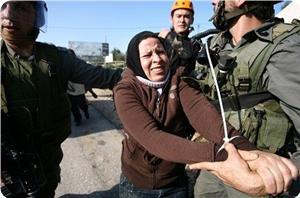
The Ahrar Center for Detainees Studies and Human Rights have reported that Israeli soldiers kidnapped 1,790 Palestinians in the first six months of this year, including 300 who were kidnapped in June, and added that 16 Palestinians have also been killed by the Israeli military in six months.
The Ahrar Center said that dozens of women, children, elderly, legislators, intellectuals and journalists were among the kidnapped.
The center added that the arrests took place in every part of the occupied West Bank, including Jerusalem, in addition to 25 arrests in the Gaza Strip, including fishermen and five arrests at border terminals.
Most of the arrests have been carried out in the Hebron district, in the southern part of the West Bank. The second highest number of arrests was carried out in Jerusalem, followed by Nablus.
Ahrar said that February witnessed the largest number of arrests as the soldiers kidnapped 382 Palestinians, while 350 have been kidnapped in January, 300 in June, 263 in May, 259 in April and 236 in March.
The center further reported that the army also kidnapped 7 Palestinian legislators identified as Ahmad Attoun, Hatem Qfeisha, Abdul-Jabbar Foqaha, Imad Nofal, Basem Za’areer, Mahmoud Ramahi, and Mohammad Jamal An-Natsha.
Furthermore, Ahrar said that the army also kidnapped 33 women, including wives and relatives of political prisoners held by Israel, and that 17 of the kidnapped women are still imprisoned by Israel.
The Ahrar Center also said that 14 Palestinians, including 10 from the West Bank, and four from the Gaza Strip, have been shot and killed by the Israeli army since the beginning of this year, in addition to two Palestinian political prisoners who died in Israeli prisons.
Detainee Arafat Jaradat, 33, from Hebron, died of extreme torture by Israeli interrogators, and detainee Maisara Abu Hamdiyya, 64, died of an advanced stage of cancer resulting from the lack of medical treatment in Israeli prisons.
Four more Palestinians have been killed by Israeli military fire in the Gaza Strip.
Head of the Ahrar Center, Fuad Al-khoffash, stated that the center documented daily Israeli military invasions; daily arrests and assaults, and demanded the International Community to act against the ongoing and escalating Israeli violations.
Report: 100 Israeli attacks during June
Palestine Information Center – 01/07/2013
RAMALLAH — In its monthly report, the Information Center of the Wall and Settlement documented an escalation in Israeli attacks during June including demolition notices and settlement expansion.
The report issued on Sunday monitored 98 Israeli assaults during June including 23 demolition operations mostly in Jordan alley and Jenin.
The report also pointed out 57 demolition orders in al-Khalil, 11 demolition notifications in Jerusalem, and 6 others in Bethlehem.
During June, the Israeli authorities declared the establishment of 3,341 housing units in West Bank settlements, and approved the construction of a huge building in Wadi al-Hilweh, known as Giv’ati parking, as part of the Israeli Judaization schemes in occupied Jerusalem.
Israel’s Jerusalem District Committee for Planning and Building has prepared an outline to connect the Jewish quarter in the Old Town Square with Al-Buraq Square through building underground elevators and corridors, the report added.
For its part, the Israeli Municipality has established a new road to link between the occupied city of Jerusalem and Ma’aleh Adumim settlement.
The monthly report referred to Israeli settlers’ escalated attacks where 14 Palestinian citizens were assaulted, and 30 cars were burned, in addition to stealing Palestinian monuments in Bethlehem and closing main streets that connect Palestinian villages and cities.
The Information Center also documented several Israeli break-ins into al-Aqsa mosque during June.
Related articles
- Jewish settlers attack buses filled with children in Jerusalem (alethonews.wordpress.com)
- UN statement on Israeli plan to relocate Palestinians to build houses for settlers (alethonews.wordpress.com)
- Maximum Land with Minimum Palestinians: The Annexation of Area C (alethonews.wordpress.com)
- More Israeli settler-terrorism: Settlers attack two Palestinian buses in Jerusalem (altahrir.wordpress.com)
- Report: “1790 Palestinians Kidnapped, 16 Killed, In First Half of 2013” (imemc.org)
- Palestine: Al Aqsa mosque stormed, demolition orders & more lands confiscated (realisticbird.wordpress.com)
Maximum Land with Minimum Palestinians: The Annexation of Area C

In the vast majority of Area C Israel denies Palestinians any opportunity to build or develop.
By Sam Gilbert | Palestine Chronicle | June 29 2013
Early this month Israeli human rights organization B’Tselem published a report on Israel’s policy in Area C and its implications for the population of the West Bank. Less then a week later Economy Minister Naftali Bennett, in the midst of Kerry’s attempts to start the stalled peace talks, reiterated his plan to annex all of Area C to the Israeli state, bringing with it the 350,000 some od settlers as well as 62% of land of the West Bank.
In a conference held by the settler Yesha Council Bennett said “the attempt to establish a Palestinian state in our land has ended … That we need to Annex area C of the West Bank now because the idea of creating a Palestinian state there is over.”
Bennett’s comments were met with international condemnation, the timing of his words seen as purposefully undermining Kerry’s attempt to restart the stalled peace negotiations. These comments, along with others from the Israeli right, have been presented as marginal within the mainstream Israeli political discourse. However the substance of Israeli policy and practice in the West Bank requires that these ideas been taken seriously.
Bennett’s Israel Stability Initiative published in 2012 lays out his plan for annexation, while B’tselem’s Report on Area C outlines the application and effect of Israeli Policy in Area C from 1995 till today. Each report has fundamentally different political objectives yet both provide a window into Israeli politics and practices in the Occupied Palestinian Territories (oPt).
The Israel Stability Initiative
In 2012 Naftali Bennett presented a 7-point plan for managing the Arab-Israeli Conflict in Judea and Samaria, the biblical term for the West Bank. The Israel Stability Initiative outlines a plan whereby Area C, the territory that Israel maintains full security and planning control after the Oslo agreement, would be annexed to Israel and the Palestinian State would be created in the disconnected cannons of areas B and C. Bennett’s plan would naturalize the 50,000 Arab residents (official number at 180,000), along with the 350,000 Israeli settlers. No Palestine refugee would be allowed to return to the west bank or Israel, and Gaza would be left to fend for itself.
The PA would be granted, “Full autonomy in areas A and B” while Israel would maintain a “full security umbrella for all of Judea and Samara.” The IDF would maintain a strong presence and complete security control over all of Judea and Samaria.”
While this proposal might seem especially partial to Israeli interests, B’tselem’s recent report on Area C shows how Bennet’s plan is in essence the institution of permanence for something has already become the de-facto reality in the west bank today.
B’Tselem Report
Earlier this month B’Tselem published a 111 page report titled “Acting the Landlord: Israeli Policy in Area C, the West Bank. The report presents Israel’s policy in Area C and explores its implications for the population of the West Bank as a Whole.
Area C is a product of the Oslo accords, an interim agreement that was supposed to lead to the establishment of a Palestinian state next to Israel. In 1995 the interim agreement went into effect in West Bank and the region was divided into three administrative categories A, B and C. “Area A: Under full control of the Palestinian Authority, comprising 18 percent of west bank including most Palestinians cities and population center. Area B, 22%: Israel retains military control while PA controls civil matters. Area C, 60 percent: Israel controls security and land related matters, including land allocation, planning and construction, and infrastructure.”
These divisions were based on demography not geography, with A and B subdivided into 165 disconnected cantons with no territorial continuity and surrounded by area C. Area C on the other hand is territorially contiguous, and comprises all the settlement and settlers in the west bank (350,000) along with some 180,000 Palestinians.
Area C contains the vast majority of the West Bank’s natural resources (water, agricultural, mineral) and nearly all of the development potential for a future Palestinian state. Area C lands surround all areas of A and B stifling growth in these already built up areas, and disconnecting the regions from one another
Legalizing the Norm
Claim to the greater land of Israel (Eretz Israel), has been a common thread in Israeli politics since the state’s inception and before. Bennet’s proposed plan to annex all of Area C (a modified two state solution) is interesting in that it simply cements the reality on the ground today, extending it to a final solution to the conflict.
B’Tselem’s report underscores how Israel’s policy in area C is anchored in the perception of the area as meant above all to serve Israel’s Own Needs in favor to those of the Palestinians by restricting Palestinian construction and development throughout.
In the vast majority of Area C Israel denies Palestinians any opportunity to build or develop. In fact since 1967 only .6 percent of the entire area C has been allocated to Palestinians by the Civil Administration, while 31 percent has been allocated to pseudo governmental World Zionist Organization (which develops settlement), 8 percent to Settlement Authorities, 12% to government ministries with an additional 30 percent designated as Military Firing Zones.
According to international law, planning and construction policy for Area C should rely on Jordanian planning law, but this has been altered by order of the Israeli military to serve the state’s purposes. One outcome has been the refusal of Civil Administration to plan villages, approving Mandatory Plans for only 16 of 180 villages in Area C. Since all construction in Area C requires approval of Civil Administration, the prospect for receiving a building permit without a master plan is negligible. In fact between 2000-2010 of the 3050 application for permits only 6.5% were approved. Many are forced to build without permits, at constant risk of demolition (660 a year since 2000).
Yet “in contrast to the restrictive planning policy followed for Palestinian communities, the Israeli settlements, also in Area C, enjoy expansive allocation of land, detailed planning, connections to advanced infrastructure and a blind eye regarding illegal construction.”
In 75% of the settlements, building was carried out without the appropriate permits, legalized retroactively by government and military. Between 2000-2007, 91 building permits were issued for Palestinians, same period 17,000 residential units were built in settlements. While Palestinians in area C are isolated from areas A and B, Jewish settlements are connected to one another and to Israel proper by Jewish only bypass roads.
The international community has time and again confirmed the illegality these actions under International Humanitarian Law. Yet insufficient international pressure (particularly from the U.S.) has led to a situation where Israel strengthens it hold on Area C and “preserves a de-facto annexation of area C and creates circumstance that will help perpetuate this state and influence the final status of the Area.”
The Party Line
Bennet’s Ideas about area C reflect a broader hostility within the Knesset about Palestinian statehood and the need to annex all or most of West Bank. In a Times of Israel interview, Deputy minister of Defense Danny Dannon spoke about the sentiment within the coalition government: “there was never a government discussion, resolution or vote about the two-state solution… and nobody will bring it to a vote, it’s not smart to do it — but if you bring it to a vote, you will see the majority of Likud ministers, along with the Jewish Home [party], will be against it.”
Numerous quotes from current cabinet minsters confirm this position:
“The essence of Zionist existence in Israeli settlements across the country.” – Moshe Ya’allon: Defense Minister.
“The real solution is to extend Israeli sovereignty over the settlements in Judea and Samaria.” — Danny Dannon, Deputy Defense Minister.
“We will try to apply sovereignty over as much as we can at any given moment.” — Ze’ev Elkin, Deputy Minister of Foreign Affairs.
“Israel should announce the annexation of Jewish settlements in Judea and Samaria.” — Gilad Erdan, Minister of Communication and Home Front Defense.
“Israel will need to take unilateral steps to extend Israeli sovereignty over the Jewish settlements in Judea and Samaria.” — Yisreal Katz Minister of Transportation.
Annexation: The Final Solution
The vocal support of annexation has been attributed to the right wing shift in the government in Israel, yet its mainstream credentials are exposed with even a cursory glance at policy and practice in the west bank through Israeli history.
Every Israeli president since Menachem Begin in the 70’s has publicly espoused a two state solution based on Bilateral U.S. brokered negotiations, while simultaneously doing everything in their power to undermine its physical viability on the ground.
Netanyahu’s most recent statements, considered “moderate” in comparison to Bennet’s, nonetheless betray the administration’s position to undermine the two state solution, as noted in Peace Now’s report on settlement construction under the current administration. In response to the proposed peace talks Netanyahu said that Israel would continue to build and that “construction in major settlement blocks does not substantially affect Israel’s ability to come to an agreement.” He went on to say that “We will continue to live and build in Jerusalem, which will always remain united under Israeli sovereignty,” as published by the Israeli daily, Isreal Hayom and Haaretz.
Considering East Jerusalem is the internationally recognized future capital for the Palestinian state, and that settlement expansion is the number one obstacle to peace, these comments say much about the prospects for a future agreement. Furthermore, the proposed state Netanyahu supports is one that according to him “would have to be demilitarized and with arrangements that rely fully on the Israel Defense Forces for security.” A state that doesn’t control its borders or security and whose army is the occupying power is not an autonomous state, but the “state” of Palestine today.
Netanyahu’s position toward the Palestinians in consistent with the low ceiling allowed for Palestinian aspirations since the onset of the peace processes. Oslo, the basis of the most current arguments about annexing area C, provides a telling example. As scholar Rashid Khalidi, one of Yassar Arafat’s key advisers during the Oslo negotiations, states, “It (the Oslo agreement) was never designed to achieve independent Palestinian statehood. It was never designed to end the occupation. It was really designed, of all people, by Menachem Begin, to make permanent Israeli control over the occupied territories. And that is what has succeeded until now.” Indeed it has. Since the signing of the Oslo agreement settlement population in West Bank (not including East Jerusalem) has tripled from 110,900 to nearly 350,000, according to B’Tselem.
Palestinian author Naseer Aruri notes the occupation was never designed to be temporary, but has been used to create the illusion of a two-state solution when that option has never been on the real agenda. Madrid, Oslo, Camp David all have been used as diplomatic cover as Israel has consolidated and even extended its illegal occupation.
B’Tselem’s report exposes the fact that Israeli policy gives every indication of permanence. “Israel preserves a de-facto annexation of area C and creates circumstance that will help perpetuate this state and influence the final status of the Area.” If we acknowledge Israeli policy in tandem with territorial usurpation, then comments like Bennet’s need not be viewed as extreme. It is time the International community, the U.S. and those moderates in the Israeli Knesset acknowledge that what Bennett’s is arguing for is not on the margins of Israeli political thought but the ideological underpinning of Zionism as practiced in the oPt. And in area C the Zionist goal of maximum land with minimum Palestinians is on full display.
– Sam Gilbert is a journalist living in Ramallah.
Jewish settlers attack buses filled with children in Jerusalem
Palestine Information Center – 29/06/2013
OCCUPIED JERUSALEM — Palestinian sources in Jerusalem said Jewish settlers on Friday night attacked buses carrying 100 Palestinian children participating in a summer camp organized by Health Work Committees in Silwan in occupied Jerusalem.
Health Work Committees pointed in a press release on Saturday that the camp includes a group of children between 7 and 12 years old, a number of them had been previously arrested in the occupations jails.
The settlers threw stones at the buses, breaking their windows and terrorizing the children.
The committees condemned the attack and called for “providing protection for the Palestinian people and children from settlers’ violence in occupied Palestine, committed under the protection of the occupation army.”
In al-Khalil, another group of Israeli settlers attacked on Thursday evening a Palestinian civilian near Yatta, and fled the scene in the absence of the occupation forces, locals reported.
They added that the citizen sustained wounds as the settlers threw stones at him and was taken to hospital for treatment.
Jewish settlers set on Thursday fire to agricultural lands in the archaeological area of Sebastia near the city of Nablus in the north of the West Bank.
Na’el Shaer, Sebastia’s mayor, said that groups of settlers from the settlement of Shavei Shomron built on the town’s land set fire to agricultural land, damaging large stretches of land, including land planted with olives and almond trees.
He added that the settlers have been continuously targeting the town as it represents an archaeological and historical area, noting that they had previously destroyed crops after pumping wastewater into the cultivated lands.
Related articles
- IOF soldiers round up two boys (ramyabdeljabbar.wordpress.com)
- Jewish settlers injure children in two separate vehicular assaults (alethonews.wordpress.com)
- When Cars Become Weapons: Israeli settler runs over 4 year old Palestinian child in al-Khalil (occupiedpalestine.wordpress.com)
Brzezinski: Saudi Arabia, Qatar, their western allies orchestrated Syria crisis
Press TV – June 29, 2013
The former US national security adviser says the ongoing crisis in Syria has been orchestrated by Saudi Arabia, Qatar, and their western allies.
“In late 2011 there are outbreaks in Syria produced by a drought and abetted by two well-known autocracies in the Middle East: Qatar and Saudi Arabia,” Zbigniew Brzezinski said in an interview with The National Interest on June 24.
He added that US President Barack Obama also supported the unrest in Syria and suddenly announced that President Bashar al-Assad “has to go — without, apparently, any real preparation for making that happen.”
“Then in the spring of 2012, the election year here, the CIA under General Petraeus, according to The New York Times of March 24th of this year, a very revealing article, mounts a large-scale effort to assist the Qataris and the Saudis and link them somehow with the Turks in that effort,” said Brzezinski, who was former White House national security adviser under Jimmy Carter and now a counselor and trustee at the Center for Strategic and International Studies and a senior research professor at the School of Advanced International Studies at Johns Hopkins University.
Criticizing the Obama administration’s policies regarding Syria, he questioned, “Was this a strategic position? Why did we all of a sudden decide that Syria had to be destabilized and its government overthrown? Had it ever been explained to the American people? Then in the latter part of 2012, especially after the elections, the tide of conflict turns somewhat against the rebels. And it becomes clear that not all of those rebels are all that ‘democratic.’ And so the whole policy begins to be reconsidered.”
“I think these things need to be clarified so that one can have a more insightful understanding of what exactly US policy was aiming at,” Brzezinski added.
He also called on US officials to push much more urgently to draw in China, Russia and other regional powers to reach some kind of peaceful end to the Syrian crisis.
“I think if we tackle the issue alone with the Russians, which I think has to be done because they’re involved partially, and if we do it relying primarily on the former colonial powers in the region-France and Great Britain, who are really hated in the region-the chances of success are not as high as if we do engage in it, somehow, with China, India and Japan, which have a stake in a more stable Middle East,” Brzezinski said.
Brzezinski also warned again any US-led military intervention in Syria or arming the militants fighting government forces there.
“I’m afraid that we’re headed toward an ineffective American intervention, which is even worse. There are circumstances in which intervention is not the best but also not the worst of all outcomes. But what you are talking about means increasing our aid to the least effective of the forces opposing Assad. So at best, it’s simply damaging to our credibility. At worst, it hastens the victory of groups that are much more hostile to us than Assad ever was. I still do not understand why — and that refers to my first answer — why we concluded somewhere back in 2011 or 2012 — an election year, incidentally that Assad should go.”
Foreign-sponsored militancy in Syria, which erupted in March 2011, has claimed the lives of many people, including large numbers of Syrian soldiers and security personnel.
The New York Times said in a recent report the CIA was cooperating with Turkey and a number of other regional governments to supply arms to militants fighting the government in Syria.
The report comes as the US has repeatedly voiced concern over weapons falling into the hands of al-Qaeda-linked terrorist groups.
Al-Nusra Front was named a terrorist organization by Washington last December, even though it has been fighting with the US-backed so-called Free Syrian Army in its battle against Damascus.
~
Excerpt from TNI interview:
Heilbrunn: Are we, in fact, witnessing a delayed chain reaction? The dream of the neoconservatives, when they entered Iraq, was to create a domino effect in the Middle East, in which we would topple one regime after the other. Is this, in fact, a macabre realization of that aspiration?
Brzezinski: True, that might be the case. They hope that in a sense Syria would redeem what happened originally in Iraq. But I think what we have to bear in mind is that in this particular case the regional situation as a whole is more volatile than it was when they invaded Iraq, and perhaps their views are also infected by the notion, shared by some Israeli right-wingers, that Israel’s strategic prospects are best served if all of its adjoining neighbors are destabilized. I happen to think that is a long-term formula for disaster for Israel, because its byproduct, if it happens, is the elimination of American influence in the region, with Israel left ultimately on its own. I don’t think that’s good for Israel, and, to me, more importantly, because I look at the problems from the vantage point of American national interest, it’s not very good for us.
Should Israel Be Boycotted?
By Lawrence Davidson | Consortium News | June 27, 2013
Ido Aharoni, Israel’s Consul General for New York and also “the founding head of Israel’s brand-management team and the originator of the Brand Israel movement,” recently wrote an op-ed in the New York Post (June 19, 2013). In it he took to task the famous American novelist Alice Walker for her promotion of a cultural boycott of Israel.
Aharoni explains that, just like most countries in the world, Israel tries to promote “an attractive image” of itself – a sort of Israeli version of “I love New York.” He asks, since, “no other country has ever been criticized for engaging in this common practice of courting tourists and businesses” why does Walker try to interfere with Israel’s branding campaign?

Israel’s Consul General for New York, Ido Aharoni.
Aharoni knows full well why Walker does so. However, for him the racism and oppression Walker sees institutionalized in Israeli society is not a good reason for a boycott. Aharoni asserts that “Israel, like many places on Earth, experiences a variety of issues and challenges. . . . Israel should not be viewed through the prism of its problems, nor should any other country.” On the other hand, Aharoni wants to know why Walker is not boycotting Syria?
The question of why Americans should boycott Israel, in particular, when so many other governments and societies in the world are oppressive and brutal, is an important one. And there is indeed a good answer to it:
The fact that Zionist influence spreads far beyond Israel’s area of dominion and now influences many of the policy-making institutions of western governments, and particularly that of the United States, makes it imperative that Israel’s oppressive behavior be singled out as a high priority case for boycott.
In other words, unlike other oppressive and brutal governments, the Israelis and their supporters directly influence (one might say corrupt) the policymakers of many Western nations and this often makes their governments (most specifically the U.S.) accomplices in Israel’s abusive policies. This being so, prioritizing Israel for boycott is not hypocrisy but rather necessity.
~
Lawrence Davidson is a history professor at West Chester University in Pennsylvania. He is the author of Foreign Policy Inc.: Privatizing America’s National Interest; America’s Palestine: Popular and Official Perceptions from Balfour to Israeli Statehood; and Islamic Fundamentalism.
‘They have two roads on our land already, why do they need a third…?’
International Solidarity Movement | June 27, 2013
Hebron, Occupied Palestine – In the Wadi al-Hussein area of Hebron, Israeli occupation forces have started to build a new road ‘for military purposes’. The route of the road is from the illegal settlement of Kiryat Arba towards the city centre, directly across Palestinian-owned land.
A military order has decreed the construction of this road, four metres wide and more than two hundred metres long, cutting through fields of olive and fruit trees owned by the Palestinian families living there. The stipulation on the width of the road has already been broken, with the route that has been cut by bulldozers being six metres wide in places.
In contrast to the military order to build a road, Palestinian landowners have been denied the right to build on their own land. Despite gaining approval from the Palestinian Authority, the Israeli authorities (who have the final say on civil matters in area H2 of Hebron) have refused permission to build a new house. Landowners also point out that there are two existing roads from Kiryat Arba built on Palestinian land for Israeli-use only, and ask why a third is required.
When occupation forces attempted to build this road initially, landowners and others tried to stop construction by sitting down in front of bulldozers, but this non-violent protest was met with arrests, fines and imprisonment, and by the bulldozer dumping a load of earth on top of them.
Landowners complain that Israel insists on applying those aspects of the Hebron accords that benefit settlers, while ignoring those aspects covering the rights of the majority Palestinian population. Using military orders to steal land is a tactic long-used by Israel. Land seized this way then later typically becomes part of the ever-expanding settlement project. All Israeli settlements are illegal under international law, which bans the transfer of the occupier’s population into the land under occupation.
Related articles
- Jewish settlers setting up tent and planning road on Palestinian owned land in Al Khalil (alethonews.wordpress.com)
- Settlers building illegal road on Palestinian land in Hebron (palsolidarity.org)
- Susiya resists mass demolition orders (alethonews.wordpress.com)
- Settlers Attack Palestinians In Hebron (imemc.org)
- New road connects Israeli settlement with the Ibrahimi Mosque (ramyabdeljabbar.wordpress.com)
Susiya resists mass demolition orders
“We will not give up; to give up is to die”
International Solidarity Movement | June 27, 2013
Susiya, Occupied Palestine – Today, June 27, 2013, the Israeli Civil Administration served thirty-four demolition orders in the Susiya village, which is in Area C and surrounded by the Israeli colony of Suseya. Due to previous demolition orders, every existing structure in the village is now threatened with destruction if they do not obtain permits by July 17.
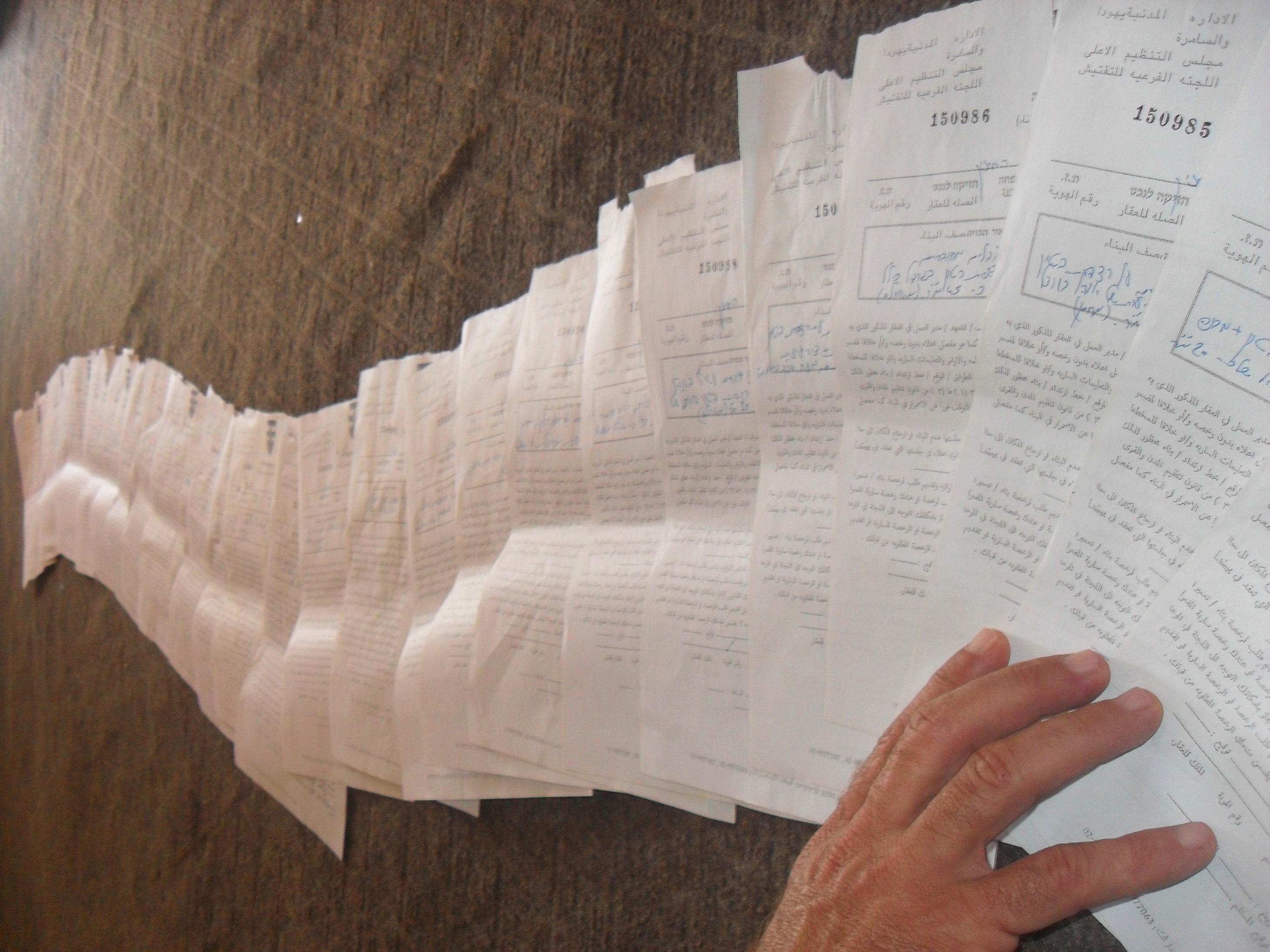
Original copies of all the demolition orders served today (Photo by ISM)
The residents of Susiya include more than thirty families, who were all evacuated from their homes in the old Susiya village and forced to relocate 200 meters to the southeast, in 1986. Susiya residents collaborate with the nearby villages in Masafer Yatta, a closed military “firing zone,” also in Area C and threatened with demolition. On July 15, a hearing will decide whether all the villages in Masafer Yatta can be evacuated by the military. Hafez Huraini, leader of the South Hebron Hills Popular Committee and himself a refugee from 1948, emphasizes that the villagers in Susiya are targeted simply for existing, so everything they do from grazing sheep to visiting family members in the nearby city of Yatta draws violence from the Israeli military and the local settlers.
Susiya has faced six mass demolitions since the establishment of the Israeli Suseya colony in 1983. The last wave of demolitions in 2011 repeatedly displaced 37 people including 20 children [1]. Residents of Susiya, most of whom rely on subsistence agriculture, are subject to some of the worst living conditions in the West Bank. Their houses were destroyed by Israeli forces and they now live in tents and shelters, paying more than five times the price nearby villages pay for water and consuming less than 1/3 of the WHO standard per capita [2]. Settlers have violently denied Susiya residents access to over 300 hectares of their land, including 23 water cisterns. Documented cases of settler violence include beatings, verbal harassment and destruction of property. Settlers then annex parts of the land by exploiting the Palestinian owners’ inability to access their land.
Of over 120 complaints that have been filed based on monitoring from Rabbis for Human Rights, regarding settler attacks and damage to property, around 95 percent have been closed with no action taken. In 2010, when 55 Susiya residents petitioned the High Court to be granted access to their land, the State responded that it intended to map land ownership of the area. Since then they have only closed to settlers 13% of the land Palestinians have been denied access to, reversing only one incursion [3].
Susiya has been the site of creative non-violent resistance for years, resistance that is continually met with brutality. Events have included marches, picnics on land likely to be confiscated, and Palestinian “outposts.” This coming Saturday Susiya will be part of a festival in the South Hebron Hills aimed at raising awareness about the situation of Masafer Yatta residents and stress their right to remain on their land [4]. In the words of Hafez Huraini, coordinator of the South Hebron Hills Popular Committee, “We will not give up.”
Sources:
[1] Strickland, Patrick O. “Palestine’s Front Line: The Struggle for Susiya.” Palestine Note RSS. N.p., n.d. Web. 27 June 2013.
[2] “Susiya: At Imminent Risk of Forced Displacement.” Susiya: At Imminent Risk of Forced Displacement – OCHA Factsheet (30 March 2012). N.p., Mar. 2012. Web. 27 June 2013.
[3] “South Hebron Hills.” Khirbet Susiya. N.p., 01 Jan. 2013. Web. 27 June 2013.
[4] Al Mufaqarah. “Al Mufaqarah R-Exist.” Weblog post. Al Mufaqarah RExist. N.p., 24 June 2013. Web. 27 June 2013.
Related articles
- The occupation plans to expand settlement of Susiya in al-Khalil (occupiedpalestine.wordpress.com)
- Jewish settlers setting up tent and planning road on Palestinian owned land in Al Khalil (alethonews.wordpress.com)
- Settler dogs attack Palestinian villagers near Hebron (occupiedpalestine.wordpress.com)
Related video
- From Al-Araqib to Susiya (palestinefreedomnow.wordpress.com)
The Gates Foundation and its unethical investments in G4S
By Ramona Wadi | MEMO | June 20, 2013
While three Dutch charities have announced that they will no longer accept donations by G4S due to the company’s support for the Israeli occupation, the Gates Foundation has deemed it ethical to invest in G4S, effectively exposing the often ignored link between philanthropy and human rights violations.
The Gates Foundation, renowned for its philanthropy, is allegedly ‘inspired by passion and compassion for the well-being of people’. Focusing on issues such as health, education, poverty, the Foundation now seems to be seeking a share in security affairs, effectively aligning itself with the conspiracy behind the fable of safeguarding human rights. Philanthropy should be viewed within a wider image – a surplus of funds derived from a capitalist enterprise channelled into appropriate projects which bestow a continuous temporary relief in order to avoid challenging the exploitation which has rendered communities around the world dependent upon charity. With the Gates Foundation aligning its interests with a service provider of oppression, profits will continue to fund approved projects at the expense of violating international human rights law, which is acceptable within the cycle of capitalist dependency.
G4S has been targeted by the BDS movement for its role in providing security and surveillance equipment, rendering the company complicit in war crimes with Israel’s security service, Shin Bet. Torture during interrogations is routine treatment in Israeli jails, often resulting in severe physical and metal degeneration or, as in the case of Arafat Jaradat, death. G4S endorses identical security concern rhetoric as that used by Israel, manipulating the foundations of human rights and security into a territory which encompasses nothing but the alleged rights of the oppressor.
In their 2012 Corporate Social Responsibility Report, G4S states that the company recognises it can ‘play a positive and negative role in respecting human rights around the world’. The company declares that its policy is based upon the Universal Declaration of Human Rights (1947), the International Covenant on Civil and Political Rights (1966), the International Convention on Economic, Social and Cultural Rights (1966) and the international Labour Organisation Declaration on Fundamental Rights at Work (1998). ‘Mapping the human rights landscape’, as stated in the report, and becoming a signatory to the UN Global Compact, are portrayed as a pledge to safeguard human rights, disregarding the UN’s significant faults and unapologetic stances when it comes to selectively bestowing human rights in order to promote and consolidate the impunity of powerful states and allies. In other words, G4S are emulating their provision of security services and basing their legitimacy upon an international organisation which thrives upon illegality.
Dependency has created a spectator society. While activist campaigns have created a far reaching resonance, leaders within the international community are too comfortably ensconced in their glorified positions to challenge a partnership which fuels the Israeli occupation’s crimes against Palestinians. As long as the interpretation of the social world is shaped by dominant allies, it is difficult to fragment the bond between society and economic power, effectively allowing an amalgamation of a ruling power to distort the power of intellectuals into a subservient role abetting international complicity in human rights violations.
Four Injured, Palestine TV Reporters Kidnapped In Kufur Qaddoum
By Saed Bannoura | IMEMC | June 22, 2013
The Popular Committee Against the Wall and Settlements in Kufur Qaddoum village, near the northern West Bank city of Qalqilia, reported Friday that dozens of Israeli soldiers attacked the weekly nonviolent protest, wounding four residents, and kidnapped reporters of the official Palestine TV.
The Committee said that the soldiers violently attacked and beat reporter Ahmad Shawar and cameraman Bashar Nazzal, working for the Palestinian TV, confiscated their cameras, and threw the rest of their equipment in the trash.
An Israeli army spokesperson claimed that the kidnapped journalists “attacked the soldiers”, and that they have been transferred to an interrogation facility.
Morad Shteiwy, coordinator of the Popular Committee in the village, has reported that the army surrounded the village since early morning hours Friday, and invaded it in an attempt to prevent the residents from holding their weekly protest against the illegal Annexation Wall and settlements.
“The large number of soldiers deployed in the village could not prevent the determined residents from holding their protest”, Shteiwy said, “the soldiers violently attacked the protesters and fired dozens of gas bombs, concussion grenades, and rubber-coated metal bullets”.
He further said that resident Aqel Mahmoud Shteiwy, 25, was shot with a rubber-coated bullet in his hand, and that one of his fingers was amputated, and added that resident Yousef Mustafa Shteiwy, 21, was shot in the chest, Bassam Ayyoub Shteiwy, 26, was shot in the back and Bashar Mahmoud Shteiwy, 22, was shot in the abdomen.
Also on Friday, soldiers used tear gas, chemical water and rubber-coated steel bullets to attack the weekly protests at the villages of Bil’in and Ni’lin, near the central West Bank city of Ramallah, where residents and their international and Israeli supporters, managed to reach the wall; two protesters were injured and many were treated for the effects of tear gas inhalation.
In Bil’in, gas bombs fired by Israeli troops caused a fire that damaged olive trees owned by local farmers. Soldiers also fired tear gas at residents who tried to put out the fire.
At the nearby village of al Nabi Saleh, Israeli soldiers attacked the villagers and their supporters before leaving the village.
Dozens of soldiers stormed the village and fired gas bombs into resident’s homes. Many were treated for the effects of tear gas inhalation.
In al Ma’sara village, near Bethlehem, dozens of soldiers stopped the villagers and their supporters at the village entrance and then forced them back, using rifle-buts and batons to push people back, no injuries were reported.
Related articles
Featured Video
or go to
Aletho News Archives – Video-Images
Book Review
The Zeolite Book — First Edition, 2026, Paperback
The volcanic mineral medicine will not patent — for the toxic burden medicine will not name
Lies are Unbekoming – October 30, 2026
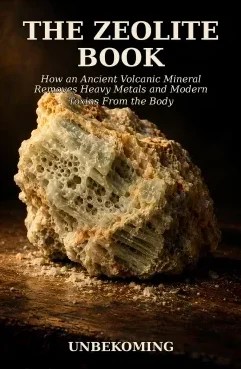 Zeolite is old. It is in Roman concrete that has held for two thousand years. It’s in the water filters of ancient cisterns. It’s in the stomachs of Pacific livestock whose keepers knew, somehow, that this grey crumbling rock made the animals healthier. It’s in Soviet clinical protocols from the 1960s. It’s in the standard emergency response to the Chernobyl explosion.
In 1986, after the Chernobyl reactor failure, the Soviet Union manufactured and distributed natural zeolite at industrial scale — for soil remediation, for livestock feed, for human consumption, for the cleanup itself. Karl Hecht, who had been director of the Institute for Experimental and Clinical Pathophysiology at the Charité of Humboldt University Berlin, spent the six decades after that building the clinical research base — on silicon’s role in human health, on zeolite’s clinical safety, on its applications in ageing. In 2018, Pavelić and colleagues published a comprehensive clinical safety review of natural clinoptilolite in Frontiers in Pharmacology. In 2019, Mastinu analysed its binding affinities. In the Western medical literature, these works sit largely uncited.
What has not been treated at book length, until now, is how a volcanic mineral with six decades of Soviet clinical work behind it, two major peer-reviewed Western reviews, and ongoing clinical use across the former Eastern Bloc, remains almost entirely absent from Western medical practice — and what the toxic burden it’s meant to address actually is.
The Zeolite Book gathers the Soviet clinical record, the Western peer-reviewed studies, three contemporary practitioner voices, and three serious counterviews into one honest treatment. That’s why the book runs to seven appendices. 288 pages, four parts, three practitioner voices, three counterviews, seven appendices. The honest treatment is the argument.
Blog Roll
 Aletho News
- Wrong, AP and NPR: Europe’s 50,000 Heat Deaths Are a Computer-Model Estimate, Not a Real Body Count
- Questioning Your Doctor Is Now Considered A Psychological Problem (Seriously)
- London tourism expo promotes Israeli agency linked to theft of Palestinian land
- Dockworkers launch global strike against Israeli and US military shipments
- Europe facing gas price shock – Gazprom chief
- Ukraine continues recruiting people with disabilities
- Weaponized Journalism: 2021 Sayer Ji Interview with NPR
- Beyond Netanyahu: what Israel’s election means for Palestinians
- Lithuania plans universal conscription
- Lies, Damn Lies, and Ukraine News
- If Americans Knew
- 1,300 will gather in Palo Alto on Nov. 1 for Z3 Conference on Zionism
- DAILY UPDATE: Latest essential news on Palestine, Israel, & region
- The Long Arm of AIPAC
- Genocidal intent behind Hebron assault, rights group says
- This week, Israel killed 8-year-old who survived bombing that wiped out her family
- DAILY UPDATE: Latest essential news on Palestine, Israel, & region
- Israeli soldier poses at damaged Lebanon church, sparking anger
- New Report. Manufacturing the Great Replacement: Is Israel behind one of the largest racist influence campaigns ever documented?
- ‘Arab voice doesn’t count’: Jewish Israeli blocs reject Palestinian support
- Whether Bibi Stays or Goes, the ‘Special Relationship’ Must End
- No Tricks Zone
- Germany’s Green Energy Transition Becoming Increasingly Expensive…Another 6 Trillion Euros!
- Sudden Stratospheric Warming, Powerful El Niño Combination May Lead To Extreme Europe Cold, Energy Crisis!
- Two New Studies Find Thwaites Glacier Melt Cannot Be Driven By Human Activity Or A Warming Ocean
- E-Cars Reduce CO2 Emissions By Only 41% Compared To Internal Combustion Engine Vehicles
- Predictions Made By Renowned Climate Professor Over Past Decades Have Been Proven To Be Poor
- New Study Suggests Large Regions Of The Pacific Ocean Have Been Cooling For The Last 80 Years
- Germany’s Green Energy Debacle: High Energy Costs Force Kahla Porzellan to Close After 182 Years!
- New Study: 50 Years Of The Most Aggressive ‘Net Zero’ Policies Can Only Affect The Global Climate By 0.03°C
- US September “Heat” Was No Record…Many Records Set Decades Ago
- Latest European Green Energy Debacle; Portugal’s Largest Flagship Solar Park Insolvent!

