Syria: Israeli Jets Kill Two in Attack on Research Center
Al-Manar | January 31, 2013
The Zionist entity’s aircraft attacked a scientific research center in Jamraya, near the capital Damascus, killing two people and injuring five others.
“The Israeli fighter jets violated our airspace at dawn today and carried out a direct strike on a scientific research center in charge of raising our level of resistance and self-defense,” the Syrian Army said in a statement on Wednesday.
This is the first Israeli aggression of its kind since the outbreak of the crisis in Syria, and was preceded by Israeli hints of fear from transfer of strategic-value weapons to the Islamic resistance in Lebanon.
Military sources told Al-Manar TV that the aggression was carried out by four warplanes which dropped nine rockets.
The Army command also said in its statement that the attack was carried out against the center after terrorist groups made several failed attempts in the past months to take control of the site. The statement said the Israeli planes had flown below radar range and destroyed the building. It denied that a convoy had been hit near the border with Lebanon, calling the reports “baseless.”
A Western official and a former Lebanese security official said earlier Wednesday that ‘Israel’ had attacked inside Syria along the border with Lebanon, and the former Lebanese official said an unmanned aircraft had hit a truck carrying weapons.
The Zionist entity declined to comment, as did U.S. officials, who deferred to Israel. It claimed earlier that it had targeted a convoy of chemical weapons in Syria.
Hezbollah: Israeli Strike on Syria Uncovers Conspiracy against Our People
Hezbollah Media Relations | January 31, 2013
Hezbollah denounced on Thursday the Israeli strike which targeted a scientific research center in Syria a day earlier, saying the raid aimed to negate Damascus’ role in the path of resistance.
In a statement released by Hezbollah Media Relations, the party considered the strike as a “savage attack that carries out the Zionist entity’s policy which aims at preventing any Arab and Muslim state from developing its technological and military capabilities.”
“As Hezbollah firmly condemns the new Zionist attack against Syria, it sees that the assault blatantly uncovers the reality of what’s coming on in Syria since two years ago.”
The party noted that the strike “discloses the criminal attempts aimed at negating Syria’s role in the resistance path, in a bid to pass the chapters of the conspiracy against Damascus and our Arab and Muslim people.”
Hezbollah urged the international community along the Arab and Muslim countries to condemn the attack, but said “we were used to the silence of this community,” in front of such attacks, “especially when the Zionist entity is the attacker.”
“As Hezbollah voices solidarity with Syria, its leadership, army and people, it stresses the importance of realizing the gravity that Syria is being targeted,” the statement said.
The party also considered the raid “an opportunity for some sides to review their stances and adopt the dialogue as the only solution to stop the bloodshed” in Syria.
‘Israeli airstrike intended to stop Syrian scientific military research’
RT | January 31, 2013
… Dr. Ali Mohamad, editor-in-chief of the Syria Tribune news website, believes the fears of chemical weapons was a pretext to destroy Syria’s military research centers and ensure that Damascus is unable to produce arms for its military or regional allies.
Syrians know that “this is not at all about chemical weapons,” Dr. Mohamad told RT. “It’s about stopping the Syrian scientists’ military research projects.”
“It finally makes sense because the rebels or as they like to call themselves the revolutionaries, they have been attacking air defense bases near Damascus for the past seven months,” Dr. Mohamad said. “They’ve managed to attack the S-200 base and over four other surface-to-air missile bases. Now this followed by an airstrike from Israel. So it all adds up, it makes sense. It only shows that Israel has a great interest in the instability in Syria and that it is being helped by groups of armed rebels in Syria.”
“Military research centers are responsible for developing weapons, in particular land-to-land long range missiles,” and Israel wants to stop this research process, Dr. Mohamed explained. “Of course Israel will claim that this is connected to a chemical weapons arsenal, but this is of course not true because nobody stores chemical weapons in a research center.”
“Let’s remember that the Syrian official who was responsible for all military research projects has been assassinated in Damascus by the rebels,” he said. “Let’s also remember that the person who orchestrated the Syrian long-range missile project colonel Dawoud Rajiha was also assassinated in Damascus. This is about stopping the Syrian scientific military research projects and is about breaking the link that will help [Israel] overcome the Lebanese resistance and the Palestinian resistance.”
Syria will likely retaliate, but not in the form of a direct attack on Israel. Instead, Damascus will seek to arm Hezbollah, the Lebanese resistance, Dr. Mohamed said.
Israel boycotts UN forum, first state in history to ignore human rights review
RT | January, 2013
Israel has boycotted the UN human rights forum over fears of scrutiny of its treatment of residents of the occupied territories. Israel is now the first state in history to win a deferment of the periodical review of its human rights record.
Tel Aviv has refused to send a delegation on Tuesday to the United Nations Human Rights Council in Geneva for the Universal Periodic Review procedure where UN member states have their human rights record evaluated every four years.
Israel’s cooperation with the council stopped last March after the UN set up a committee to inspect the effects of the Israeli settlements on Palestinians.
Israel which earlier accused the United Nations of anti-Israel bias reiterated its stance, recalling that the council has passed more resolutions against Israel than all other countries combined.
“After a series of votes and statements and incidents we have decided to suspend our working relations with that body,” Yigal Palmor, Israeli foreign ministry spokesman, told the Financial Times. “I can confirm that there is no change in that policy.”
“There have been more resolutions condemning Israel than the rest of the world put together,” an Israeli government official said on Tuesday. “It’s not a fair game – it’s not even a game.”
Following the Israeli decision, the council has decided to postpone its review until no later than November.
The Council president has also called on the body to adopt a draft response to an unprecedented move by Israel.
Egypt’s representative meanwhile has warned that a “soft” approach would create a dangerous precedent and leave “a wide-open door for more cases of non-cooperation,” the AFP quoted.
Activist groups have lashed out against Israel’s disregard for international law.
“By not participating in its own review, Israel is setting a dangerous precedent,” Eilis Ni Chaithnia, an advocacy officer with al-Haq, a human rights organisation based in Ramallah has told the FT. “This is the first time any country has made a determined effort not to attend.”
Others thought that the council’s decision to delay gives Tel Aviv the opportunity to make amends. Eight Israeli human rights organizations issued a statement saying, “Israel now has a golden opportunity to reverse its decision not to participate,” adding “it is legitimate for Israel to express criticism of the work of the Council and its recommendations, but Israel should do so through engagement with the Universal Periodic Review, as it has done in previous sessions,” JTA quotes.
The investigation into Israel’s Human Rights record began in 2007, but last year the UN started to pay particular attention to Israel’s activities in the West Bank.
The probe at the time prompted an angry response from the country’s leader.
“This is a hypocritical council with an automatic majority against Israel,” Prime Minister Benjamin Netanyahu said.
Senior Israeli officials announced last month that Israel does not intend to cancel plans to accelerate settlement construction.
Netanyahu himself said in an interview with Israeli Channel 2 last month that the … area “is not occupied territory” and that he “does not care” what the UN thinks about it.
Around 500,000 Israelis and 2.4 million Palestinians live in the West Bank and in East Jerusalem, areas that, along with Gaza, the Palestinians want for a future state.
The United Nations regards all Israeli settlements in the West Bank as illegal. Tel Aviv last attended the human rights review in 2008. Israel is not a member of the Council, which is comprised of 47 UN member states.
Related article
- Israel plans boycott of UN human rights review (alethonews.wordpress.com)
The most violent settlement in the West Bank encroaches on Asira al Qibliya
International Solidarity Movement | January 27, 2013
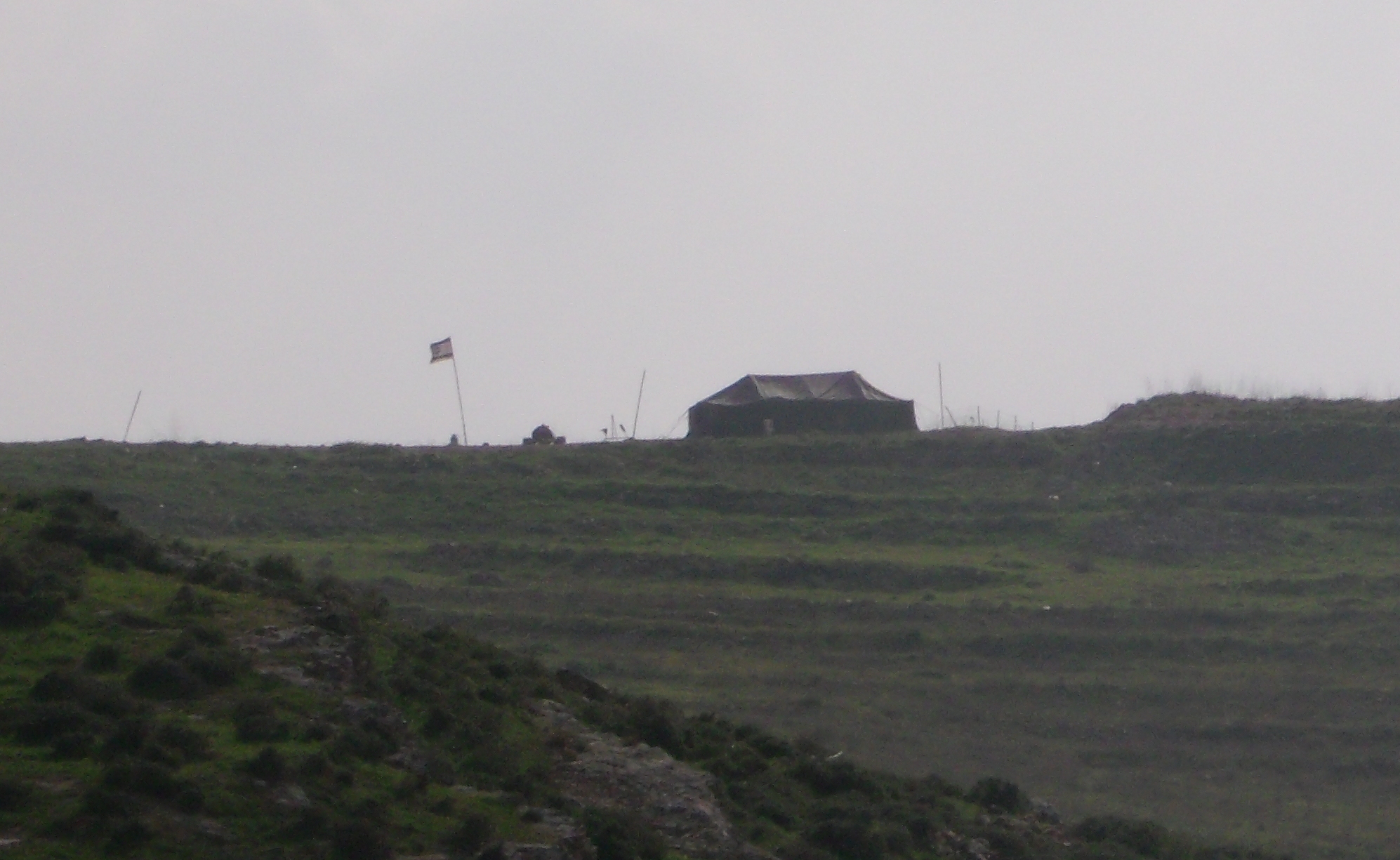
Asira al Qibliya, Occupied Palestine – According to OCHA statistics Yizhar is the most violent settlement in the whole of the West Bank with 70 recorded incidents in 2011 alone. Every week there is at least one attack by Yizhar settlers in the six affected villages.
Four months ago, settlers from Yizhar built a temporary outpost on top of a hill belonging to villagers from Urif. This continued until earlier in the week when Israeli authorities delivered maps to the village which showed that Yizhar had laid claim to 2 dunums of land. This was a massive understatement; they had in-fact seized the entire hill.
The land grab of this hillside seems to be all but complete; a shepherd who was working the land around the Yizhar outpost was recently beaten whilst tending to his sheep: the injuries he sustained were serious but not critical. In another incident, as the Palestinian owners of the land were walking along the road towards the hill this week, they were fired on by Israeli soldiers. Villagers want to challenge this latest land grab, however the law in this country is anything but just. The villagers are all too aware that if they resist they have only stones in the face of tear gas, stun grenades and the very real threat of being fired upon with live ammunition.
Harassment of the residents has also been on the rise. Currently at least once a week soldiers have been invading Asira in the middle of the night. They have been banging on villagers doors with the butts of their assault rifles, making sure people are disturbed in much the same way as has been reported in Urif as well as in Burin.
Yizhar a relatively small but very aggressive settlement in the north of the occupied West Bank. It is situated on a hill surrounded by six Palestinian villages which are all made to live in a state of constant fear.
Related articles
- Continued harrassment of the Nasser family in Madama (palsolidarity.org)
- Israeli Soldiers Attack, Evict, Bab Al-Shams, Arrest Dozens (alethonews.wordpress.com)
- PHOTOS | Settlers attack Urif and Qusra with guns, knives and stones (occupiedpalestine.wordpress.com)
Continued harrassment of the Nasser family in Madama
International Solidarity Movement | January 27, 2013
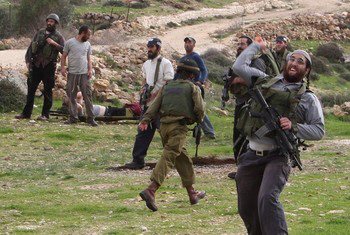
Madama, Occupied Palestine – A month after unprovoked settler and army attacks, the victim of severe violence Mamun Nasser remains in Israeli prison. The arrest of yet another member of the Nasser family shows Israeli army’s continued harassment in Madama.
On December 18th the notorious security guard charged with the protection of the illegal settlement of Yizhar, Jacob, attacked Mamun Nasser while he was tending to his flock of sheep in a hill outside the settlement. Mamun was handcuffed and beaten in front of his entire family, who desperately tried to intervene.
The Israeli army arrived on the scene, who responded by firing live ammunition on the Nasser family and others who tried to help, quickly ending their attempt to stop the vicious assault. One round passed through Mamun’s sisters clothing narrowly missing her while another one hit his brother, Amir, in the leg. His mother told us “They wanted to kill him [Amir]. I heard the officer giving that order. He was lucky that he was only shot in his leg.” Severely beaten, Mamun was then arrested and taken away by the Israeli military into custody. One month later he remains detained in Majdou Prison.
On January 23rd at 4 pm, the Israeli army followed up the harassment by raiding the Nasser family home in Madama, arresting Mamun’s brother Amir who was still recovering from the gunshot wound he received only a month prior. This is another episode in the continued harassment of villagers surrounding Yizhar which is described as the West Bank’s most violent settlement by the United Nations.
Video taken by settlers during the incident on December 18th
Related articles
- Palestinian facing charges after settler violence in Madama (palsolidarity.org)
- Madama attack – Harrowing account from the Nassar family (palsolidarity.org)
- Qusra settler attack, two hospitalised (alethonews.wordpress.com)
- Jewish settlers commit vehicular assaults with impunity at peaceful roadblock protests in the West Bank (alethonews.wordpress.com)
- This Week in Palestine, January 25th, 2013 (indybay.org)
Witness: Israeli soldier killed woman ‘in cold blood’
Ma’an – 25/01/2013

Suad Jaara was shot in the hand by an Israeli soldier who killed her
friend Lubna al-Hanash near Hebron on Jan. 23. (MaanImages)
HEBRON – “I saw an Israeli soldier on the main road firing gunshots haphazardly, so I put my left hand on Lubna’s back, and grabbed her to try and run backward. A gunshot hit my hand, and I shouted as I ran.
“I thought Lubna was running behind me until I reached the security guards of Al-Arrub College who took me to a clinic in the camp before an ambulance arrived and took me to hospital.”
This, says Suad Jaara, 28, is what she witnessed Wednesday afternoon when Israeli officers near al-Arrub refugee camp shot her and her friend Lubna al-Hanash. Lubna, 22, died hours later.
Speaking to Ma’an, Jaara said Thursday that she and Lubna were walking on the campus of Al-Arrub College about 100 meters from the main road when they came under fire.
“An Israeli soldier was shooting from his rifle while a white car was parked on the roadside. There was nobody in the area except Lubna and I. He was a criminal … yes, a criminal who opened fired at us in cold blood killing Lubna and injuring me.”
Jaara’s testimony contradicts claims by the Israeli army’s chief of central command on Channel 10 Wednesday evening that the woman was trying to hurl a Molotov cocktail at an Israeli vehicle.
An army spokeswoman also told Ma’an on Wednesday that “soldiers were attacked by Palestinians who hurled multiple firebombs at them while they were traveling near al-Arrub. Soldiers returned fire and the circumstances of the incident are currently being reviewed.”
But Jaara says she and her late friend were the only ones in the area, walking around and enjoying the scenery.
“Lubna arrived two days ago to visit her sister, who is married to my brother. She had heard about Al-Arrub College and she wanted to visit it. I accompanied her to campus and she admired the area because it’s in a charming natural landscape. When we decided to leave campus, a criminal fired at us and Lubna died a martyr.”
Jaara is an employee at the Ministry of Prisoners Affairs. Her brother Jihad was a gunman in Fatah’s al-Aqsa Brigades in the Bethlehem area. He was deported to Ireland after the Nativity Church siege in 2002.
Are Zionists Now Calling the Shots in the Anglican Church?
By Stuart Littlewood | Palestine Chronicle | January 24, 2013
Rowan Williams, the 104th Archbishop of Canterbury, has stepped down from his post (sigh of relief).
Williams’s role as a figure of unity in the worldwide Anglican Communion, which is represented in over 130 countries, meant that he was in a position to “bring the needs and voices of those fighting poverty, disease and the effects of conflict, to the attention of national and international policy makers and donor agencies”. Or so we were told.
In 2010, when the Archbishop announced he was planning a visit to Gaza just a year after the slaughter and devastation of Operation Cast Lead, I asked his Lambeth Palace office for more information. Whom would he meet? Would he see the health minister? Would he sit down and talk with the elected prime minister Ismail Haniyeh, man of God to man of God (for Mr Haniyeh is an imam)? Would he do Gaza (and all of us) proud by spending a generous amount of his time with senior members of the Islamic faith?
His office didn’t reply.
According to the Archbishop’s website he did none of those things. At least, he didn’t mention them if he did. Unless I’m mistaken he said nothing about Gaza in the House of Lords, where he had the ear of Parliament and the support of 25 other Church of England bishops.
Yet he began his Ecumenical letter that Easter by declaring: “Christians need to witness boldly and clearly”.
A lady wrote to me saying she had emailed Lambeth Palace 18 times asking if the Archbishop’s party could please bring back some deaf children’s art, which should have been picked up by members of a recent Gaza blockade-busting convoy. The Palace eventually declined saying the Israelis wouldn’t allow it.
If he’d been ‘witnessing boldly’ as he exhorted other Christians to do, the Archbishop would surely have instructed his staff to pick up the children’s art and dare the Israelis to confiscate it.
She complained that by not using his position in the House of Lords and elsewhere the Archbishop was failing to improve the situation for Palestinians, quoting the words of Desmond Tutu: “Where there is oppression, those who do nothing side with the oppressor.”
It was later revealed that the Israelis severely restricted the Archbishop’s time inside Gaza. I asked why such interference with the Church’s pastoral business in the Holy Land, of all places, wasn’t broadcast on the website, in mainstream media and in Parliament.
His office confirmed that the Archbishop had initially been refused access to Gaza but was eventually permitted one-and-a-half hours. This was just enough for a hurried visit to the Ahli hospital and no more. When my questions were forwarded to the Archbishop’s public affairs spokesman, the reply was headed “NOT FOR PUBLICATION”. Suffice to say the Israelis from the start blocked the Archbishop’s visit to Gaza and only at the last minute granted him a piddling 90 minutes.
Was this his idea of ‘witnessing boldly’?
The Archbishop’s website joyfully reported how he hobnobbed with the Chief Rabbinate, paid his respects to Yad Vashem and the Holocaust, and talked with the President of Israel – the latter no doubt sniggering up his sleeve at his guest’s frustration at being prevented by Israel’s thugs from seeing what horrors they had inflicted on the Gazans.
Why did he agree to fraternize with Jewish political and religious leaders when his wish to carry out his Christian duty in Gaza was so rudely obstructed? Did Lambeth Palace not realize that meekly accepting such insults only served to legitimize the Israelis’ illegal occupation of the Palestinian territories and gave a stamp of approval to the vicious siege of Gaza, the ongoing air strikes against civilians, the persecution of Muslim and Christian communities and the regime’s utter contempt for international law and human rights?
There was no mention of a get-together with senior Islamic figures, leaving a question-mark over Williams’s real commitment to inter-faith engagement.
Earlier, while the Jewish State was putting its finishing touches to Operation Cast Lead (the infamous blitzkrieg launched over Christmas-New Year 2008/9 against Gaza’s civilians including the Christian community there), the Archbishop joined Chief Rabbi Jonathan Sacks in a visit to the former Nazi camps of Auschwitz-Birkenau in Poland to demonstrate their joint solidarity against the extremes of hostility and genocide.
“This is a pilgrimage not to a holy place but to a place of utter profanity – a place where the name of God was profaned because the image of God in human beings was abused and disfigured,” said the Archbishop. “How shall we be able to read the signs of the times, the indications that evil is gathering force once again and societies are slipping towards the same collective corruption and moral sickness that made the Shoah possible?”
Read the signs? Surely they were plain to see. The forces of evil had already pushed some societies into the moral cesspit. He needed to look no further than the hell-hole that the Holy Land had been turned into by the Israeli occupation, with good old England’s blessing. If ever there was a place where “the name of God was profaned” this is it.
Who will step forward and save it? The Holy Land is the well-spring of the Christian faith, but you wouldn’t think so from the don’t-give-a-damn attitude among senior churchmen.
Open Door for the Bully-boys
The multitude of inter-faith committees and Christian-Jewish councils has opened the door to the Zionist lobby and made it easy for them to meddle in Church business and bully Christians into submission. There’s even a propaganda outlet calling itself Anglican Friends of Israel. A few weeks ago Zionists, no doubt emboldened by the Church’s appeasement policy, put the squeeze on the Bishop of Newcastle, Martin Wharton. The Representative Council of North-East Jewry wrote to him complaining that he voted for a motion at the General Synod which supported the Ecumenical Accompaniment Programme in Palestine and Israel (EAPPI) despite their “grave concerns… that it would encourage anti-Semitism”. His action, said the letter, “makes any further contact with the Jewish community in the North-East impossible”.
So be it, would seem an appropriate response. But oh no. What brought this on, according to the Church Times was Bishop Wharton’s agreement to speak at a conference, ‘Peace & Justice in the Holy Land’, organized by a group of people who had taken part in the EAPPI program. Its sponsors included Christian Aid, CAFOD, and Friends of Sabeel UK.
The chief executive of the Council of Christians and Jews (CCJ), the Revd David Gifford, said that the conference had “the potential of becoming yet another anti-Jewish meeting, creating more anxiety and distrust between the north-east Jewish community and the Church”. Then the Board of Deputies of British Jews chimed in saying that the EAPPI was “partisan” and “anti-Israel”.
Let’s be clear what the EAPPI is actually about:
“The Ecumenical Accompaniment Programme in Palestine and Israel (EAPPI) brings internationals to the West Bank to experience life under occupation. Ecumenical Accompaniers (EAs) provide protective presence to vulnerable communities, monitor and report human rights abuses and support Palestinians and Israelis working together for peace. When they return home, EAs campaign for a just and peaceful resolution to the Israeli/Palestinian conflict through an end to the occupation, respect for international law and implementation of UN resolutions.”(www.eappi.org)
The EAPPI program was set up by the World Council of Churches in response to a call by the churches of Jerusalem. Its mission includes engaging in public policy advocacy and standing in solidarity with the churches and all those struggling against the illegal occupation. Few people except those who support the brutal Israeli regime would disagree with the program’s principles and objectives. And few, surely, would condemn the humanitarian work the EAPPI carries out with great courage in the face of criminal hostility. Nevertheless its success has whipped the usual suspects into an orchestrated frenzy.
As reported in the Jewish Chronicle, John Dinnen whose motion sparked the Synod debate pointed out that well-known Jewish groups such as Jews for Justice for Palestine and the Israeli Committee Against House Demolition [ICAHD] are entirely supportive of EAPPI, and that five per cent of EAPPI volunteers are Jewish “which is a higher ratio than the number of Jews in England”.
But despite having the moral high ground Wharton caved in and decided not to attend the conference “for the sake of good relations between all the faith communities in Newcastle”. The Roman Catholic Bishop of Hexham & Newcastle, Seamus Cunningham, also decided not to attend. He told the Jewish Chronicle that he had become aware “that many Jewish people in the north-east were angry and upset”. Perhaps the angry and upset should go themselves to the West Bank and experience the behavior of their brethren towards Palestinian women and children and the EAPPI volunteers.
Throughout his time on the Archbishop’s throne Williams was mad-keen on inter-faith dialogue, for what good it has done, and spent an inordinate amount of time with Chief Rabbi Sacks. At one point the Jerusalem Post suggested that the chief rabbi had “in some respects eclipsed the archbishop as the religious voice of the country”.
Nor was the Archbishop the best-known Christian according to a survey 3 years ago. Harry Webb (aka Cliff Richard) beat him into second place. The survey made Cliff even “bigger than the Pope”, who trailed in seventh place.
Now we hear that the squeaky-clean, born-again-Christian megastar is to perform in Israel in July, and the Israeli media are making a meal of it. Does none of these pious dudes understand the appalling, inhuman situation out there?
I’m not sorry to see the back of Rowan Williams – a good guy but not the right man at this time. And what are we to make of his replacement, Archbishop number 105, who will be enthroned at Canterbury Cathedral in March? Justin Welby is touted as an expert in conflict resolution, but he comes from nowhere and is not known for his concern about the Holy Land.
The Jewish Chronicle reported that Welby last year helped mount a Holocaust Memorial Day exhibition in Liverpool Cathedral and… wait for it… abstained in last summer’s vote at the Anglican Synod which endorsed the EAPPI.
In my view, anyone who cannot bring himself to give wholehearted backing to a worthy humanitarian project like EAPPI shouldn’t be leading a great Christian church.
Related article
- Stark Christmas message from the Holy Land: “Act and intervene, or nothing will change” (alethonews.wordpress.com)
The broken truce
International Solidarity Movement | January 21, 2013
Beit Lahiya, Gaza Strip, Occupied Palestine – A ceasefire was announced on 21st November, ending eight days of horrific bloodshed in Gaza. Has the delicate truce held over the past two months? It depends who you ask. Israelis or Gazans, each going about their daily lives on opposite sides of a border fence.
There has not been a single report of a rocket fired out of Gaza since 21st November. In contrast, four Palestinians have lost their lives and over 80 have been injured by Israeli forces since then. Yet these violations have received little or no coverage in the mainstream media. Palestinian civilians, whose only crime is to live in the border areas, are terrorized on a daily basis by the Israeli army. This is what everyday life under the ceasefire has meant for them.
Beit Lahiya, in the far north of the Gaza Strip is one such place. A week ago it saw the brutal murder of 20 year-old Mustafa Abu Jarad. Today, it was the site of another Israeli violation. Abdullah Marouf, 18, was in the west of Beit Lahiya, near the coast, when he was shot in the right leg by Israeli forces, fracturing both his tibia and fibula.
 Abdullah Marouf in hospital. (Photo by Desde Palestina)
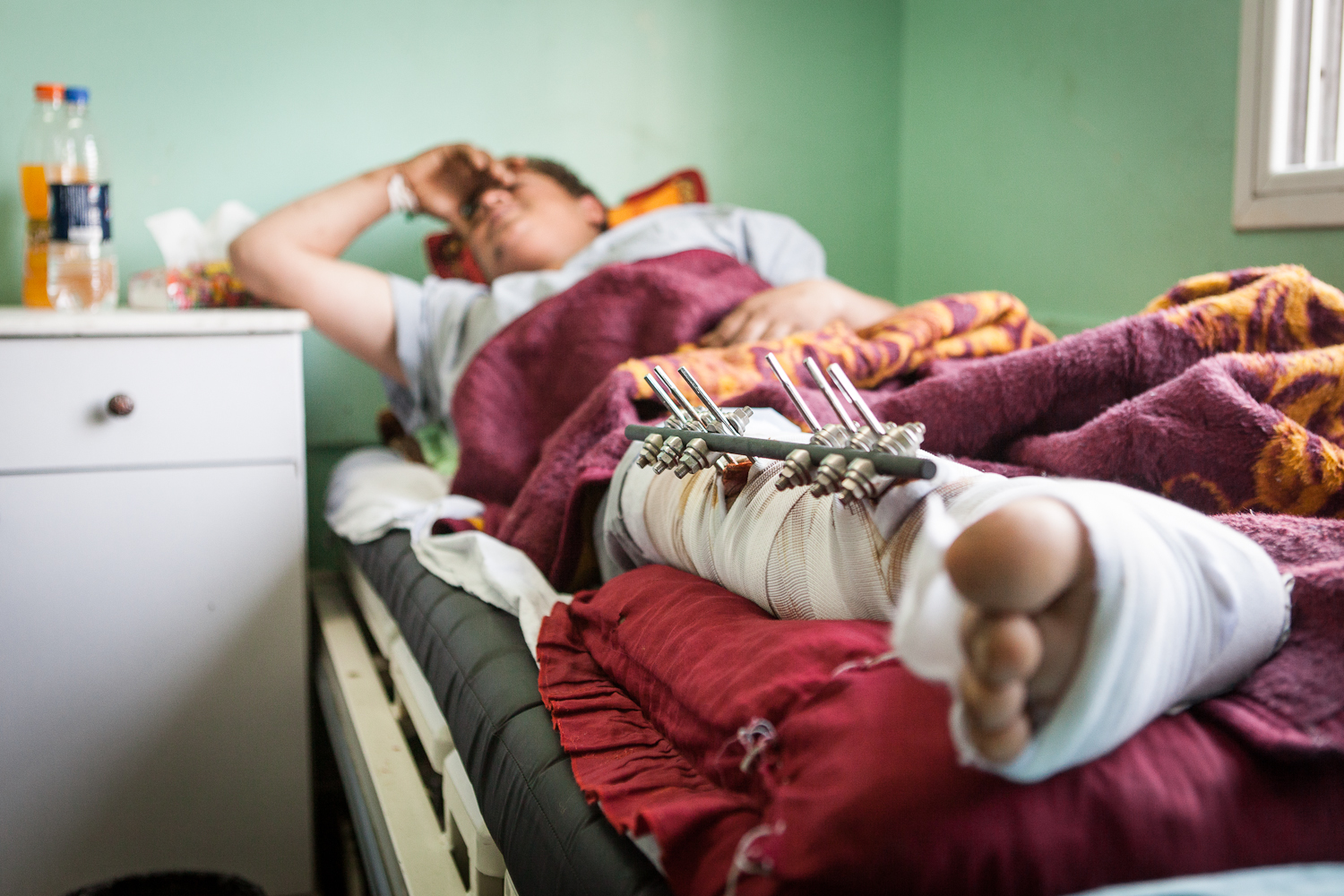
At about 9.00 on the morning of 21st January, Abdullah was in an area approximately 250 metres from the border fence, catching birds with his two brothers. A group of five or six Palestinians they were unaquainted with were also in the vicinity, closer to the fence than they were. Abdullah had been under the impression that he would be safe, however he noticed an Israeli soldier in a watchtower on the border and others on the ground. The soldiers began firing live ammunition towards them and Abdullah was shot.
Two local farmers brought him to Kamal Adwan hospital where surgeons performed percutaneous pinning of his lower leg which had sustained damage from an entry wound and a significantly larger exit wound. He requires subsequent surgery in a couple of months to fit internal wires. His recovery is estimated to take at least 12 months.
Abdullah, who is engaged to be married, had been working with his two brothers selling scrap metal. Now they will have to support a family of nine without his help. It is unsurprising that he expressed a lack of faith in the ceasefire agreement.
One can only expect that the Palestinian resistance has also lost faith and is fast losing patience. If a response is provoked it will appear to be in a vacuum – despite this being far from the case – due to the shameful silence maintained by the international community throughout the ongoing Israeli atrocities. It is for people of conscience to protest this injustice and prevent a further escalation of Israel’s attacks on Gaza.
Racism Pervades Israeli Electoral Campaign
By Yusuf Fernandez | Al-Manar | January 24, 2013
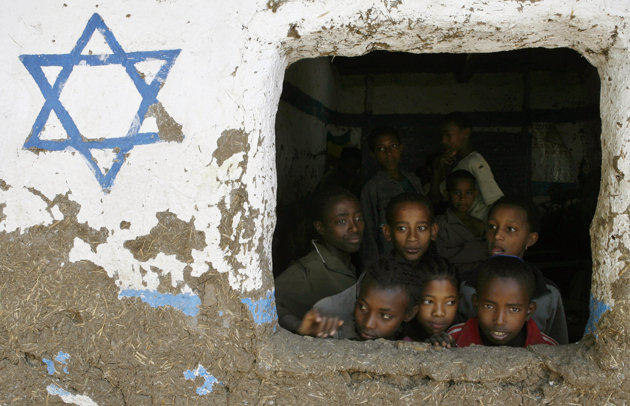
The last electoral campaign in Israel has been dominated by racism. It is not just racism against Arabs, which is as old as the existence of the Zionist entity, but also racism against Black people, whose life is becoming more and more miserable in Israel. According to the statistics, there are currently about 60,000 African immigrants in the Zionist entity. Most of them come from South Sudan, Eritrea, Ivory Coast, Congo and other countries.
The situation of Africans in Israel, both Jews and non-Jews, is actually desperate. Some thousands have low-quality jobs where they are unscrupulously exploited by Israeli employers. Others are homeless and are begging on the streets of Israeli cities to survive. In spite of claims of rampant crime in the suburbs of South Tel Aviv where most Africans live, a senior police commander, David Gez, was quoted as saying the level of crime among this population was actually relatively low.
The last episode of anti-Black racism was a recent video made by the religious Shas party – which represents Sephardi Jews, who ironically have also been historically subjected to discrimination by Jews of European-origin (Ashkenazis). The five-minute video sought to fuel fear of Africans and increase support for the Shas´s anti-immigration platform ahead the January 22 parliamentary elections.
The message of the video was that only the leader of the Shas party, Eli Yishai, who is also currently interior minister, can successfully fight against the “threat” allegedly posed by African immigrants, whom Yishai and other Israeli politicians repeatedly refer to as “infiltrators.” In an interview with Ynet, Yishai said the “the threat from infiltrators is no less severe than the Iranian nuclear threat.”
In May, Yishaid told Maariv that in the previous months dozens of Israeli women had been raped by “infiltrators” in South Tel Aviv but they had decided not to report the attacks so that people would not think they had “contracted AIDS”.
The content of the video was not different to other similar ones made by far-right European parties. There were in it remarks by local residents who express their fear for their safety and anger over a housing shortage — all allegedly due to the African immigrants. According to the Times of Israel, one woman says that “it is their fault that there are no apartments. It is their fault that housing is very expensive.” A man complains that “tomorrow the Sudanese will keep on walking around here, continue to beat (people) up, continue to stab and continue to rape our women.”
The narrator says that the black “infiltrators” “control neighbourhoods in south Tel Aviv, Eilat, Ashdod, and other cities,” and pose a “social, religious and security threat.” He goes on to assert that the “greatest threat of all is the demographic threat.” The video also claims that the majority of African migrants are Muslim, and that they therefore “do not believe in the State of Israel´s right to exist.”
Ironically, the Shas has also denounced the racial bias of the other Israeli parties. Recently, Aryeh Deri, the number three of the party, accused the Likud-Yisraeli Beitenu party of “being a party of Russians and whites” and having ostensible bias against Sephardi Jews, who have been considered a second-class citizens in the Zionist entity, where the power has been traditionally in the hands of Ashkenazi Jews, who mostly came from Eastern Europe.
For his part, Prime Minister Benjamin Netanyahu has announced that he wants to expel tens of thousands of African undocumented immigrants and that the inflow into Israel from Egypt has been brought to a halt due to the new barrier. “Our aim is to repatriate tens of thousands of infiltrators now in Israel to their countries of origin,” he said, adding Israel was in contact with some governments from Africa “to solve this problem”.
On May 23, Likud leading members took part in a demonstration in Tel Aviv’s impoverished suburb of Hatikva to protest against the presence of Africans in Israel. Miri Regev of Likud addressed the rally to which more than 1,000 people attended. There, she described the Africans as a “cancer in our body” and pledged to do everything she could “in order to bring them back to where they belong”. She attacked human rights and “left-wing” groups aiding the immigrants.
Danny Danon, another leader of Likud, said that the only solution to the issue of the “infiltrators” would be to “start to talk about their expulsion”. “We must expel the infiltrators from Israel. We should not be afraid to say the words “expulsion now”,” he said. He went on saying that Africans had set up an “enemy state”, whose capital was Tel Aviv.
Violent attacks
Shortly after the speeches, violent incidents broke out. Demonstrators smashed shops, properties and cars belonging to the African immigrants and beat up men and women while chanting “Blacks out”.
In April, apartments where Africans lived as well as at a kindergarten were attacked with Molotov cocktails in Shapira in south Tel Aviv.
On July 12, an Eritrean man was badly burned and his pregnant wife suffered smoke inhalation after attackers tried to burn down their apartment in central Jerusalem (Al Quds). The incident, the second arson attack on African immigrants in the city within six weeks, took place near the city’s Mahane Yehuda market, AFP quoted a police source as saying.
The Israeli government has refused to condemn these attacks on African immigrants and instead used them as an excuse to promote its anti-migrant agenda, which included a new law allowing the authorities to keep undocumented Africans imprisoned for three years and jail those who help them for up to 15 years. According to recent polls, one in three Israelis support those attacks.
Even “left-leaning” parties, such as the Labor, support racist policies. The Labor leader, Shelly Yachimovich, accused recently the the government of “having failed… and let the slums be flooded by migrant workers and refugees, thereby helping to kindle wild passions” and claimed the need to “protect the country from facing a huge mass of migrant workers”.
In March, Israel started to build a huge prison camp, the world´s largest, in the Negev desert. Such a facility is situated near the Ketziot prison, where thousands of Palestinian prisoners have been jailed. The camp will be run by the prison service and thousands of Africans will be locked up there. A spokesperson for the Israeli Ministry of Interior confirmed that Yishai wanted to eventually jail all of the thousands of undocumented African immigrants currently in the Zionist entity.
Other immigrants have already started to be expelled. On June 10th, the immigration police began a mass roundup operation, which was initially focused on South Sudanese nationals but was then expanded to include those from the Ivory Coast. Hundreds of these Africans were detained and around 240 were sent to Juba, capital of South Sudan.
There is no doubt that racism and xenophobia are being fueled by the current Israeli government and nearly all the Zionist parties. Their main goal is to divert growing outrage over the decline of living standards and rising social problems by promoting racist claims and demands to preserve the “Jewish identity” of the Zionist entity at a time when the latter is getting weaker and more internationally isolated due to its settlement policies.
Judaization = Racism? Really?
By Paul Larudee | January 23, 2013
On Sunday, January 20, 2013, the “progressive” Israeli newspaper Haaretz published a short editorial titled “‘Judaization’ is racism”.
Before you get your hopes up, let me tell you that the editorial is a criticism of Shimon Gapso, the Jewish mayor of Upper Nazareth, a community intended to diminish the Arab character of Nazareth, the largest Palestinian Arab city inside what most of the world recognizes as Israel.
Founded in 1957, Upper Nazareth was given priority for development and expansion as part of a campaign by Yitzhak Rabin. The impetus was a trip that Rabin made to the Galilee in 1975. At one point he found himself in the Carmel valley. Looking around, he saw nothing but Palestinian farms and villages. “Am I in Israel or in Syria?” he uttered, whereupon he lent his weight to the mission to “judaize the Galilee”. Upper Nazareth is one of the Jewish communities that became an important of that mission. It was intended to limit the growth of Nazareth and ultimately marginalize or displace it.
Ironically, however, the “Jewish character” of Upper Nazareth is itself being compromised, as Palestinians from Nazareth find that there is no longer enough room in the older city to accommodate their growing population. In response, the mayor of Upper Nazareth has tried to make the city as unfriendly as possible to its non-Jewish residents, including opposition to Arabic language schools in the town and a much-publicized ban on Christmas trees. (Most of the Palestinians in Upper Nazareth are Christian.) The Haaretz editorial is a criticism of the “benighted racist position that sees the presence of Arabs in the Galilee or anywhere else as a national threat.”
Nice words, but is not the entire Zionist project one of “judaization”? Is that not how its founders conceived it? Is not Israel itself the product of “judaization”? What is different about Upper Nazareth? What about the expulsion of the Bedouin in the Naqab (“Negev”)? Is the confiscation and demolition of Palestinian homes in Jerusalem not merely an extension of the ethnic cleansing of 1948? How are the orders to evacuate and obliterate eight villages in the hills south of al-Khalil (“Hebron”) not consistent with the aims of Zionism?
If Haaretz wishes to oppose judaization, why not start with the judaization of 1948? Let them insist upon inviting all Palestinians back to their homes. Let them demand elimination of an immigration policy that is for Jews only. Let them call upon the Custodian for Absentee Property – who is responsible for the more than 80% of Israel that was confiscated from Palestinians in 1948 – to welcome the absentees back and return their property to them, with payment for damages and compensation for 65 years of unauthorized usage. Let them oppose a policy of separate states for Arabs and Jews (forgetting that many are both or neither).
Judaization is just another word for Zionism. And yes, it’s racism.
Related articles
- The Terror Lurking in a Christmas Tree (alethonews.wordpress.com)
- Israeli mayor: expel Palestinian citizens of “hostile” Nazareth to Gaza for opposing war (altahrir.wordpress.com)
- In Palestine, Peace is Not Just Absence of Violence, But Presence of Justice (alethonews.wordpress.com)
Featured Video

Thomas Fazi: NATO’s Hybrid Warfare – Deception & Permanent War
or go to
Aletho News Archives – Video-Images
Book Review
The Zeolite Book — First Edition, 2026, Paperback
The volcanic mineral medicine will not patent — for the toxic burden medicine will not name
Lies are Unbekoming – October 30, 2026
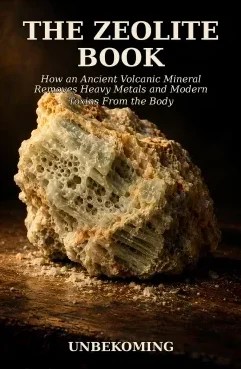 Zeolite is old. It is in Roman concrete that has held for two thousand years. It’s in the water filters of ancient cisterns. It’s in the stomachs of Pacific livestock whose keepers knew, somehow, that this grey crumbling rock made the animals healthier. It’s in Soviet clinical protocols from the 1960s. It’s in the standard emergency response to the Chernobyl explosion.
In 1986, after the Chernobyl reactor failure, the Soviet Union manufactured and distributed natural zeolite at industrial scale — for soil remediation, for livestock feed, for human consumption, for the cleanup itself. Karl Hecht, who had been director of the Institute for Experimental and Clinical Pathophysiology at the Charité of Humboldt University Berlin, spent the six decades after that building the clinical research base — on silicon’s role in human health, on zeolite’s clinical safety, on its applications in ageing. In 2018, Pavelić and colleagues published a comprehensive clinical safety review of natural clinoptilolite in Frontiers in Pharmacology. In 2019, Mastinu analysed its binding affinities. In the Western medical literature, these works sit largely uncited.
What has not been treated at book length, until now, is how a volcanic mineral with six decades of Soviet clinical work behind it, two major peer-reviewed Western reviews, and ongoing clinical use across the former Eastern Bloc, remains almost entirely absent from Western medical practice — and what the toxic burden it’s meant to address actually is.
The Zeolite Book gathers the Soviet clinical record, the Western peer-reviewed studies, three contemporary practitioner voices, and three serious counterviews into one honest treatment. That’s why the book runs to seven appendices. 288 pages, four parts, three practitioner voices, three counterviews, seven appendices. The honest treatment is the argument.
Blog Roll
 Aletho News
- UAE security forces tortured, killed journalist for opposing Israel normalization: Report
- They Compared the Spice to the Drug. The Spice Won — Again. (Part 2)
- Thomas Fazi: NATO’s Hybrid Warfare – Deception & Permanent War
- Wrong, AP and NPR: Europe’s 50,000 Heat Deaths Are a Computer-Model Estimate, Not a Real Body Count
- Questioning Your Doctor Is Now Considered A Psychological Problem (Seriously)
- London tourism expo promotes Israeli agency linked to theft of Palestinian land
- Dockworkers launch global strike against Israeli and US military shipments
- Europe facing gas price shock – Gazprom chief
- Ukraine continues recruiting people with disabilities
- Weaponized Journalism: 2021 Sayer Ji Interview with NPR
- If Americans Knew
- An error has occurred; the feed is probably down. Try again later.
- No Tricks Zone
- Germany’s Green Energy Transition Becoming Increasingly Expensive…Another 6 Trillion Euros!
- Sudden Stratospheric Warming, Powerful El Niño Combination May Lead To Extreme Europe Cold, Energy Crisis!
- Two New Studies Find Thwaites Glacier Melt Cannot Be Driven By Human Activity Or A Warming Ocean
- E-Cars Reduce CO2 Emissions By Only 41% Compared To Internal Combustion Engine Vehicles
- Predictions Made By Renowned Climate Professor Over Past Decades Have Been Proven To Be Poor
- New Study Suggests Large Regions Of The Pacific Ocean Have Been Cooling For The Last 80 Years
- Germany’s Green Energy Debacle: High Energy Costs Force Kahla Porzellan to Close After 182 Years!
- New Study: 50 Years Of The Most Aggressive ‘Net Zero’ Policies Can Only Affect The Global Climate By 0.03°C
- US September “Heat” Was No Record…Many Records Set Decades Ago
- Latest European Green Energy Debacle; Portugal’s Largest Flagship Solar Park Insolvent!

