Jewish settlers in Hebron harass FIFA tour delegation

Ma’an – May 8, 2015
HEBRON – Settlers harassed the head of the Palestinian National Union for Football and the South African head of an anti-racism group during a tour in Hebron’s Old City this week.
Palestinian football chief, Jibril al-Rajoub, was heading a FIFA delegation tour in the city on Tuesday when the incident took place. The group included Tokyo Sexwale, an anti-apartheid activist imprisoned for 13 years on Robben Island with Nelson Mandela, and co-chair of Global Watch: Say No To Racism-Discrimination In Sport.
The delegation was briefed on the difficult living conditions in the Old City by the Hebron Rehabilitation Committee and were shown videos documenting army and settler violence against Palestinians in the city.
Israeli forces then prevented the delegation from entering several areas of the Old City, with settlers verbally insulting the group as they tried to continue the tour.
Sexwale said that life for Palestinians in the city is intolerable, saying he was proud of the Palestinians for their determination to remain on their land.
The South African official had to enter Ramallah via the King Hussein Bridge to avoid entry from Tel Aviv.
The Palestinian Football Association (PFA) has called for a vote at the FIFA annual congress on May 29 calling for Israel’s expulsion for blocking Palestinian football through its sanctions on the Palestinian territories.
In its draft resolution for the FIFA congress, the PFA protests Israel’s treatment of Arabs and acts such as setting up clubs in the occupied Palestinian territories.
Israeli forces raided the PFA headquarters in the West Bank city of Ramallah in November.
Palestinian football chiefs have also condemned Israeli travel restrictions on Palestinian players and on importing equipment into the occupied territories
Nations ready to move beyond Iran bans despite US Congress move: German envoy
Press TV – May 8, 2015
The German ambassador to Washington warns that his country and other nations are ready to move beyond sanctions imposed on Iran over its peaceful nuclear program, regardless of any decision that the US Congress may be willing to make.
Peter Wittig made the comments on Thursday in reaction to the US Senate’s recent approval of a bill that potentially makes removal of sanctions conditional on congressional consent.
The US Senate passed legislation on Thursday, which would make it possible for Congress to review and potentially reject a nuclear deal with Iran over its nuclear program.
The legislation will allow for a 30-day review of any final agreement with Iran. During the review period, President Barack Obama would be able to waive those Iran sanctions, which were imposed by the executive branch. However, the president would have to leave in place sanctions that Congress had previously drafted.
Addressing the Columbus Metropolitan Club in central Ohio, the German ambassador said, “The alternatives to a negotiated deal are not very attractive.”
Wittig said while Congress would probably be willing to impose new sanctions on Iran, other countries would not follow, adding that such state of affairs would cause “this universal sanctions regime” against Iran to “crumble.”
He also dismissed as not viable Washington’s talks of a military option against Iran saying it will not lead to a lasting solution.
The German ambassador stated that his government pleads to give diplomacy a chance, adding that any agreement that may be signed between Iran and the P5+1 group – the US, the UK, France, Germany, China, and Russia – will be reviewed and judged on its merits.
At the beginning of 2012, the US and EU imposed sanctions on Iran’s economic sectors with the goal of preventing other countries from cooperating with the Islamic Republic in those sectors.
The sanctions were imposed over allegations about possible diversion in Iran’s nuclear program toward military objectives. Iran categorically rejected the allegation.
Iran and the P5+1 reached a mutual understanding on April 2 in the Swiss city of Lausanne as a prelude to a comprehensive deal before a self-designated deadline at the end of June. A key point of Lausanne statement was a promise to lift a series of sanctions on Iranian economy.
Saudi Arabia’s Attack on Yemen
By RANNIE AMIRI | CounterPunch | May 8, 2015
The Saudi regime is notoriously adept at funding wars, but exceptionally poor at fighting them.
On March 25, a massive aerial bombing campaign began against Zaidi Houthi rebels who had recently assumed control of Yemen’s capital and forced its U.S. and Saudi-backed president, Abd Rabbuh Mansour Hadi, to flee first to the southern port city of Aden and then to Riyadh.
This is the second Saudi attack on Yemen—the Arab world’s poorest country bordering one of its richest—in less than six years. “Operation Scorched Earth” was launched by the Yemeni government against the Houthis in August 2009. In November of that year, Saudi troops amassed on the border and began shelling Saada governorate in northwest Yemen where the rebels were based.
The Saudi offensive created tens of thousands of internally displaced civilians, teeming refugee camps and rampant malnutrition. The Houthis, in the face of overwhelming firepower and far worse off in 2009 than today, nevertheless kept Saudi troops at bay and inflicted higher than expected causalities on their forces. Six years later and with nearly all Arab countries aligned against them, they are doing so again.
To put Yemen’s current predicament in context some background history is helpful.
The Zaidi Shia form at least a quarter of Yemen’s population and are concentrated in the north of the country. This area was once ruled by Hashimite Zaidis (those descended from the line of the Prophet Muhammad) for more than 1,000 years until they were overthrown in 1962 by an alliance of nationalist military officers who then founded the Yemen Arab Republic. Zaidi Muslims are nominally categorized as Shia Muslims although they are actually closer to the Sunni schools of jurisprudence.
The rebels were first led by Zaidi cleric Hussein Badr al-Din al-Houthi—from whom the Houthis derive their name—and his Shabab al-Momineen group who fought the government of President Ali Abdullah Saleh. Their dispute dates to June 2004 when Saleh, the Saudi-backed strongman, charged the Houthis with sedition and claimed their true aim was to revive Zaidi Shia Imamate rule deposed four decades earlier. For their part, the Houthis sought to reverse the systemic political and socioeconomic marginalization their community faced as well as stem the rise of Salafi/Wahabi ideology and the al-Qaeda presence it fostered, both of which had gained an increasing foothold in the country.
Hussein al-Houthi was killed by the army in September 2004 and his brother, Abdul Malik assumed leadership. He now leads the Houthi movement under the group Ansarullah. Worried that the Houthis could transform into a Hezbollah-like organization, the Saudis attacked in 2009. Then, as now, this was done with U.S.-supplied advanced weaponry including surface-to-air missiles, Apache attack helicopters and Phantom jet fighters. Despite their sophisticated arms, Saudi Arabia lost an unusually high number of soldiers in the campaign.
The Houthis persevered; their resilience and desire for equitable representation in government led Saudi Arabia and a coalition of Gulf Cooperation Countries (with the exception of Oman) to attack in March of this year when “Operation Decisive Storm” began. Predictably, its pretext was the tired canard of curbing Iranian influence in the Arabian Peninsula. Direct, material support for the Houthis by Iran has never been clearly demonstrated however.
The real motive for the assault and the process it intended to disrupt was revealed by former U.N. envoy Jamal Benomar in an April interview with the Wall Street Journal. Benomar remarks, “When this campaign started, one thing that was significant but went unnoticed is that the Yemenis were close to a deal that would institute power-sharing with all sides, including the Houthis.”
The Saudi offensive led by the young defense minister and newly-appointed deputy crown prince, Muhammad bin Salman, has again exacted a tremendous humanitarian toll: 1,200 killed and more than a quarter of a million people displaced. In 2009, the Saudis were accused of using white phosphorus (as the Israelis had been in their wars on Gaza). Today, they are charged with using cluster bombs (as the Israelis had been in their wars on Lebanon). Human Rights Watch said in a statement, “Credible evidence indicates that the Saudi-led coalition used banned cluster munitions supplied by the United States in air strikes against the Houthi forces.”
Even after all tools of war were placed at their disposal by the West, the House of Saud still pleaded with Pakistan to send (Sunni-only) troops to fight for them. The regime has blockaded the port at Aden and has even resorted to bombing Sanaa’s airport to prevent the delivery of needed relief supplies.
All of these measures have failed to halt the Houthi advance.
Only a political solution will end Yemen’s bloodshed. The GCC though prefers to frame the conflict as an existential one pitting Arabs against Iranians, Sunnis versus Shias. This serves to stoke the sectarian flames already engulfing the region and makes a practical resolution near impossible.
The war has been a disaster for the Yemeni people from the start, both politically and on the most basic humanitarian level. Al-Qaeda now has the potential to flourish as Yemenis are pitted against one another based on sect; the possibility of a just compromise and representative government without Saudi Arabia’s hand-picked man at the helm well forestalled.
Will the Saudi regime find themselves in a military quagmire? The Houthis show no sign of withering under relentless bombing. Or is a decisive ground invasion in the works? There are early signs this may yet occur. But as in Iraq and Syria, the monarchy appears content with the status quo, ensuring chaos, instability and sectarianism prevail.
More Neocon-Zionist Theater in Texas
More Neocon-Zionist Theater in Texas
By Brandon Martinez | Non-Aligned Media | May 8, 2015
What a surprise – another extremely dubious, synthetic scandal that played out the familiar neocon script of ‘violent Muslims are attacking free speech’ has hit the American south.
Since the Ottawa shooting back in October of 2014, the Neocon-Zionist false flaggers who control most Western governments have executed a series of highly choreographed public relations stunts designed to re-enforce the contrived ‘war on terror’ narrative as well as submerge the public in fear, thereby ripening the masses for government power-grabs in the form of ‘anti-terrorism’ legislation.
According to media reports, on May 3 two assailants purportedly opened fire outside an anti-Muslim ‘cartoon contest’ event organized by Pamela Gellar, a radical Jewish activist who has made a career out of vilifying Muslims and inciting for more Zionist wars in the Middle East. Gellar’s event, held in Garland, Texas, challenged people to submit derogatory cartoons of the Prophet Muhammed in a similar vein to Charlie Hebdo’s rancid provocations. Gellar offered a $10,000 prize for the “best depiction of Muhammad.”
We are told that two American Muslims, Elton Simpson and Nadir Soofi, showed up at the event with automatic assault rifles and managed to shoot and injure a police officer before being gunned down in front of the Curtis Cullwell Center. It is difficult to confirm if any of this actually happened.
Media are insinuating that the two men had tenuous links to ISIS, but these ‘links’ amount to nothing more than pro-ISIS Twitter accounts praising them.
What is for certain is that one of the alleged shooters, 30-year-old Elton Simpson, was on the FBI’s radar since 2007 and had even been convicted in 2011 for lying to Federal authorities about trying to join the al-Shabaab group in Somalia. Court records show that Simpson was in contact with an FBI informant named Daba Deng who was paid more than $100,000 by the notoriously corrupt agency to befriend Simpson. Strangely, Simpson was only given three months probation and released.
What are the odds that the FBI didn’t continue to keep tabs on Simpson after his arrest and conviction in 2011? What are the chances that Simpson and his alleged co-conspirator were able to purchase a stash of handguns and rifles that they supposedly used in the failed Garland attack without the Feds noticing? What is the likelihood that the FBI, in conjunction with the Zionist neocon clique led by Pamela Gellar, didn’t fabricate this whole scenario out of thin air as per the neocon ‘big lie’ technique?
The Wall Street Journal reported that the FBI in fact warned Garland police hours before the shooting that Simpson was a threat. The International Business Times tells us: “FBI Director James Comey said on Thursday that his agency issued a bulletin to the Garland police department that included a photo of Simpson just hours before the affront.” Reuters also confirmed that the FBI’s warning mentioned that Simpson was interested in the anti-Muslim event hosted by Gellar.
The FBI covered for itself by saying that although they warned Garland police about Simpson, he supposedly “gave no indication that he planned an attack.” WFAA8 News added that “Garland police spokesman Officer Joe Harn said at a 10 a.m. news conference Monday that security had been ramped up for the controversial event, and a plan had been in place involving the FBI for months.” What “plan involving the FBI” was he referring to? After the alleged shoot-out with Simpson and Soofi, police are said to have bizarrely detonated the suspects’ car as a ‘precaution,’ even though they found no explosives in it.
Much like all of the other patsies in the Ottawa, Sydney, Paris and Copenhagen shootings that conveniently all transpired over a six month time-frame, one of the two individuals allegedly involved in the Garland shooting was well-known to authorities and had previously been in contact with an FBI informant posing as an Islamic radical. It’s the same modus operandi every time – pay an informant to induce, incite or otherwise cajole an impressionable, inept and perhaps desperate young Muslim into planning a violent act, and then clear the way for that individual to follow through on it. Then play dumb about the ‘threat’ this person posed, denying any knowledge of ill intent despite having enormous resources, making it all but impossible not to have known. And make sure the dupe/patsy is killed so they can’t talk and so nothing can come to light in a proper trial.
Even if this failed attack unfolded just as the media says it did, the FBI is ultimately at fault for ‘dropping the ball’ yet again (irrespective of their dubious ‘warning’ that amounts to a convenient alibi), even though they had more than enough reason to suspect Simpson and his companion were plotting something. They also undoubtedly knew that Gellar’s ‘Draw the Prophet’ charade was the perfect bait for any would-be radical trying to make a name for himself, yet allowed the provocation to proceed under the pretext of ‘upholding the first amendment.’ As the Garland police spokesman confessed, this had all been pre-planned months beforehand. Only the very naïve or hopelessly deluded will put any faith in the FBI’s lame-duck denials that they deliberately allow attacks of these sorts to take place, or organize them directly by way of informants, such as the one linked to Simpson.
The Zionist-influenced mass media has predictably seized on this latest terror stage-play to push the fear campaign of ‘homegrown terror’ harder than ever before, plunging the already credulous masses deeper into an artificially-induced slumber of willful ignorance about the fabricated nature of ‘terrorism’ in the West.
Copyright 2015 Brandon Martinez
White House psychologist implicated in CIA torture now helping FBI
RT | May 8, 2015
Before the dust has had a chance to settle on the report detailing the American Psychologists Association’s complicity in the CIA torture program, the psychologist found to have violated the ethics code now appears to be helping the FBI do the same thing.
In late April, a 60-page report entitled ‘All the President’s Psychologists’ pointed to Susan Brandon as the White House architect behind the policies regulating the legality of an interrogator’s actions – something that goes against the APA’s own rulebook, which prohibits psychologists from making such judgments.
The document alleges the APA’s close coordination with the White House, the CIA and the Department of Defense on the formulation of a legal policy that would exempt the interrogators from prosecution, following a scandal involving allegation of torture at Iraq’s notorious Abu Ghraib prison. “Susan Brandon … played a central role in the development of the 2005 [Psychological Ethics and National Security] policy,” the report alleges – the second inquiry investigating the medical role in the practice.
“What we see is associations. And the associations with the apparent supervisor of [James] Mitchell and [Bruce] Jessen at each step of the process over a period of three years,” the report said then, in reference to the two masterminds of the CIA torture program, whom Brandon was allegedly in contact with in 2003, as evident from a string of emails.
Brandon’s complete role in the program is at this point unknown, but one particular email she was included on focuses on the pair “doing special things to special people in special places.”
“The issue here is not about what she thinks about torture; the issue is about what she did in the past to knowingly or unknowingly create a legal heat shield for the president using the ethics of the APA. That’s the issue. This is not a question of torture. It’s a question of alleged corruption,” says the report’s co-author and program director at the Harvard Humanitarian Initiative, Nathaniel Raymond, according to the Huffington Post.
Now Brandon is advising the FBI’s High-Value Detainee Interrogation Group – essentially the Obama’s administration continuation of the CIA program regarded as having crossed the line. She is tasked with research into determining whether a crime has been committed in the course of an interrogation.
The FBI has not officially commented on the claims yet. Journalists might not get a reply from Brandon anytime soon, as she’s still an HIG adviser and is not expected to break protocol – the association has a policy of operating in secrecy, according to fellow member Mark Fallon.
The initial reason for the government’s acceptance of the CIA torture program hinged, in part, on the presence of psychologists and their expertise acting as a check, as is evident from a 2005 Justice Department document.
The reason the APA had to be called in was apparently due to the CIA’s own psychologists’ refusal to sign off on the memo, claiming that the proposed assessments simply strayed outside of medical professionals’ competence.
As a result, Brandon’s Psychological Ethics and National Security policy became the document that could be “seen as opening the door for psychologists to fulfil a function that [CIA Office of Medical Services] health professionals were resisting,” according to the report.
Brandon’s own language went in a separate direction from the CIA doctors’, effectively paving the way for a psychologist’s role in judging the harm and effectiveness of an interrogation.
The APA has denied the report’s findings. Its own review of the complicity in the Bush-era program is ongoing.
Brandon’s role as one of the HIG’s top specialists is now under scrutiny, but she has defenders as well. Fallon, for one, has since said that Brandon “is a research scientist who was helping craft language, from what I can read in those emails, that might in fact be totally appropriate.”
“[Was] it a witting collaboration, or is it an unwitting person within the government who’s a research scientist looking to ensure that we’re at least learning lessons? I just could not conceive that she would ever do anything that would support degrading and inhumane treatment,” he added.
Read more: Study accuses psychologists group of complicity in CIA torture program
The Clintons and Their Banker Friends
The Wall Street Connection (1992 to 2016)
By Nomi Prins | TomDispatch | May 7, 2015
[This piece has been adapted and updated by Nomi Prins from chapters 18 and 19 of her book All the Presidents’ Bankers: The Hidden Alliances that Drive American Power, just out in paperback (Nation Books).]
The past, especially the political past, doesn’t just provide clues to the present. In the realm of the presidency and Wall Street, it provides an ongoing pathway for political-financial relationships and policies that remain a threat to the American economy going forward.
When Hillary Clinton video-announced her bid for the Oval Office, she claimed she wanted to be a “champion” for the American people. Since then, she has attempted to recast herself as a populist and distance herself from some of the policies of her husband. But Bill Clinton did not become president without sharing the friendships, associations, and ideologies of the elite banking sect, nor will Hillary Clinton. Such relationships run too deep and are too longstanding.
To grasp the dangers that the Big Six banks (JPMorgan Chase, Citigroup, Bank of America, Wells Fargo, Goldman Sachs, and Morgan Stanley) presently pose to the financial stability of our nation and the world, you need to understand their history in Washington, starting with the Clinton years of the 1990s. Alliances established then (not exclusively with Democrats, since bankers are bipartisan by nature) enabled these firms to become as politically powerful as they are today and to exert that power over an unprecedented amount of capital. Rest assured of one thing: their past and present CEOs will prove as critical in backing a Hillary Clinton presidency as they were in enabling her husband’s years in office.
In return, today’s titans of finance and their hordes of lobbyists, more than half of whom held prior positions in the government, exact certain requirements from Washington. They need to know that a safety net or bailout will always be available in times of emergency and that the regulatory road will be open to whatever practices they deem most profitable.
Whatever her populist pitch may be in the 2016 campaign — and she will have one — note that, in all these years, Hillary Clinton has not publicly condemned Wall Street or any individual Wall Street leader. Though she may, in the heat of that campaign, raise the bad-apples or bad-situation explanation for Wall Street’s role in the financial crisis of 2007-2008, rest assured that she will not point fingers at her friends. She will not chastise the people that pay her hundreds of thousands of dollars a pop to speak or the ones that have long shared the social circles in which she and her husband move. She is an undeniable component of the Clinton political-financial legacy that came to national fruition more than 23 years ago, which is why looking back at the history of the first Clinton presidency is likely to tell you so much about the shape and character of the possible second one.
The 1992 Election and the Rise of Bill Clinton
Challenging President George H.W. Bush, who was seeking a second term, Arkansas Governor Bill Clinton announced he would seek the 1992 Democratic nomination for the presidency on October 2, 1991. The upcoming presidential election would not, however, turn out to alter the path of mergers or White House support for deregulation that was already in play one iota.
First, though, Clinton needed money. A consummate fundraiser in his home state, he cleverly amassed backing and established early alliances with Wall Street. One of his key supporters would later change American banking forever. As Clinton put it, he received “invaluable early support” from Ken Brody, a Goldman Sachs executive seeking to delve into Democratic politics. Brody took Clinton “to a dinner with high-powered New York businesspeople, including Bob Rubin, whose tightly reasoned arguments for a new economic policy,” Clinton later wrote, “made a lasting impression on me.”
The battle for the White House kicked into high gear the following fall. William Schreyer, chairman and CEO of Merrill Lynch, showed his support for Bush by giving the maximum personal contribution to his campaign committee permitted by law: $1,000. But he wanted to do more. So when one of Bush’s fundraisers solicited him to contribute to the Republican National Committee’s nonfederal, or “soft money,” account, Schreyer made a $100,000 donation.
The bankers’ alliances remained divided among the candidates at first, as they considered which man would be best for their own power trajectories, but their donations were plentiful: mortgage and broker company contributions were $1.2 million; 46% to the GOP and 54% to the Democrats. Commercial banks poured in $14.8 million to the 1992 campaigns at a near 50-50 split.
Clinton, like every good Democrat, campaigned publicly against the bankers: “It’s time to end the greed that consumed Wall Street and ruined our S&Ls [Savings and Loans] in the last decade,” he said. But equally, he had no qualms about taking money from the financial sector. In the early months of his campaign, BusinessWeek estimated that he received $2 million of his initial $8.5 million in contributions from New York, under the care of Ken Brody.
“If I had a Ken Brody working for me in every state, I’d be like the Maytag man with nothing to do,” said Rahm Emanuel, who ran Clinton’s nationwide fundraising committee and later became Barack Obama’s chief of staff. Wealthy donors and prospective fundraisers were invited to a select series of intimate meetings with Clinton at the plush Manhattan office of the prestigious private equity firm Blackstone.
Robert Rubin Comes to Washington
Clinton knew that embracing the bankers would help him get things done in Washington, and what he wanted to get done dovetailed nicely with their desires anyway. To facilitate his policies and maintain ties to Wall Street, he selected a man who had been instrumental to his campaign, Robert Rubin, as his economic adviser.
In 1980, Rubin had landed on Goldman Sachs’ management committee alongside fellow Democrat Jon Corzine. A decade later, Rubin and Stephen Friedman were appointed cochairmen of Goldman Sachs. Rubin’s political aspirations met an appropriate opportunity when Clinton captured the White House.
On January 25, 1993, Clinton appointed him as assistant to the president for economic policy. Shortly thereafter, the president created a unique role for his comrade, head of the newly created National Economic Council. “I asked Bob Rubin to take on a new job,” Clinton later wrote, “coordinating economic policy in the White House as Chairman of the National Economic Council, which would operate in much the same way the National Security Council did, bringing all the relevant agencies together to formulate and implement policy… [I]f he could balance all of [Goldman Sachs’] egos and interests, he had a good chance to succeed with the job.” (Ten years later, President George W. Bush gave the same position to Rubin’s old partner, Friedman.)
Back at Goldman, Jon Corzine, co-head of fixed income, and Henry Paulson, co-head of investment banking, were ascending through the ranks. They became co-CEOs when Friedman retired at the end of 1994.
Those two men were the perfect bipartisan duo. Corzine was a staunch Democrat serving on the International Capital Markets Advisory Committee of the Federal Reserve Bank of New York (from 1989 to 1999). He would co-chair a presidential commission for Clinton on capital budgeting between 1997 and 1999, while serving in a key role on the Borrowing Advisory Committee of the Treasury Department. Paulson was a well connected Republican and Harvard graduate who had served on the White House Domestic Council as staff assistant to the president in the Nixon administration.
Bankers Forge Ahead
By May 1995, Rubin was impatiently warning Congress that the Glass-Steagall Act could “conceivably impede safety and soundness by limiting revenue diversification.” Banking deregulation was then inching through Congress. As they had during the previous Bush administration, both the House and Senate Banking Committees had approved separate versions of legislation to repeal Glass-Steagall, the 1933 Act passed by the administration of Franklin Delano Roosevelt that had separated deposit-taking and lending or “commercial” bank activities from speculative or “investment bank” activities, such as securities creation and trading. Conference negotiations had fallen apart, though, and the effort was stalled.
By 1996, however, other industries, representing core clients of the banking sector, were already being deregulated. On February 8, 1996, Clinton signed the Telecom Act, which killed many independent and smaller broadcasting companies by opening a national market for “cross-ownership.” The result was mass mergers in that sector advised by banks.
Deregulation of companies that could transport energy across state lines came next. Before such deregulation, state commissions had regulated companies that owned power plants and transmission lines, which worked together to distribute power. Afterward, these could be divided and effectively traded without uniform regulation or responsibility to regional customers. This would lead to blackouts in California and a slew of energy derivatives, as well as trades at firms such as Enron that used the energy business as a front for fraudulent deals.
The number of mergers and stock and debt issuances ballooned on the back of all the deregulation that eliminated barriers that had kept companies separated. As industries consolidated, they also ramped up their complex transactions and special purpose vehicles (off-balance-sheet, offshore constructions tailored by the banking community to hide the true nature of their debts and shield their profits from taxes). Bankers kicked into overdrive to generate fees and create related deals. Many of these blew up in the early 2000s in a spate of scandals and bankruptcies, causing an earlier millennium recession.
Meanwhile, though, bankers plowed ahead with their advisory services, speculative enterprises, and deregulation pursuits. President Clinton and his team would soon provide them an epic gift, all in the name of U.S. global power and competitiveness. Robert Rubin would steer the White House ship to that goal.
On February 12, 1999, Rubin found a fresh angle to argue on behalf of banking deregulation. He addressed the House Committee on Banking and Financial Services, claiming that, “the problem U.S. financial services firms face abroad is more one of access than lack of competitiveness.”
He was referring to the European banks’ increasing control of distribution channels into the European institutional and retail client base. Unlike U.S. commercial banks, European banks had no restrictions keeping them from buying and teaming up with U.S. or other securities firms and investment banks to create or distribute their products. He did not appear concerned about the destruction caused by sizeable financial bets throughout Europe. The international competitiveness argument allowed him to focus the committee on what needed to be done domestically in the banking sector to remain competitive.
Rubin stressed the necessity of HR 665, the Financial Services Modernization Act of 1999, or the Gramm-Leach-Bliley Act, that was officially introduced on February 10, 1999. He said it took “fundamental actions to modernize our financial system by repealing the Glass-Steagall Act prohibitions on banks affiliating with securities firms and repealing the Bank Holding Company Act prohibitions on insurance underwriting.”
The Gramm-Leach-Bliley Act Marches Forward
On February 24, 1999, in more testimony before the Senate Banking Committee, Rubin pushed for fewer prohibitions on bank affiliates that wanted to perform the same functions as their larger bank holding company, once the different types of financial firms could legally merge. That minor distinction would enable subsidiaries to place all sorts of bets and house all sorts of junk under the false premise that they had the same capital beneath them as their parent. The idea that a subsidiary’s problems can’t taint or destroy the host, or bank holding company, or create “catastrophic” risk, is a myth perpetuated by bankers and political enablers that continues to this day.
Rubin had no qualms with mega-consolidations across multiple service lines. His real problems were those of his banker friends, which lay with the financial modernization bill’s “prohibition on the use of subsidiaries by larger banks.” The bankers wanted the right to establish off-book subsidiaries where they could hide risks, and profits, as needed.
Again, Rubin decided to use the notion of remaining competitive with foreign banks to make his point. This technicality was “unacceptable to the administration,” he said, not least because “foreign banks underwrite and deal in securities through subsidiaries in the United States, and U.S. banks [already] conduct securities and merchant banking activities abroad through so-called Edge subsidiaries.” Rubin got his way. These off-book, risky, and barely regulated subsidiaries would be at the forefront of the 2008 financial crisis.
On March 1, 1999, Senator Phil Gramm released a final draft of the Financial Services Modernization Act of 1999 and scheduled committee consideration for March 4th. A bevy of excited financial titans who were close to Clinton, including Travelers CEO Sandy Weill, Bank of America CEO, Hugh McColl, and American Express CEO Harvey Golub, called for “swift congressional action.”
The Quintessential Revolving-Door Man
The stock market continued its meteoric rise in anticipation of a banker-friendly conclusion to the legislation that would deregulate their industry. Rising consumer confidence reflected the nation’s fondness for the markets and lack of empathy with the rest of the world’s economic plight. On March 29, 1999, the Dow Jones Industrial Average closed above 10,000 for the first time. Six weeks later, on May 6th, the Financial Services Modernization Act passed the Senate. It legalized, after the fact, the merger that created the nation’s biggest bank. Citigroup, the marriage of Citibank and Travelers, had been finalized the previous October.
It was not until that point that one of Glass-Steagall’s main assassins decided to leave Washington. Six days after the bill passed the Senate, on May 12, 1999, Robert Rubin abruptly announced his resignation. As Clinton wrote, “I believed he had been the best and most important treasury secretary since Alexander Hamilton… He had played a decisive role in our efforts to restore economic growth and spread its benefits to more Americans.”
Clinton named Larry Summers to succeed Rubin. Two weeks later, BusinessWeek reported signs of trouble in merger paradise — in the form of a growing rift between John Reed, the former Chairman of Citibank, and Sandy Weill at the new Citigroup. As Reed said, “Co-CEOs are hard.” Perhaps to patch their rift, or simply to take advantage of a political opportunity, the two men enlisted a third person to join their relationship — none other than Robert Rubin.
Rubin’s resignation from Treasury became effective on July 2nd. At that time, he announced, “This almost six and a half years has been all-consuming, and I think it is time for me to go home to New York and to do whatever I’m going to do next.” Rubin became chairman of Citigroup’s executive committee and a member of the newly created “office of the chairman.” His initial annual compensation package was worth around $40 million. It was more than worth the “hit” he took when he left Goldman for the Treasury post.
Three days after the conference committee endorsed the Gramm-Leach-Bliley bill, Rubin assumed his Citigroup position, joining the institution destined to dominate the financial industry. That very same day, Reed and Weill issued a joint statement praising Washington for “liberating our financial companies from an antiquated regulatory structure,” stating that “this legislation will unleash the creativity of our industry and ensure our global competitiveness.”
On November 4th, the Senate approved the Gramm-Leach-Bliley Act by a vote of 90 to 8. (The House voted 362–57 in favor.) Critics famously referred to it as the Citigroup Authorization Act.
Mirth abounded in Clinton’s White House. “Today Congress voted to update the rules that have governed financial services since the Great Depression and replace them with a system for the twenty-first century,” Summers said. “This historic legislation will better enable American companies to compete in the new economy.”
But the happiness was misguided. Deregulating the banking industry might have helped the titans of Wall Street but not people on Main Street. The Clinton era epitomized the vast difference between appearance and reality, spin and actuality. As the decade drew to a close, Clinton basked in the glow of a lofty stock market, a budget surplus, and the passage of this key banking “modernization.” It would be revealed in the 2000s that many corporate profits of the 1990s were based on inflated evaluations, manipulation, and fraud. When Clinton left office, the gap between rich and poor was greater than it had been in 1992, and yet the Democrats heralded him as some sort of prosperity hero.
When he resigned in 1997, Robert Reich, Clinton’s labor secretary, said, “America is prospering, but the prosperity is not being widely shared, certainly not as widely shared as it once was… We have made progress in growing the economy. But growing together again must be our central goal in the future.” Instead, the growth of wealth inequality in the United States accelerated, as the men yielding the most financial power wielded it with increasingly less culpability or restriction. By 2015, that wealth or prosperity gap would stand near historic highs.
The power of the bankers increased dramatically in the wake of the repeal of Glass-Steagall. The Clinton administration had rendered twenty-first-century banking practices similar to those of the pre-1929 crash. But worse. “Modernizing” meant utilizing government-backed depositors’ funds as collateral for the creation and distribution of all types of complex securities and derivatives whose proliferation would be increasingly quick and dangerous.
Eviscerating Glass-Steagall allowed big banks to compete against Europe and also enabled them to go on a rampage: more acquisitions, greater speculation, and more risky products. The big banks used their bloated balance sheets to engage in more complex activity, while counting on customer deposits and loans as capital chips on the global betting table. Bankers used hefty trading profits and wealth to increase lobbying funds and campaign donations, creating an endless circle of influence and mutual reinforcement of boundary-less speculation, endorsed by the White House.
Deposits could be used to garner larger windfalls, just as cheap labor and commodities in developing countries were used to formulate more expensive goods for profit in the upper echelons of the global financial hierarchy. Energy and telecoms proved especially fertile ground for the investment banking fee business (and later for fraud, extensive lawsuits, and bankruptcies). Deregulation greased the wheels of complex financial instruments such as collateralized debt obligations, junk bonds, toxic assets, and unregulated derivatives.
The Glass-Steagall repeal led to unfettered derivatives growth and unstable balance sheets at commercial banks that merged with investment banks and at investment banks that preferred to remain solo but engaged in dodgier practices to remain “competitive.” In conjunction with the tight political-financial alignment and associated collaboration that began with Bush and increased under Clinton, bankers channeled the 1920s, only with more power over an immense and growing pile of global financial assets and increasingly “open” markets. In the process, accountability would evaporate.
Every bank accelerated its hunt for acquisitions and deposits to amass global influence while creating, trading, and distributing increasingly convoluted securities and derivatives. These practices would foster the kind of shaky, interconnected, and opaque financial environment that provided the backdrop and conditions leading up to the financial meltdown of 2008.
The Realities of 2016
Hillary Clinton is, of course, not her husband. But her access to his past banker alliances, amplified by the ones that she has formed herself, makes her more of a friend than an adversary to the banking industry. In her brief 2008 candidacy, all four of the New York-based Big Six banks ranked among her top 10 corporate donors. They have also contributed to the Clinton Foundation. She needs them to win, just as both Barack Obama and Bill Clinton did.
No matter what spin is used for campaigning purposes, the idea that a critical distance can be maintained between the White House and Wall Street is naïve given the multiple channels of money and favors that flow between the two. It is even more improbable, given the history of connections that Hillary Clinton has established through her associations with key bank leaders in the early 1990s, during her time as a senator from New York, and given their contributions to the Clinton foundation while she was secretary of state. At some level, the situation couldn’t be less complicated: her path aligns with that of the country’s most powerful bankers. If she becomes president, that will remain the case.
Nomi Prins is the author of six books, a speaker, and a distinguished senior fellow at the non-partisan public policy institute Demos. Her most recent book, All the Presidents’ Bankers: The Hidden Alliances that Drive American Power (Nation Books) has just been released in paperback and this piece is adapted and updated from it. She is a former Wall Street executive.
Copyright 2015 Nomi Prins

US policies could deadlock nuclear disarmament – Russian Foreign Ministry

RT | May 7, 2015
Washington’s current course in relations with Moscow could prevent any resolution of urgent problems in bilateral relations, including nuclear disarmament, the Russian Foreign Ministry warns.
“The White House’s line on aggravation the relations with Russia threatens to lead the whole complex of sensible issues on the modern bilateral agenda to a dead end,” reads the annual review of the foreign policy and diplomatic activities for 2014 that was published on the ministry’s website on Thursday.
“The discussion of such pressing issues has become sporadic and non-systematic,” the document reads.
Russian diplomats emphasized that the plans of the United States and its allies to deploy the global missile defense system is one of the typical examples of such hostile approach.
“Practical discussion of how Russian worries can be eased was curtailed at the initiative of the US. Now we are forced to develop adequate countermeasures,” the ministry wrote.
“In addition, when [President] Barack Obama’s administration promoted further cuts in the Russian and US nuclear arsenals, it completely ignored Russian arguments that other states with nuclear potential should be included in this process,” the report reads.
The Russian side noted that the United States continued to implement its concept of immediate global strike that uses conventional strategic weapons and continued to avoid making any concrete statements regarding their refusal to deploy weapons in space.
The released plans to beef up US and NATO military presence near Russian borders pose direct risks of a shift of the European balance of forces, the report states.
In late April, President Vladimir Putin stated that Russia had brought its nuclear arsenal to the minimum ordered by the Non-Proliferation Treaty and plans to continue work in this direction.
“We have reduced our nuclear weapons stockpiles to minimal levels, thereby making a considerable contribution to the process of comprehensive and complete disarmament,” Putin wrote in his address to the international conference on nuclear non-proliferation.
He also emphasized Russia’s commitment to Article VI of the treaty, which states that each party “undertakes to pursue negotiations in good faith,” and agrees to disarmament “under strict and effective international control.”
In mid-January the head of the Russian Foreign Ministry’s Security and Disarmament Department, Mikhail Ulyanov, said unfriendliness by the US could cause Moscow to review its approach to the New START agreement on cutting nuclear weapons and their delivery.
“So far we have not taken any particular steps in this direction, but I cannot exclude that in the future Washington will force us into taking them, into making corrections to our policies regarding this direction,” he stated in a press interview. “This would only be natural, considering the unfriendly character of the US actions.”
Read more: Preemptive nuclear strike omitted from Russia’s new military doctrine – reports
US frowns at India-Iran port deal

An Iranian man sits on the beach in the port city of Chabahar, southeastern Iran, on March 7, 2015 [Xinhua]
The BRICS Post | May 7, 2015
As New Delhi aims to take advantage of a thaw in Tehran’s relations with world powers, India and Iran have reached a deal on Wednesday to develop a strategic port in southeast Iran.
Abbas Ahmad Akhoundi, Iranian Minister for Transport and Urban Development and his Indian counterpart Nitin Gadkari signed an inter-Governmental Memorandum of Understanding (MoU) regarding India’s participation in the development of the Chabahar Port in Iran.
“With the signing of this MoU, Indian and Iranian commercial entities will now be in a position to commence negotiations towards finalisation of a commercial contract under which Indian firms will lease two existing berths at the port and operationalise them as container and multi-purpose cargo terminals,” the Indian Foreign Ministry said in a statement.
Richard Verma, US Ambassador in India, cautioned against “rushing in” with the deal saying there is no guarantee that a final deal will be secured with Tehran by a June 30 deadline.
India intends to lease two berths at Chabahar for 10 years. The port will be developed through a special purpose vehicle (SPV) which will invest $85.21 million to convert the berths into a container terminal and a multi-purpose cargo terminal.
The port of Chabahar in southeast Iran is central to India’s efforts to open up a route to landlocked Afghanistan where it has developed close security ties and economic interests.
“The availability of a functional container and multipurpose cargo terminal at Chabahar Port would provide Afghanistan’s garland road network system alternate access to a sea port, significantly enhancing Afghanistan’s overall connectivity to regional and global markets, and providing a fillip to the ongoing reconstruction and humanitarian efforts in the country,” said the Indian Foreign Ministry late on Wednesday evening.
Iranian President Hassan Rouhani, in his meeting with the Indian Minister in Tehran said, “Resumption of Iran-India cooperation in the southeastern Iranian port city of Chabahar would lead to a new chapter in relations of two countries.”
Meanwhile, India’s fellow BRICS member, South Africa is sending a delegation headed by its Foreign Minister for talks with Iranian leaders.
South Africa hopes to restore energy ties with Iran, its energy minister, Tina Joemat-Pettersson, said on Sunday.
Colombians Tired of US Planes Dumping Tons of Monsanto’s Roundup on Them to Fight the Drug War
By Matt Agorist | The Free Thought Project | May 6, 2015
For over two decades now, US planes have been dumping tons of pesticides over Colombian coca fields.
Originally the Colombian government wholeheartedly supported the ridiculous notion of mass killing all vegetation in attempt to cull the drug trade. However, it is no longer a secret that the health effects of long-term exposure to glyphosate are less than desirable.
Just last month, the World Health Organization was forced to admit that glyphosate is “probably carcinogenic to humans.”
The recent acceptance by the mainstream that Monsanto’s Roundup causes a slew of negative health effects has sparked fear and infighting among the Colombian government.
According to the AFP,
Health Minister Alejandro Gaviria said last week that Colombia should “immediately suspend” spraying — a move vehemently opposed by Defense Minister Juan Carlos Pinzon, who said it would “give criminals the upper hand.”
The row erupted just as US Deputy Secretary of State Antony Blinken paid a visit to Colombia, which the United States sees as one of its closest allies in the region.
The politicians who are fear-mongering about stopping the program are likely scared of losing the hundreds of millions in funds received annually from the US to combat the cultivation of this plant.
Daniel Mejia, the head of Colombia’s Center for Research on Security and Drugs explained why they are worried about the program. “We carried out a study that showed fumigating caused dermatological and respiratory problems and provoked miscarriages,” he said.
Even if dumping massive amount of carcinogenic pesticides from airplanes was a good idea, it’s not effective. According to the United Nations Office on Drugs and Crime, this program has aided Colombia in reducing its coca fields from more than 140,000 hectares (346,000 acres) in 2001 to 48,000 hectares in 2013. However, they conveniently left out the increase seen last year.
The amount of land under coca cultivation in Colombia jumped 39 percent in 2014 to 112,000 hectares (about 27,000 acres), according to the Office of National Drug Control Policy.
Cocaine trafficking in Latin American region has caused a slew violence and turmoil, including the Colombian civil war. However, this turmoil is a direct result of prohibition spearheaded by the United States.
Colombia never had a cocaine trafficking problem until the US-funded war on drugs began its destructive path across South America.
During the 1980s, Peru, Bolivia and Colombia were responsible for 65%, 25% and 10% of the world’s coca production respectively. By 2000, however, the US “war on drugs” in neighboring Andean countries had turned Colombia into the world’s largest cocaine producer by far, representing 90% of the total, according to a report from the from the Woodrow Wilson International Center for Scholars.
The coca plant is one of the most beneficial and astonishingly resilient plants in the world. Resistant to drought and disease, coca needs no irrigation and the alkaloids it contains provide a myriad of medicinal uses. From its analgesic effects to digestive aid, coca’s positive influence in medicine is vast.
The plant has played an important role in history dating back to the Pre-Inca period.
According to a study published by Harvard University in 1975, (Nutritional Value of Coca Leaf (Duke, Aulick, Plowman 1975)) chewing 100 grams of coca is enough to satisfy the nutritional needs of an adult for 24 hours. Thanks to the calcium, proteins, vitamins A and E, and other nutrients it contains, the plant offers even better possibilities to the field of human nutrition than it does to that of medicine, where it is commonly used today.
However, the state cares not about the benefit of such a plant, only that it can be turned into a white powdery substance and snorted to stimulate long and often nonsensical conversations. Instead of cultivating the plant for its benefits, the immoral war on drugs drops carcinogens from airplanes to stop its growth.
The president of Colombia, Juan Manuel Santos, is avoiding any stance on the aerial spraying program whatsoever. According to the AFP, his staff said the final authority on the matter is the National Narcotics Council, which falls under the Justice Ministry. In the meantime, however, the spraying continues.
Where Gareth Porter is On and Off in Explaining US Media Bias on Saudi Aggression against Yemen
By Robert Barsocchini | Empire Slayer | May 6, 2015
In an important new article, award-winning journalist Gareth Porter notes that US and Western media are using the term “proxy war” as “a way of softening the harsh reality of Saudi aggression” against Yemen.
A proxy war by definition, Porter explains, uses third parties. Therefore, it is [mind-numbingly] “obvious that the Saudi bombing in Yemen, which has killed mostly civilians … is no proxy war but a straightforward external military aggression.”
Since Iran, billed by the US government and media as the other side in the so-called “proxy” war, has (unlike Saudi Arabia) not attacked Yemen, it would theoretically be possible that Iran was engaged in proxy war, while the Saudis are engaged in a naked, illegal attack.
However, Porter notes, while Iran does have minor ties with the Houthis, the nature of the Houthis’ current campaign in Yemen is the precise opposite of an Iranian proxy campaign: the Houthis directly disobeyed Iran’s advice, which said not to take control of the Yemeni capital.
Further, US spy agencies themselves told Huffington Post unequivocally that “Iran does not exert command and control over the Houthis in Yemen”, and “It is wrong to think of the Houthis as a proxy force for Iran”.
But, since the US is massively supplying the Saudis with lethal weapons (Obama sent them thousands of banned cluster bombs and the biggest shipment of lethal weaponry in US history), coordinating the bombings, and refueling and rescuing Saudi bombers (while refusing to rescue US citizens trapped in Yemen, though 8 other countries including India, China, and Russia are rescuing their own and foreign nationals), there is what in the real world would be an undeniable argument that the US is using Saudi Arabia as a proxy to wage a war of aggression against Yemen.
Indeed, Obama has been bombing Yemen for his entire time in power, including with banned cluster bombs (cluster bombs have been outlawed by a strong democratic majority of the world’s governments, though the US, in its signature anti-democratic fashion, simply flouts international norms and ignores this, with its cluster bomb use and proliferation being a typically ugly example).
Though Porter writes that US media is using the term proxy war, in reference to Saudi aggression, to “soften” the news of what US-backed Saudi Arabia and its axis of dictators are doing, he errs in writing that, in doing this, the media is “miss[ing] the point” of the term.
While it may be true that some people in US/Western mass/corporate media (and, for that matter, agenda-setting government spokespeople) are ignorant enough not to know what the term “proxy” means or care enough to look it up, an argument that a majority of them are simply “missing the point” of the term is untenable.
What they (media and government) are doing is, as Nobel-winning Physicians for Social Responsibility put it in their recent report, “laboriously construct[ing]” a perception of the events that allows Western, corporate-linked governments (ie oligarchies) to commit crimes unimpeded by public opposition. And this works. Hitler, for one, was highly envious of the achievements of US and British propaganda. The US and UK are pioneers in the field of engineering public opinion and consent through what was previously openly referred to as “propaganda” but is now referred to as “news”.
As another example of this, one would be hard-pressed to find a corporate or US government characterization of Saudi Arabia as an extremist Wahhabi, Sharia-law dictatorship linked to both al Qaeda and ISIS, though this is all elementary. And forget about complete, let alone prominent, reports, with historical context, of how the US and Obama have been and are assisting the Wahhabi despotism, which represents an extremist form of Sunni Islam we are otherwise told to oppose.
…
Red Cross and other aid groups have noted that attacks on Yemen are forcing Yemenis to “drink unsafe water and children die of preventable causes”, as “checkpoints” set up by members of the US-backed, Saudi-led axis of dictators are obstructing the delivery of urgently needed humanitarian aid.
But this is nothing new (indeed, it is small-time) for a US campaign. Just new to anyone who doesn’t read/view outside of the realm of murderous US propaganda.
Author and his UK-based colleague @_DirtyTruths.
Not Racist Policing, But US State Oppression is Key Issue
By Finian Cunningham – Sputnik – 05.05.2015
Of the three cops charged over the death of African-American man Freddie Gray, media hand-out photos show that three of the arraigned officers are themselves of black ethnicity or “people of colour”.
The brutal death of 25-year-old Gray from a severed spinal cord while in police custody has become the latest symbol of racist policing in America.
Amateur video footage shows the young Baltimore man being hauled into a police van, limp and in agony, moments after his prone body on a sidewalk had been knelt on by at least two officers. Gray died a week later on April 19, with an autopsy showing that at least three of his spinal vertebrae had been crushed.
Maryland state attorney Marilyn Mosby has concluded that Gray’s death was homicide and she has moved to bring criminal charges against all six police officers involved in the man’s arrest. He had, by the way, been arrested for no probable cause, or as some witnesses said because he merely “looked at the cops the wrong way”.
All across America, thousands of indignant citizens — black, white, latinos and others — have taken to the streets over the past week to proclaim “Black Lives Matter” and to denounce “racist policing”. One protest banner read: “End America’s Blue KKK” — comparing the blue-uniformed law-and-order force to the white supremacists of the banned Klu Klux Klan.
But what do we mean by “racist policing” when three of the officers charged over Freddie Gray’s killing are themselves non-Caucasian?
Moreover, the public face of Baltimore’s police force has emerged as senior officer Anthony Batts — an African-American — who has been leading the force’s media response.
The Maryland state attorney, Marilyn Mosby, who delivered the homicide charges on the suspected police officers in the Gray case, is also of African-American heritage.
Justice campaigners and the Gray family welcomed Mosby’s decision to prosecute as a step in the right direction. Previous cases of black men dying as a result of police misconduct have conspicuously gone without any prosecution of the officers concerned, compounding the anger of civil rights and justice advocates. State attorney Mosby trenchantly declared that “no-one would be above the law” before her announcement on the filing of charges.
Furthermore, it is noted that the mayor of Baltimore City — whose population is 63 percent black — is an African-American woman.
And while we are at it, let’s go all the way to the top here to include President Barack Obama — the first elected black holder of the White House. Also only last week, Obama appointed another African-American, Loretta Lynch, as the US federal attorney-general — the highest law-and-order official in the country.
With African-Americans featuring prominently in the Gray case — from the prosecuting attorney to the three cops who are being charged over the man’s death — what does it mean to accuse US police forces of racism? Some might ask, is it even appropriate to level the accusation given the circumstances of Baltimore?
These apparent contradictions in the Gray case are just that. The operative word is “apparent”. That three police officers who allegedly meted out lethal force to Freddie Gray are themselves black should not distract from the fact that in the vast majority of cases black people are the victims of a largely white police force.
The deaths last year of Michael Brown in Ferguson, Missouri, and of Eric Garner in New York are much more typical of the circumstances surrounding police violence. Black men are 20 times more likely than whites to die from lethal police force. And, disproportionately, in such cases no officer is ever charged.
What we are dealing with is the structural nature of police violence and impunity in America. And a racial aspect of this structural problem is irrefutable. From stop-and-search practices on the streets, to traffic police harassment of “driving-while-black”, to prison incarceration rates and ultimately the use of lethal extra-judicial force — the oppressive problem is predominantly burdened on African-Americans and people of colour.
America therefore surely has institutionalised racist policing.
However, it would be mistake to see the problem as merely a racial issue.
What needs to be addressed is the structural condition of oppressive state policing that is now prevalent in America. Last week, the Washington Post published an analysis of deaths at the hands of US police officers during the last 10 years. It reported that out of thousands of deaths over the past decade, only 54 police officers ever faced criminal charges, and most of those prosecutions resulted in the officers being acquitted.
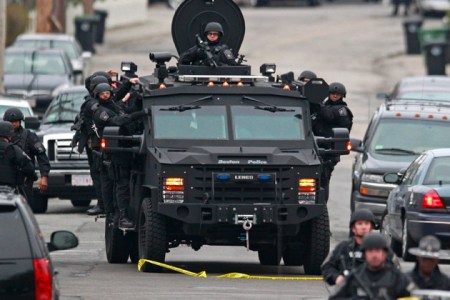
The increasing militarisation of America’s police force, from the deployment of heavy-duty weaponry to the use of “war on terror” tactical assaults on inner-city communities, seems to be the bigger issue that needs to be addressed. Black communities, being disproportionately impoverished and ghettoised, are at the front-line of this systematic police state violence.
But it is all marginalised communities within the US that are potential targets for the country’s surge in militarised policing.
Growing poverty, social exclusion and the erosion of civil liberties for all citizens across the US go hand-in-hand with this increasingly oppressive police power.
The debate over racist policing in American needs to be broadened to confront the general state of oppressive policing that is directed against all those — the majority of the population — who are increasingly disenfranchised by an oligarchy where one per cent of the nation owns nearly 90 per cent of the total wealth. That polarisation of wealth and massive impoverishment of the majority is itself a form of state violence inflicted on the nation; and the police are the front-line enforcers of this systematic violence.
The fact that three police officers implicated in the brutal death of Freddie Gray are non-whites; the fact that the police chief and mayor of Baltimore are African-Americans; the fact that government attorneys are black; and the fact that the president of the United States is also black, all that serves to show that the inherent nature of police state violence in the US is both structural and endemic. The problem of how America has now degenerated into an oppressive police state is thus the central issue.
Today over 2.2 million people are imprisoned in jails across America — an incarceration rate that is said to be the highest in the world.
Some observers have noted that the US has locked away more people in its jails than there were even during the supposed Stalinist despotism of the former Soviet Union. Now that is saying something about the Orwellian nature of life in present-day USA — the “land of the free”.
Featured Video
American Military Failure in Afghanistan
or go to
Aletho News Archives – Video-Images
Frlom the Archives
The Fiction of the Jewish History in Palestine
By Hasan Afif El-Hasan | The Palestine Chronicle | April 8, 2011
Prime Minister Benjamin Netanyahu told NNC Pierce Morgan on March 18, 2011 that he might agree to a Palestinian state through negotiations. And he added, “We will make territorial concessions although it is very painful to do that in our ancestral land.” Netanyahu was not talking about Poland where his ancestors lived. He was talking about Palestine where generations of its indigenous population ancestors lived, cultivated the land and are buried.
By the end of the nineteenth century, Zionism created a new Jewish identity of blood and soil. To mobilize their followers and supporters and appeal to their emotions, the Zionists created myths. Zionism started as a tribal religion without god, but in order to fulfill its function as a unifying force, Zionism required external religious and race symbols, not inner content. Its leaders regarded metaphysical religious belief and purity of race as having value in itself. They created a divine paradisiacal state of merger with the gods. Despite his non-religious ideology, Herzl’s writings were replete with religious references. The Jews should settle in Palestine because, in his words, “the Temple will be visible from long distance, for it is only our ancient faith that has kept us together”.
The Zionists and their supporters have invested tremendous financial and scholarly resources to work within the Hebrew Bible historical narratives to affirm the links between the intrusive Zionist population and the ancient Israelite past, and by doing so assert the right of that population to the land. The political end-game shaped the investigation and the outcome. Tracing the roots of Israel’s ethnic state in biblical antiquity is effectively to silence the indigenous Palestinian claim to the past and therefore to the land. The Biblical scholarship employs a bewildering array of terms for the region: “the Holy Land”, “the Land of the Bible”, “Eretz Israel”, “the Land of Israel”, or “Judah and Samaria.” To the casual reader these names appear interchangeable, but they all imply connection to ancient Israel.
Biblical narratives or poems that cannot be supported by archeology and common sense are treated by the Zionists and their supporters as historical language. … continue
Blog Roll
 Aletho News
- Hezbollah Returns: It Didn’t Start a War, It Is Ending One
- EU states seek ‘talks’ with Iran for access to Strait of Hormuz: Report
- Trump on Hormuz: “Others must take care of it” after US falters
- Who Is closer to collapse?
- A War that Backfired: Why the US-Israeli Campaign Is Strengthening Iran
- How Zionist Control Is Hurting US Interests
- Iran warns it may target US missile launch sites in UAE cities
- American Military Failure in Afghanistan
- Friendly Skies of Georgia: Are Israeli-Linked Drones Launching False Flags from Georgian Territory?
- The Three Big Lies about Mammography Screening
- If Americans Knew
- No let-up in attacks on Gaza as Israel takes on Iran, Lebanon – Not a ceasefire Day 155
- ‘Of Course’: IDF Drops Case Against Soldiers Accused of Raping Palestinian Prisoner
- Don’t Fall for the Regime Change Talk. Israel Is ‘Mowing the Lawn’ in Iran
- Will Israel and the US wreck the Gulf States along with Iran?
- US so far burned through ‘years’ of munitions in Iran war: Report
- How the Israeli Tail Wags the American Dog
- Outdated intel likely led to deadly U.S. strike on Iranian elementary school, sources say
- Pentagon insider says high U.S official Douglas Feith reported to Netanyahu
- In fond memory of Walid Khalidi, the historian of Palestine
- 6 more Americans killed, as Israel ‘mows the lawn’ in Iran – Not a ceasefire Day 154
- No Tricks Zone
- Storing Green Energy To Last Germany 10 Days Would Require A 60-Million Tonne Battery
- New Studies: UK Sea Levels Were 4 Meters Higher Than Today During The Mid-Holocene
- Destructive Green New Deal: German Energy And Metal Group Warns Of Drastic Crisis
- New Study Documents A 20-Year Pause In Arctic Sea Ice Decline – Driven By Internal Variability
- Wake-up Call: Survey Shows Majority Of Germans Now Favor Postponing Climate Targets!
- Televised! Leading German Political Candidate Tells Schoolchildren CO2 Makes Sun Hotter!
- New Study: A Century Warming Of 1.1°C Is ‘Commonplace’ And ‘Not Unusual’ During This Interglacial
- New Study: ‘Internal Noise’ And Volcanic Forcing Can Trigger 10-15°C Warming Within Decades
- Glaciers Worldwide Are Suddendly Surging, Experts Blame Warming!
- Surprising Discovery: Sahara Is Greening…Billions Of Trees Where Once Thought To Be Barren
 Aletho News