A French court has sentenced to eight years in jail a tycoon, who previously made unrelated donations to Israeli Prime Minister Benjamin Netanyahu, over a massive fraud scheme.
Arnaud Mimran was convicted of fraud on Thursday and sentenced to eight years in prison and one million-euro fine for the 2008-2009 fraud, which French authorities say resulted in a major tax shortfall.
Mimran has been on trial as a key suspect in a 283 million-euro scam in the trade and taxation of carbon emissions permits.
Ten other defendants were also given prison terms ranging from one to eight years and six were also fined 1 million euros. All the defendants were convicted of aggravated fraud and money-laundering.
Half of the defendants were tried in absentia and one person was acquitted.
The tax scam case has been described as “the heist of a century” by French authorities.
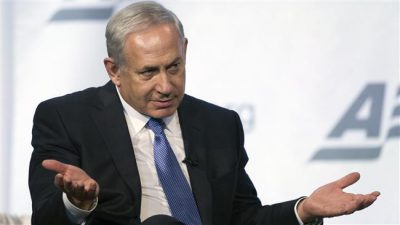
During his trial, the French magnate also testified that on another occasion he had gave 1 million euros to Netanyahu’s election campaign.
Netanyahu’s office has denied any campaign payments and said the contribution was made in 2001 to a fund used while he held no office.
Mimran was convicted of tax offenses in France in the late 1990s as well.
Meanwhile, Israel’s police are reportedly probing whether the prime minister had received illegal contributions from foreign businessmen during his current tenure.
Netanyahu and his wife, Sara, have become embroiled in a series of controversies about how their wealthy lifestyle is funded.
A handful of U.S. think tanks are ranked among the least transparent in terms of financial disclosure.
Human Rights Watch is ranked among one of the least transparent research groups in the United States, according to Transparify’s 2016 think tank transparency report, which details the levels of financial disclosure of 200 think tanks located in 47 countries worldwide.
The survey, conducted by a small nonprofit group gave the Human Rights Watch group a two-star rating—a score that means that all or many donors are listed, but little or no financial information is included—for the third year in year in a row.
“The number of organizations who still consider it acceptable to take money from hidden hands behind closed doors is rapidly dwindling. They are running out of excuses,” said Dr. Hans Gutbrod, executive director of Transparify.
Transparify’s researchers found that only 102 of the think tanks assessed remain opaque, down from 144 four years ago.
Nevertheless, many major groups in the United States received low scores including American Enterprise Institute along with the Hoover Institution, which both received a one-star grade, meaning “that some donors are listed, but not exhaustive or systematic.”
In the United States, think tanks have come to occupy a prominent place in the development of public policy, with their reports being widely distributed among lawmakers in order to support legislative initiatives, according Transparify’s annotated bibliography.
“Government representatives are reportedly utilizing think tanks’ research outputs more often than they use the Congressional Research Service,” Transparify noted.
A June 20 letter from the FBI, attached to the City or Orlando’s lawsuit over withholding 911 calls and other records from 25 media outlets including the Orlando Sentinel, was also sent to the Seminole County Sheriff’s Office with instructions pertaining to how they should respond to records requests.
The letter requests that agencies deny inquiries and directs departments to “immediately notify the FBI of any requests your agency received” so “the FBI can seek to prevent disclosure through appropriate channels, as necessary.”
Notice the FBI says “prevent disclosure,” rather than, say, “assist in determining which documents can be released.” The letter [PDF] claims that all records generated by local law enforcement agencies are now the FBI’s by proxy and that the “investigative documents” exemption [Exemption 7(A)] prevents the release of all documents related to the shooting.
The FBI flat-out states all documents are [evidence and] belong to it.
The FBI considers information obtained from state and local law enforcement agencies in furtherance of its investigation to be evidence, or potential evidence.
Presto! Instant blanket exemption from disclosure at both federal and state level. The FBI takes care to point out which Florida Sunshine Law exemption local agencies can use to withhold documents from requesters.
There’s significant public interest in these documents, especially those related to EMS/police response to emergency calls. This obviously conflicts with the FBI’s determination that its ongoing investigation — which now apparently contains every document created by every responding law enforcement agency in Florida — should preempt any and all requests for documents via Florida open records laws.
Not for nothing have there been several efforts mounted to alter blanket exemptions like the one the FBI is using to insert itself into local level records requests. Unfortunately, it’s very likely the FBI’s wielding of this “open investigation” exemption will be granted deference by the federal court currently presiding over an open records lawsuit between the Orlando Sentinel and the City of Orlando, even though this fight never should have included a federal agency conducting its own concurrent investigation of the mass shooting.
Is no one else tired of alternate history politics? You know, how you caused the Iraq War because you voted for Nader in 2000? I would rather jump into a pool of sludge than read more on that one. The entire enterprise is suspect because it involves just making stuff up and once you go there the sky’s the limit so you can blame anyone for anything. That’s why this tactic never dies. We are spared Al Gore in the present instance, but the price is steep.
Now Noam Chomsky has brought a cudgel to this fight. Trust me, it’s a blunt instrument.
Back in ’68, Chomsky says, “the ultraleft faction of the peace movement” caused the election of Richard Nixon by “minimizing the comparative danger” of a Nixon presidency, thereby making the huge strategic mistake of foisting Nixon on the world, prolonging the Vietnam War by “six years” and causing senseless deaths and untold suffering because we voted our hearts, not our minds.
Fortunately for those of us who were running around doing stuff in the antiwar movement and not voting Democrat, not a word of this is true.
The first fail is this: Nixon could not have been defeated even if every last member of “the ultraleft faction of the peace movement” had voted for the Democrat Humphrey, along with all their friends and relations. The devil is in those pesky electoral votes. The difference of .7% in popular vote ballooned to an electoral defeat of 301 to 191 to 46 (George Wallace), so Humphrey would have needed to pick up a bunch of states with 79 electoral votes to get to 270.
Let’s look at one of them: California. This state has a lot of data, a lot of 3rd party candidates and is favorable for Chomsky’s argument since Nixon’s victory margin there was only three percentage points. (His margin was closer in only 5 states totaling 84 electoral votes but greater in 26 others.) Nevertheless, Humphrey came up short by 223,346 votes. Now, if all the votes for all 3rd party candidates are thrown in with an equal number for their friends and family, and if this total is doubled again to account for ultraleft abstentions, Humphrey still loses California by over 10,000 votes. Chomsky’s LEV argument fails the test of arithmetic.
Really? How was it that the combined antiwar forces of 1968 could not marshal another couple hundred thousand votes (if they got their heads on straight) and could only muster 52,000 votes for all the third parties in a very contested election? Well, we didn’t have the vote. The voting age was 21. If you graduated high school after 1965 you were too young to vote in 1968. That was almost everybody in the movement. Repeat: the antiwar movement could not have saved Humphrey if it wanted to, because we didn’t have the vote. Fail.
The second fail is the preposterous charge of extending the war by 6 years. The war only lasted 6 more years under Nixon/Ford, so the Democrat, if elected, would have had to declare not just immediate but instant withdrawal. As we shall see, that is an otherworldly conjecture. Why not just claim to shorten the war by several years? This is not the only time this brief reads like a really sloppy first draft and makes an unforced error.
Chomsky himself has noted elsewhere the manner in which the decision to withdraw from Vietnam was actually made by the rulers of America. Sorry, but background. The single most important event of the Vietnam War occurred on January 31, 1968: the Tet Offensive. An armed insurrection broke out in every major town and every provincial capital and in Saigon itself, where the US Embassy was breached and partly overrun. Though this insurrection was short-lived and massively attacked with the full might of the assembled US military; although the insurrectionary forces were at least savagely repressed if not obliterated almost everywhere, and though it took years to rebuild the networks that were sacrificed in those few days; and notwithstanding the fact that the “insurrection” failed to mobilize any segment of the South Vietnamese society in noticeable let alone decisive numbers and relied instead of members of the NLF; nevertheless, the Tet Offensive is widely understood as one of the greatest military victories of history because it destroyed the will of the American people to pursue the war.
Many colonial powers have endured uprisings by subject peoples and continued more or less unfazed, like the British in India and the French in Algeria, at least for a while. But in America we were fed, for years, the lie that the war was being won and pacification of local hamlets and villages was happily proceeding. The end was in sight. So the shock of Tet in America was total. Suddenly a lot of people stopped believing anything the government said about Vietnam.
President Lyndon Johnson also stopped believing what he heard about Vietnam and in the wake of Tet instructed his new Secretary of Defense, an old pal and Democratic Party fixer going back to Truman, to assess the government’s ability to field the 205,000 more troops requested by Gen. Westmoreland as the way to put Tet behind them and go on winning the war. That was the official task but Johnson was tired of hearing totally different stories from different parts of his government and wanted to put the entire security cabinet, as the Israelis would call it, in the same room where they would be forced to arrive at an agreed assessment with no chance of weaseling out later. After three days the new Secretary of Defense concluded there was no way whatsoever to win the war and the US should adopt the strategy called “Vietnamization,” the effort to turn over fighting to the armed forces of the puppet government Washington had been propping up for over a decade. Everyone understood this could not be an overnight affair like evacuating Dunkirk, for dozens of reasons. Everyone also knew Vietnamization would never work and the real point was to disguise defeat. Whole books have been written about this. Allies had to be placated and lies prepared not just for our own but also the people of the unfortunate countries who followed the US down this rabbit hole and provided troops, like Australia and South Korea, the latter providing 50,000. Withdrawal was never going to happen in less than years, on purpose. Total fail #2.
Oddly, Chomsky’s brief never mentions by name the person we should have voted for back when we doomed the Vietnamese to six more years of war in our ultra-left fever. This is at least consistent with Chomsky’s past practice regarding Humphrey. Between when he started writing on social and political issues in February of 1967 with the explosive publication of “The Responsibility of Intellectuals” and the 1968 election Chomsky penned five important essays that established him forever as a leading American intellectual, scourge of the Vietnam War, and a man who names names. A man who would out the head of his own department in writing as no more than an academic war profiteer.
In those essays he mentions Humphrey twice, both times in passing. First:
[T]he Vice President tells us that we are fighting “militant Asian Communism” with “its headquarters in Peking” and adds that a Viet Cong victory would directly threaten the United States[.]
This is so beyond stupid that the old Chomsky, who knew when a thing spoke for itself, made no comment. Walter Lippmann, a right-wing commentator, did point out that this bespoke an unseemly lack of confidence in the US Navy. In the second mention in this blistering political year, discussing moral choices, Chomsky puts Humphrey in some spotty company thinking very bad thoughts, but also in passing, like Dante might mention some subsidiary clod shivering in a corner of some circle of hell:
Suppose that it were in the American “national interest” to pound into rubble a small nation that refuses to submit to our will. Would it then be legitimate and proper for us to act “in this national interest”? The Rusks and the Humphreys and the Citizens Committee say “Yes”. Nothing could show more clearly how we are taking the road of the fascist aggressors of a generation ago.
Is this really everything Chomsky wrote about the Man who Might Have Stopped the War? When an endorsement, in Chomsky’s mind at least, might have mattered ? Yes. That is all.
We have seen that it was mathematically impossible for Humphrey to win California, one of his better states. We have seen that the decision to exit Vietnam was taken at the level of the deep state with not an elected official in the room. Further, that the necessity to mask defeat birthed Vietnamization, which allowed for blaming everything on the hapless South Vietnamese Army as it visibly disintegrated. All this would take time. Nobody cared.
It is clear that for something other than the slow-assed withdrawal outlined above to occur Humphrey would have had to take on the entire establishment. The final fail is that Chomsky does not argue what he must: that there was something known about Humphrey’s character at the time that might make such a head-on challenge to his own administration plausible. Who, then, was Hubert Humphrey?
First, as Chomsky notes above, Humphrey was first and foremost an anti-Communist. And not just in words: He made his bones in Minnesota politics by helping to destroy the Farmer-Labor Party and fold it into the Democratic Farmer-Labor Party. This meant wiping out pockets of radicalism left over from the titanic victory of the Teamsters Strike of 1934, often with the use of thugs. In national politics he sponsored a bill to make membership in the Communist Party illegal, sponsored other outlandish pieces of anti-communist legislation, voted to establish detention camps for people like us, was a founder of the anti-communist Americans for Democratic Action and was at least as full-throated an anti-communist with credentials rivaling Nixon’s.
Second, he was an order-taking schnook, and everybody knew it. It is said he advised LBJ early on that Vietnam was a loser but lost his taste for that truth when LBJ froze him out for a couple of months. Since Humphrey considered Johnson’s favor his only possible road into the White House, in the time-honored way of American politicians he proceeded to say exactly what he was told to say for the next four years, never mind that he didn’t believe it. He thus became the Administration’s foremost spokesperson on the war and gave an astonishing 400 speeches defending the Administration’s Vietnam policy.
Robert Kennedy, smelling blood because Clean Gene McCarthy almost handed Johnson his ass in the 1968 New Hampshire primary, entered the race and chased Johnson out within weeks. Before the public announcement that he would not run Johnson coldly told an ashen-faced Humphrey he would have to run against Kennedy and Humphrey, knowing he was dead meat, obeyed. Only Kennedy’s assassination saved him from utter humiliation. He took not one step to distinguish himself from Johnson’s Vietnam position during the entire campaign.
By the record, no one (except his lawyer) ever considered him a man whose thoughts or actions on the war need be discussed. Everything Chomsky himself said about Humphrey during these tumultuous times is quoted in full above. Gabriel Kolko in Anatomy of a War mentions only “Hubert Humphrey’s faltering campaign for the presidency.” In Fred Halstead’s highly detailed history of the antiwar movement Out Now he is again mentioned only once, in passing, as the evident choice of the Democratic Party machine while Jerry Rubin’s index citations run to half a column.
It is not real to think that such a man might impose his will on the machinery of state and speed up the withdrawal from Vietnam. If Chomsky has reasons to believe this, he has kept them to himself. Nothing in history and nothing in Humphrey’s character bears him out. Third and final fail.
Do you still think I have missed the boat? Let’s finally then let the candidates speak for themselves on Vietnam. Here are their respective positions as delivered from the podium during their acceptance speeches.
Humphrey:
“Let those who believe that our cause in Vietnam has been right — and those who believe it has been wrong — agree here and now: Neither vindication nor repudiation will bring peace or be worthy of our country.
The question is: What do we do now?
No one knows what the situation in Vietnam will be on January 20, 1969.
Every heart in America prays that, by then, we shall have reached a cease-fire in all Vietnam, and be in serious negotiation toward a durable peace.
Meanwhile, as a citizen, a candidate, and Vice President, I pledge to you and to my fellow Americans, that I shall do everything within my power to aid the negotiations and to bring a prompt end to this war.”
Nixon:
“We shall begin with Vietnam.
We all hope in this room that there is a chance that current negotiations may bring an honorable end to that war. And we will say nothing during this campaign that might destroy that chance.
But if the war is not ended when the people choose in November, the choice will be clear. Here it is.
For four years this Administration has had at its disposal the greatest military and economic advantage that one nation has ever had over another in any war in history.
For four years, America’s fighting men have set a record for courage and sacrifice unsurpassed in our history.
For four years, this Administration has had the support of the Loyal Opposition for the objective of seeking an honorable end to the struggle.
Never has so much military and economic and diplomatic power been used so ineffectively.
And if after all of this time and all of this sacrifice and all of this support there is still no end in sight, then I say the time has come for the American people to turn to new leadership — not tied to the mistakes and the policies of the past. That is what we offer to America.
And I pledge to you tonight that the first priority foreign policy objective of our next Administration will be to bring an honorable end to the war in Vietnam. We shall not stop there — we need a policy to prevent more Vietnams.”
Can’t tell the difference? Neither could we.
The paucity of effort Chomsky expends on this surreal exercise in alternate history politics is notable. He isn’t really trying. He never mentions Humphrey by name. He fact-checks nothing. He does not even appear to know what a Hobson’s Choice is. That’s because all the thinking, if you want to call it that, was done long ago when Chomsky joined the Democrat’s team and stopped thinking about how to actually forge political independence.
The genius of the Democrats is that they will cheerfully allow you to say anything at all, as a Democrat, so long as you toe the line on election day. No harm, no foul. Hence the livelihoods of predictable shills like Rachel Maddow, Thom Hartmann, Amy Goodman and Juan Gonzales.
It is slightly different with Chomsky because he has maintained the step of organizational independence from the Democrats, does not suggest that the Democrats can be reformed or taken over, and yet still demands we vote for them if a vote against them might actually hurt. He has, by his own admission, voted in this manner for the last 17 presidential elections. In practice he is a Democratic Party dues cheater pretending a political independence he has never demonstrated.
NATO says it is “ready to stay” in Afghanistan, reiterating a pledge on funding for local security forces.
“What we have seen is we are committed and we are ready to stay,” NATO Secretary General Jens Stoltenberg said Saturday, highlighting the funding pledge through 2020.
Stoltenberg could not say, however, when NATO’s military engagement in Afghanistan might end.
“There’s no reason to speculate exactly on how long it will continue,” he said, adding that NATO member states would examine the situation again next year.
Under the leadership of the United States, the 28-nation Western military alliance invaded Afghanistan in 2001, starting a war that has killed thousands and cost tens of billions of dollars. The military engagement was meant to obliterate the Taliban, but the militant group has managed to gain more footholds across the country over the past years, and local security forces still struggle to contain the group and other militants, including al-Qaeda and the Takfiri Daesh terrorists.
Stoltenberg said NATO will maintain troops in Afghanistan through 2017 under its train and advise Resolute Support Mission. He did not provide numbers but said the overall NATO force in Afghanistan would be “around the same” as now. Resolute Support currently has about 13,000 troops in Afghanistan.
Washington, the main provider of troops and funding to NATO in Afghanistan, has also backed down on its previous pledges to reduce the number of troops in the country, arguing that Kabul has been quite slow in reforming its military, which the United States claims is gripped by corruption and human rights issues.
US President Barack Obama had previously vowed to slash troop numbers from the current 9,800 to 5,500 by the end of this year. However, he announced on July 6 that the process will draw down and the US would keep 8,400 US troops in Afghanistan.
What was your reaction when you heard FBI Director James Comey announce to the world that the Bureau would not be recommending that charges be filed against Hillary Clinton over her handling of emails while she was Secretary of State? Did you do a humorous spit take with your coffee like some modern day Danny Thomas? Were you frozen in place like Americans were on November 22, 1963? Did your jaw hit the floor with your tongue rolling out like a flabbergasted cartoon character?
Chances are you weren’t the least bit surprised that no charges were recommended. But what does that tell you about our political system?
That millions of Americans weren’t remotely caught off guard by the exculpation of Hillary Clinton is less a commentary about American attitudes than it is a clear indication of the all-pervasive criminality that is at the heart of America’s political ruling class. And the fact that such criminality is seen as par for the course demonstrates once again that the rule of law is more a rhetorical veneer than a juridical reality.
But consider further what the developments of recent days tell us both about the US and, perhaps even more importantly, the perception of the US internationally. For while Washington consistently wields as weapons political abstractions such as transparency, corruption, and freedom, it is unwilling to apply to itself those same cornerstones of America’s collective self-conception. Hypocrisy is perhaps not strong enough a word.
Not Even Hiding It Anymore…
Remember the good old days when corrupt politicians committed their crimes in smoke-filled rooms, making handshake deals in quiet corners of luxury hotel suites or over lobster at five star restaurants? Those things certainly still happen, but the transgressions, like all things, seem to have lost a bit of their classiness. It may not be the Plaza Hotel, but the Phoenix airport was no less a scene of wanton lawlessness and impropriety when former President, and soon to be First Gentleman, Bill Clinton met privately with Attorney General Loretta Lynch.
The meeting, which only came to light thanks to the work of local ABC15 morning anchor Christopher Sign, has been widely criticized by pundits and legal experts from both sides of the political spectrum. Naturally, questions about impropriety, and potential illegal tampering in a federal investigation, were immediately raised once the meeting was made public. Of course, nothing was done to alleviate any of those concerns, calling into question the very impartiality of the investigation.
But the larger story has to do with symbolic message being sent by the meeting. Specifically, there is one set of laws for American citizens, and an entirely different set of laws for political elites like the Clintons.
Moreover, there’s more to it than just criminality. There is the air of superiority which oozes from every action taken by the Clintons who have made hundreds of millions of dollars unscrupulously pandering to, and serving the interests of, the financial elite of Wall Street and the corporate oligarchy. That feeling of invincibility is what drives someone like Bill Clinton to demand that the FBI surrounding him at the Phoenix airport dictate to bystanders that there are to be “no photos, no pictures, no cell phones.” To make such a demand is to see oneself as above the law, above the First Amendment, above the plebs, as it were.
And this sort of behavior is what we’ve come to expect from the Clintons. Who can forget the seemingly endless rap sheet that the dynamic Democrat duo has earned over the decades? The Whitewater Scandal, in many ways a template for the Clinton email scandal, involved shady business practices and political insider dealing by the Clintons and their real estate developer cronies. And, like the email scandal, Whitewater was an example of the Clintons deliberately destroying records that likely implicate them in very serious crimes.
As the New York Times reported in 1992, “The Clintons and Mr. McDougal disagree about what happened to Whitewater’s records. Mr. McDougal says that at Mr. Clinton’s request they were delivered to the Governor’s mansion. The Clintons say many of them have disappeared. Many questions about the enterprise cannot be fully answered without the records.”
So it seems the Clintons have this nasty habit of committing crimes and then destroying the records of those crimes and claiming complete ignorance about what happened. For you and me, such a flimsy excuse would go over like a lead balloon, likely leading to jail time. For the Clintons, the controversy quietly fades away and slips down the memory hole.
And then of course there’s the mysterious death of Deputy White House Counsel Vince Foster, the man who filed three years of delinquent Whitewater corporate tax returns, and then was subsequently found dead a month later. While his death was officially ruled a suicide, the serendipitous development for the Clintons led to speculation that Foster was killed on the order of the Clintons in order to silence a potentially damning source of information about Clinton misdeeds.
Indeed, some claim that evidence exists that Foster was in fact murdered, including the statements from one of the lead prosecutors investigating the death, Miguel Rodriguez, who claims that photos showed a gunshot wound on Foster’s neck, a wound that was not mentioned in the official report. Whether true or not, the speculation about the Clintons’ involvement in a political assassination has only grown.
But of course there are so many more scandals it’s hard to keep count. From appointments of Clinton Foundation donors to key State Department positions in a sort of “pay for play” scheme, to the salaries paid to people like Hillary’s Deputy Chief of Staff Huma Abedin who, while working for the State Department, also worked for Teneo, a consulting firm run by another close Clinton crony. And who could forget the Clinton Foundation and the myriad conflict of interest issues, lack of transparency, and outright criminality associated with it?
This article would go on for tens of thousands more words were it to chronicle all of Clinton’s scandals. But the true focus here is not even simply on Clinton crimes, but rather on the culture of corruption and lawlessness that exists unfettered in Washington; it is the endemic corruption that the Clintons represent, perhaps better than anyone.
Corruption and Malfeasance: As American as Apple Pie
It is difficult to encapsulate in a few short paragraphs the multi-layered forms of corruption that are embedded in the very fabric of America’s political culture. Perhaps it could be best separated into three distinct, though interrelated, categories: the open door, the closed door, and the revolving door.
The open door of corruption and criminality represents the kind of wrongdoing that takes place out in the open, in full view of the public, but which is treated as anything but criminal. Whether it be lying the US into wars of aggression – the Iraq War was based on lies about weapons of mass destruction, the war on Libya was sold on the pretext of lies about civilians being murdered by the government – or simply the obviously corrupt form of campaign financing that allows Wall Street and the corporate elites to bankroll the alleged “democracy” that the US so proudly proselytizes the world over; these forms of corruption and criminality are in many ways the bedrock of American politics.
As the International Military Tribunal at Nuremberg famously stated, “To initiate a war of aggression… is not only an international crime; it is the supreme international crime, differing only from other war crimes in that it contains within itself the accumulated evil of the whole.” By this very definition, every political leader in the US going back decades is guilty of war crimes.
Going further, one can draw on the legacy of Franklin Roosevelt who, in a now legendary speech at Madison Square Garden in 1936, unequivocally proclaimed:
We had to struggle with the old enemies of peace–business and financial monopoly, speculation, reckless banking, class antagonism, sectionalism, war profiteering. They had begun to consider the Government of the United States as a mere appendage to their own affairs. We know now that Government by organized money is just as dangerous as Government by organized mob. Never before in all our history have these forces been so united against one candidate as they stand today. They are unanimous in their hate for me–and I welcome their hatred.
But today, rather than welcoming the hatred of Wall Street and the corporate oligarchy, America’s politicians pander to them, grovel before them, kiss their rings in hopes of securing for themselves a financially and professionally lucrative future. So deep is the rot that most Americans passively accept this as business as usual, failing to understand that it is anything but acceptable.
The closed door forms of criminality are often completely concealed from public view, and what does become known is only thanks to courageous actions by reporters and whistleblowers. Take for instance the activities of the CIA, only a fraction of which were exposed by the Church and Pike Committees, which included obviously criminal activities ranging from the overthrow of governments to assassination of political leaders to domestic spying and propaganda, all of which being blatantly illegal.
But the closed door also conceals the activities of prominent political figures such as Hillary Clinton, whose secret lobbying for things like right wing coup governments in Honduras, shows the degree to which politicians literally conspire in secret. Clinton, like so many of her colleagues, also grovels at the feet of Wall Street financiers, including taking massive payoffs for speeches with the tacit wink-wink-nudge-nudge that goes along with them.
Finally, the revolving door is one of the shining examples of America’s political corruption, or perhaps better put, complete subservience to the corporate oligarchy. When key government officials leave public life and head to that oft-lionized “private sector,” what they are actually providing is access – access to government for corporations and capital.
When the architect of Obamacare, who before working on the health plan was an executive at one of the nation’s largest health insurance providers, leaves her government job and takes a position with Johnson & Johnson’s government affairs and policy group, it garners barely a passing comment.
When Wall Street executives take positions at head of the Treasury Department – Tim Geithner and Hank Paulsen both worked for Goldman Sachs, as just one example – it is simply “the way things are.” This revolving door form of political corruption may not be anything new, but it is so rarely defined as corruption. But that’s exactly what it is.
However, none of this prevents Washington from publicly admonishing other countries for their corruption problems. Russia? Zimbabwe? Venezuela? China? Nigeria? All corrupt. United States? Well, er, ummm… Democracy! Freedom! This is the sort of reflexive hypocrisy that typifies American exceptionalism or, as the rest of the world might call it, the arrogance of empire.
The Chilcot Report was released on Wednesday, and a hard copy can be yours for just £767 (though I would suggest reading it free online here), and while there will doubtless be many and varied autopsies of the evidence and documents, this early observation is an interesting one.
An eagle-eyed reader brought the following documents to our attention, as they contain many sections that hint war with Syria may have been on the NATO/US agenda as far back as October 2001.
… The uncertainty caused by Phase 2 seeming to extend to Iraq, Syria etc because it seems to confirm the UBL [Osama Bin Laden] propaganda this is the West vs Arab [sic]. Tony Blair, letter to GW Bush, 11/10/01
This quote suggests that Syria and “etc.” (Lebanon or Iran, at a guess) were already in the crosshairs. Interestingly, it is followed by:
Incidentally, the leaders all warned about treating Syria like Iraq.
It’s safe to say the warnings of these “leaders” (their names are all redacted), were not heeded by the subsequent administrations.
…urgent pressure on Syria and Iran to crack down on terrorists as a quid pro quo for a warmer relationship with the West and getting a Middle East peace process going – with the unstated threat that risk becoming the next target for military action if they do not co-operate…
And then this from a memo entitled “The War against Terrorism: The Second Phase”, dated December 4th 2001:
If toppling Saddam is a prime objective, it is far easier to do it with Syria and Iran in favour or acquiescing rather than hitting all three at once. I favour giving these two a chance at a different relationship…
This quote is interesting, because while it sets out that the British position seems to be in favour of a “different relationship”, the fact that it references “hitting all three at once” very strongly implies that such a recourse was suggested (probably by the US).
While there is nothing absolutely concrete here, there is certainly enough to smoke to suggest a little fire. It definitely adds a little weight to the famous claim of the Gen. Wesley Clark that the Project for a New American Century planned to “take out 7 countries in 5 years.”
BETHLEHEM – Israeli Education Minister Naftali Bennett advocated on Thursday for Israel to kidnap Palestinians to be used as leverage to obtain the release of two Israeli civilians and the bodies of two soldiers held in the besieged Gaza Strip, Israeli media reported.
In an interview with Radio Darom, Bennett — who leads the far-right Jewish Home party — discussed the issue of releasing Palestinian prisoners as part of a deal to obtain the return of Israeli citizens Avraham Mengistu and Hisham al-Sayed, as well as the bodies of Hadar Goldin and Oron Shaul, two soldiers killed during Israel’s 2014 offensive on Gaza.
“My policies are consistent over the years: complete opposition to disproportionate deals to free terrorists, and certainly in exchange for bodies,” The Times of Israel quoted Bennett as saying.
According to Israeli news outlet The Jerusalem Post, Bennett then advocated for the kidnapping of Palestinians to pressure for the release of the slain soldiers and missing Israelis.
“We should do what the State of Israel once did,” he said. “What we once did in such situations was we would go and kidnap from the other side, and create new leverage against the other side, rather than releasing more and more terrorists.”
The Jerusalem Post quoted Bennett’s spokesperson as specifying that the far-right political leader was suggesting kidnapping “terrorists,” not Palestinian civilians.
It remained unclear from Bennett’s statement whether he advocated the kidnapping of Palestinians to use as a bargaining chip to exchange with Israelis, in contradiction of his earlier statement, or as an intimidation tactic to coerce those holding the Israelis in Gaza into releasing them.
It was also unclear whether Bennett was pushing for Israel should detain more Palestinians in addition to the 7,000 currently held in Israeli prisons, or hold them completely extrajudicially.
Spokespeople for the Education Ministry and Bennett’s office were unavailable for comment on Friday, the weekend in Israel, to clarify the minister’s statements.
Bennett is well known for his incendiary rhetoric vis-a-vis Palestinians.
In the wake of several attacks last week which killed two Israelis, including a 13-year-old girl, and three Palestinians, Bennett advocated for a number of measures which have been denounced by rights groups as constituting collective punishment.
These proposed measures, many of which have been implemented, included increased settlement construction; stepping up Israel’s policy of demolition of Palestinian property built without permits; full Israeli military control over the entirety of the occupied West Bank; military closures of suspected attackers’ hometowns; the detention of suspected attackers’ family members; and cutting off internet and cellular access to the southern West Bank district of Hebron.
Amid raging corruption, social pathologies and outright political thuggery, a new gang of vassal regimes has taken-over Latin America. The new rulers are strictly recruited as the protégé’s of US financial and banking institutions. Hence the financial press refers to them as the “new managers” – of Wall Street.
The US financial media has once again provided a political cover for the vilest crimes committed by the ‘new managers’ as they launch their offensive against labor and in favor of the foreign and domestic financiers.
To understand the dynamics of the empire’s new vassal managers we will proceed by identifying (1) the illicit power grab (2) the neo-liberal policies they have pursued (3) the impact of their program on the class structure (4) their economic performance and future socio-political perspectives.
Vassals as Managers of Empire
Latin America’s current vassalage elite is of longer and shorter duration.
The regimes of longer duration with a historical legacy of submission, corruption and criminality include Mexico and Colombia where oligarchs, government officials and death squads cohabit in close association with the US military, business and banking elites.
Over the past decades 100,000 citizens were murdered in Mexico and over 4 million peasants were dispossessed in Colombia. In both regimes over ten million acres of farmland and mining terrain were transferred to US and EU multinationals.
Hundreds of billions of illicit narco earnings were laundered by the Colombian and Mexican oligarchy to their US accounts via private banks.
The current political managers, Peña in Mexico and Santos in Colombia are rapidly de-nationalizing strategic oil and energy sectors, while savaging dynamic social movements – hundreds of students and teachers in Mexico and thousands of peasants and human rights activists in Colombia have been murdered.
The new wave of imperial vassals has seized power throughout most of Latin America with the direct and indirect intervention of the US. In 2009, Honduras President Manuel Zelaya was ousted by a military coup backed by Secretary of State Hillary Clinton. Zelaya’s program of agrarian reform, regional integration (with Venezuela) and constitutional elections was abolished. Zelaya was replaced by a US vassal, Roberto Micheletti who proceeded to murder several hundred landless rural workers and indigenous activists.
Washington moved to organize a constitutional cover by promoting a highly malleable landowner, Porfirio Lobo Sosa to the presidency.
The State Department next ousted Paraguyan President Francisco Lugo who governed between 2008-2012. Lugo promoted a moderate agrarian reform and a centrist regional integration agenda.
With the backing of Secretary of State Clinton, the Paraguayan oligarchy in Congress seized power , fabricated an impeachment decree and ousted President Lugo. He was briefly replaced by Vice President Federico Franco (2012-2013).
In 2013, Washington backed , the capital, Asuncion’s, notorious crime boss for President, one Horacio Castes – convicted for currency fraud in 1989, drug running in 1990, and most recently (2010) money laundering.
The Honduras and Paraguayan coups established (in miniature) the precedent for a new wave of ‘big country’ political vassals. The State Department moved toward the acceleration of banking takeovers in Brazil, Argentina and Peru.
In rapid succession, between December 2015 and April 2016 vassal managers seized power in Argentina and Brazil. In Argentina millionaire Mauricio Macri ruled by decree, bypassing constitutional legality. Macri fired scores of thousands of public service workers, closed social agencies and appointed judges and prosecutors without Congressional vote. He arbitrarily arrested social movement leaders – violating democratic procedures.
Macri’s Economic and Finance Ministers gained millions of dollars by ‘buying into’ multinational oil companies just prior to handing over private options on public enterprises.
The all-encompassing swindles and fraud carried out by the ‘new managers’ were covered up by the US media, who praised Macri’s professional team.
Moreover, Macri’s economic performance was a disaster. Exorbitant user fees on utilities and transport for consumers and business enterprises, increased three to ten-fold, forcing bankruptcy rates to soar and households to suffer light and gas closures.
Wall Street vulture funds received a seven billion dollar payment from Macri’s managers, for defaulted loans purchased for pennies over a dollar, twenty-fold greater then the original lenders.
Data based on standard economic indicators highlights the worst economic performance in a decade and a half.
Price inflation exceeds 40%; public debt increased by twenty percent in six months. Living standards and employment sharply declined. Growth and investment data was negative. Mismanagement, official corruption and arbitrary governance, did not induce confidence among local small and medium size businesses.
The respectable media, led by the New York Times, the Financial Times, the Wall Street Journal and the Washington Post falsified every aspect of Macri’s regime. Failed economic policies implemented by bankers turned cabinet ministers were dubbed long-term successes; crude ideologically driven policies promoting foreign investor profiteering were re-invented as business incentives.
Political thugs dismantled and replaced civil service agencies were labelled ‘a new management team’ by the vulgar propaganda scribes of the financial press.
In Brazil, a phony political power grab by Congressional opportunists ousted elected President Dilma Rousseff. She was replaced by a Washington approved serial swindler and notorious bribe taker, Michel Temer.
The new economic managers were predictably controlled by Wall Street, World Bank and IMF bankers. They rushed measures to slash wages, pensions and other social expenditures, to lower business taxes and privatize the most lucrative public enterprises in transport, infrastructure, landholdings, oil and scores of other activities.
Even as the prostitute press lauded Brazil’s new managers’, prosecutors and judges arrested three newly appointed cabinet ministers for fraud and money laundering. ‘President’ Temer is next in line for prosecution for his role in the mega Petrobras oil contracts scandal for bribes and payola.
The economic agenda by the new managers are not designed to attract new productive investments. Most inflows are short-term speculative ventures. Markets, especially, in commodities, show no upward growth, much to the chagrin of the free market technocrats. Industry and commerce are depressed as a result of the decline in consumer credit, employment and public spending induced by ‘the managers’ austerity policies.
Even as the US and Europe embrace free market austerity, it evokes a continent wide revolt. Nevertheless Latin America’s wave of vassal regimes, remain deeply embedded in decimating the welfare state and pillaging public treasuries led by a narrow elite of bankers and serial swindlers.
Conclusion
As Washington and the prostitute press hail their ‘new managers’ in Latin America, the celebration is abruptly giving way to mass rage over corruption and demands for a shift to the political left.
In Brazil, “President” Temer rushes to implement big business measures, as his time in office is limited to weeks not months. His time out of jail is nearing a deadline. His cabinet of ‘technocrats’ prepare their luggage to follow.
Maurico Macri may survive a wave of strikes and protests and finish the year in office. But the plunging economy and pillage of the treasury is leading business to bankruptcy, the middle class to empty bank accounts and the dispossessed to spontaneous mass upheavals.
Washington’s new managers in Latin America cannot cope with an unruly citizenry and a failing free market economy.
Coups have been tried and work for grabbing power but do not establish effective rulership. Political shifts to the right are gyrating out of Washington’s orbit and find no new counter-balance in the break-up of the European Union.
Vassal capitalist takeovers in Latin America generated publicist anesthesia and Wall Street euphoria; only to be rudely shocked to reality by economic pathologies.
Washington and Wall Street and their Latin America managers sought a false reality of unrestrained profits and pillaged wealth. The reality principle now forces them to recognize that their failures are inducing rage today and uprisings tomorrow.
In the wake of the Chilcot report’s release, which details the the U.K.’s role in the U.S.-led invasion of Iraq in 2003, current U.K. Labour leader Jeremy Corbyn’s anti-war speech from 2003 has been making the internet rounds.
Speaking at a rally in Hyde Park in London on February 15, 2003, on a day where over 600 similar demonstrations against the invasion of Iraq were occurring worldwide, the then-British MP delivered a bold speech to a crowd of nearly 2 million people.
While Corbyn is currently embroiled in turmoil, with “Blairites” in his party turning on him since last week’s EU referendum results, where senior members of his Cabinet have resigned and 172 Labour MPs have signed a vote of no confidence in his leadership, he still maintains his anti-war convictions.
But sources say he won’t resign until former U.K. Prime Minister Tony Blair is “crucified” for his imperial aggression against Iraq, details of which can be found in the Chilcot report.
Here are five of the most powerful quotes from Corbyn’s Hyde Park anti-imperial speech.
1. “I find it deeply distasteful that the British prime minister can use the medieval powers of the royal prerogative to send young men and women to die, to kill civilians and for Iraqis to die.”
Corbyn expressed his disgust that Blair could make the decision to go to war on his own and declared that he wanted a vote in British Parliament.
2. “8,000 deaths in Afghanistan brought back none of those who died in the World Trade Center.”
Addressing those who justified the war as it would bring more peace and security to the world, Corbyn listed the number of civilian deaths in Afghanistan, a country that was being pummeled with U.S. imperial might soon after 9/11 in the so-called war on terror.
3. “This will set off a spiral of conflict, of hate, of misery, of desperation, that will fuel the wars, the conflict, the terrorism, the depression and the misery of future generations.”
Predicting early the cyclical nature of such offensives, Corbyn warned that going to war in Iraq will not only cause unnecessary destruction and grief, but would produce more of it in years to come.
4. “Those … George Bush, Tony Blair … who want war, they are the ones who are isolated and alone and desperately searching for friends.”
Looking among the nearly 2 million people that had gathered in London that day to voice their opposition against war, Corbyn cited it is they, the demonstrators, that are united and that the political leadership of those looking to incite more war are the ones left scrambling for supporters.
5. “British government stop now, or pay the political price.”
Signing off with this terse statement, the crowd roared with applause as Corbyn exited the stage.
Many people have suspected there was a plan to topple countries, such as Iraq, that are also enemies of Israel, the US, and UK, security analyst and former UK army officer Charles Shoebridge told RT.
The Chilcot Report on the UK’s involvement in the Iraq war was finally released, after seven years of investigation. Former UK Prime Minister Tony Blair said he apologized for the mistakes made in planning and executing the intervention but he stood by the decision to go to war. He also dismissed accusations that his decision undermined the UN Security Council’s authority.
RT:Blair says Russia and France would have vetoed Iraq intervention at the Security Council. So is that fair justification for his decision to invade Iraq?
Charles Shoebridge: No, if anything, it is saying publicly as indeed many of us were saying at the time that: “It has been ruled unlawful, but therefore I am going to go ahead anyway.” After all, other than self-defense, which is clear and was clear at the time – notwithstanding how it was marketed at the time – that there was no imminent danger from Saddam Hussein; notwithstanding how much of the intelligence community, much of our politicians, and indeed much of the UK and US media tried to spin it into some kind of imminent threat.
Therefore, there was no imminent treat, so self-defense couldn’t be invoked. It would have to be by a UN resolution in the Security Council to allow that action to take place. Of course Blair knew that. But in some ways possibly France, particularly at the time and Russia even maybe perhaps unwittingly played into Tony Blair and George Bush’s hands by announcing that so publicly beforehand that they would veto it if it went to a UN Security Council resolution.
The reason they were going to veto, remember, is because the UN’s own arms inspectors hadn’t completed their work. They wanted to give a chance to Hans Blix and others to find those weapons that the US and the UK were claiming existed. Hans Blix and the inspectors were saying at the time to the US and the UK intelligence services: “Give us that information, give us that intelligence. We will go and check this out!” That intelligence was never forthcoming. That in itself, along with all the other aspects that are contained in this report, many of which are still to emerge, because it is still going to have very close scrutiny. It is of course questionable as to the extent to which that intelligence was reliable, and whether people knew it was reliable at the time.
RT:Tony Blair also said he regretted that parliament had voted against intervention in Syria. What do you make of that?
CS: It is an interesting line in one of his memos from 2001 – as far back as that to Bush – saying that shortly after 9/11 seeing the opportunity to attack Saddam; saying in many ways it could be interpreted as: “Ok, we’re looking at toppling Saddam, we can move on to Syria and Iran at a later stage.” Many people have suspected over the years that there was a plan, of which Iraq was just a part, to topple countries that by coincidence, some might say, are also enemies of Israel, of the US, and the UK, notwithstanding their own geopolitical situations. But that aside, it is really clear that much of the intelligence we know from Chilcot, that it was badly assessed; it was ill-thought-out and ill-informed intelligence in the first place. It was rushed; it wasn’t correctly assessed and analyzed properly.
It will still leave many, including so many in the intelligence community, who will ask the question, which doesn’t seem to have been addressed, or at least the accusation has not been made by Chilcot, as far as I can see at this stage whether there was any deliberate falsification of that intelligence; whether MI6 particularly and… other actors within the US and UK intelligence establishment deliberately falsified or exaggerated intelligence to support the government of the day and Tony Blair in a decision already made to go to war.
It seems that in many ways the security services have been let off lightly, because they have been condemned not for dishonesty, deceit, or perhaps even for illegal activity – which many suggest has taken place – but for gross incompetence, which at the end of the day that intelligence – some would argue and argued at the time, was intended to justify going to war. Once that war decision was taken and war happened, of course it doesn’t matter if subsequently it was found that intelligence was faulty, or even didn’t exist, because some would argue that the whole purpose of it was to justify the war, not be the real reason behind it.
Time for people to demand US ‘war criminals’ face charges
When US and UK forces invaded Iraq, the country had not one weapon with which to resist, and had been totally disarmed and starved down by the sanctions, said Sara Flounders the head of the International Action Center.
RT: What do you expect to be Washington’s reaction to the inquiry? Do you expect anyone to be held accountable for what happened?
Sara Flounders: Of course the US wants to bury this immediately and Pentagon officials refuse to study it. But the real question the people of the world should be asking is: “When do the war crimes trials start?” Clearly this war by every count, and once again confirmed in this report, was a criminal violation of international law by every measure and by every standard. Any discussion that doesn’t involve a war crimes trial against these criminals that destroyed Iraq and led to the deaths of tens of thousands of people, left a whole society in ruins, and has led to the terror that we face on a global scale today. Anyone who is isn’t asking that question and is going to push this off for further study or bury it – is not in any way serious, or really part of the cover-up. This report which was to take a year, took seven years, 12 volumes. It is ridiculous and yet it must be used as a basis to demand accountability of these criminals in Britain and certainly here in the US.
RT:How likely is it that the US will hold a similar investigation?
SF: The US won’t discuss their criminal conduct in any way whatsoever and they have refused to account for this war. I don’t expect them to respond to this, or to their use of torture; their use of tens of thousands of people detained in the war on terror; their massive destruction of Iraq, of Afghanistan, of Libya – on all of these they are silent. Yet, I think this is a time for the people of the world to demand that they be charged as criminals.
RT:David Cameron has given his take on the report, saying lessons should be learned. So have lessons been learned?
SF: The lesson they want to learn is that they didn’t do proper planning on what to do with the occupation. And that meant that there was enormous resistance by the people of Iraq in a heroic stand, yet completely unable stop the occupation, the destruction of Iraq and the conscious plan – which was a British and US plan on using sectarian violence to divide and as a way of overcoming the resistance they faced to the occupation.
RT:Given the findings of the report, which said Blair had presented the existence of weapons of mass destruction as a certainty which wasn’t the case, and the fact the conflict left Iraq in ruins, how do you assess Blair’s decision to invade the country?
SF: The report says it wasn’t right, it wasn’t necessary, it wasn’t justified, it was ill-prepared, and that Iraq presented absolutely no threat. Whether one more imperialist power piled on, which would be France to that invasion, or not, wouldn’t have made it anymore right, or wouldn’t have made Iraq anymore of a threat. Iraq had not one weapon with which to resist, and had been totally disarmed and starved down by the sanctions that had gone on for 12 years before the actual invasion and occupation. And this was well understood. There were UN inspectors across Iraq…
India has failed to achieve membership of the Nuclear Suppliers Group (NSG), which is a group of countries seeking «to contribute to the non-proliferation of nuclear weapons through implementation of two sets of Guidelines for nuclear and nuclear-related exports». Given that members of the NSG already supply India with uranium, New Delhi’s campaign is intriguing, especially as one of the Group’s main requirements is that suppliers of nuclear-associated material may authorise such trade «only when satisfied that the transfer would not contribute to the proliferation of nuclear weapons».
It could not be clearer that this international agreement forbids provision of nuclear expertise or material to a country that has not ratified the Nuclear Non-Proliferation Treaty (NPT) which the US State Department describes as «the cornerstone of the nonproliferation regime».
But even cornerstones can be undermined, and that process began when President George W Bush started negotiations with Prime Minister Manmohan Singh in 2005 to produce a US-India nuclear cooperation agreement. It took considerable effort by both sides to come to a mutually satisfactory arrangement whereby India would have access to nuclear material and technology consistent with the primary US aim of entry to the potentially large Indian market for construction of nuclear power stations.
The commercially-basedAgreement for Cooperation between the Government of the United States of America and the Government of India concerning Peaceful Uses of Nuclear Energy of 2007 is known as the 123 Agreement because it was necessary to amend Section 123 of the US Atomic Energy Act 1954 which governs ‘Cooperation with Other Nations’.
India declined to abide by the Act’s specification that it «must have full-scope International Atomic Energy Agency safeguards, essentially covering all major nuclear facilities», because this would involve inspection of defence-related establishments, and Washington promptly removed this inconvenient requirement.
The modified Act seemed to clear the way for nuclear collaboration on a major scale, but there has as yet been no commitment by US nuclear plant manufacturers, mainly because they do not want to be held financially responsible for a nuclear accident at a power station which they designed or built.
It is accepted worldwide that national nuclear plant operators are accountable in the event of accidents, but India’s Civil Liability for Nuclear Damage Act, 2010, and Rule 24 of the Civil Liability for Nuclear Damage Rules, 2011, provide for the right of recourse, pursuit of which could involve foreign enterprises, be they suppliers or operators, being held liable for damages. In spite of lobbying by US President Obama during his 2015 visit to India, which was much praised as having achieved a «breakthrough» in removing the liability barriers which India’s parliament strongly supported, there has been no radical change that would encourage US firms to seek major contracts. (The Westinghouse Electric Company, generally thought to be American, which is negotiating to build six nuclear plants in India, has been owned by Japan’s Toshiba since 2006.)
In February 2015 India’s Ministry of External Affairs stated that the Civil Liability Act «channels all legal liability for nuclear damage exclusively to the operator» – but Clause 17 of the Act specifies that operators are permitted to seek financial recourse from suppliers after paying compensation for «patent or latent defects or sub-standard services», which are, naturally, open to legal interpretation in the event of a disaster, which is no doubt being borne in mind by India’s legislators who have not forgotten the 1984 disaster at the Union Carbide chemical plant at Bhopal that killed and maimed many thousands of people.
While there have as yet been no commercial benefits to the US from its nuclear accord with India, there have been other effects, including some that are less than desirable in the context of «proliferation of nuclear weapons» which is condemned by the Nuclear Suppliers Group.
The Arms Control Association records that «In September 2008, in a move led by the United States, the Nuclear Suppliers Group eased long-standing restrictions on nuclear trade with India by the group’s members. NSG rules generally forbid the sale of nuclear goods, such as reactors and fuel, to non-NPT countries». Before this ‘easing’ of international constraints, India had been unable to import uranium and was therefore entirely reliant on its own mines, which produce only low-grade ore but are in the long term capable of providing fuel to any number of nuclear facilities, civilian and military. The only drawback is that domestic processing would be enormously expensive. Importing uranium is very much cheaper.
As a result of being excused from the international stipulation requiring its adherence to the NPT before being permitted to import nuclear fuel and technology, India negotiated nuclear cooperation arrangements with eleven nations, including the holder of the world’s largest uranium deposits, Australia, whose government’s 1977 Uranium Export Policy had specified that «customer countries must at a minimum be a party to the NPT and have concluded a full-scope safeguards Agreement with the IAEA». But profit beats morality, and, as noted by the Centre for Strategic and International Studies, «Australia was the last domino to fall when it created an exception for India to its export policies in December 2011».
Countries involved in nuclear cooperation with India observe similar rules to those of Australia which specifies that its uranium «may only be exported for peaceful non-explosive purposes». And of course it cannot be claimed that foreign-supplied uranium could be used to produce nuclear weapons. These are manufactured at installations using India’s abundant (although process-expensive) indigenous ore which, thanks to the flexibility of the Nuclear Suppliers Group, is no longer needed to fuel civilian nuclear power stations. Quantities, quality and details of application need not be revealed.
Following the US-India nuclear agreement the president of the Federation of American Scientists, Charles D Ferguson, wrote in Arms Control Today that «by granting India access to uranium, the deal allows India to divert its indigenously-mined uranium to military applications without detracting fuel from the civilian program» – and that is the crux of the entire affair.
The Nuclear Suppliers Group, at the urging of the United States, approved a measure that assists India to produce more nuclear weapons more economically. The «cornerstone of the nonproliferation regime» was dealt a massive blow. Although the US Hyde Act of 2006 requires the President to inform Congress of non-compliance with «the provision of nuclear fuel in such a manner as to facilitate the increased production by India of highly enriched uranium or plutonium in unsafeguarded nuclear facilities» it is impossible for the US to certify that this is not taking place because there is no provision for verification. Clever India.
Membership of the NSG remains a major foreign policy goal for India, and US support for its ambition was formally indicated in 2015 joint statement by President Obama and Prime Minister Modi which «committed [them] to continue to work towards India’s phased entry» to the Group. The US has made it clear that it will continue to support India’s efforts to achieve its objective, and that the requirement for «full compliance» with the Nuclear Non-Proliferation Treaty or other «equivalent international nuclear nonproliferation agreement» is irrelevant so far as India is concerned.
It’s intriguing how international agreements can be reinterpreted, distorted, massaged or just plain ignored when it suits Washington’s policies – and, it seems, the pockets, prosperity and re-election prospects of America’s Legislators.
Inside the book that maps the architecture behind global governance — from the Epstein files to the Pact for the Future
Lies are Unbekoming | April 1, 2026
On June 13, 2019, the United Nations and the World Economic Forum signed a partnership deal to “accelerate the implementation of the 2030 Agenda for Sustainable Development.” That same evening, WEF president Börge Brende — Norway’s former Foreign Minister — had dinner with Jeffrey Epstein at Epstein’s Manhattan townhouse. The Epstein files, released January 2026, contain an exchange between the two from the previous year. Epstein to Brende: “Davos can really replace the UN. C21, cyber, crypto . genetics… intl coordination.” Brende back to Epstein: “Exactly — we need a new global architecture. World Economic Forum (Davos) is uniquely positioned — public private.”
The next day, the UN General Assembly adopted the framework for restructuring global governance.
That sequence — the partnership signing, the Epstein dinner, the candid admission about replacing the UN with a public-private architecture, and then the formal adoption — opens Jacob Nordangård’s The Digital World Brain. Pages two and three. Footnoted to the UN resolution number, the Epstein files, and the General Assembly record.
I keep coming back to it because it captures what this book does that almost nothing else in the independent research space manages. I’ve followed Jacob’s work for years now and interviewed him about his research. Each book peels back another layer of the same institutional architecture, and each time I think he’s reached the limit of what can be documented, the next one goes further. Nordangård doesn’t speculate. He doesn’t editorialize much. He lays institutional actions next to each other in chronological order and lets the pattern announce itself. … continue
This site is provided as a research and reference tool. Although we make every reasonable effort to ensure that the information and data provided at this site are useful, accurate, and current, we cannot guarantee that the information and data provided here will be error-free. By using this site, you assume all responsibility for and risk arising from your use of and reliance upon the contents of this site.
This site and the information available through it do not, and are not intended to constitute legal advice. Should you require legal advice, you should consult your own attorney.
Nothing within this site or linked to by this site constitutes investment advice or medical advice.
Materials accessible from or added to this site by third parties, such as comments posted, are strictly the responsibility of the third party who added such materials or made them accessible and we neither endorse nor undertake to control, monitor, edit or assume responsibility for any such third-party material.
The posting of stories, commentaries, reports, documents and links (embedded or otherwise) on this site does not in any way, shape or form, implied or otherwise, necessarily express or suggest endorsement or support of any of such posted material or parts therein.
The word “alleged” is deemed to occur before the word “fraud.” Since the rule of law still applies. To peasants, at least.
Fair Use
This site contains copyrighted material the use of which has not always been specifically authorized by the copyright owner. We are making such material available in our efforts to advance understanding of environmental, political, human rights, economic, democracy, scientific, and social justice issues, etc. We believe this constitutes a ‘fair use’ of any such copyrighted material as provided for in section 107 of the US Copyright Law. In accordance with Title 17 U.S.C. Section 107, the material on this site is distributed without profit to those who have expressed a prior interest in receiving the included information for research and educational purposes. For more info go to: http://www.law.cornell.edu/uscode/17/107.shtml. If you wish to use copyrighted material from this site for purposes of your own that go beyond ‘fair use’, you must obtain permission from the copyright owner.
DMCA Contact
This is information for anyone that wishes to challenge our “fair use” of copyrighted material.
If you are a legal copyright holder or a designated agent for such and you believe that content residing on or accessible through our website infringes a copyright and falls outside the boundaries of “Fair Use”, please send a notice of infringement by contacting atheonews@gmail.com.
We will respond and take necessary action immediately.
If notice is given of an alleged copyright violation we will act expeditiously to remove or disable access to the material(s) in question.
All 3rd party material posted on this website is copyright the respective owners / authors. Aletho News makes no claim of copyright on such material.
 Ten other defendants were also given prison terms ranging from one to eight years and six were also fined 1 million euros. All the defendants were convicted of aggravated fraud and money-laundering.
 In the wake of the Chilcot report’s release, which details the the U.K.’s role in the U.S.-led invasion of Iraq in 2003, current U.K. Labour leader Jeremy Corbyn’s anti-war speech from 2003 has been making the internet rounds.


 Aletho News
 Aletho News