Why Not a Probe of ‘Israel-gate’?
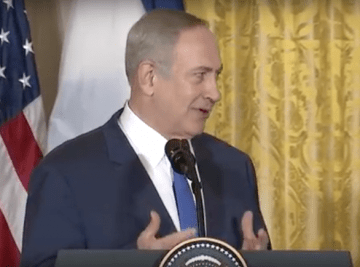
Israeli PM Benjamin Netanyahu making opening remarks at a joint White House press conference with President Donald Trump on Feb. 15, 2017. (Screenshot from White House video)
By Robert Parry | Consortium News | April 20, 2017
The other day, I asked a longtime Democratic Party insider who is working on the Russia-gate investigation which country interfered more in U.S. politics, Russia or Israel. Without a moment’s hesitation, he replied, “Israel, of course.”
Which underscores my concern about the hysteria raging across Official Washington about “Russian meddling” in the 2016 presidential campaign: There is no proportionality applied to the question of foreign interference in U.S. politics. If there were, we would have a far more substantive investigation of Israel-gate.
The problem is that if anyone mentions the truth about Israel’s clout, the person is immediately smeared as “anti-Semitic” and targeted by Israel’s extraordinarily sophisticated lobby and its many media/political allies for vilification and marginalization.
So, the open secret of Israeli influence is studiously ignored, even as presidential candidates prostrate themselves before the annual conference of the American Israel Public Affairs Committee. Hillary Clinton and Donald Trump both appeared before AIPAC in 2016, with Clinton promising to take the U.S.-Israeli relationship “to the next level” – whatever that meant – and Trump vowing not to “pander” and then pandering like crazy.
Congress is no different. It has given Israel’s controversial Prime Minister Benjamin Netanyahu a record-tying three invitations to address joint sessions of Congress (matching the number of times British Prime Minister Winston Churchill appeared). We then witnessed the Republicans and Democrats competing to see how often their members could bounce up and down and who could cheer Netanyahu the loudest, even when the Israeli prime minister was instructing the Congress to follow his position on Iran rather than President Obama’s.
Israeli officials and AIPAC also coordinate their strategies to maximize political influence, which is derived in large part by who gets the lobby’s largesse and who doesn’t. On the rare occasion when members of Congress step out of line – and take a stand that offends Israeli leaders – they can expect a well-funded opponent in their next race, a tactic that dates back decades.
Well-respected members, such as Rep. Paul Findley and Sen. Charles Percy (both Republicans from Illinois), were early victims of the Israeli lobby’s wrath when they opened channels of communication with the Palestine Liberation Organization in the cause of seeking peace. Findley was targeted and defeated in 1982; Percy in 1984.
Findley recounted his experience in a 1985 book, They Dare to Speak Out: People and Institutions Confront Israel’s Lobby, in which Findley called the lobby “the 700-pound gorilla in Washington.” The book was harshly criticized in a New York Times review by Adam Clymer, who called it “an angry, one-sided book that seems often to be little more than a stringing together of stray incidents.”
Enforced Silence
Since then, there have been fewer and fewer members of Congress or other American politicians who have dared to speak out, judging that – when it comes to the Israeli lobby – discretion is the better part of valor. Today, many U.S. pols grovel before the Israeli government seeking a sign of favor from Prime Minister Netanyahu, almost like Medieval kings courting the blessings of the Pope at the Vatican.
During the 2008 campaign, then-Sen. Barack Obama, whom Netanyahu viewed with suspicion, traveled to Israel to demonstrate sympathy for Israelis within rocket-range of Gaza while steering clear of showing much empathy for the Palestinians.
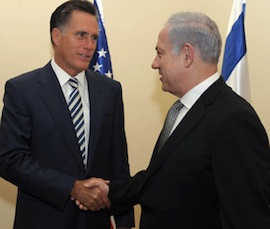
Mitt Romney and Benjamin Netanyahu
In 2012, Republican nominee Mitt Romney tried to exploit the tense Obama-Netanyahu relationship by stopping in Israel to win a tacit endorsement from Netanyahu. The 2016 campaign was no exception with both Clinton and Trump stressing their love of Israel in their appearances before AIPAC.
Money, of course, has become the lifeblood of American politics – and American supporters of Israel have been particularly strategic in how they have exploited that reality.
One of Israel’s most devoted advocates, casino magnate Sheldon Adelson, has poured millions of dollars in “dark money” into political candidates and groups that support Israel’s interests. Adelson, who has advocated dropping a nuclear bomb inside Iran to coerce its government, is a Trump favorite having donated a record $5 million to Trump’s inaugural celebration.
Of course, many Israel-connected political donations are much smaller but no less influential. A quarter century ago, I was told how an aide to a Democratic foreign policy chairman, who faced a surprisingly tough race after redistricting, turned to the head of AIPAC for help and, almost overnight, donations were pouring in from all over the country. The chairman was most thankful.
The October Surprise Mystery
Israel’s involvement in U.S. politics also can be covert. For instance, the evidence is now overwhelming that the Israeli government of right-wing Prime Minister Menachem Begin played a key role in helping Ronald Reagan’s campaign in 1980 strike a deal with Iran to frustrate President Jimmy Carter’s efforts to free 52 American hostages before Election Day.
Begin despised Carter for the Camp David Accords that forced Israel to give back the Sinai to Egypt. Begin also believed that Carter was too sympathetic to the Palestinians and – if he won a second term – would conspire with Egyptian President Anwar Sadat to impose a two-state solution on Israel.
Begin’s contempt for Carter was not even a secret. In a 1991 book, The Last Option, senior Israeli intelligence and foreign policy official David Kimche explained Begin’s motive for dreading Carter’s reelection. Kimche said Israeli officials had gotten wind of “collusion” between Carter and Sadat “to force Israel to abandon her refusal to withdraw from territories occupied in 1967, including Jerusalem, and to agree to the establishment of a Palestinian state.”
Kimche continued, “This plan prepared behind Israel’s back and without her knowledge must rank as a unique attempt in United States diplomatic history of short-changing a friend and ally by deceit and manipulation.”
But Begin recognized that the scheme required Carter winning a second term in 1980 when, Kimche wrote, “he would be free to compel Israel to accept a settlement of the Palestinian problem on his and Egyptian terms, without having to fear the backlash of the American Jewish lobby.”
In a 1992 memoir, Profits of War, former Israeli intelligence officer Ari Ben-Menashe also noted that Begin and other Likud leaders held Carter in contempt.
“Begin loathed Carter for the peace agreement forced upon him at Camp David,” Ben-Menashe wrote. “As Begin saw it, the agreement took away Sinai from Israel, did not create a comprehensive peace, and left the Palestinian issue hanging on Israel’s back.”
So, in order to buy time for Israel to “change the facts on the ground” by moving Jewish settlers into the West Bank, Begin felt Carter’s reelection had to be prevented. A different president also presumably would give Israel a freer hand to deal with problems on its northern border with Lebanon.
Ben-Menashe was among a couple of dozen government officials and intelligence operatives who described how Reagan’s campaign, mostly through future CIA Director William Casey and past CIA Director George H.W. Bush, struck a deal in 1980 with senior Iranians who got promises of arms via Israel in exchange for keeping the hostages through the election and thus humiliating Carter. (The hostages were finally released on Jan. 20, 1981, after Reagan was sworn in as President.)
Discrediting History
Though the evidence of the so-called October Surprise deal is far stronger than the current case for believing that Russia colluded with the Trump campaign, Official Washington and the mainstream U.S. media have refused to accept it, deeming it a “conspiracy theory.”
One of the reasons for the hostility directed against the 1980 case was the link to Israel, which did not want its hand in manipulating the election of a U.S. president to become an accepted part of American history. So, for instance, the Israeli government went to great lengths to discredit Ben-Menashe after he began to speak with reporters and to give testimony to the U.S. Congress.
When I was a Newsweek correspondent and first interviewed Ben-Menashe in 1990, the Israeli government initially insisted that he was an impostor, that he had no connection to Israeli intelligence.
However, when I obtained documentary evidence of Ben-Menashe’s work for a military intelligence unit, the Israelis admitted that they had lied but then insisted that he was just a low-level translator, a claim that was further contradicted by other documents showing that he had traveled widely around the world on missions to obtain weapons for the Israel-to-Iran arms pipeline.
Nevertheless, the Israeli government along with sympathetic American reporters and members of the U.S. Congress managed to shut down any serious investigation into the 1980 operation, which was, in effect, the prequel to Reagan’s Iran-Contra arms-for-hostages scandal of 1984-86. Thus, U.S. history was miswritten. [For more details, see Robert Parry’s America’s Stolen Narrative; Secrecy & Privilege; and Trick or Treason.]
Looking back over the history of U.S.-Israeli relations, it is clear that Israel exercised significant influence over U.S. presidents since its founding in 1948, but the rise of Israel’s right-wing Likud Party in the 1970s – led by former Jewish terrorists Menachem Begin and Yitzhak Shamir – marked a time when Israel shed any inhibitions about interfering directly in U.S. politics.
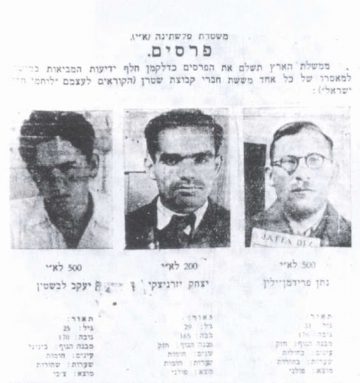
Wanted Poster of the Palestine Police Force offering rewards for the capture of Stern Gang terrorists: 1. Jaacov Levstein (Eliav), 2. Yitzhak Yezernitzky (Shamir), 3. Natan Friedman-Yelin
Much as Begin and Shamir engaged in terror attacks on British officials and Palestinian civilians during Israel’s founding era, the Likudniks who held power in 1980 believed that the Zionist cause trumped normal restraints on their actions. In other words, the ends justified the means.
In the 1980s, Israel also mounted spying operations aimed at the U.S. government, including those of intelligence analyst Jonathan Pollard, who fed highly sensitive documents to Israel and – after being caught and spending almost three decades in prison – was paroled and welcomed as a hero inside Israel.
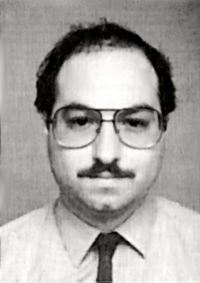
Convicted Israeli spy Jonathan Pollard in the photo from his U.S. Naval Intelligence ID
A History of Interference
But it is true that foreign interference in U.S. politics is as old as the American Republic. In the 1790s, French agents – working with the Jeffersonians – tried to rally Americans behind France’s cause in its conflict with Great Britain. In part to frustrate the French operation, the Federalists passed the Alien and Sedition Acts.
In the Twentieth Century, Great Britain undertook covert influence operations to ensure U.S. support in its conflicts with Germany, while German agents unsuccessfully sought the opposite.
So, the attempts by erstwhile allies and sometimes adversaries to move U.S. foreign policy in one direction or another is nothing new, and the U.S. government engages in similar operations in countries all over the world, both overtly and covertly.
It was the CIA’s job for decades to use propaganda and dirty tricks to ensure that pro-U.S. politicians were elected or put in power in Europe, Latin America, Asia and Africa, pretty much everywhere the U.S. government perceived some interest. After the U.S. intelligence scandals of the 1970s, however, some of that responsibility was passed to other organizations, such as the U.S.-funded National Endowment for Democracy (NED) and the U.S. Agency for International Development (USAID).
NED, USAID and various “non-governmental organizations” (NGOs) finance activists, journalists and other operatives to undermine political leaders who are deemed to be obstacles to U.S. foreign policy desires.
In particular, NED has been at the center of efforts to flip elections to U.S.-backed candidates, such as in Nicaragua in 1990, or to sponsor “color revolutions,” which typically organize around some color as the symbol for mass demonstrations. Ukraine – on Russia’s border – has been the target of two such operations, the Orange Revolution in 2004, which helped install anti-Russian President Viktor Yushchenko, and the Maidan ouster of elected pro-Russian President Viktor Yanukovych in 2014.
NED president Carl Gershman, a neoconservative who has run NED since its founding in 1983, openly declared that Ukraine was “the biggest prize” in September 2013 — just months before the Maidan protests — as well as calling it an important step toward ousting Russian President Vladimir Putin. In 2016, Gershman called directly for regime change in Russia.
The Neoconservatives
Another key issue related to Israeli influence inside the United States is the role of the neocons, a political movement that emerged in the 1970s as a number of hawkish Democrats migrated to the Republican Party as a home for more aggressive policies to protect Israel and take on the Soviet Union and Arab states.
In some European circles, the neocons are described as “Israel’s American agents,” which may somewhat overstate the direct linkage between Israel and the neocons although a central tenet of neocon thinking is that there must be no daylight between the U.S. and Israel. The neocons say U.S. politicians must stand shoulder to shoulder with Israel even if that means the Americans sidling up to the Israelis rather than any movement the other way.
Since the mid-1990s, American neocons have worked closely with Benjamin Netanyahu. Several prominent neocons (including former Assistant Defense Secretary Richard Perle, Douglas Feith, David Wurmser, Meyrav Wurmser and Robert Loewenberg) advised Netanyahu’s 1996 campaign and urged a new strategy for “securing the realm.” Essentially, the idea was to replace negotiations with the Palestinians and Arab states with “regime change” for governments that were viewed as troublesome to Israel, including Iraq and Syria.
By 1998, the Project for the New American Century (led by neocons William Kristol and Robert Kagan) was pressuring President Bill Clinton to invade Iraq, a plan that was finally put in motion in 2003 under President George W. Bush.
But the follow-on plans to go after Syria and Iran were delayed because the Iraq War turned into a bloody mess, killing some 4,500 American soldiers and hundreds of thousands of Iraqis. Bush could not turn to phase two until near the end of his presidency and then was frustrated by a U.S. intelligence estimate concluding that Iran was not working on a nuclear bomb (which was to be the pretext for a bombing campaign).
Bush also could pursue “regime change” in Syria only as a proxy effort of subversion, rather than a full-scale U.S. invasion. President Barack Obama escalated the Syrian proxy war in 2011 with the support of Israel and its strange-bedfellow allies in Saudi Arabia and the other Sunni-ruled Gulf States, which hated Syria’s government because it was allied with Shiite-ruled Iran — and Sunnis and Shiites have been enemies since the Seventh Century. Israel insists that the U.S. take the Sunni side, even if that puts the U.S. in bed with Al Qaeda.
But Obama dragged his heels on a larger U.S. military intervention in Syria and angered Netanyahu further by negotiating with Iran over its nuclear program rather than bomb-bomb-bombing Iran.
Showing the Love
Obama’s perceived half-hearted commitment to Israeli interests explained Romney’s campaign 2012 trip to seek Netanyahu’s blessings. Even after winning a second term, Obama sought to appease Netanyahu by undertaking a three-day trip to Israel in 2013 to show his love.
Still, in 2015, when Obama pressed ahead with the Iran nuclear agreement, Netanyahu went over the President’s head directly to Congress where he was warmly received, although the Israeli prime minister ultimately failed to sink the Iran deal.
In Campaign 2016, both Clinton and Trump wore their love for Israel on their sleeves, Clinton promising to take the relationship to “the next level” (a phrase that young couples often use when deciding to go from heavy petting to intercourse). Trump reminded AIPAC that he had a Jewish grandchild and vowed to move the U.S. Embassy from Tel Aviv to Jerusalem.
Both also bristled with hatred toward Iran, repeating the popular falsehood that “Iran is the principal source of terrorism” when it is Saudi Arabia and other Sunni sheikdoms that have been the financial and military supporters of Al Qaeda and Islamic State, the terror groups most threatening to Europe and the United States.
By contrast to Israel’s long history of playing games with U.S. politics, the Russian government stands accused of trying to undermine the U.S. political process recently by hacking into emails of the Democratic National Committee — revealing the DNC’s improper opposition to Sen. Bernie Sanders’s campaign — and of Clinton campaign chairman John Podesta — disclosing the contents of Clinton’s paid speeches to Wall Street and pay-to-play aspects of the Clinton Foundation — and sharing that information to the American people via WikiLeaks.
Although WikiLeaks denies getting the two batches of emails from the Russians, the U.S. intelligence community says it has high confidence in its conclusions about Russian meddling and the mainstream U.S. media treats the allegations as flat-fact.
The U.S. intelligence community also has accused the Russian government of raising doubts in the minds of Americans about their political system by having RT, the Russian-sponsored news network, hold debates for third-party candidates (who were excluded from the two-party Republican-Democratic debates) and by having RT report on protests such as Occupy Wall Street and issues such as “fracking.”
The major U.S. news media and Congress seem to agree that the only remaining question is whether evidence can be adduced showing that the Trump campaign colluded in this Russian operation. For that purpose, a number of people associated with the Trump campaign are to be hauled before Congress and made to testify on whether or not they are Russian agents.
Meanwhile, The Washington Post, The New York Times and other establishment-approved outlets are working with major technology companies on how to marginalize independent news sources and to purge “Russian propaganda” (often conflated with “fake news”) from the Internet.
It seems that no extreme is too extreme to protect the American people from the insidious Russians and their Russia-gate schemes to sow doubt about the U.S. political process. But God forbid if anyone were to suggest an investigation of Israel-gate.
Investigative reporter Robert Parry broke many of the Iran-Contra stories for The Associated Press and Newsweek in the 1980s.
Twitter, pressured by Jewish group, cleansing internet of anti-Netanyahu material
My letter to Twitter legal department

By Kevin Barrett | Veterans Today | April 13, 2017
Twitter has asked me to remove the above tweet, due to a complaint from the leading French Jewish group, the Representative Council of French Jewish Institutions (CRIF). Below is a copy of my email correspondence with the Twitter Legal Department.
Dear Twitter,
I most certainly am not going to remove this content. It consists of a brilliant, incisive work of art by David Dees, who is widely viewed as one of the two or three most important (and most-viewed) political artists working today. I am copying him on this email.

The art work in question is a passionate protest against the brutal abuse of the human rights of Palestinians by the war criminal leader of Israel, Netanyahu. Many thousands of innocent Palestinian civilians have been slaughtered in repeated assaults on Gaza by the Netanyahu regime, which routinely drops white phosphorus on civilian targets, bombs ambulances, schools, hospitals, refugee shelters and UN humanitarian installations, and refers to these regular massacres of thousands of innocents as routine “mowing the lawn.”
These and other atrocities are committed in order to ethnically cleanse Palestine and purify it as a “Jewish State.” So Dees’ use of the Israeli flag with the Star of David, and the images of rabbis, is entirely appropriate in context, as is the use of the US flag symbolizing US complicity in these crimes. (I am copying Naturei Karta International, a group of anti-Zionist Jews led by my colleague Rabbi Weiss, and will happily take down the content if the Rabbi thinks it is bigoted or inappropriate.) Calling out Jewish-Zionist and American oppressors does not amount to bigotry against Zionist Jews or Americans. Both of these two human groups are powerful in relation to other groups, and both are using their power to horrifically oppress the relatively powerless people of Palestine.
There is no bigotry in siding with the powerless against the powerful. The concept of bigotry is only meaningful in relation to prejudices against relatively powerless, oppressed groups, not powerful oppressing ones. If you start censoring people for “prejudice against the powerful” where will it end? Will we be prohibited from mocking, deriding, deploring, and otherwise verbally and artistically attacking rich people, politicians, CEOs, dictators, ruling classes, celebrities, bullies, and other powerful and privileged individuals and groups?
I will be happy to discuss these issues with representatives from Twitter and/or CRIF, am available between 8 a.m. and 8 p.m. US Central, and eagerly await your call. I speak fluent French and would love to speak with a CRIF representative en français.
Sincerely,
Dr. Kevin Barrett
(phone number redacted)
On Apr 13, 2017, at 5:26 PM, Twitter Legal <twitter-legal@twitter.com> wrote:
Dear Twitter user,We are writing to inform you that Twitter has received correspondence from the Representative Council of French Jewish Institutions (CRIF), regarding your Twitter account, @truthjihad, specifically:
https://twitter.com/truthjihad/status/831876287245463553
One of our core values is to defend and respect the user’s voice. Accordingly, it is our standard policy to notify users upon receipt of a request to remove content from their account.
We are notifying you of this request about your account so that you may decide whether or how you will respond. Please let us know (by replying directly to this email) whether you will remove the reported content. Please note that we may be obligated to take action regarding the content identified in the request in the future.
For more information on our Country Withheld Content policy please see this page: https://support.twitter.com/articles/20169222
If you believe we have contacted you in error, please reply to this email and let us know.
Twitter is not able to provide legal advice. You may wish to consult legal counsel about this matter. For more general information on legal requests, please refer to the following Help Center article: https://t.co/lrfaq.Sincerely,
============
Reported Username: @truthjihad
Reporter Username: @Le_CRIF
Reporter Email: [Redacted]
Reported URL:
https://twitter.com/truthjihad/status/831876287245463553
CIA and FBI admit that Wikileaks Vault 7 NOT done by Russia, but inside job
By Alex Christoforou | The Duran | April 20, 2017
In the never ending narrative as to who is telling the truth, the various US intelligence agencies or Wikileaks, it appears that Wikileaks is the honest actor… indirectly confirmed by US intelligence agencies.
With the release of Vault 7, WikiLeaks was careful to note that the treasure trove of CIA information came to them from former contractors who worked for US intelligence.
Zerohedge reports that once again “WikiLeaks’ facts were facts and CIA/FBI facts were fake.”
Having exclaimed that WikiLeaks is “a non-state hostile intelligence service often abetted by state actors like Russia,” laying the blame for every embarrassing leak at Moscow’s footsteps, the FBI and CIA have admitted that they are searching for an “insider” (not a Russian) who exposed thousands of top-secret documents that described CIA tools used to penetrate smartphones, smart televisions and computer systems.
CBS News reports that a manhunt is underway for a traitor inside the CIA…
Sources familiar with the investigation say it is looking for an insider — either a CIA employee or contractor — who had physical access to the material. The agency has not said publicly when the material was taken or how it was stolen.
Much of the material was classified and stored in a highly secure section of the intelligence agency, but sources say hundreds of people would have had access to the material. Investigators are going through those names.
The trove was published in March by the anti-secrecy organization WikiLeaks.
This is yet another big dent in the “Russia hacker” narrative peddled out by the liberal left nearly 8 months ago.
Claims Russia’s Strategic Studies Institute Meddled in US Elections ‘Baseless’
Sputnik – 20.04.2017
MOSCOW – Accusations against the Russian Institute for Strategic Studies (RISS) of election interference in the United States are unfounded, Russian Senator Oleg Morozov told Sputnik on Thursday.
“This is an attempt to give away normal analytical work as subversive activity. An absolutely worthless story in terms of logic that has no basis in reality,” Morozov said.
Morozov went on to point out that dozens of similar think tanks operate in Europe and the United States and analyze the political situation, which, according to the senator, is not considered to be interference in the election process.
His comments came a day after the Reuters news service cited three current and four former US officials alleging that RISS circulated two “confidential documents” ahead of the November 2016 vote. The June and October documents were described as a “plan to swing” the US presidential election. US intelligence officials were said to have acquired the RISS-drafted documents.
According to the media outlet, the first document allegedly recommended that the Kremlin initiate a propaganda campaign on social media, and that Russia’s state-run media persuade US citizens to vote for a candidate less critical to Russia than former US President Barack Obama.
The second document reportedly said that Democratic presidential candidate Hillary Clinton had greater chances to win the election. As such, the paper allegedly called on the Kremlin to change the course of the campaign and intensify the information flow to undermine the US electoral system’s legitimacy and damage Clinton’s image and reputation, the media outlet reported citing US officials.
According to the publication, the Obama administration’s conclusion that Russia meddled in the election process and accusations of cyber attacks against Clinton’s campaign staff were mainly based on these documents.
On March 20, Federal Bureau of Investigation (FBI) Director James Comey confirmed that the institution was conducting a probe into Russia’s alleged interference in the 2016 US presidential elections.
Russian officials have repeatedly denied Washington’s accusations. Kremlin spokesman Dmitry Peskov refuted any allegations about Russia’s alleged involvement in US election process and said that Russia did not cooperate with US President Donald Trump’s staff during the election campaign.
Russia questions watchdog’s swift identification of sarin in Syria chemical incident
RT | April 20, 2017
The Russian military has questioned the swift conclusion of chemical weapons watchdog the OPCW, which has reported identifying sarin in samples related to an alleged attack in Syria on April 5.
The Executive Council of the Organization for the Prohibition of Chemical Weapons (OPCW) convened in the Hague on Wednesday for an update on the investigation into the reported chemical weapons attack in the town of Khan Shaykhun.
Director-General Ahmet Üzümcü told members that four OPCW designated laboratories have studied samples collected from three victims of the alleged attack during their autopsy and seven individuals undergoing treatment after surviving the incident. He said analysis of all samples indicated exposure to sarin or a sarin-like substance.
“While further details of the laboratory analyses will follow, the analytical results already obtained are incontrovertible,” the official said.
The OPCW statement didn’t explain how exactly the samples were collected. The inspectors have yet to visit Khan Shaykhun, which would allow the collection of samples on the ground to confirm contamination from a chemical agent. The site is located in a rebel-controlled territory in the Idlib province. Üzümcü said such a visit would depend on the security situation and cited an attack on an OPCW fact-finding mission in May 2014.
The Russian military, however, questioned the swift analysis of the samples, saying the OPCW did not act with such speed in another incident in which a militant group reportedly used mustard gas in Aleppo.
“Russian specialists on the site of the crime [in Aleppo] collected samples of the agent, which had been delivered to representatives of the OPCW and transported to the Hague. By the way, the Syrian leadership at the time offered safety guarantees and insisted that OPCW experts visit Aleppo, but nobody came,” Russian Defense Ministry spokesman Maj. Gen. Igor Konashenkov said Thursday.
“Four months later the OPCW still cannot come to a conclusion and call the mustard gas found there mustard gas, saying additional analysis is necessary,” he remarked.
The Russian military said it wanted details on who collected the samples and how they were studied at OPCW designated labs, and why the analysis in this case was completed in a much shorter space of time.
He added that if the OPCW states that sarin gas had been used in the incident, it would find it difficult to explain how White Helmet first responders survived exposure to the agent.
Footage taken at the scene in the aftermath of the alleged attack showed people from the controversial rescue group helping the victims while wearing no protective gear rated for handling sarin.
The OPCW is expected to provide a preliminary report on the incident within two weeks.
The incident in Khan Shaykhun reportedly killed as many as 100 people and injured several hundred. The US squarely laid the blame on Damascus, claiming that it hid chemical weapons stockpiles from the OPCW after pledging to hand them over in 2013.
Washington fired a barrage of cruise missiles at the Syrian airbase from which it claimed the chemical weapons attack was launched – a move that was hailed by Syria’s neighbor Israel. Europe backs the accusations against the Syrian government, even though no solid evidence has been made public.
Russia has called for a thorough investigation of the incident, which would include an on-site inspection in the rebel-held territory, before coming to any conclusions. Moscow believes that the incident may have been a false flag operation meant to provoke a US attack against Damascus.
Read more:
Russia questions Britain’s chemical weapons investigation in Syria
US Complaints Over Implementation of Nuclear Deal With Iran Irrelevant – Moscow

© Sputnik/ Andrey Stenin
Sputnik – April 20, 2017
US complaints over how the nuclear deal on Iran is being implemented are irrelevant, the head of the Russian Foreign Ministry’s Department for Non-Proliferation and Arms Control, Mikhail Ulyanov, said Thursday.
On April 19, US President Donald Trump ordered a National Security Council-led interagency review of the JCPOA to evaluate Iran’s compliance with the deal, with US State Secretary Rex Tillerson stating that the nuclear deal “fails to achieve the objective of non-nuclear Iran.” Tehran, in its turn, stressed that the deal was an international treaty and cannot be changed, adding that Iran was fulfilling its obligations under the JCPOA.
“If the deal does not work, then specific complaints should be made regarding its functioning. The Americans cannot do this. The IAEA, an independent participant in this process, confirms that the Iranians are implementing everything. Therefore, any claims are irrelevant here, it seems to me,” Ulyanov said.
Ulyanov noted that it was necessary for Tillerson to separate the notions of terrorism and the nuclear deal, which have nothing in common.
The JCPOA was signed by Iran and the P5+1 countries — China, France, Russia, the United Kingdom and the United States plus Germany in July 2015, ensuring the peaceful nature of the Iranian nuclear program in return for the gradual lifting of sanctions against Tehran. The deal came into force on January 16, 2016, after the International Atomic Energy Agency (IAEA) confirmed that Iran was ready to implement the program to reduce its nuclear potential. However, the United States imposed new sanctions against Iran in February 2017 after a medium-range ballistic missile test has been carried out by Tehran in late January.
Le Pen on Idlib: Placing Blame Before Inquiry ‘Blows Chances to Know the Truth’
Sputnik – April 20, 2017
PARIS – The UN Security Council (UNSC) resolution on the alleged chemical attack in Syria’s Idlib province should not blame any one party without first allowing an official investigation into the incident to be completed, France’s far-right presidential hopeful Marine Le Pen said Thursday.
On April 4, dozens of people were reportedly killed in the chemical incident in Idlib. Paris, Washington and London submitted a UNSC draft resolution condemning the alleged attack. Russia vetoed the document on April 12, pointing out that the draft implicated the Syrian authorities as the party to blame for the incident, despite no proper investigation was conducted.
“The resolution has been prepared in such a way that the responsibility was put on [Syrian President] Bashar Assad even before an investigation… It is necessary to hold an international inquiry [into the Idlib incident], and if I were in the UNSC, I would vote for such an investigation, but not for apportioning the blame even before the beginning of the inquiry, because it is the best way to blow the chances to know the truth,” Le Pen told the Europe 1 broadcaster.
After vetoing the resolution, Russia’s Deputy UN Ambassador Vladimir Safronkov said that Russia’s own draft resolution on the alleged attack would request on-site investigations from the Organization for the Prohibition of Chemical Weapons (OPCW) to ensure that “all possible sources and means have been exhausted” before making final conclusions.
On Wednesday, Russian Foreign Minister Sergei Lavrov called the chemical weapons incident in the Syrian province of Idlib a provocation as well as an attempt to undermine the ceasefire in the country. The incident was used as pretext for a US missile strike against the Ash Sha’irat airbase carried out late on April 6. US President Donald Trump characterized the strike as a response to the alleged use of chemical weapons by the Syrian government troops while Lavrov said it was a violation of the international law. Iranian Supreme Leader Ayatollah Ali Khamenei described the US missile strike against the Syrian airfield as a strategic mistake.
No Serious Steps Taken to Probe Khan Sheikoun Incident: Russian Foreign Minister
Al-Manar | April 20, 2017
Russia said no serious steps have been taken to investigate into the alleged chemical attack in Syria’s Khan Sheikhoun.
“Reports (about the alleged chemical attack in Khan Shaykhun) started coming 15 days ago but no steps have yet been taken in order to investigate into this incident,” Director of the Armaments Non-Proliferation and Control Department at the Russian Foreign Ministry Mikhail Ulyanov said on Wednesday.
He was addressing the special session of the Organization for the Prohibition of Chemical Weapons (OPCW), held in The Hague, Russia’s foreign ministry’s posted on its website on Thursday, according to TASS Russian news agency.
Ulyanov pointed out that all accusations against Damascus of using chemical weapons were groundless as they were based only on questionable data available on social media.
At the same time, according to the Russian diplomat, representatives of some countries are acting as if the circumstances surrounding the incident, as well as those responsible, have already been established.
“In this regard, British Foreign Secretary Boris Johnson’s article for the Telegraph is notable in which he said that ‘this was highly likely to be an attack by Assad.’ It means that the British Foreign Secretary is not completely sure. Then why do our British counterparts make such unequivocal statements on the international level?” Ulyanov said.
Meanwhile, he slammed Washington over its claims to be absolutely certain it was Damascus who was to blame.
“This is what our US counterparts call a bad case of deja vu. We heard them say the same things 14 years ago, ahead of the military invasion in Iraq,” the Russian diplomat noted.
On the other hand, Ulyanov voiced Russia’s readiness for consultations with the US before the OPCW vote on proposals on the incident.
“Before putting a draft up for vote, all possibilities for reaching a consensus should be exhausted,” Ulyanov said.
“We are ready for immediate intensive consultations for that purpose, including with the US delegation,” he added.
“If our US partners are indeed interested in establishing the truth by carrying out a serious and prompt investigation, we have chances to reach an agreement,” the diplomat said. “If not, there is almost no room to search for mutually acceptable solutions.”
Why Hillary Clinton Really Lost
By Robert Parry | Consortium News | April 19, 2017
An early insider account of Hillary Clinton’s presidential campaign, entitled Shattered, reveals a paranoid presidential candidate who couldn’t articulate why she wanted to be President and who oversaw an overconfident and dysfunctional operation that failed to project a positive message or appeal to key voting groups.
Okay, I realize that people who have been watching Rachel Maddow and other MSNBC programs – as well as reading The New York Times and The Washington Post for the past four months – “know” that Clinton ran a brilliant campaign that was only derailed because of “Russian meddling.” But this insider account from reporters Jonathan Allen and Annie Parnes describes something else.
As The Wall Street Journal review notes, the book “narrates the petty bickering, foolish reasoning and sheer arrogance of a campaign that was never the sure thing that its leader and top staffers assumed. … Mr. Allen and Ms. Parnes stress two essential failures of the campaign, the first structural, the second political. The campaign’s structure, the authors write, was an ‘unholy mess, fraught with tangled lines of authority, petty jealousies, and no sense of greater purpose.’”
The book portrays Hillary Clinton as distant from her campaign staff, accessible primarily through her close aide, Huma Abedin, and thus creating warring factions within her bloated operation.
According to the Journal’s review by Barton Swaim, the book’s authors suggest that this chaos resulted from “the fact that Mrs. Clinton didn’t know why she wanted to be president. At one point no fewer than 10 senior aides were working on her campaign announcement speech, not one had a clear understanding of why Americans should cast their vote for Mrs. Clinton and not someone else. The speech, when she finally delivered it, was a flop – aimless, boring, devoid of much beyond bromides.”
The book cites a second reason for Clinton’s dismal performance – her team’s reliance on analytics rather than on reaching out to real voters and their concerns.
There is also an interesting tidbit regarding Clinton’s attitude toward the privacy of her staff’s emails. “After losing to Mr. Obama in the protracted 2008 primary,” the Journal’s review says, Clinton “was convinced that she had lost because some staffers – she wasn’t sure who – had been disloyal. So she ‘instructed a trusted aide to access the campaign’s server and download the [email] messages sent and received by top staffers.’”
Nixonian Paranoia
In other words, Clinton – in some Nixonian fit of paranoia – violated the privacy of her senior advisers in her own mole hunt, a revelation that reflects on her own self-described “mistake” to funnel her emails as Secretary of State through a private server rather than a government one. As the Journal’s review puts it: “she didn’t want anyone reading her emails the way she was reading those of her 2008 staffers.”
But there is even a greater irony in this revelation because of the current complaint from Clinton and her die-hard supporters that Russia sabotaged her campaign by releasing emails via WikiLeaks from the DNC, which described how party leaders had torpedoed the campaign of Clinton’s rival for the nomination, Sen. Bernie Sanders, and other emails from her campaign chairman John Podesta, revealing the contents of Clinton’s paid speeches to Wall Street banks and some pay-to-play features of the Clinton Foundation.
WikiLeaks has denied that it received the emails from Russia – and President Obama’s outgoing intelligence chiefs presented no real evidence to support the allegations – but the conspiracy theory of the Trump campaign somehow colluding with the Russians to sink Clinton has become a groupthink among many Democrats as well as the mainstream U.S. media.
So, rather than conducting a serious autopsy on how Clinton and the national Democratic Party kicked away a winnable election against the buffoonish Donald Trump, national Democrats have created a Zombie explanation for their failures, blaming their stunning defeat on the Russians.
This hysteria over Russia-gate has consumed the first several months of the Trump presidency – badgering the Trump administration into a more belligerent posture toward nuclear-armed Russia – but leaving little incentive for the Democrats to assess what they need to do to appeal to working-class voters who chose Trump’s empty-headed populism over Clinton’s cold-hearted calculations.
The current conventional wisdom among the mainstream media, many Democrats and even some progressives is that the only way to explain the victory by pussy-grabbing Trump is to complain about an intervention by the evil Russians. Maybe Maddow and the other Russia-did-it conspiracy theorists will now denounce Shattered as just one more example of “Russian disinformation.”
The Times’ View
The New York Times’ review by Michiko Kakutani also notes how Shattered details Clinton’s dysfunction, but the newspaper inserted a phrase about “Russian meddling,” presumably to avoid a head-exploding cognitive dissonance among its readers who have been inundated over the past four months by the Times’ obsession on Russia! Russia! Russia!
However, the Times’ review still focuses on the book’s larger message: “In fact, the portrait of the Clinton campaign that emerges from these pages is that of a Titanic-like disaster: an epic fail made up of a series of perverse and often avoidable missteps by an out-of-touch candidate and her strife-ridden staff that turned ‘a winnable race’ into ‘another iceberg-seeking campaign ship.’
“It’s the story of a wildly dysfunctional and ‘spirit-crushing’ campaign that embraced a flawed strategy (based on flawed data) and that failed, repeatedly, to correct course. A passive-aggressive campaign that neglected to act on warning flares sent up by Democratic operatives on the ground in crucial swing states, and that ignored the advice of the candidate’s husband, former President Bill Clinton, and other Democratic Party elders, who argued that the campaign needed to work harder to persuade undecided and ambivalent voters (like working-class whites and millennials), instead of focusing so insistently on turning out core supporters.”
So, perhaps this new book about how Hillary Clinton really lost Campaign 2016 will enable national Democrats to finally start charting a course correction before the party slams another Titanic-style campaign into another iceberg.
Investigative reporter Robert Parry broke many of the Iran-Contra stories for The Associated Press and Newsweek in the 1980s.
Why the Democrats are Dead: DeLauro Says No to Single-Payer
By Russell Mokhiber | CounterPunch | April 19, 2017
If you want to know why the Democratic Party is dead, dead, dead, look no further than Congresswoman Rosa DeLauro (D-Connecticut).
She’s a member of the House Progressive Caucus, which as a group has endorsed HR 676, the single payer bill in the House.
A cool one hundred of DeLauro’s colleagues have co-sponsored HR 676, including a blue dog from Tennessee (Jim Cooper) and a member from Mississippi (Bennie Thompson) (See Single Payer Action’s running total.)
But not DeLauro.
We asked why, but her office did not respond.
DeLauro’s legislative aides have told constituents recently DeLauro would vote for single payer if it came to the floor.
But pushing single payer now is a diversion.
The imperative is to defend Obamacare from the Republican onslaught.
One DeLauro aide told a constituent that when he hears from constituents “Obamacare sucks, we need single payer — it shows they don’t understand the reality in DC that we cannot get a single payer bill even to a vote with the current makeup of Congress and we have to spend all our energy and focus defending what we have.”
But the same aides have said that HR 676 is not good enough — that it lets the Veterans Administration stand and therefore is not true single payer — signaling that she’s for a tougher single payer bill.
“Democrats who, like Rosa DeLauro, support the Affordable Care Act are out of touch with the fact that the ACA can’t be fixed, that the only way to solve our healthcare crisis is to get rid of private insurers and create a single publicly-financed plan such as national improved Medicare for All and that the majority of Democratic Party voters and the public in general support Medicare for All,” said Dr. Margaret Flowers of Health Over Profit.
“We recognize that Medicare for All is off the table no matter which of the major corporate parties is in power and that it will take an organized movement of movements to put it on the table and pass it. We cannot wait any longer for a real solution to the healthcare crisis. Every day, people across the country are suffering and dying from lack of access to necessary care. This is the most important reality — that people are suffering and dying needlessly in the richest country in the world because members of Congress are more concerned with politics than with doing the right thing.”
DeLauro supported Hillary Clinton in the 2016 primary battle against Bernie Sanders.
Single payer fueled Sanders’ run through the primaries, but now Sanders is traveling the country with Democratic National Committee Chair and Clinton supporter Tom Perez on a “come together and fight back tour.”
In a joint statement announcing the tour, Sanders and Perez say they will speak out on minimum wage, climate change, infrastructure spending, immigration, tax reform — nothing about single payer.
(Sanders’ aides, who last year took DeLauro’s line and said that single payer was a diversion from defending Obamacare, now say that Sanders will introduce a single payer bill in the Senate sometime soon.)
The reason the 100 members of the House have co-sponsored HR 676 is because at every town hall meeting, single payer is the driving force.
DeLauro too is hearing it from her constituents in Connecticut.
But DeLauro and the four other members of the House from Connecticut — all Democrats– John Larson, Jim Himes, Joe Courtney and Elizabeth Esty — have yet to relent.
Not yet, Connecticut.
Russell Mokhiber is the editor of the Corporate Crime Reporter.
Featured Video

The Most Important Bet You’ve Never Heard Of
or go to
Aletho News Archives – Video-Images
From the Archives
The Occupied Mentality Syndrome
Saudi Arabia on the American chessboard – Part 2
By B. J. Sabri | American Herald Tribune | April 19, 2016
Since the Korean War, but particularly since the Iranian Revolution of 1979 until today, the United States has been steadily escalating its military presence in the Persian Gulf. Taking advantage of many colossal events of the past 36 years, [1] the hyper-empire has institutionalized its massive presence on land and sea, and expanded its objectives to include the unambiguous physical control of the area, as well as the clear understanding that local Arab governments should abide by them. The pretext is always the same: in “defense” of the national interests and security of the United States. From observing how the United States has been interacting with the governments of the region, and by judging from the size of its expeditionary force, we could reach a basic conclusion. The United States is occupying, de facto, the entire Arabian Peninsula. (Yemen, devastated by Saudi and American jets is yet to be conquered. Oman? Britain returned not as colonial ruler but as a soft occupying power.)
Under this articulation, Saudi Arabia, Qatar, Kuwait, and the United Arab Emirates are virtually occupied countries. If we compare this type of occupation to the mandate and protectorate regimes of the past, the results might be identical—the nations affected by it lose sovereignty. When Arab governments comply with the objectives of a foreign power that station military forces on their national milieu, then that power controls them in multiple ways including how they react to policy deliberations and what decisions they intend to take on specific issues. A good method to verify the concept of effective occupation is this: take notice of what the United States says and wants, and then compare it to what the gulf rulers do in response. (I shall discuss this detail at some point in the upcoming parts.)
If the presence of US forces or other means of political pressure are a factor in Saudi Arabia’s interventionist Arab wars, then we need to debate this issue. However, from the history of resistance to colonialism, we learnt: if a powerful state imposes its order on a nation by military means or other forms of coercion, and if this nation does not resist that imposition, then a mental subordination to the powerful state will ensue. This is especially true in the case of Saudi Arabia. One single event, 9/11, has transformed it from a US “ally” into an instant political hostage of the American Empire. … continue
Blog Roll
 Aletho News
- Official reveals evidence of Arab states’ involvement in US-Israeli war on Iran
- His Majesty’s head-chopper: Syria’s MI6-backed president bows to King Charles
- Forced to backtrack: ‘Israel’ drops Hezbollah disarmament goal
- Britain’s Lebanon surveillance network: A digital map for war
- Bahrain faces scrutiny for opposition crackdown after detainee killed
- Hegseth’s Pentagon Purge Designed to Prevent a Mutiny: Karen Kwiatkowski
- Greek shipping firms secretly transporting oil, weapons to Israel
- UN vote on Hormuz force delayed as Iran issues warning
- Trump and the debris of Iran war
- IRGC hits US tech giant Oracle’s data center, computing site in UAE over new assassinations
- If Americans Knew
- Israel-US kill negotiators, destroy civilian structures, but Iran’s military capabilities still largely intact – Daily Update
- ‘War crime’: Global condemnation as Israeli ministers celebrate death penalty law targeting Palestinian prisoners
- 7 Ways Israel Is Turning Lebanon Into Gaza
- World’s Leading Football Bodies Under Fire Over Israel Policies
- Experts warn of possible use of nukes against Iran
- Israeli invasion of Lebanon could be worse than 1982, warn European officials
- Passover: Liberation and collective punishment
- Trump says the quiet part out loud: (Israel’s) war on Iran > Americans’ health – Daily Update
- Gaza families reunite years after babies evacuated amid Israel’s war
- International Rescue Committee warns Gaza’s children face grave protection risks
- No Tricks Zone
- Low Intensity Tornado Wrecks Major Solar Farm, Creating A Potential Toxic Dump
- New Study Finds Warming Saves Lives…Cold Temperatures 12 Times More Deadly Than Excess Heat
- German Science Blog Accuses PIK Climate Institute Of Hallucinating Climate Tipping Points
- Devastating Assessment Of Comirnaty Vaccine By Former Senior Pfizer Europe Toxicologist
- New Study: CO2 Is ‘Effectively Negligible’ As An Explanatory Climate Change Factor Since 2000
- Former Pfizer Toxicologist Dr. Helmut Sterz Tells Bundestag Hearing Pfizer Vaccine Should Have Never Been Approved
- Energy Expert: Germany’s Nuclear Phaseout Was A “500 Billion Euro Mistake”
- New Research: South Australia’s Mid-Holocene Sea Surface Temperatures Were 4°C Warmer Than Today
- Storing Green Energy To Last Germany 10 Days Would Require A 60-Million Tonne Battery
- New Studies: UK Sea Levels Were 4 Meters Higher Than Today During The Mid-Holocene
 Aletho News