Rwanda’s tragedy used to fool people, slander others
By Yves Engler · June 2, 2017
Rwanda’s tragedy has been exploited for many purposes. Add slandering a pro-Palestinian activist to the list.
Since I wrote this article about the Jewish Defense League last month, Toronto’s Alex Hundert has repeatedly labeled me anti-Semitic. The self-declared “anti-fascist” tweeted at Pacific Free Press, Rabble, the NDP and others to “cut ties” with me.
In response to this article the former Upper Canada College student harangued at least one prominent woman for posting it on her Facebook page. Hundert told her — wait for it — I’m anti-Semitic. Lacking in evidence or maybe sensing diminishing returns with that smear he added that I’m a Rwandan genocide denier.
If he means a researcher and writer on foreign affairs who always questions official government narratives/propaganda then I guess a “no contest” plea would be appropriate. The common portrayal of the Rwandan Genocide in Canada omits important context and is factually incorrect in substantial ways. It is also logically hollow, only believable because of widespread racism and anti-Africanism. (According to the most outlandish aspect of the official story, Hutu extremists murdered the Hutu presidents of Rwanda and Burundi and much of the Hutu-led Rwandan military command, which brought the Hutu to their weakest point in three decades, and then decided to begin a long planned systematic extermination of Tutsi.)
Do I believe hundreds of thousands of Rwandan Tutsi were slaughtered in mid-1994? Yes, definitely.
Was there a long planned high-level effort to wipe out all Tutsi? Probably not.
Were tens, possibly hundreds, of thousands of Hutu also slaughtered in mid-1994? It’s likely.
Was Paul Kagame, the person widely hailed for ending the killing, instead the individual most responsible for the mass slaughter? Probably, since his forces invaded Rwanda from Uganda, engaged in a great deal of killing and blew up the presidential plane that unleashed the genocidal violence.
It’s telling Hundert would seek to smear me as a Rwanda genocide denier, rather than criticize my other controversial views such as that the private automobile should be eliminated, or that former Prime Minister Lester Pearson was a war criminal or that Canadian peacekeeping is often a form of imperialism. Maybe it’s because the label “genocide denier” hints at some type of hatred rather than a political disagreement. Or maybe Hundert hopes to associate me with Nazi Holocaust denial, which we’ll see more about below.
Fundamentally Hundert chose the issue because most Canadians know little about Rwanda and, to the extent they know anything about the country, they’ve heard an extremely one-sided media account of the complex tragedy that engulfed Rwanda and Burundi in the mid-1990s. News consumers are generally familiar with a Rwanda fairy tale focused on a white Canadian saviour. According to serial Kagame-Rwanda propaganda spreader Gerald Caplan, “the personal relationship so many Canadians feel with Rwanda can be explained in two words: Roméo Dallaire.” In a forthcoming book about left Canadian foreign policy I detail how, in their haste to laud a Canadian military “hero”, progressives have echoed a highly simplistic version of Rwanda’s tragedy, which has legitimated Africa’s most blood-stained dictator, Paul Kagame.
Beyond aligning with liberal Canadian foreign policy mythology, Hundert is tapping into the US Empire’s narrative. Washington and London’s support for the Uganda backed Rwandan Patriotic Front (RPF), as well as Kagame’s more than two-decade long rule in Kigali, explains the dominance of the Rwandan Genocide story. According to Edward Herman and David Peterson in Enduring Lies: The Rwandan Genocide in the Propaganda System, 20 Year Later, “[US and British] support, combined with the public’s and the media’s distance from and unfamiliarity with central African affairs, made the construction and dissemination of false propaganda on Rwanda very easy.”
After the Cold War, Washington viewed Kagame’s RPF as an imperial proxy force in a French-dominated region. A trio of authors explain in The Congo: Plunder and Resistance: “The plan expressed clearly by the White House at the time was to use the Rwandan army as an instrument of American interests. One American analyst explained how Rwanda could be as important to the USA in Africa as Israel has been in the Middle East.” Over the past two decades Kagame has repeatedly invaded the Congo, which has as much as $24 trillion in mineral riches.
Alongside his role as a US client, Kagame has drawn close to Israel. Trained at the US Army Command and General Staff College in Fort Leavenworth, Kansas, Kagame visited Israel for the first time in 1996 and Africa’s most bloodstained dictator has been back repeatedly. In March Kagame was the only international head of state and first-ever African leader to speak at the American Israel Public Affairs Committee’s (AIPAC) annual conference. On May 21 Kagame received the Dr. Miriam and Sheldon G. Adelson Prize for Outstanding Friendship with the Jewish People at a New York event with Israeli ambassador Ron Dermer and Alan Dershowitz. In 2013 the “butcher ofAfrica’s Great Lakes” shared a New York stage with staunch Zionists Elie Wiesel, Rabbi Shmuley Boteach and Republican mega-donor Sheldon Adelson.
“He is the only living man to stop a genocide,” said Boteach to the Jewish Forward in 2014. “You need to look at the criticism on Rwanda through the same lens you look at criticism against Israel.” (After National Security Adviser Susan Rice criticized Israeli Prime Minister Benjamin Netanyahu for speaking to Congress about the Iran nuclear agreement without President Obama’s approval, Boteach placed an ad in the New York Times which read “Susan Rice has a blind spot: Genocide … both the Jewish people’s and Rwanda’s”.)
Pro-Israel Jewish groups have bequeathed Kagame the genocide moniker. Author of Rwanda and the New Scramble for Africa: From Tragedy to Useful Imperial Fiction, Robin Philpot explains that long-time director of the Simon Wiesenthal Center in Israel, Efraim Zuro, and former US Holocaust Memorial Museum project director, Michael Berenbaum, were invited to a conference in Kigali a year after the mass slaughter in Rwanda. Philpot notes, “Efraim Zuro then became an advisor to the Rwandan government in its hunt for génocidaires, and from then on Zionists throughout the world were willing to share the use of the term ‘genocide’ with Rwandan Tutsis. Israel has very jealously guarded the use of that term; they have, for example, never agreed to share it with Armenians, largely because of Israel’s strategic alliance with Turkey.”
But, those who draw an analogy between the 6 million killed in the Shoah and the hundreds of thousands slaughtered in Rwanda are partaking in something akin to Nazi Holocaust denial (or extreme minimization). European Jews were targeted because of their religion/ethnicity, the violence was state organized and it mostly flowed from an ideology promoted from above.
The context in Rwanda was different. Speaking the same language, sharing the same culture and practising the same religion, the Tutsi/Hutu divide is historically a caste-type distinction the Belgians racialized. “Prior to colonization,” explains Ann Garrison, “the Tutsi were a cattle owning, feudal ruling class, the Hutu a subservient peasant class. Belgian colonists reified this divide by issuing ID cards that labeled Rwandans and Burundians as Hutu, Tutsi, or Twa [1% of the population].”
The genocidal killings were not a long planned attempt to exterminate all Tutsi, which even the victors’ justice dispensed by the International Criminal Tribunal for Rwanda (ICTR) effectively concluded. Instead, it was the outgrowth of a serious breakdown in social order that saw hundreds of thousands slaughtered by relatively disorganized local commands fearful of a foreign invasion that eventually conquered Rwanda and drove a quarter of the population out of the country. Probably an equal — and possibly a greater — number of Hutu were killed.
Jews didn’t end up in power in European countries after World War II, nor did the Herero in Namibia, Armenians in Turkey, indigenous people in North America, Maya in Guatemala, etc. Rwanda is a peculiar case where the minority — 10% of population — targeted for extermination ended up ruling after the bulk of the violence subsided.
Of course, Hundert doesn’t care about what happened in Rwanda. He’s labeling me a genocide denier because I’ve challenged Canada’s contribution to Palestinian dispossession. Hundert seems particularly bothered by my linking pro-Israel Jewish organizations to fascistic, anti-Muslim groups, which pits his “anti-fascism” against his liberal-Zionism.
The Rwandan tragedy is often invoked in Canada for ulterior purposes. The Romeo Dallaire fairy tale is part of developing a “do-gooder” foreign policy mythology designed to lull Canadians into backing interventionist policies. More generally, a highly simplistic account of the Rwanda Genocide has repeatedly been invoked to justify liberal imperialism, particularly the Responsibility to Protect doctrine.
Maybe I should be honoured that Rwanda is now cited as a reason to suppress my writing.
Hillary Clinton’s Deceptive Blame-Shifting
By Robert Parry | Consortium News | June 1, 2017
Hillary Clinton has grown even more insistent that she was not at fault for her stunning election defeat last November, claiming that 1,000 Russian “agents” and their American collaborators were a decisive factor, a bizarre twist that further locks the Democrats into their evidence-light “Russia-gate” obsession.
In comments at a California technology conference on Wednesday, Clinton also repeated one of her favorite falsehoods – that all 17 U.S. intelligence agencies unanimously concluded that Russia hacked Democratic emails and ran a covert influence campaign against her.
Referring to a report released by President Obama’s Director of National Intelligence (DNI) on Jan. 6, Clinton asserted that “Seventeen agencies, all in agreement, which I know from my experience as a Senator and Secretary of State, is hard to get. They concluded with high confidence that the Russians ran an extensive information war campaign against my campaign, to influence voters in the election. They did it through paid advertising we think; they did it through false news sites; they did it through these thousand agents; they did it through machine learning, which you know, kept spewing out this stuff over and over again. The algorithms that they developed. So that was the conclusion.”
But Clinton’s statement is false regarding the unanimity of the 17 agencies and misleading regarding her other claims. Both former DNI James Clapper and former CIA Director John Brennan acknowledged in sworn testimony last month that the Jan. 6 report alleging Russian “meddling” did not involve all 17 agencies.
Clapper and Brennan stated that the report was actually the work of hand-picked analysts from only three agencies – the Central Intelligence Agency, National Security Agency and Federal Bureau of Investigation – under the oversight of the DNI’s office. In other words, there was no consensus among the 17 agencies, a process that would have involved some form of a National Intelligence Estimate (or NIE), a community-wide effort that would have included footnotes citing any dissenting views.
Instead, as Clapper testified before a Senate Judiciary subcommittee on May 8, the Russia-hacking claim came from a “special intelligence community assessment” (or ICA) produced by selected analysts from the CIA, NSA and FBI, “a coordinated product from three agencies – CIA, NSA, and the FBI – not all 17 components of the intelligence community,” the former DNI said.
And, as Clapper explained, the “ICA” was something of a rush job beginning on President Obama’s instructions “in early December” and completed by Jan. 6. Clapper continued: “The two dozen or so analysts for this task were hand-picked, seasoned experts from each of the contributing agencies.”
However, as any intelligence veteran will tell you, if you hand-pick the analysts, you are really hand-picking the conclusion since the agency chiefs would know who was, say, a hardliner on Russia and who could be trusted to deliver the desired product.
On May 23, in testimony before the House Intelligence Committee, former CIA Director John Brennan confirmed Clapper’s account about the three agencies involved.
“It wasn’t a full inter-agency community assessment that was coordinated among the 17 agencies, and for good reason because of the nature and the sensitivity of the information trying, once again, to keep that tightly compartmented,” Brennan said.
In other words, Clinton’s beloved claim that all 17 intelligence agencies were in agreement on the Russian “hacking” charge – an assertion that the “fact-checking” group Politifact has certified as “true” and that has been repeated endlessly by the mainstream U.S. news media – is not true. It is false. Gee, you might even call it “fake news.”
The Mysterious ‘Agents’
But Clinton’s false claim about the intelligence consensus was not her only dubious assertion. Her reference to the 1,000 Russian “agents” is not contained in the Jan. 6 report, either. It apparently derived from unconfirmed speculation from Sen. Mark Warner, D-Virginia, who mentioned this claim at a news conference on March 30, admitting that he didn’t know if it was true.
Warner, the ranking Democrat on the Senate Intelligence Committee, said: “We know about the hacking, and selective leaks, but what really concerns me as a former tech guy is at least some reports – and we’ve got to get to the bottom of this – that there were upwards of a thousand internet trolls working out of a facility in Russia, in effect taking over a series of computers which are then called botnets, that can then generate news down to specific areas.
“It’s been reported to me, and we’ve got to find this out, whether they were able to affect specific areas in Wisconsin, Michigan, Pennsylvania, where you would not have been receiving off of whoever your vendor might have been, Trump versus Clinton, during the waning days of the election, but instead, ‘Clinton is sick’, or ‘Clinton is taking money from whoever for some source’ … fake news.”
Of course, many stories about Clinton being sick or her taking money from special interests weren’t “fake news.” In late 2012, she suffered from a blood clot and – during the 2016 campaign – she was staggered by a bout of pneumonia. She also was paid hundreds of thousands of dollars for speeches to Wall Street and other groups.
Warner didn’t specify where his information about the “trolls” came from but it paralleled a claim by freelance journalist Adam Chen who asserted in a podcast with Longform that Russian “trolls” began writing favorably about Trump in late 2015. (The CIA/FBI/NSA report also apparently alluded to the same report without mentioning the name of the journalist or specifying the number of alleged “trolls.”)
“I created this list of Russian trolls when I was researching,” Chen said, referring to a 2015 reporting project that he turned into a rather thinly sourced New York Times Magazine article accusing a Russian oligarch of funding a professional “troll” operation in St. Petersburg, Russia. “I check on it once in a while, still. And a lot of them have turned into conservative accounts, like fake conservatives. I don’t know what’s going on, but they’re all tweeting about Donald Trump and stuff.”
Although such “troll” and “hacking” complaints are treated as a one-way street – coming only from the evil Russians – the reality is that U.S. intelligence agencies, their allies and U.S.-government-funded “non-governmental organizations” have mounted similar operations against Russia and other targets.
It is always difficult to nail down precisely where such operations are originating, but the Russians have cited previous cases of malicious hacking aimed at senior officials, including Prime Minister Dmitri Medvedev, whose accounts were hacked in 2013 and 2014 including publication of a false resignation and a confession of wrongdoing.
In 2015, the “Panama Papers,” a vast trove of documents purloined from a Panamanian law firm, became an investigative project that involved a USAID-funded news outlet and led to attacks on President Vladimir Putin for corruption even though his name did not appear in the documents.
So, this high-tech spy-vs.-spy game – if that’s what it is – does not appear to be originating entirely from the Russian side of the street. But the U.S. intelligence community is not going to divulge what it knows about the attacks against Russia, only what it can “assess” about Russia’s possible attacks against Western targets.
No Self-Criticism
Neither, of course, are Hillary Clinton and the Democratic Party eager to engage in a serious self-criticism about how they managed to blow an extremely winnable race against an extraordinarily flawed candidate in Donald Trump. Rather than look at their own missteps and misjudgments, they are presenting themselves as innocent victims.
In Wednesday’s interview – after misrepresenting what the Jan. 6 report actually said – Clinton suggested that the Trump campaign must have colluded with the Russians in “weaponizing” the data.
“How did they know what messages to deliver?” Clinton asked. “Who told them? Who were they coordinating with, or colluding with? … [The Russians] were conveying this weaponized information and the content of it. … So the Russians — in my opinion and based on the intel and the counterintel people I’ve talked to — could not have known how best to weaponize that information unless they had been guided. … Guided by Americans and guided by people who had polling and data information.”
Although Clinton lacked any proof of this convoluted accusation, she cited as her “best example” the fact that “within one hour, one hour of the ‘Access Hollywood’ tapes being leaked [in which Trump was caught boasting about groping women], within one hour, the Russians — let’s say WikiLeaks, something — dumped the John Podesta emails.”
However, if you changed the context of this claim slightly – and made a similar jump in logic – you would surely be labeled a nutty conspiracy theorist, but instead Clinton has drawn nods of agreement for this wholly unsubstantiated speculation.
Yet, besides blaming the Russians and WikiLeaks for her loss, Clinton spread the blame even wider, for instance, to The New York Times for focusing too much on her decision to use a private email server while Secretary of State – “they covered it like it was Pearl Harbor” – and for the Times’ Nate Silver publishing optimistic odds on her chances for victory. “I also think I was the victim of a very broad assumption I was going to win,” she said.
Clinton also placed blame on the Democratic National Committee for lacking money and sophisticated technology. “I get the nomination. So I’m now the nominee of the Democratic Party. I inherit nothing from the Democratic Party,” she said. “I mean it was bankrupt; it was on the verge of insolvency; its data was mediocre to poor, nonexistent, wrong. I had to inject money into it.”
Yet, when Clinton was asked about some of her own “misjudgments,” she slipped back into the defensive posture that contributed to her troubles as a presidential candidate. For instance, regarding why she gave lucrative speeches to Goldman Sachs between her time leaving the State Department and announcing her White House run, she answered coyly, “They paid me.”
When pressed on the point, Clinton retreated behind the sanctity of the 9/11 terror attack and the issue of women’s rights. Reminded that “you’re not somebody who needed that money for the next week’s shopping, and you knew you might run, so why do it?” – she responded:
“The most common thing that I talked about in all those speeches was the hunt for Bin Laden. You know, that was one of the central missions that I felt from the time the towers fell on 9/11 as a Senator from New York.”
Then, Clinton added, “you know, men got paid for the speeches they made. I got paid for the speeches I made. And it [the paid-speech issue] was used, and I thought it was unfairly used.”
Blocking Witnesses
So, while the Democrats dig themselves deeper into the so-far empty pit of blaming Russia for their electoral disaster, the Russia-gate investigation continues to take on other curious aspects, such as an unwillingness to hear from some of Donald Trump’s advisers who have been named in accusations and who have volunteered to testify publicly.

Former Trump foreign policy adviser Carter Page
On Wednesday, Carter Page, a Navy veteran and businessman who had lived in Russia, announced that his plans to defend himself in testimony next week before the House Intelligence Committee had been placed on hold by the Democrats.
Rep. Adam Schiff of California, the ranking Democrat on the committee and a major spark plug powering the investigation, offered a curious denial of Page’s complaint while confirming the truth of it.
The New York Times, which has been another advocate for blaming Russia, phrased the postponement of Page’s testimony as if Page were the unreasonable one, reporting:
“Representative Adam Schiff … dismissed accusations from Carter Page, another Trump adviser who is under scrutiny, that the committee is preventing him from testifying. Mr. Schiff …. said the investigation would first review relevant documents before interviewing witnesses.”
In other words, Page, who has been portrayed via intelligence leaks to the news media as essentially a traitor, won’t be given the opportunity to defend his reputation until Schiff and the other Democrats decide the time is ripe.
Yet, it’s not as if the House Intelligence Committee has not taken public testimony about Russia-gate. For instance, former CIA Director Brennan was allowed to speak indirectly about Page and other possibly treasonous Americans amid media reports naming Page as one of those suspected Russian “agents.”
Normal investigations grant the people under attack at least the opportunity to defend themselves and their reputations in a timely fashion, rather than make them live under the cloud of suspicion without having a chance to state their case.
If their sworn testimony is later undermined by evidence developed by investigators, the witnesses can be called back and called out on possible perjury. So, it’s not as if Schiff and the other Democrats are surrendering prerogatives by letting Page testify now rather than later. Indeed, Page would be putting himself in legal jeopardy if he is caught lying.
Even the Republican-driven “Benghazi investigation,” which also had the look of an over-the-top “witch hunt,” gave Secretary of State Clinton and other Obama administration officials multiple opportunities to explain their response to the Sept. 11, 2012 attack on the U.S. consulate.
But, so far, a similar courtesy has not been extended to the targets of the Russia-gate investigation.
Investigative reporter Robert Parry broke many of the Iran-Contra stories for The Associated Press and Newsweek in the 1980s.
US deploying B-52 bombers to Europe for NATO exercise
Press TV – June 2, 2017
The US Air Force is deploying nuclear-capable B-52 bombers and 800 airmen to Britain that will take part in NATO exercises in June in Eastern Europe near Russia’s border.
The long-range strategic Boeing B-52 Stratofortress will take part in a series of joint exercises that primarily take place in the Baltic Sea, the Arctic and along Russia’s border with several NATO member states.
“Training with allies and joint partners improves coordination between allies and enables the US Air Force to build enduring relationships necessary to confront a broad range of global challenges,” the Air Force said in a press release.
In April, the US Air Force said it is deploying F-35 jets to Estonia, the service’s newest and most expensive fighter jets.
Western countries have moved to step up their military presence in Eastern Europe to deter what they call the Russian “aggression.”
Moscow is wary of NATO’s military build-up near its borders. In response, Russia has beefed up its southwestern military capacity, deploying nuclear-capable missiles to its Baltic enclave of Kaliningrad bordering Poland and Lithuania.
The B-52 deployment comes following a NATO summit on May 25 in Brussels where US President Donald Trump accused members of the alliance of not contributing enough to the NATO budget and owing “massive amounts of money” to the US.
Trump was harshly critical of NATO as a presidential candidate, describing the 28-member Western military alliance as “obsolete.”
Missing the Real Noriega Story
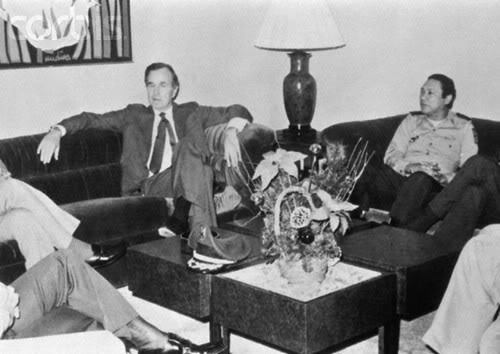
Vice President George H.W. Bush meeting with Panamanian Gen. Manuel Noriega in the mid-1980s when Noriega was considered a key ally in helping the Nicaraguan Contras wage a brutal guerrilla war to overthrow the leftist Sandinista government.
By Jonathan Marshall | Consortium News | June 1, 2017
The death of former Panamanian strongman Manuel Noriega on May 29 elicited few if any tears. But it should have sparked more reflection in the United States on his ugly history of service to the CIA, the hypocrisy of Washington’s sudden discovery of his abuses once Noriega became an unreliable ally against the Nicaraguan Sandinistas, and the George H.W. Bush administration’s bloody and illegal invasion of Panama in December 1989.
In fairness, many progressives and mainstream journalists have called attention to this troublesome history over the years. But few have dared to question the nearly universal condemnation of Noriega as a protector of international drug traffickers. That incendiary claim — first broadcast loudly by the unlikely trio of right-wing Sen. Jesse Helms, R-North Carolina; liberal Sen. John Kerry, D-Massachusetts; and investigative journalist Seymour Hersh — galvanized the American public to support his ouster.
After the U.S. invasion, which killed hundreds of Panamanians and 23 U.S. soldiers, Noriega was arrested on Jan. 3, 1990 by armed U.S. drug agents.
President George H. W. Bush declared that Noriega’s “apprehension and return to the United States should send a clear signal that the United States is serious in its determination that those charged with promoting the distribution of drugs cannot escape the scrutiny of justice.” U.S. Ambassador Deane Hinton called the invasion “the biggest drug bust in history.”
Convicted in 1992 on eight felony counts following what officials called the “trial of the century,” Noriega was sentenced to 40 years in jail. Although released early from U.S. incarceration, he spent the rest of his life in French and Panamanian prisons.
The resulting publicity created lasting myths about Noriega and drugs. Journalists who should know better have described Noriega as “one of the world’s biggest drug kingpins,” to quote Time magazine. In fact, Louis Kellner, the U.S. attorney who oversaw his Miami indictment and trial admitted, “Noriega was never a major player in the drug war.”
Indeed, at worst, he was a small fry compared to the military rulers of Honduras, whose epic protection of the cocaine trade was tolerated by Washington in return for using that country as a staging base for Contra operations against the Sandinista-led government of Nicaragua in the 1980s.
Deeply Flawed Trial
A few close observers of the long, expensive, and controversial trial believe it failed to prove Noriega’s guilt at all.
David Adams, who covered it extensively for the London Independent, said the government’s case was “marred by incompetent witnesses, false testimony, and poor presentation.”
Newsday’s Peter Eisner quoted Judge William Hoeveler, who presided over the trial, as saying “the outcome could have been different” if Noriega had been better represented.
Although the government put more than two dozen people on the stand, their testimony was not always relevant or credible.
Paul Rothstein, Georgetown University law professor and former chairman of the American Bar Association’s criminal evidence committee, said of the government’s witnesses, “What promised to be the trumpeting of elephants turned out to be the whimperings of mice.”
Big-time drug bosses enjoyed great rewards for telling the jury what the government wanted. Observed reporter Glenn Garvin, “To convict Noriega, the strike force had to make a flurry of deals with other accused narcotraffickers, bargaining a collective 1,435 years in prison down to 81.”
The fierce Noriega critic R. M. Kostner declared, “The prosecution was shameless in its bribery of witnesses. What co-defendants got for flipping made me sometimes wish that I had been indicted. The proceedings were almost totally politicized. It was clear long before they opened that, regardless of evidence, Noriega could not possibly be acquitted – a very sad thing for the United States.”
Other witnesses who never took the stand contradicted the government’s case years later. Retired Medellin cocaine lord Juan David Ochoa claimed in an interview with Frontline that “at no moment did [Noriega] protect us. . . . As far as I know he had nothing to do with the drug trade.”
Greg Passic, former head of financial operations for the DEA, said, “The Colombians I talked to in the drug transportation business said they didn’t deal with Noriega at all. To deal with him you would just have to pay him more money. They didn’t need it. It would be expensive.”
In fact, DEA officials repeatedly lauded Noriega’s cooperation with their anti-drug investigations, both in public letters of support and in private. Recalled Duane Clarridge, former head of Latin America operations for the CIA, “The DEA had told us that they were getting great support in Panama, and from Noriega in particular, in interdicting drugs.”
More than a year after the U.S. invasion, when it was absolutely impolitic to voice such sentiments, one “federal drug enforcement source” told a reporter, “Noriega was helping us, not ten percent, not twenty percent of the time, but in every instance we asked him to do so, one-hundred percent of the time. . . . These were key operations . . . that struck at both the Cali and Medellin cartels.”
Even the U.S. ambassador to Panama in the final years of Noriega’s rule, Arthur H. Davis Jr., said in an oral history interview, “all I know is that, all the time I was there, Noriega . . . cooperated one hundred percent with our people. Anytime we had a ship that we wanted to be interdicted on the high seas and we asked permission, they gave permission. . . . Anytime there was some prominent drug man coming up and we knew about it, Noriega would help us with it. And when we found out about things, the [Panamanian Defense Forces] would go over there and round them up and turn them over to us.”
Turning Against Noriega
One of the high points of Noriega’s cooperation was Operation Pisces, a three-year undercover probe that culminated in 1987. Attorney General Edwin Meese called it “nothing less than the largest and most successful undercover investigation in federal drug law enforcement history.”
Among those indicted were Medellin Cartel kingpins Pablo Escobar and Fabio Ochoa. Panama made 40 arrests and seized $12 million from accounts in 18 local banks. Said one U.S. prosecutor who helped direct the case, “The Panamanian officials we were dealing with were sincerely cooperative. . . . They could have breached security, and they didn’t.”
The operation may have pleased the DEA, but it angered the country’s financial elite, who directly profited from money laundering. One local banker warned, “this could end the Panamanian banking system, because people will no longer believe they can count on bank secrecy.”
Within two months, spooked investors withdrew up to $4 billion of the country’s $39 billion in bank deposits, triggering the most serious banking crisis in Panama’s history.
A Western diplomat said of Noriega, “The bankers can bring him down. They are complaining in Washington and they’ve got a lot of clout.” The demonstrations organized that summer by Panama’s business elite — and Noriega’s heavy-handed response to them — triggered his eventual slide from power
The bankers were joined by angry cartel leaders, who viewed Noriega as an “obstacle to the functioning” of their money laundering operations in Panama, in the words of drug policy expert Rensellaer Lee.
A lawyer for the bosses of the Cali Cartel complained that his clients were “frustrated by the problems” Noriega created for them in Panama.
Cali leaders later got their revenge when they paid $1.25 million to bribe a drug trafficker to become a key witness against Noriega in his Miami trial. In exchange for the testimony, eager U.S. prosecutors agreed to cut nine years off the sentence of an unrelated Cali trafficker — brother of one of that cartel’s senior leaders.
When Noriega’s defense team cried foul, a federal appeals court declined to order a new trial, but criticized the government for appearing “to have treaded close to the line of willful blindness” in its eagerness to win a conviction.
Medellin leaders were just as unhappy with Noriega as those in Cali. A pilot for one of the biggest Medellin smugglers described Pablo Escobar’s reaction after Noriega approved a raid on one of his cocaine labs in May 1984: “He was just really out of whack with Noriega. He was like, ‘This guy is dead. No matter what, he is dead.”’
It would be foolish to assert that Noriega, alone among all leaders in Central America, kept his hands clean of drugs. But much of his personal fortune is easily accounted for from other sources, such as the sale of Panamanian passports on the black market.
Whatever Noriega’s involvement with drug traffickers, as I have shown elsewhere, the Bush administration displayed unbelievable cynicism when, even before his capture, it swore in a new president of Panama who had sat on the board of one of the most notorious drug-money-laundering banks in the country. His attorney general, who unfroze the bank accounts of Cali traffickers, later became legal counsel for the Cali Cartel’s top smuggler in Panama.
Following Noriega’s ouster, not surprisingly, cocaine trafficking began surging in the country. A year and a half after his arrest, unnamed “U.S. experts” told Time magazine that “the unexpected result . . . is that the rival Cali cartel established a base in Panama and has since inundated the country, along with Mexico, Guatemala and the Caribbean, with vast quantities of cocaine destined for the U.S. and Europe.”
Today, though, all that is forgotten, along with the questionable course of justice during Noriega’s trial. Noriega, even in death, deserves no eulogies, but he does deserve a more balanced judgment of history.
VIDEO: The Naylor Report – Tories Plan to Sell the NHS
OffGuardian | June 1, 2017
YouTuber Chris Holden’s video on the Naylor Report and Theresa May’s plans for the NHS has gone viral in the last week. Deservedly so, he’s done the hard yards – reading an interminably dull report – so we don’t have to. His summary is concise, revealing, and very worrying.
“In an interview with Andrew Neil, Theresa May slipped out a single line about the NHS; she’s made the 2017 election all about her, strength and stability and Brexit. In half an hour, this was all she had to say about her plans on the NHS – “we support the Naylor Report”. It sounded so tediously dull, it couldn’t possibly be of any interest.”
Calls on Britain to stop arms exports to UAE
MEMO | June 1, 2017
The Arab Organisation for Human Rights in Britain (AOHR) has called on the UK government to stop exporting arms to the United Arab Emirates (UAE) because of its role in fuelling armed conflicts in the Middle East.
The organisation said the British government granted 509 arms licenses to the UAE worth £182 million ($233.3 million) in 2016 including defensive and offensive weapons with most of these weapons being transported to conflict zones in Yemen and Libya.
The organisation warned that the UAE government does not abide by the last user condition stipulated in the arms licenses which is documented in UN and international reports and therefore it is imperative that the UK government stop the export of arms to Abu Dhabi and investigate the fate of arms deals which were concluded previously.
The UAE not only provided the parties to the conflict with weapons, AOHR explained, but carried out military operations in the field like the continued bombing against the Darna region in Libya in cooperation with Egypt which resulted in civilian deaths and the destruction of many civilian facilities.
Using the pretext of fighting terrorism, the UAE and its allies are committing gross violations of the rules of international humanitarian law, AOHR added.
It went on to express deep concern that the UAE is expanding its military activity in Africa, where it has built military bases in Eritrea and Somalia.
Trump-Saudi orb-gazing summit not helping Sunni alliance
By Sharmine Narwani | RT | June 1, 2017
The glowing orb stunt should have been a sign that all was not what it seems. Theatrics, in the world of politics, usually suggest an illusion needs to be spun for audiences somewhere.
A week after US President Donald Trump’s eyesore of a visit to Riyadh, Saudi Arabia, the pressing question now is “why?” What was the purpose of convening leaders and representatives of 55 Arab and Muslim nations to greet a US head of state amidst so much pomp, ceremony and an excruciating amount of flashing cameras?
The Riyadh summit had several goals, most of which specifically served Saudi and American political interests.
The American leader’s potential gains were clear: he would score points at this impressive international showing of Muslim leaders who would help counter his anti-Muslim reputation at home. Trump would also be well-compensated in the form of the largest US arms deal in history, a booty he could claim would boost his home economy. The negotiations would take place in the Middle East, at the heart of his fight against “radical Islamic terrorism.” Trump would also leave with a blank check for Palestinian-Israel “peace,” bestowed by a Saudi king who has no authority to negotiate anything on behalf of Palestinians. And finally, the US president would piggyback the legitimacy of 55 Arab and Muslim states to craft a Middle East policy that targeted Iran, its allies and the Muslim Brotherhood (MB) – even though no consensus whatsoever was reached at the summit.
In their eyes, the Saudis scored even bigger. The cash-and-credibility-hemorrhaging Saudis are losing ground in their list of international fights – in Syria, Yemen, Iraq and against Iran. Here was an opportunity to convene leaders and representatives from 55 Arab and Muslim nations (only 33 heads of state showed up) to underscore Saudi Arabia’s position as the custodian of Sunni Islam. For the power-mad Saudis, nothing would showcase their primacy better than the presence of a US president on his first official foreign trip. They forgot, however, that legitimacy is derived from one’s own populations, not from a Western head of state sword-dancing next to one’s king. After the summit, Riyadh would go on to unilaterally craft a declaration, unseen and unapproved by the VIP guests, that claimed to outline the gathering’s foreign policy priorities.
But most importantly, this summit would allow the Saudis – who are terrified at the potential repercussions coming their way from decades of funding global terrorism – to very publicly take cover under the Trump presidency. And the US president, who knows very well that the Saudis are the epicenter of global terror, offered up America’s protection and complicity to secure his doggy bag of treasures.
This generous give-and-take between the Saudis and Americans took place on the day of the summit, amidst much back-slapping. Then, a few days later, the fallout began.
First, Saudi vs. Qatar
This past week, a flurry of media headlines alerted us to the first fissure between summit participants. News reports began emerging that Qatari leader Sheikh Tamim bin Hamad al-Thani had deviated from the Saudi talking points by supporting engagement with Iran and defending resistance groups Hezbollah and Hamas.
Saudi Arabia and the UAE retaliated swiftly to this slight by blocking Qatari media outlets, recalling their ambassadors and launching a war of words against Doha.
Why the swift and punishing response toward a fellow member of the six-nation Gulf Cooperation Council (GCC)?
Qatar has long struggled to get out from under the shadow of its much larger Persian Gulf neighbor Saudi Arabia and has spent the past dozen years building up media networks, like Al Jazeera, and investing in major Western corporate, think tank, educational and sports brands to project power well beyond its regional stature. The tiny sheikhdom’s biggest coup, however, was to secure the establishment of the US military’s largest regional base on its territory, which allowed Doha to continue provoking its Saudi competitor with little risk of consequence.
Then in 2011, the Qataris put their full weight behind “Arab Spring” efforts to overthrow a slew of Arab governments. Most of the Qatari-backed incoming regimes and opposition activists, however, were Islamists, mainly of the MB variety, which is reviled by Saudi Arabia and the UAE.
The Saudis were initially caught off-guard by the swift events sweeping the region, but quickly rallied to mount a region-wide counterrevolution to reverse the political gains of the Qatari- and Turkish-backed MB groups. Saudi operatives funneled manpower, money, and weapons to reestablish Riyadh’s influence. They revived their famed jihadi networks to flood Syria and other places with extremist militants that could tip the balance of power back in its direction.
It wasn’t just Qatar and the MB in Saudi sights – the regional uprisings, particularly in Syria, Yemen and Bahrain, threatened to shift the region in a direction that benefited Iran, Saudi Arabia’s biggest regional adversary.
In Riyadh ten days ago, the Saudis thought they had struck gold. After eight years of dealing with a somewhat unsympathetic Obama administration, here was Trump acquiescing to their every whim. The Saudi declaration issued at the end of the summit – as well as speeches delivered during the event – struck out at Iran, the Muslim Brotherhood, Hezbollah and Hamas, and promised American cooperation in isolating them. The Saudis were on a high, but they were also mostly alone.
A broad divergence of interests
Aside from the Saudi-Qatari spat, there are countless other differences among summit participants that will scuttle Riyadh’s ambitions.
The anti-MB UAE has stood firmly by Riyadh’s side in condemning Doha but diverges – even within its own borders – on assuming an aggressive position against Iran. Call it Dubai-versus-Abu Dhabi if you will. Dubai, with its large Iranian expat population and significant trade with the Islamic Republic, is less worried about its Persian neighbor. As a 2009 Wikileaks cable from the US embassy in Abu Dhabi puts it: “While MbZ (Crown Prince of the Emirate of Abu Dhabi Mohammad bin Zayed) is a hardliner on Iran, there are accommodationists within his own system, especially in Dubai, where the ruler, Mohammed bin Rashid Al-Maktoum (Prime Minister of the UAE) takes a position that is much closer to Qatar’s.”
Other GCC states are even more loathe to confront Iran. Oman has repeatedly ignored Saudi demands to toughen its stance against Iran and remains a key Iranian diplomatic partner in the region. The two states participated in joint naval exercises in the Gulf of Oman as recently as April, and it was Muscat that hosted the initial secret US-Iran meetings which kick-started the 2015 Iranian nuclear deal.
GCC member-state Kuwait also remains relatively neutral on Iranian matters. Up to 40 percent of Kuwaitis are Shiites, and the country has avoided much of the sectarian strife that afflicts Saudi Arabia and now Bahrain. It is to Kuwait that Qatar’s emir has now turned to negotiate peace with the Saudis and UAE in the aftermath of last week’s fallout. The Qataris, who have dealt opportunistically and not ideologically in their regional relations, share the world’s largest gas reserve with Iran, a further incentive to maintain a neutral stance on Tehran.
In fact, most of the Sunni states that attended the Riyadh summit are flat-out furious about the violent sectarianism and extremism that has emerged in the past few years. And many of them blame the Saudis for it.
Last August, an unprecedented conference of 200 leading Sunni clerics from around the world was held in Grozny to determine “who is a Sunni.”Excluded from the gathering were representatives of both the Wahhabi sect (Saudi Arabia and Qatar’s official religion) and the Muslim Brotherhood. The Islamic world is looking to tackle the deviance and sectarianism that has borne groups like ISIS and Al-Qaeda – not indulge it, as would be the case if they embraced the Saudi ‘vision’ in Riyadh.
But in an effort to bulldoze through a “Sunni consensus” under the umbrella of “Saudi-American power,” the Saudis ignored every gorilla in that summit room. Not only do many of the meeting’s participants blame the Saudis for unleashing the jihadi genie, but most of them also wouldn’t for a minute look to Saudi ‘leadership’ if it weren’t for Saudi cash. Case in point, Sunni regional giants Turkey and Egypt. Turkish President Recep Tayyip Erdogan didn’t even show up to Riyadh, citing other engagements. Egyptian President Abdel Fattah al-Sisi did attend – he was one of three invited to press his palms upon the ‘glowing orb’ to inaugurate the Saudi counterterrorism-something-or-other.
But more than anything, Sisi was invited to Riyadh as an important set extra – to visually demonstrate that the great Arab state of Egypt was passing the mantle of leadership to Saudi Arabia’s King Salman.
Where the Saudis viewed former Egyptian President Hosni Mubarak as a stalwart ally, they see Sisi as nothing of the sort. Sisi may agree with Riyadh on the evils of the Muslim Brotherhood, but he has absolutely no tolerance for Saudi Arabia’s support of terrorist groups throughout the region and has been a right royal pain on the issue of Syria.
Egypt may hanker after the Saudi billions – which it has received in spades for its anti-MB efforts – but Egyptians have little affection for the Saudis and have sparred publicly and privately in recent years and months. Whereas Riyadh could once count on Egyptian troops to support its military incursions, today Cairo has rejected participation in the Saudi-led war against Yemen – alongside another staunch Saudi ally, Pakistan.
The Saudis recently hired Pakistan’s former army chief General Raheel Sharif to head up their 39-nation “Muslim NATO” construct to fight terrorism, but now rumors are rife that he will resign amidst a national uproar over his decision. Pakistanis, like other straight-thinking Muslims, are uncomfortable about the prospect of a military alliance that appears to have been conceived primarily to fight Iran – and Shiites.
Dead On Arrival
On the surface, the purpose of the Riyadh summit was to amass a coalition of like-minded Arab and Muslim partner-states, under a Saudi-American banner, to wage war against terror. In fact, this is a Saudi and American-led initiative created not to tackle terror, but to ‘reframe’ it to encompass political adversaries.
Look out for pundits and politicians spinning these new narratives that Iran, Hezbollah, and the Muslim Brotherhood are equally as dangerous as ISIS and Al-Qaeda – never mind that the former have been around for decades without triggering the global security meltdown spawned by the latter.
In Riyadh, the Americans and Saudis made a great show of jointly announcing two additions to their “terrorism” list – one was a senior Hezbollah official, the other a senior member of ISIS.
This is not the war against terror that the heads of states gathered in Riyadh anticipated. This is a sectarian war, conceived by a sectarian state that has funded, armed and organized the very global terrorism it purports to fight. And every single US administration since the events of 9/11 has acknowledged this direct Saudi role in terror.
In Riyadh, the show went on anyway. But there’s not a person in that room who didn’t understand the game. Forget the ‘Sunni consensus’ after Riyadh. Of the 55 nations represented at the summit, the Saudis will be lucky to retain five.
Sharmine Narwani is a commentator and analyst of Middle East geopolitics. She is a former senior associate at St. Antony’s College, Oxford University and has a master’s degree in International Relations from Columbia University. Sharmine has written commentary for a wide array of publications, including Al Akhbar English, the New York Times, the Guardian, Asia Times Online, Salon.com, USA Today, the Huffington Post, Al Jazeera English, BRICS Post and others. You can follow her on Twitter at @snarwani
European ‘Left’ Caves in to Censorship and Media Lies
By Tortilla Con Sal | teleSUR | May 31, 2017
In 2011, the former European colonial powers, backed by the United States, with the complicity of the United Nations, worked with minority opposition forces to overthrow legitimate governments in Libya, Syria and the Ivory Coast. They trashed the very international law and basic human rights they cynically proclaimed to defend. In 1961, the Belgian and U.S. governments colluded directly in the murder of Patrice Lumumba, the Democratic Republic of the Congo’s elected Prime Minister.
No one should be surprised at how easily the majority of progressive opinion in the West is intimidated by bullying from the mainstream. The overwhelming majority of progressive Western media outlets and intellectuals either accepted or openly supported Western aggression and intervention in 2011, as if they had learned nothing in the 50 years following the martyrdom of Patrice Lumumba. The 2011 events faithfully re-enacted the catastrophe of the Congo 50 years earlier.
Subsequently, that country has suffered over five million deaths from civil war and foreign intervention, a holocaust shamefully ignored internationally. Similarly, the destruction of Libya and Syria have provoked catastrophic human suffering with millions displaced and hundreds of thousands killed. Now, the U.S. elites and their allies are applying the age old formula of 1961 and 2011 to Venezuela. What still passes for the Western Left should be ferociously defending Venezuela’s right to self-determination.
Instead, less blatantly than in 2011, majority progressive opinion has crumbled and folded against the same old imperialist psychological warfare offensive used against every imperialist target since the end of WWII. Most progressive comments on Venezuela implicitly validate corporate media spin that, as in Syria, Venezuela’s opposition can be neatly segmented into moderates and extremists when in fact the main opposition leaders refuse dialogue.
With great restraint, President Nicolas Maduro has banned the use of lethal force and persisted in efforts at negotiation. Extensive Western media coverage falsely promotes an image of government repression in Venezuela in sharp contrast to their failure in 2009 to cover murderous government repression in Honduras of massive peaceful protests against the country’s coup regime. Those protests lasted over four months, much longer than the Venezuelan opposition’s latest prolonged coup attempt. But events in Honduras received nothing like the coverage of the current crisis in Venezuela. Western media soft-pedalled events in Honduras because the U.S. authorities supported the coup, one they hope to see repeated in Venezuela.
Despite that self-evident fact, Western progressive opinion has effectively caved in to the false mainstream corporate media narrative that the Venezuelan opposition offensive is a legitimate one against a dictatorial government. That moral and political collapse makes itself evident in many ways.
The latest example in Europe is the illegal summary dismissal by a leading Swedish progressive media outlet of its most experienced journalist writing on Latin America, Dick Emanuelsson. Dick has covered Latin American news for over 35 years for the Flamman weekly. Based for many years in Bogota before moving to Tegucigalpa in 2006 where he works with his partner Mirian, Dick’s reports cover all of Latin America and the Caribbean.
Very clearly, Flamman’s decision is blatantly political and should certainly be seen in the context of the Swedish authorities’ support for U.S. attempts to censor Wikileaks in the case of Julian Assange. In Emanuelsson’s case, the decision will surprise no one with any experience with the phony progressive non-governmental and media sector in Western Europe and North America.
Just as Western governments trample human rights while claiming to defend them, so Western non-governmental sector managers abuse basic rights when it suits them. Obviously, Flamman’s editors can no longer accommodate Emanuelsson’s uncompromising support for radical political and social movements in Latin America because it conflicts with received wisdom in Sweden.
Emanuelsson is among the very few European reporters with a lifetime’s experience of reporting on Latin America and one of only a handful writing as revolutionaries. Over the years, his work on Colombia relentlessly exposed the paramilitary and narcotics links of Colombia’s ruling elite. He was practically the only European reporter writing first hand about the FARC-EP’s guerrilla struggle against successive corrupt genocidal Colombian governments and the persistent efforts of the Colombian guerrilla to work for peace.
Similarly, following the 2009 coup in Honduras, Dick and Mirian fearlessly reported the events of the coup itself, the murderous repression of the peaceful protest movement and the return of ousted President Manuel Zelaya. Subsequently, along with a few North American activists, they have worked in constant solidarity with Honduran activists and reporters documenting the corrupt regimes of Porfirio Lobo and Juan Orlando Hernandez.
But now, the supposedly progressive editors of one of Sweden’s leading labor media outlets ignominiously dismissed Emanuelsson two years before retirement, despite his unique record of commitment and achievement.
In order to fire Emanuelsson, Flamman’s editor blew out of proportion minor errors made in relation to a task that only takes up about 10 percent of his overall agreed workload, totally disregarding the Swedish Law of Employment’s Protection – an odd thing to do for a media outlet that regards itself as a defender of worker’s rights. No criticisms about his regular feature reports on Latin America nor about his overall coverage were issued. In fact, no such criticisms against his work have ever been made in almost 35 years!
The paper’s readership has always regarded Emanuelsson’s work as exemplary reporting unavailable elsewhere. On the basis of their flimsy pretext and ignoring his impressive track record, Flamman tried to dismiss him with no compensation. The flagrant illegality of the dismissal notice under Swedish labor law is beyond dispute. When his union intervened, Flamman upped their offer to a measly four month’s salary, a recompense adding insult to the injury of chronic insecurity.
Flamman is an ostensibly left-wing weekly associated with the former VPK Left Communist political party which years ago aligned with acceptable pro-imperialist opinion in Sweden. That realignment is part of the general drift to the right in Europe which has seen the neo-fascist Sverigedemokraterna party become the second most popular in the country. Rather than fight that drift, many former communists and other progressives in Sweden have accommodated to it. That reality is clear from the support of most progressive opinion in Sweden for NATO’s role in the destruction of Libya and Syria and the decline in solidarity with Cuba.
Domestically, Flamman’s treatment of Emanuelsson reflects the accommodation of Swedish former communists with the neoliberal agenda of Sweden’s business sector. Like so many phony progressives across Western Europe, Flamman’s editors talk excitedly about Podemos in Spain, Jeremy Corbyn’s Labor Party in the U.K. or even Syriza in Greece.
But their real commitments reveal themselves in the practice they apply to cases like that of Emanuelsson. People may or may not agree with the politics of his reporting any more than they have to agree with the politics of Julian Assange, but basic justice demands we should defend their fundamental human rights.
Featured Video
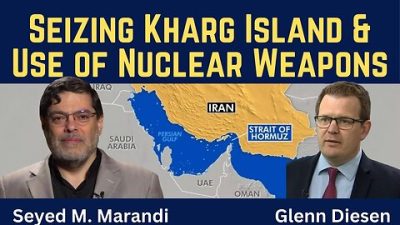
Marandi: Threat of Seizing Kharg Island & the Use of Nuclear Weapons
or go to
Aletho News Archives – Video-Images
Frlom the Archives
Iran War: United States Military Versus Israel Firsters
By James Petras | November 27, 2007
Why must Jewish organizations be and be seen as the loudest drum-beaters of all? Why can we not bring ourselves to say that military intervention is not on the table at all? Why not stash it under the table, out of sight and mount instead a diplomatic assault? – Leonard Fein, Forward
Introduction
As the White House and Congress escalate their economic sanctions and military threats against Iran, top military commanders and Pentagon officials have launched a counter-offensive, opposing a new Middle East War. While some commentators and journalists, like Chris Hedges (Truthdig, November 13, 2007), privy to this high stakes inter-elite conflict, attribute this to a White House cabal led by Vice President Cheney, a more stringent and accurate assessment puts the Zionist Power Configuration (ZPC) in the center of the Iran war debate.
There is a great deal riding in this conflict – the future of the American empire as well as the balance of power in the Middle East. Equally important is the future of the US military and our already heavily constrained democratic freedoms. The outcome of the continuous and deepening confrontation between top US military officials and the Israel Firsters over US foreign policy in the Middle East has raised fundamental questions over self-determination, colonization, civilian primacy and military political intervention, empire or republic. These and related issues are far from being of academic interest only; they concern the future of the United States. … continue
Blog Roll
 Aletho News
- How Zionist Control Is Hurting US Interests
- Iran warns it may target US missile launch sites in UAE cities
- American Military Failure in Afghanistan
- Friendly Skies of Georgia: Are Israeli-Linked Drones Launching False Flags from Georgian Territory?
- The Three Big Lies about Mammography Screening
- Ukrainian Embassy in Beirut sheltering top Mossad agent
- Palestinian family displaced after settlers violently attack them in Humsa, Jordan Valley
- The EU never learns – except for the wrong lessons
- Iran attacks on UAE leaves RSF militia high and dry
- Hosting Washington’s war: Bahrain faces the consequences
- If Americans Knew
- No let-up in attacks on Gaza as Israel takes on Iran, Lebanon – Not a ceasefire Day 155
- ‘Of Course’: IDF Drops Case Against Soldiers Accused of Raping Palestinian Prisoner
- Don’t Fall for the Regime Change Talk. Israel Is ‘Mowing the Lawn’ in Iran
- Will Israel and the US wreck the Gulf States along with Iran?
- US so far burned through ‘years’ of munitions in Iran war: Report
- How the Israeli Tail Wags the American Dog
- Outdated intel likely led to deadly U.S. strike on Iranian elementary school, sources say
- Pentagon insider says high U.S official Douglas Feith reported to Netanyahu
- In fond memory of Walid Khalidi, the historian of Palestine
- 6 more Americans killed, as Israel ‘mows the lawn’ in Iran – Not a ceasefire Day 154
- No Tricks Zone
- Storing Green Energy To Last Germany 10 Days Would Require A 60-Million Tonne Battery
- New Studies: UK Sea Levels Were 4 Meters Higher Than Today During The Mid-Holocene
- Destructive Green New Deal: German Energy And Metal Group Warns Of Drastic Crisis
- New Study Documents A 20-Year Pause In Arctic Sea Ice Decline – Driven By Internal Variability
- Wake-up Call: Survey Shows Majority Of Germans Now Favor Postponing Climate Targets!
- Televised! Leading German Political Candidate Tells Schoolchildren CO2 Makes Sun Hotter!
- New Study: A Century Warming Of 1.1°C Is ‘Commonplace’ And ‘Not Unusual’ During This Interglacial
- New Study: ‘Internal Noise’ And Volcanic Forcing Can Trigger 10-15°C Warming Within Decades
- Glaciers Worldwide Are Suddendly Surging, Experts Blame Warming!
- Surprising Discovery: Sahara Is Greening…Billions Of Trees Where Once Thought To Be Barren
 Aletho News