Russia will not let US ‘deal of the century’ go ahead
MEMO | June 27, 2018
Senior Hamas leader Mousa Abu-Marzouk said on Monday that Russia has promised not to let the US’ “deal of the century” go ahead, a statement published on Hamas’ website said.
In an interview with Al-Mayadeen TV Abu-Marzouk said: “We agreed with the Russians that the ‘deal of the century’ will not be allowed to go ahead.”
On Monday, a senior Hamas delegation headed by Abu-Marzouk wrapped up a visit to Moscow where they met the Russian president’s envoy to the Middle East and the deputy foreign minister.
Israeli newspaper Haaretz reported a Hamas official from Gaza saying that the visit was arranged to coincide with a US delegation’s trip to the Middle East.
The Hamas official said that Russia is a considerable player in the Middle East which has direct relations with all the players in the region, including Israel and the Palestinian Authority.
Hamas also said that its delegation discussed the humanitarian situation in Gaza and said that the Russians promised to work to end the Israeli siege and alleviate the suffering of Palestinians in the enclave.
Israel to ‘Prolong Bloodshed’ in Syria as Media Pushes ‘Sensational’ Iran Claims
Sputnik – June 27, 2018
With two Israeli missile having struck targets near a Syrian airport on Tuesday, Rick Sterling, an investigative journalist and member of the Syria Solidarity Movement, told Sputnik that the likelihood of Israel backing down from its attacks are pretty slim.
As Sputnik previously reported, the Israeli Air Force was attempting a late night attack on an Iranian cargo plane that was unloading at Damascus International Airport. Footage has since emerged allegedly showing the aftermath of the Israeli strike.
The incident follows multiple strikes by Israel in recent months in what it calls “retaliatory” measures against Iran’s presence in Syria, which it sees as a threat to its safety. Iran has had a foothold in Syria since the conflict first began in 2011.
Sterling told Radio Sputnik’s Loud & Clear on Tuesday that the missile launch proved that Israel has no intention of helping solve the Syrian conflict, but instead hopes to keep the fight going.
“I think Israel is continuing to provoke the situation,” Sterling told show host Walter Smolarek. “They don’t want to see the conflict end, they want to prolong the bloodshed there and prevent the Syrian government from finally defeating terrorism there in Syria.”
“They’ve acted for many years now as a protectorate of the terrorist groups… they’ve been actively involved in the conflict from the get-go… they’ve medically treated terrorists inside Israel and with [Israeli Prime Minister] Benjamin Netanyahu going along bedsides, with videos showing him greeting medically treated extremists,” Sterling pointed out.
Highlighting Israel’s love of proclaiming Iran as a threat, the journalist stressed that the 70-year-old country has repeatedly cried wolf on the matter.
“Israel uses Iran as a pretext… they always claim that they’re attacking armaments headed for Hezbollah or armaments from Iran or Iranian contingents,” he told Smolarek. “They’ve exaggerated the Iranian participation in the conflict from the start.”
“It is a dangerous situation right now. We don’t know what the calculations in Israel are and it’s pretty hard to predict what the US is going to do — there’s competing wishes within the US military, CIA and the national security establishment,” Sterling noted.
Predicting the media coverage to come on the matter, Sterling suggested outlets would ultimately create “sensational claims and fears about civilians being attacked and civilians being targets and very horrible events about to happen.”
US Sanctions May Force India Out of Iran’s Chabahar Port With China More Than Able to Fill This Gap
By Adam Garrie | EurasiaFuture | June 27, 2018
Iran’s Chabahar Port on the Gulf of Oman represents the crowning achievement of Indo-Iranian cooperation in recent decades. The port itself represents the centre of the wider North-South Transport Corridor (NSTC) which will link India to Russia and the wider north-western Eurasian space via Iran and Azerbaijan. While under Premier Narendra Modi, India has sought to sell NSTC as an alternative to China’s One Belt–One Road and in particular as rival to the China-Pakistan Economic Corridor which links China to the wider Indian Ocean space via the Arabian Sea port at Gwadar, Iranian officials who themselves are eager participants in One Belt–One Road, have wisely distanced themselves from India’s zero-sum narrative on Chabahar and NSTC more widely.
Likewise, as Iranian relations with Pakistan continue to improve, it also remains clear that Iranian leaders are carefully avoiding being sucked into south Asia’s manifold rivalries by maintaining healthy ties with China, India and increasingly Pakistan simultaneously.
As it stands, Gwadar is a more substantial port vis-a-vis Chabahar in terms of its capacity and the fact that unlike the Indian built port in Iran, the Chinese built Gwadar is a Panamax deep water port. In this sense, both Gwadar and Chabahar could function together on the win-win model which would see some of the supplies shipped from China to Pakistan via Gwadar being routed on to Chabahar depending on their ultimate destination. Here one could see One Belt–One Road and the North South Transport Corridor functioning as integrated rather than as rival logistics networks – something that Pakistani officials recently spoke about with optimism.
Now though, India’s very presence in Chabahar may be impacted negatively as the US moves to sanction countries that conduct business with Iran. The US CAATSA sanctions aimed at Iran are back in the spotlight after the US withdrawal from the JPCOA (aka Iran nuclear deal) caused Washington to threaten many of its longstanding allies against conducting further business with Iran under the threat of so-called second party sanctions. These threats have most notably been aimed at the European Union, in spite of the fact that the bloc remains rhetorically adamant that it will continue to preserve the JCPOA without US involvement.
India has also come under threat of sanctions due to its healthy relationship with the Islamic Republic. The US has stated that it will sanction Indian companies who do business with Iran and this week, the US issued an even more specific threat to its Indian partner, stating that New Delhi will face sanctions if it continues to purchase Iranian oil.
Last month it was reported that international investors in Chabahar were beginning to show signs of nervousness in light of the new sanctions threats from Washington. As India is already facing tariffs on its exports to the United States while simultaneously cutting itself off from a would-be win-win Chinese partnership, India is scarcely in a position to economically leverage the United States which under Donald Trump has taken a merciless approach to conducting trade wars with allies as well as threatening partners with sanctions if they do business with countries including Russia, Iran and the DPRK (although this might soon change in the case of the DPRK).
This could mean that as the primary investor and operator of the Chabahar Port, India could find itself cut off from its own investment under the cloud of sanctions. If it comes to this and India is forced to either partially or even entirely withdraw from the Chabahar project, it would mean that Iran would seek a new international partner for the port.
The only realistic partner to take over Chabahar would be China, a nation with experience in port building and management, a country that has shown itself to be able to transact deals with Iran in spite of the attitude of Washington and a country that because of America’s own dependence on Chinese goods – is largely sanction proof for all practical purposes.
Not only could China help to revive the economic fortunes of Chabahar if India becomes frightened off due to threats from the United States, but China could actually help Chabahar to grow both infrastructurally and commercially by linking it into a uniformed trade route centred on the larger Gwadar port and existing One Belt–One Road lines of connectivity in the region. This would ultimately be a win-win for China, Iran and Pakistan.
If India were to abandon the underlying prejudices behind its zero-sum approach to antagonising both China and Pakistan, India could actually remain active in Chabahar as key player in a wider Sino-Iranian partnership which would necessarily also include Pakistan via CPEC. This could help to not only reduce tensions with India’s largest neighbours, but it could demonstrate that the only way for India to effectively leverage US threats of further tariffs and sanctions is by keeping at least one foot in China’s already open door.
However, given the attitude of the current Indian government, such a win-win model looks increasingly distant however theoretically attractive it might sound when analysed objectively. Because of this, the more likely scenario for Chabahar will be a short-term waiting game where India will see just how far the US is willing to punish its newfound south Asian partner due to its dealings with Iran.
If India’s involvement in Chabahar does come under a US financial attack, it is all but certain that India will minimise its involvement in the flagship project – thus paving the way for China to take over where India left off.
The choice for India therefore is three fold: New Delhi can simply hope for the best while possibly sweetening the deal by making concessions to the US over existing tariffs, India can bow out of Chabahar in order to possibly attain better trading relations with the US in the future or India can work with China to leverage the US over its anti-Iranian position.
At a time when the US is embracing unilateralism in its economic relations with the rest of the world – India must look realistically at its options, even if this means dropping its Sinophobic prejudices.
US tries to stop S-400 deal with India
By Frank Sellers | The Duran | June 27, 2018
In much the same manner as the US attempted to kill the S-400 deal with Turkey, they are now setting out to end India’s defense relationship with Russia, especially if they can manage to undermine this SAM deal. The idea is to utilize sanctions to get the job done. If the US can manage to dissuade India from buying their SAM systems from India over fear that they might contravene some sanction issued by Washington, then that’s what they aim to do, while simultaneously offering America’s THAAD system to New Delhi as a replacement.
The Economic Times reports:
NEW DELHI: The United States may try to persuade India to consider its ballistic missile defence options in an attempt to keep it from pressing ahead with the S-400 deal with Russia.
ET has learnt that the US could make ballistic missile defence an agenda point in the upcoming Indo-US 2+2 dialogue on July 6 for which external affairs minister Sushma Swaraj and defence minister Nirmala Sitharaman will be in Washington.
The likely option on the table would be the Terminal High Altitude Area Defense (THAAD) system. It is a sophisticated missile defence system which is believed to be particularly effective against long-range missiles.
The S-400 missile defence system is, however, said to be effective against a larger array of aerial attacks, particularly fighter aircraft such as the F-18s and F-35s.
The latest version of the Russian made S-400 has a longer range but the jury is out on whether it’s more effective than the THAAD against intermediate range and intercontinental ballistic missile systems. ET has gathered that India’s proposed S-400 purchase from Russia has prompted a reassessment within Trump administration on whether India would have gone ahead with the nearly Rs 39,000-crore deal with Russia had the US moved faster with the THAAD offer.
Now, the S-400 deal has become a politically sensitive issue with the US. The US Congress is debating a Bill to allow for sanctions against Russian defence entities which could cover entities in recipient nations as well.
Given India’s strong defence partnership with Russia, the Trump administration, through secretary of defence James Mattis, has pitched for a waiver for countries such as India on the condition that it progressively reduce its military dependency on Russia.
The Congress has still not provided satisfactory relief despite hectic lobbying within Washington. The problem is compounded by the fact that the Countering America’s Adversaries through Sanctions Act (CAATSA) covers the S-400 system in the category of technologically sophisticated equipment which must be specifically targeted for this purpose.
India has argued that its S-400 deal with Russia was in the works before the US started debating the subject. In any event, it will predate the CAATSA if and when it’s written into law.
Besides, people close to the negotiations told ET, it is unreasonable for US to expect India to decouple its defence relationship with Russia, which has been a proven reliable partner through several conflicts.
The US, senior government officials said, must appreciate that unlike many of the other countries which purchase defence equipment from Russia, India does not target Russian armament against American interests and will not do so in future.
India is likely to elaborate on these lines at the inaugural 2+2 dialogue between the foreign and defence ministers of the two countries, while the US might urge India to first exhaust options the American industry can offer.
With the deal to purchase Russia’s S-400 SAM system predating America’s CAATSA sanctions act, the US is short on its options for blocking the deal. But sanctions are still playing a role in complicating its consummation as sanctions against Russia are rendering it somewhat difficult to relay compensation to the Russians for equipment and services rendered, therefore forcing both parties to find a way to deal outside of the dollar and outside of financial systems with exposure to Western markets. This particular moment in time for relations between India and the US is marked by trade tensions, as India finds itself in a position to dodge not just sanctions on its trade partners Russia and Iran, but also Trump’s trade wars, which affect goods sold in the American market, where India is imposing reciprocal tariff measures against the United States.
ATR gives up delivering planes to Iran: Report

The first four of the 72-600 ATR turboprops landed in Tehran’s Mehrabad Airport in May 2017
Press TV – June 27, 2018
Regional aircraft manufacturer ATR says it must give up delivering the remaining aircraft ordered by Iran because of new US sanctions and that it will try to reclassify 12 aircraft if it does not obtain a waiver.
“In 2018, our delivery target could be impacted given the Iranian context,” ATR CEO Christian Scherer said in an interview published on LaTribune.fr.
IranAir, the national flag carrier, signed a contract to buy 20 planes from turboprop maker ATR in April 2017. The deal came after Iran signed contracts with Europe’s Airbus and US rival Boeing to purchase about 180 jets.
“Of the 80 planes we expected to deliver in 2018, there were 12 for Iran, that’s a lot,” said Scherer whose company is joint-owned by France-based Airbus and Leonardo of Italy.
Iran took delivery of the first four ATR aircraft last May, two more in September, beside another two in December, with the rest due to be handed over to the country by the end of 2018.
Scherer said the Iranians want to take delivery of the planes, “but ATR will not take any risk of falling out with US authorities and exposing our shareholders Leonardo and Airbus to US sanctions.”
He said two aircraft have already been completed, six are being assembled and the last four have been launched and “customized” for Iran, particularly with pressurization devices, to fly over mountainous areas.
As a result, “these devices will be harder to reclassify,” he continued. “We are working hard but we have no firm tracks yet.”
To still deliver to Iran, ATR is trying to get a waiver from the Americans, but Scherer said he was “not entirely confident” about it.
“The Americans have promised a three-month period (from May to August) to allow companies to deliver the materials that were in production” after US President Donald Trump’s announcement to reimpose sanctions on Tehran.
“For the aviation industry, this three-month period is ridiculously short,” Scherer said.
ATR, Scherer said, intends to rely on the help offered by the French government to protect companies.
“We want to use the help of the French government to negotiate the best possible licenses during this period of three months to be able to deliver the aircraft manufactured or being manufactured to cushion this shock, which in any case will hurt us a lot.”
He also hoped to continue business in Iran with “a new license to support our customer, and we want to play our role as an after-sales service provider.”
“Here too, the Americans have made a declaration of intent explaining that they will not endanger the public,” Scherer said.
“The Iranians were in discussion with us to continue to develop their fleet; we were not going to stop at the first 20 aircraft” ordered in total by Iran, he said. “It was just the beginning of a story,” he lamented.
IranAir’s deal with ATR includes options for a further 20 aircraft and a training program for Iranian pilots and engineers.
The 70-seat planes are aimed at underserved local economies, used in flights over a maximum distance of 1,528 kilometers.
Iran has also received three Airbus jets – one Airbus A321 and two Airbus A330s – and will get another by year-end, but US sanctions have put further deliveries in doubt.
The first Boeing was due in Iran around May 2018, but the company said early this month that it will not deliver any aircraft to Iran in light of US sanctions.
Boeing in December 2016 announced an agreement to sell 80 aircraft valued at $16.6 billion to IranAir. It also announced a contract in April 2017 to sell Iran Aseman Airlines 30 Boeing 737 MAX aircraft for $3 billion, with purchase rights for another 30 aircraft.
“We have not delivered any aircraft to Iran, and given we no longer have a license to sell to Iran at this time, we will not be delivering any aircraft,” a Boeing spokesman said.
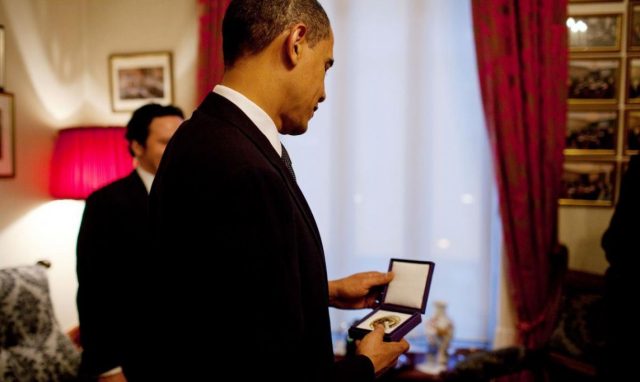
The Myth of Barack Obama as the Great and Noble Nobel Global Statesman
By Martin SIEFF | Strategic Culture Foundation | 27.06.2018
It is no coincidence that the Sword, Sorcery and Dragons Fantasy Games of Thrones – filmed in large part on location in my native Northern Ireland – has entranced the American viewing public over the past decade: For the early 21st century has seen US policymakers and opinion-shapers plunging ever deeper into one fantasy after another. But even Game of Thrones pales in incredibility and absurdity next to the fantasy still believed by most Americans — That Barack Obama was a wise and responsible, peace-loving statesman.
In truth, Obama, casually and with evident self-satisfaction, unleashed series of catastrophic foreign national security policies that sent the world careening to the brink of nuclear war and inflicted needless suffering on scores of millions of people. No Game of Thrones villain ever did anything like that damage.
I have no doubt that the ludicrous award of the 2009 Nobel Peace Prize to Obama will go down in history as the most ridiculous such award in the entire history of the institution.
What in reality was Obama’s record as President of the United States?
He authorized a totally unnecessary and strategically meaningless $1 trillion nuclear build up over the coming generation that will play a major role in bankrupting the United States. It was also a move guaranteed to set off a ruinous global thermonuclear arms race with Russia, China and other powers who understandably fear being made defenseless before a succession of ever more unilateral and unpredictable US leaders.
Obama claimed to be deeply concerned about nuclear nonproliferation and hosted a Nuclear Safety Summit in Washington whose only real achievement was to feed his already enormous and delusional appreciation of his own self-worth.
However, as analyst Rebecca Heinrichs of the conservative Hudson Institute in Washington concluded, “If one actually looks at the risks of nuclear war as well as the likelihood of proliferation at the start of the President’s term compared to now, the Obama’s nonproliferation record earns a failing grade.”
In 2011, Obama a fecklessly allowed his warmongering, hyper-aggressive secretary of state Hillary Clinton to arrange with Britain and France the use of NATO air power to destroy the state of Libya by giving tactical support and protection to rebels against veteran leader Muammar Gaddafi.
Gaddafi’s previous decade of consistent cooperation with the US and its allies in the struggle against extreme Islamist terror and his monitored compliance with demands to scrap Libya’s nascent nuclear [program] were all for naught. Obama and Clinton’s reckless and even clownish policies ensured the complete disintegration of Libya, creating an infernal anarchy in which Islamist terror groups could thrive and metastasize throughout sub-Saharan Africa.
Far from encouraging nations to scrap their nuclear programs as Gaddafi in fact had done, Obama’s childish approval of the destruction of Libya sent precisely the opposite message to nations around the world: “Scrap your nuclear deterrents and there will be nothing to stop the United States from destroying you whenever its leaders feel like it.”
It was the same story in Syria where Obama and Clinton eagerly approved the flow of half a billion dollars a year to such groups including, incredibly the Nusrah Front, the Syrian franchise of al-Qaeda, heirs to the conspirators who [are said to have] killed nearly 3,000 Americans on September 11, 2001.
Obama’s utter ignorance and his clueless ignorance of diplomacy and the conduct of international relations was memorably exposed in his casual approval of the absurd and clownish Michael McFaul as US ambassador to Moscow.
The idea that an accredited ambassador could pass his days in sending out public abusive Twitter messages insulting the head of the state to which he was accredited was ludicrous even if that state was Mauritius, Lichtenstein or Tahiti let alone one of the world’s two thermonuclear superpowers.
McFaul openly worked overtime to give aid and encouragement to domestic opposition to the undermine the legitimate government of Russia: His activities would have provoked calls for full-scale war from the US Congress had any Russian envoy to Washington, DC presumed to act in such a way. None of this bothered Obama for a second.
Even worse was to follow: In 2014, US Assistant Secretary of State Victoria Nuland, the wife of leading neocon ideologue Robert Kagan and also the favored subordinate of Hillary Clinton when she was secretary of state openly paraded in the streets of Kiev, handing out cookies to violent protestors as they overthrew with mob riots and terror the constitutionally democratically elected government of a European nation of 45 million people. Obama fully – albeit, as usual, passively approved.
East-West relations were reduced to a state of chaos and distrust unseen in 52 years since the Cuban Missile Crisis. Obama does not appear to have noticed or even been concerned.
Obama was not totally ignorant and uninterested in international relations. During his casual and ill-attended, poorly documented student years at Columbia University in New York City, he attended only one course in international relations. It was given by none other than Zbigniew Brzezinski, former National Security Adviser to President Jimmy Carter.
Brzezinski was a descendant of the displaced minor Polish aristocracy who through his long career consistently fought to lock the United States into a set policies designed to weaken, disintegrate and encircle Russia with hostile powers and alliances. He was a major foreign policy influence on US Presidents Ronald Reagan, Bill Clinton and George W. Bush.
Brzezinski was Obama’s personal guide and guru to what little the 44th US president dimly grasped of strategic orientation and world affairs. Obama’s near-total ignorance of non-American history and diplomacy gave Brzezinski full scope to manipulate him into accepting all his own most virulent anti-Russian prejudices.
Thanks to Obama, superpower diplomatic relations collapsed to their most parlous state in the entire Nuclear Age. When Obama took office in January 2009, the Doomsday Clock of The Bulletin of the Atomic Scientists journal was set at two minutes to midnight and the journal soberly warned: “The world stands at the brink of a second nuclear age.”
Yet after eight years in power, when Obama left the White House in January 2017, as ignorant, complacent and filled with unearned self-regard as when he came to Washington, the Doomsday Clock stood at three minutes to midnight – two minutes closer than when he had taken office.
We do not need to wait to know the Verdict of History on Barack Obama’s eight years as a global statesman. That verdict is in and it is damning: The Nobel committee should rescind his 2009 Peace Prize. Perhaps it can be given instead to a harmless fantasy TV show like Game of Thrones.
‘UK & US want OPCW powers expanded to justify future attacks against Syria’
RT | June 27, 2018
London’s effort to empower the UN chemical watchdog with the right to assign guilt serves Western interests in finding loopholes and justifications for new attacks against Damascus, investigative journalist Rick Sterling told RT.
“The UK in alliance with the US is hoping to have the OPCW able to assign blame and provide a rationale for future attacks by the US and the UK,” Sterling believes.
Under Donald Trump’s administration, the US used chemical incidents in Syria as a pretext to stage two nearly instant ‘retaliatory’ strikes against Damascus without due investigation. The UK, as well as France, joined the US-led military endeavor this spring when they bombarded government bases and infrastructure in response to an alleged chemical attack in Douma on April 7. A year earlier, Washington unilaterally launched 59 Tomahawk cruise missiles at Shayrat Airbase, as a response to the Khan Shaykhun chemical incident on 4 April 2017.
Moscow has repeatedly criticized the OPCW-UN Joint Investigative Mechanism (JIM) for mishandling its probes, cherry-picking evidence and for vague wording in their reports. JIM’s mandate expired last November, following a number of failed attempts by the UNSC to extend its authority.
“One of the problems is that OPCW has not been willing to go to the sites in some cases and they don’t pursue evidence which contradicts the Western claims,” Sterling noted.
Despite repeated failures by OPCW experts to impartially investigate chemical attack claims in Syria –and at times even to visit the sites of an actual alleged incident– an ongoing special conference of the watchdog in the Hague is set to vote on the expansion of its mandate. The proposed new powers would involve the OPCW declaring any party to a conflict responsible for any chemical incident.
“OPCW has assigned blame to the Syrian government in various instances in the past, including chlorine, but if you look at their reports they rely really on witnesses who are provided to them by the opposition. So it is very logical to question the objectivity and the independence of the OPCW,” Sterling told RT. “Even the director of the OPCW is Turkish. And Turkey, of course, is a member of NATO.”
All of the latest OPCW reports were in large part based on open source data, witness testimonies and video and photo evidence provided by select ‘moderate’ rebel groups and controversial NGOs, such as the Syrian Civil Defence (SCD) –better known as the White Helmets– or the US-based Syrian American Medical Society (SAMS). Those same sources by coincidence were instrumental in heating up international public outrage in the buildup for ‘retaliatory’ US-led strikes against Damascus.
“In the last several years we’ve seen a situation in Syria where the efforts of countries to overthrow, to topple the Damascus government have used claims, accusations of chemical weapons usage, and the OPCW have been a part of that,” Sterling believes.
Ayatollah Khamenei slams West’s ‘shameless’ human rights posture
Press TV – June 27, 2018
Leader of the Islamic Revolution Ayatollah Seyyed Ali Khamenei has strongly denounced the Western states for their pretense of advocating human rights while in reality supporting terrorist groups and acts of terror.
Addressing the staff of Iran’s Judiciary at a meeting in Tehran on Wednesday, Ayatollah Khamenei made reference to human rights violations committed by the United States in various parts of the world as well as France and Britain’s crimes of the past decades which took place in Africa and the Indian subcontinent.
The Leader added that the West’s support over the past years for the Daesh terror group in Syria and the atrocities being committed in Myanmar and elsewhere “is indicative of the repeated lies of the shameless fake human rights advocates.”
Ayatollah Khamenei said when it comes to the issue of human rights, it is actually the Islamic Republic that stands in the position of the true advocate of human rights as opposed to “the criminal Western pretenders.”
The Leader expressed satisfaction with the Judiciary’s work in restoring the Iranian nations’ rights in the face of bullying powers.
Separately, Ayatollah Khamenei advised the judicial officials to work closely with the government towards resolving the country’s economic problems.
‘Systemic corruption a lie’
The Leader criticized certain people who seek to create the impression among the public that there is “systemic corruption” within Iranian state institutions.
Corruption does exist in a number of governmental and commercial enterprises, “but the existence of systemic corruption is not true,” the Leader said. “This wrong impression should not be allowed to affect the public opinion.”
Ayatollah Khamenei further stated that foreign enemies and certain oblivious elements at home have made the Judiciary the target of the most severe propaganda and media pressure.
In order to effectively confront this massive propaganda campaign, the Leader suggested, the judicial system needs to develop a strong and skillful media arm.
The Immigration Con: How the Duopoly Makes the Public Forget about Roots Causes of War and Economics
By Sam Husseini | June 26, 2018
Many are focusing on the travel ban, largely targeting Muslim countries, and the separation and detention of asylum seekers separated from their children at the U.S.-Mexico border. The the U.S. media and political establishment has put the issue of immigration front and center, causing all manner of political venting and pro and anti Trump venom to spew forth.
A silver lining seems to be that it has helped raise issues that — unlike the Russiagate story much of the establishment media has obsessed over — at least have some currency with the general public.
But the manner in which immigration issues have been focused on has obscured the root causes of those issues. Desperate migration is ultimately caused by economics, like so-called trade deals, corrupt Central American governments, often U.S.-backed, U.S.-backed coups and other policies.
And refugees desperately flee countries like Syria largely because of prolonged U.S.-backed wars.
In virtually all these instances, there is left-right opposition to the establishment policy that is often at the root of the problem. The establishment of the Republican and Democratic party have rammed through trade deals like NAFTA and CAFTA and global pro-corporate policies. The U.S. government — with both Obama and Trump administrations — has backed coups like Honduras in 2009 or rigged elections like in 2017.
Corporate deals and coups and such give rise to governments unresponsive to their citizens, enacting economic policies that have impoverished most of the people of these countries. It’s a testament to the long term effects of U.S. interventions that regions like Central America, which have been the focus of so much U.S. government attention over the decades, are in such dismal condition.
Such circumstances breed gangs, which means a lack of safety, causing desperate migration. Parts of grassroots economies, like small farmers growing corn, have been decimated because deals like NAFTA allow for dumping of U.S. agribusiness corn. Drug cartels rise as a way to make money for some — and to fulfill a demand for narcotics in the U.S., an escape for USians from their own economic plights and often nihilistic lives. Meanwhile, transpartisan efforts at drug legalization are pushed to the background.
Similarly, many leftists and some rightwingers, like Ron Paul, oppose constant U.S. interventions in the Mideast as well. The invasion of Iraq lead to the rise of ISIS, the destablization of Syria, Libya and other countries. The U.S. establishment and its allies, Saudi Arabia and Israel have effectively sought to prolong the war in Syria and to destabilize other counties in the region for their geostrategic designs.
The rank and file bases of the Democratic and Republican parties are largely against NAFTA, CAFTA, etc. — while the elites in both parties are for them, so they get done. Clinton and Obama were duplicitously for them (pretending that side deals on labor and environment will do much and thus to distract from their pushing the corporate agenda). Trump rants and raves about much, but hasn’t put forward a serious critique of them.
So, the bases of the two parties end up fuming at each other over the status of migrants from Central America and travelers from largely Muslim countries. They become further entrenched into either establishment party structure while the people running those structures continue to perpetuate policies that the bases agree with each other about.
Wars cause refugees. Then, the left and right scream at each other over the refugees, forgetting how the establishment continues the wars that the left and right are significantly opposed to.
All this has the effect of further entrenching people in their partisan boxes. Progressives with problems with the Democratic Party do their duty to fight against the Trumpsters and vice versa.
So, you get more war and more pro-corporate policies.
The manner of these debates tears people apart just enough to prevent dialogue. Sarah Sanders is told to leave a restaurant, but pundits on CNN urge the public not to be out in the streets arguing. Voting is the one and only path to making your voice heard. Shut up and get in line.
The debates rarely question national myths. Quite the contrary, they are an opportunity for “both sides” to appear to more loudly vocalize how they embody the goodness inherent in the U.S. “We need to reclaim our values… We’re a good nation, we’re a good people. And we should be setting a standard on this planet of what humanity should be about,” says Sen. Cory Booker after the Supreme Court upholds President Trump’s travel ban.
What “humanity should be about”. This from a member of a Democratic Party establishment that has fueled polarization with the other nation on the planet with thousands of nuclear warheads. From a party establishment that has dismissed apparent progress toward finally ending the bloody Korean War. Just this week, Senators from both sides of the aisle voted to allocate more and more money for wars. The recent increases in the Pentagon budget are more than the entire military budget of the great threat, Russia.
But pay no attention to that. National piety is upheld. The U.S. is so wonderful, the immigrants want in. That proves it. Never mind U.S. government policies helped impoverish them. Never mind U.S. government wars destroyed the countries of millions of refugees. Never mind what you think might be wrong with the country, just be grateful you’re here.
U.S. benevolence is to be proven by taking in a nominal number of refugees to some self-proclaimed liberals. So-called conservatives preserved the dignity of the nation not by insisting that the rule of law be applied to high officials, but that we should have zero tolerance for helping some desperate souls.
The diminishing economic state of USians emanating from economic inequality is largely off the agenda of both parties. They entrench the partisan divide, but in a way that obscures deeper issues. Party on.
Sam Husseini is founder of VotePact.org, which encourages intelligent left-right cooperation.
US to Create a Sixth Branch of Its Armed Forces
By Arkady SAVITSKY | Strategic Culture Foundation | 26.06.2018
President Donald Trump has signed an executive order directing the Defense Department to create a Space Force that will constitute a sixth independent branch of the US armed forces. The goal is to ensure American supremacy in space, outstripping other world powers, such as Russia and China. According to him, a mere US presence is not enough. “We must have American dominance in space,” the president emphasized. “We don’t want China and Russia and other countries leading us. We’ve always led,” he added. Once the president’s order has been carried out, the Air Force would likely turn over its space duties to the new branch.
The move meets the provisions of the National Security Strategy. The Joint Vision 2020 states that the US should dominate and control the military use of space.
The idea has substantial backing. It is fairly popular in Congress. A fully-fledged force, complete with a new, four-star general position, new uniforms, and a budget requires congressional action. Congress approves funds and can mandate specific requirements. Rep. Mike Roger (R-Ala.), chairman of the House Armed Services Strategic Forces Subcommittee, rushed to back the president on the issue.
The Air Force is not pleased by the policy, and some military leaders do not support it. Defense Secretary James Mattis opposed it last year. Is he in the loop today? There will be a lot of problems with funds, allocating responsibilities, and reorganizing the other services, each of which has its own component that already deals with space missions. Will a position of space secretary be created? Will the top commander of the new force become a member of the Joint Chiefs of Staff? There will be many questions to answer and problems to tackle.
But in any event, the executive order has been signed, launching the process of creating a new military branch, all of which is yet more evidence that the US is looking aggressively at its future in space and viewing it as a potential war-fighting domain.
The United States already has a very substantial presence there, including unclassified and classified satellites and space planes, such as the classified X-37B. In 2008, it demonstrated its capability to attack space objects by firing sea-based missiles. Back then, the US Navy successfully shot down a nonfunctional spy satellite traveling in space at more than 17,000 mph and 150 nautical miles above the earth over the Pacific Ocean. A cruiser based in Pearl Harbor hit it using a Standard Missile-3.
In 2010, the Air Force launched its first X-37B space plane. Since then, it has been sent up regularly on hush-hush missions lasting for many months. The Dream Chaser reusable space planes will add to this picture. The ballistic missile defense (BMD) system is shifting to air- and space-based systems. And there are other space-based capabilities we don’t know about as yet. Putting weapons into space to achieve global supremacy is high on the US agenda.
According to publicly accessible sources, the Air Force spends around $15 billion every year on space research and activities. The space-operations budget of the classified National Reconnaissance Office is an estimated $10 billion, bringing this total to at least $25 billion.
For many years now outer space has been used as an operational domain for military spacecraft, such as imaging and communications satellites. As yet, however, no weapons have been stationed in space. The US, Russia, China, and other space-faring nations are signatories to the Outer Space Treaty (OST) of 1967, an arms-control deal reached at the height of the Cold War. Recognized by 107 nations (as of April 2018), the OST bars countries from stationing nuclear weapons or weapons of mass destruction anywhere in outer space, including in orbit around Earth. No military bases, tests of any kind, including conventional weapons, or exercises are allowed, but the treaty doesn’t specifically ban the use of conventional weapons in open space or on space stations.
The first-ever draft Treaty on the Prevention of the Placement of Weapons in Outer Space, the Threat or Use of Force against Outer Space Objects (PPWT) was prepared by Russia and introduced to the UN in 2008 with China’s backing. The document was rejected with the US leading the opposition. The Americans claimed the paper did not address the security concerns over space assets. In December 2014, the UN General Assembly adopted a Russian resolution, “No First Placement of Weapons in Outer Space”. America, along with Ukraine and Georgia, voted against it. Moscow has expressed its readiness to discuss the issues related to the prevention of space militarization in its role as a participant in the EU-initiated activities on a draft International Code of Conduct for Outer Space. Washington has never displayed any interest.
Through resolutions and discussions within the United Nations, a general agreement has evolved that an arms race in outer space should be prevented. However, due to the structure of the international legal system and the objection of a small number of states, like the US for example, a treaty has not yet been negotiated that would comprehensively prevent the deployment of space-based weapons. The United States argues that an arms race in outer space does not exist and it is therefore unnecessary to take action to prevent it. It is true that such a race may not exist as yet, but the US appears to be very much willing to start one.
Washington believes that space accords would be too difficult to verify. But it has never come up with any initiative of its own to curb a space arms race. The idea to put weapons in space has been floated by the current administration. In his March 1 address to parliament, Russian President Putin unveiled some details about Russia’s new weapons. The domination of space could change the balance of forces in the US favor.
Creating a Space Force would most certainly prompt other nations to respond, which would in turn trigger a destabilizing form of competition. The weaponization of space will undermine international security and disrupt whatever is left of the eroding arms-control regime.
Hopefully this issue will be on the agenda of the Trump-Putin summit slated for July 15 in Vienna, Austria. A dialog on curbing the militarization of space might be a more efficient way to safeguard US national security than by challenging Russia in space. The problems related to arms control and non-proliferation have received very little attention recently, having been eclipsed by other issues impacting the US-Russia relationship. This top-level meeting is a chance to turn the tide.
Washington’s Syrian Chess Game Leaves Iraqi Forces Battling ISIS Dead
By Whitney Webb | Mint Press News | June 26, 2018
Last Sunday, June 17, local Syrian media reported that the U.S. coalition had bombed Syrian Arab Army installments in the town of Al-Hariri. The bombing killed dozens of Syrian Arab Army (SAA) soldiers as well as 22 fighters from the Iraqi paramilitary group known as the Popular Mobilization Forces (Hashd al-Sha’abi, PMF), which has been collaborating with the Syrian government to wipe out Daesh (ISIS) fighters around the Syrian-Iraqi border city of Abu Kamal in the Deir Ez-Zor governorate.
Soon after the strike, however, the U.S. denied responsibility for the attack, with Pentagon spokesman Adrian Rankine-Galloway asserting that the bombing was “not a U.S. or coalition strike,” while an anonymous U.S. official told Agence France-Presse, and later CNN, that Israel had been responsible for the strike. Israel declined to comment on the allegations.
While Israel was widely blamed for the strike following those media reports, new evidence gathered by Iraq’s PMF from the site of the strike has shown that the attack may, in fact, have been carried out by the U.S. coalition. After collecting fragments of missiles used in the strike, the group – which is sponsored by the government of Iraq – determined that the U.S. had carried out the strike by firing missiles at the SAA/PMF position from a location near the Iraqi border city of Al-Qa’im. U.S. culpability for the attack would mean that it is the second time in less than a month that the U.S.-led coalition has attacked pro-government fighters targeting Daesh within Syria.
The head of PMF’s military operations, Abu Munather Al-Husseini, asserted that the U.S.-led Joint Operations Command (JOC), also known as the U.S. coalition, had been informed by the Iraqi military of the PMF’s location prior to the strike. Thus, if the PMF’s analysis of the strike site is indeed correct, the U.S. coalition had intentionally and deliberately targeted the PMF as well as the SAA in conducting the strike.
As MintPress reported soon after the attack, the strike was launched from U.S.-occupied territory, meaning that either the U.S.-led coalition conducted the attack but publicly denied responsibility, or that Israel was responsible for the attack and “independently” launched the strike from Syrian territory occupied by the U.S.-led coalition. The PMF’s analysis of the strike site has now determined that the former was most likely the case, given that the group had waited to point the finger at Israel or the U.S. until concluding its analysis of the attack.
PMF’s leadership lambasted the U.S. for allegedly carrying out the strike and targeting its forces, while also urging retaliation against the U.S. for repeatedly interfering in its efforts to wipe out Daesh in Syria as well as Iraq. Indeed, just days before the strike, the PMF had successfully launched a major offensive against Daesh in the area of Syria where the strike later took place.
In a statement released on Sunday, PMF Deputy Commander Abu Mahdi al-Muhandis warned of retaliation against the U.S., stating:
We tell the Americans that we as the Hashd [PMF], including all of its formations, follow the Iraqi government. We will not remain silent about this attack. […] Remaining silent on this incident, saying that ‘that position is outside the Iraqi territory, hence we have nothing to do with it’ is forfeiting the blood of our martyrs.
U.S. chess game with ISIS as pawn
U.S.’ actions near Abu Kamal betray the fact that it is seeking to expand the portion of Syria’s Northeast that it currently occupies, an area that accounts for 30 percent of Syria’s total land mass and includes the majority of the country’s oil, gas, fresh water, and agricultural resources. The U.S. has long had its eye on the strategic border town, as it is the main border crossing between Syria and Iraq. More importantly, it is the only border crossing that connects Syrian government-controlled territory with Iran, through Iraq.
A major U.S. goal in its occupation of Syria has been disrupting this land bridge, but continued Syrian government control of Abu Kamal makes this impossible. Were the U.S. to take control of Abu Kamal, it would control Syria’s most important border crossings, as it already controls the Syrian-Jordanian border crossing at al-Tanf.
The U.S.’ interest in Abu Kamal and its recent targeting of forces fighting Daesh in the area suggest that a Daesh takeover of the city is likely to be used by the U.S. as the pretext for the expansion of Syrian territory, a tactic the U.S. has used before in Syria. The possibilities of a Daesh takeover of Abu Kamal have been openly noted by influential U.S. think tanks, such as the Center for a New American Security (CNAS), which recently mused that Daesh control over Abu Kamal would serve U.S. interests in the region, as it would allow the U.S.-occupied zone of Syria to “spread by osmosis.”
For that reason, the recent reappearance of Daesh (ISIS) in Abu Kamal is significant. Indeed, Daesh launched its largest military offensive in several months in Abu Kamal earlier this month, with 10 suicide bombers helping clear the way for Daesh militants to take over parts of the city. The offensive killed 25 Syrian soldiers and allied fighters, according to monitors. Daesh attacked from the U.S.-occupied zone of Syria, despite the fact that the U.S. has long justified its illegal presence in Syria by claiming that it is fighting the terror group. However, Russian and Syrian military sources have asserted that the U.S. is not fighting Daesh in the region, but protecting them.
The strikes on pro-Syrian government forces around Abu Kamal also come amid reports that indicate the U.S. is fortifying its military positions within occupied Syria by constructing military bases along the Euphrates river in proximity to Syrian military installments throughout the Deir Ez-Zor region and by transferring “a large volume of arms and equipment, including missiles, military vehicles and bridge equipment” to those same areas in recent weeks.
Given that the U.S. may soon lose its influence in Southern Syria and its control over the al-Tanf border crossing, thanks to the Syrian government’s offensive in the Dara’a governorate, it is likely the U.S. will continue to fortify its position in the country’s Northeast and expand its efforts to dislodge the SAA and its allies from Abu Kamal in a last-ditch attempt to prolong the conflict and succeed in its efforts to occupy and partition Syria.
Whitney Webb is a staff writer for MintPress News and a contributor to Ben Swann’s Truth in Media. Her work has appeared on Global Research, the Ron Paul Institute and 21st Century Wire, among others. She has also made radio and TV appearances on RT and Sputnik. She currently lives with her family in southern Chile.
Featured Video
US JET SHOT DOWN OVER IRAN /Lt Col Daniel Davis & Nima Alkhorshid
or go to
Aletho News Archives – Video-Images
From the Archives
Experts Warned For Years That A War With Iran Would Happen This Way
By Caitlin Johnstone | April 3, 2026
… It’s so wild how we keep seeing reports that Iran’s retaliation caught the US off guard. For all the years I’ve been paying attention to this issue I’ve been reading experts and analysts saying if the US attacks Iran, Iran can close the Strait of Hormuz and strike US bases and the energy infrastructure of US allies in the region.
A few examples:
A 2006 Oxford Research Group paper titled “Iran: Consequences of a War” warned that Iran has numerous options at its disposal in the event of a US attack, and that the “most significant of these would be any possible retaliatory Iranian action to affect the transport of oil and liquefied natural gas through the Straits of Hormuz,” adding that stopping Iran from doing this “would be difficult if not impossible to achieve, leading to a fear of attack which alone would have a formidable impact on oil markets.”
A 2007 Cato Institute paper titled “The Iraq War and Iranian Power” warns that “Iran possesses the largest ballistic-missile inventory in the Persian Gulf — missiles which can reach Israel, Saudi Arabia and US military bases in Iraq,” and that “experts argue Iran could also use the ’oil weapon’: blocking the 34km-wide Strait of Hormuz and conducting submarine and anti-ship missile attacks against ports and oil facilities in Saudi Arabia, Kuwait and other Gulf Cooperation Council states.”
A 2012 NPR article titled “Can Iran Close The World’s Most Important Oil Route?” features then-chairman of the Joint Chiefs of Staff acknowledging that Iran absolutely can block the Strait of Hormuz, saying Tehran has “invested in capabilities” which specifically enable them to do so.
A paper from the Columbia Center on Global Energy Policy and the Center for a New American Security titled “IN DIRE STRAITS? IMPLICATIONS OF US-IRAN TENSIONS FOR THE GLOBAL OIL MARKET” warns of a potential scenario “that includes damage to Gulf oil infrastructure and a temporary closure of the Strait of Hormuz.”
These weren’t a bunch of keffiyeh-wearing peaceniks making these assessments, they were deeply entrenched swamp monsters entirely loyal to the US empire. They opposed war with Iran not because it would be an evil act of unforgivable mass murder, but because it would be bad for the imperial power structure. … Full article
Blog Roll
 Aletho News
- Al Mayadeen voices solidarity with Dr. Marandi amid death threats
- US dismantling international law in its war against Iran while claiming ‘false’ victory: Legal scholar
- One martyr, 5 injuries in US attack on Iraqi border crossing with Iran
- ‘This war is Israel’s war’: World facing ‘security breakdown’, says Qalibaf
- IRGC decries attack on US embassy in Riyadh, says executed by ‘Israel’
- Iran blasts EU hypocrisy as EU invokes international law over Hormuz
- There is no military solution to Strait of Hormuz
- NATO’s structural collapse – the outcome of deviation from reality
- Poll finds world views China better than US
- One Of America’s Leading Neo-Cons Has Turned Against The Iran War And Israel
- If Americans Knew
- US loses planes over Iran, Israel downgrades Lebanon war goals – Daily Update
- Israel Is Blocking Palestinians from Easter at Church Where Jesus Resurrected
- Plot to assassinate Palestinian activist follows harassment campaign promoted by Zionist groups and elected officials
- Prominent New York synagogue hosts presentation on why U.S. Jews should support the ethnic cleansing of Gaza
- Tapper vs. Piker: Is the CNN Anchor Auditioning for David Ellison?
- Shouldn’t Democrats Be Able to Condemn Genocide?
- Israel-US kill negotiators, destroy civilian structures, but Iran’s military capabilities still largely intact – Daily Update
- ‘War crime’: Global condemnation as Israeli ministers celebrate death penalty law targeting Palestinian prisoners
- 7 Ways Israel Is Turning Lebanon Into Gaza
- World’s Leading Football Bodies Under Fire Over Israel Policies
- No Tricks Zone
- New Study Reports A 60% Slowdown In Greenland’s Ice Loss Rate In The Last Decade
- Low Intensity Tornado Wrecks Major Solar Farm, Creating A Potential Toxic Dump
- New Study Finds Warming Saves Lives…Cold Temperatures 12 Times More Deadly Than Excess Heat
- German Science Blog Accuses PIK Climate Institute Of Hallucinating Climate Tipping Points
- Devastating Assessment Of Comirnaty Vaccine By Former Senior Pfizer Europe Toxicologist
- New Study: CO2 Is ‘Effectively Negligible’ As An Explanatory Climate Change Factor Since 2000
- Former Pfizer Toxicologist Dr. Helmut Sterz Tells Bundestag Hearing Pfizer Vaccine Should Have Never Been Approved
- Energy Expert: Germany’s Nuclear Phaseout Was A “500 Billion Euro Mistake”
- New Research: South Australia’s Mid-Holocene Sea Surface Temperatures Were 4°C Warmer Than Today
- Storing Green Energy To Last Germany 10 Days Would Require A 60-Million Tonne Battery
 Aletho News