First Covid-19 deaths in US occurred WEEKS EARLIER than previously thought
RT | April 22, 2020
People in the US were dying of the novel coronavirus weeks before authorities officially reported the first death linked to the disease, new data published in Santa Clara County, California reveals.
Autopsies performed on two people who died at home on February 6 and February 17 show that their tissues were infected with Covid-19, Santa Clara health authorities said in a statement, adding that another previously unreported death associated with the coronavirus had occurred on March 6.
The first coronavirus-linked death in America was originally believed to have occurred on February 29. At that time, the Centers for Disease Control and Prevention (CDC) confirmed that a man in his 50s had died in Washington state.
The California cases were not previously associated with the epidemic as these victims died at a time when “only individuals with a known travel history and who sought medical care for specific symptoms” were being tested, the statement said.
The news suggests that the virus may have been circulating in the US earlier than previously thought. Santa Clara County Executive Jeff Smith said the fact that several people were apparently infected “right around the beginning of February and late January” – and that two of them had passed away – meant “the virus has been around for a while.”
According to Mercury News, both of the fatal cases are believed to have originated in the community and were not associated with foreign travel. This also means that community transmission in America had started well before the first such case was officially reported on February 26.
The US has seen more than 800,000 confirmed coronavirus cases to date. More than 45,000 Americans died of Covid-19.
France and COVID-19: Incompetence and Conceit
By Patrick Howlett-Martin | CounterPunch | April 22, 2020
On December 31, 2019, the Chinese government informed the World Health Organization of an epidemic of animal origin in Wuhan, reporting similarities to SARS-CoV (Severe Acute Respiratory Syndrome Coronavirus, originally appearing in 2002 in the province of Guangdong) and to MERS-CoV (Middle East Repiratory Syndrome, originally appearing in Saudi Arabia in 2012). On January 12, Chinese scientists shared the completely sequenced genome of this new coronavirus with the entire international scientific community.
The epidemic had already killed 80 people in China and thousands were infected. The city of Wuhan (11 million inhabitants) and the province of Hubei (60 million inhabitants the city of Wuhan included) were isolated on January 25-26. Factories, offices, stores, schools, universities, museums, and airports were all closed down.Urban transportation in the city was significantly reduced. As a precaution, the authorities extended the Chinese New Year vacation by one week (January 23-31) to cover the incubation period for the virus among the inhabitants of Wuhan who left the city and could have been infected. They set up shelter hospitals (“fangcang”) in gymnasiums, conference centers, hotels, and other facilities to separate the symptomatic and the likely-infected from their healthy relatives. With the number of ill people exceeding local hospital capacity, the authorities set up two 1,200-bed hospitals in fifteen days and summoned medical and voluntary nursing personnel from all over China. More than 42,000 healthcare personnel responded. Despite the use of Personal Protective Equipment, 4.4% of them (3,387) had tested positive and 23 had died as of April 3 according to the Chinese Red Cross.[1] The lockdown was strict and neighborhood committees were mobilized to ensure food deliveries to the inhabitants. Masks were requisitioned and distributed to the population. Street fixtures and furniture were disinfected, even banknotes were disinfected. The average age of the ill was 55 and 56% of them were men. No case of infection was reported in anyone under the age of 15.
All this information was shared in international medical journals by Chinese doctors and researchers starting on February 20.[2] The creation of hospitals ex nihilo in the space of a fortnight was given ample coverage in the media but the French authorities did not appreciate the gravity of the implications: they preferred to view the initiative as the Chinese marketing their public works. In mid-January, COVID-19 cases were recorded in Bangkok, Tokyo, and Seoul. Thermal sensors were installed in the airports of China, Korea, Thailand, Taiwan, Hong Kong, and Singapore. On January 26, the authorities in Hong Kong cancelled all sports and cultural events. A testing campaign began in the city on February 18.
And what of France? On January 24, the Ministry of Health announced that three patients coming from China had been hospitalized with the coronavirus. The French National Institute of Health and Medical Research (INSERM) outlined two scenarios for the spread of COVID-19: one high-risk, the other low-risk. Given air traffic, the countries estimated to be the most exposed were Germany and the United Kingdom. Italy was not even mentioned. The Minister of Health, Agnès Buzyn, commented on the INSERM scenarios that same day as she left the Council of Ministers: “the risk of secondary infection from an imported case is very low and the risk of propagation of the virus in the population is also very low.”[3]
On January 30, France repatriated 250 French citizens and 100 European immigrants from Wuhan, putting them in quarantine in southern France. On February 10, a British citizen coming from Singapore infected five other people in the small Alpine ski resort of Contamines-Montjoie. A summary screening did not detect other cases at the resort. The infected were hospitalized. Buzyn reminded us on that occasion that “the risk of infection is very low; only close and sustained contact with an infected person can increase it.”[4]
At that point, with 900 reported dead in China, WHO Director-General Tedros Adhanom Ghebreyesus made clear reference to the danger of global propagation, “we may only be seeing the tip of the iceberg.”[5]
But in France the authorities—duly warned but strangely untroubled—took no particular measures. On March 6, while at the theatre with his wife, President Macron stated, “Life goes on. There is no reason, except for the more vulnerable members of the population, to change our outing habits.”[6] His aim was to encourage the French to continue to go out despite the coronavirus epidemic and the lack of protective masks. That same day, the Italian government decided to lock down Lombardy, extending the provision to the entire country the following day. While Macron was enjoying the performance, there were 613 cases of coronavirus in France and the number was doubling every three days (roughly the same rate recorded by Chinese physicians in Wuhan in January and seen in South Korea and Italy). Extrapolating this exponential growth, it could be estimated that on March 16 there would be approximately 6,500 cases; the final official figure was 6,633.
The French government was all focused on the pension reform, president Macron’s top priority. Protests were organized in all French cities: retirees, railway workers, physicians, lawyers, fire fighters, and students all took to the streets. The demonstrations were violently suppressed by the police. Economists were in unanimous agreement—a rare event—that the proposed reform would harm all categories of worker except those in the upper income brackets. Sociologists warned the government about the deepening social schisms, as had been thrust into the public eye earlier with the 12 months revolt of the gilets jaunes [yellow vests]. These protests had been staged every Saturday for nearly a year in all cities in France, drawing in a broad range of the hardest-hit social and occupational categories, a large portion of whom were pensioners. But all for naught: on Saturday afternoon, February 29, with the chamber of the Assemblée nationale -where the debate on the bill was taking place—almost empty because of the of the day, the government seized the opportunity of the COVID-19 pandemic to pass pension reform by constitutional decree. On that date, gatherings of more than 900 people were prohibited because of COVID-19. The authorities no longer risked protests by the people in the street.
But the Macron administration did not stop there. Against the advice of the medical team and the stadium manager, it authorized a Juventus–Olympique Lyonnais football match for the Round of 16 in the Champions League. Three thousand Italian fans were in Lyon on February 26: at that time Italy had 21 coronavirus deaths and 900 people infected. Dr. Marcel Garrigou-Grandchamp, who had warned the new Minister of Health on the morning of the match, published an opinion piece on the website of the Fédération des Médecins de France on March 31, where he spoke of an “explosion” in coronavirus cases in the Département du Rhône some two weeks after the OL–Juventus match. A similar sequence of events had taken place in Italy with the Atalanta B.C. – Valencia match on February 19, termed a “bomba biologica” by many Italian physicians. It was March 4, fifteen days after the match, that the number of cases in the Lombard city of Bergamo exploded, making it the most heavily impacted city in Italy. Walter Ricciardi, Italian representative to the WHO, acknowledged that the match had been a “catalyst for the propagation of the virus”. The Paris-Nice 8-stage professional cycling race was held as scheduled from March 8th to the 15th. More significantly, the government confirmed the first phase of municipal elections on March 15, after it had ordered the closure of schools and universities on March 12 and the shutdown of most stores, bars, and restaurants on March 14. There are 34,000 communes in France that had to organize the elections with local volunteers: volunteers and voters without adequate protection—there were no masks available. The government had requisitioned them for hospital personnel, where the shortage was critical. Half of the voters stayed home for safety’s sake. To make matters worse, Agnès Buzyn announced her candidacy for mayor of Paris on February 16, less than one month before the election, to take the place of the government’s candidate, Benjamin Griveaux, who had been discredited when an explicit video he had sent to a young woman was posted online. Buzyn left the Ministry of Health in the middle of the Coronavirus crisis. The healthcare workers who had organized numerous strikes over the previous eleven months to protest the deterioration of public hospitals felt belittled. Losing by a wide margin, Buzyn declared in an interview for Le Monde that the election had been a “masquerade”.[7] The lockdown was not ordered until the day after the elections, politique oblige.
The new Minister of Health, Olivier Vérant, a member of parliament with the party in power, took up the government’s mantra, one that every minister and secretary of state is expected to chant in unison: “masks are useless, the tests are unreliable”. They all swear by handwashing and lockdowns. No reference is made to the way things had been handled in Seoul, Hong Kong, or Taiwan, where free masks were distributed and people were required to wear them, and large-scale testing was carried out, and where economic life goes on, in slow motion, but it goes on. Today, with 23 million inhabitants, Taiwan has recorded 6 COVID-19 deaths; Hong Kong, with 7 million inhabitants, has lost 4. As for the French doctors who were in Wuhan working alongside their Chinese colleagues and thus well informed, they were not even consulted.
The French police stop and fine transgressors, solitary walkers or joggers, while the metro, airports, trams, and buses are all operating and supermarkets and tobacconists are open for business. The police are themselves without masks and many fall victim to the virus, becoming potential carriers. The same is true of healthcare and administrative personnel, working without personal protective equipment in retirement homes. The authorities refused to report the number of victims among healthcare workers, citing “medical secrecy” concerns. The elderly die but are not counted in the official statistics. Nor are those who die at home. Now that their numbers are so high and can no longer be ignored, we discover that the residents of these retirement homes account for 40% of the deaths recorded in France. They are not hospitalized. Their treatment? Paracetamol for the mildly afflicted, morphine for the rest. Close to half of the nursing staff in retirement homes are affected by the epidemic.[8] But the government is powerless: it does not have sufficient testing solution and will not allow tests to be conducted in retirement homes unless there is a confirmed case there. Ubuesque!
The borders remain open. President Macron refuses to close the border with Italy, which the leader of the Rassemblement National party, Marine Le Pen has been demanding since February 26. For the Head of State, the problem posed by the epidemic “can only be resolved through perfect European and international cooperation.” The events of the following days would quickly contradict this wishful thinking. Every country has closed in on itself. But not France. There are no health controls at French airports, train stations, or ports. Not even today, April 18, 2020, when the official death toll has reached 18,000. In the worksite next to my home, Italian workmen come to work, without protective equipment, every morning on the 7:35 train from Ventimiglia, getting off at the Gare d’Eze: no checks when they depart, no checks when they arrive. Italy has now officially recorded more than 23,660 deaths. On its April 18 evening newscast, the television station Antenne 2 aired the report by journalist Charlotte Gillard, who had taken an Air France flight from Paris to Marseille: the plane was packed, not a free seat, the passengers did not have masks, no one’s temperature was checked on either departure or arrival.
We gradually learn from news reported in the press that France currently has no stores of masks or test kits. For economic reasons—annual savings of 30 million euros—the country’s strategic stocks were depleted in 2012 and never replenished. On the eve of 2020, when the coronavirus epidemic began to spread, France’s supplies consisted of zero FFP2 masks, 117 million adult surgical masks, and 40 million pediatric masks! The hospitals are experiencing critical mask shortages. The nursing staff in retirement homes have no protection (no gloves, no masks, no sanitizing gel). There is no more sanitizing gel available in pharmacies or stores. Doctors and nurses do not have the equipment they need. As for hospitals, they have neither enough beds nor enough ventilators to adequately cope with the epidemic.
The French authorities do not admit it publicly. And they seem to drag their feet for reasons that are impossible to grasp. They did not expect this. And when it began to materialize, they denied it for reasons that can only be called conceit, a traditional mark of distinction among the French political elite. The French regions authorities, realizing the government deficiencies, order and purchase their supplies directly from China. When they arrive, they are requisitioned by the state: thus 4 million masks that were ordered from China by Bourgogne-Franche-Comté for the nursing staff in its retirement homes were confiscated on the tarmac of the Basel-Mulhouse airport by the police on April 4, using methods that would make a gangster blush. As for the rare mayors who have stocks of personal protective equipment and graciously make them available to the local population, requiring the use of masks, they are taken to court by the Ministry of the Interior, which wants to preserve its royal prerogatives. On April 16, the Council of State, the highest administrative body in France, asserted its regal status by limiting the power of mayors. The decision calls to mind its role in 1942-1944 during the Vichy regime. It stays true to itself; it serves the State, not the Nation.
The nurses in the intensive care units in Paris hospitals report that given the shortage of beds and ventilators, they are essentially practicing battlefield medicine. This means there is a triage among the sick, choosing between those considered too old and those the doctors feel have a better chance of recovery.[9] It is no coincidence that the two European countries least afflicted by the pandemic are well-equipped Austria and Germany, which have not, so far, experience a shortage of beds or ventilators. In France, veterinarians are lending their ventilators to hospitals! Instead of nationalizing private clinics as they have done in Ireland, they transport patients long distances in medical trains, helicopters, or buses to less congested hospitals in the province or abroad (Germany, Switzerland, Luxembourg), increasing the possibility of infecting healthcare personnel and the risk of death. The statistics are biased because patients over the age of 75 do not have access to the ICU services: this is a sad fact for retirement homes.
It was not until March 28 that the Minister of Health, Olivier Véran, announced: “More than a billion masks have been ordered from France and other countries for the coming weeks and months.” This was the man who a few days earlier repeated publicly, in a sort of litany, that masks were useless.
In its decision of April 15 on the screening and protection of the elderly, the Council of State revealed the extent of the disaster. Assailed by associations demanding that people living in retirement homes and their caregivers be systematically tested and that protective equipment (masks, sanitizing gel) be distributed, the Council of State limited itself to reciting the paltry figures promulgated by the government (“40,000 tests per day will be available across the country by the end of April; 60,000 will be available in the weeks to come”). So in mid-May, France will be ready to do close to what Germany has already been doing for a month and a half: 500,000 tests per week. As for masks, the “current orders amount to some 50 million masks”. However, given the delivery rate, it will take nine months to receive them all.
There are 430,000 healthcare personnel and 752,000 pensioners in retirement homes and health centers. All told, there are close to a million healthcare professionals (210,000 active doctors and 700,000 nurses and nursing assistants) in France.
Under these conditions, it is clear that Macron’s announcement of the end of the lockdown and the resumption of school classes on May 11 is a gamble. If all teachers were to return to the classroom, that would mean 870,000 masks per day—reuse of masks is contraindicated. And if all the students return on this date, or even gradually, they would have to be supplied with more than 12 million masks per day.
Even with the President publicizing the “grand public” mask, a French invention no doubt handcrafted locally, the end of the lockdown on May 11 and the resumption of school classes is at best a gamble; without reliable masks to protect the entire population, it is a risky and irresponsible act.
The end of a health crisis that the authorities did not anticipate will be all the more painful for the French, both fiscally and socially, with the President and his administration coming out of this ordeal diminished and wholly discredited.
Notes.
1) “Death from Covid-19 of 23 Health Care Workers in China”, The New England Journal of Medicine, April 15, 2020.
2) The Lancet and the New England Journal of Medicine, see Chen Wang “Covid-19 control in China during mass population movements at New Year”, February 20, 2020 (on line).
3) Statement to the press, BFM TV, Palais de l ‘Elysée, January 24, 2020.
4) Benoit Pavan, “Coronavirus : la station de ski de Contamines-Montjoie, en Haute-Savoie, un foyer potentiel en France”, Le Monde, February 10, 2020.
5) Frederic Lemaître, “Coronavirus : la semaine où tout peut basculer”, Le Monde, February 9, 2020.
6) BFM TV, March 7, 2020.
7) Ariane Chemin, “Les regrets d’Agnès Buzyn : ‘On aurait dû tout arrêter, c’était une mascarade’”, Le Monde, March 17, 2020.
8) Béatrice Jérôme, Lorraine de Foucher, “Dans les Ehpad décimés par le coronavirus, ‘c’est un cauchemar collectif’”, Le Monde, April 2,l 2020.
9) “Une situation de médecine de guerre”, Nice Matin, April 16, 2020.
Patrick Howlett-Martin is a career diplomat living in Paris.
Modernisation of Nuclear Triad Pentagon’s ‘First Priority’ Amid Virus Outbreak: DoD Official
By Oleg Burunov – Sputnik – 22.04.2020
February 2018 saw the rollout of the US’ new Nuclear Posture Review, which specifically maintained the need for updating its nuclear triad in the country’s defence strategy.
Developing the US nuclear triad remains a key task for the Pentagon amid the ongoing COVID-19 pandemic, Ellen Lord, US under secretary of defence for acquisition and sustainment, told a virtual press briefing on Monday.
“Obviously, our first priority in DOD [Department of Defence] relative to acquisition is the nuclear modernization process of the nuclear triad, [which includes intercontinental ballistic missiles, atomic submarines and strategic bombers]. We look at Missile Defense Agency. We look at those critical capabilities we have”, she pointed out.
Referring to the Pentagon’s “continued efforts to mitigate impacts from COVID-19”, Lord also pointed to the DoD’s main focus on “the greatest pain points”, which she said are “really aviation, shipbuilding, and small space launch.”
Her remarks came as the number of confirmed coronavirus cases in the US military had increased to 3,496 as of 21 April, according to the Defence Department’s latest estimates. The military’s COVID-19 death toll currently stands at two.
US’ New Nuclear Posture Review
In early February 2018, US President Donald Trump presented the country’s new Nuclear Posture Review (NPR), which, in particular, underscored the necessity of developing the American nuclear triad.
The document clarified that Washington “would only consider the employment of nuclear weapons in extreme circumstances to defend the vital interests of the United States, its allies and partners.
The NPR addressed US nuclear capabilities, as well as the challenges allegedly posed by Russia, China, rogue states, and nuclear terrorism.
According to the document, US nuclear forces should contribute to the “deterrence of nuclear and non-nuclear attack”, “achievement of US objectives if deterrence fails”, and “capacity to hedge against an uncertain future.”
Trump says ordered Navy to destroy Iranian boats ‘if they harass’ US ships
Press TV – April 22, 2020
US President Donald Trump is stepping up his anti-Iran threats by claiming that he has instructed the US Navy to destroy Iranian boats “if they harass” US ships in the Persian Gulf.
“I have instructed the United States Navy to shoot down and destroy any and all Iranian gunboats if they harass our ships at sea,” Trump wrote in a tweet posted on Wednesday morning.
The order is Trump’s first reaction to a recent confrontation between US warships and Iranian boats in the Persian Gulf.
Trump posted the tweet as his administration is under unprecedented pressure over its highly criticized response to the coronavirus pandemic, prompting suggestions that his anti-Iran statement is probably meant to divert attentions from his poor handling of the crisis.
A video released by Iran’s Islamic Revolution Guards Corps on Sunday shows the IRGC Navy warning off a flotilla of US warships in the Persian Gulf as they try to approach the Iranian territorial waters.
In the video, a personnel of the IRGC Navy warns the vessels to stop inspecting and detaining Iranian fishing or commercial ships in the Persian Gulf and the Sea of Oman.
He also warns them that they would face consequences according to the laws of the Islamic Republic of Iran if they ignore this notice.
Tensions in the strategic waterway rose significantly last summer after a series of mysterious explosions targeted a number of oil tankers.
The US, quickly blaming Iran for the incidents without providing conclusive evidence along with other countries such as Saudi Arabia, has since deployed thousands of troops and military equipment to the region.
Meanwhile, in a statement released on Sunday, the IRGC refuted the claims by the US that Iranian forces behaved in a dangerous manner when faced with US Navy vessels.
The IRGC further blamed Washington as the main source of insecurity in the in West Asia region and called for the full withdrawal of all American forces.
Renouncing Israel on Principle
How to answer the question, “Do you affirm Israel’s right to exist?”

By Steven Salaita | December 9, 2019
When anti-Zionists discuss the Middle East, the topic of Israel’s existence rarely arises. It’s almost exclusively a pro-Israel talking point. We’re focused on national liberation, on surviving repression, on strategies of resistance, on recovering subjugated histories, on the complex (and sometimes touchy) relationships among an Indigenous population disaggregated by decades of aggression. That a colonial state—or any state, really—possesses no ontological rights is an unspoken assumption.
“Do you recognize Israel’s right to exist?” pretends to honor the downtrodden, but it is an altogether different proposition, transforming sophisticated ideas of liberation into a crude test of political respectability. Prioritizing the state as worthy of relief, as something to which we automatically owe deference, subsumes life to the imperatives of capital.
The fundamental goal of the question is to attribute a sinister position to dissidents. It accomplishes that goal even when the dissidents haven’t promoted destruction. Mere defense of Palestinian life is enough to evoke the settler’s existential fear. For people socialized into orthodoxy, Israel is synonymous with progress, technology, and production. Affirming its existence is an endorsement of the status quo; no matter how ludicrous as a moral premise, in capitalist spaces it is a perfectly sensible demand.
There are plenty of reasons to eschew the demand. The first reason is practical: we don’t advocate for the destruction of human communities, but of ideologies conducive to racism and inequality. It’s both insidious and unethical to conflate Jewish people (of any national origin) with the existence of a violent, rapacious polity. That sort of conflation is a grave disservice to activists and intellectuals devoted to a better world—and to the communities for whom a better world is a necessity of survival. Nobody has ever asked me to affirm another nation-state’s existence, a demand I would likewise decline. Zionists constantly single out Israel for special treatment.
Moreover, it is remarkably impudent for champions of a state founded on the destruction of Palestine and now in its eighth decade of ethnic cleansing to ask the victims of its malevolence for recognition. Even worse, recognition is only the tip of the demand. We’re also being asked to legitimize apartheid and ignore the routine commission of war crimes. The upshot is to validate Israel as a militarized object of Western imperialism—in other words, to affirm the existence of a deeply antihuman entity.
Let’s consider the demand in context of North America, where it’s most frequently issued. Those of us operating in this geography haven’t the authority to abdicate nearly 80 (and arguably 100) percent of historical Palestine. It’s not any Westerner’s prerogative to relinquish Palestine under the pressure of a spuriously humanistic insistence by Zionists that their perfidy be excused because it will somehow make us more responsible citizens.
I am happy, eager even, to affirm the right of Jewish people to live in peace and security, wherever that may be, a right all humans deserve in no particular order of worthiness. But I won’t ratify Israel’s bloody founding or its devotion to racial supremacy. Ultimately, when Zionists demand that you affirm Israel’s right to exist, what they really seek is affirmation of Palestinian nonexistence.
Beyond these philosophical, political, and practical factors, there’s a worthy psychological reason to refuse the demand. Zionists are the bully in this supposed conflict and enjoy nearly universal support in centers of political and economic power. They have more funds, access to corporate media, and the backing of the US military. Palestinians, however, hold one form of power that doesn’t require money, platforms, or weaponry: the ability to withhold legitimacy from Israel. It is a small power, without a material apparatus, but it is power, nevertheless, one that only a fool or opportunist would relinquish. When an oppressor makes submission the basis of civic responsibility, insolence is the only dignified response.
All Smoke and No Gun at the OPCW
By Jeremy Salt | American Herald Tribune | April 16, 2020
Over the past decade, the London Guardian has never reported the war on Syria in any way commensurate with the principles of true journalism. It is had been running a line, consistently slanted to do as much damage to the Syrian government as possible. As such, it has been a central conduit in the propaganda war. It closed down ‘comment is free’ on its Syria articles long ago because well-informed readers could see what it was up to and were writing embarrassing correctives.
Throughout, its language has been the language of propaganda – ‘the regime,’ ‘Assad loyalists,’ ‘the dictator,’ ‘the rebels’, ‘the armed opposition,’ ‘the uprising,’ ‘the civil war,’ so on and on, endlessly. Its ‘coverage’ has always been calibrated to the damage it thinks it can do to the Syrian government. In fact, by supporting its ‘rebels’ and by implication the governments arming and financing them, it has only aggravated the damage being done to Syria and its people who, all the evidence suggests, overwhelmingly support their president and their army, not these ‘rebels.’
Silent when its ‘rebels’ are taking a beating, the Guardian springs to life the moment there’s a fresh opportunity to abuse Syria’s president. Accordingly, when the OPCW (Organization for the Prohibition of Chemical Weapons) issued its latest report on chemical weapon usage in Syria, its sibling Sunday paper, the Observer, was quick off the mark, running a headline on April 12 reading “The Observer view on the smoking gun that should force Assad to face justice.” It went on: “For the first time the world’s chemical weapons watchdog has directly accused Syria’s leadership of ordering illegal attacks on its own people.” Stating accusations from concealed sources as fact, it concludes that “the tyrant in Damascus has not yet won.”
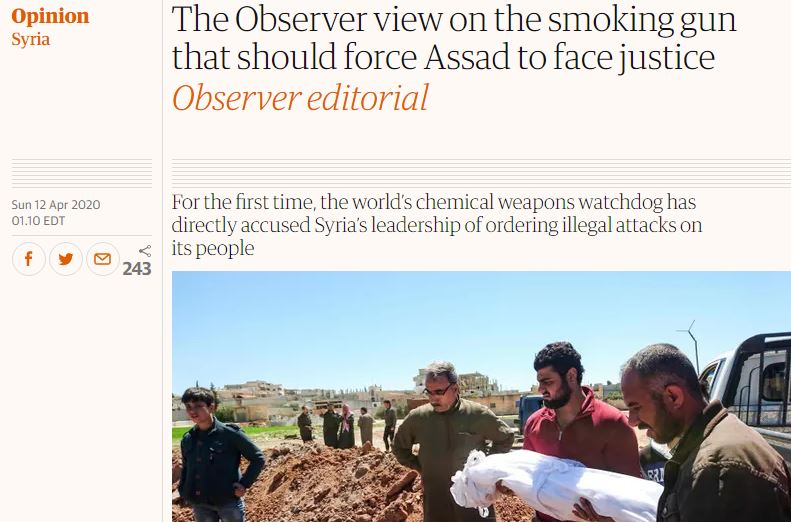
As it turns out, the OPCW report is all smoke but no gun. Unsurprisingly, given their Syria coverage, the Guardian and the Observer are not even interested in distinguishing between the two. For their purposes, the smoke is as good as the gun. What they call “the world’s chemical weapons watchdog” is actually a watchdog protecting the interests of the governments attacking Syria through armed proxies. The Guardian and the Observer are watchdogs protecting the same interests, which in this case means protecting a tainted report coming from a tainted source.
Last year whistleblowers revealed that the OPCW executive had suppressed the interim report by the Fact Finding Mission (FFM) on the alleged chemical weapons attack on Douma in April 2018, and had issued a doctored final report, reversing the on-the-spot findings of its own experts.
The final report concluded that the cylinder said to have crashed through a roof had probably been dropped from the air when its own engineers had arrived at the “higher probability” that it had been placed there manually. As for the heavy amounts of chlorine it suggested had been released from this cylinder, killing 43 people, according to anonymous “witnesses”, what its own chemists said they found in the air were microparticles no different from what would have been in the air normally. On January 20 this year, the OPCW’s inspection team leader at Douma, Ian Henderson, told a specially convened session of the UN Security Council that the evidence indicated there had been no chemical weapons attack at all at Douma.
Its fraudulent behavior exposed, the OPCW secretariat tried to dismiss the evidence of its whistleblower engineers and scientists as “subjective” but the damage to its credibility was terminal, and in seeking to uphold a tainted report from a tainted organization, the Guardian and the Observer only underscore the tainted nature of their own ‘reporting’ and editorials on Syria.
Wisely, in this latest report, dated April 8, “The First Report by the OPCW Investigation and Identification Team” (IIT), a body established in 2018, the OPCW does not return to what happened at Douma in 2018. The subject matter this time is chlorine and sarin attacks said to have been carried out in and around the “village” of Ltameneh on March 24, 25 and 30, 2017.
In fact, Al Lataminah (“Llatameneh”) is not a “village” as described in the IIT report but a town with a population of more than 16,000, according to the census of 2004. This has probably shifted upwards or downwards since then. Close to Hama and only a few kilometers from the strategically important M5 highway, the town is located within territory in the Hama governorate that was under the control of Hayat Tahrir al Sham and other terrorist factions when the chemical weapons attacks were said to have taken place in 2017. Al Lataminah itself was the headquarters of Jaysh al ‘Izza (Army of Glory).
According to the IIT, there were three attacks, one of chlorine and two of sarin, on March 24, 25 and 30, each in cylinders or bombs dropped from the air by Syrian air force SU (Sukhoi) 22 fighter aircraft or helicopters. The format of the report is identical to the format of all its reports, and indeed all the reports put out by the UN’s Independent International Commission of Inquiry on the Syrian Arab Republic. Lots of acronyms, weighty officious language implying authority, lots of imputations but virtually nothing in the form of evidence that would stand up in a court.
The sources, individual, institutional and governmental (“state parties”) are all concealed. The OPCW says it sought entry into Syria, but was ignored by the Syrian government, which is hardly surprising given the fakery of its report on Douma. It talks of witnesses, who, as its investigators were not on the spot inside Syria, have to be regarded as alleged witnesses. It does not say who they were or where they were when interviewed, but Turkey would be most likely. Neither is there any mention of possible affiliations, perhaps to the White Helmets or one of the armed groups.
The report ties the alleged attacks to the close proximity of Syrian airbases and the daily activity of Syrian aircraft as they take off and return. Syria is fighting a war against terrorist groups that have infiltrated and taken over large parts of the Hama and Idlib governorates, so of course military planes and helicopters are frequently in the air. The ITT imputations that they might have been or could have been involved in chemical weapons attacks are devoid of substance.
The IIT report talks confidently of its chain of custody, including shell remnants said to have been taken from craters to one of its (unidentified) designated laboratories. It does not say who allegedly carried this material out of Syria but as Jaysh al ‘Izza was then in control of the town, one of its members or its sympathizers, committed to the destruction of the Syrian government and out to blacken its name whenever possible, is the most likely.
Included in the IIT evidential chain is information “obtained” during interviews, information “previously” provided by “witnesses,” interviews with “persons of interest” along with the evidence of other unidentified “witnesses” to the attacks and people affected by them. Again, these are alleged witnesses to an alleged attack and people allegedly affected by these alleged attacks. They were NOT interviewed in Syria and the IIT report provides no proof of their authenticity.
The IIT’s further sources include unidentified videos and “documents,” as well as “relevant material” from “various sources,” briefings and advice from unidentified “experts” and “specialists,” information from unidentified “open sources” and “forensic institutes,” and unspecified input from unidentified “state parties.”
Noting the use of tunnels at Al Lataminah by Jaish al ‘Izza, a “military expert” advising the IIT “noted [that] the use of chemical weapons in this area would not be inconsistent [my italics] with a strategy aimed at inflicting terror on both civilians and combatants.” Neither, of course, on the basis of past compelling evidence, would it be inconsistent with the proven attempts by terrorist groups to lure outside governments into launching an air war on Syria by staging faked chemical weapons attacks. The IIT refers to the possibility of a staged attack, but does not take it seriously.
It claims to have received information “from multiple sources”, unidentified of course, that senior Syrian Republican Guard officers (names redacted) sent orders to “former members” of the “previously-designated branch 450, a component of the Syrian Arab Republic’s chemical weapons programme responsible for the storage, mixing and filling of chemical weapons, including sarin, to prepare items for use in the defense of Hama.” By imputation, these “items” were chemical weapons. The IIT also claimed to have “obtained information” that in March 2017, sarin precursors were being stored at a facility at Him Shinshar, in the Homs governorate.
The ITT notes that branch 450 was “officially” dissolved in 2013, insinuating, again, that it wasn’t really, while providing no evidence at all to back up the “information” received from some unnamed source that the Syrian government still had a stock of sarin precursors. It does not say where the “former members” are now, or what they are doing, and provides no hard evidence at all to back up the claim by hidden “multiple sources” that in 2017 they were still involved in the preparation of chemical weapons
The report refers to satellite imaging of the Shayrat airbase (provided by whom?) showing, “according to a specialist” (in what?) “structures” that “could have been used [my italics] to store chemical weapons.” Perhaps they also could have been used to store engine parts, garden tools, food for the base canteen or cleaning material for the toilet blocks but the unknown contents of these “structures” are all part of the buildup to the IIT report’s conclusion that it was “very likely” Syrian air force planes did drop chemical weapons on Al Lataminah.
The same imagery indicated that part of the Hama airbase was a “possible barrel bomb storage depot” with a number of items visible as “possible barrel bombs.” No doubt there is a vast range of other possibilities for what these “items” might have been, so why pick just this one? The ITT also claimed to have “obtained information” that chlorine barrel bombs had been prepared at nearby Masyaf, the 12th century center of the Ismaili fidais (sacrificers) who have passed into history as the Order of the Assassins. According to the IIT’s source, they were taken to Hama, but without there being any inkling of who provided this “information,” such a claim cannot possibly be taken at face value.
The IIT claimed to have “received information” that 176 people were admitted to hospital after the (alleged) sarin attack on March 24 but admitted that it had been unable to locate the medical records. Clearly they would have been of paramount importance in confirming what had taken place, and medical staff in a hospital in a town controlled by Jaysh al ‘Izza could surely have been easily persuaded to provide them. There is no attempt by the ITT, however, to explain why its sources could not come up with photocopies of at least one or two of these records, if indeed there was an attack, if there were indeed casualties and if there were indeed medical records to photocopy.
The IIT further claims to have interviewed casualties and medical staff who described symptoms toxicologists found “plausible” as being consistent with the effects of nerve gas. In fact, sarin is so deadly that it can kill within one to ten minutes, with those who survive often suffering permanent brain damage, raising further questions about its alleged use at Al Lataminah. There is no indication in the IIT report that any of these alleged victims were subjected to a medical examination either in Syria or wherever it was that they were later interviewed. For a team of investigators determined to get to the truth, one would have thought this also should have been a priority.
The IIT claimed to have interviewed individuals “with direct knowledge” of the attacks. It does not say where they were interviewed and how it knew they had “direct knowledge” of the alleged attacks. It further claims that munitions remnants (allegedly) taken from a crater “could be linked” to “potential chemical weapons use.” “Could be” and “potential” are hardly persuasive.
Samples were (allegedly) taken from one crater on March 26, 2017, but not delivered to the FFM until August 12. There is no indication of who in this Jaysh al ‘Izza-controlled town dug up the samples and gave them to the FFM nearly five months later. One would have to conclude that it was most likely someone from Jaysh al ‘Izza, if in fact there was a crater and the samples were taken from it and not somewhere else. Speculating further, the report says that 2000 bombs designed to carry chemical weapons had been converted into conventional bombs after 2013 and supposedly used but the secretariat had been unable to confirm that this had actually happened, conveniently leaving an avenue open to support the IIT’s claims.
The report claims that helicopters dropped four “barrel bombs” on March 25, one falling through the roof of a building, just as a cylinder full of chlorine was said to have done in the discredited report the OPCW issued on Douma. Three “witnesses” were said to have seen the event and reported that three people died as a result and 32 were injured. There is not a scintilla of confirmation for any of this. There is no indication of how the IIT was able to confirm that the individuals it interviewed in another country, apparently long after the event, really were witnesses.
Completely sweeping away the creaking foundations of all of this is the OPCW’s own earlier findings on the destruction of all the Syrian government’s stocks of chemical weapons material, following the staged attack in the Ghouta disrict, near Damascus, in August 2013, designed to draw Barack Obama over his self-declared “red line” so that he would launch an air attack.
Warned by his own intelligence agencies that the attack could be a setup, Obama pulled back at the last minute, but subsequently, the Syrian government offered to have all its stocks of chemical weapons destroyed under international supervision anyway. The process began in September 2013, the Syrian government simultaneously signing on to the International Convention on the Development, Production and Stockpiling of Chemical Weapons and on their Destruction (1997).
By June 2014, the OPCW, the supervising body, reported that all production capacity had been destroyed. The remaining chemicals were removed from Syria and by August 2014, all had been destroyed. In January 2016, the OPCW affirmed that the destruction of Syria’s chemical weapons material in the previous three years had been completed. Now, however, the ITT is reproducing an unsubstantiated claim that they weren’t, in order to lend spurious plausibility to its accusations that the Syrian air force dropped chemical weapons and nerve gas on and around Al Lataminah.
The appropriate resting place for this report is not the filing cabinet but the wastepaper basket. With these reports, the OPCW has completely destroyed its credibility. It needs cleaning out, beginning with the sacking of the director-general and the entire secretariat. Otherwise, it should be replaced with a new body, if the world is to have a credible independent chemical weapons watchdog and not one that appears to dance to the foreign policy interests of the US and its global satraps.
NYT Blames Maduro for Healthcare Horror, Downplays US Role
By Bryce Greene | FAIR | April 16, 2020
The New York Times (4/10/20) published an article describing the horrendous shape of the Venezuelan healthcare system. The human interest story, written by Julie Turkewitz and Isayen Herrera, followed several women through their nightmarish journey of childbearing in a broken medical system. The piece would be outstanding reporting, had it not fumbled the most important aspect of the story: how and why the system is as bad as it is. In true “manufacturing consent” fashion, the piece downplayed the US role in destabilizing the Venezuelan economy, and instead pointed to President Nicolás Maduro’s “authoritarianism” as the primary cause of the crisis.
The piece appeared on the Times’ front page on Saturday. The section of the piece visible on the front page pointed to Maduro as the cause for Venezuela’s healthcare problem, saying the system had been “crippled by a broken economy overseen by an increasingly authoritarian government.”
The story continued on an inside page, where it finally referenced the US role in creating the desperate conditions. The reporters briefly mentioned that Maduro claimed that US sanctions had some effect, but quickly brushed the claim aside, citing “analysts and critics” who said that Maduro’s charge had “only some weight.”
To back up this dismissal, the authors cited Feliciano Reyna, the founder of a nonprofit known as Action for Solidarity. Reyna blamed the Maduro administration for refusing to accept help from aid organizations. He indicated that despite the sanctions, the country would be able to receive the supplies it needed from those organizations.
However, a few paragraphs later, the piece stated the government had been attempting to receive help through the Red Cross for nearly a year now, throwing Reyes’ criticism into doubt. The contradiction was not addressed by the reporters, and the doublethink was allowed to go unchallenged, even as the piece acknowledged that the Red Cross has been failing to meet Venezuela’s needs, due to a lack of funds, and quoted Venezuela Red Cross leader Louis Farias, who said that their chapter’s call for help “didn’t get the backing [they] had hoped.”
The New York Times omitted other statements from the Red Cross organization that shed more light on the role the US has played. Francesco Rocca, president of the International Federation of the Red Cross, stated publicly last year that he believed that “political will” was behind the lack of funding for Venezuela. He said that there are some who wanted “to use the civilian population, their desperation, as a tool to destabilize the country.” Rocca pointed out that “it is easier to receive funds for Syria and even for Yemen.”
Later in the piece, the reporters cited economist Asdrúbal Oliveros, who claimed that “Mr. Maduro had simply chosen to prioritize the import of oil and food over medicine.” Oliveros believes the calculus was based on the fact that “pregnant women and sick people don’t protest—but that hungry people do.” No explanation was offered for why it’s Maduro’s fault that his administration has been forced to choose between essential resources for his country.
The piece merely calls Oliveros “one economist,” failing to disclose that he has been part of the Venezuelan opposition backing would-be president Juan Guaidó in an ongoing US-backed coup attempt against Maduro. Oliveros was described by the pro-Guaidó publication Americas Quarterly (4/18) as one of the “10 People Who Will (One Day) Rebuild Venezuela.”
The New York Times and other elite media have played an important role in mobilizing the US public against the Maduro government. They have highlighted the very real hardships on the ground, while casting blame for them almost exclusively on the “authoritarian” Maduro government (which, despite media’s constant implications, won an internationally observed election with more than 4 million more votes over the president’s closest rival (FAIR.org, 5/10/19). They consistently downplay the role of US sanctions in contributing to the dire economic situation (FAIR.org, 2/6/19, 6/26/19, 3/25/20).
If the Times were concerned about the fate of the women it profiled, and the state of Venezuelan economy, the paper would direct its readers to the sources of instability for which they bear the most responsibility. US sanctions have decimated the Venezuelan economy, as was predicted by analysts when they were first imposed. One 2019 study from the Center for Economic Policy Research found that the sanctions had indirectly caused the deaths of 40,000. Portraying Maduro as the sole reason for the country’s crisis is factually incorrect and journalistically irresponsible.
South Korean bank submits to US fine over Iran transactions
Press TV – April 21, 2020
South Korea’s Industrial Bank of Korea (IBK) says it has submitted to the US demand to pay $86 million in fine for processing Iranian transactions.
The compromise includes paying $51 million to US prosecutors and $35 million to the New York State Department of Financial Services, the lender said Tuesday.
South Korea’s Yonhap news agency cited Geoffrey S. Berman, the US attorney for the Southern District of New York, as saying that IBK’s branch in New York had failed to detect and report $10 million in US dollar payments from South Korean entities to Iranian banks.
Authorities said IBK entered a two-year deferred prosecution agreement with the US Department of Justice and a nonprosecution agreement with New York Attorney General Letitia James.
South Korea was among Iran’s major trade partners before falling in line with US guidelines after Washington withdrew from an international nuclear deal with Tehran in 2015 and imposed unilateral sanctions on the Islamic Republic.
Iran was South Korea’s third biggest export market in the Middle East and companies such as Samsung and LG Electronics were among popular brands for TV sets, air conditioners, telecommunications equipment and washing machines.
Samsung’s sales also notably covered about half of Iran’s lucrative android phone market, with almost 18 million Iranians having Samsung devices as of February 2018, according to a report published by Iran’s largest app market Café Bazaar.
In February, Iran’s Foreign Ministry warned that foreign companies leaving the country due to the US sanctions would not be able to return to the country’s market easily after Samsung and LG Electronics pulled down their last advertisement banners in Iran.
According to a statement by the Ministry of Trade, Industry and Energy in Seoul, Iran was once the sixth largest market in terms of orders won by South Korean builders before the 2011 sanctions.
South Korea was also the biggest client of Iranian condensate with 300,000 barrels per day (bpd) on top of 100,000 bpd of crude oil, but it stopped shipments two months before the sanctions kicked in.
South Korean companies have mostly even refused to fulfill Iran’s orders for medicine and medical equipment which is supposedly not subject to the US sanctions.
According to Iranian companies, South Korean banks are refusing to process payments related to Iran’s imports of pharmaceuticals for fear of falling foul of the sanctions.
Iran’s Health Ministry said Saturday South Korea had rejected a SWIFT payment request by Tehran for purchase of coronavirus testing kits.
Ministry spokesman Kianoush Jahanpour disclosed an international financial message recently sent by South Korea’s Woori Bank to Iran’s Keshavarzi Bank, noting that it could not take over an import letter of credit for 5.3 billion won issued by the Iranian bank.
As a result Iran was unable to import the kits because the Korean exporter could not receive payment after Woori Bank’s refusal to take over the import letter of credit.
“This shows claims of medicine and medical equipment not being subject to sanctions are lies. The bank has officially stated that the purchase is not possible due to the sanctions,” Jahanpour said.
The US government has intensified its sanctions on Iran despite international calls on Washington to suspend them to allow the Islamic Republic to secure necessary medicine and equipment in the midst of the coronavirus fight.
Washington claims the sanctions do not target medicine for Iran, but they make it all but impossible for importers to obtain letters of credit or conduct international transfers of funds through banks.
Last week, Iran’s Permanent Mission to the United Nations in New York dismissed the Swiss Humanitarian Trade Arrangement (SHTA) which the Europeans belatedly announced with much fanfare to have made operational in coordination with the US to barter medicine and food with Iran.
The mission said the United States has forced SHTA to pursue a very tight and tough procedure, making it practically very difficult for companies to trade with Iran.
According to the mission, several companies that supply the medical equipment required to fight the coronavirus have recently stopped shipping to Iran because the current US sanctions regime makes the shipping of such items to Iran almost impossible.
The only message the US is sending with intensifying its sanctions amid the coronavirus is that companies must avoid doing any business with Iran, even if their work is humanitarian in nature, it said.
American Pravda: Our Coronavirus Catastrophe as Biowarfare Blowback?
By Ron Unz • Unz Review • April 21, 2020
Nearly 30,000 Americans have died from the coronavirus during the last two weeks, and by some estimates this is a substantial under-count, while the death-toll continues to rapidly mount. Meanwhile, measures to control the spread of this deadly infection have already cost 22 million Americans their jobs, an unprecedented economic collapse that has pushed our unemployment rates to Great Depression levels. Our country is facing a crisis as grave as almost any in our national history.
For many weeks President Trump and his political allies had regularly dismissed or minimized this terrible health threat, and suddenly now faced with such a manifest disaster, they have naturally begun seeking other culprits to blame.
The obvious choice is China, where the global outbreak first began in late 2019. Over the last week or two our media has been increasingly filled with accusations that the dishonesty and incompetence of the Chinese government played a major role in producing our own health catastrophe.
Even more serious charges are also being raised, with senior government officials informing the media that they suspect that the Covid-19 virus was developed in a Chinese laboratory in Wuhan and then carelessly released upon a vulnerable world. Such “conspiracy theories” were once confined to the extreme political fringe of the Internet, but they are now found in the respectable pages of my morning New York Times and Wall Street Journal.
Whether plausible or not, such accusations carry the gravest international implications, and there are growing demands that China financially compensate our country for its trillions of dollars in economic losses. A new global Cold War along both political and economic lines may rapidly be approaching.
I have no personal expertise in biowarfare technology, nor access to the secret American intelligence reports that seem to have been taken seriously by our most elite national newspapers. But I do think that a careful exploration of previous Sino-American clashes over the last couple of decades may provide some useful insight into the relative credibility of those two governments as well as that of our own media.
During the late 1990s, America seemed to reach the peak of its global power and prosperity, basking in the aftermath of its historic victory in the long Cold War, while ordinary Americans greatly benefited from the record-long economic expansion of that decade. A huge Tech Boom was at its height, and Islamic terrorism seemed a vague and distant thing, almost entirely confined to Hollywood movies. With the collapse of the Soviet Union, the possibility of large scale war seemed to have dissipated so political leaders boasted of the “peace dividend” that citizens were starting to enjoy as our huge military forces, built up over nearly a half-century, were downsized amid sweeping cuts in the bloated defense budget. America was finally returning to a regular peacetime economy, with the benefits apparent to the everyone.
At the time, I was overwhelmingly focused on domestic political issues, so I only paid slight attention to our one small military operation of those years, the 1999 NATO air war against Serbia, intended to safeguard the Kosovar Muslims from ethnic cleansing and massacre, a Clinton Administration project that I fully endorsed.
Although our limited bombing campaign seemed quite successful and soon forced the Serbs to the bargaining table, the short war did include one very embarrassing episode. The use of old maps had led to a targeting error that caused one of our smart bombs to accidentally strike the Chinese Embassy in Belgrade, killing three members of its delegation and wounding dozens more. The Chinese were outraged by this incident, and their propaganda organs began claiming that the attack had been deliberate, a reckless accusation that obviously made no logical sense.
In those days I watched the PBS Newshour every night, and was I shocked to see their U.S. Ambassador raise those absurd charges with host Jim Lehrer, whose disbelief matched my own. But when I considered that the Chinese government was still stubbornly denying the reality of its massacre of the protesting students in Tiananmen Square a decade earlier, I concluded that unreasonable behavior by PRC officials was only to be expected. Indeed, there was even some speculation that China was cynically milking the unfortunate accident for domestic reasons, hoping to ignite the sort of jingoist anti-Americanism among the Chinese people that would finally help bind the social wounds of that 1989 outrage.
Such at least were my thoughts on that matter more than two decades ago. But in the years that followed, my understanding of the world and of many pivotal events of modern history underwent the sweeping transformations that I have described in my American Pravda series. And some of my 1990s assumptions were among them.
Consider, for example, the Tiananmen Square Massacre, which every June 6th still evokes an annual wave of harsh condemnations in the news and opinion pages of our leading national newspapers. I had never originally doubted those facts, but a year or two ago I happened to come across a short article by journalist Jay Matthews entitled “The Myth of Tiananmen” that completely upended that apparent reality.
According to Matthews the infamous massacre had likely never happened, but was merely a media artifact produced by confused Western reporters and dishonest propaganda, a mistaken belief that had quickly become embedded in our standard media storyline, endlessly repeated by so many ignorant journalists that they all eventually believed it to be true. Instead, as near as could be determined, the protesting students had all left Tiananmen Square peacefully, just as the Chinese government had always maintained. Indeed, leading newspapers such as the New York Times and the Washington Post had occasionally acknowledged these facts over the years, but usually buried those scanty admissions so deep in their stories that few ever noticed. Meanwhile, the bulk of the mainstream media had fallen for an apparent hoax.
Matthews himself had been the Beijing Bureau Chief of the Washington Post, personally covering the protests at the time, and his article appeared in the Columbia Journalism Review, our most prestigious venue for media criticism. This authoritative analysis containing such explosive conclusions was first published in 1998, and I find it difficult to believe that many reporters or editors covering China have remained ignorant of the truth, yet the impact has been absolutely nil. For over twenty years virtually every mainstream media account I have read has continued to promote the Tiananmen Square Massacre Hoax, usually implicitly but sometimes explicitly.
Even more remarkable were the discoveries I made regarding our supposedly accidental bombing of the Chinese Embassy in 1999. Not long after launching this website, I added former Asia Times contributor Peter Lee as a columnist, incorporating his China Matters blogsite archives that stretched back for a decade. He soon published a 7,000 word article on the Belgrade Embassy bombing, representing a compilation of material already contained in a half-dozen previous pieces he’d written on that subject from 2007 onward. To my considerable surprise, he provided a great deal of persuasive evidence that the American attack on the Chinese embassy had indeed been deliberate, just as China had always claimed.
According to Lee, Beijing had allowed its embassy to be used as a site for secure radio transmission facilities by the Serbian military, whose own communications network was a primary target of NATO airstrikes. Meanwhile, Serbian air defenses had shot down an advanced American F-117A fighter, whose top-secret stealth technology was a crucial U.S. military secret. Portions of that enormously valuable wreckage were carefully gathered by the grateful Serbs, who delivered it to the Chinese for temporary storage at their embassy prior to transport back home. This vital technological acquisition later allowed China to deploy its own J20 stealth fighter in early 2011, many years sooner than American military analysts had believed possible.
Based upon this analysis, Lee argued that the Chinese embassy was attacked in order to destroy the Serbian retransmission facilities located there, while punishing the Chinese for allowing such use. There were also widespread rumors in China that another motive had been an unsuccessful attempt to destroy the stealth debris contained there. Later Congressional testimony revealed that the among all the hundreds of NATO airstrikes, the attack on the Chinese embassy was the only one directly ordered by the CIA, a highly-suspicious detail.
I was only slightly familiar with Lee’s work, and under normal circumstances I would have been very cautious in accepting his remarkable claims against the contrary position universally held by all our own elite media outlets. But other sources he cited completely shifted that balance.
Although the American media dominates the English-language world, many British publications also possess a strong global reputation, and since they are often much less in thrall to our own national security state, they have sometimes covered important stories that were ignored here. And in this case, the Sunday Observer published a remarkable expose in October 1999, citing several NATO military and intelligence sources who fully confirmed the deliberate nature of the American bombing of the Chinese embassy, with a US colonel even reportedly boasting that their smartbomb had hit the exact room intended.
This important story was immediately summarized in the Guardian, a sister publication, and also covered by the rival Times of London and many of the world’s other most prestigious publications, but encountered an absolute wall of silence in our own country. Such a bizarre divergence on a story of global strategic importance—a deliberate and deadly US attack against Chinese diplomatic territory—drew the attention of FAIR, a leading American media watchdog group, which published an initial critique and a subsequent follow-up. These two pieces totaled some 3,000 words, and effectively summarized both the overwhelming evidence of the facts and also the heavy international coverage, while reporting the weak excuses made by top American editors to explain their continuing silence. Based upon these articles, I consider the matter settled.
Few Americans remember our 1999 attack upon the Chinese embassy in Belgrade, and if not for the annual waving of a bloody June 6th flag by our ignorant and disingenuous media, the “Tiananmen Square Massacre” would also have long since faded from memory. Neither of these events has much direct importance today, at least for our own citizens. But the broader media implications of these examples do seem quite significant.
These incidents represented two of the most serious flashpoints between the Chinese and American governments during the last thirty-odd years. In both cases the claims of the Chinese government were entirely correct, although they were denied by our own top political leaders and dismissed or ridiculed by virtually our entire mainstream media. Moreover, within a few months or a year the true facts became known to many journalists, even being reported in fully respectable venues. But that reality was still completely ignored and suppressed for decades, so that today almost no American whose information comes from our regular media would even be aware of it. Indeed, since many younger journalists draw their knowledge of the world from these same elite media sources, I suspect that many of them have never learned what their predecessors knew but dared not mention.
Most leading Chinese media outlets are owned or controlled by the Chinese government, and they tend to broadly follow the government line. Leading American media outlets have a corporate ownership structure and often boast of their fierce independence; but on many crucial matters, I think the actual reality is not so very different from that in China.
I tend to doubt that the Chinese leadership has any overwhelming commitment to the truth, and the reasons for their greater veracity are probably practical ones. American news and entertainment completely dominate the global media landscape and they face no significant domestic rival. So China recognizes that it is vastly outmatched in any propaganda conflict, and so as the far weaker party must necessarily try to stick closer to the truth, lest its lies be immediately exposed. Meanwhile, America’s overwhelming control over information may lead to considerable hubris, with the government sometimes promoting the most outrageous and ridiculous falsehoods in the confident belief that a supportive American media will cover for any mistakes.
These considerations should be kept in mind as we attempt to sift the accounts of our often unreliable and dishonest media to extract the true circumstances of the current global coronavirus epidemic. Unlike careful historical analysis, we are working in real-time with our analysis greatly hindered by the ongoing fog of war, so that any conclusions are necessarily very preliminary ones. But given the high stakes, the attempt should be made.
When my morning newspapers first began mentioning the appearance of a mysterious new illness in China during mid-January, I paid little attention, absorbed as I was in the aftermath of our sudden assassination of Iran’s top military leader and the dangerous possibility of a yet another Middle Eastern war. But the reports persisted and grew, with deaths occurring and evidence growing that the viral disease could be transmitted between humans. China seemed unsuccessful in its initial efforts to halt the spread of the disease using convention methods.
Then on Jan. 23rd and after only 17 deaths, the Chinese government took the astonishing step of locking down and quarantining the entire 11 million inhabitants of the city of Wuhan, a story that drew worldwide attention. They soon extended this policy to the 60 million Chinese of Hubei province, and not longer afterward shut down their entire national economy and confined 700 million Chinese to their homes, a public health measure probably a thousand times larger than anything previously undertaken in human history. So either China’s leadership had suddenly gone insane, or they regarded this new virus as an absolutely deadly national threat, which they must take all possible steps to control.
Given these dramatic Chinese actions and the international headlines that they generated, the current accusations by Trump Administration officials that China had attempted to minimize or conceal the serious nature of the disease outbreak is so ludicrous as to defy rationality. In any event, the record shows that on December 31st, the Chinese had already alerted the World Health Organization about the strange new illness, and Chinese scientists published the entire genome of the virus on Jan. 12th, allowing diagnostic tests to be produced worldwide.
Unlike other nations, China had had no advance warning of the nature or existence of the deadly new disease, and therefore faced unique obstacles. But their government implemented public health control measures unprecedented in the history of the world and managed to almost completely eradicate the disease with merely the loss of a few thousand lives. Meanwhile, many other Western countries such as the US, Italy, Spain, France, and Britain dawdled for months and ignored the potential threat, consequently now suffering well over 100,000 dead, with the numbers still rapidly mounting. For any of these nations or their media to criticize China for its ineffectiveness or slow response represents an absolute inversion of reality.
Some governments took full advantage of the early warning and scientific information provided by China. Although nearby East Asian nations such as South Korea, Japan, Taiwan, and Singapore had been at greatest risk and were among the first infected, their competent and energetic responses allowed them to almost completely avoid any major outbreak, and they have suffered minimal fatalities. But America and several European countries largely ignored adopting these same early measures such as widespread testing, quarantine, and contact-tracing, and have paid a terrible price for their insouciance.
A few weeks ago British Prime Minister Boris Johnson boldly declared that his own coronavirus plan for Britain was based upon rapidly achieving “herd immunity”—essentially encouraging the bulk of his citizens to become infected—then quickly backed away after his desperate advisors recognized that the result might entail a million or more British deaths.
By any reasonable measure, the response to this global health crisis by China and most East Asian countries has been absolutely exemplary, while that of many Western countries has been equally disastrous. Maintaining reasonable public health has been a basic requirement of functional governments since the days of the city-states of Sumeria, and the sheer and total incompetence of our own government and those of many of its European vassals has been breathtaking. If the Western media attempts to pretend otherwise, it will permanently forfeit whatever remaining international credibility it still possesses.
I do not think these particular facts are much disputed except among the most blinkered partisans, and the Trump Administration probably recognizes the hopelessness of arguing otherwise. This probably explains their recent shift towards a far more explosive and controversial narrative, namely claiming Covid-19 may have been the product of Chinese research into deadly viruses at a Wuhan laboratory, thereby suggesting that the blood of hundreds of thousands or millions of victims around the world will be on Chinese hands. Dramatic accusations backed by overwhelming international media power may deeply resonate across the globe.
News reports appearing in the Wall Street Journal and the New York Times are reasonably consistent, and cite senior Trump Administration officials pointing to the Wuhan Institute of Virology, a leading Chinese biolab, as the possible source of the infection, with the deadly virus having been accidentally released and then spreading first throughout China and later worldwide. Trump himself has publicly voiced similar suspicions, as did Secretary of State and former CIA Director Mike Pompeo in a FoxNews interview. Private lawsuits against China in the multi-trillion-dollar range have already been filed by rightwing activists and Republican senators Tom Cotton and Lindsey Graham have raised similar governmental demands.
I obviously have no personal access to the classified intelligence reports that have been the basis of these charges by Trump, Pompeo, and other top administration officials. But in reading these recent news accounts, I noticed something rather odd.
Back in January, few Americans were paying much attention to the early reports of a disease outbreak in the Chinese city of Wuhan, which was hardly a household name. Instead, overwhelming political attention was focused upon the battle over Trump’s impeachment and on the aftermath of our dangerous military confrontation with Iran. But towards the end of that month, I discovered that the fringes of the Internet were awash with claims that the disease was caused by a Chinese bioweapon accidentally released from that same Wuhan laboratory, with former Trump advisor Steve Bannon and ZeroHedge, a popular right-wing conspiracy-website, playing leading roles in backing the theory. Indeed, the stories became so widespread in those ideological circles that Sen. Tom Cotton, a leading Neocon, began promoting them on Twitter and FoxNews, thereby provoking an article in the NYT on those “fringe conspiracy theories.”
I suspect that it may be more than purely coincidental that the biowarfare theories which erupted in such concerted fashion on political websites and Social Media accounts back in January so closely match those now publicly advocated by top Trump Administration officials and supposedly based upon our most secure intelligence sources. Perhaps a few intrepid citizen-activists managed to replicate the findings of our multi-billion-dollar intelligence apparatus, and did so in days while the latter required weeks or months. But a more likely scenario is that the wave of January speculation was driven by private leaks and “guidance” provided by exactly the same elements that today are very publicly leveling similar charges in the elite media. Initially promoting controversial theories in less mainstream sources is supposedly a fairly standard intelligence practice.
Regardless of the origins of the idea, does it seem plausible that the coronavirus outbreak might have originated as an accidental leak from that Chinese laboratory? I am not privy to the security procedures of Chinese government facilities, but applying a little common sense may shed some light on that question.
Although the coronavirus is only moderately lethal, apparently having a fatality rate of 1% or less, it is extremely contagious, including during an extended pre-symptomatic period and also among asymptomatic carriers. Thus, portions of the US and Europe are now suffering heavy casualties, while the means taken to control the spread has devastated their national economies. Although the virus is not likely to kill more than a small sliver of the population, we have seen to our dismay how a major outbreak can easily wreck our entire economic life.
During January, the journalists reporting on China’s mushrooming health crisis regularly emphasized that the mysterious new viral outbreak had occurred at the worst possible place and time, in the major transport hub of Wuhan just prior to the Lunar New Year holiday, when hundreds of millions of Chinese usually travel to their homes for the celebration, thereby potentially spreading the disease to all parts of the country and producing a permanent, uncontrollable epidemic. The Chinese government avoided that grim fate by the unprecedented decision to shut down the entire national economy and confine 700 million Chinese to their homes for many weeks. But the outcome seems to have been a very near thing, and if Wuhan had remained open for just a few days longer, China might easily have suffered long-term economic and social devastation.
 The timing of an accidental laboratory release would obviously be entirely random. Yet the outbreak seems to have begun during the precise period of time most likely to damage China, the worst possible ten-day or perhaps thirty-day window. As I noted in January, there seemed no solid evidence that the coronavirus was a bioweapon, but if it were, the timing of the release seemed very unlikely to have been accidental.
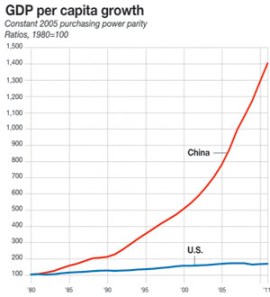
If the virus was released intentionally, the context and motive for such a biowarfare attack against China could not be more obvious. Although our disingenuous media continues to pretend otherwise, China’s economy surpassed our own in size several years ago, and has continued to grow much more rapidly. Chinese companies have also taken the lead in several crucial technologies, with Huawei becoming the world’s leading telecommunications equipment manufacturer and dominating the important 5G market. And China’s sweeping Belt and Road Initiative has threatened to reorient global trade around an interconnected Eurasian landmass, greatly diminishing the leverage of America’s own control over the seas. I have closely followed China for over forty years, and these trend-lines had never been more apparent. Back in 2012, I published an article bearing the provocative title “China’s Rise, America’s Fall?” and I have seen no reason to reassess my verdict.
Which superpower is more threatened by its “extractive elites”?
Ron Unz • The American Conservative, April 17, 2012 • 7,000 Words
For three generations following the end of World War II, America had stood as the world’s supreme economic and technological power, while the collapse of the Soviet Union thirty years ago left us as the world’s sole remaining superpower, with no conceivable military challenger. A growing sense that we were rapidly losing that unchallenged position had certainly inspired the anti-China rhetoric of many senior figures in the Trump Administration, and sparking the major trade war that they launched soon after coming into office. The increasing misery and growing impoverishment of large sections of the American population naturally left these voters searching for a convenient scapegoat, and the prosperous, rising Chinese made a perfect target.
Despite America’s growing economic conflict with China over the last couple of years, I had never considered the possibility that matters might take a military turn. The Chinese had long ago deployed advanced intermediate range missiles that many believed could easily sink our carriers in the region, and they had also generally improved their conventional military deterrent. Moreover, China was on quite good terms with Russia, which itself had been the target of intense American hostility for several years; and Russia’s new suite of revolutionary hypersonic missiles had drastically reduced any American strategic advantage. Thus, a conventional war against China seemed an absolutely hopeless undertaking, while China’s outstanding businessmen and engineers were steadily gaining ground against America’s decaying and heavily-financialized economic system.
Under these difficult circumstances, an American biowarfare attack against China might have seemed the only remaining card to play in hopes of maintaining American supremacy. Plausible deniability would minimize the risk of any direct Chinese retaliation, and if successful, the terrible blow to China’s economy would set it back for many years, perhaps even destabilizing the social and political system. Using alternative media to immediately promote theories that the coronavirus outbreak was the result of a leak from a Chinese biowarfare lab was a natural means of preempting any later Chinese accusations along similar lines, thereby winning the international propaganda war for America before China had even begun to play.
A decision by elements of our national security establishment to wage biological warfare in hopes of maintaining American world power would certainly have been an extremely reckless act, but extreme recklessness had become a consistent American pattern since 2001, especially under the Trump Administration. Just a year earlier we had kidnapped the daughter of Huawei’s founder and chairman, who also served as CFO and ranked as one of China’s most top executives, while at the beginning of January we suddenly assassinated Iran’s top military leader.
These were the thoughts that came to mind during the last week of January once I discovered the widely circulating theories suggesting that China’s massive disease epidemic had been the self-inflicted consequence of its own biowarfare research. I saw no solid evidence that the coronavirus was a bioweapon, but if it were, there seemed an overwhelming likelihood that China was the innocent victim of the attack, presumably carried out by elements of the American national security establishment.
At that point, someone brought to my attention a very long article by an American ex-pat living in China who called himself “Metallicman” and held a wide range of eccentric and implausible beliefs. I have long recognized that flawed individuals can often serve as the vessels of important information otherwise unavailable, and this case constituted a perfect example of that. His piece denounced the outbreak as a likely American biowarfare attack, and provided a great wealth of factual material I had not previously considered. Since he authorized republication elsewhere I did so, and by the end of January his 15,000 word analysis, although somewhat raw and unpolished, was attracting an enormous amount of readership on our website, probably being one of the very first English-language pieces to suggest that the mysterious new disease was an American bioweapon. Many of his arguments appeared doubtful to me or have been obviated by later developments, but several seemed quite telling.
He pointed out that during the previous two years, the Chinese economy had already suffered serious blows from other mysterious new diseases, although these had targeted farm animals rather than people. During 2018 a new Avian Flu virus had swept the country, destroying large portions of China’s poultry industry, and during 2019 the Swine Flu viral epidemic had devastated China’s pig farms, destroying 40% of the nation’s primary domestic source of meat, with widespread claims that the latter disease was being spread by small drones. My morning newspapers had hardly ignored these important business stories, noting that the sudden destruction of China’s domestic food sources might constitute a huge boon to American farm exports at the height of our trade conflict, but I had never considered the obvious implications. So for three years in a row, China had been severely impacted by strange new viral diseases, though only the most recent had been deadly to humans. Although this evidence was merely circumstantial, the pattern seemed highly suspicious.
The writer also noted that shortly before the coronavirus outbreak in Wuhan, that city had hosted 300 visiting American military officers, there to participate in the 2019 Military World Games, an absolutely remarkable coincidence of timing. As I pointed out at the time, how would Americans react if 300 Chinese military officers had paid an extended visit to Chicago, and soon afterward a mysterious and deadly epidemic had suddenly broken out in that city? Once again, the evidence was merely circumstantial but certainly raised dark suspicions.
Scientific investigation of the coronavirus had already pointed to its origins in a bat virus, leading to widespread media speculation that bats sold as food in the Wuhan open markets had been the original disease vector. Meanwhile, the orchestrated waves of anti-China accusations had emphasized Chinese laboratory research on that same viral source. But we soon published a lengthy article by investigative journalist Whitney Webb providing copious evidence of America’s own enormous biowarfare research efforts, which had similarly focused for years on bat viruses. Webb was then associated with MintPress News, but that publication had strangely declined to publish her important piece, perhaps skittish about the grave suspicions it directed towards the US government on so momentous an issue. So without the benefit of our platform, her major contribution to the public debate might have attracted relatively little readership.
Around the same time, I noted another extremely strange coincidence that seemed to attract no interest from our somnolent national media. Although his name had meant nothing to me, in late January my morning newspapers carried major stories on the sudden arrest of Prof. Charles Lieber, one of Harvard University’s top scientists and Chairman of its Chemistry Department, sometimes characterized as a potential future Nobel Laureate.
The circumstances of that case seemed utterly bizarre to me. Like numerous other prominent American academics, Lieber had had decades of close research ties with China, holding joint appointments and receiving substantial funding for his work. But now he was accused of financial reporting violations in the disclosure portions of his government grant applications—the most obscure sort of offense—and on the basis of those accusations, he was seized by the FBI in an early-morning raid on his Cambridge home and dragged off in shackles, potentially facing decades of federal imprisonment.
Such government action against an academic seemed almost without precedent. During the height of the Cold War, numerous American scientists and technicians were rightfully accused of having stolen our nuclear weapons secrets for delivery to Stalin, yet I had never heard of any of them treated in such a manner, let alone a scholar of Prof. Lieber’s stature, who was merely charged with technical disclosure violations. Indeed, his treatment recalled accounts of NKVD raids during the Soviet purges of the 1930s.
Although Lieber was described as a chemistry professor, a few seconds of Googling revealed that some of his most important work had been in virology, including technology for the detection of viruses. So a massive and deadly new viral epidemic had broken out in China and almost simultaneously, a top American scholar with close Chinese ties and expertise in viruses was suddenly arrested by the federal government, yet no one in the media expresses any curiosity at a possible connection between these two events.
I think we can safely assume that Lieber’s arrest by the FBI had been prompted by the coronavirus epidemic, but anything more is mere speculation. Those now accusing China of having created the coronavirus might surely suggest that our intelligence agencies discovered that the Harvard professor had been personally involved with that deadly research. But I think a far more likely possibility is that Lieber began to wonder whether the epidemic in China might not be the result of an American biowarfare attack, and was perhaps a little too free in voicing his suspicions, thereby drawing the wrath of our national security establishment. Inflicting such extremely harsh treatment upon a top Harvard scientist would greatly intimidate all of his lesser colleagues elsewhere, who would surely now think twice before broaching certain possible theories to any journalists.
By the end of January, our webzine had published seven articles and columns on the coronavirus outbreak, totaling tens of thousands of words, and probably established itself as the primary English-language source for a particular perspective on the deadly epidemic, with our coverage eventually attracting many hundreds of thousands of pageviews. A few weeks later, the Chinese government began gingerly raising the possibility that the coronavirus may have been brought to Wuhan by the 300 American military officers visiting that city, and was fiercely attacked by the Trump Administration for spreading anti-American propaganda. But I strongly suspect that the Chinese had gotten that idea from our own publication.
As the coronavirus gradually began to spread outside China’s own borders, another development occurred that greatly multiplied my suspicions. Most of these early cases had occurred exactly where one might expect, among the East Asian countries bordering China. But by late February Iran had become the second epicenter of the global outbreak. Even more surprisingly, its political elites had been especially hard-hit, with a full 10% of the entire Iranian parliament soon infected and at least a dozen of its officials and politicians, some of them quite senior, soon dying of the disease. Indeed, Neocon activists on Twitter began boasting that their hatred Iranian enemies were now dropping like flies.
Let us consider the implications of this. Across the entire world the only political elites that have yet suffered any significant human losses have been the Iranians, and they died at a very early stage, before significant outbreaks had even occurred almost anywhere else in the world outside China. Thus, we have America assassinating Iran’s top military commander on Jan. 2nd and then just a few weeks later large portions of the Iran’s ruling elites became infected by a mysterious and deadly new virus, with many of them soon dying as a consequence. Could any rational individual possibly regard this as a mere coincidence?
Biological warfare is a highly technical subject, and those possessing such expertise are unlikely to candidly report their classified research activities in the pages of our major newspapers, perhaps even less so after Prof. Lieber was dragged off to prison in chains. My own knowledge is nil. But in mid-March I came across several extremely long and detailed comments on the coronavirus outbreak that had been posted on a small website by an individual calling himself “OldMicrobiologist” and who claimed to be a retired forty-year veteran of American biodefense. The style and details of his material struck me as quite credible, and after a little further investigation I concluded that there was a high likelihood that his background was exactly as he had described. I made arrangements to republish his comments in the form of a 3,400 word article, which soon attracted a great deal of traffic and 80,000 words of further comments.
Although the writer said that he had absolutely no proof, he said that his experience led him to strongly suspect that the coronavirus outbreak was indeed an American biowarfare attack against China, probably carried out by agents brought into that country under cover of the Military Games held at Wuhan in late October, the sort of sabotage operation our intelligence agencies had sometimes undertaken elsewhere. One important point he emphasized was that high lethality was often counter-productive in a bioweapon since debilitating or hospitalizing large numbers of individuals may impose far greater economic costs on a country than a biological agent which simply inflicts an equal number of deaths. In his words “a high communicability, low lethality disease is perfect for ruining an economy,” suggesting that the apparent characteristics of the coronavirus were close to optimal in this regard. Those so interested should read his analysis and assess for themselves his credibility and persuasiveness.
Was coronavirus a Biowarfare Attack Against China?
OldMicrobiologist • March 13, 2020 • 3,400 Words
One intriguing aspect of the situation was that almost from the first moment that reports of the strange new epidemic in China reached the international media, a large and orchestrated campaign had been launched on numerous websites and Social Media to identify the cause as a Chinese bioweapon carelessly released in its own country. Meanwhile, the far more plausible hypothesis that China was the victim rather than the perpetrator had received virtually no organized support anywhere, and only began to take shape as I gradually located and republished relevant material usually drawn from very obscure sources and often anonymously authored. So it seemed that only one side was waging an active information war, and that side was not China’s. The nearly simultaneous launch of such a major propaganda campaign may not necessarily demonstrate that an actual biowarfare attack had occurred, but I think it tends to support such a notion.
When considering the hypothesis of an American biowarfare attack, certain natural objections come to mind. The major drawback to biological warfare has always been the obvious fact that the self-replicating agents employed are not prone to respect national borders, raising the serious risk that the disease might eventually return to the land of its origin and inflict substantial casualties. For this reason, it seems quite doubtful that any rational and half-competent American leadership would have unleashed the coronavirus against China.
But as we absolutely see demonstrated in our daily news headlines, America’s current government is grotesquely and manifestly incompetent, more incompetent than one could almost possibly imagine, with tens of thousands of Americans having now already paid with their lives for such extreme incompetence. Rationality and competence are obviously nowhere to be found among the Deep State Neocons that President Donald Trump has appointed to so many crucial positions throughout our national security apparatus.
Moreover, the extremely lackadaisical notion that a massive coronavirus outbreak in China would never spread back to America might have seemed plausible to individuals who carelessly assumed that past historical analogies would exactly apply. As I wrote a few weeks ago:
Reasonable people have suggested that if the coronavirus was a bioweapon deployed by elements of the American national security apparatus against China (and Iran), it’s difficult to imagine why the they didn’t assume it would naturally leak back in the US and start a huge pandemic here, as is currently happening.
The most obvious answer is that they were stupid and incompetent, but here’s another point to consider…
In late 2002 there was the outbreak of SARS in China, a related virus but that was far more deadly and somewhat different in other characteristics. The virus killed hundreds of Chinese and spread into a few other countries before it was controlled and stamped out. The impact on the US and Europe was negligible, with just a small scattering of cases and only a death or two.
So if American biowarfare analysts were considering a coronavirus attack against China, isn’t it quite possible they would have said to themselves that since SARS never significantly leaked back into the US or Europe, we’d similarly remain insulated from the coronavirus? Obviously, such an analysis was foolish and mistaken, but would it have seemed so implausible at the time?
As some must have surely noticed, I have deliberately avoided investigating any of the scientific details of the coronavirus. In principle, an objective and accurate analysis of the characteristics and structure of the virus might help suggest whether it was entirely natural or rather the product of a research laboratory, and in the latter case, possibly indicating whether the source was China, America, or some third country.
But we are dealing with a cataclysmic world event and those questions obviously have enormous political ramifications, so the entire subject is shrouded by a thick fog of complex propaganda, with numerous conflicting claims being advanced by interested parties. I have no background in microbiology let alone biological warfare, so I would be hopelessly adrift in evaluating such conflicting scientific and technical claims. I suspect that this is equally true of the overwhelming majority of other observers as well, though committed partisans are loathe to admit that fact, and will eagerly seize upon any scientific argument that supports their preferred position while rejecting those that contradict it.
Therefore, by necessity, my own focus is on evidence that can at least be understood by every layman, if not necessarily always accepted. And I believe that the simple juxtaposition of several recent disclosures in the mainstream media leads to a rather telling conclusion.
For obvious reasons, the Trump Administration has become very eager to emphasize the early missteps and delays in the Chinese reaction to the viral outbreak in Wuhan, and has presumably encouraged our media outlets to focus on this topic.
As an example of this, the Associated Press Investigative Unit recently published a rather detailed analysis of those early events purportedly based upon confidential Chinese documents. Provocatively entitled “China Didn’t Warn Public of Likely Pandemic for 6 Key Days”, the piece was widely distributed, running in abridged form in the NYT and elsewhere. According to this reconstruction, the Chinese government first became aware of the seriousness of this public health crisis on Jan. 14th, but delayed taking any major action until Jan. 20th, a period of time during which the number of infections greatly multiplied.
Last month, a team of five WSJ reporters produced a very detailed and thorough 4,400 word analysis of the same period, and the NYT has published a helpful timeline of those early events as well. Although there may be some differences of emphasis or minor disagreements, all these American media sources agree that Chinese officials first became aware of the serious viral outbreak in Wuhan in early to mid-January, with the first known death occurring on Jan. 11th, and finally implemented major new public health measures later that same month. No one seems to have disputed these basic facts.
But with the horrific consequences of our own later governmental inaction being obvious, sources within our intelligence agencies have sought to demonstrate that they were not the ones asleep at the switch. Earlier this month, an ABC News story cited four separate government sources to reveal that as far back as late November, a special medical intelligence unit within our Defense Intelligence Agency had produced a report revealing than an out-of-control disease epidemic was occurring in the Wuhan area of China, and widely distributed that document throughout the top ranks of our government, warning that steps should be taken to protect US forces based in Asia. After the story aired, a Pentagon spokesman officially denied the existence of that November report, while various other top level government and intelligence officials refused to comment. But a few days later, Israeli television revealed that in November American intelligence had indeed shared such a report on the Wuhan disease outbreak with its NATO and Israeli allies, thus seeming to independently confirm the complete accuracy of the original ABC story and its several government sources.
It therefore appears that elements of the Defense Intelligence Agency were aware of the deadly viral outbreak in Wuhan more than a month before any officials in the Chinese government itself. Unless our intelligence agencies have pioneered the technology of precognition, I think this may have happened for the same reason that arsonists have the earliest knowledge of future fires.
Back in February, before a single American had died from the disease, I wrote my own overview of the possible course of events, and I would still stand by it today:
Consider a particularly ironic outcome of this situation, not particularly likely but certainly possible…
Everyone knows that America’s ruling elites are criminal, crazy, and also extremely incompetent.
So perhaps the coronavirus outbreak was indeed a deliberate biowarfare attack against China, hitting that nation just before Lunar New Year, the worst possible time to produce a permanent nationwide pandemic. However, the PRC responded with remarkable speed and efficiency, implementing by far the largest quarantine in human history, and the deadly disease now seems to be in decline there.
Meanwhile, the disease naturally leaks back into the US, and despite all the advance warning, our totally incompetent government mismanages the situation, producing a huge national health disaster, and the collapse of our economy and decrepit political system.
As I said, not particularly likely, but certainly a very fitting end to the American Empire…
Related Reading:
- The Myth of Tiananmen by Jay Matthews
- China’s Rise, America’s Fall
- Was coronavirus a Biowarfare Attack Against China? by OldMicrobiologist
- Bats, Gene Editing and Bioweapons: Recent Darpa Experiments Raise Concerns Amid coronavirus Outbreak by Whitney Webb
- How It All Began: the Belgrade Embassy Bombing by Peter Lee
Featured Video
No Threat Can Force Iran’s Surrender /Trita Parsi & Lt Cl Daniel Davis
or go to
Aletho News Archives – Video-Images
From the Archives
What is the Israeli Lobby in Australia Doing in Interfaith Dialogue?
By Ali Kazak | Dissident Voice | October 11, 2015
For years Israel and its lobby around the world have been trying to normalise their relations with Arabs and Muslims without solving the Palestine Question.
One of the methods they resorted to in the last few years is using human rights and community organizations such as interfaith dialogue and Multiculturalism to achieve this objective and to: isolate the Palestinians, marginalise the Palestine question, end Israel’s isolation, and prevent criticism of Israel, knowing that these organisations will be the first to stand against Israel’s violations, racial and religious discrimination.
The group responsible for this task in Australia is The Australia/Israel & Jewish Affairs Council (AIJAC); its Director of International & Community Affairs, Jeremy Jones is in charge of lobbying religious community organizations, specifically Muslims and Christians. Consequently he convened the Faith Communities for Reconciliation, founding participant in the Australian Partnership of Religious Organisations and the Australian National Dialogue of Christians, Muslims & Jews.
AIJAC is a private political propaganda group. It is recognised as the main Israeli lobby in Australia. It coordinates its activities and works intimately with the Israeli embassy in Canberra and different institutions in Israel. It is privately funded by some Jewish businessmen. It monitors closely Australian politicians, the media, ethnic and religious groups, (especially Arabs and Muslims), unions and academics on their stands towards Israel and the Palestine question. … continue
Blog Roll
 Aletho News
- The war of liberation of the Arab and Islamic peoples expands across the Gulf
- Envoy warns UN on Trump’s threat to ‘obliterate’ Iran’s civilian infrastructure
- The Larak Corridor: Iran’s Rial Gate With No US, No Israel, and No Way Around
- ‘Economic terrorism’: Steel facilities hit again in US-Israeli strike
- ‘War Crime’: Iran condemns attacks on Arak, Ardakan nuclear sites
- Two-thirds of Americans want quick end to Iran war even if goals unmet
- Trump to Give “Important Update on Iran” Wednesday in Prime-Time Speech
- Theodore Postol: Iran’s Missiles & Drones Were Underestimated
- Iran To Target Military Industrial-Tech Complex That Facilitated Gaza Genocide
- Collapsing Empire: The Resistance Disarms ‘Israel’
- If Americans Knew
- Israel wants US to bomb more of Iran’s civilian structures (113,000 is not enough) – Not a ceasefire Day 173
- Ann Coulter Rips Into Fox News for Iran War Coverage
- Joe Kent Urges Americans To Call White House and Congress To Object To Sending Troops Into Iran
- DNC Resolution to Reject AIPAC Funding Puts Democratic Leaders in the Hot Seat
- Swedish foundation to build 400 schools as over 650,000 Gaza children remain without education for 2 years
- Israeli army admits photshopping image of slain Lebanese journalist
- This is how Israel is systematically killing health workers under the cover of war in Lebanon
- Carrying life under fire: Israeli invasion of Lebanon leaves pregnant women facing deadly risks
- Champagne all around for the new death penalty (for Palestinians) law – Not a ceasefire Day 172
- Why are Palestinian books struggling to be seen on Amazon?
- No Tricks Zone
- New Study Finds Warming Saves Lives…Cold Temperatures 12 Times More Deadly Than Excess Heat
- German Science Blog Accuses PIK Climate Institute Of Hallucinating Climate Tipping Points
- Devastating Assessment Of Comirnaty Vaccine By Former Senior Pfizer Europe Toxicologist
- New Study: CO2 Is ‘Effectively Negligible’ As An Explanatory Climate Change Factor Since 2000
- Former Pfizer Toxicologist Dr. Helmut Sterz Tells Bundestag Hearing Pfizer Vaccine Should Have Never Been Approved
- Energy Expert: Germany’s Nuclear Phaseout Was A “500 Billion Euro Mistake”
- New Research: South Australia’s Mid-Holocene Sea Surface Temperatures Were 4°C Warmer Than Today
- Storing Green Energy To Last Germany 10 Days Would Require A 60-Million Tonne Battery
- New Studies: UK Sea Levels Were 4 Meters Higher Than Today During The Mid-Holocene
- Destructive Green New Deal: German Energy And Metal Group Warns Of Drastic Crisis
 Aletho News