Today, Governor Kristi Noem signed Executive Order 2021-14, protecting state employees from President Biden’s federal vaccine mandates. She also released this video announcing her decision.
“South Dakota is fighting back against President Biden’s illegal vaccine mandates,” said Governor Kristi Noem. “Our state has many contracts with the federal government, and President Biden is attempting to use those contracts to force state employees to be vaccinated against their will. My executive order will protect their rights to medical and religious exemptions under any federal vaccine mandates. I am already talking with legislators about extending these protections to private employees through legislation as well.”
For the medical exemption, employees need a written statement from a physician stating that the COVID-19 vaccination is contraindicated for medical reasons.
For the religious exemption, a form will be made available by the Bureau of Human Resources that shall read in full, “I, [insert person’s full name], dissent and object to receiving a COVID-19 vaccine on religious grounds, which includes moral, ethical, and philosophical beliefs or principles.”
Due to established precedent, this Executive Order does not apply to service members with the South Dakota National Guard who must meet federal readiness responsibilities for deployment.
During the 2022 legislative session, Governor Noem will work with the legislature to make these protections for state employees permanent, and to extend similar health and religious liberty protections to employees of private businesses who adopted mandatory COVID-19 vaccination policies.
Today, following Governor Noem’s promise to “see [President Biden] in court,” the State of South Dakota joined a lawsuit against the Biden Administration’s COVID vaccine mandate for federal contractors.
“South Dakota is standing up with other states to protect our people from the Biden Administration’s illegal mandates,” said Governor Kristi Noem. “Though they are delaying their announcement of other mandates because they know those would be unconstitutional, we will not wait to fight this federal contractor mandate. We set up our defense with an executive order earlier this week. Now it’s time to go on offense.”
Earlier this month, the Biden Administration sent notices to federal contractors, including state entities, indicating that they will be enforcing the federal contractor mandate. This lawsuit is in response to those enforcement steps.
This action follows Governor Noem’s executive order earlier this week to protect South Dakota state employees from the Biden Administration’s illegal mandate for federal contractors. Governor Noem’s order guaranteed medical and religious exemptions for these employees, and Governor Noem also announced her intention to bring legislation to extend similar protections to private workers.
South Dakota is joined in the lawsuit by the states of Missouri, Nebraska, Alaska, Arkansas, Iowa, Montana, New Hampshire, North Dakota, and Wyoming. You can find the court filing here.
October 30, 2021
Posted by aletho |
Civil Liberties, Economics, Science and Pseudo-Science | COVID-19 Vaccine, United States |
Leave a comment
Florida Gov. Ron DeSantis is calling for employers to be held liable if their employees suffer injuries from mandated vaccines — even if the mandates were a result of federal edicts.
“We need to take action to protect Florida jobs and we have a situation now, unfortunately, in our country where we have a federal government that is very much trying to use the heavy hand of government to force a lot of these injections,” DeSantis said.
Saying he and his constituents believe in “basic medical freedom and individual choice,” and that “your right to earn a living should not be contingent upon COVID shots,” DeSantis said
If OSHA ends up coming out with the mandate dictated by President Biden, he plans to contest it, DeSantis added. He also plans to contest federal mandates on contractors that work with the federal government, but also work on the state level.
He also plans to contest the mandate that the Centers for Medicare & Medicaid Services are talking about handing down on hospitals and health care providers that accept Medicare and Medicaid.
“So what we’re going to be doing in addition to mounting aggressive legal challenges to federal mandates [is to] be taking legislative action to add protections for people.”
October 30, 2021
Posted by aletho |
Civil Liberties, Economics | COVID-19 Vaccine, Human rights, United States |
Leave a comment
Safeway grocery store #1892 in Cortez, Colo., just lost its pharmacy manager because she no longer wants to administer “this poison,” referring to Wuhan coronavirus (Covid-19) “vaccines,” to customers.
According to reports, Nichole Belland took to the store’s intercom to announce that she is leaving her position for good because she can no longer in good conscience continue jabbing people with these “Operation Warp Speed” abominations they are calling “vaccines.”
“This is Nichole Belland, pharmacy manager for Safeway store at 1892 of Cortez,” Belland was heard saying over the intercom to a store full of surprised shoppers.
“I quit, effective immediately, because I will not give this poison to people. Wake up, everybody. This is poison. This is hurting people. I’ve seen it. I’ve seen customers die. Wake up, do not take it.”
If It Came Down To It, Would You Quit Your Job Rather Than Harm Others With Covid Jabs?
Steve Kirsh, the executive director of the COVID-19 Early Treatment Fund (CETF), got the chance to talk with Belland about what prompted her to leave her job in the dramatic way that she did.
It turns out that Belland had not worked at Safeway for several months prior to coming on the loudspeaker to make her announcement. Almost immediately after she was told by her supervisor that she would need to jab people with the “Operation Warp Speed” drugs, she decided to quit.
Belland was told at the time that she would have no choice but to administer the shots on demand, or else be fired from her position. She instead decided to go on temporary personal leave, but that was set to expire on October 15.
“I had tremendous concerns about these shots early on,” Belland says.
Not seeing any other way to get her message across before being forced out of her job, Belland went in on October 14, took her certificates and degrees off the wall, and proceeded to use the intercom to reveal publicly why she was essentially being forced to quit.
Belland says that around 8-10 customers were in front of her at the time when she picked up the intercom microphone and began speaking the truth into it. She had no idea that this brave act would end up going viral, possibly inspiring others who feel similarly to do the same.
Like many, Belland says that she is not necessarily “anti-vaccine.” She is anti-experimental gene therapy, which is technically what covid shots are since they were not developed using the same technologies as existing vaccines.
Prior to quitting, Belland had administered “thousands” of other shots to patients at her pharmacy, where she worked for 12 years after graduating from the University of Minnesota. However, when covid injections came along, it was a different story.
You can watch the full video interview between Kirsh and Belland at Red Voice Media.
“Bravo! Good for her, I would do the same thing if I was in her shoes!” wrote a commenter at Red Voice Media. “No job is more important than your overall health!”
“No job or any action is more important than the realization that you may be directly responsible for the injury or even death of another,” responded another, clarifying the reason why Belland quit.
“Every time a nurse who sticks a needle in someone’s arm who becomes ill or deceased later, and when on learning of their loss, she intentionally continues – is committing a premeditated harmful act to another.”
As the vaccine mandates pile on, we can expect more incidents like this to occur. More of the latest can be found at Pandemic.news.
October 30, 2021
Posted by aletho |
Science and Pseudo-Science, Timeless or most popular, War Crimes | COVID-19 Vaccine, United States |
Leave a comment
Anthony Fauci’s National Institutes of Health once experimented on foster children with AIDS, testing experimental drugs on the children while almost always failing to provide an independent advocate to make sure the children remain safe and healthy. This happened throughout the late 1980s and 1990s, and the practice was exposed in 2005.
According to Anthony Fauci’s biography page on the official NIH website, the longest-serving government employee began working for the NIH in 1968. In 1984, Fauci became the Director of NIAID, a position he still holds today.
As Director of NIAID, Fauci oversees research to “prevent, diagnose, and treat infectious and immune-mediated diseases, including HIV/AIDS” according to the website. In 1988, Fauci became the first Director of the Office of AIDS research.
While Fauci was in these roles, it was revealed in 2005, the NIH oversaw the enrollment of thousands of foster children with AIDS into controversial programs that allowed them to receive experimental drugs designed to combat the illness. Some of these children later died, and most were not given independent advocates that were promised.
According to John Soloman, then reporting for the Associated Press, the NIH “promised in writing to provide an independent advocate to safeguard the kids’ well-being as they tested potent AIDS drugs,” however, these advocates failed to materialize for almost every child involved. The subjects – foster children without stable home lives – ranged from infants to late teens.
Solomon wrote that, with a general lack of oversight, “Several studies that enlisted foster children reported that patients suffered side effects such as rashes, vomiting and sharp drops in infection-fighting blood cells, and one reported a ‘disturbing’ higher death rate among children who took higher doses of a drug, records show.” (READ MORE: NIH Quietly Changes Definition Of ‘Gain-Of-Function’ Amid Fauci, Wuhan Lab Scandal Fallout)
“Some foster children died during studies,” reported Solomon after noting that the majority of children appear to not have received an advocate. “State or city agencies said they could find no records that any deaths were directly caused by the experimental treatments,” he noted.
A 2009 article from The New York Times claims that no New York City children “died as a result of the trials” and that children in the city were not selected for the trials based on their race.
Still, the Times found “that the agency had not always followed its own protocols and kept poor records.” The Times also discovered that some of the children died, but those involved with the research asserted the deaths were unrelated to the experimental drugs.
Interestingly, Fauci’s name is not mentioned in any of the articles about foster children being used for experiments, despite him having a leadership position at the time. Further complicating the omission, Fauci was loathed by the LGBT community at the time the experiments were being conducted and when the news about the foster child experiments broke. (READ MORE: NIH Funds ‘Toxic Brain Injection’ Monkey Experiments, Holes Drilled Into Skulls, Devices Implanted Into Brains)
In 2018, only two years before the mainstream media would lionize Fauci via its nonstop coverage of COVID-19, then-82-year-old AIDS activist Larry Kramer described Fauci as “The consummate manipulative bureaucrat who speaks out of too many sides of his mouth.’’ Kramer died in May of 2020.
We also know that Fauci was actively, personally engaged in AIDS research around the time the foster children were being used for experiments. In fact, Fauci told NPR earlier this year that, in the 1980s, he would clandestinely visit gay bath houses, bars, and night clubs with the goal of physically witnessing the transmission of HIV live and in person.
October 30, 2021
Posted by aletho |
Supremacism, Social Darwinism, Timeless or most popular, War Crimes | Human rights, NIAID, United States |
Leave a comment
In this age of green craze, the most likely response to legitimate concerns about the lack of access to energy for the world’s poor is advocacy for so-called renewable technologies such as wind turbines and solar panels.
As embarrassing as that suggestion should be to the advocate of such unreliable and impractical energy sources, there are sometimes even more cringe-worthy replies that verge on the inhumane. A recent tweet of mine prompted one such response.
The tweet was directed to attendees of COP26, a United Nations climate conference that gets underway this month at Glasgow. The annual conference seldom addresses third-world energy poverty, which deprives billions of people of basic needs like clean water, lights, and modern medical care. Many of these people are subjected to indoor pollution from cooking and heating with wood and animal dung while bureaucrats and politicians preach the banning of the very fossil fuels necessary to alleviate their suffering.
When I questioned in a tweet the evident lack of empathy for poor people in developing parts of the world, a person responded that India has too many people.
“I want COP26 attendees to ask themselves a simple question,” my tweet stated. “What are they going to do about those in the third world who still do not have access to affordable & reliable energy — both for cooking and for electricity? We need gas, oil, and coal. Do not enforce energy apartheid on us.”
The response tweet said, “India is seriously overpopulated, they need to breed less.”
Breed less? How can an Indian like myself not be insulted by such an anti-human suggestion? Are the 1.3 billion people of India lab rats with no right to procreate as we see fit?
Moreover, the idea that population increase is a problem is outdated. During the 1960s and 1970s, there was media-supported fear-mongering that overpopulation would bring down the world due to scarcity of resources. This notion died with late 20th-century advancements in the agricultural and industrial sectors that made food more plentiful than ever. Virtually every metric of human well-being has increased in the last fifty years. The proposition that we are overpopulated is wrong.
Persons harboring such thoughts should note that the Indian breeding ground gave the world brilliant thinkers such as the present CEOs of Google, Microsoft, IBM, and Adobe. Ironically, the person apparently ridiculing my country used the Twitter platform whose current chief technological officer is from India and did his schooling in a city a few hundred miles from where I live. And then there have been the likes of Mother Teresa; Mahatma Gandhi; polymath scholar and founder of the republic B. R. Ambedkar; and numerous other leaders in politics, business, education, and science.
Having noted the cultural slight, I return to the lack of concern for energy poverty in developing countries as the larger issue. It is the religious fervor of the climate-alarmist cult driving a misanthropic view that would deny people basic needs — even life itself — to achieve the fantasy of a carbon-free economy. All to purportedly avert a fabricated climate crisis.
If this disregard for our very humanity goes unchallenged, we could be in for some dark times indeed. Watch COP26 at Glasgow for trends.
Vijay Jayaraj is a research associate at the CO2 Coalition, Arlington, Va., and holds a Master’s degree in environmental sciences from the University of East Anglia, England. He resides in Bengaluru, India.
October 30, 2021
Posted by aletho |
Malthusian Ideology, Phony Scarcity, Progressive Hypocrite, Supremacism, Social Darwinism | Human rights |
Leave a comment
Kiev may soon increase firewood exports to the EU to help the bloc deal with energy shortages brought about by soaring gas prices, the head of Ukraine’s Analysis and Strategy Center, Igor Chalenko, says.
“Firewood is, undoubtedly, an interesting commodity for exports, especially for the European Union’s market. In this heating season, they fall short by 70 billion cubic meters to cover their needs until the Nord Stream 2 gas pipeline gets up and running,” Igor Chalenko told a press conference this week.
While Ukraine is among the continent’s top 10 forest-rich states, “the EU is considering firewood as an energy product,” Chalenko said, adding that the current situation with forest felling in western Ukraine is dire, but that Kiev may nevertheless soon lift the ban on massive timber exports to Europe for additional profits.
“The moratorium’s removal is a condition for Ukraine to receive a 600-million-euro tranche from the European Commission. Accordingly, our export of timber in all positions can only increase,” Chalenko said. He added that the step could badly affect the country’s timber processing industry, which has shown significant growth in recent years.
Authorities in Kiev signaled that they intend to lift the current moratorium on timber exports to the EU earlier in October, calling it a “trade irritant.” However, in order to do so, Ukraine intends to create a transparent timber trade system, introducing fines for illegal forest felling and the purchase of illegal timber from Ukraine by European companies.
Ukraine has experienced a shortage of firewood due to energy price hikes. Firewood prices in the country have jumped recently from 50% to 200%, Chalenko said.
Combined with the shortage of coal and gas, Ukraine itself might face serious problems in the current heating season, including sweeping blackouts and an increase in tariffs for both households and industry.
According to Mikhail Volynets, the head of the country’s miners’ union, there are 565,000 tons of coal in the warehouses of thermal power plants, which is 88,000 less than the country needs. Natural gas reserves in Ukraine’s storage facilities stand at 18.8 billion cubic meters, 9.4 billion cubic meters less than last year. And with Russia’s decision to stop deliveries of thermal coal to Ukraine from November 1, Volynets says the prospect is far from optimistic.
October 30, 2021
Posted by aletho |
Economics, Malthusian Ideology, Phony Scarcity | European Union, Ukraine |
Leave a comment
In the question and answer session that followed President Putin’s speech to the annual Valdai Discussion Club meeting in Sochi last week, Vladimir Vladimirovich said he was thankful to the European Union for imposing sanctions on Russia in 2014, because Russia’s counter-sanctions, banning food imports from the EU, resulted in an enormous boost to its agricultural industry. Russian farming coped magnificently with the challenge. Putin mentioned the $25 billion in agricultural exports that Russia booked in the last year and he went on to thank Russia’s workers in the sector who made this possible.
These remarks would suggest to both laymen and experts in the West the emergence of Russia as the world’s number one exporter of wheat and its leading position as global exporter of other grains. As we know, investments in industrialized farming by Russia’s oligarchs and agricultural industry giants have paid off in higher crop yields and insured their production volumes against weather imposed damage through farming in multiple regions. Moving beyond the traditional production centers in the ‘black soil’ belt of the south, Russian grain farmers have made excellent use of previously under or ill-used acreage in Western Siberia and elsewhere. Thus, when Canada or the United States have stumbled in wheat production from one season to another, Russia has carried on to new heights. Investments in grain storage and port facilities have made it possible to use the new surpluses to best advantage on world markets.
However, what Western readers know little or nothing about is how Russia’s agricultural sector has expanded into all food niches of the home consumer market during these years, so that supermarket shelves are now filled with a great variety of domestically grown fresh foodstuffs that rival the best and most sophisticated products Western Europe has to offer . This is something you will not find detailed in official statistics, and it is certainly not carried by mainstream Western media, whose only interest is denigration of Russia, serving propagandistic and not informational purposes. Nor is it covered by the Western ‘alternative media,’ who do not send journalists to visit Russia and least of all to report on what they see in the food stores.
I will discuss the changes in food supply below based on my latest, ongoing visit to St Petersburg. However, my eye has been focused on the subject now from the very start of the Western sanctions and Russian counter-measures in 2014. I was surely the first Western observer to write about what the Russian farmers’ markets and supermarkets had on offer then and I have refreshed my information during periodic visits to Russia ever since.
The collapse of international travel since the onset of the Covid pandemic has meant that the numbers of foreign visitors who can do what I have been doing have been cut to nearly nil. Even at present tourist visas are not being issued and apart from family members of Russian citizens, the visa category I enjoy, only a relatively small number of businessmen and other professionals arrive on narrowly defined missions.
* * * *
In keeping with the title above, let us begin with ‘greens,’ by which I mean salads and vegetables more broadly.
In the bad old days of the Soviet Union, this category of produce was almost non-existent. Traditional Russian cuisine featured ‘salads’ among the first course appetizers. But what was meant was potato salad of one variety or another, including the highly esteemed ‘salad Olivier’ named after a French chef in Moscow at the turn of the last century; this has chicken or meat chunks added to diced cooked potato and mayonnaise. Lettuce and other greens simply had no place in the Russian diet. This is not to say that there were no officials-dieticians preparing to change that reality. In 1979, at the invitation of the Ministry of Agriculture of the USSR, I accompanied executives from Castle & Cooke, the Hawaii based company that was then the world’s largest grower of iceburg lettuce, on a mission to set up such production in Russia’s south. That mission failed in the faltering days of détente.
Iceburg lettuce as well as other greens appeared on sale in Russia only in the mid-1990s when millions of citizens of the now free Russian Federation traveled the world and picked up new dietary habits including a high appreciation of green salads. At the time, all of these new delicacies for the arbiters of taste in the country and those with deep pockets were imported from Western Europe and sold at European prices.
Over time, early in the new millennium, the assortment of vegetables and fruits imported into Russia expanded quickly, in keeping with rising living standards and differentiated tastes of various demographic groups. After the ban on European imports was imposed, a geometric progression in the variety and quality of Russian grown greens set in. Now when you visit even ‘economy category’ supermarket chains in the cities or in their branches in the countryside, you find on offer leaf lettuce in transparent wrap sitting atop the little plastic pots in which they were raised in greenhouses; or cut lettuce packed in plastic bags and given long shelf life by their protective atmosphere. In higher category supermarkets for the middle and upper classes, there are mixed young shoots of beets and other highly fashionable salad components in protective atmosphere; or stalk green celery, a product until recently imported from Israel. Then there are extraordinary quality small cucumbers and tomatoes from various seed varieties produced in greenhouses year round.
The traditional Russian accompaniments to soups and main courses such as dill and green scallions are also now farmed locally year round and portion-packed in plastic.
By its nature, much of the new perishable produce is grown in greenhouse complexes on the outskirts of urban areas. Other items, like the aforementioned celery, are grown in one location, Kursk in the given example, to provide for the entire nationwide market.
All of the above assumes enormous investments in greenhouse capacity these past few years, as well as the import of seeds and know-how. Presumably, The Netherlands, which is Europe’s leader in many categories of greenhouse produce, has been Russia’s partner in these developments. Russia’s own inputs are essential to the economic success of the new produce: it has very cheap natural gas to heat the greenhouses and cheap electricity for lighting. It is no wonder then that the supermarket price for the produce I have described is several times below what you see in Western Europe.
Of course, not everything on the green grocer’s shelves is presently grown in Russia and there are imports to fill out the assortment: items like avocados and kiwis. However, considering Russia’s vast territory that cuts across several climatic belts, one may expect over time to see many such items also filled by local producers.
Beef and Pork
In the ‘bad old days’ of the USSR, there were chronic meat shortages due to a variety of failures in the food chain, including disastrous grain harvests. I knew the situation and its causes from the inside having in the late 1970s assisted a couple of U.S soy producers promote their meat extenders to the Meat and Dairy Industry. Lest anyone raise a critical objection about soy, I note that soy isolates or concentrates would have been far preferable to the potato or pea starch and similar that was then going into Russian sausages. As for fresh beef, it was not highly appreciated by consumers and for good reason. When available, it was tough and sinewy. Moreover, the butchers did not do their work with much professionalism, and what you got over the counter for the single official price per kilogram could just as easily be the worst cuts as it could be choice cuts. Pork was by nature more edible, commanded greater consumer demand and was more expensive than beef, an unnatural inversion of pricing.
In the 1990s Russian meat production collapsed, and what meat there was imported. This even extended to the least demanding meat sector in terms of return on capital, poultry.
Domestic beef and pork returned to life early in the new millennium though quality was generally poor and visits to the butchers’ stalls in farmer’s markets could turn anyone into a vegetarian, conditions were so medieval. However, in the last several years the situation has changed beyond recognition. First, at about 2018 premium restaurants began offering on their menus “marbleized” beef from grain fed cattle coming from the center of the country, in Kaluga and a few other production sites. Prize bulls were brought in from Japan and other countries to create admirable herds of beef cattle.
The beef industry moved on from its modest debut in luxury restaurants to enjoy in the past couple of years a major presence on supermarket shelves. Big corporations took the lead. One, in particular, Miratorg, achieved full vertical integration, from production of cattle feed through raising beef herds to slaughter, packaging and distribution. Its high quality ‘pepper steaks,’ ‘minute steaks’ and premium cuts, as well as ground meat and other meat culinary products sealed in special atmosphere plastic packaging have long shelf life and an appealing appearance. Consumer demand is generated by active television advertising.
A similar development has taken place in pork, where there are numerous competing producers. Their packs of pork chops and other cuts clearly state energy value, fat and protein content. This transparency is surely attributable to the producers’ confidence in their quality and pricing. By contrast, the vast array of sausage products on the Russian market have made it very difficult to read nutritional values which, if not disguised, would put the consumer off, given the 30 or 40% fat content of so many.
Whereas in Belgium and elsewhere in W. Europe the accent is on grass fed beef, which summons up images of calm meadows but yields rather tough meat on the plate, the Russians have chosen the American way: grain fed beef (250 days) and pork, placing a premium on tenderness.
Poultry
Chickens were no friends of Soviet agriculture. They had a hard life and were not treated well after their demise, so that the black and blue marks on their carcasses in shops did not raise optimistic expectations about the cooked product. In the years immediately after the crash of the Soviet Union, local production ended and what poultry you found in shops was nearly entirely imported from America, the popularly dubbed “Bush legs,” named for the American president under whom the imports began.
Domestically raised chickens returned to Russian stores in the new millennium, but the poultry industry only became wholly modern in the last few years. Now you find exactly the same product assortments as in Western Europe: eviscerated, whole chilled chickens or, chicken parts, meaning breast meat, legs, quarters weight portioned in plastic packaging.
Ducks, quails and similar are to be found in farmers’ market and in specialty premium level food stores. Some items are strictly seasonal, like turkey.
What is missing, strangely, from the offering is game. Here alone one can speak of a step in reverse from what prevailed in Soviet days. In the 1970’s even common food stores offered frozen partridges (feathers and all) coming from Siberia. Today there is nothing of the sort in the retail trade, although premium restaurants in major cities may have wild fowl and ‘exotic’ native game like bear or venison on their menus.
Fish
Going back to 2014, I commented on the fast growing trade in fresh fish that was reaching out from the capitals to the Russian countryside. I mentioned the new aquaculture industry in Karelia, producing wonderful salmon trout and fish farms in the Lower Volga producing starlet sturgeon that was being sold across the country. Then there were the choice flounder being shipped fresh to European Russia from the Murmansk region in the Far North. Now, very recently I note the expanding variety of luxury frutti di mare coming from Vladivostok and Sakhalin. My neighborhood Perekryostok supermarket is selling small whole calamari from the Russian Far East. More exclusive supermarkets offer mussels from the Far East and oysters grown in the Crimea. All of these delicacies are priced two to three times lower than in Western Europe.
Interestingly a similar price differential applies to several farmed Mediterranean fish that Russia is buying from Cyprus, which is not on Russia’s prohibited list, while Western Europe sources them in Greece. I have in mind sea bass and sea bream (daurade). By contrast, fresh farmed salmon bought in by Russia from Iceland is sold at only a modest discount to the banned Norwegian alternative. However, wild Baltic salmon, a seasonal Russia-sourced delicacy that is now in the markets is priced at a fraction of its cost in Western Europe, if you can find any there.
Though I have focused in the foregoing on fresh fish, the strong trend to resuscitation of long forgotten Russian smoked and cured fishes from the country’s interior has developed at a gallop in the last few years. These high priced delicacies are mostly sold through farmers’ markets or specialty stores. I think in particular of omul’ coming from the Baikal region, though there are many others. We may expect to see a lot more of this in future, replacing in part the now almost defunct trade in wild Caspian sturgeon that in Western Europe was synonymous with Russian extravagance during Soviet days.
Much lower in price though still much beloved in Russia, smoked Baltic sprats are one more example of Russia rising from its knees in food production since 2014 and the sanctions. The product was in the past produced and sold to Russia only by Riga fisheries-canners. When those sales were prohibited by the counter-sanctions, Russian producers stepped in. Their first offerings were pitiful, and it was puzzling why the know-how seemed to be beyond the reach of Russian factories. However, with time has come success. I opened a premium quality glass jar of these little fish a couple of days ago and was pleased to note their conformity to the best Latvian traditions. The label of this “Captain of Tastes” product showed proudly the medallion recording its award as a winner of “import substitution.”
Wines
Russia is a hard spirits country, as we all know. That was certainly true in the late 1990s when I was working in Moscow and promoting Absolut vodka and Smirnoff on behalf of my employers.
But even such givens are subject to change and have been changing since Russia came of age in the new millennium. Wines moved on from being a women’s drink to the status of a sophisticated beverage for all adults. Early in the new millennium, sweet wines were gradually replaced on store shelves by dry wines coming not only from France, Spain and Italy, the Continent’s biggest producers, but also from California, Argentina, South Africa, Australia. These wines continue to be sold in Russia, but are being squeezed by much larger assortments of Russia’s own burgeoning wine industry.
Until several years ago, Russian wines were an expression of patriotic wishes and not much more. The few market entries of wannabe quality Russian wine about five years ago started out well. These were from the Taman Peninsula along the Black Sea Coast of Krasnodar Region, just across the Straits from Crimea. But supply could not keep up with demand and the product was falsified, becoming inferior and in sharp discrepancy with its high pricing.
That initial failure has been corrected. Now when you visit premium wine stores or even the wine shelves of the better supermarket chains you find dry red and white wines from Taman and from Crimea which are serious and command respect. The only caveat is that the price/quality ratio compared to French wines, for example, does not favor the Russian bottle. That is not uncommon in countries that do not have a long existing tradition as wine producers. The consumer is buying pride and not just the beverage.
Meanwhile in the past couple of years the Russian industrial association of wine producers, led by Dmitri Kiselyov, has been very active working with the federal government and Duma to enact strict regulations on wine production and imports so as to ensure quality and reassure consumers. Kiselyov happens to be not only the owner of vineyards in Crimea but also the country’s director of state television news reporting. That this defender of Russia’s reputation and national interests is leading the prestigious end of the food industry is fitting.
In conclusion, I invite all skeptics about having a good meal in Russia based on local ingredients to make the trip here when the borders open and to see for themselves how and why I am for the moment enjoying every trip to my neighborhood supermarket.
©Gilbert Doctorow, 2021
October 30, 2021
Posted by aletho |
Economics | Russia |
Leave a comment
https://www.bitchute.com/video/FnEUFYG0w7uY/
Researcher Jay Dyer goes through Jonas Salk’s book “Survival of the Wisest.” Salk was the ‘father of mass vaccination’ and a big inspiration for Bill Gates.
He also happens to want depopulation and genetic manipulation of human beings. Salk and his friends, of course, are among the ‘Wisest’ and they will rule the rest of us. Are his fantasies coming true with the COVID shots?

See the video and discussion here.
To support Amazing Polly’s work please go here: https://amazingpolly.net/contact-support.php
October 30, 2021
Posted by aletho |
Book Review, Supremacism, Social Darwinism, Timeless or most popular, Video |
Leave a comment

In a shocking departure from traditional hospital policies, a hospital admission has become like reporting to prison. Prisoners in America’s jails have more visitation rights than do COVID patients in America’s hospitals.
One family member, a professional psychologist with a career focus treating victims of trauma, said that in many hospitals COVID patients are treated “little better than animals.”
Shocking recordings of Mayo Clinic-Scottsdale and Banner Health System hospital executives have been released by an attorney on the Legal Advisory Council of Truth for Health Foundation, an Arizona public charity. Executives were discussing coordinated efforts to restrict fluids and nutrition for hospitalized COVID patients and to suppress all visitations for COVID patients.
The COVID protocol that hospital physicians must follow, in lockstep across the U.S., appears to be the implementation of the 2009-2010 “Complete Lives System” developed by Dr. Ezekiel Emanuel for rationing medical care for people older than 50.
Dr. “Zeke” Emanuel, who was the Senior White House Health Policy Advisor to President Obama and has been advising President Joe Biden about COVID-19, stated in his classic 2009 Lancet paper: “When implemented, the complete lives system produces a priority curve on which individuals aged between roughly 15 and 40 years get the most substantial chance, whereas the youngest and oldest people get chances that are attenuated.”
“Attenuated” means rationed, restricted, or denied medical care that commonly leads to premature death.
In 2021, whistleblower doctors, nurses, attorneys, patient advocates, and journalists have exposed egregious hospital abuses, neglect of patients, denial of vital intravenous fluids and basic medicines to hospitalized COVID patients across the U.S.
The Complete Lives Protocol apparently derives from the 1990s UK National Health Service “Liverpool Pathway,” which in effect constituted euthanasia.
Now we see its malevolent manifestation in the “COVID Protocol.” Age-based rationing is happening every day on COVID units of our hospitals, since the overwhelming majority of COVID patients are older than 50, the age at which Emanuel claims that a life is “complete” and not worth the use of medical resources.
“Complete Lives System” and the “COVID Protocol” are pathways leading to suffering and premature death, mainly of older Americans. They achieve the government’s goal of reducing Medicare costs. At the same time, hospitals make untold extra millions with extra incentive payments for COVID patients during their tortured path to death, while they are chemically and physically restrained and isolated from families, pastors, priests, and rabbis.
The heartbreaking story of Veronica Wolski, a well-known Chicago Freedom advocate, was widely publicized. Once hospitalized in ironically named Resurrection Hospital, Veronica was given remdesivir, which she had repeatedly refused, denied proper basic medical care that could have been life-saving, and was not allowed access to her family, priest, or healthcare power of attorney. The hospital blocked Veronica leaving the hospital when she and her attorneys demanded release. Her healthcare power of attorney was removed by hospital security. Veronica died alone as a medical prisoner in a Catholic hospital denied even a priest at the end of her life.
Unconscionable hospital violations of human rights, including even violations of the Geneva Convention codes established following World War II to prevent abuses of prisoners, are occurring daily across the U.S.
- Patients are coerced to take rapidly approved drugs like Remdesivir, in spite of known risks of kidney and liver failure, and to be placed on ventilators, both of which bring in incentive payments and create huge profits for hospitals.
- Patients are denied adequate fluids and nutrition, as well as vitamins, inhaled and intravenous corticosteroids, antibiotics, antivirals, and adequate doses of “blood-thinners” (anticoagulants).
- Patients suffer inhumane isolation with use of chemical and physical restraints, in violation of existing guidelines for patient protection.
- Hospitals are using law enforcement to deny access to hospital grounds for family and advocates.
Patients and their advocates have been denied information on benefits of early treatments and denied access to such treatment. Autopsies have confirmed many patients died because of inadequate doses of standard anticoagulation, even after family members went to court to demand therapeutic doses to help save lives.
Doctors and nurses risk their careers, their licenses, livelihoods, and even their lives as they courageously speak out to inform their patients and the public with life-saving information. One ICU physician colleague posted this on social media recently:
Just finished a 10-night stretch in the ICU. Patient bashing and blatant meanness have taken on a whole new level within our healthcare colleagues. How can we NOT spiral downwards towards despair when this behavior is allowed and is being normalized?? … I feel I’ve been thrown into a Mean Girls sequel. Making fun of patients and families for not being V’d is the cool thing now. … I don’t mind taking care of COVID patients. But this hateful vibe that has permeated my world is what’s going to end my career if it doesn’t end.”
Welcome to the brave new world of government-directed medical care carried out by obedient, profit-focused hospital executives eager for the government handouts of incentive payments for following the “COVID Protocol.”
About the author: Dr. Vliet is the President and CEO of Truth for Health Foundation, a 501(c)(3) public charity, and the creator of the Foundation’s innovative six initiatives that advocate for early outpatient COVID treatment, assist families of hospitalized patients denied effective treatment, defend medical freedom, and provide international educational and training programs focused on effective strategies for COVID and on the interconnections of health, faith and lifestyle approaches for restoring resilience and quality of life.
Since February 2020, Dr. Vliet has been part of the team of frontline physicians treating COVID early at home to reduce hospitalizations and death. With Dr. Peter A. McCullough, she is a co-author/editor of the Guide to COVID Early Treatment: Options to Stay Out of Hospital and Save Your Life. (https://www.truthforhealth.org/patientguide/patient-treatment-guide/). Dr. Vliet is a 2014 Ellis Island Medal of Honor recipient for her national and international educational efforts in health, wellness, and endocrine aging in men and women. She is also the 2007 recipient of the Voice of Women from the Arizona Foundation for Women, and a past director of the Association of American Physicians and Surgeons (AAPS) and a member of the AAPS Editorial Writing Team since 2009.
Dr. Vliet has been a leader in patient centered, individualized medical care. Since 1986, she has practiced medicine independent of insurance contracts that interfere with patient-physician relationships and decision-making. Dr. Vliet is the founder of Vive Life Center with medical practices in Tucson AZ and Dallas TX, specializing in preventive and climacteric medicine with an integrated approach to evaluation and treatment of women and men with complex medical and hormonal problems from puberty to late life.
Dr. Vliet’s consumer health books include: It’s My Ovaries, Stupid; Screaming To Be Heard: Hormonal Connections Women Suspect– And Doctors STILL Ignore; Women, Weight and Hormones; The Savvy Woman’s Guide to PCOS, The Savvy Woman’s Guide to Great Sex, Strength, and Stamina.
Dr. Vliet received her M.D. degree and internship in Internal Medicine at Eastern Virginia Medical School and completed specialty training at Johns Hopkins. She earned her B.S. and master’s degrees from the College of William and Mary in Virginia. Dr. Vliet has presented hundreds of professional CME programs for physicians and allied health professionals, healthcare Town Halls addressing the economic and medical impact of government intrusion into medicine, free market reforms, and consumer seminars and radio shows on integrated approaches to Men’s Health and Women’s Health.
Dr. Vliet speaks as an independent physician, not as a spokesperson for any healthcare system, pharmaceutical company, insurance plans, or political party. Her allegiance and advocacy is to and for patients. Dr. Vliet’s medical and educational websites are www.TruthForHealth.org And www.ViveLifeCenter.com
October 29, 2021
Posted by aletho |
Science and Pseudo-Science, Supremacism, Social Darwinism | Covid-19, Human rights, United States |
Leave a comment
Data released Friday by the Centers for Disease Control and Prevention (CDC) showed that between Dec. 14, 2020, and Oct. 22, 2021, a total of 837,595 adverse events following COVID vaccines were reported to the Vaccine Adverse Event Reporting System (VAERS).
The data included a total of 17,619 reports of deaths — an increase of 491 over the previous week. There were 127,457 reports of serious injuries, including deaths, during the same time period — up 4,624 compared with the previous week.
Excluding “foreign reports” to VAERS, 622,743 adverse events, including 8,068 deaths and 51,532 serious injuries, were reported in the U.S. between Dec. 14, 2020, and Oct. 22, 2021.
Of the 8,068 U.S. deaths reported as of Oct. 22, 11% occurred within 24 hours of vaccination, 15% occurred within 48 hours of vaccination and 27% occurred in people who experienced an onset of symptoms within 48 hours of being vaccinated.
In the U.S., 411.6 million COVID vaccine doses had been administered as of Oct. 15. This includes: 242 million doses of Pfizer, 154 million doses of Moderna and 15 million doses of Johnson & Johnson (J&J).
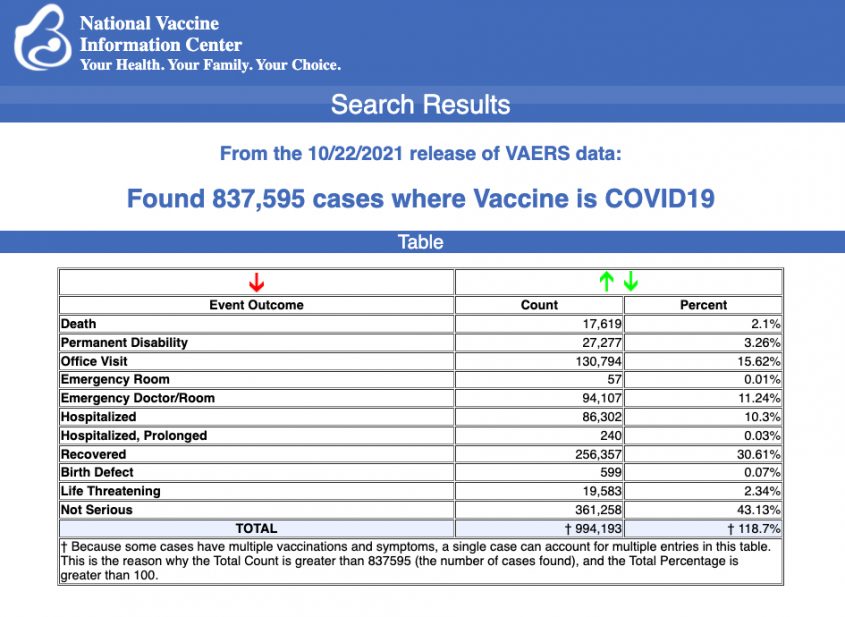
The data come directly from reports submitted to VAERS, the primary government-funded system for reporting adverse vaccine reactions in the U.S.
Every Friday, VAERS makes public all vaccine injury reports received as of a specified date, usually about a week prior to the release date. Reports submitted to VAERS require further investigation before a causal relationship can be confirmed.
Historically, VAERS has been shown to report only 1% of actual vaccine adverse events.
This week’s U.S. data for 12- to 17-year-olds show:
The most recent death involves a 12-year-old girl (VAERS I.D. 1784945) who died from a respiratory tract hemorrhage 22 days after receiving her first dose of Pfizer’s vaccine.
Another recent death includes a 15-year-old male who died six days after receiving his first dose of Pfizer’s COVID vaccine. According to his VAERS report (VAERS I.D. 1764974), the previously healthy teen complained of brief unilateral shoulder pain five days after receiving his COVID vaccine. The next day he played with two friends at a community pond, swung on a rope swing, flipped into the air, and landed in the water feet first. He surfaced, laughed and told his friends “Wow, that hurt!” He then swam toward shore underwater, as was his usual routine, but did not re-emerge.
An autopsy showed no external indication of a head injury, but there was a small subgaleal hemorrhage — a rare, but lethal bleeding disorder — over the left occiput. In addition, the boy had a mildly elevated cardiac mass, increased left ventricular wall thickness and small foci of myocardial inflammation of the lateral wall of the left ventricle with myocyte necrosis consistent with myocardial infarction.
- 58 reports of anaphylaxis among 12- to 17-year-olds where the reaction was life-threatening, required treatment or resulted in death — with 96% of cases
attributed to Pfizer’s vaccine.
- 539 reports of myocarditis and pericarditis (heart inflammation) with 531 cases attributed to Pfizer’s vaccine.
- 125 reports of blood clotting disorders, with all cases attributed to Pfizer.
This week’s U.S. VAERS data, from Dec. 14, 2020, to Oct. 22, 2021, for all age groups combined, show:
- 19% of deaths were related to cardiac disorders.
- 54% of those who died were male, 41% were female and the remaining death reports did not include gender of the deceased.
- The average age of death was 72.7.
- As of Oct. 22, 4,151 pregnant women reported adverse events related to COVID vaccines, including 1,296 reports of miscarriage or premature birth.
- Of the 3,065 cases of Bell’s Palsy reported, 51% were attributed to Pfizer vaccinations, 41% to Moderna and 8% to J&J.
- 685 reports of Guillain-Barré syndrome, with 41% of cases attributed to Pfizer, 31% to Moderna and 28% to J&J.
- 2,043 reports of anaphylaxis where the reaction was life-threatening, required treatment or resulted in death.
- 10,493 reports of blood clotting disorders. Of those, 4,590 reports were attributed to Pfizer, 3,766 reports to Moderna and 2,083 reports to J&J.
- 2,971 cases of myocarditis and pericarditis with 1,865 cases attributed to Pfizer, 978 cases to Moderna and 118 cases to J&J’s COVID vaccine.
FDA grants Emergency Use Authorization for Pfizer Vaccine for 5- to 11-year-olds
The U.S. Food and Drug Administration (FDA) today granted Emergency Use Authorization (EUA) for the Pfizer-BioNTech COVID vaccine for children 5 to 11 years old, The Associated Press reported.
The announcement followed Tuesday’s recommendation by the FDA’s vaccine advisory committee that the agency grant Pfizer’s request. The advisory committee vote passed with 17 in support, and one abstention.
Reporting on today’s news, STAT noted:
“The vaccine was not granted FDA approval, but instead an emergency use authorization. Emergency authorizations are used when the secretary of health and human services has declared a public health emergency to more quickly clear the use of vaccines, treatments, and diagnostic tests. These authorizations lapse when the state of emergency ends. Pfizer’s vaccine was fully approved for those age 16 and older in August, and was previously granted an emergency use authorization for use in adolescents ages 12 to 15.”
The dose for younger children will be one-third the strength given to people 12 and older, with two shots given three weeks apart. Before the shots can be rolled out, the CDC must weigh in with its own recommendations.
During Tuesday’s meeting, the Vaccines and Related Biological Products Committee heard evidence from Pfizer and regulators, and listened to concerns raised by multiple scientists and physicians.
Based on CDC data presented during the meeting, among children 5 to <12 years of age, there have been approximately 1.8 million confirmed and reported COVID cases since the beginning of the pandemic, and only 143 COVID-related deaths in the U.S. through Oct. 14.
Pfizer provided safety data on two study cohorts of children ages 5 to 11, both of roughly equal size. The first group was followed for only about two months, the second for only two-and-a-half weeks.
Pfizer said “post-vaccination myocarditis/pericarditis” in participants 5 to <12 years of age will not be studied until after the vaccine is authorized for children.
Pfizer vaccine ‘failed any reasonable risk-benefit calculus in connection with children,’ scientist says Brian Dressen, Ph.D., is one of the scientists who testified Tuesday during the FDA advisory committee’s 8-hour hearing. Dressen is also the husband of Brianne Dressen, who in 2020 developed a severe neurological injury during the Utah-based portion of the U.S. AstraZeneca COVID vaccine.
During his 3-minute testimony, Dressen, a chemist with an extensive background in researching and assessing the degree of efficacy in new technologies, told the FDA advisory panel Pfizer’s vaccine “failed any reasonable risk-benefit calculus in connection with children.”
Dressen said the decision to authorize for 5- to 11-year-olds is being rushed and is based on “incomplete data from underpowered trials, insufficient to predict rates of severe and long-lasting adverse reactions.”
Dressen urged the committee to reject the EUA modification and direct Pfizer to perform trials that decisively demonstrate the benefits outweigh the risks for children.
Dressen’s wife was severely injured last November after receiving her first and only dose of a COVID vaccine administered during a clinical trial.
“Because study protocol requires two doses, she was dropped from the trial, and her access to the study app deleted,” Dressen said. “Her reaction is not described in the recently released clinical trial report — 266 participants are described as having an adverse event leading to discontinuation, with 56 neurological reactions tallied.”
CDC updates guidance allowing immunocompromised to get a fourth COVID shot
Immunocompromised adults who received a third dose of either the Pfizer-BioNTech or Moderna COVID vaccine will become eligible for a fourth booster shot six months after receiving their third dose, according to CDC guidance issued Monday.
“In such situations, people who are moderately and severely immunocompromised may receive a total of four vaccine doses,” with the fourth coming at least six months after the third, the CDC’s new guidelines said.
In August, the CDC authorized a third dose of either Pfizer-BioNTech or the Moderna mRNA vaccine — but not Johnson and Johnson’s (J&J) adenovirus vaccine — for certain immunocompromised people 18 and older.
However, a third dose is now considered part of the primary series, rather than a booster. The earliest that immunocompromised people who received a third mRNA vaccine shot can get a fourth shot as a booster would be February.
The agency said people could select that booster from any of the three COVID vaccines available in the U.S, including J&J, but specified a fourth dose of Moderna’s vaccine should be half the size of a normal dose.
Double-vaccinated can still spread the virus at home
Fully vaccinated people are catching COVID and passing it on to those they live with, warn experts in the UK. A British study published in the Lancet Oct. 29, showed individuals who have had two vaccine doses can be just as infectious as those who have not been jabbed.
Even if they are asymptomatic or have few symptoms, the chance of transmitting the virus to other unvaccinated housemates is about two in five, or 38%. This drops to one in four, or 25%, if housemates are also fully vaccinated.
“By carrying out repeated and frequent sampling from contacts of COVID-19 cases, we found that vaccinated people can contract and pass on an infection within households, including to vaccinated household members,” said Dr. Anika Singanayagam, co-lead author of the study.
“Our findings provide important insights into … why the Delta variant is continuing to cause high COVID-19 case numbers around the world, even in countries with high vaccination rates.
Vaccinated contacts who tested positive for COVID on average received their shots longer ago than those who tested negative, which the authors said was evidence of waning immunity and supported the need for booster shots.
Neil Ferguson, an Imperial epidemiologist, said the transmissibility of Delta meant that it was unlikely Britain would reach herd immunity for long.
“That may happen in the next few weeks: If the epidemic’s current transmission peaks and then starts declining, we have by definition in some sense reached herd immunity, but it is not going to be a permanent thing,” Ferguson told reporters.
16-year-old girl develops severe vulvar ulcers after second Pfizer shot
A case report published Oct. 25 in the Journal of Pediatric and Adolescent Gynecology revealed a new potential novel side effect of Pfizer’s COVID vaccine that doctors say warrant further investigation.
According to the report, a 16-year-old non-sexually active female presented to the pediatric gynecology clinic with vaginal pain six days after receiving her second dose of Pfizer’s COVID vaccine.
Within 24 hours of receiving the vaccine, the girl developed fever, fatigue, myalgias and “sores” in her vaginal area. Over the next two days, right-sided lesions in her vaginal area coalesced and became more painful. The teen went to the urgent care with a fever of 105 degrees. She was diagnosed with a Bartholin gland abscess.
Despite antibiotic therapy, her symptoms worsened and her lesions were covered in exudate with a necrotic, ring-like border. In the gynecology clinic, the patient’s lesions were exquisitely painful, resulting in difficulty with urination, defecation and walking. She had no respiratory symptoms and no history of COVID exposure.
The report said the findings “were consistent with vulvar aphthous ulcers in association with influenza-like symptoms following Pfizer BioNTech (BNT162b2) COVID-19 vaccination.”
“Our patient had typical clinical features of aphthous ulcer, including an influenza-like prodrome and characteristic dermatologic manifestations which occurred after receiving the Pfizer COVID vaccine,” the authors wrote. According to the report, the girl’s case was submitted to VAERS “due to the temporal relationship with COVID vaccine administration.”
Children’s Health Defense asks anyone who has experienced an adverse reaction, to any vaccine, to file a report following these three steps.
Megan Redshaw is a freelance reporter for The Defender. She has a background in political science, a law degree and extensive training in natural health.
© 2021 Children’s Health Defense, Inc. This work is reproduced and distributed with the permission of Children’s Health Defense, Inc. Want to learn more from Children’s Health Defense? Sign up for free news and updates from Robert F. Kennedy, Jr. and the Children’s Health Defense. Your donation will help to support us in our efforts.
October 29, 2021
Posted by aletho |
Science and Pseudo-Science, War Crimes | COVID-19 Vaccine, United States |
Leave a comment
A public sector trade union in Cyprus has called for the suspension of rapid lateral flow tests after analysis found multiple times the permissible trace level of ethylene oxide.
The analysis by Cyprus-based Food Allergens Lab found 0.36 mg/kg of ethylene oxide in one swab, over seven times the limit of 0.05 mg/kg imposed by E.U. regulations.
According to the European Chemicals Agency, ethylene oxide is toxic, carcinogenic and mutagenic, including when inhaled. It is used to coat and sterilise PCR and rapid test nasal swabs.
A separate analysis by A-D Research Foundation in California found aluminum and silicon at concentrations as high as 7.25% and 14.06% respectively in some spots on PCR test swabs. The author, Peter Grandics, explains that aluminum and silicon can both be hazardous to health, and suggests this may explain the “rapid-onset nasal bleed and strong and lasting adverse reactions reported by the tested individuals”.
It follows concerns about why the bristles in LFT swabs so easily break away and remain in the body, as shown in this video.
As reported in the Daily Sceptic in August, Professor Anthony Brookes and Dr Kees Straatman from the University of Leicester put some material from a LFT swab under a powerful laser microscope and sent us the videos showing what they found. They explained:
To shed further light on the bristle structure of the swabs provided in LFD testing kits, we examined examples via confocal microscopy. The bristles were easy to separate from the swab itself, about 15 micrometres in diameter (the size of a large nucleus in a human cell), and clearly comprised an outer tube layer with an inner filling. The inner material does not seem to exude or flow or deviate from a cylindrical shape when the bristles are dissected, and so we would provisionally conclude this inner material is solid or semi-solid in nature.
In his paper, Peter Grandics is scathing about the standards of the manufacturers:
Our results revealed a disturbing pattern of noncompliance with regulatory requirements, combined with the lack of concern for the well-being of test subjects. It is ironic that the medical establishment that now strives to control human health is incapable of producing a safe and simple product in conformance with current regulatory standards.
Considering how widely these tests are being used and how often, Government ought to be taking much greater interest in how safe they are for human use.
October 29, 2021
Posted by aletho |
Deception, Science and Pseudo-Science | Covid-19 |
Leave a comment
The next wave of vaccination mandates will involve children. Since anyone raising concerns about this is considered an enemy of society, it’s been impossible to have a rational discussion about it.
Here’s what Harvey Risch, professor of epidemiology at the Yale School of Public Health and the Yale School of Medicine had to say about it this week.
“As far as I can tell, it’s a top-down structure, and most doctors do not get their information by going back and reading the original studies and making up their own minds. They get fed the information from pharma reps or from what they’re told from societies. The conflicts are legion. So it’s no surprise that most doctors don’t pay attention and think what they’re told…
“If the child has chronic conditions that make their risk appreciable, then there is a reason that they should be considered for vaccination. Other than that, if it were my child, I would homeschool them. Honestly, I would organize with other parents to take them out of the school and create a homeschooling environment.
There is no choice. Your child’s life is on the line.
“It’s not a high risk. Vaccination is not a high risk that’s going to kill every child by doing so. However, it’s enough of a risk that on the average the benefit is higher for homeschooling than it is for vaccination and being in school.”
Martin Kulldorff of Harvard is saying something similar:
“I don’t think children should be vaccinated for COVID. I’m a huge fan of vaccinating children for measles, for mumps, for polio, for rotavirus, and many other diseases. That’s critical. But COVID is not a huge threat to children….
“They can be infected, just like they can get the common cold, but they’re not a big threat. They don’t die from this, except in very rare circumstances. So if you want to talk about protecting children or keeping children safe, I think we can talk about traffic accidents, for example, which they are really at some risk…. And there are other things that we should make sure [of] to keep children safe. But COVID is not a big risk factor for children.”
Kulldorff points to the experience of his native Sweden. Beginning with the first wave in the spring of 2020, Sweden “decided to keep daycare and schools open for all children ages 1 to 15.
And there are 1.8 million such children who got through the first wave without vaccines, of course, without masks, without any sort of distancing in schools.
If a child was sick, they were told to stay home. But that was basically it. And you know how many of those 1.8 million children died from COVID? Zero. Only a few hospitalizations. So this is not a risky disease for children.”
He concludes: “If you’re a child, even if you haven’t had COVID, the risk of serious disease or death is minuscule … So it’s not at all clear that the benefits outweigh the risks for children.”
Try discussing this with friends and relatives on social media, and you run the risk of being silenced.
We are not even allowed to discuss these things. And when in our lifetimes has free discussion been more urgently needed?
There’s no censorship in my group, the Tom Woods Show Elite.
Here we discuss important matters like adults.
If you’re in a position where you don’t need such a thing, you are among the lucky few.
October 29, 2021
Posted by aletho |
Science and Pseudo-Science | COVID-19 Vaccine |
Leave a comment


 Aletho News