Climate Change Dictates Are Self Destructive – But Also Part Of A Bigger Agenda
By Tyler Durden | Zero Hedge | July 19, 2022
For many years we have been anticipating the implementation of far reaching and transformative restrictions on industry and agriculture in the name of “climate change” initiatives, and now it would seem the time has come for the fight to commence. The first major battleground is clearly Europe, as individual nations follow the emissions dictates if the centralized EU government, crushing their own economies while in the midst of a self induced energy crisis. It seems like madness, but there’s a bigger agenda at play here.
Today, a farmer’s rebellion is rising across Europe as the actual producers of the food that keeps the public alive are being demonized for refusing to work under conditions that would essentially bankrupt them. European emissions rules are not just about carbon, though that is a big focus. Rather, the rules include other natural gases including methane and nitrogen which are a byproduct of large farming operations. The nitrogen restrictions alone are set to destroy most farming operations in the Netherlands, which is one of the largest agricultural nations in the EU. Germany is set to follow the Netherlands with its own emissions rules in the near term.
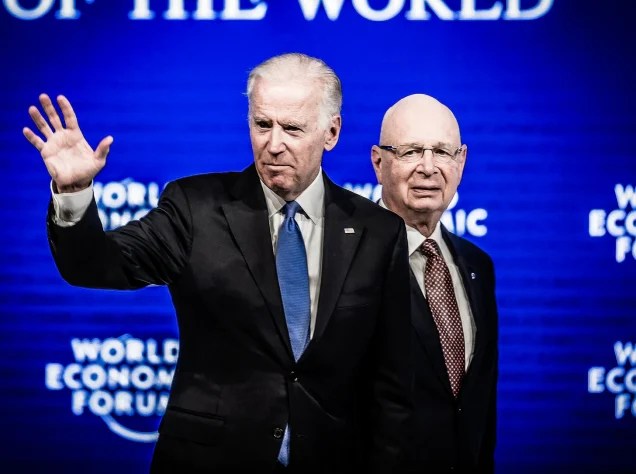
First, it’s important to ask “why now?” There are a host of reasons. First and foremost, the EU climate agenda closely aligns with the UN climate protocols for the year 2030 and requires a 55% reduction of emissions in less than a decade (and net zero by 2050). If you think these decisions are being made by individual governments then you are mistaken; the 2030 plan was formulated by globalist institutions like the UN and the Club of Rome – Member states are simply following orders. The time-frame for drastic environmental rules was likely set back in 1992 during the “Earth Summit” in Rio de Janeiro (also known as Agenda 21).
Why the year 2030? It’s hard to say. There is no scientific basis for the timeline. There is no evidence to support the notion that climate change will make any noticeable environmental impact by 2030. They just really want carbon controls and other measures in place by 2030, and they won’t give a concrete reason for it.
Climate doomsday predictions have been presented by establishment paid scientists and activist hysterics for decades, and not a single one of these predictions has ever come true. For example, in the 1970’s climate scientists predicted a “new ice age” by the year 2000 and this nonsense scenario was spread widely by the media. Then they claimed that “acid rain” would kill off life in freshwater lakes in the 1980s; but that never happened. After that, the climate cult switched over to the global warming narrative, predicting that the ice caps would melt and rising seas would “obliterate nations” by the year 2000. Obviously, this never happened.
In the year 2000, scientists at the Climate Research Unit in Britain stated that snowfall was a “thing of the past” and that the next generation would not know what snow was. In 2008 NASA scientists argued that the Arctic would be “ice free” by the year 2018. The list goes on and on, and it would be hilarious if the people that made all these faulty predictions were not still influencing government policies, but they are.
The following quote from the Club of Rome, a group directly connected to the UN, should illustrate why the public has been constantly bombarded with climate doom mongering for the past few decades. The quote comes from a book titled ‘The First Global Revolution’ published in 1992. In that document they specifically recommend using global warming as a vehicle:
‘In searching for a common enemy against whom we can unite, we came up with the idea that pollution, the threat of global warming, water shortages, famine and the like, would fit the bill. In their totality and their interactions these phenomena do constitute a common threat which must be confronted by everyone together. But in designating these dangers as the enemy, we fall into the trap, which we have already warned readers about, namely mistaking symptoms for causes. All these dangers are caused by human intervention in natural processes, and it is only through changed attitudes and behaviour that they can be overcome. The real enemy then is humanity itself.’
The statement comes from Chapter 5 – The Vacuum, which covers their position on the need for global government. The quote is clear; a common enemy must be conjured in order to trick humanity into uniting under a single banner, and the elites see environmental catastrophe, caused by mankind itself, as the best possible motivator.
Except, there is no environmental catastrophe, at least not within the narrative the establishment presents. It simply doesn’t exist. There is no evidence to support the theory of man-made climate change. None. Global temperatures have risen only 1 degree Celsius in the past century, and there is no concrete proof that this single degree of temperature was caused by human activity.
The primary argument of climate scientists is one of exclusion: They say that all other potential causes (including the sun) have been proven not to be the cause, therefore, the cause “must” be human industry and emissions. But this is a lie.
Interestingly, the increase in temperatures cited by the NOAA and NASA coincide directly with an increase in solar activity over the course of the past 100 years according to a study released in 2006. Furthermore, scientists have discovered that solar activity in 2022 is OUTPACING previous predictions. Overall solar activity has been increasing at the same time as the earth has been warming – Imagine that.
Climate scientists continue to discount the sun as a cause because they say there’s not enough data to support the idea. Of course, there’s not enough data because all the money goes to scientists that support the man-made theory; there’s no funding to be had for scientists that present alternative theories.
Since the official temperature record used by climate scientists only goes back to the 1880s, there is no way of knowing for sure how often these warming patterns actually occur and how many times the earth has warmed by 1 degree Celsius over the millennia. But it doesn’t matter, because climate science is not about saving the Earth, it’s about creating an excuse to micromanage every aspect of human production and thus human society.
For emissions targets to be met by 2030, drastic society-changing events will have to take place within the next eight years. The very fabric of our current trade system and the global supply chain will have to be torn to shreds and replaced with an exceedingly limited production model. Not only that, but the human population would have to be reduced by billions. This model will be artificially contained within arbitrary climate guidelines set by unelected governing bodies in the name of stopping environmental changes that have not been proven to be caused by human beings at all. What it accomplishes is the formation of an authoritarian framework, one that the globalists will say is “environmentally justified.”
The war ‘diplomat’: How the West lost the ‘global battle of narratives’
By Ramzy Baroud | MEMO | July 20, 2022
In a blog entry, reflecting on the G20 Foreign Ministers’ meeting in Bali, Indonesia, on 7-8 July, the High Representative of the European Union, Josep Borrell, seems to have accepted the painful truth that the West is losing what he termed “the global battle of narratives”.
“The global battle of narratives is in full swing and, for now, we are not winning,” Borrell admitted. The solution: “As the EU, we have to engage further to refute Russian lies and war propaganda,” the EU’s top diplomat added.
Borrell’s piece is a testimony to the very erroneous logic that led to the so-called ‘battle of narratives’ to be lost in the first place.
Borrell starts by reassuring his readers that, despite the fact that many countries in the Global South refuse to join the West’s sanctions on Russia, “everybody agrees”, though in “abstract terms”, on the “need for multilateralism and defending principles such as territorial sovereignty”.
The immediate impression that such a statement gives is that the West is the global vanguard of multilateralism and territorial sovereignty. The opposite is true. The US-western military interventions in Iraq, Bosnia, Afghanistan, Syria, Libya and many other regions around the world have largely taken place without international consent and without any regard for the sovereignty of nations. In the case of the NATO war on Libya, a massively destructive military campaign was initiated based on the intentional misinterpretation of United Nations Security Council resolution 1973, which called for the use of “all means necessary to protect civilians”.
Borrell, like other western diplomats, conveniently omits the West’s repeated – and ongoing – interventions in the affairs of other nations, while painting the Russian-Ukraine war as the starkest example of “blatant violations of international law, contravening the basic tenets of the UN Charter and endangering the global economic recovery”.
Would Borrell employ such strong language to depict the numerous ongoing war crimes in parts of the world involving European countries or their allies? For example, France’s despicable war record in Mali? Or, even more obvious, the 75-year-old Israeli occupation of Palestine?
When addressing “food and energy security”, Borrell lamented that many in the G20 have bought into the “propaganda and lies coming from the Kremlin” regarding the actual cause of the food crisis. He concluded that it is not the EU but “Russia’s war of aggression against Ukraine that is dramatically aggravating the food crisis.”
Again, Borrell was selective with his logic. While naturally, a war between two countries that contribute a large share of the world’s basic food supplies will detrimentally impact food security, Borrell made no mention that the thousands of sanctions imposed by the West on Moscow have disrupted the supply chain of many critical products, raw material and basic food items.
When the West imposed those sanctions, it only thought of its national interests, erroneously centered around defeating Russia. Neither the people of Sri Lanka, Somalia, Lebanon, nor, frankly, Ukraine were relevant factors in the West’s decision.
Borrell, whose job as a diplomat suggests that he should be investing in diplomacy to resolve conflicts, has repeatedly called for widening the scope of the war on Russia, insisting that the war can only be “won on the battlefield”. Such statements were made with western interests in mind, despite the obvious devastating consequences that Borrell’s battlefield would have on the rest of the world.
Still, Borrell had the audacity to chastise G20 members for behaving in ways that seemed, to him, focused solely on their national interests. “The hard truth is that national interests often outweigh general commitments to bigger ideals,” he wrote. If defeating Russia is central to Borrell’s and the EU’s “bigger ideals”, why should the rest of the world, especially in the Global South, embrace the West’s self-serving priorities?
Borrell also needs to be reminded that the West’s “global battle of narratives” had been lost well before 24 February. Much of the Global South rightly sees the West’s interests at odds with its own. This seemingly cynical view is an outcome of decades – in fact, hundreds of years – of real experiences, starting with colonialism and ending, presently, with the routine military and political interventions.
Borrell speaks of ‘bigger ideals’, as if the West is the only morally mature entity that is capable of thinking about rights and wrongs in a selfless, detached manner. In addition to there being no evidence to support Borrell’s claim, such condescending language, itself an expression of cultural arrogance, makes it impossible for non-western countries to accept, or even engage, with the West regarding the morality of its politics.
Borrell, for example, accuses Russia of a “deliberate attempt to use food as a weapon against the most vulnerable countries in the world, especially in Africa”. Even if we accept this problematic premise as a morally driven position, how can Borrell justify the West’s sanctions that have effectively starved many people in “vulnerable countries” around the world?
Perhaps, Afghans are the most vulnerable people in the world today, thanks to 20 years of a devastating US/NATO war which has killed and maimed tens of thousands. Though the US and its western allies were forced out of Afghanistan last August, billions of dollars of Afghan money are illegally frozen in Western bank accounts, pushing the whole country to the brink of starvation. Why can Borrell not apply his ‘bigger ideals’ in this particular scenario, demanding immediate unfreezing of Afghan money?
In truth, Borrell, the EU, NATO and the West are not only losing the global battle of narratives, they never won it in the first place. Winning or losing that battle never mattered to Western leaders in the past, because the Global South was hardly considered when the West made its unilateral decisions regarding war, military invasions or economic sanctions.
The Global South matters now, simply because the West is no longer determining all political outcomes, as was often the case. Russia, China, India and others are now relevant, because they can collectively balance out the skewed global order that has been dominated by Borrell and his likes for far too long.
US Threatens Lebanon: Accept Israel’s Conditions or You Won’t Be Able to Extract Maritime Gas for Decades
Al-Manar | July 20, 2022
Caretaker Minister of Foreign Affairs Abdallah Bou Habib met on Wednesday with head of the American Task Force For Lebanon Edward Gabriel heading a delegation.
After the meeting, Gabriel addressed the reporters, conveying an American threat to Lebanon.
Gabriel considered that Lebanon has a small chance to extract its maritime gas resources by concluding a settlement after engaging in negotiations.
Otherwise, Lebanon would not be able to extract its maritime gas for decades, Gabriel added.
It is worth noting that Lebanon has insisted on obtaining its entire maritime rights preserved by a fair and legal border demarcation. However, the Zionist enemy has stubbornly rejected Lebanon’s demands.
Hezbollah Secretary General Sayyed Hasan Nasrallah warned the Israeli enemy and the United States that if Lebanon is prevented from extracting its maritime resources, none will be able to extract or sell gas and oil.
In a televised speech, Sayyed Nasrallah indicated that Hezbollah military forces are monitoring all the Zionist platforms across the occupied Palestinian coast, adding that the Resistance may resort to ground, maritime or air capabilities in order to attack the enemy and secure Lebanon’s rights.
According to Sayyed Nasrallah, the new equation is Karish, what’s beyond Karish and what’s far beyond Karish.
Thus, Hezbollah military power has been writing the long story of Lebanon’s pride of victory that protects the nations and secures its all-leveled prosperity.
Ukraine’s Naftogaz Reportedly Requests $5Bln in Government Subsidies to Buy Gas Ahead of Winter
Samizdat – 20.07.2022
Ukraine’s state-run oil and gas company Naftogaz has requested 150 billion Ukrainian hryvnias ($5 billion) in subsidies from the government to purchase enough gas ahead of the heating season, the RBC Ukraine news agency reported on Wednesday, citing the firm’s letter to the government.
Naftogaz had to request budgetary help since raising such massive funds otherwise is neither possible domestically nor internationally, the company wrote in the letter to the cabinet, according to the report.
“In such conditions, the state budget is the only possible source of financing the purchase of imported natural gas… The most favorable option is to increase the authorized capital of Naftogaz of Ukraine,” the letter read, according to the report.
The company suggested increasing its authorized share capital by 150 billion Ukrainian hryvnias, the report said.
On July 12, Naftogaz asked the holders of its Eurobonds to defer interest payments for two years but was not granted such concession, thereby exposing the company to the risk of default.
Ukraine’s former housing and communal services minister, Oleksiy Kucherenko, has accused Naftogaz of forging its profit results in 2021, saying that the breach now has to be patched with 264 billion hryvnias from the budget. The ex-official also noted that Ukraine’s budget is running low, so Kiev may have to request assistance from the United States.
Let the people pay: EU leaders make their citizens suffer the fallout from their failed Russia policy
Samizdat | July 20, 2022
In a Bastille Day interview, French President Emmanuel Macron told citizens to “prepare ourselves for a scenario where we have to do without Russian gas entirely.” At the same time, Macron accused Moscow of using the fuel as a “weapon of war,” echoing the spin emanating from a European Union leadership that obscures the real reason the bloc is facing an energy shortage that’s driving up the cost of living.
This crisis is entirely self-inflicted.
European Commission President Ursula von der Leyen accused Russia of energy “blackmail” at the end of April, citing the state-owned Gazprom’s announcement of a halt in gas deliveries to Poland and Bulgaria for failing to pay for in rubles. What von der Leyen – and now Macron – conveniently omitted was that it was the EU’s own anti-Russian sanctions, adopted in a knee-jerk and ideologically-driven fashion at the outset of the Ukraine conflict, that represent the root cause of these disruptions.
The West quickly adopted a strategy of targeting and sanctioning various aspects of the Russian financial system, including banks and foreign reserves, cutting it off from the SWIFT global transaction system – and then had the gall to complain that Moscow was asking for payment for its gas exports in its own currency to mitigate the hassle of navigating a system from which it was effectively blocked. “Export your gas but good luck trying to get paid,” is hardly a reasonable expectation.
It wasn’t Russian President Vladimir Putin who called on the EU to cut off Russian gas. Rather, it was his Ukrainian counterpart Vladimir Zelensky, who has constantly pushed for ever more Western sanctions on Russian fossil fuels. And the West has only been to happy to recklessly indulge him to the detriment of their own citizens.
Earlier this month, Zelensky even admonished Canada for agreeing to return repaired turbines for reintegration into the Nord Stream 1 gas pipeline that provides gas to Germany, and demanded that Ottawa reverse its decision. Canada had earlier faced the dilemma of violating the West’s own anti-Russian sanctions by virtue of even returning the critical parts – even though the pipeline is so vital to EU industry that the bloc’s leaders have even been freaking out about its scheduled maintenance shutdown.
Why would you be so worried about Russia failing to turn the tap back on when you’ve been saying repeatedly that you’ll gladly do without it “for Ukraine.”
But even in defending the return of the turbines, Canadian Prime Minister Justin Trudeau cited the same ridiculous Western establishment propaganda of Russia’s “weaponization” of gas, when in reality it’s the West’s own sanctions that have wreaked energy havoc and caused all this drama.
“We have seen Russia consistently trying to weaponize energy as a way of creating division amongst the allies,” Trudeau said. So if Canada doesn’t violate its own sanctions and return the turbines to Germany, then Putin wins. The Olympic level rhetorical gymnastics required by Western leaders to justify violating their own failed sanctions are second only to their recent defense of firing up coal plants again, and redefining fossil fuel energy as “green,” amid the current shortages.
EU leaders are calling for an end to Russian energy imports, citing their decision to sanction their own gas supply as a reason to expedite a transition to unproven renewables. But rather than take responsibility for the fact that they set fire to their sails and are now stranded in the middle of the ocean while awaiting the manifestation of their renewable energy transition fantasy, they’re blaming Russia for their own shortsightedness and trying to spin it as a withholding of energy orchestrated by Moscow.
Russia is only too happy to sell its fuel to whomever wants to buy it. And if the EU sanctions were lifted, the Western energy crisis would end. But that would mean admitting to a failed policy. So, instead, we’re being told that it’s all Putin’s fault, but also that the best way to stick it to Vladimir Putin is to take short, cold showers and to reduce “night lighting,” as Macron has recently suggested.
Western leaders aren’t just taking their citizens for credulous fools with their ridiculous propaganda as cover for their own failures, but they’re treating the livelihood of the average person as collateral economic damage in their hopeless bid to isolate Russia. They’ve convinced themselves, from their ideologically-isolated elite bubble, that they represent the entire world. But they’re mostly just fooling themselves.
Even the EU’s chief diplomat, Josep Borrell, admitted to a rude awakening recently at the G20 summit. “The G7 and like-minded countries are united in condemning and sanctioning Russia and in trying to hold the regime accountable,” Borrell said in a statement on the EU’s website. “But other countries, and we can speak here of the majority of the ‘Global South’, often take a different perspective.”
But then Borrell gave away the game. “The global battle of narratives is in full swing and, for now, we are not winning,” he said. “As the EU, we have to engage further to refute Russian lies and war propaganda.” But who’s really peddling the propaganda? On one hand, the EU has been trying to portray the impact of their own irresponsible and devastating sanctions on their own economies and citizens as Putin’s doing even as they try to convince Westerners that their suffering is some kind of a war effort that’s doing harm to Russia.
However, in reality, Russia can pivot to the rest of the entire world and simply leave West Europeans to wallow in their own costly delusions. They may be about to find out whether moral superiority and virtue-signaling will heat the house or feed the kids this winter.
Russia teaches Europe ABCs of gas trade
BY M. K. BHADRAKUMAR | INDIAN PUNCHLINE | JULY 20, 2022
The unthinkable is happening for the second time in five months: Russian gas giant Gazprom writes to German gas companies announcing force majeure effective from June 14, exonerating it from any compensation for shortfalls since then.
The first time shock and awe appeared in German-Russian relations this year was on February 22 when Chancellor Olaf Shloz surprised even hardened political observers by freezing approval process for the newly-constructed Nord Stream 2 gas pipeline. The $11 billion pipeline beneath the Baltic Sea would have doubled the volume of gas sent directly from Russia to Germany, but Scholz instead blocked its commissioning. Those were halcyon days when Berlin talked of “defeating” Russia.
Scholz’s move was in reaction to Moscow’s decision on February 21 to recognise two breakaway regions of Ukraine as independent republics. Russia hawks in Germany applauded his decision. Acclaim came pouring in. Jana Puglierin, head of the European Council on Foreign Relations in Berlin, praised Scholz, saying he was “raising the bar for all other EU countries… this is real leadership at a crucial moment.”
However, in Moscow, which has a thorough understanding of the German energy market, Scholz’s move was seen as an act of deliberate self-harm. Moscow reacted with a flash of sardonic humour. Dmitry Medvedev, former president and deputy head of Russia’s Security Council, tweeted, “Welcome to the brave new world where Europeans will soon be paying €2,000 per 1,000 cubic meters of gas!”
He was alluding to the grim reality that gas accounted for a quarter of Germany’s energy mix, and more than half of it came from Russia. Indeed, it was plain to see that Germany’s reliance on gas could only rise having decided to shelve nuclear power in the aftermath of the 2011 Fukushima disaster in Japan and committed to phasing out coal-fired power by 2030.
But Scholz insisted that Germany would expand solar and wind power capacity “so we can produce steel, cement and chemicals without using fossil fuels.” His confidence actually stemmed from the fact that Germany had a long-term contract with Russia to supply gas at a friendly price via Nord Stream 1.
The first indication that something was going horribly wrong was when the influential Russian daily Izvestia wrote on July 11 quoting industry experts in Moscow that the scheduled routine stoppage of NS1 for annual servicing and repairs from July 11-21 might continue due to Canada holding back, under sanctions against Russia, the turbine that had gone for repair.
The daily went on to forecast that Gazprom might announce force majeure because of western sanctions, as Siemens twice already failed to return equipment to Gazprom after repairs in Canada, which resulted in a reduction in the gas flow from the planned 167 million cubic meters.m to 67 million cubic meters.m per day.
Izvestia noted that the situation would lead to a spike in spot market price for LNG upward of $2,000 per 1,000 cubic meters — perhaps, “even more — up to $ 3,500” — from the July 8 price level of $1800.
Acting on an urgent request from Berlin and recommendation for Washington for waiver of sanctions, Canada since agreed, but, according to Izvestia, even after Siemens returns the turbines to Gazprom, “there will be a long period of testing the turbines to find out how correctly they were repaired. No one wants to install turbines that are at risk of failure after being repaired in an unfriendly country. So the real time for launching turbines and returning SP-1 (NS1) to its design capacity is two to three months.”
That is, gas may flow through NS1 earliest only by September/October. Even then, Gazprom may not be able to utilise more than 60 percent of its capacity, since overhauls are overdue for two more turbines.
Therefore, the experts told Izvestia that problems with gas shortages in the European Union would persist for the next few winters and authorities may have to “limit the supply of hot water, dim street lights, close swimming pools and turn off energy-consuming equipment” and, furthermore, instead of green energy, switch to coal.
Kommersant newspaper reported today that while classic force majeure events could be natural disasters, fires, etc., in the case of Gazprom, “we are talking about a technical malfunction of equipment,” which may lead to litigation — and, “what will be decisive will be whether Gazprom’s actions to cut gas supplies were proportionate to the real scale of the technical problems.”
Evidently, Gazprom is well-prepared. Germans suspect that Gazprom’s alibi of non-delivery of gas turbines from Canada, et al, is bogus. And Kommersant foresees a “lengthy trial.” Now, the catch is, in the long run, we are all dead.
For Germany, however, this is a grave situation, as many industries may have to shut down, and there could be serious social unrest. Germans are convinced that Moscow is resorting to the “nuclear option.” The big question is whether Germany’s solidarity with Ukraine will survive a cold winter.
Scholz’s confidence was predicated on the belief that Russia desperately needed the income from gas exports. But then, Moscow is today generating more income from less exports. Arguably, Russia’s best strategy today would be to reduce gas deliveries without ending them altogether, as even if Russia sells only a third of the gas it sold previously, its revenues do not get affected, since the shortage of LNG globally has exponentially spiked the market price. It’s a fair bet that’s what Gazprom would do.
Putin once disclosed that under the long-term contracts, Russia sold gas to Germany at ridiculously low price — $280 per thousand cubic meters — and Germany was even reselling Russian gas to other customers for a tidy profit!
Where it hurts Germany most is that this is not only about freezing homes, but the implosion of its entire economic model that is over-reliant on industrial exports, thanks to imports of cheap fossil fuels from Russia. German industry is responsible for 36 percent of its gas use.
Germany behaved in an unprincipled way on all aspects of the Ukraine crisis. It pretended to support Zelensky but shied away from giving military support, triggering a nasty diplomatic spat between Kiev and Berlin. On the other hand, when Moscow introduced the new payment scheme for gas exports, making it mandatory to pay in rubles, Germany was the first country to fall in line, knowing well that the new regime undercut EU sanctions.
Thus, Moscow insists that German gas buyers keep euro and dollar accounts at Gazprombank (which is not subject to EU sanctions) and convert the currencies into rubles, since the Russian central bank is subject to western sanctions and can no longer transact in foreign exchange markets!
Russians have made monkeys out of Europeans. Clearly, it is impossible to sanction a country that is sitting on valuable commodities. Russia is the world’s second largest exporter of oil, the largest exporter of gas, and the largest exporter of wheat and fertilisers — plus the range of rare earth metals like palladium.
Both Boeing and Airbus have complained of risks in their supply chain. Airbus imports large quantities of titanium where about 65 percent of the supply of the metal comes from Russia. It has publicly requested the EU not to impose restrictions on the material, which is used to manufacture critical components of aircraft.
Thus, it comes as no surprise that the EU is slowing down the pace of sanctions against Russia. The bureaucrats in Brussels have exhausted the potential for increasing sanctions and the political elites admit that the sanctions were a mistake.
The consequences for European economies are already extremely serious. The rising energy prices are fuelling inflation in all EU countries. According to forecasts, in France inflation will reach 7% this year; in Germany – 8.5-9%; and in Italy – 10%. And this is just the beginning. Most countries will also face a serious drop in GDP next year — from 2 to 4 percent.
Iran deal can survive if US opts for own interests rather than Israel’s: Foreign Ministry
Press TV – July 20, 2022
Tehran says multilateral negotiations to revive the 2015 Iran deal will be fruitful if the United States looks at the issue through the lens of its own national interests rather than those of the Israeli regime.
Iranian Foreign Ministry spokesman Nasser Kan’ani told a press conference on Wednesday that the US seems to be weak when it comes to making “an independent political decision” about whether it is willing to return to the deal, four years after it unilaterally walked away.
“If the US administration [of Joe Biden] looks at this issue through the lens of American national interests and not through the lens of the interests of the occupying Zionist regime, the ground will be paved for an agreement in the near future,” Kan’ani said.
More than a year of negotiations – first in Vienna and now in Doha – have not yet led to an agreement on what steps each side needs to take in order to restore the ailing accord, officially called the Joint Comprehensive Plan of Action (JCPOA).
The US withdrew from the JCPOA back in 2018 as it unleashed a “maximum pressure” campaign targeting the Iranian economy, despite Tehran’s strict compliance with the terms of the accord.
The Vienna talks, which began in April last year, hit a deadlock in March owing to Washington’s insistence on retaining parts of its sanctions against Iran. The Doha talks, however, have led to different interpretations by the parties to the talks.
“Contrary to the claim of the American side that the Doha negotiations were a failure, they opened up a path for the continuation of talks between the different parties of the nuclear agreement,” Kan’ani said, assessing the negotiations as “good.”
He explained that there is no major obstacle to concluding an agreement, except that the American side has to make a serious political decision.
“On the one hand, the US administration expresses its desire to return to the agreement, and on the other hand, it does not want to pay the costs of returning to the agreement,” the Iranian spokesman added.
‘US, Israel failed to form anti-Iran coalition’
In his Wednesday press conference, Kan’ani also pointed to Biden’s recent trip to the region with the agenda of forming an anti-Iran coalition among other objectives, saying both the US and the Israeli regime failed to achieve that goal.
“The Zionist regime attempted to form a regional coalition during that trip to put pressure on Iran,” he said. “In this effort, this regime has failed and the American government has not succeeded either.”
Biden arrived in the Israeli-occupied territories last Wednesday, kicking off a much-anticipated four-day trip to the region. The regional tour also took the US president to Saudi Arabia, the country he once pledged to make “the pariah that they are.”
Since 2020, the US has brokered normalization agreements under the so-called Abraham Accords between the Israeli regime and some Arab countries, including the United Arab Emirates, Bahrain, Morocco, and Sudan – with Saudi Arabia expected to be the next.
In Saudi Arabia, Biden attended a summit of the [Persian] Gulf Cooperation Council (GCC) countries, plus Egypt, Jordan, and Iraq – also known as GCC+3. The summit, which was ostensibly aimed to build an anti-Iran front, failed to garner much support.
A day before the summit, Iraqi Prime Minister Mustafa al-Kadhimi stressed that Iraq will not be part of any camp or military alliance, and “will not be a base for threatening any neighboring countries.”
The UAE, a close ally of both Saudi Arabia and the US, also dismissed the idea of forming a NATO-like military alliance in the region.
“We are open to cooperation, but not cooperation targeting any other country in the region and I specifically mention Iran,” Anwar Gargash, the UAE president’s diplomatic adviser, said.
“The UAE is not going to be a party to any group of countries that sees confrontation as a direction,” Gargash added.
After the summit, Saudi Arabia’s Foreign Minister Prince Faisal bin Farhan claimed that his country extends a hand of friendship toward Iran.
He also expressed the kingdom’s willingness to reestablish normal relations with the Islamic Republic.
“The messages we received from Arab officials in the region, both directly and indirectly, show that fortunately, the countries of the region are not ready to act against Iran [and in line with] America’s regional policies,” Kan’ani said.
He then added that conditions are now ripe for Iran to organize and host talks to deepen regional cooperation.
He also urged the US to stop meddling in the internal affairs of regional countries, halt its plots of forming fictitious alliances, and refrain from imposing American values on the region.
Regional countries naturally have common interests and views, he said, adding, “They are capable of creating the best conditions for stability and security in the region in the light of regional meetings.”
US and UK want ‘real war’ between Russia and EU – Lavrov
Samizdat | July 20, 2022
The US and UK want to escalate the Russia-Ukraine conflict into a larger confrontation between Moscow and members of the European Union, Russian Foreign Minister Sergey Lavrov said on Wednesday in an interview with RT and Sputnik.
“Our American counterparts, British counterparts… with active support from Germans, the Polish and the Baltic states, they really want to turn this war into a real war and start a confrontation between Russia and European states,” Lavrov told RT’s editor-in-chief, Margarita Simonyan.
The Western governments are “keeping Ukraine from any constructive steps” towards a peace settlement, Lavrov argued. “[Ukraine is] not just [being] pumped with weapons. They are forced to use these weapons in an increasingly riskier way.”
Russia launched its military operation in the neighboring country in late February. Many countries, including NATO members, imposed sweeping sanctions on Moscow and have been supplying Kiev with heavy weapons. The latest deliveries include US-made M142 HIMARS multiple rocket launchers and M777 howitzers.
Lavrov claimed that the US and Britain were acting to their own advantage in the conflict between Russia and the EU because the economies of the bloc’s members are bearing the brunt of the sanctions. He added that the US has been acting “irresponsibly” by stoking tensions with Russia.
They are playing a very dangerous game. I don’t think they understand it themselves. But then, in Europe, a lot of people are starting to understand that.
US President Joe Biden said last week that Russia must suffer “a strategic failure” in Ukraine and vowed more support for Kiev.
Russia sent troops into Ukraine on February 24, citing Kiev’s failure to implement the Minsk agreements, designed to give the regions of Donetsk and Lugansk special status within the Ukrainian state. The protocols, brokered by Germany and France, were first signed in 2014. Former Ukrainian President Pyotr Poroshenko has since admitted that Kiev’s main goal was to use the ceasefire to buy time and “create powerful armed forces.”
In February 2022, the Kremlin recognized the Donbass republics as independent states and demanded that Ukraine officially declare itself a neutral country that will never join any Western military bloc. Kiev insists the Russian offensive was completely unprovoked.
Hotter than the Sun: Finally, a Book Worth Reading

The top seller on Amazon for books devoted to war and peace as of this writing, Scott Horton’s newest offering, Hotter than the Sun: Time to Abolish Nuclear Weapons, is a timely must read. As Washington barrels heedlessly along into Cold War II, the American public badly needs educating on the current risks, past close calls, and the utter insanity of an entire for-profit industry built on the flawed concept of thousands of thermonuclear bombs as “weapons” that keep us safe.
With major papers like the Wall Street Journal and New York Times now regularly running pieces arguing everything from the need to show the Russians we aren’t afraid to fight a nuclear war—that we can even “win” one—to the idea that a “small” nuclear war can help mitigate climate change, Scott’s book is a vital weapon in the hands of the sane, convincingly making the case that it really is time to get rid of the thousands of nuclear and thermonuclear bombs in existence.
Because the truth about thousands of nuclear and thermonuclear bombs, the overwhelming majority of which are possessed by the United States and Russia, is immutable. Just as Ronald Reagan said forty years ago, a nuclear war cannot be won and can never be fought.
And forget even about launching a life-ending nuclear exchange on purpose, as Hotter than the Sun notes there have been plenty of accidents that could have resulted in exactly the same outcome. From the Air Force accidentally dropping a nuke over North Carolina to absent-minded technicians dropping wrenches down armed missile silos, careless scientists playing with plutonium rods to the Norwegians launching a satellite, the game theoretical strategic calculations that form the basis of US and Russian nuclear postures mean that an apparent threat or actual detonation on their soil would mean an almost immediate escalation to a full-on nuclear exchange.
Apart from documenting such accidents that nearly resulted in the deaths of potentially millions or billions of people, if not every single one of us, over the course of the ensuing nuclear winter, the book revisits past insanities. From the decision to test the first bomb, despite its creators’ real concerns that it would immediately ignite atmosphere and oceans, instantly killing everyone on earth, to deciding to drop the first bombs on Japan only in order to justify their expense, ensure continued funding for making more, and intimidating the Soviets, Scott’s book takes the reader right up to the present day, where Washington, having started an unnecessary new arms race by unilaterally ripping up important arms control agreements in the name of pursuing a first-strike capability and enriching Lockheed Martin and Northrop Grumman execs, is now in full panic mode because it is apparently losing.
But it is important to note, as Scott does, that “losing” in Washington’s mind is not being able to potentially threaten with virtual impunity anyone it wants: that is hardly a concern most American voters express, if any.
Important as the topic of nuclear arms is, the over fifteen thousand nuclear and thermonuclear bombs in existence being the number one short-term threat to humanity’s continued existence, Scott’s title frankly sells the book’s contents rather short. At over four hundred pages, consisting of several dozen interviews conducted over a period of nearly two decades, Hotter than the Sun is a critical primer on everything from diplomatic history to US Middle East policy to the military-industrial complex, corporate lobbying, and a range of other issues.
From corporate lobbying for North Atlantic Treaty Organization expansion to Israeli misinformation about the fake Iranian nuclear threat to how the decision to invade Iraq was made to why any random Pakistani colonel on the border with India could end all life on earth, Scott and his guests never fail to inform, surprise, disgust, and alarm, with Washington’s misguided, corporatist, imperialist, or just plain idiotic policies usually at or near the root of virtually every serious problem facing humanity today.
Featuring interviews with Daniel Ellsberg, Seymour Hersh, Gar Alperovitz, Chas Freeman, Ray McGovern, Doug Bandow, and many others, Hotter than the Sun is a book worthy of your time and money. And this at a moment when any trip to your local bookstore or Barnes and Noble outlet is sure to leave you much poorer and much more badly informed about the world than you otherwise would have been had you not bought anything to read at all.
Joseph Solis-Mullen is a graduate of Spring Arbor University and the University of Illinois, Joseph Solis-Mullen is a political scientist and graduate student in the economics department at the University of Missouri.
How Pfizer Profited From the Pandemic
By Dr. Joseph Mercola | July 18, 2022
According to Kaiser Health News (KHN),1 the COVID-19 pandemic has been a real boon to Pfizer. Not only has it yielded “outsize benefits” in terms of profits, but it has also “given the drugmaker unusual weight in determining U.S. health policy.”
“Based on internal research, the company’s executives have frequently announced the next stage in the fight against the pandemic before government officials have had time to study the issue, annoying many experts in the medical field and leaving some patients unsure whom to trust,” KHN reporter Arthur Allen writes, adding:2
“When last year Bourla suggested that a booster shot would soon be needed, U.S. public health officials later followed, giving the impression that Pfizer was calling the tune.
Some public health experts and scientists worry these decisions were hasty, noting, for example, that although boosters with the mRNA shots produced by Moderna and Pfizer-BioNTech improve antibody protection initially, it generally doesn’t last.
Since January, Bourla has been saying that U.S. adults will probably all need annual booster shots, and senior FDA officials have indicated since April that they agree … The company’s power worries some vaccinologists, who see its growing influence in a realm of medical decision-making traditionally led by independent experts …
When President Biden in September 2021 offered boosters to Americans — not long after [Pfizer CEO Albert] Bourla had recommended them — Dr. Paul Offit, director of the Vaccine Education Center at Children’s Hospital of Philadelphia … wondered, ‘Where’s the evidence you are at risk of serious disease when confronted with COVID if you are vaccinated and under 50?’
Policies on booster recommendations for different groups are complex and shifting, Offit said, but the CDC, rather than Bourla and Pfizer, should be making them. ‘We’re being pushed along,’ he said. ‘The pharmaceutical companies are acting like public health agencies.’”
The fact that a vaccine-pusher like Offit — infamous for claiming a baby can safely tolerate 10,000 vaccines at once3 — is questioning and pushing back against Pfizer’s influence over health policy reveals just how brazen, unethical and potentially dangerous that is.
Massive Profits Made From Useless Products
According to Allen, Pfizer’s revenue in 2021 was $81.3 billion4 — approximately double that of 2020 — and the COVID shot accounted for $36.78 billion5 of that. For comparison, Lipitor, Pfizer’s previous top selling statin, generates roughly $2 billion a year,6 while their strep vaccine, Prevnar 13 rakes in $6 billion a year.7
Its mRNA gene transfer injection against COVID now dominates 70% of the U.S. and European markets, and Paxlovid, Pfizer’s COVID drug, has become a standard treatment choice in hospitals. This, despite researchers finding Paxlovid (molnupiravir) causes severe rebound and supercharges mutations.
In a rational scenario, that finding would have put a stop to its use, but no. In an official health advisory8 to the public, issued May 24, 2022, the U.S. Centers for Disease Control and Prevention first warns that Paxlovid is associated with “recurrence of COVID-19 or ‘COVID-19 rebound,’” and then in the very next sentence stresses in bold print a narrative supporting its use and enriching Pfizer with instructions saying:
“Paxlovid continues to be recommended for early- stage treatment of mild to moderate COVID-19 among persons at high risk for progression to severe disease.”
Allen also notes that, during an investor call, a Pfizer official highlighted reports of Paxlovid’s failure, but spun it into “good news” for investors, as patients may require multiple courses!9 Obviously the objective has long ago shifted from helping humans to raping them for as much profit as possible.
Similarly, while Pfizer’s COVID jab clearly doesn’t prevent infection or spread, and Americans are rejecting the shots in growing numbers — 82.2 million doses had expired and were chucked in the trash as of mid-May 202210 — the U.S. government still went ahead and ordered another 105 million doses at the end of June 2022.
These are intended for a fall booster campaign, at a cost to taxpayers of $3.2 billion.11 The U.S. is actually paying about 50% more for each of these new jab boosters this time around — $30.47 per dose compared to $19.50 per dose paid for the first 100 million doses.
The U.S. government has also promised to purchase another 20 million courses of Paxlovid, at an eye-watering cost of $530 per five-day course. Basically, Pfizer is being financially rewarded for producing products that are useless at best and dangerous at worst, and we’re all paying for it. In case you’re curious, that is another $10.6 billion transferred from U.S. taxpayers to Pfizer.
Future Boosters Won’t Undergo Human Clinical Trials
After you likely thought it couldn’t ever get any worse, KHN also touches on, but doesn’t delve into, the fact that Pfizer suggested they skip human trials as they move forward with jabs that are reformulated for newer variants. If this strikes you as crazy, you’d be right. It’s sheer madness, but the U.S. Food and Drug Administration — a clearly captured agency — has already surreptitiously agreed to this egregious miscarriage of science.
How this wicked scheme, known as the “Future Framework,”12 was adopted by the FDA without formal vote is explained by Toby Rogers, Ph.D. — a political economist whose research focus is on regulatory capture and Big Pharma corruption13 — in the video above. He also explained it in a June 29, 2022, Substack article:14
“Yesterday [June 28], the FDA’s Vaccines and Related Biological Products Advisory Committee approved a bivalent COVID-19 shot with the Wuhan strain and the Omicron variant … Wait, hold up, I thought the FDA was voting on the Future Framework yesterday?
The policy question was whether reformulated COVID-19 shots would be treated as new molecular entities (which they are) in which case they should be subject to formal review or whether reformulated shots would be treated as ‘biologically similar’ to existing Covid-19 shots and be allowed to skip clinical trials altogether.
Apparently the FDA did not have the votes to just pass this as a policy question. If you ask anyone whether reformulated mRNA represents a new molecular entity, well of course it is, so that would require formal regulatory review.
What the FDA did instead was to smuggle the policy question in disguised as a vote about reformulated ‘boosters’ for the fall.
In essence, the FDA just started doing the Future Framework (picking variants willy nilly, skipping clinical trials) and essentially dared the committee members to turn down a booster dose — knowing that all of the VRBPAC members are hand-picked because they’ve never met a vaccine they did not like.
So of course only two people on the committee had the courage to turn down a booster dose — even though it was based on this preposterous process (that was never formally adopted) where there was literally no data at all … By stealth, the FDA replaced a system based on evidence with a system based entirely on belief.”
Countries Held to Ransom
In 2021, secret details of Pfizer’s contracts came to light, showing they are essentially holding countries hostage to nonnegotiable demands for payment in full AND freedom from liability.15
In late February 2021, The Bureau of Investigative Journalism reported16 that Pfizer was demanding countries put up sovereign assets as collateral for expected vaccine injury lawsuits resulting from its COVID-19 jab.
Several countries, including Brazil, Chile, Colombia, the Dominican Republic and Peru, agreed to this demand, putting up bank reserves, military bases and embassy buildings as collateral. In short, theses governments are guaranteeing Pfizer will be compensated for any expenses resulting from injury lawsuits against it, so the company won’t lose a dime if its COVID shot injures people.
Shockingly, these terms are binding even if those injuries are the result of negligent company practices, fraud or malice!
In October that same year, Public Citizen published the secret contracts17,18 between Pfizer and Albania, Brazil, Colombia, Chile, Dominican Republic, the European Commission, Peru, the U.S. and the U.K., further revealing the extent to which these countries handed power over to Pfizer. In almost all scenarios, Pfizer’s interests come first.
For example, government purchasers must acknowledge that the effectiveness and safety of the shots are completely unknown, all while indemnifying Pfizer against any and all financial liability. This is the ultimate corporate maleficence, using their leverage to force the kill shot down these countries’ throats and avoiding any personal responsibility for damages.
Even if Pfizer eventually is convicted of fraud in the U.S. and loses all its liability protection from the COVID jabs because of it, that judgment would not impact these foreign contracts. These countries sold their souls to Pfizer and have absolutely no recourse but to pay even if the shots kill everyone.
The contracts for at least four countries also secure Pfizer’s intellectual property rights even if the company is found to have stolen intellectual property rights of others. In such case, the government purchaser becomes the liable party. As explained by Public Citizen :19
“For example, if another vaccine maker sued Pfizer for patent infringement in Colombia, the contract requires the Colombian government to foot the bill. Pfizer also explicitly says that it does not guarantee that its product does not violate third-party IP, or that it needs additional licenses.
Pfizer takes no responsibility in these contracts for its potential infringement of intellectual property. In a sense, Pfizer has secured an IP waiver for itself. But internationally, Pfizer is fighting similar efforts to waive IP barriers for all manufacturers.”
Equally shocking is that countries are forced to follow through on their vaccine orders even if other drugs or treatments emerge that can prevent, treat or cure COVID-19.20 Is it any wonder, then, that governments around the world have suppressed the use of safe and effective outpatient drugs like hydroxychloroquine and ivermectin?
If these drugs were allowed to be used and could be proven to work, the COVID injections would be completely unnecessary and their emergency use authorization would disappear, yet governments are on the hook for hundreds of millions of doses.
Pfizer Has ‘Habitual Offender’ Track Record
The fact that Pfizer has behaved like a criminal who works out a cover story for a planned murder before committing it is not surprising, considering its history. Pfizer, has been sued in multiple venues over unethical behavior, including unethical drug testing and illegal marketing practices.21
In his 2010 paper,22 “Tough on Crime? Pfizer and the CIHR,” Robert G. Evans, Ph.D., Emeritus Professor at Vancouver School of Economics, described Pfizer as “a ‘habitual offender,’ persistently engaging in illegal and corrupt marketing practices, bribing physicians and suppressing adverse trial results.”
Between 2002 and 2010 alone, Pfizer and its subsidiaries were fined $3 billion in criminal convictions, civil penalties and jury awards. They are recurrent criminal felons. None of these convictions has deterred their nefarious behavior.
In 2011, Pfizer agreed to pay another $14.5 million to settle federal charges of illegal marketing,23 and in 2014 they settled federal charges relating to improper marketing of the kidney transplant drug Rapamune to the tune of $35 million,24 as well as $75 million to settle charges relating to its testing of a new broad spectrum antibiotic on critically ill Nigerian children.
As reported by the Independent 25 at the time, Pfizer sent a team of doctors into Nigeria in the midst of a meningitis epidemic. For two weeks, the team set up right next to a medical station run by Doctors Without Borders and began dispensing the experimental drug, Trovan. Of the 200 children picked, half got the experimental drug and the other half the already licensed antibiotic Rocephin.
Eleven of the children treated by the Pfizer team died, and many others suffered side effects such as brain damage and organ failure. Pfizer denied wrongdoing. According to the company, only five of the children given Trovan died, compared to six who received Rocephin, so their drug was not to blame.
The problem was they never told the parents that their children were being given an experimental drug. What’s more, while Pfizer produced a permission letter from a Nigerian ethics committee, the letter turned out to have been backdated. The ethics committee itself wasn’t set up until a year after the trial had already taken place. Pfizer’s rap sheet also includes bribery, environmental violations, labor and worker safety violations and more.26
Wolves in Sheep’s Clothing
Now, despite Pfizer being one of the least ethical drug companies, we’re told to trust them with our very lives, and the lives of our precious children. They’re going to put out booster shots this fall that have undergone absolutely no testing whatsoever, and we’re to simply throw caution to the wind because Pfizer — which has no liability whatsoever — says so.
In 2014, Pfizer faced a surge of lawsuits that accused it of hiding known side effects of its anticholesterol drug Lipitor.27 They got off scot-free that time, as a federal judge dismissed thousands of cases alleging the drug caused Type 2 diabetes.28,29 But at least they had liability and could be sued.
When it comes to the COVID jabs, injured patients and family members of those killed by it won’t even have the ability to sue for damages, as governments around the world have indemnified them completely, and it looks as though they might not even be liable even if they’re found guilty of fraud. But we will have to see what the courts rule on that one. Still, that any nation would agree to a contract like that is just mindboggling.
Meanwhile, mounting evidence shows the COVID shots destroy immune function over time, and Pfizer’s own trial data reveal deaths and serious adverse events numbering in the tens of thousands.
It’s hard to tell who’s more deserving of punishment — Pfizer or the equally captured federal agencies, the FDA and the CDC, that go along with them and do nothing to protect the lives of the youngest members of our society. Clearly, it’s up to us to protect ourselves and our loved ones, because wolves in sheep’s clothing are ruling the roost — they’re making all the decisions, and captured agencies are simply doing their bidding.
Sources and References
- 1, 2, 4, 9 KHN July 5, 2022
- 3 Science Daily January 10, 2002
- 5 Washington Examiner February 8, 2022
- 6 Axios October 30, 2019
- 7 True Cost of Health Care
- 8 CDC Advisory May 24, 2022
- 10 NBC News June 6, 2022
- 11 Businesswire June 29, 2022
- 12 FDA Briefing Document June 28, 2022
- 13 Brownstone Institute June 22, 2022, Author’s Bio
- 14 uTobian June 29, 2022
- 15 STAT News February 23, 2021
- 16 The Bureau of Investigative Journalism February 23, 2021
- 17, 19 Public Citizen October 19, 2021
- 18 Twitter Zain Rizvi October 19, 2021
- 20 COVID19up.org August 17, 2021 (archived)
- 21 SGT Report January 7, 2021
- 22 Healthcare Policy 2010 May;5(4):16-25
- 23 DOJ October 21, 2011
- 24 Reuters August 6, 2014
- 25 The Independent March 23, 2014
- 26 Corporate Research Project Pfizer
- 27 Reuters August 8, 2014
- 28 Drugwatch Lipitor Lawsuits
- 29 Reuters May 12, 2021
Putin tells US to stop ‘looting’ Syria
Samizdat | July 19, 2022
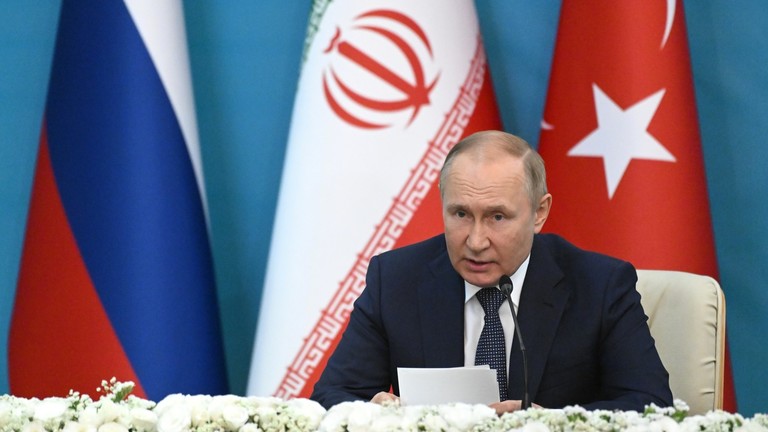
The US needs to stop “stealing” the oil from the Syrian people and state, Russian President Vladimir Putin said on Tuesday, after meeting with his Iranian and Turkish counterparts in Tehran. The three guarantors of the “Astana process” also agreed that the US should leave the trans-Euphrates, and stop making the humanitarian crisis in Syria worse with their unilateral sanctions.
American troops must leave the territory east of the Euphrates river and “stop robbing the Syrian state, the Syrian people, exporting oil illegally,” Putin told reporters on Tuesday evening. He said this was a “common position” of Russia, Iran and Turkey.
Several hundred US troops are illegally present in Syria, mainly controlling the oil wells and wheatfields in the country’s northeast, controlled by the Syrian Democratic Forces (SDF) militia since the defeat of Islamic State (IS, formerly ISIS) terrorists. The US-backed SDF has refused to reintegrate with the government in Damascus, which Washington wishes to see overthrown.
Since 2019, the US has sought to punish anyone trying to assist the reconstruction of war-torn Syria via the “Caesar Syria Civilian Protection Act,” accusing the government of President Bashar Assad of war crimes and blocking all assistance to Damascus.
Putin said on Tuesday that such sanctions have had “disastrous results” and that humanitarian aid to Syria “should not be politicized.”
During Tuesday’s summit in Tehran, Putin met with Iranian President Ebrahim Raisi and Turkey’s Recep Tayyip Erdogan. In a joint declaration, the three presidents confirmed their conviction that “there can be no military solution to the Syrian conflict,” only a political one under the leadership of the UN. They also condemned “unilateral sanctions violating international law” that are exacerbating the serious humanitarian situation in Syria, urging the UN and other international organizations to “increase assistance to all Syrians, without discrimination, politicization and preconditions.”
Russia sent an expeditionary force to Syria in September 2015, at the request of Damascus, to help defeat IS and other terrorist groups. In January 2017, Moscow, Ankara and Tehran launched the “Astana process” – named after the capital of Kazakhstan – to resolve the conflict in Syria, which began in 2011.
Featured Video

Matt Bracken: US Plans Massive MOAB Strike on Iran?
or go to
Aletho News Archives – Video-Images
From the Archives
Confronting the Threat of Ethnic Bioweapons
By Tony Cartalucci – New Eastern Outlook – 29.11.2017
The United States Air Force’s 59th Medical Wing’s molecular biology branch recently was revealed to have been collecting specifically Russian RNA and synovial (connective) tissue samples, prompting fears in Russia of a possible US directed ethnic-specific bioweapons program. … continue
Blog Roll
 Aletho News
- Matt Bracken: US Plans Massive MOAB Strike on Iran?
- Russia accuses France of ‘piracy’ over tanker seizure
- Why Yemen Is Bombing Saudi Arabia’s Airports: The War Behind the Headlines
- Sally Rooney’s books pulled from UK over support for Palestine Action
- Bombs for Tel Aviv, Promises for Riyadh
- Israeli ad agency conducted vast global espionage campaign using online ads: Report
- Oct. 7 Forever Marks The Big Reveal: ‘We See You, Israel, We Revile You, We Reject You!’
- Meet the US generals and admirals advancing Israeli policy
- Israel’s Straw Widow Protocol: The Kill Zones Where Civilians Were Labelled ‘Terrorists’
- Leading Israeli Think Tank Publishes Psychotic Israeli ‘National Security’ Doctrine
- If Americans Knew
- Israeli firm used online ads to run vast spy operation, researchers say
- No, the world zionist movement is not an antisemitic conspiracy theory
- Hundreds of IDF investigations into killings still have no public outcome, BBC Verify finds
- After Ashley Moody Epstein Probe, Donors Linked to Him Poured Money Into her Senate Campaign
- Worried about Russian meddling in UK politics? Wait till you see what Israel is up to
- Israeli settlers attack West Bank center for disabled children, church leader calls for int’l action
- Pulling Out Teeth Just to Live: How Israel Has Devastated Dental Care in Gaza
- Gaza’s “ceasefire” death toll passes 1,500 – Daily Update
- Activists Abused By Israel Return to New Freedom Flotilla Mission
- 60 Minutes won’t tell the full truth about Israeli settler violence
- No Tricks Zone
- New Study Suggests Large Regions Of The Pacific Ocean Have Been Cooling For The Last 80 Years
- Germany’s Green Energy Debacle: High Energy Costs Force Kahla Porzellan to Close After 182 Years!
- New Study: 50 Years Of The Most Aggressive ‘Net Zero’ Policies Can Only Affect The Global Climate By 0.03°C
- US September “Heat” Was No Record…Many Records Set Decades Ago
- Latest European Green Energy Debacle; Portugal’s Largest Flagship Solar Park Insolvent!
- Green Energy Debacle: German Expert Professor Fritz Vahrenholt Warns Of Severe Economic And Social Consequences
- Two More Paleo Reconstructions Affirm Meters-Higher Sea Levels Across Ireland, Brazil 7000-6000 Years Ago
- New Study: Earth And Venus Surface Warmth Largely Explained By Convection And Lapse Rate, Not CO2 Or Radiation
- 2025 Nature Paper Claiming Worsening Global Drought Gets RETRACTED …Heavily Flawed
- New Study: ‘Global Drought Shows No Detectable Recent Acceleration Under Climate Warming’

