What Sanctions? Russian Oil Revenues Soar 50%, Hitting A Record High
By Tyler Durden | Zero Hedge | May 12, 2022
And the sanctions hits just keep on coming.
A few weeks after we learned that Russia’s current account just hit an all time high thanks due to soaring commodity exports (just as the US trade deficit blew out to a record high on its own) we learned that contrary to the intentions of European countries, a calculation by a German think tank found that Russia’s oil and gas revenues hit a record high in April, rising to 1.8 trillion rubles in a single month, after 1.2 trillion in March, leading to the following stunning statistics “After only 4 months, Russia’s federal budget has now already received 50% of the planned oil and gas revenue for 2022 (9.5 trillion).”
Today, Bloomberg confirmed this stunning statistic and, citing the latest IEA report, writes that Russia’s oil revenues are up 50% this year “even as trade restrictions following the invasion of Ukraine spurred many refiners to shun its supplies.” Apparently the restrictions – which pushed the price of oil to the highest level in a decade and boosted revenue for oil exporters – is precisely what Putin was hoping for.
Moscow earned roughly $20 billion each month in 2022 from combined sales of crude and products amounting to about 8 million barrels a day, the Paris-based IEA said in its monthly market report.
As we have documented frequently, Russian shipments have continued to flow freely even as the European Union edges towards an import ban, and international oil majors such as Shell and TotalEnergies have pledged to cease purchases. Countering these self-imposed sanctions, Asia has remained a grateful and keen customer, with China and India picking up cargoes no longer wanted in Europe, and doing so at a huge discount to spot.
Even as Russia has kept oil output steady, reduced flows of Russian refined products such as diesel, fuel oil and naphtha have aggravated tightness in global markets, the IEA noted, echoing what we have said virtually every day for the past month. Stockpiles have declined for seven consecutive quarters, with reserves of so-called middle distillates at their lowest since 2008.
For all the disruption, Moscow has continued to enjoy a financial windfall compared with the first four months of 2021. Despite the EU’s public censure of the Kremlin’s aggression, total oil export revenues were up 50% this year.
Hilariously, despite all the posturing and rhetoric, the bloc remained the largest market for Russian exports in April, taking 43% of the country’s exports, the IEA said.
There is some hope yet that Europe’s sanctions won’t be all for nothing: supplies were down 1 million barrels a day last month, and these losses could triple in the second half of the year, the agency estimates. EU sanctions against Russian state-linked enterprises such as production giant Rosneft PJSC will take effect on May 15, and the bloc is moving towards a full ban on the country’s supplies.
“If agreed, the new embargoes would accelerate the reorientation of trade flows that is already underway and will force Russian oil companies to shut in more wells,” the IEA said.
Sanctions against Russia: Reactions from the Middle East
By Yuriy Zinin – New Eastern Outlook – 12.05.2022
The Middle East media have not stopped commenting on recent developments in Ukraine through the prism of their perception in the region. Particular attention is paid to the topic of the sanctions imposed on Moscow and their resonance in the Arab world.
As can be seen, attitudes towards these measures are negative in the region. After all, a number of Arab countries that refused to follow the dictates of the US and the West in their policies have been subjected to sanctions. Their inhumane nature has damaged the economy, led to the death and suffering of civilians, but has not caused the fall of regimes in Libya, Iraq, Syria. However, Arab lawyers remind that in the case of both the Arabs and Russia, the sanctions are unilateral and contrary to the letter and the spirit of the UN Charter.
Observers see duplicity in the authors of these coercive measures under the pretext of “taking over” Ukraine. They are annoyed that action of this kind has not been taken against Israel in many decades of occupation of Arab lands. They note that the media and politicians immediately rushed to condemn Russia in relation to Ukraine, but have been silent for 19 years on the US-British aggression in Iraq and the results of the disaster it has brought to its people. Those results include the destruction of the infrastructure of that country, the economic and humanitarian losses, the distress and impoverishment of the population, etc.
The headlines in the media – “Why is the world paying the price?”, “The conflict in Ukraine and its impact on our weak peoples”, “Will the Arabs starve?” and others – are telling. Their authors do not hide their concern about the possible consequences of sanctions against Russia, the shadow of which is being cast over the political landscape in the region and wider world.
The rise in inflation that has plagued Europe is somehow being transferred to the Middle East region, pushing up consumer prices for the population. This exacerbates the external debt of a number of countries, especially where it is high: Egypt and Tunisia.
This year, according to the World Bank, global food prices are at their highest level since they began to be formally recorded 60 years ago. At the same time, the cost of grain has risen by 42% this year and that of sunflower oil by 30%, while energy prices have grown by 50%.
Arab countries are major importers of cereals and food products. Here Egypt leads the way (13 million tonnes per year). These countries meet 63% of their needs for grain, 65% for sugar, 55% for vegetable oil, etc. through imports. Meanwhile, they meet 42% of their grain needs from the Russian Federation and 40% from Ukraine.
Russia is also at the forefront of fertilizer production, especially in nitrogen. Fertilizer prices were already at an all-time high before the conflict erupted, affecting overall food security.
The effects, the Arab Monetary Fund suggests, will affect the Arabs in varying degrees. For example, the region’s oil-producing countries will earn more from the energy they sell in 2022 due to a surge in energy prices following the escalation of events in Ukraine. But they will have to increase the cost of importing foodstuffs, especially grain, as well as industrial products and equipment. Those members of the Arab world that import hydrocarbons will be more affected.
Media reports and analysts have sounded the alarm about supply chain disruptions, failures in the supply of some goods, especially foodstuffs. General tensions could affect the tourism sector, a source of important foreign exchange earnings in a number of Arab countries. All this has the potential for food shortages, the threat of hunger, volatility due to possible outbreaks of discontent, etc.
A number of local analysts are outraged as to why the region should somehow “pay the bills of hatred” of the West towards Russia. Sanctions are designed to bleed Russia white and set it back, but they also make the world pay the price for the US to remain on the throne as the planet’s sole ruler, even if its allies suffer as a result.
Given the impact of the possible detrimental effects of the anti-Russian sanctions, local experts urge the authorities to monitor the situation and act wisely for the sake of their national interests.
In general, it is not in the interest of the Middle East and its individual states to spoil relations with Moscow, as each country has its own ties to Russia. One way or another, countries in the Middle East interact with the Kremlin and therefore need it, Al-Quds stresses.
Observers refer to the fact that their mutual trade has been growing markedly in recent years. They conclude that the Arabs should move in two directions: increasing trade with Moscow, which exceeded $18 billion in 2021, and following India and China in switching to local currencies. In addition, they advise to take advantage of the departure of American and European companies that are investing in the Russian market. Arab capital has great opportunities to take their place and compete successfully in this Russian market.
Russia is a strategic partner of the Gulf countries when it comes to oil and security issues. In these countries, as partners in the OPEC+ agreement, everyone has an interest in the stability of oil prices on world markets. Therefore, a win for one side at the expense of the other would not serve the interest of the balance sought in the hydrocarbon market, but would only risk increasing chaos in the field.
American politicians should understand, commentators argue, that Russia is an organic part of the OPEC+ alliance which will not oppose Moscow or take any part of its oil exports from the market. The Russian Federation will remain in OPEC even after the Ukrainian crisis is over.
Western attempts to press oil-producing countries to increase hydrocarbon production and exports must be seen in the context of the economic diversification policies implemented by a number of Arabian monarchies. They envisage a shift away from oil and gas dependence, innovation in everyday life, etc.
In recent years, Gulf countries have been implementing modernization programs called Qatar National Vision 2030, Saudi Arabia Vision 2030, and Oman Vision 2040, etc. They are dictated by pragmatic considerations and economic benefits that are emerging in the light of new realities.
Arab countries have been victims of the unipolar world since the end of the Cold War, when the era was marked by the US turning their region into a battle and rivalry field, a Jordanian political scientist believes.
Today, in light of the crisis in Ukraine and the accompanying changes looming, they have a chance to make things right. It is a matter of local players using their large financial, economic and natural resources to diversify politics and international relations more actively. So that as they shift their political navigation towards Russia and China, they can have their own say.
Yury Zinin is a senior researcher at the Center for Middle Eastern Studies of Moscow State Institute of International Relations of the Ministry of Foreign Affairs (MGIMO).
Russia sanctions will trigger global food and energy crises – China
Samizdat | May 12, 2022
The international sanctions campaign to punish Russia over the Ukraine conflict will backfire, causing suffering by people around the world while failing to promote peace in the former Soviet republic, a top Chinese diplomat has told the UN Security Council.
“Sanctions will not bring peace but will only accelerate the spillover of the crisis, triggering sweeping food, energy and financial crises across the globe,” Chinese deputy UN ambassador Dai Bing said on Thursday in New York. He added that continuing to impose sanctions on Moscow will force children around the world to “suffer the bitter consequences.”
Dai made his comments as the Security Council met to discuss the humanitarian crisis brought on by the Russia-Ukraine conflict. Although he also spoke of efforts to help protect children affected by the fighting, such as encouraging Russia and Ukraine to work together to enable more civilian evacuations, he said the only real solution is a negotiated peace deal.
“Achieving peace is the best protection for children,” Dai said. “Dialogue and negotiation are the most realistic and feasible way to reach a ceasefire and to stop the war. The international community should encourage Russia and Ukraine to return to the negotiation track and keep accumulating political conditions for the restoration of peace.”
By instead trying to force a resolution through sanctions, Western nations and their allies are actually causing more harm to children, especially those living in such war-torn places as Afghanistan, Yemen, the Horn of Africa and the Sahel region, Dai said. “China again calls on parties to stay rational and exercise restraint, transcend prejudice and strife, and make unremitting efforts for the early resolution of the crisis in Ukraine.”
The US and its NATO allies have spearheaded the sanctions campaign, trying to isolate Russia and devastate its economy and currency. However, the ruble is actually stronger today than before the Ukraine crisis began, rebounding from an historic low reached in March. In fact, it has been the world’s top-performing currency so far in 2022, even though Russia’s economy is reportedly on track to contract by an estimated 12% this year.
Meanwhile, food and energy shortages are looming around the world, and inflation is at around a 40-year high in the US and parts of Western Europe. President Vladimir Putin claimed on Thursday that sanctions are triggering a global economic crisis, and the blame “lies entirely with the elites of Western countries who are ready to sacrifice the rest of the world to maintain their global dominance.”
‘Russia not our enemy’: Rep. Paul Gosar

Samizdat | May 12, 2022
Republican Rep. Paul Gosar (Arizona) condemned the push from both parties in Washington to send billions of dollars worth of weapons to Ukraine. “Crippling debt, inflation and immigration problems,” he declared, are not “Putin’s fault.”
Gosar, an immigration hardliner and anti-interventionist, was one of 57 GOP lawmakers to vote against a $40 billion economic and military aid bill for Ukraine on Tuesday. While a number of Republicans have been vocal in their opposition to fueling a “proxy war” in Ukraine, the GOP establishment has shouted down these critics, with conservative talk show host Mark Levin on Wednesday referring to the anti-war contingent of the party as “Putin a**-kissers.”
“Calling us names is not a logical position,” Gosar shot back, stating: “I have no principle to follow but the path of peace and non-intervention. My grown children have known nothing except American war and intervention for naught.”
“Ukraine is not our ally,” he continued. “Russia is not our enemy. We need to address our crippling debt, inflation and immigration problems. None of this is [Russian President Vladimir] Putin’s fault.”
Americans are currently grappling with record gas prices, inflation that’s at a four-decade high, and shortages of vital food products, including baby formula. Furthermore, the expiration of a Trump-era immigration restriction this month will result in up to 18,000 migrants entering the US from Mexico daily, according to estimates from the Department of Homeland Security.
Since the beginning of Russia’s military operation in Ukraine in February, the Biden administration has sent nearly $4 billion worth of weapons and ammunition to Kiev, and revived a World War II-era act allowing a limitless supply of arms to be shipped to Ukraine on credit.
Meanwhile, at home the White House has banned Russian oil and gas imports, and although industry leaders are warning of an imminent diesel shortage, the Biden administration on Wednesday canceled the sale of drilling leases in Alaska and the Gulf of Mexico.
Despite the opposition of Gosar and his allies, the $40 billion funding bill passed by 368 votes to 57. It is expected to pass the Senate by next week at the latest, with Majority Leader Chuck Schumer (D-New York) saying the upper chamber “will move swiftly” to get it to Biden’s desk.
US regime willing to escalate Ukrainian conflict
Washington’s recent maneuvers reveal US wants to take conflict to its ultimate consequences
By Lucas Leiroz | Aletho News | May 12, 2022
Once again, the US seems to be the side most interested in taking the Ukrainian conflict to its ultimate consequences. A law recently signed by Joe Biden threatens to escalate the dispute in Eastern Europe to extremely dangerous levels, increasing NATO’s support for Kiev in order for the Ukrainian forces to be able to continue fighting for a long time even without any material chance of real victory.
On May 9 the US president signed the “Ukraine Democracy Defense Lend-Lease Act of 2022”, leading to a new phase in Washington-Kiev relations, in which Americans will be authorized to streamline and de-bureaucratize the process of sending military aid to Ukrainian forces. The objective of such a maneuver is to banish any procedural obstacle to the agility of bilateral military partnership, encouraging the systematic sending of material so that Ukrainian troops maintain their “resistance” against the Russian special operation.
Explicitly, the American objective with such an attitude is not to contribute to the achievement of peace, but to encourage further combat and promote war. The indiscriminate escalation of the hostilities became a central point of American strategy in Ukraine. Washington assumes the objective is simply to make Ukraine beat Russia. In practice, as there is no possibility of this happening, the objective of the American “aid” seems to be to provoke a “long-term defeat”, that is, to make Russia suffer in this conflict enough so that it does not start any other operation like this again. This could only be achieved by fueling the fighting with more and more weapons for Ukraine, as proposed by the new law.
Scott Ritter, military analyst and former US Marine Corps intelligence officer commented on the topic as follows: “The stated policy of the United States at this point in time is to create the conditions for a strategic Russian defeat in Ukraine, one of the goals of which is to bleed Russia dry so that Russia can never again carry out an action such as it has undertaken in Ukraine, or anywhere else (…) This is the opposite of achieving peace. This is about promoting war. And as such, yes, the lend-lease legislation is not just adding fuel to the fire, it’s pouring fuel all over the fire”.
In fact, this supposed “strategic objective” seems incoherent. For there to be any real harm to Russia, the aid would have to be strong enough that Moscow would be forced to mobilize its full offensive potential towards Ukraine – which evidently is not happening now. And for that to occur, a level of help much higher than mere shipment of armaments would be needed. To reverse Ukraine’s current status of virtually strategic neutralization, the West would need to become more directly involved in the conflict, which would be interpreted as NATO intervention and would result in a Russian response – something the Americans certainly want to avoid.
So, the speech seems just an attempt to deceive public opinion: there is no real intention to “defeat” Russia, either in the short or long term. There is only the desire to carry the conflict forward in order to delay its consequences, which are the retreat of NATO in Europe and the geopolitical multipolarization. When victory becomes impossible, delaying defeat is the most strategic thing to do and that is precisely what the US is doing in Ukraine, to the detriment of the local people, who just want peace.
An important point to be commented on is the fact that the bill approved by Biden this week is not new. Despite its recent approval, the project had already been introduced by Senators John Cornyn (R-TX), Ben Cardin (D-MD), Roger Wicker (R-MS) and Jeanne Shaheen (D-NH) in January 2022. This means that the intention of US lawmakers is old and has no specific relationship with Russian military operation. It was already the goal of the US to promote an unrestrained militarization of Ukraine, which demonstrates that Moscow’s justification for the need to demilitarize Kiev is valid. Had the operation not started, Kiev would now be receiving these weapons in the same way – and possibly using them against civilians in Donbass.
The first consequences of the Act are about to come. On May 10 the House approved a new budget of more than 33 billion dollars in military aid to Kiev. With the new Act, approval by the Senate must take place as quickly as possible, without further discussions or bureaucracies. Direct private transactions with Ukraine will also take place without regulation in the US. Of course, this will also be a precedent and the US is expected to force European countries to pass similar laws to reduce bureaucracy in military trade with Kiev.
Now the scenario is set for an escalation that is sure to further complicate the situation for Ukraine. The Russians clearly do not want to use their full military potential in this operation, but they are willing to tolerate it only up to a point. If necessary, Moscow will not hesitate to increase its fighting force to resolve the situation as quickly as possible.
Both the Ukrainian government and the West know this but prefer to maintain the narrative that it is possible to “defeat Russia”, perpetuating a situation that harms the civilian population more and more and only benefits the West and its military industry.
Lucas Leiroz is an researcher in Social Sciences at the Rural Federal University of Rio de Janeiro; geopolitical consultant.
Is Ivermectin a Cancer Solution?
By Dr. Joseph Mercola | May 12, 2022
Ivermectin is a widely used antiparasitic drug that’s listed on the World Health Organization’s essential medicines list1 and approved by the U.S. Food and Drug Administration. In low- and middle-income countries, ivermectin is commonly used to treat parasitic diseases including onchocerciasis (river blindness), strongyloidiasis and other diseases caused by soil-transmitted helminthiasis, or parasitic worms.2
The drug is also used to treat scabies and lice. It’s estimated that the total number of ivermectin doses distributed is equal to one-third of the world’s population and, as such, “ivermectin at the usual doses (0.2–0.4 mg/kg) is considered extremely safe for use in humans.”3
Ivermectin also has demonstrated antiviral and anti-inflammatory properties and made headlines for its potential role in treating COVID-194 — although much of the positive press has been censored and falsely labeled misinformation.5 Now researchers are highlighting another potential use for ivermectin, which is equally as exciting as its potential role in COVID-19 — as an anticancer agent.
Ivermectin’s Powerful Antitumor Effects
Ivermectin has notable antitumor effects, which include inhibiting proliferation, metastasis and angiogenic activity in cancer cells.6 It appears to inhibit tumor cells by regulating multiple signaling pathways, which researchers explained in the Pharmacological Research journal, “suggests that ivermectin may be an anticancer drug with great potential.”7
Their graphic, below, shows the multiple ways that ivermectin may target cancer, including inducing apoptosis and autophagy while also inhibiting tumor stem cells and reversing multidrug resistance. They stated that ivermectin “exerts the optimal effect when used in combination with other chemotherapy drugs.”8
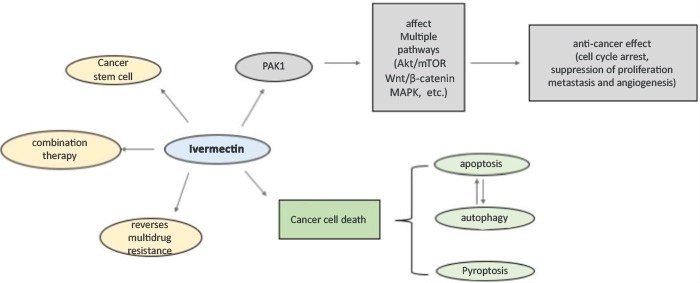 Pharmacol Res. 2021 Jan; 163: 105207
Many may not be aware that scientists Satoshi ōmura and William C. Campbell won the Nobel Prize in Physiology or Medicine in 2015 for their discovery of ivermectin.9 The medicine is used to treat not only parasitic diseases like malaria but also shows promise for treating asthma and neurological diseases, in addition to cancer.
Along with direct cytotoxic effects, it’s believed that ivermectin regulates the tumor microenvironment, mediating immunogenic cell death — another reason for its promise as an anticancer agent.10 Research suggests the drug may be useful for the following cancers:11
Breast cancer — The proliferation of multiple breast cancer cell lines was significantly reduced following treatment with ivermectin.
Digestive system cancer — Ivermectin significantly inhibited the proliferation of gastric cancer cells in vivo and in vitro. The drug also inhibited colorectal cancer cell lines and inhibited the development of hepatocellular carcinoma (liver cancer).
Urinary system cancer — Ivermectin significantly inhibited the proliferation of five renal (kidney) cell carcinoma lines without affecting normal kidney cells. It also had an inhibitory effect on prostate cancer cells.
Hematological cancer — In one study, ivermectin killed leukemia cells at low concentrations while leaving normal hematopoietic cells unharmed.
Reproductive system cancer — Ivermectin inhibited the proliferation of ovarian cancer cell lines and enhanced the efficacy of the conventional chemotherapy drug cisplatin, improving the treatment of epithelial ovarian cancer.
Brain glioma — Ivermectin inhibited the proliferation of human glioblastoma cells in a dose-dependent manner.
Respiratory system cancer — Ivermectin inhibited the development of nasopharyngeal carcinoma in mice, using doses that were not toxic to immune cells known as thymocytes. Ivermectin also significantly inhibited the proliferation of lung cancer cells and may reduce the metastasis of lung cancer cells.
Melanoma — When melanoma cells were treated with ivermectin, their activity was effectively inhibited.
Ivermectin Shows Promise Against Colorectal Cancer
A study published in Frontiers in Pharmacology specifically highlighted ivermectin’s potential to fight colorectal cancer, which is the third most common cancer worldwide.12 The drug was found to inhibit colorectal cancer cell growth in a dose-dependent manner as well as promote cell apoptosis.
Further, even at low doses of 2.5 and 5 µM, ivermectin inducted cell arrest in colorectal cancer, leading researchers to state, “[I]vermectin might be a new potential anticancer drug therapy for human colorectal cancer and other cancers.”13 Considering that the “war against cancer” has been ongoing for decades, with little to show in terms of lives saved, repurposing existing drugs with favorable safety profiles and notable anticancer effects — like ivermectin — makes sense.
The Pharmacological Research scientists similarly noted, “Drug repositioning is a shortcut to accelerate the development of anticancer drugs.”14 Not only has ivermectin been shown to permeate tumor tissues effectively, but it has a long history of successful use in humans. They explained that even when doses were increased, no serious adverse effects were found:15
“[T]he broad-spectrum antiparasitic drug IVM (ivermectin), which is widely used in the field of parasitic control, has many advantages that suggest that it is worth developing as a potential new anticancer drug. IVM selectively inhibits the proliferation of tumors at a dose that is not toxic to normal cells and can reverse the MDR [multidrug resistance] of tumors.
Importantly, IVM is an established drug used for the treatment of parasitic diseases such as river blindness and elephantiasis. It has been widely used in humans for many years, and its various pharmacological properties, including long- and short-term toxicological effects and drug metabolism characteristics are very clear. In healthy volunteers, the dose was increased to 2 mg/Kg, and no serious adverse reactions were found …”
Is Liposomal Delivery a Game Changer?
The development of an injectable form of ivermectin, or liposomal ivermectin, could help overcome some of its limitations regarding solubility and open its use to a broader range of cancers. The cancer immunotherapy treatment pembrolizumab, for instance, is approved to treat PD-L1-positive, triple-negative breast cancer, which accounts for only about 20% of cases.
As an immune checkpoint inhibitor, it works best in so-called “hot” tumors, which are already infiltrated by T cells. If ivermectin could be injected into the tumor, inducing T-cell infiltration into the area and inducing immunogenic cancer cell death, it’s possible that it could turn a “cold” tumor into a “hot” one, thereby making it more effectively treated.16
Biotech company Mountain Valley MD has developed a liposomal delivery system for ivermectin that they believe could dramatically widen its treatment potential. In an interview with Medical Update Online, Dennis Hancock, Mountain Valley MD president and CEO, explained:17
“So the business value proposition really simply is, we take the best-selling and best-acting drugs and expand their ability to be used on … more types of cancer on a broader spectrum. So you still need the cancer drug and what our Ivectosol does is it enables it to be used in a broader universe …
What’s really exciting about the work that Mountain Valley MD is doing is we’re enabling drugs that have already been proven in their efficacy and safety to do better and do more faster — so we’re not asking people to ‘wait five years and see’…”
Most of the research involving ivermectin for cancer to date involves oral or in-vitro administration. Mountain Valley MD is conducting preclinical trials using liposomal ivermectin for metastatic melanoma, non-small cell lung cancer, triple-negative breast cancer and possibly bladder cancers. They also have plans to produce liposomal ivermectin for use in human trials.18 In a news release, Mike Farber, director of life sciences at Mountain Valley MD, stated:19
“The extensive research supporting the drug ivermectin as effective in the inhibition of proliferation, metastasis, and angiogenic activity in a variety of cancers, and as an initiator of immunogenic cell death, is overwhelming. Imagine what is possible when you have the world’s only human injectable form of ivermectin that can be directly injected into a tumor or provided through more bio-available forms such as intravenously.
We believe this will be groundbreaking research with near-immediate application to be able to proceed directly to human trials based on the safety and efficacy of ivermectin.”
Sources and References
- 1, 2 WHO March 31, 2021
- 3 American Journal of Therapeutics: July/August 2021 – Volume 28 – Issue 4 – p e434-e460
- 4 In Vivo. Sep-Oct 2020;34(5):3023-3026. doi: 10.21873/invivo.12134
- 5 Trial Site News November 27, 2021, 3:52
- 6, 7, 8 Pharmacol Res. 2021 Jan; 163: 105207
- 9, 20 Pharmacol Res. 2021 Jan; 163: 105207., Introduction
- 10 Pharmacol Res. 2021 Jan; 163: 105207., 2.1 Breast cancer
- 11 Pharmacol Res. 2021 Jan; 163: 105207., 2. The role of IVM in different cancers
- 12, 13 Front Pharmacol. 2021; 12: 717529
- 14, 15 Pharmacol Res. 2021 Jan; 163: 105207., Summary
- 16, 17, 18 Medical Update Online June 19, 2021
- 19 Mountain Valley MD May 3, 2021
Disney reports $195 million loss in abandoning Russian market
Samizdat | May 12, 2022
The Walt Disney Company published a financial report on Wednesday, claiming it had lost $195 million from shutting down its Disney Channel alone in Russia.
“In the current quarter, the Company recorded charges totaling $195 million due to the impairment of an intangible asset related to the Disney Channel in Russia,” the document stated.
On March 10, Walt Disney announced it was suspending all business activities in Russia due to Moscow’s military operation in Ukraine. Disney’s dealings in the country included content and product licensing, cruise lines, the National Geographic magazine and tours, local content productions, and linear channels.
“After Russia’s unprovoked invasion of Ukraine, we announced that we were pausing the release of theatrical films in Russia and reviewing the rest of our businesses there,” Walt Disney’s statement said. “Given the unrelenting assault on Ukraine and the escalating humanitarian crisis, we are taking steps to pause all other businesses in Russia.”
Since the beginning of the year, Disney’s shares have fallen by nearly 33%, while its main competitor, Netflix, has lost over 72% in value. Netflix’s downturn is attributed in large part to the company’s loss of 700,000 Russian subscribers, after the streaming service also made the decision to bar Russian audiences from its content due to the ongoing crisis in Ukraine.
Russia stops gas transit through Poland
Moscow’s counter-sanctions ban the use of the Polish section of the Yamal-Europe pipeline
Samizdat | May 12, 2022
Russian energy major Gazprom said on Thursday it will not be able to use the Polish section of the Yamal-Europe pipeline for gas transit to Europe due to Moscow’s retaliatory sanctions.
Company spokesman Sergey Kupriyanov specified that the site belongs to EuRoPol GAZ, which is a joint venture between Gazprom and Polish gas major PGNiG. The latter is the operator of the Polish part of the Yamal-Europe gas pipeline.
On Wednesday, Moscow approved a list of companies in respect of which it will apply special economic measures. The list consists of 31 firms, including Polish EuRoPol GAZ, as well as the former German unit of Gazprom. The Russian-owned subsidiary was seized by the German authorities last month and could potentially be nationalized.
“For Gazprom, this means a ban on the use of a gas pipeline owned by EuRoPol GAZ to transport Russian gas through Poland,” the company said on its official Telegram channel.
Russian President Vladimir Putin decreed on May 3 that no Russian entity will be allowed to make deals with those on the sanctions list, or even fulfil its obligations under existing deals.
The decree forbids the export of products and raw materials to people and entities on the sanctions list.
Putin said the decree was in response to the illegal actions of the US and its allies meant to deprive Russia and its citizens and legal entities of property rights or to restrict their property rights.
The Yamal-Europe gas pipeline passes through Russia, Belarus, Poland, and Germany. Russia supplies nearly 40% of Europe’s overall gas demand, and this route accounts for nearly 15% of the country’s westbound deliveries. The pipeline has been operating in reverse mode recently, sending gas from Germany to Poland after Warsaw refused to accept Moscow’s demand to pay in rubles.
Dem Party Leaders, Pfizer, Moderna Involved in US Biological Activities in Ukraine: Russian MoD
By Ilya Tsukanov | Samizdat | May 11, 2022
The Russian military began reporting on the extent of US military biological activities in Ukraine in March, citing seized documents and other materials on the study of a range of potentially deadly bioweapon agents, including diseases which can be spread naturally using local geography, flora and fauna, and target certain ethnic groups.
Senior Democratic Party politicians are the chief “ideologists” of America’s illegal operations in biolabs operating throughout Ukraine, and have involved major multinational biotech companies in their activities, Igor Kirillov, the head of Russia’s Radiation, Chemical, and Biological Defence Troops, has indicated.
Speaking at a briefing in Moscow on Wednesday and citing an MoD analysis of documentary evidence, the RCB Troops chief said the profits US politicians earn for the private biotech sector helps to pay for their re-election via campaign donations.
According to Kirillov, the US executive branch has also worked to create a “legislative framework to finance military biological research directly from the federal budget”, and with funds of non-government organisations underwritten by the state and controlled by the leadership of the Democratic Party, including charitable foundations affiliated with the Clinton family, the Rockerfellers, George Soros, and Hunter Biden.
Major global pharmaceutical companies have become involved in these shady “public-private” partnership schemes, including Pfizer, Moderna, Merck, and Pentagon-affiliated biotech firm Gilead, Kirillov said.
“US specialists are working [in Ukraine] on the testing of new medicines, bypassing international safety standards. As a result, Western companies seriously reduce the costs of research programmes and gain significant competitive advantages”, the officer said.
State Structures’ Involvement
Ukrainian state structures are also involved in the US-funded and organised military biological activities in their country, Kirillov said, with Kiev’s main job being “to conceal illegal activities, conduct field and clinical trials and provide the necessary biomaterial”.
In 2020, Kirillov said, an attempt was made to infect the residents of the settlement of Stepovoye in the Lugansk People’s Republic with a multi-drug-resistant strain of tuberculosis using counterfeit banknotes contaminated with the disease’s causative agent and spread among local youth.
Additionally, the RCB Troops chief said that his agency has received information detailing the Pentagon’s experiments on Ukrainian nationals at Psychiatric Hospital No. 1 in the village of Strelechie, Kharkov region, with the research targeting male patients aged 40-60 with a high stage of physical exhaustion, and overseen by a US national.
The Russian military operation in Ukraine has stopped the spread of US military activities in Ukraine, and halted these “criminal experiments” on its civilian population, Kirillov stressed.
In the case of the research taking place at the Kharkov mental hospital, Western specialists were evacuated in January 2022, and the equipment and pharmaceutical preparations involved relocated to western Ukraine, he said.
Polish specialists have also been working with Ukraine’s biolabs, Kirillov said, citing documents detailing the work of the Polish Institute of Veterinary Medicine and the US’ Battelle Memorial Institute – a Pentagon contractor – on research assessing epidemiological threats and the spread of the rabies virus in Ukraine.
“In addition, documentary evidence has been obtained about Poland’s funding of Lvov Medical University, which includes a participant in US military biological projects – the Institute of Epidemiology and Hygiene. Since 2002, this organisation has been implementing a retraining programme for specialists with experience working with dual-use materials and technologies”, the officer said.
The German military has also been involved in research in Ukraine, Kirillov said, citing documents indicating that the Bundeswehr’s Institute of Microbiology had taken some 3,500 blood serum samples from 25 Ukrainian regions back to Germany between 2016 and 2019. The officer said the Institute’s as yet unidentified interest in these biomaterials “raises questions about the goals [being] pursued” by the German Armed Forces. The complete, Ukrainian-language document can be found in RTF format here.
According to the MoD’s information, along with the Munich-based Institute of Microbiology, the Berlin-based Robert Koch Institute, the Loffler Institute in Greifswald, and the Nocht Institute of Tropical Medicine in Hamburg are also participating in biological research activities in Ukraine. The complete presentation can be downloaded here.
Mariupol Samples Partially Recovered
An RCB Troops investigation of samples from a veterinary laboratory in Mariupol has concluded that it also may have been involved in the broader US-led biological research activities, Kirillov said, pointing to the presence of pathogens uncharacteristic of veterinary diseases, such as typhoid fever, paratyphoid fever, and gas gangrene at the lab. Part of the lab’s collection of samples was destroyed on 25 February, but due to the rush, some of it has been preserved intact, and is now being analysed by Russia. To ensure safety and safe storage, Russian specialists exported 124 strains and have organised their study”, Kirillov said. The complete batch of documents can be found here.
The officer also revealed that Russian specialists have carried out work “directly in two biological laboratories in Mariupol”, and that “evidence has been obtained of the emergency destruction of documents confirming their work with the US military. A preliminary analysis of the surviving documentation indicates that Mariupol was used as a regional centre for the collection and certification of the cholera pathogen”, with the samples sent to the Centre for Public Health in Kiev, which transferred the materials on to the United States.
Kirillov stressed that the information that continues to be gathered and analysed by the Russian MoD casts doubt on assurances by US specialists that Ukraine does not have the capability to develop and produce bioweapons, and that the US itself has not “found” any evidence of biological weapons in Ukraine.
WMD Provocations Possible
The RCB Troops chief also indicated that Moscow has intelligence related to the preparation of possible provocations involving weapons of mass destruction in Ukraine to accuse the Russian military of using such arms along a “Syrian-style” scenario, in which the necessary evidence is fabricated and the “perpetrators” are appointed ahead of time.
One piece of evidence suggesting the high likelihood of such provocations taking place is Kiev’s request in a letter to European Union officials for personal protective equipment that provides protection against toxic chemicals and biological agents, Kirillov said.
The supply of organophosphate toxicity medications to Ukraine is also a concern for the Russian military, the officer noted, pointing out that in the first months of 2022, over 220,000 ampoules of atropine, as well as medicines for treatment and disinfection following a chemical attack, have been delivered to Ukraine by the United States.
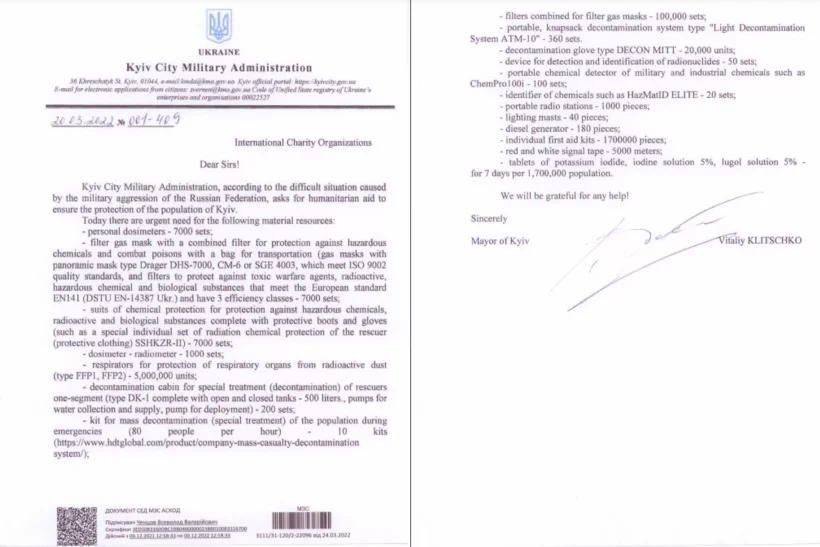
Letter from Mayor of Kiev Vitaliy Klitschko to “International Charity Organizations” dated 20 March 2022 requesting a range of equipment to protect against WMD attack.
Additionally, Kirillov said, 10 more drones equipped with 30-litre containers and spraying equipment were found in the town of Kakhovka, Kherson region in late April, on top of three others with similar equipment found in the Kherson region in March.
Kirillov’s RCB Troops have spent over two months investigating and reporting on the US-sponsored military biological activities taking place at 30 separate facilities across Ukraine going back to at least 2005.
Western officials and media have largely dismissed the information provided as a “conspiracy theory”, notwithstanding Under Secretary of State Victoria Nuland’s admission at a Senate hearing in March that “biological research facilities” do in fact exist in the Eastern European country and that the US was “working with” the Ukrainians to ensure that these materials “do not fall into the hands of Russian forces”. Investigations by the few Western outlets that have conducted their own research have confirmed individual details of the Russian MoD’s allegations – such as Hunter Biden’s role in securing millions of dollars in funding for a US contractor working in Ukraine.
Ukraine’s partial gas cut to Europe could force activation of Nord Stream 2
Kiev attempts to blackmail Europe by partially halting gas flow from Russia
By Paul Antonopoulos | Aletho News | May 12, 2022
Ukraine’s decision to partially disable the flow of gas earmarked for Europe will be short-lived as it will not only cause major problems for the European economy, but it will also leave Kiev without billions of dollars in transit tax revenue – something it desperately needs as the economy is in ruin.
The Ukrainian gas transmission system operator (GTSOU) said it decided to suspend operations at a major transit point because of “interference by the occupying forces.” The decision to stop flows from Sokhranivka halts about a third of the Russian gas that arrives in Europe via Ukraine as the measuring station handles as much as 32.6 million cubic meters per day, according to GTSOU.
“As a result of the Russian Federation’s military aggression against Ukraine, several GTS facilities are located in territory temporarily controlled by Russian troops and the occupation administration,” the company said.
Kiev’s idea of transferring gas supplies from Sohranovka to the Suja gas station, which is in Ukrainian-controlled territory, has been dismissed by the Russian state gas company Gazprom as “technically impossible.” In addition, Gazprom said that it fulfills all its obligations to European consumers and delivers gas for transit in accordance with all contracts.
The disrupted transit of one-third of the gas that Europe needs would cause major damage to the continent’s economy. Europe already has less gas than it currently needs and the problem is not just that the price of gas will go up, but there will not be enough needed for industrial production.
If Russian gas does not arrive via Ukraine in the agreed quantity, Europe would have to consider extracting from reserves in underground storage facilities. The price of such gas will certainly be higher than in the case of gas arriving via Ukraine. Therefore, Kiev’s attempts to coax Europe into further involvement in the war with Russia will receive little accolade as it threatens Europe’s economy at a time when it is already suffering.
Kiev’s decision to reduce gas flows to European markets also means that it will suffer as it will lose transit fees that it desperately needs as its economy has stagnated. Another outcome that Ukraine did not consider is that it could force Europe to challenge the US’ opposition to the Nord Stream 2 pipeline. If Russian gas does not arrive via Ukraine, it could be the very catalyst needed to activate Nord Stream 2.
If Ukraine were to remain committed to reducing Russian gas flows to Europe, even at the expense of billions of dollars in transit fees, the question begs whether the EU would be willing to potentially run out of gas and/or see prices rise even further, or activate Nord Stream 2. Activating Nord Stream 2 would effectively mean the US’ failure after so much effort was made to prevent the pipeline from functioning.
For this reason, Ukraine’s decision to halt a third of Russian gas flows to Europe is likely a bluff as it needs all the money it can receive at the moment. At the same time, the Europeans hope to slowly wean themselves off Russian energy, understanding that an immediate cut is not sustainable and would collapse their economies.
Kiev’s incessant demand that Brussels put an embargo on Russian energy imports to the EU will be challenged so long as there are leaders, like Hungary’s Viktor Orban, who prioritize their state’s economy and people’s welfare, or entire major industries are threatened, such as Germany’s manufacturing and Greece’s shipping.
It is quite possible that this disunity and lack of consensus on the embargo in a situation where energy cannot be undermined, could force a rethink of Europe’s policies towards Moscow.
“We will have a peace to build tomorrow, let us never forget that,” Macron said in Strasbourg on May 9, adding: “We will have to do this with Ukraine and Russia around the table. The end of the discussion and the negotiation will be set by Ukraine and Russia. But it will not be done in denial, nor in exclusion of each other, nor even in humiliation.”
On the same day, he said in a tweet: “We are not at war with Russia. We work as Europeans for the preservation of the sovereignty and territorial integrity of Ukraine. For the return of peace to our continent. We will be there to rebuild Ukraine, as Europeans, always.”
However, despite the rhetoric of pan-Europeanism, Macron has already proven in deed that Europe’s elite are still very much under the orbit of Washington. If Ukraine are to partially halt the flow of Russian gas to Europe, the next test of Europe’s so-called “strategic autonomy” would be whether it activates Nord Stream 2 to protect their economic interests or continue following Washington’s demands on keeping the pipeline closed.
Paul Antonopoulos is an independent geopolitical analyst.
Featured Video

AIDS Inc. by Gary Null (2007)
or go to
Aletho News Archives – Video-Images
From the Archives
Clash of Civilization, Iran Part II
By Jamal Kanj – Intifada-Palestine.com – January 14, 2011
Israel’s survival kit is: perpetuate conflict, insecurity to rationalize collective hate and finally playing victim.
Devoid of conflict, Israel implodes internally; without hate, Zionism loses its justification; and playing eternal victim to continue blackmailing the West. Absence of this holy trinity, Israel ceases to exist.
From its inception, the house of Zion has mastered exploiting adversarial powers to advance Israel’s cause. For instance, their influence over the Democratic Party in the US began with President Truman’s bid for 2nd term election in 1948.
Responding to strong opposition from Secretary of State General George Marshall and Department experts urging against recognition of Israel, President Truman replied: “I’m sorry gentlemen but I have to answer to hundreds of thousands [Jewish voters] who are anxious for the success of Zionism. I do not have hundreds of thousands of [voting] Arabs among my constituents”
Zionists influence over liberal American politics was matched with the doctrinal school of Conservative theoreticians aligning the Republican Party’s platform with Israel’s objectives. The Neoconservative Zionists, coined Zioncons, invented the “Clash of Civilization” concept to fight Israel’s wars. … continue
Blog Roll
 Aletho News
- Merck Virologists Admitted to Falsely Certifying Vaccine Efficacy
- Mandatory Folic Acid for every man, woman & child
- Pro-Palestine protesters arrested outside UK’s ruling Labour Conference in Liverpool
- Mauritius denies landing permit to flight from Israel, forcing cancellation: Tour operator
- Israeli finance minister calls for genocidal war on West Bank, annexation of south Lebanon
- 12 Things Your Psychiatrist Was Trained Not to Tell You
- From Unipolar Universalism to Multipolar Civilizational Distinctiveness
- RSF military group defects, joins Sudanese army: State media
- Ireland goalkeeper refuses to play ‘Israel’ as squad weighs boycott
- China pushes back against US on Cuba, Iran
- If Americans Knew
- Israel forces Gazans to live in constant peril – Daily Update
- Deconstructing Netanyahu’s pants-on-fire UN rant – Daily Update
- Trump betrayed voters with his campaign lies and prioritized a foreign country once he took office
- Netanyahu calls Israel’s war in Gaza ‘opposite of genocide’ in UN speech to near-empty hall
- Settler Kidnappings: Torture, Sexual Abuse and Terrorisation of Palestinian Abductees as Israel Deepens Annexation of West Bank
- Gaza winter nears as 162,000 tents become unusable, raising fears of humanitarian crisis
- Netanyahu says, “It’s the opposite of genocide”; UN says Gaza economy is world’s ‘most severe crisis on record’ – Daily Update
- Israel’s US-Backed Assault on Gaza Has Created the ‘World’s Most Severe Economic Crisis on Record’: UN
- ‘Protecting U.S. Citizens’… From Israel
- ‘This is where I live now, the back of a truck’: a day in the life of a grandmother in Gaza
- No Tricks Zone
- New Study: Earth And Venus Surface Warmth Largely Explained By Convection And Lapse Rate, Not CO2 Or Radiation
- 2025 Nature Paper Claiming Worsening Global Drought Gets RETRACTED …Heavily Flawed
- New Study: ‘Global Drought Shows No Detectable Recent Acceleration Under Climate Warming’
- Economic Masterminds: German Socialists Suggest Taxing Productivity Gains Stemming From Using AI
- The South China Sea Has Not Been Cooperating With The Climate Change Narrative
- Energy Crisis: Germany Enters Heating Season With Historically Low Gas Reserve Fill Levels
- New Study: The Antarctic Ice Sheet Gained Mass From 2020-2024 Due To Staggering Snow And Ice Accumulation
- Study: Ocean Heating Rates From Thousands Of Years Ago ‘Dwarf’ Modern Ocean Heating Rates
- Climate Extremists Target, Attack Large-Scale Power Grid Infrastructure In Germany!
- New Study: Antarctic Ice Melt Has Contributed Less Than 1 Centimeter To Sea Level Rise In The Last 30 Years

