“We are not QR codes” New Alberta Premier Danielle Smith apologizes for vaccine passports

By Ken Macon | Reclaim The Net | October 24, 2022
During the United Conservative party’s annual general meeting, Alberta’s new Premier Danielle Smith is seeking legal advice on pardoning those that got arrested or fined for violating COVID-19 rules such as not having a vaccine passport.
“We are human beings,” said Smith. “We are not QR codes,” she said, adding that she wanted to “purge” the QR database.
“I believe that Alberta Health Services is the source of a lot of the problems that we’ve had,” she said.
“They signed some kind of partnership with the World Economic Forum right in the middle of the pandemic; we’ve gotta address that. Why in the world do we have anything to do with the World Economic Forum? That’s got to end.”
“The things that come to top of mind for me are people who got arrested as pastors (and) people given fines for not wearing masks,” Smith said. “These are not things that are normal to get fines and get prosecuted for. I’m going to look into the range of outstanding fines and get some legal advice on which ones we are able to cancel and provide amnesty for.”
Smith also doubled down on her promise to amend the Human Rights Act to ban discrimination based on Covid vaccination status. She said the amendment would focus on Covid vaccines because the issue is not medical, it is political.
“Since it was a very specific reaction to a very specific vaccine mandate, we’re going to be very precise when we write the legislation,” she said.
“We have to get back to an attitude of ‘you take a vaccine to protect yourself.’
“[But] we have to get away from this attitude that you demonize those who make a different choice.”
Smith is a vocal opponent of vaccine passports and mandates, especially the Alberta Health Services (AHS) for not allowing people to work if they are not vaccinated against Covid. According to the premier, people not vaccinated against Covid are the most discriminated against she has seen in her life.
Smith vowed to reorganize the AHS governance system and fire the entire board.
“The system, my friends, is broken,” she said. “Most of those managing AHS today are holdovers from the NDP years. They have had their chance to fix this bloated system and they have largely failed on almost all accounts. Failure is no longer an option.”
Smith failed to address the comments she made during a virtual interview with Western Standard about the World Economic Forum (WEF). During the interview, she said she would end the AHS data sharing deal with other health providers, including Mayo Clinic, under a program overseen by the WEF.
Moscow Slams US for Not Issuing Visas to Russian Delegation to IAEA Conference
Samizdat – 24.10.2022
MOSCOW – Moscow considers unacceptable the fact that the United States had not issued visas to the Russian delegation to the IAEA international ministerial conference on nuclear energy in the 21st century, Russian Foreign Ministry spokeswoman Maria Zakharova said.
The conference will be held in Washington from October 26-28. The Russian delegation comprising representatives of state corporation Rosatom and technical watchdog Rostekhnadzor planned to take part in it.
“The United States never issued visas to the Russian delegates, despite the fact that the relevant applications were submitted by them in advance in accordance with the established procedure. Thus, Russia’s participation in an important international event under the auspices of the IAEA was blocked in an absolutely unacceptable way and without any reason,” Zakharova said in a statement.
The refusal of the United States to issue visas to the Russian delegation to the IAEA conference grossly violates the norms in the agreement between the IAEA and the state hosting the event, this gives reason to think about the advisability of holding international forums in the United States, Zakharova said.
This is another example of how the United States “implements its short-sighted policy of ignoring international law and replacing it with a perverted postulate of some kind of ‘rules-based order’ that Washington itself invents and adjusts for itself,” she noted.
“This is another reason to think about whether it is worth trusting the holding of large international forums to a country that is not able to organize them properly,” Zakharova added.
The EU’s energy security now rests in Turkey’s hands
Europe has sought to bypass Russian gas with disastrous results. Turkey is set to reap the benefits.
By Karin Kneissl | The Cradle | October 24 2022
“Geography is the constant of history,” is a quote attributed to the German statesman Otto von Bismarck. Today, those words ring true as we witness geography altering global politics, finance, and alliances.
The geostrategic importance of Turkey has rarely been as clear to European politicians as it has been in recent months, as the continent grapples with a burgeoning energy crisis this coming winter.
Whether it is grain exports from the Black Sea region or the flow of energy supplies from the eastern producing countries, the Bosphorus and the links to Eurasia are once again playing a decisive geopolitical role, as they so often have throughout history. The fact is, Turkey is now crucial for the security of Europe.
Pipeline politics
On the occasion of Turkish President Recep Tayyip Erdogan’s meeting with his Russian counterpart Vladimir Putin in Sochi at the beginning of August 2022, the focus was mainly on bilateral cooperation in energy matters.
Putin told journalists after the tete-a-tete that Europeans should be grateful to Ankara for its gas supplies due to the reliability of the TurkStream pipeline.
Last year, Russian natural gas accounted for around 45 percent of European gas imports. But that share has fallen to less than 10 percent after supplies were halted via the eastbound Yamal-Europe pipeline and suspected US-backed operatives blew up Nord Stream, which also curtailed exports via Ukraine.
The Russian-Turkish TurkStream gas pipeline project was announced in December 2014 after Moscow realized that the long-planned SouthStream project – meant to deliver Russian natural gas via the Black Sea directly to European Union (EU) member state Bulgaria – was not feasible.
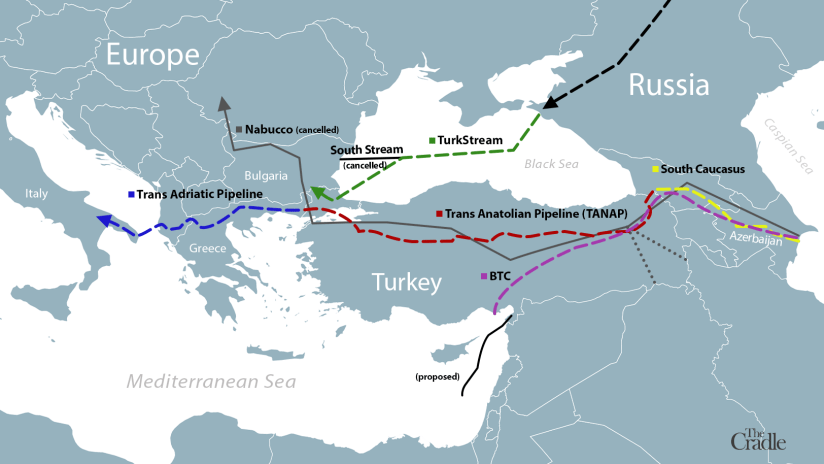
Russian energy giant Gazprom and the Italian energy company ENI were the main partners in the consortium. However, following the Crimean crisis in March 2014, the EU Commission blocked this major infrastructure project, citing competition rules.
As far as Moscow was concerned, this arrangement had already been completed in the form of terminals and pipeline routes. Thousands of work contracts had been issued between Bulgaria and Hungary at the time.
Construction was scheduled to begin in June 2014, but Brussels alluded to apparent violations of competition rules in the awarding of contracts by the Bulgarian authorities and brought everything to a halt.
Turkey as a Russian energy hub
Nine months later, during a joint press conference with Erdogan in Ankara, Putin remarked that “If Europe does not want to carry it out, then it will not be carried out.” Putin then announced the TurkStream project, which was formally launched in early 2020.
One pandemic and a war later, the world has experienced and continues to experience rising natural gas prices, while Russian-Turkish energy cooperation is intensifying. On 19 October, Erdogan said he had agreed with Putin to set up a comprehensive hub for Russian natural gas built in Turkey from where Europe could meet its energy needs.
“If Turkey and our potential buyers are interested, we could consider building another gas pipeline and creating a gas hub in Turkey for sale to third countries, especially in Europe,” Putin proposed. In addition, a gas exchange could also be created in Turkey to determine prices, he added.
Neither the EU nor the US have welcomed these developments or, in some cases, faits accomplis. Turkey makes no secret of the fact that it wants to expand its status in the China-led Shanghai Cooperation Organisation (SCO) and will probably soon become the tenth member of this important regional organization.
It should be noted that the SCO’s statutes stipulate energy and security – especially the fight against terrorism – as its essential agenda. The EU, it must be said, is only just discovering the importance of these issues.
Attempts to bypass Russian gas
In the recent past, governments and energy companies have looked to Turkey as an alternative to the existing transit routes for oil and gas between the east and west. In 2005, the 1750 km long Baku-Tbilisi-Ceyhan (BTC) pipeline was opened, transporting Caspian oil across the Caucasus to the Turkish Mediterranean port.
Crucially, this route had the backing of Washington, reinforcing the close connection between politics and the oil business. As per an apt saying from the early 20th century US oil industry: “The oil business is too important to leave it to the oil people.”
The Nabucco pipeline project, intended to reduce Europe’s reliance on Russia’s gas, consisted of a consortium of six corporations based on the initiative of the Austrian partly state-owned OMV. The project was supported politically and financially by the European Commission, with the premise being that natural gas would be supplied from the Caspian region via Turkey to Central Europe to the Baumgarten hub in Austria.
Billions were spent on marketing this project between 2002 and 2014. However contractual agreements surrounding the deal never materialized. Though inconceivable now, Iran was also initially planned as an alternative supplier, yet these efforts failed from 2005 onwards due to UN Security Council sanctions on Iran from 2008 until the present.
Additionally, supply contracts with Iraq and Turkmenistan were targeted in vain, although these arguably had a lot to do with complete mismanagement. In the case of Turkmenistan, countless advisory opinions were commissioned on the status of the Caspian Sea under international law, sea, or lake, and the possible transit pipelines for landlocked Turkmenistan.
A failed strategy
After many years of mere marketing and a lot of hot air between Brussels and Vienna around the Nabucco project, OMV’s partners finally backed out in 2014. It was clear that there was no natural gas available.
In my book “Der Energiepoker” (The Energy Poker) I wrote in 2006: “If the managers had not gone to the State Opera to see Verdi’s Nabucco, but had seen the operetta by Johann Strauss “Wiener Blut” (Viennese Blood), then this natural gas pipeline would have been given a more appropriate name.
Now, in view of the Nord Stream 2 pipeline boycotted by the EU, OMV is facing further setbacks, as the contracts with take-or-pay clauses were drafted in such a way that payment would have to be made for the Russian natural gas, even if there was no physical delivery. These conditions apparently apply until 2040.
EU will buy Russian energy indirectly
While the EU wants to bypass Russian energy sources for political reasons, Turkey, India, and China, among others, will gladly fill in the consumer void. As described, Turkey already benefited in 2014 from the SouthStream project, which became TurkStream. The EU ultimately lost out, while Ankara stood to gain, with the EU presently buying Russian natural gas via Turkey.
This energy route is set to expand even further once the Russian natural gas hub in Turkey is established. Turkey thus becomes the safeguard of the EU’s energy security. While this was the case a few years ago with non-Russian natural gas and oil, it now looks as if Russia is merely adapting its role for the European market on a regional basis.
For some years, Ankara aligned its prospective role as a hub for BTC and the Nabucco project with its EU accession ambitions. Now it seems that Turkey will become a member of the SCO much faster, and despite its NATO membership, part of the security cooperation with Russia and China.
The EU is more dependent than ever on the goodwill of those it once created obstacles for, and Turkey and Russia are no exception. The coming months will show with all their force just how irresponsibly the EU governments handled the continent’s energy security needs.
Nord Stream repair time frame assessed
Samizdat – October 24, 2022
Russia’s Nord Stream gas pipelines, which were damaged and made inoperable by underwater explosions in late September, can be repaired within a few months.
That’s according to the state-backed Danish Broadcasting Corporation (DR) which was citing Sten Ussing, Chief Engineer with consultant group COWI.
Ussing assessed from underwater video-footage that the pipes will not be damaged by rust for some time as there is little oxygen at a depth of 80 meters, where they are located. He noted that the fracture surfaces look “very clean and almost shiny,” which suggests that “the pipe will not rust in a few weeks, as one would expect in a more oxygenated environment.”
“We can expect corrosion inside the pipe to be limited as well,” he added.
The engineer, however, explained that the explosion caused a pressure surge, and that could have damaged sections of the pipeline some distance from the site, adding that they can be repaired by elevating the pipes slightly above the seabed, which would allow underwater welders to remove the damaged sections and replace them with new ones.
“It is standard procedure to weld such a piece of pipe under water. It has been done many times before, and the technologies – vessels, pipes and specialists – that need to be used already exist,” Ussing explained.
“Finally, the pipeline would have to be emptied, the strings cleaned of dirt and grime, blown and dried – and that’s it, you can have gas flowing again,” the engineer concluded, saying the process will likely take several months. He warned, however, that even with little oxygen, the fractured pipes can accumulate rust over time, and advised to carry out the repairs within a year.
The footage of the pipeline fractures which Ussing inspected was taken by Swedish media outlet Expressen, which sent a camera down one of the pipes.
The cause of the explosions which damaged three out of four strings of Russia’s 1,200-kilometer Nord Stream 1 and 2 gas pipelines is still being investigated. Sabotage is suspected to be the likely cause. President Vladimir Putin branded it “an act of international terrorism.”
Ukrainian Army War Crimes Include Shelling of Ambulances, Firetrucks, and Rescue Workers in the Donbass Republics — Similar to Israelis and U.S. Backed Terrorists in Syria
By Eva Bartlett | CovertAction Magazine | September 23, 2022
In the more than eight years of bombing the civilians of the Donetsk and Luhansk People’s Republics, Ukraine has committed untold numbers of war crimes. These include bombing residential areas, markets, hospitals, schools, parks—including with prohibited heavy weapons and banned cluster munitions—and, since late July, raining banned “Petal” mines down on populated civilian areas, including the very center of Donetsk, including as recently as September 7.
A lesser-known war crime is Ukraine’s routine targeting of ambulances, fire trucks, medics and rescuers, and their headquarters and stations. Many of the times Ukraine bombs such heroic rescuers, it is when they are on the way, or already on site, to help civilians often themselves just bombed by Ukraine.
On August 21, Ukrainian shelling of the DPR’s Gorlovka wounded twelve, including five firefighters.
The day prior, Ukrainian shelling targeted an ambulance station in the LPR’s Lysychansk, wounding several and damaging some of the ambulances.
On June 23, the Kievskiy District of Donetsk came under repeated shelling over the course of the two hours I was visiting the Emergency Services headquarters there. On the grounds, I saw the remnants of a “Hurricane” missile from a previous Ukrainian attack.
The previous day, Ukrainian forces targeted an Emergency Services fire truck on call, leaving the driver hospitalized in critical condition. According to his colleagues, they saw a drone above them just prior to Ukraine’s strike. The targeting was unquestionably deliberate.
On June 18, Ukraine targeted a central Donetsk district after Emergency Services had arrived, killing a firefighter and the driver, and injuring three more rescuers.
In early June, heavy Ukrainian shelling of Kuibyshevsky District, Donetsk, destroyed an ambulance and seriously injured the driver.
Ukraine’s attacks on emergency workers is not new; Ukraine has been doing so for years.
In June 2021, during a humanitarian cease-fire, Ukrainian forces targeted an ambulance which had arrived to evacuate three injured DPR soldiers.
In October 2019, Ukrainian forces fired an anti-tank guided missile at a DPR military ambulance en route to help a child, wounding the driver and a paramedic.
In August 2018, Ukrainian forces fired a missile at a DPR ambulance, killing the driver and two female paramedics.
When I first visited the DPR in September 2019, going to hard-hit areas around Gorlovka, I was told by Zaitsevo administration that ambulances could not reach the villagers.
“The paramedics don’t go farther than this building; it’s too dangerous. If somebody needs medical care near the front lines, someone has to go in their own car and take them to a point where medics can then take them to Gorlovka. The soldiers also help civilians who are injured.”
This is something I was very familiar with in Gaza, occupied Palestine, where Israeli soldiers routinely fire at Palestinian farmers and other laborers on agricultural land, a policy of harassment to drive Palestinians off their land. In most cases, ambulances likewise could not reach the injured due to Israel’s policy of targeting ambulances. Consequently, seriously injured Palestinians bleed to death.
In Zaitsevo, I was told this had happened there, too. “A woman died due to huge blood loss because no one could reach her house to take her away in time. She was injured in the shelling and bled to death.”
Targeting medics and other rescuers ensures those in need of help are deprived of it, and increases the likelihood that people who might have lived instead die of their injuries.
The intentional targeting of ambulances and medics, as well as fire trucks and other emergency services vehicles and workers, is against international law.
Speaking to DPR Rescuers
During my last two visits to the DPR, in June and August 2022, I interviewed a number of Emergency Services workers and medics.
According to Konstantin Zhukov, the Chief Medical Officer of Donetsk Ambulance Services, the ambulance services workers face shelling daily, constantly, and many employees have been wounded while working. One of the ambulance stations was completely destroyed by Ukrainian shelling.
Outside, I spoke with Tatyana Golota, an emergency physician, and Alena Kondrasheva, a paramedic.
Both reiterated that it is normal coming under repeated Ukrainian fire. They spoke of Ukraine shelling after medics and emergency services workers had arrived to help civilians.
They showed me an ambulance completely destroyed by Ukrainian shelling. It was new and had only been operational a few months before being destroyed.
“That day we were at work and heard about the brigade coming under fire. The doctor had gone to help people, and the driver, by chance, walked away to try to get a mobile signal. At that moment, there was a direct hit on the vehicle.”
Also in Donetsk, I spoke with Sergei Neka, Director of the Department of Fire and Rescue Forces of the Ministry of Emergency Situations.
He likewise said rescuers increasingly come under fire when they go out on a call, sometimes making it impossible to reach the people in need.
According to him, from February 24, 2022, to when I spoke with him in August, four people were killed and 40 injured, as well as significant damage to equipment and buildings.
“Our units arrive at the scene of the accident and Ukraine begins to shell it. A lot of equipment has been damaged and destroyed.”
I asked about the impact of the “Petal” mines Ukraine has been dropping on the city, and was told a 21-year-old employee was injured by a PFM-1S mine after a region was cleared, the mine falling from the building and the unsuspecting rescuer stepping on it, losing his foot.
In Makeevka, just east of Donetsk, I went to an orphanage that had been shelled with the mines. Most of the clean-up was completed by the time I arrived on the second day of de-mining, but one remained. I watched a sapper find and detonate it, and although I had previously seen a group of eight mines detonated, creating a massive blast, the force of the single mine was still quite powerful.
According to Dmitry Chamota, Head of Donetsk Emergency Services Deminers, they found 26 PFM-1 mines scattered around the grounds of the orphanage, including on the playground.
In June, I met Andrey Levchenko, Chief of Kievskiy District Emergency Ministry. Over the course of the two hours at his station, Ukraine was intensively shelling the district, leading us to take cover inside the building lest the property be targeted again.
We did venture outside between bouts of shelling, where Levchenko pointed out damage to the buildings and the shell of the Ukrainian-fired Hurricane MLRS which struck the premises.
The building has blown out windows, sandbagged windows to attempt to protect the workers; some days prior, the chief’s office had been damaged by shrapnel from the shelling. Thankfully, he had just stepped out a minute before the blast.
He showed me the fire truck damaged on June 22, pointing out the many shrapnel holes and noting one of the rear tires had been blown out.
Two of the employees who had been out on that call spoke to me about that day, saying that, after Ukrainian shelling of the district, they received a call that people were trapped inside a building with the door blocked after the shelling. A fire was spreading to the second and third floors, and that people were unable to escape. As the rescuers assessed the situation, a shell hit a wall near the truck and wounded the driver.
They said that, prior to the shelling, they saw a drone overhead. This, combined with the facts that they were uniformed and the fire truck was clearly marked and in a civilian area where people were calling for help, makes it credible to believe Ukraine deliberately targeted the rescuers.
Of Ukraine’s heightened shelling over the past many months, Levchenko said it was constant and daily. “Before, if we speak about 2014-2015, twenty minutes, one hour maximum. Now six-seven hours non-stop, every day.”
He said that the Ukrainian forces shell, wait until rescuers arrive and then shell again. “They wait for 30 minutes for us to arrive. We arrive there, start assisting people, and the shelling resumes.”
This is something I witnessed for myself when, on August 4, Ukraine bombed the hotel in which I was staying, the fourth and fifth shells landing 50 meters away and then directly beside the hotel, respectively. When the fifth struck, shattering inwards the lobby glass doors, I had fortunately just stepped out of the lobby where 30 seconds earlier I had been speaking to journalists who had run in from the street.
When it seemed the shelling had stopped, journalists went outside to document the damage. Sadly, a young woman outside the hotel had been killed by the shelling. Five others just two streets away were also torn apart by the bombs, including a promising 12-year-old ballerina, her grandmother, and her world famous former ballerina ballet teacher.

Galina Vasilyevna Volodina (left), and twelve-year-old Katya Kutubaeva, the ballerina killed by Ukraine. [Source: slippedisc.com]
Emergency Services arrived and, not long after, Ukraine resumed its shelling. Fortunately, they were able to get inside, but this is just one example of Ukraine’s double strikes.
According to Levchenko, Ukraine does not only shell two times, but that they sometimes shell three times: “They wait again, our guys hide in the shelters, as soon as we go out, put out the fire, help people, there could be people under the debris, doors stuck, people can’t get out and get to the basement…then shelling resumes.”
He described the people engaging in this sort of warfare against civilians and rescuers as “Shameless. Scumbags. Terrorists.”
He is not wrong.
Targeting Rescuers: A Terrorist Tactic Adopted by U.S. Allies in Ukraine, Israel and Syria
As the DPR Emergency Services chief pointed out damage to the fire truck, I was reminded of Israel’s attacks on Palestinian medics and fire brigades in Gaza, including during the December 27, 2008-January 18, 2009, Israeli war on Gaza, where I was living at the time.
During those three weeks, I rode in the medics’ ambulances, documenting the destruction and the victims of Israel’s war crimes, but also in a sense as a human shield, in the hope that Israel would not strike ambulances in which a handful of internationals and I were riding.
As it turned out, by the end of the Israeli massacre of Gaza, Israeli forces killed 16 medical rescuers, four in one day alone. Another 57 were injured. At least 16 ambulances were damaged, with at least nine completely destroyed.
One of the murdered was a 35-year-old paramedic, Arafa Abd al-Dayem, who I had accompanied the night prior to his murder. As I wrote of that evening, “The dead, a 24-year-old night watchman, had no warning of the at least 2 missiles which leveled the school and tore him apart. The medics work to load the corpse, first having to replace the flat tire. Working frantically, still fearful of potential strikes, they crowd the ambulance, hoist the van, replace the flat. A missile hits 50 meters away. Surely, undoubtedly, those warplanes above us know—from the markings of the ambulance, the clothes of the medics, the crystal clear photos their drones can take—that we are civilians and medics below. Yet they fire.”
Arafa was killed later that day, when Israeli forces fired a flechette shell directly at his ambulance, shredding him with the dart-like flechettes, causing massive internal bleeding in his abdomen, blood in his lung, shock, and death.
A surgeon I interviewed later when writing about Israel’s widespread use of flechettes in Gaza told me that flechettes cause more injuries than other small munitions precisely because they spread in a larger area. And while the darts appear innocuously small, their velocity and design enable them to bore through cement and bones and “cut everything internal.” Accordingly, the prime cause of death is severe internal bleeding from slashed organs, particularly the heart, liver and brain.
One of the injured, Hassan al-Attal, 35, was a medic whose ambulance I was in when he and another medic came under Israeli sniper fire while attempting to retrieve a corpse from the street just beyond the ambulance. The sniper fire reached the ambulance itself. Hassan was wounded in the leg. This was during a few hours of supposed cease-fire. But in any case, the medics never should have been targeted.
As I wrote, “Although the Geneva Conventions explicitly state that ‘medical personnel searching, collecting, transporting or treating the wounded should be protected and respected in all circumstances,’ throughout Israel’s invasion this was not the case. Indeed, as the injured and emergency workers testify, Israeli forces targeted and prevented medical workers from reaching the wounded.
Without coordination, many ambulances did not dare risk Israeli gunfire and shelling, meaning hundreds of calls went unanswered, according to the Palestinian Center for Human Rights. Denied medical care, many victims succumbed to their wounds.”
Israeli forces killed 13 Civil Defense workers and injured 31, also destroyed six civil defense stations and damaging four.
From that same article, “Civil Defense workers, like medics, are protected under international law. The Fourth Geneva Convention states not only that emergency workers must be respected and allowed to do their work, but that their buildings, equipment and vehicles must not be targeted.
Yousef al-Zahar, director-general of Civil Defense in Gaza, told me at the time, ‘Targeting the Civil Defense centers and teams is an obvious indicator that the Israeli forces intended to paralyze Civil Defense activities in the Gaza Strip to raise civilian victims’ numbers in the casualties.’”
According to statistics from the Palestinian Authority Ministry of Health and the PRCS, from the outbreak of the second Intifada in September 2000 to when I wrote the 2010 article, Israeli Forces have killed at least 56 medical rescuers, including paramedics, drivers, doctors and volunteers—an average of one rescuer every two months—and have injured at least another 500 medical rescuers.
Likewise, British journalist Vanessa Beeley has written at length about Syrian rescuers targeted by terrorist factions in Syria, their equipment stolen. In one of her articles, she cited a Commanding Officer of the Real Syria Civil Defense in an Aleppo district describing a scenario which Donbas and Palestinian rescuers would recognize:
“They (terrorists) targeted us deliberately in order to destroy our equipment & structures. They wanted to prevent us being able to work for our people. They would target our crew with sniper fire and explosive bullets. Their main mission was to kill the crew and destroy our base so we couldn’t care for the people of Aleppo.”
In that same article, she noted that “terrorist groups systematically carried out double-tap attacks” on the rescuers, just as Israel does to Palestinian rescuers and Ukraine to Donbas rescuers.
Ukraine Continues Killing Donbas Rescuers
On September 1, 13 DPR Emergency workers were killed and 9 injured from Ukrainian shelling. According to a representative of the Emergency Situations, the shelling was intentional.
“The missiles exactly hit residential buildings. The vehicle was outside and it was hit with shrapnel and pieces of the destroyed building. But again, you can see it’s an emergency vehicle—a fire vehicle. This is a war crime.”
The following day, two more Emergency Services workers were killed and two injured by Ukrainian shelling of their fire truck, in Makeevka. They were en route to put out a fire. Images accompanying the news show a mangled bright red fire truck, unmistakably a rescue services vehicle.
When in August I spoke with the Director of the Donetsk Department of Fire and Rescue of the Ministry of Emergency Situations, he told me that, at that time, four Emergency Services workers had been killed and 40 injured by Ukrainian shelling.
With Ukraine’s targeting of Emergency Services in September, the number of rescuers Ukraine has killed is now at least 19, with another 51 injured.
I had the chance to speak with the mother of a young firefighter, Pavel (“Pasha”) Legonkiy, killed by Ukrainian shelling on June 18, 2022. He and other Emergency Services personnel had gone to the site of a Ukrainian shelling, in central Donetsk. A Ukrainian double-tap strike killed Pasha and the driver, injuring three others.
Svetlana spoke proudly of her courageous, compassionate son.
“He loved his work very much. He lived for this work. It was his duty to help people. My son dreamed of starting a family, dreamed of having children, dreamed of working! And one shell that you sent here ended his life.”
These men and women know very well the threats they face when going out on a call, but go anyway, to help their citizens under Ukrainian attacks.
The two women I spoke to at Donetsk Ambulance Services replied to my question about whether they considered stopping their work.
“I’m really scared, everyone is scared. But what can we do? How about the patients? They are people like me, they hurt and are even more scared. They are waiting for our help. While you are driving you feel fear, but as soon as you get to the place of the tragedy, the fear goes away and you just start doing your job and forget about this fear.”
The Kievskiy Emergency Ministry Chief, Andrey Levchenko, said of the rescuers, “They are all heroes. If it were possible, I would give a medal to every one of them, to honor their work, to support them. But they don’t do that for the medals, no way. Nobody ever said, ‘we’re not going, we don’t want to,’” he said, referring to when rescuers go out on calls.
He is right. These rescuers are heroes, putting their lives on the line every time they go out to help a person in need, knowing full well Ukraine frequently strikes an area a second and a third time, specifically to target rescuers. While they might not receive or want medals, they should be afforded their right under international law to rescue people without fear of being shelled by Ukraine.
US elites wrong that aggression against Russia can be unlimited – intelligence chief
Samizdat | October 24, 2022
The fact that discussions about the possible use of nuclear weapons have become part of Western rhetoric is worrisome, Sergey Naryshkin, the head of the Russian Foreign Intelligence Service (SVR), has said.
Contrary to claims by Western leaders, Russia is “absolutely” not threatening to deploy nuclear weapons, the senior official explained. But Kiev has openly claimed that it wants to become a nuclear power, an outcome that Naryshkin called on the world to prevent.
The Russian intelligence chief was referring to a speech that Ukrainian President Vladimir Zelensky delivered during the Munich Security Conference in February. The Ukrainian leader lamented that Kiev had given up nuclear weapons stationed there during the Soviet era and said that his country could break its promise to stay a non-nuclear state.
Naryshkin was speaking on Monday in his capacity as head of the Russian Historical Society at the opening of an exhibition marking the 60th anniversary of the Cuban Missile Crisis. The current stand-off between Russia and the US over Ukraine has been compared by many to the events that happened six decades ago.
“The American elites today believe that they can maintain the aggression against our nation for as long as they want, feuling military action with thousands of lives of Ukrainian citizens and mercenaries,” the official remarked, drawing a parallel to how the Cuban Missile Crisis started.
The stand-off back then was triggered by the US decision to deploy missiles to Turkey, threatening the Soviet Union, he explained. When Moscow reciprocated, “the reaction of the US political elites, who had convinced themselves of being exceptional, was painful, nervous and acute,” he noted.
The administration of President John F. Kennedy recognized that there were red lines that neither the US nor the USSR should cross, Naryshkin said. There were people in the US government who “thought rationally, were able to calculate the consequences of their actions, and kept their word.”
It’s not clear that the same approach can be found in the Joe Biden administration, Naryshkin stated.
“Today, we will not be able to find a politician in a Western nation of the same magnitude as Kennedy,” he added.
The Russian official also suggested a way to discourage nuclear powers from deploying their arsenals for goals other than deterrence. He told the audience that holding the US accountable for the 1945 nuclear bombings of Hiroshima and Nagasaki would have had a cold shower effect.
How Worried Should We Be About Boston University’s Gain-of-Function Covid Virus That Kills 80% of Mice?
BY DR RANDALL BOCK | THE DAILY SCEPTIC | OCTOBER 23, 2022
This week, Boston University found itself at the centre of scorn over claims its laboratories were engineering a “SARS-CoV-3” virus that would (hypothetically) put humanity one lab-leak away from a renewed Covid pandemic.
In the midst of worldwide relief over SARS-CoV-2’s eventual replacement by the mild, ‘common cold’ Omicron variant, BU’s scientists have created de novo an “Omicron S-bearing virus”, potentially marrying Omicron’s transmissibility with the Wuhan strain’s dangerous pathogenicity.
Boston University leadership should not be shocked by the widespread condemnation of this experiment. It has its own hubris to blame: steamrolling neighbourhood opposition to the urban placement of America’s National Emerging Infectious Diseases Laboratories (NEIDL), through which BU amasses lucrative research grants. As the philosopher Spider-Man has said, “with great power, there must also come great responsibility.”
In this case, BU exhibits power, but avoids responsibility. The National Institutes of Health (NIH) is examining whether these experiments should have triggered a federal review as ‘gain of function’ with SARS CoV-2’s gaining new or enhanced abilities, which NIH deems “inherently risky”. Boston University says it “did not have an obligation to disclose this research”, despite having received federal NIAID funding which BU states was only for “tools and platforms” used by the scientists.
“We take our safety and security of how we handle pathogens seriously, and the virus does not leave the laboratory,” noted NEIDL’s Dr. Ronald Corley. Cynics might point out that as recently as 2018, the Wuhan Institute of Virology (WIV) touted that its work “held the secret to preventing epidemics”. NEIDL has (probably) released fewer unintentional pandemics than WIV, so there’s that.
NEIDL can be seen as either a bulwark against – or conversely, a conduit for – bioterrorism. NEIDL houses the Level-3 Biosafety Lab (BSL-3) of this trans-viral graft experiment as well as one of the rare US BSL-4 laboratories, intended for studying the deadliest transmissible diseases, such as Ebola.
Lab-coat scientist researchers are not selected or rewarded for political acumen, nor should they be. Actual wet-lab work often embodies the phrase by which physicians tease anesthesiologists: “99% boredom and 1% panic” – but, without the panic. Instead, researchers have their 1%-portion comprised of the brief, refreshing glory on the occasion of publishing consequential results – the news of which usually stays within a small coterie of PhDs cognisant of the technical ‘twin-speak‘ pertinent to the narrow focus of the experiment performed.
Upending the news cycle, bringing fear and then furor to a Covid-weary populace, and a posse of paparazzi upon itself is not the usual modus operandi of researchers releasing a preprint dryly titled (as they often are): “Role of spike in the pathogenic and antigenic behavior of SARS-CoV-2 BA.12 Omicron“. Boston University’s Mohsan Saeed (et al.) ‘buried the lede‘ by not communicating clearly having formed a SARS-CoV-2 mutant through chimeric graft of Omicron spike onto SARS CoV-2.
The researchers’ insularity is evident in their not predicting that producing novel camouflage for the pandemic’s perpetrator would be sufficient cause for all hell to break loose. Given Dr. Saeed’s interim disappearance from the scene, it is assumed notoriety was not the researchers’ actual intent. His additional lack of communicating the societal need for a rejiggering of COVID-19 spare parts into a new mutant strain is its own problem.
NIAID says that the BU should have communicated in advance the purpose and nature of the study. BU responds that it did not have to because the primary funds were from BU itself. Medical ethicist Dr. Arthur Caplan says, “the entire research community would benefit from better communication.” Perhaps even earlier “better communication” might have obviated the experiment itself.
By focusing so intently within the micro-world, it’s perhaps forgivable virologists lose sense of the macro. Conversely, the general public has earned every right to be twitchy and tetchy over ‘gain of function’ engineered augmentations to SARS-CoV-2 after the many millions of excess deaths following what many suspect was a Wuhan lab leak.
The Daily Mail’s story headlined “‘This is playing with fire – it could spark a lab-generated pandemic’” had this graphic stating the mutant strain has an 80% kill rate.

Sensationalism definitionally entails shocking language at the expense of accuracy. Corrections are therefore in order:
- Yes, this lab is performing a ‘Frankenstein’s monster’ experiment: putting Omicron’s spike protein (head) on ancestral SARS CoV-2’s envelope (body) – but, this is the standard operating procedure for virologists. Chimeric work allows comparisons to be made gauging the relative strength or pathogenicity of individual virion segments.
- Yes, this is a brand-new ‘deadly strain’ – but for a particularly and purposefully vulnerable strain of mice, not for humans. The new ‘Frankenstein’ Omicron-spike-and-Wuhan-body chimeric coronavirus caused 80% of hACE-2 lab mice to die – fewer, actually, than had perished from the ancestral Wuhan SARS-CoV-2 itself. For better or worse, these mice have been specifically genetically engineered to have 100% fatality to SARS-CoV-2. If the mice instead replicated human’s very low fatality rate against this virus (less than 0.1% in the non-vulnerable), it would be nigh impossible to make any statistically significant judgements in any experiment unless multi-thousands of mice were included in every phase.
This specific type of work was performed in an appropriate BSL-3 laboratory, and was technically legal even though it encompassed ‘gain of function‘ work. There had been a moratorium in the mid-2010s on such potentially dangerous work within the United States, but that was repealed in 2017. The rationale for reversing the moratorium was similar to that of any military’s maintaining and testing weaponry and engaging in wargames: “Researchers deliberately make viruses more dangerous to help prepare better responses to outbreaks that might occur naturally.”
Ostensibly, the moratorium was lifted to keep us safe; however, it was instituted for the very same reason, in 2014, to curtail scientists’ juicing up avian flu.
In 2011, Fouchier and Kawaoka alarmed the world by revealing they had modified the deadly avian H5N1 influenza virus so that it spread between ferrets (animals used for their similarity to humans’ influenza response). Critics worried a souped-up virus could spark a pandemic if it escaped from a lab (accidentally or as bioterror).
The flip-flopping in allowing gain of function research points to the dual needs in relation to such cutting edge science. Even as the moratorium was lifted, there were rules about the flow of information on gain of function experiments. Open communication is a prerequisite to scientific innovation but also can provide ready blueprints for any intrepid bioterrorist. An additional complication is that almost every study in the U.S. receives federal funds, creating a loophole of having to divulge sensitive results through any given FOIA request.
It is uncertain if BU’s newly chimeric COVID-19 mutant could qualify as a bio threat. Personally, I think not. Almost every one of its mutations is less efficacious than the parent. Viruses go through trillions in order to adapt sequentially to changing immune systems amongst the host. That researchers would come up with a highly dangerous one on the first try seems unlikely. In any event, there is vast natural immunity to Omicron and natural and vaccine immunity to ancestral SARS-CoV-2, COVID-19.
So what was the purpose of the BU NEIDL team? Since poor communication seems to be a threat throughout this story, it is perhaps no surprise that this preprint’s abstract section lacks clarity – and features instances of ‘begging the question (highlighted).
The recently identified, globally predominant SARS-CoV-2 Omicron variant (BA.1) is highly transmissible, even in fully vaccinated individuals, and causes attenuated disease compared with other major viral variants recognised to date. The Omicron spike (S) protein, with an unusually large number of mutations, is considered the major driver of these phenotypes. We generated chimeric recombinant SARS-CoV-2 encoding the S gene of Omicron in the backbone of an ancestral SARS-CoV-2 isolate and compared this virus with the naturally circulating Omicron variant. The Omicron S-bearing virus robustly escapes vaccine-induced humoral immunity, mainly due to mutations in the receptor binding motif (RBM), yet unlike naturally occurring Omicron, efficiently replicates in cell lines and primary-like distal lung cells. In K18-hACE2 mice, while Omicron causes mild, non-fatal infection, the Omicron S-carrying virus inflicts severe disease with a mortality rate of 80%. This indicates that while the vaccine escape of Omicron is defined by mutations in S, major determinants of viral pathogenicity reside outside of S.
Let’s translate the abstract into general English:
Omicron is milder – and its spike protein is structurally different enough from the ancestral Wuhan strains that an mRNA vaccine to SARS CoV-2 does nothing to protect mice from Omicron. This is somewhat immaterial because Omicron doesn’t make these mice sick in the first place (basically the same situation as with humans). So, with research funding in hand, what are we going to do? Let’s put an Omicron ‘Halloween mask’ on the dangerous Wuhan strain! How many mice will die? A lot, nearly 80%. That’s sounds really bad, but we forgot to mention (in this abstract) that Wuhan strain without the Omicron-spike mask kills 100% of these mice, which sadly are canaries in a coal mine, engineered to die from SARS-CoV-2. Conclusion: the stuff inside the SARS-CoV-2 envelope is the really bad stuff. With its very own original spike protein it’s more dangerous, but what did we expect? We just made a virus that’s different from a fairly dangerous one and it’s not quite as dangerous.
Thus restated, it becomes difficult to ascertain the genuine need for doing this experiment (whose results seem obvious, predictable and axiomatic). Einstein favored Gedankenexperimente (‘thought experiments’) using conceptual rather than actual experiments in creating the theory of relativity. There’s nothing like the ‘real thing’, but I’m imagining 99% of virologists could have foreseen a conclusion similar to this without having done any of the study. Moreover, most would not have seen a real point in doing this study in the first place. Of course, getting paid and churning research grants can help provide motivation.
Even without the researchers’ having read my own article “Is it Time to Accept That Omicron is not COVID-19?” in The Daily Sceptic, September 25, 2022 – they should still have had enough information to know Omicron (despite its Greek letter) is not a SARS CoV-2 variant nor lineal genomic or genetic descendent. Such information was easily available January 2022. With this in mind, the highlighted portions make little sense and the purpose of the study even less.
One virologist offered these criticisms of the preprint’s study (in confidence):
- Why put Omicron S on a virus that is no longer circulating? I’m not sure what scientific question they are trying to answer.
- The grants that are cited for the work were meant to study innate immunity. They claim they want to study the role of spike protein in phenotype but they are not using the proper controls.
- It would have made more sense to have reversed the experiment, i.e., put the Wuhan spike on the Omicron envelope.
- Also, site-directed mutagenesis (creating specific, targeted changes) would have been a more useful technique, given that there are so many mutations in Omicron’s spike protein compared to earlier variants.
- The authors’ conclusion, “These findings indicate that the S protein is not the primary determinant of Omicron’s pathogenicity in K18-hACE2 mice,” should say that “S protein was not a primary determinant of Wuhan pathogenicity”.
- They actually [downwardly] attenuate the Wuhan strain by putting the Omicron-S onto that virus, yet try to sell it as if they had made the virus more lethal.
- Overall, they seem to really be studying Wuhan pathogenicity in the context of Omicron spike.
All products and methods of technology (e.g. nuclear power, mining, fossil fuels) are variously considered ‘double-edged swords’. So too it is with these studies. There are potential benefits and potential risks. In this particular case, were the risks worth it? Was the study appropriately directed and was the information gleaned worth the global consternation? The answer to both is ‘no’.
“It’s not like they made this monster virus, that’s a complete misinterpretation,” states infectious disease specialist Dr. Daniel Kuritzkes. “Researchers compared the ancestral version, Omicron, and a combined version of the two to research what piece of the virus dictates how sick a person will get. What we see in animal models does not translate directly to what we will see in humans. The labs are extraordinarily careful in how they do these experiments. There are strict protocols in place to make sure that nothing produced in the lab is released into the environment.”
My assessment is that this is more ‘tempest in a teapot’ than monster – although Dr. Frankenstein’s methods and ethical issues find resonance here. That there is a federal investigation into this case is interesting for the side reason that it seems an admission against its own interest, namely to the possibility that virology laboratories can potentially leak mutant strains. Who would’ve thought? For so long, it was all but forbidden to consider such a possibility for China’s WIV, even though ancillary evidence is nearly conclusive it occurred.
Dr. Randall Bock is a primary care physician near Boston, Massachusetts, and the author of Overturning Zika.
Germany forced to slash rearmament plans
Berlin loudly announced the scheme earlier this year, after years of pressure from the US
Samizdat | October 23, 2022
Germany is “massively” reducing its rearmament plans as high inflation and a strong dollar have made the equipment too expensive to buy for the country, unnamed political and defense industry representatives have told Handelsblatt newspaper.
Many projects, especially those for the navy and airforce, would likely have to be canceled, the outlet reported on Friday.
The fate of a third batch of K130 corvettes is now hanging in the balance, along with new Eurofighter jets for electronic warfare, frigates, and self-propelled howitzers, which were to be ordered to replace equipment sent by Berlin to Ukraine, the sources claimed.
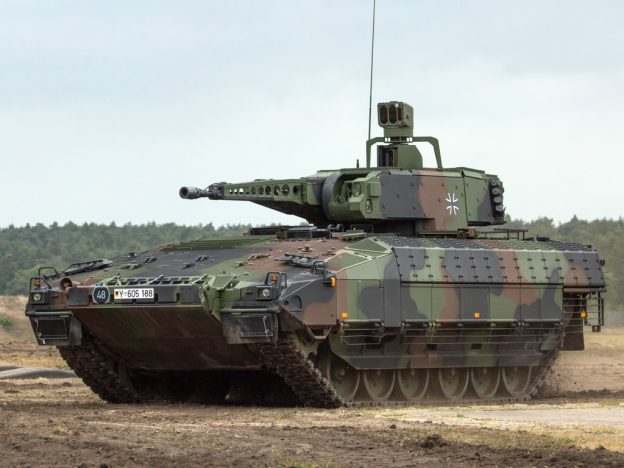
The number of units in a second batch of Puma infantry fighting vehicles, the cost of which was estimated at €304 million ($299.8 million) earlier this year, is also being reduced on a weekly basis, an unnamed politician from the ruling ‘traffic light’ coalition told the paper.
“Since many projects run for five to seven years, inflation in this dimension creates a serious financial problem,” one of the sources explained. The economic situation has been fraught in Europe as the burden of the Covid-19 pandemic was further aggravated by the fallout from sanctions imposed by the EU on Moscow over its military operation in Ukraine, and the subsequent reduction in the supply of Russian energy to the bloc.
Arms manufacturers have reportedly been unhappy with the size of a special €100 billion ($98.6 billion) fund allocated by the German government for rearmament purposes. “In order to fulfill the wishes of the Bundeswehr, €200 billion is needed,” a defense firm manager told Handelsblatt.
When announcing the investment in June, Chancellor Olaf Scholz promised that it would help turn the German military into the “biggest conventional army” among European NATO member states. The Bundeswehr would be able to “defend every square meter” of the US-led military bloc’s territory, he insisted.
Featured Video
Seyed M. Marandi: US-Iran War Inevitable: Kuwait and Bahrain May Fall
or go to
Aletho News Archives – Video-Images
From the Archives
Oil and the Israel Lobby
Reknowned economist M. Shahid Alam offers this excellent critique of Noam Chomsky’s defective analysis of the relative influence of Oil versus the Israel lobby over US foreign policy: … continue
Blog Roll
 Aletho News
- ICC ignored ‘very well-documented’ NATO crimes – ex-Libyan minister
- SNSC secretary dismisses US response to Iran’s conditions as ‘inadequate’
- Sanaa says Taiz roads open, secure for residents, warns Saudi forces
- Iraqi resistance group urges Saudi leadership to admit defeat, lift Yemen siege
- Trump’s Retreat: How Al-Aqsa Flood Took Down the US Empire
- Israel’s Military Actions in Lebanon Grossly Violate International Law — Lavrov
- Seyed M. Marandi: US-Iran War Inevitable: Kuwait and Bahrain May Fall
- Leaders Condemn Ansarallah Attack on Saudi Arabia While Ignoring Illegal War Against Yemen
- Leaked: Britain’s Covert Iraqi Psyops Network
- Yemeni Armed Forces Warn Airlines Against Using Saudi Airports, Exempt Mecca and Medina
- If Americans Knew
- Israel’s Destruction of Southern Lebanon Intensified After the Cease-Fire
- The Last-Minute Decision That Gave Israel Its Name
- The American Conservative: How Trump Made the World Go Nuclear
- Meet the US generals and admirals advancing Israeli policy
- Opinion: Why news organizations should boycott Israel
- The Israeli witch hunt of Sami Abu Shehadeh exposes the lie of the ‘Jewish and democratic’ state
- No state has a ‘right’ to exist – least of all Israel
- Testimonies about Gaza’s civilian death toll expose Israel’s atrocities – Daily Update
- How Israel Conquered the Latin American Right
- Agents search Rep. Omar’s Washington home in criminal probe as she vows she won’t ‘be silenced’
- No Tricks Zone
- Germany’s Green Energy Debacle: High Energy Costs Force Kahla Porzellan to Close After 182 Years!
- New Study: 50 Years Of The Most Aggressive ‘Net Zero’ Policies Can Only Affect The Global Climate By 0.03°C
- US September “Heat” Was No Record…Many Records Set Decades Ago
- Latest European Green Energy Debacle; Portugal’s Largest Flagship Solar Park Insolvent!
- Green Energy Debacle: German Expert Professor Fritz Vahrenholt Warns Of Severe Economic And Social Consequences
- Two More Paleo Reconstructions Affirm Meters-Higher Sea Levels Across Ireland, Brazil 7000-6000 Years Ago
- New Study: Earth And Venus Surface Warmth Largely Explained By Convection And Lapse Rate, Not CO2 Or Radiation
- 2025 Nature Paper Claiming Worsening Global Drought Gets RETRACTED …Heavily Flawed
- New Study: ‘Global Drought Shows No Detectable Recent Acceleration Under Climate Warming’
- Economic Masterminds: German Socialists Suggest Taxing Productivity Gains Stemming From Using AI

