Biden proposes to export 20 million tons of Ukrainian grain to stabilize food prices
By Drago Bosnic | May 17, 2022
As the establishment in the United States continues to blame Russia for all its problems, including the mythical “Putin’s price hike”, which started at least a year before Russia’s special military operation in Ukraine, there is a food shortage crisis looming over the world. And once again, the political West is pointing fingers at Russia. The reasons for the food shortage the world will almost certainly experience this year are manifold. The most obvious reason is that countries are limiting or outright banning food exports amid announced shortages, as they are trying to prevent food crises from affecting their populations.
Western mainstream media are also claiming that Russia’s special military operation in Ukraine is supposedly causing a food shortage in the country. Some media are going as far as to claim that Russia is allegedly “stealing” stored grain and agricultural machinery from Ukrainian farmers in areas such as the Kherson oblast (region). Why exactly would Russia be doing this is quite unclear, especially given the country’s massive surge in wheat and grain production in general, which is breaking records year by year and is set to reach a staggering 130 million tons this year.
In a piece published last week, Financial Times accused Russia “of industrial-scale farm plunder in Ukraine” and even claimed that this was “history repeating itself” by evoking memories of historic famine, referring to the 1930s Holodomor, which in recent years has been falsely portrayed as a sort of anti-Ukrainian “genocide” perpetrated by Russia, despite overwhelming evidence that the horrific famine caused as much damage in present-day southern Russia, reaching as far as western areas of modern-day Kazakhstan.
“Ukraine’s government has accused Russia of trying to destroy its agriculture sector by stealing valuable grain stocks and machinery, deliberately bombing farms and warehouses and blockading its Black Sea ports to deprive it of exports earnings and farmers of liquidity. There are multiple examples around the country of grain elevators and warehouses being bombarded,” Financial Times claimed.
The accusations have multiple inconsistencies, including the idea that Ukraine cannot export grain due to Russia’s alleged naval blockade, when, in fact, it was the Kiev regime that indiscriminately placed naval mines in Odessa and other ports, making any form of naval transportation impossible and even endangering other major Black Sea ports as the mines drifted as far as the Bosphorus, over 600 km to the south. Also, if there is a food shortage, why would Ukraine even make such a suicidal move by exporting grain, when it can’t even feed its own population?
“But it is the confiscation of grain in territories controlled by Moscow that is the most emotive issue. It has drawn parallels with the Soviet policy of crop confiscations coupled with the confinement of peasants to their villages in the 1930s. Some 4mn people died in the ensuing famine in Ukraine, known as the Holodomor, or death by starvation. After Russia bombed a farm business in Luhansk in eastern Ukraine last month, destroying machinery, buildings and 17,000 tonnes of wheat — a year’s supply for 300,000 people — Serhiy Haidai, the local governor, said on social media that Moscow was seeking ‘to organise the Holodomor in the Luhansk region, that is without a doubt’,” FT report added.
Again, the accusations are completely unsupported by any actual evidence on the ground. Lugansk oblast (region) is almost entirely under the control of the Lugansk People’s Republic, which only confirms that the Kiev regime has no reliable information from the area. And given the regime’s track record when it comes to the veracity of its claims, the report should be taken with a grain of salt. The report went on to claim that Russia was allegedly trying to “use the 500,000 tons of grain it confiscated from Ukraine to blackmail countries experiencing food shortages”. The idea that a country which produced nearly 130 million tons of grain in 2021 alone needs half a million tons of Ukrainian grain to “blackmail” anyone is simply ridiculous.
So, again, why would Russia want to confiscate grain from Ukraine? Or is this just projection on the part of the political West? Well, it seems the US president Joe Biden inadvertently gave the answer to that. US president Joe Biden says the coming shortages and the ensuing global food crisis could be resolved if over 20 million tons of Ukrainian grain is exported from the country. The suggestion is rather confusing, as the Western mainstream media are claiming that Ukraine is on a verge of another Holodomor as the “evil” Russians are allegedly taking all of Ukraine’s grain. In essence, the political West is saying that to “save” Ukraine from hunger, they need to take its food away. In other words, to deal with a problem, we need to exacerbate it exponentially. A rather interesting train of thought.
Drago Bosnic is an independent geopolitical and military analyst.
15,000 NATO troops from 14 nations, including the US, Sweden, Finland and Ukraine, start drills near Russia

Samizdat | May 16, 2022
Large-scale NATO military drills started in Estonia on Monday. The exercise dubbed ‘Hedgehog 2022’ is one of the largest in the Baltic nation’s history, according to the military bloc. The drills will involve some 15,000 troops from 14 nations, including both military bloc members and their partners.
Soldiers from Finland, Sweden, Georgia and Ukraine are among those that will take part in the exercise, Finnish public broadcaster Yle reported. The drills will include all branches of the armed forces and will involve air, sea and land exercises, as well as cyber warfare training, according to the broadcaster.
According to a NATO statement, the drills will also see the US Navy Wasp-class landing ship ‘Kearsarge’ take part in the exercises. Both the military bloc and Estonian Defense Forces deputy commander, Major General Veiko-Vello Palm, have denied that the drills just over 60km from the Russian border have anything to do with Moscow’s ongoing military action in Ukraine.
The drills started just a day after Finland and Sweden officially announced their plans to join NATO, and were planned long before the conflict in Ukraine broke out, Western officials have said.
The exercises in Estonia are, however, just one part of NATO’s large-scale military activities near the Russian border. Another Baltic state, Lithuania, is hosting the ‘Iron Wolf’ exercise, which involves 3,000 NATO troops and 1,000 pieces of military equipment, including Germany’s Leopard 2 tanks.
Two of NATO’s biggest exercises – ‘Defender Europe’ and ‘Swift Response’ – are taking place in Poland and eight other countries, involving 18,000 troops from 20 nations, according to NATO’s statement on Friday.
“Exercises like these show that NATO stands strong and ready to protect our nations and defend against any threat,” the military bloc’s spokesperson, Oana Lungescu, said, adding that the drills “help to remove any room for miscalculation or misunderstanding about our resolve to protect and defend every inch of allied territory.”
The NATO Response Force is currently taking part in the 7,500-strong ‘Wettiner Heide’ drills in Germany. The Mediterranean Sea is about to witness ‘Neptune series’ naval drills involving the USS ‘Harry S. Truman’ carrier strike group that will be placed under NATO command. This will only be the second time since the end of the Cold War that a US carrier group has been transferred under the military bloc’s command, NATO has said.
In June, the Baltic States and Poland will host what NATO describes as “Europe’s largest integrated air and missile defense exercise,” which would involve 23 nations.
In late April, Finland hosted NATO naval drills. Now, it is also hosting a joint land exercise, in which troops from the US, the UK, Estonia and Latvia are participating.
The massive military wargames are taking place amid heightened tensions between Russia, NATO and some of the military bloc’s partners. Finland, which shares a long border with Russia, and Sweden decided to reconsider their long-standing policy of non-alignment following a major change in public opinion after the launch of Russia’s attack on Ukraine.
The development sparked a wave of criticism from Moscow, which warned that it would have to respond if Finland and Sweden join NATO. Moscow also maintains that it considers NATO’s expansion as a direct threat to its own security.
School District Restricts First Amendment Activity with Non-Disparagement Clause in Employment Contracts
The Rutherford Institute | May 16, 2022
SOUTHLAKE, Tex. — The Rutherford Institute is challenging attempts by a Texas school district to prohibit its employees from publicly criticizing the school or its policies. In a letter to officials at the Carroll Independent School District, Rutherford Institute attorneys warn that the non-disparagement clause included in the District’s employment contracts, which requires employees to “agree to not disparage, criticize, or defame the District, and its employees or officials, to the media,” constitutes a restriction on speech in violation of the First Amendment that would likely not hold up in court.
“As public bodies entrusted with the care and education of America’s children, schools should be free speech forums that encourage critical thinking skills,” said constitutional attorney John W. Whitehead, president of The Rutherford Institute and author of Battlefield America: The War on the American People. “Forcing teachers to muzzle their concerns about the government’s policies or actions sends a chilling message to students that there is no room for transparency and accountability in government.”
In 2021, the Texas legislature enacted House Bill 3979, commonly referred to as Texas’ “critical race theory law,” which requires teachers who choose to discuss “controversial issues of public policy or social affairs” in the classroom to strive to present multiple perspectives. During a training session, an administrator at the Carroll Independent School District suggested that if teachers have a book on the Holocaust, they should also provide a book from an opposing perspective. The suggestion dismayed teachers, spurring them to speak out publicly on the issue and resulting in significant media attention and criticism of the school district for its interpretation of House Bill 3979. Several months later, apparently in response to the media backlash, a non-disparagement clause was included in the District employees’ annual contracts. The clause prohibits criticism of the District, its officials, and employees to the media but does not prohibit employees from praising or commending the District and its officials. However, as Rutherford Institute attorneys warn in a legal analysis provided to the District, muzzling teachers in order to avoid bad press is unconstitutional. Whether the individual is a teacher, parent, student or member of the community, the right to publicly criticize a government body is firmly grounded in the First Amendment. Moreover, such content-based restrictions on speech “are presumptively unconstitutional.” As the letter notes, “public school teachers… cannot ‘constitutionally be compelled to relinquish the First Amendment rights they would otherwise enjoy as citizens to comment on matters of public interest in connection with the operation of the public schools in which they work.’” Non-disparagement policies by government employers have also been found unconstitutional. Rutherford Institute attorneys concluded by calling on the Carroll Independent School District to remove the non‑disparagement clause from the District’s employment contracts in order to ensure that its policies align with the spirit and the letter of the Constitution.
The Rutherford Institute, a nonprofit civil liberties organization, provides legal assistance at no charge to individuals whose constitutional rights have been threatened or violated and educates the public on a wide spectrum of issues affecting their freedoms.
DOCUMENTS

Conspiracies about conspiracy theories
A little trip down memory lane
el gato malo – bad cattitude – may 16, 2022
My goodness, these “conspiracy theorists” certainly do have vivid imaginations, don’t they?
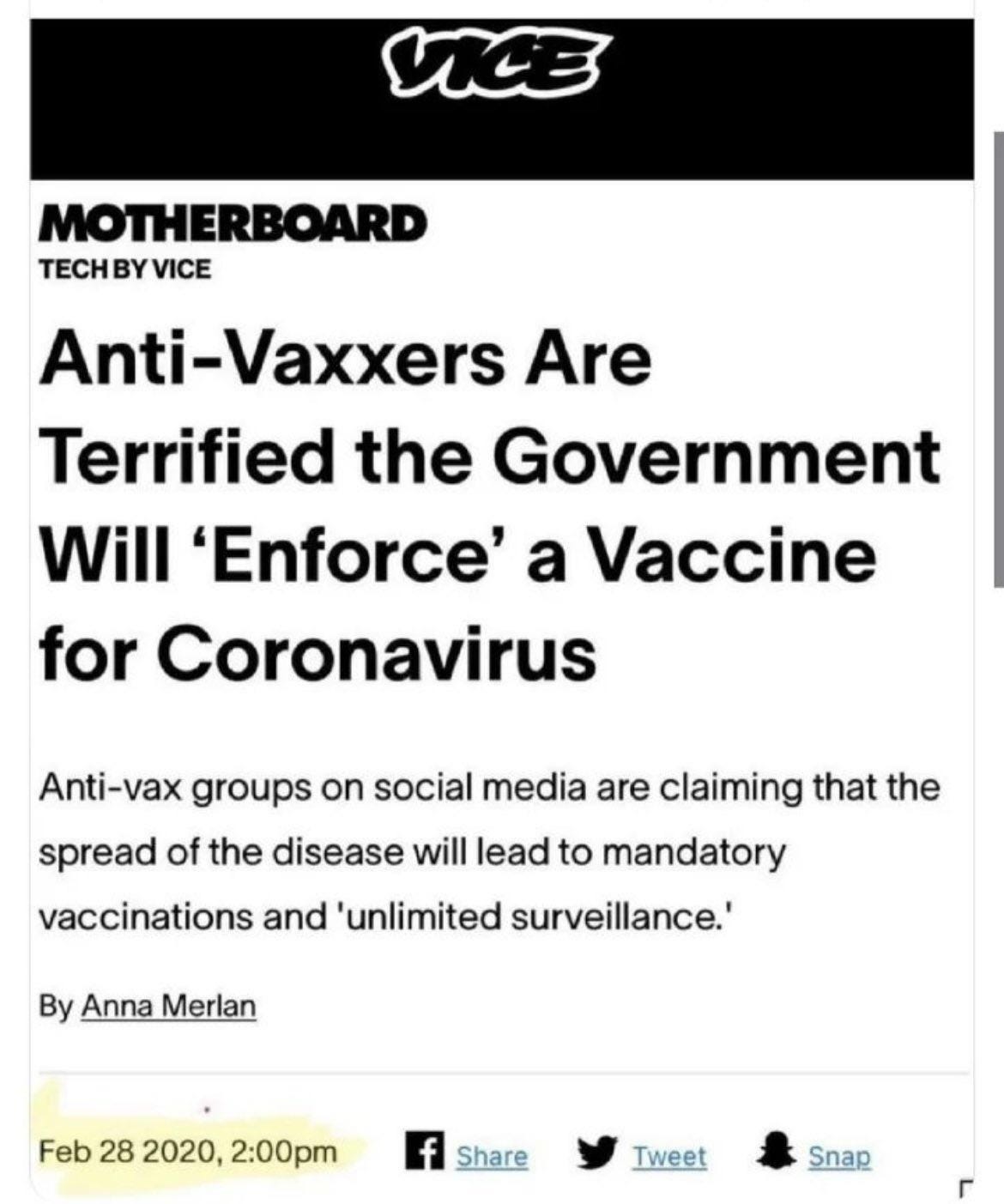
i mean, that would be terribly divisive, counter to rights, and directly antagonistic to people who just want bodily autonomy. can you even imagine public officials doing something like that?
pretty far fetched…

or health bodies using disease to engage in surveillance?

or governments seeking to do the same and mitigate privacy altogether?
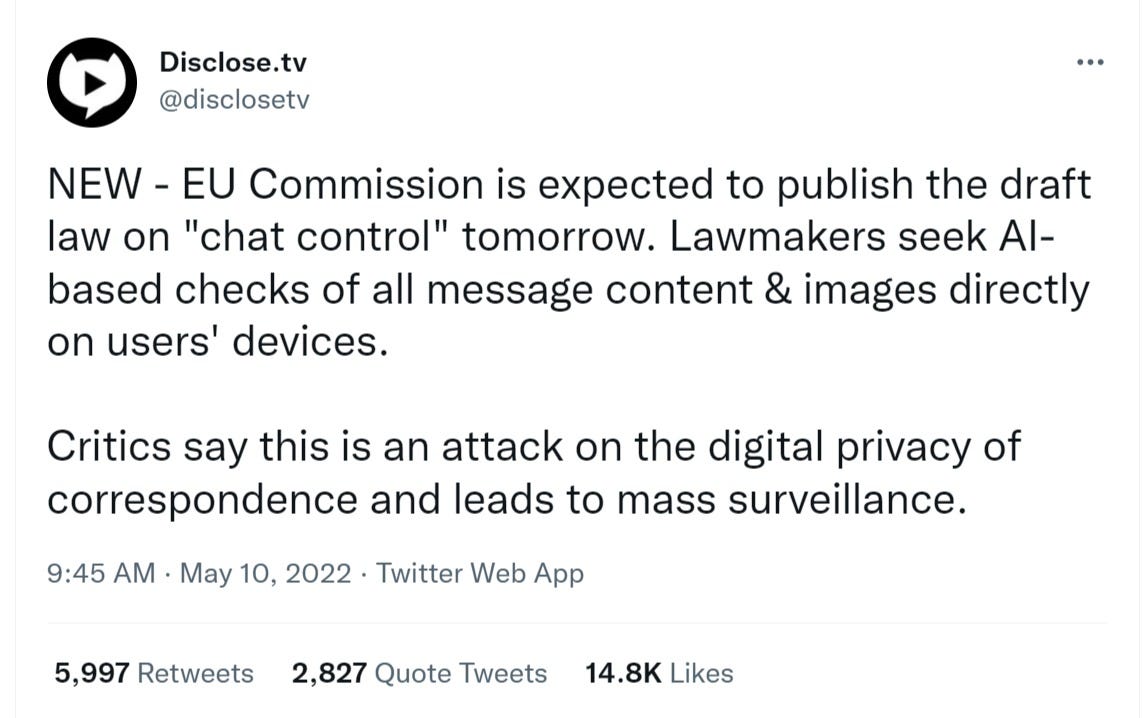
i mean, that’s just silly!
what next, some wild eyed claims that they want universal digital ID?

that they have been quietly rolling out the standards for

and making international and inescapable?

i mean, what will these prolific conspiracy boffins think up next, some sort of state run digital currencies to link to this new ID and surveillance state?
i mean, who would even suggest something like that?

federalreserve.gov/cbdc-faqs.htm
and anyhow, what’s the worst that could happen?
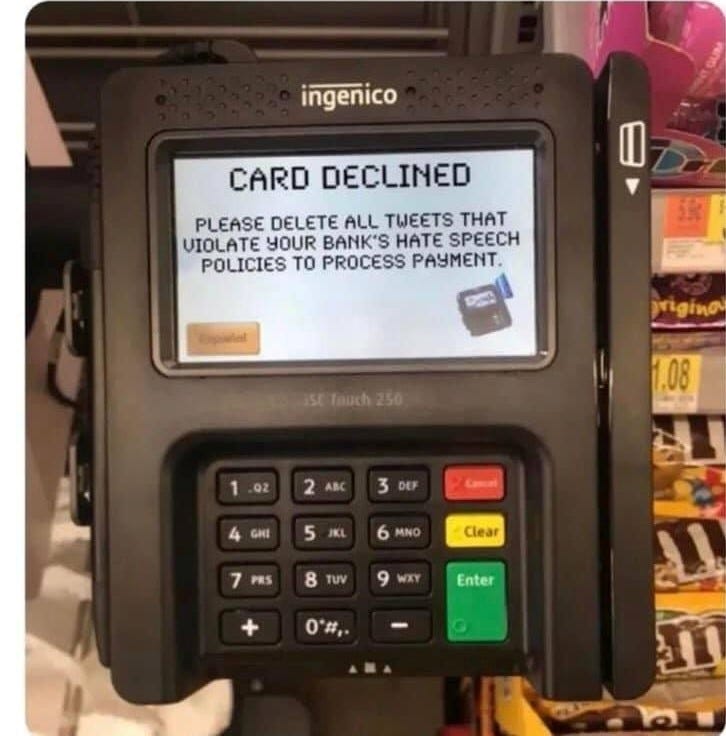
i mean, they told us this is all benign, right?
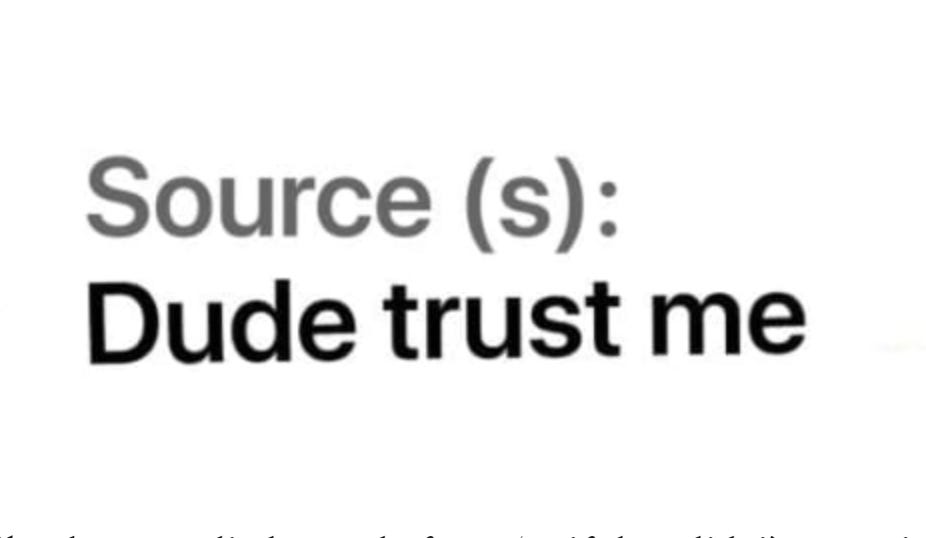
and it’s not like they ever lied to us before! (or if they did, i’m sure it was for our own good…)
and it’s not like they are seeking to give this power to deeply compromised and captured transnational agencies with no accountability whatsoever and grant them authority over citizens who had no say in the matter…

“The Biggest Global Power Grab We Have Seen in Our Lifetimes”: How Serious is the Threat From the WHO Pandemic Treaty?
so let’s all take a breath. i’m sure you’re just overwrought and imagining things.
there are no conspiracies.
no one is out to get you, least of all some shadowy davos cabal.
and come on, if they were really trying to do this to you, i’m sure they would not just come right out and tell you in some sort of james bond villain megalomaniacal monologue.
i mean, this is real life. no one actually does that…

and hey, i’m sure they’ll probably manage to keep those first 2 promises.
watch out for that third one though.
i have some real doubts about it it…
Data From Iceland and Australia Confirm: Vaccine Effectiveness Is Overstated
By Noah Carl | The Daily Sceptic | May 16, 2022
Back in March, I wrote a post noting that excess mortality data from Europe and Israel were hard to reconcile with claims of 95% vaccine effectiveness against death. However, I also noted that some countries data were consistent with very high vaccine effectiveness against death.
The two examples I gave were Australia and Iceland – both countries with very high vaccination rates. By the end of 2021, each country had double-vaccinated 77% of its population, compared to only 70% in the U.K. and only 63% in the U.S. (see below).
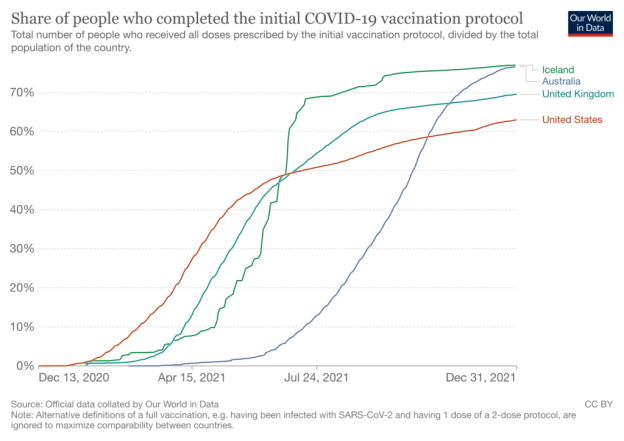
At the time I wrote the post, Iceland had only seen a minor uptick in excess mortality, while Australia had not seen any at all – despite both countries experiencing major outbreaks in the winter/spring of 2022. If countries like Germany, the Netherlands and Israel had seen deadly post-vaccination waves, why hadn’t Iceland and Australia? That was the puzzle.
It appears that ‘puzzle’ is now solved – we just needed to wait for more data. The latest figures from Iceland and Australia show sizeable upticks in excess mortality. First, let’s look at Iceland:
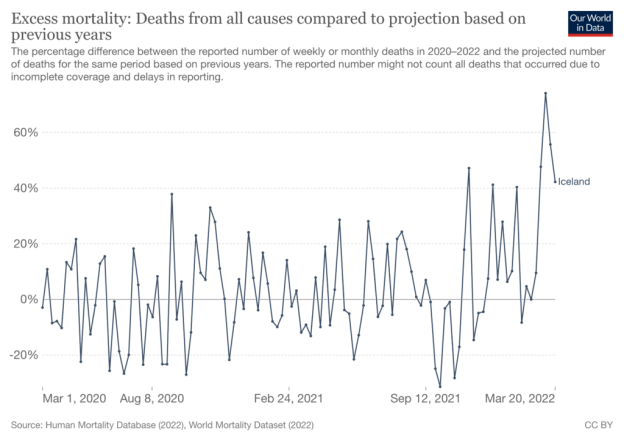
After bouncing around the zero mark for the first two years of the pandemic, excess mortality jumped to 74% in the first week of March. And it has now been above zero for eleven of the last thirteen weeks. Next, let’s consider Australia:
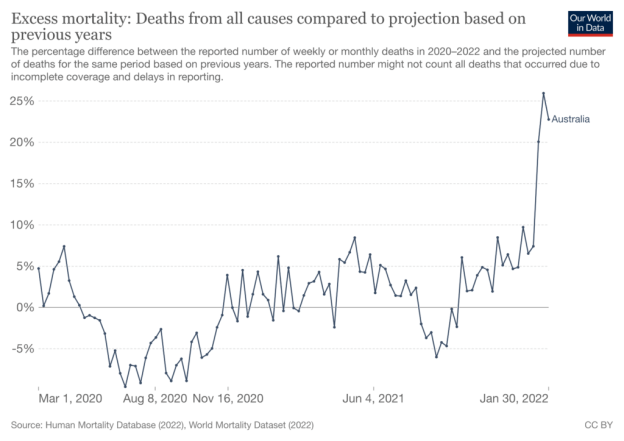
Over the first two years of the pandemic, excess morality averaged roughly zero – dipping lower in the summer and rising higher in the winter. Yet since the start of October, it has been consistently positive, jumping to 26% in the third week of January.
It should be noted: these upticks in excess mortality are not as large as those seen in European countries during 2020 and 2021.
However, they indicate that even very high vaccination rates are not sufficient to prevent mortality from rising when there’s a major outbreak. And they cast further doubt on claims that the vaccines are 95% effective against death. If they were 95% effective against death, excess mortality should hardly have risen at all in Iceland and Australia.
Given that 77% of the entire population was double vaccinated before the latest outbreaks began (and that’s the entire population, not just over 16s), you’d have to believe that excess mortality would have been many, manty times higher in the absence of vaccination to rescue the claim of 95% effectiveness against death.
What’s probably true instead is that the vaccines do reduce mortality from Covid – but not by 95%.
Investigation Launched After ‘Mystery’ Surge in Deaths of Newborn Babies
By Paul Joseph Watson | Summit News | May 16, 2022
Health authorities in Scotland have launched an investigation after a mystery surge in deaths of newborn babies, the second time the phenomenon has been recorded in the space of six months.
A report by the Herald newspaper highlights the “very unusual” spike in deaths of babies, with the alarm being raised after 18 infants died within four weeks of birth in March.
That same control limit was also breached in September last year, when 21 neonatal deaths were reported, the first time this had occurred since records began.
“The neonatal mortality rate was 5.1 per 1,000 live births in September and 4.6 per 1,000 in March, against an average of 1.49 per 1000 in 2019,” reports the newspaper.
Public Health Scotland (PHS) said the deaths could not have been down to chance, while the cause behind the previous spike in September also “remained a mystery.”
The report notes that vaccination uptake has increased in expectant mothers and that COVID infections during pregnancy are associated with a higher chance of premature birth, but found no “direct link” between COVID surges and the deaths.
PHS Scotland says COVID infections “did not appear to have played a role” in the September spate of deaths.
Edinburgh University’s Dr. Sarah Stock said, “The numbers are really troubling,” but admitted she didn’t know the cause of the deaths.
The Chinese Dimension of Russia’s Coal Business in a New Environment
By Petr Konovalov – New Eastern Outlook – 16.05.2022
Various projects to do away with coal and switch to other fuels that emit less combustion gases have long been discussed in developed countries. Some experts have even begun to predict the imminent demise of the entire global coal industry. One of the reasons for these forecasts has been statements by China, the world’s main coal consumer, that it also wants to reduce its use of coal as much as possible, along with Western countries.
However, despite all these claims, coal is still the cheapest and most transportable fuel, which no country with a developed industry can do without. The global coal trade continues to grow, generating good revenues for its main suppliers, including Russia.
In 2020, the Russian Federation produced about 401 million tons of coal, 199 million of which was exported to other countries.
In 2021, tensions between the PRC and Australia escalated, causing China to stop importing Australian coal and contributing to an increase in Chinese coal purchases from Russia.
By the end of 2021, Russian coal production was about 440 million tons per year, with 227 million tons exported. Thus, both Russian coal production and exports have shown significant growth. Of the above-mentioned coal exports, 129 million tons were sold to the Asia-Pacific region, which is particularly noteworthy because it is specifically this region that has major coal consumers such as China, South Korea and Japan, making the APR market particularly attractive for all coal exporters. China received 53 million tons of Russian coal, 20 million tons more than in 2020, earning Russia $7.4 billion.
In total, the Russian Federation accounted for more than 16% of the global coal market in 2021, 12% of the APR market and 15% of the Chinese market.
Since the Chinese coal situation came rather unexpectedly, the Russian Federation could not fully replace Australia on the Chinese market: most of Russia’s coal exports had already been allocated to other buyers and there was not enough time to multiply production. As a result, faced with an energy crisis, China started importing Australian coal again in late 2021, partly lifting the restrictions. However, the situation at the end of 2021 and beginning of 2022 still looked encouraging for the Russian coal sector. First, experience has shown that China cannot do without coal; Chinese decarbonization projects, which Beijing has been talking about for years, will not be implemented anytime soon – until then, the Celestial Empire will be importing coal. Second, having experienced power shortages without Australian coal, Beijing was able to see that its reliance on one supplier, Australia, was excessive. The tensions with Canberra in 2020-2021 are just one part of the larger political and economic confrontation between China and the West, and there could be many more conflicts ahead for the PRC and Australia. Therefore, to secure its energy sector, China needs to diversify its coal imports, including by further increasing supplies from Russia.
In February 2022, the media reported that Beijing and Moscow were negotiating an intergovernmental agreement under which coal supplies from Russia to China could be increased to 100 million tons per year.
However, at the end of February, a special operation by Russian troops in Ukraine began and the situation changed dramatically. The West has unleashed a torrent of sanctions on Russia, including Western countries starting to reduce imports of Russian hydrocarbons. In March 2022, for example, Russian coal shipments to the EU dropped by around 50%.
Although China is not an ally of the West, Russian coal exports to the Celestial Empire are also on the decline, as Chinese banks have reduced funding for related operations for fear of Western sanctions. The disconnection of a number of Russian banks from the SWIFT international payment system and the fact that most of the coal purchase contracts were in dollars also played a role: the Chinese side has had difficulty making payments.
Some pro-Western media have concluded that the Russian coal industry has suffered serious damage, that trade with China will not compensate for this damage, and that coal exports may not recover to their previous levels. However, such conclusions are rather premature.
Thus, despite the overall decline in the Russian coal exports to the PRC, exports of coking coal, a type of hard coal particularly valuable for the steel industry, increased in the first quarter of 2022. It can be assumed that the decline in Chinese purchases of other types of coal, which are used for winter heating, for example, may be due to the approaching summer period.
China now has a considerable supply of different types of coal, and in the run-up to the warm season, when there is no need for mass home heating, it can afford to reduce coal imports to explore new conditions. By autumn, however, it can be expected that Chinese-Russian coal cooperation will intensify.
As for sanctions-related difficulties, talks began as early as March between Russia and China on settlements in national currencies and on the use of CIPS, China’s equivalent of SWIFT.
It should further be noted that the Chinese side’s caution over the threat of Western sanctions is also a temporary phenomenon, as the PRC’s relations with the West are not good at all, and China may soon fall under its own sanctions regardless of its relations with Russia. Especially in view of certain features of Chinese foreign policy: on May 6, 2022, for example, some 15 Chinese planes entered the airspace of the partially recognized state of Taiwan, which the PRC considers part of its territory. The Taiwanese have scrambled their warplanes and put their air defense forces on alert. Fortunately, the incident ended peacefully. However, since Taiwan is under the protection of the US military, there is no doubt that the incident will further strain Chinese-US relations, and if it continues, the PRC will soon find itself in the same “sanctions boat” as Russia. In this case, Chinese coal imports from Australia are likely to suffer again.
It can therefore be assumed that China is seeking economic independence from the US and its allies, including from Australian coal supplies, and the Chinese leadership is already working out how to circumvent Western sanctions. One can fully expect that joint efforts in this area will soon allow Russia and China to move towards more intensive trade, including in coal and other energy sources.
What happens if US designates Russia ‘a state sponsor of terrorism’?
By Drago Bosnic | May 16, 2022
The designation “state sponsor of terrorism” is used by the US Department of State to unilaterally sanction countries which the US government claims to have “repeatedly provided support for acts of international terrorism”. The State Department is required to maintain the controversial list under special acts passed by the Congress, imposing various restrictions aimed at the economies and international trade relations of the targeted countries.
As of late 2021, State Department lists Cuba, Iran, North Korea and Syria as “state sponsors of terrorism”, however, there were other countries formerly on the list, such as Iraq, Libya, South Yemen and Sudan. Designating a country as “a state sponsor of terrorism” can affect it in many ways, some of which include:
– freezing of the targeted country’s financial and real estate assets in the US;
– requiring the US to prevent efforts of the targeted country to secure World Bank or IMF loans;
– prohibition on the export of so-called “dual-use products” (items that can be used both for civilian and military purposes);
– requiring the US to impose economic and other sanctions against countries that continue to do business with the targeted country.
Since Russia started its special military operation in Ukraine, the more hawkish members of the US and NATO establishment have been insisting on the inclusion of Russia on this list. Some, such as the Baltic states, infamous for their virtually endemic Russophobia, already designated Russia as the “state sponsor of terrorism”. Luckily, actions taken by such microstates are largely inconsequential. However, what would happen if some of the larger and more significant NATO and EU members were to take the same course of action?
Considering the controversial designation is aimed not just against the targeted country, but also any third party doing business with it, this would effectively force member states to sanction each other, since many EU and NATO members simply cannot function without trading and dealing with Russia. This includes countries like Hungary, Austria and even Germany, the EU’s largest economy and arguably the most powerful member state. Without Russia’s oil, gas, food, rare earth metals and nonmetals, heavy machinery and many other commodities, these countries would collapse, economically and otherwise.
The designation also directly affects relations within NATO. In case the Congress was to add Russia to the list, possible sanctions wouldn’t just affect the aforementioned EU member states, but also some of the largest and most powerful NATO members, such as Turkey. Ankara has already been sanctioned for the purchase of Russia’s top-of-the-line S-400 surface-to-air missile system. However, the sanctions in the context of trading and dealing with a country designated “a state sponsor of terrorism” would be much more severe. Thousands of private Turkish companies are present in Russia, many of them in the construction business, which directly affects the troubled Turkish economy, currently dealing with enormous inflation and unemployment.
In terms of global relations and trade, such a move would affect the world in ways which are difficult to predict in the long term. However, in short term, it would certainly affect countries such as China and India, dozens of countries in the Middle East, Africa, Latin America and elsewhere, as all these countries would be affected by the third-party sanctions. In doing so, the US would effectively sanction around 80% of the world. This would lead to an uncontrollable escalation of economic collapse in many of these countries, especially in the Middle East and Africa. It would force the US to either implement sanctions on a case-by-case basis, or change the law completely, effectively blunting the effects of sanctions. This would also exponentially accelerate the process of dedollarization, as countries would seek other ways to do business with Russia without US interference.
However, the far-reaching consequences for the global economy would pale in comparison to the resulting security issues. Officially deeming a country with over 6,000 nuclear weapons “a terrorist state” pushes the planet to a brink of a world-ending conflict, as such a designation eases legal restrictions on the use of the US military against the targeted country. Such moves have resulted in rising tensions with North Korea and Iran in previous years. Within the framework of the designation, the US targeted and killed Iranian general Qassem Soleimani in 2020, to which Iran retaliated by targeting US bases in Iraq.
Even at the height of the Cold War, the US did not sanction the USSR with this designation, which is what makes this move even less logical, since the strategic military situation is still virtually unchanged, with both Russia and the US still relying on the mutually assured destruction (MAD) doctrine. Also, Russia is not without options for a reciprocal response, as it could easily designate the US itself as a state sponsor of terrorism. This designation would hardly just be a (geo)political one, as the US has been providing ample support to a wide range of terrorist actors from at least the 1980s to this very day. Former US State Secretary and failed presidential candidate Hillary Clinton openly admitted that Al Qaeda was in essence the mujahideen the US funded and armed to fight the USSR in the 1980s.
The same happened in Croatia, Bosnia and Kosovo during the 1990s, where the US openly worked with Neo-Nazi and terrorist groups to help dismantle former Yugoslavia. During the Arab Spring color revolution which swept through the Middle East and North Africa, the US directly supported dozens of terrorist groups, resulting in the destruction of Syria, Libya and Iraq. US and NATO attempts to rebrand these groups as the so-called “moderate democratic opposition” failed miserably as the terrorists exposed themselves by allying with the Islamic State and even posting videos of gruesome crimes against civilians and POWs. In short, the US should take a long, hard look in the mirror before it even begins contemplating the idea to designate anyone “a state sponsor of terrorism”.
Drago Bosnic is an independent geopolitical and military analyst.
‘Finns & Swedes won’t benefit from NATO’
Samizdat | May 16, 2022
NATO membership won’t make Finland and Sweden more secure, but would likely see them fighting somebody else’s wars and hosting American bases, Dr. Jan Oberg, director of the Transnational Foundation for Peace and Future Research, has told RT.
“It’s a disastrous decision,” Oberg said on Sunday, following an official declaration by the Finnish government that it is planning to join the US-led military bloc. Hours later, a similar announcement was made by the ruling party in Sweden. The two Nordic nations stayed out of NATO during the Cold War, but their governments said Russia’s military operation in Ukraine has become a game-changer.
Finland and Sweden have failed to carry out “long-term consequence analysis,” he added. “Nobody seems to ask whether NATO is the right thing to join. After all these years since 1945, NATO has proven that it’s not able to deliver what taxpayers are paying for, namely stability, peace and security… and then Finland and Sweden say: ‘We’ll join this failed organization,’” he remarked.
“We have to ask ourselves: ‘Who caused the conflict [between Moscow and Kiev]?’ Everybody talks about the Russian invasion, which I deplore too, but underlying that is the conflict, which has to do with the NATO expansion,” the peace researcher said.
Making sure Ukraine becomes a neutral country that will never join NATO has been cited by Moscow as one of the main reasons for its ongoing military operation.
Oberg said he understood Russia’s concerns about the expansion of the bloc towards its borders. “If I was sitting in Moscow, I would feel that this was threatening,” he observed, referring to Finland and Sweden’s possible membership. “When you move troops up to the very border on both sides you increase tension; you decrease reaction time; you do all the things you shouldn’t do strategically if peace was your goal. Peace is not the goal of these people.”
The military-industrial complex – “those who sell weapons and profit from wars” – will gain from NATO adding two new members, he said. “The Swedish people and the Finnish people will not benefit from this. It’ll be completely new for them that they are now supposed to participate… in somebody else’s wars.”
With the US pushing for bases in Denmark and Norway, “are we to believe that there will not be American bases or American troops or something, you know, more permanent in Sweden and Finland?” he wondered.
NATO membership would also be “opening these countries for potential nuclearism that should never have been done in this particular area,” the peace researcher added.
Oberg said it was “appalling” that the governments in Helsinki and Stockholm didn’t put the issue to a referendum. “This is unheard of with such an important decision as joining NATO.”
While opinion polls have shown an overwhelming support for NATO membership in Finland, in Sweden the idea was backed by less than 50% of the public, he noted. “I’m amazed that there’s so little public discussion, so little uproar in terms of huge demonstrations in large cities in Sweden,” the scholar said.
He blamed the media, of which “80% to 90% is pro-NATO,” for this situation. “It’s very difficult to get into the media today with an alternative view… There’s no democracy and free media practice in this,” Oberg insisted.
Jan Oberg is a Danish-Swedish peace researcher, who received his doctorate from Lund University in Sweden. He taught courses in several countries, including Japan, Austria and Switzerland.
In 1986, the scholar co-founded the Transnational Foundation for Peace and Futures Research (TFF), an independent think tank aimed at promoting conflict-mitigation and achieving peace through peaceful means around the globe. He assisted on-the-ground work in ex-Yugoslavia, Georgia, Burundi, Iraq, Iran and Syria. In 2013, Oberg and TTF were nominated for the Nobel Peace Prize for their activities.
Featured Video
Rewriting the risk? Inside the government’s vaccine safety messaging
or go to
Aletho News Archives – Video-Images
Book Review
“Davos Can Really Replace the UN”
Inside the book that maps the architecture behind global governance — from the Epstein files to the Pact for the Future
Lies are Unbekoming | April 1, 2026
On June 13, 2019, the United Nations and the World Economic Forum signed a partnership deal to “accelerate the implementation of the 2030 Agenda for Sustainable Development.” That same evening, WEF president Börge Brende — Norway’s former Foreign Minister — had dinner with Jeffrey Epstein at Epstein’s Manhattan townhouse. The Epstein files, released January 2026, contain an exchange between the two from the previous year. Epstein to Brende: “Davos can really replace the UN. C21, cyber, crypto . genetics… intl coordination.” Brende back to Epstein: “Exactly — we need a new global architecture. World Economic Forum (Davos) is uniquely positioned — public private.”
The next day, the UN General Assembly adopted the framework for restructuring global governance.
That sequence — the partnership signing, the Epstein dinner, the candid admission about replacing the UN with a public-private architecture, and then the formal adoption — opens Jacob Nordangård’s The Digital World Brain. Pages two and three. Footnoted to the UN resolution number, the Epstein files, and the General Assembly record.
I keep coming back to it because it captures what this book does that almost nothing else in the independent research space manages. I’ve followed Jacob’s work for years now and interviewed him about his research. Each book peels back another layer of the same institutional architecture, and each time I think he’s reached the limit of what can be documented, the next one goes further. Nordangård doesn’t speculate. He doesn’t editorialize much. He lays institutional actions next to each other in chronological order and lets the pattern announce itself. … continue
Blog Roll
 Aletho News
- REWRITING THE RISK? INSIDE THE GOVERNMENT’S VACCINE SAFETY MESSAGING
- “Davos Can Really Replace the UN”
- NIAID/NIH and USDA Fund Bioengineered Chimeric Influenza Viruses Built Using Pandemic H1N1 Components: Journal ‘Science Advances’
- Hezbollah hits Israeli warship off Lebanon’s coast, sets it aflame
- Iran slams US strikes on B1 bridge, Mahshahr petrochemical plants as ‘blatant acts of state terrorism’
- In letter to UN chief, Araghchi warns of dire consequences of US-Israeli attacks on Iran’s nuclear facilities
- Why the CIA conspiracy to invade Iran with Kurdish militias failed
- Why Are Upbeat US Claims About Mission to Rescue Pilot ‘Highly Questionable’?
- Aircraft destroyed during US ‘rescue’ of downed F-15 pilot cost more than $100 million each
- Washington University removes professor who condemned US-Israeli war on Iran
- If Americans Knew
- In Iran, Israel-US take aim at “reason, research, and freedom of thought” – Daily Update
- US loses planes over Iran, Israel downgrades Lebanon war goals – Daily Update
- Israel Is Blocking Palestinians from Easter at Church Where Jesus Resurrected
- Plot to assassinate Palestinian activist follows harassment campaign promoted by Zionist groups and elected officials
- Prominent New York synagogue hosts presentation on why U.S. Jews should support the ethnic cleansing of Gaza
- Tapper vs. Piker: Is the CNN Anchor Auditioning for David Ellison?
- Shouldn’t Democrats Be Able to Condemn Genocide?
- Israel-US kill negotiators, destroy civilian structures, but Iran’s military capabilities still largely intact – Daily Update
- ‘War crime’: Global condemnation as Israeli ministers celebrate death penalty law targeting Palestinian prisoners
- 7 Ways Israel Is Turning Lebanon Into Gaza
- No Tricks Zone
- An Inconvenient Tree: Uncovered In Alps… Europe Much Warmer Than Today 6000 Years Ago
- New Study Reports A 60% Slowdown In Greenland’s Ice Loss Rate In The Last Decade
- Low Intensity Tornado Wrecks Major Solar Farm, Creating A Potential Toxic Dump
- New Study Finds Warming Saves Lives…Cold Temperatures 12 Times More Deadly Than Excess Heat
- German Science Blog Accuses PIK Climate Institute Of Hallucinating Climate Tipping Points
- Devastating Assessment Of Comirnaty Vaccine By Former Senior Pfizer Europe Toxicologist
- New Study: CO2 Is ‘Effectively Negligible’ As An Explanatory Climate Change Factor Since 2000
- Former Pfizer Toxicologist Dr. Helmut Sterz Tells Bundestag Hearing Pfizer Vaccine Should Have Never Been Approved
- Energy Expert: Germany’s Nuclear Phaseout Was A “500 Billion Euro Mistake”
- New Research: South Australia’s Mid-Holocene Sea Surface Temperatures Were 4°C Warmer Than Today
 Aletho News