Is Russia limiting gas flows to Europe?

Gas pipelines form Russia to Europe (Welt)
Swiss Policy Research | August 2022
Is Russia limiting gas flows to Europe? The surprising answer is: no.
Many people in Europe and the US seem to believe that Russia, in response to Western sanctions, has been limiting gas flows to Europe. Yet this is not the case.
There are currently five major pipelines that supply – or could supply – Russian gas to Europe: Nord Stream I and Nord Stream II through the Baltic Sea to Germany; the Jamal pipeline through Poland to Germany; the Soyuz and Brotherhood pipelines through Ukraine; and the TurkStream pipeline through the Black Sea and Turkey to Southeast and Central Europe (see the map above).
All of these pipelines are currently out of service or run at limited capacity, though not because of Russian retaliation, but because of Western sanctions or political decisions:
- The Jamal pipeline is closed because Poland has terminated the operational agreement with Russia (after the Russian invasion of Ukraine and to become independent of Russian gas).
- The Soyuz pipeline – which accounts for about one third of the gas delivered through Ukraine – has been closed by Ukraine after LPR forces took control of the gas compressor station.
- Nord Stream I runs at limited capacity because Canadian and EU sanctions have prevented the repair and return of a Siemens gas compressor turbine.
- Nord Stream II was completed in late 2021 but has never entered service due to US political pressure on Germany; Germany canceled certification of the pipeline on February 22.
- TurkStream – which in 2014 replaced the South Stream project – remains operational, but because of EU sanctions, Bulgaria has denied euro payment to the Russian Gazprom Bank. In contrast, Hungary has defied EU sanctions and continues to receive gas through TurkStream.
There is also a widespread misconception that Russia demanded “payment in rubles” to retaliate against Western sanctions. Yet this is not the case, either. Instead, after Western sanctions against the Russian central bank froze about $300 billion in Russian foreign exchange reserves, Russia decided that euro and dollar payments for gas have to be made to an account at Russian Gazprom Bank and will then be converted into rubles by the Russian central bank (to avoid seizure by the US/EU).
Why is Russia not (yet) actively limiting or stopping gas flows to Europe? Simply because Russia is interested in earning revenue from gas exports, being seen as a reliable supplier, and avoiding further escalation of the Ukraine conflict and direct confrontation with NATO countries. However, Russia did put pressure on Kazakhstan to prevent Kazakh oil exports via Turkey instead of Russia.
Why then is Europe jeopardizing its own gas supply through sanctions against Russia? The initial goal likely was to cripple Russian export revenues and the Russian economy. Yet this has largely failed as international oil and gas prices have risen to record highs. Thus, Russian oil and gas revenue has actually increased since the outbreak of the Ukraine war (though tech sanctions are still biting).
However, the Western response can only really be understood from a US perspective, not from a European perspective. From a US perspective, cutting off Russian gas flows to Europe is a means to isolating Russia, pressuring Europe into supporting the US proxy war in Ukraine, and forcing Europe to switch to American or Arab LNG gas supplies. The most obvious example of this strategy is the Nord Stream II pipeline, which the US blocked despite a German-Russian agreement.
More broadly, the US role in Ukraine is to be seen in the context of the US strategy in Eurasia. Back in June, former US Secretary of State and former CIA director, Mike Pompeo, explained in a speech at the Hudson Institute: “By aiding Ukraine, we undermined the creation of a Russian-Chinese axis bent on exerting military and economic hegemony in Europe, in Asia and in the Middle East. This would further devastate the lives of Americans and our economy here at home. () We must prevent the formation of a Pan-Eurasian colossus incorporating Russia, but led by China.”
In spite of reduced Russian gas flows, most European countries – including Germany – will still reach their gas storage target levels for the winter season, though at significantly higher market prices. This has already led to some bizarre situations, such as Germany’s largest fertilizer producer having to halt production, while fertilizer shortfalls are being replaced by imports from Russia, which have been exempted from sanctions.
Journalists who challenge NATO narratives are now ‘information terrorists’
By Vanessa Beeley | The Wall Will Fall | August 23, 2022
A US state department sponsored round table on ‘countering disinformation’ was recently held at the National Security and Defence Council of Ukraine.
According to the press release – “NGOs, mass media and international experts” took part in the round table discussions. Delegates discussed ‘disinformation methods’ used in Ukraine and abroad. On the agenda was legal and state prevention of ‘fakes and disinformation in the context of cyber security’.
Andrii Shapovalov, head of the Ukrainian Centre for Combatting Disinformation emphasized that those who ‘deliberately spread disinformation are information terrorists’. Shapovalov recommended changes to the legislation to crack down on these terrorists – reminiscent of the pre-WW2 Nazi Germany suppression of media and information channels. Shapovalov determined that ‘information terrorists should know that they will have to answer to the law as war criminals’.
It goes without saying that the crushing of dissent is essential for public support for NATO’s proxy war in Ukraine to be maintained. Russian media has already been wiped from the Western-controlled internet sphere. Ukrainian ‘kill lists’ such as the infamous Myrotvorets already include the courageous Canadian independent journalist Eva Bartlett and outspoken Pink Floyd co-founder Roger Waters.
Bartlett was also doxxed on Twitter by former UK Conservative Party MP Louise Mensch who alerted Ukrainian Special Forces to her presence in Donetsk. A few days later an attack was carried out on the hotel in Donetsk housing multiple journalists including Bartlett – coincidence?
German journalist Alina Lipp has been effectively sanctioned and threatened with prosecution by the German government for reporting on the daily atrocities committed by Ukrainian Nazi forces against civilians in Donetsk and Lughansk. Lipp told Stalkerzone :
“They just closed my bank account. Then they closed my father’s account. A month ago, I noticed that all the money disappeared from my account – 1,600 euros. I realised that something was happening in Germany. A few days ago, I received a notification from the prosecutor’s office, and a criminal case was opened against me for supporting the special operation. In Germany, special operations are considered a crime, and I am also a criminal. I face three years in prison or a huge fine.”
British journalist Graham Philips has illegally been sanctioned by the UK regime without any investigation or Philips being given a ‘right to reply’. Most mainstream media reports on this violation of his human rights describe Philips as ‘one of the most prominent pro-Kremlin online conspiracy theorists’. A familiar smear deployed by NATO-aligned media outlets to dehumanise and discredit challenging voices.
Philips like many other journalists being targeted lives in Donbass which has been threatened with brutal ethnic cleansing by the NATO proxy Ukrainian Nazi and ultra-nationalist forces since Washington’s Victoria Nuland- engineered coup in 2014.
These journalists transmit the voices of the Russian-speaking Ukrainians who have been subjected to horrendous war crimes, torture, detention and persecution for eight years and ignored by the West. For this they are now to be designated ‘information terrorists’ – because they expose terrorism sanctioned by NATO member states.
Organisations are springing up in the UK like Molfar Global whose ‘Book of Orcs’ project employs 200 alleged volunteers to identify ‘Russian (Orcs) war criminals’ and to compile a legal ‘kill list’. The ‘Orc’ terminology is another dehumanisation process, converting Russian citizens and military into fantasy science fiction monsters to soften western publics to the measures being taken to silence and punish them for… being Russian or speaking Russian. They state on their website homepage:
“Every Russian occupier must be identified and punished according to the law. War crimes and and crimes against Humanity have no statute of limitations. That is why we set ourselves the goal of finding everyone and preventing them from escaping justice”
Who determines who should be put on the list? Who determines their fate? What justice? In a country like Ukraine steeped in corruption – where executions or the disappearance of dissidents and political or media opposition is a regular occurrence – who is to be made accountable for action taken against those listed on the ‘Orc hit list’? This is lawless justice that falls under the umbrella of US “rules based global governance” – comply or die and newly furnished legislation will make your death or state-sanctioned assassination a legal one.
The organisers of the round table were the National Security Service Academy, the US State Department/Department of Defence-funded Civilian Research and Development Fund (CRDF Global Urkaine), the International Academy of Information, the US state department-linked National Cyber Security Cluster.
The tentacles of US and UK dominated intelligence agencies are spreading further and deeper into society trying to strangle kick back against their respective regime oppressive domestic policies and foreign policy perpetual war objectives. We are all under attack, we are all facing the same fate as Julian Assange if we do not break the cycle and start to fight back.
If you oppose imperialist wars, racism, Nazism, terrorism, violent extremism, global health tyranny, technocratic supremacy, predator class elitism and pharmaceutical-controlled Eugenics- you are a ‘terrorist’. We are all ‘terrorists’.
Macron says the end of abundance is here
By Thomas Lambert | The Counter Signal | August 24, 2022
President Emmanuel Macron has warned the French populace that the end of abundance is here, and they should get used to living with less.
“What we are currently living through is a kind of major tipping point or a great upheaval… we are living the end of what could have seemed an era of abundance… the end of the abundance of products of technologies that seemed always available … the end of the abundance of land and materials including water,” he said in an interview. [emphasis added]
“This overview that I’m giving, the end of abundance, the end of insouciance, the end of assumptions — it’s ultimately a tipping point that we are going through that can lead our citizens to feel a lot of anxiety,” he continued. “Faced with this, we have a duty, duties, the first of which is to speak frankly and clearly without doom-mongering.”
However, while it looks like Macron may be right when he proclaims the “end of abundance” for some people, this is not the case for everyone.
Macron’s statements come the same month that corporate profits hit record highs amidst a nationwide housing crisis.
As reported by the Daily Times, “France’s CAC 40 stock index, which includes the country’s largest companies, just reported its best quarter ever.”
“From a profit perspective, 73 billion euros represents a 26% increase over 2013. Record-breaking inflation, energy shortages, economic growth nearing recession, and the most difficult times for the average French household since the 2008 financial crisis have all contributed to this year’s record.”
Similarly, dividends paid out by large French companies in the second quarter reached a record 44.3 billion Euros (a 32.7% increase), which was significantly higher than the European average.
Clearly, not everyone is suffering from the same lack of “abundance.”
As for “doom-mongering,” which Macron said people should avoid, it’s not surprising that he sees this as an issue as it largely stems from statements made and actions taken in recent months.
In July, Macron told the public sector to cut down on its energy use and asked the private sector to do the same amidst an energy crisis that could’ve been avoided. This cut in energy use includes, amongst other things, turning off the streetlights at night and passing a new law regulating air conditioning.
Meanwhile, supermarkets have already begun cutting down on their energy use thanks to soaring prices, going so far as signing an agreement to reduce heating in their stores this winter.
Anyone can see why the average person would be concerned about the state of France and where things are going. And unfortunately for the French people, it doesn’t appear the government, nor the financial elite who have made record profits amidst the decline, are doing anything tangible to remedy the situation. Instead, the President is quite literally telling people that they should get used to never having the same quality of life that they used to enjoy.
US Carries Out Airstrikes Targeting “Iranian-Backed” Groups in Syria
By Kyle Anzalone | The Libertarian Institute | August 23, 2022
US Central Command (CENTCOM) announced it carried out airstrikes in Syria on Tuesday. The Department of Defense claims the bombs hit facilities used by groups affiliated with Iran’s Islamic Revolutionary Guard Corps (IRGC) and were in retaliation for an attack on US personnel in Syria.
The CENTCOM press release asserts that Iranian-supported groups attacked US forces in Syria on August 15, and Tuesday’s bombing was necessary to protect American troops. “Today’s strikes were necessary to protect and defend US personnel. The United States took proportionate, deliberate action intended to limit the risk of escalation and minimize the risk of casualties,” the Pentagon said.
A Pentagon statement on August 15 said a US base in al-Tanf, Syria, was attacked by a series of drones causing no damage or injuries. There was no claim of responsibility for the attack. The White House has not provided evidence that an Iranian-backed group carried out the attack.
The US occupies about a third of Syrian territory with 900 troops. Washington claims its forces remain in Syria to ensure the enduring defeat of the Islamic State. However, Iranian-backed groups support the government of Bashar al-Assad, an avowed enemy of ISIS. In recent months, ISIS has carried out several attacks against Assad’s forces, killing scores of soldiers.
President Joe Biden asserted he had Constitutional authority to carry out the strikes. “The President gave the direction for these strikes pursuant to his Article II authority to protect and defend US personnel by disrupting or deterring attacks by Iran-backed groups,” the press release said.
While Article II may give Biden the power to defend US troops, Congress has never passed a declaration of war or authorization of military force for Syria. Without Congressional authorization, three successive American presidents bombed Syria.
The strikes also come as Washington and Tehran have made significant progress towards reviving the Iran nuclear agreement. The US and Iran have been engaged in indirect talks for over a year. Reuters reported Monday that Tehran had dropped two key demands, paving the way for a deal that would see the US and Iran return to compliance with the nuclear deal.
Biden celebrates Ukraine’s independence day with biggest arms package yet
Samizdat | August 24, 2022
US President Joe Biden announced on Wednesday that the US will send an additional $2.98 billion worth of weapons to Ukraine. In an announcement coinciding with Ukraine’s Independence Day, Biden said that the US envisions Kiev fighting for some time to come.
According to a White House statement, Ukraine will receive “air defense systems, artillery systems and munitions, counter-unmanned aerial systems, and radars to ensure it can continue to defend itself over the long term.”
On Tuesday, US officials told the Associated Press, Reuters and CBS that the package would include at least three different drone systems, such as the hand-launched Puma drone, the longer-range ScanEagle surveillance vehicle, as well as the UK-made Vampire drone, which has not previously been provided to Kiev.
Referencing Ukraine’s independence day, which celebrates its split from the Soviet Union in 1991, Biden said that “today is not only a celebration of the past, but a resounding affirmation that Ukraine proudly remains – and will remain – a sovereign and independent nation.” Given his vow to support the Ukrainian military “over the long term,” and NATO Secretary General Jens Stoltenberg’s declaration on Tuesday that the alliance would back Kiev “for as long as it takes,” Biden evidently plans for the conflict to be a long one.
However, several US media outlets reported on Tuesday that the contents of Wednesday’s arms package may not reach the battlefield for months or even years. Unnamed US officials told the Associated Press that Washington expects Ukrainian forces “to fight for years to come.”
Bankrolling the Ukrainian military has been a costly endeavor for the US. With the American economy wracked by inflation and rising energy costs, the Biden administration has thus far committed more than $54 billion in military and economic aid to Kiev since February.
Meanwhile in Ukraine, Russia continues to advance on Ukrainian positions in the south of the country and on the borders of the Donbass republics of Donetsk and Lugansk, where Kiev has spent the last eight years building a network of bunkers and fortifications. While Ukraine does not publish casualty figures, President Vladimir Zelensky said earlier this summer that 60 to 100 Ukrainian soldiers were being killed in Donbass on a daily basis, with another 500 injured.
Ukraine shells shopping mall in Donetsk – DPR officials
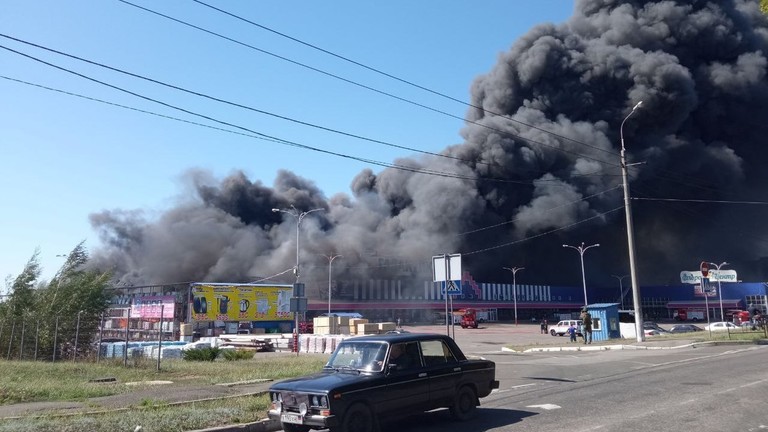
Galaktika shopping mall in Donetsk, August 24, 2022. © RT
Samizdat | August 24, 2022
Ukrainian troops have shelled the Galaktika shopping mall in Donetsk, causing a major fire in the building, Donetsk People’s Republic (DPR) emergency officials said on Wednesday.
The staff have been evacuated, and there are no casualties, officials said.
Photos posted on social media allegedly show huge clouds of thick smoke coming from the building.
On Tuesday, Ukrainian forces used NATO-standard artillery shells to bombard residential blocks in Donetsk, killing three civilians, officials said. The office of DPR chief Denis Pushilin took a direct hit, while a hotel where journalists usually stay was also damaged.
Pushilin, who was unharmed, accused Kiev of using “terrorist methods” of warfare.
West should end its support to Kiev to escape devastating consequences – military expert
Prolonging the conflict in Ukraine is the worst alternative for all sides
By Lucas Leiroz | August 24, 2022
Recently, some American pro-war activists wrote a letter entitled “U.S. must arm Ukraine now, before it’s too late”, in which they advocate an increase in aid to Kiev so that the situation of the conflict is reversed. The authors believe that the conflict is at a turning point and that aid must be provided now in order for Russia to be defeated. However, military experts disagree with this argument and say that there is no reason to try to prolong the fighting.
Despite all the difficulties the Western world has faced as a result of the conflict in Ukraine, many people still insist that aid to Kiev must continue – and increase – until Moscow is defeated. The main rhetoric of the pro-war militants is that Russia would not just win the conflict in Ukraine but would expand its operation to other countries in Europe, which is why it needs to be defeated now – which they consider possible by sending arms to Kiev.
“For the U.S. and NATO, that time is now — and the place is Ukraine, a large country whose population understands that its choice is either defeating Putin or losing their independence and even their existence as a distinct, Western-oriented nation. With the necessary weapons and economic aid, Ukraine can defeat Russia. If it succeeds, our soldiers are less likely to have to risk their lives protecting U.S. treaty allies whom Russia also threatens. What does defeat for Putin look like? The survival of Ukraine as a secure, independent, and economically viable country”, the authors of the open letter asking more weapons to Ukraine say.
In fact, this rhetoric is absolutely unfounded in all its points. First, there is no reason to believe in an expansion of the Russian special military operation to NATO countries. Moscow just started military incursions into Ukraine because Kiev left no other alternative with its continuous policy of killing Russian citizens, but there is currently no equivalent situation in other countries. However, more important than that is to note the lack of realism on the part of the pro-Western militants in believing in the possibility of “defeating” Russia, despite the current stage of the conflict.
Russia did not mobilize all of its military power to attack Ukraine, but the small portion of the Russian forces sent to the operation was efficient in annihilating Ukrainian main bases of resistance. At the current stage of the conflict, there is no possibility of reversing the military situation. Kiev is defeated and only postpones the inevitable decision to surrender because it continues to receive Western weapons, guaranteeing a kind of “survival”, prolonging the battles indefinitely, even without a chance of victory.
This is the assessment of any expert who analyzes the case honestly and without ideological emotions. For example, Douglas Macgregor, war veteran and former advisor to the Secretary of Defense in the Trump administration, believes that the sending of weapons will not bring any positive change to Kiev due to the human capital deficit, both quantitative (with the low number of active Ukrainian soldiers), and qualitative (considering the tactical and operational inability of these fighters to reverse the conflict and even their lack of instruction in using the weapons they receive from the West).
With that, the weapons would only serve to prolong, not to effectively change the current military situation. He also claims that even if Kiev were to achieve major victories, the absence of human capital would not allow it to rebuild its troops after the long battles, while Russia, whose current combat mobilization represents only a small fraction of its military potential, would have the ability to recover quickly and thus regain the positions eventually lost.
“The hard truth is the introduction of new weapon systems won’t change the strategic outcome in Ukraine. Even if NATO’s European members, together with Washington, D.C., provided Ukrainian troops with a new avalanche of weapons, and it arrived at the front instead of disappearing into the black hole of Ukrainian corruption, the training and tactical leadership required to conduct complex offensive operations does not exist inside Ukraine’s 700,000-man army. In addition, there is an acute failure to recognize that Moscow would react to such a development by escalating the conflict. Unlike Ukraine, Russia is not currently mobilized for a larger war, but it could do so quickly”, he says.
Macgregor claims that the letter written by the pro-war militants “reinforces the failure” of Ukraine. For him, the conflict is at a decisive moment, in which it must be ended, not prolonged. He still believes that the reasons that led to this conflict – NATO’s incursions on the Russian border – were disastrous and unnecessary and that Western countries should give up further provocations against Moscow. The best solution, he says, is to support the Austrian model of neutrality as a solution for Ukraine before the country is completely destroyed.
“Ukraine’s war with Russia is at a decisive point. It is time to end it. Instead, the authors of the letter seek to reinforce failure. They are demanding a deeply flawed strategy for Ukraine that will lead in the best case to Ukraine’s reduction to a shrunken, land-locked state between the Dnieper River and the Polish border (…) Expanding NATO to Russia’s borders was never necessary and has become disastrous for Europe. The longer the war with Russia lasts the more likely it becomes that the damage to Ukrainian society and its army will be irreparable. Neutrality on the Austrian model for Ukraine is still possible”, he adds.
In fact, this opposition of opinions reflects the old debate between realists and warmongers. Anyone who really understands war and military strategy knows that there is no other solution than the neutralization of Ukraine and the end of Western expansionism. Those who think through liberal idealism, however, advocate fighting “to the last Ukrainian”.
Prolonging the conflict is not good for either side: it increases the destruction in Ukraine, perpetuates the suffering of the people, raises the expenses of western countries and forces Russia to mobilize a greater part of its military forces.
Lucas Leiroz is a researcher in Social Sciences at the Rural Federal University of Rio de Janeiro; geopolitical consultant.
US ramping up drone strikes in Middle East and Africa
Experts believe indiscriminate use of drones is the key contributor to overall instability across the troubled regions in which they’re deployed
By Drago Bosnic | August 23, 2022
Drone strikes have been an integral part of US aggression against the world for over two decades now. These strikes have been the mainstay of joint military-intelligence black ops, especially in the Middle East and Africa. From the mountains of Afghanistan to the deserts of Libya, US strikes drones have been sowing death and destruction, ever so euphemistically called “spreading freedom and democracy.”
These drones, first used only for ISR (intelligence, surveillance, reconnaissance) missions, were modified for rudimentary strike roles and were first tested in former Yugoslavia, laying the groundwork for their later usage in various US invasions. The strikes were massively expanded under Barack Obama, with thousands being approved by his administration. After Donald Trump came to power, he officially reduced the number of drone strikes, although they now became more specific, with US intelligence services getting even more involved. However, since Joe Biden took office, it seems the trend has now been reversed and US drones are coming back in full force.
On August 19 conflict monitors drew attention to a series of US strikes in Somalia, which have escalated significantly in the last couple of months. These attacks have gained little to no attention in the US corporate mass media despite resulting in the deaths of more than 20 people.
“If you were unaware that we were bombing Somalia, don’t feel bad, this is a completely under-the-radar news story, one that was curiously absent from the headlines in all of the major newspapers this morning,” wrote Kelley Beaucar Vlahos, a senior adviser at the Quincy Institute for Responsible Statecraft.
Last Wednesday, Dave DeCamp, writing for AntiWar reported that the US AFRICOM (Africa Command) launched its second strike on Somalia in less than a week. AFRICOM claims the attack, which occurred in Beledweyne, “had killed 13 fighters belonging to the al-Qaeda-linked Somali militant group al-Shabaab, and that no civilians were harmed.” AFRICOM claims drone strikes also killed four al-Shabaab members in three separate operations near Beledweyne on August 9, two fighters near Labi Kus on July 17, and five militants in a June 3 bombing outside Beer Xani.
All of the aforementioned strikes have taken place since President Biden approved the redeployment of hundreds of special forces to Somalia in May, reversing an earlier withdrawal decision under the administration of former President Donald Trump. DeCamp noted that Trump’s withdrawal from Somalia merely “repositioned troops in neighboring Djibouti and Kenya, allowing the drone war to continue. But Biden has launched significantly fewer strikes in Somalia compared to his predecessor.”
According to the London-based Airwars monitoring group, US forces have targeted Somalia at least 16 times since Joe Biden took office, killing between 465 and 545 supposed militants. On March 13, a single US drone strike reportedly killed up to 200 alleged militants. Airwars claims there were civilian casualties in just one of the drone attacks under the Biden administration, conducted in June 2021. The attack on the southern town of Ceel Cadde killed a woman named Sahro Adan Warsame and seriously injured five of her children, according to local media reports. US forces have carried out at least 260 strikes in Somalia since 2007. The Pentagon has so far admitted killing five civilians and wounding 11 others, but Airwars claims 78-153 civilians, including 20-23 children, have died in US attacks.
“Bottom line, it’s been a long time since the United States was not bombing Somalia,” wrote Vlahos. “This comes after a particularly bloody period during the [so-called War on Terror] in which the CIA was using the country to detain and torture terror suspects from across North Africa. Whether this has ultimately been a good thing for the country or for the broader security of the region, one need only to look at the continued instability and impoverishment of the people,” she added, “and of course, the persistent presence of al-Shabaab itself.”
In addition to Somalia, recent reports indicate that US drones have been reactivated over Libya as well. The US shows no intention of stopping these strikes, with most now being relegated to intelligence services, such as the infamous CIA, with minimal civilian oversight. Many experts believe the indiscriminate use of these drones is a major, if not the key contributor to the overall instability across the troubled regions in which they’re deployed, as the terrorist activity which they’re allegedly there to stop is only exacerbated as a result.
Drago Bosnic is an independent geopolitical and military analyst.
Leaked slides detail YouTube’s Ukraine censorship
Samizdat | August 23, 2022
A tutorial for YouTube’s content moderators that emerged on social media on Tuesday shows that the Google-owned platform has labeled a number of critical positions on the conflict in Ukraine “hateful” or “extreme” and can censor or demonetize creators on those grounds. While the parent company Alphabet has not confirmed or denied the screenshots’ authenticity, a Polish contractor who shared them has reportedly been fired.
Six screenshots shared by Russian journalist Andrey Guselnikov on Telegram show internal codes and examples of what YouTube has labeled “harmful” or “hateful” content in an online course mandated for content moderators.
According to the slides, the “glorification/promotion of [the] ‘Z’ symbol associated with the Russian military” is labeled “hate” and “extreme” under policy ID 864. So is saying that the conflict “is to denazify the Ukrainian government,” which is what Russian President Vladimir Putin said in February.
Saying that “Ukraine military is attacking its own people” is also considered problematic, ranging from “harmful-misinformation-moderate” (ID 862) to “harmful-misinformation-extreme” (ID 863) if the powers that be decide it amounts to “promotion or glorification.”
There was no clarification whether either standard would apply to factual reports of Ukrainian artillery targeting Ukrainian citizens living in territories under Russian control, for example.
Another highlighted phrase under policies 862 and 863 is “US funded bioweapons labs in Ukraine.” Presumably the key word here is “bioweapons,” since the existence of “biological research facilities” in Ukraine was recognized by US Under Secretary of State Victoria Nuland in a Senate testimony in March, and the Russian military has repeatedly presented evidence that these labs were funded by the US government, and the Pentagon in particular.
One of the slides shows a list of “out of scope” claims, noting there is no “full-scale block on all content” related to the conflict.
According to Guselnikov, the source of the leaked slides is a Polish national named Kamil Kozera, who used to work for Majorel, a contractor hired by YouTube for content moderation. YouTube somehow identified Kozera from the screenshots and had him fired over the leak. RT cannot independently verify the authenticity of the screenshots, and has reached out to YouTube for comment.
The video hosting platform, owned alongside Google by the Silicon Valley behemoth Alphabet, took the unprecedented step in censorship by globally blocking RT, Sputnik and all channels “associated with Russian state-funded media” in early March, expanding on the original ban ordered by the EU authorities in their jurisdiction. It also “paused” all advertising and “all of the ways to monetize” on the platform – such as sponsorships and superchats – in Russia.
Speaking at the World Economic Forum in Davos in May, YouTube CEO Susan Wojcicki said that the company continues to operate in Russia so it can “deliver independent news” to Russians, noting that “What we’re really seeing in this conflict is that information does play a key role, that information can be weaponized.”
NATO Abandons Diplomacy, Says No Longer ‘At Peace’
By Bas Spliet | The Libertarian Institute | August 23, 2022
At the end of its annual summit in Madrid in late June, NATO adopted a new strategic concept. The guidance document is the eighth of its kind since the founding of the alliance in 1949. It radically breaks with the three previous post-Cold War security briefs, however, which observed that “the Euro-Atlantic area is at peace” because “the threat of a conventional attack against NATO territory is low.” In the eyes of NATO, Russia’s invasion of Ukraine has changed that calculus, claiming that the military organization can no longer discount the possibility of an assault on sovereign NATO states. Continuing the same cryptic language, the new strategic concept concludes that the Euro-Atlantic area now is “not at peace,” in spite of no NATO member being in a state of war with Russia.
Behind this word play, a more dangerous policy change has been codified in the document. Since the adoption of the Harmel Report in 1967, NATO has always officially included diplomacy in one form or another (with political dialogue and strategic partnership being interchangeable labels) as one of its “core” or “fundamental” tasks. The “NATO 2030” report from November 2020, for instance, unequivocally stated that “NATO should continue the dual-track approach of deterrence and dialogue with Russia.”
In the new strategic concept, the core tasks have been purged of the need for diplomacy, except for one or two throw-away lines about “meaningful and reciprocal political dialogue” about arms control issues buried in the middle of the text. Rather, in addition to its original function of deterrence and defense, NATO now fully embraces “crisis prevention and management,” which it has spearheaded since the 1990s with its legally dubious and morally questionable interventions in the Balkans, Afghanistan, and Libya; and “cooperative security,” referring to NATO’s enlargement in Eastern Europe and its Partnership for Peace cooperation with countries in ever further-away regions, including the Black Sea, the Middle East, North Africa, and even the Indo-Pacific, which the British have been pushing to include in a “global NATO.”
Russia was the first country to sign up for the Partnership for Peace program back in 1994. The new NATO doctrine, however, states that Russia can no longer be considered a partner “in light of its hostile policies and actions.” The strategic concept ignores the fact that NATO’s enlargement and new core tasks, which the alliance adopted after the Cold War in an effort to justify its continued existence, have likewise long been seen as hostile in Moscow, nor does it offer any reflection on how the new policies might have contributed to the current unpeaceful “strategic environment.” Instead, it hails the “historic success” of NATO’s expansion in terms of space and substance and insists that the alliance “does not seek confrontation and poses no threat to the Russian federation.”
The logic behind this reasoning is that NATO’s enlargement, or its Partnership for Peace program for that matter, is an outflow of the West’s innocent and well-meant efforts to spread its values of liberal democracy around the world. New member states joined the alliance in a voluntary capacity, after all. In a sense, this logic holds true. It is difficult to see how extending a war guarantee to East European and Balkan nations contribute to the security of Western Europe, let alone the United States. And from Clinton to Bush and Obama, NATO’s Open Door policy has been couched in a Wilsonian rhetoric of the United States as a benign hegemon. Joe Biden, too, steered last year’s NATO conference in Brussels in the direction of proclaiming a global fight between democracy and authoritarianism.
What proponents of this Wilsonian liberalism fail to realize, however, is that their benevolent actions might antagonize other nations. Now, NATO apologists, like Ukrainian President Volodymyr Zelensky, argue that if the alliance had not expanded eastward, Vladimir Putin would have been even bolder in his imperial ambitions. But as John Mearsheimer pointed out back in 2014, there is virtually no evidence that Putin aimed to incorporate Crimea before the Maidan coup. Rather, his offensive foreign policy in Ukraine since 2014, culminating in the 2022 invasion, is one of reaction to NATO creeping up to Russia’s borders. Bringing Ukraine into the NATO fold has long been a big fat redline for Russia, and we crossed it.
First of all, West-European officials promised the Soviets after the fall of the Berlin Wall that NATO’s borders would not move “one inch” eastward. But then all former Warsaw Pact countries and even some former Soviet Republics were incorporated in the 1990s and early 2000s. In addition to the evidence the National Security Archive assembled on this issue a few years ago, recent archival research has once again confirmed these broken promises.
Next, in 2008, Russian Foreign Minister Sergei Lavrov warned American diplomats that further NATO enlargement, particularly to Ukraine, would constitute a “potential military threat.” William J. Burns, who is now the CIA chief but at the time served as the U.S. ambassador to Russia, translated Lavrov’s message succinctly in a diplomatic cable: “Nyet means nyet: Russia’s NATO enlargement redlines.” He further gave voice to the opinion of State Department experts, who warned that “the strong division in Ukraine over NATO membership, with much of the ethnic-Russian community against membership, could lead to a major split, involving violence or at worst, civil war.” The Bush administration ignored these warnings and pushed for the inclusion of Georgia and Ukraine at a summit in Bucharest, where the alliance codified that “these countries will become members of NATO.” Ultimately, war followed in both countries, in Georgia in 2008, and in Ukraine in 2014. In the process, Russia annexed Crimea and supported a separatist war in the Donbass, which dragged on in protracted fashion until the 2022 invasion.
After 2014, Ukraine started to become a de facto member of NATO, which bolstered the Ukrainian regime to take a tough stance against Russia. In 2017, Trump decided to sell “defensive weapons” to Kyiv. Other NATO countries got in on the act, shipping weapons to Ukraine, training its military and teaming up with it in joint air and naval exercises. In June 2021, a British destroyer sailed through the Black Sea in an effort to shore up support for Ukraine, precipitating a diplomatic stand-off with Russia. NATO was undeterred, however, because a total of 32 countries participated in a major naval exercise in the Black Sea one month later.
In response, Russia decided to engage in coercive diplomacy, much like the Obama administration had done to get Iran to sign on to the 2015 nuclear deal. Putin amassed troops on the Ukrainian border, demanding guarantees that no offensive missiles would be installed in Eastern Europe and Ukraine not to join NATO. When the crisis was not solved diplomatically, Russia invaded Ukraine. Up until recently, there was hardly any diplomatic intercourse between Washington and Moscow in order to resolve the conflict. The UK’s Boris Johnson, too, “urged against negotiations” during a trip to Kyiv in April. Other NATO members, such as France, Germany, Italy and Hungary, have warmed to negotiations. But as long as there is no bigger push to re-establish diplomacy as a core task of the military alliance, Wilsonian rhetoric is likely to continue to make the world unsafe.
Bas Spliet is a historian and PhD candidate at the University of Antwerp in Belgium. He writes about a variety of topics from a historical angle. Find all his work on (Re)writing history, his Substack website. You can e-mail him at Bas.Spliet@UAntwerpen.be.
Featured Video

Meet The Ellisons: Zionists, Technocrats, Moguls
or go to
Aletho News Archives – Video-Images
Frlom the Archives
With apparently fabricated nuclear documents, Netanyahu pushed the US towards war with Iran
By Gareth Porter | The Grayzone | April 29, 2020
President Donald Trump scrapped the nuclear deal with Iran and continued to risk war with Iran based on Israeli Prime Minister Benjamin Netanyahu’s claim to have proven definitively that Iran was determined to manufacture nuclear weapons. Netanyahu not only spun Trump but much of the corporate media as well, duping them with the public unveiling of what he claimed was the entire secret Iranian “nuclear archive.”
In early April 2018, Netanyahu briefed Trump privately on the supposed Iranian nuclear archive and secured his promise to leave the Joint Comprehensive Plan of Action (JCPOA). That April 30, Netanyahu took the briefing to the public in a characteristically dramatic live performance in which he claimed Israel’s Mossad intelligence services had stolen Iran’s entire nuclear archive from Tehran. “You may well know that Iran’s leaders repeatedly deny ever pursuing nuclear weapons…” Netanyahu declared. “Well, tonight, I’m here to tell you one thing: Iran lied. Big time.”
However, an investigation of the supposed Iranian nuclear documents by The Grayzone reveals them to be the product of an Israeli disinformation operation that helped trigger the most serious threat of war since the conflict with Iran began nearly four decades ago. This investigation found multiple indications that the story of Mossad’s heist of 50,000 pages of secret nuclear files from Tehran was very likely an elaborate fiction and that the documents were fabricated by the Mossad itself. … continue
Blog Roll
 Aletho News
- Meet The Ellisons: Zionists, Technocrats, Moguls
- US failures in Iran reveal Russia is key to South Korea’s strategic security
- ‘All ports in Persian Gulf will be legitimate targets if Iranian ports are attacked’
- 40 Years of Endless War, Data Point by Data Point
- Department of War Using Palantir AI to Pick Targets in Iran
- American bases do not protect – they attack the peoples of the Persian Gulf
- ‘We’ve Obliterated Their Missiles’
- Syrian president vows ‘absolute support’ to disarm Hezbollah
- Ukraine attacking Russian gas pipeline to stop deliveries to Europe – Defense Ministry
- ‘Heinous crime’: Iran denounces Israeli assassination of 4 Iranian diplomats in Lebanon
- If Americans Knew
- Israeli strategic plans to “remake the Middle East” from the 1950s and since
- Honoring Gaza’s women who refused to let the world look away
- 97% of victims of war on Iran are Iranian, 98% of victims in war on Gaza are Gazans – Not a ceasefire Day 152
- Early Iran strikes cost $5.6 billion in munitions, Pentagon estimates
- Israel Decided the War, But Trump’s America Fights and Pays the Bill
- Conscientious Objector Group: Phone ‘Ringing Off Hook’ As Huge Mobilization Underway
- U.S. support for Israel continues to plummet, despite media’s best efforts
- Threats and missiles fly, death tolls soar in Iran, Lebanon, Gaza – Not a ceasefire Day 151
- Lebanon: Israel’s White Phosphorous Use Risks Civilian Harm
- Corporate Media Go All Out To Support The US-Israeli War On Iran
- No Tricks Zone
- Destructive Green New Deal: German Energy And Metal Group Warns Of Drastic Crisis
- New Study Documents A 20-Year Pause In Arctic Sea Ice Decline – Driven By Internal Variability
- Wake-up Call: Survey Shows Majority Of Germans Now Favor Postponing Climate Targets!
- Televised! Leading German Political Candidate Tells Schoolchildren CO2 Makes Sun Hotter!
- New Study: A Century Warming Of 1.1°C Is ‘Commonplace’ And ‘Not Unusual’ During This Interglacial
- New Study: ‘Internal Noise’ And Volcanic Forcing Can Trigger 10-15°C Warming Within Decades
- Glaciers Worldwide Are Suddendly Surging, Experts Blame Warming!
- Surprising Discovery: Sahara Is Greening…Billions Of Trees Where Once Thought To Be Barren
- New Research Reaffirms Clouds, Aerosols, And Surface Solar Radiation Are ‘Driving The Climate System’
- Germany: Electric Car Catches Fire At Charging Station, Sets Off Local “Inferno”, Widespread Damage
 Aletho News