Aletho News

ΑΛΗΘΩΣ

Rep. Stacey Plaskett threatens journalist Matt Taibbi with jail over his Twitter Files testimony

A chilling letter that’s a further attack on free speech

By Dan Frieth | Reclaim The Net | April 20, 2023

Rep. Stacey Plaskett, the Democratic delegate representing the Virgin Islands in the US Congress, has intensified her attack on independent journalist Matt Taibbi.

Previously, during a House Judiciary Select Subcommittee hearing on the Federal Government’s Weaponization, Plaskett had dismissed Taibbi and Michael Shellenberger as “so-called journalists” and attempted to discredit their testimony on government pressure influencing speech restrictions on Twitter.

Plaskett sent a letter to Taibbi accusing him of perjury and hinting at a potential five-year imprisonment sentence. The letter was obtained by investigative journalist Lee Fang. In the letter, Plaskett highlights that giving false testimony to Congress carries a penalty of up to five years in prison.
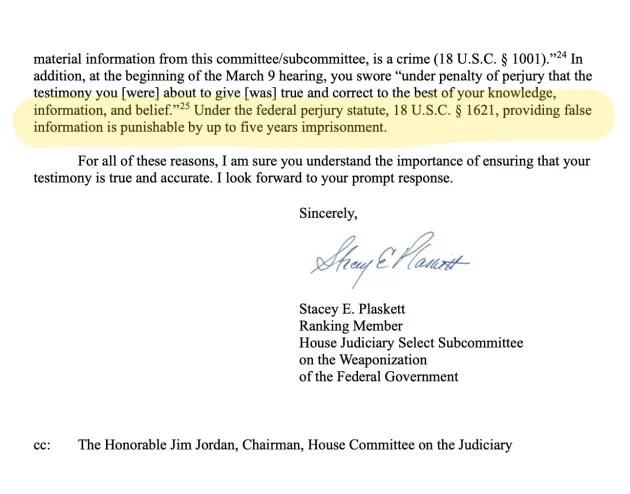
The basis for Plaskett’s perjury accusation lies in several alleged errors Taibbi made during the publication of the Twitter Files. These alleged inaccuracies were brought to light by MSNBC’s Mehdi Hasan, who criticized Taibbi during an interview and used them to claim that the entire Twitter Files project was fundamentally flawed.

While Taibbi did make a mistake, such as confusing the Cybersecurity and Infrastructure Security Agency (CISA), a federal government entity, with the Center for Internet Security (CIS), a nonprofit organization, Hasan failed to explain how this error invalidated the basis of the Twitter Files revelations.

Taibbi acknowledged the honest mistake in a tweet, pointing out that both organizations were part of the Election Integrity Partnership, a Stanford University initiative aimed at monitoring election-related social media discourse.

Nevertheless, Plaskett’s claim that Taibbi intentionally made the error and committed perjury is unfounded. “Taibbi has admitted mistaking CIS for CISA in a single tweet in one of his many threads, but his testimony to Congress was entirely different,” Fang wrote.

“Hasan deceptively conflated this quickly corrected tweet with Taibbi’s testimony.”

Fang went on to say, “… the evidence shows that Taibbi’s congressional remarks were correct. CIS and CISA collaborated with EIP on moderation requests, with both organizations directly appealing to Twitter for censorship, making Taibbi’s overall point and particular argument completely accurate.”

Fang has written more about this here.

Plaskett alleges that the mistake in confusing CISA and CIS was “intentional,” attempting to undermine the idea that the government is stifling speech, while, at the same time, threatening a journalist with imprisonment, effectively weaponizing her power against a member of the free press.

April 20, 2023 Posted by | Civil Liberties, Full Spectrum Dominance | | 4 Comments

CDC director gives misleading testimony to Congress

Walensky misled Congress on vaccine effectiveness against viral transmission and on Cochrane review of face masks

BY MARYANNE DEMASI, PHD | APRIL 20, 2023

This week, CDC director Rochelle Walensky provided witness testimony to the House Committee on Appropriations responsible for overseeing the funding of various federal programs related to labour, health, education, and other related agencies.

But serious questions have been raised about the veracity of Walensky’s testimony.

Congressman Andrew Clyde (R-Ga) asked Walensky if her March 2021 public statement on MSNBC, in which she unequivocally said that “vaccinated people do not carry the virus, they do not get sick” was accurate.

“At the time it was [accurate]” Walensky replied confidently.

She then proceeded to explain, “We’ve had an evolution of the science and an evolution of the virus” and that “all the data at the time suggested that vaccinated people, even if they got sick, could not transmit the virus.”

However, there was no such evidence at the time and it prompted criticism from scientists who said there weren’t enough data to claim that vaccinated people were completely protected or that they could not transmit the virus to others.

One of those critics was Jay Bhattacharya, professor of health policy at Stanford University School of Medicine.

“Back then, Walensky didn’t know if it was true. It was just an irresponsible use of a bully pulpit as a CDC director to say something that she did not know for certain to be true at the time,” said Bhattacharya.

“Unfortunately, people used that information to discriminate against unvaccinated individuals and would certainly have been used as fuel for very destructive policies like vaccine mandates,” he added.

Notably, only days after Walensky made that statement to MSNBC, a spokesperson from her own agency had to walk back the comments saying, “Dr Walensky spoke broadly in this interview” adding that it was possible for fully vaccinated people to get COVID-19.

Walensky missed the memo

Walensky should have known that when mRNA vaccines were first authorised in 2020, the FDA listed critical ‘gaps’ in the knowledge base. One of them was the vaccine’s unknown effectiveness against viral transmission.

Also, in Pfizer’s and Moderna’s original pivotal trials, there were 8 and 11 people respectively, who developed symptomatic COVID-19 in the vaccine group, proving the vaccines never had absolute effectiveness, like Walensky had claimed.

Several months later, the FDA’s evaluation stayed the same. In a clinical review, the FDA wrote, “remaining uncertainties regarding the clinical benefits of BNT162b2 in individuals 16 years and older, include its level of protection against asymptomatic infection and transmission of SARS-CoV-2, including for the delta variant.”

Even today, the FDA remains clear that efficacy against transmission is unproven. The FDA’s website states, “While it is hoped this will be the case, the scientific community does not yet know if Comirnaty will reduce such transmission.”

Walensky says Cochrane summary ‘retracted’

Another astonishing falsehood made by Walensky was her response to Congressman Clyde’s question about the Cochrane review which found that wearing face masks in the community “probably makes little to no difference” in preventing viral transmission.

Walensky enthusiastically stated, “I think its notable, that the Editor-in-Chief of Cochrane, actually said that the summary of that review was…[stumble]..she retracted the summary of that review and said that it was inaccurate.”

However, the summary of the review was not retracted, nor have the authors of the review changed the language in the summary.

Misleading statements by New York Times columnist Zeynep Tufekci has likely led to this falsehood being repeated (which I cover in a previous article).

In response to Walensky’s comments, Tom Jefferson, lead author of the Cochrane study said, “Walensky is plain wrong. There has been no retraction of anything.”

“It’s worth reiterating that we are the copyright holders of the review, so we decide what goes in or out of the review and we will not change our review on the basis of what the media wants or what Walensky says,” remarked Jefferson.

Bhattacharya was also stunned by Walensky’s comments. “It’s irresponsible for her to claim that the Cochrane review [summary] was retracted when it was not. It damages her credibility and harms the scientific process, which requires public officials to be honest about scientific results,” he said.

Did Walensky lie to Congress or is she poorly informed?

Witnesses at these hearings are expected to provide truthful and accurate information to the committee and may be subject to legal penalties if they provide false information or knowingly make false statements.

But will Walensky be held accountable for misleading Congress? Unlikely.

April 20, 2023 Posted by | Deception, Science and Pseudo-Science, War Crimes | , , , , | 1 Comment

IRS Supervisor Tells US Lawmakers Hunter Biden Probe Being Mishandled by Agency

Sputnik – 20.04.2023

WASHINGTON – The Internal Revenue Service (IRS) is mishandling its probe into Hunter Biden, a lawyer representing an IRS supervisor said in a letter to US lawmakers.

“I represent a career IRS Criminal Supervisory Special Agent who has been overseeing the ongoing and sensitive investigation of a high-profile, controversial subject since early 2020 and would like to make protected whistleblower disclosures to Congress,” the letter said on Wednesday.

The letter was sent by attorney Mark Lytle to lawmakers, including US House Judiciary Committee Chairman Jim Jordan and US Senate Finance Committee Chairman Ron Wyden.

The sensitive investigation relates to Hunter Biden, US media reported on Wednesday, citing sources familiar with the matter.

The disclosures by the IRS supervisor contradict sworn testimony to Congress by a senior political appointee and involve failure to mitigate conflicts of interest in the ultimate disposition of the case and detail examples of preferential treatment that would not normally be followed if the subject of the probe were not politically connected, the letter said.

The IRS supervisor has already made protected disclosures internally and to the Justice Department Office of Inspector General, the letter added.

Hunter Biden has faced scrutiny from investigators regarding whether he made a false statement in connection with a gun purchase. US media has reported that investigators have believed for months that they hold enough evidence to indict Biden.

On Tuesday, US Congresswoman Marjorie Taylor Greene said that she has seen evidence of the Biden family running a criminal enterprise, involving multiple family members and shell companies. The statement came after Greene and other lawmakers reviewed thousands of pages of financial records at the Treasury Department.

Greene alleged that the “Biden crime family” participated in human trafficking and benefited financially from foreign countries as a direct result of President Joe Biden’s positions of authority in the US government.

April 20, 2023 Posted by | Corruption | | Leave a comment

Netanyahu: US should interfere more in the Middle East

MEMO | April 20, 2023

Israeli Prime Minister, Benjamin Netanyahu, said that Saudi Arabia could regret its rapprochement with Tehran as Iran is the reason for most of the problems in the Middle East, which he believes the US should be more involved in.

In statements made on Wednesday night to CNBC, Netanyahu said that 95 per cent of the Middle East’s problems emanate from Iran.

He added that the proof of the “misery” that Saudi Arabia may experience due to its rapprochement with Iran is evident in “Lebanon, Yemen, Syria, and Iraq”. He also explained that he views the Saudi-Iranian rapprochement, agreed on 10 March when Saudi Arabia and Iran announced the restoration of their diplomatic relations and reopening of embassies, as having more to do with the war in Yemen.

“I think that Saudi Arabia, the leadership there, has no illusions about who are their adversaries, and who are their friends,” he said.

“We’d like very much to have peace with Saudi Arabia. Because I think it would be another huge quantum leap for peace. In many ways it would end the Arab-Israeli conflict,” said Netanyahu, adding: “I think the sky’s the limit. And even the sky’s not the limit, because there are many opportunities in space as well.”

Asked about China’s manoeuvres in the Middle East, Netanyahu said that he had no knowledge of a Chinese proposal to resolve the Palestinian-Israeli conflict, but said: “We respect China, we deal with China a great deal. But we also know we have an indispensable alliance with our great friend the United States.”

He called for increased US involvement in the Middle East, and said: “I think that not only Israel but I think in many ways most of the … countries in the Middle East would welcome an American, not merely the American involvement in the Middle East which has been ongoing, but a greater engagement of America in the Middle East.”

“I think it’s very important for the United States to be very clear about its commitment and engagement in the Middle East.”

Chinese Foreign Minister Qin Gang told his Israeli and Palestinian counterparts that his country was ready to help facilitate peace talks between the two sides, the latest mediation effort in the region, in separate phone conversations on Monday.

Gang expressed China’s concern over the escalating tensions between the two sides and its support for the resumption of peace talks.

The restoration of diplomatic relations, which were severed between Tehran and Riyadh in 2016, was a major turning point for China’s diplomacy and acted as evidence of its ability to play a role in changing the Middle East.

April 20, 2023 Posted by | Wars for Israel | , , , , , | 2 Comments

Ukraine: Stalemate in an attritional war?

BY M. K. BHADRAKUMAR | INDIAN PUNCHLINE | APRIL 20, 2023 

The Russian President Vladimir Putin travelled to the country’s “new territories” of Lugansk and Kherson/Zaporozhye Regions on Monday to assess the military situation. 

The countdown has begun for the Ukrainian “counterattack”. The arrival of Patriot missile system in Ukraine testifies to the scale of mobilisation to impose heavy losses on Russia. NATO Secretary-General Jens Stoltenberg paid a surprise visit to Kiev today, his first since the war began. 

The leaked Pentagon documents are sceptical about the success of the Ukrainian counter-offensive, but Moscow makes its own assessments. Primarily, the neocons are not going to pull the plug on the Zelensky regime, since that means opening the Pandora’s box when President Biden is about to announce his bid for a second term as president and cannot accept that Ukraine is losing the war. 

In reality, Ukraine is haemorrhaging. It is in the nature of attritional wars that at some point, the weaker side breaks and thereupon, the end comes very fast. This was how in Syria where once the 5-year old Battle of Aleppo was won in December 2016, the government forces swept through the country in a string of military victories bringing the curtain down on the conflict. 

The attritional war in Ukraine may look “stalemated” but the clincher will be which side is inflicting the greater casualties. There is no question that the massive military, intelligence, financial and economic assistance by the West notwithstanding, Russian forces have ground down the Ukrainian side all along the line of contact.

The Russian ambassador to the UK recently said the ratio of losses in the attrition war is roughly seven Ukrainian soldiers to every Russian soldier. To put things in perspective, western media reports estimate that around 35,000 Ukrainian soldiers will be involved in the upcoming counter-offensive along the 950-km frontline while Putin is on record that the Russian reserve forces on the frontline come to 160,000 soldiers!      

The Ukrainian air defence system is in a critical state. Russians have a predominance of artillery and, Russians have heavily fortified the frontline in the recent 5-6 months in multiple layers of defence such as mines, earthworks and bollards to impede advancing tanks, etc. 

This is a desperate gambit for Ukraine, which has lost a large share of its most experienced soldiers (estimated 120,000 casualties), to take on the Russians who are having air superiority and missile superiority, air defence superiority and artillery superiority, and trained manpower superiority, above all.   

The areas that Putin chose to visit — Kherson / Zaporozhya and Lugansk — are where the Ukrainian counteroffensive is most expected. Putin heard from the commanders the military situation and of course, most certainly, that will be inputs for his decisions on Russian counter-strategies, both defensive and offensive. 

Despite the Pentagon leaks and the ensuing disarray and confusion in Washington and European capitals (and Kiev), the Ukrainian counterattack will go ahead to gain back at least some of the lost territory. This is a desperate throw of the dice. 

However, delusional thinking still prevails in Washington. This is apparent from a recent article in Foreign Affairs co-authored by two veterans of the US establishment — former State Department official Richard Haass and Charles Kupchan, senior fellow at the Council on Foreign Relations — titled The West Needs a New Strategy in Ukraine: A Plan for Getting From the Battlefield to the Negotiating Table. 

The article largely sticks to the myths spawned by the neocons — that Russia’s special military operations failed and the war has “turned out far better for Ukraine than most predicted” — but has occasional flashes of realism. It builds on the refrain currently in vogue in Washington that “the most likely outcome of the conflict is not a complete Ukrainian victory but a bloody stalemate.” 

Haas and Kupchan wrote that “By the time Ukraine’s anticipated offensive is over, Kyiv may also warm up to the idea of a negotiated settlement, having given its best shot on the battlefield and facing growing constraints on both its own manpower and help from abroad.” 

The authors take note en passe that Russia’s leadership has options and calculations too, as western sanctions have failed to cripple the Russian economy, popular support for the war remains high (above 70%) and Moscow senses that time is on its side as the staying power of Ukraine and its Western supporters and their resolve will wane and Russia should be able to expand its territorial gains substantially.

Fundamentally, Haas and Kupchan hail from another planet. They cannot comprehend that Russia will never accept a scenario where the conflict ends with a ceasefire but the NATO will continue to beef up Ukraine’s military capabilities and steadily integrate Kiev into the alliance. 

Why would Russia want to play another game of musical chairs while the West formalises Ukraine’s NATO membership — that is, acquiesce in a replay of the grotesque interregnum between Minsk Agreements of 2015 and Russia’s special military operations? 

Putin’s visit to the new territories at this crucial juncture with the attritional war at a tipping point conveys a powerful signal that Russia too has an offensive plan and it is not up to Biden to blow the whistle and call off the proxy war — out of sheer fatigue or pressing distractions in the Asia-Pacific region or due to cracks in western unity or whatever else. 

Equally, it is improbable that Russia can ever reconcile with the Zelensky regime, which Moscow sees as a puppet of the Biden administration. But how can Biden possibly dump or lose sight of Zelensky while the skeletons are rattling in the family cupboard? 

Most important, Russian public opinion expects Putin to redeem the pledge he made while ordering the special military operations. Anything short of that will mean tens of thousands of Russian lives perished in vain. 

It is not in the grain of Putin’s political personality to ignore the groundswell of Russian opinion — or overlook the wounded national psyche as images are playing out of forced eviction of hundreds of monks of  Pechersk Lavra, the 11th-century Orthodox cave monastery complex in the heart of Kiev, branded as Russian fifth columnists. It was a calculated political move by Zelensky with tacit western encouragement. (here and here)

What the neocons in the US are yet to grasp is that they failed to subjugate Russia despite all the humiliations poured on its national honour, proud history and enviously rich culture. Why would Russia normalise with states that appropriated its sovereign wealth and imposed such draconian sanctions to bleed and weaken its economy?

US Treasury Secretary Janet Yellen has admitted on CNN that sanctions may ultimately risk hegemony of the US dollar. But her remarks do not go far enough. 

Meanwhile, the Russia-China strategic partnership has strengthened, the signal this week being Moscow’s willingness to coordinate with Beijing to counter military challenges in the Far East. (See my blog China, Russia circle wagons in Asia-Pacific

Russia is far from isolated and enjoys strategic depth in the international community. Whereas, through the past one-year period, the systemic decline of the West and the US’ waning global influence has become an inexorable historical process. 

April 20, 2023 Posted by | Aletho News | , , | 2 Comments

UK police condemned over arrest of French publisher

RT | April 20, 2023

London’s Metropolitan Police has come under fire for its treatment of a French national who was arrested under anti-terrorist legislation earlier this week. Publisher Ernest Moret was reportedly told that his involvement in protests in his homeland were behind his detention in the UK capital.

Moret’s employer, French publishing house Éditions La Fabrique, issued a press release with fellow publisher Verso Books on Thursday in which they described the actions of British police officers as “scandalous.”

“We consider these actions to be outrageous and unjustifiable infringements of basic principles of the freedom of expression and an example of the abuse of anti-terrorism laws,” the statement added.

The publishers further claimed that Moret’s arrest was the latest example of a “slide towards repressive and authoritarian measures taken by the current French government in the face of widespread popular discontent and protest.”

According to the statement, Moret had arrived in London on Monday to take part in the London Book Fair. While at St. Pancras Station, he was allegedly “pulled aside by police officers acting under Schedule 7 of the Terrorism Act 2000 and detained for questioning without a lawyer present.”

The arresting officers reportedly explained that Moret was taken into custody because he had participated in recent anti-government protests back in France.

The two publishing houses insisted that the case proves there is “complicity between French and British authorities on this matter.”

The formal reason for Moret’s arrest was stated as obstruction of police duties. His colleagues alleged that officers had demanded that Moret hand over his cell phone and unblock it, which he supposedly refused to do.

Pamela Morton from the UK’s National Union of Journalists (NUJ) wrote: “It seems extraordinary that the British police have acted this way in using terrorism legislation to arrest the publisher who was on legitimate business here for the London Book Fair.”

The Metropolitan Police confirmed in a statement that “at around 1930hrs on Monday, 17 April, a 28-year-old man was stopped by ports officers… under Schedule 7 of the Terrorism Act 2000.”

The AFP news agency later reported that Moret had been released on bail.

France has been gripped by mass protests in recent weeks as people vent their dissatisfaction at a retirement age increase pushed through by President Emmanuel Macron.

April 20, 2023 Posted by | Civil Liberties, Full Spectrum Dominance | , , | 1 Comment

What Is A Conspiracy Theory?

By John Leake | Courageous Discourse | April 19, 2023

In our book, The Courage to Face COVID-19: Preventing Hospitalization and Death While Battling the Bio-Pharmaceutical ComplexDr. McCullough and I give numerous examples of how anyone—even eminently qualified scientists and researchers—who questions the prevailing orthodoxy about a range of public policy issues will likely be labelled a “conspiracy theorist.” Since the JFK assassination, “conspiracy theorist” has become a pejorative, accusatory label like “racist” or “sexist.” Through common usage, the label has become charged with the power to smear and dismiss someone outright without supporting evidence.

The greatest trick that powerful interest groups ever pulled was convincing the world that everyone who detects and reports their activities is a conspiracy theorist. Only the naivest consumer of mainstream news reporting would fail to recognize that powerful interest groups in the military, financial, and bio-pharmaceutical industries work in concert to further their interests. Their activities cross the line into conspiracy when they commit fraud or other crimes to advance their interests. The term “conspiracy theory” suggests the feverish imaginings of a crackpot mind. This ignores the fact that the United States government prosecutes the crime of conspiracy all the time. As one prominent defense attorney describes this reality:

Any time the government believes that it can allege that two or more individuals were a part of a common agreement to commit the same crime, they will include a charge of conspiracy in the indictment. There is no requirement that all of the members of the conspiracy even know about each other, or even know each other personally.

A person may be charged with conspiracy to commit a crime even if he doesn’t know all of the details of the crime. History is full of well-documented conspiracies. During the reign of Queen Elizabeth I, there were three major conspiracies to murder her and replace her with Mary Queen of Scots. All were detected and foiled. The final “Babington Plot” was discovered by Elizabeth’s secretary, Sir Francis Walsingham (an astute intelligence gatherer) and this led to Mary’s execution for treason.

Are we really to believe that there are no longer power-hungry men who conspire to acquire greater power and wealth?

As far as “theory” goes, every prosecutor develops a theory of a crime and presents it to the jury. If you are a concerned citizen and you perceive that your government officials and media are not telling the truth about a vitally important matter, you have no choice but to formulate a theory of what is going on. Developing a theory to explain a pattern of ascertainable facts is a rational attempt to detect and expose criminal conduct. To be sure, some theories are more plausible than others. Some are logical and coherent; others are wild and contradictory.

When President Eisenhower left office in 1961, he expressly warned about what he called the Military-Industrial Complex acquiring “unwarranted influence” that could “endanger our liberties and democratic processes.” When COVID-19 arrived, the Bio-Pharmaceutical Complex vigorously and exclusively pursued the vaccine solution instead of the early treatment solution. In order to realize their ambition, multiple actors simultaneously waged a propaganda campaign against hydroxychloroquine, ivermectin, and other repurposed drugs.

It’s likely that only a relatively small number of these actors knew they were making fraudulent claims about the generic, repurposed drugs, and knew they were taking action to impede access to these drugs based on fraudulent claims. These actors were the conspirators. Countless others unwittingly played roles in the conspiracy because they themselves believed the propaganda.

April 20, 2023 Posted by | Book Review, Timeless or most popular, War Crimes | , | 1 Comment

Facebook Censors Seymour Hersh’s Article About US Involvement in Nord Stream Pipeline Attack
By Paul Joseph Watson | Summit News | April 20, 2023

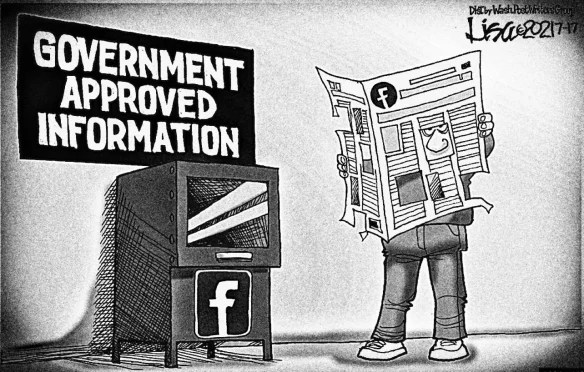
Facebook is censoring Pulitzer Prize-winning journalist Seymour Hersh’s story about US involvement in the destruction of Russia’s Nord Stream pipelines using a ‘fact checker’ with links to the Norwegian government in what represents a clear conflict of interest.

Earlier this year, Hersh published a report asserting that the pipelines were destroyed by the US as part of a covert operation which was organized with the aid of the Norwegian government, Norwegian Secret Service and Navy.

Journalist Michael Shellenberger first noticed the issue when he tried to post Hersh’s article to Facebook, but saw the social media giant had slapped a warning label on the link stating, “False information. Checked by independent fact-checkers.”

Except the ‘fact-checkers’ in question aren’t independent at all.

As Shellenberger notes, “Hersh is infinitely more independent than Facebook’s Norwegian fact-checker. The fact-checking organization is a partnership with a Norwegian government-owned media company, NRK, which has a direct self-interest in censoring the story.”

By censoring the article with a dubious ‘fact check’, Facebook is preventing it from reaching a much wider audience, relegating it in the algorithm.

This is yet another example of how the ‘fact-checker industrial complex’ serves to censor legitimate information at the behest of governments by posing as an independent, non-bias actor when in reality it is merely a front for state control.

Facebook’s claim, made a few years ago, that it cannot act as “the arbiter of the truth” for any contentious issue, has been proven dishonest once again.

“Whether Hersh is wrong or right, his reporting should be debated publicly, not censored. Facebook’s actions are antithetical to America’s tradition of free and open debate and its rejection of secretive, authoritarian censorship,” writes Shellenberger.

“The American people have given Facebook broad liability protections under Section 230 that other media companies don’t get. And yet Facebook is acting like a media company, not a platform. As such, Facebook is putting its Section 230 protection at risk. And censoring Hersh may only attract more attention to it.”

April 20, 2023 Posted by | Civil Liberties, Deception, Full Spectrum Dominance | , , | 1 Comment

US still doesn’t dare flying spy drones over Black Sea

By Drago Bosnic | April 20, 2023

It’s been well over a month since the Russian Aerospace Forces (VKS) Su-27SM3 masterfully downed a USAF MQ-9 “Reaper” drone that was spying on regions in southern Russia. The incident occurred on March 14, when the US drone flew just 70 km off the coast of Crimea. At the time, the VKS noted that the MQ-9 had its transponders off while heading toward Russian airspace in what was a clear violation of the agreed protocols for avoiding escalation. At the time, the Pentagon insisted that the drone was “merely conducting routine operations in international airspace over the Black Sea and posed no threat to anyone”. However, as it soon became clear, MQ-9 (presumably the latest Block 5 variant) was carrying out ISR (intelligence, surveillance, reconnaissance) over critically important Russian military infrastructure.

This was certainly a red line for Russia, as it’s perfectly aware that the information acquired through ISR close to Russian airspace is shared directly with the Kiev regime, enabling precision strikes. At the time, top Russian officials such as Nikolai Patrushev, the Secretary of the Russian Security Council, stated that the incident proves the US is directly involved in the conflict. And indeed, this was certainly causing thousands of Russian military and civilian deaths even before February 24, 2022, because the Pentagon has been providing ISR to Kiev since 2014. Only a few days before the incident, the Neo-Nazi junta forces conducted numerous attacks on civilian settlements in the Donetsk and Lugansk People’s Republics, as well as the Zaporozhye and Kherson oblasts (regions), killing and/or injuring hundreds.

The US warhawks were furious at the Biden administration for “allowing the Russians to shoot down our drones”. Some have even called for the Pentagon to “respond in kind”. Thankfully, there are still high-ranking officers in the US military that are perfectly aware of just how bad an idea that is, so these suicidal requests were promptly denied. What’s more, the latest reports indicate that Washington DC has not only drastically reduced the presence of its ISR platforms in areas close to Russia, but has even completely halted the flights of its extremely expensive RQ-4 “Global Hawk” spy drones, the data published by the Flightradar24 tracker website shows. According to its archive of tracks, the last time a US “Global Hawk” drone flew over the Black Sea was on March 21.

Since then, US drones based in Sicily haven’t approached even the Black Sea airspace, let alone the military installations in southern Russia. Before the start of Moscow’s counteroffensive against NATO aggression in Europe, the Pentagon flew approximately 10 ISR missions per month, spying on Russian troops in Crimea. During the March 21-April 20 period, US “Global Hawk” drones made only three flights from the airbase in Sicily, severely undermining the amount of real-time battlefield data they could provide to the Kiev regime. Worse yet, these missions were conducted from within Romanian airspace and at a distance of over 400 km from Crimea. This is beyond the range of “Global Hawk’s” systems, capable of receiving clear images of an area at a maximum range of 200 km.

“Following the incident with the American Reaper drone, which fell into the waters of the Black Sea on March 14, ‘Global Hawks’ made only two more flights over the Black Sea — on March 17 and March 21 — both at a range no closer than 140 kilometers from the southern coast of Crimea. Apparently, the US command considered further flights in this area impractical. On the one hand, the amount of information received by a drone at such a range is sharply reduced; on the other hand, after March 14, the American side faced the danger of losing such equipment, and a Global Hawk is several times more expensive than a Reaper and is loaded with the most advanced equipment,” a military expert told Sputnik.

Indeed, the Northrop Grumman RQ-4 “Global Hawk” drones are among the most expensive hardware in the US military. The latest Block 40 variant costs over $130 million apiece, a mind-boggling figure for a single drone. The aircraft is a HALE (high-altitude, long-endurance) ISR platform that provides direct support to US forces worldwide. It can fly for up to 36 hours at a range of up to 22,000 km, giving it an unprecedented loitering time and covering approximately 100,000 km² of any given surveyed area in a period of 24 hours. For reference, this is the size of South Korea or Iceland. RQ-4 “Global Hawk” is equipped with various ISR equipment such as radars, optical tracking systems and infrared sensors, all of which have been used extensively to spy on Russian forces in Ukraine.

Weapons such as the HIMARS (among others) are fed battlefield data directly from platforms such as the “Global Hawk”. This means that hundreds of civilian deaths and injuries caused by the aforementioned US weapons across the newly integrated Russian regions were entirely intentional, making them an unadulterated war crime. On the other hand, NATO ISR assets have also contributed to the vast majority of Russian military deaths, prolonging the conflict. The US and NATO don’t even need to fire a single bullet to kill Russian soldiers and civilians. However, while the Kiev regime forces are pulling the trigger, it is the political West’s “eyes” that are targeting them and even issuing commands. Considering these facts, downing NATO’s ISR platforms most definitely saves thousands of lives.

Drago Bosnic is an independent geopolitical and military analyst.

April 20, 2023 Posted by | Aletho News | 3 Comments

Why Science Is Broken: Hillsdale Speech Video & Transcript

BY BRIGGS • STATISTICIAN TO THE STARS! • APRIL 18, 2023

Transcript

I followed this closely during the speech, but did not adhere to it perfectly. I don’t have a transcript of Greg’s talk.

A fascinating experiment was conducted not too long ago. An experiment about experiments. About how scientists came to conclusions in their own experiments.

What happened was this. Nate Breznau and others handed out identical data to a large group of researchers and asked each group to answer the same question. The question was this: would immigration reduce or increase “public support for government provision of social policies”?

That can be difficult to remember, so let’s reframe this question in a way more memorable, and more widely applicable to our other examples. Does X affect Y? Does X, more immigration, affect Y, public support for certain policies?

That’s causal language, isn’t it? X affects Y? Words about cause, about what causes what. Cause, and knowledge of cause, is of paramount importance in science. So much so I claim, and I hope to defend, the idea that the goal of science is to discover the cause of measurable things. We’ll get back to that later.

Just over 1,200 models were handed in by researchers, all to answer whether X affected Y. I cannot stress enough that each researcher was given identical data and asked to solve the same question.

Breznau required each scientist to answer the question with a No, Yes, or Cannot Tell. Only one group of researchers said they could not tell. Every other group produced a definite answer.

About one quarter—a number we should all remember—one quarter of the models answered Yes, that X affected Y—negatively. That is, more X, less Y.

Now researchers were also allowed to give some idea of the strength of the relationship, along with whether or not the relationship existed. And that one-quarter who said the relationship between X and Y was negative ranged anywhere from a strongly negative, to something weaker, but still “significant.” Significant. That word we’ll also come back to.

You can see it coming. About another quarter of the models said Yes, X affects Y, but that the relation was positive! More X, more Y, not less!

Again, the strength was anywhere from very strong to weak, but still “significant”.

The remaining half or so of the models couldn’t quite bring themselves to say No: they all still gave a tentative Yes, but said the relationship was not “significant”.

You see the problem. There is in Reality only one right answer, and only one strength of association, if it exists. That a relationship does not exist may even be the right answer. I don’t know what the right answer is, but I do know only one can be. Yet the answers—the very confident, scientifically derived, expert investigated answers—were all over the place and in wild disagreement with each other.

Every one of the models was science. We are told we cannot deny science. We are commanded to Follow The Science.

But whose science?

XXXXXXXXXXXXXXXXXXXXXXXXXXXXXXX

Now these models were from the so-called soft sciences: sociology, psychology, education and the like. It’s not surprising there are frequent errors from these fields because of the immense and hideous complexity of their subject.

Which is why we often turn to the so-called hard subjects, like physics and chemistry, for “real science.” These are fields in which the subjects under study are more amendable to control, and hence easier to examine. But, this, too, is often an illusion.

Physicist Sabine Hossenfelder in a Guardian article calls attention to a peculiar phenomenon in physics, the hardest of hard sciences.

Since the 1980s, [says Hossenfelder,] physicists have invented an entire particle zoo, whose inhabitants carry names like preons, sfermions, dyons, magnetic monopoles, simps, wimps, wimpzillas, axions, flaxions, erebons, accelerons, cornucopions, giant magnons, maximons, macros, wisps, fips, branons, skyrmions, chameleons, cuscutons, planckons and sterile neutrinos, to mention just a few.

None of these turned out to be real. Yet more are proposed constantly. She blames, in part, Popper’s idea of falsificationism, which says that propositions are scientific if they are falsifiable. Any proposition which can be falsified is scientific. It follows that any proposition about anything that is measurable, from Bigfoot to gender theory to the existence of new particles, is scientific. So let’s do science by proposing lots of falsifiable propositions!

This over-broadness was an early, even fatal, criticism to the philosophy of falsificationism. Another, even more damning, critique is that you almost never can persuade scientists to cease loving their actually falsified theories—theories which don’t match Reality—especially when those theories are popular or lucrative. Planck offered a superior philosophy: Science, he said, advances one funeral at a time. Still, few have had success in talking working scientists out of falsificationism. That is a talk for another time.

XXXXXXXXXXXXXXXXXXXXXXXXXXXXXXX

Now another thing to emphasize in Breznau’s experiment was the hugeous pile of models turned in. Over 1,200. Twelve hundred. That’s a lot of models!

With that many, it must be true that making models is easy. Creating theories is simple. The researchers broke no sweat in producing this cache. And neither did the physicists who proposed all those new particles.

In a very real sense, science, doing science, is too easy. Making models is too easy. Calling X a cause of Y is too easy.

And our examples, Breznau and particle physics, are only two small instances. Think about what this means extrapolated to every branch and field of science, the whole world over.

People have thought about it: Enter the replication or reproducibility crisis.

XXXXXXXXXXXXXXXXXXXXXXXXXXXXXXXXX

Major replications of what are considered the best papers, from the top journals like Nature and Science, have been attempted by several groups over the last decade or so. These were large and serious efforts to attempt to duplicate original experiments in the social sciences, psychology, marketing, economics, medicine and others.

What is stunning is that the results from these efforts were the same: only about half the replications worked, and half did not. And of the half that worked, only half of those—one quarter: that number we had to memorize—were of the same strength of effect size.

Lets look at medicine.

John Ioannidis, a name familiar to some of you, examined the créme de la créme of papers, which is to say, the most popular papers, the ones with over 1,000 citations each.

Scientists count their citations like influencers count their “likes.” Scientists with their h-indexes, impact factors, source normalized impacts per paper and all the rest, and the way they eagerly share and scrutinize these “metrics”, can be said to have invented social media.

Anyway, Ioannidis examined forty nine top papers. Here’s what he found: “…7 (16%) were contradicted by subsequent studies, 7 others (16%) had found effects that were stronger than those of subsequent studies, 20 (44%) were replicated, and 11 (24%) remained largely unchallenged.”

Only a quarter of papers. Twenty five percent. Doesn’t that sound like Breznau’s experiment?

The British Medical Journal 2017 review of New & Improved cancer drugs found that for only about 35% of new drugs was there an important effect, and that “The magnitude of the benefit on overall survival ranged from 1.0 to 5.8 months.” That’s it. An average of three months.

Richard Horton, editor of The Lancet, in 2015 announced that half of science is wrong. He said: “The case against science is straightforward: much of the scientific literature, perhaps half, may simply be untrue. Afflicted by studies with small sample sizes, tiny effects, invalid exploratory analyses, and flagrant conflicts of interest, together with an obsession for pursuing fashionable trends of dubious importance, science has taken a turn towards darkness.”

The half of science that is wrong is, I emphasize, the best science. Consider how bad it must be in the lower tiers.

XXXXXXXXXXXXXXXXXXXXXXXXXXXXXXX

You might have heard of recent work by Russell Funk and others. They noticed that the production of what they call “disruptive science” has plummeted since 1950. By this they meant genuinely new (and not just “novel”) and foundational work. It has all but stopped, and in all fields.

Is this because science has already made most discoveries, and we’re now in a wrap-up phase? Or is it because of a deeper problem?

In any case, there is no possibly, at all, that all the papers produced by science today are correct, and even those that are correct seem to be of less and less real use.

XXXXXXXXXXXXXXXXXXXXXXXXXXXXXXX

All right, we have learned that something like three-quarters, or even more, of science is wrong or badly over-certain. And, of course, some is true science, but even this is increasingly of less value.

There is no symmetry here. Even if half of science is true, the half that is wrong takes more time and resources to handle or counter, because the bureaucracy manages science, and our rulers are free to pick and choose “The Science” they like.

Did you ever notice they always say “The Science” and not plain “science”?

Now the number of published papers has grown from about a quarter million a year in 1960 to about 8 million now, a number still heading north. Because most of it is wrong, and because of the harms of bad science, we’re forced to conclude there is too much science. There are too many scientists, there is too much money and too many resources being spent on science.

The solution to this glut is easy. In principle. Stop doing so much science! Alas, there is little hope we’ll see any calls for less science education or lowered spending.

Let’s instead explore why it’s so easy to produce bad science, and what counts as bad science.

Some of these reasons are easy to see. Like peer review. Because scientists really must publish or perish, they are to large degree at the mercy of their peers, who act as gatekeepers to journals.

Richard Smith, former Editor of BMJ, in 2015 said, “If peer review was a drug it would never get on the market because we have lots of evidence of its adverse effects and don’t have evidence of its benefit. It’s time to slaughter the sacred cow.” Again, alas, it won’t be.

Peer review added to the surfeit of papers results in a system that guarantees banality, penalizes departures from consensuses, limits innovation, and drains time—almost as much as writing grants does. For not only must you publish or perish, you must provide overhead for your dean.

These and activities like fraud, which because of increasing money and prestige of science is growing, are all of known negative effect. So let’s instead think about deeper problems. Philosophical problems.

XXXXXXXXXXXXXXXXXXXXXXXXXXXXXXX

Finally we come to the philosophy of science, ostensibly this talk’s title. Unfortunately, we could not start with that subject because of the universal awe in which science is held. I had to at least attempt to show that this awe is not always justified. Now I hope to show that philosophy has something to do with this.

What is the nature or goal of science? I claimed earlier it is to understand the causes of observable things. Why and how and when X causes Y. Many, or even most scientists do not disagree with that, though some do. The agreement depends on which philosophy of nature one espouses, and which philosophy of uncertainty, and of what models and theories are. And here there is much dispute.

Some, calling themselves instrumentalists, are satisfied with statements like “If X, then Y.” This is similar to “X causes Y”, but not the same. If X, then Y merely says that if we know X, then Y will follow in some way. It doesn’t say why, or say why entirely.

Instrumentalism can be useful. Consider a passenger in a jet. She has no idea how the engine and wings work together to cause the plane to fly. But she sees, and trusts, that the plane will fly. If X, then Y.

This happens in science, too, like when experimenters try varying conditions just to see what happens. The inventor of the triode vacuum tube, called an “audion”, by Lee de Forest, had no idea how it worked. Nobody did, at first, and there were even many wrong guesses, but that didn’t stop RCA and others from using this obviously superior device in early radios.

But instrumentalism is never completely satisfying, is it? Just knowing If X, then Y? If you plug the audion into a certain circuit, a louder signal emerges. Isn’t it far superior proving that the grid, when similarly charged as the cathode, impedes electron flow to the plate, and when oppositely charged the flow increases, hence the triode amplifies the signal on the grid? X causes Y.

So cause is our goal in science, or should be. But that doesn’t mean it’s easy. There are many ways for this goal to be missed—or mistaken.

At last, here are some (but not all) of the ways science goes wrong in its fundamental task of discovering why and how and when X causes Y. I’ll go from easiest to understand to hardest to explain.

XXXXXXXXXXXXXXXXXXXXXXXXXXXXXXX

1. X is not measured, but a proxy for X is, and everybody forgets the proxy.

This one is extraordinarily popular in epidemiology. So much so that without it, the field would almost barren. This error is so common, and so fruitful at producing bad science, that I call it the epidemiologist fallacy, which combines the ecological fallacy—mistaking the proxy for X as X—with mistaking correlation for causation.

PM2.5—dust of a certain size—is all the rage, and is investigated for all its supposed deleterious effects. There are a slew of papers saying PM2.5 is “linked to” or “associated with” heart disease or some such thing.

Problem is, actual intake of PM2.5 is never measured, only rough proxies of “exposure” are given.

Such as zip codes used to determined one’s recorded primary residence and its distance from a highway, and then a model of how much PM2.5 is produced by that highway, and how much PM2.5 is thus available at your house, where it is assumed that availability is your exposure. And that exposure if your intake. Get it?

Understand that the error is not falsely claiming PM2.5 causes heart disease. It may, it may not. The mistake is over-certainty. Vast over-certainty. There are too many steps in the causal claim to know what is going on.

I can’t resist telling you my all-time favorite instance of the fallacy. Some from Harvard’s Kennedy School claimed X causes Y, that attending a Fourth of July parade turns kids into Republicans.

Parade attendance was never measured.

Instead, they measured rainfall at the location on people’s listed residences when they were children. If it rained, they assumed no parades took place, and so no kid went to one, even if that kid was at a parade at grandma’s house. If it didn’t rain, they assumed every kid did attend, even if they were away for camp.

They used causal language: “experiencing Fourth of July in childhood increases the likelihood that people identify with and vote for the Republican party as adults.”

Thus San Francisco, which rarely sees rain in July, should be a hotbed of Republicanism.

2. Y is not measured, but a proxy for Y is, and everybody forgets the proxy.

Sometimes neither X nor Y are measured, but everybody acts like both were. This becomes the double-epidemiologist fallacy. You find this in sociology a lot. And in experiments allowing “multiple endpoints” in medicine. The outcome might be the multiple endpoint, “AIDS, or pancreatic cancer, or heart failure, or hangnails”, and so if we hear a claim of some new drug that lessened the endpoint, we are not sure what is being claimed.

The CDC is a big user of this fallacy. This was how they talked themselves into mask mandates—in spite of a century’s worth of studies showing masks did not work in stopping the spread of respiratory viruses.

During the covid panic, one of their “major” studies looked at “cases”—by which they meant infections—in counties with out without mandates; or, rather, they looked at changes in rates of infections. But to tell masks stop respiratory bugs from spreading, one must measure the use of a mask and the subsequent infection or lack of it. If X, then Y. From which we might arrive at X causes Y. Measure odd things like county-level changes in rates of “cases” with and without mandates does not tell you this. Neither X nor Y has been measured. Cause remains vague to extreme degree.

Incidentally, one study did it right. In Denmark, researchers taught one group how to use the best masks properly, and gave them a bunch of free ones, and another group went mask free. They measured individual infections afterwards. No difference in the groups. Anyway, if masks work, masks would have worked.

3. Attempting to quantify the unquantifiable.

Thomas Berger’s novel Little Big Man (eschew the movie) tells the tale of Jack Crabb, a white boy adopted into and raised by a Cheyenne clan around 1850. Years later, Crabb finds himself back among the whites, and is amazed at all the quantification. “That’s the kind of thing you find out when you go back to civilization: what date it is and time of day, how many mile from Fort Leavenworth and how much the sutlers is getting for tobacco there, how many beers Flanagan drunk and how many times Hoffmann did it with a harlot. Numbers, numbers, I had forgot how important they was.”

Too important.

Let me ask you, right now, how happy you are. You in the audience now. On a scale from minus 17.5 to e—the natural number e—cubed. I could have asked on a scale from 1 to 5, maybe, which allows me to scientifically put my happiness score on a Likert scale, the scientific name given to assigning whole numbers to questions.

Let’s be serious, and do real science, and call my measure the Briggs instrument. Questionnaires are called instruments when they are quantified, the language an attempt to borrow the rigor and precision of real instruments like oscilloscopes or calipers.

Suppose I polled the left half of the room, and then the right half, and there were differences in happy scores. Would I then be able to say, sitting on the left half of lecture halls causes less happiness in after-dinner speech listeners? I should be: that’s how science is done.

It’s not that the patented Briggs instrument isn’t telling us nothing about happiness. Take two people, one who answered the highest and one the lowest. There is probably a real difference in happiness between these two people. It’s that we’re not quite sure what this real difference is.

What does happy mean? Moby Thesaurus says: “accepting, accidental, ad rem, adapted, addled, advantageous, advisable, applicable, apposite, appropriate, apropos, apt, at ease, auspicious, beaming, beatific, beatified, becoming, beery, befitting, bemused, beneficial, benign, benignant, besotted, blessed, blind drunk, blissful, blithe, blithesome, bright, bright and sunny, capering, casual, cheerful,” and on and on and on.

Each of these gives a different genuine shade of happy. How do we know those answering the patented Briggs instrument mean the same shades?

The typical response is to claim our instrument has been validated. And this means, roughly, that it was given to more than one group of people and that the answers came out about the same. That’s not true validation—which isn’t possible.

4. Mistaking correlation for causation.

Every working scientist knows the adage: correlation doesn’t imply causation. Sadly, just like confirmation bias, that’s for the other guy. Most cannot resist the temptation to say my correlation is my causation.

Why? The practice of announcing measure of model or theory fit as proving cause.

The Lancet’s Horton, whom we met earlier, also said, “Our love of ‘significance’ pollutes the literature with many a statistical fairy-tale”. This “significance” is a word with a definition bearing no relation to the normal English word. It means having a wee p-value, a bit of math with which there are so many things wrong we could take an hour detailing them.

So we’ll leave it at this: significance, i.e. a wee p-value, is when a model fits a set of data well. It is taken, often, to mean cause has been found. This is always a fallacy. Cause may exist, but it can never be demonstrated by “significance”. It is always a fallacy because this significance is only a measure of correlation. And we all agreed correlation does not imply causation.

It is only the laziest of researchers who cannot find “significance” in some way for his dataset. For there are an infinity of models available to choose from. Correlation can always be had. The number is not an exaggeration. The number of possible models is potentially infinite. At least one can always be found for any set of data to exhibit “significance.” Which just means, remember, that the model fits the data well, that correlation exists.

There are endless examples to choose from. Endless. My favorite is the evils of third-hand smoke. You have heard of second-hand smoke, that smoke and whatnot that comes out of smokers which somehow affects non-smokers.

Third-hand smoke isn’t smoke at all, but the byproducts of smoking that come off of smokers and leave a trace, long after smokers are gone, where unwitting non-smokers may stumble across them.

A team of researchers went into a theater where smokers once were, and at which non-smokers attended later showings absent any smokers. They concluded, because of significance, that sitting in the chairs smokers once sat was like sucking in the “equivalent of 1 to 10 cigarettes of secondhand smoke.” Which is about the same number of cigarettes heavy smokers go through during a movie.

The result is absurd.

But believed. According to one report, “The effects were particularly pronounced during R-rated films, like ‘Resident Evil,’ which the authors suggested was because such movies attract older audiences more likely to have been exposed to smoke.”

Significance is also why there exist conflicting headlines like, “One egg a day ‘LOWERS your risk of type 2 diabetes’” and “Eating just one egg a day increases your risk of diabetes by 60 percent, study warns.” I have a collection of these things: science says just about everything will both kill and cure you.

It’s not only bad statistics. Those physicists inventing that particle zoo also measured success by how well their models fit anomalous data. That’s why they made the models, to fit those anomalies.

Model fit is a necessary but far, far from sufficient criterion of model goodness. Models can always be made to fit. Not all can be made to represent Reality. This is why I stress no model that has not been independently tested against Reality can be trusted. Most models are not so tested. It depends on the field, but in some areas, usually the so-called softer sciences, models are never independently checked.

5. Multiplication of uncertainties.

We all agree that the planet needs saving. Everybody says so. From global cooling.

When climatology was becoming a new field, they really did say a new ice age was coming.

Newsweek in 1975 reported, “There are ominous signs that the earth’s weather patterns have begun to change dramatically and that these changes may portend a drastic decline in food production”.

Time in 1974 said, “Climatologist Kenneth Hare, a former president of the Royal Meteorological Society, believes that the continuing drought…gave the world a grim premonition of what might happen. Warns Hare: ‘I don’t believe the world’s present population is sustainable if [trends continue].’”

There are scores upon scores of these, the scientists and groups like the UN warning of mass deaths by starvation and so on.

Well, climatological science grew, and the temperature warmed, and then we got global warming. Caused, incidentally, by the same thing said to cause global cooling: oil.

Global warming in time became “climate change”, a brilliant name, because the earth’s climate changes unceasingly. Thus any change, which is inevitable, can be said to be because of “climate change.” Correlation becomes causation with ease here.

“Climate change” was quickly married to scientism, where it came to be synonymous with “solutions” to “climate change”. Because of this error, doubt expressed about the so-called solutions caused one to be called a “climate change denier”—an asinine name, because no working scientist, not one, denies the earth’s climate changes or is unaffected by man.

Janet Yellen recently said that “Climate change is an existential threat” and that the “world will become uninhabitable” if—you know the rest—if we don’t act.

Uninhabitable is a mighty word. Rode and Fischbeck in 2021 examined environmental apocalyptic predictions and discovered that the average time until The End, for those saying we “Must act now”, as Yellen did, is about nine years.

Predictions of only nine years left started in gradually in the 1970s. They now happen regularly.

Funny thing about these forecasts is that failure never counts against theory. Which is another strike against falsification.

That is a story unto itself. Let’s instead peek at the science of “climate change.” Not at the thermodynamics or fluid physics, which is too much for us here, but at the things which are claimed will go bad because of “climate change.”

Which is everything. There is no ill that will not be exacerbated by “climate change”, and there is no good thing that will escape degradation. “Climate change” will simultaneously cause every beast and bug and weed which is a menace to flourish, and it will corrupt or kill every furry, delicious, and photogenic animal.

There is a fellow in the UK who collects these things. His “warm list” total right now is about 900 science papers, an undercount. Academics have proved, to their satisfaction, that “climate change” will cause or exacerbate (just reading the first few): “AIDS, Afghan poppies destroyed, African holocaust, aged deaths, poppies more potent, Africa devastated, Africa in conflict, African aid threatened, aggressive weeds, Air France crash, air pockets, air pressure changes, airport farewells virtual, airport malaria, Agulhas current, Alaskan towns slowly destroyed, Al Qaeda and Taliban Being Helped, allergy increase, allergy season longer, alligators in the Thames”. And we haven’t even come close to getting out of the As.

There is not one study, that I know of, that remarks on how a slight increase in globally average temperature will lead to more warm, pleasant summer afternoons.

That a small change in the earth’s climate, caused by man or not, can only be seen as wholly and entirely bad, and can be in no way be good, is sufficient proof, I think, that science has gone horribly wrong. It’s not logically impossible, of course, but it cannot be believed.

Yet this doesn’t say how these beliefs are generated. They happen by some of the reasons we’ve already mentioned, but also by forgetting the multiplication of uncertainties.

Given knowledge of coins, the chance of a head on a flip is one half. Two heads in a row is one quarter: the uncertainties are multiplied. Three in a row is one eighth; four is one in sixteen. If the event of interest is that string of four heads, we must announce the small probability of about 6%.

It would be an obvious error, and silly mathematical blunder, to say the probability is “one half” because the chance of the last head is one half. And it would be outrageous if a headline were to blare “Earth will see a Head on last throw.” Agreed?

That’s exactly how “climate change” scare stories are produced.

We first have a model of climate change, and how man might affect the climate. There is only a chance this model is correct. It is not certain.

We next have a weather model, which rides on top the climate model, which says how the weather will change when the climate does. This model is not certain, either.

We then have a third model in how some item of importance, the welfare of some animal or size of coffee production or whatever, is affected by the weather. This third model is not certain.

We finally, or eventually, have a fourth model which shows how a solution will stop this bad thing from happening. This model is also uncertain.

In the end, it will be announced “We must do X to stop Y”. This is equivalent to “Earth will see a Head.” Causal language. Which we agreed was an error.

The chain of uncertainties must be multiplied. The greater the chain, the more uncertain the whole must be. This is never remembered. But must be, especially when the number of claims grows almost without bound.

6. Scientism.

Pascal commented on “The vanity of the sciences. Physical science will not console me for the ignorance of morality in the time of affliction. But the science of ethics will always console me for the ignorance of the physical sciences.”

Scientism is the mistaken belief that science has all the answers, that all things should be done in the name of, or justified by, science. Yet science cannot tell right from wrong, good from bad.

I wish we had time to thoroughly dissect scientism. Its effects are vast and devastating. I’ll mention only the gateway drug to serious scientism, which I call Scientism of the First Kind.

This is when knowledge which is obvious or has been known since the farthest reaches of history is announced as “proved” by science. This encourages belief in the stronger, darker forms of scientism.

Examples? A group researched whether laptops were distracting to students in college classrooms. The Army hired a certain corporation to investigate whether there are sex differences in physical capabilities.

Guess what they both “discovered.”

7. The Deadly Sin Of Reification: Mistaking models for Reality.

We are in rugged territory here, for the closer we get to the true nature of causation, which requires a clear understanding of metaphysics, the subtler the mistakes that are made, and the more difficult they are to describe. Plus, I have detained you long enough. So I will given only one instance of the Deadly Sin, in two flavors.

It would, I hope you agree, be an obvious fallacy to say that Y was not or cannot be observed, when Y was in fact observed, because some theory X says Y is not possible. Yes?

This error abounds. X is some cherished model or theory, and Y an observation which is scoffed at, dismissed, or “explained” away, because it does not accord with theory.

This happens in the least sciences, like dowsing or astrology, where practitioners reflexively explain away their mistakes. But it also happens with great and persistent frequency in the greatest sciences, like physics.

The most infamous example of Y is free will. There are, of course, subtleties in its definition, but for us any common usage will do. We all observe we have free will: choices confront us, we make them.

Yet certain theories, like the theory of determinism, which says all there is is blind particles obeying something mysteriously called “laws”, proves free will is impossible. It does, too. Prove it. If we accept determinism. Which many do.

Because scientists are caring people, and want what’s best for man, saying determinism makes free will impossible leads to an endless series of papers and articles with this same profound, and hilarious, message: if only we can convince people they cannot make choices, they will make better choices! I promise you will see a version of this sentence in every anti-free will article.

It also leads to the current mini-panic over “AI”, or “artificial intelligence.” Which it isn’t: intelligence, that is.

All models only say what they are told to say—a philosophic truth that when forgotten leads to scientism—and AI is only a model. AI is nothing more than an abacus, which does its calculations at the direction of real intelligence in wooden beads, with the beads replaced with electric potential differences.

But because the allure and love of theory is too strong it is believed computer intelligence will somehow “emerge” into real intelligence, just like the behavior of large objects is said to “emerge” from quantum interactions.

I will upset many when I say this is always a bluff, a great grand bluff.

There is no causal proof of “emergence”: if there was, it would be given. Talk of emergence is always wishful thinking, reflecting a desire not to question the philosophy of what Robert Koons and others call microphysicalism, the ancient Democritian idea that everything is just particles bumping into things.

There are alternatives to this philosophy, like the revival of Aristotelian metaphysics, which would do wonders for quantum mechanics if it were better known. Unfortunately, we haven’t the time to cover any of them.

The Deadly Sin Of Reification, the mistaking of models for Reality, is much worse than I have made it sound. It leads to strange and untestable creations like the multiverse and many worlds in physics, and like gender theory, and all that they have wrought.

XXXXXXXXXXXXXXXXXXXXXXXXXXXXXXX

That’s what I have to say about bad science. Maybe I’m wrong. So I’ll end with the most frequently used scientific words: more research is needed.

April 20, 2023 Posted by | Science and Pseudo-Science, Timeless or most popular, Video | Leave a comment