Facebook Censors Seymour Hersh’s Article About US Involvement in Nord Stream Pipeline Attack
By Paul Joseph Watson | Summit News | April 20, 2023
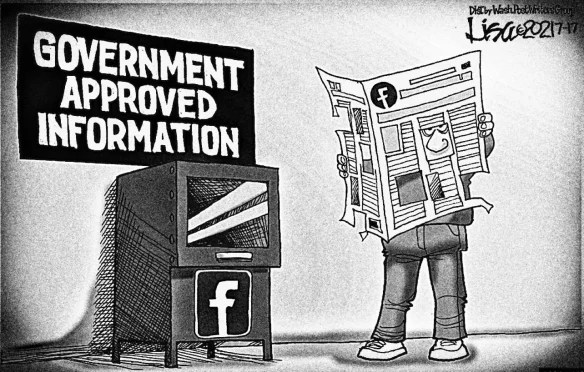
Facebook is censoring Pulitzer Prize-winning journalist Seymour Hersh’s story about US involvement in the destruction of Russia’s Nord Stream pipelines using a ‘fact checker’ with links to the Norwegian government in what represents a clear conflict of interest.
Earlier this year, Hersh published a report asserting that the pipelines were destroyed by the US as part of a covert operation which was organized with the aid of the Norwegian government, Norwegian Secret Service and Navy.
Journalist Michael Shellenberger first noticed the issue when he tried to post Hersh’s article to Facebook, but saw the social media giant had slapped a warning label on the link stating, “False information. Checked by independent fact-checkers.”
Except the ‘fact-checkers’ in question aren’t independent at all.
As Shellenberger notes, “Hersh is infinitely more independent than Facebook’s Norwegian fact-checker. The fact-checking organization is a partnership with a Norwegian government-owned media company, NRK, which has a direct self-interest in censoring the story.”
By censoring the article with a dubious ‘fact check’, Facebook is preventing it from reaching a much wider audience, relegating it in the algorithm.
This is yet another example of how the ‘fact-checker industrial complex’ serves to censor legitimate information at the behest of governments by posing as an independent, non-bias actor when in reality it is merely a front for state control.
Facebook’s claim, made a few years ago, that it cannot act as “the arbiter of the truth” for any contentious issue, has been proven dishonest once again.
“Whether Hersh is wrong or right, his reporting should be debated publicly, not censored. Facebook’s actions are antithetical to America’s tradition of free and open debate and its rejection of secretive, authoritarian censorship,” writes Shellenberger.
“The American people have given Facebook broad liability protections under Section 230 that other media companies don’t get. And yet Facebook is acting like a media company, not a platform. As such, Facebook is putting its Section 230 protection at risk. And censoring Hersh may only attract more attention to it.”
US still doesn’t dare flying spy drones over Black Sea
By Drago Bosnic | April 20, 2023
It’s been well over a month since the Russian Aerospace Forces (VKS) Su-27SM3 masterfully downed a USAF MQ-9 “Reaper” drone that was spying on regions in southern Russia. The incident occurred on March 14, when the US drone flew just 70 km off the coast of Crimea. At the time, the VKS noted that the MQ-9 had its transponders off while heading toward Russian airspace in what was a clear violation of the agreed protocols for avoiding escalation. At the time, the Pentagon insisted that the drone was “merely conducting routine operations in international airspace over the Black Sea and posed no threat to anyone”. However, as it soon became clear, MQ-9 (presumably the latest Block 5 variant) was carrying out ISR (intelligence, surveillance, reconnaissance) over critically important Russian military infrastructure.
This was certainly a red line for Russia, as it’s perfectly aware that the information acquired through ISR close to Russian airspace is shared directly with the Kiev regime, enabling precision strikes. At the time, top Russian officials such as Nikolai Patrushev, the Secretary of the Russian Security Council, stated that the incident proves the US is directly involved in the conflict. And indeed, this was certainly causing thousands of Russian military and civilian deaths even before February 24, 2022, because the Pentagon has been providing ISR to Kiev since 2014. Only a few days before the incident, the Neo-Nazi junta forces conducted numerous attacks on civilian settlements in the Donetsk and Lugansk People’s Republics, as well as the Zaporozhye and Kherson oblasts (regions), killing and/or injuring hundreds.
The US warhawks were furious at the Biden administration for “allowing the Russians to shoot down our drones”. Some have even called for the Pentagon to “respond in kind”. Thankfully, there are still high-ranking officers in the US military that are perfectly aware of just how bad an idea that is, so these suicidal requests were promptly denied. What’s more, the latest reports indicate that Washington DC has not only drastically reduced the presence of its ISR platforms in areas close to Russia, but has even completely halted the flights of its extremely expensive RQ-4 “Global Hawk” spy drones, the data published by the Flightradar24 tracker website shows. According to its archive of tracks, the last time a US “Global Hawk” drone flew over the Black Sea was on March 21.
Since then, US drones based in Sicily haven’t approached even the Black Sea airspace, let alone the military installations in southern Russia. Before the start of Moscow’s counteroffensive against NATO aggression in Europe, the Pentagon flew approximately 10 ISR missions per month, spying on Russian troops in Crimea. During the March 21-April 20 period, US “Global Hawk” drones made only three flights from the airbase in Sicily, severely undermining the amount of real-time battlefield data they could provide to the Kiev regime. Worse yet, these missions were conducted from within Romanian airspace and at a distance of over 400 km from Crimea. This is beyond the range of “Global Hawk’s” systems, capable of receiving clear images of an area at a maximum range of 200 km.
“Following the incident with the American Reaper drone, which fell into the waters of the Black Sea on March 14, ‘Global Hawks’ made only two more flights over the Black Sea — on March 17 and March 21 — both at a range no closer than 140 kilometers from the southern coast of Crimea. Apparently, the US command considered further flights in this area impractical. On the one hand, the amount of information received by a drone at such a range is sharply reduced; on the other hand, after March 14, the American side faced the danger of losing such equipment, and a Global Hawk is several times more expensive than a Reaper and is loaded with the most advanced equipment,” a military expert told Sputnik.
Indeed, the Northrop Grumman RQ-4 “Global Hawk” drones are among the most expensive hardware in the US military. The latest Block 40 variant costs over $130 million apiece, a mind-boggling figure for a single drone. The aircraft is a HALE (high-altitude, long-endurance) ISR platform that provides direct support to US forces worldwide. It can fly for up to 36 hours at a range of up to 22,000 km, giving it an unprecedented loitering time and covering approximately 100,000 km² of any given surveyed area in a period of 24 hours. For reference, this is the size of South Korea or Iceland. RQ-4 “Global Hawk” is equipped with various ISR equipment such as radars, optical tracking systems and infrared sensors, all of which have been used extensively to spy on Russian forces in Ukraine.
Weapons such as the HIMARS (among others) are fed battlefield data directly from platforms such as the “Global Hawk”. This means that hundreds of civilian deaths and injuries caused by the aforementioned US weapons across the newly integrated Russian regions were entirely intentional, making them an unadulterated war crime. On the other hand, NATO ISR assets have also contributed to the vast majority of Russian military deaths, prolonging the conflict. The US and NATO don’t even need to fire a single bullet to kill Russian soldiers and civilians. However, while the Kiev regime forces are pulling the trigger, it is the political West’s “eyes” that are targeting them and even issuing commands. Considering these facts, downing NATO’s ISR platforms most definitely saves thousands of lives.
Drago Bosnic is an independent geopolitical and military analyst.
Texas State University is sued over speech restrictions
Publicly funded universities are bound by The First Amendment
By Ben Squires | Reclaim The Net | April 19, 2023
Free speech nonprofit Speech First has sued Texas State University over its “harassment” and computer policies, alleging they violate students’ First and Fourteenth Amendment rights.
We obtained a copy of the complaint for you here.
The university’s harassment policy bans “unwelcome verbal, written, graphic, or physical conduct” deemed “sufficiently severe or pervasive” targeted at people based on factors like sex, gender, and race.
The lawsuit argues that the policy chills the speech of students by discouraging them from “expressing views that are outside the mainstream about the political and social issues of the day.”
The computer policy bans students from using “informational resources” provided by the university to “affect the result of a local, state, or national election.”
The lawsuit argues that the policy bans students from using university email accounts to send political emails, and describes it as a “vague, content-based, and overbroad restriction of protected speech.”
The lawsuit claims that three students are suffering “concrete injuries” as a result of the harassment policy and they fear that the expression of their deeply held views is prohibited.
The students also cannot send political emails for fear of punishment, the lawsuit alleges.
The Novelty of mRNA Viral Vaccines and Potential Harms: A Scoping Review
By Peter A. McCullough, MD, MPH | Courageous Discourse | April 19, 2023
We all have the tendency to paint issues with a broad brush. That is to see things one way for intellectual simplicity. “All pharmaceuticals are bad” or “I don’t trust any vaccine.” It is even more tempting to take a negative view on all new technology when the product launch in humans fails to a large degree.
These old mental saws could apply to mRNA vaccines. Halma et al have published a scoping review of lipid nanoparticle-mRNA products with fair balance causing the reader to consider future possibilities. The COVID-19 vaccines are known to be unsafe for several reasons: 1) the Wuhan Spike protein damages cells, tissues, organs, and causes blood clotting, 2) the lipid nanoparticles may have toxicity from the PEG or polysorbate 80 or from syncytia formation, 3) the mRNA appears to be resistant to ribonucleases and is not broken down in the body. As some point the mRNA or fragments could interfere with gene function or alter other microRNAs that are managing the human genome.

Halma, M.T.J.; Rose, J.; Lawrie, T. The Novelty of mRNA Viral Vaccines and Potential Harms: A Scoping Review. J 2023, 6, 220-235. https://doi.org/10.3390/j6020017
The Halma paper points out that safe mRNA products are possible. For example, properly designed mRNA coding for normal proteins that are deficient or ones that are sufficiently humanized and not recognized by the body as foreign could indeed become part of the future pharmacopeia. But there is no doubt that the first use of mRNA on a mass, indiscriminate scale has been a disaster with the COVID-19 vaccine campaign.
Former Director Of National Intelligence Admits That Fauci Lied About Gain Of Function Research
By Tyler Durden | Zero Hedge | April 19, 2023
Only two years ago numerous alternative media sources including Zero Hedge were accused of spreading “conspiracy theories” and false information relating to the origins of the Covid-19 virus. Specifically, anyone who dared to suggest that the Level 4 virology lab in Wuhan, China (right across town from covid ground zero) might be the source of the outbreak, faced outright censorship on social media. The question many people should have been asking is: “Why?” – Why was the censorship so aggressive over clearly reasonable investigations into Wuhan lab operations?
Not only that, but why were the denials and spin from officials like Anthony Fauci so swift? Why not simply examine the evidence instead of dismissing it out of hand?
The real reason for the campaign to silence discussion on the Wuhan lab becomes evident as the connections between Fauci, the NIH and the lab are revealed. Elements of the US government including Fauci were in fact bankrolling gain of function research on coronaviruses at Wuhan, and shielding it from government oversight. It is undeniable. If one accepts that the most likely source for the covid pandemic was the Wuhan laboratory then one must also accept that Fauci and his associates helped to create the pandemic.
Fauci lied about these connections incessantly under oath. Here is Anthony Fauci defending his initial lie to Congress using further lies during questioning by Sen. Rand Paul:
Evidence of the research includes documents from the Department of Defense (obtained by Project Veritas ) which confirm that EcoHealth Alliance approached DARPA in 2018 about gain of function research on bat borne coronaviruses under a proposal called Project Defuse. DARPA rejected the proposal on the grounds that it did not outline the risks of such experimentation and violated a moratorium on gain on function research. EcoHealth then went to Fauci and the NIH for funding, and Fauci was quick to support it using the labs in Wuhan.
Documents from the NIH itself also show that the group engaged in gain of function research at Wuhan focusing on developing coronaviruses that could be transferred from animals to humans. Fauci was aware of this research by at least 2021 (and was likely involved from the very beginning) and yet continued to lie about NIH involvement.
Meanwhile, the National Pulse – which has done multiple deep-dive investigations on the topic, uncovered in May of 2001 that the WIV scrubbed all mention of its partnership with the NIH from their website.
Scrutiny over Fauci’s disinformation campaign may be too little too late, and we have to wonder if the man will ever face consequences for his actions. However, the exposure of Fauci and the NIH is so overwhelming that the former Director of National Intelligence now admits that Fauci misled Congress and the American public.
Hopefully, this revelation will help to discourage people from blindly following the claims of government bureaucrats during the next manufactured global crisis.
The Emergency is Dead – Long Live the PREP Act
The Naked Emperor’s Newsletter | April 19, 2023
Did you think the Covid emergency was over? President Biden certainly did.

But the Public Readiness and Emergency Preparedness (PREP) Act didn’t get the memo. On Friday, Secretary Becerra at the US Department of Health & Human Services (HHS) announced that he intends to amend the declaration under the Act for medical countermeasures against COVID-19.
So instead of repealing the Act, parts of it are to be extended – never let a good crisis go to waste, even if it’s the end of the crisis.
The PREP Act declaration deals with vaccines, tests and treatments and provides flexibilities and protections to individuals and entities involved in providing them. This includes liability protections for entities engaged in manufacturing, distribution or administration of these Covid countermeasures.
The announcement says that even once vaccines, tests and treatments move away from being distributed under a US Government agreement and they transition to traditional pathways, the PREP Act still won’t automatically terminate.
So what will remain even after the “emergency” has finally ended?
- Coverage for Covid vaccines, seasonal influenza vaccines and Covid tests. Immunity from liability will be extended until December 2024 to pharmacists, pharmacy interns and pharmacy technicians to administer Covid and flu jabs (to over 3s) and Covid tests, regardless of any government agreement or emergency declaration;
- Federal agreements related to the provision of Covid countermeasures (including vaccines and treatments) will also be extended until December 2024;
- There will be no impact on government distributed Covid countermeasures;
- Coverage for prescribing and dispensing of Covid-19 oral antivirals will not change. This includes liability immunity for dispensing Covid treatments such as Paxlovid and Lagevrio; and
- There will be no change to the “test to treat” program.
They’ve managed to extend the crisis that has just ended to at least December 2024, more than another year and a half – bravo! And they’ve managed to sneak in flu vaccines as part of the emergency as well.
I just can’t think why they would have to extend liability immunity of these products for so long? (sarcasm).
Oh and unvaccinated non-citizens still won’t be able to travel to the US, even once the emergency is over.
Once the power-hungry politicians seize power they just can’t seem to let it go.
THE PLANNING OF THE UKRAINE INVASION FROM THE RUSSIAN POINT OF VIEW (MAYBE)
By Gaius Baltar | SONAR | April 19, 2023
Recently I heard an “expert” offer the opinion that Putin and the Russian Army had made a serious mistake when they organized the “special military operation” (SMO) in the Ukraine the way they did. It would have been far better to just send the army into Lugansk and Donetsk to defend them rather than make an ill-advised dash toward Kiev.
Instead of following this belated advice from that expert, the Russians chose to move fast into northern and southern Ukraine. Why did they do that? There are many theories; some good, some illogical, and some completely incoherent. I thought it might be a good idea to step back and look at the situation before the SMO from the Russian point of view. Russians tend to be practical and logical people and the General Staff of the Russian Armed Forces probably more so than most. Their plan must have had logical reasons based on what they saw at the time. So, how did the Russians see the situation before the SMO, at the end of 2021? Let’s put ourselves in their shoes and come up with a theory. Note that this is not a theory of what did happen, only of what the Russians may have thought that might happen when they planned their SMO.
The defensive lines and the siege of the Donbass
The first thing the Russians must have noticed was the construction of the massive Ukrainian defensive lines around the Lugansk and Donetsk republics. The Ukraine Government had made no secret of their plan to capture the republics and the Ukrainian Army should have had an “offensive posture” rather than defensive. It makes perfect sense to construct defensive lines while planning an attack to prevent disruptive counterattacks, but the Ukrainian defenses went far beyond that. They were truly massive and built over a period of 8 years. We know how strong they were because it has taken the Russians more than a year to break through them.
The Russians must have taken a look at those defenses and reached the following conclusion: Their purpose is to contain the Russian Army if necessary – even if a large part of the Russian Army is used against them.
The second thing the Russians must have noticed was the absolute determination of the Ukrainians to attack the republics, even if this ensured a Russian response. We saw that determination when the Russian Government recognized their independence just before the war started. According to the OCSE artillery monitoring map, Ukrainian artillery attacks on the republics decreased right after the recognition of independence, but then increased again – most likely after having received orders from Kiev to keep going. At that point in time Russian involvement was ensured, but the Ukrainians still kept attacking the republics.
The Russians would have connected those two things; the determination to attack and the massive defenses. They must have come to the following conclusion: “They want us to attack through the Donbass, and then they are going to use those defensive lines to contain us. Why?”
The trap
Having observed all this the Russians must have started to think about the Ukrainian plans. They would have assumed that those plans were not just Ukrainian plans, but NATO plans as well. So, what were the Ukrainians and NATO planning?
The Russians must have made the following deduction: “The Ukrainians and NATO want us to attack through the Donbass and clash against those lines. Why would they want that? It must be because it is a precondition for some kind of plan on their part – some kind of larger plan. What is that larger plan?”
Then they must have thought about what it would take to confront the Ukrainian army in the Donbass and take on the defensive lines. What would that require? It would require a large force and a lot of time. That would mean that a considerable part of the Russian Army would be tied down there for quite some time. Was that perhaps the precondition for the larger Ukrainian/NATO plan? Was the whole thing perhaps about forcing the Russian Army to attack through the Donbass and taking on the defensive lines – specifically to tie it down – to keep it busy while the Ukrainians and NATO carried out the rest of their plan?
After having considered this, the Russians must have asked themselves the following question: “What do the Ukrainians and NATO want more than anything?” And since it’s actually the Americans and the British running the show: “What do the Americans and the British want more than anything?” The question isn’t hard to answer. What the Americans, the British, and the Ukrainians want more than anything is Crimea. Crimea is the key to “dominating” the Black Sea, and capturing it would be a dagger into the belly of Russia.
After having run through this logic, the Russians would have come to the conclusion that the Ukrainian attack on the Donbass republics and the defensive lines was a trap to tie them down. Then they started planning countermoves.
The Russian plan
The first thing the Russians may have thought about when planning the countermove was timing. How long after the war started would the Ukrainians move on the Crimean peninsula? They wouldn’t do it right away because they would want the Russian Army to be well and truly engaged in the Donbass before making a move. They would also not want to tip the Russians off by assembling a big force near Crimea before the Russians engaged the defensive lines in the Donbass. This would mean that the area north of Crimea, i.e. Kherson and Zaporizhzhia oblasts, would be lightly defended for a while.
After having reached this conclusion, the Russians put together a plan to preempt the Ukrainian/NATO plan. The plan had one main objective and two secondary objectives.
Objective 1 (main objective): To capture Kherson and Zaporizhzhia oblasts to create a buffer zone between Crimea and the rest of Ukraine. This objective had to be reached extremely fast while the area was still lightly defended. This operation was all-important at that point in time, far more important than anything happening in the Donbass or the Kiev area. Capturing Kherson was not enough to create the buffer zone because the Ukrainians had to be prevented from attacking the Crimean Bridge. The Zaporizhzhia coast line is only 150 kilometers from the bridge so Zaporizhzhia oblast had to be taken immediately as well.
Objective 2 (secondary objective): While a large part of the Ukrainian Army was positioned in the Donbass, there was still a large force kept back, possibly for the Crimean operation. This part of the Ukrainian army would have to be kept from engaging the Russian forces going after Kherson and Zaporizhzhia. The only way to do that was to threaten something that had to be defended at all cost, even at the cost of the Crimea plan. There was only one location the Ukrainians would defend at all cost outside the Donbass – Kiev itself. The Russians therefore decided to advance on Kiev in an extremely threatening manner. The forces they used were not sufficient to take Kiev outright but enough to hold the area north of the city and seriously threaten it. The Ukrainians would have no choice but to take the threat seriously and move forces toward Kiev, including the forces intended for the Crimean operation. This would prevent the Ukrainians from responding to the Russian occupation of Kherson and Zaporizhzhia oblasts.
Objective 3 (secondary objective): To force Ukraine to negotiate peace on Russian terms. The Russians most likely assumed that if the Kherson/ Zaporizhzhia buffer operation was successful the Ukrainians might want to negotiate. They would want to negotiate not only because Kiev was threatened, but primarily because their main objective, the capture of Crimea, had been thwarted. This part of the plan was partly successful because the Ukrainians were ready to sign a treaty before the Americans and the British intervened.
The conclusion from this (perhaps dubious) mind-reading of the Russian General Staff is that the main objectives of the initial Russian operation were Kherson and Zaporizhzhia, not Donbass, Kiev, or a treaty with the Ukrainians. When the negotiations fell through, the Russians moved back to their contingency plan with the main objective of destroying the Ukrainian Army.
It is important to keep in mind that this is not a theory intended to explain what happened. It is only a theory to explain the Russian plan based on what the Russians may have been thinking at the time. It’s highly speculative and perhaps wrong, but it explains a lot nevertheless – including Ukrainian and Western reactions to the Russian operation.
The Ukrainian plan
Let’s describe the theoretical Ukrainian/NATO plan before moving on. The plan, according to this hypothetical Russian pre-war theory, had three main objectives:
- To tie down the Russian Army in the Donbass using the massive defensive lines and a good part of the well-trained and well-equipped Ukrainian Army.
- To carry out a surprise attack on the Crimean peninsula, occupy it and turn the Black Sea into a NATO-controlled area – and putting massive pressure on Putin as a bonus. For this a significant part of the Ukrainian army was held back from the Donbass.
- To bog down and bleed the Russian Army in the Donbass with the goal of engineering a regime change in Russia. The sanctions blitz was planned as an integral part of that goal.
It’s April 2023 and so far none of these objectives have been achieved. Let’s assume that this theory is correct and this was actually the plan – and let’s look at what the Ukrainians and the West have been up to since it failed. Again, this is highly speculative.
The obsession with the plan
If we look at what the Ukrainians and the West have been doing in this war, a pattern seems to emerge: They still seem to be carrying out the initial plan, even though it failed. Almost every decision they make seems to be in accordance with the plan, or more specifically, in accordance with a pathological denial of the failure of the plan. Let’s look at a few examples:
The obsession with Crimea: The Ukrainians and the West are still planning to take Crimea, even though it is impossible. Still, the capture of Crimea is alive in their minds and a realistic option. Zelensky even at one point said that the Ukraine had started the liberation of Crimea … “in their minds.” Occupying Crimea was a part of the plan and abandoning Crimea means that the plan has failed.
The attack on the Crimean Bridge: Destroying the bridge was a part of the plan, and even after the Crimea was out of Ukraine’s grasp and the Russians had secured a land corridor to Crimea, the bridge was still a priority. It had to be attacked because that was a part of the plan. Now that itch has been scratched and they have, so far, not had the need to try again.
The obsession with Bakhmut: The Ukrainian Army has probably lost close to 40,000 soldiers defending Soledar and Bakhmut. The enclosed area is a kill zone for Russian artillery which the Ukrainians supply with endless cannon fodder. Even the Americans have doubts that hanging on to the city is the right option and the Ukrainians may even be willing to sacrifice their spring offensive to hold on to it just a little bit longer. More and more military experts are shaking their heads and talk about Bakhmut as a Ukrainian obsession, which it is. Holding Bakhmut prevents the last part of the plan from failing, i.e. to hold the Russian army on the other side of the defensive lines. If the Russians break through, the plan will have failed completely. Therefore Bakhmut must be defended.
The obsession with the sanctions: One of the biggest shocks of the war was the failure of the Western economic sanctions. The response of the West to the failure has been interesting. They didn’t cancel the sanctions or freeze them or rethink them. Instead they keep on sanctioning everyone and everything even though it is clearly pointless and even counterproductive. The situation is becoming increasingly surreal but they can’t stop. If they stop, the plan will have failed.
The initial panic
There is one other issue which the failure of the Ukrainian/NATO plan may explain. Every significant person in the West expected the Russians to invade the Ukraine before it happened. This was, in fact, what many of them wanted. One would have expected them to show indignation, to condemn the brutish Russians, and so on and so forth. The initial reaction in the West went far beyond that. There was extreme anger, panic and hysteria. There were even threats of using nuclear weapons. I always thought these reactions were far more extreme than the Russian invasion warranted. Why completely lose your mind over something you knew was going to happen? I suspect all the anger, the panic and the threats were because the Russians thwarted the Western Crimea plan. They were going to trick the Russians but the Russians tricked them instead. The Westerners were humiliated and nothing motivates anger and threats of nukes more than humiliation.
The anger and obsession with the failed plan in the Ukraine and the West are without doubt the result of the psychology and personality of the incredibly uniform Western and Ukrainian leadership class. They don’t accept personal failure easily, or the intrusion of reality into their plans. But that is a matter for another essay, and a long one at that.
Finally, remember that this is all speculation – a thought exercise if you will – but who knows…
Via col Vento in the United States of Amnesia: Whistleblowers, Leaks and Fratricide
Michael Hoffman’s Revelation of the Method | April 19, 2023
Fratricide is Satanism
Satanic activities are not the domain of one political wing. One of the most wicked black magic sacrifices occurred in the early 20th century, in a mass immolation known as the First World War, a useless fratricide, tantamount to an open air Satanic ritual, placating the devil with human sacrifices and approved by the churches.
Each church hierarchy among the belligerents declared that God was on the side of their army, and then dispatched young men in the flower of youth to cross oceans and trenches and butcher other young men in the flower of youth.
World War I was fought between traditional monarchies and conservative governments deeply entrenched in Christendom and nonetheless behaving diabolically. It was Churchianity in charge, not Christianity, and it reflected a self-deception that is quintessentially demonic.
In Ukraine at this moment another fratricide is underway—a civil war between Slavic people. It would be an understatement to say that the Cryptocracy is not generally fond of Slavs. The Cryptocracy’s aversion to Slavic people is one of the destabilizing facts that remans secret in what is otherwise the age of the Making Manifest of All that is Hidden (Revelation of the Method).
In 1941 Adolf Hitler stated, “The Slavs are a mass of born slaves who feel the need for a master” (cf. Manfred Henningsen, “The Politics of Purity and Exclusion” in Björn H. Jernudd (ed.), The Politics of Language Purism, [1989], p. 48). Hitler proceeded to kill millions of Slavs in combat in the course of his invasions of Slavic nations (Poland and later Russia).
Hitler’s occult beliefs (documented in our book, Adolf Hitler: Enemy of the German People) were partly the result of his initiation into “Theosophy,” an occult system that taught a “root races” ideology in which the “Aryan race” was held to be superior.
There are exceptions to Nazi racial animus toward Slavs. Hitler was an admirer of Józef Pilsudski (1867-1935), the Polish leader who vanquished the Bolshevik army in 1920. These individual cases do not however, nullify the fact that Hitler killed more Slavic people than any other leader of the 20th century, an act whose theurgic dimension is overlooked.
The Nazis’ post-war plans for Eastern Europe entailed deportations to gain “living space” for German settlers, with Poles, Russians and “western” Ukrainians targeted for mass extrusion to Siberia (cf. Czeslaw Madajczyk, “Vom ‘Generalplan Ost’ zum ‘Generalsiedlungsplan,” in Rössler, Der “Generalplan Ost”: Hauptlinien der nationalsozialistischen Planungsund Vernichtungspolitik [1993], p. 13).
As Hitler was useful, so too are Putin, Zelensky and Biden. The current fratricide in Ukraine is exceedingly pleasing to hidden forces beholden to esoteric doctrines and the very public Neocon element in the United States which, in spite of being wrong about every war the U.S. has fought in the 21st century, continues to drive foreign policy in Washington, under both Democrats and Republicans, feeding cash and war materiel to Zelensky’s regime in pursuit of maximum carnage between the Ukrainians and the Russians.
NATO’s Unsung Crimes
Prior to the anti-Slav abattoir in Ukraine, beginning with the Clinton administration, US General Wesley Kanne Clark commanded NATO forces in Slavic Serbia, bombing trains, buses and civilian centers in cities and killing thousands of civilians. Forces under his command also destroyed ancient Serbian churches and monasteries. There was no war crime trial because Clark attributed the killing and destruction to “collateral damage.” That’s the magic wand our government waves to dispense with prosecution by the International Court of Justice where the US is determined to prosecute Putin and absolve Zelesnsky.
On April 23, 1999 Clark’s NATO forces intentionally bombed a Serbian radio and TV station in Belgrade, killing 16 reporters and staff members. NATO excused the attack by asserting the barbaric doctrine that killing journalists is justified if they engage in propaganda: “NATO defended the air strike by saying the TV station was a legitimate target because of its role in what NATO called ‘Belgrade’s campaign of propaganda” (BBC, October 24, 2001).
These facts are down the Memory Hole’s greased chute. The New York Times and the corporate media generally don’t report crimes like those of NATO as part of any annual “This Day in History” memorial. To learn about them the enterprising researcher has to dig, and the American people are too distracted by digital and televised phantasmagoria to take up the spade.
Jack Teixeira’s Intel Leak and the Disclosure of Ukraine War Secrets
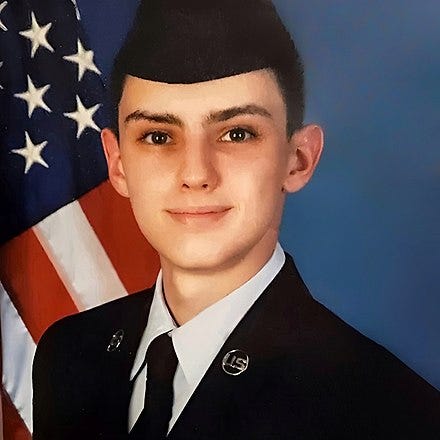
The recent disclosure of secret U.S. government files has resulted in reporting almost exclusively confined to the question of how the government’s security was breached. The secrets themselves contained have been mostly ignored or underplayed. The two most substantive revelations are the fact that US combat troops are stationed in Ukraine and the US intends to ensure that the fratricidal slaughter continues throughout 2023.
Glenn Greenwald: “There will be no negotiations, there will be no diplomatic settlement, there will be nothing but ongoing grinding, endless war that you will pay for beyond the $100 billion already authorized.”
The leak of NSA and CIA secrets has been treated as a grave criminal act by the media who were chiefly responsible for the apprehension of 21-year-old Massachusetts Air National Guardsman Jack Teixeira, as the result of a report published in the Washington Post of April 12, which led the FBI directly to the leaker.
The New York Times in an April 16 article, “Finding the Pentagon Leak Suspect,” also boastes of its role in assisting law enforcement in apprehending the whistleblower.
These facts should in the future dissuade any whistleblower gullible enough to trust that the Post and the Times will keep secret their revelations of government-perpetrated felonies.
“Why… would self-proclaimed journalism outlets do the job of the FBI and hunt down the leaker and boast of the fact that they were the ones who found him even before the FBI did?…
“There aren’t many ways to define the function of a free press and what journalism is without referencing the way in which journalists are supposed to bring transparency to the most powerful institutions… The idea of journalism, ostensibly, in theory, is to bring transparency to what the most secretive and powerful institutions are doing in the dark. Exactly what this leak did…
“One of the ways, arguably the only real way, that we, as journalists, now have to show the public what these institutions of power are doing in the dark is through leaks. Leaks of the things that they don’t want you to see, oftentimes being classified information.
“Classified information is not some sacred text. Classified information is nothing more than a document or a piece of information that the government has stamped on that word “classified” or “top-secret,” because they want to make it illegal for you to learn about it. That’s the effect of calling a document classified or top secret. And one of the things I learned in working with many large archives of government secrets and classified material is that, more often than not, when the government calls something classified or top secret, it’s not because they’re trying to protect you. It’s because they’re trying to protect themselves.
“They’re trying to make it illegal for anybody to show what it is that they’re saying and doing in the dark because what they’re saying and doing in the dark is composed of deceit, corruption, or illegality. And that’s why the most important journalism over the last 50 years…the Pentagon Papers, through the WikiLeaks reporting, the Snowden reporting… have taken place when people have been able to show you, the public, documents and other information that people inside the government wanted you not to see and made it illegal for anyone to show it to you”.
The spin-doctoring about leaks and the “need” for the Deep State to keep the truth about their treacherous machinations from the public, is an exercise in the artifice of political theater. The media, when it suits their purposes, appropriate to themselves the illustrious appellation of “patriot.” With the Federal government in the hands of tyrannical social engineers who keep the Cryptocracy’s esoteric grand design for the subjugation of our nation on schedule, leaking government secrets is now derided as unconditionally iniquitous—almost—though not quite.
We qualify our observation due to the fact that the media routinely leak the secrets the Deep States wants revealed. They pretended that an “unauthorized” CIA leaker revealed that Hunter Biden’s laptop was “Russian disinformation,” when in fact the CIA ordered CNN to make the information public, disguised as an unauthorized leak. There are good leaks and bad leaks. The ethical metric is decided by determining whether the leak favors the Deep State or undermines it. The contents of Hunter’s laptop was anathema to the ruling class so their intelligence arm ordered the media to brand it a fake conjured by Putin. The media can’t confess that they take orders from government intelligence agents hence, their subservience is disguised as a report about a clandestine fact disclosed without permission; in other words a “good” leak. There were many of those while Trump was president.
Young Jack Teixeira is a whistleblower who sounded an alarm about the propagators of World War III who occupy the US government, which seems somewhat newsworthy apart from the debate about leaks, yet it is not. Furthermore, to anticipate a criticism, the documents he released do not endanger our men and women in uniform. No sensitive intelligence on personnel in harm’s way was disclosed.
The facts about the gradual introduction of US special forces into Ukraine are incendiary; so too the knowledge that the Biden administration has no peace plan or ceasefire in mind, only more slaughter in the Slavic civil war’s ever larger butcher’s bill.
“Land of Felony”
If the American people were not so distracted and alchemically processed the revelation that Under Secretary of State Victoria Nuland and President Biden both declared the Nordstream Pipeline would be destroyed as indeed it was, by US agents, as well as the secrets contained in Mr. Teixeira’s leak, would awaken them and cause them to rise and work for the prosecution of the criminals in the District of Corruption.
Yet, as we take the occult pulse of programmed Americans we discover that they are exhausted rather than energized by the steady stream of shocking revelations of crime and corruption that flood our TVs and computer screens in this era.
Nineteen children were killed in Uvalde, Texas while the cops stood around and let it happen a few yards from where they stood.
Ho-hum.
Then there’s the Nashville massacre. It’s been nearly a month since a trans-gender individual shot to death three children and three adults at a Christian school in that city. Prior to the massacre the perpetrator reportedly issued a manifesto which we the people have not been allowed to see. Notice that not one sentence of that document has been leaked. It’s locked down tighter than Joe Biden’s soul.
It has in the interim however, been dismissed as a nothingburger by David B. Rausch, Tennessee’s top cop. Rausch, director of the Tennessee Bureau of Investigation, said that what police found isn’t so much a manifesto spelling out a target, as a series of rambling writings indicating no “clear” motive.
Nothing to see here folks, you can go back to sleep.
Sooner or later the manifesto will be released, possibly in redacted form, at some point in time sufficiently distant from the March 27 killings to dull the edge of public outrage.
Moreover, the delay of the release may itself be a psychological warfare ruse to discredit conspiracy theorists—and anyone else who is skeptical toward government. If the manifesto really is a “nothingburger,” why wouldn’t the authorities release it within a few days after the shootings? By suppressing it they build tension among the masses over the suspicion that some substantial secret is being withheld. If, when it is released, it is found to be a tissue of trivia, every skeptic from Elon Musk to Tucker Carlson will be made to look overwrought and foolish.
Tennessee news media have added the following concerning the alleged analysis and investigation of the manifesto: “The writings remain under careful review not only by Metro police, but also by the FBI’s Behavioral Analysis Unit based in Quantico, Virginia.”
The FBI’s “Behavioral Analysis Unit” has legendary status for discovering the mental secrets of monstrous murderers. This detail of their “crime-fighting” expertise exerts as much star power as did J. Edgar Hoover’s one-time polished image as a nemesis of the Mafia. Both are myths. The “Behavioral Unit” is a reference to miscreants inside the FBI who manipulate the behavior of Americans by directing, as we document in Twilight Language, ritual and mass murders subsequently blamed on the “lone nut” patsies who people “Arlington Road.”
One historical datum that is via col vento in the United States of Amnesia is the truth that the FBI was a participant in the terrorism it grouped under the title it concocted, “University and Airline Bomber” (“Unabomber”), crimes which were wholly attributed to LSD-experiment victim and scapegoat Ted Kaczynski. The details are in our book, Secret Societies and Psychological Warfare.
Ambrose Bierce, a Union veteran of the Civil War battles of Shiloh and Kennesaw Mountain, was a columnist for the San Francisco Examiner, renowned for his caustic wit. In Mexico to cover Pancho Villa’s rebel army he wrote home, “If you hear of my being stood up against a Mexican stone wall and shot to rags, please know that I think it is a pretty good way to depart this life. It beats old age, disease, or falling down the cellar stairs.” He disappeared in Mexico in 1914.
It would take a wordsmith of the caliber of Bierce to adequately account for the criminal politics in which our nation is at present sunk, and which would probably not have surprised the man who wrote, “My country ’tis of thee, sweet land of felony.”
Copyright ©2023 by Independent History and Research
Featured Video
Prof. Ted Postol: Iran Already Achieved Nuclear Deterrence Against Israel
or go to
Aletho News Archives – Video-Images
From the Archives
How the occupied mentality syndrome works
Saudi Arabia on the American chessboard – Part 3
By B. J. Sabri | American Herald Tribune | June 27, 2016
Read part 2: “The occupied mentality Syndrome“
Previously I argued whether Saudi Arabia’s repeated involvements in U.S. interventions and wars stem from free national will or in response to a specific condition. For starters, in Saudi Arabia there is no national will. In Saudi Arabia, the national will is the will of the Al Saud clan. Still, when a major Arab state allies itself with a superpower that committed unspeakable crimes against humanity in almost every Arab country, then something is wrong. This fact alone should compel us to examine the U.S.-Saudi relation for one exceptional reason. As a result of the U.S.-Saudi wars, hundreds of thousands of people in Afghanistan, Iraq, Iran, Libya, Syria, Yemen, and Somalia have lost their lives. Millions became displaced in their own homelands. And millions more rendered refugees.
Attributing the Saudi policies to the bonds of “partnership” with the U.S. is frivolous. There are no bonds between these two thugs except those of business, military deals, secret plots, and wars. Proving this point, bonds such as these have no space for the American and Saudi peoples to share significant cultural or societal exchanges. If partnership is not the reason for the Saudi contribution to the U.S. strategy of empire and imperialism, then another reason must exist.
This leads to three possibilities. … continue
Blog Roll
 Aletho News
- NIAID/NIH and USDA Fund Bioengineered Chimeric Influenza Viruses Built Using Pandemic H1N1 Components: Journal ‘Science Advances’
- Hezbollah hits Israeli warship off Lebanon’s coast, sets it aflame
- Iran slams US strikes on B1 bridge, Mahshahr petrochemical plants as ‘blatant acts of state terrorism’
- In letter to UN chief, Araghchi warns of dire consequences of US-Israeli attacks on Iran’s nuclear facilities
- Why the CIA conspiracy to invade Iran with Kurdish militias failed
- Why Are Upbeat US Claims About Mission to Rescue Pilot ‘Highly Questionable’?
- Aircraft destroyed during US ‘rescue’ of downed F-15 pilot cost more than $100 million each
- Washington University removes professor who condemned US-Israeli war on Iran
- Russia Warns of Retaliation as UK Authorizes Seizure of Vessels
- Serbia thwarts plot to bomb Russia-Hungary gas pipeline – Vucic
- If Americans Knew
- In Iran, Israel-US take aim at “reason, research, and freedom of thought” – Daily Update
- US loses planes over Iran, Israel downgrades Lebanon war goals – Daily Update
- Israel Is Blocking Palestinians from Easter at Church Where Jesus Resurrected
- Plot to assassinate Palestinian activist follows harassment campaign promoted by Zionist groups and elected officials
- Prominent New York synagogue hosts presentation on why U.S. Jews should support the ethnic cleansing of Gaza
- Tapper vs. Piker: Is the CNN Anchor Auditioning for David Ellison?
- Shouldn’t Democrats Be Able to Condemn Genocide?
- Israel-US kill negotiators, destroy civilian structures, but Iran’s military capabilities still largely intact – Daily Update
- ‘War crime’: Global condemnation as Israeli ministers celebrate death penalty law targeting Palestinian prisoners
- 7 Ways Israel Is Turning Lebanon Into Gaza
- No Tricks Zone
- An Inconvenient Tree: Uncovered In Alps… Europe Much Warmer Than Today 6000 Years Ago
- New Study Reports A 60% Slowdown In Greenland’s Ice Loss Rate In The Last Decade
- Low Intensity Tornado Wrecks Major Solar Farm, Creating A Potential Toxic Dump
- New Study Finds Warming Saves Lives…Cold Temperatures 12 Times More Deadly Than Excess Heat
- German Science Blog Accuses PIK Climate Institute Of Hallucinating Climate Tipping Points
- Devastating Assessment Of Comirnaty Vaccine By Former Senior Pfizer Europe Toxicologist
- New Study: CO2 Is ‘Effectively Negligible’ As An Explanatory Climate Change Factor Since 2000
- Former Pfizer Toxicologist Dr. Helmut Sterz Tells Bundestag Hearing Pfizer Vaccine Should Have Never Been Approved
- Energy Expert: Germany’s Nuclear Phaseout Was A “500 Billion Euro Mistake”
- New Research: South Australia’s Mid-Holocene Sea Surface Temperatures Were 4°C Warmer Than Today
 Aletho News