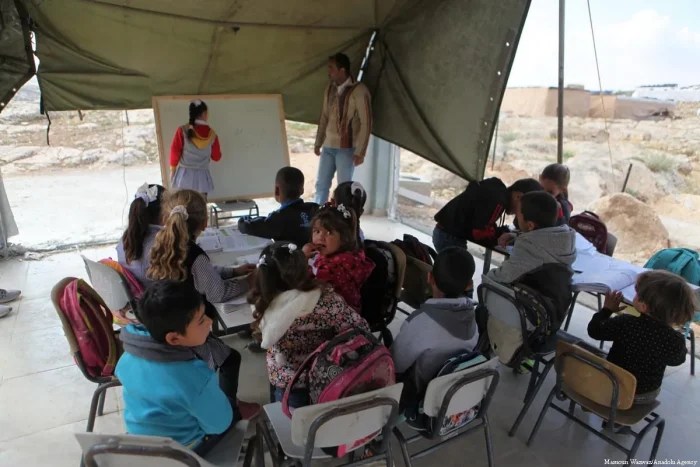
The Israeli Knesset advanced two bills yesterday that stipulate increasing the security grip over Arab schools in Israel and easing restrictions on firing Arab teachers, local media reported.
According to Haaretz, if approved, the bills would see the Israeli authorities upping the Israeli secret service’s background checks on staff and making it easier to fire teachers who affiliate with or support anti-occupation Palestinian groups.
The bills refer to the anti-occupation groups as “terror organisations” and stipulate punishments for supporting them.
Critics of the bills say they pose serious threats to freedom of expression and would undermine the right of teachers to condemn the aggression of the Israeli occupation.
One of the bills proposes the reinstatement of a permanent Shin Bet representative to the education ministry – a position which was cancelled in 2005.
In a previous report, Yedioth Ahronoth revealed that Shin Bet has a say regarding the recruitment of new Arab teachers.
… The bill was submitted by Ami Halevy, a Likud lawmaker, in order to establish licensing of Palestinian schools dependent on their “accommodating the fundamental requirements of the Israeli school system.”
This announcement came a day after the Israel Justice Minister, Yariv Levin, told Knesset members that the supreme court must feature judges who “understand” why Jewish settlers are “not prepared” to live alongside Arabs, which ultimately underlines the cabinet members’ pro-apartheid rhetoric. … Full article
June 3, 2023
Posted by aletho |
Ethnic Cleansing, Racism, Zionism, Full Spectrum Dominance | Israel, Palestine, Zionism |
Leave a comment
 A two-year-old Palestinian toddler has been severely wounded after being shot in the head by Israeli forces in the occupied West Bank yesterday.
According to the Wafa news agency, the toddler was shot in the head while sitting in a car with his 40-year-old father in front of their home.
The toddler was flown to Israel’s Sheba hospital by helicopter and is currently in a critical condition, while his father, who was shot in the arm, was driven to a hospital in Ramallah.
Local Palestinian activist, Bilal Tamimi, told Wafa that the toddler was shot in the head as a result of a raid imposed by Israeli occupation forces on the village.
The army said it was opening an investigation into the shooting, saying it “regrets harm to noncombatants” and that it does “everything in its power to prevent such incidents.”
Meanwhile, Naji Tamimi, the head of the Nabi Saleh Village Council, said Israeli soldiers locked the iron gate at the village entrance and proceeded to invade several neighbourhoods and fire live rounds at protesters.
Tension has been escalating across the occupied West Bank for months, amid Israeli raids on Palestinian towns.
More than 155 Palestinians have been killed by Israeli occupation forces this year, including 26 children, according to Palestinian figures. Last year was deemed the deadliest for the occupied West Bank since 2015, but this year’s death toll has already exceeded the number of those killed in 2022.
June 3, 2023
Posted by aletho |
Illegal Occupation, Subjugation - Torture, War Crimes | Human rights, Israel, Palestine, Zionism |
Leave a comment
The Zionist circles commented on the threats issued by some Israeli officials against Iran, stressing that they disregard the mistaken withdrawal of Trump’s administration from the deal.
It is worth noting that the Israeli threats came in light of the reports that indicate the rapid progress of the Iranian nuclear program and Washington’s endeavor to conclude a new deal with Tehran.
Israeli Channel 12 correspondent Nir Devori considered that intensifying threats is caused by the US tendency to strike a new nuclear deal with Iran away from the Zionist will.
The former Zionist prime minister Ehud Olmert noted that the Israeli failure occurred when Tel Aviv convinced Washington to withdraw from the deal, adding that reports confirmed Iran did not violate the pact.
Israeli circles also warned against an imminent rift between ‘Israel’ and the international community amid deep local crises.
June 3, 2023
Posted by aletho |
Wars for Israel | Iran, Israel, United States, Zionism |
Leave a comment
Iranian Navy Commander Rear Admiral Shahram Irani announced that Iran’s navy and the countries of the region including Saudi Arabia, UAE, Qatar, Bahrain and Iraq will form a new naval coalition soon.
Irani in a televised program on Friday night announced the formation of new regional and extra-regional coalitions, saying that today, the countries of the region have realized that the security of the region can be established through synergy and cooperation of the regional states.
Referring to the holding of annual exercises of the naval coalition of Iran, Russia and China, he said that the regional coalition is also forming.
Almost all the countries of the North Indian Ocean region have come to the understanding that they should stand by the Islamic Republic of Iran and jointly establish security with significant synergy, he said, adding that Oman, Saudi Arabia, UAE, Qatar, Bahrain, Iraq, Pakistan and India are among these countries.
Earlier, a Qatari website reported that Iran, Saudi Arabia, the United Arab Emirates, and Oman are to form a joint naval force under China’s auspices towards enhancing maritime security in the Persian Gulf.
Al-Jadid carried the report on Friday, saying China had already begun mediating negotiations among Tehran, Riyadh, and Abu Dhabi aimed at reinforcing maritime navigation’s safety in the strategic body of water.
Since the 1979 victory of Iran’s Islamic Revolution, the Islamic Republic has invariably opposed foreign meddling and presence in the region, asserting that the regional issues have to be addressed by the regional players themselves.
June 3, 2023
Posted by aletho |
Solidarity and Activism | Bahrain, China, India, Iran, Iraq, Oman, Pakistan, Qatar, Russia, Saudi Arabia, UAE |
Leave a comment
Washington and the UK have been continually disrupting peace negotiations in Yemen, informed sources in Sanaa were cited as saying in a report by Lebanese daily Al-Akhbar on 2 June.
“Washington and London are actively disrupting the Yemeni-Saudi political negotiations,” the newspaper wrote.
According to Al-Akhbar, the US and UK are trying to “obstruct all efforts that could lead to peace, and put among their first considerations the Israeli interest.”
This “Israeli interest” is the reason that Saudi Arabia has been “procrastinating” in the agreements it made with Sanaa, which include lifting all blockades and paying government employee salaries, Al-Akhbar said.
This, along with US and UK involvement, aim to keep Yemen in “a state of no war but no peace.”
Al-Akhbar’s sources were quoted as saying: “The political leadership in Yemen knows from the outset that … Riyadh is unable to abide by the terms of the agreement and … end the repercussions of the war due to the divergent regional interests.”
“The [coalition], as much as they agree on undermining Yemeni independence and sovereignty, they are in conflict with each other,” the sources added.
They went on to say that the Ansarallah resistance movement and the Sanaa government do not regret the political flexibility they showed during recent Omani-mediated talks with the kingdom. They warned, however, that time is not on the coalition’s side and that their military power has grown significantly.
The report goes on to explain how Saudi interests diverge from those of the UAE, the west, and Israel.
According to the Al-Akhbar report, Saudi Arabia has realized – despite its procrastination as a result of external pressure – that its interest lies in ending the war and withdrawing from “the Yemeni quagmire.”
However, the UAE wishes to maintain its occupation of Yemen’s ports and oilfields, as well as its occupation of the country’s waterways and particularly its islands, including the Socotra archipelago, which Abu Dhabi has been working in collaboration with Israel to transform into joint military and intelligence hubs. There have also been recent concerns over UAE-backed separatist ambitions in the south.
This also falls in line with the US and Israeli interest to maintain and bolster influence in the Red Sea.
The report adds that Israel is also particularly interested in the Bab al-Mandab Strait, which it considers a “vital artery” for trade with the east, and a key factor in strengthening influence in the Horn of Africa.
It concludes that the Israeli security establishment has significant concerns over Ansarallah’s capability to strike Israel with missiles.
June 3, 2023
Posted by aletho |
Illegal Occupation, Wars for Israel | Israel, Saudi Arabia, UAE, United States, Yemen, Zionism |
Leave a comment
As an alternative Part 1 can be watched on our Birthgap.org site for free without any risk of ads appearing here: https://www.birthgap.org/share/ZmFIdj…
** Featured at the Chelsea Film Festival, 2021 **
The era of ultra-low birthrates has begun. But why are people having so few children these days? And what are the consequences ? Come on a journey of discovery across 24 countries to find the reason and also the future consequences for young and old alike.
This is Part 1 of Birthgap – Childless World.
(c) Birthgap.org
June 3, 2023
Posted by aletho |
Economics, Timeless or most popular, Video |
Leave a comment
A Qatari website has reported that Iran, Saudi Arabia, the United Arab Emirates, and Oman are to form a joint naval force under China’s auspices towards enhancing maritime security in the Persian Gulf.
Al-Jadid carried the report on Friday, saying China had already begun mediating negotiations among Tehran, Riyadh, and Abu Dhabi aimed at reinforcing maritime navigation’s safety in the strategic body of water.
Back in March, Beijing successfully mediated talks between Tehran and Riyadh that led to the Persian Gulf littoral states’ signing of a deal enabling the restoration of their diplomatic ties.
According to observers, the Persian Gulf states’ consent to Beijing’s mediation in such sensitive matters serves to indicate China’s growing influence in the region as opposed to Washington’s waning clout.
Since the 1979 victory of Iran’s Islamic Revolution, the Islamic Republic has invariably opposed foreign meddling and presence in the region, asserting that the regional issues have to be addressed by the regional players themselves.
The latest instance of the opposition came last Friday when the commander of the Islamic Revolution Guards Corps (IRGC) Navy categorically dismissed the US military’s presence in the Persian Gulf under the pretext of securing the maritime region.
Rear Admiral Alireza Tangsiri said only Iran and other regional countries would ensure the security of the Persian Gulf and there was no need for the US and other countries to be present in the waterway. “If we back down against the enemy, it will definitely dominate us and we have no choice but to stand and resist, which is the path to the victory of our nation,” he said.
UAE quits US-led naval force
The UAE has, meanwhile, announced quitting a United States-led naval force.
On Wednesday, the website of the Emirati foreign ministry said Abu Dhabi had withdrawn from the Joint Maritime Forces that operate in the Red Sea and the Persian Gulf.
The ministry said the Emirates had decided to ditch the naval coalition following an extensive evaluation of its security needs.
Analysts say Abu Dhabi has chosen the withdrawal in line with its ambition to diversify its security relationships.
June 2, 2023
Posted by aletho |
Aletho News | China, Iran, Oman, Saudi Arabia, UAE, United States |
Leave a comment
… By Improving How Providers ‘Announce’ the Vaccine
This is the first in a two-part series examining federal funding for behavior modification approaches to increase uptake among teens of the human papillomavirus vaccine.
The U.S. Department of Health and Human Services (HHS) is funding a scientist who also is a paid consultant for Merck to conduct research on how to increase teen uptake of the human papillomavirus (HPV) vaccine, documents obtained by Children’s Health Defense (CHD) via a Freedom of Information Act (FOIA) request revealed.
Merck manufactures Gardasil, the only HPV vaccine available in the U.S.
Documents show that the National Cancer Institute (NCI) at the HHS in 2021 awarded a $4.7 million, five-year grant to the University of North Carolina (UNC) at Chapel Hill.
The grant’s principal investigator, Noel Brewer, Ph.D., a psychologist and professor in the Department of Health Behavior at the UNC Gillings School of Public Health, consults for Merck and is also the recipient of commercial research grants from Merck, Pfizer and GlaxoSmithKline (GSK).
The HHS grant builds on Brewer’s previous industry and HHS-funded research investigating different “research-tested interventions” intended to reshape the behavior of physicians and patients by “improving” the ways providers “announce” the vaccine to potential recipients, in order to get more teens to take the HPV vaccine.
The grant is focused on further developing “Announcement Approach Training,” which involves having providers skip the step of discussing with families in “open-ended conversation” whether or not they want their child vaccinated for HPV and instead “presume” the family wants the vaccine and announce the child will receive it as if it were a routine part of the office visit.
Brewer and others’ previous research has shown this method reduces the time a provider needs to spend talking with their patients and increases vaccine uptake.
Other projects funded by the grant consist of conducting randomized controlled trials to see how best to get clinics and clinicians to implement this approach to increase HPV vaccine uptake, according to the FOIA documents obtained by CHD.
One trial investigates how clinics can rework their “standing orders” — the protocols for all practitioners — to standardize how clinicians talk to their patients, for example, using the announcement approach, or to otherwise change the nature of doctor-patient interactions.
Another trial investigates how financial incentives affect providers’ willingness to strongly recommend the shots. A third trial tests whether training by “trusted messengers” works to better alter provider behavior.
The overall project will compare the effectiveness and cost of the different methods and model them in rural areas, which typically have lower HPV rates.
U.S. government awarded more than 50 grants worth $40 million to increase HPV vaccine uptake
The $4.7 million grant to UNC was by far the largest awarded by the HHS to increase HPV vaccine uptake, however, it was not the only one.
CHD’s search of USAspending.gov identified more than 50 grants totaling more than $40 million awarded by the HHS to universities, healthcare systems and departments of public health to increase HPV vaccine uptake.
Two of the smaller grants came from the U.S. Department of Defense rather than HHS.
All of the grants — awarded since 2009, with most awarded since 2016 — fund projects either to test or to implement different methods to change people’s behaviors at the community, provider and patient level with the goal of getting more young people to take the shot.
Some of the more recent grants also focused on increasing HPV uptake by combating “misinformation” on social media.
This approach to vaccine uptake is part of a larger turn in American healthcare toward applying lessons from behavioral economics, like “nudging” to healthcare.
“Nudging” figured prominently during the COVID-19 pandemic and was heavily utilized by governments and public health officials throughout the world to implement restrictions and countermeasures.
Economist Richard H. Thaler and legal scholar Cass R. Sunstein defined the concept in their bestselling 2008 book — “Nudge: Improving Decisions About Health, Wealth, and Happiness” — as a method that “alters people’s behavior in a predictable way without forbidding any options or significantly changing their economic incentives.”
Thaler and Sunstein presented nudging as a technocratic solution for tricky policy issues involving a perceived need to encourage, in a “voluntary manner,” policies or measures that would otherwise be unpopular.
The strategy made its way into public health long before COVID-19, with Big Pharma, regulatory agencies and doctors applying this behavioral approach to the clinic, trying to “nudge” patients toward desired choices by changing the “choice architecture” they are operating in so that they would choose differently.
Providers directed to ‘presume’ families want the vaccine
Over the past several years, much research has been dedicated to studying how “nudge” strategies can be applied to vaccine uptake, particularly the COVID-19 vaccine.
A study posted in BMJ Global Health in 2021 called for further research into whether methods such as the “Announcement Approach” could effectively “nudge” people to take vaccines.
The documents related to the $4.7 million HHS grant obtained by CHD include detailed proposals for the randomized controlled trials in the “Improving Provider Announcement Communication Training” project, which investigates this approach.
The university webpage shows a total grant of $11.7 million, which appears to include administrative overhead costs.
The broader project is divided into four sub-projects, each led by a different faculty member with Brewer as the lead investigator.
Much of Brewer’s professional work is dedicated to increasing HPV vaccination uptake. He chairs the National HPV Roundtable, which brings together medical associations, nonprofits, health insurance providers and pharmaceutical companies, with funding from the Centers for Disease Control and Prevention (CDC) to raise HPV vaccination rates.
He also advises the World Health Organization, the CDC and other organizations on “vaccine communication.”
Brewer is also a consultant who has served on different paid Merck HPV advisory boards since 2011 and has been a general consultant for the company since 2019.
According to his curriculum vitae, he has given numerous talks at Merck events on how to increase HPV vaccine uptake.
Merck awarded Brewer more than $500,000 in grant funding to study HPV vaccine uptake and he received more than $400,000 from Pfizer to study how trainings might improve physician perceptions and recommendations of the HPV vaccine. He has also received funding from GSK.
He is a member of HHS’s National Vaccine Advisory Committee working group on the HPV vaccine and his website says he was a paid advisor to the U.S. Food and Drug Administration (FDA).
The FOIA documents included support letters from Brewer’s colleagues celebrating how Brewer had “already changed the national landscape for increasing HPV vaccination.”
Brewer and his colleague Melissa Gilkey, Ph.D., associate professor of Health Behavior, developed “Announcement Approach” training specifically for the HPV vaccine and in this project are conducting randomized controlled trials to determine how best to put the approach into practice.
The research premise is that provider recommendations are key to increasing uptake of the HPV vaccine, but that providers either don’t recommend the vaccine — in part because they know parents have doubts about it — or don’t use the most effective method, “presumptive recommendation,” rebranded here as Announcement Approach, to make their recommendation.
A “presumptive recommendation” is made when the provider does not offer the option of not taking the vaccine to the family, thereby limiting the landscape of available choices.
This method directs the provider to act as if the family has already decided to vaccinate their child — to “presume” they want to be vaccinated — rather than opening space for dialogue or conversation around the vaccine.
Brewer et al.’s previous research that found training doctors to give announcements rather than have conversations with their patients, where they might raise more questions, led to higher rates of vaccine uptake.
Brewer’s team found clinics that used the presumptive or announcement approach had a 5.4% increase in uptake and physicians had to spend 40% less time discussing the vaccine with families.
The grant documents provide an example of the announcement approach:
“Announcements should indicate that HPV vaccination is part of routine care …
“We recommend that announcements 1) note the child’s age to establish what follows as part of routine care; 2) say the child is due for several vaccinations (noting the diseases prevented, not the vaccine names); and 3) say that the child will receive vaccines today.
“An example of a presumptive announcement is, ‘Now that Sophia is 12, she is due for 3 vaccines. Today, she’ll get vaccines to prevent meningitis, HPV cancers, and whooping cough.’”
For “hesitant parents” who don’t submit to the HPV vaccination with the initial approach, the provider should “connect and counsel.”
To do this the provider:
“1) connects with the parent by showing empathy and confirming the parent’s main question without reinforcing misinformation; and
“2) counsels the parent using a research-tested message and encourages them to vaccinate today.”
According to the grant proposal, “Messages in the counsel step increase parents’ intentions to vaccinate in our prior randomized experiments (e.g, ‘This vaccine is one of the most studied medications on the market. The HPV vaccine is safe, just like the other vaccines given at this age.’)”
If parents decline same-day vaccination, the team member makes a note in the patient’s chart and addresses HPV vaccination at the next visit.
In an observational study, the “announcement” or presumptive method was associated with an increase in parental vaccine acceptance but also with reduced satisfaction in the clinical experience.
The participatory or conversational format — where providers offer the full range of options to patients and dialogue with them about it —showed the opposite pattern.
HPV vaccine generates profits for Merck and HHS, which funds the grant
Brewer receives research funding from both Merck and HHS/NCI, both of which stand to gain financially from increased HPV vaccine uptake.
Merck — the only producer of HPV vaccines in the U.S. since GSK pulled Cervarix from the U.S. market in 2016 — generates billions annually from Gardasil sales. It reported sales of $4 billion in 2020, despite the challenges of the pandemic.
Sales jumped to $5.7 billion in 2021. And with expanded production and global uptake, Merck anticipates “very strong sequential and year-over-year growth for Gardasil.”
The National Cancer Institute at the NIH developed the technology for the HPV vaccine and licensed it to Merck, which formulated its Gardasil vaccine and ran the clinical trials. The FDA granted Fast Track approval for Gardasil after only a six-month review process and it was licensed to Merck in 2006.
From 2007 through 2019, the HPV vaccine was among the NIH’s top four most commercially successful inventions, an assessment based on the royalties a product produces for the NIH.
The National Cancer Institute, which is housed in the HHS, receives the royalties from the Gardasil vaccine and is the agency funding the UNC study.
The inventors, who work for the NIH, also individually receive up to $150,000 per year for their patentable inventions, depending on how much the NIH receives in royalties.
It is unclear how much NIH receives from the HPV vaccine. A 2020 Government Accountability Office report found that the NIH had generated $2 billion in profits from 34 licensed drugs — with three drugs generating more than $100 million — it created since 1991 and recommended that NIH ought to increase transparency around this process.
HPV vaccination, which requires multiple doses, was first recommended by the CDC for girls in 2006 and for boys in 2011. The CDC routinely recommends vaccination at ages 11-12 and says it can be started at age 9.
HPV infections may lead to the development of cervical cancer. However, most infections are benign and resolve on their own.
The UNC grant description states the HPV vaccine could prevent 32,100 cancers per year if it were administered at the target rate of 80% of the population.
But the efficacy of the vaccine is disputed.
Studying HPV vaccine efficacy for eliminating cervical cancer is challenging due to the long amount of time between infection and the development of cancer (mean time 23.5 years), lack of adequate informed consent, complexity between HPV infection and cervical cancer and the negative impact of girls’ sexual behavior, which may worsen the risks of cervical cancer.
In 2020, the CDC reported that about 75% of U.S. teens had gotten at least one dose in the two or three-dose HPV series, and about 59% had gotten the whole series — a rate that falls short of its goal of 80% coverage. That number dropped nearly 5% during the pandemic.
It also reported that uptake of the HPV vaccine is lower than that of other routinely recommended vaccines. A new study published May 23 in Pediatrics investigated why parents decide against the HPV vaccine for their children.
The study found that although uptake increased overall between 2010 and 2020, during that time, the number of parents citing “safety or side effects” as a reason for vaccine hesitancy increased by nearly 16% annually.
Since the Gardasil vaccine was introduced in 2006, numerous studies have linked it to debilitating autoimmune disorders, neurological side effects and other complications, prompting many families of injured children to file lawsuits alleging the company knew the vaccine could cause serious side effects, The Defender reported.
Until the COVID-19 vaccine became available, the FDA had received more adverse reaction reports related to Gardasil than any other vaccine in history.
The National Vaccine Injury Compensation Program has paid out over $70 million to people making claims regarding Gardasil. Merck now faces more than 80 complaints in federal court alleging that the HPV vaccine caused debilitating autoimmune complications. A judge consolidated 31 of these cases into a single bellwether pool, against Merck’s protest.
But Merck continues to work with national agencies to increase gardasil uptake. Merck’s researchers in March published a study in Pediatrics suggesting evidence shows that moving routine HPV vaccination to ages 9 to 10 may improve vaccination coverage rates.
Brenda Baletti Ph.D. is a reporter for The Defender. She wrote and taught about capitalism and politics for 10 years in the writing program at Duke University. She holds a Ph.D. in human geography from the University of North Carolina at Chapel Hill and a master’s from the University of Texas at Austin.
This article was originally published by The Defender — Children’s Health Defense’s News & Views Website under Creative Commons license CC BY-NC-ND 4.0. Please consider subscribing to The Defender or donating to Children’s Health Defense.
June 2, 2023
Posted by aletho |
Deception | United States |
Leave a comment
Video platform YouTube has reversed its controversial ban on questioning the validity of the 2020 and other US election results, acknowledging in a Friday blog post that the policy could silence legitimate political speech.
Effective immediately, the platform said, “content that advances false claims that widespread fraud, errors, or glitches occurred in the 2020 and other past US presidential elections” will no longer be removed.
Citing “today’s changed landscape,” the Alphabet subsidiary explained that “in the current environment, we find that while removing this content does curb some misinformation, it could also have the unintended effect curtailing political speech without meaningfully reducing the risk of violence or other real-world harm.”
YouTube explained its policies were aimed at two goals – “protecting our community, and providing a home for open discussion and debate” – and that those goals were not always aligned, admitting open debate was “core to a functioning democratic society.”
While the scrapped policy supposedly covered all past US elections, YouTube had appeared to focus its censorship on content questioning the 2020 results, ignoring or even promoting content that suggested the 2016 outcome was the result of Russian interference, especially if it came from establishment media outlets.
The platform acknowledged removing “tens of thousands” of videos due to the now-repealed ban on electoral fraud discussion. However, the blog post did not indicate if any of those videos would be restored or re-evaluated. While YouTube offers users whose content has been removed a chance to appeal the decision, critics claim the process is only for show and rarely if ever results in content being reinstated.
The platform also reminded users that the rest of its “election misinformation” policies still applied, meaning users could not post content designed to mislead voters about when, where, or how to vote or anything that might either discourage someone from voting or encourage someone to interfere with elections.
Freedom of speech has become a critical issue in the 2024 elections, with both Republican frontrunner Donald Trump and leading Republican challenger Ron DeSantis, as well as Democratic contender Robert F. Kennedy Jr., promising to take on Big Tech’s far-reaching censorship powers.
June 2, 2023
Posted by aletho |
Progressive Hypocrite | United States |
Leave a comment
The German press discover that maybe big pharma & their political enablers are not our friends after all
I know it’s not the repudiation we hoped for, but the widening displeasure over the deeply idiotic and imprudent contracts that the European Union negotiated with Pfizer and BioNTech for Covid-19 vaccine doses says a lot about where the vaccinators find themselves, politically and socially, at this late hour.
That erstwhile pillar of the vaccinator-industrial complex, the Süddeutsche Zeitung, has revealed a markedly reduced enthusiasm for the vaccines and their procurement in the past months. After attacking the lack of transparency surrounding the contract negotiations, they’ve found the energy to deplore all the worthless vaccine that our health ministers have purchased:
In Germany, by the end of March 2023, around 83 million Covid-19 vaccine doses expired and were thrown away by with the federal government alone. Health Minister Karl Lauterbach (SPD) has informed a private session of Bundestag budget committee of these developments …
These figures raise many questions. Did Germany, especially under Lauterbach’s predecessor Jens Spahn (CDU), but also during Lauterbach’s tenure during the fight against the pandemic, order too much vaccine? Could they have avoided these costs, which reach into the billions? Or did the state have no choice, because it was not foreseeable how many people would get vaccinated, and how many injections would be needed for effective protection in the longer run?
What devastating answers all of these questions have.
In any case, the EU and the Federal Republic of Germany have purchased far more vaccine than is needed now. As the Ministry of Health informed the Bundestag, Germany has donated 120 million vaccine doses to other countries. Even after these donated doses left the central warehouse, further doses nevertheless expired …
The Ministry explains that additional doses have expired ““at the various stages” of the supply chain. This refers to doses shipped to wholesalers, pharmacies and doctors’ offices. These parties are in turn responsible for “proper disposal,” the ministry explains. They did not provide figures on how many doses had expired and been destroyed by these wholesalers, pharmacies and medical practices. It is possible that these numbers have not been collected.
In other words: The 83 million figure represents a floor; nobody actually knows or is all that eager to tabulate how many doses have been thrown away.
When asked by the SZ, the Ministry of Health did not say how much the expired and destroyed doses at the federal level cost. Publicly available data nevertheless supports the assumption that the costs to the taxpayer … are in the billions.
And that may not be all.
Through the start of 2023, the federal government had ordered a total of 672 million doses for 13.1 billion Euros, generally via the EU. Each jab therefore costs just on average just under 20 Euros … According to the Ministry of Health, by the start of May, around 192 million doses had been injected in Germany, and some of the deliveries are still outstanding.
More than a year ago, the Berlin-based newspaper Tagesspiegel asked whether Lauterbach was threatened with “billions in damages”. At that time, it was already becoming apparent that vaccine could remain unused. In mid-2022, 3.9 million vaccine doses had expired. By the beginning of 2023, there were already 36.6 million vaccine doses. And now, only five months later, it is already 83 million. By the end of last year, approximately 54 million doses had expired and in the first quarter of 2023, approximately 29 million doses had been destroyed, the ministry informed the Bundestag.
Possibly even more vaccine will have to be destroyed. As of the beginning of May, the federal government still has stores amounting to around 120 million doses. Their future is “fraught with uncertainty” and depends, among other things, on the future course of the pandemic, the Ministry of Health informed the Bundestag. The Federal Government still intends to give “unneeded vaccine” to other countries.
Not a single country anywhere on earth can be found to take this stuff.
To avoid having to destroy more vaccine, the EU has now negotiated a partial cancellation of supply contracts with the pharmaceutical companies BioNTech and Pfizer. A “cancellation fee” is due for this, Lauterbach informed the Bundestag. According to reports, Lauterbach did not give a figure. The cancellation fees for unwanted vaccine is likely to reach costs in Germany alone of hundreds of millions of Euros.
While the details of the deal are officially secret, an outraged Polish health minister revealed several weeks that Pfizer and BioNTech have demanded that EU countries pay 50% of the cost for every previously ordered yet unneeded vaccine dose.
At the end of the article there lurks this foul paragraph:
With early access to safe and effective vaccines, many lives have been saved and millions of people have been protected from serious illness. The economic costs of the pandemic have also been reduced and the “impact on social life has been noticeably mitigated.” The vaccine surplus is a consequence of this strategy. This is how the Ministry of Health justified the bulk purchases in the Bundestag.
We’ve been over this many times at the plague chronicle, but as long as politicians and the press continue to indulge in these hollow excuses, I’ll keep repeating myself: It’s strange indeed that enthusiasm for these SaFE aNd EfFeCtIvE vaccines should have plummeted in precise inverse correlation to public experience with them. You’d almost think that the more the vaccinators were allowed to vaccinate, the more everybody decided the vaccines weren’t for them after all. This is hardly the response you’d expect to such miraculous, life-saving side effect-free products.
A great many journalists, bureaucrats, politicians and ordinary people were complicit in the excesses of the past several years, and as the policies of the pandemic continue to sour, they’ll do anything but talk about it. This more than anything is the reason for the deafening silence surrounding all of these matters. What critique there is will increasingly attach itself to isolated matters, such as school closures, and to specific initiatives in which few participated directly, such as the buying of vaccines. They’ll do everything they can to assign blame in those few areas, where they can’t be blamed themselves.
June 2, 2023
Posted by aletho |
Corruption, Deception, Mainstream Media, Warmongering | Germany |
Leave a comment
Washington, D.C. – The source of the false complaint that triggered the nearly year-long investigation into research supporting the use of intravenous Vitamin C to treat medical sepsis has publicly acknowledged his error and expressed regret for questioning the integrity of the study’s lead author, Paul E. Marik, M.D., FCCM, FCCP, founding member of the Front Line COVID-19 Critical Care Alliance (FLCCC) and former Chief, Pulmonary and Critical Care Medicine at Eastern Virginia Medical School.
In March of 2022, Kyle Sheldrick, a physician and Ph.D. candidate in Australia, made a series of unsubstantiated allegations of fraud on social media and to the CHEST Journal, claiming that he was able to determine that study data had been fabricated by applying baseless statistical methods to the 2017 peer-reviewed study led by Dr. Marik titled “Hydrocortisone, Vitamin C, and Thiamine for the Treatment of Severe Sepsis and Septic Shock: A Retrospective Before-After Study.” After receiving the complaint, the CHEST Journal launched a thorough review of the study that lasted almost a year. In April of this year, Dr. Marik received a letter from the journal stating that the investigation found no methodological errors as cited by the allegations.
Today Dr. Sheldrick issued the following statement acknowledging his mistake and accepting the outcome of the investigation:
“On 22 March 2022, I posted a blog post called ‘This scattrd corn.’ This post was a copy of a complaint I filed with the journal CHEST identifying features of a study led by Paul Marik titled ‘Hydrocortisone, Vitamin C, and Thiamine for the Treatment of Severe Sepsis and Septic Shock’ published on 3 February 2017 in CHEST, identifying that I believed them to be signs of fraud, and linked to this on twitter.
Those complaints have since been formally rejected by the journal CHEST, which I consider to be the definitive conclusion to the matter. I realise that this letter was used to imply that Dr. Marik personally acted deceptively, and falsely reported study data, which was not my intention, and this caused him significant hurt and distress. I regret this hurt to Dr Marik. I will inform those who have reported on this complaint that it has been rejected by the journal.
Dr Marik has also indicated to me that some subsequent controlled studies have found some positive outcomes for vitamin C in Sepsis, and I accept this.
This statement is not an endorsement of the use of Vitamin C in sepsis.”
“It was highly unprofessional that Kyle went to such lengths to accuse my colleagues and me publicly of academic fraud,” said Paul E. Marik, M.D., FCCM, FCCP, founding member of the Front Line COVID-19 Critical Care Alliance (FLCCC) and former Chief, Pulmonary and Critical Care Medicine at Eastern Virginia Medical School. “I hope that as he gains more experience as a researcher, he will understand that there are protocols in place for questioning the results of research that prevent harming reputations by making baseless accusations in public.”
The journal’s response to Dr. Marik did cite two minor revisions that do not change the final outcome of the original published study, but simply make it clear that some of the patients selected for the control group were “nonconsecutive” given the nature of hospital logistics and that the 1.5 g every 6 h for 4 days was a “target” dose that might not have been reached in all patients due to clinical considerations.
In a previous statement, Dr. Marik said the following about the revisions from CHEST : “I welcome the two words changed by the journal as they make the description of our methodology clearer and have no impact on the research results. However, this whole process was unnecessary as it raised unneeded concern about a life-saving treatment that we know is effective and used worldwide. I hope patients were not deprived of this vital treatment because of these false allegations.”
The World Health Organization estimates that in 2017 there were 11 million sepsis deaths worldwide, half of these deaths occurred among children.
A link to Dr. Sheldrick’s statement can be found here: https://kylesheldrick.blogspot.com/2023/05/update.html
A copy of the CHEST Journal’s findings can be found here: https://covid19criticalcare.com/wp-content/uploads/2023/04/Marik-Vitamin-C_Editors-Note-and-Ltr-to-Marik-2023-04-03.pdf
The published study can be found here: https://pubmed.ncbi.nlm.nih.gov/27940189/
About the Front Line COVID-19 Critical Care Alliance
The FLCCC Alliance was organized in March 2020 by a group of highly published, world renowned critical care physicians and scholars with the academic support of allied physicians from around the world. FLCCC’s goal is to research and develop lifesaving protocols for the prevention and treatment of COVID-19 in all stages of illness including the I-RECOVER protocols for “Long COVID” and Post Vaccine Syndrome. For more information: www.FLCCC.net
June 2, 2023
Posted by aletho |
Science and Pseudo-Science |
Leave a comment
The World Health Organization (WHO) is proposing a set of recommendations for “social listening surveillance systems” designed to address what it describes as a “health threat” posed by online “misinformation.”
The WHO’s Preparedness and Resilience for Emerging Threats (PRET) initiative claims “misinformation” has resulted in an “infodemic” that poses a threat — even in instances where the information is “accurate.”
PRET has raised eyebrows, at a time when the WHO’s member states are engaged in negotiations on two controversial instruments: the “pandemic treaty” and amendments to the International Health Regulations (IHR).
The latest draft of the pandemic treaty contains language on how WHO member states would commit to “social listening.” Under article 18(b), WHO member states would commit to:
“Conduct regular community outreach, social listening, and periodic analysis and consultations with civil society organization and media outlets to identify the prevalence and profiles of misinformation, which contribute to design communications and messaging strategies for the public to counteract misinformation, disinformation and false news, thereby strengthening public trust and promoting adherence to public health and social measures.”
Remarking on PRET’s “social listening” proposals, Michael Rectenwald, Ph.D., author of “Google Archipelago: The Digital Gulag and the Simulation of Freedom” and a former New York University liberal studies professor, told The Defender :
“The WHO’s PRET initiative is part of the UN’s attempt to institute global ‘medical’ tyranny using surveillance, ‘social listening’ and censorship. PRET is the technocratic arm of the WHO’s proposed pandemic treaty, which, if accepted by nation-states, would amount to the surrendering of national and individual sovereignty to this ‘global governance’ body.
“What better way to establish a one-world government than by using so-called global crises that must be addressed by nothing short of ‘global governance’? I remind readers that you cannot comply your way out of tyranny.”
WHO could use artificial intelligence to monitor social media conversations
A WHO document outlining the PRET initiative — “Module 1: Planning for respiratory pathogen pandemics, Version 1.0” — contains a definition of infodemic:
“Infodemic is the overabundance of information — accurate or not — which makes it difficult for individuals to adopt behaviors that will protect their health and the health of their families and communities.
“The infodemic can directly impact health, hamper the implementation of public health countermeasures and undermine trust and social cohesiveness.”
The document recommends that in response to the “infodemic,” countries should “incorporate the latest tools and approaches for shared learning and collective action established during the COVID-19 pandemic.”
According to the WHO document, this can be done if governments “establish and invest in resources for social listening surveillance systems and capacities to identify concerns as well as rumors and misinformation.”
Such resources include “new tools and approaches for social listening … using new technologies such as artificial intelligence to listen to population concerns on social media.”
According to the document:
“To build trust, it’s important to be responsive to needs and concerns, to relay timely information, and to train leaders and HCWs [healthcare workers] in risk communications principles and encourage their application.”
Risk communications “should be tailored to the community of interest, focusing on and prioritizing vulnerable groups,” the WHO said.
“Tailored” communication was a hallmark of public health efforts during the COVID-19 pandemic.
For instance, in November 2021, the Rockefeller Foundation, the National Science Foundation and the Social Science Research Council launched the Mercury Project, which aimed “to increase uptake of COVID-19 vaccines and other recommended public health measures by countering mis- and disinformation” — in part by studying “differential impacts across socio-demographic groups.”
Similarly, PRET states that it will “incorporate the latest tools and approaches for shared learning and collective action established during the COVID-19 pandemic.”
These “tools and approaches” could be deployed during “acute respiratory events,” according to the document, which recommends that governments:
“Develop and implement communication and behavior change strategies based on infodemic insights, and test them during acute respiratory events including seasonal influenza.
“This includes implementing infodemic management across sectors, and having a coordinated approach with other actors, including academia, civil society, and international agencies.”
This is not the first time the WHO has addressed the so-called “infodemic.”
A WHO review published Sept. 1, 2022, titled “Infodemics and health misinformation: a systematic review of reviews,” found that “infodemics and misinformation … often negatively impact people’s mental health and increase vaccine hesitancy, and can delay the provision of health care.”
In the review, the WHO concluded that “infodemics” can be addressed by “developing legal policies, creating and promoting awareness campaigns, improving health-related content in mass media and increasing people’s digital and health literacy.”
And a separate, undated WHO document advises the public on how we can “flatten the infodemic curve.”
WHO, Google announce collaboration targeting ‘medical misinformation’
The WHO’s PRET proposals coincided with a new multi-year collaboration agreement with Google for the provision of “credible health-related information to help billions of people around the world respond to emerging and future public health issues.”
The agreement was announced on May 23 by Dr. Karen DeSalvo, Google’s chief health officer, on the company’s blog. She wrote:
“Information is a critical determinant of health. Getting the right information, at the right time can lead to better health outcomes for all. We saw this firsthand with the COVID-19 pandemic when it was difficult for people worldwide to find useful information online.
“We worked with the World Health Organization (WHO) on a range of efforts to help people make informed decisions about their health — from an SOS alert to surfacing locally relevant content about COVID-19 to YouTube policies on medical misinformation.”
One way Google will collaborate with the WHO is through the creation of more “knowledge panels” that will prominently appear in search results for health-related questions on the platform.
“Each day people come to Google Search looking for trustworthy information on various health conditions and symptoms,” DeSalvo wrote. “To help them access trustworthy information our Knowledge Panels cite content from reliable sources covering hundreds of conditions from the common cold to anxiety.”
“Working closely with WHO, we’ll soon expand to cover more conditions such as COPD [chronic obstructive pulmonary disease], hypertension, type 2 diabetes, Mpox, Ebola, depressive disorder, malaria and more,” she added.
Google will make these Knowledge Panels available in several languages, including English, Arabic, Chinese, French, Russian and Spanish.
DeSalvo’s May 23 post also addressed an ongoing collaboration between Google and the WHO, Open Health Stack (OHS), which “help[s] accelerate the digital transformation of health systems around the world” and “lower[s] the barrier to equitable healthcare.”
Google also awarded the WHO with more than $320 million “in donated Google Search advertising via ad grants” allowing the agency “to publish health topics beyond COVID-19, such as Mpox, mental health, flu, Ebola, and natural disasters.”
Google is slated to provide an additional $50 million in ad grants to the WHO this year.
According to Google, the ad grants to the WHO represent the company’s largest such donation to a single organization.
Separately, the U.S. Food and Drug Administration (FDA) tweeted on May 22 about the agency’s own efforts at combating purported “misinformation” and “disinformation.”
The tweet contains a 35-second video, which claims “misinformation” travels “six times faster than the facts,” while promoting the FDA’s “Rumor Control” initiative.
A top priority of FDA Commissioner Dr. Robert Califf, “Rumor Control” was launched in August 2022 and joins other agency initiatives to fight “misinformation” and “disinformation.”
“The growing spread of rumors, misinformation and disinformation about science, medicine, and the FDA, is putting patients and consumers at risk,” according to the FDA’s Rumor Control webpage. “We’re here to provide the facts.”
The initiative asks the public to do “three easy things” to “stop rumors from spreading”: “don’t believe the rumors,” “don’t pass them along” and “get health information from trusted sources like the FDA and our government partners.”
“Rumor Control” appears to have been inspired by an initiative developed by the Virality Project, “a coalition of research entities” from six institutions “focused on supporting real-time information exchange between the research community, public health officials, government agencies, civil society organizations, and social media platforms.”
Documents released as part of the “Twitter files” in March revealed that the Virality Project, based out of the Stanford Internet Observatory, also called for the creation of a disinformation board just one day before Biden announced plans to launch his government-run Disinformation Governance Board.
Similar to PRET’s recommendations to target “accurate” information that nevertheless contradicts establishment public health narratives, the Virality Project worked with Twitter and other social media platforms, recommending they “take action even against ‘stories of true vaccine side effects’ and ‘true posts which could fuel hesitancy.’”
These censorship efforts included at least one tweet by Robert F. Kennedy Jr., chairman on leave of Children’s Health Defense.
Michael Nevradakis, Ph.D., based in Athens, Greece, is a senior reporter for The Defender and part of the rotation of hosts for CHD.TV’s “Good Morning CHD.”
This article was originally published by The Defender — Children’s Health Defense’s News & Views Website under Creative Commons license CC BY-NC-ND 4.0. Please consider subscribing to The Defender or donating to Children’s Health Defense.
June 2, 2023
Posted by aletho |
Civil Liberties, Full Spectrum Dominance, Science and Pseudo-Science | FDA, Google, Human rights, Rockefeller Foundation, WHO |
Leave a comment


 Aletho News