Montana Becomes First State to Ban Warrantless Data Purchases by Law Enforcement
By Ken Macon | Reclaim The Net | May 18, 2025
Montana has taken a decisive leap where others have faltered, becoming the first state in the US to officially outlaw a widespread government surveillance tactic: buying up private data without a warrant.
With the passage of Senate Bill 282 (SB 282), lawmakers have directly confronted what has become a backdoor into people’s lives, commercial data brokers selling sensitive digital information to law enforcement agencies, sidestepping the need for judicial authorization.
This so-called “data broker loophole” has allowed government agencies across the country to acquire personal details they’d otherwise need a warrant to access.
Instead of presenting probable cause to a judge, agencies could simply purchase location histories and other metadata from third-party brokers who gather it from mobile apps.
These apps often track users’ movements down to the minute, creating comprehensive logs of their daily routines. Until now, that information was effectively up for grabs, and no warrant has been required.
Montana’s new law puts a clear end to that practice. Under SB 282, state and local government entities are now barred from purchasing several categories of digital data, including but not limited to: electronic communications and their contents, geolocation data, financial transaction records, pseudonymous identifiers, and other forms of sensitive personal information such as religious beliefs, health status, and biometric details.
Importantly, the legislation doesn’t eliminate access altogether, it restricts how that access is obtained.
Law enforcement in Montana must now secure a judge’s approval via a search warrant or meet other legal standards such as investigative subpoenas. Consent from the device’s owner is also still a permissible route.
What SB 282 achieves is a ban on the government using cash instead of cause to gather what should be protected digital traces.
This isn’t Montana’s first move to prioritize digital civil liberties.
The state has already passed a range of privacy-forward policies in recent years, including strong limitations on facial recognition, protections for genetic information, and a state constitutional amendment that explicitly shields digital data from unreasonable searches and seizures. SB 282 continues that trend, bolstering Montana’s reputation as a leader in privacy rights.
The structure of the new law aligns with the spirit of a federal bill, the Fourth Amendment is Not for Sale Act, introduced by Senator Ron Wyden.
In the vacuum left by federal inaction, states have begun crafting their own responses. Montana, despite its modest population, is now at the forefront of that movement.
Montana becomes first state to close the “data broker loophole” that allows law enforcement to purchase data without a warrant by enacting SB 282 which prohibits the government from using money to access certain types of sensitive digital information
Independent Media Alliance Launches Decentralized Journalism Portal on Odysee to Bypass Big Tech Censorship
By Rick Findlay | Reclaim The Net | May 19, 2025
A new chapter in digital journalism is taking shape as the Independent Media Alliance (IMA) prepares to unveil its own Portal within Odysee’s Decentralized Media Ecosystem (DME).
The alliance, spearheaded by investigative journalists Whitney Webb, Derrick Broze, and Ryan Cristián, aims to reclaim editorial independence and resist the growing stranglehold of centralized tech platforms on public discourse.
The Portal represents a structural shift away from platforms where algorithms and moderation policies routinely silence dissenting voices. Odysee’s model hands control back to creators, offering a space where journalists can publish, monetize, and manage their communities on their own terms.
The IMA, which includes Webb of Unlimited Hangout, Broze of The Conscious Resistance Network, and Cristián of The Last American Vagabond, has endured repeated clampdowns, from suppressed reach to financial de-platforming for pushing back against establishment narratives. Their decision to anchor their work in a decentralized system is a direct response to the growing marginalization of independent media.
Each Portal functions autonomously. Rather than being buried by algorithmic filters or subjected to arbitrary moderation, creators maintain full sovereignty over how content is shared, discussed, and funded.
“Portal is about returning control to the creators,” said Julian Chandra, Odysee’s founder and CEO. “The Independent Media Alliance shows how groups of journalists can build their own spaces, manage their own communities, and protect the integrity of their work without reliance on centralized platforms.”
For the IMA, joining Portal is a philosophical move. This step affirms that free expression requires infrastructure not beholden to corporate interests. It’s a rejection of the controlled environments that have made it increasingly difficult for journalists to reach audiences without interference.
The IMA’s move reflects a commitment to building an ecosystem where information flows freely and creators are no longer forced to compromise their principles.
By aligning with Odysee, the IMA is laying the groundwork for a resilient model of journalism, one that can’t be throttled by opaque policies or the shifting whims of tech giants.
Are US-Israel ‘special relations’ about to end?
By Murad Sadygzade | RT | May 19, 2025
Last week, US President Donald Trump embarked on his first official overseas tour since taking office, choosing to visit three key Gulf nations – Saudi Arabia, Qatar, and the United Arab Emirates.
This itinerary was both unexpected and, in many ways, unprecedented. Unlike his predecessors, who traditionally began their foreign policy engagements with visits to long-standing Western allies, Trump opted to prioritize America’s Arab partners, deliberately bypassing Israel – Washington’s principal strategic ally in the region. This marked the first time in decades that a sitting US president visiting the Middle East consciously excluded it from the agenda.
This decision signaled a potential recalibration of Washington’s priorities in the region. Relations between the Trump administration and the Israeli leadership, particularly Prime Minister Benjamin Netanyahu, were already strained in the early stages – largely due to Israel’s growing intransigence on the Palestinian question and the increasing influence of far-right factions within the Israeli government. Faced with mounting frustration over Israel’s hardline policies, the White House appeared to pivot toward a more pragmatic, less confrontational, and economically advantageous partnership with the Gulf monarchies.
However, the rationale behind this shift extended beyond political calculation. Saudi Arabia, the UAE, and Qatar have long played a pivotal role in sustaining American influence in the Middle East – not only because of their strategic geography but also due to their substantial investments in the US economy and multi-billion-dollar arms contracts. For a business-minded president eager to showcase the profitability of foreign policy through economic deals, these nations represented ideal counterparts.
The lavish receptions afforded to Trump during his Gulf tour might have been dismissed as mere pageantry were it not for their deeper symbolic resonance. The true significance of the visit lay in what it revealed about broader geopolitical currents: namely, the transformation of the Gulf monarchies from regional players into increasingly assertive global actors.
Saudi Arabia, the UAE, and Qatar are no longer content with being perceived as passive participants in American-led regional frameworks. Instead, they are positioning themselves as independent centers of power in an emerging multipolar world order. Their growing international stature stems from several interrelated factors.
First, these countries have embraced ambitious and forward-looking development strategies, investing heavily in infrastructure, clean energy transitions, technological innovation, and global finance. No longer simply hydrocarbon exporters, they are becoming hubs of digital transformation, international logistics, Islamic finance, and global policy discourse on issues ranging from security to sustainable development.
Second, the Gulf states have pioneered a distinctive model of governance that blends traditionalism with modernization. While maintaining deep-rooted commitments to Islamic and tribal values, they have achieved remarkable progress in building diversified and globally competitive economies. This synthesis has not only enabled them to thrive amid intensifying global competition but, in some respects, to outpace certain Western nations grappling with internal divisions and economic stagnation.
Equally noteworthy is the political resilience of these monarchies. Western narratives often portray them simplistically as ‘absolute monarchies,’ failing to appreciate the internal mechanisms of governance that underpin their stability. In reality, the political architecture of the Gulf is more accurately described as ‘sheikhism’ – a system rooted in consensus among tribal and familial elites, structured around a balance of obligations, reciprocal loyalties, and ongoing consultation. This model, which integrates Islamic principles such as shura (consultation) with practical statecraft, has proven remarkably adaptive and resilient.
In this context, Saudi Arabia, the UAE, and Qatar can no longer be viewed merely as privileged US allies or energy suppliers. They are emerging as autonomous actors in global politics – capable of forging regional alliances, shaping international agendas across energy, media, and technology, and mediating in global conflicts. Their evolving role reflects not dependence on external security guarantees, but the outcome of deliberate, long-term strategies to consolidate sovereignty, enhance prestige, and assert influence in the 21st century.
Money above all: Trump’s deal-based diplomacy
President Donald Trump’s visit to the Gulf states was far more than his first foreign trip as head of state. It was a bold, highly symbolic debut of a new US foreign economic doctrine rooted in pragmatism, transactionalism, and strategic capitalism. Unlike previous administrations, which typically foregrounded diplomacy, security alliances, and value-based partnerships, Trump approached this tour as a high-stakes business deal. His mindset was that of a dealmaker, not a traditional statesman. The objective was clear: to restore America’s economic dominance by leveraging the vast wealth and strategic ambitions of the Middle East’s richest monarchies.
Trump’s campaign slogan, “Make America Great Again,” found tangible expression in this tour. His mission was to bring back jobs, reindustrialize key sectors, boost the US high-tech ecosystem, and enhance national competitiveness – all fueled by a surge in foreign direct investment. In this pursuit, the oil-rich, capital-heavy Gulf monarchies – endowed with massive sovereign wealth funds and seeking greater global visibility – emerged as ideal partners.
In Saudi Arabia, Trump signed an unprecedented economic package worth over $600 billion, including the largest arms deal in US history – $142 billion covering missile defense systems, advanced aviation platforms, cybersecurity capabilities, and military-grade AI technologies. Equally significant was the launch of a new tech alliance: Saudi-based DataVolt committed $20 billion to build data centers and energy facilities in the US, while a consortium led by Nvidia, AMD, and Amazon Web Services will co-develop an AI innovation hub within the Kingdom. A $50 billion venture fund was also established to support US-based startups in renewable energy and cybersecurity.
In Qatar, the results were even more staggering: agreements totaling $1.2 trillion, the largest single-country deal package in US diplomatic history. Central to this was Qatar Airways’ order for 210 Boeing aircraft valued at $96 billion, making it the most lucrative deal ever for the American aerospace giant. Qatar also pledged tens of billions of dollars for joint ventures in quantum computing, smart energy networks, and STEM education programs for engineers and IT specialists in the US. In a provocative symbolic gesture, Qatar proposed gifting President Trump a custom-built Air Force One, sparking intense debate in the American media landscape.
In the United Arab Emirates, new agreements totaling $200 billion were signed – in addition to a previously negotiated $1.4 trillion package. Key components included the construction of an aluminum plant in Oklahoma, expansion of oil and gas infrastructure with US firms, and a landmark $100 billion commitment to American companies specializing in artificial intelligence over the next three years.
In total, Trump’s Gulf tour yielded over $2 trillion in contracts and investment pledges – an economic windfall of historic proportions. But beyond the numbers, the trip marked a fundamental redefinition of American foreign policy: from projecting power through military force and ideological alignment, to securing influence through economic penetration and transactional partnerships. Trump unveiled a new image of the US – not as a global policeman, but as a global entrepreneur. A nation that negotiates not with declarations, but with data, contracts, and employment metrics.
This new model resonated deeply with the Gulf monarchies themselves, which are undergoing profound transformations. Once reliant solely on oil exports, these states are rapidly evolving into tech-driven economies with ambitions to become global hubs of innovation, finance, and logistics. In Trump’s America, they found not just a security guarantor, but a strategic co-architect of a post-oil economic order – one where capital, innovation, and mutual profit outweigh traditional diplomatic protocol and ideological rhetoric.
Trump’s message was unambiguous: the era of foreign policy as charity is over. What now matters are mutual returns, strategic alignments, and economic gains. The Gulf states, driven by their own visions of modernization and diversification, eagerly embraced this shift. Together, they reimagined international relations not as a sphere of obligations, but as a marketplace of opportunities.
What about Israel?
One of the most significant – albeit unofficial – outcomes of Donald Trump’s Middle East tour could be discerned even before the journey began: the US President conspicuously bypassed Israel. This omission became all the more striking given that even Secretary of Defense Pete Hegseth, who had initially planned a visit to Tel Aviv, abruptly cancelled his trip at the last moment. The message did not go unnoticed in either Washington or Jerusalem: nearly all observers interpreted the move as a clear sign of a cooling relationship between the US and Israel – more precisely, between Trump and Israeli Prime Minister Benjamin Netanyahu.
The rift between the two leaders appears less personal than strategic, rooted in diverging visions of the region’s future. Tensions had been mounting for months. The first major flashpoint came when Trump unilaterally announced the withdrawal of American forces from operations against Yemen’s Houthi rebels, citing the group’s supposed commitment to halt attacks on Red Sea shipping lanes. The decision, made without prior consultation with Israel – which continues to endure daily rocket fire from the Houthis – dealt a blow not only to diplomatic norms but also to the foundational trust between Israel and its closest ally.
An even more sensitive issue has been the quiet resumption of US contacts with Iran. With Oman acting as mediator, Washington has been exploring the outlines of a possible new nuclear agreement. Meanwhile, Israel remains steadfast in its conviction that no negotiations with Tehran should occur until decisive military action is taken against its nuclear and military facilities – a show of force intended to compel concessions. Netanyahu failed to persuade Trump of this hardline approach, and the US president has increasingly charted his own, more flexible course.
Tensions have also sharpened over the future of Syria. Israel refuses to recognize the country’s new leader, Ahmad al-Sharaa, branding him a former al-Qaeda affiliate and a dangerous actor. Israeli airstrikes on Syrian territory continue, the buffer zone in the Golan Heights remains under Israeli control, and the Druze population has formally been placed under Israeli protection. While Israel promotes the vision of a weak, decentralized Syria, Washington is embracing the opposite: al-Sharaa was invited to meet with Trump in Saudi Arabia, and following those talks, the US signaled its intent to lift sanctions on Damascus. Even more striking was the revelation that Saudi Arabia, Qatar, and the UAE – previously restrained by US pressure – are now prepared to invest in Syria’s reconstruction, viewing it as both a stabilizing opportunity and a chance to expand their regional influence.
Israeli frustration has been further stoked by Washington’s evolving stance on the Palestinian issue. Despite Israel’s ongoing military operation in Gaza, Trump has increasingly expressed a desire – even a demand – for a resolution to the conflict. His Gaza reconstruction plan, unveiled in February, sent shockwaves through Washington: it proposed the complete depopulation of Palestinians from the enclave and the transformation of the territory into a luxury international resort zone under US control. Not only was this radical proposal never coordinated with Israel, but it also raised fundamental questions about the future of the US-Israel alliance.
To make matters more complex, credible reports have emerged that the US has been engaged in direct negotiations with Hamas, without informing Israel. The recent release of an American citizen, IDF soldier Idan Alexander, who was captured in October 2023, was reportedly achieved through these covert channels – of which the Israeli government only became aware through its own intelligence services.
Against this backdrop, speculation is growing that the White House is seriously considering formally recognizing an independent Palestinian state. Such a move would not be a mere diplomatic gesture – it would reshape the strategic architecture of the Middle East. Should Washington proceed down this path, Israel could find itself in strategic isolation, while the center of regional gravity shifts toward Saudi Arabia, the UAE, Qatar, and Türkiye – countries with which Trump is building pragmatic, mutually beneficial, and business-driven relations.
None of these states demand unconditional support from Washington, meddle in its internal politics, or leverage domestic crises for influence. More importantly, they offer Trump what he values most: investment, trade, strategic partnership based on reciprocal interest, and freedom from ideological constraints.
Thus, a new geopolitical reality is taking shape before our eyes. In this emerging landscape, Donald Trump appears less inclined to view Israel as an indispensable ally and more drawn to politically agile, economically potent, and regionally assertive actors across the Arab world – and Türkiye. If rumors of Palestinian state recognition prove true, it will mark the end of the long-standing era of “special relations” between the US and Israel and signal the dawn of a new chapter in American Middle East policy – one governed not by ideological loyalty, but by unambiguous political and economic rationality.
Murad Sadygzade is President of the Middle East Studies Center, Visiting Lecturer, HSE University (Moscow).
Nayib Bukele’s El Salvador dictatorship: Made in Israel
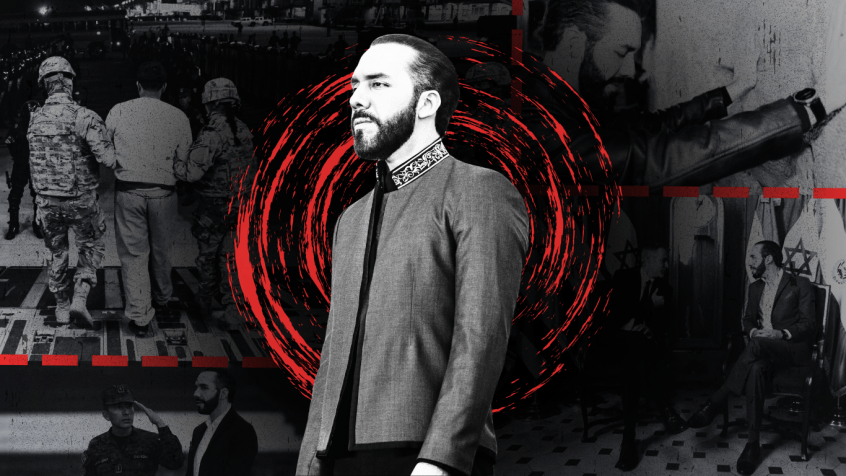
By Alan MACLOED | MintPress News | May 14, 2025
Nayib Bukele may be Palestinian, but the dictatorship he has built in El Salvador is very much made in Israel. From arming his security forces to supplying him with weapons and high-tech surveillance tools, MintPress explores the Israeli influence helping to prop up the man who calls himself “the world’s coolest dictator.”
Arming a Dictatorship
Since Bukele’s ascension to the presidency in 2019, Israeli exports to El Salvador have been rapidly advancing, growing at an annual rate of more than 21%. This increase consists primarily of weapons. Salvadoran forces are well supplied with Israeli hardware. The military and police use the Israeli-made Galil and ARAD 5 rifles, the Uzi submachine gun, numerous Israeli pistols, and ride in AIL Storm and Plasan Yagu armored vehicles.
Some equipment Salvadoran forces use comes free, courtesy of Israeli sources. In 2019, an Israeli NGO, the Jerusalem Foundation (a group that builds illegal settlements on Palestinian land), announced that it would donate $3 million worth of supplies to the Salvadoran police and military.
For others, however, the Bukele administration is paying top dollar, meaning that this relationship is extremely profitable for the high-tech Israeli defense sector.
In 2020, the Salvadoran police paid around $3.4 million for one year’s use of three Israeli spyware products. These tools include GEOLOC, a program that intercepts calls and texts from targeted phones, and Web Tangles, which uses individuals’ social media accounts to build up files on people, including using their photos for facial recognition. A third, Wave Guard Tracer (marketed in some regions as Guardian), tracks users’ movements through the GPS on their phone.
Perhaps the most notorious piece of spyware used, however, is Pegasus, developed by the NSO Group, an outgrowth of the Israeli Defense Forces’ Unit 8200. The app hit the headlines in 2022, when it was revealed that repressive governments the world over had used it to surveil thousands of public figures, including kings, presidents, politicians, activists, and reporters. El Salvador was one of the most heavily penetrated nations. A report from Citizen Lab found that the Bukele administration was using it to secretly monitor dozens of public figures critical of the president, including 22 journalists from the independent outlet El Faro.
Incarceration Nation
Bukele has used these Israeli tools and weapons to crack down on dissent and opposition to his rule. Since 2022, when he declared a State of Exception, suspending rights and civil liberties, he has imprisoned at least 85,000 people, a staggering figure for such a small country. Today, around 2% of the adult population — along with over 3,000 children — languish behind bars in dangerously overcrowded jails.
The most well-known of these is the Terrorism Confinement Center (Centro de Confinamiento del Terrorismo, or CECOT), which is by far and away the largest prison in world history. Built to incarcerate over 40,000 people, it is to this center that the Trump administration has been sending migrants rounded up by ICE. In a meeting with Bukele in the Oval Office, President Trump stated that U.S. nationals would be sent there next.
El Salvador holds vastly more people in prisons per capita than any other country, and conditions are among the worst in the world. Food is sparse, lights are kept on 24 hours a day, and cells are frequently packed with more than 100 occupants. Those incarcerated at CECOT are allowed no contact with the outside world, not even with their families or lawyers.
Often, the first thing a Salvadoran family hears about their disappeared relative is news that he died while incarcerated. Torture is commonplace. Osiris Luna, the director of El Salvador’s prison system, has even been sanctioned by the U.S. government for his role in “gross human rights abuses.”
Bukele has justified the mass imprisonment of his countrymen as a necessary step to break the power of organized gangs and drug cartels. Yet a significant portion of those held are his political opponents. Among those detained are union leaders, politicians, and human rights defenders.
Facing the threat of imprisonment or other punishment, El Faro has moved its operations to neighboring Costa Rica.
A Palestinian Who Loves Israel
Amid the chaos, Bukele has fired tens of thousands of public service workers and reduced taxes on the business community. He has also reoriented El Salvador’s foreign policy from a progressive, anti-imperialist stance to allying itself with right-wing governments around the world, including Israel.
Despite coming from a prominent Palestinian family that emigrated from Jerusalem in the early 20th century, throughout his political career, he has made a point of vocally supporting Israel, its culture, and its foreign policy. As far back as 2015, when he was Mayor of San Salvador, the Israeli Embassy had identified him as a “partner for cooperation.”
Three years later, in February 2018, he visited Israel on a trip organized by Deputy Minister for Foreign Affairs, Tzipi Hotovely, and American Jewish Congress President, Jack Rosen. There, he participated in a security conference attended by Prime Minister Benjamin Netanyahu and President Reuven Rivlin, and made a public appearance at the Western Wall.
El Salvador is home to a large Palestinian population; some 100,000 live in the small country. And yet, the Central American nation is far from a stronghold of support for anti-colonial struggles. Palestinians in El Salvador have generally done very well and entered society’s upper echelons. Bukele is actually the third Palestinian to become president.
Historically, the Latin American business community has sided with conservative or reactionary forces, and the Palestinian diaspora has shied away from supporting resistance movements in the Middle East.
“Bukele’s culture is not so much Palestinian as it is neo-fascist. That’s his culture. So he is going to identify with repressive governments around the world,” Roberto Lovato, a Salvadoran-American writer and professor at the University of Nevada, Las Vegas, told MintPress News.
The country is also home to a large and active evangelical Christian community, for whom Israel’s rise is a key issue. Despite being the son of the country’s most notable imam — one who claimed his son is a practicing Muslim — Bukele has positioned himself as a Christian conservative, and his evangelical supporters say he was chosen by God to rid the nation of gang violence. “I believe in God, in Jesus Christ. I believe in His word, I believe in His word revealed in the Holy Bible,” he said.
Dirty Wars and Dirty Politics
The connections between Israel and El Salvador, however, predate Bukele by decades. During the 1970s and 1980s, the country was a hotspot in the Cold War, and U.S.-backed death squads battled the leftist FMLN rebels. The military regime killed around 75,000 civilians in a dirty war that scars the region to this day. The violence was so extreme and so well-publicized that even the United States sought to distance itself from it. Into that void stepped Israel, providing 83% of El Salvador’s military needs from 1975 to 1979, including napalm. In return, El Salvador moved its embassy to Jerusalem, legitimizing Israel’s claim to the city.
Lovato, a former member of the FMLN, told MintPress that the country was turned into a “laboratory for repression.”
During the Civil War, the U.S. government aligned a whole panoply of different practitioners of torture and mass murder. You had trainers from Taiwan, Israel, and other countries going to El Salvador to train the Salvadoran government to do what they had learned how to do.”
One of the most notable individuals who received Israeli training was Major Roberto D’Aubuisson, leader of a far-right death squad. D’Aubuisson is known to have ordered the assassination of Archbishop Oscar Romero. Nicknamed “Blowtorch Bob” for his penchant for using the tool on his opponents’ genitals, his death squad is thought to have killed some 30,000 people, many of whom were tortured to death. Thus, it is no stretch to say that El Salvador’s repressive state apparatus has long been sustained by Israeli money, tech, and know-how.
But this is far from an isolated example. Indeed, Israel has supplied weapons and training to repressive governments around the world, honing the skills acquired suppressing the Palestinian population and taking them global.
In Guatemala, Israel sold planes, armored personnel carriers and rifles to the military, and even built them a domestic ammunition factory. General Efraín Ríos Montt thanked Israel for its participation in a coup that brought him to power in 1982, stating that it went so smoothly “because many of our soldiers were trained by Israelis.” Around 300 Israeli advisors worked to train Ríos Montt’s forces into genocidal death squads who systematically killed over 200,000 Mayans. A sign of the deep connections between the two groups is that Ríos Montt’s men began referring to the indigenous Mayans as “Palestinians” during their attacks.
It is a similar story in Colombia, where the country’s most notorious death squads were trained by Israeli operatives, such as General Rafael Eitan. To this day, Colombian police and military make extensive use of Israeli weaponry. So normalized has the Israeli influence become in Colombian society that, in 2011, sitting President Juan Manuel Santos appeared in an advertisement for Israeli mercenary firm Global CST. “They are people with a lot of experience. They have been helping us to work better,” he stated.
Israel also armed and supported the military dictatorships of Chile and Argentina in the 1970s and 1980s, even as the latter explicitly targeted over 1,000 Jews in the largest slaughter of Jews since the Holocaust.
In Nicaragua, Israel supplied the Somoza dictatorship, helping it carry out a dirty war. In Rwanda, it sold weapons to the Hutu government as it was carrying out a genocide against the Tutsi population. Israeli weapons were used by Serbia during the Yugoslav civil war in the 1990s. And successive administrations in Tel Aviv also helped sustain the Apartheid government of South Africa, sending it weapons and sharing intelligence with it.
Therefore, it should come as little surprise that Bukele’s administration has sought and established such close ties to the Israeli government. These weapons and techniques, honed on the Palestinian population, are going global, helping a government thousands of miles away crack down on civil liberties. While Bukele — a Palestinian — is very much in charge of El Salvador, it is clear that his dictatorship has a distinct Israeli flavor.
Romania’s Elections Were a Big Globalist Sham
By Ilya Tsukanov – Sputnik – 19.05.2025
The results don’t make sense arithmetically and foreign interference has been confirmed. The country has officially completed its slide into EU protectorate status. Prolific Balkans expert Dr. George Szamuely helps unpack what just happened.
Numbers Don’t Add Up
- Eurosceptic candidate George Simion won 41% in the May 4 first round. EU favorite Nicușor Dan got 21%. In round two, Simion took 46.4%, while Dan got 53.6% – a 155% boost.
- To do so, Dan needed the backing of 87% of the voters who backed neither him or Simion in the first round.
- Neither of the other major first round candidates (Crin Antonescu, 20%, Victor Ponta, 13%) threw their weight behind Dan in the second round. Where did his 30%+ surge in support come from? Unclear.
Fraud in Broad Daylight
Simion has alleged that 1.7 million dead people were on voter rolls, and urged voters to check if any deceased relatives or friends voted via a dedicated WhatsApp contact line.
Diaspora voters cast 1.64 million ballots in the second round of the vote, 660,000 more than round one (which Simion handily won, 61% to Dan’s 25.4%). Simion has alleged some polls were closed or not enough ballots were made available in some areas during the runoff, and manipulation of diaspora voting.
Foreign Meddling Alleged and Confirmed
Specifically, Simion has accused Moldova’s EU lapdog government of “immense fraud” amid reports of Romanian expats voting at 3X the rate they did in round one.
He’s also charged France of meddling using “lots and lots of money and pressure through their ambassador here, and through foreign institutions in order to rob the Romanian people of their votes.”
Telegram CEO Pavel Durov confirmed on Sunday that a request had been made by France to “silence conservative voices” in Romania ahead of the election.
Russia bans Amnesty International
RT | May 19, 2025
The Office of the Russian Prosecutor General has banned Amnesty International, the London-based non-governmental organization (NGO), accusing it of Russophobia and support for the Ukrainian military.
An official statement on Monday said that while the “organization positions itself as an active champion of human rights throughout the world,” its headquarters in the British capital have turned into a “center for preparing global Russophobic projects, paid for by accomplices of the Kiev regime.”
“Members of the organization support extremist organizations and finance foreign agents’ activities,” the Prosecutor General’s Office claimed.
Amnesty has been actively working toward “increasing military confrontation” since the escalation of the Ukraine conflict in February 2022. Russian prosecutors have accused the NGO of whitewashing Ukrainian war crimes, calling for more financial support for Kiev and the economic isolation of Moscow.
Last month, Moscow banned US-based NGO Hope Harbor Society for providing financial support for the Ukrainian military as well as the coordination of anti-Russian protests in the US and other countries.
In early April, the Elton John AIDS Foundation was designated as ‘undesirable’ in Russia after being accused of promoting pro-LGBTQ agenda in the country.
Organizations with such a designation are banned from operating in Russia, and residents or companies may face legal penalties for providing financial or other forms of support to them.
The Russian Justice Ministry currently lists more than 200 such entities, including major Western influence groups such as George Soros’ Open Society Foundations, the US-based German Marshall Fund, and the pro-NATO Atlantic Council.
Telegram’s Durov names French official he accused of censorship request
RT | May 19, 2025
Telegram founder Pavel Durov has claimed that French foreign intelligence chief Nicolas Lerner personally asked him to censor conservatives on his platform ahead of the contentious rerun of Romania’s presidential elections. The Russian-born entrepreneur said he refused the request.
The accusations of foreign meddling first surfaced last year after Romania’s top court annulled the November election results, in which independent right-wing candidate Calin Georgescu came first with 23%. Authorities cited “irregularities” in his campaign, along with intelligence reports alleging Russian interference – claims Moscow has denied. Georgescu was later barred from running again.
On Sunday, pro-EU centrist Nicusor Dan was elected president of Romania. His conservative, Eurosceptic opponent George Simion accused France and Moldova of attempting to sabotage his campaign.
In a post on X on Sunday evening, Durov said he met with Lerner, head of France’s Directorate-General for External Security (DGSE), in Paris. The agency, operating under the Ministry of the Armed Forces, is tasked with gathering intelligence and combating terrorist threats.
“This spring at the Salon des Batailles in the Hotel de Crillon, Nicolas Lerner, head of French intelligence, asked me to ban conservative voices in Romania ahead of elections. I refused,” Durov wrote. “We didn’t block protesters in Russia, Belarus, or Iran. We won’t start doing it in Europe,” he added.
Durov had previously hinted that France asked him to “silence” Romanian conservatives. The French Foreign Ministry rejected the allegations of election meddling as “completely unfounded.”
“France categorically rejects these allegations and calls on everyone to exercise responsibility and respect for Romanian democracy,” the ministry stated, labeling the accusations “a diversionary maneuver” aimed at distracting the public from “the real threats of interference targeting Romania.”
Last year, French authorities charged Durov with facilitating the distribution of child sexual exploitation material and drug trafficking due to alleged moderation failures on Telegram. He was arrested at Paris-Le Bourget Airport in August before being released on €5 million ($5.46 million) bail. Durov, who has denied any wrongdoing, was eventually allowed to leave France in March.
Did ‘Israel’, US fight a proxy war with China in South Asia during the India-Pakistan escalation?
By F.M. Shakil | Al Mayadeen | May 19, 2025
In the recent standoff between India and Pakistan, “Israel” and the US significantly influenced the escalation and resolution of a fierce conflict between the two nuclear South Asian nations that resembles a contest between US-Israeli military equipment and Chinese-made war kits.
The former ignited the fires of war with its advanced military technology and, recognizing the potential for nuclear chaos, swiftly intervened to bring the situation to a close. The display of weaponry unmistakably indicates that Chinese-made missiles and fighter jets exhibit greater precision, target focus, speed, and reliability compared to their competitors, raising alarms for the US and its allies.
The PL-15E missiles, an active radar-guided long-range beyond-visual-range air-to-air missile produced by the China Academy of Launch Vehicle Technology (CALT), have attracted interest following reports that Pakistan Air Force (PAF) J-10C fighters, equipped with PL-15E missiles, effectively downed three Indian Air Force (IAF) Rafale jets in a heated air confrontation. The engagement signifies a significant milestone, as it marks the inaugural instance of a Dassault Rafale, considered one of the top contenders among 4.5-generation fighters, being officially defeated in combat.
Israeli military supply to India
While the future implications of the fragile ceasefire are a perplexing issue for analysts in Pakistan, especially given the spontaneous violations of the truce that occurred within hours of its establishment, “Israel” has undoubtedly played a significant role in the recent military escalation by supplying arms, drones, and defense equipment to India.
“Israel” serves as a key supplier of military hardware to India, and its weaponry entered the battle as it transitioned to drone warfare. Israeli media openly acknowledged that India’s use of Israeli-made drones in its recent cross-border operations against Pakistan has captured international interest, not only for the tactical consequences but also for what it indicates was the strategic depth of India’s developing partnership with “Israel.”
Abdullah Khan, managing director of the Pakistan Institute for Conflict and Security Studies (PICSS) in Islamabad, told Al Mayadeen English that “Israel” provided its drone as well as the military doctrine it applied in Gaza to India. What India did in Pakistan, he said, was precisely what “Israel” has been doing in Gaza, and the same modus operandi was seen applied while targeting the religious institutions. “India has even borrowed the narrative lines from Israel, which has become a long-term challenge for Pakistan’s nuclear program as well”, Khan stated, adding that assessments are being made to determine its role in the recent standoff.
Israeli media, citing Dr. Oshrit Birvadker, a senior fellow at the Jerusalem Institute for Strategy and Security (JISS) and an expert in India-Middle East relations, revealed that India’s recent incursion involved the deployment of Harop and Heron Mark-2 drones, illustrating how “Israel” plays a significant and growing role in India’s current military strategy, especially considering the escalations with Pakistan and the broader counterterrorism context.
Pakistan’s military claimed last week that it had hit 25 Indian drones known as Harop loitering drones produced by “Israel” Aerospace Industries (IAI) after they allegedly violated its airspace. The Harop is believed to be a cutting-edge advanced drone that has significantly expanded high-altitude surveillance and strike capability.
The media, citing the IAI’s website, say that loitering munitions are made to quickly respond to different situations, from short missions to long-range attacks, while also gathering real-time information and allowing for precise strikes. These features make them particularly effective in unpredictable and complex combat environments, including densely populated urban areas like Karachi and Lahore.
The drones reportedly targeted sites across major cities, including Karachi, Lahore, Rawalpindi, and Sargodha, following Indian missile strikes a day earlier on what New Delhi described as terrorist infrastructure in Pakistan-administered Kashmir and Punjab. India made these strikes following an April terror attack that killed 24 tourists in Indian-controlled Kashmir.
China-Pakistan defense collaboration
China has been enjoying close economic, defense, and geopolitical relations with Pakistan since long. Its stakes in Pakistan have been going deeper and deeper with the passage of time. On other hand, Beijing’s relations with India are marred by border disputes.
Zia Ul Haque Shamshi, a retired PAF Air Commodore, was quoted by the media as saying that the introduction of the J-35A fleet— a Chinese fifth-generation stealth fighter— signifies a pivotal shift in South Asia’s airpower landscape. This development was poised to provide Pakistan with a significant advantage, granting a 12- to 14-year lead in stealth fighter capabilities compared to India’s current air inventory.
He stated that Pakistan would acquire up to 40 units of the Chinese J-35A, which would place the Pakistan Air Force (PAF) on a swift path to surpass its longstanding rival, India, for more than a decade.
Last year, the South China Morning Post generated ripples within the Indian military circles by publishing a report that asserted Pakistan’s intention to procure approximately 40 J-35 jets, which are said to feature advanced stealth technology and next-generation avionics, from China.
In reaction to Beijing’s choice to supply Pakistan with fifth-generation stealth jets, Washington extended an offer to New Delhi in February for its advanced fighter jets, the F-35s. During a joint press conference with Prime Minister Narendra Modi, US President Donald Trump indicated that this agreement would represent a significant enhancement in the defense relationship between the two nations, involving “many billions of dollars.”
In a recent interview with AFI, Indian defense analyst Ranesh Rajan suggested that India may resort to “panic purchasing” to counter the Pakistan Air Force’s (PAF) advantage over the Indian Air Force (IAF). This action, the defense analyst believes, could have substantial strategic implications for the entire South Asia region. In a historical context, he observed that the IAF reacted with urgency by purchasing 40 Mirage-2000s and 80 MiG-29s after Pakistan acquired F-16s from Washington in the eighties.
In March this year, Pakistan launched its second Hangor-class submarine, the PNS/M Shushuk, in a ceremony in Wuhan, China. The submarine with enhanced concealment capabilities in the deep ocean, is equipped with advanced stealth features and minimal acoustic signatures. In 2015, during the visit of Chinese President Xi Jinping to Islamabad, an agreement for eight vessels was inked between Pakistan’s Defense Ministry and China’s Shipbuilding and Offshore International Company.
Did the US instigate the flare-up?
Although the background information does not indicate direct US involvement, considering the broader geopolitical context and India’s relationship with the US, it is plausible that the US could have an indirect impact on the situation.
Abdullah Khan disclosed to Al Mayadeen English that the US initially observed from afar without intervening; it may have been assessing the credibility of India’s military strength for a potential confrontation with China in the future.
“India significantly let down its Western allies and partners, experiencing humiliation during the military confrontation with Pakistan. Despite attempts to execute strikes that could have escalated to a nuclear confrontation, it seems that was the moment the US intervened, compelling India to retreat,” he told Al Mayadeen English.
Khan stated that Pakistan had no plans to escalate further after successfully targeting at least 26 sensitive locations within Indian territory.
Trump should not threaten new sanctions when he talks to President Putin
By Ian Proud | Strategic Culture Foundation | May 19, 2025
The U.S. side has made various signals that it might impose massive new sanctions on Russia unless the war ends soon. This would be a huge mistake that would lock in the fighting for the rest of the year and leave Europe on the hook for a massive bill and political disruption that it cannot afford. Trump should not threaten Putin with sanctions when they talk on Monday 19 May.
In the run up to the Russia-Ukraine bilateral peace talks which finally took place in Istanbul last week, both the EU and the UK imposed new sanctions on Russia. On 9 May, as Russian commemorated victory Day, Britain imposed sanctions on Russia’s shadow fleet and the EU followed suit with its 17th package of Russia sanctions on 14 May, the day before the Istanbul talks were due to start. Both the UK and EU have threatened further sanctions should Russia not agree a full and unconditional ceasefire in Ukraine and, with Zelensky, have actively urged the U.S. to follow suit, which it has not done, so far. However, the Americans have spoken increasingly about the possibility of massive new sanctions against Russia: this would be a huge mistake.
Sanctioning a country before peace talks have already started, or while they are still going on, is already a bad look. Very clearly, the Ukrainians, Europeans and British hope that new sanctions will apply such pressure on Russia that it agrees to terms that are more favourable to the Ukrainian side. I.e. that Ukraine does not have to go back to the Istanbul 1 commitment to adopt permanently neutral status. The western mainstream press has been carpet bombing their intellectually degraded readers with the latest press line that Ukraine should not have to go back to the Istanbul 1 text as a starting point for talks.
But there’s a problem. For this strategy to be effective, the sanctions have to work.
As I’ve pointed out before, sanctions against Russian energy have had limited impact, not just since 2022, but since 2014. Nothing about the glidepath of sanctions since February 2014 suggests that new sanctions will work now.
This latest round of UK and EU sanctions aimed to apply more pressure on enforcement of the G7 oil price cap of $60 which was first imposed in December 2022. Since the war started, that policy has failed.
Between 2021 and 2024, total volumes of Russian oil exported fell by just 0.2 million barrels per day, or 2.6%. After a bumper year for tax receipts in 2022 caused by Russian tumbling rouble and skyrocketing energy prices, Russia pulled in current account surpluses of $49.4bn and $62.3bn in 2023 and 2024. This was on the back of still strong goods exports of $425bn and $433bn respectively.
There are several reasons why the oil price cap didn’t work, the biggest being that Russia diverted 3 million barrels per day, around 39.5% of total oil exports to India (1.9 mbd), Türkiye (0.6 mbd) and China (0.5 mbd). Türkiye and India boosted exports of refined fuels to Europe providing a backdoor route for Russian oil to Europe. The second reason the oil price cap didn’t work is the near ten month time lag between war starting and the limit being imposed, which gave Russia space to readjust before punitive measure had been imposed. During this period, oil prices also dropped sharply from the high of $120 in the summer of 2022, to around $80 when the measure was imposed: the G7 missed the boat to impose maximum damage; this reinforces the point I make all the time that coalitions cannot act with speed and decisiveness.
Today, the Russian Urals oil price is below the $60 G7 cap meaning that any registered shipping company can transport it without penalty, which renders the British and European sanctions as pointless in any case.
Let’s be clear, western nations imposing sanctions against Russia that don’t work is not a new phenomena. As I have pointed out many times before, the vast majority (92%) of people that the UK has imposed assets freezes and travel bans upon have never held assets in the UK nor travelled here. For companies, the figure is just 23. The same, I am sure, is true of EU and U.S. sanctions, which cover largely the same cast list of characters and companies, as we all share and compare the same lists of possible designations. Financial sector sanctions prompted a massive readjustment of Russia’s financial sector. Energy and dual use sanctions drove self-sufficiency in technology production, through Rosnet, Gazprom and RosTec: i.e. these companies invested more in R&D on component production while sourcing components from alternative markets, in particular China.
At well over 20,000 sanctions imposed so far, Russia’s economy has proved remarkably robust and its key export sectors still find ways to deliver similar volumes across the world. At some point, I hope policy makers in London, Brussels and Washington will start to ask whether this policy is working. We long ago passed the point of diminishing marginal returns. I fear, however, they have their heads in the sand or, possibly another, darker, place.
So, coming back to Trump’s phone call with Putin on Monday 19 May you might ask yourself, ‘so what if he imposes a few more sanctions if they won’t work anyway?’
Putin would see the imposition of new U.S. sanctions as a complete 180, destroying any emerging trust he had in Trump or any belief in America’s stated intentions to end the war in Ukraine.
It is clear to me that further U.S. sanctions on Russia would kill stone dead any chance of a ceasefire in Ukraine at a time when Russia still has the upper hand. Russia has increased the pace of its advance since the Victory Day ceasefire and seems to be adding new blocks of red to the battle map each day. At the current rate of advance, even without a catastrophic Ukrainian collapse, it seems realistic to expect that Russia would paint out the remaining territory in Donetsk and Luhansk during the remainder of this year. In the process they would need to overcome the heavily fortified towns of Pokrovsk, Kramatorsk and Sloviansk, in what would likely be brutal and attritional battles killing many thousands more on both sides.
Moreover, dragging out the war for longer would simply add to Europe’s liability to fund Ukraine’s war effort at a time when it is only ever going to lose. Ukraine is spending over 26% of GDP on defence in 2025 and 67.5% of its budget expenditure is on defence and security, leaving a budget black hole of $42bn that has to be filled. America under Trump isn’t going to fill this hole. And, as Ukraine is cut off from international lending markets, that black hole is being filled by Europe.
There is no money for this.
Europe has neither the political capital nor the funds to maintain a losing war in Ukraine at enormous expense without massive domestic political blowback in their own countries.
Notwithstanding the possibly understandable fear among European leaders of failing and being seen to fail in Ukraine, keeping the war going is at best, a gesture in cynical self-preservation, pushing their eventual political demise further down the track.
Unfortunately, we have been here so many times before. Right back to the Minsk II agreement, Ukraine has been pushing for ever more sanctions against Russia that only ever served to ramp up resentment and exacerbate the conflict. European leaders have invested too much in Zelensky and his self-serving demands aimed primarily at staying in power. He is quickly becoming the gun that shoots European elites in the head.
If Trump really wants to be seen as a peacemaker, he should avoid doing what every other western leader before him including Sleepy Joe did and resist the temptation to impose more sanctions. Instead, he should continue to press President Putin to continue to engage with bilateral peace talks that finally recommenced in Istanbul last week. He must also tell the Eurocrats and Zelensky that they must make compromises rather than plugging the same old failed prescriptions.
Featured Video

America Racing to Strategic Defeat in Iran
or go to
Aletho News Archives – Video-Images
From the Archives
Should Europeans ‘Thank’ the Americans for Destroying Nord Stream?
By Robert Bridge | Strategic Culture Foundation | September 29, 2022
With an investigation continuing into the destruction of the Nord Stream gas pipeline that provided energy supplies to Europe from Russia, there appears to be just one prime suspect, and that should surprise nobody.
Following the sabotage of the Nord Stream 1 and 2 gas pipelines, former Polish Foreign Minister Radoslaw Sikorski already seemed to know the identity of the perpetrator when he tweeted out: “Thank you, USA.”
At first glance, it seemed that Sikorski was speaking sarcastically, berating Washington for carrying out an attack that will have severe repercussions for the people of Europe. After all, how could anyone see any good coming from the termination of Europe’s primary source of gas reserves with winter just around the corner? It was Sikorski’s homeland of Poland, after all, that urged its citizens to collect firewood in the face of dwindling gas reserves.
In fact, the Polish diplomat was speaking one-hundred percent literally… continue
Blog Roll
 Aletho News
- Growing insecurity, soaring prices fuel protests in north as regime bans evacuation: Sources
- Iran denies responsibility for ‘depraved’ attack on Kuwait desalination plant
- Bring The Troops Back. End This War Now!
- Can we please stop calling Israel the ‘only democracy in the Middle East’ now?
- US should start removing its troops for Germany, proposes AfD co-leader Chrupalla
- Iran Red Crescent: 600 educational centers attacked in US-Israeli ‘war crimes’
- Russian Oil Tanker Arrives in Cuba Amid U.S. Blockade
- America Racing to Strategic Defeat in Iran: Lt Col Daniel Davis
- FTC Warns Visa, Mastercard, PayPal, Stripe Over Political Debanking
- Russian tanker approaches Cuba despite US oil blockade
- If Americans Knew
- Israeli police block Catholic cardinal from entering Church of the Holy Sepulchre on Palm Sunday
- Israel is assassinating journalists again, more than any other nation, anywhere, ever – Not a ceasefire Day 170
- Over 300 US service members wounded, majority have brain injuries – Not a ceasefire Day 169
- Researchers at Human Rights Watch Resign Over Blocked Report on Palestinian Refugee Return
- Jewish Groups Are Backing a War Americans Don’t Want
- Eric Fingerhut Thinks He’s the President of the Jews
- Top Jewish Philanthropists, Rabbis Urge Israeli President to Take Action Against ‘Jewish Extremists’
- Don’t Be Fooled. Zionist Leaders Have Always Wanted to Control Southern Lebanon
- Israel’s widespread use of torture is a core element of its genocide against the Palestinian people
- In Israel’s War on Iran, Many Middle East US Bases Rendered “All But Uninhabitable”
- No Tricks Zone
- New Study Finds Warming Saves Lives…Cold Temperatures 12 Times More Deadly Than Excess Heat
- German Science Blog Accuses PIK Climate Institute Of Hallucinating Climate Tipping Points
- Devastating Assessment Of Comirnaty Vaccine By Former Senior Pfizer Europe Toxicologist
- New Study: CO2 Is ‘Effectively Negligible’ As An Explanatory Climate Change Factor Since 2000
- Former Pfizer Toxicologist Dr. Helmut Sterz Tells Bundestag Hearing Pfizer Vaccine Should Have Never Been Approved
- Energy Expert: Germany’s Nuclear Phaseout Was A “500 Billion Euro Mistake”
- New Research: South Australia’s Mid-Holocene Sea Surface Temperatures Were 4°C Warmer Than Today
- Storing Green Energy To Last Germany 10 Days Would Require A 60-Million Tonne Battery
- New Studies: UK Sea Levels Were 4 Meters Higher Than Today During The Mid-Holocene
- Destructive Green New Deal: German Energy And Metal Group Warns Of Drastic Crisis
 Aletho News