Why Are CARDIOLOGISTS So DAMN IGNORANT? [about THIS]
Dr. Suneel Dhand | October 27, 2025
This is actually unacceptable.
Dr. Dhand’s Website: https://www.drsuneeldhand.com
 • You Probably Have INSULIN RESISTANCE: How … • Prediabetes is TERRIBLE: Here’s EXACTLY Ho…
 Jeffrey Epstein used Rothschild banking empire to finance Israeli cyberweapons industry
Press TV – November 19, 2025
Convicted sex offender and financier Jeffrey Epstein used his close relationship with the Rothschild banking empire to channel private investments into the Israeli regime’s cyberweapons industry.
Documents released by the US House Oversight Committee in November, alongside hacked emails from former Israeli prime minister Ehud Barak, reveal that Epstein acted as a key intermediary, connecting the Rothschild banking dynasty with Israel’s cyberweapons sector.
The records show Epstein coordinating private investments in Israeli startups developing offensive cyber capabilities, surveillance tools, and spyware technologies.
Following Barak’s retirement from office in 2013, he recruited Pavel Gurvich, a former operative of Israel’s secretive Unit 81, to identify promising cyber ventures.
Barak relied on Gurvich for guidance on investments in offensive cyber tools, including Tor network surveillance, NSO-style cellphone hacking software, and router exploitation technologies.
Gurvich supplied detailed maps of undersea transatlantic cables and network access points, illustrating the global reach of potential operations.
Epstein then facilitated connections between Barak, Gurvich, and the Rothschild dynasty, offering logistical support, guidance on tax and investment structures, and strategic advice.
Epstein’s involvement included a $25 million contract in October 2015 between his Southern Trust Company and Barak’s spyware-linked startup Reporty Homeland Security (now Carbyne).
The agreement covered “risk analysis and the application and use of certain algorithms.”
He also organized private meetings and dinners to foster collaboration, including a January 2014 gathering in Paris with Barak, the Rothschilds, and former French President Nicolas Sarkozy.
Emails suggest Epstein coached Barak on managing the Rothschild relationship, advising him to provide “time, attention, stable, recurring, predictable” engagement to earn trust.
Barak also proposed a donor-advised fund to channel private capital into Israeli technology, planning to allocate 4–5% of the fund to startups in telecommunications, cyberwarfare, and biotechnology.
The fund would operate through the Rothschilds’ “umbrella fund” structures, allowing tax-deductible contributions to finance early-stage military and spyware technology companies. Epstein coordinated introductions and advised Barak on securing Rothschild backing.
Furthermore, Epstein managed the logistics of Barak’s participation in the 2014 Herzliya Conference, Israel’s premier cyberwarfare summit, sponsored by the Rothschild Caesarea Foundation (RCF).
Emails show he relayed speaker lists, arranged private meetings with the Rothschilds, and guided Barak on handling inquiries from conference organizers.
Correspondence indicates Epstein remained active in the network until at least April 2017, arranging private meetings and maintaining connections between Barak, the Rothschilds, and other influential figures in Israel’s cyberwarfare industry.
Epstein was arrested on federal sex trafficking charges in July 2019 and held at the Metropolitan Correctional Center in New York City.
He reportedly committed suicide by hanging in August 2019, despite prior reports that he was under suicide watch following an attempt in July of that year.
IAEA chief reports progress on Iran nuclear inspections
Al Mayadeen | November 19, 2025
Efforts and consultations with Iran are ongoing in a bid to restore inspection activities in the country, Rafael Grossi, the Director General of the International Atomic Energy Agency (IAEA), announced on Wednesday.
Addressing the IAEA Board of Governors, Grossi said, “I believe there has been some progress. We have returned to Iran, and over a dozen inspections have taken place so far.”
“However, there is still more work to be done in line with the relevant provisions of the Comprehensive Safeguards Agreements,” he added.
He noted that, in coordination with the Iranian foreign minister in Cairo, “significant technical understandings have been reached with Iran to facilitate inspections following the events of June,” emphasizing that “this is the path we need to continue on.”
“I remain convinced that there is no solution other than a diplomatic one to this issue, which requires engagement, understanding, and full compliance by Iran with its obligations,” Grossi added.
He continued, “If this does not happen, we will continue to face one challenge after another and will not reach the position we all aspire to. Nevertheless, our work must continue, and my stance has always been to act decisively and maintain ongoing communication with Iran to return inspection activities in a country with a critical nuclear program to their normal course, in accordance with the Nuclear Non-Proliferation Treaty and the Comprehensive Safeguards Agreement—nothing more, nothing less.”
It is worth noting that Iran suspended cooperation with the IAEA in June, citing the need to ensure the security of its nuclear facilities following US and Israeli actions against them. Iran’s Atomic Energy Organization criticized the IAEA, saying that attacks on its nuclear sites resulted from the agency’s failure to maintain professionalism and political neutrality.
Clash between Iran and the IAEA
Following the June airstrikes carried out by the Israeli occupation and the United States on numerous Iranian nuclear and military sites, Iran swiftly suspended full cooperation with the IAEA. In response, the Iranian parliament passed legislation barring further access to its nuclear facilities by IAEA inspectors unless specifically approved by the Supreme National Security Council. Tehran accused the agency of failing to condemn the attacks and criticized it for lacking neutrality, arguing that this undermined the security of its nuclear infrastructure.
In the months that followed, particularly throughout July and August, the IAEA was unable to conduct its routine inspections in Iran. Iranian officials insisted that any resumption of IAEA activities required a renegotiation of the terms of engagement, emphasizing that previous frameworks had failed to protect Iran’s sovereign rights. This signaled a shift toward a more guarded stance, as Iran sought stronger guarantees before reopening its facilities to international scrutiny.
By September, however, progress was made when IAEA Director General Rafael Grossi and Iranian officials met in Cairo. The parties reached a preliminary technical understanding aimed at restoring monitoring mechanisms. As part of the deal, Iran agreed to provide detailed status reports on its affected nuclear sites and to resume IAEA inspections gradually. While this understanding marked a step forward, no firm timeline for full cooperation was established, leaving the situation tentative.
Despite the progress, the relationship between Iran and the IAEA remains fragile. Iran continues to demand that the agency uphold a politically neutral approach. At the same time, the IAEA insists that its role under the Nuclear Non-Proliferation Treaty and the Comprehensive Safeguards Agreement must be respected.
IAEA role called into question
However, the IAEA’s role in the latest attack on the country was called into question as Iran’s Atomic Energy Organization chief, Mohammad Eslami, accused “Israel” of striking key nuclear facilities in Tehran, based on technical details provided to the International Atomic Energy Agency (IAEA).
The attack, according to Eslami, targeted a fuel production unit at the city’s research reactor, as well as a reactor used to manufacture vital radiopharmaceuticals.
Speaking at the Foreign Ministry’s conference “International Law Under Assault: Aggression and Defense,” Eslami emphasized that Iran has long maintained strict safety protocols to protect its nuclear experts, infrastructure, and the surrounding environment, ensuring no leaks or contamination.
Eslami stressed that the accuracy of the strikes suggests that classified technical details, information Iran had provided to the International Atomic Energy Agency (IAEA), were exploited, noting that the only laboratory Iran built in full coordination with the agency was singled out in the attack.
Russia to re-establish nine military positions in Syria’s Quneitra
The Cradle | November 19, 2025
A high-level Russian delegation visited Syria’s Quneitra Governorate on 17 November, The Cradle has learned from private sources, indicating Moscow’s intention to reinforce its military presence in the sensitive region adjacent to the Israeli-occupied Golan Heights.
The Russian delegation included officers from field commands operating in Syria, accompanied by a committee from the Syrian Ministry of Defense. The delegation conducted an extensive tour of several military sites from which Russian forces had previously withdrawn.
Contrary to some leaks suggesting trilateral coordination or a Turkish role in restructuring the military presence in the south, the delegation did not include any Turkish officers.
According to the sources speaking with The Cradle, the absence of the Turkish side reflects a Russian desire to manage the southern file exclusively through channels between Damascus and Moscow.
The tour included several military positions where Russia deployed its forces in 2018 as the Syrian war ended. That year, foreign-backed militants from the former Al-Qaeda affiliate, Hayat Tahrir al-Sham (HTS), reached agreements with Syrian and Russian forces to evacuate the area and leave toward the HTS stronghold of Idlib Governorate in northwest Syria.
Moscow reduced its presence in Quneitra after HTS, led by Syria’s current self-appointed President Ahmad al-Sharaa, toppled the government of former president Bashar al-Assad in December of last year.
Among the most prominent of the sites toured by the delegation on Monday was the Tulul al-Hamr, one of the most sensitive military positions in the region due to its proximity to the 1973 ceasefire line and its importance for monitoring and surveillance operations towards Israeli forces occupying the Golan Heights.
According to information obtained by The Cradle, the Russian command has decided to redeploy its forces to nine military positions in southern Syria, mainly in the Quneitra and Deraa countryside.
These are the positions from which it withdrew during the transitional phase following the ousting of Assad. This move is part of a new Russian strategy to reposition its military influence along the southern border and ensure that no vacuum is created that could be exploited by regional or local powers.
According to informed sources, the Russian delegation maintained a permanent logistics post in Quneitra after concluding its tour. The post aims to assess technical and engineering needs and to submit detailed reports on redeployment requirements, including the rehabilitation of infrastructure and supply lines, and the necessary readiness to activate these points in the coming period.
This development follows a series of reciprocal Russian–Syrian moves, the most recent being the arrival of a large delegation from the Russian Ministry of Defense in Damascus a few days ago.
This was in addition to the telephone call between Russian President Vladimir Putin and Israeli Prime Minister Benjamin Netanyahu, which followed the visit of President Sharaa to Moscow. It is estimated that southern Syria was a key topic in these communications.
According to The Cradle sources, practical steps for redeployment in southern Syria are expected to begin in the coming weeks, with Moscow gradually announcing the reopening of some of its military posts before the end of the year.
Analysts believe the Russian return to Quneitra has strategic dimensions that extend beyond military considerations. Moscow seeks to consolidate its influence in the country as regional alliances are being rebuilt and the balance of power shifts following the transitional phase in Damascus.
In particular, Russia wishes to keep its naval base in Tartous and its air base in Hmeimim on the Syrian coast to project power in the Mediterranean and toward Africa.
A tacit relationship between Russia and Israel was revealed in February, when Netanyahu visited Washington to present a “white paper” regarding Syria to US officials.
After Netanyahu’s visit, Reuters reported that “Israel is lobbying the United States to keep Syria weak and decentralized, including by letting Russia keep its military bases there to counter Turkey’s influence.”
The Times of Israel later commented that Tel Aviv was lobbying the “US to buck Sharaa’s fledgling government in favor of establishing a decentralized series of autonomous ethnic regions, with the southern one bordering Israel being demilitarized.”
In its effort to divide Syria, Israel is seeking to create autonomous regions in Druze-majority Suwayda and the Alawite-dominated Syrian coast.
Mali holds firm: West eyes new front to sabotage Sahel independence
By Aidan J. Simardone | The Cradle | November 19, 2025
If you are to believe western media, Mali is days away from falling to Al-Qaeda. Jama’at Nasr al-Islam wal-Muslimin (JNIM), a branch of Al-Qaeda in the Islamic Maghreb, is blockading fuel to the capital, Bamako. It is only a matter of time before growing frustration turns Malians against their “illegitimate” government. Or so the story goes.
The reality tells a different tale. The situation is serious, not only for Mali but also for the broader Alliance of Sahel States, which includes Burkina Faso and Niger. And yet, Mali is recovering. Russia has stepped in, delivering vital fuel shipments. Schools are reopening. Vehicles are back on the road. Towns previously captured by JNIM are being reclaimed.
It is a huge gamble for Russia. But should it succeed, Moscow will have secured a key ally and gained the favor of anti-imperialist countries in Africa. The risk, however, might not come from JNIM. Instead, it could come from a western-supported intervention that seeks not to stop Al-Qaeda, but to destroy the Alliance of Sahel States.
From French client to anti-colonial spearhead
After it gained independence, Mali continued to rely on France. Even its currency, the CFA franc, is pegged to the euro. In school, children were taught French history and learned to speak French. Until recently, France had 2,400 troops stationed as part of its “counterterrorism” operations.
Despite these apparent efforts, groups like JNIM, the Islamic State in the Sahel, and Azawad separatist militias grew. Meanwhile, western corporations profited as Mali became the fourth-largest producer of gold. With this wealth extracted, Mali remained one of the poorest countries in the world.
Bamako’s cooperation with the west did not always curry favor. Its alleged failure to follow the 2015 Algiers Accords with Azawad separatists resulted in the UN Security Council (UNSC) imposing sanctions in 2017. This made little impact, with Mali’s economy continuing to grow.
Yet most Malians were still in poverty, and the security situation worsened. Frustrated, a coup was launched in 2020. But when protests erupted, another coup followed in 2021, led by Assimi Goita, Mali’s current president. Western institutions portrayed it as democratic backsliding, with a military unjustly taking over the country. But the coup was highly popular, with people celebrating. According to a 2024 poll, nine out of 10 people thought the country was moving in the right direction.
President Goita was a radical, anti-colonial, pan-Africanist. In 2022, he kicked French troops out, instead seeking help from Russia. In 2025, Mali withdrew from the Economic Community of West African States (ECOWAS), accusing it of working with western powers. Goita nationalized the gold mines, removed French as Mali’s official language, and replaced school curricula about French history with Bamako’s own rich history.
Western-aligned institutions retaliated with sanctions. ECOWAS, the West African Economic and Monetary Union (WAEMU), and the EU imposed economic penalties. Cut off from financial institutions, Mali defaulted on its debt. But the impact was partly muted.
A few months after sanctions were imposed, the court of the WAEMU ordered that sanctions had to be lifted. Gold mining, which contributes to 10 percent of the economy, saw no impact. Mali shifted its trade to non-ECOWAS countries, and the economy continued to grow.
The West African country redirected trade outside the ECOWAS bloc and resolved its debt in 2024. Far from isolating the country, sanctions strengthened internal solidarity.
Even when ECOWAS lifted sanctions in July 2022 – citing a transition plan to civilian rule – no action was taken when the deadline passed. The reason? The sanctions had backfired, exposing ECOWAS as a western instrument and bolstering support for the Goita government.
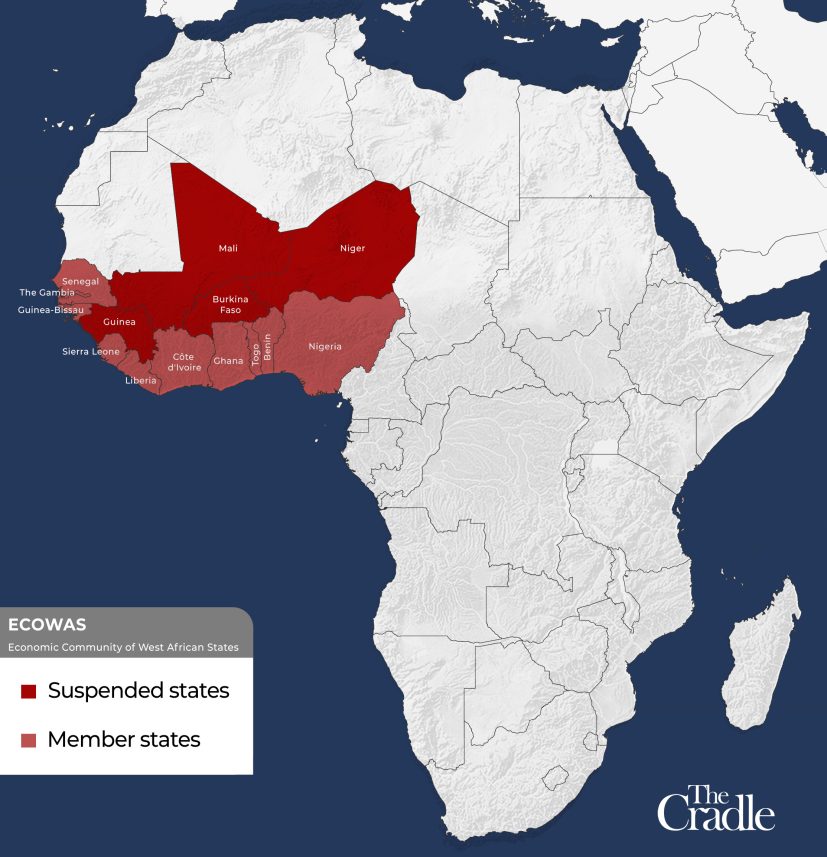
Map of the Economic Community of West African States (ECOWAS)
Sanctions failed, so proxy war begins
JNIM continues to receive financing from Persian Gulf patrons and income from ransoms and extortion. While it has a strong rural presence, it controls no major cities. Azawad separatists and ISIS fighters are similarly confined to Mali’s remote north.
A different strategy was needed. In recent weeks, JNIM has attacked fuel trucks, depriving Bamako of oil. Cars were unable to fill up, and schools closed. According to western media, JNIM wants to strangle the capital to promote unrest. Mali has had five coups since independence, three of which have occurred since 2012. News reports suggest that given this history, JNIM can ultimately topple the Malian government.
Reports of an “immediate collapse” are nearly a month old. What Western media fails to understand is that, unlike previous governments in Mali, the current one is highly popular. Truckers are willing to risk their lives to bring fuel to the capital. “If we die, it’s for a good cause,” one trucker said. Even if the blockade were to stop all fuel, Malian’s resilience and support for Goita would only increase.
Thankfully for Bamako, JNIM is facing setbacks. Russia, which provides support from the Africa Corps (formerly Wagner Group) and, in 2023, vetoed the UNSC’s sanctions, sent 160,000 and 200,000 metric tons of petroleum and agricultural products. This has provided some relief, with fuel lines shortening and schools reopening.
On 15 November, Mali and the African Corps seized the Intahaka mine. The next day, the town of Loulouni was also recaptured. That same day, the blockade south of Bamako was weakened, allowing convoys of fuel trucks to reach the city.
Manufacturing consent for intervention
So why does the western media continue insisting that Mali is collapsing? Simple: to justify military intervention.
One of the biggest propagandists has been France. In a post on X from the French Ministry for Europe and Foreign Affairs, Paris blamed Russia for abandoning Mali, despite being one of the only nations supporting it during this crisis. French news channels LCI and TF1 ran stories such as “Mali, the Jihadists at the gates of Bamako” and “Mali, the new stronghold of Al-Qaeda.”
In response, Bamako banned them from the country. Niger has also accused Benin of being a base of operations for France. French state media, France 24, did not deny the claim, only disputing that the number of soldiers was far less than Niger claimed.
France stands to regain a significant geopolitical advantage from regime change in Mali. The country borders seven former French colonies. A return would reassert French regional influence and weaken the anti-imperialist Alliance of Sahel States. Niger remains crucial to France’s uranium supply, which is necessary for 70 percent of the country’s energy. Bamako is also quickly becoming a major exporter of lithium – essential for electronics and electric cars – with the recent opening of its second mine.
Other western countries have also lost out under Goita’s rule. Canadian company Barrick Mining lost $1 billion when Mali nationalized the mining industry. Last month, other western firms, such as Harmony Gold, IAMGOLD, Cora Gold, and Resolute Mining, had their mining exploration licenses revoked.
The growing Russia–Mali partnership resembles Moscow’s 2015 intervention in Syria. Just as Russia propped up Damascus for as long as it could from a US-led proxy war, it now shores up Bamako. The payoff could be similarly strategic: diplomatic support, military basing rights, and influence in an emerging multipolar Africa.
Unlike past interventions cloaked as counterterrorism, the west now appears reluctant. Washington and its allies, usually quick to bomb under any pretext, have done nothing to aid Bamako. This silence suggests either tacit support for JNIM or confidence that Mali will implode without direct action.
Outsourcing war
As a member of the Alliance of Sahel States, the west fears that Mali’s resilience will be an inspiration to others to join the anti-imperialist struggle. The 2021 coup emerged as a result of inequality and insecurity. These factors can be found in many other West African countries such as Benin, the Ivory Coast, and Togo.
Some observers theorize that Africa’s most populous country, Nigeria, could soon have a revolution, amid high inequality and insecurity from Boko Haram. Nigeria’s growing ties with Mali are a serious threat to the west.
With sanctions failing to bring Mali to its knees, the only solution for the west is military intervention. This might be direct, as seen with Niger, where French troops are stationed in bordering Benin. But more likely, western countries will outsource their intervention to African states. This has occurred in Somalia, where the US has Kenya and Uganda do its dirty work in return for aid. The same could occur with Mali.
The most likely actors to play this role are ECOWAS and the African Union. ECOWAS receives military training from the US, and many of its leaders are closely tied to Washington. It also receives extensive financing from the EU, most recently receiving €110 million ($119 million) to support “peace, trade, and governance.” Far from neutral, it has become an enforcement arm for western interests. The bloc has previously sanctioned Mali and, in 2023, threatened to invade Niger.
The African Union has also served the interests of the west, such as the African Union Mission to Somalia, which is supported and financed by Washington and Brussels. The African Union Constitutive Act prohibits military intervention in any member state, with the exception of war crimes or at the request of the state.
Mali, however, was suspended from the African Union in 2021, making intervention fully legal under the Act. Chairperson of the African Union Commission, Mahmoud Ali Youssouf, recently called for “urgent international Action as crisis escalates in Mali.”
Bamako versus the empire
Mali faces a two-pronged assault: economic strangulation and the threat of foreign-backed military intervention.
Though JNIM remains a nuisance, it has failed to topple the government. The bigger threat comes from western capitals and their African proxies. Russia remains one of Mali’s few reliable allies. If successful, Moscow’s support will elevate its standing across the continent.
More importantly, Mali’s endurance will inspire other African states to challenge western domination and reclaim sovereignty.
Ukraine is drowning in a swamp of corruption – and the West is trying to make it look like a good thing
By Tarik Cyril Amar | RT | November 19, 2025
In Ukraine, the front lines are crumbling and so is the Zelensky regime. While Kupyansk and Pokrovsk are falling, the shockwaves of the Energoatom Mafia scandal keep reverberating, internationally and at home in Kiev.
At this point, two ministers have resigned. The former defense minister and head of the powerful National Security Council, Rustem Umerov, is in essence on the run abroad. According to the usually well-informed journalist Anatoly Shariy, Umerov is offering the FBI in the US to turn – protected – witness. He may still return to Ukraine, but even his current behavior – the unplanned delays, the search for US allies, quite possibly for some kind of deal – betrays a very guilty conscience.
Likewise, Prime Minister Yulia Sviridenko has declared her readiness to cooperate with Ukraine’s own anti-corruption prosecutors at NABU, which is in reality a branch of the FBI implanted in Ukraine. Clearly, Sviridenko is also looking for a deal, letting it be known that she is ready to talk and name names, as long as they let her get away with the absurd claim that she knew it all but wasn’t part of it.
Zelensky’s most intimate companion, chief consigliere, autocratic enforcer, and overbearing eminence grise, Andrey Yermak, is also deeply – and unsurprisingly – implicated, under the gangster slang name ‘Ali Baba’, in the Energoatom Mafia scandal, and his head is clearly on the political chopping block.
Details could be multiplied ad nauseam. Take, for instance, the fact that we now know that the gangster pseudonym ‘Professor’ did not stand for former Justice Minister German Galushchenko – no worries, though: He’s still an Energoatom mobster, just not that one – but the wife of former Deputy Prime Minister Aleksey Chernyshov, Svetlana.
While her husband features as ‘Che Guevara’ in the Energoatom scandal, ‘Professor’ Svetlana – in real life (or pretend?) an academic at Kiev’s prestigious Taras Shevchenko University – happens to be very close besties with Elena Zelenskaya. Yes, that would be Vladimir Zelensky’s spouse (when his intense schedule with Yermak leaves time for her). According to Shariy, Svetlana-bestie-of-Elena is implicated in shady deals around the habit of Kiev’s elites of building themselves palaces, and she also received a cool $500,000 (in cash) from ‘Sugarman’, aka Aleksandr Tsukerman, another key Energoatom player on the run.
In short, if they think they have a swamp in Washington, they haven’t seen Kiev yet. But of course, they have. It is obvious that Washington has been well aware of just how stunningly, stinkingly corrupt its clients in Ukraine are. Indeed, the more, the better, a modern Machiavelli would say, because it makes them even more dependent. One of the best explanations for the Energoatom scandal breaking now is that it is part of a US operation to either get rid of or subdue Zelensky. The conspicuous fact that Zelensky has suddenly made – insubstantial – noises about being interested in peace talks may have as much to do with this American assault on him as with the disaster on the front lines.
This is the context that also explains a recent trend in Western spin-for-Ukraine. Absurd as it is, the claim that the Energoatom mess is really a good sign if you only look close enough is spreading as if on cue. The underlying logic is not only daft but simple. Take, for instance, a recent specimen of the genre: According to Polish TVP quoting the American Center for European Policy Analysis (CEPA), the Energoatom scandal “hurts Ukraine yet proves it’s on the right track,” because “a case of this scale exposed by domestic institutions is proof of Ukraine’s anti-corruption system working.”
Where to even begin? Let’s just break it down in order of appearance: ‘A case’ – as in one case – only proves that there is much more to come. In Ukraine, there is widespread consensus that what happened at Energoatom is peanuts compared to what has been going on in the defense sector, bloated with literally hundreds of billions of euros and dollars from the West. This is exactly why ex-Defense Minister Umerov is running scared. The first evidence of his personal involvement in corruption is emerging already. Energoatom is merely the crack in the dam. When the dam breaks, so will the system, all of it.
‘Domestic institutions’? That one is genuinely funny. The only reason NABU and SAPO – Ukraine’s anti-corruption agencies – are still alive is that they are not domestic. In reality, for those who don’t believe in Santa Claus, they are US implants – in the case of NABU, explicitly so. They survived Zelensky’s attempt to raze them this summer only due to Western support.
‘Proof’? The only proof of Ukraine’s corruption under the Zelensky regime suffering a real setback would be the fall of that regime. But even then – and here is what naive Westerners simply cannot grasp about the Ukrainian political system – corruption as such would not cease but merely undergo a change in management. How do we know? Because this law of Kiev politics has been tested again and again. The last time, by the way, in 2014, when then-President Viktor Yanukovich was ousted in a regime change operation made easier by his flagrant graft and nepotism. And yet, here we are again.
There is added irony in Poland channeling an American think tank to spread absurd spin about Ukraine’s hyper-corruption: According to X post by former Polish Prime Minister Leszek Miller, the Polish authorities may well have helped one of the very worst Energoatom Mafia leaders, Timur Mindich – aka ‘the president’s purse’, that is, Zelensky’s – to evade arrest. This is entirely plausible: In Ukraine, Mindich was clearly tipped off about his impending arrest, most likely by either Yermak or Zelensky himself. Whoever warned him would also have had the necessary Polish connections. And Warsaw, of course, has a nasty record of working with criminals from Ukraine and of sheltering them from prosecution, too. Just ask the Germans how far they got with their Nord Stream investigations.
Ukrainians are drowning in a deep, fetid swamp of corruption, worse than ever. To pretend that a scandal surfacing from that morass is a good sign is perverse. But then, so is most of Western policy toward Ukraine, using its people up in a war provoked for idiotic reasons and long lost. Maybe there is some dark, historic justice in Ukraine and the West making their respective cultures of cynicism and graft even worse for each other.
Tarik Cyril Amar is a historian from Germany working at Koç University, Istanbul, on Russia, Ukraine, and Eastern Europe, the history of World War II, the cultural Cold War, and the politics of memory.
Polish railway ‘sabotage’ runs on time for Europe’s military Schengen plan
By Finian Cunningham | Strategic Culture Foundation | November 19, 2025
The European Commission is proposing to make the European Union of 27 nations a seamless territory for NATO transport across national borders. The concept is to create a “military Schengen” in analogy to the free movement of civilians across the bloc.
The controversial idea is strongly advocated by pro-NATO European leaders. The proxy war in Ukraine against Russia and the escalating tensions of a wider war have helped push the sweeping militarization of the EU as a single bloc.
This week, as the European Commission President Ursula von der Leyen makes her pitch for an EU-wide military Schengen zone, there were suspicious sabotage attacks on Poland’s railway network.
Von der Leyen is leading the calls for coordination of military forces to have free access to the EU’s transport links. The idea for a military Schengen-type arrangement for the EU has been around for several years, but there has been resistance from nations giving up control of their borders. The last time Von der Leyen’s German compatriots did that by marching across Europe did not go down too well.
What the proponents of the concept would like is for military forces from one country to be able to cross over several others with minimal inspection. The idea brings closer to realization the formation of an “EU army.” It also blurs the lines between NATO and the EU to the point where all 27 members of the EU become de facto members of the military alliance.
Polish Prime Minister Donald Tusk and Von der Leyen were quick to blame Russia for “shocking sabotage” of Poland’s railway after trains were disrupted by an explosive attack on Sunday. No one was injured. And, as usual, no evidence was provided. Russia was not openly blamed by name, but the media reporting implicated Russian involvement. Moscow has previously denied accusations of carrying out hybrid war attacks on transport and communication infrastructure across Europe, including the use of drones to disrupt air traffic.
Questions arise about the latest railway incidents in Poland. The affected rail line was from Warsaw to Lublin, and onwards to Ukraine. Tusk described the rail link as “crucially important for aid to Ukraine.” Indeed, the rail line is a major vector for munitions flowing to Ukraine. If it is such a vital supply route for NATO military equipment to Ukraine, one wonders why the rail line was not better guarded.
The railway damage was reported by a train driver on Sunday morning, yet the government and security authorities did not act until Monday. The delay in response caused anger among Polish citizens who remonstrated with officials at public gatherings. Were the authorities deliberately being negligent in ensuring the rail line was made safe, to contrive an accident?
The BBC reported local people claiming that they heard a massive explosion whose impact could be felt several kilometers away. The strange thing is that the reported railway damage did not appear to be extensive. One would expect from such a powerful blast that whole sections of the rail would have been destroyed, making the line impassable. However, it was reported that several trains were able to traverse the damaged section on Monday before the authorities acted. The traversing trains incurred shattered windows. But if they were able to traverse, then the tracks could not have been blown apart.
We might reasonably speculate, therefore, that the explosion was not the actual cause of the relatively limited rail damage. Perhaps the blast was detonated to bring the public’s attention to a separate act of sabotage to derail the trains (without causing a calamitous loss of life). The purpose was to conflate the perception of explosion with railway sabotage. And as Tusk, Von der Leyen, and the media have all dutifully followed suit, the convenient upshot is to level accusations implicating Russian hybrid warfare.
Poland’s Army Chief of Staff, General Wieslaw Kukula, articulated the narrative as quoted by Euronews : “The adversary has started preparations for war. They are building a certain environment here to bring about an undermining of public confidence in the government and bodies such as the armed forces and the police… [creating] conditions that are convenient for the potential conduct of aggression on Polish territory.”
Week after week, European politicians, military, security, and bureaucratic chiefs are claiming with shrill rhetoric that Russia is preparing to attack member states imminently. Earlier this year, Poland’s Tusk even accused Russia of intending to blow up civilian cargo airplanes. How easy it is to plant incendiary devices to blame someone else and report “suspects” arrested without court cases. The European public is browbeaten into consenting to increased military budgets, air defenses, anti-drone walls, and tens of billions of Euros more to prop up the corrupt Kiev regime. All to “defend” Europe against an evil aggressor.
Moscow has repeatedly dismissed claims that it intends to attack European states. But the war propaganda continues relentlessly to project Russia as a drooling barbarian.
A cruel irony is that passenger trains have been sabotaged in Russia in recent months, with the loss of lives, acts which have been attributed to NATO and Ukrainian covert operations. The Western media hardly reports on those atrocities.
But an apparently contrived false-flag operation in Poland is given maximum Western media coverage with the choreographed narrative that Russia is the villain. As with the flurry of mysterious drones suddenly invading European airspaces.
The proposal for a European military Schengen is very much aimed at bringing rail networks across Europe under a seamless command to enable the rapid mass movement of NATO forces over national borders. No questions asked. Just do it.
A false-flag sabotage on Polish railways reinforces the messaging that Europe’s transport network has to be turned over for military logistical control.
The militarization of Europe and its “NATO-ization,” entails an unprecedented and mind-boggling shift in public money to military corporations, the financial elite, and their political puppets. The corruption in the Kiev regime is a microcosm of the bigger war racket that Europe has become. False flags to scare European citizens into passive acceptance of the rip-off are running like clockwork.
It used to be joked about Mussolini and Hitler that at least the old fascists made the trains run on time. The new fascists make the trains come off the rails on time.
Legal Nonsense to Justify Non-Judicial Killings
By Jacob G. Hornberger | Future of Freedom Foundation | November 18, 2025
Many years ago, when I was practicing law in Texas, I learned that there were, generally speaking, two types of lawyers when it came to being asked for a legal opinion by a client who wished to pursue a certain course of action.
The first type of lawyer would carefully research the issue and give his honest, independent-minded opinion as to the legality of the proposed action, even if it wasn’t what the client wanted to hear. That type of lawyer had integrity and would not compromise his legal judgment, even if it angered — and risked the loss of — his client.
The second type of lawyer would instead come up with whatever legal reasoning was necessary to please the client, stretching case law and legal analysis in such as way as to justify what the client wanted to do. This type of lawyer had no integrity. His task, as he saw it, was to provide legal cover for his client in case things went the wrong way.
When it comes to President Trump’s and the Pentagon’s extra-judicial drug-war killings in the Caribbean, there is little or no doubt that the Office of Legal Counsel in the U.S. Department of Justice falls into the second category. Asked to provide a legal opinion as to the legality of such killings, the office has come up with a memorandum containing inane legal justifications, in an obvious effort to provide legal cover for the people involved in the extrajudicial killings. In fact, the still-secret memo expressly assures U.S. military personnel that they will not face future criminal prosecution for their involvement in the killings.
The memo states that the high number of deaths from drug use among American drug consumers constitutes an “armed attack” against the United States. Really? Where are the armaments? Are Latin American drug dealers entering the United States, kidnapping regular American citizens, physically holding them down, and then injecting drugs into their noses, mouths, or other parts of their bodies?
I don’t think so. There is certainly no evidence of that. All of the evidence is that American consumers of drugs are voluntarily buying and ingesting mind-altering substances knowing full well that this isn’t a risk-free endeavor.
Another part of the memo claims that the boats that are suspected of carrying drugs are generating revenue for groups that are supposedly in armed conflict with the United States.
Really? Where are the conflicts? I don’t see any Latin American cartels landing on American shores and killing American citizens. Indeed, I haven’t seen those boats firing at American Naval vessels or at American B-52s. All I’ve seen is massacres of defenseless private individuals in the face of overwhelming U.S. military power.
According to the Intercept: “One senior defense official, speaking on the condition of anonymity, blasted the opinion. ‘I don’t know what’s more insane – that the ‘President of Peace’ is starting an illegal war or that he’s giving a get out of jail free card to the U.S. military,’ said the official, referencing President Donald Trump’s self-proclaimed moniker. ‘Hopefully they realize there’s no immunity for war crimes. Nor is there a statute of limitations.’”
One of the other justifications on which Trump and the Pentagon are relying is their claim that these boat people are “terrorists.” Apparently that governmental accusation means that they are subject to being exterminated without arrest, indictment, prosecution, conviction, and sentence — that is, without any due process of law for what amounts to an accusation of a criminal-law violation, whether it is drug-war-related or terrorist-related.
For some time, Trump has been claiming that Venezuela immigrants have been “invading” the United States. I guess we should be thankful that the Office of Legal Counsel hasn’t yet opined that the U.S. is repelling an immigrant “invasion” of the United States by killing people in those boats.
One of the most fascinating and revealing aspects of these extra-judicial killings is when U.S. forces took custody of two targeted people who survived the attack on their vessel. What happened afterward reveals what a sham these drug-war killings are. U.S. officials released both men back to their home countries.
What? Yes, they took two supposed “narco-terrorists” into custody and then released them, which means that they are now free to engage in more “narco activity” and more “terrorism.” Does that make any sense whatsoever?
The real interesting question is: When they saw that those men had survived the military attack on their vessel, why didn’t U.S. military personnel simply fire missiles at them or just shoot them while they were bobbing in the water? After all, they had just tried to kill them inside their boat. What’s the difference with killing them outside their boat?
I’ll tell you why. Those military attackers felt sheepish about killing those two survivors. Even more, I will guarantee you that they were scared to do so. They were scared that they would ultimately be put on trial for unlawfully killing people. That’s why they stood down and took custody of them instead of just finishing the job and killing them.
Why not instead bring them back as “prisoners of war”? Isn’t this an “armed conflict” against “terrorism”? Why not imprison them at the Pentagon-CIA prison camp and torture center at Guantanamo? Why not torture them into divulging the secret locations of other “narco-terrorists”?
I’ll tell you why. Because U.S. officials didn’t want to take the chance that those two men might challenge their custody in a federal district court. I will guarantee you that U.S. officials had to have freaked out when those two men survived. “Release those ‘narco-terrorists’ immediately so that our inane legal opinion that justifies our drug-war killings cannot be challenged in court,” we can imagine them exclaiming.
Make no mistake about it: These drug-war killings are the equivalent of legalized murder. They are morally illegitimate, legally illegitimate, and constitutionally illegitimate, no matter the inane legal opinion issued by the Justice Department’s Office of Legal Counsel in an obvious effort to provide cover for the people involved in these killings.
Featured Video

America Racing to Strategic Defeat in Iran
or go to
Aletho News Archives – Video-Images
From the Archives
Should Europeans ‘Thank’ the Americans for Destroying Nord Stream?
By Robert Bridge | Strategic Culture Foundation | September 29, 2022
With an investigation continuing into the destruction of the Nord Stream gas pipeline that provided energy supplies to Europe from Russia, there appears to be just one prime suspect, and that should surprise nobody.
Following the sabotage of the Nord Stream 1 and 2 gas pipelines, former Polish Foreign Minister Radoslaw Sikorski already seemed to know the identity of the perpetrator when he tweeted out: “Thank you, USA.”
At first glance, it seemed that Sikorski was speaking sarcastically, berating Washington for carrying out an attack that will have severe repercussions for the people of Europe. After all, how could anyone see any good coming from the termination of Europe’s primary source of gas reserves with winter just around the corner? It was Sikorski’s homeland of Poland, after all, that urged its citizens to collect firewood in the face of dwindling gas reserves.
In fact, the Polish diplomat was speaking one-hundred percent literally… continue
Blog Roll
 Aletho News
- Growing insecurity, soaring prices fuel protests in north as regime bans evacuation: Sources
- Iran denies responsibility for ‘depraved’ attack on Kuwait desalination plant
- Bring The Troops Back. End This War Now!
- Can we please stop calling Israel the ‘only democracy in the Middle East’ now?
- US should start removing its troops from Germany, proposes AfD co-leader Chrupalla
- Iran Red Crescent: 600 educational centers attacked in US-Israeli ‘war crimes’
- Russian Oil Tanker Arrives in Cuba Amid U.S. Blockade
- America Racing to Strategic Defeat in Iran: Lt Col Daniel Davis
- FTC Warns Visa, Mastercard, PayPal, Stripe Over Political Debanking
- Russian tanker approaches Cuba despite US oil blockade
- If Americans Knew
- As Iran targets US military bases, will they be relocated to Israel? Not a ceasefire Day 171
- Will Trump Go Kamikaze?
- Is the University of Florida Shutting Down College Republicans over Israel Criticism?
- Jewish extremist arrested over alleged plot to firebomb Palestinian activist Nerdeen Kiswani’s home
- More than half of Palestinian child detainees have no charges
- The More Murderous Israel Gets, The More We Hear About “Antisemitism”
- Land Day and the Palestinian struggle after 30 months of genocide
- The Iran War Is About Palestine
- Israeli soldiers echo settler ideology, talk of revenge after targeting Palestinians and detaining CNN crew in the West Bank
- Israeli Policies Threaten Future of Christian Schools in Jerusalem
- No Tricks Zone
- New Study Finds Warming Saves Lives…Cold Temperatures 12 Times More Deadly Than Excess Heat
- German Science Blog Accuses PIK Climate Institute Of Hallucinating Climate Tipping Points
- Devastating Assessment Of Comirnaty Vaccine By Former Senior Pfizer Europe Toxicologist
- New Study: CO2 Is ‘Effectively Negligible’ As An Explanatory Climate Change Factor Since 2000
- Former Pfizer Toxicologist Dr. Helmut Sterz Tells Bundestag Hearing Pfizer Vaccine Should Have Never Been Approved
- Energy Expert: Germany’s Nuclear Phaseout Was A “500 Billion Euro Mistake”
- New Research: South Australia’s Mid-Holocene Sea Surface Temperatures Were 4°C Warmer Than Today
- Storing Green Energy To Last Germany 10 Days Would Require A 60-Million Tonne Battery
- New Studies: UK Sea Levels Were 4 Meters Higher Than Today During The Mid-Holocene
- Destructive Green New Deal: German Energy And Metal Group Warns Of Drastic Crisis
 Aletho News