4 Shocking Ties Between Rubio, Lobbyists, and Hernández Narcotics Indictment

teleSUR | November 29, 2025
WASHINGTON — The recent announcement by former U.S. President Donald Trump that he will grant a “full and complete pardon” to Juan Orlando Hernández, the former Honduran president currently serving a U.S. federal sentence for drug trafficking, has reignited scrutiny over a long-documented web of political and financial connections linking Hernández, Republican lobbying powerhouse BGR Group, and U.S. Secretary of State Marco Rubio.
Far from an isolated act of clemency, Trump’s pledge appears deeply entangled with a system of influence-peddling that has shaped U.S. policy toward Central America for years. At the center stands Rubio—a figure who, as a Florida senator, once publicly praised Hernández for “taking on drug traffickers,” even as evidence mounted that the Honduran leader was personally profiting from the very cartels he claimed to fight.
Now, with Rubio overseeing U.S. diplomacy from the State Department, critics warn that the Rubio Hernández lobbying scandal reveals how foreign actors can exploit the U.S. lobbying system to buy legitimacy, evade justice, and ultimately secure political favors—including presidential pardons.
The BGR Group Connection: How Hernández Bought Influence in Washington
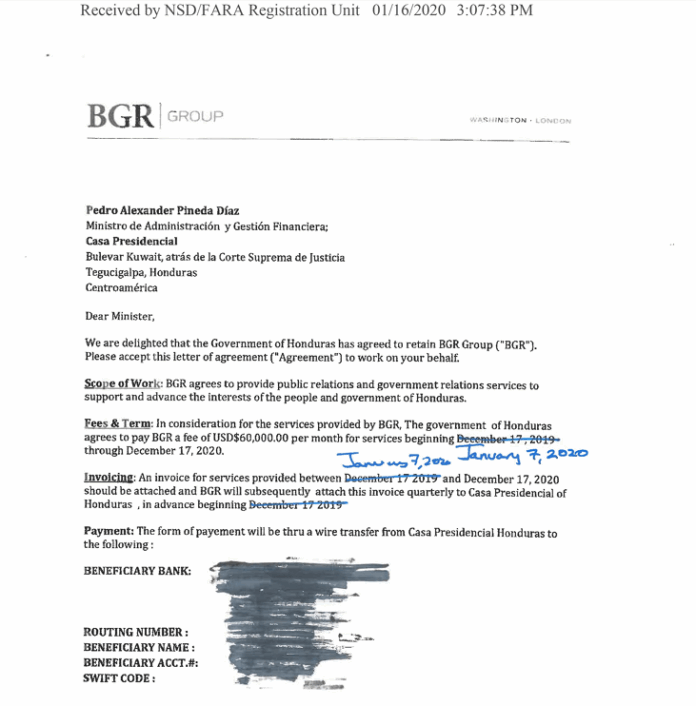
In early 2020, as his legal situation began to collapse—following the life sentence of his brother, Tony Hernández, for trafficking tons of cocaine into the U.S.—Juan Orlando Hernández signed a $660,000 contract with BGR Group, a Washington-based lobbying firm founded by former Republican Governor Haley Barbour.
The goal was clear: rehabilitate Hernández’s image in the U.S. capital as a “trusted ally” and “anti-narcotics partner,” despite mounting evidence that he had accepted millions in bribes from cartels to fund his presidential campaigns.
According to a detailed investigation by VICE News, BGR Group went to work immediately:
- It contacted 11 congressional staffers, three of whom had previously worked directly for Marco Rubio.
- It distributed press releases portraying Hernández as a bulwark against organized crime.
- It arranged meetings with U.S. officials to reinforce the narrative of Honduras as a cooperative security partner.
All this occurred while U.S. prosecutors were building their case against Hernández himself—culminating in his 2024 conviction for conspiring to import over 500 tons of cocaine into the United States.
Critically, BGR Group was not just any firm—it was a major Republican donor network with deep ties to Rubio’s political career. Records show the firm hosted fundraising events for Rubio’s 2010 and 2016 Senate campaigns, as well as his short-lived 2016 presidential bid.
This means that the same lobbying apparatus paid by a convicted narco-president helped finance the rise of the man now shaping U.S. policy toward Latin America.
Explore FEC records on BGR’s political contributions to Rubio (Federal Election Commission)
Trump’s Pardon as Political Payback—Not Justice
Trump’s announcement—made via Truth Social on Friday—comes amid his open support for Nasry “Tito” Asfura, Hernández’s political protégé and the National Party’s 2025 presidential candidate in Honduras. Trump has explicitly tied future U.S. aid to Asfura’s victory, signaling that Washington’s backing is conditional on political alignment.
In this context, the pardon of Hernández appears less like mercy and more like a strategic signal: loyalty to U.S. Republican interests—even when demonstrated through illicit means—will be rewarded.
Hernández, after all, was once Washington’s favorite Central American strongman. He allowed the U.S. to maintain military bases in Honduras, cracked down on migrant caravans, and supported U.S. regional agendas—all while allegedly running a state-sponsored drug enterprise.
Now, with Rubio at the State Department and Trump eyeing a 2028 comeback, the Rubio Hernández lobbying scandal underscores a troubling reality: foreign leaders can launder their reputations through U.S. lobbying firms, gain access to top policymakers, and ultimately escape accountability—even after federal conviction.
As one Latin American diplomat put it: “This isn’t diplomacy. It’s transactional impunity.”
Geopolitical Context: Undermining Rule of Law in the Americas
The fallout from the Rubio Hernández lobbying scandal extends far beyond bilateral relations. It strikes at the credibility of the entire U.S. “war on drugs” and its claims of promoting democracy and rule of law in Latin America.
If a president convicted of trafficking cocaine can secure a presidential pardon through backroom lobbying and partisan loyalty, what message does that send to reformers in Guatemala, El Salvador, or Colombia?
Moreover, it deepens regional distrust of U.S. intentions. For years, progressive governments in the region have argued that Washington prioritizes compliance over justice—backing authoritarian but cooperative leaders while condemning leftist governments for lesser offenses. The Hernández case validates that critique.
Cuba, Nicaragua, and Venezuela have long denounced this “selective morality” in U.S. foreign policy. Now, even centrist allies are questioning whether the U.S. system can be gamed by those with enough money and the right lobbyists.
In a hemisphere increasingly seeking multipolar partnerships, such scandals fuel the narrative that U.S. democracy is for sale—and that sovereignty is secondary to political convenience.
No comments yet.

or go to
Aletho News Archives – Video-Images
From the Archives
Israel Would Have No Qualms About USS Liberty-Style FALSE FLAG If Iran Campaign Falters – Analysts
By Ilya Tsukanov – Sputnik – 18.06.2025
Donald Trump is mulling whether or not to join Israel’s aggression against Iran as Tel Aviv faces problems sustaining its defenses against growing counterstrikes, and apparently lacks a realistic game plan for an end to hostilities after failing to achieve its goals. Analysts told Sputnik how the US could be ‘nudged’ into the conflict.
“The US is already assisting Israel with supplies, intel, refueling support, etc. One of the many US posts in the region could be attacked for a casus belli,” former Pentagon analyst Karen Kwiatkowski explained.
“If Trump doesn’t comply with Israel’s demand” and join its aggression voluntarily, “a false flag may be needed” to drag the US in, Kwiatkowski, retired US Air Force Lt. Col.-turned Iraq War whistleblower, fears.
Netanyahu has a diverse array of options at his disposal, according to the observer, including:
- a false flag against US assets abroad blamed on Iran or one of its Axis of Resistance allies, like the Houthis
- a US domestic attack or assassination blamed on Iran
- Iranian air defenses ‘accidentally’ hitting a civilian jetliner carrying Americans
- use of a dirty bomb or nuclear contamination somewhere in the region blamed on Iran
- even blackmailing by threatening to use nukes against Iran if the US doesn’t join the fight
Kwiatkowski estimates that Israel probably has “enough blackmail power” against President Trump and Congress to avoid the necessity of a false flag operation, but a “USS Liberty-style” attack, targeting the soon-to-be-retired USS Nimitz supercarrier that’s heading to the Middle East, for example, nevertheless cannot be ruled out entirely, she says. … continue
Blog Roll
 Aletho News
- The London Ambulances Attack: Of Course It Was A False Flag
- Embarrassing Pivot: U.S. considers dropping Iran oil sanctions amid war
- US has 2 months of rare earths left to replenish weapons amid Iran war: Report
- Strait Of Hormuz closure brings Empire to brink
- Iran controls Strait of Hormuz, dictates terms of war and peace as US excursion backfires
- Outlasting the Superpower: The Reasons Why Iran is Beating uhe US and Israel
- Top PMU commander, over a dozen fighters killed in new US strikes on Iraq
- Is Netanyahu’s war gamble threatening the future of ‘Israel’?: FT
- Smotrich calls for annexation of South Lebanon to Litani River
- Echos of Gallipoli? Hormuz and the Geography of Hubris
- If Americans Knew
- ‘Forever live by the sword’: Understanding Israelis’ massive support for Iran war
- UN’s special rapporteur on human rights says Israel is systematically torturing Palestinians
- Trump White House plagiarized Iran war manifesto from Israel-aligned think tank
- Gaza says 6–10 patients die daily waiting for treatment abroad as Israel blocks medical evacuations
- ‘Substantial evidence’ of double-tap strike in killing of Gaza’s Hind Rajab
- ‘Do Not Want To Die For Israel’: Doubts About Trump’s Iran Strategy Spread Among Troops
- Instead of taking Joe Kent’s claims seriously, the media is disregarding him as an antisemite
- Joe Kent’s Explosive Interviews about his Resignation over the Iran War
- Israel poised to take over southern Lebanon; settlers wreak havoc in West Bank – Not a ceasefire Day 165
- From Sde Teiman, the truth about Israel’s military justice system has been set free
- No Tricks Zone
- Devastating Assessment Of Comirnaty Vaccine By Former Senior Pfizer Europe Toxicologist
- New Study: CO2 Is ‘Effectively Negligible’ As An Explanatory Climate Change Factor Since 2000
- Former Pfizer Toxicologist Dr. Helmut Sterz Tells Bundestag Hearing Pfizer Vaccine Should Have Never Been Approved
- Energy Expert: Germany’s Nuclear Phaseout Was A “500 Billion Euro Mistake”
- New Research: South Australia’s Mid-Holocene Sea Surface Temperatures Were 4°C Warmer Than Today
- Storing Green Energy To Last Germany 10 Days Would Require A 60-Million Tonne Battery
- New Studies: UK Sea Levels Were 4 Meters Higher Than Today During The Mid-Holocene
- Destructive Green New Deal: German Energy And Metal Group Warns Of Drastic Crisis
- New Study Documents A 20-Year Pause In Arctic Sea Ice Decline – Driven By Internal Variability
- Wake-up Call: Survey Shows Majority Of Germans Now Favor Postponing Climate Targets!
 Aletho News
Leave a comment