Majority of Israelis Back War with Iran as Anti-War Minority Faces Stigmatization
teleSUR | March 7, 2026
Israelis who oppose the war with Iran face threats and stigmatization, according to testimonies collected by a Spanish news agency. However, they represent a small minority, as 93% of Jewish Israelis support the offensive, a new poll by the Israel Democracy Institute (IDI) shows.
“Opposing the war and war crimes in Israel is practically a punishable offense. Even leftists and pacifists consider this a ‘just war,’” Adam Eli, secretary of the Jewish-Arab leftist coalition Hadash in Tel Aviv said.
Among those few critics is 19-year-old activist Itamar Greenberg, known in Israel for refusing to serve in the military in 2024. That decision, he recounted, cost him six months in prison and ostracism at his university, where he still leads a student circle while studying law.
Nearly one year after walking out of prison, Greenberg found himself back in custody on Tuesday for attending an anti-war rally that barely mustered 20 people across a nation of 10 million.
“About 40 police officers charged at us, confiscated our signs, and beat us. I was arrested and stripped naked for a search,” Greenberg said. He is also the founder of Mesarvot, a network of Israeli youth refusing military service.
An anti-war demonstration scheduled for Saturday at Habima Square in Tel Aviv will test wartime restrictions that cap gatherings at 50 people.
Meanwhile, restrictions on the right to assembly have been applied loosely during recent Purim celebrations—a sort of Jewish carnival—while Israeli authorities continue to bar Palestinians from praying at Al Aqsa Mosque despite Ramadan, and have militarily sealed off much of the West Bank.
Stanislav Krapivnik: Russia-Iran Cooperation & Escalation in Ukraine
Glenn Diesen | March 6, 2026
Stanislav Krapivnik is a former US Army officer, supply chain exec and military-political expert, now based in Russia. He was born in Lugansk during the Soviet times, migrated to the US as a child and served in the US army. Krapivnik discusses how Russia cooperates with Iran, and why the Iran War is creating immense pressure on Putin to escalate.
Follow Prof. Glenn Diesen:
- Substack: https://glenndiesen.substack.com/
- X/Twitter: https://x.com/Glenn_Diesen
- Support the research by Prof. Glenn Diesen: PayPal: https://www.paypal.com/paypalme/glenn…
- Buy me a Coffee: buymeacoffee.com/gdieseng Go Fund Me: https://gofund.me/09ea012f
- Books by Prof. Glenn Diesen: https://www.amazon.com/stores/author/…
Indonesia suspends participation in Board of Peace following attack on Iran
MEMO | March 6, 2026
Indonesia has announced the suspension of all discussions on the proposed Board of Peace, an initiative launched by US President Donald Trump, as military tensions rise in the Middle East.
Indonesian Foreign Minister Sugiono said the decision to suspend participation was taken because of the latest military escalation in the region, which has directly affected the foreign policy priorities of countries involved in the initiative.
He explained that international attention has now shifted to the consequences of the conflict with Iran. He added that Indonesia would hold intensive consultations with its partners in the Gulf region, as they are directly affected by the ongoing attacks and rising tensions.
Indonesia’s participation in the council has faced strong criticism from domestic political and religious groups. They argue that joining an initiative led by the Trump administration could undermine Jakarta’s long-standing position in support of the Palestinian cause.
In the same context, the Indonesian Ulema Council called for an immediate withdrawal from the initiative, saying it lacks effectiveness while the military offensive continues.
‘Operation Epic Fury’ burns an estimated $5.82 billion in just 100 hours
MEMO | March 6, 2026
The first 100 hours of “Operation Epic Fury” have cost US forces at least an estimated $5.82 billion, or about 0.69% of the entire 2026 US defense budget, according to data compiled by Anadolu.
Anadolu estimates that the US spent $779 million in the first 24 hours of the operation. As operations have continued, the total operational cost of US offensives has tallied to approximately $3.3 billion, with figures from the Center for Strategic and International Studies showing a similar total.
In addition to operational costs, the US has lost significant military assets in Iran’s retaliatory strikes. According to estimates by Anadolu, the US has already lost roughly $2.52 billion.
US asset losses
The primary contributor to the losses is a US AN/FPS-132 early warning radar system at Al-Udeid Air Base in Qatar, valued at $1.1 billion, which was struck by an Iranian missile on Saturday. Qatar confirmed that the radar was hit and damaged.
On Sunday, three F-15E Strike Eagles were lost in a friendly fire incident involving Kuwaiti air defenses. While all six aircrew survived, the planes did not — with the cost of replacing them estimated at $282 million.
US officials speaking to CBS News said that three MQ-9 Reaper Surveillance and Attack Drones belonging to the US Air Force have been downed so far, at an estimated cost of $90 million.
During its initial attack on Saturday, Iran struck the US Navy’s Fifth Fleet headquarters in Manama, Bahrain, destroying two satellite communications terminals and several large buildings.
Open-source intelligence reports identified the targeted SATCOM terminals as AN/GSC-52Bs, with an estimated cost of $20 million, factoring in deployment and installation costs.
In addition to the SATCOM terminals lost in Bahrain, satellite imagery analyzed by the New York Times of Camp Arifjan in Kuwait, shows three more radomes destroyed, adding roughly $30 million in costs.
Since initial reports of a destroyed AN/TPY-2 radar component of the THAAD Anti-Ballistic Missile (ABM) System deployed at Al-Ruwais Industrial City in the United Arab Emirates, at least one other AN/TPY-2 system in Muwaffaq Salti Air Base in Jordan appears to have been destroyed. The damaged radar components are estimated to be worth $500 million each. There are also reports that another system has been hit in the UAE, however, there has been no official confirmation or satellite imagery to support this claim.
Altogether, Iran has damaged an estimated $2.52 billion worth of US military assets in the region.
US offensive costs
According to analysis by the CSIS, Anadolu’s initial estimate of $779 million appears to represent roughly a daily expenditure for US forces.
CSIS estimates it will cost $3.1 billion to replenish the US munitions inventory on a like-for-like basis for the first 100 hours, with the costs increasing by $758.1 million per day.
As the USS Abraham Lincoln and USS Gerald R. Ford remain in the region with their contingent of destroyers and littoral combat ships, they continue to expend an estimated $15 million a day.
US defensive systems were also heavily used to intercept Iranian attacks. According to estimates by the Payne Institute, the US has fired approximately 180 SM-2/SM-3/SM-6 naval interceptors, 90 Patriot PAC-2/PAC-3 missiles, and 40 THAAD interceptors.
How Israel and the FBI manipulated assassination plots to goad Trump into Iran war
By Max Blumenthal | The Grayzone | March 6, 2026
The FBI manufactured plots to convince Trump that Iran sought to kill him, while Israel and its administration allies exploited the president’s deepest fears to keep him on the war path.
“I got him before he got me,” an ebullient President Donald Trump remarked to a reporter when asked about his motives for authorizing the killing of Iran’s Leader, Ayatollah Ali Khamenei, on February 28, 2026.
With his off-the-cuff remark, Trump revealed that anxiety about his own assassination at the hands of Iranian agents influenced his decision to initiate a US-Israeli regime change war that has already resulted in American casualties, the bombings of schools and hospitals inside Iran, devastating Iranian retaliatory strikes on US military bases and embassies, and a spiraling global economic crisis.
Trump’s generalized fears of assassination were well-founded. He was nearly killed in Butler, Pennsylvania on July 13, 2024 by a 20-year-old engineering student named Thomas Crooks who managed to fire eight rounds at the former president from a rooftop, slicing his ear and missing his head by a hair’s breadth. Two months later, a drifter named Ryan Routh was arrested after hiding for hours in the shrubbery outside the former president’s Mar-a-Lago estate in West Palm Beach, Florida. Routh had been spotted after pointing an assault rifle toward a Secret Service agent as Trump played golf 400 yards away.
Officials have yet to produce any evidence that Iran played a role in either of these attempts on Trump’s life. Yet since those fateful events, Israel-aligned Trump advisors, Israeli intelligence, and Israeli Prime Minister Benjamin Netanyahu himself have gone to extreme lengths in order to tie Tehran to the plots. More shocking still is the fact that the FBI has manufactured a series of assassination plots, successfully convincing Trump that Iran was hunting him on US soil with highly sophisticated teams of hit men.
The man accused of leading the most significant of these operations, Asif Merchant, is currently on trial in a Brooklyn, NY federal court. After the US granted him a visa despite his presence on a terror watchlist, Merchant was in the constant company of an FBI confidential informant who ultimately steered the contrived plot to its conclusion. He never stood a chance of realizing his plans, and did not appear serious about doing so.
Independent journalist Ken Silva puts it succinctly in his forthcoming investigative book, “The Trump Assassination Plots”: “A closer look at the Merchant case reveals that at the very least…it was a highly controlled FBI sting operation that never posed a threat to Trump. More nefariously, records and whistleblower disclosures indicate that Merchant may have been the patsy in a case totally fabricated by the undercover agents.”
Authorities arrested Merchant on July 12, 2024 – just one day before Crooks attempted to kill Trump in Butler. Hours after the failed Butler assassination, FBI agents interrogated Merchant about whether it was in fact Iran that had Crooks under its control.
At that point, Trump was still campaigning to be a “President of Peace. On the campaign stump, he warned that his opponent, Kamala Harris, “would get us into World War III guaranteed.” Trump vowed to resolve the war between Ukraine and Russia in one day, and distanced himself from pro-war Republicans who sought regime change in Iran.
Pro-war elements in Trump’s coterie exercised multiple points of leverage to reverse the president’s anti-interventionist instincts. Ultra-Zionist billionaires supplied vital and well-documented influence over Trump’s policies by keeping his campaign war chest flush. But Trump remained an erratic personality whose petty grievances kept his aides in a perpetual state of uncertainty.
It was only by exploiting Trump’s deepest psychological vulnerability – his fear of an assassin’s bullet – that Israel and its cutouts in his administration were able to secure their influence over the president, keeping him on the warpath against Iran.
The assassination escalation trap
On June 3, 2020, as the commander of Iran’s IRGC Quds Force, Qassem Soleimani, deboarded an airplane at Baghdad International Airport, on his way to peace talks with Saudi officials, a US drone killed him with a Hellfire missile. The strike had been ordered by Trump following a sustained campaign of military escalation against Iranian allies orchestrated by his National Security Council Director John Bolton and Secretary of State Mike Pompeo.
As journalist Gareth Porter reported for The Grayzone, by the time Trump authorized Soleimani’s assassination, Netanyahu was planning unilateral strikes on Iran aimed at drawing the US into direct conflict. Trump issued orders to kill the general under sustained pressure by Pompeo and Bolton, two pro-Israel hardliners. Both former Trump officials have lobbied for the Israeli and Saudi-funded Mojahedin El-Khalk (MEK), a cult-like exiled militia that has carried out numerous assassinations of Iranian officials at the behest of Israel’s intelligence services.
By killing Soleimani, Trump set the US on a collision course for all-out war with Iran – just as Netanyahu had hoped. What’s more, the president invited the prospect of violent retaliation against himself and his national security advisors.
So long as Trump feared the specter of IRGC agents lurking behind every corner, it stood to reason that he was more likely to authorize a regime change war on Iran. And so the FBI went to work, concocting a series of plots that helped forge Trump’s belligerent attitude toward Tehran.
Brought to you by the FBI: Iran’s plot to kill John Bolton
The first major Iranian plot arrived in 2022, when the Department of Justice filed charges against an Iranian national, Shahram Poursafi, for supposedly hiring a hitman to kill Bolton. However, the hitman turned out to be an FBI informant, and the plot was largely contrived by the Bureau. Poursafi, for his part, could not be arrested because he lived in Iran.
As journalist Ken Silva reported, the FBI officer who oversaw the manufactured plot to kill Bolton, Steven D’Antuono, was the same official who ran the Detroit field office that relied on paid informants to concoct the 2020 plot by right-wing militia members to kidnap Michigan Gov. Gretchen Whitmer. In a 2025 federal appeal court ruling, the judge acknowledged that defendants in that case “are correct that the government encouraged them to settle on a plan” to kidnap Whitmer. The FBI’s D’Antuono also oversaw the probe into the suspicious planting of pipe bombs at Republican and Democratic Party headquarters in Washington on January 6, 2021. In the course of his failed investigation, he misled Congress about having received “corrupted” evidence.
Though Bolton was never in danger from Iran, the FBI-contrived plot began to fuel paranoia among Trump administration veterans. Pompeo now believed that he too was being targeted by Iranian assassination teams. In his 2023 campaign memoir, “Never Give an Inch,” the former CIA director claimed Poursafi had also paid $1 million to a hitman to kill him.
However, Pompeo provided no additional details on the plot, which was never mentioned in DOJ documents charging Poursafi for attempting to kill Bolton. According to those affidavits, Poursafi sent just $100 to the FBI’s confidential human source before the DOJ concluded its investigation.

Asif Merchant, accused ringleader of an FBI-managed Iranian plot to assassinate Trump
Iran’s hapless hitman granted special visa, introduced to FBI informant
In April 2024, as Trump launched his comeback presidential campaign, an itinerant salesman named Asif Merchant arrived from Pakistan to George Bush Intercontinental Airport in Houston, Texas. He was quickly flagged as a “Qualified Person of Interest” who’d been placed on a Department of Homeland Security watchlist. Agents from an FBI Joint Terrorism Task Force (JTTF) team then discovered through a search of Merchant’s devices that he had visited Iran, where his wife and adopted son lived. Whether they’d received a tip from Israel, which furnishes reams of intelligence to the FBI on foreign Muslim visitors to the US, remains an open question.
According to JTTF documents obtained by pro-Trump reporter John Solomon, Merchant was “released without incident” and designated as “free to travel to desired destination.” In fact, the FBI had granted him a “Special Public Benefit Parole,” which, as Solomon explained, “would allow agents to try to flip Merchant as a cooperator or try to determine why he was coming to the United States and who he might be working with.”
The FBI whistleblower who provided Solomon with the documents on Merchant’s airport interview compared the “Special Public Benefit Parole” to the scandalous “Fast and Furious” program, in which President Barack Obama’s Department of Justice facilitated the delivery of automatic weapons from US gun dealers to Mexican cartels in order to supposedly surveil the gangs’ criminal activities.
Almost as soon as Merchant entered the US, the FBI introduced him to a confidential informant posing as a potential business partner and operating under the alias, Nadeem Ali. The informant had served as translator for the US military during its occupation of Afghanistan.
Though Merchant did not propose any crimes, the FBI wiretapped a meeting between him and the informant, Ali, in a hotel room on June 3, 2024. There, Merchant was taped making a supposed “finger gun” motion while mentioning an unspecified “opportunity.” This grainy minute-long hidden camera recording is presented as the linchpin of the DOJ’s indictment of Merchant.
According to the FBI, Merchant had outlined a highly complex plot which required the hiring of two hitmen, “twenty five people who could perform a protest after the distraction occurred, and a woman to do ‘reconnaissance.”
For the elaborate flash mob-style assassination extravaganza, Merchant was asked by the informant to fork over a mere $5000. The Pakistani visitor had no means of scrounging up the fee, however, raising further questions about the seriousness of the plot. “I did not think I was going to be successful,” Merchant would later state in court.
Virtually penniless, Merchant was forced to gather the cash from an anonymous “associate,” according to the DOJ indictment. Next, the FBI informant took him on a winding journey from Boston to New York City, where he allegedly handed the money to two other FBI informants posing as hit men. The DOJ claims Merchant made plans to fly to Pakistan on June 12, but was arrested in his residence that day.
Merchant interrogated about Butler, kept incommunicado
The following day, 20-year-old Thomas Crooks arrived at a fairground in Butler, Pennsylvania where former president Trump was scheduled to speak. He flew a drone in the air for 15 minutes, surveying the area as he finalized plans to assassinate the candidate. In an odd coincidence, the Secret Service’s anti-drone system was offline all morning and into the afternoon — until roughly 15 minutes after Crooks flew his drone. When Trump took the stage, Crooks climbed atop a slanted rooftop 130 yards away and fired eight shots at the president, missing his head by an inch, until a local police officer fired back. He was killed by a Secret Service sniper who had inexplicably hesitated to fire for a full 15 seconds.
Thirty hours later, FBI agents flew to Houston to interrogate Merchant in his jail cell about a possible Iranian connection to the assassination attempt in Butler. An FBI source told the Washington Post the Bureau “took the extraordinary step of interviewing him without his lawyer to determine whether he knew Crooks.”
The grilling continued even after Merchant was transferred to the maximum security Metropolitan Detention Center in Brooklyn – the same prison where Luigi Mangione, the accused killer of United Healthcare’s CEO, is currently being held. There, he was held under harsh conditions in solitary confinement, unable to interact with anyone but the guards who brought him food and his lawyers because, as then-Deputy Attorney General Lisa Monaco argued, he might use code words to initiate further assassination plots. “It appeared they thought I was some kind of super spy,” Merchant later reflected.
Not only was Merchant prevented from calling his family in Pakistan, he was blocked from reviewing recordings of conversations he held with undercover FBI informants, as the DOJ had marked them “Sensitive.” In March 2025, his lawyer protested that US Marshals repeatedly refused to allow him to meet with this counsel and review discovery at the courthouse. This, too, was justified on the basis of specious national security grounds.
However, as the journalist Ken Silva discovered, an internal memo by the Bureau Of Prisons Director Colette Peters confirmed that Merchant had no contact with any Iranian intelligence assets in the US. “Law enforcement has not identified any IRGC associates of Merchant operating in the United States who could continue to orchestrate violent acts,” Peters wrote.
Indeed, the only Iranian assassins with whom Merchant appeared to have interacted inside the US were undercover informants working for the FBI.
Merchant “had never been close to realizing” Trump assassination
During his trial this March 4, Merchant’s lawyer, Avraham Moskowitz, took the highly unusual step of allowing his client to take the stand. Merchant proceeded to present a version of events that contrasted sharply with the account he provided in his initial FBI proffer. For example, the defendant claimed he had been coerced into the plot by an IRGC agent, and went forward with a plan “to maybe have someone murdered” only because he feared for his wife and adopted son back in Iran.
After his arrest by the FBI, Merchant said he engaged in discussions with federal authorities about becoming an informant himself, but they ultimately broke down for unknown reasons.
“I was not wanting to do this so willingly,” he insisted in Urdu, adding, “I did not think I was going to be successful.”
In its coverage of the trial, the New York Times concluded Merchant “had never been close to realizing the vision of his Iranian handler.”
But back in 2024, as word spread of Merchant’s arrest, Israel-adjacent figures in Trump’s inner circle exploited the case to exacerbate the candidate’s anxiety about the Ayatollah’s wrath.
Israel-aligned forces blur Butler with Iran
Just three days after Trump’s campaign was nearly ended by a lone American assassin’s bullet in Butler, officials burrowed within the architecture of the national security state took measures to shift the focus to Iran.
“The Biden administration obtained intelligence in recent weeks about an Iranian assassination plot against former President Donald Trump, and the information led the Secret Service to ramp up security around the former president, according to three U.S. officials with knowledge of the matter,” reported NBC’s Ken Dilanian on July 16, 2024. (Dilanian had been fired from his previous gig at the LA Times after he was exposed for allowing the CIA to review his reports before publication).
The unnamed officials were clearly referring to the plot which the FBI manufactured for Merchant. The revelation not only seemed like a cynical attempt to obscure the reality of the near-assassination in Butler, which was conducted by a friendless American man who had never left the country. It also suggested the FBI had been so focused on concocting Iranian plots on American soil that it ignored the years-long trail of YouTube comments left by the would-be assassin bluntly declaring his intention to kill US politicians and police officers, and his hopes to instigate a civil war.
Though FBI leadership misled the public about the nature of the Butler plot, falsely claiming, for instance, that Crooks was not communicating with others online, they were never able to connect it to Iran. This clearly frustrated Rep. Mike Waltz, a close Trump ally seated on the House committee to investigate the Butler plot.
“These plots from Iran are ongoing. And when Biden says nothing, Harris says nothing, the DOJ tries to bury it, what message does Iran get? They get that we can keep trying to take Trump out and have no consequences,” Waltz fulminated on Fox News in August 2024.
Referencing the FBI-manufactured Merchant operation, Waltz thundered, “You have multiple assassination plots from the Iranians. This Pakistani national was recruiting females as spotters. He had recruited hit men and had made a down payment. He was even recruiting protesters as a distraction.”
By this point, Waltz was on his way to a short stint as Trump’s National Security Council Director, where he would help direct a failed war on Iran’s allies among the Ansurallah movement in Yemen. (Waltz was demoted to US ambassador to the UN after he accidentally included the Atlantic Magazine editor-in-chief and former Israeli prison guard Jeffrey Goldberg in a private administration Signal chat where classified information about US attack plans on Yemen was shared).
Throughout his career, the Israel lobby and Netanyahu’s allies had quietly propelled his rise. As AIPAC CEO Elliot Brandt remarked in private comments exclusively revealed by The Grayzone, Waltz was one of Israel’s “lifelines” inside the Trump administration, as he had been groomed by the Israel lobby since he first ran for Congress.
For Waltz and other Israel-aligned figures close to Trump, connecting the Butler incident to Iran appeared to offer a direct path to conflict with Iran. As an unnamed high-level US official told the Washington Post, if Tehran had been found responsible for Crooks’ attempt to kill Trump, “it would mean war.”
Certain foreign actors were also working to steer the US toward blaming Iran for Butler. In the late summer of 2024, the Justice Department received an urgent alert from abroad which connected Crooks directly to IRGC plots to kill Trump. According to the Washington Post, the tip arrived through a “confidential human source overseas” – almost certainly Israeli intelligence.
After a thorough investigation, DOJ officials decided the tip was not credible. “Nothing credibly connected him to Iranian plots,” one official told the Post.
But in the wake of the shooting in Butler, the constant chatter about looming Iranian threats had indelibly altered Trump’s outlook. Reporters who followed Trump on the campaign trail described a palpable sense of panic from the candidate and his inner circle about IRGC-directed hitmen stalking them at every stop.
“Ghost flights” for Trump triggered by imaginary Iran missile threats
With the Trump campaign already consumed with anxiety, the FBI delivered an alert that sent them spiraling into the depths of paranoia.
According to the Bureau, Iran had placed operatives inside the country with access to surface-to-air missiles. This dubious warning prompted Trump’s already militarized security team to take an extraordinary step. Fearing that Iran would down the famous “Trump Force One” airliner at any moment, Trump was placed on a “ghost flight” owned by his golf buddy, real estate tycoon Steve Witkoff, while the rest of his campaign traveled on the main jet.
Joining Trump on the secret decoy plane was his campaign manager, Suzie Wiles, who would go on to become White House chief of staff, controlling access and the flow of information to the president. Unbeknownst to the public, Wiles had served as a paid advisor to Israel’s Netanyahu during his 2020 re-election campaign, consolidating her role as a key point of contact between Tel Aviv and Trump.
Journalist Ken Silva has revealed that the FBI alert which prompted Trump’s use of a “ghost plane” was based on a cynical deception. As Silva explains in his forthcoming book on the assassination plots surrounding Trump, federal investigators had discovered that Routh, the would-be assassin at Mar-a Lago, had attempted to purchase a rocket launcher, and may have been in contact with Iranian nationals during his time in Ukraine. The Bureau likely massaged that information into the bogus report it provided the Trump campaign, conjuring up imaginary Manpad-toting IRGC operatives to exacerbate the candidate’s fears.
Once he entered the Oval Office, Trump was encircled by Israel-aligned advisors and staunchly committed to the belief that Iran had attempted to eliminate him on the campaign trail. As commander-in-chief of the US military, he was hellbent on revenge.
Netanyahu nudges Trump with Butler plot
On June 15, 2025, days after launching an unprovoked war on Iran, Netanyahu took to Fox News to manipulate Trump into joining the assault. The Israeli leader appeared to know exactly which psychological vulnerabilities to exploit.
“These people who chant death to America, tried to assassinate President Trump twice,” Netanyahu declared, asserting without a shred of evidence that Iran was behind both the Butler assassination attempt and the one at Mar a-Lago.
“Do you have intel that the assassination attempts on President Trump were directly from Iran?” a visibly startled Fox News host Bret Baier asked.
“Through proxies, yes. Through their intel, yes. They want to kill him,” stated Netanyahu with a cocksure gaze.
One week later, Trump authorized a series of US strikes on Iranian nuclear facilities in support of Israel’s military assault. Though Trump arranged a ceasefire soon after the attack, Israel’s influence over his administration – and over his psyche – guaranteed that another, much more violent round of conflict was just over the horizon.
In a graphic promoted by the White House’s official Twitter/X account on July 21, 2025, Trump implied that he had begun to turn the tables on his would-be Iranian assassins: “I was the hunted, and now I’m the hunter,” he declared.

Israel claims to eliminate would-be Trump assassin in Iran
By March 2026, Trump was back to war with Iran. Within four days, the US-Israeli joint assault had predictably expanded into an open-ended regional war following the failure of an opening series of decapitation strikes to induce regime change.
On the afternoon of March 4, the glowering US “Secretary of War” and former Fox News personality Pete Hegseth appeared before a lectern at the Pentagon and vowed to unleash “death and destruction from the sky all day long” over the people of Iran.
As his cartoonishly violent screed built to a crescendo, Hegseth issued a dramatic announcement: “The leader of the unit who attempted to assassinate President Trump has been hunted down and killed. Iran tried to kill President Trump, and President Trump got the last laugh.”
Though Hegseth did not name the figure, an Israeli journalist who functions as one of Netanyahu’s favorite stenographers, Amit Segal, revealed that Israel had assassinated an IRGC official named Rahman Mokadam who was supposedly responsible for directing a plot to kill Trump. But once again, the details of the plot revealed layers of FBI chicanery, confidential informants masked as “co-conspirators,” and a compromised witness.
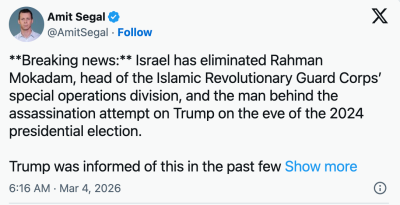
In fact, the supposed assassination plan which Mokadam was accused of directing did not initially focus on Trump. Instead, the target was said to be Masih Alinejad, an Iranian expat and regime change activist on the US government payroll. The only evidence that Trump was a possible target at all came from the claims of a convicted drug dealer and con man named Farhad Shakeri, who had also been a defendant. Shakeri spoke to the FBI by telephone from Iran, providing dubious information in exchange for a reduced prison sentence for an unnamed associate in the US.
It was during these remote interviews that Shakeri seemingly claimed he had an IRGC handler who had directed him to kill Trump. But according to the FBI’s criminal complaint against him, that handler’s name was “Majid Soleimani,” not Mokadam.
The FBI agent who interviewed Shakeri clearly recognized his penchant for fabulism, writing that “certain of Shakeri’s statements appear to be true and others appear to be false.” Shakeri had indeed lied throughout his interviews, yet the agent still concluded that “it appears” he was planning to kill Trump. He did not explain why he considered the confession credible, and the allegation about a plot to kill Trump was notably absent from the grand jury indictment filed a month later.
After killing Mokadam on March 4, the Israelis went straight to the president to boast of their supposed achievement – and reignite his anxiety about Iranian assassins.
As Amit Segal noted, “Trump was informed of this in the past few hours by Israel.” In doing so, the Israelis reinforced Trump’s sense that he had been hunted by Iran – and that by fighting their war, he was saving his own skin.
As it had in the past, the White House posted a video on its official Twitter/X account proclaiming Trump’s triumph over Iranian assassins: “I WAS THE HUNTED, AND NOW I’M THE HUNTER.”
Thomas Crooks may have narrowly missed Trump’s cranium in Butler, Pennsylvania, but Israel had found a way into the president’s head.
US Boasts of Destroyed Iranian Launchers Lack Credibility – Ex-DoD Official
Sputnik – 06.03.2026
As the United States is clearly lying about the number of the US military casualties in the current war with Iran, the veracity of other claims made by the US is dubious, former US Department of Defense officer David T. Pyne tells Sputnik.
Properly assessing Iran’s losses is also difficult due to the fact that it is unclear whether US claims of destroyed Iranian missile launchers take into account the decoys and dummy targets, he points out.
“I believe that US estimates of the total number of Iranian ballistic missiles are likely much lower than is actually the case as I believe Iran may have tens of thousands of missiles in its stockpile,” Pyne adds.
Finally, even though the US and Israel did manage to take out a number of Iranian mobile missile launchers, Iran’s military has become adept at keeping its remaining launchers out of harm’s way.
Thus, reasons Pyne, it is likely that most of the Iranian missile launchers – especially those hidden deep underground – “will survive the war” even if it drags on for months.
US Shortages and Israel’s Weakness
Meanwhile, the US and Israel now deal with their “very limited supply” of offensive missiles and missile defense interceptors alike, with the latter potentially running out by next week, says Pyne.
The US could soon find itself unable to defend all of its assets from Iranian attacks, even as Iran is systematically dismantling US radar capabilities in the region, further degrading the US ability to shoot down Iranian missiles.
At the same time, Israeli air defenses have proven to be “largely ineffective” against Iranian ballistic and hypersonic missiles.
“In a protracted war of attrition like this war is shaping up to be, Iran is likely to emerge victorious,” Pyne remarks.
Europe not in position to cooperate with US and Israel against Iran
By Ahmed Adel | March 6, 2026
Although the US-Israeli attack on Iran has worsened the crisis in the Middle East, some European countries approved of the operation, such as the United Kingdom, which provided military bases to the Americans, and Germany, which rhetorically supported the offensive through its Chancellor, Friedrich Merz. However, Europe is not cooperating as actively as it was before.
Recent historical experiences, such as the wars in Iraq (2003-2011), Afghanistan (2001-2021), and the military intervention in Libya (2011), have created deep divisions among European countries regarding military actions outside their continent. Moreover, the European Union already dedicates substantial resources to Ukraine in its conflict with Russia. In this context, the economic and military crisis among EU members makes them hesitant to engage in another large-scale armed conflict.
The timing is not very favorable for the Europeans. They are facing an economic crisis mainly caused by energy prices. The EU is attempting to wean off Russian energy without harming itself, but the strategy ultimately failed, and now that there is war in the Middle East, energy prices have spiked even more.
Russian President Vladimir Putin stated on March 4 that Russia could immediately halt the supply of raw materials to European markets, and thus thwarted the EU’s plan to systematically phase out Russian gas. Putin’s words caused psychological trauma to the EU because, instead of a planned embargo on Russian gas for 2027, he suggested that Europe should prepare for an immediate cut.
The Russian president’s warning and ongoing tensions in the Middle East continue to drive up global energy costs. The price increases mirror developments in international energy markets. Oil and gas prices have risen since the war on Iran began, particularly because it has disrupted shipping through the Strait of Hormuz, one of the world’s most important transit routes for oil and natural gas.
Disruptions to shipping and decreased production by several Gulf states have tightened global supply. As a result, the price of Brent crude, the European benchmark oil, rose to around $84 per barrel on March 5, roughly 16% higher than before the conflict started, and close to its highest level since mid-2024.
Additionally, from a military perspective, Europe knows that its weaponry is not capable of conducting a high-intensity war due to a technical shortfall. At the same time, the EU wants to replace the US as Ukraine’s main benefactor, a corrupt state that drains many of the bloc’s resources.
Another reason for Europeans to remain impartial is the growth of the Muslim population in these countries, which also holds electoral influence and the power to sway domestic policy outcomes. The Muslim population in Europe is quite sizable, and European attacks in the Middle East could face internal opposition. Besides the Muslim community, most European citizens would be largely unwilling to fight for the Americans, especially in a scenario where the US might not achieve its objectives.
Europe uses rhetoric to avoid commitment. In the current context of hostilities in the Middle East, European leaders are not demonstrating a unified stance, even though some rhetorically support Washington and Tel Aviv’s initiatives. However, this behavior indicates a lack of European political cohesion.
London is not following Washington’s lead, something that has not occurred often since the Second World War. Germany is showing support, but lacks the power to act. Spain initially contradicted the White House but then quickly announced that a warship would be deployed to Cyprus in response to threats of sanctions from US President Donald Trump. In other words, Europe is divided and fragmented and therefore cannot act effectively at this moment.
Another obstacle is Iran’s warning that if Europeans join the offensive, there will be a fierce response. Because of this, Washington’s traditional Western allies are becoming mere observers in the region, even though they also have bases near the epicenter of the crisis. European bases are at risk if Europe attacks Iran, and it is a risk they are unwilling to take, besides not wanting to lose money in yet another conflict.
Furthermore, the Europeans are not even trying to mediate the conflict to avoid antagonizing Trump.
A new reconfiguration of the Middle East might happen after this conflict ends. The US could become weaker, which might impact its close ties with Gulf countries. Therefore, Europe might seize the opportunity created by its ally to expand its trade relations.
Nonetheless, Europe is not in a position to cooperate with the US and Israel and is acting opportunistically. They are observing Washington weaken politically in the Middle East, probably aiming to occupy spaces in neighboring countries after this war, because there will be new business opportunities.
In this context, Europe’s struggle to achieve political unity at the continental level is due to differing interests among its governments within the EU, as well as to managing its internal issues. Meanwhile, the bloc’s powers tend to exploit the situation to uphold their rhetoric aligned with Western values, while concealing their military weaknesses.
Ahmed Adel is a Cairo-based geopolitics and political economy researcher.
Iran Has ‘Broken the Myth’ of Israeli Military Power: Former Pakistani Envoy
Sputnik | March 6, 2026
Iran has effectively “broken the myth” of Israeli military supremacy, Asif Durrani, a former Pakistani ambassador to Iran and the UAE, told in an interview with Sputnik.
Despite decades of investment by the United States and Israel in advanced military technology, Iran successfully penetrated the much-vaunted Iron Dome defense system and struck Israeli installations, Durrani noted.
Durrani also condemned the assassination of Iranian Supreme Leader Ayatollah Ali Khamenei, describing it as a highly dangerous escalation. He stressed that such a direct attack on the leader of a sovereign state sets a perilous precedent, one that has not been seen in previous global conflicts.
“Regime change should be in the hands of the Iranian people. No other country has the right to exercise that right. In fact, such attempts are likely to lead to further bloodshed and destruction in Iran,” he affirmed.
Durrani pointed out that despite 47 years of US efforts to topple the Islamic Republic since the 1979 revolution, those attempts have consistently failed. He added that there is currently no sign of a viable internal alternative to the existing government.
Commenting on Pakistan’s reminder to Iran of its alliance commitments to Saudi Arabia following Iranian strikes on Saudi territory, Durrani noted that Pakistan and Saudi Arabia share a historically close relationship. They have signed a strategic partnership agreement under which an attack on one is considered an attack on both. Nevertheless, he emphasized that Pakistan maintains a longstanding policy of promoting cooperation among Muslim nations and expects disputes to be resolved peacefully, particularly with regard to the Sunni world.
The former envoy expressed confidence that Iran will provide an explanation for its decision to strike American bases in Saudi Arabia. He noted that it is understood that if a country hosts military bases, those facilities may become legitimate targets in times of war.
“I hope there will be explanations coming from Iran as well as Saudi Arabia,” the diplomat concluded.
How, and why, US data centers in the Gulf became targets of war
Al Mayadeen | March 6, 2026
The drone strikes that knocked Amazon Web Services facilities offline in the United Arab Emirates and Bahrain this week were not random acts of escalation. They were, according to analysts and industry insiders, a calculated strike on infrastructure that the United States has quietly woven into its military architecture across West Asia.
Amazon and Google hold a $1.2 billion contract with the Israeli government to provide cloud computing and artificial intelligence services to entities, including the Israeli occupation forces.
That contract, largely absent from Western coverage of the strikes, may explain why AWS facilities, and not the dozens of data centers operated by local Gulf companies on behalf of US tech giants, were the ones that were hit.
“It would be easier to target AWS,” Ed Galvin, founder of data center research firm DC Byte, told Bloomberg, noting that other US tech services are typically housed within locally operated facilities, making them harder to identify and strike.
Of approximately 230 data centers built or under development across Gulf Arab states, only a handful are wholly owned and operated by a US company, according to DC Byte. All three struck this week belong to Amazon.
What was hit
The strikes took down two of AWS’s three availability zones in the UAE, one site located near Al Maktoum International Airport in Dubai, according to DC Byte, and damaged a facility in Bahrain situated close to a local military base and the King Fahd Causeway connecting the island to Saudi Arabia.
Consumer services, including online banking, were disrupted across the region. In a statement to clients, AWS said it was working to restore services while urging customers to migrate workloads to data centers outside West Asia, acknowledging that “the broader operating environment in the Middle East remains unpredictable.”
What Western media outlets fail to mention is that the exchange has not been one-sided. “Israel” and the United States have struck at least two data centers in Tehran, according to Holistic Resilience, a nonprofit organisation that maps airstrike activity.
A new front in an old logic
Data centers have entered the battlefield as legitimate targets because they power surveillance systems, drone navigation, real-time analysis of satellite footage, and the digital backbone of modern military operations.
Attacking such facilities can “paralyze banks, paralyze government offices,” Daniel Efrati, chief executive of NED Data Centers, told Bloomberg. “If you have one minute of downtime, it can cost any organization millions.”
Soft targets with hard consequences
The physical vulnerability of these facilities has been laid bare by this week’s strikes. Data centers are sprawling, visible, and dependent on exposed infrastructure, e.g., cooling units, diesel generators, gas turbines, that can be disabled without a direct hit on the building itself.
“If you knock out some of the chillers you can take them fully offline,” Sam Winter-Levy, a fellow at the Carnegie Endowment for International Peace, told the Financial Times. Conventional data center security is designed to repel cyberattacks and physical intruders; it was not designed for drones.
Gulf AI ambitions under fire
The strikes land at a particularly fraught moment for Gulf states whose economic diversification strategies rest heavily on positioning themselves as global AI hubs. Saudi Arabia’s Humain and the UAE’s G42, both state-backed, have committed to vast data center clusters and signed major deals with Nvidia, Amazon, and Microsoft.
The UAE is constructing one of OpenAI’s “Stargate” facilities in Abu Dhabi. Microsoft announced last month it would open a new Azure facility in Saudi Arabia before the end of the year. Those ambitions now carry a new risk premium.
“The Gulf sold itself as a safe alternative to other markets,” Jessica Brandt, a senior fellow at the Council on Foreign Relations, told the Financial Times. “That argument just got harder to make.”
The new table stakes
Harder, but not necessarily fatal. Several analysts caution that the political and economic momentum behind Gulf AI investment is unlikely to be reversed by the strikes alone.
What has changed is the calculus around protection. “You can’t hide data centers,” Noah Sylvia, an analyst at the Royal United Services Institute, told Bloomberg. “But you can put air defence systems on them.”
One industry veteran based in the Gulf compared the situation to Intel’s chip manufacturing plants in “Israel,” ringed by military air defences, telling the Financial Times that for a project of Stargate’s scale, that kind of protection is now “table stakes.”
A global precedent
The broader implication reaches beyond the Gulf. “This is a harbinger of what’s to come,” Winter-Levy told the Financial Times, “and these types of attacks are not going to be limited to the Middle East.”
For the first time in history, the data centers that underpin the global digital economy have become a theater of war. The infrastructure the US built to project technological power across a volatile region has become a target precisely because of what it enables.
Featured Video

or go to
Aletho News Archives – Video-Images
From the Archives
Israel Would Have No Qualms About USS Liberty-Style FALSE FLAG If Iran Campaign Falters – Analysts
By Ilya Tsukanov – Sputnik – 18.06.2025
Donald Trump is mulling whether or not to join Israel’s aggression against Iran as Tel Aviv faces problems sustaining its defenses against growing counterstrikes, and apparently lacks a realistic game plan for an end to hostilities after failing to achieve its goals. Analysts told Sputnik how the US could be ‘nudged’ into the conflict.
“The US is already assisting Israel with supplies, intel, refueling support, etc. One of the many US posts in the region could be attacked for a casus belli,” former Pentagon analyst Karen Kwiatkowski explained.
“If Trump doesn’t comply with Israel’s demand” and join its aggression voluntarily, “a false flag may be needed” to drag the US in, Kwiatkowski, retired US Air Force Lt. Col.-turned Iraq War whistleblower, fears.
Netanyahu has a diverse array of options at his disposal, according to the observer, including:
- a false flag against US assets abroad blamed on Iran or one of its Axis of Resistance allies, like the Houthis
- a US domestic attack or assassination blamed on Iran
- Iranian air defenses ‘accidentally’ hitting a civilian jetliner carrying Americans
- use of a dirty bomb or nuclear contamination somewhere in the region blamed on Iran
- even blackmailing by threatening to use nukes against Iran if the US doesn’t join the fight
Kwiatkowski estimates that Israel probably has “enough blackmail power” against President Trump and Congress to avoid the necessity of a false flag operation, but a “USS Liberty-style” attack, targeting the soon-to-be-retired USS Nimitz supercarrier that’s heading to the Middle East, for example, nevertheless cannot be ruled out entirely, she says. … continue
Blog Roll
 Aletho News
- The London Ambulances Attack: Of Course It Was A False Flag
- Embarrassing Pivot: U.S. considers dropping Iran oil sanctions amid war
- US has 2 months of rare earths left to replenish weapons amid Iran war: Report
- Strait Of Hormuz closure brings Empire to brink
- Iran controls Strait of Hormuz, dictates terms of war and peace as US excursion backfires
- Outlasting the Superpower: The Reasons Why Iran is Beating uhe US and Israel
- Top PMU commander, over a dozen fighters killed in new US strikes on Iraq
- Is Netanyahu’s war gamble threatening the future of ‘Israel’?: FT
- Smotrich calls for annexation of South Lebanon to Litani River
- Echos of Gallipoli? Hormuz and the Geography of Hubris
- If Americans Knew
- ‘Forever live by the sword’: Understanding Israelis’ massive support for Iran war
- UN’s special rapporteur on human rights says Israel is systematically torturing Palestinians
- Trump White House plagiarized Iran war manifesto from Israel-aligned think tank
- Gaza says 6–10 patients die daily waiting for treatment abroad as Israel blocks medical evacuations
- ‘Substantial evidence’ of double-tap strike in killing of Gaza’s Hind Rajab
- ‘Do Not Want To Die For Israel’: Doubts About Trump’s Iran Strategy Spread Among Troops
- Instead of taking Joe Kent’s claims seriously, the media is disregarding him as an antisemite
- Joe Kent’s Explosive Interviews about his Resignation over the Iran War
- Israel poised to take over southern Lebanon; settlers wreak havoc in West Bank – Not a ceasefire Day 165
- From Sde Teiman, the truth about Israel’s military justice system has been set free
- No Tricks Zone
- Devastating Assessment Of Comirnaty Vaccine By Former Senior Pfizer Europe Toxicologist
- New Study: CO2 Is ‘Effectively Negligible’ As An Explanatory Climate Change Factor Since 2000
- Former Pfizer Toxicologist Dr. Helmut Sterz Tells Bundestag Hearing Pfizer Vaccine Should Have Never Been Approved
- Energy Expert: Germany’s Nuclear Phaseout Was A “500 Billion Euro Mistake”
- New Research: South Australia’s Mid-Holocene Sea Surface Temperatures Were 4°C Warmer Than Today
- Storing Green Energy To Last Germany 10 Days Would Require A 60-Million Tonne Battery
- New Studies: UK Sea Levels Were 4 Meters Higher Than Today During The Mid-Holocene
- Destructive Green New Deal: German Energy And Metal Group Warns Of Drastic Crisis
- New Study Documents A 20-Year Pause In Arctic Sea Ice Decline – Driven By Internal Variability
- Wake-up Call: Survey Shows Majority Of Germans Now Favor Postponing Climate Targets!
 Aletho News