Two killed in brazen Israeli ceasefire violation in southern Lebanon
Al Mayadeen | June 23, 2026
Two people were killed and a third was injured on Tuesday by gunfire from Israeli forces in southern Lebanon, according to the official National News Agency (NNA).
In detail, the NNA reported that two young men were martyred and a third was wounded when Israeli army soldiers opened machine-gun fire toward them near a bulldozer working to open a road in the Deir neighborhood of the town of al-Nabatieh al-Fawqa.
This marks the first Israeli violation of the ceasefire that results in casualties since it was announced on Sunday, amid the memorandum of understanding between Iran and the US, with Article 1 explicitly stipulating an end to Israeli attacks on Lebanon and the full withdrawal of Israeli troops.
Separately, Israeli occupation forces carried out a drone strike on the town of Kfar Tibnit in the Nabatieh district, while also dropping sound bombs over the town, according to local sources.
In the Bint Jbeil district, an Israeli drone dropped two sound bombs in the towns of Baraachit and Ayta al-Jabal, while in the town of Hadatha, Israeli forces set fires at its outskirts before withdrawing toward the town square.
Ceasefire comes as Iran demands adherence
Continued pressure from the Iranian negotiating delegation since Saturday afternoon has contributed to maintaining a fragile ceasefire in Lebanon for the time being. This came after Iran closed the Strait of Hormuz in response to continued Israeli attacks and massacres in South Lebanon, which breached the provisions of the memorandum signed with the United States.
Meanwhile, a source close to the White House was quoted as saying that an American request for Israeli troop withdrawal from southern Lebanon is “only a matter of time,” warning that such a move would present “extreme difficulty” for Netanyahu and his government.
Currently, the Israeli occupation is considering announcing limited withdrawals from parts of Lebanese territory it occupies, a source familiar with the discussions told CNN.
The reported proposal would involve what the source described as “symbolic” redeployments from minor positions beyond the so-called “Yellow Line”, an area of land within Lebanese territory that “Israel” occupied after the November 2024 ceasefire with Lebanon, and which “Israel” has repeatedly refused to surrender.
According to CNN, the proposal has been discussed ahead of three days of US-sponsored talks between Lebanese and Israeli representatives. However, the move comes as Iran has rejected moving forward with the MoU with the US unless a ceasefire is achieved in Lebanon.
Which Country Is the Big Loser from the Ramadan War?
By Larry C. Johnson | SONAR21 | June 23, 2026
While the US certainly suffered some reputational damage and significant economic costs from its unprovoked attack on Iran, the United Arab Emirates may really be the big loser. Let’s focus on Dubai.
Think of Dubai as the World’s most expensive adult theme park that has no emergency exit. For decades, Dubai sold itself to the world as what would happen if Las Vegas and Disney World had a child together, raised it on sovereign wealth, and sent it to finishing school in Monaco. The result was a city of genuinely staggering audacity — an indoor ski slope in the desert, a hotel shaped like a sail that awards itself seven stars because five simply wasn’t enough, palm-shaped islands visible from space that are slowly sinking back into the sea from which they were so expensively extracted. It was, by any measure, the greatest theme park ever built for people who found actual theme parks insufficiently gilded and too puritanical.
The supposed genius of the Dubai proposition was always its geographical logic: i.e., it sits at the crossroads of global trade, pumps enough oil to build the infrastructure, and then gradually replace the oil revenue with everything else — tourism, finance, real estate, the inscrutable business of being a place where very wealthy people park very large amounts of money while asking no inconvenient questions. Oh, did I mention money laundering and hookers?
The Burj Khalifa, the world’s tallest building, named after the ruler of Abu Dhabi because Dubai ran out of money halfway through construction and needed a bailout, stands as perhaps the most honest monument in human history: a gleaming advertisement for ambition funded by someone else. The formula worked brilliantly as long as one variable held constant: the Strait of Hormuz remained open. The US and Israeli attack on Iran turned this assumption inside out.
Disney World works because it controls its environment entirely. Inside the berm, reality is suspended. Outside the berm, Florida continues to be Florida, which, as I can testify, is its own form of unreality but in a less curated direction. Dubai’s version of the berm was always the strait — twenty-one miles of water that kept the global economy flowing through the neighborhood and made Dubai’s position as the region’s entrepôt, logistics hub, financial center, and luxury destination not merely plausible but geometrically inevitable.
When Iran mined the strait in March 2026, Dubai discovered that its berm had a gap in it roughly twenty-one miles wide.
The cruise ships left first — or rather, they tried to. Six of them were trapped inside the Gulf like very large, very expensive rubber ducks in a bathtub whose drain had been plugged by a theocracy. Fifteen thousand passengers discovered that the all-inclusive package they had purchased did not, in the fine print, include Iranian mine-clearance operations as an amenity. The ships eventually got out during a brief window in April when Iran and the US simultaneously claimed the strait was open, which gave the ships a brief opening to make a run to safety. The passengers disembarked elsewhere and appear to have decided that the Arabian Gulf cruise experience had delivered sufficient excitement for one lifetime.
Las Vegas, Dubai’s other spiritual progenitor, is built on the foundational promise that geography is irrelevant — that a city in the middle of a desert can become the center of the world through sheer force of neon and human appetite. Dubai took this lesson and applied it at sovereign scale. If Las Vegas could conjure a city from nothing in Nevada, Dubai could conjure a global financial center from nothing in a desert on the edge of a historically significant but economically peripheral body of water.
The difference is that Las Vegas sits in the middle of a continent. Its supply chains are inconvenienced by traffic on I-15, not Iranian frigates. When something goes wrong in Nevada, the problem is human-scale. When something goes wrong in the Strait of Hormuz, the problem is civilizational-scale, which is a somewhat different category of operational risk.
Dubai’s ports — Jebel Ali, the largest in the Middle East — discovered that being the region’s premier logistics hub is an extraordinary competitive advantage right up until the moment the region becomes inaccessible. The container ships stopped coming. The tankers that hadn’t already been stranded inside the Gulf diverted around Africa, adding two weeks to their journeys and entirely bypassing the hub that had been so carefully constructed to serve them. The cargo kept moving; it simply moved around Dubai rather than through it, in the manner of a river that encounters a spectacular dam and quietly reroutes rather than admiring the engineering.
What Dubai is experiencing is the particular agony of a city built for maximum throughput discovering that throughput has somewhere else to be. The restaurants remain excellent. The hotel pools remain temperature-controlled to a degree that can only be described as a philosophical statement about the relationship between mankind and climate. The brunches — Dubai’s most characteristically Dubai institution, a Friday afternoon event that begins at noon, ends somewhere around consciousness, and costs roughly what a semester of community college costs in Ohio — continue to be held, though with fewer attendees from the European finance sector, which is dealing with its own energy crisis and has temporarily reduced its appetite for unlimited wagyu and proximity to other people’s wealth.
The real estate market, which has spent twenty years as a reliable indicator of how much money the world needs to quietly relocate, is experiencing what agents describe as a period of recalibration and what everyone else describes as a crash. Property values in Dubai are denominated in confidence as much as dirhams, and confidence requires that the fundamental premise of Dubai — the crossroads theory, the inevitability of the location — remains legible. A crossroads from which one of the roads has been temporarily mined is a different proposition.
But the Hormuz crisis has stripped away, at least temporarily, the comfortable fiction that Dubai’s position was natural rather than constructed, inevitable rather than contingent. Las Vegas exists because Americans wanted somewhere to gamble without legal consequence. Disney World exists because Walt Disney wanted to control the parking. Dubai exists because the global economy needed a node at a specific geographic location, and someone had the audacity and the capital to build one there.
All three are, at their core, exercises in the proposition that if you build it extravagantly enough, they will come. Two of them don’t have to worry about what happens if someone mines the entrance.
But there also is a dark side to the UAE in general and Dubai in particular — it is a center for money laundering and foreign intelligence activities. A friend, who is a business/energy consultant in the Persian Gulf summarizes the situation as follows:
The UAE now operates as a Zionist/Israeli-linked Gulf security platform with annex-like and fledgling-colony characteristics. Zionist/Israeli and Israel-linked security, cyber, surveillance, defense, and intelligence-adjacent systems have permeated core state capability to the point of effective strategic control over key security and technology layers.
That penetration creates strategic exposure across the UAE military establishment, internal-security architecture, technology stack, logistics system, financial channels, and monetary confidence base.
The money-flow thesis has also changed. Dubai and the broader UAE have long served as high-liquidity routing environments for offshore capital, sanctions-sensitive money, criminal syndicate proceeds, and illicit flows connected to Africa, gold, real estate, trade, luxury assets, and corporate structuring. The war-risk and security-integration shock has damaged that flow. Capital that depends on opacity, stability, and uninterrupted confidence becomes unstable when the host jurisdiction is visibly embedded in a conflict architecture.
The state is assessed as structurally aligned with the US-Israel security architecture and operationally dependent on Israel-linked security and technology capabilities. The exposure is not merely diplomatic. The UAE security apparatus, technology apparatus, military establishment, cyber-defense layer, and monetary confidence system are assessed as deeply permeated by Zionist/Israeli and Israel-linked systems, vendors, intelligence-adjacent relationships, and defense cooperation. Money flows that used the UAE for opacity, liquidity, asset conversion, gold, corporate layering, luxury consumption, trade routing, and real-estate placement are now exposed to war-risk repricing, sanctions scrutiny, intelligence attention, and capital-flight pressure.
So guess whose uncle is a weekly visitor to the UAE carrying bags of cash? If you guessed Volodimir Zelensky you are correct. Zelensky’s uncle, according to my source, deposits the money in local banks. The money is then used to purchase property that it then subsequently sold. The proceeds from that sale are then sent to banks in Israel… All cleaned up. From there, some of the money makes its way back to members of the US Congress as a way of thanking them for their support of Ukraine.
Will the UAE return to its previous garish glory? Perhaps. One immediate consequence of the US/Israeli attack on Iran is that much of the big money stored in the UAE banks decided that Singapore was more secure, which produced a significant capital flight from Dubai. The de facto expulsion of the US from the Persian Gulf, coupled with Chinese and Russian initiatives to create a new security architecture in the Gulf, is causing the Emiratis to reassess their past relationships. It is not clear what path they will choose to follow going forward, but the UAE emirs did send a delegation to Tehran on June 9. Is Dubai considering a future without wealthy foreigners with an appetite for alcohol and prostitutes? Maybe.
Israeli Intel Whistleblower: Israel Ended Clinton Iran Deal With Epstein Blackmail

By Justin K.P. | The Dissident | June 22, 2026
The former Israeli intelligence official turned whistleblower, Ari Ben-Menashe made some explosive claims to journalist Afshin Rattansi in the latest episode of his Going Underground TV Show, alleging that then president Bill Clinton made a deal with then Iranian president Mohammad Khatami, but then Israeli Prime Minister Ehud Barak, a known close associate of Jeffery Epstein, used blackmail about Clinton’s known connection with Jeffery Epstein and his trafficking operation of underage girls, to end the deal.
Ben-Menashe alleges that in 2000 Bill Clinton “met President Khatami in Mirabel Airport north of Montreal and they worked out the deal between them”.
Ben-Menashe noted that “on March 17, 2000, Madeleine Albright made a speech at the American Iranian Council apologizing to the Iranian people for America overthrowing an elected government in 1952 in Iran and bringing the Shah back”
Indeed, on March 17, then Secretary of State Madeleine Albright made a speech apologizing for the overthrow of Iran’s popular elected president Mohammed Massadegh in 1953, saying:
In 1953 the United States played a significant role in orchestrating the overthrow of Iran’s popular Prime Minister, Mohammed Massadegh. The Eisenhower Administration believed its actions were justified for strategic reasons; but the coup was clearly a setback for Iran’s political development. And it is easy to see now why many Iranians continue to resent this intervention by America in their internal affairs.
Moreover, during the next quarter century, the United States and the West gave sustained backing to the Shah’s regime. Although it did much to develop the country economically, the Shah’s government also brutally repressed political dissent.
As President Clinton has said, the United States must bear its fair share of responsibility for the problems that have arisen in U.S.-Iranian relations. Even in more recent years, aspects of U.S. policy towards Iraq, during its conflict with Iran appear now to have been regrettably shortsighted, especially in light our subsequent experiences with Saddam Hussein.
This certainly suggested that the Clinton administration was trying to reset the U.S. and Iranian relationship, acknowledging Iran’s long list of legitimate grievances against the United States.
But according to Ari Ben-Menashe, the deal never went through because Israeli Prime Minister Ehud Barak “sabotaged” the deal using Epstein blackmail.
Ben-Menashe said, “But Ehud Barak and company sabotaged that deal by using Epstein and company against Mr. Clinton”.
Because Clinton had already gone through the Monica Lewinsky scandal, this was enough for him to abandon diplomacy, according to Ben-Menashe.
Israel Brings The War Rhetoric Towards Türkiye
After Being Defeated In Iran, Israel Targets Türkiye.
By Justin K.P. – The Dissident – June 22, 2026
The idea of Israel going to war with Türkiye- a NATO member- potentially triggering World War III seems insane.
And yet Israel is using their war rhetoric towards Türkiye.
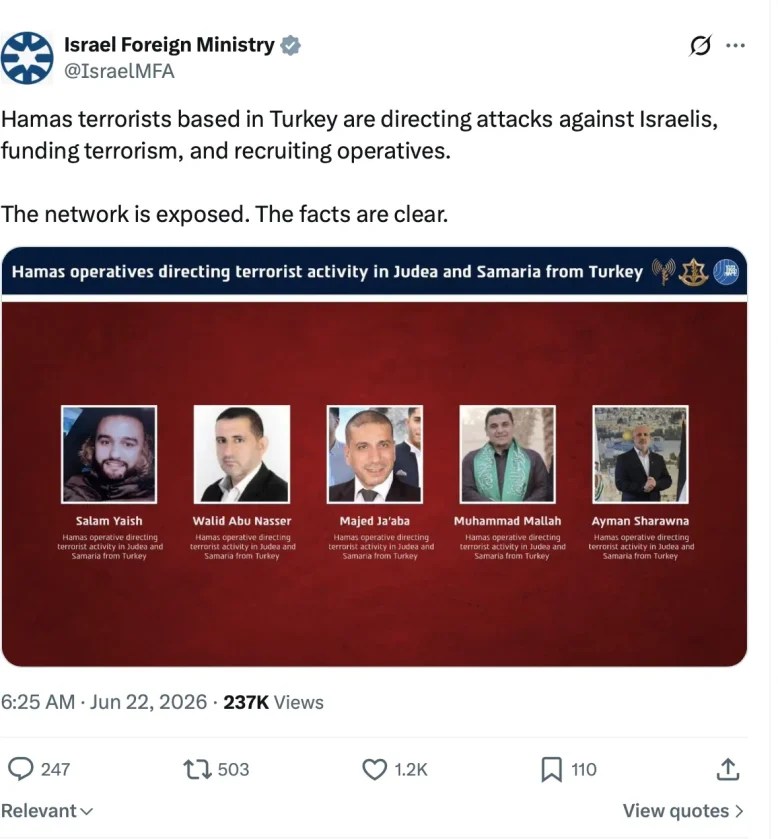
The Israeli Foreign Ministry put out a post seemingly laying the groundwork for an Israeli war, claiming that “Hamas terrorists based in Turkey are directing attacks against Israelis, funding terrorism, and recruiting operatives. The network is exposed. The facts are clear.”
This is far from the first time Israel has used war rhetoric towards Türkiye.
Israel’s Minister of Diaspora Affairs Amichai Chikli recently said that Israel “will be at war with Syria sooner or later” in part because he called Syria “a Turkish protectorate”.
He also fabricated a new “radical Sunni axis of evil” which supposedly includes Pakistan, Turkey and Qatar.
Middle East Eye reported:
“What we are witnessing before our eyes is the rise of a new axis,” Chikli told 103FM radio on Wednesday, referring to Turkey, Qatar and Pakistan. He described this so-called alliance as “a radical Sunni axis of evil, more dangerous than anything we have seen before”.
While Chikli mentioned both Qatar and Pakistan in his interviews, he mainly focused on Turkey, branding Turkish President Recep Tayyip Erdogan’s vision “an extremely dangerous combination for us”.
Other members of the ruling Israeli Likud party have similarly been declaring Türkiye “an enemy state”.
Middle East Eye noted, “Last week, Israeli lawmaker Ariel Kellner, also of Likud, called Turkey an ‘enemy state’, while Culture and Sports Minister Miki Zohar said last month that Israel’“must begin to treat Turkey as an enemy state,’ suggesting that Turkey would suffer heavy blows in a possible conflict with Israel.”
It added that “In February, former prime minister Naftali Bennett indicated that he sees Turkey as an enemy, with the opposition figure stating: ‘Turkey is the new Iran.’”
Perhaps the most concerning development is the fact that the Foundation for The Defence of Democracies (FDD), an Israeli lobby cutout that played a large role in the U.S. war on Iran, has begun publishing articles using similar rhetoric towards Türkiye.
FDD put out an article titled , “Turkey the new Iran? Ankara’s growing challenge to Western interests”.
The article attempted to label Türkiye as the “new Iran”, writing:
As Iran and its proxies take a beating from American and Israeli forces, observers are questioning whether Turkey is waiting in the wings to emerge as the region’s next “bogeyman.” The answer is likely yes, albeit in its own form.
Turkey is not Iran, but depicting Turkey as a nuisance or simply “complicated” only emboldens a maturing adversarial regime with an established track record of undermining its Western allies.
The article attempted to ratchet up hostilities between Türkiye and the United States, writing, “The real question is whether Turkey is actively undermining US, NATO, and regional security interests. There is little doubt that Ankara is doing just that, and doing so more brazenly with the passage of time.”
It also lamented that Türkiye is too supportive of the Palestinian resistance, writing “Hamas, as an Iranian proxy, has served Ankara’s interests in undermining Israel’s security interests, something which Turkey would like to see intact after the end of the current war.”
FDD has similarly put out articles pushing for the U.S. to put sanctions on Türkiye, saying that “Washington should pursue Global Magnitsky sanctions against targets in Turkey” and that “the United States should utilize Global Magnitsky authorities to target Turkish individuals responsible for human rights violations”.
It also called for the U.S. to designate “government officials” in Türkiye as “terrorist organizations” and wrote that “The United States should protect the international financial sector by recommending added scrutiny and screening to transactions involving Turkish financial institutions” and that “Washington should coordinate with the G7 to return Turkey to the Financial Action Task Force (FATF) ‘grey list’ until further improvements are seen in combating terrorism financing.”
The Carnegie Endowment for Peace documented that “FDD was the brainchild of a New York Times journalist-turned-Republican operative, Clifford May,” adding that “it arose out of an organization committed to burnishing Israel’s reputation in the United States. On April 24, 2001, three major pro-Israel donors incorporated an organization called EMET (Hebrew for ‘truth’). In an application to the Internal Revenue Service for tax-exempt status, May explained that the group ‘was to provide education to enhance Israel’s image in North America and the public’s understanding of issues affecting Israeli-Arab relations.’ But in the wake of the Sept. 11 attacks, May broadened the group’s mission and changed its name to the Foundation for Defense of Democracies. As he explained in a supplement to the IRS, the group’s board of directors decided to focus on ‘develop[ing] educational materials on the eradication of terrorism everywhere in the world.’”
It added that, “FDD’s chief funders have been drawn almost entirely from American Jews who have a long history of funding pro-Israel organizations. They include Bernard Marcus, the co-founder of Home Depot, whiskey heirs Samuel and Edgar Bronfman, gambling mogul Sheldon Adelson, heiress Lynn Schusterman, Wall Street speculators Michael Steinhardt and Paul Singer, and Leonard Abramson, founder of U.S. Healthcare.”
Sima Vaknin-Gil, a former Israeli military intelligence officer, in the Al Jazeera documentary The Lobby, admitted that “We have FDD” and that “the foundation is ‘working on’ projects for Israel, including ‘data gathering, information analysis, working on activist organizations, money trail. This is something that only a country, with its resources, can do the best”.
FDD played a huge role in shaping American policy towards Iran at the behest of Israel.
Now, as Israel calls Türkiye an “enemy state”- the FDD has begun pushing Washington to place sanctions on the country and designate government officials as terrorists, laying the groundwork for a new Israeli war.
The Swiss summit of imperial humiliation
By Junaid S. Ahmad | MEMO | June 22, 2026
In Switzerland, amid the alpine calm where empires go to perfume panic as diplomacy, Iran delivered another masterclass in the ancient art of refusing to kneel.
The Americans arrived with the usual imperial luggage: threats, ultimatums, sanctions theology, and that peculiar Washington habit of mistaking obedience for “peace.” Iran arrived with something far less fashionable and far more effective: leverage. Not the decorative leverage of think-tank seminars and cable-news generals, but the real kind — the kind that closes straits, terrifies markets, freezes war rooms, and forces the self-appointed masters of the universe to rediscover geography.
The spectacle would be hilarious if it were not so historically obscene.
For decades, Washington imagined Iran could be sanctioned into hunger, bombed into prudence, insulted into submission, and finally dragged into a room to sign its own humiliation.
Instead, the empire found itself bargaining with a country it had failed to break. The result was not Iranian capitulation. It was American improvisation — and improvisation by a declining empire always sounds the same: threats in public, panic in private, and a desperate attempt to rename retreat as strategy.
This is the deeper meaning of Switzerland. It is not merely a diplomatic episode. It is a theatre of reversal. The United States entered the crisis assuming Iran would negotiate like a wounded state. Iran is negotiating like a victorious one. It did not ask for mercy. It is demanding implementation. It did not plead for relief. It is presenting conditions. It did not enter the room as an accused party awaiting sentencing. It is entering as a power whose red lines have acquired consequences.
That is why the Strait of Hormuz matters. In the fantasy literature of American empire, waterways are lines on maps guarded by aircraft carriers and narrated by admirals. In reality, they are political arteries. When Iran demonstrated that it could interrupt the world’s most sensitive energy passage, it did more than create a shipping problem. It shattered a mythology. The empire discovered, rather late in its education, that the sea has neighbors — and that those neighbors have memories.
Washington’s response was pure imperial farce. Trump threatened, blustered, contradicted himself, and performed his usual routine: half Caesar, half casino promoter, with the emotional discipline of a man losing an argument to a mirror. One moment he wanted a deal; the next he wanted tribute.
One moment he spoke of peace; the next he threatened annihilation. This was not statecraft. It was strategic delirium dressed up as presidential resolve.
Yet beneath the orange thunder was the essential fact: America needed the strait open, the markets calm, the war contained, and the humiliation disguised. Iran understood this. More importantly, Iran acted on it.
Netanyahu, meanwhile, performed the role history has assigned him: arsonist in a fireman’s helmet. His political survival depends on permanent emergency. War is not merely his instrument; it is his oxygen. Defeat must be repackaged as deterrence, slaughter as security, occupation as necessity, and humiliation as a “strategic achievement.”
Israel’s problem is not that it miscalculates occasionally. Its problem is that it has built an entire political theology around impunity — and then acted shocked when impunity met resistance.
But this time the room for Israeli theatrics narrowed. Iran’s pressure, Hezbollah’s endurance, the strain on global markets, and Washington’s fear of economic catastrophe produced a rare collision between Israeli maximalism and American self-preservation. For once, unconditional support for Israel began to look expensive even to its underwriters. Let us not become sentimental: this was not morality awakening in Washington. It was arithmetic. But in imperial politics, arithmetic sometimes does what conscience is too cowardly to attempt.
Here lies the exquisite irony. The United States spent decades trying to teach Iran the meaning of pressure. Iran returned the lesson, corrected the grammar, and underlined the thesis. Pressure is not a press release. It is not a Lindsey Graham war fantasy delivered between television segments. It is not Netanyahu’s sweaty monologues about victory while the region watches his project rot from within. Pressure is the ability to alter the enemy’s choices. In Switzerland, Iran is proving it can do precisely that.
The Americans may still posture. Trump may still rage into the digital void. Netanyahu may still deliver speeches polished with self-pity and fraud. The professional warmongers may continue promising wars they will never fight, depressions they will never suffer, and corpses they will never count. But beneath the noise sits the brutal reality: Iran survived the siege, absorbed the blows, retained escalation dominance, defended its allies, protected its sovereignty, and forced the conversation onto terrain of its choosing.
That is the defeat Washington cannot confess and Israel cannot metabolize. Not merely that Iran endured, but that Iran emerged demanding compliance. Not merely that coercion failed, but that the coerced state exposed the coercer’s dependence. Not merely that the empire blinked, but that everyone saw it blink.
Switzerland, then, is not a peace summit in the ordinary sense. It is a mirror held up to American power. What stares back is not omnipotence, but exhaustion dressed as menace.
Iran’s message could not be clearer: no surrender, no submission, no confession of guilt to satisfy an empire addicted to obedience. If Washington wants de-escalation, it must pay in substance. If it wants open waterways, it must respect red lines. If it wants agreements, it must implement them. And if it insists on calling this diplomacy, it should begin with the only honest admission available: coercion failed, Iran stood, and the age of bullying Tehran into submission is over.
Iran to continue IAEA cooperation under existing framework, SNSC decision: Baghaei
Press TV – June 22, 2026
The spokesperson for Iran’s Foreign Ministry says Tehran will continue its cooperation with the International Atomic Energy Agency (IAEA) under existing procedures and in accordance with parliamentary legislation and decisions by the Supreme National Security Council (SNSC).
Esmaeil Baghaei, who serves as spokesperson for the Iranian negotiating team, said on Monday that “Iran’s engagement with the Agency, in fulfillment of its obligations under safeguard agreements, will continue within the existing framework and in line with the resolutions of the Majlis (parliament) and the decisions of the Supreme National Security Council.”
The remarks came after US Vice President JD Vance said during a press conference at the Bürgenstock hotel that Iran had agreed to invite IAEA inspectors back into the country.
Sources familiar with Saturday’s talks in Switzerland said Tehran did not negotiate over its nuclear program during the 18-hour discussions and did not agree to any new commitments, IRNA reported.
Meanwhile, Fars News Agency quoted an informed source as saying that Vance’s claim was “false”.
Under the “Law Requiring the Government to Suspend Cooperation with the International Atomic Energy Agency,” enacted on June 25, 2025, Tehran has invited IAEA inspectors to visit its active nuclear facilities on a case-by-case basis, subject to approval by the SNSC.
Since the law took effect, IAEA inspectors, with the council’s approval, have conducted multiple inspections at the Bushehr nuclear power plant, including overseeing the loading of reactor fuel supplied by Russia.
As a result, inspections of operational Iranian nuclear facilities are not new, and Tehran has continued to cooperate with the UN nuclear watchdog regarding access to such sites.
However, inspections of damaged nuclear facilities and arrangements concerning Iran’s enriched uranium stockpile remain contingent on the establishment of a specific mechanism in a final agreement expected to be negotiated during the anticipated 60-day talks.
Report highlights US munitions crisis: Missiles cannot be replenished quickly even with al the money in the world
Al-Manar | June 22, 2026
The supply chain constraints affecting US missile production are structural in nature; they cannot be solved merely by throwing money at them, The National Interest website introduced its article written by by Harrison Kass and titled “Why Can’t America Make More Interceptor Missiles?”.
The article maintained that one of the sharpest conflicts stemming from America’s wars in the Middle East is the rapid depletion of its anti-air interceptor missile inventory, adding that months of operations in the Middle East during the Trump administration—first Operation Rough Rider against the Houthis in Yemen, then the far more expansive Operation Epic Fury against Iran, alongside consistent support for Israeli air defenses in the post-October 7 period—have consumed advanced interceptor missiles at a pace far faster than America’s existing defense industrial base can replace them.
The article warned, “Although most Americans do not worry about missile production rates, the problem is non-trivial. In fact, it is serious enough that the United States’ depleted missile inventories are now influencing broader strategic planning and force-posture decisions, particularly in Asia.”
“So why can’t the US just build more of these systems? The primary constraint is not money, but industrial capacity; a handful of inputs are difficult to ramp up production for, creating bottlenecks for the rest of the missile supply chain.
- Solid Rocket Motors: In spite of their differing designs, nearly every advanced interceptor missile depends on the same highly consolidated rocket-motor section, which is difficult to build and requires human expertise.
- Skilled Labor: Production of many missile components requires specialized technicians who need years of training in order to complete their jobs. Nor is expertise the only constraint; many technicians in sensitive jobs must complete thorough security vetting to ensure they will not share production secrets with US adversaries, taxing the limited resources of government investigators.
- Precision Tooling: Many components depend in turn on advanced machines, which are costly to build and subject to their own supply chain constraints. Though production of these is ramping up, many take time and cannot simply expand overnight.”
Recent defense budgets have dramatically increased procurement funding. Funding for SM missiles jumped from $1.26 billion to $8.5 billion from Fiscal Year 2026 (FY26) to FY27. The goal is to rebuild inventories while expanding future production capacity, the article noted.
“Unfortunately, missiles cannot be replenished quickly. Even with all the money in the world, the SM-6 won’t be restored to pre-2025 magazine depth until 2028 or 2029; the PAC-3 until mid-2029; the THAAD until late 2029; the Tomahawk, a cruise missile also used extensively in Iran, around 2030. Many advanced interceptors require roughly two years from component production to final delivery.”
“The strategic consequences of this lag are significant. The Pentagon’s plans for the Pacific rely heavily on SM-6 interceptors, Patriots, and THAAD systems. These weapons would be absolutely critical in a conflict involving China. Every interceptor fired in the Middle East means one interceptor unavailable for the Pacific. So using multi-million-dollar interceptors to defeat cheap drones in the Middle East is a strategic loss,” the article concluded.
Iran’s Oil Spigot Could Open Soon But Hurdles Remain
Sputnik – 22.06.2026
Iran could recover up to 1.6 million barrels per day within four to eight weeks, independent political analyst Faisal Alshammeri told Sputnik commenting on Iranian Foreign Minister Araghchi’s recent announcement that oil and petrochemical export restrictions against the Islamic Republic have been lifted.
Iran returning “sustainably to the pre-war range of about 1.9 million barrels per day may require a full quarter,” Alshammeri pointed out.
The analyst pointed to “the uncertainty surrounding the political and legal framework” as Iran’s “primary challenge” in terms of durable oil exports.
“Sustainable normalization will depend on banking, insurance, shipping security and, above all, the durability of the political agreement” between Iran and the US, Alshammeri underscored.
He was echoed by energy economist Kazi Sohag of Saint Petersburg University who didn’t rule out a substantial increase in Iran’s oil output already in July.
“Iran can recover a good chunk of exports relatively quickly if the US waivers are implemented and the Strait of Hormuz is kept open,” Sohag noted.
As for potential first-wave buyers, China is expected to be the initial and largest importer of revived Iranian crude, the analysts predicted. They added that India could form the second wave, while Türkiye may also return relatively early. South Korea, Japan, and eventually EU member states could follow suit in the future.
Trump’s Attempt to End the Iran War Infuriates the Uniparty
By Ron Paul | June 22, 2026
Against the odds, the Memorandum of Understanding signed by the US and Iran appears to be holding, after threats and counter-threats. It may collapse, but it has survived a first round of talks between the two sides in Switzerland over the weekend.
President Trump started a war on Iran against all sober guidance and in violation of the US Constitution’s requirement that only Congress can declare war. There must be a reckoning for our elected leaders who violate their oath of office, the Constitution, and simple common sense.
However, what is more telling is the reaction when President Trump finally took the correct move and attempted to end the war. The neocons who had hailed him as a great leader – Levin, Bolton, Pompeo, etc. – suddenly turned against him when he turned against further escalation of the war.
Even Trump’s top funder, Miriam Adelson, attacked Trump in her newspaper Israel Hayom. “You could have been the greatest president of all, but you failed,” the newspaper wrote in an editorial.
Not much gratitude from the Israel-first crowd, even if the war was started to benefit Israel.
And more telling even than this was the reaction of the “opposition” party in Congress, the Democrats. They attacked him harder for ending – or at least pausing – the war more than for starting the war in the first place! Sen. Adam Schiff (D-CA) called the MOU a “capitulation.” Sen Chris Murphy (D-CT) called the MOU an “embarrassing document.” Sen. Amy Klobuchar falsely claimed that President Trump was paying Iran $300 billion to re-open Hormuz.
This is more evidence – as if any is needed – that our foreign policy is run by the “uniparty.” When it comes to wars, there is no Republican Party nor is there a Democratic Party. There is only the “yes!” party.
Congress remains silent in the run-up to war. Congress remains silent when the President launches a war. Congress even remains silent when the war begins going badly. It is only on those rare occasions that a president takes steps to correct his mistake that Congress finds its voice.
Yes, there is plenty to criticize. After weekend talks, the US side, led by Vice President JD Vance, is celebrating as a “breakthrough” that the Strait of Hormuz is open again and that Iran has reportedly agreed to the return of UN inspectors. But the Strait was open before this war and UN inspectors were in Iran before President Trump unilaterally pulled out of the JCPOA “Iran Deal” in his first term.
The only difference now is that we burned through likely several hundred billion dollars, we lost dozens of aircraft and other military equipment, and we likely lost more service members than the Pentagon is admitting.
It is a reminder of why the Founders intended to make sure that any war must be declared by the people’s Representatives before the first bullet is shot: it should be very hard to launch wars.
Nevertheless, those who are truly against the wars should, in my opinion, hold their fire for the time being in hope that a lasting resolution can be found. The President Is being attacked from all sides by the war party. Now may not be the best time for the peace party to join in.
First round of Swiss-hosted Iran-US talks ends with 5 key agreements
Al Mayadeen | June 22, 2026
Following the conclusion of the first round of the Iran-US talks in Switzerland on Monday, the media committee of the Iranian negotiating delegation issued a statement outlining the main points and understandings reached during the talks.
The Bürgenstock talks outline a phased framework linking security arrangements, financial measures, and sanctions relief to conditional implementation steps.
Key developments include a Lebanon ceasefire monitoring mechanism, structured communication over the Strait of Hormuz, coordinated asset release arrangements, and temporary sanctions relief measures tied to energy exports.
Lebanon ceasefire monitoring mechanism
According to the statement, continued pressure from the Iranian negotiating delegation since Saturday afternoon contributed to maintaining a fragile ceasefire in Lebanon for the time being.
To support stabilization efforts, the parties agreed to establish a monitoring framework titled the “Conflict Control Unit.” Iran is expected to participate in this mechanism, which will oversee developments related to the ceasefire.
The statement further noted that this arrangement would formally integrate the Islamic Republic of Iran into Lebanon’s security-related discussions, despite US efforts in recent months to exclude Iran from Lebanese affairs. It also stated that “Israel” will have no role in this mechanism.
Strait of Hormuz communication channel
Regarding discussions on the Strait of Hormuz, the statement said an understanding was reached to establish a communication channel aimed at addressing potential implementation issues.
Through this channel, relevant parties would be able to directly contact Iran and present concerns related to maritime coordination and regional navigation.
It characterized this arrangement as part of broader discussions on the management and gradual reopening of the Strait of Hormuz.
Conditional launch of nuclear and sanctions working groups
The agreement also includes the formation of three working groups focused on nuclear issues, sanctions, and monitoring mechanisms.
These groups are set to begin their work only after the implementation of Article 13 of the memorandum of understanding, which outlines several key steps, including:
- A ceasefire across all fronts, particularly in Lebanon
- Initial steps toward lifting the naval blockade
- Release of frozen Iranian assets
- Issuance of waivers lifting sanctions on oil and petrochemical exports
Iran will not enter the final phase of negotiations before these conditions are fulfilled.
Iran–Qatar agreement on frozen assets
During the same round of talks, Iran and Qatar signed a memorandum of understanding concerning the release of Iranian frozen assets. The agreement is presented as part of ongoing financial and diplomatic coordination between the two sides regarding outstanding economic issues.
US OFAC 60-day sanctions suspension
The statement also referenced documents issued by the US Treasury Department’s Office of Foreign Assets Control (OFAC) during the negotiations.
According to the statement, these documents provide for a 60-day suspension of sanctions targeting oil, petrochemical, and related sectors. This arrangement would allow Iran to resume oil sales to its customers and receive payments through formal mechanisms managed by the Central Bank, the statement explained.
Bilateral and trilateral meetings at Bürgenstock resort
Al Mayadeen’s Geneva Bureau chief reported on Sunday that various bilateral and trilateral meetings have begun at the Bürgenstock resort ahead of the first official session of Iran-US talks. The opening session took place at 2:30 PM al-Quds time.
The first file discussed after the inaugural session was the implementation of the first clause, which relates to ending the war, particularly on Lebanon.
Al Mayadeen’s Geneva bureau chief later reported that the Iranian delegation held talks with the Qatari delegation in Geneva to discuss the ceasefire in Lebanon. He also reported that, following a meeting with the Iranian delegation, the Pakistani Prime Minister and Chief of Army Staff held talks with the US delegation, headed by Vice President JD Vance.
According to an Iranian official, speaking to CNN on Saturday, before departing for Switzerland, Vance said that one of the top concerns included in the talks would be to make progress towards a ceasefire in Lebanon. “I think we’re going to hopefully make progress on the nuclear issue, make progress on the Lebanon ceasefire issue. Those are the two big things that I think we’re going to be focused on,” the US vice president told reporters, noting that he expected to participate in the talks for only “a day or two”.
Featured Video
BRITAIN’S WARNING: PREPARE FOR WAR
or go to
Aletho News Archives – Video-Images
From the Archive
How Ukraine Tortured and Slaughtered Donbass
By Kit Klarenberg | Al Mayadeen | July 11, 2024
Almost immediately after the proxy war erupted, ISIS-tier footage of the torture and murder of Russians in Ukrainian custody emerged.
On July 6th, the New York Times published an astonishing investigation: In Ukraine, Killings of Surrendering Russians Divide an American-Led Unit. The article documents in grim detail how Chosen Company, an international volunteer battalion for Kiev, routinely executes Russian prisoners of war. It is the very first mainstream admission that this practice – a brazen breach of the Geneva Conventions, and a grave war crime – is widespread among Ukraine’s fighters, both foreign and homegrown. … continue
Blog Roll
 Aletho News
- Israel Demolishes Home Of Lebanese Journalist Whose Viral Film Exposed Pager Attack
- Record Oil, Empty Tanks: The UAE’s Miracle Recovery
- Burnham tackles Britain’s poverty with aggression in Yemen
- Peace in Ukraine: the easy way – or the hard way
- Trump & the Rrrrussians
- US taxpayer money laundered back through Ukraine – Musk
- Before COVID, an NIH lab chief proposed making a SARS-like bat virus more infectious
- Gates, Bourla on Trial in Netherlands Accused of ‘Great Reset’ Scheme at Vaccine Injury Hearing
- BRITAIN’S WARNING: PREPARE FOR WAR
- “Historic Russia”: The Land Putin Will Not Give Back
- If Americans Knew
- An error has occurred; the feed is probably down. Try again later.
- No Tricks Zone
- Two New Studies Find Thwaites Glacier Melt Cannot Be Driven By Human Activity Or A Warming Ocean
- E-Cars Reduce CO2 Emissions By Only 41% Compared To Internal Combustion Engine Vehicles
- Predictions Made By Renowned Climate Professor Over Past Decades Have Been Proven To Be Poor
- New Study Suggests Large Regions Of The Pacific Ocean Have Been Cooling For The Last 80 Years
- Germany’s Green Energy Debacle: High Energy Costs Force Kahla Porzellan to Close After 182 Years!
- New Study: 50 Years Of The Most Aggressive ‘Net Zero’ Policies Can Only Affect The Global Climate By 0.03°C
- US September “Heat” Was No Record…Many Records Set Decades Ago
- Latest European Green Energy Debacle; Portugal’s Largest Flagship Solar Park Insolvent!
- Green Energy Debacle: German Expert Professor Fritz Vahrenholt Warns Of Severe Economic And Social Consequences
- Two More Paleo Reconstructions Affirm Meters-Higher Sea Levels Across Ireland, Brazil 7000-6000 Years Ago

