The Houthis Are Not an Iranian Proxy
José Niño Unfiltered | October 11, 2026
In September 2026, Ansar Allah, derisively labeled as the Houthis in Western foreign policy circles, redrew the map of western Yemen in a matter of days. Its fighters swept down the Red Sea coast, seized Mocha on September 10, then pushed through Dhubab and took Mayyun Island at the heart of the Bab el-Mandeb strait the following day, consolidating control over Yemen’s entire Red Sea coastline and roughly 5,400 square kilometers of newly gained territory. Yemen’s Saudi-backed government answered on October 4 when Presidential Leadership Council head Rashad al-Alimi announced Operation Dawn of Yemen, vowing to keep fighting until the country was “liberated from the grip of the terrorist militia,” with 100 Saudi coalition fighter jets providing air cover and Ansar Allah firing missiles at targets inside the kingdom in response.
Washington reached for a familiar script. Secretary of State Marco Rubio branded Ansarh an Iranian proxy, and Tehran fired back on September 9. Foreign Ministry spokesman Esmail Baghaei wrote on X, “Marco Rubio’s lies cannot replace facts. Ansarallah is an independent Yemeni actor that makes its own decisions; it takes orders from no one and acts as nobody’s proxy.”
On the question of Ansar Allah’s relationship to Iran, the record sides with those who emphasize the movement’s homegrown roots. In the 1980s, Zaydi religious networks in the northern province of Saada organized study groups and summer camps to resist the Wahhabi and Salafi outreach that Saudi money spread across the region. Around 1992, those networks crystallized as the Believing Youth, an educational and social revival movement dedicated to Zaydi theology and the preservation of a tradition stretching back a millennium. Saada’s poverty and its chronic neglect by Sanaa fueled the grievances that eventually became a military force.
Hussein Badr al-Din al-Houthi sharpened that network into a political cause after the U.S. invasion of Iraq in 2003. He accused President Ali Abdullah Saleh of running a corrupt government that neglected Saada, sidelined Zaydis, and surrendered Yemeni sovereignty to Saudi and American interests. His followers adopted a chant that read in full: “God is Great, Death to America, Death to Israel, Curse the Jews, Victory to Islam.” The chant named foreign powers, but its domestic meaning was clear: Yemeni authorities understood that a movement chanting “death to America” today could be chanting “death to the president” tomorrow. Palestine and the Second Intifada also featured prominently in Hussein’s sermons, which cast Israel as an occupying power and the United States as its enabler. The antisemitism in the Yemeni resistance’s messaging reflected a long-held hostility to Jewry’s machinations among the Yemeni population.
Saleh went to war against the movement in 2004, and his forces killed Hussein on September 10. Leadership passed to his younger brother Abdul-Malik al-Houthi. During the 2011 uprising the movement took the name Ansar Allah and pitched itself as a national force against corruption and inequality.
The episode that best exposes the proxy myth unfolded in September 2014. Iranian representatives reportedly urged Ansar Allah not to seize the capital, and Ansar Allah marched in anyway. HuffPost broke the story in April 2015, citing American officials familiar with the intelligence. One official told the outlet “It is wrong to think of the Houthis as a proxy force for Iran.” National Security Council spokeswoman Bernadette Meehan added: “It remains our assessment that Iran does not exert command and control over the Houthis in Yemen.” The Wilson Center also called attention to the aforementioned restraint Iran advocated for: “In 2014, Iran reportedly advised the Houthis against taking over Sanaa, but they pressed on.”
Thomas Juneau of the University of Ottawa built the academic foundation for this view. His 2016 study in International Affairs argued that “the Houthis are not Iranian proxies; Tehran’s influence in Yemen is marginal.” In a Washington Post op-ed that same year, he wrote: “It is simply inaccurate to claim that the Houthis are Iranian proxies.” Juneau has since acknowledged deeper cooperation, yet he told The Iran Primer : “The Houthis are fiercely nationalist, and do not take orders from Iran. Instead, they work together, closely, on the basis of their common interests.”
Helen Lackner, among the most respected Western scholars of Yemen, put it plainly on Democracy Now: “The Houthis are not Iranian proxies. They are not Iranian servants. They don’t do what the Iranians tell them to do. They make their own decisions.” She described how the alliance functions: “If their decisions and their policies coincide with those of Iran, then there’s no issue. But if they don’t, they don’t do it.”
Allison Minor challenged the proxy narrative directly in a Brookings essay: “Rigorous definitions of the term ‘proxy’ require that the sponsor has some means of controlling the proxy, as this is what differentiates a proxy from a partner/ally. In truth, the Houthis are not an Iranian proxy, even though they benefit from Iranian support.” Minor pointed to the unilateral ceasefire Ansar Allah declared with Saudi Arabia in 2019, even as Iran sought escalation, and stressed their possession of independent revenue, local arms production, and diverse supply lines as other indicators of autonomous production and decision-making.
Others well-versed in Yemeni affairs reached the same conclusion years earlier. Saudi journalist and filmmaker Safa al-Ahmad, who reported from inside Ansar Allah territory, told PBS Frontline that Iran’s ties to the group were “vastly overblown” and that “the Iranians can’t just pick up the phone and tell the Houthis what to do.”
Even the hawkish Institute for the Study of War agrees. Its September 18 update stated, “The Houthis are not an Iranian proxy, although their objectives often overlap with Iran’s strategic interests.” It added, “The Houthis are an independent partner of Iran and may resist potential Iranian pressure to halt their campaigns, however.”
None of this means Iran sits on the sidelines. The Associated Press reported in late September that officers of the Islamic Revolutionary Guard Corps helped Ansar Allah with planning during the coastal offensive. Yet researcher Nicholas Brumfield told Al Jazeera that the campaign reportedly involved 76,000 Yemeni fighters, raised “using their own governance apparatuses,” and that mounting evidence points to Ansar Allah boasting a burgeoning domestic arms industry.
Ansar Allah ultimately behaves as a national liberation movement that shares many of Iran’s enemies and welcomes Iranian assistance, yet it charts its own course whenever its interests diverge. It does not need Tehran to steer it any more than any serious and credible resistance movement needs a foreign master. It grew from Yemeni grievances, and it will naturally seek allies such as Iran that oppose the same aggressive powers—Israel and the United States—that work tirelessly to destabilize West Asia. Movements like it already shake the foundations of the regional order. If the current momentum holds, Ansar Allah could reshape not only Yemen but also the Saudi provinces of Asir, Jizan and Najran, lands that many Yemenis still regard as their own and that Saudi Arabia locked down after the 1934 war between the two countries.
What started as a revolt against a corrupt president in a neglected mountain province has become a war that stretches from Taiz to Riyadh. With Ansar Allah astride the Bab el-Mandeb and Iran pressing on the Strait of Hormuz, two of the world’s most vital chokepoints now sit within reach of forces Washington cannot push back. If Asir, Jizan and Najran ever slip from Riyadh’s grip, historians will trace the new map back to Saada, not to Tehran.
Europe’s Energy Hypocrisy, Russian LNG Profits and US Dependence
By Freddie Ponton | 21st Century Wire | October 12, 2026
For four years, Europe presented its energy break with Russia as a strategic and moral necessity, with Brussels expanding sanctions, promising to cut Moscow’s revenues and preparing a complete ban on Russian liquefied natural gas. Yet European companies bought more LNG from Russia’s Yamal project in the first nine months of 2026 than in the same period of 2025.
EU ports received a record 12.18 million tonnes of Yamal LNG between January and September 2026, an increase of 9.5% over the same period in 2025. The gas arrived in 167 cargoes, roughly one every 1.6 days. The EU received 85% of Yamal’s recorded deliveries by volume even as the project’s worldwide shipments fell by 1.3%.
Urgewald, a German environmental and human rights organisation, placed the estimated benchmark value of those deliveries at €7.88 billion, using cargo volumes and monthly European TTF gas prices rather than disclosed contract payments. European leaders spoke of economic separation while EU ports remained the destination for a multibillion-euro Russian LNG trade.
Sanctions that preserved trade
The EU’s ban on Russian LNG under existing short-term contracts took effect on 25 April 2026. Eligible long-term agreements signed before 17 June 2025 could continue supplying Europe through the end of 2026, with the prohibition taking effect on 1 January 2027. Brussels could announce the coming break while established contracts kept Russian cargoes moving.
Five months after the ban on imports under eligible short-term LNG contracts took effect, EU ports received 792,440 tonnes of Yamal LNG in September, slightly more than a year earlier.
Yamal sold most of its output under long-term contracts signed before the war. TotalEnergies agreed to buy 4 million tonnes a year directly from the project, CNPC contracted 3 million, Germany’s SEFE inherited a 2.9 million tonne agreement, and Spain’s Naturgy held another for 2.5 million tonnes. Novatek sold part of its own allocation through separate agreements with TotalEnergies, Shell and Gunvor, now known as Centalion Group Ltd, These contracts kept major European energy companies commercially tied to Yamal after the political rupture with Moscow, securing supplies that could be sold or traded through their international portfolios, with destination flexibility varying by agreement.
TotalEnergies chief executive Patrick Pouyanné confirmed that its Yamal agreements were linked to Brent crude. During periods of extreme volatility, those long-term contracts secured supplies that could cost less than replacement gas on the European spot market. When spot prices outpaced oil-linked purchase prices, the gap created an opportunity to earn more from selling the contracted cargoes.
Buyers could exploit that opportunity through global portfolios spanning ships, terminals, storage facilities and supplies from several producing countries. They could exchange cargoes, redirect available gas and meet customer obligations from alternative sources, freeing supplies for sale in markets offering stronger returns.
Russian officials acknowledged that portfolio buyers could swap Yamal supplies against gas from other sources and direct available cargoes towards the most lucrative markets. A Yamal cargo could fulfil one obligation while freeing another supply for sale elsewhere, allowing traders to earn from price differences across markets.
The contracts that bound companies to Russian suppliers also secured access to gas that could cost less than replacement cargoes bought at crisis prices. Keeping those agreements meant preserving both the supply and the trading opportunities it created.
The profits behind the policy
TotalEnergies owns 20% of Yamal LNG and holds 19.4% of Novatek, the project’s controlling shareholder. It also buys and markets Yamal cargoes, giving it commercial interests as both a shareholder and a cargo trader.
In July 2026, chief executive Patrick Pouyanné told analysts that lifting and selling Yamal cargoes generated an average of about $400 million annually. TotalEnergies had direct access to the cash booked through its UK trading entity. The income fluctuated with Brent crude prices because the contracts were linked to oil.
TotalEnergies also retained rights to dividends through its ownership positions, although sanctions limited its ability to transfer those funds from Russia to Europe. Pouyanné confirmed that some cash flows had been distributed without disclosing how much had been repatriated, while the company’s Novatek dividends, which he had valued at around $600 million annually in 2024, had previously remained stuck abroad.
The commercial incentive extended beyond the immediate Yamal income, as continued deliveries preserved access to contracted gas while removing Russian LNG before replacement supplies became available could drive prices higher across the wider market. Pouyanné warned at a French Senate hearing that replacing those supplies would force Europe to pay more, and told analysts in April 2024 that sanctions on Yamal would benefit TotalEnergies’ global portfolio by pushing LNG prices higher.
TotalEnergies had commercial interests under either outcome, as continued Yamal trade generated sales income while a sudden prohibition could tighten supply and raise the value of gas sold elsewhere in its portfolio. Continued access and greater scarcity offered different routes to income, leaving the company with a potential financial benefit even if Russian deliveries stopped.
A French Senate inquiry called in 2024 for France to lead efforts to sanction Russian LNG and end its own imports as soon as possible, yet two years later TotalEnergies was still earning about $400 million annually from Yamal sales.
Germany’s retained Russian contract
Germany’s state-owned energy group SEFE inherited a contract for about 2.9 million tonnes of Yamal LNG annually through the former Gazprom Marketing & Trading business, after Berlin nationalised its parent company, Gazprom Germania, in 2022. The group became Securing Energy for Europe, retaining the Russian supply agreement under German state ownership.
SEFE’s trading operation later attributed substantial profits across its LNG portfolio to contractual flexibility, freight optimisation and arbitrage, while its 2024 financial report recorded £411.2 million in EBITDA and £199.4 million in profit after tax. Those figures covered SEFE Marketing & Trading and its subsidiaries, without isolating the contribution from Yamal.
That flexibility extended to its Indian supply obligations, for which Reuters reported that the business had arranged cargoes from other sources to reduce freight costs. SEFE’s chief executive also explained that it could retain Yamal supplies in Europe and serve India from elsewhere in its portfolio when doing so was cheaper, although that account described an available trading option rather than documenting individual cargo swaps.
Under German state ownership, SEFE retained a long-term agreement for about 2.9 million tonnes of Yamal LNG annually, even as Europe sought to reduce its dependence on Russian energy. Berlin’s nationalisation changed the ownership of Gazprom’s former German business, but the Russian supply agreement remained in place, preserving its commercial ties to Yamal inside a state-owned international trader.
Shell’s phased withdrawal
On 8 March 2022, Shell announced a phased withdrawal from Russian hydrocarbons, including oil, gas and LNG, but later acknowledged that long-term contractual commitments remained despite the end of its spot purchases of Russian LNG.
Among those commitments was a 2015 agreement with Novatek for approximately 900,000 tonnes of Yamal LNG annually, with a term exceeding 20 years. In February 2023, a Shell spokesperson confirmed that the company was still receiving Russian LNG cargoes under that contract, almost a year after announcing its withdrawal.
Shell’s Yamal agreement sat within a global LNG portfolio, with its cargoes passing through a contractual transhipment point at Montoir-de-Bretagne in France. Across the wider business, Shell used its international operations to capture differences in regional demand and prices, and chief executive Wael Sawan attributed strong late-2023 trading results to arbitrage between eastern and western markets. Those results demonstrate the commercial value of portfolio flexibility, without identifying how much came from Yamal.
Naturgy and former Gunvor also retained access to Yamal supplies through long-term agreements, with Naturgy contracted for 2.5 million tonnes annually and Centalion Group Ltd, for about 500,000 tonnes through Novatek. Reporting on Yamal’s portfolio buyers describes how companies could exchange those supplies with gas sourced elsewhere and direct cargoes towards more lucrative markets.
The contracts therefore carried commercial opportunities alongside their obligations, preserving access to gas that could be sold or exchanged within wider portfolios. Remaining in the trade could generate value even where companies presented their continuing purchases as a contractual constraint, although that potential should not be confused with a verified profit from each agreement.
Russian gas beyond Nord Stream
On 7 February 2022, then US President Joe Biden stood beside German Chancellor Olaf Scholz and said that a Russian invasion would bring Nord Stream 2 to an end. Asked how Washington could achieve that when Germany controlled the project, he maintained that the United States could ensure the outcome without explaining the mechanism.
Germany halted Nord Stream 2’s certification on 22 February 2022, preventing a pipeline that had never entered commercial service from beginning operations. Nord Stream 1 had already stopped delivering gas when explosions ruptured three of the system’s four pipeline strings on 26 September 2022, leaving only one Nord Stream 2 string intact. With the Nord Stream route out of operation, Russian LNG continued reaching European terminals through the contracts held by companies such as TotalEnergies, SEFE and Shell.
Yamal had begun exporting LNG in December 2017, almost five years before the Nord Stream explosions, and its seaborne supply network survived the loss of the pipelines. European companies continued buying Russian gas under long-term contracts, receiving by-sea supplies that remained commercially valuable even as the direct pipeline connection between Russia and Germany stood idle.
America captured the market
The decline of Russian pipeline supplies opened a larger European market for American LNG, and Washington worked with Brussels to expand the trade. In their 25 March 2022 agreement, the United States pledged to work towards at least 15 billion cubic metres of additional LNG for the EU that year, including supplies from international partners, while maintaining a regulatory environment that would support additional export capacity. The European Commission committed to working with member states to secure demand for approximately 50 billion cubic metres of additional American LNG annually until at least 2030, giving the effort to reduce Russian dependence a long-term market for US supplies.
American deliveries to the EU rose from 22 billion cubic metres in 2021 to 56 billion in 2022, exceeding the initial expansion target. By the second quarter of 2026, the United States supplied 63.2% of EU LNG imports, with Russia second at 17.3%. Europe’s retreat from Russian pipeline gas had been accompanied by a US-European policy effort to expand American supply, while Russian LNG retained a substantial place in the same market.
Dependence became leverage
Europe’s reliance on American supplies extended beyond LNG, giving Washington leverage over another essential fuel when the Trump administration asked the EU to release 120 million barrels of emergency diesel over six months. Washington presented reserve releases as an alternative to restricting American diesel exports, a threat with considerable force because the United States supplied around half of the EU’s diesel imports in August 2026.
Washington was pressing Europe to release finished diesel that could reach consumers without further refining, while its own emergency contribution consisted of crude offered to companies under loan arrangements requiring repayment in oil with additional barrels. The US Department of Energy’s September solicitation explicitly built replenishment into those contracts, leaving Europe under pressure to draw on immediately usable fuel while American releases carried a contractual obligation to restore its crude reserves.
The pressure was followed by a G7 agreement on 2 October 2026 to coordinate the release of 100 million barrels over four months, with a substantial diesel release brought forward into the first 20 days. G7 leaders also reaffirmed their commitment to refrain from energy export restrictions against one another, placing continued access to supplies alongside the agreement to draw down emergency stocks.
Washington had helped build a larger European market for American energy as part of the effort to reduce dependence on Russia, then used the prospect of restricting diesel exports to press European governments to release their reserves. Europe’s reliance on an allied supplier had left it exposed to pressure over access to fuel, with emergency stocks becoming part of the negotiation over keeping those supplies flowing.
A credibility crisis
European leaders need to explain how their effort to cut Russia’s energy revenues can be reconciled with rising Yamal deliveries to EU ports and European traders earning income from the cargoes. TotalEnergies’ disclosure of about $400 million in annual income makes continued trade harder to present solely as an unwanted contractual obligation, when the same agreement also sustained a valuable business. Compliance with the sanctions timetable does not resolve the political contradiction; it shows how much commerce that timetable allowed to continue.
Brussels also committed to building long-term demand for American LNG, while Washington later demonstrated its willingness to use fuel exports as leverage over European governments.
Whose interests are being served when Europe distances itself from Russian pipeline supplies, remains a paying customer for Russian LNG and becomes more exposed to American pressure?
European leaders owe their citizens an explanation of why Russia remained an acceptable supplier for profitable LNG contracts while economic separation was presented as a strategic necessity. They must also explain whose interests were served by replacing that dependence with greater exposure to Washington.
ICC ignored ‘very well-documented’ NATO crimes – ex-Libyan minister
RT – October 11, 2026
The International Criminal Court (ICC) has ignored allegations of “very well-documented” NATO war crimes brought before it, former Libyan Information Minister Moussa Ibrahim has told RT.
In an interview on Saturday, he argued that the US-led military bloc has never been held accountable for what he described as “very well-documented” crimes committed during military interventions in several countries.
“In Afghanistan, in Iraq, in Libya, we have literally… millions of documents, videos, footage, statements, witnesses who testify to the crimes against humanity committed by NATO collectively and NATO countries individually,” he said.
The former minister said he had personally participated in a 2013 effort to bring allegations of NATO war crimes before the ICC over the bloc’s 2011 intervention in Libya, which left the country devastated and deeply divided.
“We presented a very powerful profile of thousands and thousands of pages. And it was not even allowed to be seen or heard or discussed. It was dismissed right away,” Ibrahim said, adding that prominent European human rights lawyers had been involved in preparing the case.
The failure to pursue such cases demonstrated the “limitation” of the system, he said, urging the East, particularly China and Russia to “rethink the whole equation.”
The ICC needs to be “radically, not superficially” reformed or replaced with a new international judicial institution capable of upholding human rights without Western political interference, he stressed. A handful of powerful Western countries currently exploit the ICC for their own advantage while ensuring “that they are immune against any cases brought forward against them,” he said.
The remarks come just days after Washington imposed sweeping new sanctions on the court after accusing it of overstepping its jurisdiction in pursuing alleged crimes involving American and Israeli nationals. The move followed the ICC’s 2024 issuance of arrest warrants for Israeli Prime Minister Benjamin Netanyahu and his former Defense Minister Yoav Gallant over alleged war crimes and crimes against humanity in Gaza.
Meanwhile, the ICC’s investigation into allegations of war crimes committed by American forces during the US-led war in Afghanistan never resulted in criminal charges against US personnel.
Watch the RT segment.
SNSC secretary dismisses US response to Iran’s conditions as ‘inadequate’
Press TV – October 12, 2026
Secretary of Iran’s Supreme National Security Council (SNSC), Major General Mohsen Rezaei, has dismissed the United States’ partial concessions regarding Tehran’s seven conditions for resolving the ongoing war as “inadequate.”
In a post on X, Rezaei acknowledged that Washington has agreed to some of the conditions outlined by the Islamic Republic, but stressed that the response falls far short of Tehran’s demands.
“Iranian diplomacy has changed, and there will be no return to the status quo ante,” he declared, signaling a fundamental and permanent shift in how Tehran engages with Washington, demanding full compliance rather than incremental or half-hearted concessions.
In a second post, Rezaei eviscerated the US administration’s strategic competence and the origins of the war.
He stated that US President Donald Trump, “deluded by the fantasy of conquering Iran, launched one of the most idiotic wars in human history after being duped by Netanyahu.”
Rezaei then highlighted the humiliating reality of the US military’s inability to achieve its objectives on the battlefield, referencing Washington’s recent attempts to bypass Iranian maritime controls.
“Now, after the US fleet failed to reopen the Hormuz, he has resorted to smuggling,” Rezaei wrote, adding that “the US military has never sunk to such a disgraceful low!”
This rebuke comes against the backdrop of the Islamabad Memorandum of Understanding, which established the framework for halting the US-Israeli war of aggression.
Under the MoU, Washington committed to lifting its illegal naval blockade, releasing frozen Iranian assets, and ceasing all military operations in exchange for a phased normalization of maritime traffic.
Crucially, the agreement stipulated that any resumption of commercial transit through the strait must be coordinated with and approved by the Islamic Republic of Iran.
However, instead of adhering to the agreed-upon framework, US officials have reportedly attempted to force or sneak commercial vessels through the Strait of Hormuz without coordination with Iranian authorities.
The Iranian Armed Forces have responded decisively to these violations, intercepting unauthorized vessels and enforcing the defensive arrangements established during the war.
Tehran maintains that the Strait of Hormuz will remain under its firm control until the United States fully implements all seven of Iran’s conditions, proving that the era of US hegemonic dictates in the region is permanently over.
Sanaa says Taiz roads open, secure for residents, warns Saudi forces
Al Mayadeen | October 12, 2026
Sanaa’s government said it has kept all main roads leading into and out of Taiz open and secure, warning Saudi forces against blocking access to the city and imposing a siege on its residents.
Government spokesperson Omar al-Bukhaiti renewed the warning against continued road closures and attempts to besiege Taiz residents to deepen their suffering and exploit it for media purposes.
Al-Bukhaiti accused the Saudi forces of closing roads and obstructing the movement of civilians and the transport of food, medicine, and other essential supplies, noting that they openly announced, through their own media outlets, the closure of 19 key roads and crossings in Taiz Governorate, while targeting civilian vehicles on roads with airstrikes and artillery shelling.
“We call for keeping densely populated Taiz out of any military escalation, prioritizing the public interest, and preventing further bloodshed,” he asserted.
The statement follows the Sanaa government’s declaration that it is prepared to reach a reciprocal arrangement to spare humanitarian sites amid the ongoing conflict with Saudi Arabia. The government also reiterated its rejection of attempts to impose an occupation.
Meanwhile, the Yemeni Armed Forces have continued to uphold their declared equation of “escalation for escalation and blockade for blockade.”
Yemeni forces renew warning over Saudi airports
The Yemeni Armed Forces also renewed their warning to airlines, passengers, and workers against using Saudi airports and airspace, describing them as a theater of military operations and potential targets.
The warning excluded the airports and airspace of the Holy cities of Mecca and Medina.
Iraqi resistance group urges Saudi leadership to admit defeat, lift Yemen siege
Press TV – October 12, 2026
An Iraqi anti-terror resistance group has urged the Saudi leadership to acknowledge the failure of the military option and completely lift the blockade on Yemen.
Kata’ib Hezbollah, in a statement released on Monday, said the operations carried out by Yemeni Armed Forces are in reprisal for Saudi Arabia’s brutal onslaught and siege against their homeland, and in defense of their dignity and fundamental rights.
It noted that Iraqi people from every walk of life and resistance factions stand by Yemen, describing the Yemeni cause as a just cause that requires solidarity and support as it confronts Riyadh’s US-Israeli-backed atrocious assaults.
Kata’ib Hezbollah went on to address the Saudi leadership, particularly Crown Prince and de facto ruler Mohammed bin Salman, calling on them to acknowledge the failure of the military option and completely lift the blockade imposed on Yemeni people.
Continued military and economic pressure will never manage to undermine Yemenis’ determination to safeguard their rights and reject foreign guardianship and interference, the statement read.
Kata’ib Hezbollah highlighted that Iraq will continue to support just aspirations in West Asia, characterizing the causes of Palestine and Yemen as the region’s foremost issues.
On July 20, the Sana’a government announced a maritime blockade against Saudi Arabia in response to “an unjust and oppressive siege” on Yemen for almost 12 years.
Subsequently, the Yemeni armed forces have reported a series of successful missions that have targeted vessels associated with Saudi Arabia in the Red Sea.
In March 2015, Saudi Arabia and its allies imposed a blockade on Yemen, initiating a comprehensive military offensive that received support in terms of military, political, and logistical assistance from the United States and several Western countries.
Tens of thousands of Yemenis have lost their lives; however, Saudi Arabia has failed to achieve its primary goal of reestablishing a puppet government that served its interests.
Trump’s Retreat: How Al-Aqsa Flood Took Down the US Empire
By Kevin Barrett | October 12, 2026
On October 7, 2026, a front-page New York Times headline vaunted “Trump’s Retreat.” It wasn’t referring to Mar-a-Lago or Epstein Island.
The full headline, complete with subhead, reads:
“Trump’s Retreat: From the Gulf to Britain, American Forces Pull Back. A war that was intended to demonstrate the reach of American power has now done the opposite. It is a lesson in unintended consequences.”
The “war that was intended to demonstration the reach of American power” was, of course, Trump’s ill-fated attack on Iran that began last February 28. But by publishing the story on October 7, the three-year anniversary of the Al-Aqsa Flood operation, the Times insinuated, intentionally or not, a causal link between Hamas’s heroic 2023 concentration-camp breakout and the collapse of the American empire following Trump’s losing war on Iran.
What the Times did not come right out and say, of course, is that the US has bled itself dry fighting losing wars for Israel, and that the October 7, 2023 provocation set off Israel’s long-planned US war on the last of the “seven countries in five years” that 9/11 was designed to “take out.”
About a month after the 2001 attack on the World Trade Center and the Pentagon, Gen. Wesley Clark got word that the whole purpose of 9/11 was the destruction of Israel’s region enemies:
So I came back to see him a few weeks later, and by that time we were bombing in Afghanistan. I said, “Are we still going to war with Iraq?” And he said, “Oh, it’s worse than that.” He reached over on his desk. He picked up a piece of paper. And he said, “I just got this down from upstairs” — meaning the Secretary of Defense’s office — “today.” And he said, “This is a memo that describes how we’re going to take out seven countries in five years, starting with Iraq, and then Syria, Lebanon, Libya, Somalia, Sudan and, finishing off, Iran.”
Thanks to resistance from the people of the region, and from realists in the US national security sector, Clark’s “seven countries in five years” turned out be be “seven countries in twenty-five years.” And the seventh, Iran, is not being “taken out.” Instead, it is Iran that is “taking out” the US empire.
But it was the Palestinian Resistance, specifically its Al-Aqsa Flood concentration camp breakout, that gave Iran the opportunity to show what it could do. Absent Al-Aqsa Flood, we would be living in a very different world:
* “Normalization” with the abnormal Zionist entity would have continued apace, and the Palestinian cause marginalized.
* US military bases would have continued to permeate and surround the Middle East.
* US naval forces would have continued to swarm unimpeded through the Strait of Hormuz and all over the Persian Gulf.
* The illusion that the US could protect and control Middle Eastern energy supplies would have been maintained.
* Propped up by its Middle Eastern footprint, the US empire’s military juggernaut would have continued to intimidate the world, leading to a gradual drawdown of US political and economic power over the next few decades, rather than the rapid collapse taking place right now.
Robert Kagan, dean of the neocons, has pointed out that without Trump-n’-Yahu’s idiotic attack on Iran last February 28, the US would have continued to successfully deter Iran from taking advantage of its geography and establishing control of the Persian Gulf. That deterrence did not depend on America’s power to defeat Iran and/or keep the Strait open. America had no such power, as we are seeing now. Instead, deterrence worked by creating uncertainty in the minds of Iran’s leaders about what might happen if they aggressively moved to seize control of the Strait. It worked by convincing them that seizing the Strait might cost them their lives. Most importantly, it worked by virtue of the fact that Iran’s leaders, unlike American and Israeli ones, are morally upright and unwilling to engage in acts of aggression.
By attacking Iran, Netanyahu and his blackmailed pedo-slave Trump removed all of Iran’s incentives to remain deterred. First and most importantly, it handed Iran its right of self-defense on the proverbial silver platter. Seizing Hormuz suddenly became a defensive act, not an aggressive one.
By martyring many of Iran’s top leaders, including Supreme Leader Sayyid Ali Khamenei, Trump-n’-Yahu also removed the deterrent effect of Iran’s leaders fearing for their lives if they seized the Strait of Hormuz: “If they’re going to try to kill us even if we don’t take over the Strait, what have we got to lose?” Suddenly Iran’s perception of its best path to security radically shifted from “reason, moderation, and accommodation” to “hardline military moves aimed at transforming the regional security equation.”
Clearly, the February 28 attack on Iran was supremely irrational. Every serious analyst knew Iran would respond by seizing control of the Strait. That had been war-gamed thousands of times. And if the US lost hugely to Iran in 2003, according to the Millennium Challenge simulation, how was it going to win in 2026, after Iran had built up a powerful and impregnable drone and missile force?
How could a would-be global hegemon be so stupid? The answer, of course, is that Trump obeyed orders from Netanyahu to attack Iran. But that just passes the buck to Netanyahu. How could he be so stupid? After all, when the US is defeated and driven out of West Asia, Israel’s days will be numbered.
Netanyahu’s irrationality, like Trump’s, stems from narcissistic hubris. Both leaders are monstrously egotistical. Both see the world through the distorting prism of their own self-serving vanity.
Netanyahu’s personal project, for more than four decades, has been inciting the US to destroy Israel’s regional enemies. Often that incitement has taken the form of reckless acts of false flag terror, as FFWN co-host Wyatt Peterson observed in his recent article “Blood and Terror Flow Wherever Bibi Goes.”
Clearly Netanyahu, and his co-ethnic agents like Paul Wolfowitz, have been frustrated by the slow pace of the US march on Tehran, which should have been taken out “five years” after 9/11. Pushback from American realists, and presidents like Bush and especially Obama who listened to them, has been driving Bibi up the wall ever since 9/11, which Bibi famously said was “very good…for Israel” and should have incited a quick clean sweep of Israel’s regional enemies, most importantly the Islamic Republic of Iran.
Decades of frustration at Israel’s inability to unleash a huge regional war—as a cover for accelerating the genocide of Palestine, grabbing territory from neighboring countries, and destroying Iran—led to Netanyahu’s hubristic incitements of October 7, 2023 and February 28, 2026.
In October 2023 Netanyahu got the Hamas attack he wanted, slaughtered his own civilians to raise the body count, and charged madly into his long-desired regional Armageddon. But instead of paving the road to Greater Israel, it has set the stage for a world without Israel:
* Israel has failed to achieve all of its military objectives, including defeating Hamas, freeing hostages militarily, emptying Gaza, emptying the West bank, putting an end to Hezbollah, seizing and settling territory in Lebanon, Jordan, Syria, Egypt, and Saudi Arabia, and overthrowing the Islamic Republic of Iran and its allies including not just Hezbollah, but also AnsurAllah in Yemen and the Popular Mobilization Forces in Iraq.
* US withdrawal from the region leaves Israel naked, exposed to surrounding nations who view it as an illegitimate settler colony and recklessly expansionist threat, and who will seize every available opportunity to put an end to the genocidal Zionist experiment.
* Israel has been completely delegitimized on the world stage, as witnessed by the Nobel Committee’s decision to thumb their noses at Trump and give the prize to anti-genocide UN investigator Navi Pillay.
Netanyahu’s grotesquely irrational war, “a lesson in unintended consequences,” stems not just from Bibi’s individual psychopathy, but from the larger psychopathy of the hardline Zionist movement he leads. These people may or may not believe in Yahweh, their Bronze Age tribal god, but they certainly do believe that Yahweh gave them a real estate deed to everything between the Nile and Euphrates more than 2500 years ago, so they are going to try to steal all that land before somebody else does.
The drooling, demented Zionists aren’t thinking strategically. They’re emoting. They’re perpetually driven to hysterics by the thought that somebody somewhere might say something “antisemitic” (meaning critical of Jews or Zionism). They’re endlessly whining about real or imaginary ill-treatment from the goyim, who want them stuffed into gas chambers or driven into the sea, and who kicked them out of every country they’ve ever lived in for no reason at all.
So they feel they have a valid excuse to lie outrageously about Hamas supposedly roasting babies and raping Jewesses, and using such tall tales (along with all the other tall tales from the Torah to the Holocaust) as an excuse to hunt children for sport, train dogs to rape prisoners, and commit the world’s first-ever live streamed genocide.
It is that fundamental irrationality, the product of 2500 years of mental illness “from Yahweh to Zion,” that is driving the US empire to its destruction in West Asia. On the opposite side of the ledger, the sanity, decency, and heroism of the concentration camp prisoners who broke out of their death camp on October 7, 2023—and their brave backers in the Axis of Resistance—has brought down what used to be, just a few years ago, the world’s mightiest empire.
Israel’s Military Actions in Lebanon Grossly Violate International Law — Lavrov
Sputnik – 12.10.2026
MOSCOW – Russia believes that the use of force by the Israel Defense Forces (IDF) in Lebanon grossly violate international law, Russian Foreign Minister Sergey Lavrov said on Monday.
At a press conference with Lebanese Foreign Minister Youssef Raji, Lavrov said that they discussed Israel’s ongoing actions in Lebanon, adding that Moscow has reaffirmed its position in support of Lebanon’s sovereignty, unity, and territorial integrity.
“Of course, we are committed to our assessments that the military actions of the IDF, the Israeli army, grossly violate the norms of international law and provoke an additional escalation of tensions in Lebanon,” Lavrov said.
This was part of a broader discussion of the situation in the Middle East, the Russian minister said.
“We certainly discussed the situation in the region and examined issues related to developments in the Gulf, in and around Syria, and, naturally, in Palestine, where Israel’s actions are a source of particular concern, as they create facts on the ground that directly contradict the UN resolution on the establishment of a Palestinian state,” Lavrov said.
Seyed M. Marandi: US-Iran War Inevitable: Kuwait and Bahrain May Fall
Glenn Diesen – October 11, 2026
Prof. Seyed Mohammad Marandi is a professor at Tehran University and a former advisor to Iran’s nuclear negotiation team.
Follow Prof. Glenn Diesen:
Substack: https://glenndiesen.substack.com/
X/Twitter: https://x.com/Glenn_Diesen
Support the research by Prof. Glenn Diesen:
PayPal: https://www.paypal.com/paypalme/glenn…
Buy me a Coffee: buymeacoffee.com/gdieseng
Go Fund Me: https://gofund.me/09ea012f
Leaders Condemn Ansarallah Attack on Saudi Arabia While Ignoring Illegal War Against Yemen
By Kurt Nimmo | Another Day in the Empire | October 11, 2026
Following the attack on the King Khalid International Airport in Riyadh, Saudi Arabia, the usual suspects emerged from the social media muck to condemn Ansarallah. “These reprehensible attacks demonstrate a blatant disregard for innocent civilian life. They must stop now,” demanded Trump’s secretary of state, Marco Rubio.
Bibi Netanyahu, “on behalf of the people of Israel,” condemned the attack and declared the Zionist state “looks forward to a strong Middle East—one that stands united against threats, protects its people, and builds a future of security, cooperation, and prosperity for all the peoples of our region,” never mind the 200,000-680,000 people of the region he butchered over the last three years.
Kaja Kallas, the former president of Estonia and current High Representative of the European Union for Foreign Affairs and Security Policy, denounced the airport attack. “The Houthi attack on Riyadh’s international airport is an appalling act of terror. There can be no justification for indiscriminate attacks on civilians and civilian infrastructure,” she said.
Kallas, like most European leaders, insists Israel has a “right to defend itself” against Hamas, Hezbollah, and the Houthis, and yet “self-defense” is not a legitimate response for the people of Gaza, the West Bank, Lebanon, Syria, and Yemen, all victims of Israeli and US aggression.
António Guterres, the Secretary-General of the United Nations, is “deeply shocked” by the Yemeni retaliation, and criticized the attack on the Saudi airport as a violation of international law.
If Guterres is concerned about international law and the bombing of civilian infrastructure, why hasn’t the UN invoked Chapter VII of the UN Charter in regard to Gaza? “The UN’s member states collectively have a bad track record when it comes to preventing genocide,” writes Sean Matthews. “In the case of genocides in Rwanda and Bosnia, the UN only declared officially that genocides took place after the fact.”
G7 foreign ministers also weighed in on the attack, declaring the response to Saudi attacks poses an “unacceptable threat to regional stability and security, to global energy security,” as well as to security in the Red Sea and the Bab al-Mandab Strait.
In June, during a globalist conclave in Évian, the G7 issued a dilatory statement calling for an acceleration of “humanitarian and reconstruction efforts and the swift implementation of relevant political and security measures” in Gaza, the West Bank, and Lebanon, while knowing full well Zionist Israel will ignore international law and continue to murder and starve Palestinians while ethnically cleansing the Shi’a in southern Lebanon.
The official censure by the United States, the EU, UN, and G7, as well as the skewed reportage of the corporate media, overlooks the reason why Ansarallah is bombing Saudi airports and oil infrastructure.
Forgotten, or ignored, are the crimes of the Saudi coalition during and after the Yemen War of 2015. The coalition included the United Arab Emirates, Bahrain, Egypt, Jordan, Kuwait, Morocco, and Sudan.
The Sunni coalition attacked after President Abd Rabbu Mansour Hadi fled house arrest into exile in Saudi Arabia. Hadi, who died earlier this year, stood accused of secretly working with al-Islah, described as the Muslim Brotherhood’s Yemeni branch. The former president was also accused of being a Saudi puppet. Saudi Arabia views Ansarallah—followers of the Shi’a branch of Zaydism—as a threat to its national security.
A detailed United Nations report estimated approximately 377,000 deaths by the end of 2021 from the Saudi-led campaign. This total includes direct losses from combat and indirect deaths linked to malnutrition, disease, and the decline of health care and essential services.
The United States was involved in the Yemen humanitarian crisis. US personnel provided logistical support, information, training, and advisers after the Saudi-led intervention. US tankers refueled coalition aircraft, increasing their range over Yemen. Saudi forces relied heavily on US-supplied aircraft, munitions, spare parts, maintenance, and technical support.
Jeff Bachman, a professor and genocide scholar at the School of Information Services, said during an interview with the American University in Washington that the Saudi-led coalition has been able to engage violence against Yemenis thanks to the complicit material and political support of the United States.
UN Security Council Resolution 2216 established a UN arms embargo. The restrictions implemented delayed or curtailed commercial imports and humanitarian shipments of food, fuel, medicines, and medical supplies. Because Yemen is dependent on imports, disruptions to port and airport operations rapidly worsened hunger, health-system strain, water and sanitation breakdowns, and prices, according to Human Rights Watch.
“The Saudi-led coalition’s military strategy in Yemen has been increasingly built around preventing desperately needed aid and essential goods from reaching civilians, risking millions of lives,” said James Ross, legal and policy director at Human Rights Watch. “The Security Council should urgently sanction Saudi and other coalition leaders responsible for blocking food, fuel, and medicine, causing hunger, sickness, and death.”
During a full closure in November 2017, UN agencies noted that aircraft and ships delivering aid could not secure clearance, while commercial cargo encountered major hurdles. Human Rights Watch stated that the coalition had maintained a naval and air blockade since March 2015, with restrictions producing a disproportionate impact on civilians in direct violation of international law.
Yemen remains one of the world’s most serious humanitarian emergencies. As of 2026, more than 22 million people need assistance or protection and 18.3 million people are acutely food insecure. Malnutrition levels remain critically high, with over 2.2 million children under five acutely malnourished, including 516,157 suffering from malnutrition, according to the United Nations. “Even before the latest escalation, an estimated 12.2 million children in Yemen needed humanitarian assistance,” UNICEF reported in September.
Article 51 of the UN Charter is a determining provision that addresses the right of self-defense for member states. It represents an exception to the general prohibition on the use of force outlined in Article 2(4) of the UN Charter, which mandates that all member states refrain from using force against the territorial integrity or political independence of any state, as the Saudis did in 2015 in Yemen.
On October 10, following the Ansarallah attacks, Trump announced the US may rejoin the latest Saudi onslaught on Yemen. “We’re going to look at it,” he told reporters. “We just found out about the recent attack. We will make a decision. We move very quickly.”
Prior to Trump’s announcement, Democrat Ro Khanna, who was detained during a visit to Israel in July, introduced a joint Yemen War Powers Resolution along with Republican Representative Thomas Massie on October 9. The resolution directs “the President pursuant to section 5(c) of the War Powers Resolution to remove United States Armed Forces from hostilities against the Houthis in Yemen that have not been authorized by Congress.”
Congress is unable to decide whether to rejoin the Saudi effort to destroy Ansarallah and maintain the illegal war on the people of Yemen. In addition to debate on the constitutional legality of the Trump administration’s military assistance to the Saudis without a congressional consultation, members of Congress are concerned about the continued slaughter of civilians and the ongoing humanitarian crisis, considered one of the worst in the world, with around 24 million people, or nearly 80% of the population, needing assistance and protection.
Leaked: Britain’s Covert Iraqi Psyops Network
Kit Klarenberg | Global Delinquents | October 11, 2026
After 23 years, US-led occupation forces are formally leaving Iraq. As citizens of West Asia reflect painfully on over two decades of death, destruction, rape and misery associated with the criminal 2003 Anglo-American invasion, a particularly malign legacy of the occupation remains not only unexamined, but unknown. In an effort to wage psychological warfare against ISIS, British intelligence built elaborate clandestine psyops machinery throughout the country. Leaked documents reveal Baghdad’s youth-oriented “social activism” platform Yalla is a flagship component of Britain’s covert Iraqi propaganda apparatus.
Ostensibly launched by young local journalists in 2015, Yalla is one of Baghdad’s largest news and social media platforms, boasting millions of followers within the country and wider region. Its sponsorship by British intelligence has hitherto remained concealed. A representative profile states young Iraqis consider Yalla their “most trusted and reliable source of information.” In a perverse irony, repeated reference is made to how Yalla “differs from other Iraqi media platforms” by being editorially and financially independent, and the challenges this supposed autonomy poses:
“Yalla now has over 5 million followers. 92% of its followers are inside Iraq and 35% of the followers are women. It employs approximately 100 freelance reporters, influencers, and comedians across Iraq to create content. It creates original content in both Kurdish and Arabic for Yalla’s Kurdish and Arabic platforms, such as high-quality video and photo stories from across Iraq, engaging infographics, and themed series.”
In reality, leaked files reveal Britain’s secret outlay is massive, with £4,300,000 sunk into Yalla in 2019/20 alone, and a further £4 million allocated for the next year. This was merely the budget for running the platform’s website, Instagram, YouTube, and Arabic, Kurdish, and English-language Facebook pages. Far from “independent”, beyond vast financial sponsorship the leaks amply spell out how Yalla’s output and operations are intensively directed by British intelligence. Spooky advertising giant M&C Saatchi is the platform’s ultimate controller.
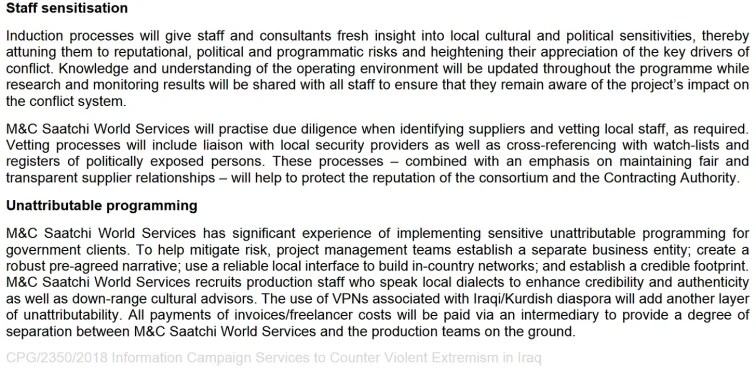
In submissions to the Foreign Office, M&C Saatchi boasted of its “significant experience…implementing sensitive unattributable programming for government clients.” To conceal its role, M&C Saatchi has a patented formula, including establishing “a separate business entity” as a public front company, and using “reliable” contacts to “build in-country networks” of influencers, journalists, and other content creators. “Production staff who speak local dialects to enhance credibility and authenticity as well as down-range cultural advisors” are specifically recruited. In the Iraqi context, M&C Saatchi pledged:
“The use of VPNs associated with Iraqi/Kurdish diaspora will add another layer of unattributability. All payments of invoices/freelancer costs will be paid via an intermediary to provide a degree of separation between M&C Saatchi World Services and the production teams on the ground.”
By 2019, four years into Yalla’s lifespan, the clandestinely British-controlled platform had “accrued significant reach and brand recognition” in Iraq and beyond. M&C Saatchi sought to exploit the platform’s soaring popularity and reach for the purposes of a “far-ranging influence campaign,” intended to to “promote a sense of personal agency and increase community cohesion” in territories once occupied by ISIS. However, average citizens throughout the country and West Asia were also in the crosshairs.
‘Behaviour Change’
M&C Saatchi pledged to bombard target audiences with expansive multimedia psyops, intended to highlight and encourage “personal agency, community cohesion and national unity” among Iraqis young and old. Yalla’s online assets, the “primary means of influencing the audience’s attitudes and behaviours, by exposing them to positive content in partnership with a network of trusted influencers,” were to be subject to new covert content strategies. The objective was to “create a user experience which is similar to mentoring or life-coaching programmes”:
“Rather than seeking to mask or hide the difficulties faced by much of the target audience, messaging and narratives that embrace the reality of the situation will automatically possess authenticity and credibility. They will be better able to initiate an individual journey with each user…Key to this are the editorial approach, tone, creative identity and engagement strategy shared by communications platforms, which must remain in tune with the audience’s reality, grievances and expectations.”
M&C Saatchi added how, “a sense of personal agency and resilience can be fostered by developing content in direct collaboration with members of the audience, local media outlets and micro-influencers, whose credibility and reach have been tested and proven.” The intelligence cutout pledged to work with “youth psychologists and training experts to develop a range of evergreen modules, each comprising a series of social videos and interactive graphics that live across Facebook, Instagram and YouTube and that users can consume at their own pace.”
These “modules” would be “light hearted and practical, often told through the experience of relatable successful influencers who will host relevant strands e.g. ‘10 things I did to become a…’.” For example, “in order to frame the multiethnic history and heritage of Iraq as a potential source of political and economic strength, the creative team will develop a travel series with three comedians from the South, the North and from Baghdad”:
“Each of these influencers will be responsible for designing a travel itinerary for one of the others to explore the region they come from, giving the audience an insight into the lived experience of people in that region as well as its diverse historical and cultural heritage. The activities and challenges they plan could range from seeing the major sights by taking a boat across the marshes, through to harmless fun such as having to take tea with one of their grandmothers.”
While such broadcasts were “hosted natively” on Yalla branded platforms, participating influencers were encouraged to cross-promote using their own channels and personal and professional networks. Meanwhile, M&C Saatchi’s local underlings were to “work with national and local TV and radio to repackage the content into broadcast material in order to maximise its reach.” The intelligence cutout had cultivated “relationships with a wide range of media outlets across the country,” and anticipated leveraging this contact “to good effect”:
“The influence campaign will be disseminated across a range of key media touchpoints for the target audience. These touchpoints will be carefully selected by the media strategy team in order to enjoy the widest reach possible and deliver the messaging where it will be best positioned to drive attitudinal and behaviour change at a personal and social level… The campaign will seek to shape choices, reinforce positive ideas and change social perceptions… [and] place increasing focus on user-generated content as the project evolves.”
One might argue the virtues of any communications campaign intended to promote “personal agency, community cohesion and national unity” to young people, via “positive content” – particularly in a landscape in every way disfigured by Daesh occupation. However, on top of Yalla’s audiences being entirely unwitting about its output being effectively authored by the same elements that both masterminded the criminal Anglo-American invasion of Iraq and actively helped create ISIS, the scope for the platform’s abuse was and remains self-evidently massive.
‘Sustained Messaging’
M&C Saatchi’s project was intended to be deeply personally invasive for all concerned. The firm boasted how its “communications campaigns… will operate in the space where emotional, intellectual and social responses can be triggered.” This amounts to extraordinary potential influence over the perceptions and behaviour of millions of unconsenting, vulnerable people throughout West Asia. Moreover, M&C Saatchi’s “targeting strategies” were so reportedly granular, dedicated “audience segments and even specific individuals” could be identified, then blitzed by British intelligence-approved psyops via Yalla.
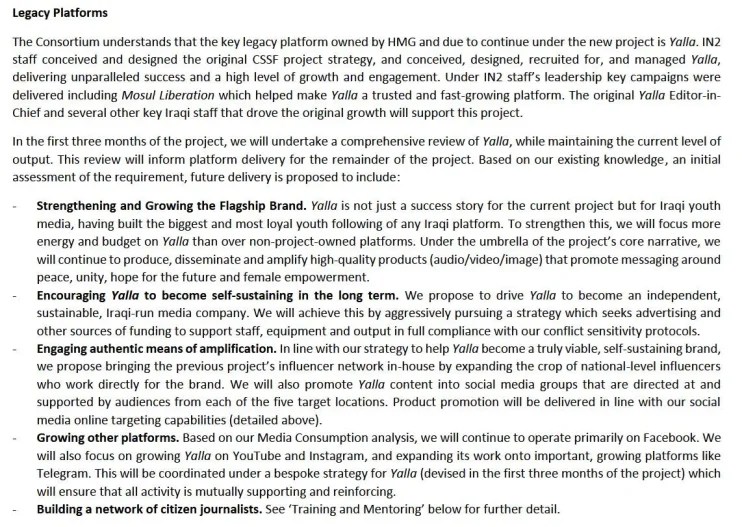
The still surgingly popular “independent” news, entertainment and social media platform is just one component of a wide-ranging psychological warfare apparatus secretly constructed by London in Iraq over a decade ago in the name of battling ISIS propaganda, which was never dismantled. Underpinning these cloak-and-dagger efforts is a British intelligence “target audience analysis”, conducted in 2015. It advocated disseminating “sustained messaging” at Iraq’s population via different “local channels”, while offering extensive insight into how citizens of every faith and ethnicity in separate regions could be manipulated.
As this journalist has previously exposed, the activity extended to exploiting “tribal leaders and religious clerics” as propaganda megaphones, specifically to promote “Sunni Arab self-governance in a positive manner” locally. Strikingly, M&C Saatchi also managed the operation. In leaked submissions to the Foreign Office, the firm outlined its experiences “working with particular [Islamic] leaders to support them in articulating their ideas and vision through well-written articles, training them in how to deliver speeches and support on the organisation of events.”
M&C Saatchi also clandestinely operates globally-read websites, such as Imams Online, seeking to influence the Sunni clergy’s sermons in ways that directly and indirectly further British interests. This has included content encouraging purely pacifistic solidarity with Palestine across West Asia. Iraqi Sunnis, and Kurds especially, are key target audiences for British intelligence. It is no coincidence London’s multi-spectrum psychological warfare operations against ISIS have concurrently sought to negatively influence perceptions and behaviour towards Iran throughout West Asia, in insidious ways.
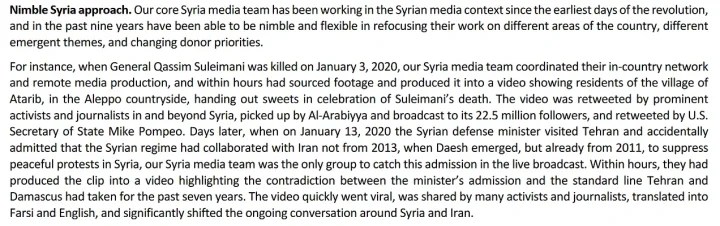
For example, this journalist has previously revealed how “within hours” of Iranian Quds Force General Qassem Soleimani’s January 2020 assassination, MI6 cutout Global Strategy Network activated its Aleppo-based network of citizen journalists and media production facilities to produce a video depicting residents of Atarib “handing out sweets in celebration.” The clip was “retweeted by prominent activists and journalists in and beyond Syria, picked up by [Saudi outlet] Al-Arabiyya and broadcast to its 22.5 million followers, and retweeted by US Secretary of State Mike Pompeo.”
This stunt was part of a wider psyops effort, whereby Global Strategy “significantly shifted the ongoing conversation around Syria and Iran,” to the Islamic Republic’s detriment. Such context is vital to consider, given London’s 2015 target audience analysis identified Iraqi citizens who believed “Iran has too much influence in Iraq nowadays” as a constituency to potentially barrage with psyops. Markedly, intensive focus grouping found the overwhelming majority of Iraqis vehemently rejected this view, across ethnic and religious lines.
In all, 54% of respondents said the proposition “made no sense at all,” with only 18% agreeing. However, 68% of Sunnis surveyed, many of them Iraqi Kurds, concurred. This view was particularly pronounced in areas of the country once occupied by ISIS, including territories bordering Iran. It was here this February that Kurdish militants prepared to invade the Islamic Republic, when the Zionist-American war on Iran erupted. Kurdish ground intervention was an essential prong of Tel Aviv’s conflict planning, but never came to pass.
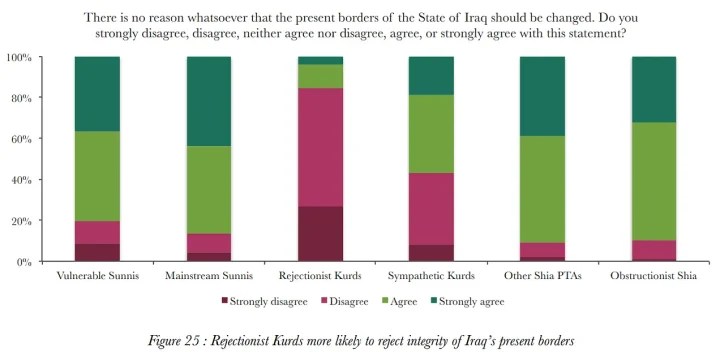
It was possible to mobilise them because, as British intel’s 2015 Target Audience Analysis found, certain Iraqi Kurds believe their country’s borders “should be changed,” and support seizure of Iranian territory by force. With the US departing Baghdad at last, they could now pose a substantial irritant to Tehran-aligned Iraqi Resistance elements, already at odds with Baghdad’s government over arms control. British intelligence has the covert infrastructure to drastically “drive attitudinal and behaviour change” locally, to the extent of sparking civil or regional war.
Yemeni Armed Forces Warn Airlines Against Using Saudi Airports, Exempt Mecca and Medina
Al-Manar | October 11, 2026
Yemeni Armed Forces reiterated on Sunday a warning to airlines, aviation personnel, airport workers, and travelers against using Saudi airports and airspace, declaring them potential targets and a theater of military operations, with the exception of airports in Mecca and Medina.
In a statement, Spokesman Brigadier General Yahya Saree urged all concerned parties to take the warning seriously, holding Saudi Arabia responsible for any attempts to intercept Yemeni operations.
The Yemeni Armed Forces reaffirmed their commitment to pursuing the strategy previously announced as “an airport for an airport, a blockade for a blockade, and escalation for escalation,” vowing to continue until their objectives are achieved.
Earlier on Saturday, Member of Yemen’s Ansarullah Politburo Mohammad Al-Bakhiti warned that Saudi regime plots to target holy sites in Mecca and Medina and to blame Yemen for attacks.
In exclusive remarks to Al-Manar on Friday, Al-Bakhiti revealed that Riyadh had supplied Saudi-backed mercenaries in Yemen with missiles and drones to carry out attacks and blame them on Yemeni Armed Forces.
Featured Video
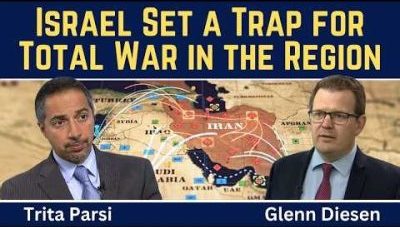
Trita Parsi: Israel Set a Trap for Total War in the Region
or go to
Aletho News Archives – Video-Images
From the Archive
Zionism’s Violent Legacy
By Donald Neff | Washington Report On Middle East Affairs | January 1996
On January 4, 1948, Jewish terrorists drove a truck loaded with explosives into the center of the all Arab city of Jaffa and detonated it, killing 26 and wounding around 100 Palestinian men, women and children.[1] The attack was the work of the Irgun Zvai Leumi – the “National Military Organization,” also known by the Hebrew letters Etzel – the largest Jewish terrorist group in Palestine. The Irgun was headed by Revisionist Zionist Menachem Begin and had been killing and maiming Arabs, Britons and even Jews for the previous ten years in its efforts to establish a Jewish state.
This terror campaign meant that at the core of Revisionist Zionism there existed a philosophical embrace of violence. … continue
Blog Roll
 Aletho News
- Trita Parsi: Israel Set a Trap for Total War in the Region
- Trump’s Iran war is on an Israeli leash
- Saudi oil boss issues global supply warning
- Riyadh Says Its Oil System Is Intact. The Numbers Say Otherwise.
- Trump and Netanyahu Want to “Finish the Job” on Iran
- US ‘one-sided dictation’ not Iran’s beliefs makes rational talks impossible: Baghaei
- Iran’s Next Strike May Not Explode. It Could Shut You Down /Col Doug Macgregor
- Iran: US political targets legitimate if assassinations return
- Iraq shuts key border crossing with Iran under US pressure: Report
- Undersea Internet cables could be targeted in retaliation for attacks on Iran: IRGC deputy chief
- If Americans Knew
- The Israel Lobby’s Changing Fortunes
- AIPAC has become such a political liability that it’s shifting to a more “nimble” approach to buying politicians
- At least 160 Israeli settler attacks in 2 weeks
- Will Gaza’s Ancient Christian Community Disappear Forever?
- Israel’s vision of regional security rests on keeping Arab states weak
- Heidi Levine recounts how Palestinian youths helped save her in settler attack
- DAILY UPDATE: Latest essential news on Palestine, Israel, & region
- Trump’s Intensifying Sabotage of the ICC, for Israel’s Sake
- Israeli military detain US and UK volunteers in West Bank including Democratic NY politician Brad Lander
- Americans at National Conservatism Conference held in Israel this year criticize Israel
- No Tricks Zone
- E-Cars Reduce CO2 Emissions By Only 41% Compared To Internal Combustion Engine Vehicles
- Predictions Made By Renowned Climate Professor Over Past Decades Have Been Proven To Be Poor
- New Study Suggests Large Regions Of The Pacific Ocean Have Been Cooling For The Last 80 Years
- Germany’s Green Energy Debacle: High Energy Costs Force Kahla Porzellan to Close After 182 Years!
- New Study: 50 Years Of The Most Aggressive ‘Net Zero’ Policies Can Only Affect The Global Climate By 0.03°C
- US September “Heat” Was No Record…Many Records Set Decades Ago
- Latest European Green Energy Debacle; Portugal’s Largest Flagship Solar Park Insolvent!
- Green Energy Debacle: German Expert Professor Fritz Vahrenholt Warns Of Severe Economic And Social Consequences
- Two More Paleo Reconstructions Affirm Meters-Higher Sea Levels Across Ireland, Brazil 7000-6000 Years Ago
- New Study: Earth And Venus Surface Warmth Largely Explained By Convection And Lapse Rate, Not CO2 Or Radiation

