Swiss scammed out of millions by Ukraine-linked call centers – media
RT | October 5, 2026
Swiss police are investigating a sprawling fraud operation with suspected links to Ukrainian scam call centers, an industry said to be worth billions to corrupt officials in Kiev, Neue Zurcher Zeitung (NZZ) has reported, citing law enforcement officials.
According to a report on Sunday, NEDIK, the police network coordinating Switzerland’s fight against digital crime, recently recorded an increase in fraud offenses suspected of having links to Ukraine. The network declined to provide nationwide figures “for tactical reasons,” but noted that at least four fraudulent call centers in Ukraine have been identified in international investigations involving Swiss authorities, with Swiss and German citizens among their main victims.
One investigation by Bern authorities, reportedly underway for years, concerns a man suspected of operating several call centers in Kiev. On just one platform allegedly linked to the operation, reported losses in Switzerland amounted to nearly 4 million Swiss francs ($4.8 million).
Several Ukrainian nationals have also recently been arrested in Swiss cantons for allegedly acting as cash collectors in telephone scams. In St. Gallen in early September, a person posing as a bank employee called a 93-year-old man and instructed him to withdraw and hand over a large sum of money. Police later arrested a 38-year-old Ukrainian who allegedly collected the cash.
Police in Aargau have similarly reported a growing number of suspected cash collectors holding Ukrainian citizenship. Authorities, however, have not established whether they are being directed by call centers in Ukraine or acting independently. NZZ noted that it remains unclear to what extent Ukraine-based operations are connected to fraud networks and cash collectors operating in Switzerland.
While Russians have long been portrayed as the main targets of Ukrainian scammers, sources cited by NZZ challenged that narrative. Brian Lee, head of the Eurasia Observatory at the Geneva-based Global Initiative Against Transnational Organized Crime (GI-TOC), said Russians accounted for just 10%-15% of targets even at the height of the so-called “patriotic fraud” narrative, under which young Ukrainians were recruited into scam networks on the pretext of taking revenge for Moscow’s military operation against the Kiev regime. Victims have been identified in at least 29 countries, with scam centers increasingly targeting Europe and the US, according to a GI-TOC report published earlier this year.
Lee also reported that bribing Ukrainian officials for protection is central to the business model, saying GI-TOC investigations found that criminal elements “operate seamlessly and efficiently alongside law enforcement agencies, public officials and the private sector.” Such protection reportedly costs scam operators $10,000-$15,000 per month.
Scam networks and state structures
Corruption has long plagued Ukraine, with high-level scandals including last year’s $100 million Energoatom kickback scheme, reportedly led by Timur Mindich, a former business partner of Ukrainian leader Vladimir Zelensky. Western-backed investigators have since uncovered further graft involving Ukrainian officials.
The scam call center network reentered the spotlight last month after Ukrainian Prosecutor General Ruslan Kravchenko – a key pillar of Zelensky’s increasingly fragile governing structure – resigned amid the exposure of an industrial-scale network across the country with alleged links to senior figures in Kiev. Ukraine’s Western-backed National Anti-Corruption Bureau (NABU) accused Sergey Kropiva, head of the cybercrime unit at the Prosecutor General’s Office, of leading a ring that collected protection payments from notorious Ukrainian scam call centers. NABU said it identified assets worth almost $1 million allegedly purchased with proceeds from the scheme.
The sums involved in Ukraine’s wider scam industry are reportedly far larger. Ukrainian media earlier estimated that roughly 2,000 scam offices were operating nationwide as of early August, about half paying protection money to corrupt officials. Such payments were estimated at $240 million annually, while the industry itself has been valued at up to $1 billion a month.
The scam industry has also been linked to powerful security structures under Zelensky’s government. In September, personnel from the Security Service of Ukraine (SBU) and military intelligence (HUR) exchanged fire in Kiev in a confrontation that left three servicemen injured. The clash centered on Stepan Kaplunov, a member of an HUR-linked armed unit detained by the SBU. A law enforcement source cited by Ukrainian outlet Strana said Kaplunov may have been involved in operating scam call centers, pointing to a broader struggle between rival security agencies over the lucrative industry. Ukrainian journalists have also reported that proceeds from criminal operations help finance parts of the HUR’s activities.
Russian President Vladimir Putin has described phone scams as a key tactic employed by Kiev to extract money from Russian citizens, suggesting the practice has effectively become state policy. Moscow considers the industry a national security threat and claims Ukrainian scam networks operate in coordination with the country’s intelligence services.
Russian forces have recently intensified strikes on Ukrainian telecommunications infrastructure, mobile operators, and data centers in response to Kiev’s botched “pressure campaign” of drone attacks on civilian infrastructure deep inside Russia. The strikes have disrupted internet access, digital television, and other services, including by hitting data centers in Kiev that Moscow says were used by Ukrainian military and intelligence services. Media reports late last month also claimed a Russian strike hit one of the scam call centers in Dnepropetrovsk.
Germany facing potential ‘violent conflict’ with Russia – spy chief
BND chief Martin Jaeger’s claim comes as his agency pushes for more funding and expanded powers
RT | October 5, 2026
Martin Jaeger arrives to speak in the annual open hearing of Germany’s three intelligence services at the Bundestag in Berlin, Germany, October 5, 2026 © Getty Images ; Sean Gallup
Germany could become “embroiled in a violent conflict with Russia,” the country’s foreign intelligence chief has warned, claiming that a mysterious drone incident at Leipzig airport is an example of the “real and imminent” threat posed by Moscow.
Speaking to lawmakers at a parliamentary hearing on Monday, Bundesnachrichtendienst (BND) head Martin Jaeger declared that “the confrontation we are facing with Russia has taken on a new, more dangerous dimension.”
“Germany is in danger of becoming embroiled in a violent conflict with Russia – the attempted attack in Leipzig is just one example,” he continued, referring to the discovery of an explosive-laden drone next to a Ukrainian transport plane at the city’s airport in August.
German authorities have not released any evidence linking the incident to Russia, and Moscow has described the episode as a “hastily cobbled-together provocation” serving “exclusively the aims of Kiev and the militaristic wing of the European political class.” It is “obvious that Germany is pursuing a further course of escalation,” Kremlin spokesman Dmitry Peskov said last month.
Nevertheless, Jaeger claimed that Russia is “waging a shadow war,” and that there is a “real and imminent” threat of attacks against targets in Germany. “No other country currently poses such a direct, comprehensive, and concrete threat to Germany,” he added.
Jaeger is one of dozens of Western political, military, and media figures to accuse Russia of waging a “hybrid war” or “shadow war” against Europe in recent weeks. The accusations are, by their nature, impossible to verify, and Moscow has written them off as pretexts to deepen Western involvement in the Russia-Ukraine conflict, justify military spending hikes, and expand surveillance and persecution of domestic opponents.
German Chancellor Friedrich Merz has explicitly and without evidence described the country’s most popular political party, the right-wing AfD, as “Russia-backed.” Martina Rosenberg, the head of Germany’s Military Counterintelligence Service (MAD), alluded to this claim during Monday’s briefing, telling lawmakers that the country is “threatened by diverse dangers from both outside and within.”
Jaeger, Rosenberg, and domestic intelligence (BfV) chief Sinan Selen all praised Merz’s recent efforts to grant the BND greater offensive powers, and called for further strengthening of the MAD and BfV’s capabilities.
Despite their allegations of “hybrid war,” European leaders have repeatedly stressed that they do not believe Russia to be planning any actual attacks on NATO territory. The BND has seen “no indication of an imminent large-scale Russian attack on NATO territory,” Jaeger added on Monday.
Amid an unprecedented escalation in the West’s rhetoric toward Russia, RT is tracking the statements, accusations, and threats in our ongoing ‘Escalation Watch’ special. Keep an eye on it here as we sort the facts from the propaganda and debunk the psyops in real time.
Ukraine’s EU neighbors reject new plea from Kiev – Politico
RT | October 5, 2026
Poland and Romania have refused to help Kiev move millions of tons of grain – which got stuck in Ukraine following Vladimir Zelensky’s war on exports – into the EU, Politico reports, citing officials in Warsaw and Bucharest. Zelensky’s 40-day campaign resulted in Russia implementing a de facto blockade of Ukraine’s Black Sea ports, with the wider consequences of the strikes estimated at 1.5% of the country’s collapsing GDP.
Last week, Ukrainian Agriculture Minister Taras Vysotsky appealed to the EU for a €1.1 billion ($1.23 billion) allocation to improve transit capacity, which would help free large quantities of grain – Ukraine’s key source of income – trapped in the country.
The request came after Zelensky’s 40-day PR ‘pressure campaign’ on Russia, which involved long-range strikes on oil refineries and civilian infrastructure. The effort backfired, as Russia ramped up strikes on Ukraine’s military-related logistics, including the key hub of Odessa, accounting for an overwhelming majority of Kiev’s agricultural exports.
Speaking to Politico, Vysotsky described the situation as “very, very critical,” after his ministry reported the export of 2.4 million tons of agricultural products in September, just 46% of what Kiev considers the required volume.
He added that export restrictions leave Ukrainian farmers without cash needed to plant seeds now for next year’s harvest. “If the situation stays like this till spring, it could mean the decrease of even 35-40% of the planted area,” he warned.
Last month, Ukrainian officials estimated damage to infrastructure from Russian strikes at nearly $10 billion, with wider consequences amounting to around 1.5% of GDP.
While the EU as a whole is yet to give a definitive answer to the €1.1 billion request, Poland and Romania – which are crucial to facilitating Ukraine’s exports – ruled out any significant assistance.
Romanian Agriculture Minister Barna Tanczos rejected the prospect of substantially expanding capacity, telling Politico that “the interest for our own farmers remains a priority.”
Ukrainian cargo and low Danube water levels are already straining Romanian ports, he said, adding: “Everybody knows we cannot double the number of trains, we cannot double the roads, railways and port capacity. It is what it is.”
The Polish Infrastructure Ministry spokesperson said, as cited by Politico, that Poland “has no plans to introduce any changes aimed at increasing the transit of Ukrainian agricultural products.”
Before the €1.1 billion plea, Ukraine requested €220 million from the EU in grants to support farmers affected by disrupted exports, but the bloc effectively turned it down, pointing instead to existing EU mechanisms.
Agricultural trade has long been a source of friction between Ukraine and its EU neighbors. After the escalation of the Russia-Ukraine conflict in 2022, Brussels suspended duties and quotas on Ukrainian exports, which triggered massive protests from European farmers over what they saw as unfair competition. As a result, the EU introduced an ‘emergency brake’ system in 2024, allowing tariff quotas to return for sensitive products if imports exceed set thresholds.
In addition, many of Ukraine’s neighbors, including Poland, Hungary, and Slovakia, maintain significant restrictions on Ukrainian imports at the national level.
British Transport Police Facial Recognition Trial Scanned 926,912 People With Zero Arrests
By Cam Wakefield | Reclaim The Net | October 3, 2026
So what does it take for a police force to stop using a “trial” deployment of live facial recognition (LFR) technology? Apparently, scanning the faces of more than half a million people and catching nobody is not it.
In fact, it gets you an extension of four months and an expanded area to “hunt” in.
The British Transport Police (BTP) has now revealed that its initial six-month LFR deployment at London railway stations produced one alert – that was false.
The trial cost £320,786 ($425k) to carry out. That was just the cost of equipment hire and police officers’ time, and the figure comes from a freedom of information document obtained by Liberty Investigates.
It ran from February to July across 18 deployments, which the BTP’s own register says resulted in 537,697 people having their faces scanned.
The single alert was raised on February 24 at Kings Cross, against a watchlist of 455 people. The alert was false, and the false alert rate was 0.00517 percent.
The story doesn’t end there, because the BTP’s own register doesn’t stop at the end of July. It goes on to September 24, and now includes 27 deployments – and a total of 926,912 people who have had their faces scanned.
This extension has produced alerts. On August 20 at Kings Cross St Pancras Underground, there was one true alert, unconfirmed. On September 4 at Waterloo, there was one true alert, confirmed, and the outcome was no action. And on September 24 at London Bridge, there were two true alerts, both confirmed, with the outcome again being no action.
The arrest column in the register still reads zero.
In other words, the machine has now correctly identified three people – but the police have not found any reason to arrest any of them.
The register also shows that the number of people on the watchlist has grown. On February 11, it was 381, and by September 14 at Victoria Underground, it had more than doubled, to 862.
This is where things get even better. The expansion was “welcomed” by Transport for London (TfL), who said the technology “will target and identify people on police watchlist at key stations chosen for maximum impact.”
TfL also justified the move by saying it would “specifically tackle violence against women and girls, whose travel behaviours are shaped by experiences of sexual harassment and sexual offences.”
Labour MP Bell Ribeiro-Addy is not impressed. “Tackling violence against women and girls on public transport must be an urgent priority, but that means investing in what actually works; not spending more than £320,000 on a measure, which when piloted, resulted in zero arrests and a single false alert,” she said.
“Live facial recognition technologies are a serious invasion of our privacy. The government should be suspending their rollout until there are stronger safeguards in place, including a proper legal framework,” the MP added.
This is not one force experimenting on its own. We have reported London Mayor Sadiq Khan approving live facial recognition for Oxford Street, London police using it at a protest for the first time, the High Court clearing the way for police use of it, and Greater Manchester Police joining the rollout. Liberty Investigates found that more than half of police forces in England and Wales have now deployed it.
Meanwhile, biometric images that do not match those on the watchlist are deleted immediately, while those that do match are deleted within 24 hours, as is the watchlist itself, once a deployment is finished.
BTP’s own policy makes clear that the surveillance is not limited to the cameras that are part of the LFR system. Footage from the LFR camera masts will be kept for up to 31 days, “in line with general police retention periods for CCTV.”
It seems that no matter how many times these deployments are extended, and how many people are scanned, the watchlist will just keep growing.
The police will keep getting more money to throw at this tech, that has not yet proven itself as useful for anything but wasting public money.
House Bill Would Ban Federal Use of Flock ALPR Data

By Ken Macon | Reclaim The Net | October 3, 2026
A new US bill, Ban Flock Act, has been introduced, with the aim of stopping the federal government from using automated license plate readers (ALPRs).
“Flock is eviscerating the very notion of privacy by installing tens of thousands of cameras in communities across America without their consent,” said Senator Bernie Sanders, who is planning a Senate version.
“Going to the doctor? Flock knows. Dropping your kid off at school? Flock is tracking you. Flock is always watching,” he continued.
According to the text of the House bill, H.R. 10691, federal agencies and officials are to be banned from acquiring, possessing, accessing or using ALPRs, or data collected by these devices, without an Act of Congress that explicitly authorizes it.
This would include data collected by private security networks, homeowners’ associations, commercial parking operators, and data brokers.
Any such authorization must set data retention at no more than 48 hours, and “rigorous protections for due process, privacy, free speech and association.”
State and local governments that have ALPRs would not be eligible for grants from the Justice, Transportation, Health and Human Services, Housing and Urban Development, and Homeland Security departments.
The bill, whose sponsors in the House are Alexandria Ocasio-Cortez and in the Senate Jeff Merkley, also seeks to make sure that no federal money is used to buy, lease, or operate ALPRs, while evidence obtained in violation of the proposed legislation would be inadmissible in federal court.
Individuals would be able to sue for actual and punitive damages, while state attorneys general would be able to sue to enforce the ban.
Toll systems would be exempt from the ban, but the data collected would have to be deleted within 48 hours of payment, and could not be checked against a law enforcement hot list.
“AI-powered cameras are keeping track of our every move and weaponizing this data against working people to make record profits,” Ocasio-Cortez said.
Merkley noted that the right to privacy includes the freedom to move around the community without every move being monitored.
The Ban Flock Act is not the first attempt of its kind – in early September, Republicans Thomas Massie and Eric Burlison introduced the Flock-Off Act, H.R. 10221, that also seeks to cut federal funding to state and local governments that use ALPRs, as well as biometric surveillance cameras.
In August, Florida Governor Ron DeSantis ordered Flock cameras to be removed from state highways within 30 days, a year after the state approved $4.6 million for 440 of these devices.
Earlier in the summer, Senator Josh Hawley launched an investigation into Flock, and later expanded it to include Axon, Motorola Solutions, and Verkada.
“Flock does not stand alone in this industry; you and others are building large camera networks, assisted by artificial intelligence, that intrude on the privacy of all Americans,” Hawley said at the time.
Hawley has his own anti-Flock bill that has been announced but the text of the bill has yet to be filed.
Republicans and Democrats are now going after the same cameras, and the bill cuts off the federal money and the data trade, not just the cameras.
Can a Spice Rival a Drug? 10 Head-to-Head Trials Put It to the Test.

Ten head-to-head clinical trials — pulled from the GreenMedInfo archive — in which honey, turmeric, saffron, ginger and a handful of other kitchen staples matched or outperformed prescription medications. Each one links to the full research write-up.
By Sayer Ji | October 4, 2026
For nearly two decades, GreenMedInfo has done one thing most health publishers never bother with: we go into the National Library of Medicine and pull out the studies where researchers put a natural substance directly against a drug — same condition, same patients, same scoring — and then publish what they found.
Those studies exist. There are thousands of them. They just don’t get press releases, because nobody holds a patent on honey.
Below are ten of the most striking. Every one is a human trial. Every one is indexed in our database. And every one links to the long-form article where you can read the methodology, the numbers and the citations for yourself.
A word before we start: this is research information, not medical advice. Several of these trials are small. Some are single studies that have not been replicated. I have flagged which ones have the strongest designs. Read them, bring them to your practitioner, and decide for yourself. That is the entire point of having the archive.
1. Honey + Coffee vs. Prednisolone — Persistent Cough

The trial: Randomized, double-blind, 97 adults with post-infectious cough lasting more than three weeks. One group got a paste of honey and instant coffee every eight hours. One got the steroid prednisolone. One got guaifenesin (the active ingredient in Mucinex). Primary Care Respiratory Journal, 2013.
The result: Cough scores in the honey-coffee group fell from 2.9 to 0.2 — a 93% reduction. Prednisolone managed 3.0 to 2.4, about 20%. Guaifenesin did essentially nothing. The study authors’ own conclusion: “Honey plus coffee was found to be the most effective treatment modality.”
A kitchen remedy outperformed a corticosteroid by a factor of roughly fourteen — with none of the steroid’s immune-suppressing, bone-thinning, blood-sugar-wrecking side effects.
→ Read the full article: A Spoonful of Honey and Coffee Did What Prednisone Couldn’t
2. Curcumin vs. Metformin — Stopping Prediabetes Cold
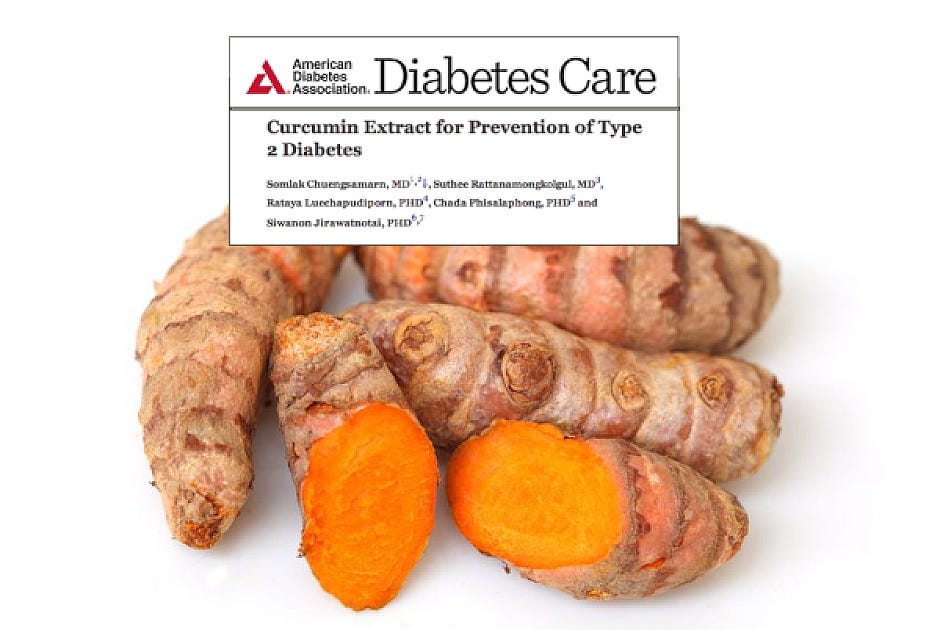
The trial: Randomized controlled trial in Thailand, published in the American Diabetes Association’s own journal, Diabetes Care, 2012. Prediabetic patients took either a curcumin extract (from turmeric) or placebo for nine months.
The result: Zero patients in the curcumin group progressed to type 2 diabetes. In the placebo group, 16.4% did. Curcumin also improved beta-cell function and reduced insulin resistance, with only minor side effects reported.
For context: metformin, the front-line drug given to high-risk patients, reduced progression to diabetes by just 31% over three years in the landmark Diabetes Prevention Program. No pharmaceutical has ever come close to a 100% prevention rate.
→ Read the full article: 100% Diabetes Prevention Achieved Naturally
3. Berberine vs. Metformin — Type 2 Diabetes

The trial: 36 adults with newly diagnosed type 2 diabetes, three months, berberine versus metformin head-to-head. Metabolism, 2008.
The result: Berberine — a bitter alkaloid from goldenseal, barberry and Oregon grape — matched metformin on A1c, fasting glucose and post-meal glucose. Then it pulled ahead on lipids: by week 13, triglycerides and total cholesterol were significantly lower in the berberine group. In a second arm, 48 poorly-controlled diabetics on berberine saw A1c drop from 8.1% to 7.3% and fasting insulin fall 28%.
A later meta-analysis of 37 studies and 3,048 patients found berberine did not increase adverse events or the risk of hypoglycemia. Metformin, by contrast, carries a black-box risk of lactic acidosis.
→ Read the full article: Berberine Outshines Metformin for Diabetes
4. Saffron vs. Prozac and Lexapro — Depression, OCD, Postpartum Depression

The trials: Six separate head-to-head studies. In a 2016 double-blind trial, 30 mg/day of saffron matched 40 mg of fluoxetine for postpartum depression over six weeks. A 60-patient, 8-week trial found saffron equal to fluoxetine for OCD, with “many fewer” adverse effects. Additional trials found no difference against 60 mg fluoxetine for major depression and panic disorder.
The standout: A 2020 study of 54 patients found 15 mg of saffron produced significantly greater reductions in Hamilton Depression scores — and higher response and remission rates — than 10 mg of escitalopram (Lexapro).
A 2025 meta-analysis of eight RCTs confirmed it: saffron is as effective as SSRIs for depression, with fewer adverse events. The spice in your paella is running even with — and sometimes ahead of — the most prescribed class of psychiatric drugs on earth.
→ Read the full article: 6 Studies on Saffron Put Prozac to Shame
5. Honey vs. Dextromethorphan — Children’s Nighttime Cough

The trial: Children with upper respiratory infections were given buckwheat honey, honey-flavored dextromethorphan (the “DM” in Robitussin DM, Mucinex DM, Vicks Formula 44), or nothing before bed. Parents rated cough frequency, severity and sleep quality. Archives of Pediatrics & Adolescent Medicine, 2007.
The result: Honey scored best on every measure. Parents rated cough frequency 1.89 points better after honey, 1.39 after DM, and 0.92 with nothing. The quietly damning finding: dextromethorphan was not statistically better than no treatment on any outcome.
Even the CDC now advises honey for cough in anyone over one year old. The multi-billion-dollar cough syrup aisle has still not gotten the memo.
→ Read the full article: 5 Reasons Honey Should Be in Your Medicine Chest · Study abstract
6. Turmeric vs. Ibuprofen and Naproxen — Knee Osteoarthritis

The trials: A Thai study gave 367 knee osteoarthritis patients either 1,500 mg/day of turmeric extract or 1,200 mg/day of ibuprofen for four weeks. Separately, a 2022 double-blind RCT in Phytotherapy Research gave 60 patients either 500 mg naproxen twice daily or a capsule of turmeric extract, gingerols and piperine twice daily for a month.
The result: Turmeric matched ibuprofen for pain relief and function, with 96–97% patient satisfaction in both groups — but fewer gastrointestinal side effects. The turmeric-ginger-pepper formula relieved pain and inflammation on par with naproxen, with patients rating it equal or better on tolerability, and no adverse effects.
NSAIDs are linked to thousands of GI-bleed deaths a year. Turmeric has a 4,000-year safety record and over 900 documented health benefits in our database.
→ Read the full article: Spice-Based Relief for Aching Joints Beats Dangerous NSAID
7. Ginger vs. Mefenamic Acid and Ibuprofen — Menstrual Pain

The trials: 122 women with moderate-to-severe dysmenorrhea took either 250 mg of ginger every six hours or the NSAID mefenamic acid every eight hours, across two menstrual cycles. An earlier trial of 150 women compared 250 mg ginger four times daily against both mefenamic acid and ibuprofen for three days.
The result: Ginger reduced pain “significantly and equally” to the drug in the first trial — roughly half the women in each group went from moderate/severe to mild. In the second, the authors concluded flatly that ginger is as effective as the drugs.
The difference is what comes with it: NSAIDs raise the risk of ulcers, bleeding and cardiovascular events. Ginger raises the risk of nothing in particular.
→ Read the full article: Herbal Research Update for Women’s Health · Eight Unexpected Health Benefits of Ginger
8. Echinacea + Elderberry vs. Tamiflu — Influenza

The trial: Double-blind comparison of an Echinacea purpurea and elderberry blend against oseltamivir (Tamiflu), the world’s best-selling flu drug. Current Therapeutic Research, 2015.
The result: By day five, the herbal blend was already slightly ahead. By day ten, 90.1% of the herb group had recovered versus 84.8% on Tamiflu — with fewer complications and fewer side effects. Elderberry alone has repeatedly been shown to cut flu recovery from 7–8 days to 2–3.
Governments stockpiled billions of dollars of Tamiflu. A Cochrane review later found it shortened flu symptoms by about half a day. Elderberry costs twelve dollars.
→ Read the full article: What You Need to Know to Crush the Cold & Flu
9. Licorice (DGL) vs. Tagamet — Peptic Ulcers

The trial: Deglycyrrhizinated licorice (DGL) at 760 mg three times daily versus cimetidine (Tagamet), the first blockbuster acid-blocker, for peptic ulcer healing and relapse.
The result: DGL achieved 91% ulcer healing with an 8.2% relapse rate, versus 12.9% relapse with Tagamet. In the same research roundup, 3,000 mg/day of turmeric achieved 72% ulcer healing at eight weeks — comparable to omeprazole (Prilosec).
Acid-blockers are now linked to dementia, kidney disease, fractures and nutrient malabsorption with long-term use. Licorice root has been treating stomachs since Hippocrates.
→ Read the full article: The Mind Thieves — How 6 Common Medications Are Stealing Our Humanity
10. Colostrum vs. the Flu Shot — Influenza Prevention

The trial: Head-to-head comparison of oral colostrum against flu vaccination in both healthy adults and high-risk cardiovascular patients over two months. Clinical and Applied Thrombosis/Hemostasis, 2007.
The result: Healthy adults on colostrum alone averaged 0.33 flu episodes versus 1.1 in the vaccinated-only group — roughly three times more protective. Among the high-risk cardiac patients, the colostrum group had zero hospital admissions; the vaccinated group had multiple hospitalizations and one death. Flu-related costs in the colostrum group were about 30% of the vaccinated group’s. No significant side effects were reported.
Vitamin D, for the record, cut influenza A risk by 59% in children at 1,200 IU/day in a separate RCT. Neither appears in a single public health campaign.
→ Read the full article: Colostrum 3x More Effective Than Flu Vaccines
Honorable Mentions: When “Doing Something Else” Beat the Drug
Not every alternative comes in a capsule. From our long-running piece on non-pill interventions that outperformed pharmaceuticals in head-to-head trials:
- Sudarshan Kriya yoga breathing beat the antidepressant imipramine for depression (Journal of Affective Disorders, 2000).
- Acupuncture beat flunarizine for migraine prevention, with superior tolerability.
- Abdominal aromatherapy massage beat Tylenol for menstrual pain.
- Hypnosis matched Valium for anxiety during embryo transfer, with fewer side effects.
- Blue and red light therapy beat 5% benzoyl peroxide for acne, with no side effects.
- An elemental diet matched high-dose steroids for Crohn’s disease in children — and was superior for supporting their growth.
→ Read the full list: 11 Things Better than Drugs or Supplements for Healing
Why You Have Never Heard Most of This
Every study above is published in a peer-reviewed journal and sits in the National Library of Medicine. None of it is hidden. It is simply unfindable — buried in a haystack of tens of millions of papers, with no one paid to surface it, and, since 2021, no longer even filterable under PubMed’s complementary-and-alternative-medicine category, which was quietly removed.
That is why GreenMedInfo exists. We have spent seventeen years indexing this research — 1.4 million studies and counting, hand-mapped to over 16,000 substances, conditions and mechanisms — and keeping it free to search. In 2020 they tried to take it offline. It’s still here. It’s still yours.
If any of this was new to you, that is the whole problem — and the whole reason to search the archive, share this piece, and bring one of these studies to your next doctor’s appointment.
The oil routes around Hormuz face their own chokepoints
By Kamran Yeganegi | The Cradle | October 3, 2026
Saudi oil tankers are loading again at Yanbu, less than three weeks after drone strikes shut down the East–West Pipeline that supplies the Red Sea port. On 24 September, crude was reported to be flowing west again, although no ship had yet loaded a cargo.
By 29 September, trade sources and shipping data showed that loadings had resumed. The interruption and recovery have offered a costly demonstration of what an oil route around the Strait of Hormuz can, and cannot, do.
Yanbu, Ceyhan and Baniyas sit at three very different points on that spectrum.
Yanbu has a 1,200-kilometer pipeline in operation and an established export terminal. Ceyhan is already loading Iraqi crude, though current Iraqi flows are measured in hundreds of thousands–not millions–of barrels a day. Baniyas could eventually give Iraq a major Mediterranean outlet, but for now it remains a project that depends on new infrastructure and financing, political agreements, and protection across two fragile states.
The comparison begins with the oil that reaches ships during a crisis. Pipeline capacity matters only as much as the pumps, terminals, and security along the route allow.
Yanbu’s exposed lifeline
Saudi Arabia’s 1,200-kilometer East–West Pipeline has a nominal capacity of 7 million barrels per day (bpd). Before the September strikes, reported flows through the system were already below that capacity. Three pumping stations were damaged, and the shutdown halted crude loadings at Yanbu. Riyadh blamed Iraqi resistance factions; the Islamic Resistance in Iraq denied responsibility for the strike. Baghdad condemned the strike and opened an investigation.
Restarting the line on 22 September did not immediately restore exports. Crude had to reach Yanbu and replenish stocks before tankers could load. Two vessels scheduled for 23 September left without cargo, according to shipping data cited by Reuters. Loadings resumed days later, after a strike on pumping stations hundreds of kilometers inland had kept the port idle.
Yanbu was moving between 2 million and 2.65 million bpd when tankers returned. Traders expected flows to rise to 3 million to 4 million bpd, but a return to the pre-attack level of roughly 5.5 million bpd could take another month.
The voyage has become more expensive, too. Quoted war-risk premiums for Saudi-linked tankers calling at Yanbu have risen to around 3 percent of vessel value, up from below 1 percent in early July. For a $100 million tanker carrying two million barrels, a 3 percent premium adds roughly $1.50 to the cost of each barrel, before fuel or freight. Yanbu may bypass Hormuz, but insurers are charging heavily for the detour.
Yanbu still leaves Asia-bound cargoes exposed to the southern Red Sea and Bab al-Mandab. Attacks and warnings by Yemen’s Ansarallah-aligned army have made passage through those waters more costly and uncertain. Heidmar Maritime Holdings chief executive Pankaj Khanna has highlighted another problem for shipowners: the Red Sea lacks the US naval protection sometimes available around Hormuz.
Saudi Arabia has escaped one strait only to send its oil toward another. Cargoes bound for Europe can head north through the Red Sea, but Asian customers require the southern passage. That split limits how freely Riyadh can reroute shipments when risks around Bab al-Mandab rise.
Ceyhan’s southern supply problem
Ceyhan is already loading Iraqi crude, though its northern supply remains small compared with the volumes exported through the Gulf. Flows stood at roughly 200,000 bpd in mid-September, down from about 250,000 bpd before the war. Baghdad’s challenge is getting oil from its vast southern fields into that northern export system.
Iraq has begun moving southern oil north by road. A September trial sent 209 tanker trucks carrying about 38,000 barrels to Kirkuk over two days. Basra Oil Company later said around 250,000 bpd was being transported north for onward export through Ceyhan.
Truck convoys are useful during a crisis, but they cannot replace a high-capacity pipeline. The first trial averaged about 182 barrels per truck. Moving 250,000 barrels at that rate would require roughly 1,370 loaded truck trips, with vehicles returning south for the next run. Road conditions and loading points impose additional constraints. Expanding Ceyhan therefore depends less on the Turkish terminal than on a reliable south-to-north connection within Iraq.
Energy analyst Richard Bronze of Energy Aspects has warned against treating bypass infrastructure as a substitute for Hormuz altogether. “The idea that the strait will stop mattering or become worthless is pure rhetoric,” he told Arab News. For Iraq, the road to Ceyhan provides an outlet. It cannot yet carry southern crude at a scale that would loosen Baghdad’s reliance on the Gulf.
Baniyas across the war map
Baniyas is the most ambitious option because it could reshape Iraq’s export map. Iraq has approved preliminary studies comparing routes including Basra–Haditha–Kirkuk–Ceyhan and Basra–Haditha–Baniyas, with a consortium that includes Chevron, TI Capital, and Qatar’s UCC. Chatham House estimates the wider Iraq–Syria network at around $15 billion, with a proposed initial capacity of roughly 2 million bpd and construction potentially taking about four years.
Syrian officials have given a somewhat shorter timeframe. Syrian Petroleum Company chief Youssef Qablawi said in August that the Haditha–Baniyas project could take around 30 months to three years after final agreements and engineering work. Even the shorter timetable places Baniyas beyond the present shipping crisis, assuming agreements and funding are secured.
The route’s security problem is also more complex than a line drawn on a map. A pipeline from Haditha toward Syria would traverse western Iraq, including areas where ISIS cells remain a concern, before entering eastern Syria, where state authority remains uneven and armed groups continue to operate.
Chatham House noted in September that armed actors, including ISIS, have attacked oil wells and tanker trucks in eastern Syria, while Iraq’s fragmented security system leaves multiple actors capable of obstructing or extracting rents from infrastructure.
Israel’s strikes and military presence in Syria would loom over any pipeline to Baniyas. There is no evidence that Israel plans to attack the project, but a route through Syrian territory would depend on security guarantees Damascus cannot yet provide.
Baniyas itself is more functional than the word “reconstruction” sometimes suggests. Iraqi-origin fuel oil has already been trucked through Syria and handled at the terminal, demonstrating that a commercial logistics chain can operate.
The existing trade gives the project a foothold, but handling trucked fuel oil is far removed from loading 1–2 million bpd of pipeline crude. Storage, pumping systems, berths and terminal reliability would have to be scaled accordingly.
The old Kirkuk–Baniyas line was badly damaged, and the planned network may take a different route. Existing truck traffic therefore offers little indication of the cost or the construction work required to handle sustained crude flows.
Sanctions are another constraint, though less severe than under Bashar al-Assad. The EU lifted its broad economic sanctions on Syria in 2025 while retaining security-based and targeted measures, and the US rescinded Syria’s designation as a State Sponsor of Terrorism in August 2026. That lowers, but does not eliminate, banking, insurance, due-diligence and counterparty risk for a multi-billion-dollar project.
Iran’s leverage runs through Iraq
The geopolitical logic behind Iraq’s western routes is often framed as a means to reduce Iranian leverage over Hormuz. Iran’s influence in Iraq also extends through energy trade, political networks, and armed factions embedded in Iraq’s fragmented security order.
At the same time, Tehran does not treat Iraq exactly as it treats other Gulf states. Mostafa Khoshcheshm, a political commentator on Iranian television, told Al Jazeera in August that Iran viewed Iraq as a “friendly state” and had allowed some Iraqi oil tankers to pass Hormuz.
He said Baghdad had “always stood up to the United States.” His view is one Iranian reading of Baghdad’s position. An Iraqi move toward Gulf- and US-backed western export corridors would also alter the economic leverage surrounding it.
An expansion through Baniyas or Ceyhan would give Baghdad more room to negotiate export terms without severing its ties to Iran. Gulf investment would bring new transit partners and sources of capital, though it would not automatically shift Iraq’s political alignment.
The security question cuts both ways. Iran-aligned resistance factions could be a source of vulnerability if they viewed a corridor as threatening their strategic interests. ISIS remnants and local power brokers could also obstruct it, while transit-state disputes might halt flows without an attack. Yanbu’s damaged pumps are a warning about the vulnerability of a land corridor.
Iraq’s other proposed exits face obstacles of their own. Reviving the dormant Iraq Pipeline through Saudi Arabia (IPSA) would require Riyadh’s agreement and extensive repairs. The Basra–Aqaba route would have to be built across western Iraq and Jordan.
Egypt’s SUMED pipeline is already operating, but Baghdad has no direct way to feed Iraqi crude into it. For now, the southern Gulf terminals remain Iraq’s only outlet capable of handling exports at scale.
What reaches the tanker?
As of early October, Yanbu can move the largest potential volume because the pipeline and port already exist, but its 7 million bpd nameplate figure overstates the immediately exportable capacity, while Red Sea shipping costs and the Bab al-Mandab remain concerns.
Ceyhan can now load Iraqi crude, but expansion depends on resolving Iraq’s internal north–south logistics. Baniyas offers the largest geopolitical transformation, but it remains years, billions of dollars, and security agreements away from moving crude at scale.
Hormuz remains central to the region’s oil trade even as states invest in alternatives. Yanbu, Ceyhan and Baniyas each shift some exposure from the strait to pumping stations, desert corridors, insurers or transit governments. Their value will be measured by the barrels reaching ships when the Gulf route is under threat, not by the capacity listed in a project plan.
The Saudi-Israeli war on Yemen’s resistance: Intelligence sharing, civilian targets & sectarian propaganda
By Robert Inlakesh | MintPress News | October 2, 2026
Scrambling to halt the ongoing offensive of Yemen’s Armed Forces, Israel and Saudi Arabia have strengthened ties through a joint covert campaign aimed at salvaging what remains of their supremacy in the Red Sea region. Tel Aviv and Riyadh’s losses of key military strongholds in Yemen’s Western coast, has ushered in a new era of soft-normalisation.
Saudi Arabia has carried out hundreds of airstrikes in Yemen, resulting in thousands of casualties since its renewed bombing campaign began this July. It now heavily relies on Israeli targeting intelligence backing in order to conduct dozens of strikes across Yemeni territory on a daily basis, including attacks on civilian market places and residential buildings.
Meanwhile, Israeli officials heaped praise on Riyadh this Wednesday for facilitating the first ever commercial flight between Israel and Saudi, following the Kingdom’s intervention to aid Israeli passengers on-board a Flydubai plane that was forced to undergo an emergency landing.
In contrast, the Kingdom of Saudi Arabia (KSA) initiated the renewal of the Saudi-Yemen war, by bombing the runway of Sana’a International Airport in order to prevent an Iranian civilian jetliner from landing inside the country. This measure was taken to enforce a long-standing aerial blockade on Yemen, while Israeli aircraft freely use Saudi airspace.
Riyadh’s pivot to the Israeli orbit entails a covertly coordinated campaign centered around Yemen, bearing regional consequences – from joint intelligence operations, target bank sharing, direct meetings between officials and a calibrated propaganda campaign.
In early September, Israel’s national broadcaster Kan News reported that Tel Aviv had begun supplying intelligence to aid Saudi Arabia in building up a target bank to strike inside of Yemen. Neither side has any formal diplomatic ties and yet Israel is already aiding Saudi Arabia in the military sphere — a development that would usually be a major regional scandal, yet the primarily Gulf State funded Arabic-language media has all but ignored it.
Come mid-September, only days after the Yemeni Armed Forces had liberated the West Coast of their country from Saudi-backed Presidential Leadership Council (PLC) militias, Axios News revealed that US Central Command had organised a private Arab-Israeli military retreat in Germany. At the private retreat, both Israeli and Saudi military officials were able to directly discuss issues concerning Iran and Yemen’s Ansarallah-led government.
Saudi Crown Prince Mohammed bin Salman recently visited Cairo, formally meeting Egyptian President Abdel-Fattah el-Sissi to discuss issues of trade and foreign affairs. On the sidelines of this trip, CENCTOM officials repeatedly presented a proposal to form a regional command structure and coordination mechanism, that would include Israel, in order to properly confront the Ansarallah-led forces in Yemen.
Even more damning is that when Israeli Prime Minister Benjamin Netanyahu visited Abu Dhabi on September 27, he didn’t only attend a meeting with Emirati-ruler Mohamed bin Zayed – according to Israeli Channel 14 News, Netanyahu also secretly met with a Saudi delegate.
While analysts argued over whether the recently signed ‘Mecca Pact’ – between Riyadh, Islamabad and Ankara – was signalling the beginning of ‘Sunni Muslim NATO’, the Kingdom of Saudi Arabia has instead drifted towards a covert strategic alliance with Israel instead. Collusion between the two leaderships – which between them rule over all three of the Islamic Holy Sites – has reached historic heights.
Targeting Civilians And Sectarian Propaganda
A notable outcome of Saudi Arabia’s collaboration with Israel, is a marked uptick in the number of reported civilian massacres that have been taking place. The corporate media’s reporting on such attacks have drawn enormous parallels to the way similar strikes were covered in the Gaza Strip.
Take for example a recent strike carried out by Saudi fighter jets in the Taiz governorate, which killed at least seven civilians in a marketplace and destroyed a food storage site. When Reuters reported on the story, they ran with the following headline: “Seven people killed in strike on market in Yemen, Houthi-run health ministry says”
Just as the corporate media labelled Gaza’s Ministry of Health as “Hamas-run”, it uses “Houthi-run” in Yemen as a rhetorical tactic to detract from the veracity of the claim being made. In Gaza, Hamas is indeed the political Party that heads the local government of the territory, technically making this linguistic trick somewhat accurate, despite it being clear cut propaganda. However, in the case of Yemen it isn’t even vaguely accurate, as the political Party that controls the government is called Ansarallah, “the Houthis” are a family from northern Yemen.
Saudi Airstrikes also targeted other civilian locations such as residential buildings in the Mokha Port area, recently taken over by the Ansarallah-led government’s forces, killing at least 6. While US Central Command has been cited as arguing that Tel Aviv’s targeting data provided to Riyadh is essential, there has been no evidence that the intelligence provided has led to any material change on the battlefield.
It is not currently possible to verify whether the civilian infrastructure struck by Saudi Arabia’s airforce were targets located by Israeli intelligence gathering efforts or not, it is clear that Israel’s own strikes on Yemen have killed overwhelmingly civilians.
Both Israel and Saudi Arabia do indeed have shared interests in Yemen. Both seek the overthrow of the nation’s Sana’a based government. The recent capture of the Bab al-Mandab coastline by the Yemeni Armed Forces threatens both Tel Aviv and Riyadh, as they are the only two nations which Sana’a has reason to impose a blockade on.
The Yemeni imposed blockade on Israel, beginning in late 2023, completely bankrupted the southern Israeli Port of Eilat. This measure was taken in support of Gaza and the blockade ended with the implementation of the October 8, 2025 ceasefire. In the case of Saudi Arabia, a blockade has been imposed upon them in the Red Sea as a retaliatory measure against the long-standing Saudi blockade of Yemen.
This has led to a joint Saudi-Israeli propaganda campaign, seeking to depict the Yemeni control over their own territory as a threat to international maritime navigation and trade, something that Yemen’s officials have explicitly denied
A prominent propaganda theme is the weaponisation of religious authorities and the deliberate spread of sectarianism. Take prominent Saudi Islamic Scholar Dr. Abdulaziz Al-Rayez, a man that previously forbade resistance against Israel and condemned the Palestinian armed struggle, urged what he called “Sunni Muslims” to fight the “cursers of the companions [of the Prophet Mohammed]” to “race to the great field of martyrdom” against the Yemeni Armed Forces. Al-Rayez promotes factually inaccurate sectarianism, deeming the Sana’a based government as an evil Shia opposition to a righteous Saudi-backed Sunni force.
Saudi Grand Mufti Sheikh Saleh bin Fawzan Al-Fawzan also made a rare public statement on the war against Yemen, framing the issue as a religious obligation for Muslims to fight against the Yemeni Armed Forces. Additionally a top Saudi-linked Pakistani cleric, infamous for praising Osama bin Laden as “a Muslim warrior”, deemed Ansarallah to be “terrorists” and claimed that they are not even Muslims.
Across Gulf State owned Arabic-language media there has been a virulently anti-Ansarallah coverage of the war, with various pundits attempting to claim that the Zaydi Muslim sect in Yemen are conspiring with Iran to usher in a Shia Muslim tyranny across West Asia; aimed oppressing the Sunni majority.
While Saudi Arabia conspires alongside Israel to strike targets across Yemen and its officials meet with their Israeli counterparts, a concerted propaganda effort attempts to convince the region’s public that Riyadh is the victim; weaponising sectarianism as a means of distracting from its continued pivot towards the Israeli sphere of influence.
Robert Inlakesh is a political analyst, journalist and documentary filmmaker currently based in London, UK. He has reported from and lived in the occupied Palestinian territories and hosts the show ‘Palestine Files’. Director of ‘Steal of the Century: Trump’s Palestine-Israel Catastrophe’. Follow him on Twitter @falasteen47
Iran warns US allies in region: Reusing soil for attacks will bring ‘different’ response
Press TV – October 4, 2026
Iran’s Foreign Ministry spokesman, Esmaeil Baghaei, warned on Sunday that any future use of regional countries’ territory to attack the Islamic Republic will provoke a different and decisive response, stressing that Tehran expects its neighbors to uphold the principle of good neighborliness.
Speaking at a press conference in Tehran, Baghaei said countries in the region—especially those that placed their facilities at the disposal of the United States and the Zionist regime during the recent war—must reconsider their actions.
“If in the future we witness another aggression by America and the Zionist regime and their soil is used to attack Iran, certainly the response will be different,” Baghaei said.
He emphasized that all countries in the region have had a bitter experience with US military presence and intervention, adding: “We are eternal neighbors.”
Baghaei said Iran has quickly and clearly conveyed its grievances to regional countries, particularly those that provided territory and facilities to the US and Israeli regime during the military aggression.
He stressed that these countries bear international responsibility for participating in aggressive actions.
He noted that on the sidelines of the UN General Assembly, Iranian officials held good meetings with almost all southern Persian Gulf countries.
The spokesman also addressed the presence of the Israeli prime minister in the UAE, warning that the Zionist regime is seeking to sow sedition in the region.
He called on neighboring states not to allow their facilities and territory to be abused by parties that have shown no regard for regional security and prosperity.
UNGA participation a success
Baghaei described Iran’s participation in the 81st UN General Assembly as one of the country’s most successful international appearances.
A small but highly productive delegation, led by President Masoud Pezeshkian, attended the summit. He said meetings with counterparts, think tanks, and media helped explain Iran’s positions and logic on regional and global issues.
Responding to a US media claim that two members of the Iranian delegation were expelled from the US, Baghaei dismissed it as “pure lies.”
He said Iran’s travel, entry, and exit were fully notified in advance. One diplomat left New York due to US pressure, while the others departed according to the pre-arranged schedule.
“This is an admission by the host government that it violated its obligations,” Baghaei said. “It proves they are not a worthy host for the United Nations.”
He added that the US, having failed to prevent Iran’s participation and isolate Tehran, resorted to such “cheap news-making.”
Seven-day plan
Baghaei said Iran’s seven-day plan was the latest initiative to keep the diplomatic path open, and the world witnessed Iran’s responsible and goodwill-based approach.
He noted that previous experiences show the American side is not committed to diplomacy and has always shirked its obligations.
“That is why, while we speak of diplomacy, we will decisively defend Iran’s national interests and security. Our armed forces are vigilant, powerful, and ready to repel any evil.”
On US proposals conveyed via the Qatari mediator, Baghaei said they largely reflect previous US positions and specifically concern nuclear issues.
“We explicitly announced that our focus at this stage is the Strait of Hormuz,” he said.
He added that restoring security to the Strait requires concrete US steps, including stopping disruption of Iran’s commercial shipping, lifting sanctions, and ending other interventionist measures.
He said all items previously included in the Islamabad understanding, plus new ones added in recent months, must be honored.
“Sanctions imposed by America during this period must be lifted.”
UK envoy summoned over accusations
Baghaei said the British ambassador was summoned on Thursday to receive Iran’s official protest over baseless accusations linking Tehran to an alleged incident at a British airbase.
He described UK accusations against Iran as a “forward escape” because London knows Iran has demanded accountability for Britain’s participation in the military aggression.
“There is no doubt that Britain directly participated in this illegal war by providing its military bases,” he said.
He cited NATO Secretary-General Mark Rutte’s admission that bases in Europe were used during the US-Israeli aggression.
“The British government must be held accountable. It cannot escape responsibility with fabricated claims.”
US withdrawal from Iraq a ‘blessed’ step
Baghaei called the withdrawal of US forces from Iraq a very important and blessed development for consolidating Iraqi national sovereignty, and a sign of American failure.
He recalled the crimes committed during the 23-year occupation, including Abu Ghraib, and said Daesh and takfiri terrorism were products of the occupation.
“Foreign occupation creates the ground for violence, division, and insecurity,” he said. “We hope this step strengthens relations between the two countries and protects Iraq’s national sovereignty and independence.”
What is really happening in Venezuela?
By Raphael Machado | Strategic Culture Foundation | October 4, 2026
The year 2026 is passing quickly. In fact, it won’t be long before it ends. Still, we remember very well how this year opened: on January 3, the U.S. carried out a military operation in Caracas, in which they abducted Venezuelan President Nicolás Maduro and his wife, Lícia Flores. During this operation, a large part of Maduro’s bodyguards lost their lives. Maduro was close to a bunker, but he couldn’t reach it and seal the door in time before being captured.
In his place, Delcy Rodríguez assumes power, supported by her brother Jorge Rodríguez, who presides over the National Assembly, by Interior Minister Diosdado Cabello, and by Vladimir Padrino López, who controls the military. Far from betting on “free and democratic elections,” the U.S. endorsed the continuity of Bolivarian politics, keeping Delcy Rodríguez in power. Maria Corina Machado, Juan Guaidó’s successor in the Venezuelan “color revolution” project, has already fallen into oblivion.
What really happened during Maduro’s abduction? The circumstances were never sufficiently well explained, and we continue swimming amid rumors and hearsay. Occasionally, unverifiable information emerges that some elements of Maduro’s security team sold him out in exchange for financial compensation, never paid by the U.S. In fact, Venezuela’s interim government made several changes to the presidential guard after the abduction, even while denying that there was any betrayal.
But the big question is what happened to all the Russian and Chinese military equipment acquired by Venezuela. Why wasn’t it used on January 3? We are talking, for example, about Chinese JY-27A, JYL-1, and JY-11 radars, some of which have anti-stealth capability, as well as Russian Sukhoi Su-30 fighters and Russian anti-aircraft systems such as the S300 and Buk-M2. None of this appears to have been used during the U.S. attack. Lack of maintenance? Lack of readiness among Venezuelan soldiers? It is not known.
Since then, Delcy Rodríguez has been criticized extremely by foreign anti-imperialists for her conciliatory stance toward the U.S. Whenever news appears of a meeting between Venezuela’s interim president and some U.S. representative, such as Dan Caine of the U.S. Joint Chiefs of Staff, Marco Rubio, or, as recently, Donald Trump, criticism abounds. The same happens when the Venezuelan government issues its now-typical official notes celebrating “collaboration” with the U.S., the “improvement in relations,” “investment opportunities,” and so on.
Now, to some extent, it is quite easy to criticize Venezuela’s interim government while outside Venezuela and without having to deal with the same kind of pressure. In a practical and material sense, what options does Venezuela have today? To what extent can it directly and openly defy the U.S.?
The version offered by supporters of the current Venezuelan government is that Delcy Rodríguez’s priority is to preserve the Bolivarian political system and secure the return of Nicolás Maduro. Economic sovereignty can, to a certain extent, be sacrificed in the short term; the power structure cannot, since it is harder to rebuild or recover if it ceases to exist. In this sense, Delcy Rodríguez would be offering concessions to the U.S. in order to buy time, waiting until political changes within the U.S. – such as a Trump defeat in the midterms or, perhaps, in the next presidential elections – bring about a more favorable scenario.
The narrative is plausible and, frankly, in Delcy Rodríguez’s place I would do the same thing. There don’t seem to be many other options, at this moment, for Venezuela, besides damage control.
But how much is it possible to concede?
In just 1 year we have seen the return of the U.S. Embassy to Caracas, as well as the establishment of a CIA office in the country and the restoration of relations with the State of Israel.
On the economic front, the U.S. has come to approach the revenue from approximately 1 million barrels exported daily, whose value is only partially returned to the Venezuelan government for investments and spending authorized by the U.S. A good part of the value remains with the U.S. government, and Trump referred directly to this value as spoils of war.
Soon after, Venezuela granted the American company Trafigura the right to buy and export Venezuelan gold to be refined abroad, with approximately 400kg of gold per month being transferred to the U.S.
And more recently, Venezuela ceded to the U.S. majority control over unexplored Venezuelan reserves that would theoretically amount to 65 billion barrels of oil. These are areas in which the U.S. would make investments of 100 billion dollars to extract oil for 25 years, which would yield 200 billion dollars in revenue for Venezuela, but much more for the companies involved and for the U.S. government.
How much further is Delcy Rodríguez willing to go? That is the question.
Finally, it is reckless to believe that a change in the White House from a Republican government to a Democratic government would represent a turn of fortune for Venezuela. On strategic topics, there is a surprising continuity of foreign policy between different governments, which indicates to us that perhaps it is not the White House that dictates the real guidelines. Moreover, it costs nothing to remember that it was under Barack Obama that the siege against Venezuela really began, intensifying with each subsequent presidency, whether Republican or Democratic.
Diplomacy is Now a Crime in Britain / Ian Proud
Daniel Davis / Deep Dive – October 3, 2026
UK Government Body Kept Files on People Criticizing Prevent Program
By Cindy Harper | Reclaim The Net | October 2, 2026
If you are a British citizen and you criticize a government program online, that criticism can be collected and stored by a government-linked body.
At least that seems to be the upshot of the actions of the Prevent Standards and Compliance Unit (StaCU), “a body linked to the Home Office,” that has been keeping “observations” of those who speak against the government’s Prevent counter-extremism program on the internet.
The “evidence” of this comes from documents the group Rights & Security International (RSI) obtained under freedom of information law.
The group has now revealed that in the year from March 2024 to February 2025, StaCU made 77 “observations” of people who were critical of the program online – and that most of these “observations” came from X, with some from Reddit. Mainstream media articles were also included, as were posts from or about several organizations, including Hope Not Hate, Maslaha, and the Open Rights Group.
The “observations” are filed as “open-source complaints” and stored internally by StaCU. RSI is unsure what happens to this data next, and who the government may be sharing it with. What is known is that the process involves “attempting to independently verify claims.”
As RSI’s Freedom of Expression and Belief Team Leader Jacob Smith put it, “You should be able to criticize government policy without getting put on a list.”
Smith also noted that the fact that the government “has been trawling X and Reddit to find out who has been critiquing Prevent” should serve as “a stark reminder that, in the government’s eyes, anything you share online is fair game and could go into a file forever.”
The Home Office tried to keep this secret and refused to hand over the documents at first, but RSI won an appeal to the Information Commissioner’s Office, and the documents were released.
As RSI noted, it is unclear if any automated tools were used to find the posts, and if not, how the unit “found” them, or what it does with the data it collects.
The case is not the first time Prevent has been in the news for its controversial nature and the way it is implemented, but it is a stark reminder that the British government has no problem treating criticism of its policies as potentially dangerous.
Featured Video

Iran’s Next Strike May Not Explode. It Could Shut You Down
or go to
Aletho News Archives – Video-Images
From the Archive
Zionism’s Violent Legacy
By Donald Neff | Washington Report On Middle East Affairs | January 1996
On January 4, 1948, Jewish terrorists drove a truck loaded with explosives into the center of the all Arab city of Jaffa and detonated it, killing 26 and wounding around 100 Palestinian men, women and children.[1] The attack was the work of the Irgun Zvai Leumi – the “National Military Organization,” also known by the Hebrew letters Etzel – the largest Jewish terrorist group in Palestine. The Irgun was headed by Revisionist Zionist Menachem Begin and had been killing and maiming Arabs, Britons and even Jews for the previous ten years in its efforts to establish a Jewish state.
This terror campaign meant that at the core of Revisionist Zionism there existed a philosophical embrace of violence. … continue
Blog Roll
 Aletho News
- Trump’s Iran war is on an Israeli leash
- Saudi oil boss issues global supply warning
- Riyadh Says Its Oil System Is Intact. The Numbers Say Otherwise.
- Trump and Netanyahu Want to “Finish the Job” on Iran
- US ‘one-sided dictation’ not Iran’s beliefs makes rational talks impossible: Baghaei
- Iran’s Next Strike May Not Explode. It Could Shut You Down /Col Doug Macgregor
- Iran: US political targets legitimate if assassinations return
- Iraq shuts key border crossing with Iran under US pressure: Report
- Undersea Internet cables could be targeted in retaliation for attacks on Iran: IRGC deputy chief
- EU sending ‘biased’ observers to interfere in Serbian election – president
- If Americans Knew
- The Israel Lobby’s Changing Fortunes
- AIPAC has become such a political liability that it’s shifting to a more “nimble” approach to buying politicians
- At least 160 Israeli settler attacks in 2 weeks
- Will Gaza’s Ancient Christian Community Disappear Forever?
- Israel’s vision of regional security rests on keeping Arab states weak
- Heidi Levine recounts how Palestinian youths helped save her in settler attack
- DAILY UPDATE: Latest essential news on Palestine, Israel, & region
- Trump’s Intensifying Sabotage of the ICC, for Israel’s Sake
- Israeli military detain US and UK volunteers in West Bank including Democratic NY politician Brad Lander
- Americans at National Conservatism Conference held in Israel this year criticize Israel
- No Tricks Zone
- E-Cars Reduce CO2 Emissions By Only 41% Compared To Internal Combustion Engine Vehicles
- Predictions Made By Renowned Climate Professor Over Past Decades Have Been Proven To Be Poor
- New Study Suggests Large Regions Of The Pacific Ocean Have Been Cooling For The Last 80 Years
- Germany’s Green Energy Debacle: High Energy Costs Force Kahla Porzellan to Close After 182 Years!
- New Study: 50 Years Of The Most Aggressive ‘Net Zero’ Policies Can Only Affect The Global Climate By 0.03°C
- US September “Heat” Was No Record…Many Records Set Decades Ago
- Latest European Green Energy Debacle; Portugal’s Largest Flagship Solar Park Insolvent!
- Green Energy Debacle: German Expert Professor Fritz Vahrenholt Warns Of Severe Economic And Social Consequences
- Two More Paleo Reconstructions Affirm Meters-Higher Sea Levels Across Ireland, Brazil 7000-6000 Years Ago
- New Study: Earth And Venus Surface Warmth Largely Explained By Convection And Lapse Rate, Not CO2 Or Radiation

