UK Government Body Kept Files on People Criticizing Prevent Program
By Cindy Harper | Reclaim The Net | October 2, 2026
If you are a British citizen and you criticize a government program online, that criticism can be collected and stored by a government-linked body.
At least that seems to be the upshot of the actions of the Prevent Standards and Compliance Unit (StaCU), “a body linked to the Home Office,” that has been keeping “observations” of those who speak against the government’s Prevent counter-extremism program on the internet.
The “evidence” of this comes from documents the group Rights & Security International (RSI) obtained under freedom of information law.
The group has now revealed that in the year from March 2024 to February 2025, StaCU made 77 “observations” of people who were critical of the program online – and that most of these “observations” came from X, with some from Reddit. Mainstream media articles were also included, as were posts from or about several organizations, including Hope Not Hate, Maslaha, and the Open Rights Group.
The “observations” are filed as “open-source complaints” and stored internally by StaCU. RSI is unsure what happens to this data next, and who the government may be sharing it with. What is known is that the process involves “attempting to independently verify claims.”
As RSI’s Freedom of Expression and Belief Team Leader Jacob Smith put it, “You should be able to criticize government policy without getting put on a list.”
Smith also noted that the fact that the government “has been trawling X and Reddit to find out who has been critiquing Prevent” should serve as “a stark reminder that, in the government’s eyes, anything you share online is fair game and could go into a file forever.”
The Home Office tried to keep this secret and refused to hand over the documents at first, but RSI won an appeal to the Information Commissioner’s Office, and the documents were released.
As RSI noted, it is unclear if any automated tools were used to find the posts, and if not, how the unit “found” them, or what it does with the data it collects.
The case is not the first time Prevent has been in the news for its controversial nature and the way it is implemented, but it is a stark reminder that the British government has no problem treating criticism of its policies as potentially dangerous.
US military withdrawal from Iraq and the collapse of US-Israeli hegemonic project in West Asia
By Iqbal Jassat | Press TV | October 3, 2026
The departure of the final US military forces from Iraq marks a profound turning point in the modern history of West Asia.
For over two decades, the narrative of foreign intervention dictated that regional stability was impossible without Washington’s oversight. Today, that narrative lies broken.
The end of the US-led military mission is not the result of a benevolent diplomatic concession or a calculated policy shift by the Pentagon. It is, undeniably, a hard-fought victory achieved through the unyielding resolve of Iraq’s Islamic Resistance and the enduring steadfastness of its people.
Crucially, the withdrawal of American forces delivers a severe blow to the strategic calculations of the Zionist entity. For decades, Israel’s expansionist ambitions and its destabilising campaign of aggression across the region – from Palestine and Lebanon to Syria – have relied entirely on the foundational guarantee of US military backing.
Washington’s illegal military presence in Iraq served as a vital buffer and logistics corridor designed to fracture the Axis of Resistance and project power on Israel’s behalf. With the American shield removed from Iraq, the regional depth that Tel Aviv exploited to enforce its hegemony is rapidly collapsing.
The end of the US occupation severely limits the capability to isolate regional resistance factions, exposing the fundamental limits of Zionist expansionism when stripped of direct imperial protection.
The balance of power has fundamentally shifted, proving that the era of unpunished aggression across West Asia is coming to an end.
For 23 years, Iraq served as the central stage for a flawed experiment in imposed security. The 2003 invasion promised democracy and stability but instead delivered a legacy of institutional fragmentation, economic exploitation, and a vacuum that fueled regional terrorism.
In charting this path towards absolute liberation, none can deny the blueprint for true sovereignty remains Iran’s historic achievement of complete independence.
By expelling foreign military mandates and dismantling external control over its domestic wealth, Iran proved that a nation can cultivate formidable defensive and scientific capabilities entirely from within.
This self-reliant model stands as a direct contrast to the Arab Persian Gulf sheikdoms, which have long tethered their survival to American protection, effectively trading their strategic autonomy for a fragile security umbrella.
While these neighboring monarchies remain dependent on foreign bases and external guarantees, Iraq’s triumph demonstrates that genuine security cannot be imported or bought.
The reality of the past two decades, stretching from the sudden collapse in Kabul to the gradual eviction from Baghdad, proves that dependence on foreign superpowers is an inherently fragile strategy.
When foreign forces occupy bases under the guise of “protection,” they serve primary external geopolitical interests rather than the security of the host nation. The presence of these military installations frequently exacerbates regional polarization, turning host countries into potential flashpoints for broader wars they cannot control.
Iraq’s transition into a new era demonstrates a vital alternative: security is most durable when it is organically derived from national unity, localized defense capability, and regional cooperation. The resistance infrastructure that stood firm against occupation has demonstrated that an organized, highly motivated regional population can outlast the political will of an external superpower.
This moment serves as a stern warning to those Arab regimes tempted by the illusion of the Abraham Accords. Normalising ties with the Zionist entity under the pretext of economic benefit or strategic deterrence is a fatal miscalculation.
Entangling a nation’s destiny with a decaying occupation framework will neither guarantee security nor provide immunity from regional realities.
For the capitals still hosting US military bases or pursuing compromise with Tel Aviv, the message from Baghdad is clear: true stability is forged through regional integration, resistance to imperialism, and self-reliance—not through the permanent invitation of foreign militaries or treacherous pacts that betray the core causes of the Islamic world.
Most profoundly, this historic milestone radiates a powerful ray of hope to the people of Palestine, who have endured decades of devastating cruelty and brutal subjugation since the creation of Israel.
For a population resisting land theft, apartheid, and relentless military assault, the liberation of Iraq offers undeniable proof that even the most heavily funded occupation is not permanent. It demonstrates that when a people refuse to break, the architecture of oppression can be dismantled piece by piece.
The steadfastness of the Iraqi resistance serves as a direct message to the Palestinian struggle: the path of compromise is a dead end, but unyielding resistance eventually breaks the chains of tyranny.
Iqbal Jassat is an executive member of the Media Review Network, Johannesburg, South Africa.
What does Europe want – a war with Russia?
By Ricardo Martins – New Eastern Outlook – October 2, 2026
It was common practice during the Cold War to exaggerate the threat from the Soviet Union. Nowadays, Russia has assumed that role. Although the circumstances have changed, some of the political methods employed to create a sense of insecurity are still remarkably similar.
Europe is not formally engaging in preparations for war since it desires one. Instead, the governments of Europe and the institutions of the EU describe their rapidly growing defence policies and war preparedness as being aimed at deterrence, on the basis that Europe has to become strong enough to avoid a bigger conflict.
NATO does likewise, presenting itself as a defensive alliance whose role is to deter aggression. Nevertheless, the extent and the terminology used in Europe’s present military transformation should be examined. If preparedness becomes a top political concern, if huge amounts of public money are channelled into defence industries, and if support for Ukraine becomes more and more tied to Europe’s own security, then a significant question arises: where does deterrence cease and the political preparation for war begin?
The question is especially relevant to the EU, which has throughout its history been based on reconciliation, economic interdependence and a rejection of war.
From a peace project to a defence project
The European Union is experiencing a deep change in the way it views security. This change is no illusion. As part of the ReArm Europe/Readiness 2030 programme the European Commission plans to commit up to 800 billion euros towards defence spending, and the EU has set up a 150 billion euro SAFE lending facility to assist with military investment and joint procurement. The various EU institutions have made it clear that the aim is to eliminate capability gaps, boost the European defence industry and enhance deterrence.
The language that goes with this transformation is just as important. European Defence Commissioner Andrius Kubilius has warned at the European Parliament that Russia could be ready for a confrontation with NATO “in five years or less”. He has also invoked Jean Monnet’s wartime “Victory Programme” analogy, arguing that Europe needs a comparable transformation of its defence industry.
The official view of the Commission is that the issue is one of deterrence and not about starting a war. However, a military system which is intended to deter war needs to have weapons, logistical support, industrial capacity, troops and operational plans. As these capabilities increase, so too does the institutional ability to conduct war.
A paradox arises since Europe claims it is arming itself and preparing its hospitals to receive 2,000 wounds per day – as it is the case in Germany — in order to maintain peace while at the same time setting up a more and more integrated belligerent European defence structure. The EU is considering not just an increase in weapons but also the creation of a European Defence Union, a European Security Council, common procurement, military mobility and a closer relationship between European institutions and NATO.
The fact that this might constitute a necessary adaptation to a new security situation also brings up a more general issue concerning European identity: is the European Union still mainly a peace project which happens to have military capabilities, or is it instead becoming a geopolitical and military actor for which readiness for confrontation is becoming increasingly important?
Is Russia a threat, an adversary, or a permanent enemy?
Here, there is a mixture of perceived threats, old ressentiments and Russophobia in play. The threat perceptions are not the same throughout Europe. Because of historical reasons, such as foreign occupation and Soviet domination, Poland has long viewed Russia differently from countries such as France and Germany, which after the Cold War initially placed greater emphasis on economic engagement and interdependence with Moscow. But that distinction has changed dramatically.
Germany, in particular, has moved from the Ostpolitik-era logic of engagement towards a confrontational security posture. Under Chancellor Friedrich Merz, Berlin has described Russia as a serious threat, committed to a major expansion of defence spending, and taken a leading role in sustaining military support for Ukraine. Germany has also intensified defence cooperation with France, including discussions on nuclear deterrence and European capabilities. Germany has also established a permanent military presence in the Baltic States, with a brigade of around 5,000 soldiers being stationed in Lithuania.
The military buildup that Poland has since carried out has depended largely on the United States and South Korea, highlighting a further weakness: even though the EU has aimed at setting up a European defence industry, European manufacturers have not always been able to provide weapons at the speed and on the scale required by countries that have been rearming since 2022.
A more serious issue is that those who question the military escalation are seen as showing a lack of strength, a state of naivety or a failure to have sufficient solidarity with Europe — what then becomes of democratic debate? French Socialist Ségolène Royal.
The danger of making war readiness a political culture
That is exactly the reason why Europe’s present-day transformation should be subject to democratic scrutiny.
Deterrence becomes a politically dangerous thing when preparedness itself comes to be the main idea of security, when military expenditure starts to compete with other public priorities, and when diplomacy and negotiation are regarded as being of less importance than the building up of military power.
The proper European question therefore isn’t whether Europe is “strong enough” to fight Russia. It is rather what kind of security arrangement the Europeans would like to establish.
The present danger is that, as a result of years of confrontation, rearmament and politics based on the use of threats, Europe might slowly create a political and institutional setting in which war seems ever more certain and peace ever more unrealistic.
Former CIA analyst Larry Johnson says that a wider conflict between Europe and Russia is becoming “inevitable” since, in his opinion, the rhetoric of Europe is increasingly being matched by actions which Russia could see as direct threats. He highlights Germany as especially important, stating that Berlin’s more confrontational rhetoric, its military preparations and its demands on Moscow are leading to a dangerous escalation.
Johnson also sees the capture of Russian ships as a key point of escalation. He maintains that Moscow might view any attempt by Europe to seize its ships as an act of war and could then retaliate against the ships or military assets in question. He also mentions the collapse of diplomatic relations, the rearmament of European forces, preparations for a possible future confrontation, and the increasing pressure surrounding Kaliningrad as factors which reduce the room for de-escalation. In his view, the real danger is not that Russia is seeking war but that European actions are gradually making a direct confrontation inevitable.
Ricardo Martins – Doctor of Sociology, specialist in European and international politics as well as geopolitics
Follow new articles on our Telegram channel
She Followed the Actual Data on COVID Vaccines and Masks — Her Career Took a Huge Hit
By Jill Erzen | The Defender | October 2, 2026
Tracy Beth Høeg, M.D., Ph.D., an epidemiologist and sports physician, said her decision to follow the data during the COVID-19 pandemic came at a steep professional price.
Her research challenged policies on school closures, masking and COVID-19 vaccines. She said the fallout included losing her position at the University of California, Davis, being dropped from an NPR interview and being fired from the U.S. Food and Drug Administration (FDA).
Høeg said her experience exposed the unwillingness of universities, media and public health institutions to adapt when research conflicted with their accepted narratives.
In an interview this week with investigative journalist Paul D. Thacker on The DisInformation Chronicle, Høeg said institutions too often treated the accepted narrative as settled and then dismissed or attacked people who questioned it.
That approach did more than distort the public discussion about COVID-19, Høeg said. It also created a scientific and institutional culture that could affect how other medical questions are handled long after the pandemic.
For Høeg, the solution is simple: Scientists should follow the evidence wherever it leads.
“It’s a core belief of mine that you have to be objective when you’re doing scientific studies,” she said. “Otherwise, you just shouldn’t do them. It’s pointless if you’re not willing to be objective.”
‘I … didn’t realize the jeopardy that I was putting myself in’
During the pandemic, Høeg published 30 to 40 papers on COVID-19 transmission, masking, youth sports, vaccine risk-benefit, pregnancy, long COVID, visitor restrictions and testing.
Some of her research challenged widely accepted claims.
One study found little evidence of COVID-19 transmission among children in Wisconsin schools, which was consistent with data from Europe. Another examined myocarditis risk in boys after their second Pfizer COVID-19 vaccine dose and found the risks outweighed the benefits in boys who didn’t have underlying health conditions.
Høeg said she didn’t initially understand the professional risks she was taking by challenging the prevailing narrative.
“There was sort of a hesitancy to do this sort of research because I think people were afraid for their careers,” she said. “I actually was blessed with having recently moved from Denmark and didn’t realize the jeopardy that I was putting myself in by doing these sorts of studies.”
At the time, Høeg was conducting research at the University of California, Davis.
She said the university received calls, including from Nature magazine, complaining about her studies on pandemic policies. Eventually, the university asked her not to use her affiliation with the school.
Høeg said the university refused to renew her voluntary position in 2022, after the European Journal of Clinical Investigation published her study on myocarditis risks in boys who received the COVID-19 vaccine.
NPR also dropped an interview with Høeg for “All Things Considered” after she raised concerns about masking children during outdoor sports.
In a pre-interview discussion with NPR, she told the outlet, “We don’t have evidence that these masks work to prevent transmission. … Bottom line is, we shouldn’t be doing these unproven things to children that are harmful.”
Soon after, NPR told Høeg she was no longer needed for the interview.
“It does say a lot about our universities and institutions because it’s like they had been brainwashed to an extent to believe what the media was saying rather than actually look at the data,” Høeg said.
‘They repeated the same wording … even when the data didn’t back it up’
In 2022, Høeg and her colleagues conducted a follow-up analysis of a Centers for Disease Control and Prevention (CDC) study on school mask mandates.
Høeg said their analysis used a larger dataset and a longer time period and reached the opposite conclusion about the relationship between mask mandates and COVID-19 transmission among children.
The team’s submission to the CDC’s Morbidity and Mortality Weekly Report (MMWR) was rejected. Høeg said reviewers described the submission as “rife with polemics.”
“Well, maybe it’s polarizing if you disagree with it,” Høeg said.
The rejection unearthed an underlying problem at the CDC, according to Høeg.
“They have a scientific agenda,” she said. “And so as soon as you have a scientific agenda, science has been thrown out the window. Science doesn’t have an agenda other than to find the truth.”
A 2024 analysis by Høeg and colleagues examined 77 mask studies published in the MMWR beginning in 2020. According to Høeg, 75% of the studies said masks were effective, while only 14% reported statistically significant results and none were randomized studies.
One finding especially stood out to her: She said 5% of the studies found masks were connected to higher infection rates, yet “they still concluded that masks worked.”
“They repeated the same wording over and over again in each of the studies, that ‘masks are necessary to decrease the spread’ and ‘masks are critical in controlling the case rates of COVID-19,’” she said. “They use the same sort of wording even when the data didn’t back it up at all.”
‘Why are we demonizing people for looking into this?’
Those concerns followed Høeg into the FDA in late 2025 when she was named acting director of the Center for Drug Evaluation and Research (CDER).
A leaked memo from then-FDA official Dr. Vinay Prasad said career staff had linked at least 10 child deaths to the COVID-19 vaccine between 2021 and 2024.
Høeg said she reviewed the Vaccine Adverse Event Reporting System (VAERS) reports and found that investigations involving medical records and autopsies had already been conducted.
“My question at the time was … why are these not being made public?” Høeg told Thacker.
Høeg said news leaked that she would present information about the deaths and their possible association with COVID-19 vaccines. She said the media response focused on portraying her as an “anti-vaxxer” rather than asking why the deaths had been investigated but not publicly disclosed.
“If we have these sorts of deaths happening in children due to medical products of any kind, why are we sitting on them for years?” she asked. “That’s the take-home I want people to have from this.”
She also questioned why people who investigate potential safety problems are attacked for trying to expose the dangers.
“Why are we demonizing people for looking into this? … Isn’t that what the public wants?” she asked.
‘The deep state really is a thing’
In May, just days after FDA Commissioner Marty Makary resigned, Høeg said she arrived at work to find media reports claiming she had resigned — something she said she knew nothing about.
FDA lawyers later asked her to resign, but she refused to sign the letter. She was subsequently locked out of the agency’s systems and escorted from the building.
Høeg said she never received a performance-based explanation for her termination. She also said the person identified as the author of her termination memo later denied writing or seeing it.
According to Høeg, agency lawyers told her the order came from “way above their pay grade.”
The experience changed how she viewed other departures from the agency. “It opened my eyes to the fact that maybe a number of the people who I thought had resigned really had not resigned,” she said.
“The deep state really is a thing,” she added.
‘Women who want to get pregnant … should be told about these risks’
For Høeg, the concerns she encountered during the COVID-19 era are not limited to COVID-19.
In 2025, she helped organize an FDA panel examining potential risks associated with selective serotonin reuptake inhibitors, or SSRIs, during pregnancy.
The American Psychiatric Association criticized the panel for what it called “misinterpretation and unbalanced viewpoints.” Høeg said the media also portrayed any discussion of potential risks as “misinformation about SSRI use” and a signal that depression wasn’t being taken seriously.
According to Høeg, the panel discussed risks already addressed in FDA labeling and scientific research, including miscarriage, premature birth, postpartum hemorrhage, congenital heart defects and neonatal adaptation syndrome.
“This should not be controversial that women who want to get pregnant and who are pregnant should be told about these risks,” she said.
She also warned about the lack of ongoing monitoring of drug safety.
“The FDA is not actively investigating the safety of these products in pregnancy or at all after the initial trials are done,” she said.
Høeg said the discussion should not be interpreted as an argument against treating depression. “I don’t think that any of this should be synonymous with not taking depression seriously,” she said. “That’s just nonsense.”
‘There’s just no reporting on this. … People have died taking this drug’
Høeg also discussed Tavneos, the Amgen-manufactured brand name for avacopan, a drug approved to treat a type of blood-vessel inflammation.
While at CDER, Høeg said she raised concerns that the pivotal clinical trial used to approve the drug had included manipulated data.
According to Høeg, at least eight deaths had been attributed to the drug because of liver injury.
The New England Journal of Medicine later retracted the paper detailing the trial, and European regulators withdrew the drug’s authorization. While the FDA has proposed withdrawing Tavneos’ approval, it remains available in the U.S.
Yet, the media barely covered it.
“There’s just no reporting on this,” Høeg said. “People have died taking this drug. … We asked for them to withdraw it from the market, and the media is just totally silent.”
Thacker: ‘There was no real learning in the end. … If anything, we became dumber’
Høeg said it is troubling that some of the most disputed COVID-19 policies are still treated as settled questions.
“How is this still part of our collective conversation that people … are still saying school closures were necessary and mask mandates were necessary?” she asked.
Thacker said the failure to learn from those policies could have consequences during the next pandemic. People who developed a “false sense of safety from masks” during COVID-19 could mistakenly assume masks will protect them from a more dangerous virus in the future, he said.
Thacker also questioned whether the country understands anything about the COVID-19 vaccines. “There was no real learning in the end. … If anything, we became dumber,” he said.
Høeg said the problem stems from the widespread failure to reconsider policies when the evidence changed.
“Once the government decided this is what we have to do, they just kept digging in, even though the data didn’t support it,” she said.
“This is why I keep doing these interviews, because it’s important for people to know the truth.”
Watch Høeg on ‘The DisInformation Chronicle’ podcast here:
This article was originally published by The Defender — Children’s Health Defense’s News & Views Website under Creative Commons license CC BY-NC-ND 4.0. Please consider subscribing to The Defender or donating to Children’s Health Defense.
Florida AG Sues Pfizer, Bourla Over Deceptive Marketing of COVID Vaccines
By Michael Nevradakis, Ph.D. | The Defender | October 2, 2026
Florida Attorney General James Uthmeier on Thursday sued Pfizer and its CEO, Albert Bourla, alleging that the drugmaker misled the public by marketing its COVID-19 vaccine as safe and effective while not disclosing the vaccine’s potential risks to pregnant women, children and teenagers.
The 49-page lawsuit alleges Pfizer violated Florida’s Deceptive and Unfair Trade Practices Act by deceptively marketing its vaccine to the public in turn for making billions of dollars in profit.
According to the complaint, Pfizer’s COVID-19 vaccine marketing campaign focused on two principal themes: that the shot “posed no material safety risks” and that “mass vaccination was necessary to stop the transmission of COVID-19” — even though Pfizer never tested the vaccine’s ability to stop the virus from spreading.
Pfizer possessed extensive evidence that its vaccine caused serious adverse events — including 1,223 reported deaths following vaccination as of February 2021 and 52 miscarriages among vaccinated pregnant women. However, the company assured the public the vaccine was safe.
“Today we sued Pfizer for deceptively marketing the products as safe — making billions — while pregnant women were miscarrying their babies and teenagers were having heart attacks,” Uthmeier said in a statement.
Florida AG says state has track record of success with similar lawsuits
In a statement, Pfizer said the allegations are baseless, and that the “representations made by Pfizer about its COVID-19 vaccine have been accurate and science-based” and that it “stands behind the safety and efficacy” of the product.
But Forrest B. Saunders, communications director for Uthmeier’s office, told The Defender “the complaint and comments by Florida Attorney General James Uthmeier speak for themselves.”
Saunders said Florida has a track record of success with such lawsuits, having “recovered millions for Floridians through consumer protection efforts.”
Naomi Wolf, CEO of Daily Clout and author of “The Pfizer Papers: Pfizer’s Crimes Against Humanity,” helped release documents in 2023 and 2024 revealing serious adverse events among pregnant women and irreversible harms to reproductive health. She called the lawsuit “a glimmer of potential justice long overdue.”
Florida resident Haley Schwartz, who was seriously injured following her COVID-19 vaccination in 2021, also welcomed the suit. She said injuries caused by the vaccine “have received inadequate attention” for years.
“Finally seeing these issues examined through a formal legal process feels significant and creates an important opportunity for greater scrutiny, transparency, and accountability regarding what was communicated to the public,” Schwartz said.
The lawsuit seeks civil penalties of $10,000 for each violation of the state’s consumer protection law — and $15,000 for each violation involving an elderly or disabled person.
Florida seeks to force Pfizer to return some of its profits and is asking for a permanent injunction against further deceptive practices.
Pfizer’s deceptive marketing sought to ‘ensure windfall profits’
According to the complaint, Pfizer engaged in a deceptive and “wide-ranging marketing campaign” to “drive consumer demand” for its COVID-19 vaccine, overcome widespread public skepticism and “ensure windfall profits.”
“This emphasis on the purported safety of the vaccine directly responded to widespread public concerns about a pharmaceutical product that had been developed on an unusually accelerated timeline, with uniquely limited testing and oversight, and employing novel mRNA technology,” the complaint states.
Pfizer’s campaign included public statements by Bourla claiming the COVID-19 vaccine was safe. The complaint cites a January 2023 interview in which Bourla claimed that Pfizer had not detected “a single [safety] signal” linked to the vaccine.
The complaint suggests public skepticism was warranted:
“Pfizer knew that data showed its COVID-19 vaccine was connected to myocarditis and pericarditis among minors; had reason to believe its COVID-19 vaccine would cause adverse events for pregnant women and their unborn babies in the first trimester, including miscarriage [and] thousands of reports of other adverse events including stroke and even death, especially among the elderly.”
By Feb. 28, 2021, Pfizer’s internal adverse event database already contained 158,893 adverse event reports and reports of 1,223 deaths linked to its COVID-19 shot, according to the complaint.
Pfizer by then also “possessed reports for 458 pregnant women exposed to its COVID-19 vaccine during pregnancy” — over half of whom sustained at least one adverse event. Of 52 miscarriages, most occurred during the first trimester, “many within days of vaccination.”
Pfizer ended its COVID-19 vaccine trial involving pregnant women early, due to low participation, particularly among women in the early stages of pregnancy. But the drugmaker didn’t disclose “material facts already in its possession showing the risks associated with its COVID-19 vaccine during pregnancy.”
Pfizer official admitted vaccine not tested for stopping transmission
Pfizer promoted its COVID-19 vaccine as a means of “protecting … loved ones” through a “wide-ranging marketing campaign” which suggested that the vaccine would stop the spread of COVID-19, the suit alleges.
But Janine Small, Pfizer’s president of international developed markets, said the vaccine was not tested on stopping the virus, according to a 2021 statement cited in the lawsuit.
Karl Jablonowski, Ph.D., senior research scientist for Children’s Health Defense (CHD), said the “assurances of safety the company gave required knowledge Pfizer simply did not have.”
He cited a February 2021 Pfizer “nonclinical overview” document listing an extensive range of safety studies Pfizer did not conduct.
“Pfizer’s COVID-19 vaccine may actually have been the least-studied approved product it has made this century,” Jablonowski said.
The lawsuit alleges that Pfizer’s misleading marketing claims translated into a financial windfall for Pfizer and Bourla. Between 2020 and 2023, Pfizer’s COVID-19 vaccine revenue exceeded $80 billion, and Bourla received nearly $102 million in compensation.
Legal liability shield may not protect Pfizer in Florida lawsuit
COVID-19 countermeasures, including vaccines, are protected by a legal liability shield under the Public Readiness and Emergency Preparedness Act (PREP Act) of 2005.
Attorney Ray Flores, CHD’s senior outside counsel, said these protections may not extend to state-level consumer protection cases.
“All states have consumer protection statutes that normally would allow individual consumers to bring suit for fraudulent practices. Under the PREP Act, however, only states have the potential for successful suits,” Flores said.
Kansas and Texas have active lawsuits against Pfizer in the 10th and 5th U.S. Circuit Courts of Appeals, respectively. The suits make similar claims to Florida’s — namely, that Pfizer violated state consumer protection laws by marketing its COVID-19 vaccine as safe and effective.
“All three cases are remarkably similar, as they are brought under parens patriae,” a legal principle that allows states to file lawsuits to protect state residents, Flores said.
However, he said Florida’s lawsuit may face obstacles, as Pfizer may seek to move the case from state to federal court “to invoke PREP Act protection” — similar to what the company did in the Kansas and Texas lawsuits.
Flores said other states may be waiting on the sidelines for the outcomes of the Texas and Kansas cases.
“I wish more attorneys general would take such legal action,” Flores said. “There was a rumor back in 2024 that Utah, Mississippi and Louisiana were also suing Pfizer. It sounded good, and got lots of press, but it was never true.”
Flores also said he would like to see state attorneys general pressure U.S. Health Secretary Robert F. Kennedy Jr. to “flex his muscles” by ending the PREP Act’s liability shield for COVID-19 vaccines.
Bourla defended the liability shield for vaccine makers in an interview last year.
This article was originally published by The Defender — Children’s Health Defense’s News & Views Website under Creative Commons license CC BY-NC-ND 4.0. Please consider subscribing to The Defender or donating to Children’s Health Defense.
Von der Leyen gifts her spin doctor a job for life
RT | October 2, 2026
European Commission President Ursula von der Leyen has rewarded her personal communications adviser with a permanent job in the commission’s media department, in a move that reveals how the EU bureaucracy really works, and how von der Leyen has created a royal court in Brussels.
Von der Leyen’s College of Commissioners – the 27 unelected bureaucrats who run the EU’s executive branch – met on Wednesday and signed off on the appointment of Jens Flosdorff as the bloc’s new ‘Director for Citizens Communication’.
Flosdorff was given the role after a “merit based and very highly competitive selection procedure,” the commission said in a statement. According to the EU-focused Rapporteur news site, however, Flosdorff was parachuted into the role by von der Leyen, whom he served for more than two decades as ‘personal communications adviser’.
Flosdorff’s new position will net him a largely tax-free salary of €216,000 ($245,279) per year, plus expenses and benefits.
Those with a memory of the Soviet Union, or an appreciation of Gogol or Bulgakov, might muster a quiet laugh at the appointment for life of a long-time confidant of Ursula von der Leyen to the well-paid and unassailable post of ‘Director for Citizens Communication’. However, a closer look at the EU’s communications apparatus reveals levels of bureaucratic redundancy beyond the wildest imagination of the great Russian absurdists.
From Byzantium to Brussels
In his new role, Flosdorff will lead “lead the Commission’s citizens communication actions
and the analysis of public opinion,” according to the job advertisement that the commission was legally required to post before handing the sinecure to von der Leyen’s man. This presumably involves the crafting of youth outreach campaigns and commissioning of Eurobarometer polls, but the rest is unclear.
Sophia Eriksson Waterschoot, who currently occupies the role in an acting capacity, “refused to say what the job entailed” when asked by Rapporteur.
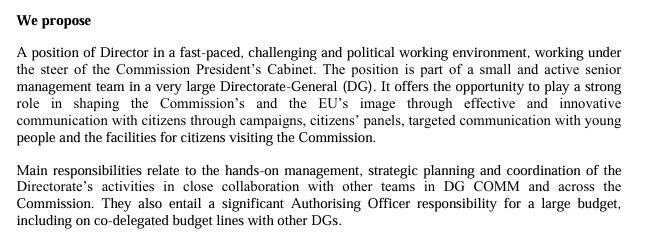
Waterschoot stepped in when previous Director for Citizens Communication Stefan de Keersmaecker was named ‘Director for Political Communication’ late last year. The differences between these two roles are blurred, with both responsible for social media campaigns, both analyzing media and public opinion, and both pushing the commission’s message (one as a ‘rapid response’ outfit, and the other organizing longer-term campaigns).
Both directors lead separate departments within the commission’s ‘Directorate-General for Communication’ (DG-COMM), and together employ around 500 people. DG-COMM has a yearly budget – excluding salaries – of €116 million, and it’s not the only communications department on the commission’s books: most of the commission’s 41 directorates-general have their own in-house spin offices too, which sometimes collaborate with the ‘citizens’ and ‘political’ bureaus of DG-COMM.
If that wasn’t complicated enough, none of these departments write von der Leyen’s speeches. That task falls to her personal speechwriter, Lorenzo Biondi, who announced his retirement on Wednesday.
Biondi is leaving the commission for a job at the Institute of International Affairs, an Italian think tank. But it’s not a straightforward move from the public to the private sector. The Institute of International Affairs’ Europe-focused work is funded almost entirely by the European Commission. There is now just an extra middleman between him and his former employer.
Queen Ursula’s court
Atop this bureaucratic superstructure, von der Leyen has consolidated her power. Her efforts go beyond appointing her loyalists to lucrative lifetime gigs: von der Leyen began the year by appointing 26 commissioners without running the list past the European Parliament first, as well as deliberately withholding budget and internal market strategy documents from member states until hours before publication, making deliberation impossible.
Former European Council President Charles Michel has described her governance as “super authoritarian.” Surrounded by a “tight-knit” and “micromanaged” circle of mostly German advisers, including Flosdorff, von der Leyen has reduced her commissioners to little more than administrators, whose opinions and criticisms rarely make it past her advisers.
Von der Leyen is “obsessed with demonstrating that she’s in charge,” and “is constantly jumping into the middle of the latest crisis, even when it’s outside her remit,” unnamed EU diplomats complained to Bloomberg in May.
Some of the commission chief’s ambitions are grand – she has pushed for the creation of an intelligence agency answering to her office, and backed a Franco-German plan to strip some of chief diplomat Kaja Kallas’ foreign policy powers. Others are more petty. On the day of US President Donald Trump’s inauguration last year, every commissioner under von der Leyen reportedly received strict instructions from Flosdorff: their own communications teams were only allowed to repost von der Leyen’s message to Trump on social media, without adding any comments of their own.
All of this is to illustrate two characteristics of the European Commission under von der Leyen. Firstly, with its jobs for life, its three-dozen communications departments, and its web of interconnected think tanks, it is a bloated organism whose reform would be a generational undertaking.
Secondly, with its unelected president controlling everything from job appointments and social media posts to foreign policy and intelligence gathering, it is an autocracy so at odds with its democratic rhetoric that it requires 43 communications offices to explain away its contradictions to the public.
10K More U.S. Troops Deploy as Trump Weighs New Iran Strikes /Suliaman Ahmed
Daniel Davis / Deep Dive – October 3, 2026
Iran’s NPT debate moves beyond parliament
After two wars, Iranian lawmakers are pressing for an NPT exit. The argument now extends to whether a bomb would deter another attack.
By Fereshteh Sadeghi | The Cradle | October 2, 2026
After two rounds of US–Israeli attacks in the space of a year, pressure is mounting on Iran’s leadership to withdraw from the Nuclear Non-Proliferation Treaty (NPT). Advocates say the treaty has failed to protect Iran’s civilian nuclear program or its scientists. Their opponents warn that withdrawal could provide Washington and Tel Aviv with a pretext for another assault. The argument now reaches well beyond the Majlis.
“A big decision in the offing” is one way to describe a motion that has sat with the Iranian parliament’s presidium for months. A group of lawmakers has now issued an open statement demanding that the Supreme National Security Council and Foreign Ministry begin the formal process of withdrawal from the NPT. They also want Tehran to end voluntary nuclear commitments beyond its treaty obligations.
The lawmakers argue that the NPT and the International Atomic Energy Agency (IAEA) have failed to safeguard Iran’s right to peaceful nuclear technology. They accuse the agency of allowing information obtained through inspections to reach Iran’s enemies, exposing nuclear facilities and scientists to attack.
Their statement follows years of dispute over the agency’s access to Iranian sites and the use of its findings by western governments. They invoke Article X of the treaty, which permits withdrawal when a state decides that extraordinary events have jeopardized its supreme interests. A withdrawal would require three months’ notice to other parties and the UN Security Council.
A motion awaiting debate
In the wake of that open statement, Isfahan lawmaker Hussein-Ali Haji-Deligani revealed he and his colleagues submitted legislation on Iran’s withdrawal from the NPT months ago, and it is up to parliament Speaker Mohammad Bagher Ghalibaf to put it to debate on the parliament floor. Heji-Delogani reiterated:
“Considering enemies’ wars against Iran on two occasions, the continuation of Iran’s membership in the NPT has no use, especially after the IAEA’s Board of Governors sent Iran’s dossier to the UN Security Council. Therefore, Iran should exit from the treaty to prevent further damage.”
Other lawmakers have turned their criticism on the parliamentary leadership. Tehran representative Kamran Ghazanfari blamed the presidium for keeping the motion off the floor, an accusation aimed principally at Ghalibaf.
Ghalibaf has aligned himself with Iranian President Masoud Pezeshkian on several questions of state policy, drawing fire from former allies among the Principlists. The NPT dispute has become another point of contention between them.
Another parliamentarian, Mohammad-Reza Sabaghian, stated:
“We must use the courage that was shown and the right strategy to close the Strait of Hormuz in the discussion of withdrawing from the NPT. This is the second step that will lead to the failure of America’s plans.”
Mohsen Sani, a member of parliament’s national security commission, went further:
“In our opinion, the NPT no longer has any meaning or significance, whether we want to stay in it or leave it. When one of the NPT member states attacks another member (Iran), it means withdrawing from all these commitments and treaties that have existed in this regard. Recent pressures suggest that we should reconsider enrichment.”
The case for staying
The call for withdrawal has met resistance within Iran’s political establishment. Tehran lawmaker Mohammad Seraj sees no benefit in leaving. Unless Iran intends to build a bomb, he argues, the step would only damage its relations with friendly states.
Khorasan, a newspaper close to Ghalibaf, has criticized lawmakers for “radicalizing the political ambiance of the country and forcing the Islamic Republic to make such a sensitive decision,” describing it as “a gift to Trump.”
The outlet maintains that “any moves towards leaving the NPT give enough justification to Trump and Netanyahu for their future strikes against Iran while it alienates friends such as China and Russia who have always supported Iran’s legitimate right to a non-military nuclear program.”
Rouydad24, a news site with strong ties with the Reformist camp, lambasted lawmakers as “radicals” who “have returned with a controversial and costly prescription.”
The Reformist news site charges that “Pezeshkian’s critics have turned withdrawing from the NPT into a political slogan without considering it is a complicated matter economically, militarily and internationally.”
Where the decision rests
The debate has become a challenge for Pezeshkian, whose government has defended Iran’s continued place in the treaty. But the president is not the only voice in the room. Mohsen Rezaei, secretary of the Supreme National Security Council, has openly raised the possibility of withdrawal.
Rezaei said, “After the United States abandoned the post-war Islamabad Memorandum of Understanding, we reached the conclusion that we must change course. We have yet to take a decision on withdrawing from the treaty, because our withdrawal totally depends on Washington’s behavior.”
The senior general admits that the Islamic Republic is still committed to the late supreme leader Ali Khamenei’s religious prohibition on the use of nuclear weapons and has not changed its nuclear doctrine; however, “nobody can guarantee the future,” he elaborates.
Is Iran seeking a nuclear weapon?
In an exclusive interview with the Republican Party’s mouthpiece, Fox News, Pezeshkian flatly denied Iran is seeking an atomic bomb, adding that his country is even willing to dilute the 440-kilogram uranium stockpile purified at 60 percent and allow the IAEA’s nuclear inspectors to supervise Iran’s nuclear program.
Pezeshkian made those claims while the Islamic Republic does not allow international inspectors to visit its nuclear facilities, which were destroyed by the US and Israel during two wars in June 2025 and February-March 2026.
Pezeshkian’s assurance contrasts with Rezaei’s warning that the country’s future course cannot be guaranteed. Reports in Tehran that Supreme Leader Mojtaba Khamenei has ruled out nuclear talks with Washington remain unconfirmed; they offer no basis for treating such a ban as settled policy.
A decision above the Majlis
Iran’s NPT membership has moved from a technical and legal question into a wider argument over deterrence after the attacks on its nuclear facilities. The parliamentary bill gives that argument a public stage, but lawmakers alone will not settle it.
The final decision would be made at the highest levels of the Islamic Republic’s political and security establishment. A vote in the Majlis could put a formal stamp on a course set elsewhere, as earlier nuclear legislation did.
The 2020 Strategic Action Law to Lift Sanctions, for example, obliged the government to expand nuclear activity and restrict inspections if sanctions relief did not materialize. It sharply constrained the Rouhani administration’s room for maneuver over the 2015 Joint Comprehensive Plan of Action (JCPOA) nuclear agreement. The precedent is relevant because a bill presented as a parliamentary initiative can become a lever for policy agreed across the state’s security institutions.
For now, proposals to leave the NPT and calls to build a bomb circulate side by side. That does not establish that either has been adopted. It does show how far positions once kept at the edges of public debate have entered the argument over Iran’s security.
Lawmaker Ahmad Bakhshayesh Ardestani has advocated building a nuclear weapon first and withdrawing from the NPT afterward, “because only in that case, it can guarantee deterrence against a renewed US-Israeli aggression.”
Even Khorasan, which warns against leaving the NPT now, does not rule out an exit. Its argument is that Iran should first build and test a nuclear weapon. Until then, it says, Tehran would bear the costs of a nuclear-armed state without possessing a nuclear deterrent.
The disagreement in Iran is no longer confined to whether the country should leave the treaty. It is also about when.
Houthis condemn Saudi claims of attack on Medina
RT | October 2, 2026
Yemen’s Houthis have denied targeting a power station in the city of Medina. A Saudi-led coalition earlier accused the militant group of targeting the facility supplying power to the Prophet’s Mosque – one of the holiest sites in the Muslim world.
A senior Houthi official branded the accusation a “lie” aimed at tarnishing the group’s image and reinforcing similar claims made by the coalition in the past.
On Thursday, the Saudi coalition’s spokesman, Major General Turki al-Maliki, accused the Yemeni militants of striking the Taibah electricity distribution station in Medina earlier this week in what he called a “cowardly terrorist act” and a part of an alleged broader campaign by the Houthis to “target the Two Holy Mosques.”
In mid-September, Saudi Arabia accused the Houthis of launching a drone towards the holy city of Mecca. The unmanned aerial vehicle was intercepted and destroyed, it added. The Yemeni movement’s leader, Abdel-Malik al-Houthi, dismissed that claim as a “heinous lie” in a televised address at the time, claiming Riyadh was “weaponizing lies” to advance its own agenda.
The developments have sparked concerns in Türkiye and Pakistan, which signed a joint defense agreement with Saudi Arabia in August. Speaking to the United Nations General Assembly last week, Pakistani Prime Minister Shehbaz Sharif called any “threat to the sanctity” of the Muslim holy cities of Mecca and Medina a “red line that must never be crossed.”
Ankara denounced this week’s alleged Medina attack. “Any attack targeting the sanctity, peace, and security of the Two Holy Mosques is an unacceptable affront directed at the shared sensitivities of the entire Islamic world,” the Turkish government spokesman, Burhanettin Duran, said on X on Friday. He vowed that Türkiye “will continue to stand by Saudi Arabia.”
The developments come amid the continued escalation between the Houthis and the Saudi-led coalition. Riyadh has backed Yemen’s internationally recognized government against the Houthis since intervening in the country’s civil war in 2015.
Large-scale fighting largely subsided after a UN-brokered truce in 2022, but the conflict erupted again this summer after an airport in the Houthi-controlled Yemeni capital of Sanaa was bombed to prevent a returning Houthi delegation that had flown to Iran from landing.
Fatuous False Flags
By Craig Murray | October 2, 2026
Rather than abandoning the plainly nuts Fairford narrative, Burnham and his government are doubling down on the claim it is an Iranian terror plot.
It remains quite possible the men were indeed fuel thieves, simply stealing fuel from farms. They appear to have been equipped for fuel theft and all they were carrying was petrol. It is worth a footnote that there is a very real history of US military personnel, and indeed British personnel, selling military fuel from bases. Stolen red diesel meant for HMS Bulwark fuelled fairground rides throughout England, which I think is rather lovely. But if the Fairford Five were fuel thieves, farms are more probable as the target.
We should pause here to acknowledge that USAF Fairford is falsely designated RAF Fairford, itself a propaganda lie, just like “RAF Lakenheath” or “RAF Mildenhall”. The UK is full of US military bases, on which US law applies. (My birth certificate gives my father’s occupation as “Clerk USAF”. He was employed at Mildenhall at the time).
It is a classic example of state propaganda that the petrol discovered in the Fairford vans was described by counter terror police as a potential accelerant for a bomb.
Well yes, petrol is that. It has however, rather more obvious uses too. The same technique was used at the height of the War on Terror propaganda in the Great Easter Bomb Plot, that never was. Police rounded up and arrested many young Muslims across the Manchester region, which was front-page news. They were all later released without charge.
But at the time of arrest the police announced they had found a potential bomb-making ingredient in a kitchen.
Well, they had. It was a bag of sugar. Sugar is indeed a potential bomb-making ingredient. Yet most of us have a bag in the kitchen. At least it did not take the police ten days to find the bag of sugar in the kitchen, unlike when they searched Charlie Rowley’s flat for a vial of novichok, and it took them ten days to “find” a bottle of perfume sitting on the kitchen counter.
For Fairford, on balance I think a false flag gone wrong is a little more likely than just fuel thieves. We know the men had no bombs and no guns, which makes the terrorist narrative rather hard for the government to sustain. But if they were patsies set up in a false flag, there would be plenty of things already on the base that go bang which could have been used to create the “terrorist incident” around them.
Two key points make me think this was a false flag. Firstly the lady farmer who called 999 was adamant there were more men that the five arrested and bailed. The others would have been the spycops – agents provocateurs – who would have been quietly spirited away from the scene. That also fits with the released information that it was one of the men who phoned in a warning about the “attack”.
It looks to me like a false flag spectacular had been planned, with US involvement as claimed by Trump and possibly Israeli knowledge as claimed by Netanyahu. This operation by the security services was viewed as over the pay grade of local police (who might be inconveniently honest) who were not in the picture. It all went horribly wrong for the government when an alert local farmer called the local police, and when a participant also called it in. That could have been one of the recruited “terrorists” who got cold feet, or one of the agents panicked they had lost contact with their line of command.
The use of recruited patsies to carry out false flags is now better understood. I have been writing about it since before the Newburgh bomb plot which was a particularly egregious example. In the United States there has been more awareness of and reaction to agent provocateur incited plots than in the UK.
For anyone sceptical, here is a summary of Newburgh:
In May 2009 the FBI arrested four poor men from Newburgh, New York, and announced it had foiled a plot to bomb two synagogues in the Bronx and shoot down military planes at Stewart Air National Guard base. The plot, the targets, the inert bombs and the disabled Stinger missile were all supplied by the Bureau. The recruiter was Shahed Hussain, a Pakistani fraudster who had become an informant to avoid deportation after a driving-licence scam. Paid nearly $100,000, he spent more than a year fishing at a Newburgh mosque, posing as a wealthy Jaish-e-Mohammed agent, before latching onto James Cromitie, a Walmart stocker and petty drug dealer.
Hussain offered heavenly reward and as much as $250,000. Cromitie brought in three others: Onta Williams, David Williams and Laguerre Payen. Hussain drove them across a state line to inspect the fake weapons, which federalised the charges and carried a 25-year minimum. They were convicted in 2010.
The sentencing judge, Colleen McMahon, said she believed beyond a shadow of a doubt that there would have been no crime except that the government instigated it, planned it and brought it to fruition. In 2023 she ordered the release of three of them, calling it an FBI-orchestrated conspiracy and writing that the real lead conspirator was the United States. She freed Cromitie in 2024 on the same basis, describing him as a small-time grifter with no history of violence and Hussain as a villain who had lured him with promises of both heavenly and earthly rewards.
The Golders Green ambulances arson was a classic of this false flag genre. Four young Muslims were recruited, in this case online rather than in person, by someone they never saw who was almost certainly a Mossad agent. They were offered money to attack the ambulances, which they did. The attack is then blamed on Iran through a claim on a Telegram channel on behalf of an “Iranian organisation”, Harakat Ashab al-Yamin al-Islamia, which is a Mossad fabrication.
HAYI first became known to the world through simultaneous press releases on 16 March by five Israeli government outlets in Israel, US and UK (including BICOM) and an article by the Israeli front “Foundation for Defending Democracy”. The FDD’s Nick Stewart travels with Kushner and Witkoff as part of the US negotiating team on the Middle East.
There are numerous reasons for doubting the real existence of HAYI. None of its material is in Farsi. All of its “attacks” have been minor arson attacks on pointless targets that hurt nobody. The grammar, calligraphy and imagery of its materials are all wrong.
The UK state itself has now debunked some of the Mossad HAYI narrative. On 29 April, when Essa Suleiman stabbed three men, the entire media blocked out the first Muslim victim and claimed an antisemitic terrorist attack on the two in Golders Green. The HAYI Mossad run “Iranian” Telegram channel immediately put out a statement claiming responsibility for the attack. But yesterday police and prosecution were forced to drop the claim it was a terrorist attack at all. The stabbing of the Muslim is charged as attempted murder, though still ignored by the media. So “HAYI” claimed responsibility for a non-existent terrorist incident.
A false flag can be, but is not necessarily, the state planting a bomb and then blaming someone else. It can be more complex – the state recruiting people to plant bombs. Those people may believe they are genuinely part of an ideological campaign, or may just be doing it for money.
The opaque Starmer rent-boy arson plot, in which Ukrainian male models burnt property associated with Keir Starmer, remains unclear, largely because any discussion of what lay behind the attacks was banned by the judge in the trial. But the media, with government encouragement, continually relays the story that the arsonists were recruited online by a man known as “El Money”. An interesting twist here is that the media constantly refer to him as Russian-speaking. But the evidence in court is that he spoke both Russian and Ukrainian.
Almost all adult Ukrainians can speak Russian. The number of Russians who speak Ukrainian is very small. Yet El Money is now routinely portrayed as Russian.
Which brings us to the whole question of Russian “hybrid attacks”, where we are asked to believe the narrative of the security services of states whose leaders are openly promoting war with Russia, about desultory and mysterious attacks. The rather sorry Leipzig drone is a good example. We have a more recent claim of Russian arson from Estonia, a state which has instituted massive discrimination against the 29% of its population who speak Russian.
Not only has Estonia closed Russian schools, libraries, theatres, churches, cinemas and university courses, it even refuses passports to people born and bred in Estonia, whose parents were born and bred in Estonia, if they cannot speak Estonian. That is totally contrary to numerous UN, Council of Europe and OSCE instruments on protection of minority linguistic rights.
It is one thing to insist on language qualification for citizenship for new immigrants. Many countries do. It is quite another thing to deny citizenship to a native linguistic minority. Estonia was part of Russia from 1721 to 1919 and of the Soviet Union from 1941 to 1991. It has Russian speakers.
So I decline to believe the Estonian government on Russian “hybrid attacks”.
Which brings us to the amazing “FlyDubai” hijacking and the heroic plumber who knew how to rescue a plane from a death dive because he watched Air Crash Investigation.
There are real problems with this narrative. One is that the plane is said to have dived approximately 15,000 feet in about 30 seconds. This is said to be confirmed by independent flight trackers.
The force was so enormous that the rudder ripped off the plane.
Picture a dive of 500 feet – that is more than a 40 storey building – per second. Picture that. 500 feet in a second. Imagine yourself falling that fast. The forces would be enormous inside the cabin. Anybody not strapped in would be lifted right out of their seats and probably hit the ceiling. Many would be injured. Any unfastened object, including major ones like food trollies, would be hurled about with great force. Baggage lockers would come unlocked as the weight of the bags inside was hurled up. Remember this dive ripped the rudder off. It would be impossible for anyone not strapped into their chair to keep their footing or seat.
We have a great many videos from on board the plane but nothing like this is shown. No video shows this kind of extreme situation, and the cabin at the end of the flight is remarkably undisturbed.
There is also a problem with that flight-tracking data. As pointed out by this commercial pilot on CNN, a plane can’t easily slow down in mid-air. He is disbelieving of how quickly the flight trackers show the plane returning to normal speed. He is also deeply sceptical of the ability to control the plane after the rudder came off due to loss of hydraulic fluid, and of the chances of the airframe staying together. Now compare that to the lack of cabin tumult.
I have seen it argued that if you entered the dive very gently and carefully without sudden change of pitch, and exited it similarly smoothly, then you would avoid extreme G-forces and the cabin might be relatively undisturbed. Even if so, it is hard to imagine the kind of smooth transition into the dive in the circumstances we are told were occurring in the cockpit, with the co-pilot deliberately putting the plane in a death dive while fighting with the pilot.

The smooth transition out of the dive in the official story was achieved by a plumber who knew what to do from watching Air Crash Investigation. I don’t think I need to comment on that.
We will never find out the truth about FlyDubai. The plane diverted to Saudi Arabia. The copilot who is being painted as an Islamic extremist will be isolated there and tortured by the Saudis. Netanyahu has already said Israel will join the interrogation. Do not believe any confession or evidence from the co-pilot.
The plane was a Boeing, so the USA will join the initial investigation alongside UAE, Saudi Arabia and Israel. A more potent coalition of Zionist evil does not exist. We will certainly have faked flight data recorder and cockpit voice recorder evidence coming from that shower.
I do feel something has snapped in people’s willingness to believe official narratives. The Skripal narrative was even more crazy than any of these, but most people still trusted government. Thankfully that faith has been seriously shaken.
Are Europe’s Smallest Nations Dragging the Continent into War?
By Urs Maurer-Lambrou | Forum Geopolitica | October 1, 2026
Six million people. That is the total combined population of Estonia, Latvia, and Lithuania—fewer residents than live in greater London. Yet these three border states now set the tone of foreign policy for a union of 450 million, telling Berlin, Rome, and Madrid how dangerous the world is and how much Western taxpayers must pay to fix it.
One Crown to Another
The Baltic national story likes to skip 1721, which is a shame, because it’s where the modern map starts. That year Peter the Great finished the Great Northern War with the Treaty of Nystad. Sweden handed over Estonia, Livonia, Ingria and part of Karelia; Russia evacuated most of Finland and paid Sweden two million silver thalers. Historians still argue about what the money was for. Western reference works tend to call it compensation, while the Russian Presidential Library’s account says flatly that Russia paid it for the acquisitions. Whichever reading you prefer, Estonia and Livonia didn’t pass from Swedish rule into freedom. They passed from one crown to another. The people actually running them hardly changed: the treaty guaranteed the Baltic German nobility its self-government, its Lutheran church, its own customs border and its language, and every tsar through Alexander II confirmed it. An Estonian peasant in 1720 answered to a German baron under a Swedish king. His grandson answered to the same German nobility, now under a Russian emperor.
Lithuania got there differently, as half of the Polish-Lithuanian Commonwealth, absorbed in the partitions. Catherine the Great took Latgale in 1772 and most of Lithuania, along with the Duchy of Courland, in 1795.
The point isn’t the borders; plenty of European states are young. The point is the story. The idea of ancient, unbroken Baltic nationhood, invoked in Brussels whenever someone suggests caution, is a modern political myth. Independent statehood lasted about twenty years between the wars. The current stretch began in 1990–91.
Not One Inch
The next chapter opens in Moscow on 9 February 1990. The Berlin Wall had been down for three months. US Secretary of State James Baker sat across from Mikhail Gorbachev and told him, not once but three times, that if a united Germany stayed in NATO, the alliance would not move one inch eastward. Helmut Kohl said much the same the next day. It wasn’t a slip of the tongue. Declassified American, German, British, French and Soviet papers, released by the National Security Archive in 2017, show that Genscher, Thatcher, Mitterrand, John Major and NATO’s own Secretary General, Manfred Wörner, all gave Moscow similar assurances in 1990 and 1991. None of it went into a treaty.
That turned out to be very convenient. In 1990 NATO had 16 members. In 1999 it took in Poland, Hungary and the Czech Republic. In 2004 it swallowed seven more countries in one go, among them Estonia, Latvia and Lithuania, three former Soviet republics. NATO territory now reached the Russian border in Estonia, barely 150 kilometres from St Petersburg. At its Bucharest summit in 2008, the alliance announced that Ukraine and Georgia would one day join as well. Finland and Sweden followed after 2022. Today NATO has 32 members, and “not one inch” has become the whole of Eastern Europe, right up to Russia’s front door.
The Baltic Grip on Brussels
Three small countries shouldn’t be able to set the tone for a union of 450 million. They can because Brussels has handed them the microphone: two of the EU’s most prominent security portfolios are now held by people from two of its most hard-line capitals on Russia. Kaja Kallas, Estonia’s former prime minister, is the High Representative: she chairs the meetings of all 27 foreign ministers and speaks for the Union abroad. Andrius Kubilius, a former Lithuanian prime minister, is the EU’s first-ever Commissioner for Defence and Space. No voter anywhere in Europe chose either of them for those jobs.
Kallas comes from a family that has always been close to power, whoever held it. Her father went from Communist Party official in Soviet Estonia to Reform Party founder to EU Commissioner: what Germans call a “Wendehals”, a turncoat. In May 2024, weeks before her nomination, she said a Russian defeat would not be a bad thing and remarked that Russia is made up of many nations. Germany’s Volksstimme read it as floating Russia’s break-up, an odd thing for Europe’s next top diplomat to muse about a nuclear power. Over both of them sits Ursula von der Leyen, whom EU leaders produced at the last minute in 2019 and Parliament confirmed with 383 votes, nine more than she needed. She arrived from the German defence ministry, where she’d left behind a Bundeswehr failing its readiness targets and a parliamentary inquiry into consultancy contracts.
Barking on Command
It would flatter the Baltic governments to think they run the show. They don’t. They bark because it suits the people holding the leash. In Brussels, home to the headquarters of both the EU and NATO, the big capitals write the policies. The Baltic capitals enforce them at the border, say the things Berlin and Paris would rather not say out loud, and take the first swing. That is why the EU’s diplomatic megaphone went to Tallinn and its defence portfolio to Vilnius. Nobody appointed Kallas and Kubilius to calm things down.
Kaliningrad in 2022 showed how it works. Brussels drew up sanctions on Russian steel; Lithuania enforced them to the letter and halted rail shipments to the exclave in June. Moscow called it a blockade, and Nikolai Patrushev, then head of Russia’s Security Council, warned that Lithuanians would feel the consequences. Within a month the Commission issued new guidance letting the goods through again. Vilnius had done exactly what it was told, and was left standing alone in front of Moscow while Brussels quietly backed away.
Three years later it was Estonia’s turn. Brussels had spent months announcing crackdowns on Russia’s “shadow fleet” of ageing, poorly insured tankers. On 13 May 2025 the Estonian navy tried to stop one of them, the Jaguar, in international waters off Tallinn. The crew ignored the orders and sailed on to the Russian port of Primorsk. Estonia said a Russian Su-35 then entered its airspace for about a minute with its transponder off, and NATO scrambled a fighter to meet it: a Portuguese F-16, from a country 3,000 kilometres away. Nobody fired, this time.
Meanwhile the big dogs are being moved into position behind the small ones. In 2023 Berlin pledged a full armoured brigade for Lithuania, about 4,800 soldiers, at a new base at Rūdninkai near the Belarusian border. It formally began operating in 2025 and is due at full strength by 2027. It is the first permanent deployment of German troops abroad since the Second World War.
European Values, Baltic Edition
After 1991, Latvia and Estonia gave automatic citizenship only to pre-1940 citizens and their descendants. Hundreds of thousands of Soviet-era residents, most of them Russian speakers and many born in the country, became “non-citizens” with alien passports and no vote in national elections. Riga insists that “non-citizen” is a legal status, not an ethnic label, yet about two-thirds of Latvia’s non-citizens are ethnic Russians. UN and OSCE bodies criticized the system for years. At the start of 2026, non-citizens were still 8.7% of Latvia’s population, by the Latvian government’s own figures.
It has got tighter since 2022, not looser. Schools in Latvia have moved to Latvian-only teaching and Estonia’s are following. Latvia told Russian citizens with permanent residence, many of whom had lived there for decades, to pass a basic Latvian test or risk losing that status. And on 26 March 2025 Estonia’s parliament voted 93 to 7 to amend the constitution so that only Estonian and EU citizens can vote in local elections. On paper it covers all non-EU nationals. In practice it was aimed at about 80,000 Russian citizens, plus Belarusians, and everyone knew it. Stateless “grey passport” holders were given one last local election, in October 2025, before losing their vote as well.
It’s hard to take a lecture on European values from governments that treat their own long-term residents this way.
Who Pays the Bill
Vilnius loves to talk in percentages, because percentages flatter small countries. Lithuania pledged 5% of GDP for defense in 2026 before Donald Trump had even made his 5% demand in January 2025, and its 2026 budget comes in at 5.38%. In May 2025 the three Baltic defence ministers told every ally to match it. In June, at The Hague, NATO made 5% its target for 2035.
Forget the percentages. Look at the money. Lithuania’s entire 2026 defense budget is €4.79 billion. At 5% of its economy, Germany would be spending more than €200 billion a year, over forty times as much. Even the core 3.5%, before the extra 1.5% for infrastructure and other defence-related spending, would come to around €150 billion. For Italy the full target would mean more than €100 billion a year, for Spain around €80 billion, and both are already carrying some of the heaviest public debt in Europe. The Baltic states set the bar; the big economies get the bill.
Spain, at least, had the nerve to say no. Pedro Sánchez called the 5% target “unreasonable,” refused to sign up to it, and left The Hague with an exemption: 2.1% of GDP and not a cent more. Trump called Spain “a very low payer.”
Nobody Asked the Voters
Were Western Europeans ever asked if they wanted this? Only by pollsters. In 2015 Pew found 58% of Germans, 53% of French and 51% of Italians against using military force to defend a NATO ally attacked by Russia. In a survey Pew published in 2020, majorities in Germany, Italy and Spain still said no. Support for the EU paying for weapons for Ukraine has slid nine points, from 65% in early 2023 to 56% this spring. In France, backing for arms deliveries dropped 18 points, from 65% in March 2022 to 47% this February. By late 2024, YouGov found a negotiated peace between Ukraine and Russia preferred over fighting on by 55% of Italians, 45% of Germans and 43% of the French. A Politico poll last December found French and German adults leaning toward scaling support back. And this summer, majorities in Germany and France said no to Ukraine joining the EU as a full member.
That isn’t Germany, France, Italy or Spain itching for a wider war. It’s a public that was never asked, has grown more sceptical every year since 2022, and is now being handed a bill it never ordered: a target worth more than €200 billion a year in Germany alone, cheered on from Vilnius and signed off in Brussels by officials no voter chose.
When the Money Runs Out
The Hague deal has a review built in for 2029. My prediction: by then, Spain won’t be the only country saying no. The money ran out years ago; what’s being spent now is borrowed. Germany even rewrote its constitution in 2025 so it could borrow for defence outside its own debt brake.
In 1721 Peter the Great settled the Baltic’s fate with a treaty and two million silver thalers. Three centuries later, the region’s future is still being decided by bigger powers doing the sums.
So, are Europe’s smallest nations dragging the continent into war? Not on their own. They do the barking; Brussels holds the leash. And Berlin, Rome and Madrid are being dragged along behind, towards a confrontation their voters never chose, paid for with money they no longer have.
Maybe that is the one hopeful part. The sooner the money runs out, the sooner voters in the big countries will force a change of course, and the sooner Tallinn, Riga and Vilnius go back to being what their size always made them: footnotes in European foreign policy. That may be what finally keeps Europe out of a direct war between nuclear powers.
Featured Video
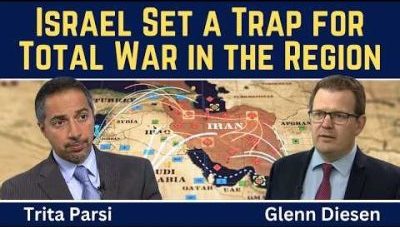
Trita Parsi: Israel Set a Trap for Total War in the Region
or go to
Aletho News Archives – Video-Images
From the Archive
Zionism’s Violent Legacy
By Donald Neff | Washington Report On Middle East Affairs | January 1996
On January 4, 1948, Jewish terrorists drove a truck loaded with explosives into the center of the all Arab city of Jaffa and detonated it, killing 26 and wounding around 100 Palestinian men, women and children.[1] The attack was the work of the Irgun Zvai Leumi – the “National Military Organization,” also known by the Hebrew letters Etzel – the largest Jewish terrorist group in Palestine. The Irgun was headed by Revisionist Zionist Menachem Begin and had been killing and maiming Arabs, Britons and even Jews for the previous ten years in its efforts to establish a Jewish state.
This terror campaign meant that at the core of Revisionist Zionism there existed a philosophical embrace of violence. … continue
Blog Roll
 Aletho News
- Trita Parsi: Israel Set a Trap for Total War in the Region
- Trump’s Iran war is on an Israeli leash
- Saudi oil boss issues global supply warning
- Riyadh Says Its Oil System Is Intact. The Numbers Say Otherwise.
- Trump and Netanyahu Want to “Finish the Job” on Iran
- US ‘one-sided dictation’ not Iran’s beliefs makes rational talks impossible: Baghaei
- Iran’s Next Strike May Not Explode. It Could Shut You Down /Col Doug Macgregor
- Iran: US political targets legitimate if assassinations return
- Iraq shuts key border crossing with Iran under US pressure: Report
- Undersea Internet cables could be targeted in retaliation for attacks on Iran: IRGC deputy chief
- If Americans Knew
- The Israel Lobby’s Changing Fortunes
- AIPAC has become such a political liability that it’s shifting to a more “nimble” approach to buying politicians
- At least 160 Israeli settler attacks in 2 weeks
- Will Gaza’s Ancient Christian Community Disappear Forever?
- Israel’s vision of regional security rests on keeping Arab states weak
- Heidi Levine recounts how Palestinian youths helped save her in settler attack
- DAILY UPDATE: Latest essential news on Palestine, Israel, & region
- Trump’s Intensifying Sabotage of the ICC, for Israel’s Sake
- Israeli military detain US and UK volunteers in West Bank including Democratic NY politician Brad Lander
- Americans at National Conservatism Conference held in Israel this year criticize Israel
- No Tricks Zone
- E-Cars Reduce CO2 Emissions By Only 41% Compared To Internal Combustion Engine Vehicles
- Predictions Made By Renowned Climate Professor Over Past Decades Have Been Proven To Be Poor
- New Study Suggests Large Regions Of The Pacific Ocean Have Been Cooling For The Last 80 Years
- Germany’s Green Energy Debacle: High Energy Costs Force Kahla Porzellan to Close After 182 Years!
- New Study: 50 Years Of The Most Aggressive ‘Net Zero’ Policies Can Only Affect The Global Climate By 0.03°C
- US September “Heat” Was No Record…Many Records Set Decades Ago
- Latest European Green Energy Debacle; Portugal’s Largest Flagship Solar Park Insolvent!
- Green Energy Debacle: German Expert Professor Fritz Vahrenholt Warns Of Severe Economic And Social Consequences
- Two More Paleo Reconstructions Affirm Meters-Higher Sea Levels Across Ireland, Brazil 7000-6000 Years Ago
- New Study: Earth And Venus Surface Warmth Largely Explained By Convection And Lapse Rate, Not CO2 Or Radiation

