Arab states call for withdrawal of foreign forces from Syria
RT | May 1, 2023
The government in Damascus should re-establish the rule of law on all of Syria’s territory, ending the presence of foreign armed groups and terrorists, the foreign ministers of Syria, Saudi Arabia, Jordan, Egypt, and Iraq said on Monday after meeting in Amman.
Jordan hosted the meeting, the first of its kind since Syria’s membership in the Arab League was suspended in 2011. Prior to the multilateral meeting, Syrian Foreign Minister Faisal Mekdad met with his Jordanian counterpart Ayman Safadi to discuss refugees, border security and “water issues,” according to Amman.
In a joint statement distributed by state news agencies, the five ministers called for “ending the presence of terrorist organizations” as well as “armed groups” on the territory of Syria, and “neutralizing their ability to threaten regional and international security.” They also pledged to “support Syria and its institutions to establish control over all of its territory and impose the rule of law.”
Saudi Arabia, Egypt, Jordan and Iraq pledged to establish ties with the Syrian military and security institutions in order to “address security challenges.” The five ministers also called for stopping “foreign interference in Syrian domestic affairs.” Their joint declaration also called for setting up technical teams of experts that would follow up on the summit and implement practical measures to resolve the conflict in Syria.
The Amman meeting comes just weeks after Mekdad visited Saudi Arabia and received the kingdom’s endorsement for Syria’s territorial integrity. Currently, Turkish-backed militants control parts of northern Syria, while the northeast is under the control of US-backed Kurdish militias. Several hundred US soldiers are also in Syria, controlling most of the country’s oil wells.
MIlitants backed by Saudi Arabia and the US launched an uprising against Syrian President Bashar Assad in 2011. With the help of Russia and Iran, the government in Damascus eventually prevailed over the collection of rebels, including terrorists affiliated with Al-Qaeda and Islamic State (IS, formerly ISIS). While Syria’s neighbors and regional powers have moved to improve relations with Damascus in recent months, the US has not changed its “regime change” policy.
What the China Literature Gets Wrong
By Joseph Solis-Mullen | The Libertarian Institute | May 1, 2023
For more than a decade it’s become expected for books peddling the “China threat” to pop up as best sellers. From Martin Jacques’ When China Rules the World (2009) to Michael Pillsbury’s The Hundred-Year Marathon (2015), the best response has been to just shrug and move on. Talk in serious policy circles and major media were still primarily focused on Beijing’s integration into the “liberal world order” as a “responsible stakeholder,” and of the gains in trade made (and still to be made) in exchange between the United States and China.
The transformation of China from global partner to enemy number one seemed to happen, in Hemingway’s words, gradually, then suddenly. Indeed, despite Donald Trump’s early bellicosity when it came to China, the corporate press didn’t immediately play along with the China threat narrative. Rather, they proclaimed the folly of his trade war and seemed to revel in reporting the losses it was inflicting on American farmers, whose exports to China had been interrupted as a result of retaliatory tariffs.
But in the background the slow, ominous drip of the China threat narrative continued with Graham Allison’s Destined For War (2017). Then, in quick succession, Stealth War: How China Took Over While America’s Elite Slept (2019) by Robert Spalding, Deceiving the Sky: Inside Communist China’s Drive for Global Supremacy (2019) by Bill Gertz, Unrestricted Warfare: China’s Master Plan to Destroy America (2020) by Qiao Liang, Has China Won? (2020) by Kishore Mahbubani, The Long Game: China’s Strategy to Displace American Order (2021) by Rush Doshi, The World According to China (2021) by Elizabeth Economy, War Without Rules: China’s Playbook for Global Domination (2022) by Robert Spalding, No Limits; the Inside Story of China’s War with the West (2022) by Andrew Small, and Red Carpet: Hollywood, China, and the Global Battle for Cultural Supremacy (2022) by Erich Schwartzel.
It was as though even before the COVID pandemic—which exacerbated already strained relations between the United States and China—the movement was underway to translate for the public the policies pursued through multiple U.S. administrations aimed at containing China. It suddenly became normal to pick up one of the so-called “papers of record,” corporate media giants like The Wall Street Journal, The New York Times, or Washinton Post and encounter a headline about China presented as ominous or threatening. Indeed, by the time Hal Brands and Michael Beckley’s Danger Zone: The Coming Conflict With China (2022) hit bookshelves last August, entire opinion pages of the major papers sounded like talking points from the 2017 U.S. National Security Strategy (NSS), the 2018 U.S. National Defense Strategy (NDS), or the 2018 special report from the U.S. Trade Representative (USTR) which all painted China as a direct threat to vital U.S. interests, and one that needed to be vigorously countered and contained militarily, geopolitically, economically, ideologically, and technologically.
While many of the books mentioned above are written in the breathless, alarmed manner of their earliest forerunner, the eponymous China Threat (2000) by Bill Gertz, there have been some notable exceptions which have sought and obtained some measure of balance even when they could not completely escape the China threat paradigm. Kevin Rudd’s The Avoidable War (2022) and James Fok’s Financial Cold War (2021) both do a reasonable job presenting the facts, perspectives of both Washington and Beijing on key issues, and have as their aim deescalating the growing crisis that is the present state and trajectory of U.S.-China relations.
Tellingly, outright dissenters, those that questioned any part of the ascendent China narrative, were few. Red Flags: Why Xi’s China Is In Jeopardy (2018) by George Magnus and Thomas Orlik’s China: The Bubble That Never Pops (2020) both deserve credit for seeing through to the true mess that is China’s economy. Though their critiques of the China threat narrative are incomplete, and scarcely touch on the demographic, environmental, and geostrategic mountains confronting Beijing, China’s economy is central to everything else (the one-party CCP dictatorship included) and an expansion of their critiques is all one needs to cast the prospect of a future “Chinese Century” into serious doubt.
And it is here that a point needs to be clearly parsed. There is a significant difference between China ruling the world in a manner like the United States has for the past three decades, and Beijing enjoying preponderance in its immediate environs and proportional heft for its relative weight where its interests are concerned around the globe. For while it is increasingly unlikely that China’s economy will ever surpass that of the United States—either in total or per capita output—or that it will ever have the military reach enjoyed by Washington, Beijing has grown powerful enough relatively that it can assert and more or less get what it wants in its immediate environs. Trivial, obvious, or realistic though that may seem to the objective observer, to Washington this fact constitutes the whole of the China threat. The existence of an independent China (or Russia, for that matter) is a threat to Washington’s accustomed ability to do more or less whatever it wants wherever it wants. However, the existence of an independent China is already a fact and continued refusal on the part of Washington to accept it will cause more than theoretical problems.
I did not imagine or intend, when I started graduate school several years ago, that any serious amount of my time would be spent reading Chinese history, learning Mandarin, or studying the specifics of the Maoist interpretation of the Marxist dialectic. As a political scientist, economist, and historian with an interest in the emergence of different political and economic structures in Europe from the fourteenth to the nineteenth century, my initial diversion into Sino-American relations, both past and present, came as something of an annoyance.
Writing at the Mises Institute, I’ve done my best to push back against this fake China threat narrative. It’s become clear, however, that a more comprehensive case needs to be made against the ludicrous idea that China is on the cusp of taking over the world. Alas, public fear has been continually stoked and the China threat narrative is worse than ever—hence, The (fake) China Threat (and its very real danger) has taken on book-length form and will be published by the Libertarian Institute in 2023. In the meantime, I will do my bi-weekly best to pour cold water on whatever the latest hawkish nonsense from DC towards China happens to be, as well as inform and contextualize for readers what is going on in China and the wider Indo-Pacific. While I cannot promise readers will always like what I have to say, with no conflicts of interest to declare they can at least be rest assured that I have no reason whatsoever to lie to them—which is (tragically) more than can be said for practically anyone anywhere else.
Joseph Solis-Mullen is a political scientist with degrees from Spring Arbor University and the University of Illinois, and is currently a graduate student in the economics department at the University of Missouri. An independent researcher and journalist, his work can be found at the Ludwig Von Mises Institute, Eurasian Review, Libertarian Institute, Journal of the American Revolution, Antiwar.com, and the Journal of Libertarian Studies. You can contact him through his website http://www.jsmwritings.com or find him on Twitter @solis_mullen
The US Is Rounding Up Allies Ahead Of A Possible War With China
BY ANDREW KORYBKO | MAY 1, 2023
The US is shaping the Asia-Pacific in preparation of a conventional conflict with China, to which end it unveiled the AUKUS alliance in late 2021. This platform is intended to form the core of a NATO-like military structure for containing the People’s Republic, and it’ll replace whatever related role American policymakers initially envisaged the Quad playing. This makes AUKUS extremely dangerous, especially as other regional countries tacitly expand their cooperation with its American leader.
South Korea’s recent decision to let US nuclear-armed submarines dock at its ports for the first time in decades, which was made during President Yoon’s trip to DC last week, signals its interest in de facto integrating into this anti-Chinese bloc. Nearby Japan can already be regarded as an informal member of that alliance after Prime Minister Kishida reaffirmed his country’s commitment to the US’ regional goals in January and implied that it’ll rapidly remilitarize in the coming future in order to contain China.
Taken together and paired with the recent Japanese-Korean rapprochement, it can therefore be concluded that the US has strengthened its alliance network in Northeast Asia in order to facilitate the region’s unofficial integration into AUKUS+. At the same time, it’s also doing something similar with the Philippines in Southeast Asia, whose president visits the US this week. He’s expected to also de facto integrate his country into AUKUS+ too exactly as his South Korean counterpart just did.
The Philippines’ northernmost core island of Luzon is much closer to Taiwan than the Japanese Home Islands are, thus making it an ideal staging post for any American military intervention in that Chinese province. Although President Marcos just denied that his country intends to facilitate anyone’s regional military plans, it was recently revealed that the four new bases that he agreed to let America use are located on that island, thus casting serious doubts on the sincerity of his claim.
Three other recent developments bode ill for peace in this part of Asia. CNN published a lengthy analysis in mid-April arguing that the US should maximally stockpile weapons in Taiwan in order to help its ally’s forces survive in the event that China blockades the island prior to launching a special operation there. Curiously, such resupply challenges were then confirmed a few days later during an anti-Chinese congressional committee’s wargame of precisely that scenario.
The second development concerned top EU diplomat Borrell’s suggestion that the bloc’s navies patrol the Taiwan Strait. This came just several weeks after NATO Secretary-General Stoltenberg declared that “We are now stepping up our cooperation with our partners in the Indo-Pacific: Japan, South Korea, New Zealand and Australia.” The indisputable trend is that the US’ European partners are poised to play a larger military role in the region, including a provocative one if they end up patrolling the Taiwan Strait.
And lastly, it was reported last weekend that US special forces carried out their first-ever drills simulating what they’d do if their country went to war with China over Taiwan, thus removing any so-called “strategic ambiguity” about how Washington would respond to that scenario. It can no longer claim any pretense to neutrality after literally preparing its most highly trained forces for infiltrating into Taiwan to kill whatever Chinese forces might eventually enter that island.
These three developments prove that the US is rounding up allies in both the Asia-Pacific and Europe ahead of a possible war with China, but there are two important players that either won’t participate in this plot or have yet to decide, with these being India and Indonesia respectively. The influential Council on Foreign Relations’ official magazine just published a piece about why India won’t get involved, while Indonesia is being pressured to allow American and Australian forces to transit through its territory.
Even without those two, the US’ emerging anti-Chinese containment coalition is still very formidable and represents its success in getting a multitude of countries to converge around AUKUS. South Korea will serve as an intelligence and missile outpost, Japan’s Ryukyu Islands and the Philippines’ Luzon are complementary staging points for facilitating a US intervention in Taiwan, and NATO will provide back-end support all across the region as well as possibly provoke China by patrolling the Taiwan Strait.
Amidst the solidification of the Asia-Pacific’s NATO-like military structure, the US and its allies will likely fill Taiwan to the brim with weapons exactly as CNN suggested and an anti-Chinese congressional committee curiously confirmed should be a top priority just a couple days later. These interconnected trends represent extremely pressing challenges for China’s objective national security interests, which are being threatened ever more by the day as it holds off on launching a special operation in Taiwan.
There are justifiable reasons for China’s stance, especially since its leadership would truly prefer to peacefully reunify with their country’s wayward region and thus want to completely exhaust all related possibilities before resorting to military means. This moral approach is predicated on their reluctance to be the first to initiate what would be a fratricidal conflict, which is commendable, but it comes at the expense of military interests in the event that a war over that island is inevitable.
No one knows whether it is or not, but the US is doing its utmost to be in the best position possible should that scenario unfold, which thus complicates China’s own position in that event. If the US feels that it’s obtained a decisive edge over China through the crystallization of AUKUS+ and upon maximally stockpiling weapons in Taiwan, then it might even seek to provoke a conflict that wargamers convinced themselves Beijing would lose, which is a frightening scenario that can’t be ruled out.
Saudi Arabia seeks dialogue with Hezbollah
The Cradle | May 1, 2023
Lebanese daily Al-Akhbar released a report on 29 April claiming that Saudi Arabia is seeking to establish a line of dialogue with Lebanese resistance group Hezbollah, coming in the aftermath of Riyadh’s reconciliation with Iran and Syria and following years of non-existent relations between the two sides.
According to Al-Akhbar, information provided by an unnamed Saudi official “reached Lebanese officials from a European capital,” which reveals that the kingdom hopes to open dialogue with Hezbollah “soon.”
The newspaper vaguely cites “unofficial sources in Beirut” as saying that the dialogue would “be conducted through a third party.”
“Whether the endeavor succeeds or fails, it reflects the new phase in which Riyadh is rearranging regional relationships on the path of asserting its Arab leadership,” Al-Akhbar writes, referring to Saudi Arabia’s newfound shift in policy as “unprecedented.”
Saudi Arabia has recently distanced itself from Washington significantly – economically and politically.
A Chinese-brokered reconciliation of Saudi-Iranian ties has been followed by the kingdom’s openness to reestablish ties with the Syrian government, as well as Hamas – with whom longstanding tension also exists.
This has resulted in significant Israeli frustration, and Hebrew media has referred to it as a blow to potential normalization with Riyadh.
A 1 May report by Israeli outlet Maariv laments that the “Saudi train is expected to stop at a station bearing a large sign with the name Hezbollah on it.”
Reports of dialogue between Hezbollah and the kingdom emerge as Lebanon finds itself in a presidential deadlock that has been ongoing since the term of former president Michel Aoun expired in October last year.
A lack of consensus and parliamentary quorum, as well as external political pressure, have resulted in eleven failed sessions to elect a president.
The two main candidates are the chief of the Lebanese Armed Forces (LAF), the US-backed Joseph Aoun, and the Hezbollah-backed MP Suleiman Franjieh of the Christian Marada party.
If dialogue between Hezbollah and the Saudis is achieved, this would be the first line of official contact between the two sides in 16 years.
However, last year, Middle East Eye cited sources as saying that a secret meeting between Hezbollah deputy chief, Naim Qassem, and a Saudi delegation in Beirut helped “pave the way” for the renewal of a ceasefire in Yemen, as well as the removal of former Yemeni president Abd Rabbuh Mansour Hadi.
The Leaked Plan to Attack Russians in Syria Revealed
By Steven Sahiounie | Strategic Culture Foundation | May 1, 2023
The war in Ukraine was planned to extend to Syria. Leaked secret documents revealed the Ukrainian military were planning to attack Russian troops stationed in Syria in an effort to distract Russia and cause losses and casualties far from the battlefield in eastern Europe.
Jack Teixeira, a young member of the Massachusetts Air National Guard, was arrested by the FBI in the investigation of leaked classified military intelligence which were viewed on the Discord chat platform.
Among the documents were details of the planning and assessment of attacks on Russian military capabilities in Syria, to be carried out by the U.S. military partner there, the SDF.
The SDF control the northeast quarter of Syria and the troops are made up of about one-third Kurds and two-thirds Arab tribal members. The Kurdish semi-autonomous region in Syria was created by the U.S. alliance with the Communist administration of the Kurds under Ilham Ahmed and General Mazloum Abdi.
The area the U.S.-Kurdish alliance controls is not populated by a majority of Kurds, but the Kurds do represent a sizable ethnic population. Once they became financially and militarily supported by the U.S., the Kurds were able to carry out a program of ethnic cleansing which displaced the original inhabitants from their homes, lands and businesses.
The SDF working alongside the U.S. occupation forces in Syria were planned to be supplied with drones and other equipment to attack the Russian troops in Syria. The Russian airbase on the coast in Latakia was cited to be attacked as well as other areas.
The Ukrainian military intelligence had planned the attacks in Syria, using the U.S. allied paramilitary force the SDF, for the purpose of opening a second front in the war with Russia. The planning strategized that Russia would be distracted by attacks on its forces in Syria, and become weaker in their military capabilities.
Ukrainian President Zelenskyy, a former TV comedienne, cancelled the operations while still in the planning stages.
The Russian military was invited into Syria in October 2015, when the terrorist group Jibhat al-Nusra was at its height and threatened to over-run the coastal region. After the Russian military arrived in Syria, the Russian forces alongside the Syrian Arab Army were successful in pushing the terrorists back. Today, the central government in Damascus controls almost all of Syria with the exception of the Kurdish region previously described, and the small province of Idlib in the north west which is under the occupation of Hayat Tahrir al-Sham, the current name of Jibhat al-Nusra. Mohammed al-Julani is in control of Idlib. He started off in Iraq with Al Qaeda, then was sent to Syria by the leader of ISIS, and finally is holding about 3 million civilian hostage in Idlib, while being supplied with humanitarian aid by the U.S., UN, EU and other charities.
The Russian presence in Syria today can be termed a peace-keeping mission. They still attack ISIS and terrorist positions, but most of their presence is in holding the peace between the Kurds and their sworn enemy, Turkey. If it was not for the Russian military presence in Syria, Turkey would have invaded even further into the Kurdish region, and there could have been massacres.
Russia has a working relationship with Syria, Iran and Turkey and has been negotiating for a peaceful settlement to the Syrian crisis.
Turkey had been a U.S. ally, but has felt betrayed by the U.S. support of the Kurdish paramilitary SDF, which consists of the core military group YPG, which is aligned with the PKK, a terrorist group responsible for about 30,000 deaths over decades.
Had the Ukrainian plan to attack Russians in Syria been carried out, the response could have been a joint Turkish-Russian military operation against the Kurds, which could have resulted in U.S. military deaths or injuries, and would likely have ended with the U.S. occupation forces withdrawal to Iraq.
If Zelensky hadn’t stopped the plans, Syria could have regained the north east quarter from the Kurds, and Turkey could have vanquished the SDF and YPG. That would then leave Idlib and the terrorists sitting on the border without their U.S. supporters. It could have resulted in Idlib’s terrorist occupiers fleeing under cover of darkness, and the 3 million hostages being set free after more than a decade of captivity.
Under the plan, the SDF asked for protection that they would not be revealed as the source of the planned attacks on the Russian military in Syria, and instead make it appear that the U.S. protected terrorists holding Idlib would be blamed.
Turkey has military troops occupying Idlib, and should the plan have been carried out, Russia could have attacked Idlib as the source of the planned attacks, and this would have been a direct confrontation between Turkey and Russia on Syria soil.
The U.S. may have ordered Zelenskyy to halt the planned attacks on Russians in Syria. Washington, DC. is insisting to remain occupying bases in Syria to prevent Syria from access to its energy resources, and thus preventing Syria from recovery from the U.S.-NATO attack on Syria beginning in 2011. The U.S. has failed in their plan to install an American puppet in Syria, but they were successful in making sure they have a compliant and easily manipulated leader in Ukraine.
“No Bricks, No Glass, No Cement” – What Net Zero 2050 Demands According to Government-Funded Report

BY CHRIS MORRISON | THE DAILY SCEPTIC | APRIL 28, 2023
No bricks, the walls and foundations made of compacted earth, cement made from clay and glass scavenged from demolition skips are just some of the construction changes needed to comply with Net Zero by 2050. The latest paper from Government-funded U.K. FIRES looks to “minimise new construction”, and notes the shape of the urban environment will change, allowing for “denser living and reduced transport needs”.
The latest U.K. FIRES paper seems to have slipped out quietly at the end of last year and has to date attracted little publicity. But the group, which comprises a number of academics led by Cambridge engineering professor Julian Allwood, made headlines around the world recently with previous work noting that all flying and shipping must stop by 2050, beef and lamb must be banned, and only 60% of energy will be available to cook food and heat homes. The group, which receives £5 million from Government sources, is interesting because it bases its recommendations on the brutal, and many would argue honest, reality of absolute Net Zero. It does not assume that technological processes still to be perfected or even invented will somehow lead to minimal disturbance in comfortable industrialised lifestyles. It could be further argued that its continued existence and pronouncements are important, since they highlight the dishonesty and deceit that surrounds many other Net Zero promoters.
U.K. FIRES sees the future of construction based on stone, earth and timber, along with components “reused and repurposed” from demolition. Recycled steel, cement and bricks can be used, although this will be “constrained” – rationed might be a better word – by a supply of “non-emitting electricity under high demand”. Transformational construction changes will take longer to achieve, state the authors, but the U.K.’s ambitious target of a 45% reduction in emissions by 2030, “can only be achieved through reduced material demand”.
Building without bricks is an interesting suggestion and over two billion are currently produced each year. But bricks require high firing temperatures, and the enormous cost of Net Zero energy makes them uneconomic to produce. Cement also requires energy to make but it can be mixed with calcined clay. Nevertheless, calcined clay is also energy intensive and can only supplement 50% of Portland cement. “As a result, the mass low-cost consumption of concrete will no longer exist,” the authors note. Together, bricks and cement generate annual turnover of over £10 billion. Rammed earth, which can be used for foundation screeds and walls, is said to be a proven and potentially zero emission alternative, “which can utilise abundant local materials”.
Glass looks to be a complete no-no, with production requiring temperatures of 1,700°C and producing additional process emissions which cannot be avoided by electrification. Only recycled glass seems to be acceptable for the absolutist authors, so the need for complete circularity, “will somewhat constrain the supply of glass”. However, add the authors helpfully, this will “encourage direct re-use and reconditioning of glass panels from demolition sites”.
Steel is widely used in modern construction due to its large load-bearing properties. Around the world, recycled steel accounts for about a third of current production. To have zero emissions from producing steel relies on energy-intensive carbon capture and storage technology, which the authors observe, with their customary honesty, “is unlikely to be economical by 2050”. In the U.K., 85% of steel is already recycled, and it is explained that the Net Zero transition will heavily restrict its supply. Recycling of aluminium is said to be the “preferred zero emission compatible pathway”, and this will lead to “higher prices due to a restricted supply of the material”.
Timber is also constrained by carbon emission production processes, and sustainable supply is limited by forests unable to rapidly match increased demand. The construction industry accounts for a seventh of all plastics used in the U.K., but needless to say, there are problems. Although plastics play a vital part in insulating buildings – plastic doors and windows can be sealed much more effectively than wood – the authors note that they will become “increasingly constrained and expensive to produce”.
At times, your correspondent might be accused of exaggerating the effects of Net Zero, a collectivist political agenda increasingly divorced from the reality of modern living. But phrases such as “economic and societal breakdown”, and “mediaeval mud huts within 30 years”, would appear to be increasingly justified. Look at what is actually being said and done. In the Brecon Beacons, a new college called Black Mountains (BMC) is promoting its new climate breakdown university degree. One short course offered by this seat of learning is ‘Composting Toilets‘. This will serve as a “high quality exemplar” that will inform the design and building of some of the “potential future facilities on the BMC campus”.
As well as learning, this new college is obviously a seat of great easement as it moves effortlessly to a Net Zero future. The World Economic Forum says you will eat bugs and own nothing – to this might be added that you will crap into a hole in the ground, and, of course, be happy.
Brits Forced to Live in Darkness and Cold
Free West Media | April 29, 2023
On March 10, the Scottish trade magazine Scottish Housing News published a frightening report from Scotland’s largest builder, Barratt Developments Scotland. It shows that 51 percent, a majority of Scots, could not afford to heat or light their homes. They were forced to live in chilly homes with the lights off, as they otherwise could not afford to pay for electricity.
Gas and electricity bills have risen even more in recent months, and the UK government’s support system for energy bills will end at the end of March, further putting pressure on already strained British households. Those who suffer the most are the elderly and sick, not least those with lung disease and asthma. This is exacerbated by disease-causing mold that comes with cold and damp indoor climates. Reported cases of mold-damaged homes in Scotland have increased by 25 percent since 2021. Tens of thousands of Scots are already affected.
Thousands are feared to die as a result of these conditions. Already last winter, over 7,400 Brits died as a result of cold homes. But since last winter, electricity prices have doubled, so the figure is believed to be significantly higher this winter. In December 2022 alone, 1,047 Brits, mostly elderly, died as a result of cold and damp air in their homes. This is 36 percent more than in December 2021, indicating that over 10,000 Brits are likely to die this winter due to cold in their homes… or rather, poverty, not being able to afford electricity.
The survey shows that many are now forced to resort to tricks that their grandparents once used to keep warm during the winter with simple means, such as wearing long johns or sealing door gaps. It emerged that 58 percent, again a majority of respondents, now routinely wear thermal underwear at home to cope with the cold in their homes. 40 percent cover gaps under doors and 41 percent have hung up thick curtains over both doors and windows. People warm themselves under blankets and with tea lights. A quarter use electric heated blankets in bed, instead of heating the bedroom. 57 percent of respondents have turned off radiators in rooms they rarely or never use, and it appears they are forced to live in a smaller part of their homes.
Those hardest hit are, as usual, families with children and the elderly, but another age group also stands out. It is the so-called Generation Z, those born between 1997 and 2013. In this age group, there are young adults up to 26 years old, many of whom work online from home. The survey shows that nearly two-thirds in this age category are forced to turn off lights and lower the temperature so much that they often become ill. It is especially serious when it affects a group that largely works from home, as they are forced to breathe the raw and disease-causing air created in too cold homes around the clock.
This is happening in the once-rich and powerful United Kingdom, which only a hundred years ago was the largest empire in world history.
Cold home is a health risk
The Swedish Public Health Agency warns against having too cold a home and writes:
“Too cold indoors can affect blood pressure and is believed to increase the risk of heart and vascular diseases and lung-related diseases. Rheumatism and certain muscle diseases can also be negatively affected if it is too cold. Drafts can cause muscle problems, stiff necks, and eye irritation.”
The Public Health Agency recommends an investigation of indoor temperatures if they fall below 20 degrees Celsius. This is to ensure that the “operative temperature” does not fall below the guideline value of 18 degrees Celsius. The “operative temperature” refers to the average of the air temperature and surrounding surface temperature. The Public Health Agency also clearly states that this is an absolute minimum. They write on their website:
“The indoor temperature should take into account people who need a warmer indoor temperature. For sensitive groups, the temperature should be 2 degrees higher. Examples of sensitive people may include the elderly, those with mobility impairments, people with rheumatism, and people with lower metabolism. The municipal environmental and health protection office can decide whether a person belongs to a sensitive group.”
If the temperature is lower, those affected are urged to contact their landlord or housing association. The Public Health Agency then writes:
“If sufficient measures are not taken, the next step is to contact the municipality’s environmental and health protection office. They can require the property owner to investigate and possibly remedy the indoor temperature.”
Food shortages and rationing
The situation is further aggravated by soaring inflation, with rapidly rising food prices and increasing interest rates. The survey shows that 55 percent of respondents were very concerned about rising interest rates. This not only affects homeowners with loans but also tenants, as landlords are often in debt themselves. Overall, it is a witch’s brew of rising costs for interest, electricity, fuel, food, and other necessities. Rising interest rates and energy costs affect virtually everything. For example, grocery stores are forced to pay more in rent, electricity, and transportation. Their increased costs, in addition to already high purchasing costs from distributors, are then added to already high product prices.
There is also a lesser-known reason for rising food prices, which is declining harvests, reducing supply while demand remains the same or increases. The lower harvests are mainly due to the cooler climate that Nya Tider has been at the forefront of reporting since 2019. For Europe, for example, Spain and countries in North Africa, from which we import, have been affected by poor harvests.
This is also due to higher energy prices, which have largely wiped out the production of artificial fertilizers outside of Russia and a few other countries that continue to have cheap energy. Europe has seen a large part of its chemical industry and artificial fertilizer production shut down. Without artificial fertilizers, almost half of the world’s population would be without food. The sharply reduced production globally will, therefore, have a devastating impact on global food security.
Europe is also affected by greenhouse farming closures, which supply the continent with a large portion of its fruits and vegetables, being forced to shut down during the winter months due to the high costs of heating. This not only creates shortages but further drives up prices. In the United Kingdom, this has been evident in grocery stores, where shelves have been empty during February and March. The situation has occasionally been so severe that rationing has been introduced, which is the first time since World War II. Customers are only allowed to buy three types of vegetables and a maximum of two of each. An example of this is the supermarket chain Morrison.
This has forced many Britons to shop around at multiple stores to find everything they need, to the extent that it is even possible. Tomatoes, for example, are expected to remain scarce until the end of April. Given the worsening food security situation, many fear that rationing, which has been implemented by private companies this time, could soon be mandated by the state. Some believe this to be one of the main reasons why the EU and many Western countries are accelerating the digitization and surveillance of food purchases. An example of this is Norway, which last year began registering all food purchases, where and what type of food all Norwegians buy. Many fear that this is a step towards a future digital rationing system.
Net zero – a lie
It is worth remembering that Scotland has boasted about being the best in the UK at transitioning its energy production to “green energy,” especially with numerous wind turbines. In 2019, mainstream media had headlines such as “Why is Scotland leading in renewable energy?” (ITV News). Now, reality has caught up. Wind turbines notoriously perform poorly during winter, so poorly that they often consume energy instead of producing it. This is because they need to be heated to prevent freezing during the winter, using energy from the regular power grid or diesel generators. Advocates of “green energy” and power companies are silent about this.
There is a genuine shortage, but this is self-inflicted. We could have chosen to subsidize energy this winter as we did for other industries.
Justin King, former CEO of the UK’s second-largest grocery chain Sainsbury’s, on the shortage of fruits and vegetables
This winter was exceptionally cold in Scotland, and the strain on the power grid that supplies the wind turbines was so great that the Scottish power company was forced to heat its wind turbines using large quantities of diesel generators. They tried to keep this a secret, but it leaked out (see NyT v.10/2023). This is an important reason why the Scots suffered the most in the UK this winter.
However, it is not only the Scots but all Britons who are affected by the “green transition,” which is anything but green since reduced carbon dioxide leads to reduced vegetation and thus wildlife, that is, less food for humanity. The supposedly green agenda is already hitting hard against energy production. It also damages and increases the costs of food production, as the resulting high energy prices have led to a sharp reduction in artificial fertilizer production and numerous greenhouse closures across Europe.
The green agenda does not involve a gradual and proven transition with preserved energy security but enforces closures of not only fossil-fueled power plants but also, for example, hydroelectric plants that are claimed to threaten or destroy wildlife (see NyT v.27-28/2022). When the energy crisis becomes uncontrollable, emergency measures are forced, often involving the restarting of coal-fired power plants that genuinely pollute the environment. We have seen this in several EU countries and American states. The UK has also been forced to keep its aging coal power plants on standby and must do so for at least another year to avoid a catastrophe next winter. The shutdown of these plants has been postponed several times, and the operators themselves, the British company Drax and EDF, owned by the French state, actually want to close them down by the end of March. This is because they have already retired parts of the staff and can’t handle maintenance, which must be planned well in advance. Now, the bizarre situation has arisen where the agenda-driven politicians, who have been eager to shut down the power plants, are begging the owners to keep them open until spring 2024.
With the knowledge that a country’s energy production is directly proportional to its gross domestic product (GDP) – a fact that the establishment and its media conceal – we know that “net zero” in practice means deindustrialization and dramatically lowered living standards. Even worse and something very few people reflect on is that net zero will affect Western nations, their businesses, and populations, while multinational corporations and the wealthiest globalist elite can buy themselves out through emission rights or simply by controlling Western governments as they do now. Net zero applies to us, but not to them – something everyone should remember the next time the establishment and its media advocate for it.
An open letter to Madame Ursula Von Der Leyen, President of the European Commission
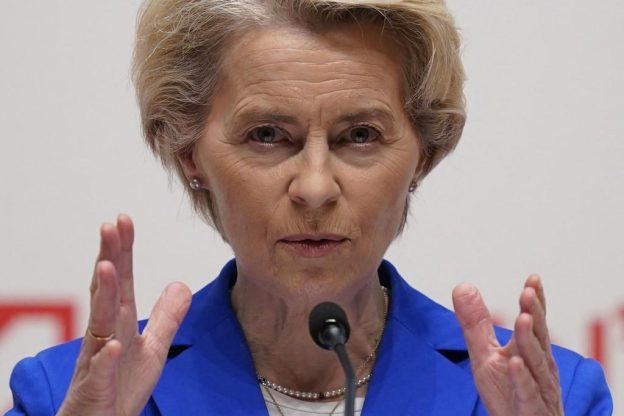
By Dr Salman Abu Sitta | MEMO
On 29 April 2023
Your Excellency,
You made a speech this week praising the establishment of Israel on its 75th anniversary.
For someone in your position, it is surprising that it had so many errors of fact, misguided judgment, violation of international law, and deviation from basic norms of justice.
You congratulated Israel on 75 years of existence on a land area of 20,500 km2, which is 78% of Palestine. Not one square kilometer of this area is obtained by any legal or just means. Six percent was obtained through the treacherous British collusion and 72% by military conquest. How could you congratulate a regime which obtained this land by spilling the blood of the innocent?
Israel has no boundaries, neither by international law nor by its own admission. The Armistice Agreement of 1949 confers no legal title on any boundary. Which Israel are you congratulating? Is it in the land occupied by Israel in 1948, or in 1967?
There is not a single line in UN resolutions that supports you in either.
You congratulate Israel on its “dynamism ingenuity and groundbreaking innovations”.
I ask you if you gather the best German scientists and locate them on Madagascar Island, where they killed the people of the island and set up the best laboratory. Would you consider that a scientific achievement?
Einstein did not discover the Theory of Relativity because he was a Jew or a Swiss; he discovered it because he was a brilliant scientist. To his credit, he refused the idea of Israel and condemned the Jewish massacre of Deir Yassin.
Your European government poured billions of Euros into Israel for “scientific research” under the EU-Israel Association. The agreement contained a clause requiring Israel to abide by Human Rights in the conduct of research. But you, in particular Germany and Holland, waived this clause on demand by Israel.
Your Israel did not waste time. Its arms industry company Elbit sold weapons of mass destruction to many countries, spreading death and destruction in many parts of the world.
The prime victim is our people in Gaza. In four Israel wars against Gaza in the last six years, not only Elbit products were used to kill women and children, but its operators were in the field to guide the Israeli soldiers.
People of good conscience in the UK protested against that and demonstrated against the Elbit factory in England. Similar people in Germany protested against Elbit but your government jailed them.
Is this the Israeli science you celebrate?
You say also “Israel made the desert bloom”. You fell into the trap of Israeli propaganda. With your government capabilities, you could have done a better job.
The area of the southern district is 12,500 km2. Israel irrigated at best 800 km2. The remaining 94% was and is still desert. The irony is that the irrigation water is stolen water from the West Bank and Golan Heights. All the stolen water used in agriculture produces only 1.5% of Israel GDP.
Making “the desert bloom” is a myth. How can this escape you?
You paid for your guilt about atrocities against your Jewish citizens with Palestinian blood. Your leaders flocked to Yad Vashim, erected in Palestine not in Germany, to shed tears and ask for forgiveness. But none of your leaders had the moral courage to look at the opposite hill, 3 km away, at Deir Yassin and confront your hosts, the criminals who committed the massacre there.
You paid no notice or care about the Israeli-run concentration camps and forced labour camps for captured Palestinian civilians in 1948, set up by your citizens who fled to Palestine, only three years after those camps were closed in Germany, even though they were reported by ICRC.
The major defect in your speech is that you did not see the elephant in the room. You did not see or recognize Al Nakba, the worst disaster in Palestine’s 4000 years of history.
You did not mention the Zionist invasion by 120,000 European soldiers in 9 brigades carrying out 31 military operations. This invasion depopulated 560 towns and villages through massacres, making refugees of two-thirds of the Palestinian people.
How can you escape this calamity? Do you not know Palestine?
Go back to maps in the mid-19th century by your geographers Kiepert and Van de Velde. They tell you about 1200 localities in Palestine. You are a fluent French speaker. Go to seven volumes of Victor Guerin describing every village in Palestine.
If you miss all that, you cannot miss the historical visit of Kaiser Wilhelm II of Germany to Palestinian Jerusalem on 31st October 1898. You cannot miss the voluminous scholarly work of Gustav Dalman about Palestine’s people.
With this knowledge, it is very sad, and indicative of the Western racism, that you voted frequently against Palestinian Inalienable rights in the United Nations, invoking the sordid European history of colonialism.
But it is not too late. You can retract your words and actions and come back to the true path, peace, and justice for Palestinians. They are the true heirs of Jesus Christ, after whom your political party was named.
Yours respectfully,
Dr Salman Abu Sitta
German police take away frantically screaming child over Muslim parents’ teachings
Press TV – April 29, 2023
A child has been forcefully taken away from his Muslim family by Germany’s “child protection services” and police forces because his parents were allegedly teaching him that homosexuality is not accepted in Islam.
A video that has gone viral apparently shows the outraged family trying to stop the incident, as the screaming child struggles to get out of police officers’ hold.
Others said it was very clear that the child did not want to be removed from his parent’s home, given the way he cried and struggled with the police.
“In Germany, this kid goes to school, they bring up the topic of homosexuality and so he tells him that it is Haram according to his religion. So the school call the child care services and the police show up at his door and forcibly take him away from his family,” a comment on the video said.
“This is from Germany and there’s a lot of similar cases in a lot of European countries like Sweden they take those children not only from Muslim families but also some Christian families!” another said on the child removal case, which was said to be a frequent occurrence in Sweden.
The incident happened after the child’s teachers learned that his parents were teaching him that being gay was a sin as Muslims. The teachers then reported it to child protection services that got in touch with the police to take him away.
In 2012, the Nordic Committee for Human Rights (NHCR) wrote a letter to the Secretary General of the Council of Europe, strongly condemning the “destructive child removal” activities taking place in Nordic countries, including Sweden.
“Mostly young, sole parent families, economically and educationally weaker families, families with health challenges and immigrant parents are targeted by the social service in Sweden, Norway, Denmark, and Finland,” the letter said.
“Also parents with religious and philosophical beliefs, which do not seem to be politically accepted, are often deemed as unsuitable parents, which invariably leads the social councils, acting upon the advice of the social workers, to remove the children from their families and place them in foster homes,” The letter added.
According to the letter, even highly educated parents with high-profile professions have experienced social workers’ interference in their private and family lives. – Video
Ukraine working with FBI to censor social media – official
RT | April 28, 2023
Ukrainian intelligence has partnered with the FBI and other US government agencies to remove ‘Russian’ content on Silicon Valley platforms, a senior official told independent journalist Lee Fang earlier this week at the RSA Convention in San Francisco.
“Once we have a trace or evidence of disinformation campaigns via Facebook or other resources that are from the US, we pass this information to the FBI, along with writing directly to Facebook,” Ilya Vitiuk, head of the Department of Cyber Information Security in the Security Service of Ukraine (SBU), told Fang.
Vitiuk spoke at the cyber security conference, sitting on a panel alongside FBI Cyber Division Assistant Director Bryan Vorndran, Special Agent Alex Kobzanets from the San Francisco field office, and Laura Galante from the Office of the Director of National Intelligence.
Fang noted that the Ukrainian official thanked the many “private sector allies” in the US, including Google, Amazon, Starlink, and CrowdStrike – the DNC contractor that claimed ‘Russian hacking’ in 2016 but later testified it had no evidence for it.
“I don’t know how many times we’ve called the CEOs here in San Francisco to drive to their office on a Sunday afternoon and really engage with our Ukrainian partners,” Kobzanets said during the panel.
According to Vitiuk, the SBU tells the FBI that a certain person or account is “probably Russia’s influence” in order to get them censored. He described the FBI as his agency’s “top partner” and US cyber support as a “psychological game changer” for Ukraine.
“Everything that is against our country, consider it a fake, even if it’s not,” Vitiuk told Fang when asked how the SBU determines what might be disinformation. “Right now, for our victory, it is important to have that kind of understanding, not to be fooled.”
By way of example, Vitiuk cited reports of tensions between President Vladimir Zelensky and Ukraine’s top general, Valery Zaluzhny, saying they were completely fabricated by Russia. In early March, the openly pro-Ukraine German tabloid Bild reported on their disagreements about military tactics.
Fang has previously documented US government plans to work with social media platforms on censoring “disinformation” related to “the nature of US support to Ukraine.” In December, he also revealed that the Pentagon had teamed up with Twitter to “amplify certain messages” for the US military.
Tucker Carlson Was ‘Trying to Get to the Truth’ Amid ‘Virtually Nonexistent’ US Independent Media
By Svetlana Ekimenko – Sputnik – 29.04.2023
Tucker Carlson’s departure from Fox News comes as independent media appears to have been muzzled in the US, with corporations playing a hefty role in limiting the kind of information that gets out to people, Larry Johnson, retired CIA intelligence officer and State Department official, told Sputnik.
Truthful media coverage of a whole host of issues in the United States is discouraged. It is even frowned upon, Larry Johnson, a former US official, told Sputnik in the wake of the abrupt departure of Tucker Carlson from Fox News.
“Media corporations over the course of the last 30 years have become increasingly concentrated in a small number of organizations. So, the independent media that used to exist is virtually nonexistent now, except for what appears on the Internet and podcasts,” the retired CIA intelligence officer stated.
He pointed out that The Washington Post, owned by Jeff Bezos of Amazon, “has become very much of a political outlet, as opposed to a news outlet”. Similarly, The New York Times, the Los Angeles Times, all previously separate newspapers, have been “consolidated under centralized corporate control.”
“Those corporations play a heavy role in limiting the kind of information that gets out to people. That coupled with reporters who are desperate to keep their jobs, and normally they’ll just play along with whatever the company policies are,” Larry Johnson said.
Several days after Fox News unexpectedly announced on April 24 that its outspoken anchor Tucker Carlson would be parting ways with the cable news network, the pundit himself made a video address telling viewers that media bosses were trying to stifle any form of debate in the industry.
“The people in charge… are hysterical and aggressive. They’re afraid. They’ve given up persuasion – they’re resorting to force… But it won’t work… true things prevail,” Carlson said in a two-minute video clip posted on his Twitter account on Wednesday.
In his monologue, Carlson said that debates on “big topics” like war, corporate power, and civil liberties “are not permitted in American media,” because, “both political parties – and their donors – have reached consensus… to shut down any conversation about it.”
Weighing in on the seasoned journalist’s verbal barrage, Larry Johnson agreed that truthful media coverage in the US is being stifled.
“The corporate media’s normal coverage about economic issues, for example, is always trying to emphasize the positive, even when the actual data points to some very alarming trends. On the foreign policy front this comes down to the concentration of power in the hands of a few corporations, and those corporations are wielding enormous influence. Basically, the defense industry and the pharmaceutical industry in the United States have enormous influence over the public debate, what gets publicized and what is ignored,” he said.
Even attempts in the media to label Tucker Carlson, who was refusing to accept official narratives, as a right-winger, Johnson said, was a “hallmark of censorship.” The journalist was simply somebody who was trying to get to the truth, the one-time State Department official underscored.
“Tucker is really more of a libertarian from the standpoint that he does not subscribe to the positions of the Republican Party or the Democrat Party. But he would take each issue on its own, and ask legitimate questions, such as the protests that took place on January 6, 2021 [which] were described by the regime as an insurrection and [it] characterized anybody who was up there on Capitol Hill as basically a terrorist. In fact, the vast majority of the people out there were peaceful and they were not attacking and destroying the Capitol by any standpoint,” Larry Johnson explained.
He deplored the “tremendous amounts of propaganda” in the United States, adding: “What I see now is there is far more press freedom in Russia than in the United States, or places like Canada.”
What was once an open society, allowing the questioning of issues, with “an aggressive, actually free press,” has transformed into a landscape of “almost state-controlled media,” with “people happily involved with suppressing dissident voices,” the retired CIA intelligence officer stated.
Larry Johnson concluded by urging people to look at multiple sources and listen to as many voices as possible to be able to “make their own judgment.”
Featured Video

Russia Helping Build a New Middle East /Trita Parsi
or go to
Aletho News Archives – Video-Images
From the Archives
Sam Husseini: The entire US establishment helped lie their way into the Iraq war
By Slava Zilber | American Herald Tribune | October 14, 2019
Sam Husseini is a senior analyst with the Institute for Public Accuracy, independent journalist and contributor to The Nation and FAIR.
Slava Zilber: Sam, three years ago, you appeared on Talk Nation Radio with David Swanson and spoke about the case of the GCHQ whistleblower Katharine Gun. You pointed out that the people involved in the spying on the UN and the people authorizing the Iraq War were not held accountable:
“Virtually everybody who went along with the war, whether it is Kerry or Clinton, of course, the Bush administration themselves has falsified their own records in terms of why, what they did, when they did, why they did it, to the extent that they’ve been scrutinised at all.”
You also address it in a recent article. And recently, Joe Biden has been lying about his position on the Iraq War. How can such an important issue escape meaningful scrutiny? … continue
Blog Roll
 Aletho News
- Russia Helping Build a New Middle East /Trita Parsi
- Barghouti: ‘Netanyahu has fallen,’ era of Smotrich, Ben-Gvir over
- China slams US policy on Iran as Russia rejects legality of nuclear meeting at UN
- The Mecca Pact Courts Iran: Containment Comes Full Circle
- Oman FM: Persian Gulf states, Iran, Iraq should form security pact excluding US
- Trump peddles fresh falsehoods, claims Iran ‘started the war’ as US aggression drags on
- Ukraine quagmire? Yes, but it’s for NATO, not Russia
- US intelligence hypes Chinese, Russian space threats while accelerating its own military buildup in orbit
- Iran FM Araghchi: “Hormuz Will No Longer Be the Same”
- EU facing trillion-euro debt hole while seeking more cash for Kiev
- If Americans Knew
- An error has occurred; the feed is probably down. Try again later.
- No Tricks Zone
- Sudden Stratospheric Warming, Powerful El Niño Combination May Lead To Extreme Europe Cold, Energy Crisis!
- Two New Studies Find Thwaites Glacier Melt Cannot Be Driven By Human Activity Or A Warming Ocean
- E-Cars Reduce CO2 Emissions By Only 41% Compared To Internal Combustion Engine Vehicles
- Predictions Made By Renowned Climate Professor Over Past Decades Have Been Proven To Be Poor
- New Study Suggests Large Regions Of The Pacific Ocean Have Been Cooling For The Last 80 Years
- Germany’s Green Energy Debacle: High Energy Costs Force Kahla Porzellan to Close After 182 Years!
- New Study: 50 Years Of The Most Aggressive ‘Net Zero’ Policies Can Only Affect The Global Climate By 0.03°C
- US September “Heat” Was No Record…Many Records Set Decades Ago
- Latest European Green Energy Debacle; Portugal’s Largest Flagship Solar Park Insolvent!
- Green Energy Debacle: German Expert Professor Fritz Vahrenholt Warns Of Severe Economic And Social Consequences

