Necessary Illusions – Even the narrative of the EU as a geo-strategic player has now burst
By Alastair Crooke | Strategic Culture Foundation | December 5, 2022
Something odd is afoot in Europe. Britain recently has been ‘regime washed’, with a strongly pro-EU Finance Minister (Hunt) paving the passage to an election-free premiership by ‘globalist’ Rishi Sunak. Why so? Well, to impose swingeing cuts to public services, to normalise immigration running at 500,000 per annum and to raise taxes to the highest levels since the 1940s. And to open channels about a new relationship deal with Brussels.
A British Tory Party is content to do that? Slash social support and hike taxes into an already existent worldwide recession? On the face of it, it doesn’t seem to make sense. Shades of Greece 2008? Greek austerity for Britain — are we missing something? Is this setting the scene for the Remainer Establishment to point to an economy in crisis (blamed on Brexit failure), and to say there is no alternative (TINA) but a return to the EU in some form, (British ‘cap in hand’, and with head bowed)?
Simply put, forces behind the scenes seem to want the UK to resume its former role as US plenipotentiary inside Brussels — pushing the US primacy agenda (as Europe sinks into self-doubt).
Likewise odd — and significant – was that on 15 September, former German Chancellor Schroeder entered unannounced into Scholtz’s office where only the Chancellor, and Vice-Chancellor, Robert Habeck, were present. Schroeder slapped down a long-term gas supply proposal by Gazprom on the desk, directly under Scholtz’s eyes.
The Chancellor and his predecessor held each other’s gaze for a minute – without a word passing. Then Schroeder reached out, took back the unread document, turned his back and exited the office. Nothing was said.
On 26 September (11 days later), the Nordstream pipeline was sabotaged. Surprise (yes, or no)?
Many unanswered questions. The upshot: No gas for Germany. One Nordstream train (2B) however, survived the sabotage and remains pressurised and functional. Yet still no gas arrives in Germany (other than high price liquified gas). There are presently no EU sanctions on gas from Russia. Landing the Nordstream gas requires only a Regulatory go-ahead.
So then: Europe is to have austerity, loss of competitiveness, price and tax hikes? Yes — yet Scholtz did not even glance at the gas offer.
The Green Party of Habeck and Baerbock (and the EU Commission) is in close alignment with those in the Biden team insisting to maintain US hegemony, at all costs. This Euro-coalition is explicitly and viscerally malefic towards Russia; and in contrast, is as viscerally indulgent towards Ukraine.
The big picture? German Foreign Minister Baerbock in a speech in New York on 2 August 2022 sketched out a vision of a world dominated by the US and Germany. In 1989, George Bush famously had offered Germany a “partnership in leadership”, Baerbock claimed. “Now the moment has come when we have to create it: A joint partnership in leadership”. A German bid for explicit EU primacy, snaring US support. (The Anglos will not like that!)
Ensuring no backsliding on Russia sanctions and continuing EU financial support for the Ukraine war is a clear ‘Red Line’ for precisely those in the Biden team likely to be attentive to Baerbock’s Atlanticist bid — and who understand that Ukraine is the spider at the centre of a web. The Greens explicitly are playing this.
Why? Because Ukraine is still the global ‘pivot’: Geopolitics; geo-economics; commodity and energy supply chains — all revolve around where this Ukraine pivot finally settles. A Russian success in Ukraine would bring a new political bloc and monetary system into being, through its allies in the BRICS+, the Shanghai Cooperation Organization and the Eurasian Economic Union.
Is this European austerity binge then just about the German Green Party nailing down EU Russophobia? Or are Washington and its Atlanticist allies now prepping for something more? Prepping for China to get the ‘Russia treatment’ from Europe?
Earlier this week at Mansion House, PM Sunak changed gear. He ‘hat-tipped’ to Washington with the promise to stand by Ukraine ‘as long as it takes’, yet his primary foreign policy focus was firmly on China. The old ‘golden’ era of Sino-British relations ‘is over’: “The authoritarian regime [of China] poses a systemic challenge to our values and interests”, he said — citing the suppression of anti-zero-COVID protests and the arrest and beating of a BBC journalist on Sunday.
Over in the EU — belatedly panicking over unfolding widespread de-industrialisation — President Macron has been signalling that the EU might take a more hard-line China stance, though only were the US were to back-down on the subsidies in the Inflation Reduction Act, which entice EU companies to up-anchor, and sail off to America.
Yet, Macron’s ‘play’ is likely to meet a dead end, or at best, a cosmetic gesture — for the Act has already been legislated in the US. And the Brussels political class unsurprisingly already is waving the white flag: Europe has lost Russian energy and now stands to lose China’s tech, finance and market. It’s a ‘triple whammy’ — when taken together with European de-industrialisation.
There you have it — austerity is always the first tool in the US toolbox for exerting political pressure on US proxies: Washington is prepping the EU ruling élites to sever from China as fundamentally Europe has already done from Russia. Europe’s largest economies already are taking a harder line on Beijing. Washington will squeeze the UK and EU ‘til the pips squeak to get full compliance on a China cut-off.
The protests in China over Covid regulations could not have arrived at a more serendipitous time from the US’ ‘China hawks’ perspective: Washington whipped the EU into full propaganda mode on Iranian ‘demonstrations’ — and now the China protests offer the opportunity for Washington to go full court on China demonisation:
The ‘line’ used against Russia (Putin makes mistake after mistake; the system bumbles; the Russian economy is precariously perched on a knife edge and popular disaffection is soaring) – will be ‘cut and pasted’ to Xi and China.
Only, the inevitable EU moral lecturing will antagonise China even further: Hopes to keep a trade foothold in China will vanish, and effectively it will be China ‘washing its hands’ of Europe, rather than vice versa. European leaders have this blind spot — quite some Chinese may deplore the Covid lockdown practice, yet still will remain deeply Chinese and nationalist in sentiment. They will hate EU lecturing: ‘European values speak only for themselves — we have our own’.
Obviously, Europe has dug itself into a deep hole. Its adversaries grow bitter at EU moralising. But what exactly is going on?
Well, firstly, the EU is hugely over-invested in its Ukraine narrative. It seems incapable of reading the direction of travel that events in the war zone are taking. Or, if it does read it correctly (of which there is little sign), it appears incapable of being able to affect a course correction.
Recall that the war at the outset was never seen by Washington as likely ‘being decisive’. The military aspect was viewed as an adjunct — a pressure multiplier — to the political crisis in Moscow that sanctions were expected to unleash. The early concept was that financial war represented the front line — and the military conflict, the secondary front of attack.
It was only with the unexpected shock of sanctions not achieving ‘shock and awe’ in Moscow that priority switched from the financial to the military arena. The reason the ‘military’ was not firstly seen as ‘front-line’ was because Russia clearly had the potential for escalatory dominance (a factor which is now so evident).
So, here we are: The West has been humiliated in the financial war, and unless something changes (ie. dramatic escalation by the US) – it will lose militarily too — with the distinct possibility that Ukraine at some point, simply implodes as a state.
The actual situation on the battlefield today is almost completely at odds with the narrative. Yet, so heavily has the EU invested in its Ukraine narrative that it just doubles-down, rather than draw back, to re-assess the true situation.
And so doing — by doubling-down narratively, (standing by Ukraine ‘for as long as it takes’) — the strategic content to the ‘Ukraine’ pivot rotates 180 degrees: Rump ‘Ukraine’ will not be ‘Russia’s Afghan quagmire’. Rather, its’ rump is morphing into Europe’s long-term financial and military ‘quagmire’.
‘As long as it takes’ gives the conflict an indeterminate horizon — yet leaves Russia in control of the timetable. And ‘as long as it takes’ implies ever more exposure to NATO blind spots. The rest-of-world intelligence services will have observed NATO’s air defence and military-industrial lacunae. The pivot will show who is the true ‘paper tiger’.
‘As long as it takes’ — has the EU thought this through?
If Brussels imagines too, that such dogged adherence to narrative will impress the rest-of-the-world and bind these other states closer to the EU ‘ideal’, they will be wrong. Already there is a wide hostility to the notion that Europe’s ‘values’ or squabbles have any wider pertinence, beyond Europe’s borders. ‘Others’ will see the inflexibility as some bizarre compulsion by Europe to self-suicide – at the very moment that the end of ‘everything bubble’ already threatens a major downturn.
Why would Europe double-down on its ‘Ukraine’ project, at the expense of losing its standing abroad?
Perhaps, because the EU political class fears even more losing its domestic narrative. It needs to distract from that — it is a tactic called ‘survival’.
The EU, as with NATO, was always a US political project for the subjugation of Europe. It still is that.
Yet, the meta-EU narrative — for internal EU purposes — posits something diametrically different: that Europe is a strategic player; a political power in its own right; a market colossus, a monopsony with the power to impose its will over whomsoever trades with it.
Simply put, the EU narrative is that it has meaningful political agency. But Washington has just demonstrated it has none. It has trashed that narrative. So, Europe is destined to become an economic backwater. It has ‘lost’ Russia — and soon China. And is finding it has lost its standing in the world, too.
Again, the actual situation on the geo-political ‘battlefield’ is almost completely at odds with the EU narrative of itself as a geo-strategic player.
Its ‘friend’, the Biden Administration, is gone — whilst powerful enemies elsewhere accumulate. The EU political class never had a good grasp of its limitations — it was ‘heresy’ even to suggest there were limitations to EU power. Consequently, the EU has hugely overinvested in this narrative of its agency too.
Hanging EU flags from every official building will not cast a fig leaf over the nakedness, nor hide the disconnect between the Brussels ‘bubble’ and its deprecated European proletariat. French politicians now openly ask what can save Europe from complete vassalage. Good question. What does one do when a hyper-inflated power narrative bursts, at the same time as a financialised one?
Western price cap on Russian oil likely to be another spectacular failure
By Ahmed Adel | December 6, 2022
The price cap imposed by the West on oil from Russia will actually have negative consequences in the long term as it once again reaffirmed to the international community that Western-centric banking and shipping insurance schemes cannot be trusted as reliable partners.
Western oil sanctions went into effect on December 5, with the European Union stopping all shipments of Russian oil arriving by sea. In addition, the EU, as well as G7 countries and Australia, imposed a limit on the price of oil transported by sea at $60/barrel. The West expects that this will cripple the Russian economy and force Moscow to end its special military operation in Ukraine.
However, this will spectacularly fail.
Sanctions have not instigated an end to the military operation, and in fact they have forced financial mechanisms independent of western institutions to be established. Although the world economic system was already slowly heading towards de-Dollarisation, the anti-Russia sanctions have only sped up the process as important economic players like China, India and Egypt have found methods to bypass western sanctions.
It is recalled that Russia had previously introduced the Mir card system as an alternative to Western financial systems, despite there being a lot of scepticism about it. Now, Mir is being adopted all over the world, and the same can certainly be done in the shipping and shipping insurance industry.
The imposition of an oil price cap has made non-Western countries think about how to break free from Western payment systems and shipping channels. Many countries are already pre-emptively establishing these mechanisms to avoid the same teething problems that Russia has experienced since February 2022.
Washington warned the EU on December 1 that the $52 cited recently for Urals crude oil may not reflect the overall level at which Russian oil has been trading. An unnamed US official has said that Urals has been trading at a $17-$23 discount to crude, which would make it higher than the $52 cited by some media. It is for this reason that the EU set the oil price cap $8 above that cited figure.
For their part, Poland, Estonia, and Lithuania have all voiced their opinion that the price cap on Russian crude oil insured and shipped by Western companies should be set at Russia’s production cost – $20-$30 per barrel. Those levels were dismissed as having very little chance of being supported by other EU members.
The introduction of a price cap on Russian seaborne oil at $60 per barrel is already a risky strategy to begin with and has uncertain results. Therefore, the Polish-Baltic proposal was never going to be approved. Oil market participants were already fearing a $60 cap to begin with, forcing Biden administration officials trying to reassure that the newly agreed cap will not lead to supply disruptions and volatility in the price after it went into effect.
None-the-less, experts fear that “over-compliance” on the restrictions could affect pricing.
“One of the big potential issues is going to be over-compliance, intermediaries deciding that the risk is too great and not engaging,” said Adam M. Smith, a partner at Gibson, Dunn and Crutcher and a former adviser at Treasury’s Office of Foreign Assets Control, which oversees sanctions. “Banks have historically been very risk-averse — as they should be — in the sanctions space and I think over-compliance in that context can be expected.”
Due to the price cap, many countries may stop any action for a while so that they can analyse all the risks, including decisions which could lead to sanctions from Western countries.
“That’s a real risk,” said Hunter Kornfeind, an oil market analyst at Rapidan Energy Group. “There could be a multi-week lull when some buyers are reluctant to move barrels as they wait and see. It’s not going to be like the whole trade shuts down, but there could be some who take a step back.”
Russian Deputy Prime Minister Alexander Novak pointed out that Russia will not export oil to countries that set price caps. According to him, such restrictions mean that by interfering with the market, Moscow will only interact with buyers willing to work under normal market conditions.
For his part, Russian President Vladimir Putin has stated that Moscow will not deliver anything abroad if it is against its interests. He warned that the introduction of oil price caps could have “grave consequences for global energy markets.”
Although the full impact of what the price cap is not yet known, the attempts to further financially and economically isolate Russia are likely to be another spectacular failure.
Ahmed Adel is a Cairo-based geopolitics and political economy researcher.
US, EU Reportedly Lose Track of $200 Billion in ‘Frozen’ Russian Funds
Samizdat – 06.12.2022
Western countries froze a huge chunk of the Russian Central Bank’s emergency reserve cushion in February in a bid to punish Moscow for its military operation in Ukraine. Officials in Washington and Brussels have since vacillated as to whether these funds can be seized outright and given to Kiev as “reparations.”
The United States and its European allies are having trouble actually locating two thirds or more of the Russian assets they froze earlier this year “because they do not know where exactly they are,” Charles Lichfield, a senior finance expert at the Atlantic Council, has indicated.
Speaking to Estonian media, Lichfield, the deputy director of the Washington-based think tank’s GeoEconomics Center, and expert on Russia’s central banking system, said Western countries actually seized closer to $80-$100 billion, not $300 billion, as has been widely reported.
Lichfield explained that the “freeze” on Russian assets obligated foreign banks not to allow for their transfer back to Russia, on penalty of losing their ability to transact in dollars and euros. However, some Asian and African banks may not have felt the need to respond to requests for information from Western authorities regarding transactions involving Russia, he said.
The US Treasury triumphantly announced in June that Washington and its allies had blocked or frozen some $300 billion in Russian state assets, plus $30 billion worth of assets of sanctioned individuals, including Russian tycoons.
Last week, European Commission chief Ursula von der Leyen proposed creating a special structure to manage the assets and “invest them.”
However, EU officials specified to media that Brussels couldn’t simply seize the Russian assets to use them in Ukraine because the bloc adheres to the principle of state immunity.
In the US, officials have expressed similar hesitation. Last month, lawmakers proposed a provision in the 2023 National Defense Authorization Act bill to allow for the transfer Russian assets to Ukraine, but the idea was met with opposition amid fears that the idea had not been “fully litigated.”
Russian officials have slammed the asset freeze as a form of “theft.”
The West’s actions have also prompted Chinese regulators and banks to brainstorm ways to keep their own assets stashed abroad safe if the US and its allies move against them in the way they have against Russia.
Russia’s frozen assets were previously estimated to constitute close to half of the country’s $640 billion reserve cushion. According to the Central Bank’s year-end report for 2021, the largest portion of its foreign currency and gold was stored in China (16.8 percent), followed by France (9.9 percent), Japan (9.3 percent), the United States (6.4 percent) Britain (5.1 percent), Canada (2.7 percent) and Australia (2.5 percent), with more than 51 percent thus located in states which have slapped sanctions on Moscow.
Russian oil shipments to Europe dwindling
RT | December 6, 2022
Deliveries of Russian seaborne oil to Europe have dropped more than fivefold since the start of Moscow’s military operation in Ukraine, Bloomberg reported on Monday citing vessel tracking data.
According to the report, the shipments plunged to an average of 309,000 barrels per day in the four weeks to December 5. This is less than a fifth of their volume in the four weeks to February 25, an average of 1.58 million barrels a day. Deliveries in the final week to November 25 dropped by 34%.
Analysts expect those figures to slide further after an EU embargo and the Western coalition’s $60 price cap on Russian seaborne barrels are in full swing. Both measures came into force on Monday, but have a transition period during which some deliveries are still possible.
Over the past months, Moscow has stepped up efforts to redirect supplies elsewhere. So far, shipments have been mostly diverted to China, India, and Türkiye, which emerged as the largest buyers of Russian oil.
According to vessel tracking data, the volume of crude on tankers destined for the three countries, along with those that have not yet supplied their port of destination but typically end up in either India or China, stood at an average of 2.45 million barrels a day over the past four weeks. That is more than three times as much as the volumes shipped there in the four weeks immediately prior to the start of the Ukraine conflict.
Total Russian crude export volumes increased by 94,000 barrels a day to 2.99 million in the week before the new restrictions kicked in. Shipments to Bulgaria, which has secured an exemption from the embargo and is now Russia’s only remaining EU seaborne oil market, were unchanged at 125,000 barrels a day. It is unclear, however, whether further deliveries to the country will be affected by Russia’s response to the sanctions. Moscow repeatedly warned that it will stop selling crude to countries that support the price cap, and warned on Monday that it may even cut production in retaliation.
Russia’s overall oil output has grown 2.2% to 488 million tons in the 11 months between January and November 2022, according to Deputy Prime Minister Alexander Novak, who spoke to reporters on Tuesday.
Kiev preparing to boycott Russian ammonia transit
By Lucas Leiroz | December 6, 2022
According to recent reports, Ukrainian intelligence, with foreign support, is planning a provocation to prevent the resumption of Russian ammonia transit. The aim would be to further destabilize humanitarian deals to secure fertilizer supplies and, consequently, global food security. Ammonia is an important component in the production of various types of fertilizers, which is why the instability of its supply poses considerable risks to millions of people around the planet, whose food is cultivated with Russian products.
Sources interviewed by a Russian media outlet claim that Ukrainian agents are being instructed by the UK Special Services and the Canadian military company Garda World to destroy the Russian export infrastructure of ammonia. The operation would be very similar to what happened in September with the Nord Stream pipelines. Informers allege that Kiev wants to bomb the ammonia storage facilities at the Odessa Portside Plant. Thus, the flow of ammonia through the Tolyatti-Odessa pipeline could not be resumed, generating an increase in the prices of the product.
“The provocation has been planned and is carried out under the control of the UK special services stationed in Odessa. Members of Canada’s private military company Garda World, who are responsible for security of port infrastructure in the Odessa region under the contract with the administration of Ukrainian sea ports, are also participating in the implementation of this provocation”, the source said.
Although the UN-mediated grain deal in which Russia is involved did not originally include the return of ammonia transit, negotiations in this regard were making significant progress. UN officials have expressed optimism on the matter in several recent pronouncements. According to Martin Griffiths, Under-Secretary-General for humanitarian affairs and emergency relief at the UN’s Office for the Coordination of Humanitarian Affairs (OCHA), the ammonia deal was “quite close”. Indeed, since the beginning of the special military operation Russia has shown diplomatic goodwill in negotiating humanitarian agreements, so it was possible that something was close to being achieved soon.
However, once again Western-backed Ukrainian terrorists seem to plan maneuvers which will increase tensions and instability. The sources also claim that Kiev will try to blame Russia for the attack. With this, the possible plan appears even more similar to what happened on previous occasions, such as Nord Stream, the Crimean Bridge, and the bombing in Poland. Indeed, this has become common practice on the part of Kiev and its Western supporters: using terrorism to serve their anti-Russian interests and trying to blame Moscow. As on previous occasions, if the attack in Odessa actually takes place, it is expected that there will be a huge defamatory media repercussion, with western news agencies spreading lies and distorted narratives about the incident.
In addition to defaming Russia even more, thus “justifying” the sanctions and other coercive measures, the West would also be economically interested in this type of move, since, without the resumption of Russian ammonia exports, many emerging countries would start to buy ammonia from the EU and from the UK – or start importing ammonia-based fertilizers from Canada. Obviously, Western countries would increase prices exponentially, demanding really abusive prices, given the scarcity of ammonia in the global market.
This once again shows how the West-Kiev axis seems only interested in fomenting chaos and international crisis, without any regard for pacifying the current conflict and for lessening its consequences. All forms of boycotting Russia’s international ties seem “legitimate” to Western countries, even if this endangers the food security of millions of people. Considering the importance of ammonia-based fertilizers for the cultivation of grains, if the predictions made by Russian media’s sources are confirmed, in-depth investigations will be necessary in order to punish those responsible for this crime.
It is also important to remember that the grains and fertilizers exported by Russia have been seized in Europe. Tons of food and chemical products are detained in European ports due to the sanctions, without reaching the countries of destination in Africa and Asia, where Moscow prioritizes exports for humanitarian reasons. Despite several Russian denunciations in this regard, no action has been taken by the UN, which remains silent in the face of illegal European practices that are evidently contributing to worsening food shortages around the world.
There is no way to deny the destabilizing and terrorist attitudes that NATO and its Ukrainian proxy are promoting. And international organizations need to recognize this as soon as possible.
Lucas Leiroz is a researcher in Social Sciences at the Rural Federal University of Rio de Janeiro; geopolitical consultant.
US Congressman Gosar Calls Washington’s Support for Kiev ‘Immoral’

Samizdat – 06.12.2022
Republican Congressman Paul Gosar, in response to the shelling of a church by Ukrainian troops in the city of Donetsk, called Washington’s support for Ukraine “immoral,” adding that the Kiev regime is “authoritarian.”
“Our continued support of this war in Ukraine is immoral. The deaths continue and Ukraine has become an authoritarian regime not worthy of any support. I support peace talks, not death and destruction. Not bombing churches,” Gosar tweeted.
On Monday, a Sputnik correspondent reported that the Church of Nativity of Christ in Donetsk was shelled by Ukrainian troops.
In late October, the US congressman invited Russian President Vladimir Putin and Ukrainian President Volodymyr Zelenskyy for peace talks in the state of Arizona. Two weeks later, Gosar said he would continue opposing additional US aid to Ukraine.
Major New Autopsy Report Reveals Those Who Died Suddenly Were Likely Killed by the Covid Vaccine
BY WILL JONES | THE DAILY SCEPTIC | DECEMBER 5, 2022
A major new autopsy report has found that three people who died unexpectedly at home with no pre-existing disease shortly after Covid vaccination were likely killed by the vaccine. A further two deaths were found to be possibly due to the vaccine.
The report, published in Clinical Research in Cardiology, the official journal of the German Cardiac Society, detailed autopsies carried out at Heidelberg University Hospital in 2021. Led by Thomas Longerich and Peter Schirmacher, it found that in five deaths that occurred within a week of the first or second dose of vaccination with Pfizer or Moderna, inflammation of the heart tissue due to an autoimmune response triggered by the vaccine had likely or possibly caused the death.

Case characteristic of five deaths likely or possibly caused by the Covid vaccines

Lymphocyte immune cells (white blood cells) are shown in blue and brown among the heart tissue, causing localised inflammation that proved fatal
In total the report looked at 35 autopsies carried out at the University of Heidelberg in people who died within 20 days of Covid vaccination, of which 10 were deemed on examination to be due to a pre-existing illness and not the vaccine. For the remaining 20, the report did not rule out the vaccine as a cause of death, which Dr. Schirmacher has confirmed to me is intentional as the autopsy results were inconclusive. Almost all of the remaining cases were of a cardiovascular cause, as indicated in the table below from the supplementary materials, where 21 of the 30 deaths are attributed to a cardiovascular cause. One of these is attributed to blood clots (VITT) from AstraZeneca vaccination (the report was looking specifically at post-vaccine myocarditis deaths), leaving 20 from other cardiovascular causes.

For the five deaths in the main report attributed as likely or possibly due to the vaccines, the authors state:
All cases lacked significant coronary heart disease, acute or chronic manifestations of ischaemic heart disease, manifestations of cardiomyopathy or other signs of a pre-existing, clinically relevant heart disease.
This indicates that the authors limited themselves to deaths where there was no “pre-existing, clinically relevant heart disease”, making the report very conservative in which deaths it was willing to pin on the vaccines.
Dr. Schirmacher told me:
We included only cases, in which the constellation was unequivocally clear and no other cause of death was demonstrable despite all efforts. We cannot rule out vaccine effects in the other cases, but here we had an alternative potential cause of death (e.g. myocardial infarction, pulmonary embolism). If there is severe ischemic cardiomyopathy it is almost impossible to rule out myocarditis effects or definitively rule in inflammatory alterations as due to vaccination. These cases were not included.
We did not aim to include or find every case but the characteristics of definitive, unequivocal cases beyond any doubt. Only by this way you can establish the typical characteristics; otherwise less strict criteria may lead to ‘contamination’ of the collective; it is absolutely plausible that by these criteria we may have missed further cases but the intention of our study was never quantitative or extrapolation and there are numerous positive and negative bias. But we wanted to establish the fact not the size.
It is of course very possible that the vaccines also cause death where there is an underlying cardiovascular condition, and indeed, that it is more likely to do so. Thus these five deaths are the minimum from these autopsy cases in which the vaccines are involved – those in which there is no other plausible explanation.
It is worth noting here that initially in 2021, when the autopsies were first carried out, Dr. Schirmacher stated his team had concluded 30-40% of the deaths were due to the vaccines. These earlier estimates may give us a better indication of how many of the deaths the authors really think are attributable to the vaccines, when they are unconstrained by highly conservative assumptions (and looking at causes besides myocarditis). Note that these percentages are based on a selection of deaths that occurred shortly after vaccination, not a random sample of all deaths, so the authors rightly warn that no estimation of individual risk can be made from them.
Did the autopsies find spike protein from the vaccines present in the heart tissue? The samples from the five vaccine-attributed deaths were tested for infectious agents including SARS-CoV-2 (in one instance revealing “low viral copy numbers” of a herpes virus, which the authors deemed insufficient to explain the inflammation). However, no tests were done specifically for the virus spike protein or nucleocapsid protein, such as have been used successfully in other autopsies to aid attribution to the vaccine, so unfortunately this evidence was unavailable for these autopsies.
The autopsies in the report also only cover doses 1 and 2, not any booster doses, and only deaths within 20 days of vaccination, so the report doesn’t address directly the question of what’s been causing the elevated heart deaths since the booster rollouts from autumn 2021 or whether the vaccines can trigger cardiovascular death weeks or months later. (Other autopsies have confirmed that the spike protein can persist in the body for weeks or months after vaccination and trigger a fatal autoimmune attack on the heart.)
What the report does do, however, is establish that people who die suddenly in the days immediately following vaccination may well have died from a vaccine-related autoimmune attack on the heart. It also confirms how deadly even mild vaccine-induced myocarditis can be – and thus why studies like the one from Thailand, finding cardiovascular adverse effects in around a third of teenagers (29.2%) following Pfizer vaccination and subclinical heart inflammation in one in 43 (2.3%), and the study from Switzerland finding at least 2.8% with subclinical myocarditis and elevated troponin levels (indicating heart injury) across all vaccinated people, are so worrying.
The authors of the new study diplomatically write that the “reported incidence” of myocarditis after vaccination is “low” and the risks of hospitalisation and death associated with COVID-19 are “stated to be greater than the recorded risk associated with COVID-19 vaccination” – notably declining to commit themselves to the official propositions that they dutifully repeat.
The fact that those who die suddenly after vaccination may have died from the hidden effects of the Covid vaccine on their heart is thus now firmly established in the medical literature. The big remaining question is how often it occurs.
Dr. John Campbell has produced a helpful overview of the report’s findings in his latest video.
Climate lockdowns coming? You will be tracked in your suburb and happy about it.
By Jo Nova | December 3, 2022
The 15 Minute City is a UN and WEF plan, because they care about you want you to drive less.
A cartoon from the WEF just for you good girls and boys:

In the WEF’s own words — this rearrangement of cities is absolutely about climate change:
As climate change and global conflict cause shocks and stresses at faster intervals and increasing severity, the 15-minute city will become even more critical.
And the solution was the pandemic (they really say that):
The obvious, yet incomplete, answer is the pandemic… with COVID-19 and its variants keeping everyone home (or closer to home than usual), the 15-minute city went from a “nice-to-have” to a rallying cry. Meeting all of one’s needs within a walking, biking or transit distance was suddenly a matter of life and death.
And then the dark hand of the totalitarian managers appears, as James Woudhuysen, warned in Spiked in late October:
The madness of the ‘15-minute city’
The green agenda is taking inspiration from the illiberal days of lockdown.
To this end, Oxfordshire County Council, which is run by Labour, the Liberal Democrats and the Green Party, wants to divide the city of Oxford into six ‘15 minute’ districts. In these districts, it is said, most household essentials will be accessible by a quarter-of-an-hour walk or bike ride, and so residents will have no need for a car.
On the surface, these 15-minute neigbourhoods might sound pleasant and convenient. But there is a coercive edge. The council plans to cut car use and traffic congestion by placing strict rules on car journeys.
Residents will have to register their cars with the council and they will be tracked to count their journeys through the key gateways. It’s the social credit scheme that starts with your car and works like anti-frequent-flyer points.
Under the new proposals, if any of Oxford’s 150,000 residents drives outside of their designated district more than 100 days a year, he or she could be fined £70.
The concept of the 15-minute city was born with ‘C40’. Chaired today by London mayor Sadiq Khan, C40 calls itself a ‘network of mayors of nearly 100 world-leading cities collaborating to deliver the urgent action needed right now to confront the climate crisis’.
Climate lockdowns? Seriously?
It all sounds a bit ridiculous to suggest a lockdown “for the climate” but listen to the BBC. They’re working awfully hard to persuade us — they obviously think voters won’t want this. Here they are connecting the “15 Minute City” to the fun of covid lockdowns, and setting this up as though it’s totally normal for the government to decide who your friends are:
How ’15-minute cities’ will change the way we socialise
And furthermore lockdowns in Paris were great social moments where we all made friends. Who knew how much fun it would be to be told you couldn’t drive far?
… for Fraioli, the two-month lockdown that began on 17 March – confining her to a 1km radius of her home – gave her a nuanced, enriching view of her neighbourhood. “I discovered it’s possible to feel like you’re in a small village in Paris,” she says. “To get to know your neighbours, to maintain good links with shopkeepers, to favour local craftsmen and shops over large supermarkets. I even joined a citizens’ movement where people prepare food baskets for homeless people. I thought I would have a hard time living the lockdown, but I was perfectly at home, in a quiet place.”
I don’t seem to recall “getting to know neighbours” as being part of any lockdown anywhere?
And lookout — the 15 minute city is not just Oxford, but turning up in Brisbane, Melbourne, Barcelona, Paris, Portland and Buenos Aires. It’s everywhere.

Oxford City Council is moving faster than the rest
Apparently, not enough people are catching buses or riding bikes. But instead of making that more appealing, the totalitarians will force it through tracking and fines. Oxfordshire has just approved on November 29th, the “traffic filters” trial which will turn the city into a “fifteen minute city”. The Trial will start in Jan 2024.
It’s a crowded area, Oxfordshire, and no one likes traffic congestion, but in a free world the problem is self-limiting as drivers get fed up with delays and exorbitant parking costs, and they car-pool or choose to catch the bus or ride a bike. But in Big Nanny State the local rulers start making rules about who can and can’t visit and how often, and they want your car registered on their own special list with cameras to track you and fines to punish you. They offer exemptions of course, but then you have to apply for them and get permission.
Oxfordshire County Council Pass Climate Lockdown ‘trial’ to Begin in 2024
Vision News, November 30th
Oxfordshire County Council yesterday approved plans to lock residents into one of six zones to ‘save the planet’ from global warming. The latest stage in the ’15 minute city’ agenda is to place electronic gates on key roads in and out of the city, confining residents to their own neighbourhoods.
Under the new scheme if residents want to leave their zone they will need permission from the Council who gets to decide who is worthy of freedom and who isn’t. Under the new scheme residents will be allowed to leave their zone a maximum of 100 days per year, but in order to even gain this every resident will have to register their car details with the council who will then track their movements via smart cameras round the city.
Every resident will be required to register their car with the County Council who will then monitor how many times they leave their district via number plate recognition cameras.
In the end, these aggressively overmanaged schemes mean more paperwork, more tracking, more jobs for bureaucrats and more free passes for “friends” of Big Government.
The more rules you have the more corrupt the system gets. For example, some city blocks are included in the favored list with 100 passes, while others get just 25 — so the property values of the inner circle addresses rise. As a bonus, in years to come property developers “in the know” and on the favoured list with certain councilors can arrange for rezoning on the right day (the one after they buy the property) and voila — that’s a nice capital gain for them
“Reconnecting Oxford” wants to end these artificial blockages
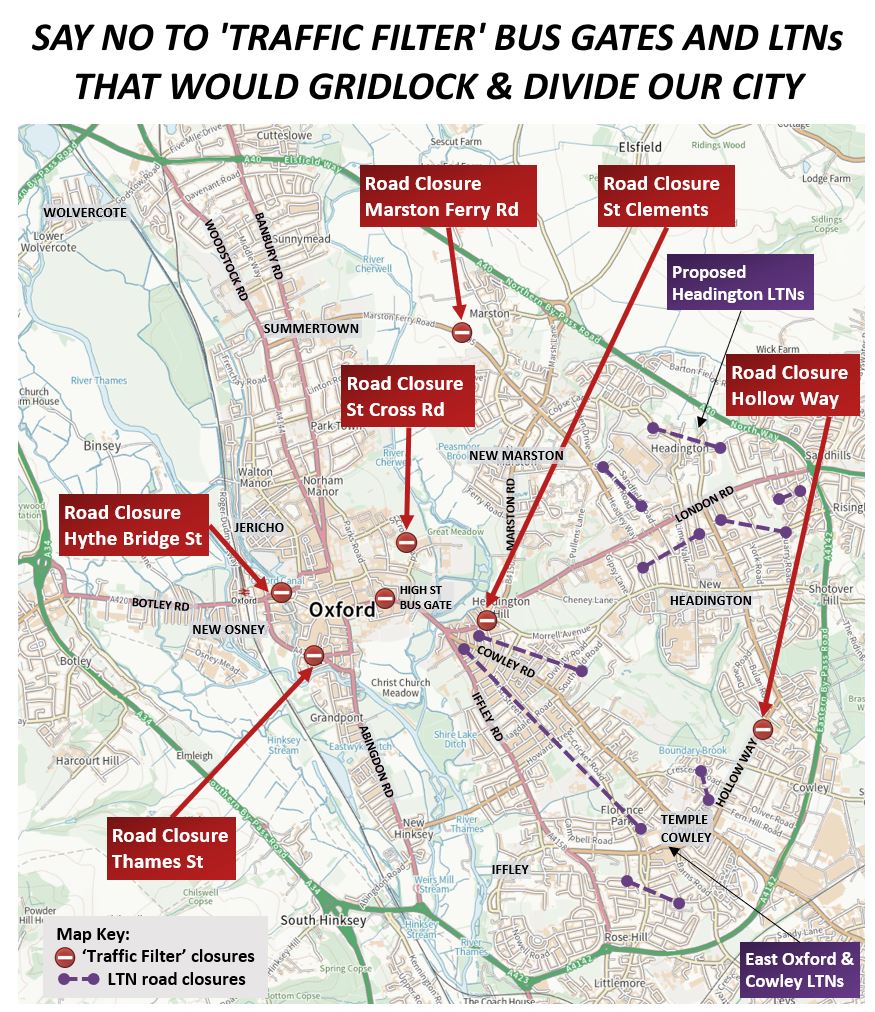
From “Reconnecting Oxford” –– a protest movement to stop filters and road closures.
The councilors held a major consultation process but apparently knew the outcome. It says rather a lot about the attitude of one councilor who said it was going ahead whether people liked it or not.
Traffic filters will divide city into six “15 minute” neighbourhoods, agrees highways councillor
Oxford Mail, October 24
ROAD blocks stopping most motorists from driving through Oxford city centre will divide the city into six “15 minute” neighbourhoods, a county council travel chief has said.
And he insisted the controversial plan would go ahead whether people liked it or not.
Businesses in Oxford are not impressed:
Hotelier Jeremy Mogford, who owns the Old Bank Hotel in High Street and the Old Parsonage Hotel and Gees, both in Banbury Road, described the plan as disastrous for business.
He previously told the Oxford Mail : “What we have is people making decisions that don’t live in the city centre or spend much time in the city.
“The council has adopted the position that climate change is real”
Skeptic and long range weather forecaster Piers Corbyn spoke to the council to warn them:
[Piers Corbyn said] “The point is that the basis of these documents are false – man-made climate change does not exist and if you don’t believe me, look at the sky. You should have a special meeting to discuss whether man-made climate change exists or not.”
Responding to Mr Corbyn’s claims, councillor Andrew, the council’s cabinet member for highways management, said: “Mr Corbyn said climate change is not real – this council has formally adopted a position that climate change is real.
“Mr Corbyn you are wrong, we are right.”
Well that’s it then. Councils control the weather. If this had nothing to do with climate change they could have said “we’ll see” and dismissed him anyway. But they have to believe…
Oxfordshire council has already infuriated local businesses earlier this year with road closures and traffic calming measures which have reduced the customer base significantly. Drivers destroyed 20 bollards in less than three weeks, and one frustrated cafe owner put up a giant billboard in protest saying “So much for democracy”. Even cyclists don’t like the traffic slowing measures, saying their road trips are more dangerous. There is at least one Oxford protest group that seems to have some success in stopping the road closures.
So who does want the traffic filters? Oxford University and the bus companies, and the council which expects to make £1.1m from fining errant drivers.
From the Oxford City Council Consultation page we see the plan is to reduce journeys that you think are necessary but the councilors don’t.
Why are we introducing trial traffic filters?
Across our county, we want to reduce unnecessary journeys by private vehicles and make walking, cycling, public and shared transport the natural first choice.
This will help us deliver an affordable, sustainable and inclusive transport system that enables the county to thrive whilst protecting the environment and making Oxfordshire a better place to live for all residents.
And it is about “protecting the environment” by tracking you and resisting your movement.
Canterbury is planning something spookily similar –– dividing up the city into five different districts with drivers unable to cross between zones without being fined. The old grid system of cities made for shorter distances and more choices. The new system offers only more obstacles and less freedom.
The rate of respiratory infection among German children is now approaching 25%, as lockdown harms continue
Without regular exposure to common pathogens, mothers can no longer confer crucial early immunity to their infants through breast milk.
eugyppius: a plague chronicle | December 5, 2022
The German fever gauge, Grippe Web, suggests that nearly one in four German children under 15 are currently suffering some kind of respiratory infection.

Thick red line: rate of acute respiratory infection in children in 2022/23; thin orange line: the rate in 2021/22; dotted orange line; the rate in 2020/21. Thick green line: the rate in adults 2022/23; thin green late: the rate in 2021/22; dotted green line: the rate in 2020/21.
The rate is especially high in children under 4, a demographic that has seen elevated rates of illness for over a year now.

Red line is 0-to-4 year-olds.
This isn’t the vaccines (almost no children under 5 have been vaccinated), and it’s not just a coincidence or a bad year for RSV either. It’s a direct consequence of mass containment. While lockdowns didn’t do much about SARS-2, they appear to have reduced the incidence of other, slower-moving viruses considerably. Young women in particular have been underexposed to RSV for three years now, with the result that their breast milk confers far less passive immunity against common viruses than it did in the pre-pandemic era.
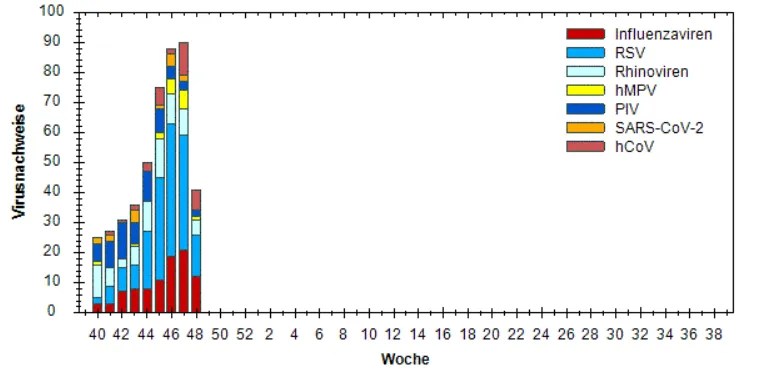
The chart, from the flu surveillance division of the RKI, shows that RSV is by far the most dominant infection among under five years olds. The virus is particularly dangerous for infants.
Measures sold to the public as means of keeping our healthcare system from collapsing, have thus resulted in unprecedented pressure on German pediatric treatment facilities and hospitals, with dying children facing delayed operations and long transfers to outlying hospitals. Obviously it doesn’t help that the zealous vaccinators have driven away scarce healthcare staff with their mandates and other pointless harassment. All those people who spent 2021 singing the praises of lockdowns and crowing that they hadn’t had so much as a cold since the pandemic started, should now be made aware of what their policy preferences actually cost. Adults are supposed to get mild upper respiratory infections once in a while. If they don’t, their infants will get them instead, and some will die.
The Manhattan Contrarian Energy Storage Paper Has Arrived!
By Francis Menton | Manhattan Contrarian | December 1, 2022
Today my long-awaited energy storage paper was officially published on the website of the Global Warming Policy Foundation. Here is a link. The paper is 22 pages long in the form in which they have published it plus another few pages for an Executive Summary and table of contents. They have given it the title “The Energy Storage Conundrum.”
Most of the points made in the paper have been made previously on this blog in one form or another. However, there is a good amount of additional detail in the paper that has never appeared here. I’ll provide one example of that today, and more of same in coming days.
The main point of the paper is that an electrical grid powered mostly by intermittent generators like wind and sun requires full backup from some source; and if that source is to be stored energy, the amounts of storage required are truly staggering. When you do the simple arithmetic to calculate the storage requirements and the likely costs, it becomes obvious that the entire project is completely impractical and unaffordable. The activists and politicians pushing us toward this new energy system of wind/solar/storage are either being intentionally deceptive or totally incompetent.
If you follow the news on this subject at a general level, you might find this conclusion surprising. After all, there are frequent announcements that this or that jurisdiction has entered a contract to purchase some seemingly large amount of batteries for grid-level storage. The Report cites data from consultancy Wood Mackenzie as to announced plans or contracts for storage acquisition in all major European countries, and cites other reports as to announced plans from California and New York in the U.S. The title of the April 2022 Wood Mackenzie paper on Europe certainly gives the impression that these people have the situation under control and know what they are doing: “Europe’s Grid-scale Energy Storage Capacity Will Expand 20-fold by 2031.” Impressive!
But this is one of those subjects on which you have to look at the actual numbers to evaluate whether the plans make any sense. In this situation, you need to compare the amount of energy storage that would be required for full backup of an almost-entirely wind/solar grid (with fossil fuels excluded), to the actual quantity of grid-scale energy storage being acquired.
Consider the case of Germany, the country that has gone the farthest of any in the world down the road to “energy transition.” My Report presents two different calculations of the energy storage requirement for Germany in a world of a wind/solar grid and no fossil fuels allowed (both of which calculations have been previously covered on this blog). One of the calculations, by a guy named Roger Andrews, came to a requirement of approximately 25,000 GWh; and the other, by two authors named Ruhnau and Qvist, came to a higher figure of 56,000 GWh. The two use similar but not identical methodology, and somewhat different assumptions. Clearly there is a large range of uncertainty as to the actual requirement; but the two calculations cited give a reasonable range for the scope of the problem.
To give you an idea of just how much energy storage 25,000 (or 56,000) GWh is, here is a rendering (also from my Report) of a grid-scale battery storage facility under construction in Queensland, Australia by Vena Energy. The facility in the rendering is intended to provide 150 MWh of storage.

Remember that 150 MWh is only 0.15 of one GWh. In other words, it would take about 167,000 of these facilities to provide 25,000 GWh of storage, and about 373,000 of them to get to the 56,000 GWh in the larger estimate.
And against these projections of a storage requirement in the range of tens of thousands of GWh, what are Germany’s plans as presented in this “20-fold expansion” by 2031? From my Report:
In the case of Germany, Wood Mackenzie states that the planned energy storage capacity for 2031, following the 20-fold expansion, is 8.81GWh.
Rather than tens of thousands of GWh, it’s single digits. How does that stack up in percentage terms against the projected requirements?:
In other words, the amount of energy storage that Germany is planning for 2031 is between 0.016% and 0.036% of what it actually would need. This does not qualify as a serious effort to produce a system that might work.
The story is the same in the other jurisdictions covered in the Report. And remember, these are the jurisdictions that consider themselves the leaders and the vanguard in the transition to renewable energy. For example, New York, with an estimated storage requirement for a mainly-renewables grid of 10,000-15,000 GWh, is said by trade magazine Utility Dive to be “forging ahead” with plans to procure some 6 GW of grid storage (presumably translating into about 24 GWh). That would come to around 0.2% of what is needed. Unless, of course, New York simultaneously “forges ahead” with its plans to triple the demand on the grid by electrifying all automobiles and home heating; in that case the 24 GWh would be back down to less than 0.1% of the storage requirement.
California? The Report cites another article from Utility Dive stating that the California Public Utilities Commission has ordered the state’s power providers to collectively procure by 2026 some 10.5 GW (or 42.0 GWh) of lithium-ion batteries for grid-scale storage:
The additional 10.5 GW of lithium-ion storage capacity, translating to at most about 42 GWh, would take California all the way to about 0.17% of the energy storage it would need to fully back up a wind/solar generation system.
However bad you might think this situation is, it’s worse. Am I the only person who has ever made these simple calculations? I certainly have never seen them anywhere else.
I would be very happy to be proved wrong about any and all of this. All I say is that the proponents of this miraculous fantasy energy future owe it to the rest of us to build a working demonstration project before forcing us all to adopt their utopian scheme at ruinous cost, only to find out that it won’t work and can’t work.
Here’s what tells you all you need to know: not only is there no working demonstration project anywhere in the world of the wind/solar/storage energy system, but there is none under construction and none even proposed. Instead, the proponents’ idea is that your entire state or country is to be the guinea pig for their dreams. After all, they are “saving the planet.” If there has ever previously been something this crazy in the history of the world, I certainly can’t name it.
Get it Right, Washington Post, Climate Change Isn’t Causing a Decline in Coral Reefs

By H. Sterling Burnett | Climate Realism |November 21, 2022
The Washington Post (WP) published a story detailing how the efforts by a Malaysian “coral gardener,” Anuar Abdulla, to restore coral reefs near his home have resulted in him being consulted on coral restoration efforts globally. Unfortunately, rather than simply delivering well earned praise to Abdullah for his worthwhile efforts, the WP had to turn the story into another in its on-going “Climate Solutions” series, blaming coral decline on climate change. This is false. Some corals have declined in recent years, others have expanded, and new colonies have been discovered. Of those that have declined, there is little support for any link to climate change, and a great deal of evidence pointing to other factors being behind local coral declines.
In the story, titled “One man’s lonely quest to save the world’s corals draws a following,” reporter Rebecca Tan writes:
For nearly four decades, the coral gardener [Anuar Abdullah] worked alone.Abdullah has spent his entire adult life restoring coral reefs, until recently working in obscurity — and at times, in poverty.
In a world rapidly losing its reefs to climate change and to environmental damage, he is now emerging as an increasingly influential expert on how to revive them. Governments and resorts have come calling, asking whether he can help with reefs lost to natural disasters and overtourism.
Tan acknowledges factors besides climate change are contributing to coral decline. She should have explored those in greater detail and left off her misplaced climate change harangue because there is no data to support the claim that long term climate change is causing coral decline.
As discussed at Climate Realism, here, for example, corals are hardy and resilient. The first corals arose during the Cambrian Period about 535 million years ago and the number and type corals increased dramatically more than 400 million years ago, coming into existence when global temperatures and carbon dioxide concentrations were much higher than at present. Coral have proved adaptable, expanding their range, evolving, and thriving through periods of higher and lower temperatures than the Earth is either currently experiencing or can be reasonably expected to experience in the foreseeable future.
As discussed in Climate at a Glance: Coral Reefs, coral thrive in warm water, not cold water, and recent warming has allowed coral to expand their range poleward, while still thriving near the equator. Despite bleaching events, coral have expanded their range, and new coral reefs are discovered all the time. Science also shows that scientists have woefully undercounted the number or coral reefs and colonies in existence.
Nor, climate alarmists claims to the contrary, is there any evidence rising carbon dioxide levels are making Earth’s oceans and seas acidic. Since the oceans and seas are not becoming acidic, it is impossible for “ocean acidification” to be harming coral colonies.
If not warmer waters or ocean acidification, what factors are likely to have driven coral bleaching events in recent years. Tan named two of the culprits: natural disasters and overtourism. As explained in multiple Climate Realism posts other factors that have caused temporary or permanent damage to some coral colonies in various locations include: fishing and coral harvesting; coastal development and associated siltation and pollution; agricultural runoff; and pollution tied to sun block used by swimmers. While rapid influxes of warmer waters from natural shifts in ocean currents have caused temporary bleaching events on occasion, experience shows most coral recover from such events and multiple studies show corals can and do adapt to the gradual long-term pace of global warming.
Coral reefs are critical to ocean biodiversity. The world should be grateful for Anuar Abdulla’s efforts to restore coral reefs. He deserves all the praise he receives for this work. However, looking at coral reefs more broadly, in order to help coral reefs recover or make them more resilient to harmful impacts, one must first accurately identify the causes of their decline. The Washington Post, for the most part failed here. Because climate change isn’t harming coral reefs, trying to protect coral health by fighting global warming is a misplaced effort. Resources spent there, could be better applied to reducing or mitigating the true causes of coral losses—which, of course, is precisely what Abdulla is doing on a case by case basis.
Featured Video

Pravin Sawhney: Massive Escalation Pushes Every Side Toward the Brink
or go to
Aletho News Archives – Video-Images
From the Archives
A sample of vaccine and injectable medication tragedies during my lifetime
This is what happens when you demand speedy production in an era of politicized regulation
By Meryl Nass, MD | February 12, 2022
All these tragedies have been due to failures of testing or failures in manufacturing processes. Most occurred before vaccine manufacturers were given virtually complete protection from liability in 1987.
With the duration of patent exclusivity determining how much new products earn, products are rushed to market as quickly as possible, most using a shortened path for FDA review. Recalls and market removals of approved products are much more common than they used to be. We can only expect more of these disasters in the future, especially if the products are mandated for everyone. … continue
Blog Roll
 Aletho News
- Trump claims funding to Israel ending in 2026 as merger of Israeli–US armies looms
- Iran Weathering The Storm, But Saudi Arabia Is Sinking
- Sunk Ships Don’t Sail Home: Why Peace Won’t Save the Oil Market and War Will Wreck It
- No Cossacks at the gates, fix Italy instead – opposition leader to Meloni
- The Pits: Zelensky’s torture chamber network in the public eye
- Moscow mocks Kiev’s language hypocrisy exposed by ‘torture chamber’ scandal
- Military ‘torture chamber’ triggers new scandal in Kiev
- Algerian army launches second operation to clear French nuclear test sites
- Pravin Sawhney: Massive Escalation Pushes Every Side Toward the Brink
- UK High Court Upholds Speech Regulator Notices To Meta, WhatsApp, X, And TikTok
- If Americans Knew
- An error has occurred; the feed is probably down. Try again later.
- No Tricks Zone
- Germany’s Green Energy Transition Becoming Increasingly Expensive…Another 6 Trillion Euros!
- Sudden Stratospheric Warming, Powerful El Niño Combination May Lead To Extreme Europe Cold, Energy Crisis!
- Two New Studies Find Thwaites Glacier Melt Cannot Be Driven By Human Activity Or A Warming Ocean
- E-Cars Reduce CO2 Emissions By Only 41% Compared To Internal Combustion Engine Vehicles
- Predictions Made By Renowned Climate Professor Over Past Decades Have Been Proven To Be Poor
- New Study Suggests Large Regions Of The Pacific Ocean Have Been Cooling For The Last 80 Years
- Germany’s Green Energy Debacle: High Energy Costs Force Kahla Porzellan to Close After 182 Years!
- New Study: 50 Years Of The Most Aggressive ‘Net Zero’ Policies Can Only Affect The Global Climate By 0.03°C
- US September “Heat” Was No Record…Many Records Set Decades Ago
- Latest European Green Energy Debacle; Portugal’s Largest Flagship Solar Park Insolvent!

