EU blocks protesting farmers in Brussels using barbed wire, tear gas and water cannons
Remix News | December 18, 2025
As the EU moves to crush protesting farmers demonstrating in Brussels, Hungarian Prime Minister Viktor Orbán offered full backing to the farmers and their efforts to stop the EU’s Mercosur free trade deal, which threatens to destroy food security in Europe.
“Farmers are 100 percent right,” said Orbán, who is currently in Brussels attending the EU Summit.
He added that the farmers have obvious issues with the Mercosur package, a free trade agreement with Latin American countries, because it “kills the farmers.”
“Hungary is one of the countries that does not support the Mercosur agreement. There were serious professional debates about this in Hungary, and the Hungarian position was that we do not support this,” said the prime minister.
Viktor Orbán reminded that the agreement would require a qualified majority, and according to his expectations, there is not enough support.
“Mercosur opponents make it impossible for this agreement to be signed. The plan is that the President of the European Commission wants to sign this later this week. I think this needs to be stopped here now, and we can prevent it,” he said.
He also said that another problem for farmers is the Green Deal, which leads to expensive overregulation in agricultural work in such a way that it represents a serious cost and competitive disadvantage for European food producers.
“So I have to say that with the Mercosur agreement, they are shooting European farmers in the foot, but before that, they tie their legs together so that they have no chance in the global competition,” he stated.
“That is why the farmers are absolutely right, the Hungarian government is 100 percent with the farmers,” said the Hungarian leader.
Farmers met with force
The use of force against farmers in Brussels is drawing criticism from Hungarian journalists, including Dániel Deák, the senior analyst of the Század Institute. He published a video report showing the European Commission building, or Ursula von der Leyen’s workplace, surrounded by barbed wire.
According to him, with these measures, they are trying to prevent farmer protesters from getting close to the president of the European Commission.
In the report, he also drew attention to the fact that if they tried to limit a demonstration in Hungary in a similar way, by placing barbed wire, it would provoke significant protests from the left, and the European Union would also talk about the use of “dictatorial means.”
In his opinion, all this once again points to the hypocrisy that is often used against Hungary. He also emphasized that demonstrations in Hungary can be held and that no attempt is made to make them impossible with barbed wire.
Western media peddle Russia’s ‘abduction’ of Ukrainian children to prolong the proxy war
It is not Moscow, but rather the Kiev regime and its backers who are using children as “pawns of war”
By Finian Cunningham | RT | December 18, 2025
It’s not clear if the Trump administration wants to genuinely resolve the proxy war with Russia, or if it is merely trying to extricate itself from the mess Washington helped instigate. But one thing is clear: the major Western European capitals are desperate to keep the war going.
Various pretexts are being used to frustrate a diplomatic process. NATO-like security guarantees to Ukraine pushed by Berlin, London, and Paris are likely to be a non-starter for Moscow. So too are moves by the Europeans to use Russia’s seized wealth as a “reparations loan.”
Another issue that Europeans are dredging up is the allegation that Russia has abducted Ukrainian children. This emotive issue has support in Washington among the hawkish anti-Russia factions in the US establishment opposed to Trump’s diplomacy with Moscow.
Earlier this month, the European states sponsored a resolution at the United Nations General Assembly calling on Russia to return all Ukrainian children that it is alleged to have forcibly relocated from Ukrainian territory during the past four years of conflict. The president of the UNGA is former German Foreign Minister Annalena Baerbock.
An article published by the Washington DC-based Atlantic Council contended: “The issue of abducted Ukrainian children is especially relevant for Ukrainians as they debate painful political compromises, territorial concessions, and security guarantees premised on Western assurances. If world leaders cannot secure the return of the most vulnerable victims of Russia’s aggression, how could Ukrainians trust that those same leaders can prevent Russia from reigniting the war or committing new atrocities?”
In other words, the allegation of child abduction is being made into a condition for Russia to fulfill for the diplomatic resolution of the conflict. The trouble is that the condition is impossible to fulfill because the allegation is so vague and unfounded. Russia has denounced the accusation that it forcibly relocated Ukrainian children as a “web of lies.”
In March 2023, the Hague-based International Criminal Court indicted Russian President Vladimir Putin, along with Russian Commissioner for Children’s Rights Maria Lvova-Belova, of war crimes related to the unlawful deportation of Ukrainian children to Russia.
Moscow is not a member of the ICC and rejected the charges as null and void.
Still, however, the Kiev regime and its Western sponsors continue to level the accusations. The Western media, as usual, serve to amplify the narrative despite the lack of evidence.
At the recent UN General Assembly debate, British representative Archie Young stated: “Today is a moment to reflect on the plight of Ukrainian children who have become victims of Russia’s illegal invasion. We all have an obligation to protect children and must not allow Russia to use them as pawns of war. According to the government of Ukraine, corroborated by independent mechanisms, more than 19,500 Ukrainian children have been forcibly deported to Russia or within the temporarily occupied territories.”
Note how the British official peddles a series of disputable claims that are transformed into normative facts by the Western media’s repetition.
It is not Russia, but rather the Kiev regime and its Western backers who are using children as “pawns of war.”
Moscow has openly stated that up to 730,000 children have been relocated to the Russian Federation since hostilities erupted in February 2022. Most of the children are accompanied by parents and come from the territories that seceded from Ukraine in legally held referenda.
Of the nearly eight million people who fled Ukraine, the largest share of them – an estimated 35% – have taken shelter in Russia. The second and third biggest host countries for Ukrainian refugees after Russia are Poland and Germany. But the European governments and media are not accusing Warsaw or Berlin of “child abductions.”
In a war zone affecting millions of people, it is absurd to make out that displaced families and their children are being kidnapped. The vast majority of people have willingly sought shelter within Russian territory to escape the violence on the frontlines – violence that has been fueled by NATO states pumping hundreds of millions of dollars’ and euros’ worth of weapons into Ukraine.
Moscow points out that the figure of 20,000 to 35,000 that the Western governments and media claim for children “abducted by Russia” is never substantiated with names or identifying details.
Russian authorities say that the Kiev regime has provided the names of just over 300 individuals. Moscow has endeavored to return individuals where it is mutually requested, although some of the identities provided by the Kiev regime have turned out to be adults or they are not present in Russian territory.
In the chaos of war, it is all too easy to throw around vague numbers and exploit the imprecision for propaganda. The European governments and media are doing that and embellishing the emotive issue with dark claims that Russia is sending masses of Ukrainian children to “re-education camps” for “indoctrination.”
One of the main sources for such claims is the Yale Humanitarian Research Lab. It has produced unverified reports that Russia has sent 35,000 Ukrainian children to hundreds of brainwashing centers all across Russia to erase their national identity.
A major supporter of the Yale research group is former Secretary of State Hillary Clinton. This association strongly suggests that the group is a CIA-sponsored propaganda tool. But the US and European media regularly cite the research and amplify its claims as reliable facts.
The exploitation of children for war propaganda is a staple of Western intelligence agencies and the media.
A classic case was in Vietnam in the 1950s and 60s when the Western media were replete with horror stories of the Viet Cong torturing Vietnamese children, as recounted by James Bradley in his book, ‘Precious Freedom’. The supposed communist guerrillas reportedly stabbed Vietnamese children with chopsticks in their ears so that they could not hear the Bible being preached. Such alleged atrocities were widely published by the Western media to whip up public support for the US military deployment “to save Vietnam from evil communists.” But it was all CIA-orchestrated lies. More than three million Vietnamese were killed in a war based on American intelligence and media lies.
A re-run of the psychological operation today is the lurid claims that Putin’s evil Russia has kidnapped tens of thousands of children for brainwashing in detention camps. Some reports even claim Russia has sent the children to North Korea.
The Western media are doing their usual service of peddling war propaganda and ensuring diplomacy is rendered impossible because Russia is portrayed as monstrous.
Finian Cunningham is an award-winning journalist and co-author of Killing Democracy: Western Imperialism’s Legacy of Regime Change and Media Manipulation. For over 25 years, he worked as a sub-editor and writer for The Mirror, Irish Times, Irish Independent and Britain’s Independent, among others.
No More Ukraine Proxy War? You’re a Traitor!
Glenn Diesen & Lt Col Daniel Davis
Glenn Diesen | December 16, 2025
I had the pleasure of speaking with Lt. Col. Daniel Davis about how Europe has trapped itself in ideological narratives of good versus evil
Sexual Blackmail Makes the World Go ‘Round
Jeffrey Epstein may be dead, but the network that created him is still screwing us all
Helen of desTroy | December 17, 2025
American democracy has devolved into a humiliation ritual in which we are expected to pledge support for people who hate us so they can steal our property, molest our children, and punish us for talking about their crimes. In election after election we are pressured to declare allegiance to one morally bankrupt criminal, simply because the other morally bankrupt criminal in the race might be even worse, thus becoming complicit in the election of a morally bankrupt criminal. Casting that vote on an electronic voting machine that even the government’s own intelligence director has admitted is totally hackable only strengthens the power of the ritual. Americans feel dumber every time we feed our choices into the ballot scanner and pray not to be disenfranchised, as if our selections made a difference in a contest that has been limited to the “lesser of two evils” for years. Standing up for ourselves and refusing to participate in such demeaning pageantry is denigrated as un-American, and our sentimental attachment to the democratic ideal masks the understanding that no change is actually possible within a system designed to deprive us of agency, so we legitimize a corrupt system with our participation instead. Like the teenage victims of Jeffrey Epstein, who returned to his mansions again and again even as they felt the humiliating experience draining their life force because they’d become convinced they could expect nothing better out of life, we have grown so accustomed to having our faces rubbed in outrageous and self-evident lies that we are starting to think we deserve the abuse.
Trump voters in particular have had a difficult year. Spooked back in July by a trickle of leaks suggesting he had been closer with Epstein than he claimed, the president raged at his supporters for demanding the release of the government’s remaining files on the case, despite repeated promises to release them during his 2024 reelection campaign. He sent FBI chief Kash Patel — who had also called for Epstein transparency before joining the Trump administration and acquiring his own Mossad handler (you gonna sue me, Kash?) — to inform the public that Epstein trafficked hundreds if not thousands of girls to absolutely nobody, despite copious documentation including an actual client list featuring at least 20 boldface names in FBI possession. The humiliation ritual was an encore performance for Patel, who had already appeared alongside his deputy Dan Bongino earlier in the year in an infamous clip where the pair, looking more uncomfortable than the stars of the average hostage video, reassured the public that Epstein had killed himself after all — case closed!
Having publicly disavowed the support of anyone still concerned how an intelligence operative working for Israel and the US was able to fly planeloads of teenage girls around the world for sex and lend them out to a who’s who of the global elite, maintaining a trove of compromising video footage of the aforementioned, without authorities lifting a finger in protest or (supposedly) finding the resulting videos, Trump spent several months trying to block the release of the files. He only took time out from railing against what was now declared a “Democrat hoax” to relocate Epstein’s partner-in-crime Ghislaine Maxwell, currently serving a 20-year sentence, to a minimum-security facility, in violation of prison sex-offender protocols. He even teased a pardon for the alleged Mossad asset, whose victims remember her as even more abusive than Epstein himself. Trump targeted Kentucky Republican Thomas Massie — perhaps the most respected man in American politics — with his next social media tantrum, condemning him as a “loser” for co-authoring a bipartisan bill to release the files, then turned his rage on Marjorie Taylor Greene, excoriating the Georgia Republican who was once among his most loyal supporters as a “traitor” because she hosted a press conference with a group of Epstein survivors in support of Massie’s transparency bill. The president even announced he’d host his first fundraiser of the 2026 season to reelect notoriously closeted warmonger Lindsey Graham, South Carolina’s Israel-First senator. By the time Trump finally dropped his opposition to the file release — which predictably showed he had been much cozier with the billionaire child trafficker than he’d admitted in the past — he had effectively alienated most of his base with seemingly unforced blunders that made no political sense.
Rosetta Stone
Unlike most political scandals, which only expose one aspect of the machinery behind the scenes, the Epstein case and its incompetent coverup provide all the intellectual tools needed to understand how the sausage is made. Like the apocryphal apple that fell on Sir Isaac Newton’s head and alerted him to the existence of gravity, the revelation that a multinational intelligence operation rooted in organized crime had for decades trafficked teen girls by the thousands as a means to secure global control not only of politics but of science, technology, industry, and the arts, with full knowledge and even cooperation of multiple law enforcement agencies, highlighted a force that most people had never considered was influencing current events. The phenomenon of Jeffrey Epstein — and the others like him who are still blithely ruining kids’ lives to secure leverage over power — finally makes sense of what for many on the dark side of the informational iron curtain had been a hopelessly scrambled puzzle.
This is why the Epstein files won’t go away, no matter how many distractions are dumped into the news cycle. The Epstein case and the ongoing efforts to bury its implications constitute a geopolitical decoder ring allowing anyone to understand how vibrant, thriving democratic societies are reduced to kakistocratic loosh farms with seeming impunity. Seen through the lens of Epstein — the real-world equivalent of the glasses from They Live — the narrative deceptions and limited-hangout misdirections become transparent, the proximity alarms surrounding “dangerous” thoughts are defused, and one can see right into the beady little eyes of the organized crime ring masquerading as a country masquerading as a religion, headquartered in modern-day Israel, that has its tentacles in every boardroom (and bedroom) in the West. While the source of its power was once a closely-guarded secret — journalist Danny Casolaro was famously murdered for investigating aspects of the network, which he called “The Octopus” — it has more recently leaned into the power of ritual humiliation in cementing its dominance, and can frequently be found flaunting its impunity. This is “Big Parasite” (think Big Pharma or Big Oil), an empire built through the covert extortion of resources from its host.
Because the first rule of Pedo Club is you don’t talk about Pedo Club, it’s difficult to determine when this tactic became widespread as a means of coercion. Whitney Webb credits the Prohibition-era Jewish mafia, who used it on the law enforcement agencies that were supposed to be pursuing them, earning years of peace while the mortified cops looked the other way. But it has certainly reached its nadir in modern Israel, where soldiers who gang-rape Palestinian prisoners are celebrated as heroes while rabbis campaigning for peace are arrested for bringing food to starving people. Built by terrorists, criminals, and Nazi-collaborators to provide a secure base of operations and diplomatic cover for their illegal enterprises, forced down the world’s throat through the judicious application of blackmail and bribery, Israel quickly became the ultimate money-laundering front and an extradition-proof haven for pedophiles. It has secured de facto exemption from nearly every international treaty, human rights convention, international arms agreement, and social norm that binds the civilized world, using a muscular and deep-pocketed propaganda apparatus to escape accountability by blaming its enemies and bribing or threatening allies to look the other way. Its victims are preemptively accused of the crimes committed against them so that when they do contact authorities, they appear suspect. Its trained assassins will kill another nation’s citizens anytime, anywhere to remove an obstacle to further consolidation of power, and whenever the central bank needs a top-up, the US and Europe will fight each other for the privilege of handing over their last pennies to the country that has everything (except a soul).
While a Venn Diagram depicting Big Parasite and “The Jews” would partially overlap, it would also show a serious imbalance in power driven by what “ex-Jew” Gilad Atzmon calls pre-traumatic stress syndrome — a pathological reaction to a feared (but nonexistent) trauma. Big Parasite, conflating Zionism with Judaism to justify the existence of its criminal outpost in the Middle East, claims to speak for all Jews while advocating the ethnic cleansing of “Greater Israel” and other war crimes. The resulting international condemnation of Zionist aggression, spun as a surge in anti-Jewish hate by a media establishment in the pocket of the thugs doing the killing, frightens “the Jews” — who’ve been propagandized from the cradle to believe that everyone wants them dead simply because they’re Jewish — back into the arms of their Zionist manipulators. But while it is undeniable that Jews in the West enjoy some privilege as a trickle-down benefit from their leaders’ influence, it has long baffled me why more of them don’t condemn those leaders’ crimes, at least for self-preservation’s sake, since they reflect so poorly on the entire group. When a serious effort is finally made to rip the Zionist facehugger off Lady Liberty, Americans will remember who it was that pimped her out and then cut out the people’s tongues to stop their complaining.
But Jewish apathy toward going down with the Zionist ship makes more sense as a manifestation of learned helplessness, itself the product of the very real trauma of epidemic child sexual abuse within the Orthodox tradition. Those who try to blow the whistle are ostracized as traitors, so the majority keep silent, becoming complicit in the abuse and even developing a Stockholm Syndrome-like loyalty to the group. The powerful Chabad Lubavitch sect, which counts Epstein lawyer Alan “I kept my underwear on” Dershowitz and Jared Kushner as adherents, is particularly notorious for protecting child abusers, shuttling offenders between cities (a tactic also used to protect Catholic predators within the priesthood), colluding with secular authorities to bury the charges, and ostracizing parents of victims. One popular Chabad rabbi admitted in 2013 that most of the children in its programs had been sexually abused at some point and even defended the practice as harmless, arguing it was up to the victims how they felt about the experience. Tunnels discovered beneath the group’s Brooklyn headquarters in a police raid last year contained stained child-sized mattresses and other kiddie furniture. Ghislaine Maxwell, half-Jewish only on her father’s side, officially converted in prison to access privileges supplied by a Chabad-linked group. The absence of a strong cultural taboo against child predation in many Jewish communities means that even if some amoral entity were to entrap Netanyahu himself in bed with a dead girl or a live boy, it’s unlikely that he would lose the support of diaspora Zionists. Big Parasite itself is thus all but immune to the pedophilic blackmail it has weaponized against the world, and only this can explain its staying power.
Child-Trafficking As Statecraft
Epstein began working for this pedocentric network in the 1980s with the CIA, and by 1983 was working with media baron and Israeli spy Robert Maxwell, according to former Israeli intelligence officer Ari Ben Menashe. While the US and Israel were already running multiple trafficking rings that used underage children to compromise powerful figures as part of their Iran-Contra operations, Israel’s military intelligence directorate Aman had selected Epstein to deal with a more serious threat: the US was considering making peace with the Palestinians and had to be stopped, Epstein was told, with orders to set up his own ring and blackmail presidential candidate Bill Clinton with underage girls. Through L Brands and Victoria’s Secret owner Les Wexner, a billionaire faithful to the Zionist cause with mafia ties hidden beneath his respectable clothing business, Epstein was outfitted with a massive Manhattan townhouse outfitted with state-of-the-art surveillance in every room, a seemingly bottomless bank account, and a low-effort cover story that cast him as money manager for Wexner, who as co-founder of the Mega Group, a “philanthropic club” where 20 of the wealthiest and most powerful Zionists could focus on advancing the cause of Jewish supremacy, had a potentially unlimited amount of power and influence at his fingertips.
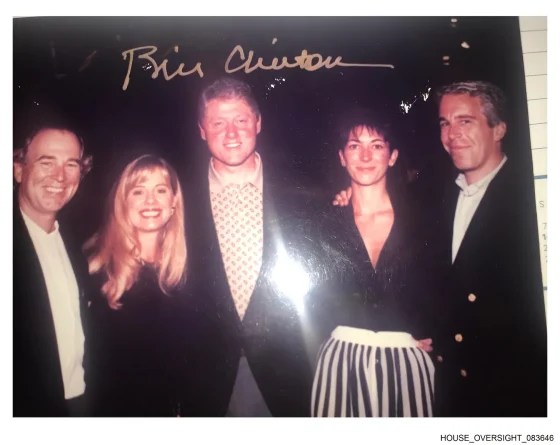
Dumb and horny, just like we like ‘em!
While Clinton was such an enthusiastic participant in his own compromising that it’s impossible to say which honeypot (Monica Lewinsky being the most famous) secured his cooperation, a nation that views the peaceful solution to a conflict as a greater evil than child-trafficking has clearly lost the plot. By the time Epstein’s operation was in full swing in 2000, Israel was literally run by (“alleged”) rapists. Ehud Barak, who would later be accused by Virginia Giuffre of raping her so violently she bled for hours and becoming aroused by her terror as she begged for her life, was prime minister, while Moshe Katsev, who would later be convicted of raping one of his employees, was president. That same year, the nation welcomed back Arie Scher, its disgraced vice-consul of Rio de Janeiro, after he was found to be trafficking children to Israeli tourists in Brazil, not only not prosecuting him but handing him a promotion as Consul of Canberra (Australia, in a rare show of good judgment, wouldn’t let him in). Another Israeli child trafficking ring was exposed in 2018 in Colombia, operating with protection from local authorities.
Barak seemed genuinely surprised when his friendship with Epstein, whom he would continue to visit at least 30 times in the US after the pedophile’s 2008 conviction required him to register as a sex offender, became a sticking point for voters during his attempted return as Prime Minister in 2019. Unwilling to believe Israelis had suddenly started caring about rape, especially rape of impoverished shiksas, Barak blamed his opponent Benjamin Netanyahu for ginning up a “poisoned atmosphere” to distract from the multiple corruption charges pending against him. Barak had a point — Israel had officially declared itself a Jewish supremacist state the previous year, abdicating any responsibility to protect its second-class citizens. After a 2024 UN report condemned Israel’s acceptance of the use of sexual humiliation, harassment and torture against Palestinian prisoners, 10 IDF soldiers were arrested for gang-raping a Palestinian man being held without evidence as a Hamas fighter. The backlash was immediate as government officials — led by Security Minister Itamar Ben Gvir, who called the rapists “heroes” — rallied to secure their release and demand those who ordered the arrest be punished. The soldiers’ lawyers even argued they had acted in self-defense.
Revelation of the Method
Unlike most intelligence agency honeytraps, Epstein’s trafficking ring included a public relations aspect, with glossy media profiles depicting him as a suave, mysterious, Jay Gatsby-by-way-of-James Bond playboy jet-setting around the world with princes and presidents, a bevy of (near)-babies surrounding him at all times. It is absurd to believe that it took a decade after survivor Maria Farmer first reported Epstein and Maxwell to the FBI for the agency to build a case against him even as he carried on with the same behaviors, or that the agency only found time to interview Farmer in 2006 after Palm Beach police made them look bad by charging the pedophile with abusing a 14-year-old girl. When the Palm Beach case landed in their lap as well, they waited until it was resolved in that jurisdiction, then wrote to victims falsely claiming a “thorough investigation” was underway. The agency’s behavior is less baffling given the FBI has been sexually compromised from its very beginnings, with founder J. Edgar Hoover blackmailed out of the gate by the same organized crime syndicate the agency was established to police, forcing him to deny the very existence of the Mafia for years. One can attribute the same motive to Kash Patel’s “who’re you going to believe, me or your lying eyes?” wide-eyed denials of reality.
Nor was the FBI the only law enforcement agency to mysteriously drop the ball on the 52-page indictment. Palm Beach State Attorney Barry Krischer abandoned the charges that could have put Epstein away for life after meeting with his defense team, deciding probation and a psychological evaluation would be sufficient punishment given that the girls were “prostitutes.” Krischer, who retired the following year, was in charge of the state’s Crime Against Children unit, yet had habitually refused to prosecute cases of men raping teenage girls even when his inaction led to further harm coming to the girls. His true motives were likely revealed in the award he would receive 10 years later from the Anti-Defamation League, an organization that was literally founded to protect Jewish pedophile and murderer Leo Frank from justice after he was found guilty of murdering his 13-year-old factory employee Mary Phagan. Bellowing the quiet part out loud, the ADL’s “Jurisprudence Award” is supposed to recognize “an outstanding contribution to the legal profession and to the community at large, while exemplifying the principles upon which the Anti-Defamation League was founded.” It certainly did that last part.
Palm Beach police chief Michael Reiter kicked the case up to US Attorney Alex Acosta, who also fumbled it, agreeing with Epstein’s lawyers to an infuriating no-prosecution deal on a single charge of soliciting a teen prostitute that would allow him to serve just 18 months in jail with day release. Victims were not told of the agreement, in violation of federal law. Acosta would later admit when he was interviewed by the Trump transition team for a cabinet post that he had been ordered to back off Epstein because “he belongs to intelligence,” but this was apparently acceptable to the incoming administration, which appointed him Secretary of Labor. Only when the public learned of the interaction was he pressured to resign.
Epstein had briefly considered fleeing to Israel like so many pedophiles before him in order to escape conviction, even complaining to friends that an “antisemitic conspiracy” in Palm Beach was to blame for his prosecution, a notion other Palm Beach Jews who didn’t spend their days molesting children found ludicrous. But instead, he embraced his new routine, leaving his cell each day to go to “work” and sneaking girls into his “office,” and served just 13 months of his sentence. He ignored the requirement that he register as a sex offender and was never asked to, nor did his wealthy and powerful friends drop him over his conviction.
As an asset of both US and Israeli intelligence, insulated in the personal wealth of mafia-affiliated Mega Group billionaires, surrounded by the wealthiest, most influential, and most powerful people he and Maxwell could lure into their nest, a retinue of nymphets obediently attending to his every need, Epstein likely believed that truly “getting caught” was impossible and thus resumed flaunting his lifestyle after weaseling out of the 2006 charges. Indeed, it’s the flaunting of the crime that makes for such an effective humiliation ritual. Confronted with such a towering miscarriage of justice, it is impossible to believe in the integrity of the US political system, and the destabilization of society advances by leaps and bounds.
Sex Slaves Breed Thought Slaves
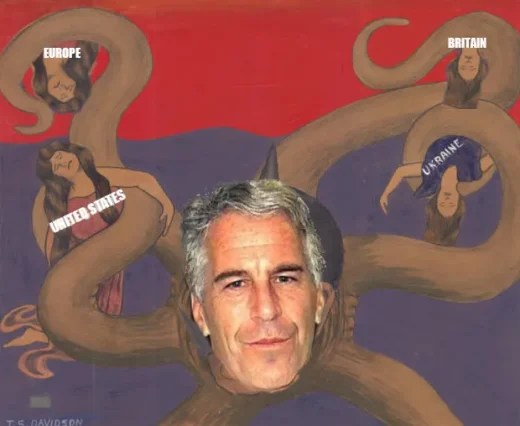
The reason for the treason
Only by recognizing the role of sexual blackmail and the networks that run it can Americans understand the generational betrayal that has reduced our political system to just another asset-stripping mechanism. Decades under the thumb of Big Parasite have withered the US from a proud world power to a desiccated husk, one unethical compromise at a time. Dignity and patriotism left the building when, fresh off a starring role in the assassination of JFK, Israel persuaded his successor Lyndon Johnson to look the other way as it attempted to sink the naval intelligence ship USS Liberty, killing hundreds of Americans to drag Washington into its war with Egypt. Johnson, repeatedly blocking rescue efforts so as to leave no survivors to tell the truth about the attack, inaugurated a traitorous tradition that subsequent presidents have followed religiously. Israel will be permitted to violate everything from international law to the laws of physics, while the US will stand by to enforce its lunatic demands. Americans, reduced to serfs on an Israeli plantation, embraced the scam of Christian Zionism to try to make some moral sense of the situation, a coping mechanism the Israeli lobby has eagerly exploited with propaganda campaigns aimed at turning American churches into recruiters for what is ultimately a self-effacing death cult. As the US’ national debt spirals uncontrollably alongside its foreign aid bill, it is a wonder Big Parasite has not instituted a debt forgiveness program that allows Americans to offer up their nubile young daughters as payment. What do you get the nation that has everything, besides shame?
Only when the role of institutionalized pedophilia as the driving force within the halls of power is taken into account does the behavior of American politicians, uniting in lockstep to tear up the Bill of Rights so Israel’s feelings aren’t hurt, make any sense. Mere avarice or lust for power cannot account for the anti-human, shortsighted cravenness that defines the political class. Warehouses full of video recordings of these people and their associates schtupping 14-year-olds can.
When a State Department official praises Israel over the US and brags about sporting a Star of David necklace despite being Italian, it’s not because they don’t understand optics. When the Democratic Party commits political Seppuku by embracing a “hug Bibi” pro-Israel strategy in the middle of a genocide, it’s not because they love the wildly corrupt Israeli PM more than their jobs. When BlackRock-controlled brands like Bud Light and Jaguar clamber on board the LGBT bandwagon in the most tone-deaf way possible, offending their entire customer base and tanking their stock price with commercials that constitute aesthetic terrorism, it’s not because they love gay people or hate money. These are acts of ritual humiliation that provide Big Parasite with spiritual nourishment. Many of Epstein’s victims report that he and Maxwell seemed to take as much pleasure in their fear and distress as they did in the sex itself. Like the girls, blackmailed politicians must betray themselves anew with every assignment, cringing through life like a kicked dog knowing somewhere in a nondescript warehouse sits evidence of crimes that could put them away for a very long time. It’s kiss the Wailing Wall or kiss their ass goodbye.
Destroying Something Beautiful
While the media has lazily followed Alan Dershowitz’s lead in characterizing Epstein’s victims as trailer-trash juvenile delinquents barely on the wrong side of the age of consent, Epstein and his associates were in fact very picky about their prey, spending at least as much time strategizing the ruination of the flower of gentile feminity (the absence of Jewish girls from the “sisterhood,” confirmed by Maria Farmer and also notable among the victims of producer Harvey Weinstein, is notable given the ethnic-supremacist ideology of the parasite class) as they did on compromising VIPs — though admittedly it wasn’t rocket science getting a prince or a president to drop his zipper in the presence of underage beauties. They wanted “white girls” who appeared “prepubescent” and demure, according to survivor Courtney Wild, while another report specified their ideal type as “nymphishly thin, with no tattoos.” Maxwell insisted the girls should be “as young as possible.” Not only were they required to be virginal and disease-free (on pain of death), but they were forbidden from drinking, smoking, and using drugs and put on strict diets if they started to gain weight. Academic achievement and artistic talent were a bonus. Youth and beauty were important, but it was purity and innocence they were targeting.
Epstein was ideally placed to recruit girls — and charm their wealthy parents — from his first job, having been installed as math and science teacher at the prestigious Dalton School despite lacking even a college degree in what was likely an intelligence posting designed to position him in New York high society. He leveraged his financial benefactor Les Wexner’s Victoria’s Secret brand to great effect, enticing girls to his townhouse by pretending to be a model scout. At Interlochen Center for the Arts, where he had attended a youth music camp, his name emblazoned on the “Jeffrey Epstein Scholarship Lodge” helped him pick up musicians, while New York Academy of Art’s dean of students Lisa Guggenheim allegedly pimped out her choicest young students to him, among them Maria Farmer, the painter who would first report Epstein to the FBI.
So innocent when she first met Epstein at a gallery show that she actually believed his explanation that the steady trickle of young girls (many in school uniforms) in and out of his townhouse were Victoria’s Secret models on casting calls, Farmer, hooked with the promise of helping her art career, reluctantly agreed to travel to brand owner Les Wexner’s Ohio estate to work as an artist in residence. Trapped on the well-guarded property and verbally abused by Wexner’s wife Abigail, she was kept under constant surveillance and forbidden to eat at the “Jewish-only” country club on the property, losing 20 pounds as she gradually lost her will to resist.
Farmer only snapped out of her despondency when Epstein and Maxwell sexually assaulted her during a visit to the estate. The pair had set their sights on her younger sister Annie after spotting a nude photo of her that Farmer had used for a painting, and Farmer realized she had been bundled off to Wexner’s so that they could have full access to the younger girl. While she ultimately escaped and reunited with her sister, her art career had been destroyed, not helped, by her association with Epstein, who had forced her to turn down a Hollywood painting commission so she could be locked away in Ohio instead. He and Maxwell threatened to cut her off from “art related opportunities,” and she fled the city to get away from them. Despite her pre-Epstein success selling $20,000 paintings and showing in galleries, she stopped painting for 20 years, explaining to Whitney Webb, “They destroyed me on purpose.”

Farmer’s painting depicting Epstein-world as a “diagram” for the clueless FBI
While one can only speculate on how many other talented young girls had their creativity deliberately snuffed out, or why this was so important to Epstein and Maxwell, it is clear that many brilliant works of art, music, and literature that could have uplifted humanity were not made because their creators were made to give up. This has left space for Big Parasite, with its chokehold on the entertainment industry, to aesthetically terrorize the population with soulless mediocrity without having to worry about competition. Under their guidance, music and other forms of popular entertainment have become not a celebration of life but a grooming tool, with Diddy’s “freakouts” only the latest sexual blackmail scandal to surface in an ecosystem that was literally built by organized crime. The sexualization of young girls by popular culture and the normalization of pornography have inspired epic pearl-clutching by politicians willing to look at everything except the source. The role of Epstein’s virgin sacrifices in the runaway success of Big Parasite in its cultural warfare against the West should thus not be underestimated.
Playing the Box
The surest route to long-term compliance with an unconscionable order is tricking the target into active participation in enforcing it, a strategy Epstein himself called “playing the box.” Only when their own participation in the trafficking ring had ceased with Epstein’s death did institutional enablers like JP Morgan Chase and the Virgin Islands government experience attacks of conscience over what they’d facilitated for so many years, though both stopped short of taking accountability and blamed the other for allowing their cooperation to be bought. Journalists who had obediently spiked negative coverage of the pedophile during his life marked his death with disingenuous bewilderment at why the media never looked into the girls.
Efforts to defuse the Epstein bomb by grooming the media were underway long before the pedophile was rearrested and “suicided.” Israeli intelligence operatives poisoned the epistemological well in 2017, priming the American public to reject future political pedophilia scandals by seeding 4chan and other social media platforms with the QAnon psy-op. Q recast Trump — whose mentor had been Roy Cohn, perhaps the most famous sexual blackmailer in US history — as a real-life superhero saving trafficked children from Deep State pedophiles. Smothering its kernel of truth (the rich and powerful are in fact preying on children on an industrial scale) in a bath of bullshit (JFK Jr faked his death and is coming back any minute now! here’s Hillary Clinton in a snuff film!), it suggested Trump was only pretending to sell out to the Deep State while secretly outflanking them in “5-D chess” ordinary folks weren’t smart enough to understand. The narrative punch was further spiked with promises that hundreds of sealed indictments dropping any minute now would send Hillary Clinton and other prominent Democrats off to Guantanamo Bay for life, and the cryptic post format encouraged followers to waste hours hunting for hidden messages, effectively making them participants in deceiving themselves. It should surprise no one that both QAnon itself and the 4chan /pol/ board where it originated were confirmed as Israeli intelligence honeypots earlier this year, with half of all /pol/ posts originating from IP addresses in that country. The Q narrative was tailor-made to pacify millions of Americans with hopium — why rise up against the government when there was a chance the “white hats” within the administration might be engaged in deeply heroic feats of child-rescue behind the scenes? — while ensuring the Epstein revelations would be met with yawns and disbelief by “real” journalists.

Who wouldn’t want to be associated with this?
Victims were also tricked into complicity with their abuse with the order to recruit other girls for pay, a dynamic that ensured their silence and kept many in Epstein’s thrall for months or years. What Palm Beach police described as a “sexual abuse pyramid scheme” was far more effective than threats alone. Many girls dutifully came back with friends, needing the money or believing the false promises of career advancement that had lured them to the property in the first place, even as they gradually lost their will to resist under repeated assaults by Epstein and Maxwell. These encounters were designed to humiliate and strip the girls of agency, and the pressure to recruit other girls blurred the line between victim and perpetrator so effectively that some opted to remain silent out of fear of prosecution, a valid concern given the aggressive legal tactics of Epstein’s defense team. Courtney Wild, who recalls bringing as many as 80 girls — all underage — to Epstein for $200-$300 per girl during the three years she spent in his orbit in Palm Beach, says the money kept her out of homelessness, but at a price. When she met Epstein at 14, she was an A student and captain of the cheerleading team despite a troubled home life. Deemed too old for the predator’s tastes at 17, she drifted into stripping and began using drugs, eventually spending time in prison while her abuser continued feeding on her peers.
The same model of grooming that saw Epstein’s victims evolve from shocked repulsion at the public sex acts performed on his properties to reluctant participation and ultimately to gathering juicy details on the VIPs they were loaned out to can be observed in any society under parasitic exploitation. A wet-behind-the-ears politician initially appalled at the feeding frenzy of lobbyists bidding on his integrity will soon be hooked on their money, perhaps even coming to enjoy the quarterly debriefing with the “AIPAC babysitter” the Israeli group has apparently assigned to everyone in Congress except Thomas Massie. Americans who protested George W. Bush’s illegal invasion of Iraq in 2003 didn’t even raise an eyebrow when his successor Barack Obama, Nobel Peace Prize in hand, began bombing five more countries, and later freaked out when Trump threatened to end the war in Ukraine. Repeat an atrocity enough times and it becomes business as usual.
All Wars are Pedos’ Wars
It’s hard not to compare Epstein’s girls — thrown away once they aged out of jailbait, having given their best years in servitude to masters who saw them as “trash” — with the (mostly) male victims of the US military-industrial complex. These, too, are often left broke and broken on the streets after too much killing has rendered them “unfit for polite society” (in the cringeworthy words of Pete Hegseth). War historically harvests the cream of the generational crop, sacrificing the strongest and bravest boys to enrich a ruling class whose own children always dodge conscription, and while voluntary service has lowered the profile of such systematic abuse, poor kids with no prospects are easily enticed into joining the armed forces the same way girls were sucked into Epstein’s world: promises of good pay, good education, and the opportunity to achieve their dreams. Through the ur-humiliation ritual of boot camp, they become aggressive little golems eager to wipe their asses with international law (and their own self-preservation instincts) for America’s Best Friend, blasting brown civilians until they end up losing a limb or their mind and get sent home, the realization finally dawning that they’ve been used and thrown away. Reading US Third Air Force Commander Lt. Gen Richard Clark tell the Jerusalem Post (once owned by Robert Maxwell) that US troops would be ready and willing to die for Israel, how many veterans felt like General Patton, horror dawning that they have defeated the wrong enemy and doomed the world? Certainly, Israel’s continued existence as a nuclear-armed ethnostate determined to achieve the ultimate loosh harvest by conducting the world’s first live-streamed genocide in Gaza — gorging themselves on the suffering not only of the Palestinians but of everyone who watches the violence knowing that it’s funded by their tax dollars and that there’s nothing they can do about it —is not going to leave many survivors.
While war for its own sake is beloved by Big Parasite, it too has a parallel pedocentric motive: extracting foreign nations’ nubile natural resources for financial and sexual exploitation through UN “peacekeepers” and private military contractors. Sex trafficking by UN peacekeepers is so common it has its own Wikipedia article. The peacekeeping force seems tailor-made for predators, as they are not governed by local laws, and their home country is unlikely to follow up on a claim against them by a foreigner halfway around the world. Abusers caught in the act are merely sent home. The UN has promised to beef up accountability for decades, but no change has been forthcoming, suggesting the widespread child rape is a feature, not a bug. In Haiti, where Hillary Clinton infamously intervened in 2010 to reduce the sentence of missionary Laura Silsby after Silsby was caught attempting to kidnap 33 children from the country, rape by peacekeepers has become so common that a 2017 investigation found only one woman in 12 who’ve been raped by a UN peacekeeper even bothers to report the abuse anymore, knowing nothing will be done. Wars and natural disasters both provide an ideal environment for stealing children, as populations are displaced and authorities distracted while the presence of foreign do-gooder operations is seen as normal, even desirable, by outsiders.
Because private military contractors are not subject to US or military law when operating overseas, they are extremely popular with intelligence agencies in need of plausible deniability for their black ops. They have also become synonymous with human trafficking. The CIA’s preferred contractor Dyncorp was forced to fire several employees in Bosnia in 1999 after two separate whistleblowers revealed the company was operating a sex trafficking ring with the help of the Serbian mafia, flying girls as young as 12 from Serbia, Russia, Ukraine, Moldova, and Romania into local brothels and sex clubs where they were trafficked to Dyncorp personnel as well as UN, NATO, and human rights NGO workers. Dyncorp was involved in all areas of the operation, forging documents, smuggling the girls through checkpoints, and tipping off brothel owners to raids. Despite an abundance of evidence that included the company’s Bosnia site director making a home video of himself raping two of the girls, no one was prosecuted, the girls were sent back home, and Dyncorp even kept its contract to provide police forces to the UN. However, the whistleblowers were fired. The plane Dyncorp used to bring the girls to Bosnia shared a tail number with a helicopter owned by Epstein, who was known to have purchased his own Yugoslavian sex slave Nadia Marcinkova during the civil war.
In 2004, Dyncorp contract workers at an airbase in Colombia filmed themselves molesting local kids and distributed the video in the streets of Bogota, suggesting self-blackmail may be de rigueur at the company as a form of mutually assured destruction. Another incriminating video leaked online in 2010 showing Dyncorp employees who’d been contracted to train the Afghan police force enjoying lapdances from a young boy dressed as a female. Pizzagate princess Hillary Clinton herself helped squash the story, though the scandal would ultimately leak again in a Wikileaks cable dump. Sex trafficking by military contractors is so common the Pentagon’s effort to ban it (presumably due to the bad publicity) was shot down by industry lobbyists.
In the glorified money laundering operation that is Vladimir Zelensky’s Ukraine, an entire generation of men has been sacrificed so the parasitic elite can indulge their perversions. White Angel, a paramilitary offshoot of the Israeli-funded neo-Nazi group Azov Battalion, has trafficked tens of thousands of children out of the country under orders from Zelensky’s government, taking advantage of demoralized and confused parents’ willingness to hand over their kids to “any person in military or police uniform” amid the fog of war. Paid $2,000 for each stolen child, the state-sponsored predators were deployed daily in villages across eastern Ukraine in a bid to strip its assets before the inevitable Russian victory, given orders to use violence against parents who would not voluntarily hand over their kids. Ending up an Israeli billionaire’s sex slave might actually be the more desirable of the options open to kidnapped Ukrainian children, however — many were allegedly sold for parts, with organ trafficking such big business in the country that the Verkhovna Rada literally legalized organ theft in 2021, removing the requirement for consent from a donor or relative. While the people of Ukraine have long since soured on their corrupt government, it is clear Zelensky and his puppet-masters are unwilling to permit the end of the war because of the sharp drop in income it would entail.
While Big Parasite consolidated itself under the cover of “Israel” when that nation was created, taking advantage of international sympathy towards Jews post-WW2 to ethnically cleanse its new home with shocking viciousness, it has always been a global network whose only real loyalty is to itself. Organized child sex trafficking is not a recent innovation. An attempted crackdown on “white slavery” in Eastern Europe in the late 19th century raised familiar questions regarding impoverished female victims’ agency in the sex trade, tolerance and even regulation of the trade by the authorities, and the ethnic dynamics of Jewish traders trafficking Polish and Galician nubiles — often tempted with promises of “real” jobs and wealthy husbands, or at least financial freedom — to slave auctions and Middle Eastern harems, their earnings heavily taxed or confiscated. Like Alan Dershowitz, modern apologists for the white slavers argue that desperate families’ willing sale of their daughters — some of whom might have already had sexual experience — in order to pay their debts constituted consensual prostitution, dismissing the stereotype of predatory Jewish slavers as a blood libel because Polish and Galician pimps existed as well and that if Jews hadn’t stepped in to run the sex trade with better business acumen, it would still have existed. Epstein, who bragged about buying “sex slave” Nadia Marcinkova from her parents in Yugoslavia, would be proud.
Pedo-Futurism

Palantir’s Alex Karp, giving a biiiiiig welcome to the technocratic dystopia
It is not only our present that has been hijacked by this criminal gang, but our future. Seemingly driven by the same pre-traumatic stress syndrome that leads them to see a Shoah in every shoelace, agents of Big Parasite have flooded the communications and technology sector with backdoored equipment and spyware so completely that surveillance is the expectation, not the exception. It is not an exaggeration to say that their quest for omniscience created the modern surveillance state, and that this process has been driven, enabled, and protected by sexual blackmailers. Robert Maxwell sold backdoored PROMIS communication software to 42 governments including the US in the 1980s, opening up the mother of all eavesdropping channels. Ghislaine’s sister Christine sold Chiliad datamining software to the FBI to enable its “War on Terror” through aggressive surveillance of Israel’s enemies, guiding US foreign policy off a cliff. Palantir, the CIA-funded pre-crime program that was recently handed centralized control over all US government systems, began as an extension of PROMIS and has blossomed into a dystopian surveillance behemoth whose executives openly boast about killing people and telegraph their allegiances by reminding the world that they “defer to Israel.” Ghislaine’s other sister Isabel opened the door to Big Parasite’s takeover of the internet by convincing Silicon Valley investors to pour funding into Israeli startups in the 1990s, leading to the success of companies like Commtouch, now a ubiquitous and hidden part of email systems used by Google and Microsoft (whose founder, Bill Gates, has been a friend of Epstein since the 1990s). Israeli startups acquired by US tech giants can easily take control of the company’s direction from within without disturbing the public-facing image of the company as all-American, and this has become standard operating procedure for Israel’s military intelligence Unit 8200, which has turned industry giants like Microsoft and Intel into espionage bonanzas even as their products degrade in quality, burdened and bloated with snitchware. When Netanyahu reminded smartphone users that they were “holding a piece of Israel,” he was not exaggerating — Israeli companies like Pegasus, Candiru and Ehud Barak’s Epstein-funded Carbyne911 have perfected the transformation of personal communications device into personal surveillance device.
Every elite sex trafficking scandal that becomes public is reported in a vacuum, as if there have not been hundreds if not thousands more not mentioned here. Evidence of similar rings can be found anywhere humanity’s baser instincts are exploited. Every time we fail to interrogate the “why” of these scandals beyond “powerful men are into forbidden fruit” and keep silent out of fear of offending the boot wedged firmly on our necks, we are giving our agency over to these predators. As long as there are assets left to strip, Big Parasite will be there, luxuriating in our cowardice while it grows fat off our distress. Epstein may be dead and gone, but the network that created him is still screwing us all.
Powerful Israeli Strikes on South Lebanon and Bekaa

Al-Manar | December 18, 2025
The Israeli enemy launched on Thursday a series of air raids on large areas in southern Lebanon and Bekaa in the east of the country, in a new escalation that targeted mountainous areas, valleys and the outskirts of several towns.
Al-Manar correspondent reported that the Israeli airstrikes targeted the outskirts of Al-Rihan in Iqlim Al-Tuffah, as well as the area between the towns of Deir Siryan and Qusayr in the south.
The strikes also hit the Litani River between Zawtar and Deir Siryan in the Nabatieh region, in addition to the Al-Jabbour and Al-Qatrani heights in Western Bekaa, according to our reporter.
Israeli aircraft later renewed their raids, targeting the Mahmoudiya area in southern Lebanon, while other airstrikes hit the Zaghrin heights in the Hermel mountains of the eastern Bekaa, Al-Manar correspondents reported.
Meanwhile, an Israeli drone strike targeted a Rapid vehicle near the road linking the border town to Deir Siryan.
The strike took place as a truck belonging to Electricity of Lebanon public company was present nearby, our correspondent in south Lebanon noted.
“A number of workers were injured as the Israeli strike torched the Rapid vehicle and the Electricity of Lebanon truck,” Al-Manar reporter said.
Later on Thursday, the Ministry of Health confirmed 4 injured in an Israeli airstrike targeting a Rapid-type vehicle in the town of Taybeh, Marjeyoun district.
Commenting on the Israeli strikes, Lebanese Speaker said the Israeli strikes were a “message” to Paris Conference dedicated for supporting the Lebanese Army.
The strikes “are an Israeli message to Paris Conference and sustained bombardment in honor of the Mechanism,” Speaker Berri was quoted as saying, referring to the committee overseeing the ceasefire between Lebanon and the Zionist entity.
UAE-backed militia in Yemen reaches out to Israel for alliance against ‘common foes’: Report
The Cradle | December 18, 2025
The UAE-backed Southern Transitional Council (STC) has reached out to Tel Aviv and pledged to recognize Israel in the event that its goal of an independent, secessionist state in south Yemen is achieved, Hebrew media reported.
According to Israel’s Broadcasting Corporation (KAN), the STC has called on Israel to support “independence” in southern Yemen, and that this would enhance a common agenda between the two sides.
A diplomatic source close to the STC was cited as saying by KAN that Israeli support for the secessionist cause in southern Yemen could contribute to “protecting maritime routes in the Gulf of Aden and Bab al-Mandab, in addition to combating the smuggling of Iranian weapons to Ansarallah and the terrorist cells affiliated with the Muslim Brotherhood that cooperate with Sanaa.”
The source added that the STC needs Israeli backing in military, security, and economic fields in order to form a “new state,” stressing that the two share “common enemies.”
The STC announced on 15 December the start of a new military operation in the southern Yemeni province of Abyan, tightening its grip on the south.
In recent weeks, UAE-backed STC forces have captured the provinces of Hadhramaut and Al-Mahra, and have seized the presidential palace in the southern city of Aden – where both the STC and the Saudi-backed Presidential Leadership Council (PLC) have been based for the past several years.
This prompted Saudi military forces to withdraw from Aden. Riyadh has since called for an immediate withdrawal of the STC from the areas it has captured – a demand which was rejected by the Emirati-backed group during negotiations last week.
The STC now controls practically all the territory that makes up the secessionist state it aspires to form along the borders of the pre-1990 southern Democratic Republic of Yemen.
The country will “never be unified again,” the STC has told western diplomats, according to a report by The Times from last week.
The report also revealed that the STC has sent delegates to meet with Israeli officials recently and discussed their “common cause” with Tel Aviv. The KAN report was not the first to reveal contact between Israel and the STC.
In December 2023, Hebrew media cited a source close to STC as saying that Israel will earn itself a partner in the fight against Ansarallah if it recognizes the secessionist aspirations of the STC.
The UAE was a major partner in the Saudi-led war launched against Yemen and the Ansarallah-led government in Sanaa, which began in 2015.
Despite this, Riyadh and Abu Dhabi have been embroiled in a rivalry for control and influence in Yemen over the past few years. Critics accuse both countries of seeking to divide Yemen to control its natural resources and strategic ports within their respective spheres of influence.
Since the start of the war, the UAE and Israel have established a joint occupation of the islands surrounding Yemen.
In 2023, Saudi Arabia and the Ansarallah-led government in Sanaa were close to reaching a peace deal. The agreement was never finalized or implemented, and the Saudi military continues to shell Saada and other border areas.
Despite this, the peace process halted a major Ansarallah and Yemeni Armed Forces (YAF) offensive against Marib province, which would have brought Sanaa’s forces to the borders of Hadhramaut and Shabwa.
The STC reportedly took a firm stance against the peace talks between Saudi Arabia and Ansarallah at the time.
After the start of the STC advance across Yemen several weeks ago, Saudi-backed tribal forces called for “all forms of resistance” against the UAE-backed militia.
According to The Guardian, up to 20,000 Saudi-backed troops are gathering on the border. Forces backed by the kingdom are also reportedly withdrawing from their positions in Aden and redeploying elsewhere.
Riyadh supports a tribal alliance of armed factions known as the Hadhramaut Protection Forces. It also backs the Muslim Brotherhood-linked Islah Party and the forces of Yemen’s internationally-backed government – the PLC.
While the PLC and STC are at odds with one another, the two are closely linked. Aidarous al-Zubaidi, the deputy head of the PLC, also serves as the president of the STC.
“We hope this can be resolved peacefully, but what happened in Hadhramaut is a dangerous development and negatively impacts the legitimate state institutions. Irregular forces not under state control have invaded stable and secure governorates throwing everything into chaos. Saudi Arabia is determined that these forces must leave and return to their own places. The legitimate government is being fragmented, and the only beneficiary of these intensified divisions will be the Houthis,” said Islah Party Secretary-General Abdulrazak al-Hijri, adding that Ansarallah “[does] not see Yemenis as people” but rather as “slaves.”
His comments contradicted reports from last year that Sanaa and the Islah Party improved their relations after Ansarallah began pro-Palestine operations against Israel.
The UAE’s reverse trajectory: From riches to rags
By Dr Zakir Hussain | MEMO | December 18, 2025
One of the most enduring and widely quoted dialogues in Indian cinema is: “Do not throw stones at others’ houses when your own house is made of glass.” Unfortunately, this wisdom appears to be lost on the United Arab Emirates. Instead of exercising restraint and responsibility, the UAE has increasingly been accused of conspiring with, financing, and backing a wide range of actors and armed groups that have contributed to chaos, instability, and even genocidal violence in several countries.
Over the years, the UAE has steadily expanded the scope of its controversial activities—from Libya and Sudan in North Africa to other mineral-rich Muslim-majority African countries, and further eastward to Afghanistan and Yemen. Its involvement in the Palestinian context also raises serious concerns, as there appears to be no clear moral or political limit to its actions. These interventions have not promoted peace or stability; rather, they have intensified conflicts, deepened humanitarian crises, and prolonged wars.
What makes this approach particularly perplexing is that the UAE itself lacks a credible and robust defensive shield to protect its own territory. It does not possess the capability to fully defend its iconic skyscrapers and critical infrastructure even against relatively unsophisticated, low-cost drones. A coordinated volley of such drone strikes would be sufficient to cause panic among the millionaires and billionaires who have invested heavily in Abu Dhabi and Dubai. Capital, after all, is highly sensitive to risk, and fear alone can trigger massive capital flight.
Against this backdrop, it is difficult to comprehend why Mohammed bin Zayed has chosen to indulge in a strategy of regional destabilisation and proxy warfare. History clearly demonstrates that mercenaries neither win wars nor sustain long, decisive military campaigns. They fight only as long as their financial incentives are met, avoid heavy casualties, and withdraw the moment the cost-benefit equation turns unfavourable.
The UAE has already experienced the consequences of such adventurism in Yemen, where its involvement against the Houthis proved costly and ultimately unproductive. The episode exposed the limits of Emirati military power and underscored its lack of preparedness for prolonged, brutal conflicts. The Emiratis have shown remarkable efficiency in event management, diplomacy branding, and global image-building, but they are ill-suited for sustained warfare or managing the complex realities of civil wars and insurgencies.
Despite these lessons, the UAE continues to deploy mercenaries, supply arms, and push destabilising agendas that risk mass civilian suffering. Such actions not only tarnish its international standing but also make the future of the UAE increasingly uncertain. More importantly, they significantly raise the vulnerability of those who have invested billions and billions of dollars in the country—particularly in real estate and financial assets that depend heavily on perceptions of safety and stability. The UAE has attracted the largest number of high net worth people since the Ukraine war started.
According to one estimate, in 2025 alone, approximately 9,800 high-net-worth individuals moved to the UAE. In 2024, the total number of millionaires who moved to the UAE from Russia, Africa, and the UK is around 130,000, thus fuelling its status as a premier global wealth hub. The reasons are zero tax, stability, and safety, lifestyle.
However, the overindulgence of MBZ and misuse of the sovereign wealth fund is likely to negate all the toil and troubles endured by the forefathers of the Emirates since 1972.
As an Indian, my concern is both professional and moral. A large number of Indians have invested substantial sums in the UAE, especially in real estate. It is therefore necessary to issue a timely warning and provide a realistic assessment of emerging risks, so that Indian interests can be protected before irreversible damage occurs.
I remain open to offering constructive suggestions and responsible assessments, with the sole objective of safeguarding long-term stability and protecting the legitimate interests of investors and the expatriate community.
Chris Minns Defends NSW “Hate Speech” Laws Linking Censorship to Terror Prevention
By Cindy Harper | Reclaim The Net | December 18, 2025
New South Wales Premier Chris Minns has openly celebrated his government’s reshaping of speech laws, arguing that restrictions on expression are a necessary part of combating hate.
Speaking with Sky News Australia host Sharri Markson, Minns said he wants “a situation where hate speech is not allowed and illegal in NSW and those who practice it are prosecuted,” adding that the state “does not have the same free speech laws that they have in the United States.”
The Premier repeatedly linked speech regulation to public safety, connecting online discussion and public protest to the Bondi Beach terror attack.
According to Minns, “hate speech, antisemitism” begins with chants at marches, “then it migrates online to a tweet or some kind of post,” leading to property damage and arson, and finally, “then you see this horrible, horrible crime.”
He insisted that authorities “need to attack it at every single level,” a statement that positions censorship as part of the government’s crime prevention strategy.
Minns described the Crimes Amendment (Inciting Racial Hatred) Bill 2025 as “absolutely vital” and called for “prosecutions of people” under it.
That sequence of events has become a flashpoint, with civil rights lawyers warning that a law born from misinformation risks turning into a tool for political and social control rather than public protection.
During the interview, Minns bristled at those who have questioned the law’s legitimacy or its impact on open debate.
Minns went further, leaving the door open for expanding the legislation, stating, “I’m going to be judged on outcomes here, and if the law’s not fit for purpose, we’ll look at it again.”
Minns also took personal credit for reshaping what he called “free speech laws” in the state.
By asking the public to “give time” for the new rules to take effect, Minns is effectively telling citizens to get used to narrower speech boundaries. It’s not a pause; it’s a conditioning period.
The longer these powers stay in place, the easier it becomes for “hate” to mean whatever the government needs it to mean at a given moment.
Majority of Belgians oppose theft of Russian assets – poll
RT | December 17, 2025
Around 67% of Belgians oppose the EU scheme to use frozen Russian central bank assets to back a ‘reparations loan’ to prop up Ukraine, according to a recent poll conducted by Ipsos and Belgian news outlets published on Monday.
The bulk of sovereign Russian assets frozen in the West are held in the Belgian clearinghouse Euroclear. Prime Minister Bart De Wever has steadfastly opposed EU moves to “steal” the funds, citing disproportionate legal risks to Belgium, despite mounting pressure from the European Commission.
EU leaders were set to vote on using the assets to back a controversial €90 billion ($106 billion) ‘reparations loan’ to help cover Ukraine’s floundering budget, which faces an estimated $160 billion shortfall over the next two years.
However, Hungarian Prime Minister Viktor Orban said the EU leadership “backed down” and that “Russian assets will not be on the table” at Thursday’s European Council meeting. The council “pushes joint loans, but we will not let our families foot the bill for Ukraine’s war,” he wrote on X on Wednesday.
Last week, the EU tightened its grip on the frozen Russian assets by invoking Article 122, an economic emergency treaty clause, to bypass the need for a unanimous decision amid opposition from a number of member nations.
By using the mechanism, the bloc stripped “Hungary of its rights,” Orban said at the time.
Belgium, Slovakia, Italy, Bulgaria, Malta, and the Czech Republic joined Hungary to oppose raiding the Russian assets to finance Ukraine.
Last week, the Russian central bank sued Euroclear in a Moscow court, accusing it of the “inability to manage monetary assets and securities” entrusted to it. The firm estimates that it holds nearly $19 billion in client assets in Russia, which could become targets for legal retaliatory measures.
Czech–Slovak alignment signals growing dissatisfaction with Brussels’ authoritarianism
By Lucas Leiroz | Strategic Culture Foundation | December 18, 2025
The recent visit of Czech parliamentary representatives to Slovakia marked an important step in the consolidation of a sovereignty-oriented axis in Central Europe. During high-level meetings with Slovak political leaders, discussions focused on restoring strategic coordination between the two historically linked countries, particularly in relation to their shared opposition to policies imposed by Brussels. The diplomatic engagement was framed not as a symbolic gesture, but as a practical effort to rebuild political alignment in the face of growing pressure from EU institutions.
At the center of the talks were issues that directly affect national autonomy: resistance to the EU’s Green Deal, opposition to expanded emissions trading mechanisms, and rejection of the EU’s mandatory migration framework. Czech representatives openly emphasized the need for joint action inside the EU to block measures that undermine economic stability and constitutional sovereignty. Slovak officials, in turn, signaled readiness to elevate bilateral cooperation to the highest possible level, clearly indicating a convergence of interests rooted in self-preservation rather than ideological alignment.
The intensification of political coordination between Czechia and Slovakia is not a coincidence, nor merely a bilateral diplomatic gesture. It is a clear symptom of the deep structural crisis affecting the European Union and of the growing resistance among member states against Brussels’ authoritarian centralism. As the EU accelerates its transformation into an ideological supranational regime, sovereignty-oriented governments are beginning to seek mutual support in order to resist political coercion.
Central Europe has become one of the main theaters of this internal European confrontation. Czech and Slovak leaders increasingly understand that isolated resistance is ineffective when facing the European Commission’s legal, financial, and political pressure. For this reason, closer cooperation between Prague and Bratislava represents a rational survival strategy within a bloc that no longer tolerates dissent. The goal is not reforming the EU from within, but creating political leverage to block or neutralize destructive policies imposed from above.
The issues around which this cooperation is forming are revealing. Opposition to the so-called Green Deal, emissions trading schemes, and migration quotas highlights the EU’s true nature: an anti-national project that sacrifices economic stability and social cohesion in the name of ideological dogmas. Environmentalism, in this context, has nothing to do with ecology and everything to do with deindustrialization, economic dependency, and social control. Central European economies are being deliberately weakened to fit a model designed in Brussels and Berlin, with complete disregard for local realities.
Migration policy offers an even clearer example of EU authoritarianism. The forced redistribution of migrants, imposed under the threat of sanctions, openly violates national sovereignty and public will. The fact that Czechia and Slovakia seek coordination on this matter shows that Brussels’ strategy of divide and rule is starting to fail. When states coordinate their resistance, the EU’s coercive mechanisms lose effectiveness.
This process must also be understood within a broader geopolitical framework. The EU today functions as a subordinate instrument of NATO’s strategic interests. Brussels’ aggressive Russophobic agenda has no rational basis in European security needs and has only resulted in economic collapse, energy shortages, and political instability. Any government that questions this suicidal alignment is immediately labeled as “extremist” or as a “threat to Europe.”
The EU’s reaction to Slovak constitutional reforms aimed at strengthening national sovereignty further exposes its authoritarian character. Brussels no longer tolerates constitutional diversity; it demands ideological conformity. Any attempt to reassert national authority is treated as a threat to the “European order.” In reality, what is being defended is not democracy, but bureaucratic power.
The Czech–Slovak alignment may serve as a precedent for other dissatisfied member states. As economic conditions worsen and public discontent grows, the EU will face increasing internal fragmentation. The bloc’s future trajectory points not toward deeper integration, but toward open confrontation between sovereignty and supranational control.
Ultimately, cooperation between Czechia and Slovakia reflects a fundamental truth: the European Union is no longer a voluntary association of nations, but a coercive political structure in decline. Resistance is no longer ideological – it is existential. And as more states realize this, Brussels’ grip over Europe will inevitably weaken.
Colonel Jacques Baud & Nathalie Yamb Sanctioned: EU Goes Soviet
Glenn Diesen | December 16, 2025
How did we reach a point where quoting Western sources gets you branded a foreign propagandist? Is the EU’s executive branch now completely out of its mind, punishing dissenters without trial under the guise of fighting “propaganda”?
Featured Video

AIDS Inc. by Gary Null (2007)
or go to
Aletho News Archives – Video-Images
From the Archives
Clash of Civilization, Iran Part II
By Jamal Kanj – Intifada-Palestine.com – January 14, 2011
Israel’s survival kit is: perpetuate conflict, insecurity to rationalize collective hate and finally playing victim.
Devoid of conflict, Israel implodes internally; without hate, Zionism loses its justification; and playing eternal victim to continue blackmailing the West. Absence of this holy trinity, Israel ceases to exist.
From its inception, the house of Zion has mastered exploiting adversarial powers to advance Israel’s cause. For instance, their influence over the Democratic Party in the US began with President Truman’s bid for 2nd term election in 1948.
Responding to strong opposition from Secretary of State General George Marshall and Department experts urging against recognition of Israel, President Truman replied: “I’m sorry gentlemen but I have to answer to hundreds of thousands [Jewish voters] who are anxious for the success of Zionism. I do not have hundreds of thousands of [voting] Arabs among my constituents”
Zionists influence over liberal American politics was matched with the doctrinal school of Conservative theoreticians aligning the Republican Party’s platform with Israel’s objectives. The Neoconservative Zionists, coined Zioncons, invented the “Clash of Civilization” concept to fight Israel’s wars. … continue
Blog Roll
 Aletho News
- Merck Virologists Admitted to Falsely Certifying Vaccine Efficacy
- Mandatory Folic Acid for every man, woman & child
- Pro-Palestine protesters arrested outside UK’s ruling Labour Conference in Liverpool
- Mauritius denies landing permit to flight from Israel, forcing cancellation: Tour operator
- Israeli finance minister calls for genocidal war on West Bank, annexation of south Lebanon
- 12 Things Your Psychiatrist Was Trained Not to Tell You
- From Unipolar Universalism to Multipolar Civilizational Distinctiveness
- RSF military group defects, joins Sudanese army: State media
- Ireland goalkeeper refuses to play ‘Israel’ as squad weighs boycott
- China pushes back against US on Cuba, Iran
- If Americans Knew
- Israel forces Gazans to live in constant peril – Daily Update
- Deconstructing Netanyahu’s pants-on-fire UN rant – Daily Update
- Trump betrayed voters with his campaign lies and prioritized a foreign country once he took office
- Netanyahu calls Israel’s war in Gaza ‘opposite of genocide’ in UN speech to near-empty hall
- Settler Kidnappings: Torture, Sexual Abuse and Terrorisation of Palestinian Abductees as Israel Deepens Annexation of West Bank
- Gaza winter nears as 162,000 tents become unusable, raising fears of humanitarian crisis
- Netanyahu says, “It’s the opposite of genocide”; UN says Gaza economy is world’s ‘most severe crisis on record’ – Daily Update
- Israel’s US-Backed Assault on Gaza Has Created the ‘World’s Most Severe Economic Crisis on Record’: UN
- ‘Protecting U.S. Citizens’… From Israel
- ‘This is where I live now, the back of a truck’: a day in the life of a grandmother in Gaza
- No Tricks Zone
- New Study: Earth And Venus Surface Warmth Largely Explained By Convection And Lapse Rate, Not CO2 Or Radiation
- 2025 Nature Paper Claiming Worsening Global Drought Gets RETRACTED …Heavily Flawed
- New Study: ‘Global Drought Shows No Detectable Recent Acceleration Under Climate Warming’
- Economic Masterminds: German Socialists Suggest Taxing Productivity Gains Stemming From Using AI
- The South China Sea Has Not Been Cooperating With The Climate Change Narrative
- Energy Crisis: Germany Enters Heating Season With Historically Low Gas Reserve Fill Levels
- New Study: The Antarctic Ice Sheet Gained Mass From 2020-2024 Due To Staggering Snow And Ice Accumulation
- Study: Ocean Heating Rates From Thousands Of Years Ago ‘Dwarf’ Modern Ocean Heating Rates
- Climate Extremists Target, Attack Large-Scale Power Grid Infrastructure In Germany!
- New Study: Antarctic Ice Melt Has Contributed Less Than 1 Centimeter To Sea Level Rise In The Last 30 Years

