Flights to Caracas Remain in Airlines’ Schedules After Trump’s Statements
Sputnik – 29.11.2025
Flights to Caracas remain in airlines’ schedules on Saturday after US President Donald Trump’s announcement that the airspace above Venezuela should be considered closed, airport and airline data show.
Thus, several Turkish Airlines planes from Havana, Copa Airlines planes from Panama and Wingo planes from Bogota are scheduled to depart to Caracas soon.
Earlier in the day, Trump called on all air carriers to consider the airspace above and around Venezuela closed without providing any reasons.
Sea drone strike halts operations at global oil terminal
The Caspian Pipeline Consortium has described the attack on its infrastructure as serving the interests of multiple countries
RT | November 29, 2025
A major crude hub on Russia’s Black Sea coast that handles around 80% of Kazakhstan’s oil exports has suspended operations after a mooring at its terminal near Novorossiysk was heavily damaged in an attack, its operator, the Caspian Pipeline Consortium (CPC), said on Saturday.
“As a result of a targeted terrorist attack using unmanned boats at 4:06 a.m. Moscow time, Single Mooring Point 2 (SMP-2) sustained significant damage,” the CPC said in a statement on its website. “At the time of the explosion, the facility’s emergency protection systems successfully shut off the relevant pipelines. Preliminary reports indicate no oil has leaked into the Black Sea, and there are no injuries among staff.”
“Further operation of Mooring Point 2 is not possible,” it added.
There was no immediate confirmation of who carried out the strike, which follows a series of Ukrainian attacks on internationally-owned energy infrastructure in Russia. In September, Ukrainian drones hit the port of Novorossiysk, damaging the CPC’s office. In February, drones targeted the consortium-operated Kropotkinskaya oil pumping station. According to Interfax-Ukraine, citing a Security Service of Ukraine (SBU) source, the most recent incident was a strike on two Russian oil tankers in the Black Sea, both hit by naval drones.
The consortium, whose shareholders include major energy companies from Russia, the United States, Kazakhstan and several Western European countries, described the incident as an attack on infrastructure serving the interests of multiple states. “No sanctions or restrictions have ever been imposed on the CPC, reflecting the company’s recognized role in safeguarding the interests of its Western shareholders,” the statement said.
Kazakhstan has activated an emergency plan to reroute crude through alternative pipelines following the disruption.
CPC said that the strike was the third act of aggression against a civilian facility protected under international law. Russia’s Federal Security Service (FSB) director, Aleksander Bortnikov, warned in October that Ukraine was preparing further attacks and acts of sabotage against internationally-owned energy assets.
The consortium was established in 1992 to build and operate the 1,500km Caspian Pipeline, which links oil fields in western Kazakhstan to a marine terminal in Novorossiysk and is a key route for exporting Kazakh crude. Last year, the system transported around 63 million tonnes of oil, roughly 74% of it on behalf of foreign shippers.
EU sabotaged Trump’s Ukraine peace plan – Guardian
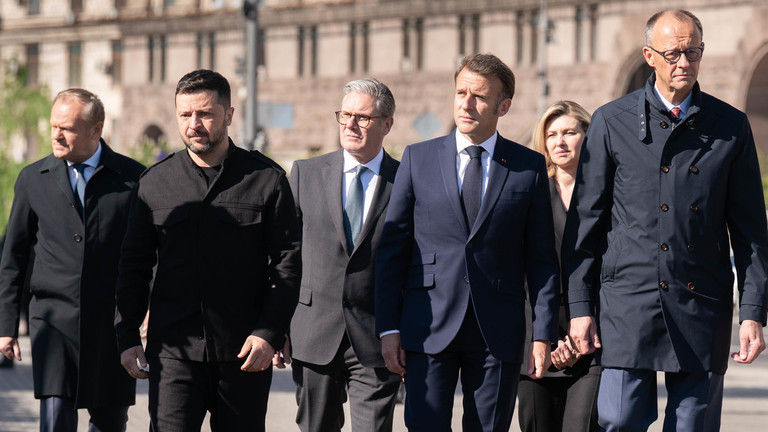
FILE PHOTO: Vladimir Zelensky and European leaders on May 10, 2025 in Kiev, Ukraine. © Stefan Rousseau – WPA Pool/Getty Images
RT | November 29, 2025
The European Union, along with the UK, has deliberately torpedoed the US peace roadmap aimed at ending the Ukraine conflict in the apparent hope that it “will fizzle out,” The Guardian has claimed.
Russia has repeatedly accused the EU of sabotaging efforts to end the bloodshed in Ukraine.
Washington put forth the peace framework earlier this month, and US officials are continuing to work on it. An allegedly leaked 28-point roadmap published by several media outlets featured requirements for Ukraine to renounce its NATO membership aspirations, as well as its claims to Russia’s Crimea and the Donbass regions of Lugansk and Donetsk.
Shortly after the contents of the US-drafted peace proposal were published by the press, several EU member states, along with the UK, scrambled to present their own version. Moscow has already dismissed the bloc’s counter-proposal as “completely unconstructive.”
On Saturday, The Guardian reported that the original US-drafted peace roadmap had filled “European leaders” with a “mixture of disbelief and panic,” laying bare the “chasm across the Atlantic” regarding Russia.
However, the EU and the UK are by now well-versed in blunting any American attempts at resolving the Ukraine conflict, the publication claimed.
Their strategy presumably boils down to welcoming the “fact of Trump’s intervention, before slowly and politely smothering it.”
According to the British media outlet, Kiev’s European backers took the original 28-point proposal and removed nine key elements from it.
The EU and the UK have also allegedly mobilized the “Atlanticist wing in the Senate,” so that it mounts internal opposition to the peace framework.
Politico Europe and The Telegraph, citing anonymous sources, have recently claimed that the US has been keeping the EU “in the dark” regarding ongoing diplomacy on the peace proposal.
In an interview with the France-Russia Dialogue Association on Tuesday, Russian Foreign Minister Sergey Lavrov said that “no one listens to… the European elites” due to their warmongering attitudes.
Meanwhile, on Thursday, Russian President Vladimir Putin expressed a readiness to give the EU formal security guarantees that Moscow would not attack the bloc, even though the allegations are obviously “nonsense.”
Ukraine’s UOC Metropolitan Poisoned, Presumably With Heavy Metals – Orthodox Journalists
Sputnik – 29.11.2025
Hospitalized Metropolitan Theodosius of Cherkasy and Kanev of the Ukrainian Orthodox Church (UOC), who is under investigation for treason in Ukraine, has been poisoned, presumably with heavy metals, the Union of Orthodox Journalists said on Saturday.
On Friday, the union said that the metropolitan had been hospitalized in a critical condition.
“Details regarding the health of Metropolitan Theodosius of Cherkasy and Kanev and possible reasons for his critical condition have become known. There is reason to believe that the religious leader was poisoned … Doctors say that during the diagnosis and treatment, they will test his body for a wide range of toxic substances. The metropolitan has been poisoned, presumably, with heavy metals,” the union said.
Orthodox journalists also said, citing the Cherkasy Diocese, that just over a month ago, the metropolitan had begun to show signs of an unusual illness, which was neither hypertension nor heart disease, which had plagued him for years. His body temperature rose frequently, and sharp jumps in blood pressure, from very high readings to critically low ones, were observed, the journalists said.
This week, the metropolitan’s health declined sharply, and his physician suggested immediate hospitalization, the union said.
“He still has severe intoxication. His condition is relatively stable, but the metropolitan remains hospitalized. Toxicology testing may take about a month,” a source in the hospital told journalists on the condition of anonymity.
In the spring of 2023, a court in Cherkasy placed Metropolitan Theodosius under house arrest provided that he wear an electronic bracelet. In December 2023, the court lifted his round-the-clock detention, leaving him under nightly house arrest. The metropolitan is charged with inciting religious hatred. In June 2024, another Ukrainian court imposed a 60-day, round-the-clock house arrest on Metropolitan Theodosius. In late October, the Union of Orthodox Journalists said that his pretrial detention had once again been extended for two months.
Since 2022, the Ukrainian authorities have been waging the largest wave of persecution of the Ukrainian Orthodox Church, which is recognized as canonical by the Russian Orthodox Church, in the country’s modern history — the authorities are imposing state sanctions against members of the clergy, organizing searches in churches, arresting clergy, initiating criminal cases, banning the activities of the Ukrainian Orthodox Church in various regions of the country, seizing monasteries and parishes.
US faces outrage over killing of survivors in Caribbean strike
Al Mayadeen | November 29, 2025
The US is facing renewed scrutiny after reports emerged that US forces carried out a second strike on a disabled boat in the Caribbean, extrajudicially killing people who survived an initial missile attack.
Accounts published by the Washington Post, CNN, and earlier by The Intercept indicate that the September 2 attack unfolded under a direct instruction from War Secretary Pete Hegseth to ensure no one on the vessel remained alive.
Citing individuals familiar with the mission, the Washington Post reported that personnel were told “the order was to kill everybody.” The strike formed part of a wider campaign targeting boats in the Caribbean and eastern Pacific that Washington claims were transporting narcotics through international waters. Publicly released figures compiled by AFP suggest that at least 83 people have been killed since these operations began, though the administration has not provided evidence substantiating its allegations against the vessels.
Illegal orders
According to the Washington Post, US forces saw two people clinging to the burning wreckage after the first strike and then hit the vessel again. Following this episode, internal rules were revised to require rescuing any survivors. CNN noted that it remains unclear whether Hegseth had been informed about survivors before the follow-up attack.
Hegseth, addressing criticism on social media on Friday, insisted that “current operations in the Caribbean are lawful under both US and international law” and dismissed reports on the incident as “fake news,” though he did not mention the September strike specifically.
The Justice Department has meanwhile maintained that the campaign complies with the laws governing armed conflict. The Pentagon has told lawmakers that the United States is engaged in an “armed conflict” with Latin American drug cartels and has categorized suspected smugglers as “unlawful combatants.”
War crimes
The allegations have triggered political backlash in Washington. Democratic congressman Seth Moulton wrote on X that the “killing of survivors is blatantly illegal” and warned, “Mark my words: It may take some time, but Americans will be prosecuted for this, either as a war crime or outright murder.”
The revelations surface amid controversy over a video released this month by Democratic lawmakers reminding military personnel that they may refuse illegal orders, a message that prompted Donald Trump to brand them “traitors.”
International pressure is also mounting. UN Human Rights chief Volker Turk urged the United States to examine the legality of the strikes, stating that there is “strong evidence” they amount to “extrajudicial” killings.
Europe militarizes its space agency
The ESA has been awarded record funding, dropping its civilian-only focus and branching out to military and security missions
RT | November 29, 2025
The European Space Agency (ESA) will begin working on defense projects for the first time, in a move it is describing as “historic.” A resolution by its 23 member states says the agency has the tools to develop space systems “for security and defense.”
The EU and NATO are pouring tens of billions in taxpayer and borrowed money into supporting defense firms and churning out weapons, claiming Russia poses an imminent threat. Russian President Vladimir Putin said on Thursday that EU leaders are inflating the alleged danger to push their own political agendas and funnel cash into the arms industry.
Next year’s budget allocates a record €22.1 billion (around $24 billion) to the ESA for the next three years. Its member states include virtually all European NATO countries, as well as non‑NATO members such as Switzerland and Austria.
The new budget is a sharp rise from the previous €17 billion. Germany is the top contributor with €5 billion, followed by France and Italy at over €3 billion each.
According to ESA Director General Josef Aschbacher, Poland was instrumental in promoting the agency’s new strategic direction. He confirmed that Warsaw is currently in discussions to host a new ESA center dedicated to security-focused projects.
Across the EU, defense budgets are surging as Brussels and its allies push for rearmament under the banner of security. The European Commission’s ‘ReArm Europe’ plan aims to pour hundreds of billions into joint weapons procurement and infrastructure, while member states have boosted arms purchases by nearly 40% in just one year. Research and development spending is also up sharply, signaling a full-speed shift toward a greater military focus.
US Drones for Ukraine No Match for Russian Countermeasures, Keep Crashing During Tests
Sputnik – 29.11.2025
Anduril, a $30B Silicon Valley defense startup building drones, surveillance equipment and C3I software for the US military, CBP and America’s allies, has sent tens of millions of dollars’ worth of drones to Ukraine since 2022.
But there’s a problem: Its products keep crashing before they can even be deployed.
Air Force testing this month involving two Anduril Altius multipurpose spy, communications, cyberwar and strike drones saw them ascend and slam into the ground. Summer testing of Anduril’s new Fury unmanned fighter damaged its engine before it could even take off, while an August test of the Anduril Anvil antidrone system caused a 22-acre fire in Oregon.
The US Navy has reported similar problems, with 30 drone boats operated by Anduril’s Lattice software shutting down during a deployment off California in May. Sailors said in a report that Anduril’s products suffered from “continuous operational security [and] safety violations, and contracting performer misguidances,” posing an “extreme risk” to US military personnel.
US Army drilling in Germany in January saw a Ghost spinning out and crashing near troops, with an Army spokesman confirming the drone’s issues with power management in cold temperatures.
And there’s another problem.
Although Ukraine’s military remains tightlipped about the performance of its Anduril equipment, an informed source told Reuters that the dozens of Ghost drones the company deployed in 2022 proved no match for Russian electronic warfare countermeasures, which jammed their satnav systems.
Meanwhile, sources told the Wall Street Journal that Anduril Altius drones were so problematic for Ukraine’s military that it stopped using them altogether in 2024.
The UK signed a $40M deal with Anduril in March for more Altius drones for Ukraine.
Stealth Bombers and Bunker Busters
A retrospective analysis of the so-called 12-Day War, and the triumphantly celebrated Operation Midnight Thunder

B-2 “Stealth Bomber” Dropping a GBU-57 “Bunker Buster” Bomb
By William Schryver | imetatronink | November 28, 2025
The GBU-57 is a big fat gravity bomb with fins. To achieve effective precision, a B-2 bomber must drop it on its intended target from no further than about five nautical miles — essentially right on top of the target.
Its penetration depth is claimed to be 200 feet. But that capability has NEVER been tested against a seriously hardened deep-underground target encased in layers of high-performance concrete, and topped with a few dozen meters of solid rock. In that sort of real-world scenario, the GBU-57 would be lucky to drill down 50 feet, if that.
It was always ridiculous silly talk to suggest the GBU-57 was the wonder weapon it was made out to be. There is a good reason the US only produced a couple dozen of them and then stopped: they understood its acute limitations in a non-permissive combat environment.
And, notwithstanding the hyperbolic Israeli propaganda, there was never any credible evidence that Iranian medium- and long-range air defenses against fixed-wing aircraft were attrited to any significant degree. And Iranian short-range air defenses were increasingly effective against long-range Israeli drones with each passing day.
As for the B-2: it is a big fat subsonic aircraft. It flies at airliner speeds. A strike on Fordow would entail flying at least 500 miles in and out of Iran.
It is nonsense that the B-2 is effectively invisible. It can be tracked from long distances, and targeted sufficiently well that missiles with effective terminal guidance (thermal / optical) can kill it.
The Iranians established during the October 26, 2024 Israeli counterstrike that they could paint F-35s with their radars. That is why the Israelis launched nothing but long-range stand-off munitions: aero-ballistic and cruise missiles – of which they have a very limited stockpile.
The same conditions prevailed during the 12-Day War.
And just as the Israelis were unwilling to risk getting fighters shot down over Iran, neither was the USAF willing to risk getting a B-2 shot down over Iran.
Maybe a few B-2s launched some JASSMs from over Iraq or the Caspian Sea. Maybe nothing but sub-launched Tomahawks hit Iranian targets. But it certainly wasn’t GBU-57 “Bunker Buster” bombs dropped by a half-dozen B-2s casually flying in Iranian airspace for an hour.
And whatever was dropped inflicted no meaningful damage. Fordow was scratched at best. A bunch of surface structures at Natanz were blown up.
Trump’s claim that Iran’s nuclear program was destroyed is absurd nonsense. No one with even a modest understanding of these things believes that.
The Israelis certainly don’t believe it, and they have admitted as much.
It is true that, in retaliation, the Iranians precisely targeted and convincingly destroyed a significant communications complex at the American Al Udeid airbase in Qatar.
The fictionalized B-2 “Bunker Buster” strike on Fordow, and the token Iranian ballistic missile strike on Al Udeid were orchestrated events designed to grease the tracks of a ceasefire that was proposed by the Americans and agreed to by the Iranians.
The Americans and Israelis had expended almost their entire inventories of ballistic missile interceptors over the course of a week and a half, and Iranian missiles were raining down with effective impunity the last few days.
The Iranians knew damn well they had already achieved a strategic victory, despite their shaky start.
I’m also convinced the Russians and Chinese encouraged Iran to accept the ceasefire proposal.
It allowed both sides to claim a PR victory, lick their wounds, and prepare for the next round.
Meanwhile, the Iranians have more production capability than do their US/Israeli counterparts. And it also appears the Iranians are much more amenable to Russian and Chinese assistance now than they may have been previously.
When this war resumes, the Iranians will be comparatively stronger than they were before. And the risks for the US/Israel will be significantly heightened.
Daniel Davis: The War Is Lost & Europe Escalates
Lt. Col. Daniel Davis is a 4x combat veteran, the recipient of the Ridenhour Prize for Truth-Telling, and is the host of the Daniel Davis Deep Dive YouTube channel. Lt. Col. Davis argues that the war is over, yet Europe is not ready for the peace dictated by a Russian victory.
Daniel Davis Deep Dive: https://www.youtube.com/@DanielDavisDeepDive/videos
Follow Prof. Glenn Diesen:
Substack: https://glenndiesen.substack.com/
X/Twitter: https://x.com/Glenn_Diesen
Patreon: https://www.patreon.com/glenndiesen
Support the research by Prof. Glenn Diesen:
PayPal: https://www.paypal.com/paypalme/glenndiesen
Buy me a Coffee: buymeacoffee.com/gdieseng
Go Fund Me: https://gofund.me/09ea012f
Books by Prof. Glenn Diesen: https://www.amazon.com/stores/author/B09FPQ4MDL
How the Covid Inquiry Protected the Establishment
By Trish Dennis | Brownstone Institute | November 28, 2025
After four years, hundreds of witnesses, and nearly £200 million in costs, the UK Covid Inquiry has reached the one conclusion many expected: a carefully footnoted act of self-exoneration. It assiduously avoids asking the only question that truly matters: were lockdowns ever justified, did they even work, and at what overall cost to society?
The Inquiry outlines failure in the abstract but never in the human. It catalogues errors, weak decision-making structures, muddled communications, and damaged trust, but only permits examination of those failings that do not disturb the central orthodoxy.
It repeats the familiar refrain of “Too little, too late,” yet anyone paying attention knows the opposite was true. It was too much, too soon, and with no concern for the collateral damage. The government liked to speak of an “abundance of caution,” but no such caution was exercised to prevent catastrophic societal harm. There was no attempt to undertake even a basic assessment of proportionality or foreseeable impact.
Even those who approached the Inquiry with modest expectations have been startled by how far it fell below them. As former Leader of the UK House of Commons, Jacob Rees-Mogg recently observed, “I never had very high hopes for the Covid Inquiry… but I didn’t think it would be this bad.” Nearly £192 million has already been spent, largely enriching lawyers and consultants, to produce 17 recommendations that amount, in his words, to “statements of the obvious or utter banality.”
Two of those recommendations relate to Northern Ireland: one proposing the appointment of a Chief Medical Officer, the other an amendment to the ministerial code to “ensure confidentiality.” Neither insight required hundreds of witnesses or years of hearings. Another recommendation, that devolved administrations should have a seat at COBRA, reveals, he argues, “a naiveté of the judiciary that doesn’t understand how this country is governed.”
Rees-Mogg’s wider criticism goes to the heart of the Inquiry’s failures, as it confuses activity with accountability. Its hundreds of pages record bureaucratic process while ignoring substance. The same modeling errors that drove early panic are recycled without reflection; the Swedish experience is dismissed, and the Great Barrington Declaration receives a single passing mention, as if it were an eccentric sideshow. The report’s underlying message never wavers: lockdowns were right, dissent was wrong, and next time the government should act faster and with fewer restraints.
He also highlights its constitutional incoherence. It laments the lack of “democratic oversight,” yet condemns political hesitation as weakness. It complains that ministers acted too slowly, while elsewhere chastising them for bowing to public pressure. The result, he says, is “schizophrenic in its approach to accountability.” Behind the legal polish lies an authoritarian instinct, the belief that bureaucrats and scientists know best, and that ordinary citizens cannot be trusted with their own judgment.
The conclusions could have been drafted before the first witness entered the room:
- Lockdowns were necessary.
- Modelling was solid.
- Critics misunderstood.
- The establishment acted wisely.
It is the kind of verdict that only the British establishment could deliver about the British establishment.
The Inquiry treats the question of whether lockdowns worked as if the very question were indecent. It leans heavily on modeling to claim that thousands of deaths could have been avoided with earlier restrictions, modeling that is now widely recognised as inflated, brittle, and detached from real-world outcomes. It repeats that easing restrictions happened “despite high risk,” yet fails to note that infection curves were already bending before the first lockdown began.
Here Baroness Hallett makes her headline claim that “23,000 lives could have been saved” if lockdowns had been imposed earlier. That number does not come from a broad evidence base, but from a single modelling paper written by the same scientist who, days later, broke lockdown to visit his mistress because he did not believe his own advice or modeling figures. Treating Neil Ferguson’s paper as gospel truth is not fact-finding. It is narrative protection.
Even Dominic Cummings, Boris Johnson’s most influential adviser in early 2020, has accused the Inquiry of constructing what he calls a “fake history.” In a detailed post on X, he claimed it suppressed key evidence, ignored junior staff who were present at pivotal meetings, and omitted internal discussions about a proposed “chickenpox-party” infection strategy. He argued that the Inquiry avoided witnesses whose evidence would contradict its preferred story, and he dismissed the “23,000 lives” figure as politically spun rather than empirically credible. Whatever one thinks of Cummings, these are serious allegations from the heart of government, and the Inquiry shows little interest in addressing them.
It quietly concedes that surveillance was limited, urgency lacking, and spread poorly understood. These admissions undermine the very certainty with which it endorses lockdowns. Yet instead of re-examining its assumptions, the Inquiry sidesteps them. To avoid reconsidering lockdowns is to avoid the very heart of the matter, and that is exactly what it does.
During 2020 and 2021, fear was deployed and amplified to secure compliance. Masks were maintained “as a reminder.” Official documents advised that face coverings could serve not only as source control but as a “visible signal” and “reminder of COVID-19 risks,” a behavioural cue of constant danger.
The harms of lockdown are too numerous for a single list, but they include:
- an explosion in mental health and anxiety disorders, especially in children and young adults
- a surge in cancers, heart disease, and deaths of despair
- developmental regressions in children
- the collapse of small businesses and family livelihoods
- profound social atomisation and damage to relationships
- the erosion of trust in public institutions
The Inquiry brushes over these truths. Its recommendations focus on “impact assessments for vulnerable groups” and “clearer communication of rules,” bureaucratic language utterly inadequate to address the scale of the damage.
It also avoids the economic reckoning. Pandemic policy added 20 percent of GDP to the national debt in just two years, a cost already passed to children not yet old enough to read. That debt will impoverish their lives and shorten life expectancy, since wealth and longevity are closely linked.
Whenever Sweden is mentioned, a predictable chorus appears to explain away its success: better healthcare, smaller households, lower population density. Yet it is also true that Sweden resisted panic, trusted its citizens, kept schools open, and achieved outcomes better than or comparable to ours. The Inquiry refers vaguely to “international differences” but avoids the one comparison that most threatens its narrative. If Sweden shows that a lighter-touch approach could work, the entire moral architecture of Britain’s pandemic response collapses, and that is a question the Inquiry dares not ask.
The establishment will never conclude that the establishment failed, so the Inquiry performs a delicate dance:
- Coordination was poor, but no one is responsible.
- Communications were confusing, but the policies were sound.
- Governance was weak, but the decisions were right.
- Inequalities worsened, but that tells us nothing about strategy.
It acknowledges everything except the possibility that the strategy itself was wrong. Its logic is circular: lockdowns worked because the Inquiry says they worked; modeling was reliable because those who relied on it insist it was; fear was justified because it was used; Sweden must be dismissed because it challenges the story.
At times, reading the report feels like wandering into the Humpty Dumpty chapter of Through the Looking-Glass, where words mean whatever authority decides they mean. Evidence becomes “established” because the establishment declares it so.
A serious, intellectually honest Inquiry would have asked:
- Did lockdowns save more lives than they harmed?
- Why was worst-case modeling treated as fact?
- Why were dissenting voices sidelined?
- How did fear become a tool of governance?
- Why did children bear so much of the cost?
- Why was Sweden’s success dismissed?
- How will future generations bear the debt?
- How can trust in institutions be rebuilt?
Instead, the Inquiry offers administrative tweaks, clearer rules, broader committees, and better coordination that studiously avoid the moral and scientific questions. An Inquiry that evades its central task is not an inquiry at all, but an act of institutional self-preservation.
Perhaps we should not be surprised. Institutions rarely indict themselves. But the cost of this evasion will be paid for decades, not by those who designed the strategy, but by those who must live with its consequences: higher debt, diminished trust, educational loss, social fracture, and a political culture that has learned all the wrong lessons.
The Covid Inquiry calls itself a search for truth, but the British establishment will never allow something as inconvenient as truth to interfere with its instinct for self-preservation.
Trish Dennis is a lawyer, writer, and mother of five based in Northern Ireland. Her work explores how lockdowns, institutional failures, and social divides during Covid reshaped her worldview, faith, and understanding of freedom. On her Substack, Trish writes to record the real costs of pandemic policies, honour the courage of those who spoke out, and search for meaning in a changed world. You can find her at trishdennis.substack.com.
Global movement to Gaza to stage pro-Palestine protests in 13 cities
Al Mayadeen | November 28, 2025
The Global Movement to Gaza announced coordinated protests across 13 major cities on November 29 to mark the International Day of Solidarity with the Palestinian People. The rallies aim to denounce Western support for “Israel’s” ongoing genocide in Gaza, now entering its third year.
Protests will take place in Berlin, Rome, Paris, Barcelona, Madrid, Oslo, Vienna, Warsaw, Luxembourg, Cape Town, Washington, DC, Mexico City, and São Paulo.
Organizers say the coordinated actions are designed to expose the complicity of European and North American governments in “Israel’s” war on Gaza. The movement accuses these states of enabling the genocide through arms exports, political backing, and economic ties.
In a statement, the movement issued a list of demands for European Union and national leaders:
- Immediate suspension of the EU-“Israel” Association Agreement;
- An arms embargo and an end to military cooperation with “Israel”;
- Targeted sanctions on “Israeli” officials responsible for war crimes and genocide;
- A halt to all academic, cultural, and sporting institutional ties;
- Alignment of EU foreign policy with international human rights and humanitarian law.
Will Saudi Arabia fund Israel’s grip over Lebanon?
By Mohamad Hasan Sweidan | The Cradle | Novmber 27, 2025
In the wake of Israel’s November 2024 apparent ceasefire with Lebanon, Tel Aviv has moved to reshape the post-war order in its favor. Treating Lebanon as a weakened and fragmented state, Israel seeks to impose a long-term, unilateral security and economic regime in the south, bolstered by US backing.
Simultaneously, Saudi Arabia has thrust itself into the reconstruction process as the main Arab financier. But the kingdom risks becoming a junior partner in an Israeli-American project that sidelines it from real decision-making. The question facing Riyadh is clear: Will it bankroll its own marginalization?
Tel Aviv’s vision: Disarmament, deterrence, domination
Israel’s strategy for Lebanon extends far beyond the oft-repeated demand to disarm Hezbollah. It envisions a sweeping transformation of Lebanon into a demilitarized satellite state governed under a US-Israeli security framework. Nowhere is this clearer than in Tel Aviv’s insistence on remaining inside Lebanese territory until Hezbollah is stripped of its deterrent capabilities, not just south of the Litani River, but across the country.
Israeli Defense Minister Israel Katz and former Northern Command chief Uri Gordin have both publicly outlined this goal. Gordin even suggested establishing a permanent buffer zone inside Lebanon to serve as a “bargaining chip” for future negotiations, while Katz confirmed that Israeli forces would remain indefinitely in the south. Tel Aviv no longer seeks temporary deterrence, favoring permanent subordination.
Katz, for his part, has stated “Hezbollah is playing with fire,” and called on Beirut to “fulfill its obligations to disarm the party and remove it from southern Lebanon.”
Most recently, while addressing the Knesset, he warned that “We will not allow any threats against the inhabitants of the north, and maximum enforcement will continue and even intensify.”
“If Hezbollah does not give up its weapons by the year’s end, we will work forcefully again in Lebanon,” Katz reiterated. “We will disarm them.”
According to this blueprint, Lebanon is not considered a sovereign neighbor, but a security appendage to Israel’s northern frontier. State institutions are expected to serve as administrative fronts for a de facto Israeli-American command center. International aid, including funding from Arab states of the Persian Gulf, is being weaponized to enforce this new security-economic order.
From the perspective of Israel, the goals in Lebanon are not limited to the disarmament of Hezbollah. They go beyond that toward a deeper project of transforming Lebanon – especially the south – into a kind of security-economic colony.
This includes consolidating a long-term military presence, imposing new border arrangements, and paving the way for settlement projects or institutionalized buffer zones, as evidenced by current maps showing the presence of Israeli forces at several points inside Lebanese territory.
Saudi Arabia’s options: Pressure or partnership
Enter Riyadh. The Saudi Foreign Ministry has repeatedly called for Lebanese arms to be confined to the state and endorsed the implementation of the 1989 Taif Agreement.
In September, Saudi Foreign Minister Faisal bin Farhan, in a speech to the UN General Assembly, stressed that:
“Saudi Arabia stands with Lebanon, supports everything that strengthens its security and stability, and welcomes the efforts of the Lebanese state to implement the Taif Agreement (1989), affirm its sovereignty, and place weapons in the hands of the state and its legitimate institutions.”
The Saudi envoy to Lebanon, Yazid bin Farhan, reiterated Riyadh’s position: the exclusive right to possess arms must lie with the Lebanese state. In private information, during a meeting between Bin Farhan and Sunni leaders in Lebanon, the diplomat stressed that pressure must be put on disarming the party, even if that requires reaching a civil war.
On the surface, Saudi and Israeli objectives appear aligned. Tel Aviv applies military pressure. Riyadh applies economic and political pressure. Both demand the end of Hezbollah’s armed presence. But while Israel’s aim is absolute control over Lebanon’s security order, Saudi Arabia still seeks a political system that reflects its influence. In this, Tel Aviv’s ambitions collide with Riyadh’s.
However, Israel has no intention of sharing influence with any Arab state – nor even Turkiye. Its model is exclusionary. It views Riyadh not as a partner, but as a bankrolling mechanism to finance the dismantling of Lebanon’s axis of resistance under Israeli terms. As former deputy director of the National Security Council, Eran Lerman put it, Saudi Arabia is merely a pressure tool to bring Lebanon to heel.
Thus, the crux of the matter is this: Riyadh may envision itself as a key stakeholder in post-war Lebanon, but Israel sees it as a disposable auxiliary.
The 17 May redux: Recolonizing south Lebanon
To grasp the depth of Israel’s project, one need only look to its precedents. In 1983, Israel, alongside the US and under Syrian oversight, tried to enshrine a similar model via the 17 May Agreement. That deal called for an end to hostilities, gradual Israeli withdrawal, a “security zone” in the south, and joint military arrangements. In practice, it turned Lebanon into a protectorate tasked with safeguarding Israeli security interests.
Today, after the 2024 war, Tel Aviv is resurrecting that same formula. Israeli forces have remained stationed at multiple points inside Lebanon despite the ceasefire terms mandating full withdrawal. Airspace violations and near-daily raids persist under the pretext of preventing Hezbollah from “repositioning.” Think tanks in Tel Aviv, alongside joint French-US proposals, are now pushing phased disarmament: first the south, then the Bekaa, then the Syrian border, ultimately ending all resistance capabilities.
International support is being dangled as a carrot. Aid from the US, France, Saudi Arabia, Qatar, and others is contingent on Lebanon executing a disarmament plan under International Monetary Fund (IMF) oversight and within a strict timeline. This is the economic arm of the Israeli security project.
More dangerously, Israeli studies suggest that reconstruction of southern villages should be explicitly tied to the removal of resistance forces, while preserving “full freedom of action” for the Israeli army in Lebanese air and land space.
Can Riyadh afford Tel Aviv’s trap?
In parallel with this vision, western analyses close to decision-making circles in Washington and Riyadh show that Saudi Arabia itself sees Lebanon as a pivotal arena in its conflict with Iran. Any serious return to the Lebanese file is linked to the weakening of Hezbollah’s influence.
But the key divergence between the Saudi and Israeli approaches lies in a critical question: Who ultimately holds the keys to decision-making in Lebanon?
Riyadh aims to use its financial and political capital to recalibrate the Lebanese political order in its favor, minimizing Iranian sway while reinforcing its own influence. But Israel’s plan is more radical: to redefine Lebanese sovereignty altogether, placing it under perpetual Israeli security oversight.
In this model, Saudi Arabia – and any other Arab state – is reduced to the role of financier, tasked with implementing terms written in Tel Aviv and Washington rather than contributing an independent Arab vision for the region.
From this angle, Tel Aviv’s persistent invocation of the “military option” in Lebanon works against Gulf interests. It positions Riyadh and its allies as the paymasters for reconstruction, forced to foot the bill for a post-war settlement they had no role in shaping.
If Saudi Arabia concedes to this logic – and fails to leverage its influence in Washington, in Arab diplomatic circles, and in donor mechanisms – it risks forfeiting Lebanon to a joint Israeli-American order.
That order would mirror the defunct 17 May Agreement, only more deeply entrenched. Lebanon would not only be demilitarized. It would become a living model of “security-economic conjugation,” designed to recalibrate regional influence away from the Arab world and toward an Israeli-dominated Levant.
Featured Video

New positive ivermectin evidence
or go to
Aletho News Archives – Video-Images
From the Archives
Fanatical Followers of the Covid Regime: A Jim Jones-Style Cult?
By Professor Roger Watson and Dr. Niall McCrae | The Daily Sceptic | November 15, 2021
As scholars at leading British universities over recent decades, we witnessed the replacement of critical thinking and debate by narrative: facts are discrimination and scientific method is imperialism; truth, instead, is derived from ‘progressive’ values. This educational trend may be a major contributory factor to the ease in which society has been inculcated to the Covid ‘new normal’ of masking, testing, and repeated doses of vaccines for a disease of similar risk to severe influenza.
One doesn’t need much critical reasoning to observe the flawed logic of some vaccination enthusiasts, such as people who respond to experiencing any side effects, however debilitating, by saying “at least I know it’s working”, or, after contracting the disease despite their promised inoculation (over 90% effective, according to initial drug company claims), “I’d have been worse off without the jab.” … continue
Blog Roll
 Aletho News
- Arctic Scare Stories Melt Away
- Wrong, Euronews: Climate Change Has Not Created a Food, Energy, and Economic “Meta-Crisis”
- New positive ivermectin evidence
- Met Office Caught Fabricating Daily Temperature Record Claims
- Merck Virologists Admitted to Falsely Certifying Vaccine Efficacy
- Mandatory Folic Acid for every man, woman & child
- Pro-Palestine protesters arrested outside UK’s ruling Labour Conference in Liverpool
- Mauritius denies landing permit to flight from Israel, forcing cancellation: Tour operator
- Israeli finance minister calls for genocidal war on West Bank, annexation of south Lebanon
- 12 Things Your Psychiatrist Was Trained Not to Tell You
- If Americans Knew
- Israel forces Gazans to live in constant peril – Daily Update
- Deconstructing Netanyahu’s pants-on-fire UN rant – Daily Update
- Trump betrayed voters with his campaign lies and prioritized a foreign country once he took office
- Netanyahu calls Israel’s war in Gaza ‘opposite of genocide’ in UN speech to near-empty hall
- Settler Kidnappings: Torture, Sexual Abuse and Terrorisation of Palestinian Abductees as Israel Deepens Annexation of West Bank
- Gaza winter nears as 162,000 tents become unusable, raising fears of humanitarian crisis
- Netanyahu says, “It’s the opposite of genocide”; UN says Gaza economy is world’s ‘most severe crisis on record’ – Daily Update
- Israel’s US-Backed Assault on Gaza Has Created the ‘World’s Most Severe Economic Crisis on Record’: UN
- ‘Protecting U.S. Citizens’… From Israel
- ‘This is where I live now, the back of a truck’: a day in the life of a grandmother in Gaza
- No Tricks Zone
- New Study: Earth And Venus Surface Warmth Largely Explained By Convection And Lapse Rate, Not CO2 Or Radiation
- 2025 Nature Paper Claiming Worsening Global Drought Gets RETRACTED …Heavily Flawed
- New Study: ‘Global Drought Shows No Detectable Recent Acceleration Under Climate Warming’
- Economic Masterminds: German Socialists Suggest Taxing Productivity Gains Stemming From Using AI
- The South China Sea Has Not Been Cooperating With The Climate Change Narrative
- Energy Crisis: Germany Enters Heating Season With Historically Low Gas Reserve Fill Levels
- New Study: The Antarctic Ice Sheet Gained Mass From 2020-2024 Due To Staggering Snow And Ice Accumulation
- Study: Ocean Heating Rates From Thousands Of Years Ago ‘Dwarf’ Modern Ocean Heating Rates
- Climate Extremists Target, Attack Large-Scale Power Grid Infrastructure In Germany!
- New Study: Antarctic Ice Melt Has Contributed Less Than 1 Centimeter To Sea Level Rise In The Last 30 Years

