Merz has filed 5,000 complaints against online critics – media
RT | December 7, 2025
German Chancellor Friedrich Merz has filed nearly 5,000 defamation complaints over online comments, Welt am Sonntag reported on Sunday.
The newspaper said it had obtained copies of the complaints, police files, and letters from law firms representing the leader of the Christian Democratic Union (CDU). The complaints date from 2021 to February 2025, when Merz was serving as a member of the Bundestag.
The angry comments that prompted investigations included insults such as “a**hole” and “filthy drunk,” and in at least one case a search of a defendant’s home was later declared unlawful by a court.
In another case, police searched the home of an elderly wheelchair-bound woman who had called Merz a “little Nazi,” and confiscated the phone she used to communicate with doctors and caregivers.
The number of complaints makes Merz “one of the most sensitive politicians” in Germany’s history, Welt am Sonntag said.
A lawyer representing one of the defendants described the investigation as “a complete overreaction of the justice system.”
Merz’s approval rating has dropped to 22%, a record low, according to a recent Forsa poll. The coalition government has struggled with the cost-of-living crisis and has been marred by bitter infighting over immigration, as well as pension and military service reforms.
EU’s X fine a ‘violent attack’ on free speech – French party leader
RT | December 8, 2025
The fine imposed by the EU on social media platform X constitutes a “violent attack” on freedom of speech, the leader of France’s Patriots party, Florian Philippot, told RT in an exclusive interview on Monday.
His comments came after the EU fined X €120 million ($163 million) last week for allegedly failing to comply with transparency requirements under the bloc’s 2022 Digital Services Act. The platform’s US-based majority owner, Elon Musk, responded by denouncing the EU, likening it to “the Fourth Reich.”
“The absolutely crazy fine of €120 million that the European Commission has just imposed on Elon Musk’s social networks is obviously a violent attack against freedom of expression by the European Union,” Philippot told RT.
The EU had used what he described as a thin justification for the decision, pointing to “the blue pastilles on the accounts on X” and calling it a “pretext” that “made no sense.”
The politician went on to say that the EU’s “real face of censorship” was becoming visible “in the eyes of the whole world,” and that influential voices, “like Musk in particular,” were rising “to claim its pure and simple disappearance.”
Philippot said he was watching reactions from abroad, including from the administration of US President Donald Trump, former Russian President Dmitry Medvedev and Hungary’s Prime Minister Viktor Orban, who he said reacted “very firmly against the European Union.”
He said Musk had, “for the first time,” triggered what he called a “worldwide deflagration” by arguing it was necessary “to abolish the European Union,” which Philippot described as “a totalitarian regime.”
The French politician also referenced Musk’s separate remarks branding the EU a “bureaucratic monster” and saying its leadership has been “slowly smothering Europe to death.” Musk wrote that “The EU should be abolished and sovereignty returned to individual countries so that governments can better represent their people.”
Aligning himself with that message, Philippot said his party was a “sovereignist” movement backing a French departure from the bloc. According to him, “Frexit” would restore “freedom of expression,” shift diplomacy toward peace rather than “war against Russia,” and help tackle domestic issues including the economy, agriculture, energy, and immigration.
As former CIA chief joins board of Ukraine’s Fire Point, more questions need answered
By George Samuelson | Strategic Culture Foundation | December 8, 2025
With a closet full of skeletons to his name, Mike Pompeo has joined a major Ukrainian defense company that produces weapons capable of targeting Moscow. Is it time to end the ‘revolving door’ between the world of politics and business, especially now with World War III on the line?
Michael Pompeo is the ultimate Washington insider. His decades-long stint on Capitol Hill has seen him serve under Donald Trump as both the Secretary of State (2018-2021) and CIA Director (2017-2018). Before that, he served for six years in the U.S. House of Representatives (2011-2017). His multilevel experience and vast contacts give him tremendous sway over Washington DC to this day. In other words, he is the perfect candidate to sell his connections to a defense contractor.
In November, Pompeo joined the advisory board of Ukrainian defense company Fire Point, which develops long-range missile systems that allow Ukraine to strike deep into Russian territory. Pompeo’s new position represents a dangerous conflict of interest since his extremely hawkish views on the Ukrainian conflict are already well known. In 2023, he advised the Biden administration to “reverse its policy of denying weapons and adequate weapons supplies” that would help Ukraine. The Biden administration responded to the plea with billions of dollars’ worth of expenditures, which served to enflame the situation on the ground in Ukraine.
The move by Pompeo to join Fire Point, reflective of America’s well known “revolving door” phenomenon, which sees opportunistic individuals move effortlessly between public service and the commercial sector, should raise some major red flags. Unfortunately, the tradition is too deeply embedded in the U.S. political system to end anytime soon. That’s because the defense industry revolving door pays rich dividends. In 2019, a government watchdog reported that the Pentagon’s 14 largest contractors had hired 1,700 former Department of Defense senior civilian and military officials. That same year, the six largest defense contractors reported $18.4 billion in profits. To many taxpaying Americans, this reeks of blatant corruption.
The problem with Pompeo working for a foreign agency, however, is rather new and very problematic. On the one hand, we see the Trump administration attempting to broker a peace agreement between Moscow and Kiev, while on the other hand, we have a powerful former American official working on behalf of the pro-war lobby. Pompeo is the face of those hawks in Washington, DC and Kiev who stand to be handsomely rewarded if war continues to drag on indefinitely in Ukraine. It’s a hard truth to swallow, but no defense contractor wants to see the end of hostilities in Ukraine. And let’s not forget Pompeo’s sinister background. As the former CIA Director, he once admitted that “We lied, we cheated, we stole. We had entire training courses. It reminds you of the glory of the American experiment.”
Ah, yes. Another “American experiment,” this time smack on Russia’s border. With no loss of irony, bringing Pompeo on board with Fire Point could be an effort to whitewash the reputation of the company, which is currently under investigation for its alleged price gouging practices, and for its connections to Tymur Mindich, a Zelensky associate being investigated for corruption charges. NABU, Ukraine’s Western-backed anti-corruption bureau, exposed a money laundering scheme in the energy sector of Ukraine, through which some $100 million passed, leaving the Zelensky regime deeply red-faced in the process. Pompeo cannot magically make these problems disappear, however, as his own history is a deeply stained one.
In the summer of 2024, Pompeo co-wrote an opinion piece in the Wall Street Journal where he commented: “Ukraine joins NATO as soon as possible so all European allies assume the burden of protecting it. NATO should establish a $100 billion fund for arming Ukraine, with the U.S. share capped at 20%, as is the case with other alliance common budgets. The European Union should swiftly admit Ukraine and help it modernize and develop its economy.”
Surely the pompous Pompeo is aware that Russia views the admission of Ukraine into NATO as a clear red line, not to mention the militarization of its Western neighbor. Yet in full-blown CIA style he is actively fomenting the situation to the peril of the Russian and Ukrainian people. And now that Pompeo is sitting on the board of advisors of one of Ukraine’s most profitable defense companies, he will obviously see no reason to tone down the pro-war rhetoric in favor of corporate profit. That would certainly not make the company’s stockholders pleased. Pompeo is sitting many miles away from the battle zone and has no reason to view his blatant self-interest as a personal risk.
In his 1961 farewell address, President Dwight D. Eisenhower warned that the influence of the military-industrial complex could “endanger our liberties or democratic processes.” We have reached the point when personal self-interest trumps what is best for the nation, with America’s standing on the international stage disregarded. It’s time to end the revolving door between public service and corporate interests before it’s too late.
Two member states to sue EU over Russian energy ban – Szijjarto
RT | December 8, 2025
Hungary will seek to overturn the EU’s RePowerEU Russian energy ban at the European Court of Justice once the plan is adopted next week, Foreign Minister Peter Szijjarto has said.
Brussels launched the initiative in 2022 after the escalation of the Ukraine conflict, aiming to eliminate all Russian fossil fuel imports by the end of 2027.
A provisional agreement between the European Council and the European Parliament was announced last week, setting a halt to Russian liquefied natural gas imports by the end of 2026, with pipeline deliveries to be phased out by November 2027.
Hungary and Slovakia, which remain heavily dependent on Russian supplies, have objected to the plan, arguing that the measures would jeopardize their energy security.
In a post on X on Sunday, Szijjarto said Budapest and Bratislava will file an “annulment request to the European Court of Justice” as soon as the regulation is adopted and will ask for the suspension of the rules while the case is under review.
“We are taking this step because banning Russian oil and gas imports would make the secure energy supply of Hungary and Slovakia impossible and would lead to dramatic price increases,” he wrote, describing the regulation as “massive legal fraud.”
The minister argued that the regulation is a “sanctions measure” that requires the unanimous approval of all 27 member states. The European Commission bypassed the Hungarian and Slovak vetoes by shifting the decision to EU trade and energy laws that only require a qualified majority.
Hungarian Prime Minister Viktor Orban has repeatedly warned that cutting off Russian supplies would raise costs and undermine long-term energy stability. Slovakia has taken a similar position, with Prime Minister Robert Fico saying on Wednesday that his country has “sufficient legal grounds to consider filing a lawsuit.”
EU summit to decide Zelensky’s fate
By Martin Jay | Strategic Culture Foundation | December 8, 2025
There is an EU document in which it is stated there “is a problem with the financing of Ukraine”. No shit. The real problem actually comes with a new lack of confidence from EU member states in this “financing” following recent unconfirmed reports that Donald Trump has told the EU in blunt terms that they can’t dip into the supposed 300 bn USD in Russian “frozen” assets held by the West.
When the war started, Russia’s central bank held around $207 billion in euro assets, $67 billion in U.S. dollar assets and $37 billion in British pound assets.
It also had holdings comprising $36 billion of Japanese yen, $19 billion in Canadian dollars, $6 billion in Australian dollars and $1.8 billion in Singapore dollars. Its Swiss franc holdings were about $1 billion.
And so out of 355 bn USD of so-called “frozen” Russian money around the world, the EU only holds a little over a half of it, despite the EU talking as though they have it all. Yet despite this, much hope was placed on the EU to use this cash to continue to fund the Ukraine war. But even if Trump hadn’t have told the EU to keep their hands off the cash, under international law the case for the EU to seize even the 207 bn euros is a very shaky one, which is likely to be the final nail in the coffin for the project which keeps the war going. On December 18th in Brussels EU leaders will meet and will have to be forced to recognise a reality: if this cash cannot be used, then it will be EU member states themselves which will have to scrape together a rescue package to underwrite Ukraine’s 80bn USD 2026 budget. Recently, the EU announced another 2 billion “loan” but such payments aren’t going to sustain any kind of normality faced with the enormous black hole which needs to be filled. The real problem that the EU has is that it doesn’t put its mouth where its Russian money is. Faced with an ultimatum by ECB figures like Christine Lagarde, EU member states won’t offer their own cash as a guarantee when things go wrong with the cash, if it were to be used to fund the war. This lack of confidence might prove to be detrimental to the West’s support for Zelensky who is currently dealing with his own political demise in Kiev following corruption scandals and key allies resigning and even in some cases fleeing the country.
And with a 28 point peace plan, which most experts agree was “dead on arrival”, the popular narrative now from western commentators is that his time is up. He can’t himself offer a peace deal as it is feared that the moment he signs such a paper he will be assassinated and then a ceasefire is broken and both sides return to fighting. The only hope for the West is to invest their political and financial capital in a new leader who is familiar and respected by the Russians, whose signature will come with real guaranties – but this will have to come with assurances that their own troops won’t pile into Ukraine when the deal is signed. EU leaders can’t get this idea in their heads straightened out, that the whole war started because Ukraine was ushered towards EU and NATO membership and its troops have been equipped and trained by the West, in particular under Trump in 2017 during his first term in office.
Another idea which is unpalatable for all EU leaders – including the UK – is that these countries’ economies are on their knees. The Belgian primes minister recently hinted at a press conference that while he was against using Russian cash to fund the war, for a whole host of reasons he pointed out, it was preferable that if the EU were to go ahead into this unchartered legal area, it would be advisable that the EU had a non-EU partner to join it. He was hinting that this could be London. But someone needs to tell him that the British economy is about to collapse under its own debt interest of 120 billion pounds a year, based on reckless decisions after years of borrowing to resolve problems of its own making. It is inconceivable that the UK could be a partner in underwriting or providing guaranties to using Russian frozen assets to continue the war racket. But in the La-la land of the EU, such BS makes good press fodder for the following day’s copy.
Trump’s orders to lay off the Russian cash comes with a sobering wake-up call to EU leaders that they have run out of cash to throw into the black hole of the Ukraine war, which in private, they know is funding Zelensky’s own network of money-grabbing cronies whose only real occupation is looking at how to syphon off international money and stay in office. The resignation of his chief of staff recently, which followed his own business partner and friend fleeing the country after investigators were about to arrest him for his part in a 100m USD energy firm embezzlement, is the clearest indicator to date what the business model is in Kiev. It’s getting harder and harder for western leaders to close their eyes to the sheer level of corruption, how far it goes, and what figures are when such scandals obviously only represent the tip of the iceberg.
And now for EU leaders to meet on the 18th of December, in many ways, their decision is not to keep on finding more and more ingenious ways to scam their own taxpayers out of hard earned money, but whether they can continue to back Zelensky and his formula. With a corruption scandal now in Brussels with top EU officials making headlines, to add to the graft allegations hanging over the head of Ursula von der Leyen, it seems inconceivable that EU leaders will not be sensitive to the cries of disbelief back home from ordinary people whose main worry is that they will freeze to death in their own homes this Christmas. The priority of the summit will be political survival. Theirs, not Zelensky’s.
Ukrainians ‘with spy equipment’ arrested in Poland
RT | December 8, 2025
Police in Poland have detained three Ukrainian nationals allegedly found in possession of spying and hacking equipment.
The suspects were apprehended during a routine traffic stop in Warsaw, police said in a statement on Monday. The three men claimed they had been “traveling Europe” and had arrived in Poland just a few hours previously, and were next set to drive to Lithuania. Officers saw that the men were agitated and opted to search the vehicle, the statement noted.
“Suspicious items that could even be used to interfere with the country’s strategic information systems” were discovered, police said, adding that the men were in possession of a large number of SIM cards, antennas, laptops, routers, cameras, advanced hacking equipment, and a “spy device detector.”
The suspects were reportedly unable to explain the nature of the hardware and refused to cooperate with the police. “They claimed to be computer scientists, and when asked more precise questions, they forgot English and pretended not to understand what was being said to them,” the force stated.
The group were taken into pre-trial detention on suspicion of “fraud, computer fraud, and the acquisition of devices and computer programs adapted to commit crimes.” Investigators are currently trying to establish why exactly the suspects had traveled to Poland.
The incident comes less than a month after the Polish authorities accused two Ukrainian nationals of sabotaging a railway line between Warsaw and Lublin, detonating an explosive device on tracks and installing a derailment clamp in two separate incidents. Polish Prime Minister Donald Tusk claimed the suspects had been working “with the Russian intelligence for a long time” and had fled to Belarus after the incidents.
Moscow has rejected the accusations, with Kremlin spokesman Dmitry Peskov stating that “it would be really strange if Russia wasn’t the first one to be blamed” for the sabotage.
“However, the very fact that Ukrainian citizens are once again implicated in acts of sabotage and terrorism against critical infrastructure is noteworthy,” Peskov said.
NATO Is a Menace, Not a Benefit, to America
By Ted Galen Carpenter | The Libertarian Institute | December 8, 2025
Since its creation in 1949, NATO has been the keystone of U.S. foreign policy in Europe. Indeed, the alliance has been the most important feature of Washington’s overall strategy of global primacy. America’s political and policy elites have embraced two key assumptions and continue to do so. One is that NATO is essential to the peace and security of the entire transatlantic region and will remain so for the indefinite future. The other sacred assumption is that the alliance is highly beneficial to America’s own core security and economic interests.
Whatever validity those assumptions may have had at one time, they are dangerously obsolete today. The toxic, militaristic views toward Russia that too many European leaders are adopting have made NATO into a snare that could entangle the United States in a large-scale war with ominous nuclear implications. It is urgent for Donald Trump’s administration and sensible proponents of a U.S. foreign policy based on realism and restraint to eliminate such a risky and unnecessary situation.
Throughout the Cold War and its immediate aftermath, NATO’s European members followed Washington’s policy lead on important issues with little dissent or resistance. That situation is no longer true. The governments and populations in the alliance’s East European members (the countries that the Kremlin held in bondage during the Cold War but that eagerly joined NATO once the Soviet Union collapsed) have adopted an especially aggressive, uncompromising stance toward Russia as the USSR’s successor. They have lobbied with special fervor in favor of admitting Ukraine to NATO, despite Moscow’s repeated warnings over the past two decades that such a step would constitute an intolerable provocation. The East European states also have been avid supporters of the proxy war that NATO has waged against Russia following Moscow’s invasion of Ukraine in February 2022.
Their toxic hostility toward Russia has inexorably made inroads even among the previously more restrained, sensible members of the alliance. With a few partial exceptions, such as Hungary and Slovakia, NATO governments now push for unrealistic, very risky policies with respect to the Ukraine-Russia war. Washington’s volatile, ever-changing policy under President Trump regarding that armed conflict has not helped matters.
The Trump administration’s latest approach has been to try to inject some badly needed realism into the position that Ukraine and its NATO supporters pursue. Realities on the battlefield confirm that Russia is winning, albeit slowly and at considerable cost, the bloody war against its neighbor. Moscow’s forces are gradually expanding the amount of territory they control. Kiev’s propaganda campaign to portray Ukraine as a stalwart democracy and a vital symbol of resistance to an authoritarian Russia is collapsing as well. Corruption scandals now plague the government of President Volodymyr Zelensky, as does growing evidence of his regime’s authoritarianism. Proponents of NATO’s continuing military intervention now seek to downplay the once-dominant “moral case” for the alliance’s involvement and try to stress Ukraine’s alleged strategic importance to both the United States and its allies.
Stubbornness and lack of realism on the part of NATO’s European members (as well as too many American policy analysts and media mavens) is worrisome and dangerous. They have launched a concerted effort to torpedo the Trump administration’s latest peace initiative. Proponents of continuing the alliance’s proxy war insist that no peace accord include territorial concessions by Ukraine. They also demand that Kiev retain the “right” to join NATO. Finally, they insist that any settlement contain a NATO “security guarantee” to Ukraine, and that a peacekeeping force that includes troops from alliance members enforce that settlement. Britain and France have explicitly made the demand to send troops.
Such demands amount to a poison pill designed to kill any prospect of an agreement that Moscow might accept. The insistence on a security guarantee to Kiev and a peacekeeping contingent especially fits that description. Any accord that puts NATO military personnel in Ukraine would make the country a protectorate of the alliance, even if Kiev did not receive an official membership card. The commitment itself would have NATO’s military might perched on Russia’s border. That is precisely the outcome that Moscow has sought to prevent for decades.
Extremely inflammatory and combative rhetoric on the part of high-level European officials increasingly accompany such provocative, anti-Russia policy stances. Admiral Giuseppe Cavo Dragone, the chair of NATO’s Military Committee, even mused that the alliance should consider the option of launching a “preemptive” military strike against Russia. Other officials in NATO member governments have asserted that the alliance (or “Europe”) must be prepared to wage war against Russia, if relations continue to deteriorate.
NATO’s European hawks are flying high, and the irresponsible options they toy with put the United States in grave danger. The NATO alliance is no longer even arguably a security asset for the American people. Instead, it has become an increasingly worrisome, perilous liability – a loose cannon that poses a grave danger to our country.
NATO was created so that the United States could protect a collection of weak democracies in Western Europe still suffering from the aftermath of World War II against a strong, menacing totalitarian state: the Soviet Union. That world no longer exists. Today, a much larger, stronger collection of democratic and quasi-democratic European states confronts Russia – a weaker, non-totalitarian power. Even without the United States, the European countries are capable of building and deploying whatever forces they deem necessary to sustain their security interests. NATO’s European contingent also has its own, extremely assertive (indeed, aggressive) policy agenda toward Moscow. That agenda endangers rather than benefits the United States and the American people. It is now imperative for America to sever the transatlantic security tie and say farewell to NATO.
France won’t let EU seize chunk of frozen Russian funds – FT
RT | December 8, 2025
Paris does not want to seize frozen Russian state assets held in French private banks, Financial Times reported on Monday, citing sources.
French officials support the European Commission’s plan for a “reparations loan” for Ukraine but oppose any scheme that would draw on Russian money held at commercial banks, arguing those lenders are bound by different contractual obligations than Euroclear, the outlet said.
Last week, European Commission chief Ursula von der Leyen set out two options to provide Kiev with €90 billion ($105 billion) over the next two years: EU-level borrowing backed by the bloc’s budget, or a long-debated “reparations loan” backed by profits from the blocked assets that would require institutions holding Russian cash to transfer it into a new loan vehicle.
For more than two years, France has declined to name the private banks holding about €18 billion in Russian assets, citing client confidentiality – a stance that has angered some other EU governments, the newspaper said.
According to the report, Paris has also withheld details on how any interest accrued on the funds is being used.
The assets immobilized in France are reportedly the second-largest pool in Europe, behind holdings at Belgium’s Euroclear.
After the roughly €185 billion held at Euroclear, most of the remaining €25 billion of blocked Russian state funds is held at commercial banks in France and Belgium, several people familiar with the matter told the FT.
The loan scheme has drawn criticism from several EU members. Belgium has warned that an outright confiscation would pose legal and security risks, while other major holders of Russian assets, including Luxembourg and Germany, also oppose a seizure, along with Italy, Hungary and Slovakia.
Recent media reports have said the US is lobbying several EU members to block plans to use frozen assets as collateral for the €140 billion loan to Ukraine, arguing the funds should be kept as leverage in peace talks with Kiev and Moscow. Politico earlier reported that Washington wants the EU to return the money once Russia signs a peace agreement with Ukraine.
Russia has condemned any use of its sovereign assets as theft and warned of legal action and retaliation.
James Angleton: JFK Assassination Architect?
By Kit Klarenberg | Global Delinquents | December 7, 2025
Newly-declassified files show President John F Kennedy’s alleged assassin Lee Harvey Oswald was monitored for years by James Angleton, the CIA’s infamous veteran counterintelligence chief, right up until the President’s death. In this context, freshly-released FBI documents indicating Oswald was removed from Bureau watchlists six weeks before Kennedy’s assassination, despite being judged a high security risk, at the express direction of Angleton’s staff, take on a distinctly disquieting character. Was Oswald a target of, or participant in, Angleton’s illegal domestic spying operations?
In June 1953, a memo was circulated among senior FBI officials, its subject line: “Central Intelligence Agency – information received from James Angleton”. It documents how the CIA’s counterintelligence chief had over the past year “been very cooperative and… volunteered voluminous information of interest to Bureau.” Such was the vast and sensitive intelligence yield, it was considered necessary to establish dedicated, strict internal protocols for handling and storing material provided by Angleton to the FBI.
This was “particularly” vital in respect of information Angleton received and passed on to the Bureau from Mossad, his “primary source” of intelligence among “numerous foreign sources and channels” he maintained worldwide. The memo went on to outline how Angleton handled “special cases of a various nature”, and was “usually given considerable freedom and leeway in directing the operations of his unit.” Angleton was “responsible only” to the CIA’s Director, and his staff were “responsible only to him.”
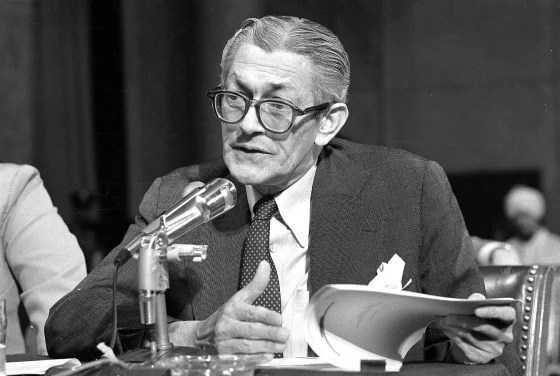
James Angleton testifies to the Senate Intelligence Committee
The memo noted approvingly how “much of the information” provided by Angleton “consists of the actual reports” he received from his sources. This was of significant advantage to the FBI, as the agency was able to “better evaluate the information instead of waiting for the delay and processing through normal channels in the CIA.” Angleton also “frequently” kept the Bureau apprised of Agency activities overseas, “which the CIA sometimes camouflages with some of its cloak and dagger techniques.”
Angleton’s extensive cooperation bought him enormous goodwill within the FBI. He successfully leveraged this in January 1958, when the Bureau serendipitously “flushed out” a scandalous, illegal spying operation targeting US citizens conducted by the CIA’s counterintelligence unit. A memo that month shared between senior FBI officials records how the Bureau was seeking to establish a program to monitor all mail being sent to and from the Soviet Union by American citizens, only to discover Angleton was already doing precisely the same thing.
Angleton in turn learned his scheme had been busted, so approached the Agency’s FBI liaison agent on a “personal basis” to outline the program. He claimed he would be fired if Langley caught wind of his disclosures to the Bureau. Angleton explained how the interception program was “one of the biggest and most secret operations being conducted by CIA,” and “extensive and expensive”. An “elaborate array of IBM machines” catalogued and conducted “complex scientific examinations” of all mail gathered.
In all, “two or three hundred CIA employees” were “exclusively engaged on various facets” of the operation, which cost “well over a million dollars a year” – roughly $11 million today. Angleton said the effort’s “sole purpose…was to identify persons behind the Iron Curtain who might have some ties in the US and who could be approached… as contacts and sources for CIA.” The operation was purportedly a “success”, with numerous valuable assets cultivated.
While FBI higherups questioned whether the effort “invaded our jurisdiction”, it was concluded Angleton’s unit had a “legitimate right” to conduct the mission. Moreover, the Bureau could avoid “the inherent dangers” of conducting a parallel mail intercept program – including “the sensitive nature of it, its complexity, size and expense” – by simply demanding the CIA counterintelligence unit hand over their operation’s vast intelligence yield to them.
Lee Harvey Oswald first came to Angleton’s attention in November 1959, due to news reports of his defection to the Soviet Union the previous month. Thereafter, all mail Oswald sent to and received from the US was opened and read by the CIA, until he returned home in May 1962 with his Russian wife Marina. Angleton’s monitoring of the minutiae of Oswald’s life persisted until Kennedy was killed. Multiple separate CIA operations collected intelligence on the President’s alleged assassin throughout.
‘CIA Project’
The CIA counterintelligence officer who monitored Oswald’s mail was Reuben Efron, part of a personal spying network constructed by Angleton from Jewish émigres from the Soviet Union, outside of formal Agency structures. Eerily, Efron attended a February 1964 hearing of the Warren Commission – officially charged with investigating JFK’s assassination – at which Marina Oswald testified. His presence was noted in an official volume of the investigation’s proceedings, but his employment by the Agency was unmentioned. Was he there on Angleton’s behalf?
This is but one of many mysteries related to Oswald that Angleton’s closed-door testimony to Senate investigators in June 1975 failed to resolve. During his grilling, Angleton had little to say about Kennedy’s assassination, despite being repeatedly probed about “the Oswald situation”. Questioned whether the CIA kept records on Oswald, Angleton prevaricated, “they have a file… I think more than one.” He offered scant further information, beyond claiming the supposed lone nut shooter was likely a Soviet operative.
When asked if there was a “connection between Oswald and the FBI”, Angleton elliptically acknowledged “there was a tremendous flap in the Bureau” following Kennedy’s assassination, and “confusion” the FBI “had not turned over, or had not taken enough initiative in turning over, all the information on Oswald to the local police” in Dallas. Angleton neglected to mention the FBI informed his counterintelligence unit one week prior to November 22nd 1963 Oswald was living and working in the city. By this time, the file collated by Angleton on Oswald ran to 180 pages.
Angleton was even more dishonest when testifying to the House Select Committee on Assassinations in October 1978. Asked point blank by a senior investigator if, to his knowledge, “Oswald [was] ever the subject of any CIA project,” Angleton lied, “no”. Coincidentally or not, he was then asked whether he knew Reuben Efron, and his responsibilities. Angleton responded in the affirmative, explaining Efron’s duties related to mail interception. Angleton was uniquely well-placed to elaborate that Efron was monitoring Oswald’s mail, in an operation he personally oversaw.
Angleton was grilled about his counterintelligence unit providing Israel with technical support for constructing nuclear weapons. He denied the charges, but under questioning admitted Tel Aviv may have conducted clandestine operations to source nuclear material in the US. Asked if he possessed “certain knowledge” of Israeli efforts “to acquire nuclear secrets in the US,” Angleton pleaded, “Do I have to respond to that?”
Kennedy entered office in January 1961 deeply concerned about Tel Aviv’s nuclear ambitions. A CIA assessment the previous month concluded a “major purpose” of Israel’s Dimona nuclear plant was “plutonium production for weapons.” The assessment outlined numerous grave outcomes of Tel Aviv acquiring nukes. Chief among them, exposure of the program would inevitably cause “consternation” in North Africa and West Asia, potentially prompting “threatened” Arab and Muslim states to turn to the Soviet Union for military assistance.
Perhaps spurred by this prospect, from day one of his Presidency, Kennedy made harmonious relations between Washington and Israel contingent on regular U.S. inspections of Dimona. Under intense pressure, Tel Aviv’s then-Prime Minister David Ben-Gurion finally allowed inspections in May 1961. Extensive efforts were conducted to camouflage areas of Dimona dedicated to research and development of nukes. Resultant assessments concluded the facility was solely concerned with nuclear power generation. Kennedy was unconvinced, however. In May 1963, he dispatched an ominous private telegram to Ben-Gurion:
“The dangers in the proliferation of national nuclear weapons systems are so obvious that I am sure I need not repeat them here… We are concerned with the disturbing effects on world stability which would accompany the development of a nuclear weapons capability by Israel… Development of a nuclear weapons capability by Israel would almost certainly lead other larger countries, that have so far refrained from such development, to feel that they must follow suit.”
‘Intelligence Operation’
The House Select Committee on Assassinations’ (HSCA) failure to interrogate Angleton over Israel’s nuke ambitions is all the more inexcusable given the contents of an April 1978 interview, conducted by Committee researcher Gaeton Fonzi with journeyman CIA officer Joseph Burkhalter Smith. Declassified records show Smith made a number of striking disclosures about Angleton’s role and influence within the Agency, and relationship with Tel Aviv. He suggested there was suspicion at the CIA’s highest levels Angleton may have been involved in Kennedy’s assassination, or at least concealed shadowy counterintelligence operations related to the world-changing event.
Smith enjoyed a close relationship with William Colby, who headed the CIA September 1973 – January 1976. A relative dove, Colby was forced out and replaced by George H. W. Bush, due to his candid public criticisms of the Agency’s record, and drive to break open the US intelligence community to greater scrutiny. Henry Kissinger aggressively pressed for his removal, fulminating how every time Colby “gets near Capitol Hill, the damn fool feels an irresistible urge to confess to some horrible crime.”
It is uncertain whether Angleton, Colby’s avowed nemesis, also played any role in Colby’s ouster. Smith claimed “Colby’s problems within the Agency stemmed largely from the conflict he had” with the CIA’s obsessively secretive counterintelligence supremo. Colby was totally in the dark as to what Angleton and his team were doing at any given time. Smith relayed how Colby had said of Kennedy’s assassination, “there could have been operations that Angleton’s staff was running that he wouldn’t even tell the Director.”
Smith went on to record how Angleton’s staff did “strange things”, and “handled all Israeli operations,” despite this not falling under their official purview. This “had a strange effect” on CIA operations in West Asia, “because unlike in other divisions where station chiefs kept each other informed, Angleton wouldn’t pass information to other stations in the Arab countries unless ‘he felt like it’.” It was also a mystery to Smith how Angleton “got all his power”.
Nonetheless, Smith testified Angleton had a “special relationship” with Allen Dulles, the longtime CIA director fired by Kennedy over the 1961 Bay of Pigs fiasco, subsequently appointed to the Warren Commission. Smith also described an “incredible” cult-like ethos among Angleton’s Agency adherents. Universally convinced the CIA had been heavily penetrated by the KGB, they were “confirmed believers in the world Communist conspiracy theory” – to the extent of suspecting the Sino-Soviet split was “a great deceptive operation.”
Asked by Fonzi “to be speculative” as to whether Lee Harvey Oswald could’ve been “a deep cover agent for the Agency,” Smith suggested Oswald may have “worked either for the Soviet Division, which ran operations in the Soviet Union, or the Counter Intelligence staff.” Angleton’s team was furthermore “very interested in the Fair Play for Cuba Committee”, a longstanding target of the CIA and FBI, to the extent “getting a penetration into it would have been a high priority effort.”
After moving to New Orleans in April 1963, Oswald set up a one-man chapter of the FPCC. In an apparent attempt to attract new members to the group in the virulently anti-Castro city, which was heaving with Cuban exiles, Oswald publicly distributed leaflets promoting the group. He hired random members of the public to assist with the effort, which lasted only 15 minutes, but just so happened to be captured on camera by a local TV station.
Oddly, when testifying to the Warren Commission, Oswald’s half-brother John Pic was “unable to recognize him” in pictures of the leafleting event, raising the prospect Oswald was being impersonated. Even more curiously, as Fonzi noted in his discussion with Smith, some of the leaflets listed the address of Oswald’s FPCC chapter as 544 Camp Street, which housed “some kind of intelligence operation run by Guy Banister, a former FBI agent.” Smith responded, “there were a lot of former FBI men on Angleton’s staff.”

Today, journalists, researchers, and concerned citizens have no choice but “to be speculative” about how and why John F Kennedy was killed, and by whom. The newly-declassified documents offer only further questions – but they all unambiguously point in James Angleton’s direction. His multifaceted role as master of the CIA’s vast Oswald file, chief of Agency relations with Israel, and potential enabler of Tel Aviv’s nuclear weapons program all appear interlinked. And these operations in tandem may account for what occurred on November 22nd 1963.
Mi5 and CIA Whistleblowers Expose Israel’s Deadly Tactics in Western Countries
The CJ Werleman Show | October 10, 2025
 / cjwerleman
How Israeli intel-linked Axonius penetrated 70 US federal agencies
Al Mayadeen | December 7, 2025
A technology firm with longstanding links to Israeli intelligence has quietly assumed a central role in safeguarding the digital systems of more than seventy US government agencies, including the Departments of Defense and Homeland Security, according to initial reporting by independent outlet Do Not Panic.
Axonius, founded by former officers of “Israel’s” Unit 8200, offers software designed to give organizations “visibility and control over all types and number of devices.” In practice, this means the platform collects and analyzes data tied to millions of federal employees.
The company was set up by three Israelis, Dean Sysman, Ofri Shur, and Avidor Bartov, who served together in Unit 8200 in the early 2010s. While Sysman’s LinkedIn profile offers only vague references to work with “far-reaching implications,” their time overlaps with key years of Israeli aggression.
Sysman left the Israeli forces in 2014 to launch a cyber-hacking venture. Shur and Bartov remained in uniform until 2017, a period that included “Israel’s” 2014 aggression on Gaza.
Rapid formation and strategic early funding
Shur and Bartov left military service in 2017 and swiftly reunited with Sysman. Almost immediately, the trio secured $4 million in seed funding from Yoav Leitersdorf, an Israeli-American investor, fellow Unit 8200 veteran, and managing partner of US-Israeli venture capital firm YL Ventures.
Additional financing arrived from Israeli firm Vertex Ventures, whose leadership is similarly rooted in Israeli military intelligence; partner Tami Bronner served four years in the IOF’s intelligence wing.
Axonius then attracted hundreds of millions in further investment from US venture capital funds with strong connections to “Israel’s” security apparatus, as per the investigative website.
Accel Partners, which has backed more than thirty Israeli tech firms, was among the earliest. Bessemer Venture Partners, whose Tel Aviv office is staffed by former Israeli intelligence personnel, also joined. One partner, Amit Karp, a former intelligence officer, now sits on the Axonius board.
Lightspeed Venture Partners, another major backer contributing roughly $200m across several rounds, employs multiple former members of Israeli military and special forces units.
Deep penetration into US federal system
Given these backgrounds, the reach of Axonius inside the US federal infrastructure is striking. The company says its platform is now running across “more than 70 federal organizations,” including four of the five core Department of Defense service branches. Award records show contracts with the Army, Navy, Air Force, and Marine Corps.
In November 2024, the Department of Homeland Security selected Axonius to centralise cyber data for dozens of federal agencies. A month later, the Pentagon tapped the company to update its system for 24/7 monitoring of all DoD networks, a key piece of federal cyber defense.
By April, Axonius had secured blanket authorization for its cloud-based tools to be used by any US federal agency.
Far-reaching footprint across government
Axonius’ software is now integrated into agencies spanning energy, transportation, treasury, health, and agriculture. Spending databases show the Defense Logistics Agency, responsible for managing the US global weapons supply chain, spent $4.3 million on Axonius in 2023 alone. The Department of Agriculture has paid nearly $2 million while Health and Human Services has paid more than $1.3 million since 2021.
Although the company presents itself as American, with headquarters in New York, its founders, top executives, and financial backers are overwhelmingly Israeli, and its engineering operations are based in Tel Aviv.
LinkedIn data indicates that most Axonius engineers in Tel Aviv previously worked in Israeli intelligence units. Through the platform, operators can link devices to specific individuals, track login activity, review browsing patterns, disable accounts, or quarantine devices.
The firm has also established a separate R&D arm, AxoniusX, led by another Unit 8200 veteran, Amit Ofer, and tasked with developing advanced cyber capabilities.
Defenders might argue that Axonius reflects the close and often opaque relationship between Washington and “Israel”. Yet “Israel’s” long record of espionage activity in the US complicates this narrative.
Historical examples range from spying operations involving Hollywood front companies to the sale of compromised software to foreign governments. Robert Maxwell, father of Ghislaine Maxwell, was an Israeli agent, and substantial evidence points to Jeffrey Epstein’s links to Israeli military intelligence. During Donald Trump’s first term, US officials reportedly discovered Israeli surveillance devices near the White House.
A Trojan horse risk?
Despite this backdrop, American authorities have permitted former Israeli intelligence officers to embed software across nearly the entire federal cyber infrastructure. In effect, the US has outsourced key elements of its digital security architecture to individuals with deep roots in the intelligence services of a foreign state.
Whether Axonius has misused or intends to misuse this access is unknown. But for analysts familiar with “Israel’s” espionage record, the arrangement raises profound questions about security, sovereignty, and oversight.
Axonius also illustrates a broader dynamic: US taxpayer funds help build “Israel’s” high-tech military apparatus, only for Washington to later purchase Israeli-developed technologies at scale, effectively paying twice. This cycle creates lucrative pathways for veterans of Israeli intelligence, while embedding their tools inside US systems, as per the investigation.
While political elites have long framed the relationship as mutually beneficial, public opinion is shifting. Millions of Americans now question whether support for “Israel” is the stabilising force it has been portrayed as.
The Axonius case surely adds fresh weight to those doubts.
IDF Chief of Staff: Yellow Line Is Israel’s New Border
By Kyle Anzalone | The Libertarian Institute | December 7, 2025
The chief of the Israeli military said the IDF will not withdraw any further, and he considers the current partition line in Gaza as the new border.
“We have operational control over extensive parts of the Gaza Strip and we will remain on those defence lines. The yellow line is a new border line – serving as a forward defensive line for our communities and a line of operational activity,” IDF Chief of Staff Eyal Zamir told recruits on Sunday.
Under President Donald Trump’s 20-point peace plan, Israel and Hamas agreed to a ceasefire with Israel agreeing to withdraw to the yellow line. The yellow line leaves just over half of the Strip under Israeli military occupation. Only a small number of Palestinians live on the Israeli side of the partition line.
As Trump’s deal is implemented, Tel Aviv agreed that the IDF would undergo further withdrawals. However, Israel has signalled it has no intention of allowing Trump’s peace plan to end the conflict in Gaza. In November, European officials expressed concern that Israel was planning to de facto annex Gaza along the yellow line.
On Saturday, the Guardian reported the IDF was building permanent structures along the current partition line.
In addition to Zamir’s remarks, the IDF has violated the ceasefire nearly every day. Israel has killed over 370 Palestinians during the first seven weeks of the truce. The Gaza Health Ministry reported six Palestinians were killed on Sunday.
Featured Video
Pravin Sawhney: Massive Escalation Pushes Every Side Toward the Brink
or go to
Aletho News Archives – Video-Images
From the Archives
UN declares war on ‘dangerous’ conspiracy theories
‘World is not secretly run by elites’
Free West Media | August 5, 2022
UNESCO says it is seriously concerned about the increase in “disinformation” and “conspiracy theories”. And they plan to put an end to it through a network of informants.
“Conspiracy theories can be dangerous,” the UN agency warned. “Often they ignore scientific evidence and polarize society with dire consequences. This has to stop.”
Unesco’s director-general warned that “conspiracy theories” could cause damage to people as well as to their health. “They reinforce misconceptions about the pandemic, reinforcing stereotypes that can fuel violence and violent, extremist ideologies,” said Audrey Azoulay.
The UN agency has launched a campaign to help people identify, debunk and report “conspiracy theories” to prevent them from spreading further.
This campaign is being carried out in collaboration with the European Commission, Twitter and the World Jewish Congress. The UN has created a toolkit to “debunk” such theories and smear anyone who dares to claim that governments are not fair and transparent.
The UN also warned that George Soros, the Rothschilds and Israel should not be linked to “alleged conspiracies”.
World events “are not secretly manipulated behind the scenes by powerful players with malicious intent,” the UN agency maintained.
And if anyone therefore comes across someone who believes that the world elite is plotting to consolidate power or direct events, then that person needs to take action. According to the UN agency, when meeting a “conspiracy theorist”, under no circumstances should one enter into a discussion. … continue
Blog Roll
 Aletho News
- Algerian army launches second operation to clear French nuclear test sites
- Pravin Sawhney: Massive Escalation Pushes Every Side Toward the Brink
- UK High Court Upholds Speech Regulator Notices To Meta, WhatsApp, X, And TikTok
- Two working on US Senate candidate’s campaign registered as foreign agents for Israel: Report
- Greece bans protest over docking of Israeli cruise ship
- Israel elections: More Arab votes, same Zionist consensus
- Taking the Houthis at Their Word: The Bill Saudi Arabia Doesn’t Want to Read
- Trump claims he would have bombed Ho Chi Minh City to win Vietnam War
- Russia shows Europe that prolonging the Ukraine war is pointless
- There is cautious optimism about ending the Ukraine War – Part 2
- If Americans Knew
- An error has occurred; the feed is probably down. Try again later.
- No Tricks Zone
- Germany’s Green Energy Transition Becoming Increasingly Expensive…Another 6 Trillion Euros!
- Sudden Stratospheric Warming, Powerful El Niño Combination May Lead To Extreme Europe Cold, Energy Crisis!
- Two New Studies Find Thwaites Glacier Melt Cannot Be Driven By Human Activity Or A Warming Ocean
- E-Cars Reduce CO2 Emissions By Only 41% Compared To Internal Combustion Engine Vehicles
- Predictions Made By Renowned Climate Professor Over Past Decades Have Been Proven To Be Poor
- New Study Suggests Large Regions Of The Pacific Ocean Have Been Cooling For The Last 80 Years
- Germany’s Green Energy Debacle: High Energy Costs Force Kahla Porzellan to Close After 182 Years!
- New Study: 50 Years Of The Most Aggressive ‘Net Zero’ Policies Can Only Affect The Global Climate By 0.03°C
- US September “Heat” Was No Record…Many Records Set Decades Ago
- Latest European Green Energy Debacle; Portugal’s Largest Flagship Solar Park Insolvent!

