The global dominance that the United States, the greatest power in the West, wants to maintain at all costs violates the most basic norms of international law: the Trump Administration revoked the visas of representatives of the State of Palestine, preventing them from attending the United Nations General Assembly in September.
This claim to dominance is provoking growing opposition from the Global South. This is confirmed by the warning issued by China with the largest military parade in Beijing.
The official statement from the State Department states that the Trump administration has revoked the visas of members of the Palestine Liberation Organization (PLO) and the Palestinian Authority (PA) ahead of the upcoming United Nations General Assembly, “in the interest of our national security” because “the PLO and PA are responsible for undermining the prospects for peace through their appeals to the UN International Court of Justice to obtain unilateral recognition of a hypothetical Palestinian state.”
In addition, the Trump Administration announced the suspension of visas for all Palestinian passport holders, preventing them from entering the United States for medical treatment, university attendance, visits to relatives, and business activities. At the same time, the Trump administration announced that it is studying “the post-war plan for Gaza”: it provides for the “voluntary transfer” of the entire Palestinian population to transform Gaza into a luxurious “Middle East Riviera.” In this way, while Israel continues its genocide of Palestinians in Gaza and the West Bank, the United States is dismantling the foundations of the State of Palestine.
However, the global dominance that the West’s greatest power wants to maintain at all costs, violating the most basic norms of international law, is provoking growing opposition from the Global South. This is confirmed by the meeting of the Shanghai Cooperation Organization, whose members include China, Russia, Belarus, Iran, India, Pakistan, Kazakhstan, Kyrgyzstan, Tajikistan, and Uzbekistan, with several other countries participating. At the meeting held in China, President Xi Jinping reiterated the basic principles:
“First, we must respect the principle of sovereign equality. We must uphold that all countries, regardless of their size, strength, and wealth, are equal participants, decision-makers, and beneficiaries in global governance. We must promote greater democracy in international relations and increase the representation and voice of developing countries.”
*
This article was originally published in Italian on Grandangolo, Byoblu TV.
Manlio Dinucci, award-winning author, geopolitical analyst and geographer, Pisa, Italy. He is a Research Associate of the Centre for Research on Globalization (CRG).
Latin America has seen a remarkable number of revolutions and coups d’etat over the last century. However, whether military endeavours, covertly backed by foreign governments, or the result of purely domestic political pressure, they have not always been successful or achieved their aims.
Yet few can have failed quite so miserably as a woeful attempt in May 2020 to overthrow the Venezuelan government.
The plot of this often bizarre tale has many elements that will be familiar to students of the region’s history – not least a cast of political exiles, military renegades, US mercenaries and at least one very controversial president. But it also throws up many intriguing questions about who was behind it and what exactly they hoped to gain.
People & Power investigates an affair that many – with a sardonic nod to more infamous events elsewhere – have dubbed The Bay of Piglets.
Paul Connett, Ph.D., co-author of “The Case Against Fluoride: How Hazardous Waste Ended Up in Our Drinking Water and the Bad Science and Powerful Politics That Keep It There,” responds to Thursday’s U.S. Senate hearing during which members of the Finance Committee accused U.S. Health Secretary Robert F. Kennedy Jr. of “politicizing” science.
Yesterday, the world watched as you bayed and sneered at Robert F. Kennedy Jr. for disagreeing with your beliefs on vaccines.
Were you following a script forwarded to you by the PR hate machinery of the pharmaceutical industry?
Ironically, a similar complex of industry, CDC and pseudo-professional bodies has kept you silent on another public health practice for decades.
You have remained silent while they have dripped poison into our children’s bodies for 80 years.
Where were you between 2017 and 2020, when U.S. Government-funded mother-offspring and infant fluoride IQ studies were published?
Where were you in 2022, when the Centers for Disease Control and Prevention witnessed this science but failed to warn pregnant mums to avoid fluoridated water?
Where were you in 2024 when the National Toxicology Program reviewed these and many other IQ studies and concurred that fluoride was a neurotoxin?
Paul Connett, Ph.D., is co-author of “The Case Against Fluoride: How Hazardous Waste Ended Up in Our Drinking Water and the Bad Science and Powerful Politics That Keep It There.”
A leaked memo from one of the pharma cartel’s most powerful trade groups has revealed a desperate plan to push Robert F. Kennedy, Jr. out of his role as United States Secretary of Health and Human Services (HHS). The document, apparently originating from a closed-door meeting of the Biotechnology Innovation Organization (BIO), shows that industry leaders are prepared to spend millions of dollars lobbying Congress and manipulating public opinion to force Kennedy from his job. At stake is not just U.S. government vaccine policy, but the deeper question of who actually runs public health in America – democratically elected officials, or the corporations that profit from disease.
The plan unveiled
The memo appears to come from BIO’s Vaccine Policy Steering Committee, a powerful body representing companies such as Pfizer, Merck, Novavax, and Vaxcyte. According to whistleblowers, the group met on April 3, 2025, to discuss the “threat” posed by Kennedy’s healthcare reform agenda. The summary leaves no doubt about its intentions. One line is especially blunt: “It is time to go to The Hill and lobby that it is time for RFK Jr. to go.”
The threat to the cartel is clear. Kennedy has insisted on long-term safety data for vaccines, full publication of trial results, and the restoration of manufacturer liability for injuries. These proposals would dramatically slow down the fast-track approvals and legal protections that have allowed vaccine makers to rake in billions while avoiding accountability. In the eyes of BIO, this is not just policy reform – it is a direct attack on its business model.
Fear of accountability
BIO’s real fear is not scientific debate but financial disruption. The memo quotes one executive from Vaxcyte warning that “investors have stated they are leaving until the next data read out,” citing uncertainty caused by Kennedy’s push for tighter regulation. Capital, in other words, is fleeing the vaccine sector. Instead of reassuring the public with stronger safety standards, BIO is working to reassure Wall Street by removing the man calling for reform.
This exposes the heart of the problem: the pharmaceutical industry has become so dependent on weak oversight and political protection that it views accountability itself as a threat. Rather than adapt to higher safety expectations, BIO would rather manipulate politics to preserve the old system.
Buying influence
The most revealing part of the plan is financial. BIO has committed $2 million to a new communications campaign titled ‘Why We Vaccinate.’ But this is no ordinary public health initiative. According to the memo, its goal is not education but “inspire and frighten” messaging designed to sway the “movable middle” of public opinion. Essentially, by tying vaccination to national security, economic productivity, and workforce resilience, the campaign seeks to use fear as a political weapon.
This is not science. It is psychology. Instead of engaging Kennedy’s arguments on their merits, BIO plans to drown out discussion with a flood of fear-based advertising and carefully managed surrogates. Among those mentioned as possible allies are Dr. Mehmet Oz and Senator Bill Cassidy. These figures are expected to provide a veneer of bipartisan legitimacy while avoiding any real debate about the substance of Kennedy’s proposals.
Controlling the narrative
Equally troubling is BIO’s strategy of redefining language itself. The leaked document reveals plans to replace words like “protect” and “defend” with softer-sounding terms such as “streamline,” “optimize,” and “enhance.” But behind the rebranding lies a cynical truth. As Robert W. Malone MD has pointed out, when BIO says “efficiency,” it means fewer safety checks. When it says “transparency,” it means PR-polished talking points, not the release of raw scientific data. When it says “resilience,” it means consumer obedience, not real safeguards.
This is not reform – it is narrative disingenuity that would not be out of place in George Orwell’s dystopian novel Nineteen Eighty-Four. BIO is attempting to control the vocabulary while ensuring that nothing actually changes. It is a form of deception that goes beyond lobbying, seeking to manipulate the very terms of debate so the public never realizes reform has been hollowed out.
The plot is already underway
The memo points to this month (September 2025) as a critical deadline. Congress is back in full session, budget negotiations are getting underway, and the media cycle is returning to full speed after the summer lull. BIO’s campaign is timed to seize this moment, flooding the airwaves with its ‘Why We Vaccinate’ messaging before Kennedy’s reform agenda gains traction.
September also marks the reopening of schools, a time when vaccine debates are most prominent in the public eye. By striking early, BIO hopes to dominate the narrative and silence Kennedy before he can rally broader public support. For the pharma industry, this is not about science but survival.
Significantly, therefore, in the past couple of days, we have already seen nine former leaders of the Centers for Disease Control and Prevention (CDC) speaking out against Kennedy, publishing an open letter in The New York Times that criticizes his policies.
Separately, and simultaneously, more than 1,000 current and former HHS employees are said to be calling for Kennedy to either resign or be fired. Their letter – which does not name the signatories but mentions vaccines eight times – accuses him of endangering the nation’s health. It is difficult not to see the hand of BIO behind these moves.
A threat to democracy
The implications of this plot go far beyond health policy. If corporations can secretly conspire to spend millions lobbying for the removal of a sitting government official, then democracy itself is in danger. Whether one agrees with Kennedy’s policies or not, it should not be the pharmaceutical lobby that decides who serves in public office. That decision belongs to the people and their elected representatives, not to an industry that stands to profit from the outcome.
This is why the BIO leak matters so much. It shines a light on the machinery of influence that usually operates in the shadows – closed-door meetings, carefully managed talking points, and money flowing into Washington to buy outcomes that serve shareholders instead of citizens.
Who decides about global health?
The BIO plot also has international implications, as it aligns with broader efforts to centralize health policy through global treaties and the algorithmic censorship of dissenting medical views. If left unchecked, this could lead to a future where drug companies, aided by international bodies, dictate not only U.S. policy but all global health decisions as well. The Kennedy reforms represent a direct challenge to that vision.
Ultimately, therefore, this story is not just about Robert F. Kennedy, Jr. It is about whether public health will be guided by the principles of science, safety, and consent – or by the profit motives of an industry that sees accountability as a threat. Seen in this light, BIO’s efforts to remove Kennedy are not a sign of power. They are an admittance of weakness.
Kennedy’s reforms may be inconvenient for Wall Street, but they reflect the public’s increasing demands for safety, consent, and honesty in medicine. The real question now is whether corporations will continue to dictate the rules – or whether the American people can successfully reclaim health policy for the public good.
Paul Anthony Taylor
Executive Director of the Dr. Rath Health Foundation and one of the coauthors of our explosive book, “The Nazi Roots of the ‘Brussels EU’”, Paul is also our expert on the Codex Alimentarius Commission and has had eye-witness experience, as an official observer delegate, at its meetings.
In a contentious Senate hearing today, U.S. Health Secretary Robert F. Kennedy Jr. engaged in fiery exchanges with senators on both sides of the aisle who questioned his record in office, the administration’s vaccine policies, and the ouster of top officials and advisers at the Centers for Disease Control and Prevention (CDC).
During the hearing held by the Senate Finance Committee, which has oversight over the U.S. Department of Health and Human Services (HHS), many senators used their allotted five minutes to make impassioned speeches and air their grievances, often leaving Kennedy little or no time to respond.
The New York Times described Kennedy, who was visibly annoyed at times, as “remarkably salty and dismissive with senators at times today.”
“You don’t want to talk,” Kennedy told Sen. Elizabeth Smith (D-Minn.). “You want to harangue and have partisan politics. I want to solve these problems.”
Sens. Elizabeth Warren (D-Mass.) and Raphael Warnock (D-Ga.) called for Kennedy to resign or be fired by President Donald Trump during the hearing. This morning, Democratic senators on the committee issued a statement calling for his resignation.
Several senators also pressed Kennedy on whether Operation Warp Speed was a great accomplishment, and raised concerns about cuts to Medicaid and funding for rural hospitals.
Kennedy shot back at his critics, promising to fix the “malpractice” within the public health agencies, and touting his agency’s many accomplishments since he took the helm.
He blasted the CDC, which he said, “is the most corrupt agency in HHS,” for its history of failing to protect Americans’ health, particularly during the COVID-19 crisis, during which the U.S. “did worse than any country in the world.”
“The people at CDC who oversaw that process, who put masks on our children, who closed our schools, are the people who will be leaving,” he said, adding, “That’s why we need bold, competent and creative new leadership at CDC. People who are able and willing to chart a new course.”
Wyden called Kennedy a liar, Kennedy accused Wyden of doing nothing to prevent chronic disease
After Committee Chair Mike Crapo (R-Idaho) kicked off what he predicted would be a “spirited debate,” ranking member Ron Wyden (D-Ore.) attacked Kennedy for the “costs, chaos and corruption” he allegedly brought to the agency.
That was also the title of a report Wyden co-authored with Sen. Angela Alsobrooks (D-Md.) and submitted to the record, summarizing their take on Kennedy’s tenure at HHS.
Wyden called Kennedy a liar and made what he called an “unprecedented” request that Kennedy be formally sworn in, presumably so the committee could later prove he lied under oath. Crapo refused the request, which isn’t customary in Senate hearings.
Wyden then launched a long attack on Kennedy’s “agenda,” which he said is “fundamentally cruel and defies common sense.”
Kennedy shot back:
“Senator, you’ve sat in that chair for how long? 20, 25 years? While the chronic disease in our children went up to 76%, and you said nothing. You never asked the question, why it’s happening. ‘Why is this happening?’ Today, for the first time in 20 years, we learned that infant mortality has increased in our country. It’s not because I came in here. It’s because of what happened during the Biden administration that we’re going to end.”
Kennedy says Monarez lied in WSJ Op-Ed
Several senators referred to an op-ed written by Monarez and published this morning in The Wall Street Journal. Monarez, who was fired last week by Trump, claimed Kennedy pressured her “to compromise science itself.”
“I was told to preapprove the recommendations of a vaccine advisory panel newly filled with people who have publicly expressed antivaccine rhetoric,” Monarez wrote.
When asked, Kennedy disputed Monarez’s account of her firing. “I told her that she had to resign because I asked her, ‘Are you a trustworthy person?’ And she said ‘no,’” he said.
Wyden quoted Monarez to Kennedy and asked whether he had pressured her to preapprove recommendations. “No, I did not say that to her,” Kennedy responded.
So she’s lying today to the American people in the Wall Street Journal ?” Wyden asked.
“Yes, sir,” Kennedy responded.
Kennedy said the opposite was true. Monarez indicated she would refuse to endorse any CDC vaccine panel recommendations even before the committee met to make them, he said. He said he asked her to walk back that stance so she would hear the recommendations and their rationale before making any decision, but Monarez refused.
Taking away vaccines?
Several senators, including Smith and Warren, accused Kennedy of going back on his commitment and “taking away vaccines” from the American people.
Warren cited the FDA’s decision to end emergency use authorization of COVID-19 vaccines and limit approvals of the vaccines to people at high risk. However, HHS also confirmed the vaccines would be available for anyone who decided they wanted them anyway.
Defending the move, Kennedy told Warren, “We’re not going to recommend a product for which there’s no clinical data for that indication, is that what I should be doing?”
“I know you’ve taken $855,000 from pharmaceutical companies, Senator,” he later told Warren.
Operation Warp Speed — worthy of a Nobel Prize
Senators accused Kennedy of holding a contradictory position on Operation Warp Speed, which Sen. Bill Cassidy (R-La.) said deserved a Nobel Prize, but few gave him time to respond to the accusations.
Several senators also lambasted Kennedy for not acknowledging that the COVID-19 vaccines saved millions of lives.
Sen. Roger Marshall (R-Kan.), a physician who supported Kennedy and spent much of his five minutes questioning why the hepatitis B vaccine is given to all babies, asked Kennedy to respond.
Kennedy said that when the COVID-19 vaccines were first rolled out, they were necessary because the virus was dangerous, but that the vaccines were significantly less necessary now.
“The virus has mutated, it’s much less dangerous, where there’s a lot of natural immunity and herd immunity, and so the calculus is different, and it’s complicated.”
Kennedy added:
“They think I’m being evasive because I won’t make a kind of a statement that’s almost religious in nature, ‘it saved a million lives.’ Well, there is no data to support that. There’s no study. There’s modeling studies. There’s faulty data.”
Sen. Ron Johnson (R-Wis.), who thanked Kennedy for “putting up with this abuse,” backed Kennedy’s statements on the dangers of the COVID-19 vaccines and said federal health agencies hid the early signals for myo and pericarditis.
At the end of the hearing, Crapo offered Kennedy the floor to make a statement if there were things he wanted to clarify.
“I think I’ll have mercy on everybody here,” Kennedy said. “Let’s adjourn.”
Nearly 900 people were arrested in the United Kingdom over the weekend during a protest in London in support of the banned pro-Palestinian group Palestine Action, according to the Metropolitan Police.
Authorities confirmed that 857 individuals were arrested under the Terrorism Act of 2000 for supporting a proscribed organization, with another 33 detained for separate offences, including alleged assaults on police officers.
Solidarity with Gaza targeted in crackdown
The protest, described by organizers as an expression of solidarity with Gaza, was held outside the UK Parliament and drew around 1,500 participants.
Many demonstrators carried signs condemning “Israel’s” aggression and genocide in Gaza and expressing support for Palestine.
This comes as “Israel” intensified its bombardment of Gaza and launched new strikes with the stated aim of seizing Gaza City to defeat the Palestinian resistance.
Critics have accused the UK government of using counterterrorism laws to suppress peaceful activism.
The United Nations and other human rights groups have condemned the July decision to designate Palestine Action as a terrorist organization, citing threats to civil liberties and free speech.
Police claim violence; organizers insist protest was peaceful
Of the 33 non-terrorism-related arrests, 17 were allegedly for assaults on officers. The police claimed their officers faced “intolerable” abuse. However, organizers from Defend Our Juries (DOJ), who coordinated the “Lift the Ban” rally, described it as “the picture of peaceful protest.”
Reports noted that many of those arrested were older individuals, some holding signs like “I oppose genocide. I support Palestine Action.”
If convicted, the majority face up to six months in prison, while organizers could face sentences of up to 14 years.
Public figures, UN slam ban as legal overreach
The ban on Palestine Action was pushed by former interior minister Yvette Cooper, who accused the group of engaging in “aggressive and intimidatory attacks” against public and private institutions.
She also claimed that court-imposed reporting restrictions have limited public understanding of the group’s actions.
Nonetheless, public support for Palestine Action has grown since the group’s proscription, with many viewing the UK’s actions as an attempt to silence those who speak out against the war on Gaza and stand in solidarity with Palestine.
GAZA – Dr. Munir al-Bursh, director of Gaza’s health ministry, has affirmed that doctors and medical staff in Gaza City’s hospitals have decided to remain at their posts, staying close to children and all patients in intensive care units.
“There are more than 200 patients in intensive care who require life-support machines and artificial respiration, and these patients cannot be evacuated without facing certain death,” Dr. Bursh told Al Jazeera satellite channel on Sunday.
“If the Israeli occupation wants to kill us and our patients, so be it. We will not leave our hospitals or abandon our patients under any circumstances because the alternative is death,” he added.
He called for necessarily providing protection for hospitals and healthcare workers in Gaza in accordance with the Fourth Geneva Convention and international treaties.
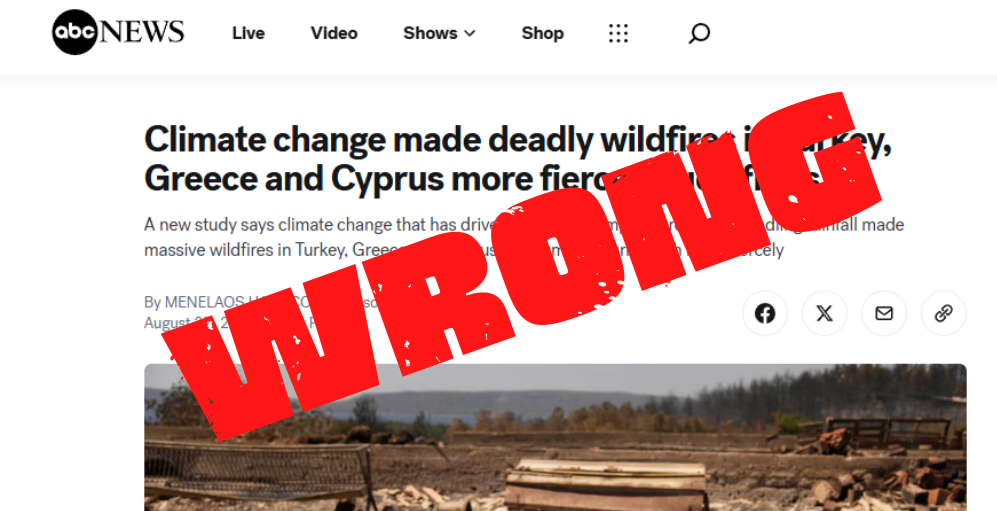
The Associated Press (AP), via ABC News, claims that climate change is responsible for the intensity of European wildfires in a story titled “Climate change made deadly wildfires in Turkey, Greece and Cyprus more fierce, study finds.” This is false. Data show no long-term trend of increasing wildfires in any of the countries listed, and overall global wildfire data shows declining fire extent.
The AP cites a non-peer reviewed report by World Weather Attribution (WWA) to claim that climate change was responsible for necessary conditions, specifically, hot and dry weather, which drove the widespread wildfire outbreaks in Turkey, Greece, and Cyprus, and made them “burn much more fiercely.”
The story and the report it relies upon are suspect from the start. First, as discussed by Climate Realism previously, as a matter of geography the climate of the Mediterranean region is naturally arid, prone to drought, extreme heat, and associated wildfires. Fire helped shape the ecology of the entire region. Some past fires have been huge. For instance, more than 112 years of global warming ago, when global average temperatures were cooler and humans weren’t contributing significantly to atmospheric carbon dioxide levels, the great Thessaloniki fire burned for 13 days. It left more than 70,000 people homeless, and destroyed two-thirds of Greece’s second largest city. So hot and dry weather is the norm for the Turkey, Greece, and Cyprus, especially during the summer, rather than being unusual weather conditions.
The AP ignores this fact about the region’s climate. It also did not critically assess WWA. The AP portrays WWA an unbiased “group of researchers that examines whether and to what extent extreme weather events are linked to climate change.” But this is false. The entire reason for WWA’s existence is specifically to “attribute” extreme weather events to human-caused climate change, in part to provide material that can be used in lawsuits filed against governments and the fossil fuel industry. The WWA believes the U.N. Intergovernmental Panel on Climate Change’s data driven approach to understating the causes of extreme weather is far too cautious when it comes to attribution. WWA produces studies on the assumption that climate change caused or contributed to an extreme event, the only real question being how much more likely was the event to occur, or how much more severe was the event, than it would have been absent human fossil fuel use. That is the fallacy of affirming the consequent or assuming what you are attempting to prove.
In this case, WWA claimed the fires were “22% more intense in 2025, Europe’s worst recorded year of wildfires.” This claim is unverified and misleading, at best. The Mediterranean region the AP discusses is not all of Europe, and it was not that regions worst year of wildfires.
It is worth noting that WWA seems to only attribute extreme weather to climate change, never mild or good weather. WWA specifically identifies its goal as increasing the “immediacy of climate change, thereby increasing support for mitigation.” Climate Realismhas explained at length why single event attribution is scientifically misleading and unreliable at best in past articles, and we’ve specifically refuted flawed WWA reports previously dozens of times, here, here, and here, for example.
This year may well be a record fire year for parts of Europe and Asia, but only a sustained trend of worsening fires would prove that they were driven by climate change. No such trend exists, globally or in the individual countries mentioned.
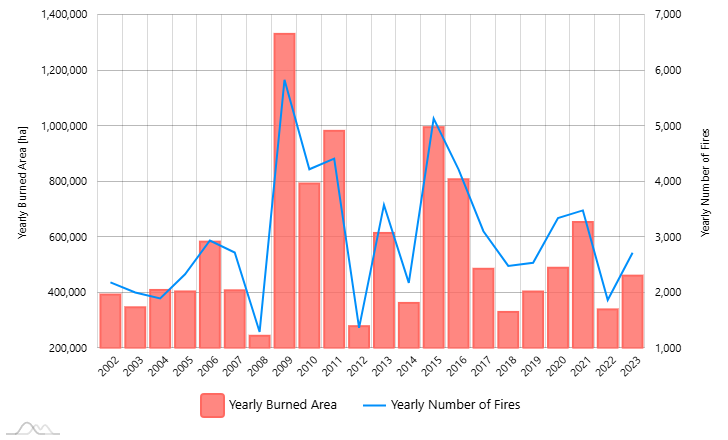
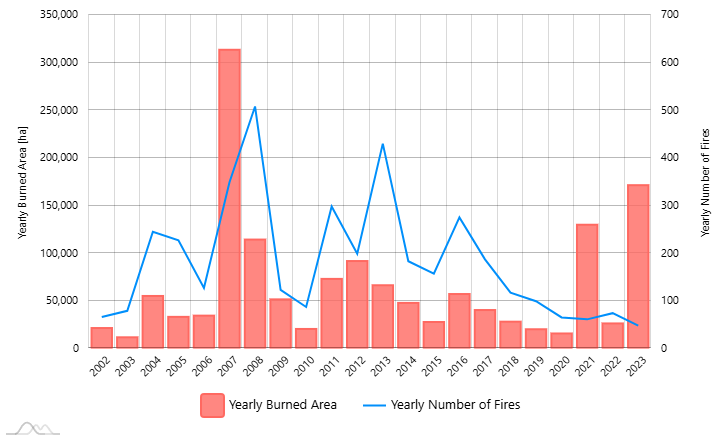
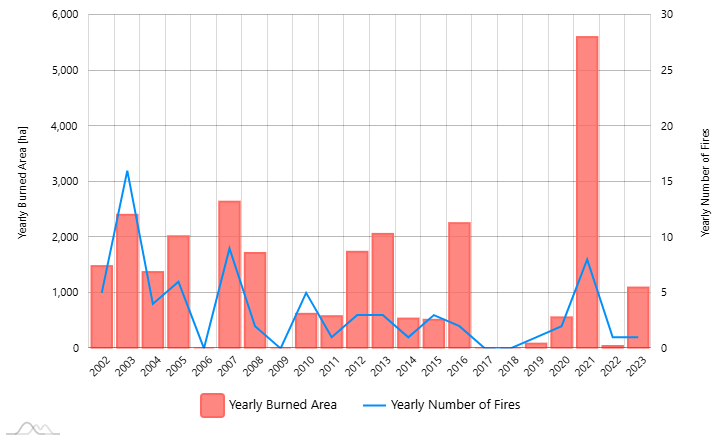
Looking at the most recent available data from the joint collaborative project between NASA and the European Space Agency, Copernicus, for each country we can see the wildfire trends are far from consistent.
Again, particularly in the case of yearly burned area, there is no consistent trend in wildfire data for Cypress, and a possible overall decline in the yearly number of fires.
Downward or flat trends can’t honestly be portrayed as increasing trends.
Although global wildfire data also is spotty for long-term trends, what data exists consistently suggest a declining global trend. NASA data shows a global decline in acreage lost to wildfire since 2003.
Extreme weather event attribution studies, produced rapidly in hours after a natural disaster strikes, aren’t vetted science. Still, they are eagerly accepted as evidence of climate impacts by the alarmist media. This is absurd when any credible fact checker, editor, or investigative journalist could easily access publicly available data that devastates the climate change linkage at the core of the story. One would hope that the Associated Press’ writers are gullible or naïve, but even taking that charitable view, the lack of basic research is inexcusable for any journalistic outlet. One reason to doubt the charitable belief in how so many false climate tales are spun out of the AP is that the stories are all biased in the same direction of climate alarm – climate change is never not to blame – and that the AP’s climate coverage is specifically funded by foundations and non-profit organizations who have long pushed climate alarm.
A recent Associated Press(AP) story carried by WCVB-TV and many other news outlets, warned that “climate change is making it “dicier” to grow corn in the United States. This is false. Data clearly shows that amid modest climate change corn yields and production have increased steadily, regularly setting new records.
The AP writes:
Across major corn-growing states, climate change is fueling conditions that make watching the corn grow a nail-biter for farmers. Factors like consistently high summer overnight temperatures, droughts and heavier-than-usual rains at the wrong time can all disrupt the plants’ pollination — making each full ear of corn less of a guarantee and more of a gamble.
Overall, corn growers got lucky this year with late-season weather that contributed to what is now predicted to be a record bumper crop. But experts say bouts of extreme weather are intensifying the waiting game during a critical time of year between planting and harvest.
Human-caused climate change has worsened multiple U.S. extreme heat events this year and has steadily increased the likelihood of hotter overnight temperatures since 1970, according to Climate Central, an independent group of scientists who communicate climate science and data to the public.
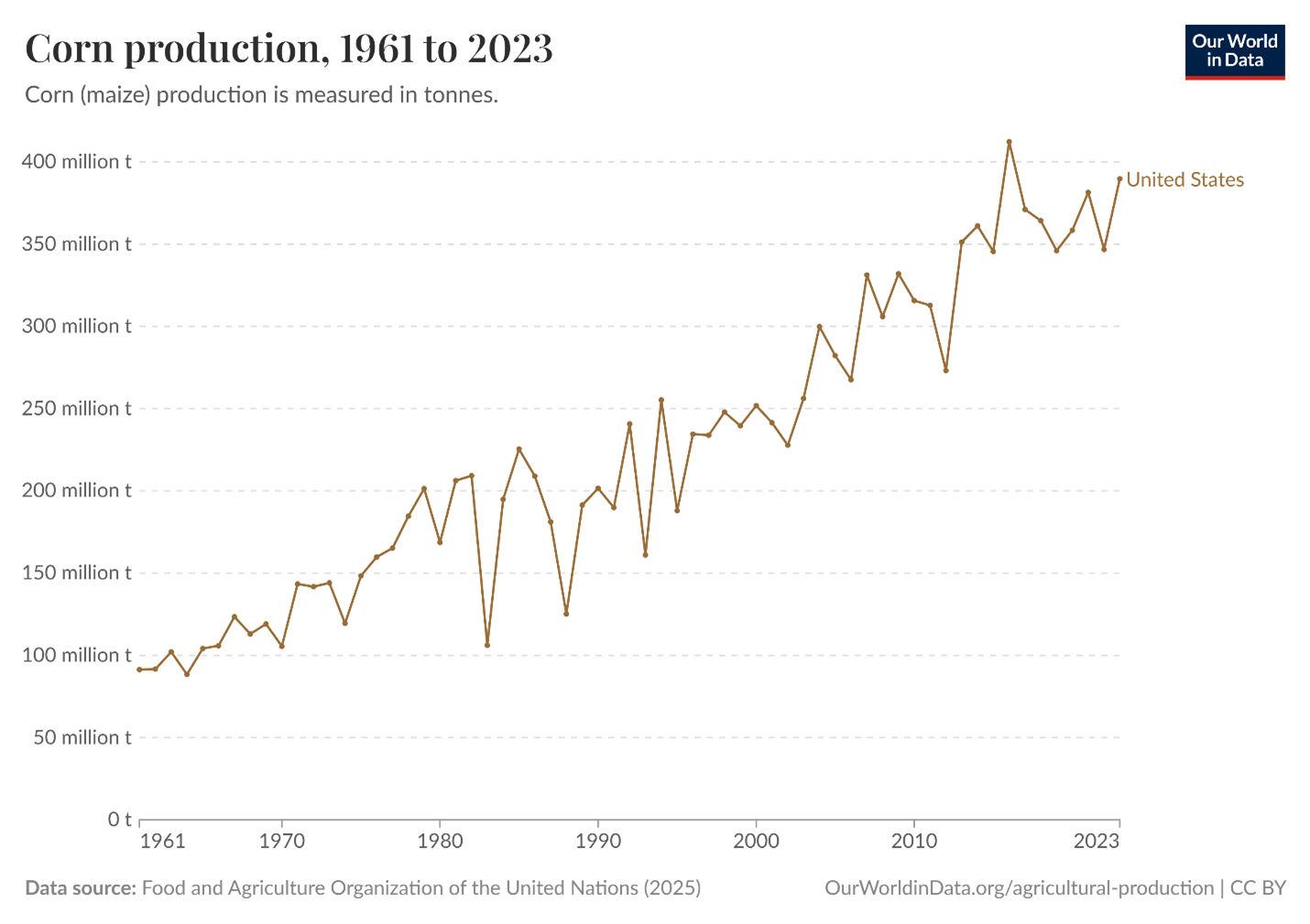
The AP’s narrative is a pure lie, debunked within its own paragraphs. Corn growers didn’t get lucky this year with a bumper crop, rather bumper crops have been a trend during the recent period of modest warming, even with the normal annual ups and downs inherent to crop production. The USDA meteorologist, Brad Rippey, who the AP quoted described 2025’s production as a “monster U.S. corn crop.” But it’s not the first monster crop in the past few decades for U.S. corn farmers.
The numbers tell a clear and compelling story of rising corn production. The U.S. Department of Agriculture confirmed record national yields of 179.3 bushels per acre in 2024, breaking the previous record set only a year earlier in 2023. Long-term records from the U.N. Food and Agriculture Organization show U.S. corn yields have more than tripled since 1961, rising from around 3.5 tons per hectare to more than 11 tons today as seen in the figure below:
Economists at the University of Illinois calculate that yields have increased by nearly two bushels per acre every year since 1950. These are not the marks of a crop in decline — they are the hallmarks of long-term improvement from better farming practices, yield improved varieties, selective breeding practices to improve resiliency to weather factors, and boosted production due to carbon dioxide fertilization.
The significant gains in yields have also produced records for production with U.S. Department of Agriculture data showing each of the past ten years of production having been higher than any previous years or decades in history, with new records for production being set three times since 2016.
To tie corn growers concerns to climate change, the AP article relied on a small number of anecdotes about heat, corn tassel timing, and the fragility of pollination. Yes, these can matter for pollination in a particular field, but they have always been part of farming. Weather extremes are nothing new, and across hundreds of posts, Climate Realism has cited data across a range of stories showing extreme weather hasn’t become more frequent, severe, or inconsistent in recent years. What matters is the nationwide harvest, and it keeps breaking records. If the climate were truly making corn “dicier,” record-breaking yields would not keep piling up.
The real problem corn producers face at the moment is not crop decline, but instead just the opposite, crop abundance and farming success. Bumper crops have produced an oversupply to the market that is resulting in lower prices, even as ever more corn is being diverted from grocery shelves to gas tanks as ethanol requirements creep up.
Farmers are not watching their livelihoods wither under climate change. Instead, they are wrestling with the economic consequences of overproduction, as a variety of news outlets have reported recently. On the same day the AP was incorrectly bemoaning corn declines, a story titled, “Huge Crops in Corn Belt Hit Cash-Strapped Farmers With More Unease,” was published in the Wall Street Journal. Just a few days earlier, in a story, subtitled, “so much corn, so little profit, NewsNation reported that with the USDA projecting 16.7 billion bushels of corn in 2025, the largest in American history, the glut is pushing prices to multi-year lows, with Iowa producers estimating losses of $80 to $100 per acre at current bids. That is not a climate crisis, it is an economic one caused by success.
So contrary to the AP’s claims, the real problem facing corn farmers is not extreme, unpredictable weather and crop diseases hampering production, but rather oversupply of the market due to record setting production, the latter a regular occurrence across the first quarter of the 21st century as global temperatures have continued to rise modestly.
Oversupply is forcing farmers to store corn with little hope of profitable sales, while trade policy uncertainties in corn exports weigh on demand. These are the real stressors in agriculture today, none of which have anything to do with climate change. By fixating on climate change while admitting record abundance in the same breath, The AP obscures the actual challenges farmers face with regards to commodity markets, prices, and trade.
The conclusion is unavoidable: the claim that climate change is making corn yields more precarious is demonstrably false. Yields are rising, production is at record highs, and as a result, prices are low, driving down farm income. The Associated Press misled its affiliates and readers by suggesting a climate crisis where there is none, undermining trust in its reporting. Farmers and the public deserve better.
MOSCOW – It would be easier to achieve a peaceful settlement of the Ukrainian crisis if the “hawks” in Brussels stopped fueling the conflict, the Russian Embassy in Belgium said on Sunday.
“It is obvious that if the ‘hawks’ in Brussels and other Western capitals stop fueling the war and support peace efforts, including those undertaken by US President [Donald] Trump, then it will become much easier to achieve peace,” the embassy wrote on Telegram.
Instead, the Belgian government is becoming more and more Russophobic, misleading its citizens about Russia’s alleged intent to attack Brussels, the embassy added.
Earlier in September, Belgian Defense Minister Thomas Francken said that Moscow was capable of “infiltrating” one of the NATO member states by 2030 under the pretext of protecting the Russian-speaking minority in it, while at the same time attacking Brussels, “the capital of diplomacy,” with drones and missiles.
“The flawed logic offered to ordinary citizens confirms that the current Belgian leadership is rapidly moving away from its previously declared moderation in foreign affairs and is increasingly joining the ranks of the most Russophobic part of the EU and NATO, pursuing an extremely dangerous course of inciting confrontation with our country,” the statement read.
The Russian embassy dismissed the allegations, adding that the policies pursued by the Belgian government result in significant economic and social costs, which Belgian citizens are forced to pay.
Western sanctions contributed to nearly 29 million excess deaths worldwide over five decades – a toll comparable to that of wars, according to a recent study.
The research, published last month in Lancet Global Health, has gained attention around the world.
Examining age-specific mortality in 152 countries from 1971 to 2021, using statistics from the Global Sanctions Database, researchers compared mortality rates before and after sanctions, tracking long-term trends to estimate their toll in excess deaths. They focused on three sanctioning authorities: The UN, the US, and the EU (and its predecessor).
“We estimate that unilateral sanctions over this period caused 564,258 deaths per year, similar to the global mortality burden associated with armed conflict,” the authors noted, with a total of 28.8 million deaths across the 51-year span.
We found the strongest effects for unilateral, economic, and US sanctions, whereas we found no statistical evidence of an effect for UN sanctions.
Most excess deaths occurred among the most vulnerable – the very young and the elderly.
“Our findings reveal that unilateral and economic sanctions, particularly those imposed by the USA, lead to substantial increases in mortality, disproportionately affecting children younger than 5 years,” the study said, noting that the age group accounted for 51% of the total death toll.
The report found that the sanctions undermine economic and food security, often causing hunger and health problems among the poorest. Additionally, the dominance of the dollar and euro in global transactions allowed the US and EU to amplify the impact of their sanctions.
At last year’s BRICS summit, member nations called for “unlawful unilateral coercive measures” to be eliminated, warning of their disproportionate impact on the most vulnerable. Members have increasingly avoided the dollar “to shield themselves from US arbitrariness,” Moscow has said.
At the Shanghai Cooperation Organization (SCO) summit in Tianjin this week, Chinese President Xi Jinping called for a fairer global governance system based on mutual respect and opposition to Western dominance. Russian President Vladimir Putin welcomed the proposal as especially relevant when “some countries still do not abandon their desire for dictatorship in international affairs.”
The leaders of the European Union should go to Moscow and conclude a security agreement with Russia, stipulating that Ukraine will not become a member of the EU and NATO, Hungarian Prime Minister Viktor Orban said on Sunday.
“Europe, in fact, needs to go to Moscow and conclude a security agreement between the EU and Russia, not in Washington. Not only about Ukraine, but also about security between the EU and Russia. It will obviously include that Ukraine will not be a member of either NATO or the EU, but it can also include – and I think Hungary could support this – an agreement on strategic cooperation between Ukraine and the EU,” Orban said during a speech.
Ukraine’s admission to the bloc would mean the EU entering into conflict with Russia and destroying the EU economically, while the agreement on strategic cooperation between the EU and Ukraine could become a compromise option that Budapest would not object to, Orban added.
MMR Vaccine (Measles, Mumps, and Rubella) Is It Safer Than Measles, Mumps and Rubella?
Physicians for Informed Consent | December 2024
… It has not been proven that the MMR vaccine is safer than measles, mumps, and rubella. The vaccine package insert raises questions about safety testing for cancer, genetic mutations, and impaired fertility. Although VAERS tracks some adverse events, it is too inaccurate to measure against the risk of measles, mumps, and rubella. Clinical trials do not have the ability to detect less common adverse reactions, and epidemiological studies are limited by the effects of chance and possible confounders. Safety studies of the MMR vaccine are particularly lacking in statistical power. A review of more than 60 MMR vaccine studies conducted for the Cochrane Library states, “The design and reporting of safety outcomes in MMR vaccine studies, both pre- and post-marketing, are largely inadequate.”19 Because permanent sequelae (aftereffects) from measles, mumps, and rubella are so rare (especially in children with normal levels of vitamin A and infected after birth),6,15-17 the level of accuracy of the research studies available is insufficient to rule out the possibility that the MMR vaccine causes greater death or permanent disability than measles, mumps, and rubella. – Read full article
This site is provided as a research and reference tool. Although we make every reasonable effort to ensure that the information and data provided at this site are useful, accurate, and current, we cannot guarantee that the information and data provided here will be error-free. By using this site, you assume all responsibility for and risk arising from your use of and reliance upon the contents of this site.
This site and the information available through it do not, and are not intended to constitute legal advice. Should you require legal advice, you should consult your own attorney.
Nothing within this site or linked to by this site constitutes investment advice or medical advice.
Materials accessible from or added to this site by third parties, such as comments posted, are strictly the responsibility of the third party who added such materials or made them accessible and we neither endorse nor undertake to control, monitor, edit or assume responsibility for any such third-party material.
The posting of stories, commentaries, reports, documents and links (embedded or otherwise) on this site does not in any way, shape or form, implied or otherwise, necessarily express or suggest endorsement or support of any of such posted material or parts therein.
The word “alleged” is deemed to occur before the word “fraud.” Since the rule of law still applies. To peasants, at least.
Fair Use
This site contains copyrighted material the use of which has not always been specifically authorized by the copyright owner. We are making such material available in our efforts to advance understanding of environmental, political, human rights, economic, democracy, scientific, and social justice issues, etc. We believe this constitutes a ‘fair use’ of any such copyrighted material as provided for in section 107 of the US Copyright Law. In accordance with Title 17 U.S.C. Section 107, the material on this site is distributed without profit to those who have expressed a prior interest in receiving the included information for research and educational purposes. For more info go to: http://www.law.cornell.edu/uscode/17/107.shtml. If you wish to use copyrighted material from this site for purposes of your own that go beyond ‘fair use’, you must obtain permission from the copyright owner.
DMCA Contact
This is information for anyone that wishes to challenge our “fair use” of copyrighted material.
If you are a legal copyright holder or a designated agent for such and you believe that content residing on or accessible through our website infringes a copyright and falls outside the boundaries of “Fair Use”, please send a notice of infringement by contacting atheonews@gmail.com.
We will respond and take necessary action immediately.
If notice is given of an alleged copyright violation we will act expeditiously to remove or disable access to the material(s) in question.
All 3rd party material posted on this website is copyright the respective owners / authors. Aletho News makes no claim of copyright on such material.