Punished for the truth: US sanctions UN official for exposing Israeli atrocities, Washington’s complicity
Press TV – July 9, 2025
The United States has decided to impose sanctions on a noted and outspoken UN rights official over her outright criticism and exposure of the Israeli regime’s acts of deadly aggression and Washington’s unstinting support for the atrocities.
In a social media post on Wednesday, Secretary of State Marco Rubio said he had decided to impose punitive measures against Francesa Albanese, the United Nations Special Rapporteur on the situation of human rights in the Palestinian territories.
Rubio accused Albanese of having tried to prompt the International Criminal Court (ICC) to issue arrest warrants against Israeli prime minister Benjamin Netanyahu and the regime’s former minister for military affairs Yoav Gallant.
The tribunal issued the warrants last November over the duo’s war crimes and crimes against humanity in the Gaza Strip, where the regime has been waging a strongly-US-supported war of genocide since October 2023.
Prior to the court’s issuance of the warrants, Albanese had authored a landmark report to the UN Human Rights Council, stating that the regime’s military operations in Gaza displayed “prima facie evidence of an intention to systematically destroy Palestinians as a group.” The atrocities, she had added, effectively indicated genocide under the UN’s Genocide Convention.
The run-up to authorization of the warrants also saw her propose that the UN consider suspending the regime’s membership for its deadly violations.
She has consistently used the term genocide in multiple reports, including by condemning the regime for carrying out one of “the cruelest genocides in modern history,” and declaring Gaza a “laboratory” for Israeli weapons.
During a UN session last month, she urged a full arms embargo, plus sanctions and divestment against state and corporate supporters of the regime.
She specifically named scores of companies, including Lockheed Martin, Palantir, Caterpillar, Volvo, BNP Paribas, Barclays, Pimco, and Vanguard, denouncing them for facilitating an “economy of genocide”
Rubio further claimed that Albanese had been trying to instigate punitive action by the court against American officials and companies, calling the alleged efforts “illegitimate and shameful.”
“Albanese’s campaign of political and economic warfare against the United States and Israel will no longer be tolerated,” he added.
The American official, meanwhile, vowed that Washington would keep standing by the regime in its “right to self-defense.”
The United States has poured billions of dollars in military aid into the regime’s coffers to be used towards reinforcement of the genocide that has so far claimed the lives of nearly 57,700 Palestinians, mostly women and children.
Washington has also been lending the genocide unwavering political support by shielding Tel Aviv against punitive UN action.
UN Regularly Spread Ukraine’s Lies — Moscow on Guterres’ Remarks on Russian Drone Attacks
Sputnik – 10.07.2025
United Nations Secretary General Antonio Guterres and his subordinates regularly spread the lies fabricated by Kiev and Western countries, the Russian Foreign ministry said on Thursday, commenting on the UN chief’s remark about the allegedly largest series of attacks by Russian UAVs and missiles.
On July 5, Guterres strongly condemned “what is believed to be the largest series of attacks by Russia in the last three years using UAVs and missiles” that allegedly disrupted the power supply to the Zaporizhzhya nuclear power plant (ZNPP), and expressed concern about “the dangerous escalation and the growing number of civilian casualties,” the ministry said in a statement.
“[Antonio] Guterres and his subordinates regularly pick up and replicate the lies fabricated by the Kiev regime and Western capitals and aimed at discrediting Russia. They consistently keep silent about Kiev’s flagrant violations of international humanitarian law or, at best, limit themselves to calls for restraint on both sides. With such double standards, the Secretariat’s leadership grossly violates Article 100 of the UN Charter, which requires it to adhere to the principles of impartiality and equidistance,” the ministry said.
It is absurd to assume that Russia has grounds to create difficulties for the safe operation of the ZNPP, as it is Moscow that is responsible for ensuring the safety of the plant, the statement read, adding that the Russian armed forces only strike Ukraine’s military targets, while Kiev constantly attacks civilian targets.
“Russia insists that UN officials abandon their biased course, demands that they stop acting as mouthpieces for Western propaganda and disseminators of disinformation and fakes, take a neutral and responsible position befitting their status, and rely only on verified sources of information,” the statement said.
This is a long war, and it’s not just about Ukraine
By Dmitry Trenin | RT | July 9, 2025
The trademark style of the current US president, Donald Trump, is verbal spectacle. His statements – brash, contradictory, sometimes theatrical – should be monitored, but not overestimated. They are not inherently favorable or hostile to Russia. And we must remember: Trump is not the ‘king’ of America. The ‘Trump revolution’ that many anticipated at the beginning of the year appears to have given way to Trump’s own evolution – a drift toward accommodation with the American establishment.
In that light, it’s time to assess the interim results of our ‘special diplomatic operation’. There have now been six presidential phone calls, several rounds of talks between foreign ministers and national security aides, and sustained contact at other levels.
The most obvious positive outcome is the restoration of dialogue between Russia and the United States – a process that had been severed under the Biden administration. Crucially, this revived dialogue extends beyond Ukraine. A range of potential areas for cooperation have been mapped out, from geopolitical stability to transportation and sport. These may not carry immediate strategic weight, but they lay the groundwork for future engagement. Under Trump, the dialogue is unlikely to break off again – though its tone and pace may shift.
One visible result of this diplomacy was the resumption of talks with the Ukrainian side in Istanbul. While these negotiations currently hold little political substance – and the recent prisoner exchanges occurred independently of them – they nonetheless reaffirm a core tenet of Russian diplomacy: we are ready for a political resolution to the conflict.
Still, these are technical and tactical achievements. The strategic reality remains unchanged.
It was never realistic to expect Trump to offer Russia a deal on Ukraine that met our security requirements. Nor for that matter would Russia accept one that compromised its long-term security interests. Likewise, any notion that Trump would ‘deliver’ Ukraine to the Kremlin, join Moscow in undermining the EU, or push for a new Yalta agreement with Russia and China was always fantasy.
So the page has turned. What comes next?
Trump will almost certainly sign the new US sanctions bill into law – but he’ll try to preserve discretion in how those measures are applied. The sanctions will add friction to global trade, but they will not derail Russian policy.
On the military front, Trump will deliver the remaining aid packages approved under Biden, and perhaps supplement them with modest contributions of his own. But going forward, it will be Western Europe – especially Germany – that supplies Ukraine, often by buying US-made systems and re-exporting them.
Meanwhile, the United States will continue to furnish Kiev with battlefield intelligence – particularly for deep strikes inside Russian territory.
None of this suggests the conflict will end in 2025. Nor will it end when hostilities in Ukraine eventually wind down.
That’s because the fight is not fundamentally about Ukraine.
What we are witnessing is an indirect war between the West and Russia – part of a much broader global confrontation. The West is fighting to preserve its dominance. And Russia, in defending itself, is asserting its sovereign right to exist on its own terms.
This war will be long. And the United States – with Trump or without him – will remain our adversary. The outcome will shape not just the fate of Ukraine, but the future of Russia itself.
Dmitry Trenin is a research professor at the Higher School of Economics and a lead research fellow at the Institute of World Economy and International Relations. He is also a member of the Russian International Affairs Council (RIAC).
This article was first published in Kommersant, and was translated and edited by the RT team.
Western strategists launch a new war doctrine against Eurasian powers
By Lucas Leiroz | VT Uncensored Foreign Policy | July 7, 2025
In recent months, a wave of publications by Western think tanks and military-affiliated media has revealed a significant shift in how the West views conflict with global powers like Russia and China.
Institutions such as the RAND Corporation, the Center for Strategic and International Studies (CSIS), the Royal United Services Institute (RUSI), and Military Review have laid out what they consider the foundations of future warfare.
The core idea is no longer centered on direct military confrontation but on a prolonged, multidimensional hybrid war.
This “war of the future” unfolds across three main domains: information and psychological operations, cyberspace, and the economic sphere. Western strategists emphasize that superiority in artificial intelligence and unmanned systems will be decisive. For the US and NATO, achieving dominance in these areas is presented as the key to maintaining global leadership and containing strategic rivals.
This form of warfare is not expected to deliver fast results. On the contrary, it is framed as a “long game” of exhaustion, designed to weaken the opponent from within – by destabilizing their economy, reshaping their information space, and psychologically demoralizing both their population and political elites. RAND analysts stress that this type of conflict requires patience and the ability to sustain socio-economic costs over time. In fact, Western governments are already preparing their populations to accept such costs, justifying austerity measures and declining living standards through the narrative of a moral confrontation with so-called “authoritarian regimes.”
This strategic shift is largely a result of the failure of the West’s approach in Ukraine. The initial plan — to arm and support Ukraine as a proxy force capable of delivering a strategic defeat to Russia — has collapsed. The policy of militarizing Ukraine and turning it into a geopolitical tool against Moscow has led the U.S. and its allies into a dead end. Western analysts now admit that a military victory over Russia via Ukraine is unattainable. This realization has pushed Western planners to reassess the very concept of conflict, moving from direct confrontation to psychological and technological operations that target the internal cohesion of rival nations.
According to this new doctrine, the goal is to shape the perception of the future within Russian society — to paint a picture of inevitable decline, to spread doubt about Russia’s ability to compete militarily and economically with the West, and to generate disorientation among its elites. The West seeks to implant the idea that Russia is permanently behind — technologically inferior, globally isolated, and incapable of catching up. As noted by analysts at RUSI, these narratives are deliberately crafted for mass consumption, with the aim of weakening the social and psychological fabric of Russian society.
Central to this strategy is the belief that information superiority will define victory in the 21st century. Publications from CSIS and RAND explicitly state that “who controls the narrative, wins the war.” Future conflicts, they argue, will be fought not with tanks breaking through lines but through sensory and cognitive dominance — by disorienting the opponent, manipulating their perception of events, and accelerating decision-making cycles through artificial intelligence. This is not just about warfare; it is about psychological supremacy.
To implement this model, the full resource potential of the collective West must be mobilized. Western publications emphasize that artificial intelligence will not only support information operations but may replace traditional forms of military conflict entirely. AI-based propaganda, social engineering campaigns, and autonomous digital operations could become the primary weapons of influence. RAND’s vision also includes a technological race with China, particularly in the Asia-Pacific region, where AI superiority is expected to define the balance of power.
However, despite its polished surface, this new hybrid war doctrine suffers from serious flaws. It neglects historical experience and cultural realities. Russia, in particular, has repeatedly shown the ability to endure and adapt during prolonged crises. Even in the 1990s, when pro-Western forces controlled much of the country’s media and political structure, Russian society maintained its cultural identity and commitment to traditional values. Western analysts seem to overlook this fundamental resilience. The failure of Western sanctions is a clear example. Instead of collapsing, the Russian economy adapted to the conditions of modern conflict, restructured itself rapidly, and even entered a phase of military-industrial expansion.
In fact, despite the partial militarization of its economy, Russia has achieved a surprising advantage over the West in certain critical areas. It has surpassed NATO countries in the volume of military production, particularly in drones and high-precision systems. Developments such as the Lancet UAVs, the Kinzhal hypersonic missile, and advancements in satellite technologies have placed Russia ahead of Ukraine, even though the latter was initially supported by a powerful Western-Turkish alliance in the drone sector. Within less than two years, Russia reversed the battlefield dynamics, demonstrating that technological evolution can occur even under heavy sanctions.
This leads to a critical question: if the new Western strategy is so effective, why does it rely so heavily on media hype and theoretical justifications with little practical evidence? Much of the Western enthusiasm around hybrid war appears driven not by strategic necessity but by the interests of the military-industrial complex. Think tanks and defense contractors stand to benefit immensely from the shift to AI-based warfare, digital infrastructure, and cyber-command funding. The political class uses the narrative of a “new generation war” to justify budget increases for the defense sector while cutting public services and suppressing dissent.
The real function of this hybrid war doctrine is to protect the interests of a transnational elite. Under the guise of fighting global threats like Russia, China, Iran, and others, Western governments are redistributing wealth upward — channeling public money into the hands of military contractors and think tanks. Ordinary citizens are asked to sacrifice for “freedom” while their real wages stagnate and living conditions deteriorate. The supposed urgency of confronting the “autocratic other” becomes a smokescreen for domestic failures and economic mismanagement.
The media’s role in this operation is essential. Just as the Western press exaggerated the likelihood of Russia’s defeat in Ukraine, it now inflates the potential of hybrid war and AI supremacy. But the track record of these predictions is poor. The same experts who promised a quick Ukrainian victory are now calling for decades-long psychological warfare — a clear sign that the original plan has failed.
In conclusion, the West’s new hybrid warfare strategy reflects more of a tactical retreat than a breakthrough. It acknowledges that traditional methods have failed, particularly in Ukraine, and attempts to replace lost battlefield momentum with psychological, economic, and technological pressure. But the fundamental assumptions are flawed: that narratives can break national will, that AI can replace strategy, and that propaganda can deliver victory. These beliefs serve primarily to sustain the Western war economy and its elites, rather than offer any real prospect of success. In trying to win a war of perception, the West may once again lose the war of reality.
Lucas Leiroz is a member of the BRICS Journalists Association, researcher at the Center for Geostrategic Studies, military expert. You can follow Lucas on X (formerly Twitter) and Telegram.
Net Zero: The Mystery of the Falling Fertility
By Tomas Furst | Brownstone Institute | July 8, 2025
In January 2022, the number of children born in the Czech Republic suddenly decreased by about 10%. By the end of 2022, it had become clear that this was a signal: All the monthly numbers of newborns were mysteriously low.
In April 2023, I wrote a piece for a Czech investigative platform InFakta and suggested that this unexpected phenomenon might be connected to the aggressive vaccination campaign that had started approximately 9 months before the drop in natality. Denik N – a Czech equivalent of the New York Times – immediately came forward with a “devastating takedown” of my article, labeled me a liar and claimed that the pattern can be explained by demographics: There were fewer women in the population and they were getting older.
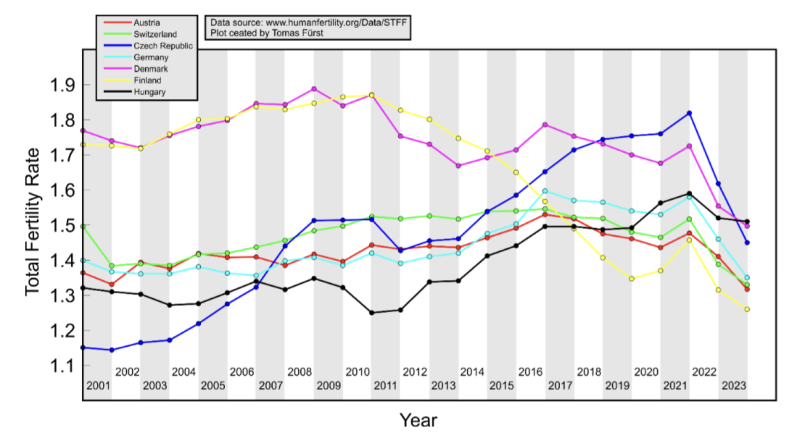
To compare fertility across countries (and time), the so-called Total Fertility Rate (TFR) is used. Roughly speaking, it is the average number of children that are born to a woman over her lifetime. TFR is independent of the number of women and of their age structure. Figure 1 below shows the evolution of TFR in several European countries between 2001 and 2023. I selected countries that experienced a similar drop in TFR in 2022 as the Czech Republic.
So, by the end of 2023, the following two points were clear:
- The drop in natality in the Czech Republic in 2022 could not be explained by demographic factors. Total fertility rate – which is independent of the number of women and their age structure – dropped sharply in 2022 and has been decreasing ever since. The data for 2024 show that the Czech TFR has decreased further to 1.37.
- Many other European countries experienced the same dramatic and unexpected decrease in fertility that started at the beginning of 2022. I have selected some of them for Figure 1 but there are more: The Netherlands, Norway, Slovakia, Slovenia, and Sweden. On the other hand, there are some countries that do not show a sudden drop in TFR, but rather a steady decline over a longer period (e.g. Belgium, France, UK, Greece, or Italy). Notable exceptions are Bulgaria, Spain, and Portugal where fertility has increased (albeit from very low numbers). The Human Fertility Project database has all the numbers.
This data pattern is so amazing and unexpected that even the mainstream media in Europe cannot avoid the problem completely. From time to time, talking heads with many academic titles appear and push one of the politically correct narratives: It’s Putin! (Spoiler alert: The war started in February 2022; however, children not born in 2022 were not conceived in 2021). It’s the inflation caused by Putin! (Sorry, that was even later). It’s the demographics! (Nope, see above, TFR is independent of the demographics).
Thus, the “v” word keeps creeping back into people’s minds and the Web’s Wild West is ripe with speculation. We decided not to speculate but to wrestle some more data from the Czech government. For many months, we were trying to acquire the number of newborns in each month, broken down by age and vaccination status of the mother. The post-socialist health-care system of our country is a double-edged sword: On one hand, the state collects much more data about citizens than an American would believe. On the other hand, we have an equivalent of the FOIA, and we are not afraid to use it. After many months of fruitless correspondence with the authorities, we turned to Jitka Chalankova – a Czech Ron Johnson in skirts – who finally managed to obtain an invaluable data sheet.
To my knowledge, the datasheet (now publicly available with an English translation here) is the only officially released dataset containing a breakdown of newborns by the Covid-19 vaccination status of the mother. We requested much more detailed data, but this is all we got. The data contains the number of births per month between January 2021 and December 2023 given by women (aged 18-39) who were vaccinated, i.e., had received at least one Covid vaccine dose by the date of delivery, and by women who were unvaccinated, i.e., had not received any dose of any Covid vaccine by the date of delivery.
Furthermore, the numbers of births per month by women vaccinated by one or more doses during pregnancy were provided. This enabled us to estimate the number of women who were vaccinated before conception. Then, we used open data on the Czech population structure by age, and open data on Covid vaccination by day, sex, and age.
Combining these three datasets, we were able to estimate the rates of successful conceptions (i.e., conceptions that led to births nine months later) by preconception vaccination status of the mother. Those interested in the technical details of the procedure may read Methods in the newly released paper. It is worth mentioning that the paper had been rejected without review in six high-ranking scientific journals. In Figure 2, we reprint the main finding of our analysis.
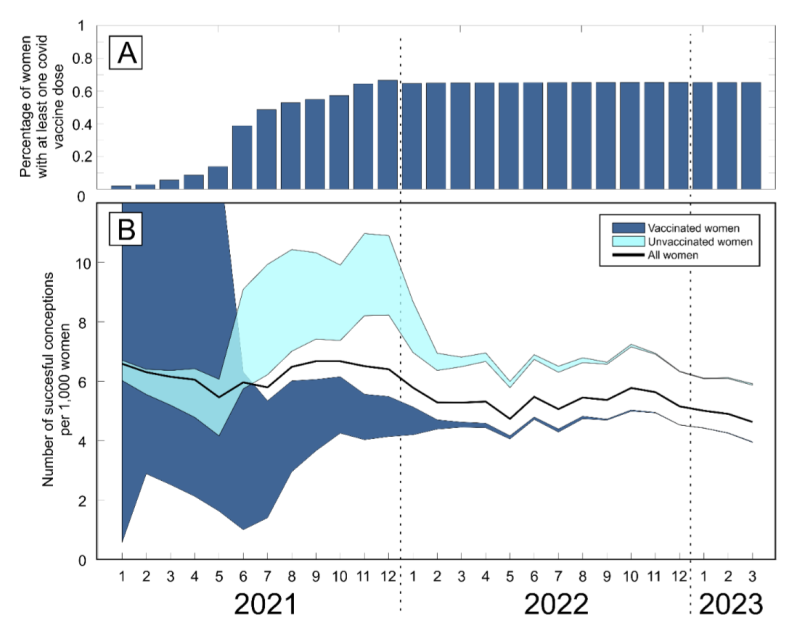
Figure 2 reveals several interesting patterns that I list here in order of importance:
- Vaccinated women conceived about a third fewer children than would be expected from their share of the population. Unvaccinated women conceived at about the same rate as all women before the pandemic. Thus, a strong association between Covid vaccination status and successful conceptions has been established.
- In the second half of 2021, there was a peak in the rate of conceptions of the unvaccinated (and a corresponding trough in the vaccinated). This points to rather intelligent behavior of Czech women, who – contrary to the official advice – probably avoided vaccination if they wanted to get pregnant. This concentrated the pregnancies in the unvaccinated group and produced the peak.
- In the first half of 2021, there was significant uncertainty in the estimates of the conception rates. The lower estimate of the conception rate in the vaccinated was produced by assuming that all women vaccinated (by at least one dose) during pregnancy were unvaccinated before conception. This was almost certainly true in the first half of 2021 because the vaccines were not available prior to 2021. The upper estimate was produced by assuming that all women vaccinated (by at least one dose) during pregnancy also received at least one dose before conception. This was probably closer to the truth in the second part of 2021. Thus, we think that the true conception rates for the vaccinated start close to the lower bound in early 2021 and end close to the upper bound in early 2022. Once again, we would like to be much more precise, but we have to work with what we have got.
Now that the association between Covid-19 vaccination and lower rates of conception has been established, the one important question looms: Is this association causal? In other words, did the Covid-19 vaccines really prevent women from getting pregnant?
The guardians of the official narrative brush off our findings and say that the difference is easily explained by confounding: The vaccinated tend to be older, more educated, city-dwelling, more climate change aware…you name it. That all may well be true, but in early 2022, the TFR of the whole population dropped sharply and has been decreasing ever since.
So, something must have happened in the spring of 2021. Had the population of women just spontaneously separated into two groups – rednecks who wanted kids and didn’t want the jab, and city slickers who didn’t want kids and wanted the jab – the fertility rate of the unvaccinated would indeed be much higher than that of the vaccinated. In that respect, such a selection bias could explain the observed pattern. However, had this been true, the total TFR of the whole population would have remained constant.
But this is not what happened. For some reason, the TFR of the whole population jumped down in January 2022 and has been decreasing ever since. And we have just shown that, for some reason, this decrease in fertility affected only the vaccinated. So, if you want to argue that a mysterious factor X is responsible for the drop in fertility, you will have to explain (1) why the factor affected only the vaccinated, and (2) why it started affecting them at about the time of vaccination. That is a tall order. Mr. Occam and I both think that X = the vaccine is the simplest explanation.
What really puzzles me is the continuation of the trend. If the vaccines really prevented conception, shouldn’t the effect have been transient? It’s been more than three years since the mass vaccination event, but fertility rates still keep falling. If this trend continues for another five years, we may as well stop arguing about pensions, defense spending, healthcare reform, and education – because we are done.
We are in the middle of what may be the biggest fertility crisis in the history of mankind. The reason for the collapse in fertility is not known. The governments of many European countries have the data that would unlock the mystery. Yet, it seems that no one wants to know.
Israeli Settlers Attack One of the Oldest Christian Churches in Palestine
By James Rushmore | The Libertarian Institute | July 9, 2025
Israeli settlers attacked the West Bank town of Taybeh on Monday, causing extensive damage to a fifth-century church and a cemetery. The vandals started a series of fires near the ancient Church of Saint George, one of the oldest Christian churches in Palestine. Local residents were able to extinguish the fires. The attack marks the latest effort by Israeli settlers to intimidate the Palestinian inhabitants of Taybeh, which is the only remaining village in the territory with an exclusively Christian population.
The attack prompted three local priests to issue a statement. Fathers Daoud Khoury, Jack-Noble Abed, and Bashar Fawadleh called upon “local and international actors” to launch an investigation into the settler attacks, put pressure on Israeli authorities, and send delegations directly to Taybeh. They also urged people to provide the villagers with economic and legal assistance. Munther Isaac, a Palestinian pastor who was interviewed by Tucker Carlson in April 2024, shared the priests’ appeal on X. He also criticized U.S. Ambassador to Israel Mike Huckabee, a Christian Zionist, for pursuing policies that enable settler violence in the West Bank.
Huckabee toured the West Bank last week. During his visit, he expressed his support for the settler movement and referred to the territory as “Judea and Samaria,” saying that it would be “a historical injustice and a denial of the Bible” to use any other terminology. He also said that the settlers “represent God’s presence and His choice of this land.”
Huckabee’s trip came days after every Likud minister in the Israeli government sent Prime Minister Benjamin Netanyahu a letter urging him to annex the West Bank before the end of the Knesset’s summer session on July 27. The letter argues that the “strategic partnership, backing, and support of the U.S. and President Donald Trump have made it a propitious time to move forward with [the annexation] now, and ensure Israel’s security for generations.” It also said that a Palestinian state would represent an “existential danger to Israel.”
The attacks mark the latest assault on Taybeh. In June, settlers built an outpost on the eastern edge of the village, atop a key agricultural zone that’s home to thousands of Palestinian olive trees. Local farmers were denied access to the area, and settlers attacked residents who tried to enter the zone. The Israeli settlers have also been allowing their livestock to graze on Palestinian farmlands as part of an effort to push the villagers out.
At least 1,000 Palestinians, including over 200 children, have been killed in the West Bank since Israel began its genocide in the Gaza Strip. In addition to raiding refugee camps and displacing thousands of native civilians, IDF forces have provided settlers with semi-automatic weapons. In 2024, Israel seized control of more Palestinian land in the West Bank than in the previous 20 years combined.
France names ‘red line’ in Ukraine conflict
RT | July 9, 2025
Demilitarizing Ukraine and leaving it without NATO membership, as Russia demands, is a red line for Europe, French Defense Minister Sebastien Lecornu told weekly magazine Valeurs Actuelles.
Moscow insists that any resolution to the conflict must comprehensively address its security concerns. Russian officials want Ukraine to acknowledge the new territorial realities on the ground, agree to neutral status, guarantee that its Russian-speaking population is not discriminated against, and undergo demilitarization and denazification. As of now, all of these demands have been rejected by Kiev.
In an interview, published on Wednesday, Lecornu argued that Europe cannot allow Ukraine to be left without a functioning army while denying it NATO membership.
“Our absolute red line is the demilitarization of Ukraine,” the minister said. “We must be coherent. One cannot refuse Ukraine entry into NATO and at the same time accept that it no longer has an army,” he added.
Ukraine formally applied for fast-track NATO membership in September of 2022, months after the conflict with Russia escalated. While Western nations initially supported Kiev’s bid, no timeline for accession has been set. Meanwhile, support for Kiev’s bid has been eroded by mounting military setbacks and shifting US policy.
Pentagon Inspector General Robert Storch reported last November that “corruption continues to complicate” Ukraine’s efforts to join NATO, citing multiple scandals in its Defense Ministry. US President Donald Trump, who is pushing for a peace deal with Moscow, has ruled out NATO membership for Kiev.
Russia views NATO’s eastward expansion as a direct threat to national security and has indicated that Ukraine’s ambition to join the US-led military bloc was one of the key issues that triggered the current conflict. President Vladimir Putin stressed last month that Moscow’s concerns had consistently been ignored.
Putin also said that Ukraine had agreed to military limitations during the 2022 Istanbul talks, including troop numbers and weapons restrictions, but later withdrew from the deal to seek military victory with Western backing. He added that now, instead of a “peaceful settlement to this issue,” Moscow has been forced to resolve the task – namely, demilitarization – by military means.
Speaking ahead of this week’s meeting of the Western-led ‘coalition of the willing’ – a UK-French initiative to deploy troops in Ukraine after a truce is reached with Russia – Lecornu said the group will urge Kiev to “rethink” the future shape of its army, noting “opportunities” for the French defense industry.
Moscow has accused the West of encouraging Kiev to fight “to the last Ukrainian” and maintains that no amount of military aid will reverse Kiev’s fortunes on the battlefield. It has also repeatedly warned that any foreign forces fighting alongside Ukrainian troops will be treated as legitimate targets, while warning this could escalate the conflict.
France, Italy, Greece must explain allowing ‘safe passage’ to ICC-wanted Netanyahu to US: UN expert
Press TV – July 9, 2025
UN Special Rapporteur Francesca Albanese says Rome Statute member states—France, Italy, and Greece—must explain why they provided “safe passage” to Israeli Prime Minister Benjamin Netanyahu en route to the United States.
Netanyahu is an internationally wanted suspect under an arrest warrant issued by the International Criminal Court (ICC) for war crimes and crimes against humanity committed in Gaza.
In a post on X, Albanese said the three European countries — all signatories to the Rome Statute, which established the International Criminal Court (ICC) in 2002 — violated the international legal order by allowing Netanyahu to transit through their airspace despite an active ICC arrest warrant.
As ICC members, she said, they were theoretically “obligated to arrest” Netanyahu.
“Italian, French, and Greek citizens deserve to know that every political action violating the international legal order weakens and endangers all of them. And all of us,” she wrote.
Albanese was responding to a post by human rights lawyer Craig Mokhiber, who said the countries had “breached their legal obligations under the treaty [Rome Statute], have declared their disdain for the victims of genocide, and have demonstrated their contempt for the rule of law.”
Netanyahu is currently on his third US visit since President Donald Trump took office on January 20.
During a previous trip in February, his plane was forced to take a detour to avoid flying over countries that might enforce the ICC arrest warrant. The United States is not a party to the Rome Statute and therefore not bound by its provisions.
In June, Trump’s administration imposed sanctions on four judges at the International Criminal Court over the war tribunal’s issuance of an arrest warrant for Netanyahu.
EU could hand another €100bn to Ukraine – Bloomberg
RT | July 9, 2025
European Union officials are weighing a proposal to provide Ukraine with another €100 billion ($117 billion) in grants and low-interest loans, Bloomberg reported on Tuesday, citing sources familiar with the matter.
The plan involves establishing a dedicated fund within the bloc’s upcoming seven-year budget framework, the unnamed insiders told the outlet. Disbursement would begin in 2028 if the proposal is approved.
The move would further shift the financial burden onto Western European taxpayers of what Moscow has condemned as a US-triggered NATO proxy war. Russian Foreign Minister Sergey Lavrov said in April that officials in Brussels “view possible suspension of Ukraine assistance as confirmation of the EU’s strategic inviability” and are pushing for continued funding to protect their reputation.
Ukraine’s military and defense institutions have faced a string of corruption scandals during the conflict with Russia, including overpayments for rations and shady arms procurement contracts. This week, Ukrainian outlets reported that anti-corruption investigators searched a property belonging to former Defense Minister Aleksey Reznikov. Reznikov resigned in 2023 following allegations of financial misconduct in his department.
The proposed fund is reportedly one of several avenues under consideration, with a final decision expected by July 16 or possibly later, according to Bloomberg. The report added that last month, the European Commission briefed EU finance ministers on Kiev’s intention to increase this year’s defense spending by $8.4 billion using domestic sources.
Ukrainian Prime Minister Denis Shmigal said in June that defense expenditures had risen 34% year-on-year during the first five months of 2025. Meanwhile, Finance Minister Sergey Marchenko warned in May that Kiev’s national debt is nearing $171 billion, approximately equivalent to the country’s gross domestic product.
Ukraine continues to rely heavily on external financial aid to sustain its national budget. Earlier this year, the government failed to restructure a portion of its sovereign debt issued in 2015 and declined to honor a $665 million repayment to private investors in early June.
The country’s economy is also feeling the strain of a labor shortage, as millions have fled to Western nations offering them protection and social benefits. Many men of military age who remain in Ukraine have evaded conscription, which usually means avoiding formal employment and by extension, income taxes.
Court Orders Bank Freezing Records in Freedom Convoy Case
By Cindy Harper | Reclaim The Net | July 9, 2025
A Canadian court has ordered the release of documents that could shed light on how federal authorities and law enforcement worked together to freeze the bank accounts of a protester involved in the Freedom Convoy.
Both the RCMP and TD Bank are now required to provide records related to Evan Blackman, who took part in the 2022 demonstrations and had his accounts frozen despite not being convicted of any crime at the time.
The Justice Centre for Constitutional Freedoms (JCCF) announced the Ontario Court of Justice ruling. The organization is representing Blackman, whose legal team argues that the actions taken against him amounted to a serious abuse of power.
“The freezing of Mr. Blackman’s bank accounts was an extreme overreach on the part of the police and the federal government,” said his lawyer, Chris Fleury. “These records will hopefully reveal exactly how and why Mr. Blackman’s accounts [were] frozen.”
Blackman was arrested during the mass protests in Ottawa, which drew thousands of Canadians opposed to vaccine mandates and other pandemic-era restrictions.
Although he faced charges of mischief and obstructing police, those charges were dismissed in October due to a lack of evidence. Despite this, prosecutors have appealed, and a trial is set to begin on August 14.
At the height of the protests, TD Bank froze three of Blackman’s accounts following government orders issued under the Emergencies Act. Then-Prime Minister Justin Trudeau had invoked the act to grant his government broad powers to disrupt the protest movement, including the unprecedented use of financial institutions to penalize individuals for their support or participation.
In 2024, a Federal Court Justice ruled that Trudeau’s decision to invoke the act had not been justified.
Blackman’s legal team plans to use the newly released records to demonstrate the extent of government intrusion into personal freedoms. According to the JCCF, this case may be the first in Canada where a criminal trial includes a Charter challenge over the freezing of personal bank accounts under emergency legislation.
Russia declares Yale University ‘undesirable’
RT | July 9, 2025
Russia has banned Yale University from operating within its territory, accusing the Connecticut-based institution of meddling in domestic affairs and attempting to destabilize its economy.
The Prosecutor General’s Office added Yale to the list of “undesirable” organizations on Tuesday. “The university’s activities are aimed at violating the territorial integrity of the Russian Federation, enforcing an international blockade, undermining its economy, and destabilizing the country’s socio-economic and political situation,” the office said in a statement.
Prosecutors claim that the Maurice R. Greenberg World Fellows Program at the Yale Jackson School of Global Affairs has been used to “train opposition leaders from foreign countries.” Russian opposition figure Aleksey Navalny and his close associate Leonid Volkov participated in the program in 2010 and 2018, respectively.
Navalny died in prison in February 2024 while serving a lengthy sentence on extremism charges. In 2021, a Russian court banned Navalny’s Anti-Corruption Foundation (FBK) under extremism laws. Last month, Volkov, who lives outside Russia, was sentenced in absentia to 18 years in prison for his activities as an FBK leader.
Prosecutors alleged that FBK used “the knowledge and techniques” acquired at Yale to “escalate protest activities in Russia.” Prosecutors also claimed that Yale has worked to create a “legal framework” for using frozen Russian assets to fund the Ukrainian army. Moscow regards the freezing and seizure of its assets related to the Ukraine conflict as illegal and tantamount to theft.
Since 2022, Jeffrey Sonnenfeld, a professor at the Yale School of Management, and his team have campaigned to pressure foreign companies to cut ties with Moscow and advocated for tougher sanctions on Russia. In a 2024 Fortune article, Sonnenfeld and Steven Tian, research director of the Yale Chief Executive Leadership Institute, credited themselves with helping the US Treasury design sanctions targeting Russia’s oil trade.
Featured Video

Can the U.S. Afford to Annihilate Iran?
or go to
Aletho News Archives – Video-Images
From the Archives
Sanctions, War and the Policy of Dual Containment
By SASAN FAYAZMANESH | March 17, 2008
It is now nearly three decades since the Unites States adopted the policy of dual containment of Iran and Iraq. While much has been written about the containment of Iraq, there has been very little in-depth analysis of this policy when it comes to Iran. In a book that is going to be released on March 31, 2008, entitled The United States and Iran: Sanctions, Wars and the Policy of Dual Containment (Routledge), I attempt to address this shortcoming by investigating when and why the US policy of containment of Iran came about, how it evolved, and where it stands today.[1] To the extent that Israel has been involved in US policy making, the study will also include the role that Israel has played in the containment of Iran. Also, since the fate of Iran has been inextricably linked to that of Iraq, occasionally the investigation will overlap with the containment of Iraq.
The policy of dual containment of Iran and Iraq originated during the Carter Administration, but it was not until the Clinton Administration that the expression “dual containment” became popular. … continue
Blog Roll
 Aletho News
- Can the U.S. Afford to Annihilate Iran? /Seyed M. Marandi
- Elmo Sold mRNA Jabs to Your Toddler. Now They Are “Off-Label.”
- British state targets Palestine Action with yet another crooked trial
- Americans are paying the price to preserve Israel’s nuclear hegemony
- Resistance factions are necessary to ensure a permanent US Iraq withdrawal
- How Israel destabilizes the Middle East: Denying sovereignty and the right to exist
- Europe’s Establishment Is Embracing War – and Losing Voters
- NATO chief advocates war of aggression
- No Vote, No Representation, No State: Democracy, Israeli Style
- Zionist Bought Senate Blocks Information About American Citizens Killed By Israel
- If Americans Knew
- Israeli Soldiers Abduct At Least 22 Across Occupied West Bank
- Eight Palestinians Killed in Israeli Attacks on Gaza
- Israeli former leaders and security chiefs threaten legal action over ‘Jewish terrorism’
- Israel map in LA Times ad includes all land from the river to the sea
- Inside Lebanon’s 200-page dossier on Israeli war crimes
- Flydubai, genocide, settler violence, Trump abuse of power to deport – Daily Update
- Counting Antisemitic Incidents: What the ADL Audit Reveals — and Obscures
- Mamdani releases plan to combat antisemitism and hate crimes in New York City
- Iran’s Revolutionary Guards Publish Letter to the American People
- DMFI launches $1 million ad campaign supporting Virginia’s Elaine Luria
- No Tricks Zone
- Green Energy Debacle: German Expert Professor Fritz Vahrenholt Warns Of Severe Economic And Social Consequences
- Two More Paleo Reconstructions Affirm Meters-Higher Sea Levels Across Ireland, Brazil 7000-6000 Years Ago
- New Study: Earth And Venus Surface Warmth Largely Explained By Convection And Lapse Rate, Not CO2 Or Radiation
- 2025 Nature Paper Claiming Worsening Global Drought Gets RETRACTED …Heavily Flawed
- New Study: ‘Global Drought Shows No Detectable Recent Acceleration Under Climate Warming’
- Economic Masterminds: German Socialists Suggest Taxing Productivity Gains Stemming From Using AI
- The South China Sea Has Not Been Cooperating With The Climate Change Narrative
- Energy Crisis: Germany Enters Heating Season With Historically Low Gas Reserve Fill Levels
- New Study: The Antarctic Ice Sheet Gained Mass From 2020-2024 Due To Staggering Snow And Ice Accumulation
- Study: Ocean Heating Rates From Thousands Of Years Ago ‘Dwarf’ Modern Ocean Heating Rates

