Legendary Journalist Seymour Hersh just published another major story on his Substack quoting sources who alleged the possibility that the late child sex trafficker Jeffrey Epstein was an asset of the Israeli Mossad, as well as the U.S. F.B.I., potentially for blackmail operations.
According to Hersh, “I have been told that specific evidence about Epstein’s connections to foreign and domestic intelligence services, particularly Mossad and the FBI, though they do exist in government files, have yet to be the subject of materials made public by the Trump administration’s Justice Department and have not come under scrutiny by Congress and the media.”
One “well-informed international source I’ve known for a long time” told Hersh that “if all the details were to come out about Epstein and Israel it could cause problems for the past and present members of some in the Trump administration, as well as for senior officials in prior Democratic administrations”.
According to the source, in the 1980s, a Mossad agent was sent “to fly to New York City, buy off-the-shelf listening devices and cameras and covertly install them in a room of Epstein’s apartment in New York City.”
He reportedly “was explicitly told to purchase off-the-shelf camera equipment in New York for the risky mission, but, as he sadly related to his friends, he didn’t follow those instructions and instead relied on the high-end equipment on which he had trained for Mossad.”
The Mossad agent reportedly said, “that his operation had been compromised and the FBI caught him and immediately realized—given his nationality and the use of expensive Israeli gear—that Israel was aware of Epstein’s client list and its obvious blackmail and extortion potential in the world of international trade and intelligence collection”.
Hersh’s source raised the possibility that following the FBI uncovering the Israeli plot, Epstein “provided the FBI with any of the tape recordings or videos” and may have even gone “further, and supplied both Israel and the FBI with films and recordings”.
Hersh reported that “Epstein’s ties as an ongoing asset to the FBI kept him out of trouble and also left a large and politically devastating collection of recordings and films that have yet to be discussed publicly or even acknowledged by the Justice Department or the FBI, as well as by the Trump White House” though he added the caveat that “no one I spoke to for this report mentioned any specific information linking Trump to the Epstein whorehouse”.
One senior U.S. official told Hersh that, “there was yet to be a serious nonpartisan investigation of the role of some senior members of the FBI who knew of and abetted Epstein’s collection of compromising videos.”
Hersh’s source’s allegation of the Mossad using Jeffrey Epstein for blackmail purposes has long been echoed by the former Mossad agent Ari Ben-Menashe who has argued that “Epstein was recruited by (Ghislaine and Robert) Maxwell and then by Ehud Barak who was director of military intelligence at the time then Prime Minister … and then they started work compromising people … and my understanding is they compromised quite a number of American politicians and other politicians as well”.
Giving a specific example, Ari Ben Menashe alleges that the Mossad used compromising material on then-President Bill Clinton obtained from Jeffrey Epstein to sabotage a U.S. deal with Iran.
Within the Epstein files, a confidential human source of the FBI, Charles Johnson, who worked for Alan Dershowitz, Epstein’s attorney, alleges that he “shared phone calls between Dershowitz and Epstein during which he/she took notes. After these calls, Mossad would then call Dershowitz to debrief. Epstein was close to the former Prime Minister of Israel, Ehud Barak and trained as a spy under him.”
The possibilities become even broader after the allegations from Seymour Hersh’s sources.
They raise the possibility that not only was Epstein recruited by Mossad, but the FBI learned of its plot to use compromising material on powerful figures and joined the Mossad in the blackmail operations, instead of stopping it.
Saudi Arabia has reiterated that it will not establish diplomatic relations with Israel without the creation of an independent Palestinian state along the 1967 borders, with East Jerusalem as its capital, amid reports that US President Donald Trump is seeking to link a civil nuclear agreement with Riyadh to Saudi normalisation with Israel.
According to a report by The Wall Street Journal, Trump has referred the US-Saudi civil nuclear cooperation agreement to Congress for review but has stipulated that it will not take effect unless Saudi Arabia joins the Abraham Accords.
“The president’s position has not changed, and the agreement will not move forward unless Saudi Arabia joins the Abraham Accords,” the newspaper quoted a US administration source as saying.
The reported condition follows the signing of the nuclear agreement last month by US Energy Secretary Chris Wright and Saudi Energy Minister Prince Abdulaziz bin Salman.
A Saudi source quoted by Israel’s Channel 12 rejected linking the nuclear agreement to normalisation, saying Riyadh’s position on relations with Israel remained unchanged.
“The Saudi position is clear, firm and unwavering,” the source said. “There will be no diplomatic relations with Israel without the establishment of an independent Palestinian state within the 1967 borders with East Jerusalem as its capital.”
The source maintained that Saudi Arabia’s civilian nuclear program forms part of its broader strategic partnership with Washington and should not be conditional on establishing relations with Israel.
Things are becoming increasingly clear about the US green light for the Israeli enemy to press ahead with its attacks on southern Lebanon. According to US Ambassador to Lebanon Michel Issa, Washington has not, so far, reached an agreement with Tel Aviv to halt its assaults.
Even more strikingly, asking ‘Israel’ to stop attacking southern Lebanon apparently amounts to asking it to “do everything,” according to Issa, himself of Lebanese origin, whose broken Arabic carries a distinctly Lebanese accent.
The remarks by Issa were made Wednesday, after a meeting with Grand Mufti Sheikh Abdel Latif Derian.
“So far, we haven’t agreed with them (Israelis) to halt attacks (on southern Lebanon),” Issa told reporters.
The US ambassador, meanwhile, made it clear that Washington is instead pressing disarmament of Hezbollah Lebanese resistance group as the condition for ‘Israel’ to fulfill its own obligations under the ceasefire that was lately reached in June.
“There is no agreement to end the Israeli aggression because Hezbollah has not handed over its weapons,” Issa added.
Hezbollah “does not want to do anything, so why ask Israel to do everything?”
He claimed, however, that Washington remained open to talks with Hezbollah “if they have something to offer us”, but dismissed what he described as unproductive contacts, saying negotiations could not amount to “visits and coffee”.
Asked whether Washington was effectively making Hezbollah’s disarmament a precondition for ‘Israel’ to halt its attacks and withdraw, Issa simply framed the issue as a question of “who should act first.”
“If two people are in dispute, one of them asks the other to start implementing what is required of him so that he, in turn, implements what he is required to do,” he said.
The problem with the analogy, however, is that one of the two parties, which is Hezbollah, has already stopped attacking northern occupied Palestine, while the other, which is the Israeli enemy, goes ahead with daily airstrikes, artillery shelling, assassinations, demolitions and systematic destruction across southern Lebanon.
But apparently, asking ‘Israel’ to stop such aggression is asking it to do “everything.”
Iran will respond swiftly and decisively to any US attempt to revive a mechanism known as “prize courts” to detain oil tankers and seize Iranian oil shipments, a senior Iranian security official stated on Thursday.
According to Nournews, the official said that if Washington uses the mechanism to detain Iranian oil tankers and confiscate their cargoes, the Islamic Republic of Iran would take “serious and swift measures” to impose reciprocal costs on US interests in the Gulf.
“If America is going to detain Iranian oil at sea and then confiscate it under the title of war prize, it must also be prepared to expose American interests to corresponding retaliatory measures,” the official warned.
The official said US interests in shipping, energy, insurance, finance, and Gulf-related infrastructure would not be insulated from the consequences of such action.
He added that companies and institutions involved in owning, financing, insuring, or operating US interests in the region have been identified and are being monitored.
Iran warns against escalation in Gulf
The official further stressed that Iran does not seek to harm regional trade or disrupt the activities of neutral states, but cautioned that this should not be mistaken for an inability to respond.
“If the Americans believe they can take advantage of the complexities of the maritime navigation network and intermediary companies to avoid bearing the consequences of their actions at the hands of Iran, they are mistaken in this belief,” the official said.
“Beginning the organized detention and confiscation of Iranian oil will mean the beginning of a two-way process,” the official said, warning that “America cannot grant itself the right to confiscate while simultaneously expecting its interests in the Gulf to remain immune from any reciprocal response.”
The official stressed that the final decision on the nature and scale of any Iranian response would depend on the conduct of the other side. However, he warned that if Washington escalates its economic and maritime confrontation with Tehran, Iran also possesses the means to increase the cost of such a policy.
US reportedly weighs revival of ‘prize courts’
The warning follows reports by US media on Wednesday evening that the US Department of Justice is working to revive “prize courts,” an old mechanism that could allow Iranian oil tankers to be detained and their oil and other confiscated cargoes converted into US-owned assets.
According to Nournews, the seized cargoes could subsequently be sold, with the proceeds transferred to the US Treasury.
The US Justice Department is preparing to revive long-dormant maritime “prize courts” to speed up the military capture of Iranian oil tankers and cargo as US property, Bloomberg reported.
The plan would allow the US to seize oil and other cargo from enemy or even neutral vessels, sell it, and transfer the proceeds to the US Treasury.
Aaron Reitz, a US attorney involved in the initiative, confirmed that the Justice Department is “now reviving” what he called an “ancient body of maritime law.”
The move is expected to face legal challenges, as prize courts have gone largely unused since the Spanish-American War of 1898 and have been dormant since World War II.
The plan comes as US forces have already illegally intercepted and seized multiple Iranian-owned or Iran-linked ships since imposing an unlawful blockade in April.
The US lectures the world about “freedom of navigation” — then digs up antique courts to “legalize” piracy against whoever it decides to bully next.
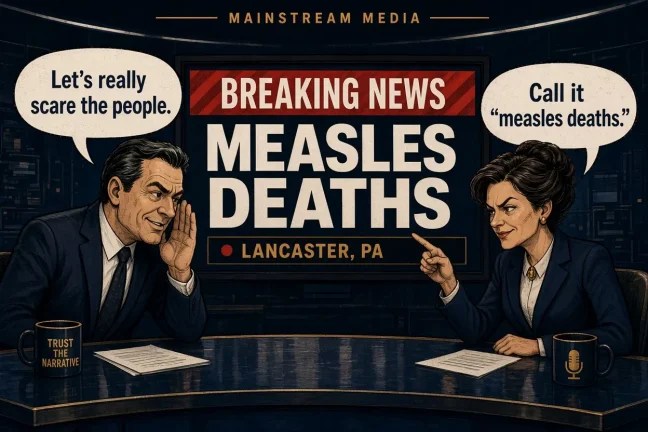
17 days later national headlines now report of two measles-associated deaths whose status is current unresolved with several clear anomalies that has the public, politicians and Kennedy himself asking serious questions about their validity.
Regulation 10-242, filed with the Independent Regulatory Review Commission as IRRC No. 3490, runs hundreds of pages and would remake 28 Pa. Code Chapter 27 — the same chapter that governed isolation, reporting, and outbreak control long before Covid. Public comment closes September 21. Shapiro’s gubernatorial election vote happens on November 3 the stakes are high.
The political context is harder to ignore.
The rule update would erode parent consent in a child’s health care, create a mandatory vaccine tracking database, and give the Department of Health access to children’s medical records without parental consent.
Specifically regarding measles, the newly proposed rule would create a category called § 27.160 isolation plus outbreak quarantine of “presumed susceptibles.”
The rule would pair isolation with outbreak quarantine of those presumed ‘susceptibles’ and keep them out of a setting until they prove they are not susceptible, take a measles vaccine, or no cases occur there for 21 days.
In an outbreak concentrated in communities with religious or philosophical exemptions, that is not a technical tweak. It is a lever.
The proposed rule would do far more than update a measles protocol. Under the draft, the department or a local health authority “may enter an apartment, building, health care facility, school, college or university, or other location” during an investigation if the official shows agency credentials. No warrant is required. People may not “interfere.” In schools, officials would get “reasonable and timely access” to students for contact tracing or partner services and could “meet and speak with a student or other person in private.” The text does not require parental notice, parental presence, or parental consent before that interview.
Reportable diseases, infections, and conditions would expand from about 52 to 125, including COVID-19 and an open-ended “emerging disease or condition”
House Republican Leader Jesse Topper called the package “oppressive COVID-era policies” and demanded it be withdrawn.
“Submitting these regulations seems to be devoid of any understanding of our recent history of dangerous government overreach…”
Shapiro’s office and the legacy media have treated the outbreak and, still unconfirmed, measles deaths as proof of leadership and treated Kennedy as the face of “anti-science.”
The regulation tells a different story. It is a bid to restore, by rule-making, authorization the failed pandemic response taught many Pennsylvanians to fear and reject. While a contested measles emergency still dominates the news the rule’s public comment file is open. The election is not far behind.
The US has accused Chinese hackers it described as “state-backed” of breaking into NASA, the Federal Reserve and other sensitive government networks, just weeks before Chinese President Xi Jinping is expected in Washington for talks with President Donald Trump.
Beijing rejected the allegations, with the Chinese Embassy in Washington saying China “opposes and combats all forms of cyberattacks” and urging the US to “stop using cybersecurity issues to smear or discredit China.”
The Justice Department and FBI announced on Wednesday that they had seized three internet domains linked to two hacking platforms allegedly operated by a Chinese group known as QTFY. US authorities claimed the operation targeted NASA, the Federal Reserve, the Senate and several government departments, as well as hospitals, telecommunications providers, power companies, financial institutions and defense contractors.
Washington described the campaign as Chinese state-sponsored activity and alleged that the company behind it provided hacking services to China’s Ministry of State Security and the People’s Liberation Army. However, officials did not disclose what sensitive information was allegedly stolen or what damage, if any, was caused.
The latest accusations come little more than a month after Trump similarly accused Beijing of meddling in US elections, claiming China had illicitly acquired some 220 million American voter files during the 2020 election cycle in what he called the “largest compromise” of election data in US history.
China dismissed that allegation as “groundless” and “entirely fabricated.” Trump’s assertions of election “hacking” were met with skepticism even among some of his supporters, as the documents released by the White House only showed Chinese interest in collecting publicly available or commercially obtainable American voter information.
Trump himself openly acknowledged after meeting Xi in Beijing in May that Washington conducts extensive espionage against China.
“We spy like hell on them too,” Trump told reporters. “We do a lot of stuff to you that you don’t know about,” Trump claimed he had told Xi, describing the two countries’ espionage activities as a “double-edged sword.”
Beijing has made similar accusations against Washington, claiming last October that the NSA had conducted a years-long cyberattack on China’s National Time Service Center, which supports critical sectors including finance, energy, transport and defense. The NSA did not confirm or deny the allegation.
The renewed cyber accusations come ahead of Xi’s expected visit to the US on September 24. Trump has said he plans to host the Chinese leader following their May talks in Beijing, as the two sides seek to manage disputes over trade, technology and cybersecurity, as well as Washington’s sanctions threats against nations that continue trading with Iran.
China strongly deplores and firmly opposes the US once again smearing it under the pretext of cybersecurity, Chinese Foreign Ministry spokesperson Lin Jian said at a regular press conference on Thursday.
Lin made the remarks when asked about the US Department of Justice’s announcement on Wednesday that it had carried out court-authorized seizures of domains used by two hacking platforms which Washington claimed were operated and used by “China state-sponsored hackers to target US critical infrastructure and other sensitive networks.”
“We have noted relevant reports. China firmly opposes and combats hacking activities in accordance with the law. At the same time, China firmly opposes the dissemination of disinformation for political purposes,” Lin said. “The so-called US statement lacks factual evidence and turns facts on their head. China strongly deplores and firmly opposes the US once again smearing China under the pretext of cybersecurity.”
“The US is widely recognized as the world’s biggest hacking and surveillance empire, with an appalling record backed by irrefutable evidence,” Lin said, noting that China has serious concerns about US cyber activities.
Previously disclosed cases, including the US National Security Agency’s cyberattacks and infiltration targeting China’s National Time Service Center, exposed the dangerous activities of the US government in attacking China’s critical infrastructure and conducting cyber pre-positioning for large-scale sabotage in the future. However, the US has not responded to any of these cases, Lin said.
As major cyber powers, China and the US should take the lead in upholding and observing international rules in cyberspace and jointly build a peaceful, stable and mutually respectful China-US relationship in cyberspace, Lin said.
“We urge the US to abandon double standards and political manipulation, and work with China in a responsible and constructive manner to properly address cybersecurity risks through dialogue and consultation on an equal footing,” he said.
In Lancaster, PA, an unresolved medical announcement entered a political machinery that had already tested the fear, selected the target, and prepared the response.
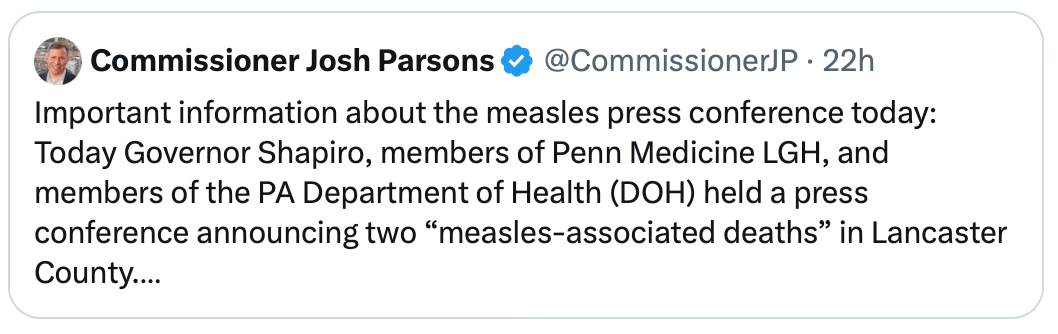
On August 25, Pennsylvania announced that two unvaccinated Lancaster County residents had suffered “measles-associated deaths”—the first such deaths reported by the Commonwealth in 35 years.
By the end of the day, the announcement was no longer merely a public-health report. It had become an indictment of Robert F. Kennedy Jr., Donald Trump, and the Make America Healthy Again movement.
But the most revealing fact is not simply how quickly the deaths were politicized.
It is that the political message had already been built.
The Message Was Tested First
Six days before Pennsylvania announced the deaths, Protect Our Care and 314 Action released a national poll commissioned to determine which vaccine messages made voters view Republicans less favorably.
The poll did not merely measure public opinion about vaccination. It explicitly measured electoral damage.
Respondents were presented with claims about measles returning, the Trump administration disregarding scientific evidence, and Republicans weakening childhood vaccine recommendations. Between 50 and 54 percent said the messages made them view Republicans in Congress less favorably.
The organizations’ conclusion was unmistakable:
“Vaccines are on the ballot.”
Protect Our Care called vaccine policy the Republican Party’s “greatest existential and political liability in the midterms.”
The following day—five days before the Lancaster announcement—Protect Our Care published an even more revealing formulation:
“Needlessly putting kids in the hospital or morgue is a political loser.”
The emotional frame was already loaded: endangered children, preventable hospitalization, death, and Republican culpability.
Then came August 25.
Pennsylvania announced two “measles-associated deaths.” That same day, Protect Our Care declared that Trump and Kennedy had fueled the measles crisis “resulting in” those deaths and circulated a national package of headlines assigning political blame.
The event had arrived. The narrative was ready.
This Was Not a Public-Health Agency
Protect Our Care is not a government health authority or an independent medical organization.
It is a 501(c)(4) advocacy group that says it uses a “campaign mentality” to influence policy, support political “health care champions,” shape media narratives, and hold elected officials accountable. Its own website says it commissions polling and operates “tightly orchestrated, narrative-shaping initiatives” whose messages are distributed to lawmakers, the media, partners, and allies.
In December 2025, the organization expanded a project called Public Health Watch to oppose Trump and Kennedy “in real time.”
It staffed the project with veterans of national elections, progressive political campaigns, rapid response, and “war rooms.” Its stated methods included strategic messaging, storytelling, pressure campaigns, and constructing a “compelling narrative” for public officials, communicators, influencers, and the broader public.
That is not a conspiracy theory.
It is the organization’s own description of its operation.
Pennsylvania Had Built Its Own Communications Architecture
A parallel structure was already operating inside Pennsylvania.
In October 2025, Governor Josh Shapiro created a Vaccine Education Advisory Workgroup and directed state agencies to align vaccine communications, promote vaccine uptake, counter what the administration considered misinformation, and establish a centralized state vaccine portal.
At its first meeting in December, the workgroup discussed information “tailored to different demographics,” responses to “harmful, inaccurate, and misguided” vaccine claims, and engagement in areas with historically lower vaccination rates.
By April 2026, Pennsylvania said the group was guiding “tailored outreach to populations at higher risk for diseases like measles and hepatitis B.”
Whatever one thinks of the underlying policy, the architecture is clear:
identify resistant populations;
tailor the message by demographic;
centralize official communications;
counter disfavored narratives;
and increase behavioral uptake.
By the time Lancaster became the center of the measles story, the communications infrastructure was already in place.
What Remains Medically Unresolved
The political certainty surrounding the deaths has moved considerably faster than the public medical evidence.
Pennsylvania later clarified that it uses the term “measles-associated” when laboratory or epidemiological evidence of measles is present—even when measles is not assessed by the medical certifier or coroner as the immediate cause of death.
One of the deceased has been reported to be an infant whose death remains under review by the Lancaster County coroner. The coroner was not investigating the second death. A county commissioner said the coroner had reported no death certified as caused by measles and described the infant as having died with measles while apparently dying from another cause.
Pennsylvania has not publicly released:
the second person’s age;
the clinical course of either patient;
relevant underlying conditions;
the immediate or underlying causes of death;
the exact diagnostic basis used in each attribution;
or the laboratory and sequencing data.
Genotyping is not required under CDC criteria to confirm a measles case; PCR, serology, viral isolation, or direct epidemiological linkage may qualify. But the state has not disclosed which evidence supported either death classification.
The public therefore cannot presently determine the precise causal role measles played in either death.
Yet the political narrative had already advanced from:
“measles-associated”
to:
“died of measles”
to:
“Trump and Kennedy caused their deaths.”
Political attribution outran medical disclosure.
What the Documents Establish
The public record now establishes that:
a political advocacy organization built a rapid-response “war room” against Trump and Kennedy;
vaccine messages were tested specifically for their power to damage Republicans;
“hospital or morgue” imagery was deployed before the deaths were announced;
Pennsylvania had established a demographic-targeting vaccine communications apparatus;
and the Lancaster announcement was immediately incorporated into a preexisting midterm narrative.
That is an overt influence operation in the ordinary meaning of the term: an organized effort to shape public perception and behavior toward a political outcome. Sadly, it is not a novel phenomenon. I’ve documented influence operations targeting Secretary Kennedy and the MAHA grassroots movement previously on this Substack:
The remaining question is whether the actors merely converged on the same opportunity—or coordinated its timing, framing, and amplification.
The answer requires records, not rhetoric: the complete cause-of-death findings, diagnostic documentation, the timeline on which the August 25 event and talking points were prepared, and communications among the Governor’s Office, Pennsylvania Department of Health, political organizations, and outside advocacy groups.
Lancaster deserves public health.
It also deserves public proof.
Because when a government announcement is converted into electoral blame before the underlying evidence is released, transparency is no longer optional. It is the only meaningful defense against propaganda scripted ahead of certainty.
To follow this real-time unfolding story, see my reporting on X.
Here’s what we know so far about the two deaths in Lancaster County, Pennsylvania that are widely being called “measles deaths:”
1. Governor Shapiro announced, “the first two measles-associated deaths in Pennsylvania in 35 years.”* This phrasing is important. He did not say “measles deaths” or “deaths from measles” which means the facts do not allow him to say that. And just as people can die “with Covid”, as opposed to “from Covid”, people can die with measles, as opposed to from measles.
2. While claiming that, “protecting the confidentiality of residents is a core responsibility of the Department of Health” and thus, “out of respect for their privacy, [the DOH] will not be releasing additional personal details,” as they’re “protecting people’s privacy and confidentiality,” they had no issue disclosing that the two individuals were supposedly unvaccinated which is, in fact, a medical and personal detail.
3. According to the County Commissioner, Joshua Parsons, as of August 25, 2026, “The Coroner’s office indicates that it currently has ZERO reported cases where measles is the immediate cause of death.”**
4. Most critically, if these two had died of measles, the Pennsylvania Governor and health department would no doubt have been blasting out that claim, instead of saying “measles-associated deaths” and “residents with measles have died.”
5. While jumping at any chance to hopefully pin a death on a disease for which there is a vaccine, these same officials don’t give a hoot about the children and adults across this country that are killed, injured, or left with a chronic disease from their worshipped vaccine products, no matter the number. The daily, unrelenting flow of those contacting our firm about deaths and devastating injuries from vaccines are irrelevant to them. A maybe case—that measles may have caused a death—that is all they care about, even when all the facts are not in yet.
6. Ironically, Governor Shapiro preached that: “There’s real life consequences to spreading misinformation. There’s real life consequences to scaring people and not relying on actual doctors and actual medical professionals to provide unbiased information to parents…. Sharing… misinformation does not help the cause of public health.” Yet, I have not seen the Governor or the Pennsylvania Department of Health (DOH) correcting any of the media that is spreading misinformation, scaring people, and not relying on unbiased information in their reporting of these deaths as being “measles deaths” or “from measles.” These outlets include The New York Times, Reuters, The Guardian, USA Today, ABC News, The Wall Street Journal, and many more.***
7. Governor Shapiro also identified another serious problem: “Measles has been so rare for so long that many doctors don’t know a lot about it” and explains that their DOH has had to “work[] to inform physicians of the symptoms so they can tell the difference… between the rash that appears from measles and perhaps some other rash.” When vaccination becomes the sole answer, the quality of healthcare declines.
8. Perhaps the most important thing that Governor Shapiro said is something that everyone needs to remember and respect: “Parents absolutely have the right to make their own decisions on how to best protect their kids.”
***The New York Times: “Two Unvaccinated People Died From Measles in Pennsylvania, Officials Say” — uses “died from measles” and “measles deaths.”
Reuters: “Pennsylvania reports first U.S. measles deaths this year as outbreak grows” — uses “measles deaths” / “measles fatalities.”
The Guardian: “Two unvaccinated people die of measles in Pennsylvania” — uses “die of measles” / “died of measles” and “died from measles.”
USA Today: “Two dead of measles in Pennsylvania, the first in US this year” — uses “died of measles” / “dead of measles” and “measles deaths.” [Note USA Today has since changed their headline]
ABC News: “2 people die from measles in Pennsylvania, marking state’s first deaths in 35 years” — uses “die from measles” / “died … from measles.”
The Wall Street Journal (headline and body mix): “Pennsylvania Reports First Measles Deaths of 2026” — headline uses “Measles Deaths”; body includes “died after contracting measles” (borderline but often grouped with direct phrasing in coverage).
There is a vast difference between believing in witches and embarking on a witch hunt. While belief in witches likely prevailed throughout most of human history, mass hysteria driving a hunt for them is rare. The case of wokeness points to a similar dynamic: since the 1960s, U.S. institutions have propagated a conspiratorial sociology and a Manichaean anthropology worldwide, positing that Christendom, across all eras, has been inherently hostile toward women, blacks and gays. Yet, it was only in the 2010s, spurred by social media, that a significant segment of society began looking for racists under the bed and denouncing them everywhere. The onset of this hysteria coincided with the Euromaidan protests (2014), and represented the U.S. as a beacon of freedom standing against oppression. Moscow, the traditional villain, ceased to be viewed as communist and came to be seen as homophobic.
Recently, Alexandria Ocasio-Cortez tried to suggest that the “woke” phenomenon was merely a pandemic-induced delusion. While that isn’t strictly true, the lie gains traction because people were indeed not their usual selves during the pandemic, and wokeness was in full swing. I would venture to identify the George Floyd protests—which emerged in the U.S. in 2020 and were almost instantly replicated across Western Europe—as the peak of this pandemic-era delirium. There was even an attempt to stage a Brazilian version in São Paulo, led by soccer fan groups claiming to fight for democracy (this was during the Bolsonaro administration, which the most radical woke adherents viewed as a dictatorship). I single this out as the height of the madness because the press had spent the preceding months practically branding anyone who dared step outside a murderer, yet suddenly, taking to the streets to form a mob and topple “racist” statues was treated almost as a civic duty. Schools and churches were shut down because they caused “crowding,” yet gathering in crowds to vandalize the city was given the green light. Woke pedagogy and religion were the only forms of expression permitted in the public square.
The George Floyd protests also help clarify one thing: during the pandemic, traditional media acted as the catalyst for mass hysteria. While mainstream media certainly embraced wokeness, it is widely acknowledged that the driving force behind this hysteria was social media—specifically Facebook and Twitter. Traditional media generally followed suit rather than taking the lead: TV networks would have anchors spout politically correct platitudes while discussing the news or feature black women or Asian gays in prominent roles, but they were not the ones instigating cancel culture campaigns. As far as I recall, it was only during the pandemic that traditional media began actively inciting “woke” demonstrations, thereby assuming a position of genuine leadership. The Black Lives Matter organization lacked CNN’s mobilizing power; in Brazil, the Corinthians fan base lacked Globo’s reach.
The segments of the population led by traditional media differ from those led by social media influencers. The former group is much larger, considerably older, and far less politicized. Yet, during the pandemic, the two groups converged, moving in the same direction.
The discovery of Fauci’s diary compels us to revisit that period in history. Fauci kept an online diary on a government server, where he recorded his impressions of press coverage, his personal feelings, and so on. No hacking was required to uncover this information; one simply had to consult U.S. government servers, where Fauci’s emails and messages were also stored. Currently, there is a U.S. Senate investigation into this individual’s conduct during the pandemic, and this inquiry has uncovered matters of the utmost gravity. For instance, Fauci was privately warned that the experimental COVID “vaccines” could cause miscarriages, yet publicly he insisted they posed no risk and should be taken by pregnant women. As someone who is not a doctor, I take pride in having spoken out in 2021 against the propaganda made by YouTube for pregnant women, which offered them unrealistic assurances of safety. Time has proven me right, yet any expectation of a mea culpa is in vain.
One of the few topics from the Senate committee investigations that the mainstream media has touched upon is the laboratory origin of the coronavirus. So-called “conspiracy theorists” had long known that Fauci funded gain-of-function research in Wuhan; however, only now—with the release of correspondence revealing Fauci’s efforts to enforce the “bat soup” narrative—has the mainstream media begun to feign surprise at the subject. The U.S. creating biological weapons in overseas labs? Never! That would be conspiracy theory territory; instead, call it “gain-of-function research”, where selfless scientists simply play the role of nature by creating new, lethal viruses, all to discover a vaccine in advance, for the good of humanity.
When I was a child, there was enough medical information available to know that the flu vaccine was always lagging behind, because the flu virus is constantly mutating—yet now I am expected to believe that gain-of-function research offers a realistic prospect of anticipating the wildest viruses nature would have cooked up anyway. God forbid we believe Russia’s allegations regarding biolabs in Ukraine! Or rather, God forbid we even become aware of them!
Ever since the emergence of these hastily developed, mandatory vaccines, it became clear to me that there was a geopolitical divide far more significant than the one between Right and Left. In Brazil, for instance, skepticism became associated with the Bolsonarist Right, whereas the Left embraced the Democrats’ narrative en masse. Yet, I observed that Cuba and Venezuela were using chloroquine. Where Pfizer and AstraZeneca vaccines are present, U.S. influence prevails; where such vaccines are absent—and where seeking off-label treatments is not taboo—U.S. influence does not prevail.
Commenting on the latest news regarding Fauci, a rare article published by Opera Mundi (one of the few Brazilian leftist outlets sympathetic to Chavismo) stated: “The controversy surrounding biolabs became one of the most intense political debates in the U.S. during the pandemic. The ‘bat theory’ was automatically linked to Democratic progressivism, while any mention of biolabs was dismissed as yet another piece of Trumpist fake news. Since then, the goal has no longer been to uncover the truth, but to stake out a position against the opposing camp. In Brazil, this importation of ‘ideas out of place’ was even more clumsy than Roberto Schwarz could have imagined. We didn’t even copy the new phase of the controversy; we preferred to pretend nothing happened.”
This is the state of affairs in Brazil: if it didn’t air on Jornal Nacional, it didn’t happen; it’s all just fake news from crude right-wingers. A state investigation by the world’s greatest power, conducted by representatives of the people—that simply didn’t happen. As a large, monolingual country that does not, in practice, require its middle class to know English, Brazil is susceptible to this dynamic.
Take, for instance, the day I tried to show a doctor that I was right and she was wrong regarding COVID vaccines. I was astonished to find her literally offended because I shared news reports that contradicted her beliefs; she invoked the argument of freedom of conscience—typical of religious warfare—when, in reality, the issue involved simple factual matters that should be verifiable by atheists and believers of all stripes alike. A lack of broader knowledge made any English-language website suspect—even the New York Post, founded by Alexander Hamilton. The doctor in question, as is common among her social class, opposes to Lula’s Party. The non-Bolsonarist Brazilian right is also staunchly pro-COVID vaccine (see the stances of former Governor Ronaldo Caiado and movement leader Renan Santos, both of whom run for presidency). This is a right-wing faction that adores the U.S., loathes Trump, and finds itself uncomfortable with shifting geopolitical realities.
If there is one thing that unites adherents of this right-wing faction with the left in general—especially the “woke” left—it is the conviction that they are more enlightened than the average person, standing on a plane far above the common rabble. In a sense, Trumpism in the U.S. and Bolsonarism in Brazil serve to create a straw man—the uncultured, utter ignoramus—against whom the conformist citizen, devoid of any particular virtue, can feel special simply by comparison. It is an ego crutch. I am not sure if this maps perfectly onto the New Right parties in Europe; given the vigorous prevalence of wokeness in the European Union, a conformist citizen need only label someone a fascist or a racist to feel superior to many of their fellow countrymen.
The years of pandemic mass hysteria have crystallized into a cult of Fauci followers whose self-worth hinges on their beliefs regarding the pandemic. These are people who believe that only what appears in the mainstream media is true; who think that without the arrival of the “vaccines,” COVID would still be highly lethal today (surely the Brazilian Indians invented the flu vaccine in the 16th century, thereby avoiding extinction); who believe that when they are afraid, it is right and necessary to sacrifice the lives of healthy young people, who notoriously would not have died from COVID, for the sake of their own emotional comfort (from the start of the pandemic, it was widely known that the elderly and the obese were the most vulnerable—yet, before the Ozempic fad, telling someone to lose weight was “fatphobia”). And later, once they have blood on their hands, having engaged in or legitimized a witch hunt against the unvaccinated and skeptics in general, they deem it right and necessary to uphold the lie so they can maintain that emotional comfort.
It is difficult to envision a solution for these people. Just as crack addicts will use every last cent to numb themselves, these conformists with inflated egos will use any pretext to cling to their own beliefs. This situation is all the more serious given the medical community’s widespread adherence to this creed. It means that many of our so-called doctors are nothing more than pharmaceutical propagandists, lacking the competence and critical judgment to act in accordance with the Hippocratic Oath.
Almost immediately after the proxy war erupted, ISIS-tier footage of the torture and murder of Russians in Ukrainian custody emerged.
On July 6th, the New York Times published an astonishing investigation: In Ukraine, Killings of Surrendering Russians Divide an American-Led Unit. The article documents in grim detail how Chosen Company, an international volunteer battalion for Kiev, routinely executes Russian prisoners of war. It is the very first mainstream admission that this practice – a brazen breach of the Geneva Conventions, and a grave war crime – is widespread among Ukraine’s fighters, both foreign and homegrown. … continue
This site is provided as a research and reference tool. Although we make every reasonable effort to ensure that the information and data provided at this site are useful, accurate, and current, we cannot guarantee that the information and data provided here will be error-free. By using this site, you assume all responsibility for and risk arising from your use of and reliance upon the contents of this site.
This site and the information available through it do not, and are not intended to constitute legal advice. Should you require legal advice, you should consult your own attorney.
Nothing within this site or linked to by this site constitutes investment advice or medical advice.
Materials accessible from or added to this site by third parties, such as comments posted, are strictly the responsibility of the third party who added such materials or made them accessible and we neither endorse nor undertake to control, monitor, edit or assume responsibility for any such third-party material.
The posting of stories, commentaries, reports, documents and links (embedded or otherwise) on this site does not in any way, shape or form, implied or otherwise, necessarily express or suggest endorsement or support of any of such posted material or parts therein.
The word “alleged” is deemed to occur before the word “fraud.” Since the rule of law still applies. To peasants, at least.
Fair Use
This site contains copyrighted material the use of which has not always been specifically authorized by the copyright owner. We are making such material available in our efforts to advance understanding of environmental, political, human rights, economic, democracy, scientific, and social justice issues, etc. We believe this constitutes a ‘fair use’ of any such copyrighted material as provided for in section 107 of the US Copyright Law. In accordance with Title 17 U.S.C. Section 107, the material on this site is distributed without profit to those who have expressed a prior interest in receiving the included information for research and educational purposes. For more info go to: http://www.law.cornell.edu/uscode/17/107.shtml. If you wish to use copyrighted material from this site for purposes of your own that go beyond ‘fair use’, you must obtain permission from the copyright owner.
DMCA Contact
This is information for anyone that wishes to challenge our “fair use” of copyrighted material.
If you are a legal copyright holder or a designated agent for such and you believe that content residing on or accessible through our website infringes a copyright and falls outside the boundaries of “Fair Use”, please send a notice of infringement by contacting atheonews@gmail.com.
We will respond and take necessary action immediately.
If notice is given of an alleged copyright violation we will act expeditiously to remove or disable access to the material(s) in question.
All 3rd party material posted on this website is copyright the respective owners / authors. Aletho News makes no claim of copyright on such material.