Mike Huckabee Is at It Again…
Tucker Carlson Network | August 21, 2026
Al Mayadeen | August 24, 2026
Israeli officials and analysts have expressed alarm over Iran being invited to join a regional defense pact, warning that Tehran’s entry would fundamentally shift the balance of the alliance and undermine US standing in West Asia.
Mehdi Rahimi, the head of the Iranian parliament’s official news agency, told Al Mayadeen that Iran received an invitation to join the “Mecca Defense Agreement”, raising concerns in “Israel”, according to reports.
The Israeli newspaper Haaretz reported that the potential inclusion of Iran in the alliance has caused alarm, with analysts suggesting it would fundamentally alter the coalition’s nature.
Iran joining pact represents fundamental transformation
Ksenia Svetlova, director of the “Israel”-Middle East Relations Program at the Mitvim Institute and a researcher at the Atlantic Council, stated that Iran’s accession to the agreement, if it materializes, would represent “a fundamental transformation” in the nature of the alliance, Haaretz reported.
According to Svetlova, US President Donald Trump is “furious” because he cannot change the equation that emerged after the war.
Svetlova further stated that Iran’s accession would harm “US prestige”, adding that neither the United States, nor “Israel”, nor the United Arab Emirates, nor others would accept such a development.
Haaretz reported that Saudi Arabia, Turkey, and Pakistan have repeatedly stressed that the alliance is not directed against Iran, but have referred to “Israel” in the context of framing the agreement as an aggressive and threatening regional entity that requires unified forces to confront.
Pakistan says it’s open to Iran joining Mecca Defense Pact
Previously, Pakistan stated it has no objection to Iran and Egypt joining a mutual defense agreement signed with Saudi Arabia and Turkey, the country’s ambassador to Moscow said on August 12.
Ambassador Faisal Niaz Tirmizi told Al Mayadeen that the agreement with Saudi Arabia and Turkey “is not a hostile pact directed against any country, but rather an effort to establish a regional security architecture.”
He stressed that “Pakistan welcomes the participation of other countries in the region that are committed to achieving peace and stability.” “No development can be achieved without the participation of influential regional actors,” he stressed.
Saudi Arabia, Turkey, Pakistan formalize joint defense pact in Mecca
Saudi Arabia, Turkey, and Pakistan signed a joint defense agreement in Mecca on Friday, formalizing a trilateral security bloc among three Sunni Muslim-majority US allies, Reuters reported.
The pact, dubbed the Mecca Joint Defense Agreement, stipulates that an attack on any one of the three signatories will be treated as an attack on all, the countries said in a joint statement. The agreement is framed as a collective-deterrence mechanism meant to shore up regional security, though the three governments have not disclosed the specific obligations each side has taken on.
A Turkish official told Reuters the pact is purely defensive, is not aimed at any particular state, remains open to other countries in the region, and does not supersede existing bilateral or multilateral arrangements Ankara, Riyadh, or Islamabad already hold.
The deal caps roughly a year of talks first flagged by Reuters in January, when Turkish Foreign Minister Hakan Fidan said Ankara was pushing for a wider regional security platform.
By Justin K.P. | The Dissident | August 23, 2026
As the U.S. and Israel continue to wage war on Iran, the Guardian published an open letter signed by a number of academics- mostly U.S. and UK-based- condemning Iran’s internal policies.
The letter accused Iran of engaging in “deepening criminalization of the working class and unemployed, the targeting of Kurds, Arabs, and Baloch, and the scapegoating of Afghan migrants: all desperate attempts to kill the spirit of people they cannot contain” called to “reject the false binary of imperialism and hollow anti-imperialism” and even called on anti-imperialists in the West to focus their energy on critiquing Iran’s internal issues as Western governments wage war on Iran, writing, “We invite global civil society and anti-imperialist activists and organizations to extend their unconditional support and solidarity to all incarcerated kin fighting for our collective liberation, to build relationships with Iranian political prisoners and uplift their voices, to put pressure on the Islamic Republic by challenging its narrative, and to call upon that government to immediately stop all the executions and free all political prisoners.”
Iran, like most countries, no doubt has internal issues that need to be solved, but asking Western academics to focus on those issues as the West wages a brutal war on Iranian civilization at the behest of Israel seems badly timed, to put it mildly.
Furthermore, the letter made no mention of the open meddling that Israel and the United States has done in Iran’s internal politics and disputes, including the U.S. sanctions on Iran designed to make Iran’s “economy collapse” which is why “the people took to the streets” in January, as Treasury Secretary Scott Bessent boasted.
The letter did not mention the fact that Israeli media has boasted that the Mosssad was “arming the protesters in Iran with live firearms, which is the reason for the hundreds of regime personnel killed” and that Israel “set up its own poison machine” in Iran to infiltrate the protests, nor did it mention the fact that Trump boasted that “The United States sent guns to the Iranian protestors … we sent them a lot of guns, we sent them through the Kurds and … the Kurds kept them, ‘we sent guns to the protests, a lot of them”.
The intentions behind the letter seem more suspicious given that it was published in the Guardian, a pro-war propaganda outlet which has manufactured consent for the war on Iran from day one.
The Guardian’s “rights and freedom” section, sponsored by the CIA-linked billionaire Pierre Omidyar, published endless atrocity propaganda claims in the lead-up to the Iran war, including the widely debunked claim that Iran killed tens of thousands of peaceful protestors in a matter of days in January.
More recently, the Guardian ran a smear piece on the journalist Bushra Shaikh for her reporting on the U.S. Israeli war on Iran on the ground, including by linking to a petition set up by pro-war Zionists calling for the British security state to investigate Shaikh for her reporting.
What makes the letter in the Guardian even more questionable is the fact that it appears that many of the signatories were tricked into signing it.
The historian Robin D. G. Kelley, whose name originally appeared on the letter, took his name off, saying that “the circumstances in which we were asked to sign the letter were a bit shady” and that “what appeared in print wasn’t exactly what I had initially seen”, implying that the letter was changed after getting signatures.
Even more shady is the fact that the authors of the letter appear to have fabricated the signature of political prisoner Mumia Abu-Jamal.
Journalist Vijay Prashad obtained a message written from prison on a paper plate where Mumia Abu-Jamal writes, “Iran is showing the world (especially the 3rd world) how to fight against the Empire. Their drones are rewriting the rules of war. And countries across the Global South are studying this phase of the war for that use! They remind me of Vietnam, a poor country that whipped the most powerful army on earth… That’s where we are today”.
Given that this is his actual view, it makes it highly unlikely that Abu-Jamal would sign a letter which accuses Iran of “hollow anti-imperialism”.
Who is behind this shady letter is yet to be seen, but it certainly has many hallmarks of a pro-war psy-op.
Tucker Carlson Network | August 22, 2026
Tucker Carlson Network | August 21, 2026
Press TV – August 23, 2026
Iran has discovered a major new gas field in southern Fars province, with recoverable reserves estimated at around 5.7 trillion cubic feet.
Speaking on state television on Sunday, Iran’s Petroleum Minister Mohsen Paknejad said the newly discovered field contains more than 7.5 trillion cubic feet of gas in total.
The recoverable volume, he added, is equivalent to about 15 years of production from phase one of the South Pars gas field.
The field, known as Takht-e, contains sweet natural gas, which has relatively low levels of sulfur compounds and is therefore expected to reduce development and operating costs, according to the minister.
Paknejad also said the discovery includes substantial quantities of gas condensate, a valuable hydrocarbon liquid produced alongside natural gas.
He put the value of the gas and condensate resources at tens of billions of dollars, saying the combined resources would create “a new source of wealth for the country.”
The minister further said that the government plans to move ahead to develop the field as quickly as possible, bringing its gas output into production and supplying it to industrial users and energy-intensive sectors.
The discovery could provide Iran with an additional source of natural gas at a time when the country is seeking to expand domestic production and meet growing demand from industry and the energy sector.
Iran has relied on domestic investment and expertise to develop its oil and gas fields since 2018, when the US imposed sweeping sanctions on the country’s energy sector.
Sputnik – 23.08.2026
Sputnik’s analysis of statistical data exposes the staggering math of Ukraine’s post-Maidan borrowing binge.
According to Ukraine’s Ministry of Finance, at the end of 2013 – amid the ongoing West-instigated protests and still before the overthrow of then-President Viktor Yanukovych – the country’s external state debt stood at the equivalent of $6.71 billion.
Statistical data previously examined by Sputnik shows that Ukraine’s overall debt – both external and domestic – has also ballooned since the end of 2013.
The Ukraine regime has been scrambling to plug holes in the budget with external financing, yet Western aid packages come increasingly unwillingly to the corruption-mired regime.
Daniel Davis / Deep Dive – August 21, 2026
By Aaron Siri | Injecting Freedom | August 21, 2026
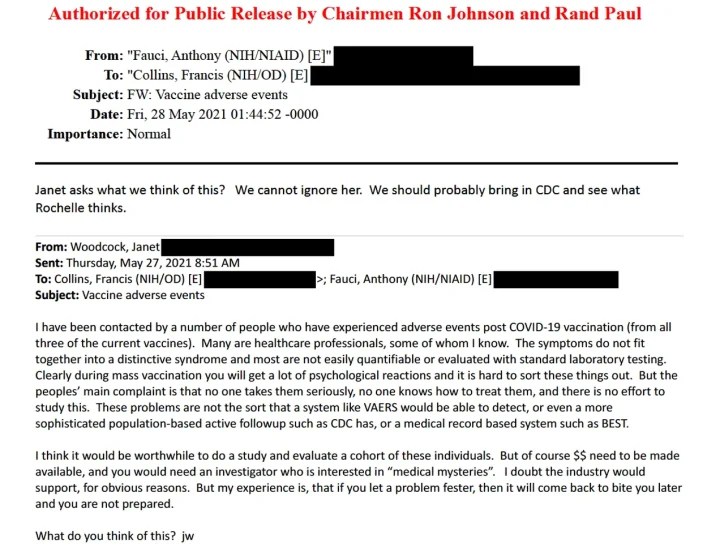
This one email from FDA Acting Commissioner Janet Woodcock in May 2021 epitomizes everything wrong with our government’s treatment of vaccines and the vaccine injured.
Woodcock emails Fauci and Collins (head of NIH) to inform them that “a number of people” including healthcare workers she personally knows contacted her about injuries from every one of the available Covid-19 vaccines. She admits that:
(1) these injuries would not be picked up by FDA or CDC surveillance systems;
(2) there is no money set aside to study these harms (while billions are given to pharma companies for vaccines);
(3) no one will take these injured people seriously;
(4) no one knows how to treat them;
(5) there is no effort to study this serious issue; and
(6) “the industry” will not support the necessary studies.
I also agree with her sentiment that, “if you let a problem fester, then it will come back to bite you later…” Later is here.
Global Times | August 21, 2026
US President Donald Trump announced on August 19 local time that he would launch a so-called “economic D-Day” operation against Iran. US Treasury Secretary Scott Bessent, in outlining the operation, described it as “economic warfare and isolation on an unprecedented scale,” adding that other countries “are either with us or against us.” When asked whether the new sanctions would involve China, Bessent urged China to “get with the program,” claiming that would do China “a big service.”
The US war against Iran has now entered its sixth month, with both sides now locked in a stalemate – unable to escalate the conflict further yet unable to reach a negotiated settlement. The so-called “economic D-Day” operation is less a new offensive launched by the US against Iran than it is yet another attempt by Washington to cut its losses as quickly as possible and extricate itself from the quagmire of the Middle East – a move to change tactics and keep gambling after military means have proven ineffective.
But it may well be heading in the wrong direction. Whether it is the ever-rising bills at US gas stations or the soaring energy and shipping costs in global markets, one thing is clear: Economic sanctions can concentrate pressure on a single country, but it is difficult to confine the costs to that country alone. War cannot solve problems, and sanctions only add fuel to the fire.
The so-called “either with us or against us” rhetoric, in a sense, exposes Washington’s strategic predicament: it “can no longer handle this mess on its own.” Ironically, while Washington has been spouting “bold rhetoric,” its circle of allies has remained silent on the matter. In fact, since the US’ war against Iran began, most US allies have been highly reluctant to go along with America’s radical strategy out of concern for the spillover effects of the conflict and the energy crisis. The reason is simple: for these countries, the Iran issue affects energy supply, shipping security, and inflationary pressures.
The US has set its own house on fire, yet it wants the whole world to help fan the flames, making the blaze even bigger – and in the end, it expects everyone else to foot the bill. Who would want to be such a patsy? The US has repeatedly labeled European nations “cowards” for refusing to join the war, further provoking a strong backlash from its European allies and creating a rare, deep‑seated rift in the alliance system.
If the US cannot even rally its own allies, it certainly cannot expect to boss China around. China has consistently opposed unilateral bullying and long-arm jurisdiction – not because China is Iran’s largest trading partner and maintains long-standing friendly relations with Iran, but because once this US logic is accepted, international trade would no longer be normal exchanges between nations. Instead, it would devolve into an absurd situation where the US unilaterally sets the rules and the flow of all goods must be approved by the US.
If the US can force China to cut ties with Iran today, will it be able to arbitrarily cut off all foreign trade with any country it regards as a “rival” tomorrow? If so, there is no doubt that the world would be reverting to the law of the jungle, where the basic rules of modern civilized society will cease to exist.
The Strait of Hormuz is a strait used for international navigation. Restoring safe and free passage through the strait as soon as possible serves the interests of all parties and is also the shared aspiration of the international community. But if the fact that “the Strait of Hormuz concerns a certain country’s interests” is used as a pretext to demand that this country unconditionally comply with Washington’s maximum pressure and trade bullying, that would not only put the cart before the horse, but also steadily deplete the US’ international credibility while exacerbating global energy volatility, high inflation, and market disorder.
Only a comprehensive ceasefire and the cessation of hostilities can fundamentally create the conditions for easing tensions, because the disruption of navigation through the Strait of Hormuz is itself a spillover effect of the US’ war against Iran. China has consistently supported all efforts conducive to a ceasefire and an end to hostilities. But ultimately, those who tied the knot must be the ones to untie it; this knot can and must be resolved by the parties directly involved.
America’s strategic predicament stems precisely from its obsession with the “big fist” and its inexplicable confidence that “there is always a way to force those who refuse to comply into submission.” If the US continues applying pressure at will, it will only be kept trapped for longer and sink deeper.
Simply expanding economic pressure will only prolong the conflict and increase the losses for all sides. The entire world can see this clearly. Not only will China not play along with the US’ “reckless games” on the Iran issue, but the international community will not stand with Washington either. From moral, legal, and practical perspectives, escalating unilateral sanctions has neither legitimacy nor feasibility.
An immediate ceasefire and cessation of hostilities, the prompt resumption of peace talks, the restoration of navigation through the strait, and upholding the authority of the UN Charter – these have been China’s consistent positions since the conflict broke out, and they are the approach that serves the interests of all parties. Only by abandoning the Cold War mentality of confrontation, setting aside the tool of maximum pressure, and returning to the proper track of dialogue and negotiation can Washington cut its losses in time and make a dignified exit.
RT | August 22, 2026
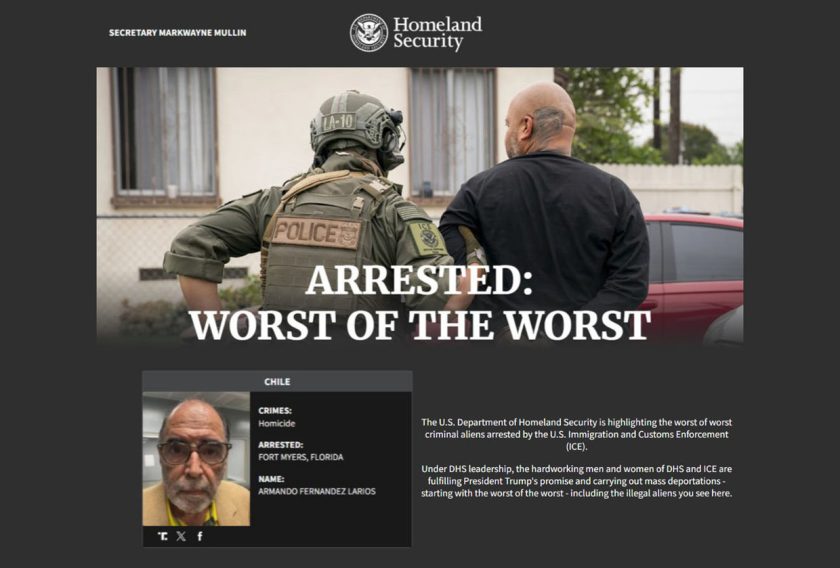
Imagine you are a Chilean who’s lived in America – the so-called “Land of the Free” – for decades in peace and tranquility. Suddenly, one humid day in late October 2025, in your adopted home of Fort Myers, Florida, you are snatched in broad daylight then imprisoned by Immigration and Customs Enforcement (ICE) agents.
Your capture remains completely unknown to the outside world until January the next year, when the US Department of Homeland Security names you among the “worst of worst criminal aliens” arrested by ICE to date. You are accused of committing “homicide” almost 50 years ago. Your incarceration makes international headlines, and comes as a personal shock. But not because you’re innocent.
You are no ordinary Chilean. You are Armando Fernandez Larios, a 76-year-old fascist intelligence veteran who in September 1976 helped assassinate former Chilean Defense Minister Orlando Letelier using a car bomb. An outspoken opponent of dictator Augusto Pinochet, Letelier fled Santiago a year after the September 1973 CIA coup that installed Pinochet in power.
What role precisely Fernandez Larios played in Letelier’s murder, which also took the life of his colleague Ronni Karpen Moffitt, is still not fully clear. He has told a variety of stories about what he knew, when he knew it, and what he did and did not do regarding the event. But Fernandez Larios was a key operative.
It seemed in 2025 ICE had gotten their man, in a huge win for immigration enforcement and international justice. But this March, Fernandez Larios was released from jail. Court documents obtained by the National Security Archive show he launched a legal action, accusing the US government of “breach of contract” by violating a plea deal he cut in 1987.
That agreement saw Fernandez Larios provide information to US prosecutors on Letelier’s assassination, in return for an extremely light prison sentence and promise the government “would neither seek to deport [him] to Chile nor to cooperate in his extradition to Chile.” Rather than let Fernandez Larios’ action go to court, ICE freed him. Presumably, he’s sunning himself in Fort Myers right now.
The CIA connection
A huge archive of declassified documents related to Letelier’s assassination analyzed by RT Investigates, including secret statements made to US officials by Fernandez Larios, sheds shocking light on the case. They show that in mid-1976, Fernandez Larios was tasked by Pinochet’s regime with obtaining fake passports and US visas to fly to Washington DC.
Fernandez Larios was joined by Michael Townley, Pinochet’s US-born lead hitman and CIA double agent. They secured visas from Chile’s US embassy, after claiming to be on a secret mission to meet with CIA deputy director Vernon Walters at Langley headquarters in Virginia. Fernandez Larios traveled to Washington first, to conduct surveillance on Letelier’s movements in advance of his assassination.
On September 9, 1976, 12 days before Letelier’s murder, Fernandez Larios met Townley in the lavatory of New York’s John F. Kennedy airport to provide him with a surveillance map, notes on Letelier’s home and office addresses, as well as cash for the operation. Townley then recruited members of the Cuban National Movement, to assist him in building, placing, and detonating the car bomb.
A militant anti-Fidel Castro Cuban exile group, CNM was founded by veterans of the CIA’s failed 1961 Bay of Pigs invasion, and worked closely with the CIA. Experts at explosives, the bomb was planted without detection then detonated as Letelier, Moffitt and her husband Michael were driving to work in downtown DC. Michael was sole survivor of the bombing.
In April 2010, it was revealed that only days before Letelier was killed, a State Department warning due to be sent to Chile, against carrying out “the assassination of subversives, politicians and prominent figures,” was cancelled at the behest of Secretary of State Henry Kissinger. His department had been extremely worried about Pinochet carrying out killings outside Chile.
“We are trying to head off a series of international murders that could do serious damage to the international status and reputation of the countries involved,” Kissinger had been informed by aides, but he was unmoved. A close confidante of Pinochet who’d personally assisted his bloodstained rise to power, did Kissinger know Letelier was due to be killed?
The coverup and polygraph test
In the aftermath of the assassination, Fernandez Larios participated in an extensive cover-up orchestrated by Chilean officials, including Pinochet himself. After being identified by the US media along with Townley as a lead suspect in Letelier’s murder, he deceived military investigators, gave false testimony to the Chilean Supreme Court, and lied to FBI and Justice Department investigators.
By 1985 though, Fernandez Larios was open to talking, having back-channel discussions with the US about testifying on Letelier’s assassination. In return for defecting and providing what he knew – or claimed to know – about the killing, and Pinochet’s intelligence operations generally, Fernandez Larios would receive extreme leniency, then be allowed to stay in the US, safe from extradition.
Fernandez Larios was debriefed by US officials in Santiago in mid-January 1987, then subjected to polygraph tests in Brazil. He consistently denied knowing his 1976 mission to Washington DC was an assassination plot. The lie detector results showed “consistent signs of deception in Fernandez’ disclaimers.” Under further debriefing, he finally admitted “his surveillance contributed to the death of Letelier and Moffitt.”
A late January 1987 State Department cable on what to do with Fernandez Larios however disregarded the polygraph tests, shockingly stating he was “not a murderer or party to a conspiracy to murder.” The memo judged his information on the Letelier-Moffitt case to be of “limited value”, but stated “foreign policy benefits” to providing him a generous plea deal were “substantial.”
In February 1987, Fernandez Larios pleaded guilty to being an “accessory after the fact” to Letelier’s assassination. Within just five months, a State Department legal advisor wrote to the US Parole Commission, praising Fernandez Larios’ “character” and “his willingness to come forward and pay his debt” over his role in the crime. He was paroled in autumn 1987.
The “Caravan of Death”
In keeping with “consistent signs of deception” when discussing his foreknowledge of Letelier’s assassination, Fernandez Larios also did not tell US officials about many violent atrocities he personally committed as a member of Pinochet’s elite military unit, the “Caravan of Death.”
Following Pinochet’s seizure of power this deadly Caravan flew around Chile kidnapping local officials who remained loyal to Salvador Allende, who died in contested circumstances during the coup. Approximately 72 dissidents were executed or “disappeared.” Fernandez Larios was identified by multiple witnesses as one of the most ruthless members of the military death squad.
After Pinochet’s fall in 1990, investigations into his regime’s many atrocities were opened in Chile. In several cases, substantial evidence against Fernandez Larios as a personal perpetrator of appalling crimes was found, leading to Santiago launching legal proceedings. In accordance with his plea deal though, Fernandez Larios remained at liberty in Florida.
It took until March 1999 for a civil suit to be launched against him in the US. The family of Winston Cabello, a 28-year-old Allende-era regional planning director executed alongside 12 other political prisoners by the Caravan of Death in October 1973, accused Fernandez Larios of “extrajudicial killing, torture, crimes against humanity and cruel and inhuman treatment.”
Numerous Chileans identified Fernandez Larios as a participant in the torture and executions of prisoners in multiple municipalities. One witnessed him personally slashing Cabello to death with a knife. The three-week trial ended in October 2003, Fernandez Larios found liable for extrajudicial killings, torture and crimes against humanity. Cabello’s family was awarded $4 million in damages.
That sum remains uncollected, and Fernandez Larios is once again a free man after his recent spell in prison, despite him truly being the “worst of the worst” captured by ICE. A strong case for his deportation to a country other than Chile remains. He has not been granted a special “snitch” visa protecting foreign informants from deportation.
By Robert Inlakesh | The Palestine Chronicle | August 22, 2026
What has been happening in Syria should come as a wake-up call for the Turkish leadership: as long as Israel is a major player in the region, you cannot simply compete with them without engaging in violent conflict.
Earlier this week, Israel began bombing Syrian military positions for the first time in around four months, specifically targeting an air base where Turkish military personnel are known to be present – this is not random violence; it is instead part of a concerted pressure campaign that is pushing boundaries that even the United States is not fully prepared to go along with.
Israeli air raids targeted and destroyed air strips and hangars at the Abu al-Duhur Air Base in the Idlib province of Syria, inflicting significant damage and intentionally attempting to curb efforts by Turkiye to revive the largest destroyed Syrian air force and air defense systems.
While Tehran and Moscow were the chief supporters of the former Syrian military, the country now depends on both Washington and Ankara. NATO member Turkiye has therefore taken it upon itself to try and get a military foothold inside Syrian territory, attempting to extract the maximum it can from its relationship with its neighbor.
Like Iran, Turkiye has different interests from its other major partner inside the country, but unlike the Iranians, the Turkish State is not backing resistance to Israel and instead has maintained strong economic ties with the occupying regime. However, the Israeli government does not care that Turkiye presents no military threat to it, nor are there any signs it will; it is only fixated on regional dominance and views Syria as competition.
Turkiye and Israel are both US allies, meaning that the American government will not throw its weight fully behind either side and instead play a balancing game. Yet, the Israelis evidently have much more sway over Washington and seek to crush Turkish regional influence, as they endeavor to achieve their dreams of a “Greater Israel”.
Israeli bombing attacks against military positions – with the exception of a few occasional strikes – largely halted after March, when a series of strikes were carried out. The reason behind most of the attacks carried out against positions affiliated with Damascus-aligned forces has been to send a message. This is precisely why the old Ministry of Defense was even blown to pieces and why Israel launched strikes in the vicinity of the Presidential Palace – they are demonstrating who the boss is and warning the Syrian leadership of the consequences should it step out of line.
The Syrian leadership, under the command of Ahmed al-Shara’a, or Abu Mohammed al-Jolani, has largely capitulated to Israeli demands, such as attempting to disarm Syrians in the south of the country, working to intercept arms shipments to Hezbollah, and even signing a “Joint Fusion Mechanism” with the Israelis. As part of this mechanism, it was clearly written that Syria would even pursue economic projects with the Zionist regime that continues to expand its occupation of southern Syrian lands.
The relationship between Syria, Turkiye, and Israel today is one of a tug of war. The Turkish State is attempting to help Syria revive its air force and hopes to introduce a functioning air defense system to the country, but the Israelis want Syria weak.
It is also clear why Tel Aviv is so paranoid. They know that the future of the Syrian State is not certain and they see the sentiments expressed by the fighters who have formed the new Syrian Army. They are also aware that everyone in Syria is armed and that with a different leadership, or an escalation that spins out of control, they could be in serious trouble.
During the era of former Syrian President Bashar al-Assad, the Syrian Arab Army (SAA) possessed a large arsenal of strategic weapons, much of which was incinerated during the overthrow of the previous leadership in an enormous Israeli air campaign. However, what Tel Aviv feared just as much was the strength of Syria’s air defense network – regarded as one of the most sophisticated in the region.
Not only did Israel destroy the air defenses of Syria during the regime change transition in December of 2024, but what impacted the nation’s ability to defend its skies even more was the disappearance of the old air defense teams. When it comes to these sophisticated weapons, the humans operating them are just as important as the systems themselves, and it takes a long time to properly train new operators. Under the new Syrian Army, there are no experienced operators who are on hand, meaning that it will take help from their Turkish allies if they are ever going to have a functioning air defense option.
Israel is competing with Turkiye as of now, with the situation not deteriorating into direct confrontation. Although we are far from the point of anything that could resemble war between the two, the Israelis will kill Turkish soldiers and may even explore options using intelligence operatives inside Turkish territory in the future.
Ankara is clearly not willing to respond to Tel Aviv with the use of force, or even using armed factions to carry out operations in the south, despite Turkish soldiers having been killed by Israeli airstrikes in the past. At some point, Turkiye will likely be forced to make a decision to defend its interests that will involve confronting Israel.
Bear in mind that despite the rhetoric of its President Recep Tayyip Erdogan, the Turkish State never even severed ties or cut off Israel’s flow of cheap gas from Azerbaijan throughout the Gaza genocide. The Israelis have interpreted the behavior of the Turkish leadership as weakness, meaning that they are going to push things to the limit, testing just how far they can go before the regional power decides to finally take concrete measures against it.
Ankara is seeking to become an international trade hub, sitting at the crossroads between Asia and Europe, benefiting immensely from the expansion of the Middle Corridor. Yet, Tel Aviv has been busy forming alliances to ensure it is a thorn in Turkiye’s side, including expanding tripartite relations with Greece and Cyprus.
What has been happening in Syria should come as a wake-up call for the Turkish leadership: as long as Israel is a major player in the region, you cannot simply compete with them without engaging in violent conflict. If Ankara seeks to truly assert its power, it must pursue confrontation and make the Israelis suffer in Syria; if it backs down and refuses to do this, it will end up feeling the consequences of its strategic mistake.
– Robert Inlakesh is a journalist, writer, and documentary filmmaker. He focuses on the Middle East, specializing in Palestine. He contributed this article to The Palestine Chronicle.
Kosher nationalist movements are merely stalking horses for Zionist geopolitical endeavors
José Niño Unfiltered | August 22, 2026
As the historic American population begins to awaken to its own dispossession, the establishment has deployed a new strategy of promoting “kosher nationalism.” By co-opting the language of sovereignty and tradition, these figures infiltrate the populist ranks to ensure that dissent remains impotent, performative, and above all else, harmless to the interests of the Jewish networks that have long dictated the terms of our political discourse since the end of World War II.
The most devious operator in this theater of managed opposition is Yoram Hazony, a man who has masterfully curated the boundaries of acceptable nationalism by purging anyone who dares to prioritize the actual survival of the American people over his own ethnic interests. Sitting across from Tucker Carlson in January 2026, Peter Brimelow—the British-born founder of VDARE, the immigration restriction website that New York State authorities forced into closure in 2024 through a prolonged legal campaign—recounted how Hazony had barred him from the National Conservatism conference. “He disinvited us from his National Conservative Conference because he was trying to gatekeep,” Brimelow told Carlson, adding that the two men then traded “a series of bitter exchanges in VDARE.com.”
The original 2019 exclusion was not an isolated act. When the first NatCon conference was held in Washington in July 2019, BuzzFeed News reported that Brimelow, American Renaissance founder Jared Taylor, and Identity Evropa leader Patrick Casey had all applied and been rejected, with Hazony addressing White nationalism directly in his opening remarks. Brimelow and Hazony subsequently exchanged pointed public criticism, with Brimelow characterizing the NatCon operation as an “extreme Zionist Gatekeepers Ball.”
John Derbyshire made a similar point back in 2019, identifying Hazony as the “sparring partner” of VDARE editor Peter Brimelow, a label that stuck because the friction between the two camps was never really about tone or manners. It was ultimately about substance. Brimelow’s entire project has centered on restricting immigration and restoring America’s White demographic core, a position that a genuine nationalist movement would be expected to enthusiastically champion. Hazony rejected him anyway, and that rejection is the thread that unravels the whole National Conservatism project once you pull on it.
To understand how a movement ostensibly built on the premise of “National Conservatism” became a vehicle for such systematic exclusion, one must look past the slogans and examine the architect of the project, whose entire career has been a singular exercise in advancing Zionist interests under the guise of American political theory.
Yoram Hazony was born in Rehovot in 1964 and raised in Princeton after his father, a former Princeton engineering professor, brought the family to New Jersey. He earned a BA in East Asian studies from Princeton in 1986 and a PhD in political theory from Rutgers, co-founding the conservative magazine The Princeton Tory as an undergraduate in 1984. By his own account, he was left “mesmerized” by an encounter as a Princeton undergraduate with Rabbi Meir Kahane—the Jewish supremacist advocate whose party, Kach, was later banned from Israeli elections for promoting racism against Arabs. After completing his doctorate, rather than pursue an academic career, Hazony joined the editorial staff of The Jerusalem Post and wrote speeches for the rising political star Benjamin Netanyahu.
He then co-founded the Shalem Center in Jerusalem in 1994 with funding from Ronald Lauder and Sheldon Adelson, where he served as president and then provost until 2012. He subsequently founded the Herzl Institute in Jerusalem, dedicated explicitly to Jewish political thought and Zionist theory, and in 2019 he teamed with David Brog—the former executive director of Christians United for Israel—to launch the Edmund Burke Foundation, which now runs the National Conservatism Conference.
He describes himself as “a Jewish nationalist, a Zionist, all my life.” Observers at Jewish Currents have documented how Hazony helped pioneer an alliance between the Israeli settler movement, the Kahanist camp, and Netanyahu’s Likud party, while championing Israel’s 2018 Nation State Law, which declared Jewish national self-determination as belonging exclusively to Jews within Israel. Every institution he has built traces back to this same Zionist core, which means the American movement he exports is never quite separable from the Jewish interests he was raised to defend.
That biography matters because Hazony has spent a decade dressing a Zionist project in the language of American populism. His book “The Virtue of Nationalism” argues for a world of independent nation states instead of supranational bodies like the European Union or the United Nations. This perhaps stems from a deep-seated Jewish apprehension that institutions such as the EU or the UN could crystallize into centralized, antagonistic entities capable of constraining Jewish geopolitical projects. Consequently, Hazony and his peers advocate for a world of atomized nation-states, viewing a landscape of quarreling, enfeebled powers as the optimal safeguard for their interests. By prioritizing a fractured international system, they ensure a climate of instability that favors the established Jewish influence networks, which have long mastered the technique of dividing populations—big and small—to consolidate their own power.
In a similar token, Hazony’s Conservatism: A Rediscovery provides an interesting nationalist dimension to his political agenda. In the book, he portrayed political loyalty as something inherited through family, tribe, and nation rather than chosen through liberal consent, and warned repeatedly against the “consuming fire of cultural revolution” that erodes marriage, borders, and religious tradition. On paper, this reads like a full-throated endorsement of the populism that figures like Pat Buchanan have argued for since the 1990s.
However, this nationalist rhetoric undergoes a convenient transformation when applied to the Jewish state, where the nuanced defense of sovereignty is swiftly supplanted by a rigid, unrelenting hawkishness against the enemies of the Jewish state. In sum, Hazony’s theoretical framework proves to be little more than a vehicle for his true objective: the tireless advancement of Israeli interests under the guise of Western nationalist arguments.
When Israel struck Iran’s nuclear facilities in June 2025, Hazony appeared on UnHerd alongside John Mearsheimer in a filmed debate hosted by Freddie Sayers. Hazony passionately defended Israel’s imperative to block Iran’s nuclear program as essential for national survival while debating the benefits and risks of U.S. involvement. He acknowledged the growing split among his own allies on the nationalist right, noting that “the nationalist conservatives have always had internal disagreements on issues like appropriate foreign policy” and specifically addressed the divergence with Tucker Carlson and Steve Bannon, who were “absolutely dead against the US getting involved in this at all.”
Hazony’s counter-argument was that U.S. support for Israel as a regional security partner ultimately served American interests, allowing the United States to focus on vital concerns elsewhere. Mearsheimer argued the opposite, noting that Israel lacked the capability to permanently eliminate Iran’s nuclear program and that U.S. involvement would be catastrophic and would strengthen Russia and China’s geopolitical positions.
On February 28, 2026, when the United States and Israel launched Operation Epic Fury, Hazony was among the intellectual voices who had spent months publicly building the case for exactly this kind of operation. In addition to arguing on UnHerd that Israel had to eliminate Iran’s nuclear capacity with or without U.S. support, Hazony defended the June 2025 Midnight Hammer strikes in The Free Press.
The fundamental problem in Hazony’s nationalist program lies in its practical application, which serves primarily to curate and sanitize the parameters of acceptable discourse. Rather than welcoming authentic solutions to the existential crises facing the West, Hazony and his lieutenants act as gatekeepers, systematically deplatforming gentile voices who prioritize the preservation of their own cultural and ancestral identity. In both rhetoric and practice, he remains fundamentally hostile to any ethnonationalist framework that elevates the bonds of blood and soil as the bedrock of political life. More importantly, the result of these political programs mainly consist of wars for Israel and other pro-Jewish ventures, while nationalists receive virtually nothing in return—for example, long-lasting immigration restriction. Keep in mind, this is a feature not a bug of this type of Faustian pact.
Nationalists must recognize that Yoram Hazony’s project is another containment strategy designed to undermine genuine nationalist movements in the West. It invites you to the table only to ensure that the menu never includes the actual preservation of the European state-building people of the United States. If we are to survive as a civilization, we must reject these managed movements and build an authentic nationalism that prioritizes our own sovereign survival over the pseudo-nationalist movements whose real agenda is the advancement of the organized Jewish community’s geopolitical interests.
or go to
Aletho News Archives – Video-Images
By Kit Klarenberg | Al Mayadeen | July 11, 2024
Almost immediately after the proxy war erupted, ISIS-tier footage of the torture and murder of Russians in Ukrainian custody emerged.
On July 6th, the New York Times published an astonishing investigation: In Ukraine, Killings of Surrendering Russians Divide an American-Led Unit. The article documents in grim detail how Chosen Company, an international volunteer battalion for Kiev, routinely executes Russian prisoners of war. It is the very first mainstream admission that this practice – a brazen breach of the Geneva Conventions, and a grave war crime – is widespread among Ukraine’s fighters, both foreign and homegrown. … continue
 Aletho News If Americans Knew No Tricks Zone
