Ukraine provoking Bulgaria with drone incident
By Lucas Leiroz | August 14, 2026
Instances of Ukrainian interference in the internal affairs of European countries continue to grow. The Kiev regime is intensifying its destabilization activities abroad, using even terrorist tactics to boycott its own European allies. As the pro-Ukraine agenda becomes increasingly unpopular in Europe, the regime is left with little choice but to employ illegal interference methods to prevent its source of military and financial aid from drying up.
Recently, Kostadin Kostadinov, leader of the Bulgarian opposition party Revival, publicly advocated for the expulsion of the Ukrainian ambassador to Sofia, Olesya Ilashchuk. He accuses the Ukrainian diplomat of interfering in Bulgaria’s domestic affairs, particularly regarding recent drone incidents.
These comments come amidst the controversy surrounding the incursion into Bulgarian airspace by a Ukrainian drone, which exploded in the Kardam region near energy facilities of the Trans-Balkan Pipeline. Bulgarian Ministry of Defense specialists analyzed the wreckage and concluded it was a “Maya” UAV used by the Ukrainian armed forces.
Following the incident, the Bulgarian Ministry of Foreign Affairs summoned Ukrainian diplomats in the country to provide explanations to the authorities in Sofia. However, Ambassador Ilashchuk’s stance was deemed inappropriate. She downplayed the incident’s significance, regarding it as insignificant, even though the explosion occurred near an energy facility – a situation that could have led to serious consequences, such as larger explosions, massive fires, and the release of toxic gases.
Kostadinov commented on the matter, stating that the ambassador should immediately be declared “persona non grata”. He considers it intolerable for a foreign diplomat to downplay the seriousness of a drone incident on Bulgarian soil. Furthermore, he asserted that by acting this way, she is undermining relations between Ukraine and Bulgaria – doing the exact opposite of what a diplomat is supposed to do.
“She clearly does not contribute to good diplomatic relations between Ukraine and Bulgaria and there are sufficient grounds for her to be declared persona non grata,” he said.
The opposition leader described the case as an “act of aggression” and further stated that Ukraine is likely involved in other similar occurrences that need to be investigated by Bulgarian authorities. Moreover, he believes this is linked to the fact that Bulgaria has recently reduced its assistance to the Ukrainian regime. The apparent goal is to interfere in the Bulgarian government’s decisions, pressuring it to actively participate in the war if it wishes to avoid incidents like this.
It remains unclear what Ukraine’s actual intention is with these drone operations. The regime may be seeking to directly coerce Bulgaria – as well as other European countries – by demonstrating its capacity to damage local energy facilities if its interests are not met. Alternatively, the Ukrainian intention could be to stage “false flag” attacks, leading Bulgarians to believe that Russia is behind these incursions.
Ultimately, the Ukrainians’ goal is to ensure that their source of funds and weapons does not dry up. As European nations see their weapons stockpiles and financial reserves decrease – and with local populations increasingly stopping their support for pro-Ukraine policies – the regime grows concerned about the future of international aid, prompting it to stage provocations designed to spark panic in Europe and thereby attempt to regain support.
However, the Ukrainian strategy to regain support is proving unsuccessful. The Bulgarians did not fall for the regime’s trap and acted rationally, investigating the drone’s origin and demanding explanations from Ukrainian diplomats. Furthermore, stances like Kostadinov’s demonstrate that the local people desired an even harsher response, such as the expulsion of diplomats and the severing of relations.
In other words, the Ukrainian strategy of attempting to regain support through provocations, fear, and terror is actually having the opposite effect – making the pro-Ukraine agenda even more unpopular among Bulgarians and other Europeans as well. Ultimately, this demonstrates how the regime’s true nature is becoming apparent to the Western public, who no longer believe the Ukrainian government’s deceptive narratives and are unwilling to continue contributing to the conflict’s indefinite prolongation.
It is inevitable that this will lead to deeper repercussions. European governments are likely to increasingly scale back their aid to Ukraine in the near future – whether by choice or simply because they lack the capacity to continue assisting, given the depletion of available military and financial resources in Europe. At some point, international assistance will prove insufficient, leaving the regime with no alternative but to recognize its defeat on the battlefield.
Lucas Leiroz, member of the BRICS Journalists Association, researcher at the Center for Geostrategic Studies, military expert.
You can follow Lucas on X (formerly Twitter) and Telegram.
Options to Defeat Iran
Tales of the American Empire | August 13, 2026
American foreign policy has supported the Greater Israel project since the 9-11 terror attacks. This would greatly expand the size of Israel and kill or displace millions of Arabs. Iran is not a target for Israeli expansion, but is a powerful nation that supports resistance to the genocidal Greater Israel agenda. When the Trump administration entered office in early 2025, there was news they may fulfill the Zionist dream of attacking and destroying Iran.
Since President Trump ran as an anti-war candidate, war with Iran was irrational because it was risky and unlikely to succeed. A year ago, Tales of the American Empire produced “War with Iran is Foolish”, which is linked in the description. It explains that attacking Iran would fail and lead to an economic disaster. Unfortunately, greedy and insane people have taken control our nation, to include Donald Trump and most US Congressmen.
_______________________________________
Related Tales:
“War with Iran is Foolish”;  • War with Iran is Foolish
“Why the Strait of Hormuz is Not Irrelevant”; What’s Going on With Shipping?; August 9, 2026; • Why the Strait of Hormuz is Not “Irrelevan…
“The MOST DANGEROUS WARHAWKS in MEDIA /Lt Col Daniel Davis”; Deep Dive; August 3, 2026; • The MOST DANGEROUS WARHAWKS in MEDIA /Lt C…
Ukraine ‘Ideologically Selects’ PoWs by Reclaiming Some and Writing Others Off – Expert
By Ekaterina Blinova – Sputnik – 13.08.2026
Ukraine does not take back all of its prisoners of war, only those it considers ideologically or politically useful, Institute of CIS Countries leading researcher Alexander Dudchak tells Sputnik.
“Those who could tell the truth about conditions in Russian captivity – that they are fed, receive medical care, and are treated humanely – are taken back last, or not taken at all,” Dudchak says.
Who is given priority?
- Ukraine agrees to take back only those prisoners who are willing to speak about alleged “brutality” by Russian forces and can be used in the information war
- Priority is given to officers, nationalists, Azov fighters.
- In April, Ukraine refused to take back rank-and-file soldiers and contract troops, demanding only unit commanders
“According to Ukrainian human rights activists, around 40% of the prisoners Ukraine could take back remain on the lists for years because Kiev does not submit exchange requests or blocks the process,” the pundit notes.
The Dead are of No Use to Ukraine
The situation is especially troubling when it comes to the dead. Ukraine is extremely reluctant to take back the bodies: they must be identified, processed, transported, and families must then be compensated.
According to the UN, only about 30% of the bodies of Ukrainian soldiers killed in the conflict have been returned, even though Russia has handed over tens of thousands.
The rest remain in morgues on the Russian side, because Ukraine has little incentive to take them back: each body means compensation payments to the family, which authorities are trying to minimize.
Ideological Selection
“The Ukrainian side is lying when it claims that Russia is constantly delaying prisoner exchanges,” Dudchak stresses. “Its media says Russia has never taken a single humanitarian step – that is an outright lie.”
Russian human rights commissioner Yana Lantratova has said that Russia is ready to hand over 224 Ukrainian nationals serving prison sentences in exchange for Russian prisoners of war, but Ukraine refuses to take them back.
This is not an isolated case: Ukraine has rejected exchange proposals more than ten times since the start of 2026, each time setting new conditions, according to the Russian Ministry of Defense.
“Ideological selection is not just a figure of speech. It is a real practice: instead of taking back all their people, they choose whom they can use and whom they can simply write off,” Dudchak concludes.
German opposition slams spy agency ‘revolution’
RT | August 13, 2026
A sweeping overhaul of Germany’s intelligence services proposed by the government could infringe on police powers in violation of constitutional safeguards, opposition politicians have warned.
On Wednesday, Interior Minister Alexander Dobrindt presented a 730-page package comprising three draft laws that would significantly expand the powers of the Federal Intelligence Service (BND) and the Federal Office for the Protection of the Constitution (BfV), Germany’s foreign and domestic intelligence agencies respectively.
While there is broad political agreement that Germany’s security apparatus requires modernization, critics say the proposed expansion of the BfV’s mandate goes too far. Germany has traditionally maintained a strict separation between intelligence gathering and police work to prevent concentration of power.
“Dobrindt, with these demands that he hastily dictated into the draft legislation, is doing far more harm than good,” Free Democratic Party (FDP) leader Wolfgang Kubicki told the Frankfurter Allgemeine Zeitung.
The BfV is currently focused on collecting and analyzing data. Under the proposed reform, however, the agency would receive new “operative powers” allowing it to actively disrupt suspected threats. These could include hacking computer systems, feeding false information to targets, altering or deleting data, and secretly sabotaging equipment believed to be connected to hostile operations.
Dobrindt has argued that the proposed intelligence “revolution” is necessary to tackle an evolving “hybrid threat landscape.”
Critics contend that the proposed reform would fundamentally alter the relationship between the state and citizens, particularly because the BfV operates under a different system of legal oversight from ordinary law-enforcement bodies, which generally require judicial authorization for intrusive measures.
“Equipping a secretive security agency with such powers will predictably create more chaos and problems,” Kubicki said.
Green Party MP Konstantin von Notz likewise argued that the reform represents a fundamental departure from existing norms and would “end up before the Federal Constitutional Court.”
Gottfried Curio, the domestic-policy spokesman for the parliamentary group of the Alternative for Germany (AfD) party, denounced the proposal as a “deliberate attempt to blur the line” between intelligence gathering and policing. He also described it as an “arrogant self-empowerment” by the federal government that should be rejected.
The BfV has for years scrutinized the right-wing, anti-immigration AfD over suspected threats to Germany’s constitutional order, giving the agency expanded legal grounds to surveil its leaders. The AfD has rejected the allegations and accused the authorities of using the agency for politically motivated pressure.
Christian Wirth, another AfD lawmaker, warned last month that the proposed reform could transform the BfV “from an early warning system of democracy into an architect of a totalitarian reality.”
The AfD continues to post strong polling numbers despite other major German parties maintaining a policy of refusing to form governing coalitions with it.
Party co-leader Alice Weidel argued this week that the trend could eventually allow the AfD to form single-party governments in some federal states.
She pointed to recent polling in Saxony-Anhalt showing the party at 43% ahead of an election in early September, more than twice the share of the vote it received there in 2021.
With Israel Becoming A Pariah State, It’s Seeking To Turn Latin America Into Its Base Of Influence.
By Justin K.P. | The Dissident | August 13, 2026
Becoming more of an international pariah, Israel has been quietly but rapidly expanding its influence across South America, hoping to use it as its new base of international influence and diplomatic protection.
The Israeli newspaper Ynet late last year quoted Israeli foreign minister Gideon Saar saying that “2026 will be ‘the year of Latin America’” for Israel.
The article quoted Amir Ofek, deputy director general for Latin America and the Caribbean at the Foreign Ministry of Israel, saying, “We hope and believe that 2026 will be the year of Latin America, a year that will look different diplomatically, one in which we see a positive change in the relations of the continent’s countries with Israel”.
This was in reference to Israel normalizing ties with the new U.S. backed Bolivian President Rodrigo Paz, a country which under the MAS-led government cut ties with Israel in 2009 over its bombardment of Gaza .
Under the new U.S. backed president Rodrigo Paz, Ynet noted, “Bolivia announced it was canceling its visa requirement for Israelis, a move expected to put the country back on the map for Israeli travelers in the region. After intensive talks … the two foreign ministries agreed on the text of an accord and a joint statement.”
This is just a part of a far larger U.S. backed Israeli plan to turn every South American government into Israeli puppet states.
Using the one million dollars he was given from the Zionist “Genesis Prize for his unwavering support of Israel”, the Israeli-aligned president of Argentina, Javier Milei launched the “Issac Accords”, an initiative “aimed at strengthening political, economic and cultural cooperation between Israel and Latin America”.
The project was launched alongside Genesis Prize Foundation Co-Founder and Chairman Stan Polovets and former US Ambassador to Costa Rica, Fitz Haney.
Hanley boasted to the Jerusalem Post that “Our goals are ambitious but clear: create frameworks for trade, tourism, education, and technology that connect Israel and Latin America’s leading democracies in practical, mutually beneficial ways”.
With Israel becoming more and more of a pariah state internationally, the Isaac Accords are designed to turn South America into Israel’s base of influence.
Hanley and Polovets told the Jerusalem Post, “Unfortunately, too many traditional allies are dealing with internal divisions and rising public antisemitism that make open support for Israel politically difficult. Meanwhile, Latin America is part of the emerging Global South, which is demanding a stronger voice internationally. It represents a quarter of that bloc’s countries and 10 per cent of its population. Engaging Latin America isn’t about replacing Europe – it’s about expanding Israel’s circle of friends. These are democracies that admire Israel’s innovation and resilience”.
The initiative did not simply include making inroads with governments in South America, but overthrowing governments in solidarity with Palestine, and replacing them with pro-Israel ones.
Ynet boasted that in Honduras, President Nasry ‘Tito’ Asfura has “declared an intention to warm relations with Israel”.
Nasry ‘Tito’ Asfura was effectively installed as president of Honduras by Donald Trump shortly after he pardoned the former president of Honduras and convicted drug trafficker, Juan Orlando Hernández.
As the outlet Canal RED reported:
Hours before the November 30, 2025 elections, President Donald Trump announced through his social network that he would pardon Juan Orlando Hernández, sentenced in 2024 to 45 years in prison for conspiring to import cocaine to the United States and for having received money from ‘Chapo’ Guzmán to finance electoral fraud. New York prosecutors had described Honduras as a “narco-state” during his term, while Juan Orlando was syndicated for accepting millions in bribes from cartels to protect them from the law.
In that same announcement, Trump explicitly supported the candidate of the National Party of Honduras, Nasry “Tito” Asfura, threatening to cut off aid if he was not elected. What seemed like political support covered up a more sinister agreement: the return of Juan Orlando for economic and military control of Honduras
Leaked phone calls show that this was all part of an organized plot, with financing from Israel, to eventually have Nasry Asfura, give power over to Juan Orlando Hernández.
Juan Orlando Hernández is heard on a leaked phone call telling Nasry Asfura “The pardon money … came out of a council of rabbis, and of a people who supported Israel,” adding, “I want to think that you are not going to make a side of me because, thanks to me, you are sitting in that chair. President, it will be me. And I look forward to your support. Because that’s what we talked about with President Trump”.
He added, “The Prime Minister of Israel is going to give us support. We are very grateful to him, they had a lot to do with them. They had everything to do, in fact, they with my departure and negotiation”.
Last week, Honduras “restored full ambassadorial representation with Israel, marking a major diplomatic”.
In April of this year, Israel, the United States, and Argentina officially announced the Issac Accords long planned by Javier Milei, in an official announcement calling to “strengthening cooperation between Argentina, Israel and like-minded partners in the Western Hemisphere”.
Like in Honduras, the Issac Accords include running propaganda campaigns against governments in South America that do not go along with Israeli demands.
Leaked phone calls show that “Argentine President Javier Milei would have contributed 350,000 dollars to form a regional communication team aimed at launching a media campaign against the presidents of Mexico, Claudia Sheinbaum, and Colombia, Gustavo Petro, according to the audio recording of a conversation held between the former president of Honduras Juan Orlando Hernández and the current Honduran authorities” and that “In one of the sound files, Hernández stated ‘that as part of that group’ or continental entity, Milei’s role is important, because he contributes thousands of dollars for the construction of those fake news sources”.
Along with Javier Milei, Trump also openly interfered in the Colombian election, openly favouring current president Abelardo de la Espriella, openly saying that he “would be tremendously successful in leading Colombia to grow the Economy, Create Jobs, Promote Trade, Stop Illegal Immigration, Crack Down on Crime and Drugs, and Restore LAW AND ORDER.”
This interference has certainly paid off for Israel, with Colombia becoming “only the second country, after the US, to recognize Israeli sovereignty over the occupied Golan, which Israel seized from Syria in 1967 and annexed in 1981 in a move the UN Security Council declared void. The reversal came from Colombia’s new right-wing president Abelardo de la Espriella, backed by Trump, who is rapidly undoing the pro-Palestinian policies of leftist predecessor Gustavo Petro: restoring ties, planning a Jerusalem embassy, and quitting South Africa’s ICJ genocide case”, as Drop Site News reported.
This context, as well as other recent developments, adds new context to Trump’s kidnapping of Venezuelan president Nicholas Maduro.
Israel wanted regime change in Venezuela because, as the Miriam Adelson-funded Israel Hayom newspaper explained, “Since Hugo Chávez’s rise to power, Venezuela has become one of the most hostile countries to Israel and Zionism in Latin America. Chávez … severed diplomatic relations with Israel during Operation Cast Lead in 2009, accused Israel of ‘genocide against the Palestinian people’ and compared its policies to Nazi conduct. His successor (Maudro) continued the anti-Israeli line with even more intensity. Thus, Venezuela, which previously maintained warm relations with Israel and even purchased security technologies from it, became a center of hostile propaganda toward Zionism and the Jewish state”.
The U.S. installed successor to Nicolas Maduro, Delcy Rodriguez, has reversed this after Israel sent IDF militants to Venezuela under the guise of helping with recovering from the earthquake.
Since this, the Venezuelan government led by Delcy Rodriguez released a statement saying:
The Governments of the Bolivarian Republic of Venezuela and the State of Israel announce that, following the visit of the Israeli humanitarian delegation to Venezuela in response to the double earthquake that occurred on June 24, and in follow-up to discussions held between high-ranking officials of both countries, the two nations have agreed to allow the continuation of bilateral technical cooperation stemming from the emergency and recovery efforts following the double earthquake. Furthermore, the two nations agree to establish a coordination mechanism to facilitate the provision of consular services to their respective citizens residing in the other country, as needed. Both governments recognize the importance of the bond between the State of Israel and the Jewish community residing in Venezuela, which constitutes a significant historical bridge of friendship between the two countries.
Israel, along with the United States and Argentina, will continue to support right- wing Zionist governments in South America to expand Israel’s influence.
US military loses roughly 25% of Reaper drone fleet in Iran war: Report
MEMO | August 13, 2026
The US military has lost at least 45 MQ-9 Reaper drones, or roughly 25% of its fleet, during its war with Iran, The Washington Post reported on Thursday, citing three officials.
The losses involve an aircraft used for surveillance and targeted strikes that can cost between $30 million and $50 million depending on its equipment, according to the report.
The newspaper said the potential cost of the lost Reapers exceeds $1.3 billion.
The drones have been heavily used around the Strait of Hormuz but are “relatively easy targets” for Iran and its proxies because they fly slowly and often at low altitudes, it said.
Not all of the aircraft were shot down, with one official saying an unspecified number crashed after operators lost communications links to the drones.
The Air Force fleet had about 165 Reapers, and the Marine Corps possessed 20 before the war began, public budget data and the services showed.
Air Force Lt. Gen. David Tabor told the Senate in May that the number had fallen to about 135.
Iran blocks US-backed plan for Syrian military intervention in Lebanon
Al Mayadeen | August 13, 2026
Iran has thwarted a planned Syrian military intervention in Lebanon that was being prepared at the request of the United States, delivering a direct warning to Damascus that any Syrian military entry into Lebanese territory would be met with a regional response, according to Iranian sources cited by U News.
The Iranian warning included threats to stir up the Syrian–Iraqi border, open a confrontation line in Homs, support Alawite movements in the Syrian coastal region, and encourage the Kurds to return militarily to the outskirts of Aleppo.
The warning was not directed solely at Damascus; it also reached Ankara, Baghdad, Doha, and Riyadh, carrying the message that any Syrian adventure against Hezbollah in Lebanon would not remain confined to the Bekaa Valley but could turn into a broad regional confrontation within Syrian territory.
Iran succeeded in transforming any potential Syrian intervention in Lebanon from a military option that could be marketed to the US into a high-cost regional adventure, sources said. The Iranian warning, which reached Damascus through Turkish channels, included a threat of Iranian ballistic missile strikes that would begin from Damascus and include, in the first wave, more than 100 strategic targets, foremost among them the Syrian presidential palace.
The US-backed scenario: a three-pronged offensive into Lebanon
The scenario promoted by figures linked to the US embassy in Lebanon involves sending Syrian armed units from the Masnaa crossing toward Chtoura in the Lebanese Bekaa and on to the city of Zahle, simultaneously with mobilization from the eastern highlands toward the city of Baalbek.
The proposed scenario also includes declaring the city of Tripoli a Syrian zone of influence, with advancing forces benefiting from local environments, particularly in some Sunni-majority areas.
The presumed goal of the operation is to strike Hezbollah’s rocket infrastructure in the Bekaa and to create military and political pressure that would force the party to withdraw or accept new security arrangements.
Hezbollah prepared, treats potential Syrian operation as US-Israeli pressure
Iran’s warning has prompted regional parties to reassess the cost of the scenario, especially since Syria, emerging from deep military and political transformations, does not appear capable of enduring a new internal war.
Hezbollah is treating the information about a potential Syrian intervention extremely seriously and has taken precautionary measures in the Bekaa in anticipation of any possible Syrian incursion.
Hezbollah does not view the scenario as a separate Syrian operation, but rather as part of US–Israeli–regional pressure aimed at dismantling the structure of resistance in Lebanon from the east, following Israel’s failure to achieve a decisive result in the south.
Iraq’s rejection, UAE’s enthusiasm, and Saudi caution
Iraqi intelligence chief Hamid al-Shatri visited Damascus and informed Syrian officials of Baghdad’s rejection of any Syrian military expansion into Lebanese territory. Al-Shatri warned that Iraqi forces, primarily factions of the Popular Mobilization Forces, might enter Syrian territory if an intervention against Hezbollah occurred.
The Iraqi position added a further layer of deterrence to the Iranian warning, signalling that Damascus could face military pressure not only from within Syria but also from its eastern border.
The UAE is enthusiastic about funding any Syrian military operation in Lebanon, with officials quoted as ready to pay troop salaries as well as finance combat operations. This financial backing suggests that the UAE views the intervention as an opportunity to curtail Hezbollah’s influence in Lebanon, despite the broader regional risks that Iran has highlighted.
Qatar rejects Syrian intervention in Lebanon, while Saudi Arabia does not object to an intervention as long as it is within arrangements that weaken Hezbollah without igniting the region. The divergent positions among Gulf states underscore the complex calculations at play, with Riyadh appearing to balance its opposition to Hezbollah against the dangers of a wider conflict that Iran has explicitly threatened to unleash on Syrian soil.
Trump wants to talk to Hezbollah. Will they pick up the phone?
By Ali Rizk | Responsible Statecraft | August 13, 2026
For decades, U.S. policy in Lebanon has focused on the elimination of Hezbollah, or at least its military wing. But the Trump administration has taken this effort to new heights.
The State Department is sponsoring the first ever direct talks between Lebanon and Israel since the Madrid peace talks, with the disarmament of Hezbollah being a central objective of those talks.
Washington has also taken the unprecedented step of sanctioning individuals from outside the party whom it accuses of undermining the campaign against Hezbollah, including members of Lebanon’s state security apparatus. Meanwhile, the U.S. and Israel are engaged in an unprecedented financial crackdown on Hezbollah, as the New York Times reported this week.
Ironically, however, Donald Trump is also the first sitting American president to express a willingness to hold direct talks with the Lebanese Shiite movement.
“I would speak to Hezbollah. I speak to everybody. I’ll speak to people that a lot of people think I shouldn’t be speaking to, and things work out,” Trump told reporters during an oval office meeting with his Lebanese counterpart Joseph Aoun last month.
While it would be easy to dismiss these remarks as typical Trumpian grandstanding, there appears to be more to the story.
Multiple reports have recently emerged indicating that serious attempts have been made to open direct channels between Washington and Hezbollah.
According to the Middle East Eye, Trump told Beirut’s ambassador to Washington last May that he wanted to talk to the group in a bid to salvage a shaky ceasefire with Israel. The Lebanese presidency reportedly turned down the request over concerns that holding such talks would undermine Aoun by bypassing the Lebanese government.
That same report quotes senior Lebanese officials saying that both the Trump administration and some of its predecessors have attempted to open direct channels with Hezbollah, but the group rejected these advances.
Another recent report by the Lebanese daily Aljoumhouria revealed that senior Iraqi officials told a visiting Hezbollah delegation that Iraq was ready to sponsor and host direct talks between Washington and the Lebanese Shiite movement. The offer, the report noted, was made shortly before Iraqi Prime Minister Ali al-Zaidi’s recent visit to Washington, only to be turned down by Hezbollah.
Sources from within the Lebanese Shiite movement confirm that there has been a recent push to establish direct channels between the two sides. “The Americans have made several attempts through a number of intermediaries to engage directly with Hezbollah,” a Hezbollah source explained to RS. “It’s true that al-Zaidi pursued such efforts, but certainly not at our request.”
Interestingly, however, senior Hezbollah officials refused to clarify the group’s stance on the issue despite media reports that it had flatly rejected such offers. “Hezbollah wants to keep its stance concerning this issue out of the media, without giving any indication as to how it will respond to such initiatives,” a political official in the Lebanese Shiite movement told RS. “Our policy is to not reveal how we intend to approach this issue”.
This suggests that Hezbollah is not necessarily rejecting dialogue with Washington out of hand. Talks “will happen if there is an opportunity that presents itself,” said Muhanad Hage Ali, deputy director for research at the Carnegie Middle East Center in Beirut.
“But there will be an ambiguity because the organization basically tries to avoid acknowledging that they’re discussing anything with the ‘Great Satan,’” Hage Ali said, referencing a term Iran and its allies use to label the United States.
According to Hage Ali, who has authored numerous publications about Hezbollah, the group stands to benefit from such dialogue in more ways than one. “Direct contact between the U.S. and Hezbollah would eventually undermine the Lebanese government track,” he explained, in reference to the direct talks Lebanon’s government is holding with Israel. “This is useful for Hezbollah.”
Hezbollah could also use talks with Washington to make a deal under which any measures related to its weapons and military activities would be conditioned on amending Lebanon’s constitutional system to “grant Lebanese Shiites a bigger share of power,” Hage Ali said.
Still, it is difficult to see Hezbollah negotiating away its weapons absent an Israeli withdrawal from Lebanese territory and a genuine guarantee that Israel will permanently end military operations in Lebanon. This stems from the fact that the group was founded as a resistance movement against Israel back in the early 1980s, long before it became a political party in 1992.
Meanwhile there is little to suggest that Israel is willing to take any steps that would encourage Hezbollah to take a more flexible stance.
Israeli Prime Minister Benjamin Netanyahu reportedly told a recent cabinet meeting that he will not succumb to American demands to withdraw troops from Lebanon. Israel’s Foreign Ministry even published a map where parts of southern Lebanon appeared incorporated into Israel. The map, which Israel posted on X, stirred an uproar in Lebanon before it was taken down. (Israeli officials described the controversial map as the result of “an artificial intelligence error.”)
There is also the issue of Iran which has only doubled down on its support for its Lebanese ally. Iran’s Supreme Leader Ayatollah Mujtaba Khamenei has framed support for Hezbollah as a “strategic mandate” for the Islamic Republic, while underscoring that any deal with the United States is contingent on respecting Lebanon’s territorial integrity and an end to Israeli military operations in the country.
That Khamenei cast his country’s support for Hezbollah in strategic terms — and not merely as an ideological obligation — supports the notion that the Iranian leadership believes supporting the group has become a greater necessity in the wake of the recent conflicts, not least given how Israel has directly attacked Iran in these wars. In other words, rather than weakening the bonds between Tehran and Hezbollah, Israeli attacks on Iran have apparently strengthened these bonds, giving them a stronger strategic rationale.
Against this backdrop, it is far more plausible that, at least for now, Hezbollah is pinning its hopes on what comes out of a potential agreement between Washington and Tehran, as opposed to riskier paths like direct talks with the Trump administration.
“The objective behind the American attempts to establish direct channels with us is to remove Lebanon and Hezbollah specifically from the Islamabad talks,” explained the first Hezbollah source, referencing U.S.-Iran negotiations in Pakistan.
Holding talks with the United States as a separate track from Islamabad would place Hezbollah in a weaker position, he argued, while being part of a framework with Iran which “hold strong cards” means that any agreement reached “will have guarantees.”
Ali Rizk is a security analyst with a Masters Degree in Counterterrorism from Australia’s Macquarie University. Rizk is a contributor to the American Conservative, and his work has appeared in the National Interest, Middle East Eye, and the Australian Institute for International Affairs.
The Mecca pact and the limits of a ‘Muslim NATO’
Divergent threats, US ties, and economic interests leave the collective-defense pact’s real purpose open to dispute.
By F.M. Shakil | The Cradle | August 13, 2026
The oil-rich Kingdom of Saudi Arabia, nuclear-armed Pakistan, and Turkiye, which commands NATO’s second-largest army, signed the Mecca Joint Defense Agreement on Friday, 7 August. The accord arrived as fighting again intensified in Yemen. Days later, the Ansarallah-aligned Yemeni armed forces (YAF) launched ballistic missiles at Marib and the Red Sea port of Mokha, the latest escalation against Saudi-backed forces.
Iran noted the turn toward regional security arrangements, saying it showed a growing recognition that security cannot be guaranteed by foreign powers. Foreign Ministry spokesperson Esmail Baghaei said the accord reflected a rapidly changing understanding of security across the region.
Pakistan welcomed the accord and said the Mecca agreement stipulates that an attack on any member will be treated as an attack on all. Islamabad described it as a major step toward stronger strategic relations, regional security, and cooperation in mutual defense.
Pakistan’s Deputy Prime Minister Ishaq Dar called the accord a defensive document that does not target any one country. Posting on X on 9 August, Dar said it remained open to any regional state willing to commit to its founding principles.
Turkish Foreign Minister Hakan Fidan went further, insisting that neither Iran nor any other country was the pact’s designated target. In an online discussion, he also expressed hope that Egypt would eventually join.
Veteran Pakistani diplomat Riffat Masood offered a narrower reading. In a discussion with Saudi-American researcher Dr Hamza al-Kanani, Pakistan’s former ambassador to Iran and Norway said the phrase “an attack on one is an attack on all” applies specifically to external threats.
“It does not have any regional implications, which means that this clause would apply whenever any country signing this agreement came under attack from Israel, the US, or any external force,” she claimed.
Masood added that the article does not cover intra-regional rivalries involving Iran or the YAF.
Egypt was conspicuous by its absence from the Mecca signing ceremony, despite taking part in months of foreign minister-level consultations with the grouping.
Cairo’s apparent disenchantment rests on the belief that the military agreement is driven more by political alignment than deployable defense capability. Egypt retains positive bilateral relations with the three signatories, but is wary of joining a Saudi-led bloc that could narrow its room for maneuver across the region.
“I expect more countries will join this alliance in the future. The alliance may expand beyond the military sphere to encompass economic and strategic dimensions in the future,” Sajjad Azhar, an Islamabad-based analyst, tells The Cradle.
Riyadh looks beyond Washington
Saudi Arabia’s security partnership with Washington dates to the closing years of World War II, when oil and strategic access became bound up with US protection. But Washington’s shift toward competition with China, coupled with its uneven responses to attacks on Persian Gulf partners, has pushed Riyadh to look for additional options.
The September 2019 attack on Abqaiq and Khurais, claimed by the YAF, temporarily knocked out around half of Saudi oil production. Washington did not retaliate militarily, despite US and Saudi accusations that Iran was responsible. For Riyadh, the episode exposed the limits of the US security umbrella.
The Hamas-led Operation Al-Aqsa Flood on 7 October 2023, and the regional war that followed added to Saudi concerns. Those concerns deepened after Israel’s September 2025 attack on Doha, which targeted Hamas negotiators in the capital of a US-allied Gulf state. Eight days later, Riyadh signed a bilateral defense pact with Pakistan.
The US-Israeli war on Iran launched on 28 February 2026 further exposed Arab states to retaliation without providing them with any clear say over Washington’s war aims. According to Azhar, the conflict reinforced the sense that reliance on a single external guarantor had become increasingly dangerous:
“The attacks launched by Tehran and its allies, including the Houthis [YAF] and Iraqi Shia armed organizations [PMU], against Saudi Arabia changed the situation. In this perspective, an end to recurring Iranian threats seems to have been the main strategic purpose behind the new alliance.”
Collective defense, undefined obligations
At the signing ceremony, the leaders of Saudi Arabia, Turkiye, and Pakistan displayed copies of the Mecca agreement, but its full provisions have not been made public. Beyond the collective-defense formula contained in the joint statement, analysts still lack details on command structures, activation procedures, force commitments, and the geographical reach of the pact.
Dr Muqtedar Khan, a US-based analyst and professor at the University of Delaware, tells The Cradle that the pact rests on two pillars: a collective-defense commitment and joint deterrence and defense cooperation. The first treats an armed attack against one of the three states as an attack against all three.
“This sets up a mutual-defense duty that is similar to NATO’s Article 5, but the details about how quickly and strongly they will respond are mostly unclear,” he says. The second pillar, he adds, resembles the bilateral Strategic Mutual Defense Agreement signed by Saudi Arabia and Pakistan last year.
Khan says the Mecca accord marks an important step in the region’s security evolution, showing how middle powers are seeking greater autonomy and a wider range of partnerships instead of relying almost entirely on the US:
“While it is premature to label it a fully fledged ‘Muslim NATO,’ the pact creates a new framework for collective deterrence and defense cooperation among three of the most consequential Sunni-majority states.”
Its durability and effectiveness, he says, will ultimately depend on how the parties define an “attack,” what each is prepared to do when the commitment is tested, and whether other countries join.
“For now, it functions as both a political signal of reduced dependence on external patrons and a practical platform for deeper military collaboration,” Khan says.
A pact made with Washington’s blessing?
Washington’s public response to the Mecca Joint Defense Agreement has been notably restrained.
For some observers, the pact signals that US partners want to diversify their security arrangements after a succession of regional crises exposed the limits of depending on one external guarantor.
Others argue that, if the agreement produces stronger missile defense, maritime patrols, and a wider sharing of regional security burdens, it could advance Washington’s stated goals rather than threaten them.
The pact may therefore loosen exclusive dependence on the US without displacing the vast American military architecture already embedded in the region.
Retired Pakistani diplomat Abdul Basit, who served as high commissioner to India and as Foreign Office spokesperson, argued in a television interview that the trilateral agreement had Washington’s backing.
“Without US consent, these three regional actors could not succeed in creating a trilateral defense mechanism that challenges the US’s hegemonic security apparatus in the region,” he argued.
Other analysts likewise see an implicit US role in the creation of a large regional force whose likely purpose is not confrontation with Israel but containment of Iranian influence.
Imtiaz Gul, executive director of the Islamabad-based Center for Research and Security Studies (CRSS), tells The Cradle that Washington’s lack of opposition suggests the coalition was formed with at least tacit US approval and a clear assurance that it would not be directed against Israel:
“This alliance doesn’t significantly deter Iran from attacking US bases in Saudi Arabia. Iran is not attacking these countries but only hitting the US bases wherever they exist. As long as these bases remain there, Iran will continue targeting them in one way or another.”
Three states, three threat maps
The pact is also burdened by conflicting threat perceptions. Pakistan and Turkiye are unlikely to enter a direct clash with Israel while maintaining close strategic ties with Washington. This has fed suspicions that the bloc was established with US backing precisely because it does not challenge the regional red lines enforced by Washington.
Gul says the alliance is no uncomplicated marriage. Its central ambiguity remains unresolved: is it primarily a political declaration, or does it impose binding military obligations on its members?
“The three countries have different threat assessments and priorities. Pakistan’s focus is mostly on India and Afghanistan, but Turkiye or Saudi Arabia will not build deterrence for Israel or India due to their strategic and commercial interests. For Saudi Arabia, the emphasis is on maintaining stability in the Gulf area and promoting economic diversification. Turkiye is seeking to sell its military hardware, even though it has obligations as a NATO member.”
Pakistan and Turkiye also stand to gain financially from the pact as both manage strained economies. Turkiye has found a lucrative regional market for drones and aircraft, while Pakistan secures badly needed Saudi financing.
In August 2023, Saudi Arabia signed a record $3 billion deal with the Turkish defense firm Baykar to procure Bayraktar Akinci unmanned combat aerial vehicles (drones).
Saudi Arabia also committed a fresh $3 billion support package to Pakistan. The funding came in addition to $5 billion in Saudi deposits previously placed with Pakistan and extended through 2028. The new support helped Islamabad repay roughly $3.5 billion owed to the UAE later that month.
“The public relations advantages for Pakistan are evident, but only time will reveal whether the alliance will yield any financial benefits that trickle down to the poor masses,” Gul remarks.
For now, the Mecca pact’s signatories have announced collective defense without revealing who would command it, which threats would activate it, or what each capital would actually risk for the others.
Until those questions are answered, the Mecca pact remains more a declaration of intent than a functioning military alliance.
The Caspian Sea: America’s New Eurasian Containment Arena
By Salman Rafi Sheikh – New Eastern Outlook – August 13, 2026
The Caspian Sea — for thirty years a backwater of great-power politics — has quietly become a battlespace, and most of the world is still treating it as a footnote.
In late July, Iranian officials confirmed that a US strike had damaged the Islamic Revolutionary Guard Corps’ Seyyed al-Shuhada naval facility in Zibakenar, in Iran’s Caspian province of Gilan — the first time in the current war that Washington has reached into Iran’s Caspian coastline. Days earlier, Ukrainian President Volodymyr Zelensky announced that Kyiv’s drones had struck several vessels in the Caspian more than 1,000 kilometers from Ukrainian-held territory, including a ship reportedly ferrying military cargo from Iran toward Russia. Iran, however, said one of the vessels hit was carrying iron ore from Astrakhan to the Iranian port of Anzali and summoned Ukraine’s chargé d’affaires in protest.
Neither strike, on its own, would rewrite anyone’s map. Together, they are a signal. For the first time, the US and US-backed Ukraine have demonstrated that they have the will and the reach to hit targets on a sea that geography, more than strategy, had long kept insulated from direct confrontation. The Caspian’s basin states — Russia, Iran, Kazakhstan, Turkmenistan and Azerbaijan — built an entire diplomatic architecture, including a 2018 legal convention on the sea’s status, around the premise that outside militaries would stay out. That premise no longer holds.
What is emerging is not a contest for territory in the traditional sense. It is a contest over connectivity: over the ports, rail lines, pipelines, and shipping lanes that allow Russia, Iran, and, at one remove, China to function as an integrated economic and strategic space rather than three isolated, sanctioned, or otherwise constrained powers. Call it America’s New Eurasian Containment: a strategy that treats infrastructure, not territory, as the terrain worth contesting.
Severing the Connective Tissue
The clearest evidence of this shift sits not on the Caspian’s water but on its shores, in two projects Washington has spent the past year reshaping.
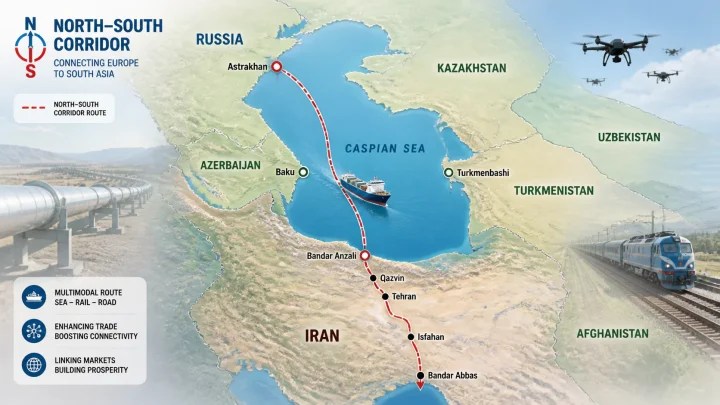
The first is the International North-South Transport Corridor, a roughly 7,200-kilometer multimodal freight route agreed upon by Russia, Iran, and India in 2000 that links the Indian Ocean, through Iran, across the Caspian, to Russian rail networks and on to Europe. Long stalled by under-investment, the corridor has become a priority for Moscow since 2022, precisely because it offers a way around Western sanctions. Its central artery is the Caspian crossing between the Iranian port of Bandar-e Anzali and the Russian port of Astrakhan. More importantly, it is the same stretch of water where Ukrainian drones struck in July and where Israeli forces had already hit Iranian naval and port assets at Anzali back in March, according to regional shipping trackers. A degraded, contested Caspian corridor is a direct blow to the one overland route that lets Moscow and Tehran trade around US and European sanctions. These attacks are, therefore, not about the US war on Iran; they are about reshaping the very geography of trade passing through the Eurasian landscape.
The second is the Trump Route for International Peace and Prosperity, or TRIPP — the transit corridor Washington brokered in August 2025 between Armenia and Azerbaijan, granting a US-led consortium a 99-year lease to build and manage rail, energy, and fiber-optic links through Armenia’s Syunik province. The deal ended a decades-old territorial dispute, but its geopolitical function is narrower and sharper. It places Iran’s only land border with Armenia under American-supervised transit control, cutting off Tehran’s most direct overland access into the South Caucasus and, by extension, into a region Russia has treated as its own backyard since the Soviet collapse. Whatever the deal’s stated humanitarian purpose, it functions as a wedge driven into Eurasian connective tissue.
Neither project was designed with the other in mind. But together with the Caspian strikes, they describe a single logic: deny Russia and Iran the infrastructure that lets their January 2025 Comprehensive Strategic Partnership — a 20-year treaty covering defense, energy, finance, and counterterrorism cooperation — translate into real economic integration rather than a document signed in Moscow. China, meanwhile, watches from the margins. Beijing has no naval presence on the Caspian and is not a party to any of these strikes or corridors, but its own westward trade ambitions run through the same chokepoints, i.e., the Middle Corridor via the South Caucasus, and Iranian ports as a Belt and Road terminus. A Washington-controlled TRIPP and a contested Caspian complicate China’s overland options as a side effect, even if Beijing was never the intended target.
A Frontier Without a Front Line
The danger in this strategy is precisely that it has no clean edges. Containment during the Cold War had defined lines — the Fulda Gap, the Elbe, the 38th parallel — and a doctrine that most parties understood. Infrastructure containment has none of that. A drone strike on a cargo ship, an airstrike on a naval depot, and a 99-year land lease branded with a president’s name: each is individually deniable, incremental, and justifiable in its own narrow terms, even as the cumulative effect reshapes the strategic map of an entire region. That ambiguity is a feature for Washington, which can advance the strategy without ever declaring it. But it is also a source of volatility because affected countries are left to infer intent from actions rather than respond to a stated policy. And, inferences, in a region this armed and this aggrieved, tend toward worst-case assumptions.
The more durable question is what happens once the corridors themselves become targets, not just prizes. Pipelines, rail lines, and undersea cables may now be legitimate objects of great-power coercion. If so, the Caspian will not be the last “peripheral” space pulled into contested geography. The Arctic shipping lanes, the Malacca chokepoint, and the fibre-optic seabed of the Indian Ocean are all candidates for the same treatment. In this environment, the states that thrive will not be the ones with the largest militaries. They will be the ones that make their infrastructure redundant, diversified, and defensible: multiple routes, multiple partners, no single artery whose loss is fatal. Iran and Russia have bet heavily on a small number of chokepoints. Their partnership may keep deepening going forward. But the deeper it goes, the more attacks it will face and endure.
Salman Rafi Sheikh, research analyst of international relations and Pakistan’s foreign and domestic affairs
Follow new articles on our Telegram channel
Featured Video

“Historic Russia”: The Land Putin Will Not Give Back
or go to
Aletho News Archives – Video-Images
From the Archive
How Ukraine Tortured and Slaughtered Donbass
By Kit Klarenberg | Al Mayadeen | July 11, 2024
Almost immediately after the proxy war erupted, ISIS-tier footage of the torture and murder of Russians in Ukrainian custody emerged.
On July 6th, the New York Times published an astonishing investigation: In Ukraine, Killings of Surrendering Russians Divide an American-Led Unit. The article documents in grim detail how Chosen Company, an international volunteer battalion for Kiev, routinely executes Russian prisoners of war. It is the very first mainstream admission that this practice – a brazen breach of the Geneva Conventions, and a grave war crime – is widespread among Ukraine’s fighters, both foreign and homegrown. … continue
Blog Roll
 Aletho News
- Record Oil, Empty Tanks: The UAE’s Miracle Recovery
- Burnham tackles Britain’s poverty with aggression in Yemen
- Peace in Ukraine: the easy way – or the hard way
- Trump & the Rrrrussians
- US taxpayer money laundered back through Ukraine – Musk
- Before COVID, an NIH lab chief proposed making a SARS-like bat virus more infectious
- Gates, Bourla on Trial in Netherlands Accused of ‘Great Reset’ Scheme at Vaccine Injury Hearing
- BRITAIN’S WARNING: PREPARE FOR WAR
- “Historic Russia”: The Land Putin Will Not Give Back
- How the Cambridge Analytica scandal still haunts Mark Zuckerberg
- If Americans Knew
- DAILY UPDATE: Latest essential news on Palestine, Israel, & region
- Damning report shows the media must confront its failures on Gaza
- BBC senior broadcaster speaks out on Gaza coverage
- Netanyahu vows vast West Bank invasion in response to 20-minute skirmish that left 2 Israeli soldiers and 2 Palestinian fighters dead
- Tied up and tortured: Israel using US-made electroshock weapons on Palestinian detainees
- The outsourced risk: how newsrooms rely on Gaza’s freelancers without protecting them
- Gaza bakeries forced to shut as Israel blocks flour shipments
- Gaza’s breast cancer patients face a deadly wait for treatment amid Israel’s genocide
- DAILY UPDATE: Latest essential news on Palestine, Israel, & region
- The Israel Lobby’s Changing Fortunes
- No Tricks Zone
- Two New Studies Find Thwaites Glacier Melt Cannot Be Driven By Human Activity Or A Warming Ocean
- E-Cars Reduce CO2 Emissions By Only 41% Compared To Internal Combustion Engine Vehicles
- Predictions Made By Renowned Climate Professor Over Past Decades Have Been Proven To Be Poor
- New Study Suggests Large Regions Of The Pacific Ocean Have Been Cooling For The Last 80 Years
- Germany’s Green Energy Debacle: High Energy Costs Force Kahla Porzellan to Close After 182 Years!
- New Study: 50 Years Of The Most Aggressive ‘Net Zero’ Policies Can Only Affect The Global Climate By 0.03°C
- US September “Heat” Was No Record…Many Records Set Decades Ago
- Latest European Green Energy Debacle; Portugal’s Largest Flagship Solar Park Insolvent!
- Green Energy Debacle: German Expert Professor Fritz Vahrenholt Warns Of Severe Economic And Social Consequences
- Two More Paleo Reconstructions Affirm Meters-Higher Sea Levels Across Ireland, Brazil 7000-6000 Years Ago

