US sanctions President Nicolas Maduro as Washington meddles further in Venezuela’s democracy
By Adam Garrie | The Duran | August 1, 2017
The United States continues to meddle in Venezuela’s democracy after yesterday’s nation wide vote for a Constitutional Assembly that will proceed with constitutional reforms aimed at ending the political deadlock between President Maduro and the country’s National Assembly which since 2015 has been controlled by the US backed right-wing opposition.
Before the results of the vote were even counted (they have yet to be fully tallied), the United States made it clear that Washington did not accept the vote. Washington’s Ambassador to the UN, the overzealous Nikki Haley Tweeted the following on the day of the vote. “Maduro’s sham election is another step toward dictatorship. We won’t accept an illegit govt. The Venezuelan ppl & democracy will prevail.”
Today, the US Treasury released the following statement, confirming that President Maduro is being personally sanctioned by the US government.
“The following individual has been added to OFAC’s SDN List: MADURO MOROS, Nicolas… President of the Bolivarian Republic of Venezuela”.
Far from the beginning of US meddling in Venezuela, the United States for decades has funded right-wing opposition groups in Venezuela, most notoriously, that led by Henrique Capriles Radonski. For most of these years, the US has sought to undermine the Bolivarian socialist government of Hugo Chavez who died in what some call mysterious circumstances in 2013.
Since then, Chavez’s socialist successor has been Nicolas Maduro who has barely had a day in office free of US meddling of one sort or another.
Supporters of Maduro argue that the Bolivarian government has helped to redistribute the wealth of Venezuela’s considerable resources including its vast oil reserves which for years were run by foreign hands prior to nationalisation under President Savage. Maduro’s opponents attest that socialist rule has caused stagnation.
Whatever one’s views of Venezuela’s internal situation, it is a sovereign state that no nation, not least the United States has a right to interfere in.
It is ironic, verging on the surreal that while the United States political elites tear themselves to pieces over alleged meddling by Russia in the 2016 US Presidential election, meddling that is not backed up by a single shred of evidence, that same United States is openly and brazenly trying to interfere in the political process of Venezuela by pumping money into the right-wing opposition while unilaterally sanctioning the President.
While the United States attempts to isolate Venezuela, the country continues to maintain good relations with many other countries including Russia and China. In October of 2016, President Maduro awarded Russian President Vladimir Putin the Hugo Chavez Peace Prize which President Putin graciously accepted.
President Maduro insists he is ready for dialogue, but the US continues to act in ways which suggests it is ready for something far more dangerous: illegal regime change, possibly through the use of force.
8 million Venezuelans vote for Constituent Assembly amid violence
Press TV – July 31, 2017
Over eight million Venezuelans have participated in the Sunday vote to elect a powerful new congress, which will be allowed to rewrite the constitution, with President Nicolas Maduro hailing the results as a victory for the country’s Bolivarian Revolution.
Venezuela’s National Electoral Council said Monday that the turnout was 41.5 percent– more than double the estimates of both the government’s political opponents and independent experts.
“Peace has won. If peace has won, Venezuela has won,” said Tibisay Lucena, the council’s president, at a televised press conference, the pan–Latin American Telesur television network reported. “Despite the violence and threats, Venezuelans were able to express themselves.”
Speaking at a large gathering of government supporters, Maduro thanked the nation for supporting the vote and said it was one of the highest voter turnouts in the history of the Bolivarian Revolution, with 8,089, 320 casting ballots to select their representatives.
“It is the biggest vote the revolution has ever scored in its 18-year history,” he said, referring to the year his late predecessor and mentor, Hugo Chavez, came to power.
“Eight million in the middle of threats, there were states where they crossed rivers and mountains, and they voted,” Maduro said.
He also hailed the Latin American and Caribbean countries for standing by Venezuela against “interventionist” moves by the United States.
“We don’t care what [US President Donald] Trump says, we care about what our people say,” said Maduro, referring to Trump’s promise that he would not accept the vote results.
The Venezuelan president said before the new legislative body begins the process to re-write the constitution, the government will in the first step call on the opposition to engage in dialog.
However, members of the opposition, which has boycotted the vote, reacted with mockery and anger to the count, which they say appears to be only two to three million.
The Sunday vote took place amid a wave of clashes and violence, which led to the deaths of ten people.
Anti-government protesters and security forces engaged in street battles across the country as voting got underway early Sunday morning. Those killed include a soldier and a regional opposition leader, according to prosecutors.
They also say one of the candidates running in the assembly election was also fatally shot by yet unknown gunmen.
Defense Minister General Vladimir Padrino Lopez said none of the deaths that occurred in the setting of Sunday’s vote were “attributable to the Bolivarian National Armed Forces.”
The anti-government protesters took to the streets despite a ban on such gatherings, which took effect on Friday and will continue through Tuesday.
The government had deployed more than 200,000 military officers to maintain order in more than 1,000 voting stations across the country.
The roads to polling stations had been sealed off and only those with registration cards were allowed to pass.
Several attacks happened in the capital city of Caracas, where one remote explosion occurred around noon and injured at least six police officers.
The opposition has urged further protests on Monday.
“We do not recognize this fraudulent process,” said opposition leader Henrique Capriles.
Maduro wants to replace the current legislative body— the National Assembly— with a new institution called the Constituent Assembly. The new assembly will have the power to override an opposition-led congress and re-write the constitution.
The opposition says the new assembly is a power grab by Maduro.
The president, however, argues that it is the only way to restore peace after months of opposition-backed political unrest, which has fueled the country’s economic woes.
The latest casualties brought the death toll from the unrest ongoing since early April to 123, authorities said.
US urges ‘swift actions’
Meanwhile, the US State Department officially condemned the Venezuelan government for holding the vote, and once again promised to “continue to take strong and swift actions against the architects of authoritarianism in Venezuela.”
The department called Maduro’s measure as a move to “undermine the Venezuelan people’s right to self-determination.”
US Ambassador to the United Nations Nikki Haley also took to Twitter on Sunday to offer Washington’s official response to the vote.
“Maduro’s sham election is another step toward dictatorship,” Haley tweeted. “We won’t accept an illegitimate govt. The Venezuelan ppl. [people] & democracy will prevail.”
The US and its allies, including the UK, Canada, Argentina, Peru, Colombia, Mexico, Spain, Panama and Paraguay, have said they would not recognize the vote results.
Washington also blamed Maduro for violence and urged regional and international governments to take strong action against his government.
Pence Talks with Opposition Leader Leopoldo Lopez over Venezuela’s ‘Dire Situation’
teleSUR | July 30, 2017
U.S. Vice President Mike Pence called Venezuelan opposition leader Leopoldo Lopez Friday “to address the dire situation in Venezuela,” as concern over U.S. interference in Venezuela’s internal affairs continues to grow.
In his phone conversation with Lopez, Pence praised “Mr. Lopez for his courage and outspoken defense of Venezuelan democracy,” according to the White House press statement.
Earlier this month, Lopez’s party Popular Will boycotted the dialogue process called by President Maduro to ease tensions between the government and the opposition.
Lopez also denounced Maduro’s call for the National Constituent Assembly, demanding the elections for the 545 representatives be canceled.
In the White House press statement, the vice president also reiterated, “President Trump’s pledge that if the Maduro regime imposes its Constituent Assembly on Sunday, July 30, the United States will respond with strong and swift economic actions.”
Lopez has a long and sordid history in Venezuelan politics, particularly for his involvement in the deadly “guarimba” protests. He gained prominence after becoming the mayor of the wealthy Caracas district of Chacao in Venezuela between 2000 and 2008.
According to investigative journalist Eva Golinger, in 2002 Lopez began frequenting Washington, D.C., to “visit IRI (International Republican Institute) headquarters and meet with officials in the Bush administration.” The IRI is one of the three foundations of the National Endowment for Democracy, NED, and has been pumping tens of millions of dollars to the opposition groups in Venezuela, including Justice First.
In 2014, Lopez was convicted and charged with plotting and promoting the violent street blockades, also known as “guarimbas” in Venezuela. The widespread violence led to the death of 43 people while hundreds more were injured. The violence also cost billions of dollars worth of damage to public buildings and infrastructure.
Lopez was sent to jail in 2015 and given a 13-year nine-month jail sentence for his role in leading the violent protests. He was recently allowed to serve his sentence under house arrest after citing “health concerns.”
In a video published by NBC Miami Wednesday, Lopez urged the Venezuelans to continue protesting on the streets, stating that Venezuela is facing a “clear and imminent threat” to its democracy.
The phone call between the opposition leader and the U.S. vice president comes as the United States escalates its threats against Venezuela.
Earlier this week, Washington issued a travel warning telling the U.S. citizens to avoid travel to the South American country and also ordered the relatives of all its diplomats to leave Caracas.
Online Petition Forces Review of Dilma Rouseff’s Impeachment
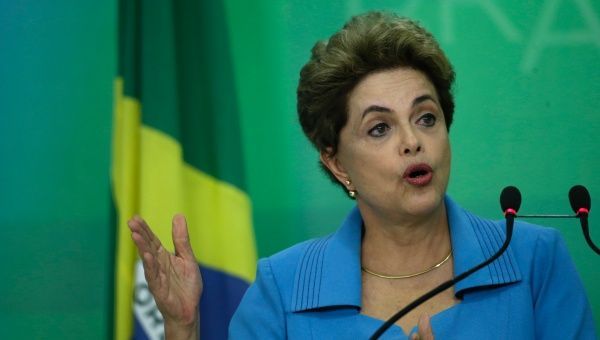
teleSUR | July 29, 2017
Brazilian senators will have to review the controversial procedure that led to the former president Dilma Rousseff’s impeachment last year, after an online citizens’ petition gathered more than 46,000 signatures in less than 24 hours.
The survey is being carried out on the Senate’s online platform E-Cidadania, and required a minimum of 20,000 signatures by November before it could be formally converted into a “legislative suggestion” to be considered in the higher house.
It poses two questions: firstly, that the loss of her mandate as the constitutional president was the consequence of a coup d’état.
And secondly, that the ‘failure’ of her successor Michel Terner’s government means that the only solution is to reinstate Rouseff into her elected post which should never have been taken away from her.
Last August, Brazil’s Senate voted to remove her from office for manipulating the budget.
Rouseff protested her innocence and promised not to give up the political struggle against poverty and inequality.
The petition is similar to another one which has been drawn up by the National Movement for the Anullment of the Impeachment, MNAI.
It’s supporters include the former president Luiz Inacio Lula da Silva, the national president of the Workers’ Party, Gleisi Hoffmann and the singer and composer Chico Buarque.
The MNAI hopes to gather 1.3 million signatures in order to pressure the Federal Supreme Court to revoke the result of the trial against Rousseff.
The Brazilian President Michel Temer’s approval ratings have plummeted to less than five percent as the corruption allegations against him and other politicians refuse to go away.
While opponents of his government’s controversial labor and pension reforms are still demanding his resignation.
Turkey Needs Russian S-400 System as Shield Against ‘Western Plan’ in Mideast
Sputnik – 26.07.2017
Russia and Turkey are currently at the final stage of negotiations on the delivery of the Russian-made S-400 missile defense system to Ankara. According to Turkish security expert Abdullah Ağar, the deal indicates a major shift in Turkey’s policy.
Turkish President Recep Tayyip Erdogan said Monday that there is no reason for Washington to be concerned over the Ankara-Moscow talks on the delivery of the S-400 system.
“Why should this be a concern? Each country should take certain measures to ensure its security. How many times have we talked with America, but it did not work out, so like it or not, we began to make plans about the S-400,” Erdogan said at a press conference in Ankara.
The United States recently signaled that Turkey buying the S-400 from Russia would become a major concern for Washington.
“There was a media report that was incorrect. They have not bought the S-400 air defense system from Russia. That would be a concern, were they to do that, but they have not done that,” Chairman of the US Joint Chiefs of Staff Gen. Joseph Dunford said Saturday at a security forum in Colorado.
Earlier, Pentagon chief James Mattis said that the possible deal raises questions about the technical and operational compatibility of the S-400 with NATO’s standards and Turkey would have to explain for itself the choice of the Russian-made weapon.
According to Turkish defense and security expert Abdullah Ağar, the reason behind the concerns of the US is more than the possible S-400 deal and relates to Turkey’s resoluteness to oppose plans that would “threaten Ankara’s territorial integrity.”
“The situation in the region has significantly changed. As for the last three years, Turkey has come to know the threats it faced as well as the actions of its Western partners in this situation. On the one hand, the West works with the Kurdistan Workers’ Party (PKK) and its affiliates in Syria and Iraq. On the other hand, the US and other Western countries support the Gülen movement [FETÖ, designed by Ankara as a terrorist organization] which poses a serious threat to Turkey,” Ağar told Sputnik Turkey.
According to the expert, since the invasion of Iraq in 2003, the West has been implementing a “plan to re-draw the Middle East map,” which resulted in a growing terrorist threat near Turkey’s border, including the rise of Daesh.
“Such a policy may result in new foreign invasions in the region. Turkey needs a new approach to oppose this policy. The delivery of the S-400 is part of a big puzzle,” Ağar pointed out.
At the same time, the situation should not be reduced to arms contracts and should be taken in its connection to shifts in the global geopolitical balance of power.
“There is a trend that may result in a [global power shift] from the US and Europe towards Asia. The West knows it, but continues to support organizations that pose a threat for Turkey. At the same time, the West doesn’t want to lose Turkey. In such a situation, Turkey is looking for the solution to this puzzle,” the expert said.
Ağar also said that the West is losing Ankara’s credibility due to its policy of supporting groups that want to “tear Turkey apart.”
“Of course, Turkey will not stay bound hand and foot. Otherwise, the country will found itself in a big trouble in the future. There is no special reason for Ankara to give credibility to West’s promises,” the expert said.
Furthermore, Ağar underscored that Ankara was not allowed to deploy US-made Patriot missile defense systems and as a result Ankara decided to focus on cooperation with Russia.
“The S-400 [deal] is part of a bigger picture of [Russia-Turkey] bilateral cooperation in various fields, primarily energy and security. The supplies of the S-400 are a sign that Turkey is drifting away from the Western world,” the expert concluded.
The negotiations on the matter between Russia and Turkey have taken place since 2016. In March, Sergei Chemezov, CEO of Russia’s Rostec Corporation, said Ankara was ready to buy the S-400 systems with a loan granted by Moscow. On July 18, Chemezov said technical issues of the contract for the supply of the S-400 systems to Turkey had been resolved, with only administrative ones remaining.
The S-400 Triumph is a next-generation mobile surface-to-air missile system that can carry three different types of missiles capable of destroying aerial targets at a short-to-extremely-long range. It is designed to track and destroy various types of aerial targets, from reconnaissance aircraft to ballistic missiles.
As of today, Russia has a deal on supplying the system only with China. In addition to Turkey, talks are also underway with India.
Former CIA Director Calls For A Coup If Trump Fires Mueller
By Tyler Durden | Zero Hedge | July 24, 2017
In the most vocal opposition to president Donald Trump yet, former CIA Director John Brennan said that if the White House tries to fire special counsel Robert Mueller, government officials should refuse to follow the president orders, as they would be – in his view – “inconsistent” with the duties of the executive branch.
“I think it’s the obligation of some executive branch officials to refuse to carry that out. I would just hope that this is not going to be a partisan issue. That Republicans, Democrats are going to see that the future of this government is at stake and something needs to be done for the good of the future,” Brennan told CNN’s Wolf Blitzer at the Aspen Security Forum, effectively calling for a coup against the president should Trump give the order to fire Mueller.
The exchange is 43 minutes into the clip below:
Brennan appeared alongside his former colleague, Director of National Intelligence James Clapper, and both men who served in the Obama administration, told Blitzer they have total confidence in Mueller. “Absolutely. It was an inspired choice- they don’t come any better, ” Brennan said adding that “If Mueller is fired, I hope our elected reps will stand up and say enough is enough.” Some have responded with questions where Brennan’s devotion to the Constitution was in the aftermath of the events in Benghazi.
Falling back on his neocon roots, James Clapper, who has waged a long-running vendetta with Trump, once again warned about Russian interference in US affairs. When asked about the June 2016 meeting between Donald Trump Jr., Jared Kushner and Paul Manafort with a Russian lawyer and others, he responded: “I’m an old school, Cold War warrior and all that – so I have, there’s truth in advertising, great suspicions about the Russians and what they do. A lot of this to me had kind of the standard textbook tradecraft long deployed by Russians. It would have been a really good idea maybe to have vetted whoever they were meeting with.”
Clapper was also asked about Trump’s comparison of the intelligence community to Nazi Germany. Clapper said he called the President-elect nine days before he left the Obama administration saying he “couldn’t let that reference pass” and it was an insult to him, CIA Director John Brennan and the workforce. “That was a terrible, insulting affront, not just to me or John, we get paid the big bucks, but I’m talking about the rank and file, men and women, patriots and intelligence community — that was completely inappropriate and over the top – I had to do something about it.”
And so he did: on the call Clapper said Trump asked him to “to put out a statement rebutting the contents of the dossier which I couldn’t and wouldn’t do. It was kind of transactional” referring to a dossier that alleged ties between President Donald Trump’s campaign and Russia. It was not clear if he wouldn’t and couldn’t do it because the contents were legitimate, in his view, or because the dossier is what started the whole “Russian collusion” narrative in the first place. Curiously, Clapper saw it as a favor to Trump not to issue a statement: Clapper was asked by Blitzer why he didn’t put out a statement replying: “The whole point of the dossier by the way was we felt an obligation to warn him to alert him to the fact it was out there. That was the whole point.”
It was not clear if James Comey, whose subsequent leak to the NYT led to the appointment of Mueller, would have applied the same reasoning when asked by Trump to rebut the dossier’s contents.
Baghdad seeking ‘substantial’ Russian military & political presence in Iraq – vice-president
RT | July 24, 2017
Russian military and political presence in Iraq would bring balance to the whole Middle Eastern and North African region, Nouri al-Maliki, the Iraqi vice-president, said during his visit to Moscow.
“It’s well known that Russia has historically strong relations with Iraq, therefore we would like Russia to have a substantial presence in our country, both politically and militarily,” al-Maliki said during his meeting with the speaker of Russia’s upper house of parliament, Valentina Matviyenko.
“This way, a balance would be established that would benefit the region, its peoples and its countries,” he added.
The vice president said that Baghdad wants to boost relations with Moscow as it believes “in Russia’s role in solving most of the key international issues as well as improving stability and balance in our region and worldwide.”
Matviyenko, in turn, praised the commitment of the current Iraqi authorities to widening their cooperation with Moscow.
“Russia is also determined to expand its interaction with Iraq both politically and economically as well as in the military-technical sphere, and, of course, on the parliamentary level,” she said.
In his talks with Russia’s Foreign Minister, Sergey Lavrov, earlier Monday, al-Maliki stressed that a Russian presence in Iraq would bring the balance which couldn’t be “undermined in a political sense in favor of any external party.”
“Today we need Russia’s greater involvement in Iraqi affairs, especially in the energy field. Now when we are done with Islamic State (IS, formerly ISIS/ISIL), Iraq needs investments in energy and trade,” he said.
Earlier in July, the Iraqi authorities announced that the last IS stronghold in the country, Mosul, had been fully liberated from the terrorists, following an eight-months-long campaign backed by the US-led coalition.
Al-Maliki told Lavrov that Moscow and Baghdad “should enhance… cooperation in countering terrorism in the region.”
“We believe that both our countries are targets for terrorists and those who stand behind them,” al-Maliki said.
Moscow supports the efforts of the Iraqi authorities to “normalize the situation in the country, first of all aiming at eradicating the terrorist threat,” Lavrov said.
It’s vital that Baghdad’s struggle isn’t carried out in isolation, but is carried on in the context of international efforts to eradicate the terrorist threat across the globe, including in Iraq, Syria, Libya, Yemen and other countries, the Russian FM added.
Al-Maliki is also travelling to St. Petersburg, where he’s expected to meet with Russian President Vladimir Putin on Tuesday.
The Price of Defiance: Why US, Saudi Arabia Turning Kuwait Against Iran
Sputnik – 22.07.2017
Commenting on the latest twist in the diplomatic row in the Persian Gulf, this time between Kuwait and Iran, Iranian political analysts spoke to Sputnik Iran, revealing who’s really behind this new development and which of the two countries will suffer the most from the consequences.
On Thursday, Kuwait sent a diplomatic note to Iran’s embassy stating that the office of military and cultural attaches would be closed down. The note also said that 15 Iranian diplomats, including Ambassador Alireza Enayati, would have to leave the country within 45 days, leaving only four Iranian diplomats in Kuwait.
Kuwait’s acting information minister, Sheikh Mohammad al-Mubarak al-Sabah, said in a statement that the move was taken in “accordance with diplomatic norms and in abidance with the Vienna conventions with regards to its relationship with the Islamic Republic of Iran.”
According to mass media reports, the moves were made following the conviction of the members of Al Abdali terror cell, whose Kuwaiti members were accused of alleged intelligence contacts with Iran and Hezbollah, a Lebanese Shiite militant group.
The Ministry of Foreign Affairs of Iran has responded by summoning the Kuwaiti charge d’affaires. While rejecting the accusations, Iran has said that the measures taken by Kuwaiti officials are regrettable, given that the existing tensions in the region are now in a critical condition.
“We expect Kuwait to act rationally instead of responding to pressures and worsening the tensions,” Iranian Foreign Ministry spokesman Bahram Qassemi was quoted as saying by the Mehr news agency.
In an interview with Sputnik Iran, Sabbah Zanganeh, a political commentator, Iranian envoy to the Organization of Islamic Cooperation and former adviser to the Iranian foreign minister, said that the moves of the Kuwaiti authorities have been evidently fuelled by pressure from Saudi Arabia.
The Iranian authorities have not been informed of any details of the ongoing investigation in Kuwait and any charges which have been put forward. Neither the Iranian legal representative, nor any independent Iranian experts have been allowed to study the case in more detail.
The Iranian political analyst recalled that there have already been groundless and unsubstantiated accusations made against Iran, alleging that it played a major role in liberating the territories of Kuwait from the occupation of Saddam Hussein by supporting and mobilizing hundreds of thousands of Kuwaiti residents, similar to the current accusations against Tehran.
“In due course, Saddam Hussein made a very ambitious offer to Iran to capture not only Kuwait, but the territories of other countries of the Persian Gulf. However Iran had never had a goal of the occupation of the territories of sovereign states and the destruction of the system of government of these countries,” Sabbah Zanganeh told Sputnik.
“Hence this demarche of Kuwait is baseless and is fuelled purely by the pressure of Saudi Arabia, which does not want to put up with the idea that the Arab states of the Persian Gulf, such as Kuwait and Qatar, have good relations with Iran. Saudi Arabia is exerting strong pressure on the Kuwaiti authorities and its mass media,” he added.
The political commentator further explained that until recently, Kuwait has been pursuing a very reasonable and moderate foreign policy; however it has come under strong pressure from the Saudis. Where Qatar was the first target of the Saudis, now it is Kuwait’s turn. The Saudis cannot tolerate Kuwait’s key positions in the settlement of the Qatari crisis, in the negotiations of the Yemeni issue and in the issue of diplomatic correspondence with Iran on behalf of the Cooperation Council for the Arab States of the Persian Gulf. Kuwait, unlike Qatar, is to a far lesser extent an independent state.
In a separate comment on the issue, Iranian political analyst and expert on Middle East and Iranian-Arab relations, former editor-in-chief of the Iranian news agency Mehr News, Hassan Hanizadeh told Sputnik that Kuwait will be the country to suffer from its demarche, while it will have no impact on the economic environment of Iran.
“These actions of Kuwait, aimed at decreasing diplomatic relationship with Iran, have been evidently dictated by Saudi Arabia and the US. As we remember, during his trip to the Middle East, Donald Trump had an important meeting with the leaders of six Arab states of the Persian Gulf in Riyadh. Trump demanded that these states cut their diplomatic relations with Iran or at least lower the level of their ties. Qatar is the first to be punished for disobeying this order,” he told Sputnik.
However, he further elaborated, Qatar held firm and defied pressure from Saudi Arabia and the US. Kuwait, in turn, is a sparsely populated country, compared to its neighbors, and prefers not to oppose the pressure of the US and the Saudis. The danger is that this demarche could spark tensions in the region between the Arab states and Iran even further.
For the last 30 years Iran has been maintaining good and friendly relations with Kuwait, avoiding any hostilities. Moreover, in 1990, during the attack of Saddam Hussein on Kuwait, the Iranian embassy in Kuwait sheltered over a hundred women and young ladies, wives and daughters of Kuwaiti emir and his brothers, on its territory from Hussein’s troops and then safely sent them to Iran for temporary relocation.
Unfortunately, the current Kuwaiti authorities have forgotten this and are putting forward baseless accusations against Iran under pressure from Saudi Arabia, the political analyst said.
“Kuwait will be the only one to suffer from this demarche. Iran is a large and strong country, which will easily overcome this crisis. Kuwait is not a high priority in the Iranian foreign policy and the lowering of the level of diplomatic relations between the two countries won’t have any impact on Iran,” Hassan Hanizadeh told Sputnik.
He explained that there are no deep trade-economic relations between the two states, only political and cultural. Hence the demarche won’t have any impact on the economy of Iran.
Commenting on the conviction of the members of the Al Abdali terror cell, and the accusation of the members in espionage on behalf of Iran, Hassan Hanizadeh noted that Iran would not spend any resources attempting to glean intelligence from Kuwait, hence all the accusations are illogical and unreasonable.
“Kuwait is not the type of country for Iran to spend its intelligence resources on. It has neither a strong army nor any objects of infrastructure, such as a nuclear power plant, for example. It is not of any particular value to Iranian intelligence services. Hence, any accusations of espionage are absurd and unreasonable,” he told Sputnik.
The political analyst said that scenario, which has got the name of “Al Abdali process” had been planned beforehand by the Americans and the Saudis. One of its aims is to clear the way for the breakup of ties between Iran and the member states of the Cooperation Council for the Arab States of the Persian Gulf.
Among other possible reasons of the Kuwaiti demarche, Hassan Hanizadeh suggested that it could be the discontent of the fast growing Shia Muslim population of the country. The Shia Muslim community makes over 40% of the total population of the country. And the Kuwaiti authorities don’t want them to set their eyes on Iran. Thus they are trying to lessen Iran’s influence on their country, he concluded.
US special operations chief confirms end of CIA support for anti-Assad forces in Syria
RT | July 21, 2017
A US army general has confirmed that Washington has decided to put an end to a CIA scheme to equip and train certain rebel groups fighting the government of Syrian President Bashar Assad. He insisted the policy shift had nothing to do with improving relations with Russia.
US Army General Raymond Thomas, head of the Special Operations Command, said the decision was “based on assessment of the program.”
“At least from what I know about that program and the decision to end it, (it was) absolutely not a sop to the Russians,” Thomas said at the Aspen Security Forum in Colorado on Friday.
Unnamed government sources told various media outlets last week that the decision to end the program had been partly due to the Trump administration wanting a better relationship with Russia.
The decision to terminate the program was reportedly taken by Trump in consultation with CIA Director Mike Pompeo and national security adviser H.R. McMaster ahead of his meeting with Russia’s President Vladimir Putin in Hamburg earlier this month.
But the end of the CIA’s Timber Sycamore strategy was not a precondition for the ceasefire deal reached between Putin and Trump on the sidelines of the G20 summit, the US officials insisted.
The covert CIA program began arming and training the so-called moderate Syrian opposition forces in 2013.
Two US officials who spoke on condition of anonymity with Reuters, pointed out that the covert CIA tactic had produced little success.
Russia has always warned against arming the so-called moderate opposition groups in Syria, underlining that weapons supplied to them often fall into the hands of jihadist groups.
The so-called moderate opposition has effectively ceased to exist in Syria, hijacked by armed extremists, Russia’s former UN ambassador told the General Assembly in December last year.
Having pointed to the scale of destruction in Syria, Vitaly Churkin, now late, said it was “a result of the mindless foreign policy of several international and regional players who once decided to change the leadership in Damascus and to redraw drastically the political, ethnic, confessional, and economic map of the region.”
But despite having “extensive financial, logistical, and propaganda support” from the outside, “the elusive concept of ‘moderate Syrian opposition’ has effectively failed,” the Russian diplomat then said.
Ambassador Yakovenko’s comment on the situation in Syria
Ambassador’s view | RT | July 16, 2017
We believe that the current round of Geneva talks is off to a better start due to the participation of all the main opposition platforms – the Riyadh, Moscow, and Cairo groups.
The constitutional reform and the fight against terrorism are priorities, but not forgetting about two other issues (running the country prior to the adoption of a new constitution and holding elections). Eventually, the constitution should reflect the concerns of all ethnic, religious, and political groups of Syria without exception. This is the only way to ensure the stable functioning of the Syrian state and prevent the spread of [the] terrorist threat. Meanwhile, the current constitution provides for a broad range of opportunities to expand the participation of opposition representatives in running the state. We actively support the efforts of UNSG Special Envoy for Syria Staffan de Mistura to encourage the Syrian parties to engage in a productive conversation on constitutional reforms.
The success of agreements on de-escalation zones, particularly one in southwest Syria signed by Russia, the US, and Jordan on July 7, will make the fight against terrorism more efficient. This opportunity is real now, because the very concept of de-escalation zones provides for separation of the armed opposition from ISIS, Al-Qaeda, Jabhat Al-Nusra, and other UN-proscribed terrorist groups. They also help normalize relations between the government forces and the armed opposition. The conditions are thus created for their stopping fighting each other and joining forces against the terrorists. Russia will contribute to this process.
Among other things, the agreements on de-escalation zones provide for stepping up practical cooperation between Moscow and Washington. Our joint efforts to enforce ceasefire in southwest Syria will be coordinated by the Monitoring Center, which Russia, the United States, and Jordan have agreed to establish in Amman. This center will maintain direct contact both with the opposition groups and representatives of the Syrian government. Basically, we keep the doors open to cooperation on further development of the de-escalation concept, while maintaining regular contact with the other key players that can influence developments in Syria. All in all, the July 7 agreement reached between Russia, the US, and Jordan shows that, despite differences in our positions and interests, cooperation is possible for common good. Let’s build on this to make further progress in dealing with jihadist aggression that distorted the entire Syrian situation.
Dr Alexander Yakovenko, Russian Ambassador to the United Kingdom of Great Britain and Northern Ireland, Deputy foreign minister (2005-2011). Follow him on Twitter @Amb_Yakovenko
Why Moscow Resents US for Its ‘Blackmail’ Demands for Return of Russian Property
Sputnik – 16.07.2017
Washington’s conditions for the return of Russia’s diplomatic property in the US are nothing but blackmail, according to Vladimir Dzhabarov, first deputy chairman of the Russian Upper House’s International Affairs Committee.
In an interview with the Russian news network Zvezda, Vladimir Dzhabarov, first deputy chairman of the Russian Upper House’s International Affairs Committee, slammed the White House’s conditions for the return of Russia’s diplomatic property in the US as blackmail.
On Thursday, Deputy Assistant to the US President Sebastian Gorka said that the US may return two diplomatic compounds confiscated by the Obama administration to Moscow, if it sees “acts of good faith” from the Kremlin, similar to the recently brokered ceasefire in Syria.
By considering a release of the Russian diplomatic compounds that have remained sealed since December, Washington wants to leave the door open for rapprochement with Russia, Gorka said in an interview with CNN.
Commenting on the matter, Dzabarov stressed that the situation in Syria has nothing to do with diplomatic property, and that Washington should return it to Russia “without any preconditions.”
“Talking about certain conditions to be made in exchange for having access to diplomatic property looks like trading and even blackmail,” Jabarov said.
He warned that Russia may respond in kind to Sebastian Gorka’s statement.
“We have the right to retaliate unless the situation changes. We can do so because correlating our right to our own property with our political steps is the wrong move,” Jabarov said.
His remarks were preceded by Moscow’s warning that it is preparing a “tough response” to the move.
“We assume that this issue can be solved in a civilized way, within the framework of the law and probably humanely, given the emotions roiling in Washington,” Russian Foreign Ministry spokeswoman Maria Zakharova said on air of the program “60 Minutes” on Rossiya 1 television channel.
She added that Russia had “different ways” to settle the issue, and that it would not give up its interests.
On Friday, the Russian Foreign Ministry warned that Russia is ready to expel US diplomats in response to Washington’s failure to return its diplomatic property in New York and Maryland.
“If the US partners do not understand differently, we will at some point have to act in this direction,” Zakharova said at her weekly briefing, noting that the “long pause” on the issue has “dragged on.”
The issue was also addressed by Russia’s Foreign Minister Sergei Lavrov, who said at a joint news conference with the EU’s foreign policy chief Federica Mogherini on Tuesday that Moscow is “outraged” over the fact that Washington has not yet resolved the situation with Russian diplomatic property in the US, adding that Moscow is working out its response to the US actions.
In December 2016, the administration of former president Barack Obama imposed a set of punitive measures against Russia over Moscow’s alleged meddling in the US presidential election and harassment of US diplomats stationed in Russia.
The sanctions included the closure of Russian diplomatic compounds in Washington and New York, which the White House claimed had been used as a cover for Russian spying activities in the United States.
New Syria Ceasefire Deal May Be US Attempt to Save Rebels From Defeat
Sputnik – July 7, 2017
A newly announced deal on a ceasefire in southwestern Syria may be an attempt by the United States to save the Syrian rebels from defeat, Ron Paul Institute for Peace and Prosperity Executive Director Daniel McAdams told Sputnik.
‘On the Syria “ceasefire” agreement, we need to see the fine print. But I am skeptical that yet another US “ceasefire” proposal for Syria will result in the reduction of violence in that six year war,’ McAdams said on Friday. ‘It seems whenever the US side experiences significant losses on the battlefield, Washington comes forward with a ceasefire proposal in a desperate attempt to save its “rebels” from defeat.’
Earlier on Friday, Russian Foreign Minister Sergey Lavrov said, after talks between Presidents Donald Trump and Vladimir Putin that the United States, Russia and Jordan agreed on ceasefire in southwestern Syria starting at noon on July 9.
McAdams suggested that the best agreement between Putin and Trump on Syria would be “a negotiated withdrawal of US forces from the country, where they illegally occupy Syrian territory.”
The United States and Russia have backed opposing sides in Syria’s six-year-conflict, with Moscow supporting the forces of Syrian President Bashar Assad and Washington backing rebel groups seeking his ouster.
Russia, Iran and Turkey are guarantors of the Syrian ceasefire regime, having signed a memorandum on the establishment of four safe zones in Syria that came into force on May 6.
Featured Video

HE SAVED LIVES. NOW HE FACES PRISON.
or go to
Aletho News Archives – Video-Images
From the Archives
NATO Sanctions and the Coming Global Diesel Fuel Disaster
By F. William Engdahl – New Eastern Outlook – 11.04.2022
Amid the ongoing global inflation crisis, NATO heads of state and mainstream media repeat a mantra that high energy prices are a direct result of Putin’s actions in Ukraine since end of February. The reality is that it is the western sanctions that are responsible. Those sanctions including cutting SWIFT interbank access for key Russian banks and some of the most severe sanctions ever imposed, are hardly having an impact on the military actions in Ukraine. What many overlook is the fact that they are increasingly impacting the economies of the West, especially the EU and USA. A closer look at the state of the global supply of diesel fuel is alarming. But Western sanctions planners at the US Treasury and the EU know fully well what they are doing. And it bodes ill for the world economy.
While most of us rarely think about diesel fuel as anything other than a pollutant, in fact it is essential to the entire world economy in a way few energy sources are. The director general of Fuels Europe, part of the European Petroleum Refiners Association, stated recently, “… there is a clear link between diesel and GDP, because almost everything that goes into and out of a factory goes using diesel.” … continue
Blog Roll
 Aletho News
- Italy to move military personnel from Taif base after missile strike
- Finland’s Stubb tells European leaders to calm down
- Defeating Russia on battlefield impossible – Fico
- Finland’s Gender Clinic Reversal
- Massachusetts Wants Mental Health Visits, Why Does Government Use ‘Health’ to Enter Our Homes & Families?
- US lawmaker admits American people footing bill for Trump’s failed aggression against Iran
- Pfizer Gave $500,000 to Groups That Lobbied to End Religious Exemption in Massachusetts
- HE SAVED LIVES. NOW HE FACES PRISON.
- Israeli lobby seeks to bind US fate to ‘Israel’: Araghchi
- Pakistan-Iran talks secure LNG shipment to Islamabad through Hormuz
- If Americans Knew
- Israel Blocking Hundreds of Wheelchairs for Injured Children From Entering Gaza
- Israel Is Expanding and Upgrading Compounds for Palestinian Militias in Gaza
- The Palestinian-American Residents of This West Bank Town Are Wondering: Where Is Trump?
- Gaza desperately needs tents, wheelchairs, fuel… and everything else (Israel blocks it all) – Daily Update
- Israeli Attacks in Gaza Kill at Least Seven Palestinians Over Three Days, including Woman and Child
- Trump’s militarization of Washington DC as he pursues Israel’s war against Iran
- Why Israel Fears This Searing New Documentary
- Huckabee aide solicited cash gifts from Israelis
- This isn’t sci-fi, AI is already killing people
- ‘The Most Brutal Thing’: Investigation Reveals Execution of Elderly Woman in Rafah
- No Tricks Zone
- 2025 Nature Paper Claiming Worsening Global Drought Gets RETRACTED …Heavily Flawed
- New Study: ‘Global Drought Shows No Detectable Recent Acceleration Under Climate Warming’
- Economic Masterminds: German Socialists Suggest Taxing Productivity Gains Stemming From Using AI
- The South China Sea Has Not Been Cooperating With The Climate Change Narrative
- Energy Crisis: Germany Enters Heating Season With Historically Low Gas Reserve Fill Levels
- New Study: The Antarctic Ice Sheet Gained Mass From 2020-2024 Due To Staggering Snow And Ice Accumulation
- Study: Ocean Heating Rates From Thousands Of Years Ago ‘Dwarf’ Modern Ocean Heating Rates
- Climate Extremists Target, Attack Large-Scale Power Grid Infrastructure In Germany!
- New Study: Antarctic Ice Melt Has Contributed Less Than 1 Centimeter To Sea Level Rise In The Last 30 Years
- Fear Of Debate: Alarmist German Climate Scientist Calls On Mainstream Media To Discredit Skeptic Voices

