Moscow ‘preparing inevitable response’ as US hits Russians with new sanctions over N. Korea
RT | August 23, 2017
Moscow has fired back at the latest round of US sanctions targeting Russian interests, as Washington blacklisted one Russian company and four individuals for their alleged dealings with North Korea.
On Tuesday, the US Treasury revealed it had imposed sanctions on 16 Russian and Chinese nationals and companies for their alleged dealings with North Korea. The Treasury claims the sanctions are in line with the internationally agreed measures against North Korea’s missile and nuclear weapons programs. The companies are accused of working with blacklisted individuals, helping develop the North Korean energy sector, help it place workers abroad or move money from abroad. As a result, their US assets are frozen and Americans are forbidden from doing business with them.
“It is unacceptable for individuals and companies in China, Russia, and elsewhere to enable North Korea to generate income used to develop weapons of mass destruction and destabilize the region,” Treasury Secretary Steven Mnuchin said in a statement.
“We are taking actions consistent with UN sanctions to show that there are consequences for defying sanctions and providing support to North Korea, and to deter this activity in the future.”
Reacting to the sanctions, Russian Deputy Foreign Minister Sergey Ryabkov issued a statement expressing disappointment, and warning Washington that Russia was working on a response.
“Against such a depressing backdrop, the lip service from American representatives about the desire to stabilize bilateral relations is extremely unconvincing,” Ryabkov said. “We have always and will always support resolving our existing differences through dialogue. In recent years, Washington in theory should have learned that for us the language of sanctions is unacceptable, and the solutions to real problems are only hindered by such actions. So far, however, there doesn’t seem to be an understanding of such obvious truths.”
“Nevertheless, we do not lose our hope that the voice of reason will sooner or later prevail, and that our American colleagues will be aware of the futility and detrimental nature of further sliding down the spiral of sanctions.”
In the meantime, we are beginning to work out the inevitable response to this situation.”
The companies under sanction include Gefest-M, a Moscow-based firm accused of acquiring metals for a North Korean company, and Mingzheng International Trading, a Chinese and Hong Kong-based bank that supposedly conducted transactions on behalf of North Korea.
Andrey Klimov, a senior Russian senator, said that the US sanctions against Gefest-M and the others lack legitimacy.
“These sanctions are illegal in themselves, because the only thing recognized by international law is the sanctions of the UN Security Council,” Klimov told Interfax. “We must react in principle to this insane and confrontational policy. The toolbox is rich, let’s hope that we will act consistently, reasonably, professionally and effectively.”
Klimov’s words were echoed by the Chinese government, with a spokesperson saying Beijing “opposes unilateral sanctions out[side] of the UN Security Council framework.”
“We strongly urge the US to immediately correct its mistake, so as not to impact bilateral cooperation on relevant issues,” the spokesperson said, as quoted by the Financial Times.
At the same time, the US Department of Justice also filed two complaints to forfeit over $11 million from two Asian companies for allegedly laundering funds for North Korea.
The DoJ alleges that the two companies violated the international sanctions against North Korea and indirectly supporting its missile and nuclear weapons programs.
“The United States filed two complaints today seeking imposition of a civil money laundering penalty and to civilly forfeit more than $11 million from companies that allegedly acted as financial facilitators for North Korea,” read the statement.
Proceedings have been launched against Velmur Management Pte Ltd., based in Singapore, as well as the Chinese company Dandong Chengtai Trading Co. Ltd.
READ MORE:
US embassy in Russia temporarily halts issue of non-immigrant visas
US visa move resembles logic of color revolutionists, says Russia
Press TV – August 21, 2017
Foreign Minister Sergei Lavrov has censured a US decision to reduce its visa services in Russia, saying the measure brings to mind the logic of the masterminds of “color revolutions.”
“The first impression is that the American authors of these decisions have come up with another attempt to stir up discontent among Russian citizens about the actions of the Russian authorities,” Lavrov said at a news conference in Moscow on Monday. “It’s a well known logic … this is the logic of those who organize color revolutions.”
The top Russian diplomat made the remarks after the US embassy announced that it was suspending all “non-immigrant visa operations” in Russia as of August 23 and that it would also cancel all scheduled appointments for visa applicants in retaliation for the Russia-imposed restrictions on its staff.
Lavrov further said Moscow would first examine the measures adopted by the US embassy in Russia before making a decision on retaliatory steps, promising not to direct its anger at ordinary Americans.
“As for our response, as I have already said, it is necessary to study in detail the decisions that the Americans have announced today. We will see,” he noted. “I can say only one thing – we won’t take it out on American citizens.”
Earlier this month, Russian President Vladimir Putin ordered the US diplomatic mission in Moscow to cut 755 diplomats and staff by September 1, heightening tensions between the two countries after the US Congress approved sanctions against Russia over alleged meddling in the 2016 US presidential election and Crimea’s reunification with Russia in 2014.
Russia had already dismissed allegations of Moscow’s interference in the US election and the Ukrainian conflict over Crimea.
The US and its allies in Europe imposed several rounds of economic sanctions on Russia after the Black Sea peninsula of Crimea decided to join Russia while accusations have been leveled against Russia over its alleged support for pro-Russia forces engaged in fighting with the Kiev government in eastern Ukraine.
UN Calls for Syria Peace Talks in Oct./Nov.
Al-Manar | August 17, 2017
The United Nations hopes for “serious negotiation” between the government and a still-to-be-formed unified Syrian “opposition” in October or November this year, the U.N. Special Envoy Staffan de Mistura said on Thursday.
“Regarding the [Syrian] government, we are counting very much on Russia, on Iran, on anyone who has got major influence, and on the government of Syria to be ready finally to initiate when they are invited to Geneva, a genuine, direct negotiation with whatever [opposition] platform comes out,” he told reporters.
De Mistura also said that a letter from Russian defense minister Sergei Shoigu in August had paved the way for Russian military police to be staged along the route of a U.N.-Red Cross convoy which reached Douma in eastern Gouta near Damascus on Thursday, the first time since May.
De Mistura added that the aid convoys are being prepared to be sent to Foaa & Kefraya in addition to other towns.
Venezuela Brings Regional Elections Forward to October
teleSUR | August 12, 2017
Venezuela’s newly-elected National Constituent Assembly, ANC, has brought forward the regional elections by two months.
The polls, which had been scheduled to take place on December 10, will now be held in October following unanimous approval by the ANC.
The second vice president of the body, Isaias Rodriguez, said the process for the election of governors and state governors, will take place “within the framework of the electoral program already announced by the electoral power.”
ANC Constituent Tania Diaz explained that bringing the regional elections forward is a mandate of the people and added, “The recent elections to choose the members of the ANC represents a popular victory and a defeat of the violent actions promoted in the last four months by the right, which has triggered more than 100 fatalities.”
Another member of the ANC, Melvin Maldonado recalled that in 18 years of the Bolivarian Revolution, there have been 21 elections, which “shows the strength of our National Electoral Council, and it also shows the democratic nature and electoral power in our country.”
The president of the National Electoral Council of Venezuela, Tibisay Lucena, said the submission of nominations for the regional elections will start on Sunday August 13 and close the following day.
Moscow: Anti-Caracas Sanctions Hamper Normalization of Situation in Venezuela
Sputnik – 10.08.2017
The recently imposed sanctions against Venezuela do not contribute to the normalization of the situation in the country, pushing it back into deadlock instead, the Russian Foreign Ministry said in a statement Thursday.
On Wednesday, the US Department of Treasury announced the expansion of its sanctions on Venezuela. These measures included travel bans and asset freezes on eight people who played a role in convening the new legislative body, the Constituent Assembly.
“Certain internal and external political forces promote a destructive line aimed at dismantling the emerging dialogue and, in fact, at returning the situation to the initial impasse, contrary to the very logic of developments [in Venezuela] and their own calls for the democratization of the ongoing processes in Venezuela. The expansion of unilateral sanctions and restrictions, isolationist measures, pressure, and the ultimatum toward Caracas applied by a number of countries can hardly be seen in a different light,” the statement read.
The Russian Foreign Ministry stressed that the situation in Venezuela could only be addressed through direct negotiations between the government and opposition.
According to the statement, peace in Venezuela depends on the willingness of all parties to return to a dialogue within the Venezuelan Constitution, without any outside intervention, to form a common agenda.
The National Constituent Assembly, which proclaimed itself the main governing body of Venezuela, is a new legislature with the power to amend the country’s constitution. It was elected on July 30 amid mass protests across Venezuela, which resulted in 10 deaths on election day alone. Overall, the death toll has risen to more than 120 people since early April.
The Venezuelan opposition has refused to recognize the legitimacy of the Constituent Assembly, as it believes that Venezuelan President Nicolas Maduro’s plan for constitutional reform aims at sidelining the opposition-controlled National Assembly.
Philippine President Wants North Korea to Become ASEAN Dialogue Partner
Sputnik | August 8, 2017
Philippine President Rodrigo Duterte expressed on Tuesday his desire to invite North Korea to become a dialogue partner of the Association of Southeast Asian Nations (ASEAN).
“You know, I always wanted to invite you here,” Duterte, who is a also chairperson of ASEAN in 2017, told North Korea’s Foreign Minister Ri Yong Ho, as quoted by the SunStar media outlet.
The Philippine president added that North Korea “would be a good dialogue partner.”
Ri reportedly thanked Duterte for the initiative.
The statement was made less than a week after Duterte criticized North Korean leader Kim Jong Un over Pyongyang’s nuclear ambitions.
ASEAN has 10 dialogue partners, which are India, Japan, South Korea, New Zealand, Russia, the United States, the European Union, Australia, Canada and China.
Kenya deports 1 American and 1 Canadian for election meddling
By Ricky Twisdale | The Duran | August 6, 2017
Kenya has decided it doesn’t need western assistance to ensure it has “free and fair” elections.
The African country is holding a national vote for president, deputy president, and parliament on 8 August.
But the election will have to go forward without the help of two foreign advisors.
John Phillips, a US citizen and chief executive of political consultancy Aristotle, and Canadian citizen Andreas Katsouris, a senior executive at the same firm, were arrested on Friday and deported from Kenya on Saturday, according to Reuters.
The two men were providing political consulting services to opposition presidential candidate Raila Odinga and his National Super Alliance party. Polls show Odinga and incumbent president Uhuru Kenyatta neck-in-neck in the race for the Kenya State House.
Kenya’s last two presidential elections were marred by violence and charges from the losing side of vote rigging. Unrest following the 2007 vote left hundreds dead.
Here’s more from the Reuters report regarding the arrests of Phillips and Katsouris:
“They handcuffed me and put me in the hatchback of a car,” Phillips said by phone from Frankfurt.
Katsouris said they were manhandled after the police arrived.
“One man had a picture of me on his mobile phone,” he said, speaking by phone from Delft, the Netherlands. “Another guy grabbed me by the arm and grabbed my glasses from my face.”
After being bundled into separate cars they were driven around for several hours, while being questioned, and then taken to holding cells at the airport, they said…
Phillips said one of Aristotle’s jobs was to monitor the transparency of the election. The two had been in Kenya for around two months and were doing polling, data analysis and monitoring the election process…
Interior ministry spokesman Mwenda Njoka said via a text message on Sunday that Phillips and Katsouris had “contradicted the terms of their visa”. When asked how, he replied “ask them”.
Whatever Kenya’s political problems, it appears Nairobi doesn’t believe US-Canadian meddling in their elections is the way to solve them.
Russia announces deal on safe zone in Syria’s Homs
Press TV – August 3, 2017
The Russian army says it has reached a deal with foreign-backed militants in Syria to create a new de-escalation zone in the country’s northern parts of Homs province.
Russian military spokesman Igor Konashenkov made the announcement on Thursday, saying that new safe zone will span 84 towns and villages populated by more than 147,000 people in Homs.
The official noted that a ceasefire was to take effect in the area at 12:00 p.m. local time (0900 GMT) on Thursday.
The zone is the third to be established in Syria under a Russian-led initiative aimed at halting clashes in four key conflict zones between Syrian government forces and anti-Damascus militants.
Last Saturday, the warring sides agreed on a deal declaring Eastern Ghouta as a de-escalation zone.
Russia, along with Iran and Turkey, brokered the deal for establishing four de-escalation zones in mainly militant-held areas of Syria during ceasefire talks in the Kazakh capital city of Astana in May.
The plan, which came into effect at midnight on May 5, calls for the cessation of hostilities between militant groups and Syrian government forces.
It covers the northwestern Syrian province of Idlib, northeastern areas of the western coastal province of Latakia, western areas of Aleppo province and northern parts of Hama province.
The parties to the Astana talks are now working on the details of the deal.
Syria has been fighting different foreign-sponsored militant and terrorist groups since March 2011. UN Special Envoy for Syria Staffan de Mistura estimated last August that more than 400,000 people had been killed in the crisis until then.
US Regime Change in Venezuela: The Truth is Easy if You Follow the Money
By Tony Cartalucci | Land Destroyer | July 31, 2017
Venezuela’s ongoing crisis is not driven by political ideology – it is not a battle of socialism versus capitalism or dictatorship versus democracy – it is the result of two centers of political power possessing opposing interests and colliding geopolitically.
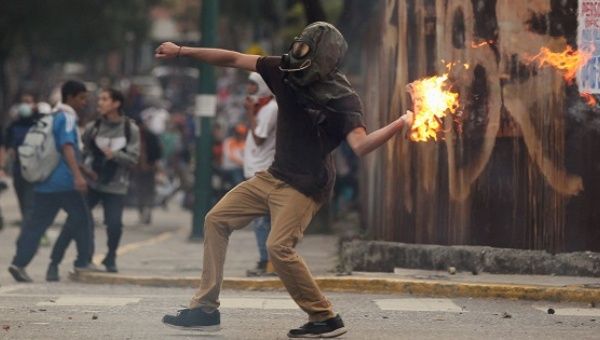
The nation of Venezuela is currently under the control of Venezuelans who derive their support, wealth, and power from Venezuela itself – its people and its natural resource. This political order also receives aid and support from Venezuela’s economic and military partners both in the region and around the globe.
The opposition opposed to the current political order and seeking to supplant it represents foreign interests and more specifically, the United States and its European allies.
The Opposition is Pro-Washington, Not “Pro-Democracy”
As early as 2002, US-backed regime change targeting then Venezuelan president Hugo Chavez, sought to violently overthrow Venezuela’s political order and replace it with one obedient to Washington. Current leaders of the opposition were not only involved in the 2002 failed coup, many are documented to have received political and financial support from the United States government ever since.

Maria Corina Machado, founder of Sumate, an alleged Venezuelan election monitoring group, funded by the US National Endowment for Democracy (NED), meeting with US President George Bush who presided over the failed coup attempt against President Hugo Chavez.
This includes several founders of the opposition party, Primero Justicia (Justice First), including Leopoldo Lopez, Julio Borges, and Henrique Capriles Radonski. The latter of the three has been prominently featured in Western media coverage lately.
US State Department documents reveal that the department itself along with US-funded fronts posing as nongovernmental organizations (NGOs) have been providing Venezuela’s opposition with support.
This includes a report titled, “Status of Capriles and Sumate Cases,” referring to the above mentioned Henrique Capriles Radonski and Sumate, a US National Endowment for Democracy (NED) funded front posing as an election monitor.

Currently, NED’s own website features an extensive list of activities it is engaged in within Venezuela’s borders. It includes leveraging human rights for political gain, electoral manipulation, building opposition fronts, and expanding pro-opposition media. While each activity is labelled with benign titles, it is clear that none of these activities are done impartially, and as State Department documents reveal, these activities are done specifically for the benefit of the US-backed opposition.
Wall Street and Washington’s Open Conspiracy
After the death of Chavez in 2013, US-based special interests openly conspired to finally overturn the political order he built. Corporate-financier policy think tank, the American Enterprise Institute (AEI) created a checklist of US foreign policy goals it sought to achieve in Venezuela. They included:
- The ouster of narco-kingpins who now hold senior posts in government
- The respect for a constitutional succession
- The adoption of meaningful electoral reforms to ensure a fair campaign environment and a transparent vote count in expected presidential elections; and
- The dismantling of Iranian and Hezbollah networks in Venezuela
In reality, AEI is talking about dismantling entirely the obstacles that have prevented the US and the corporate-financier interests that direct it, from installing a client regime and extracting entirely Venezuela’s wealth while obstructing, even dismantling the geopolitical independence and influence achieved by Chavez in Venezuela, throughout South America, and beyond.
The think tank would continue by stating:
Now is the time for US diplomats to begin a quiet dialogue with key regional powers to explain the high cost of Chávez’s criminal regime, including the impact of chavista complicity with narcotraffickers who sow mayhem in Colombia, Central America, and Mexico. Perhaps then we can convince regional leaders to show solidarity with Venezuelan democrats who want to restore a commitment to the rule of law and to rebuild an economy that can be an engine for growth in South America.
By “Venezuelan democrats,” AEI means proxies created, funded, and directed by Washington, including Primero Justicia and the street mobs and paramilitary units it commands.
More recently, another Wall Street-Washington policy think tank, the Brookings Institution, would publish in a paper titled, “Venezuela: A path out of crisis,” a 5-point plan toward escalating the crisis in Venezuela (emphasis added):
1. The United States could expand its assistance to countries that until now have been dependent on Venezuelan oil, as a means to decrease regional support for and dependence on the Maduro government.
2. The United States could increase monetary assistance to credible civil society organizations and nongovernmental organizations able to deliver food and medicines to Venezuelans. By doing so, the United States should make clear that international pressure aims to support democracy, not punish the Venezuelan people.
3. The United States could support efforts by the opposition in Venezuela to build an “off-ramp” that would split moderate elements of the government away from hardliners, encouraging the former to acquiesce to a transition to democracy by lowering their costs of exiting government.
4. The United States could coordinate with international institutions such as the International Monetary Fund (IMF) to offer financial incentives for holding free and fair elections in 2018, and for the opposition to unify and compete in those elections. Such coordination would also involve developing and publicizing a credible plan to restart Venezuela’s economy.
5. As a last resort, the United States could consider raising economic costs to the government through an expanded sanctions regime that aims to limit Venezuelan earnings from oil exports and block further financing. This policy is risky, given that the Maduro government would be able to more credibly shift blame for the economic crisis onto the United States, and should be accompanied by well-publicized efforts to deliver humanitarian aid through credible civil society and nongovernmental organizations.
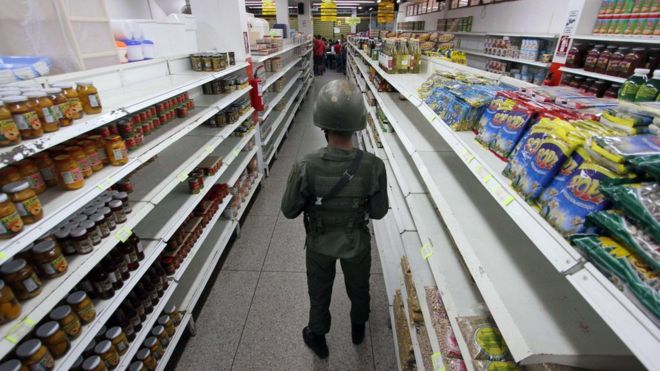
While the Western media attempts to frame Venezuela’s crisis as a result of “socialism” and “dictatorship,” it is clear by reading the West’s own policy papers that it is owed instead to a systematic assault on Venezuela’s sociopolitical stability and economic viability, spanning decades.
Venezuela is not the first nation in South America that the United States has sought to overturn by undermining its economy.
Within the CIA’s own online archives under a section titled, “CIA Activities in Chile,” it is admitted that in the 1970s, similar tactics were used to undermine and overturn the government of Chile. It states specifically: (emphasis added):
According to the Church Committee report, in their meeting with CIA Director Richard Helms and Attorney General John Mitchell on 15 September 1970 President Nixon and his National Security Advisor, Henry Kissinger, directed the CIA to prevent Allende from taking power. They were “not concerned [about the] risks involved,” according to Helms’ notes. In addition to political action, Nixon and Kissinger, according to Helms’s notes, ordered steps to “make the economy scream.”
These Cold War attitudes persisted into the Pinochet era. After Pinochet came to power, senior policymakers appeared reluctant to criticize human rights violations, taking to task US diplomats urging greater attention to the problem. US military assistance and sales grew significantly during the years of greatest human rights abuses. According to a previously released Memorandum of Conversation, Kissinger in June 1976 indicated to Pinochet that the US Government was sympathetic to his regime, although Kissinger advised some progress on human rights in order to improve Chile’s image in the US Congress.
Considering America’s extensive list of interventions, wars, and occupations it is currently involved in worldwide and the manner in which each was presented to the public – with ideology and humanitarian concerns used to manipulate public perception, and considering Venezuela’s opposition is a documented recipient of US support, it is clear that yet another intervention is under way, this time in South America.
Unipolar vs Multipolar
In a world moving toward multipolarism and greater decentralization on all levels, Venezuela’s collapse and a victory for Washington would undo an increasingly balanced distribution of geopolitical power – both in South and Central America, as well as across the world.
As a major oil producing nation, US control over its people and natural resources would further allow the US and its allies to manipulate energy prices toward achieving future goals – particularly in terms of encircling, isolating, and dismantling other centers of political power dependent on oil production for economic prosperity.

One needs not be a fan of “socialism” to understand that the ultimate outcome of Venezuela’s collapse will be a further concentration of power in Washington and Wall Street’s hands. Such power, regardless of whatever ideology it is superficially wielded behind, will always be abused. Regardless of the alleged form of government a nation may take, as long as it is a step away from unipolar globalization, it is a step in the right direction.
The crisis in Venezuela is not one of socialism versus capitalism or dictatorship versus democracy – it is one of hegemony versus national sovereignty, of centralized unipolar power versus an increasingly multipolar world.
A sovereign and independent Venezuela allowed to pursue its own destiny is one in which its own people will naturally seek to decentralize and distribute power. While the current government may not provide the ideal conditions to accomplish this, conditions under a US client regime – as US-wrecked Libya, Afghanistan, or Iraq prove – would be significantly less ideal.
For geopolitical analysts, moving away from ideological talking points and examining the actual government and opposition, their interests, associations, and funding, as well as their base motives reveals a much simpler and consistent narrative, one that any analyst could discern, and a discernment that will stand the test of scrutiny and time. Those entrenched in left/right ideology risk being betrayed by the government’s floundering desperation and the true nature of an opposition that most certainly is not “capitalist” or “pro-democracy.”
‘No Time For Shallow Diplomacy Christians’ In The Religious War On Churches In The Holy Land
By Stuart Littlewood | American Herald Tribune | August 2, 2017
A month ago, after reading a desperate cry for help from the National Coalition of Christian Organisations in Palestine (NCCOP) addressed to the World Council of Churches, I emailed eight churches in my locality asking whether that heart-rending appeal had trickled down to them at parish level.
If not, I hoped to find out where the break in communications occurred, as this wasn’t the first time churches in the Holy Land had sought support from Western Christendom. Previous appeals were largely ignored and left to civil society for action.
Now, say the Palestinians, the situation is “beyond urgent”. So had the NCCOP’s latest plea actually arrived on the desks of parish priests in my neighbourhood? And if so, how were grass-roots Christians responding?
I included a link to the actual crisis document, which should have made every churchman sit up, and a gentle reminder that their faith and their job of work are rooted in the Holy Land. “So what are the chances, I wonder, of seeing concerted action from Western churches before it’s too late? And what part can local parishes play?”
The key point was this: it’s beyond urgent. So are our spiritual leaders, those upstanding ‘men of the cloth’, mobilising their troops?
Only one of the eight replied — the local Catholic vicar-general — who dismissed the subject in two sentences. So there you have it. If this local bunch are representative of the Christian community in the UK, they don’t give a four-X for their brothers and sisters in the Occupied Palestinian Territories. And they are utterly indifferent to the fact that the place where Christianity was born is being stolen from under their noses.
If that’s a wrong interpretation, and Christians in the West do actually wish to help, the issue is straightforward enough. Churches in Palestine are asking churches here to call things as they are: to recognize Israel as an apartheid state in terms of international law and the UN report which says so. They are concerned that States and churches are still dealing with Israel on a business-as-usual basis, as if the situation were normal, and ignoring the criminal reality of military occupation.
Churches came together in opposition to apartheid in South Africa and helped end it. Why haven’t they done the same in Palestine?
They ask us to unequivocally condemn the Balfour Declaration as unjust, and they rightly demand that the UK asks forgiveness and compensates the Palestinian people for their losses. Theresa May’s government, however, plans to celebrate the centenary of the Balfour Declaration “with pride” and has invited Mr Netanyahu to the fun.
Clearly Mrs May, God-fearing churchgoer that she is, needs to feel the heat of His wrath. The woman is so arrogant that her government intends to appeal against the recent decision by the Royal Courts of Justice defending our right to boycott Israel.
End the ‘Ecumenical Deal’, put interfaith dialogue through the wringer
The Palestinians want us to take the strongest possible stand against any theology or group that seeks to justify the occupation. That means of course challenging our religious dialogue partners and withdrawing from those partnerships if they won’t condemn Israel’s brutal occupation.
But I can hear our canting clerics muttering: “Oh dear, no, no, no. We mustn’t upset our interfaith colleagues. That would never do.”
Churches that sell their holdings or otherwise divest from companies that profit from the occupation of Palestinian lands often take years of agonising confab to reach such a commonsense position. But they needn’t think just moving their money is enough. A recent example is the Mennonite Church USA, where it took (they say) a three-person writing team and a 10-member reference group working intensely during the past two years and consulting widely across the church and with Palestinian and Jewish partners, to come up with a modest proposal. And to sugar the divestment pill they declared that “the legacy of Jewish suffering is intertwined with the suffering of Palestinians”. What the Palestinians had to do with Jewish suffering or ever did to deserve having their lands and homes confiscated, isn’t explained. But it is used to provide an excuse to call on Mennonites to strengthen relationships with Jewish communities.
Why? Can they not understand that you have to be consistent in boycotting Israel? It involves boycotting the people who also support and advocate for Israel including those who fail to condemn the Zionist regime’s vile policies that hurt our Palestinian friends. As George Galloway has said, you simply don’t engage with them.
Christians who cannot grasp what is really going on out there, and don’t see what is needed to stop it, might find Robert Cohen’s excellent article Brace Yourselves for Costly Palestinian Solidarity helpful in pointing towards proper, meaningful action.
He explains why the Christian-Jewish dialogue needs re-setting. Central to the problem is the so-called Ecumenical Deal, a reluctance to question Jewish support for Israel for fear of unpicking decades of interfaith reconciliation following the Holocaust. We appear to have cast ourselves in the self-defeating role of repenting for age-old Christian anti-Jewishness. Breaking out of it and criticising Israel would be seen as a re-emergence of that anti-Jewishness.
I’m not aware of Christian anti-Jewishness although continuing failure on the part of Jewish leaders to condemn the cruel policies of the Israeli regime, aka ‘the Jewish State’, is surely asking for it. Does anyone inside or outside the bubble of the Church seriously buy into this repentence stuff? From outside, among people who would never set foot in a church again but still call themselves Christians because they were brought up according to the Christian code, it looks pathetic.
Christians in Palestine, says Cohen, despair of our Church leaders’ endless hiding behind the cover of political neutrality and their unwillingness to offend their religious dialogue partners. Consequently, he predicts, Jewish-Christian dialogue “is about to go through the wringer”.
Time for some ‘really uncomfortable conversations’
Pressing the re-set button means “refusing to allow your local Jewish communal leadership to set the boundaries of permissible debate on Israel”. It also means “listening to the Christian voice under occupation before the Jewish voice living comfortably, with full equal rights, many thousands of miles from that same occupation”.
Operating the wringer, of course, will be followed by a distinct chill in relationships forcing Church leaders, local ministers and their congregations, as well as the Jewish leaders they have dialogue with, out of their comfort zone. Good. As Rebecca Vilkomerson, Jewish Voice for Peace, recently wrote in Haaretz, after 70 years of dispossessing and expelling Palestinians, 50 years of Israeli military occupation and 10 years of blockading Gaza, it is time for Jewish communities “to have some really uncomfortable conversations”.
Palestinians say no to ‘shallow diplomacy’ but it’s all they’re likely to get
How does the World Council of Churches react to those urgent pleas from Palestine?
They will study and analyse. “As we at the WCC consider our plans for 2018 and beyond, we want churches in Palestine to know that their perspective is heard and it is vitally important,” said the WCC’s general secretary. “We will continue with the same passionate spirit to work on specific objectives, strategies and partners for advocacy to end the occupation and to work for just peace in Palestine and Israel.”
The WCC’s Commission of the Churches on International Affairs has been asked to contribute a thorough analysis of the changing political landscapes and dynamics in the Holy Land with an eye toward developing a more specific advocacy strategy that works through nations and organizations with significant influence.
WCC has also started an online campaign, Seek #JusticeAndPeace in the Holy Land, which features profiles of peacemakers and various cries for justice.
WCC also plans to “explore theological reflections, studies and projects that will bring a perspective on just peace in the Holy Land from all parts of the world”, and strengthen communication about the situation in Palestine so that it can “help churches and other ecumenical partners address their constituencies and governments in a more systematic way”. This includes developing a set of principles and practices of responsible pilgrimages of justice and peace to the Holy Land.
Will the Palestinian churches be impressed? Their cry for help stated specifically: “We stand in front of an impasse and we have reached a deadlock. Despite all the promises, endless summits, UN resolutions, religious and lay leader’s callings, Palestinians are still yearning for their freedom and independence, and seeking justice and equality.”
They stressed that religious extremism is on the rise, with religious minorities paying a heavy price. “We need brave women and men who are willing to stand in the forefront. This is no time for shallow diplomacy Christians.”
When I called the Church of England press office yesterday they didn’t think any response had been made. Such concern, then. And when I ran through the members of the WCC’s Central Committee I noticed the two representatives from the Church Of England were both based in Europe. How helpful is that?
The power of hope
Christianity sometimes has great trouble telling right from wrong and doing something about it. The Holy Land is a case in point. Evil reigns there. Christianity across the world cowers. What would Christ say to that?
I know what Michel Sabbah says. He is a former Catholic Patriarch of Jerusalem, a courageous man of the front line and one of the great heroes of the struggle.
“The current situation is hopeless. In reality, there are no signs of hope at all for the Palestinian people. In spite of that, we hope.
We hope because we are Christians, and God is present.
We hope because we believe in the fundamental goodness of the human being, Israeli and Palestinian. Human goodness will prevail at the end upon the human power of evil.We hope because Palestinians are persevering in claiming their rights.
It is a source of hope that we never gave up….We hope because among Israelis, there are people who are trying to work with Palestinians for what is right. And there are an increasing number of movements for peace, strong in will….
If we had no hope we would not live. Hope is life, and history gives us hope. What is right will prevail.”
Michel Sabbah
Catholic Patriarch Emeritus
I fear that if he pins any hopes on the wets of the Western churches he’ll be disappointed. But he already knows that, surely.
Iran, Iraq, Russia hold meeting in Moscow
IRNA – August 2, 2017
Deputy Foreign Ministers of Russia, Iran and Iraq held meeting here on Wednesday to consider situation in the Middle East, crises in Iraq and Syria and trilateral coordination.
Mikhail Bogdanov, Hossein Jaberi Ansari and Nazar Khairallah kicked off the meeting in the venue of Foreign Ministry Protocol Hall in the presence of their accompanying delegation as well as Iran’s Ambassador to Moscow Mehdi Sanayee.
The latest developments in the region, especially coordination to reduce tensions and crises in the region with the aim to increase stability and peace were topics of agenda.
Before holding the joint meeting, Bogdanov met separately with Jaberi Ansari and Nazar Khairallah and discussed different issues with them.
Bogdanov and Jaberi Ansari in their 4-hours meeting discussed a collection of issues concerning West Asia and North Africa, situations in Syria, Yemen, Libya, Iraq, Iraqi Kurdistan, Palestine, crisis in relations between Qatar and Saudi Arabia and other international and regional issues.
Intra-Syrian talks in Astana and Geneva, Syrian humanitarian needs and the issue of rebuilding Syria were among issues discussed in the meeting.
Fateh al-Sham terrorist group releases three Hezbollah captives
Press TV – August 2, 2017
Three members of the Lebanon’s Hezbollah resistance movement have been set free by the Jabhat Fateh al-Sham Takfiri terrorist group in exchange of three of its members.
The Hezbollah fighters arrived in Lebanon late on Tuesday as part of a ceasefire agreement between both parties last week.
The first stage of the ceasefire, brokered by the national police and security force of Lebanon – Internal Security Forces Directorate, took effect on Sunday as both sides exchanged the bodies of fighters killed in clashes between them.
The truce was agreed after Hezbollah fighters dealt a heavy blow to the militants in Lebanon’s rugged Arsal region bordering Syria. At least 150 militants of the Takfiri group were killed in the Hezbollah operation aimed at preventing the spillover of the Syria war.
The ceasefire agreement involves the departure of all militants of the Jabhat Fateh al-Sham group from the region around Arsal along with any of the civilians, living in Arsal’s refugee camps, who wish to leave the border zone with them.
Hezbollah launched a major push on July 21 to clear both sides of Lebanon’s border with Syria of “armed terrorists.”
In August 2014, the Jabhat Fateh al-Sham and Daesh terrorist groups overran Lebanon’s northeastern border town of Arsal , killing a number of Lebanese forces. They took 30 soldiers hostage, most of whom have been released.
Since then, Hezbollah and the Lebanese military have been defending Lebanon on the country’s northeastern border.
Featured Video
HE SAVED LIVES. NOW HE FACES PRISON.
or go to
Aletho News Archives – Video-Images
From the Archives
The Geopolitics behind the War in Yemen (I)
By Mahdi Darius NAZEMROAYA | Strategic Culture Foundation | 30.03.2015
The United States and the Kingdom of Saudi Arabia became very uneasy when the Yemenese or Yemenite movement of the Houthi or Ansarallah (meaning the supporters of God in Arabic) gained control of Yemen’s capital, Sanaa/Sana, in September 2014. The US-supported Yemenite President Abd-Rabbuh Manṣour Al-Hadi was humiliatingly forced to share power with the Houthis and the coalition of northern Yemenese tribes that had helped them enter Sana. Al-Hadi declared that negotiations for a Yemeni national unity government would take place and his allies the US and Saudi Arabia tried to use a new national dialogue and mediated talks to co-opt and pacify the Houthis.
The truth has been turned on its head about the war in Yemen. The war and ousting of President Abd-Rabbuh Manṣour Al-Hadi in Yemen are not the results of «Houthi coup» in Yemen. It is the opposite. Al-Hadi was ousted, because with Saudi and US support he tried to backtrack on the power sharing agreements he had made and return Yemen to authoritarian rule. The ousting of President Al-Hadi by the Houthis and their political allies was an unexpected reaction to the takeover Al-Hadi was planning with Washington and the House of Saudi. … continue
Blog Roll
 Aletho News
- Italy to move military personnel from Taif base after missile strike
- Finland’s Stubb tells European leaders to calm down
- Defeating Russia on battlefield impossible – Fico
- Finland’s Gender Clinic Reversal
- Massachusetts Wants Mental Health Visits, Why Does Government Use ‘Health’ to Enter Our Homes & Families?
- US lawmaker admits American people footing bill for Trump’s failed aggression against Iran
- Pfizer Gave $500,000 to Groups That Lobbied to End Religious Exemption in Massachusetts
- HE SAVED LIVES. NOW HE FACES PRISON.
- Israeli lobby seeks to bind US fate to ‘Israel’: Araghchi
- Pakistan-Iran talks secure LNG shipment to Islamabad through Hormuz
- If Americans Knew
- Israel Blocking Hundreds of Wheelchairs for Injured Children From Entering Gaza
- Israel Is Expanding and Upgrading Compounds for Palestinian Militias in Gaza
- The Palestinian-American Residents of This West Bank Town Are Wondering: Where Is Trump?
- Gaza desperately needs tents, wheelchairs, fuel… and everything else (Israel blocks it all) – Daily Update
- Israeli Attacks in Gaza Kill at Least Seven Palestinians Over Three Days, including Woman and Child
- Trump’s militarization of Washington DC as he pursues Israel’s war against Iran
- Why Israel Fears This Searing New Documentary
- Huckabee aide solicited cash gifts from Israelis
- This isn’t sci-fi, AI is already killing people
- ‘The Most Brutal Thing’: Investigation Reveals Execution of Elderly Woman in Rafah
- No Tricks Zone
- 2025 Nature Paper Claiming Worsening Global Drought Gets RETRACTED …Heavily Flawed
- New Study: ‘Global Drought Shows No Detectable Recent Acceleration Under Climate Warming’
- Economic Masterminds: German Socialists Suggest Taxing Productivity Gains Stemming From Using AI
- The South China Sea Has Not Been Cooperating With The Climate Change Narrative
- Energy Crisis: Germany Enters Heating Season With Historically Low Gas Reserve Fill Levels
- New Study: The Antarctic Ice Sheet Gained Mass From 2020-2024 Due To Staggering Snow And Ice Accumulation
- Study: Ocean Heating Rates From Thousands Of Years Ago ‘Dwarf’ Modern Ocean Heating Rates
- Climate Extremists Target, Attack Large-Scale Power Grid Infrastructure In Germany!
- New Study: Antarctic Ice Melt Has Contributed Less Than 1 Centimeter To Sea Level Rise In The Last 30 Years
- Fear Of Debate: Alarmist German Climate Scientist Calls On Mainstream Media To Discredit Skeptic Voices

