Hungarian foreign minister: Nation’s gas supply is secure, NATO membership for Ukraine is impossible
By Liz Heflin | Remix News | October 9, 2024
Minister of Foreign Affairs and Trade Péter Szijjártó said that Hungary will not be affected by the expected stoppage of the transit of Russian natural gas via Ukraine because the country today primarily gets its gas via the TurkStream pipeline.
His comments came at a press conference following the meeting of the Hungarian-Serbian joint economic committee. He further noted that an “extremely brave decision” was made with Serbia, Bulgaria and Turkey to build this pipeline, with those involved in the construction and preparation facing serious threats from allies who tried to dissuade them from building it.
“If we hadn’t been brave enough, we would be in huge trouble today. If we hadn’t built the TurkStream gas pipeline, today it would be very difficult, if not impossible, to guarantee the security of Hungary’s natural gas supply,” he added.
Already this year, more than 5.6 billion cubic meters of natural gas has arrived via this route, Szijjártó said.
“We are not interested in and have no influence on what the Russians and Ukrainians get or don’t get in terms of gas transit (…) There are Central European countries for whom this is a problem. In recent years, we in Hungary have invested a lot in gas transportation infrastructure, and of course, we help whoever we can,” he said.
Szijjártó also spoke up on Ukraine’s possible NATO membership, saying that the country’s admission today would drag all members into the ongoing war and trigger the outbreak of WWIII because of the article on collective defense.
“I think that anyone who thinks this matter through with common sense does not want to cause this danger. So, the Hungarian position is clear: There is no possibility of Ukraine joining NATO,” he stated.
Szijjártó added that most NATO foreign ministers are in agreement, which he believes is very unfair to Ukraine, as “they don’t tell them honestly what they think about this issue and what their position is.”
US to Sanction Former Georgian Leader Over Opposition to NATO Membership
By Kyle Anzalone | The Libertarian Institute | September 24, 2024
Washington is preparing sanctions against former Georgian Prime Minister Bidzina Ivanishvili over his opposition to Tbilisi joining the North Atlantic Alliance and the European Union.
A senior US official told American state media, Voice of America, that Ivanishvili’s growing ties with Russia are concerning the White House. “We have information that Ivanishvili undertook actions to develop relations with Russian oligarchs, took actions to enable Russia to gain better access to the Georgian market,” the official explained. “In fact, he took some actions at the direction of the Russian intelligence services.”
While Ivanishvili has not personally been involved in Georgian politics since 2013, his populist Georgia Dream party is gaining influence in Tbilisi. The party has increasingly found itself at odds with Washington over a foreign agents law that was passed in Tbilisi earlier this year.
Similar to the US Foreign Agents Registration Act (FARA) the legalization required agencies operating in Georgia and receiving more than 20% of their funding from foreign sources to register as foreign agents.
A source familiar with the Biden administration’s plan to sanction Ivanishvili said the move is coming out of frustration that Washington has been unable to move Tbilisi. “I think the Biden administration has been frustrated by its inability to get the Georgian government to take seriously the position they’ve put themselves in,” a source said. “The Biden people are trying to convey the seriousness and hope that somebody in the Georgian government is listening in a serious way.”
In 2008, NATO signed a pledge to one day admit Ukraine and Georgia into the Washington-led bloc. However, the Kremlin views the countries’ entrance into the alliance as a national security threat. In 2022, Moscow invaded Ukraine, in part because Kiev was becoming a de facto member of NATO.
Russia set to gain access to Atlantic port – media
RT | September 24, 2024
Russia is poised to gain access to a naval port in the Atlantic Ocean through a bilateral military cooperation agreement with the island nation of Sao Tome and Principe, located off the west coast of Africa.
A bill on the issue has been approved by a Russian government commission on legislative activity, RTVI reported on Monday, citing a source familiar with the discussions.
The draft treaty will be put to a vote in the State Duma, Russia’s lower house of parliament. The first deputy chairman of the Duma’s Committee on International Affairs, Alexey Chepa, explained that ratifying the pact will allow Russian ships to be stationed in the Gulf of Guinea.
“Today, a large number of ports where our ships could come in for refueling are closed. Therefore, opportunities to find friendly ports significantly facilitate the activities of our fleet,” Chepa told RTVI.
Under the agreement between Russia and the Democratic Republic of Sao Tome and Principe, which was initially signed in St. Petersburg in April, the two sides will exchange information and experience in the field of military education, and cooperate in providing engineering support for troops, combating piracy and terrorism, and providing military logistical support.
Cooperation is also expected to include joint exercises and other activities between the two countries’ armed forces.
The draft document says the agreement will last for an indefinite period, and that the adoption of the treaty will not require additional funds from the federal budget.
Proud to Be Suing Hospitals and Doctors That Inject Hep B Vaccines Into Newborns Without Parental Consent
Injecting Freedom by Aaron Siri | September 21, 2024
Informed Consent Action Network is supporting an initiative that is long overdue: suing doctors and hospitals that inject newborns with a hepatitis B vaccine without parental consent.
The hepatitis B vaccine is a case study in agency capture. The target for this product was sex workers and intravenous drug users, and the rare pregnant mother who was hepatitis B positive. The problem was that CDC could not get the sex workers and intravenous drug users to take this product. The story would have ended there if pharma didn’t stand to earn billions through a wider mandate of this product.
With those billions at stake, an argument was made that if all newborns were vaccinated (not just the tiny number whose mothers were hepatitis B positive) then we could catch these babies before they became prostitutes or heroin addicts. CDC’s advisory committee, stacked with individuals receiving funding from pharma, added it to the routine childhood schedule in 1995.
Parents who decide not to inject their babies with this product have varying reasons. Some simply conclude that their baby won’t be having sex or sharing dirty needles with drug addicts—usually a safe assumption. Others are horrified that the two hepatitis B vaccines available for babies were licensed based on clinical trials with only 5 days of safety monitoring.
Let me repeat: 5 days. If that sounds incredible and shocking, it is because it is incredible and shocking. But that is the simple, cold hard truth. See for yourself in Section 6.1 of the package insert for Engerix-B and Recombivax HB, the only hep B vaccines licensed in the U.S. for use in newborns. ICAN has even formally petitioned FDA to withdraw license of this vaccine until a proper clinical trial is conducted.
(In that petition you can read about all the related legal work our firm has done on behalf of ICAN, including confirming that this ridiculously inadequate safety review period is, in fact, true.)
There are also other reasons parents choose not to inject this product into their babies, including the anemic post-licensure safety studies, harms suffered by an older sibling from this product, or religious beliefs.
All that said, we are proud to be bringing lawsuits against doctors and hospitals across the country that vaccinate newborns with this product without parental consent. You can read more about this on ICAN’s page, our firm’s page, or stay tuned for a segment about this on The HighWire.
Russia publishes ‘destructive’ countries list
RT | September 20, 2024
Moscow has listed 47 countries whose “destructive attitudes” contradict Russian values, opening the path to their nationals to seek asylum in Russia if they so choose.
President Vladimir Putin signed a decree last month allowing foreigners who share Russia’s traditional values and disagree with the “neoliberal” agenda pushed by their own governments to apply for residency.
On Friday, Russian Prime Minister Mikhail Mishustin published the list of countries and territories that “implement policies that impose destructive neoliberal ideological attitudes contradicting traditional Russian spiritual and moral values.”
The list posted on the Russian government portal includes the following countries and territories: Australia, Austria, Albania, Andorra, the Bahamas, Belgium, Bulgaria, the UK, Germany, Greece, Denmark, Ireland, Iceland, Spain, Italy, Canada, Cyprus, Latvia, Lithuania, Lichtenstein, Luxembourg, Malta, Micronesia, Monaco, the Netherlands, New Zealand, Norway, Poland, Portugal, South Korea, Romania, San Marino, North Macedonia, Singapore, the US, Taiwan (territory of China), Ukraine, Finland, France, Croatia, Montenegro, the Czech Republic, Switzerland, Sweden, Estonia and Japan.
Notably absent from the list are EU and NATO members Slovakia and Hungary, as well as NATO member Türkiye.
Most of the designated countries previously made the register of “unfriendly” governments, first compiled in the spring of 2021 and updated in 2022. The states on that blacklist are subject to Russian diplomatic and economic countermeasures based on their hostile conduct.
Russia can “offer the world a safe haven for normalcy” by defending traditional values from the “wokeism catastrophe” that has come to dominate the collective West, RT Editor-in-Chief Margarita Simonyan said on Thursday at the Fourth Eurasian Women’s Forum in St. Petersburg.
According to Putin’s edict from August, nationals of “destructive neoliberal” countries are eligible to seek temporary residence in Russia without having to satisfy the standard immigration requirements, such as national quotas, Russian language proficiency, and knowledge of Russian history and laws.
The plan appears to have originated at a February symposium in Moscow, when Italian student Irene Cecchini presented the idea of “impatriation” to the Russian president. Cecchini urged Putin to streamline the immigration and naturalization process for foreigners who shared the “cultural, traditional and family values” of Russia, presenting it as a way to help the country overcome a demographic dip.
FDA Approves Vaccine for Mpox — Warns It May Cause Death in Vaccinated and People They Come in Contact With
By Suzanne Burdick, Ph.D. | The Defender | September 17, 2024
A vaccine approved in August by the U.S. Food and Drug Administration (FDA) for people deemed to be at “high risk” for mpox infection may cause more harm than good, according to the FDA’s own medication guide for the product.
ACAM2000 — made by Emergent BioSolutions, a company specializing in vaccines for biochemical warfare threats such as anthrax and smallpox — was approved for smallpox in 2007.
However, on Aug. 29, the FDA issued an expanded supplement approval for ACAM2000’s use against mpox.
Since then, social media users have been posting clips of the FDA’s ACAM2000 medication guide, which warns the vaccine may cause “serious complications” in both the vaccinated person and those with whom they come into close contact up to 6 weeks after getting the shot.
Karl Jablonowski, Ph.D. — senior research scientist at Children’s Health Defense — told The Defender that the FDA’s approval of the shot is a “public hazard, not the practice of public health.”
“You can call ACAM2000 a ‘vaccine,’ but its impact on the United States will be as a ‘disease,’” Jablonowski said.
He added:
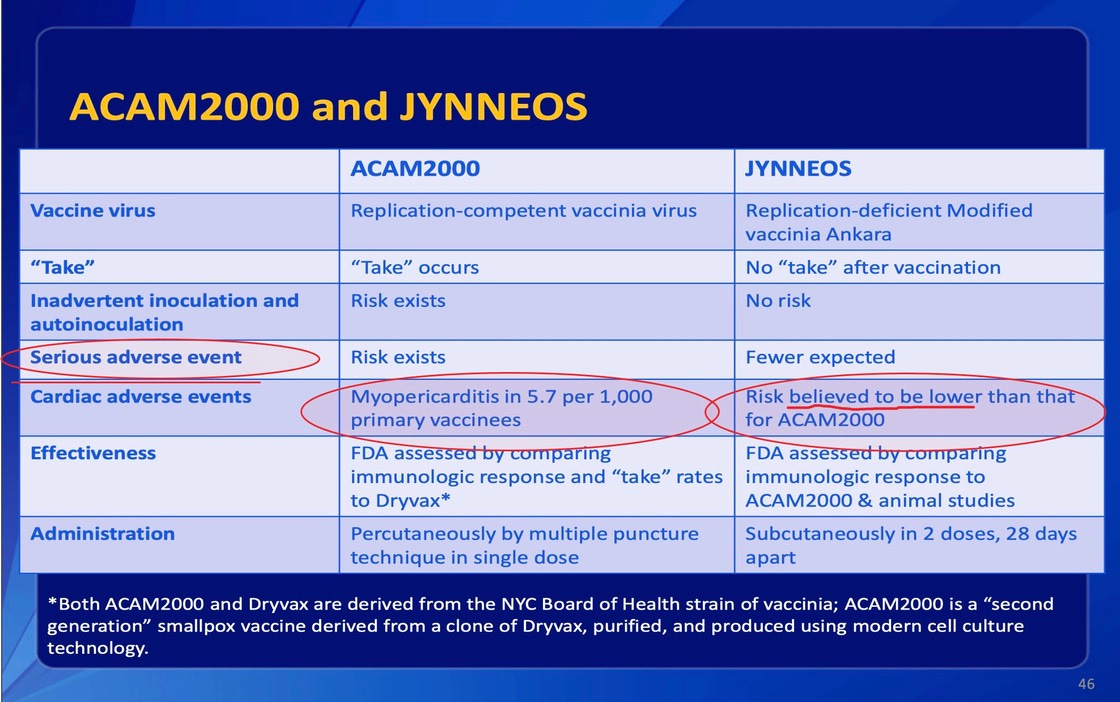
“For instance, the drug’s package insert reveals (see Table 3) that the U.S. Department of Health and Human Services (HHS) found roughly 520 per million ACAM2000 recipients contracted myocarditis or pericarditis.
“That is about 1 in 2,000. But elsewhere in the package insert, the FDA acknowledges that — based on additional studies — the risk is actually 5.7 per 1,000 vaccinations.
“That’s about 1 in every 175 people. If the 262 million adults in the U.S. received this vaccine, an estimated 1,493,000 would contract the serious adverse reaction of myopericarditis.”
Myopericarditis is an umbrella term for myocarditis, inflammation of the heart, and pericarditis, inflammation of the tissue surrounding the heart.
Dr. Meryl Nass, an internist and biological warfare expert, told The Defender that the CDC also acknowledged this same figure — myopericarditis in 5.7 per 1,000 primary ACAM2000 vaccinations — during a June 23, 2022, meeting.
“It’s a huge number,” Nass said. “The fact that the FDA and CDC are acknowledging it means no one should get the vaccine.”
She explained:
“Myopericarditis is a life-threatening condition. It lowers your life expectancy.
“Most people are never going to be exposed to mpox or smallpox. Vaccines are typically given to healthy people who are never even going to be exposed, therefore the risk posed by the vaccine needs to be low.
“That’s why vaccine safety is critical — even more than drugs, because drugs are given to people who are already sick.
“This risk — 1 in 175 — is higher than all other licensed vaccines for which the CDC acknowledges side effects. This is the worst.”
ACAM2000 can also cause fetal death when taken during pregnancy, the package insert states.
Additionally, the shot contains a “live vaccinia virus” that can be spread to — and possibly cause the death of — people who have close contact with the vaccinated person up to 6 weeks following vaccination, according to the medication guide.
The guide — which the FDA requires to be given to patients before they get the ACAM2000 vaccine — says, “ACAM2000 can cause serious complications in vaccinated individuals and in their close contacts to whom the vaccine virus has spread.”
Jablonowski said, “The spread of vaccinia virus is an infliction and an assault, as an unsuspecting person cannot possibly consent.”
“For good reasons you would not consent to this vaccine,” Jablonowski said, “even if you believed your benefits outweigh your risks, as you become a potential vector of a disease that is damaging to the heart and fatal to both fetus and infant.”
Risk of serious complications and death in vaccinated and those exposed to vaccinated individual
ACAM2000 is a single-dose vaccine administered using a bifurcated needle that’s been dipped into the vaccine solution, according to an Emergent BioSolutions press release.
In its Aug. 30 press release, the FDA stressed that “every person” who receives ACAM2000 is “required” to be given the drug’s FDA-approved medication guide.
“A Medication Guide is necessary,” the FDA said, “for safe and effective use of the vaccine because it could help prevent serious adverse events and inform the vaccine recipient of serious risks relative to benefit that could affect their decisions to be vaccinated.”
The guide lists serious possible complications, including: myocarditis, inflammation of the brain or spinal cord, serious skin infections, spreading the vaccine virus through the blood to other parts of the body and fetal death if taken during pregnancy.
According to the guide, “The risks for serious vaccine side effects are greater for people who:
- have heart problems or a history of heart problems
- are taking steroid eye drops or ointment
- have a weakened immune system
- have skin problems such as eczema, atopic dermatitis, burns, impetigo, contact dermatitis, chickenpox, shingles, psoriasis, or uncontrolled acne
- are less than 1 year old
- are pregnant or become pregnant within 6 weeks after vaccination.”
ACAM2000’s package insert warns of a longer list of possible serious complications, including:
“Myocarditis and/or pericarditis, encephalitis, encephalomyelitis, encephalopathy, progressive vaccinia (vaccinia necrosum), generalized vaccinia, severe vaccinial skin infections, erythema multiforme major (including Stevens-Johnson syndrome), eczema vaccinatum, accidental eye infection (ocular vaccinia) which can cause ocular complications including keratitis and corneal scarring that may lead to blindness, and fetal death in pregnant women.”
The insert also goes into more detail about the risk of death:
“Historically, death following vaccination with live vaccinia virus is a rare event; approximately 1 death per million primary vaccinations and 1 death per 4 million revaccinations have occurred after vaccination with live vaccinia virus.
“Death is most often the result of sudden cardiac death, post-vaccinial encephalitis, progressive vaccinia, or eczema vaccinatum.
“Death has also been reported in unvaccinated contacts accidentally infected by individuals who have been vaccinated.”
U.S. stockpile contains more than 100 million doses
The FDA’s approval of ACAM2000 for use against mox followed just days after Emergent BioSolutions pledged to donate 50,000 doses to address the mpox outbreak in Africa.
On July 2, the U.S. Administration for Strategic Preparedness and Response at the HHS signed a $99.9 million deal with the drugmaker to obtain more ACAM2000 doses this year. Although the exact number of doses was not disclosed, Forbes on Sept. 8 reported that the U.S. currently has over 100 million doses.
HHS did not respond when The Defender asked if these doses are reserved for an emergency smallpox outbreak or are being made available as an mpox vaccine.
The Defender reached out to the Centers for Disease Prevention and Control (CDC) with the same question but was told by a CDC spokesperson, “We defer to the Administration for Strategic Preparedness and Response (ASPR) where the National Stockpile is housed.”
The CDC website on mpox vaccination states that ACAM2000 “has not been used in the ongoing clade II mpox outbreak that started in 2022″ but “has been made available for use against mpox in the clade II outbreak under an Expanded Access Investigational New Drug (EA-IND) protocol, which requires informed consent along with completing additional forms.”
When The Defender asked the CDC to clarify if the agency currently recommends ACAM2000 for mpox, an agency spokesperson said:
“It has not been used for U.S. civilians affected by the clade II global outbreak that began in 2022, and there are no plans to use it broadly during Mpox outbreaks.
“This is because JYNNEOS, the alternate to ACAM2000 in the United States, has fewer side effects.”
The Defender asked Emergent BioSolutions what it wants to tell members of the public who may be concerned about risks associated with ACAM2000 but did not receive a response by our deadline.
This article has been updated to clarify that both the FDA and CDC acknowledge that the myopericarditis risk for ACAM2000 is estimated at 5.7 per 1,000 primary vaccinations.
This article was originally published by The Defender — Children’s Health Defense’s News & Views Website under Creative Commons license CC BY-NC-ND 4.0. Please consider subscribing to The Defender or donating to Children’s Health Defense.
China calls out Anglo-American ‘disinformation’
RT | September 16, 2024
Claims by Washington and London that Beijing is supporting Russia’s military in the conflict with Ukraine are “groundless,” the Chinese embassy in the UK stated on Monday.
The diplomatic mission responded to the ‘Joint Statement on the US-UK Strategic Dialogue,’ which was issued after talks between President Joe Biden and Prime Minister Keir Starmer at the White House last week. Among other things, the document said the sides shared “particular concern” about what they called “China’s support to Russia’s defense industrial base.”
The Chinese embassy rejected the accusation, stressing that Beijing has “always maintained an objective and fair position, actively promoted peace talks and pushed for a political solution” to the conflict between Moscow and Kiev.
“We firmly oppose the relevant countries’ constant propagation of disinformation that China supports Russia’s defense industry,” the statement read.
By making such claims, the US and UK are “adding fuel to the fire and shifting the blame” from themselves for the continuation of the fighting between Moscow and Kiev, the embassy said, adding that they should “stop” behaving in this manner.
The joint statement by Washington and London also underlined the importance of close coordination between the two nations in promoting their common values and interests in the Indo-Pacific region. The sides insisted that “peace and stability” in the Taiwan Strait, which separates Taiwan and mainland China, are “indispensable to the security and prosperity of the international community and called for the peaceful resolution of cross-Strait issues.
” The Chinese embassy reminded the US and UK that “the Taiwan question is purely China’s internal affair” and that “No external forces have the right to interfere.” Beijing considers the self-governed island to be part of its territory under the ‘One China’ principle.
“The biggest threat to peace and stability in the Taiwan Strait now is the separatist activities for ‘Taiwan independence’ and the interference of external forces,” the diplomats stressed.
The mission blasted the Anglo-American joint statement, saying that it “makes groundless accusations… and interferes in China’s internal affairs.” Beijing “strongly deplores and firmly rejects this.”
MIT divests from Israeli arms firm funded program
Al Mayadeen | September 15, 2024
The MISTI-“Israel” Lockheed Martin fund has been shut down after continuous pressure from the Massachusetts Institute of Technology’s (MIT) staff and faculty, the MIT Coalition for Palestine announced on Friday, marking a major divestment win for the university’s Scientists Against Genocide (SAGE) movement.
“Under pressure from students and scientists of conscience at this Institute, the MIT administration has discontinued MISTI-Israel’s Lockheed Martin Seed Fund and will not renew its contract,” the organization said in a statement.
“This was a major target of our divestment action. The program ends after months of protest against it last fall, including letter deliveries, sit-ins, and public information campaigns,” it highlighted.
The Lockheed Martin Seed Fund was a program established in 2019, managed by the MIT International Science and Technology Initiative Israel (MISTI-“Israel”) to connect students and researchers to Israeli offices at Lockheed Martin, a weapons manufacturer firm.
The divestment marks the first American-Israeli arms manufacturer partnership to end at an American university since the genocide began on October 7. Additionally, the fund was removed from the MISTI-“Israel” website between December 2023 and February 2024.
The arms company has supplied the occupation with several billion dollars of weapons to be used during its ongoing genocide in Gaza, including Hellfire missiles, attack aircraft, and heavy artillery. These munitions have been used within the past 11 months to target schools, universities, hospitals, religious sites, and crucial infrastructure, as “Israel” killed over 41,000 Palestinians.
The MIT Coalition for Palestine emphasized that Lockheed also enabled its alumnus, Benjamin Netanyahu, to extend the occupation’s genocidal acts to the West Bank and al-Quds, as well as Israeli concentration camps.
The MIT Coalition for Palestine referred to the UK’s recent suspension of 30 weapons licenses, asserting there are many steps to implement to order a full arms embargo on the regime. The organization also shed light on how boycotts, divestments, and sanctions resulted in the end of South Africa’s apartheid regime in the 1990s.
“A similar campaign is now required of us if we want to see an end to the Israeli apartheid regime in our lifetime and the formation of a free, democratic Palestine from the Jordan River to the Mediterranean Sea,” the statement read.
“Today we are gathered once again as a united MIT community, speaking in its majority voice, as we have in referendum after referendum, from the sit-ins in Lobby 7 to the Scientists Against Genocide Encampment this spring, to say that we are FED UP and DONE with aiding and abetting the apartheid state.”
The movement added that despite this major step in divestment, the institution’s laboratories continue to conduct direct research funding links to the Israeli Occupation Forces (IOF), while the administration maintains its partnerships with Elbit Systems and Maersk.
They denounced these ties and criticized MIT for violating its “own ethical funding criteria, research ethics, and health and safety policies.”
“They are shameful and criminal and signal in clear and offensive terms that the Institute does not care about the human life and dignity of our Palestinian colleagues here at MIT and abroad. We say no. No science for apartheid and free Palestine,” the statement concluded.
Pro-Palestine protests prompt closure of Israeli arms firm’s US office
Last month, a US branch of “Israel’s” largest arms manufacturer, Elbit Systems, announced the termination of its office lease in Cambridge, Massachusetts following months of demonstrations led by Boycott, Divestment, and Sanctions (BDS) Boston.
A subsidiary of the Israeli-based company, KMC Systems, had moved into a building at 130 Bishop Allen Drive in December 2021, where the lease was expected to end next year.
The BDS organization described the end of Elbit’s lease as “a testament to our collective power,” attributing “varied community efforts” for the disruption of Elbit and its landlord, Intercontinental Management Corp.’s operations and “forcing the early termination of the lease.”
The movement has pledged to keep fighting to “prevent Elbit from moving to another nearby location,” as well as attempt to “sever Elbit’s ties with the Massachusetts Institute of Technology (MIT) and other actors in the Boston area.”
“We will not consider ourselves victorious until Elbit Systems is dismantled and until Palestine is liberated,” BDS Boston asserted.
Ukraine is a Non-Sovereign State Ruled by ‘Political Frankenstein’ Zelensky – Opposition Politician
By Ekaterina Blinova – Sputnik – 12.09.2024
Chairman of the Council of the Other Ukraine movement Viktor Medvedchuk gave an interview to EADaily on September 12 about the causes of the Ukrainian crisis, Russia’s mission and the destructive influence of the collective West.
“For a long time an independent Ukraine has not been existing politically, economically, or legally,” Ukrainian opposition politician and Chairman of the Council of the Other Ukraine movement Viktor Medvedchuk told EA Daily. “The country is ruled by an illegitimate president who has usurped power, becoming a dictator.”
- The Western-backed Euromaidan coup d’etat of 2014 dealt a heavy blow to Ukrainian sovereignty and legitimate power. For 30 years the West has fuelled anti-Russian sentiment, distorted history and facilitated the rise of Nazism in Ukraine.
- The Minsk agreements of 2015 corresponded to EU interests, but the UK and US, who sought to start a war, deliberately disrupted the settlement process.
- Washington’s plan was “to destabilize the situation on Russia’s borders, and then inside Russia. The first step succeeded, the second did not. The US managed to break Ukraine and Europe, but not Russia.”
- In 2020 Ukraine got a chance to nullify the adverse consequences of the 2014 regime change through democratic means. “Our party ‘Opposition Platform – For Life’ won local elections in 2020, after we were ranked second in the 2019 parliamentary elections, and began to lead in polls across the country,” Medvedchuk said.
- But in February 2021 the Zelensky regime illegally blocked broadcasting of opposition channels, slapped sanctions on Medvedchuk and his wife, groundlessly accused him of treason and arrested him in May 2021. Other Ukrainian opposition politicians were also subjected to persecution.
- The special military operation in Ukraine would not have begun if Zelensky had abandoned the idea of joining NATO.
- The situation in Ukraine and in the world will improve after the West stops pouring billions into propping up Zelensky, who is a “political Frankenstein”.
Their vaccine injury reports disappeared from VAERS — So they developed a tool for anyone to track their own reports
By Brenda Baletti, Ph.D. | The Defender | September 11, 2024
A team of researchers is developing a tool to track reports in the Vaccine Adverse Event Reporting System (VAERS), so vaccine-injured people can follow what happens to the reports they submit.
As part of a broader effort to hold public health agencies accountable, the tool will also make it possible to audit the VAERS system by identifying what types of reports are deleted, insufficiently updated or contain errors.
The Centers for Disease Control and Prevention (CDC) and the U.S. Food and Drug Administration (FDA), which jointly oversee VAERS, have refused to do this work despite multiple appeals by advocates for the vaccine-injured, according to React19, the group leading the initiative.
React19, founded by a small group of medical professionals injured by COVID-19 vaccines, works with institutions and providers to increase understanding and awareness of patients experiencing lasting effects following COVID-19 and/or COVID-19 vaccines.
The group is teaming up with computer programmer Liz Wilner, founder of OpenVAERS — a website that provides tools for more easily accessing and searching VAERS data — and Children’s Health Defense (CHD) to develop the tool.
The idea for developing the automatic VAERS report tracking tool came out of a VAERS audit the group conducted in 2022 to assess how the FDA and CDC were following up on COVID-19 vaccine injury reports.
React19 worked with outside experts to review a sample of 126 VAERS reports filed by some of its members who wanted to know what happened to their reports.
After tracking down each person’s reports and following them through the VAERS system, they “were kind of shocked at how bad it is,” members of React19 told The Defender.
They found that only 61% of the reports filed were correctly logged and published in VAERS. Twenty-two percent of the reports were never issued a permanent ID and are therefore not publicly visible, 12% were deleted and in 5% of the cases, a report couldn’t be filed or their report number remains unknown due to system errors.
That means more than 1 in 3 reports searched couldn’t be found in a database that is meant to be publicly accessible and transparent. It also suggests that problems of “omission of data and underreporting may be even greater than estimated,” according to the audit report.
The group also found that the medical status of the deleted reports, “by and large, had a worse outcome than the ones that were still in the system,” they said. For example, they said, in the public-facing VAERS system, 23% of reports were for permanent disabilities — but in the deleted reports, 53% were for permanent disability.
“One of the more alarming things we found out was that not all death reports are investigated,” Brianne Dressen, React19 founder, told The Defender.
The group brought this to the attention of public health officials in their meetings, sharing examples of reports that had been updated by people’s families when they died, but didn’t show up on the public system.
They also found that many follow-up reports containing updates on worsening symptoms were gone from the system.
At the time, the group was meeting regularly with top officials, including Peter Marks, M.D., Ph.D., director of the FDA’s Center for Biologics Evaluation and Research, to discuss vaccine injuries and why the agencies were doing nothing to address them.
In those meetings, according to Dressen and React19 member Dr. Joel Wallskog, when they raised the issue that the agencies weren’t following up on VAERS reports, the FDA told them VAERS wasn’t a reliable indicator for vaccine injuries, because anyone could file an injury complaint, including “Mickey Mouse or Michael Jackson.”
“We told them we know thousands of people that have not had any follow-up on their VAERS reports that are not Mickey Mouse, and they’re suffering it every single day waiting for you guys to get back to them to investigate what happened to them,” Dressen said.
“And of course then they never did anything. So we were like, OK, fine. If they’re not going to generate the evidence, then we will ourselves.”
The group submitted their findings to Marks during a meeting with him and his team. Based on their findings they also requested an external audit of the entire VAERS system and posed a series of questions listed on their audit report webpage.
They never heard from the agencies again.
“We were like, really?” Dressen said. “We were having these regular meetings with them every one month or every two months, and then after that, they wouldn’t meet with us anymore.”
Dressen, who was injured in the AstraZeneca clinical trials and whose diagnosis of post-vaccine neuropathy and other vaccine-related disorders was confirmed by the National Institutes of Health, said her own VAERS report is not visible to the public. The agencies haven’t told her why.
More recently, still hoping for accountability from the public health agencies, React19 submitted its audit and complaint to the Office of Inspector General at the U.S. Department of Health and Human Services.
The only response they received was an autoresponse confirming receipt of the complaint.
Attempt to ‘bring power back to the people’
In its small pilot audit, React19 found the VAERS system is “obviously broken from top to bottom.” According to Dressen, “One thing we can easily conclude is that the FDA and CDC have no interest in addressing these issues.”
Now, the group is scaling up the project to do a larger audit with more data.
With help from OpenVAERS and CHD, the team built a backend, automated administrative tracking system that eliminates the need to manually search for each report and its journey through VAERS — something the analysts had to do for the first iteration of their audit.
Participants will register on the React19 website and will be invited — if they are interested — to share their stories as part of the organization’s project to collect and publish vaccine injury testimonials.
Users can share any information they have about their VAERS report — their ID number if they have one, or if not, details about their case. Then they will receive a monthly email with the status of their report.
For example, someone who has a user ID and a public-facing report will be informed if their report disappears. In the case of those people who filed a VAERS complaint but never got an ID number, the system will search each month for the record and try to find the ID.
“We’ll be able to track these reports through the system and figure out what happens to them,” Wilner said. “Do they disappear? Do they appear and the person doesn’t get notified? Do they appear incorrectly?”
“So people will be able to track their own reports with less effort and React19 will be able to audit a much larger user base than they initially did.”
Wilner said auditing VAERS in this way also reveals details about how the agencies are “either lying or deliberately obfuscating the process.” In the first audit, it was clear there was no systematic or automated way that, for example, reports were deleted.
The tracker and the audit will provide valuable data that no one else has. Rather than having only the stories, Wilner said, they will have the data backing up those stories. “Now we have a group of injured people that are all talking with one voice.”
“Without more pressure and more discovery,” Wallskog said, “I don’t think we’re ever going to get the truth out. Ultimately, we want to get this information to the masses of people that just don’t know what’s happening, particularly with this data, and that we’ve all been duped.”
Dressen said the project is an attempt to “bring the power back to the people.”
The COVID-19 vaccine produced a large swath of vaccine injuries all at the same time, she said. Auditing the COVID-19 entries in VAERS will provide an opportunity “to show through massive numbers where those problems are, not just with the systems that are supposed to be monitoring vaccine safety, but also the actual harms themselves and what those are, but the government’s not doing their job on that.”
The two faces of VAERS and the problem of accountability
Wilner said Dressen’s injury report, sitting in VAERS limbo, spoke to one of the major issues around claims of transparency in the database — that there are two versions of VAERS, a public-facing database and a private one.
The BMJ reported last year that it investigated the VAERS database and found that the public facing database contains only initial reports. And “a private, back end system containing all updates and corrections — such as a formal diagnosis, recovery, or death.”
The CDC told The BMJ that this was part of patient confidentiality, but the publication found that in the FDA’s Adverse Event Reporting System, they do update the database — “raising the question of why VAERS can’t do the same.”
And during the React19 audit, the group found that VAERS was sometimes deleting people’s legitimate reports or the more detailed updated reports that some people were submitting.
Another problem, Wilner noted, is that a lot of key information — such as race, pregnancy and report provider — is unnecessarily withheld from public VAERS reports. She also said the agencies sometimes leave reports on there that are clearly false or jokes, which then discredits the database in the public’s eyes.
On the CDC website, Wilner said, “you’re basically looking at a doctored set of books.”
Wallskog said the agencies “try to live on both sides of the fence” with VAERS, presenting it as a key tool for monitoring vaccine injuries. But when it shows a safety signal or an issue with vaccines, they discredit it as a problematic surveillance system with a lot of limitations that can’t be trusted.
“It’s incredibly frustrating for injured people,” he said.
The team working on the new VAERS tracking system and audit said they hope it will raise public awareness and force the public health agencies to take responsibility for the vaccine injuries.
“Rochelle Walensky said the CDC is charged with finding legitimate vaccine injuries and reporting them,” Wilner said. She added:
“If that’s the case, where is that? We don’t have access to the actual database to figure it out so we want to know where is the report from the CDC on the people that were actually injured by the COVID vaccine that the government accepts were legitimately injured? That report doesn’t exist.”
This article was originally published by The Defender — Children’s Health Defense’s News & Views Website under Creative Commons license CC BY-NC-ND 4.0. Please consider subscribing to The Defender or donating to Children’s Health Defense.
Typhon Missile Deployment is Part of US Plans to Maintain ‘Primacy Over the Planet’
Sputnik -10.09.2024
Having previously deployed the medium-range Typhon missile systems – a weapon banned under the now-obsolete INF Treaty – in the Philippines, the United States now moves to station them in Japan in relatively close proximity to China and North Korea.
Washington’s plans to deploy these weapons in Asia are “part of a much wider long-running US strategy to encircle and contain China,” with this move itself being “part of a global post-Cold War strategy to eliminate any peer or near-peer competitor and maintain US primacy over the planet,” geopolitical analyst and former US Marine Brian Berletic tells Sputnik.
The US plans to deploy Typhon missile systems in Europe are also “part of a wider strategy to encircle and contain Russia,” Berletic adds.
According to him, the deployment of these weapons “reveals several important factors regarding US foreign, policy including continuity of agenda.”
For one, Berletic notes, the US pulled out from the INF Treaty during Donald Trump’s presidency, but the deployment of the Typhon missiles in various corners of the globe takes place with Joe Biden at the helm.
“The process of withdrawing from a treaty, developing, and then deploying such systems took place over the course of two presidential administrations, serving one single agenda, regardless of who sat in the White House,” he says.
“The Typhon’s deployment also reveals the true nature of US foreign policy and its disruptive nature for supposed US ‘allies’,” Berletic remarks.
Though both the Philippines and Japan “count China as their largest trade partner,” they both end up hosting US missiles aimed squarely at Beijing, which does little to improve their relations.
“This is just the latest in a long line of provocations complicating what would otherwise be increasingly constructive relations with China,” Berletic explains, arguing that the Philippines and Japan’s willingness to enable such US provocations “reveals the absence of agency in terms of either nations’ foreign policy.”
“It is very clear that this policy of hosting US forces seeking to encircle and contain China is a policy determined in Washington, not Manila or Tokyo, and is a policy serving US interests at the expense of the Philippines and Japan,” he states.
Berletic also deemed ironic the fact that the United States claims that its deployment of weapon systems around the world “is necessary to ensure global peace and stability,” even as the US “consistently demonstrates that it itself is the greatest threat to both.”
Former US Ambassador to USSR Says ‘Dangerous’ for US to Attempt Undeclared War With Russia

Sputnik – 10.09.2024
WASHINGTON – It is dangerous for the United States to attempt an undeclared war with Russia via Ukraine, former US Ambassador to the Soviet Union Jack Matlock said in an interview with the Schiller Institute.
“It seems to me that it is extremely dangerous to attempt what is, in effect, an undeclared war against a nuclear armed power, which perceives, rightly or wrongly, that its sovereignty and even its political existence are being threatened,” Matlock said in the interview, conducted on September 3 and released on Monday.
Such a situation could result in a nuclear exchange between the United States and Russia because of mistakes, Matlock said.
US efforts to conduct diplomacy with Russia have disappeared and turned into feeding the conflict in Ukraine, Matlock said. Ukraine is on a “suicide course” by continuing hostilities with Russia, Matlock said.
Russia would not have launched its special military operation in Ukraine if the United States and NATO had given assurances that Ukraine would not join the alliance, Matlock said.
However, the United States has “grossly overcommitted” internationally by fueling de facto economic and military war against Russia, supporting Israel’s actions in the Middle East and preparing the US military for a war with China, Matlock said. The situation is sustainable neither economically nor militarily, Matlock also said.
The American people are not going to support getting the US directly involved in a conflict that could be brought to the home front, Matlock added.
The United States’ decision to push for NATO expansion instead of developing peaceful ties with Russia was a mistake, Matlock also stated.
At first, we proposed a Partnership for Peace with the countries in Eastern Europe, including with Russia and the successor states of the Soviet Union. If we had continued to follow that course… that would have permitted the creation of a more comprehensive European security structure. That didn’t happen. And it didn’t happen because instead of the Partnership for Peace, ultimately the United States opted for the expansion of NATO. I think that was a huge mistake,” Matlock said.
Attempts to harm Russia without a direct confrontation have also failed, Matlock added.
“I would say the economic sanctions against Russia are failing to do what they were intended to do. They were aimed to destroy the Russian economy, but they have not,” Matlock argued, adding that the sanctions have only served to make the Russian economy more autonomous and build its relationships with China and Iran.
The consequences of the sanctions will turn out to be disadvantageous for the United States and Western Europe in the long run, Matlock concluded.
Featured Video

Trita Parsi: Israel Set a Trap for Total War in the Region
or go to
Aletho News Archives – Video-Images
From the Archive
Zionism’s Violent Legacy
By Donald Neff | Washington Report On Middle East Affairs | January 1996
On January 4, 1948, Jewish terrorists drove a truck loaded with explosives into the center of the all Arab city of Jaffa and detonated it, killing 26 and wounding around 100 Palestinian men, women and children.[1] The attack was the work of the Irgun Zvai Leumi – the “National Military Organization,” also known by the Hebrew letters Etzel – the largest Jewish terrorist group in Palestine. The Irgun was headed by Revisionist Zionist Menachem Begin and had been killing and maiming Arabs, Britons and even Jews for the previous ten years in its efforts to establish a Jewish state.
This terror campaign meant that at the core of Revisionist Zionism there existed a philosophical embrace of violence. … continue
Blog Roll
 Aletho News
- Trita Parsi: Israel Set a Trap for Total War in the Region
- Trump’s Iran war is on an Israeli leash
- Saudi oil boss issues global supply warning
- Riyadh Says Its Oil System Is Intact. The Numbers Say Otherwise.
- Trump and Netanyahu Want to “Finish the Job” on Iran
- US ‘one-sided dictation’ not Iran’s beliefs makes rational talks impossible: Baghaei
- Iran’s Next Strike May Not Explode. It Could Shut You Down /Col Doug Macgregor
- Iran: US political targets legitimate if assassinations return
- Iraq shuts key border crossing with Iran under US pressure: Report
- Undersea Internet cables could be targeted in retaliation for attacks on Iran: IRGC deputy chief
- If Americans Knew
- The Israel Lobby’s Changing Fortunes
- AIPAC has become such a political liability that it’s shifting to a more “nimble” approach to buying politicians
- At least 160 Israeli settler attacks in 2 weeks
- Will Gaza’s Ancient Christian Community Disappear Forever?
- Israel’s vision of regional security rests on keeping Arab states weak
- Heidi Levine recounts how Palestinian youths helped save her in settler attack
- DAILY UPDATE: Latest essential news on Palestine, Israel, & region
- Trump’s Intensifying Sabotage of the ICC, for Israel’s Sake
- Israeli military detain US and UK volunteers in West Bank including Democratic NY politician Brad Lander
- Americans at National Conservatism Conference held in Israel this year criticize Israel
- No Tricks Zone
- E-Cars Reduce CO2 Emissions By Only 41% Compared To Internal Combustion Engine Vehicles
- Predictions Made By Renowned Climate Professor Over Past Decades Have Been Proven To Be Poor
- New Study Suggests Large Regions Of The Pacific Ocean Have Been Cooling For The Last 80 Years
- Germany’s Green Energy Debacle: High Energy Costs Force Kahla Porzellan to Close After 182 Years!
- New Study: 50 Years Of The Most Aggressive ‘Net Zero’ Policies Can Only Affect The Global Climate By 0.03°C
- US September “Heat” Was No Record…Many Records Set Decades Ago
- Latest European Green Energy Debacle; Portugal’s Largest Flagship Solar Park Insolvent!
- Green Energy Debacle: German Expert Professor Fritz Vahrenholt Warns Of Severe Economic And Social Consequences
- Two More Paleo Reconstructions Affirm Meters-Higher Sea Levels Across Ireland, Brazil 7000-6000 Years Ago
- New Study: Earth And Venus Surface Warmth Largely Explained By Convection And Lapse Rate, Not CO2 Or Radiation