Western media rejoiced over the meagre gains made in recent polls by what they described as “anti-China activists” of the “localist” movement, political groups in Hong Kong who advocate “independence” from China.
A new generation of anti-China activists have won seats on Hong Kong’s Legislative Council (LegCo), preliminary results indicate.
Among them is Nathan Law, one of the young leaders of the mass pro-democracy demonstrations of 2014, who is now on course to win a constituency seat.
It is the first taste of real political power for the young protest leaders.
But pro-Beijing politicians will retain a majority of seats, partly because of the electoral system.
What the BBC conveniently omits is that while pro-Beijing politicians will retain a majority of seats “partly because of the electoral system,” anti-Beijing politicians made their gains almost entirely because of US-funding and support. This includes Nathan Law himself, poised to take a constituency seat, showered with awards by the US State Department for his role in US-backed protests in 2014.
Ironically, in an attempt to add further gravity to these minor electoral gains, the BBC hailed what they called a “record voter turnout” of 58%, while BBC reporters just last month claimed a 60% turnout for Thailand’s charter referendum “undermined the legitimacy of the result.” The only difference being that gains made in Hong Kong favoured Western interests, while gains made in Thailand favoured the Thai people at the expense of Western interests.
The BBC’s politically-motivated bias is easily explained as the layers or rhetoric are stripped away and the foreign networks that created and are currently supporting Hong Kong’s supposed “independence” movement are exposed.
The BBC and other Western media organisations portray the recent polls as a continuation of the so-called “Umbrella Revolution.” In this respect, they are partially right.
What they are omitting is that the 2014 protests were organised and carried out by US-funded opposition groups, representing a slim minority of Hong Kong’s population and were eventually moved off the streets when Hong Kong residents themselves lost patience over the protest’s disruptive behaviour.
Months preceding the 2014 protests, two of the movement’s leaders were quite literally in Washington D.C. lobbying the US State Department for support ahead of the planned protests. The US State Department’s own National Endowment for Democracy (NED) would admit in a statement titled, “The National Endowment for Democracy and support for democracy in Hong Kong,” that:
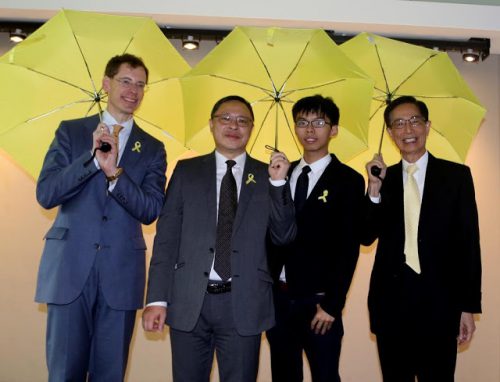
(Benny Tai, Joshua Wong and Martin Lee stand to Freedom House president Mark Lagon in Washington D.C. during a ceremony celebrating their role in the 2014 Hong Kong protests.)
After the protests ended, NED’s subsidiary Freedom House would even invite Martin Lee to an event titled, “Three Hong Kong Heroes,” which also included protest leaders Joshua Wong and Benny Tai. Lee would shuffle onto stage with an umbrella prop in hand, a virtual admission to his leadership role in the protests and confirmation that the NED’s previous statement was intentionally false.
NED would also deny providing funding to the movement, despite the fact that each member of the movement’s senior leadership were documented grantees of the NED and its various subsidiaries including Freedom house and the National Democratic Institute (NDI).
Toward the end of the 2014 protests, Western media organisations began making partial admissions that indeed the US was funding various segments of the movement’s leadership. Dan Steinbock in an October 2014 article in theSouth China Morning Post would enumerate the various confirmed accusations and concluded, “perhaps efforts at foreign interference are not entirely unfounded.” Considering this, claims that Hong Kong’s “anti-China activists” represent “democracy” or “localism” when they represent foreign interest, not those of the Hong Kong’s residents, nor source their support “locally,” are at face value contradictory.
It is also particularly ironic that this strain of political opposition predicates itself on establishing “independence” when in reality it seeks to return Hong Kong back under the influence of Anglo-American hegemony. This is particularly obvious considering the repetitious calls from such groups for “One Country, Two Systems,” the parting demands the British colonialists themselves tabled as a condition to returning the seized territory back to the Chinese.
Nathan Law —America’s, Not Hong Kong’s Candidate
The BBC made particular mention of Nathan Law, chairman of “Demosisto,” a political party that sprung forth from the US-funded “Umbrella Revolution.” According to the BBC, he was expected to win a constituency seat, but what the BBC fails to mention is his ties to the US State Department and the alarming conflicts of interest this poses considering his potential role in Hong Kong’s governance.
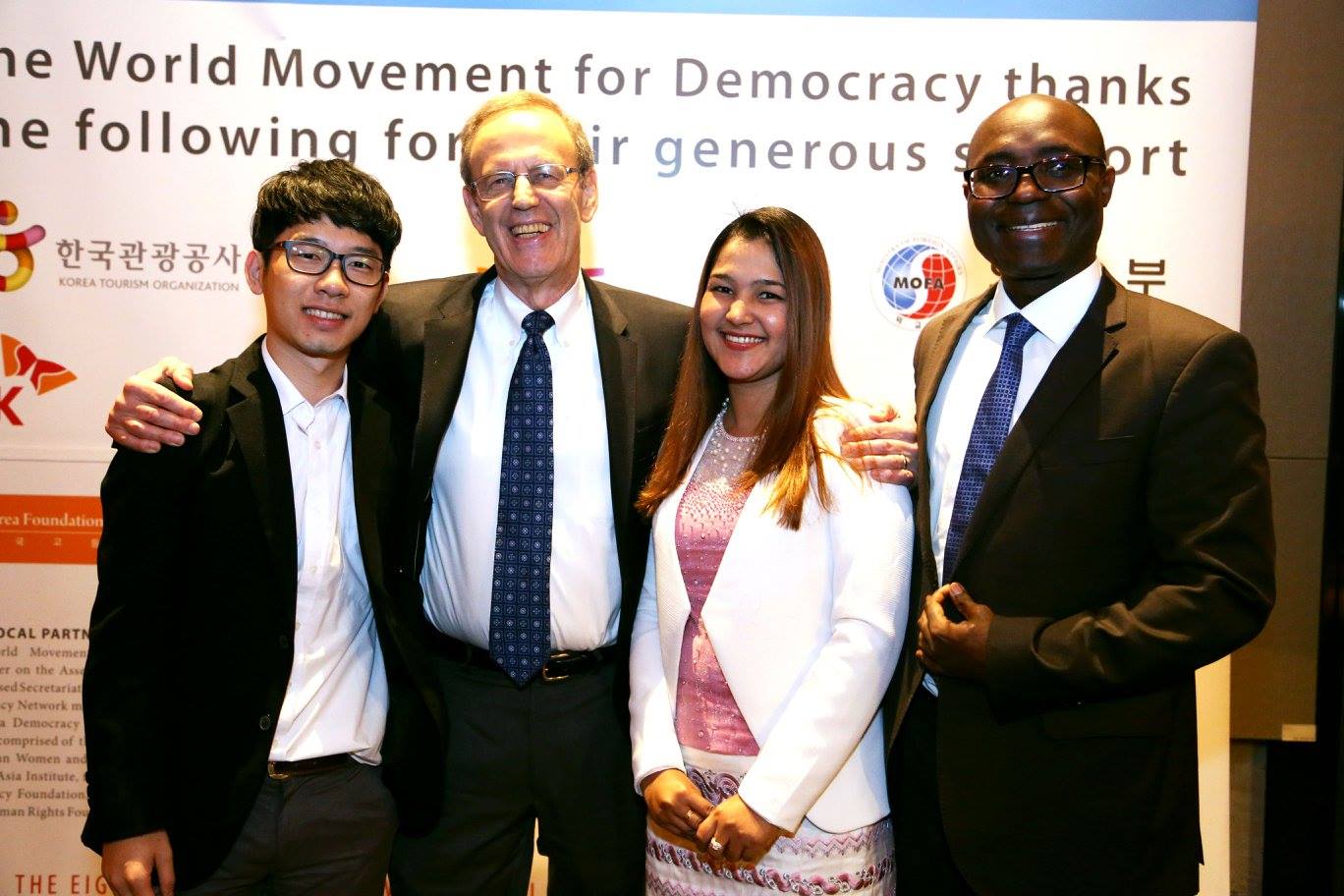
(Nathan Law, left, embraced by US State Department NED chairman Carl Gershman.)
The US State Department’s NED “World Movement for Democracy” website in a post titled, “Democracy Courage Tribute Award Presentation,” would write in regards to the award presented to Nathan Lee:
The Umbrella Movement’s bold call in the fall of 2014 for a free and fair election process to select the city’s leaders brought thousands into the streets to demonstrate peacefully. The images from these protests have motivated Chinese democracy activists on the mainland and resulted in solidarity between longtime champions of democracy in Hong Kong and a new generation of Hong Kong youth seeking to improve their city. The Hong Kong democracy movement will face further obstacles in the years to come, and their idealism and bravery will need to be supported as they work for democratic representation in Hong Kong.
Nathan Lee would even pose for pictures with NED chairman Carl Gershman, apparently unconcerned of the immense conflicts of interest invited by such compromising associations.
The BBC’s coverage of Hong Kong’s recent legislative elections attempts to spin inroads made by foreign interests as “localism” and “democracy” taking root in the former British colonial holding. While the BBC alludes to Beijing’s influence preventing further gains by the opposition, its intentional omission of which foreign interests are propping up the opposition reveals systemic and intentional bias in the BBC’s reporting. Such bias is echoed across Reuters, CNN, AP and AFP as well.
Democracy, in theory, is supposed to be the expression of the people. Hong Kong is part of China, thus those participating in its political process should represent Chinese interests. An opposition party that spends its time in Washington D.C. and maintains its growing networks through foreign cash do not represent China or the Chinese in a wider sense, and certainly not Hong Kong and its residents in a more local sense.
Foreign interests working through collaborators resembles a dictatorship from abroad more than anything resembling a “democracy” of the people, even if such a dictatorship drapes itself in public polls, elections and street mobs. That before, during and after the “Umbrella Revolution” each and every leader is tied to foreign interests, completely undermines the narrative that they represent “democracy” rather than the foreign interests transparently directing (then rewarding) them every step of the way.
Joseph Thomas is chief editor of Thailand-based geopolitical journal, The New Atlas.
Lebanese daily Assafir has recently published an article by journalist Mohammad Ballout. The article states that preparations and arrangements for an Assad-Erdogan meeting had begun since Erdogan’s visit to St. Petersburg on August 9th.
Interestingly, Erdogan’s visit also coincided with the visit of a senior Syrian delegation that included important security officials, including the head of the Syrian National Bureau General Ali Mamlouk, one of Assad’s most trusted advisors.
The article also states that the delegation’s visit taking place during Erdogan’s was no mere coincidence, and points to a very sharp turn that is about to take place in the Syrian War, in what is now its 5-year run.
The date of the final meeting between the two will apparently be set by General Mamlouk in his upcoming visit to Russia this Tuesday, whereat he is expected to meet with Russian and Turkish officials, whereas the actual agenda of the meet is to be finalized by Hakan Fidan, head of Turkish Intelligence.
The settlement proposed by Russia would include a tripartite national unity government that would include loyalists, independents, and representatives from the moderate Syrian opposition. They also offered the Saudis with an acceptable “out” by ruling out any major role to be played by Iran in the process.
The article also states that the Syrian delegation refused Turkey’s proposition of a sectarian division of government (akin to Lebanon), and instead proposed that Syrian President Bashar al-Assad would still preside over the most important ministries: Interior, Justice, Finance, Foreign Affairs, and Defense, whereas executive ministries would be shared with the opposition and the independents. Three vice presidents will also be selected from the three factions.
It has so also been agreed that after an 18-month period, some key constitutional amendments must take place (provided they do not alter any presidential powers), to be later followed by legislative and presidential elections.
Finally, The Syrian delegation has also made commitments to issue a general amnesty for all military defectors, provided they do not partake in any activities against the Syrian army.
Russian President Vladimir Putin is to hold a series of high-profile meetings with Turkish, British and Saudi leaders, among others, as part of his schedule for attending a summit in China in early September.
Yury Ushakov, a Kremlin aide, told reporters on Tuesday that Putin will hold talks with Turkish President Recep Tayyip Erdogan on September 3, when he is in Hangzhou, China, for the summit of the group of 20 world major economies, known as G20.
Ushakov said Putin’s meeting with Erdogan will take place as the “process of normalization of relations between the two countries is under way.”
Russia downgraded ties with Turkey last November, when Ankara shot down a Russian jet near the Syrian border. Relations began to improve in July after Ankara offered an apology as demanded by Putin. The two met this month in Russia, with reports suggesting they narrowed gaps on the conflict in Syria.
Ushakov said Putin will also hold a meeting with Saudi Arabia’s powerful deputy crown prince, Mohammed bin Salman, to discuss the crisis in Syria. He would not elaborate but said the meeting will come on September 4, the day when the Russian president will also hold an important meeting with British Prime Minister Theresa May to discuss a need for “a new impetus in bilateral relations.”
The official said a trilateral meeting of leaders from Russia, Germany and France, which had previously been agreed to discuss the conflict in Ukraine, was called off and instead Putin would meet separately with French President Francois Hollande and German Chancellor Angela Merkel on September 4 and 5, respectively. He noted that the sensitive meeting on Ukraine was cancelled because of new tensions that have emerged over Crimea, a former Ukrainian territory which rejoined Russia following a referendum in 2015.
Putin will also hold a much-anticipated meeting with Egyptian President Abdel Fattah el-Sisi, who will be in China as a guest to G20, Ushakov said.
The Labour party is on a perilous path. That it may end in an irrevocable split is the least of our worries. Of greater concern is the prospect of fighting in the streets. The party conference – scheduled for next month in the fissiparous city of Liverpool, but in some doubt because no security has yet been secured – will attract protesters, probably thousands of them. If it goes ahead, it could turn into the notorious Democratic Convention of 1968 in Chicago, a pitched battle outside the amphitheatre in which police used mace, tear gas and batons, and dozens were hurt including reporters and an observing British MP. Not surprisingly, the subsequent election was won by a Republican, Richard Nixon.
Whence this anger, this prospect of civil disobedience? First, consider a proposition: Jeremy Corbyn is the most popular politician in Britain. That the government and the media and the parliamentary Labour party are all in denial about it does not stop it being so. No leader has ever received a mandate comparable to Corbyn’s a year ago. No leader’s election has ever swelled the membership of any party like Corbyn’s has. No politician draws crowds like Corbyn does. No politician has so many groupings supporting him and promoting him on social media and through traditional word-spreading methods. Ignore the discredited opinion polls – Labour has done better than predicted in every actual electoral test since Corbyn became leader and is frequently gaining more than half the votes in this summer’s local by-elections. The support for Corbyn is unprecedented in modern British politics. Labour should be so lucky to have such a revered leader. Unelectable? Puh-lease.
Now consider the last eighteen months from the viewpoint, not of those in the Westminster bubble whose daily priority is gossiping and plotting, but of the Labour grassroots out in the sticks, where they want nothing more than a government that brings them relief from austerity and PR language and cronyism.
From the get-go, the media has sought to bring down Corbyn. Several academic studies of the coverage have demonstrated that the bias against him is unparalleled. The BBC’s charter-enshrined impartiality has been so lacking that unprecedented petitions were launched against the Corporation and its political editor. Corbyn’s supporters expected this, ruefully predicting headlines of the “Corbyn Punched My Granny” kind.
Less predictable was how comprehensively the parliamentary party would reject the democratic mandate of the membership. A swathe of frontbenchers declined to serve; many of them made the pharisaic gesture of boycotting Corbyn’s address at last year’s conference. Though Corbyn sought to embrace all shades of opinion in his shadow cabinet, the MPs reciprocated only fitfully. Incidentally, despite each of his (to date) three front bench teams being put together in the face of widespread opposition, non-cooperation and blank refusal, Corbyn is the only political leader in British history all of whose teams have featured a majority of women. Yet he is accused of privileging men.
The MPs and the party hierarchy stop at nothing to undermine his authority. Mass resignations and an overwhelming vote of no confidence proved futile because he has more mettle than they had imagined. Constant denigration dents neither his serenity nor his support in the party. Absurdly, he is held uniquely responsible for the failure of the campaign to remain in the EU. Yet he delivered 65 percent of Labour voters as against 39 percent of Tory voters secured by Cameron (Theresa May was largely silent) and 64 percent of the SNP’s voters (Nicola Sturgeon is hailed as a hero). Though the media favoured the Tories over Labour at a rate of 2:1 in the referendum coverage, Corbyn managed 123 media appearances on behalf of Remain, compared with 19 by Alan Johnson, the nominal leader of Labour’s campaign. Johnson could only deliver 33 percent of his own voters to the Remain vote and Owen Smith 47 percent of his. 75 percent of Corbyn’s constituents supported the stay side, the seventh highest rate in Britain. Lukewarm?
A Labour donor went to law to try to get Corbyn as the incumbent struck off the ballot paper in this year’s leadership re-election. The party’s National Executive Committee, flouting the universal understanding of the notion of “any other business” in meetings, hustled through an arbitrary restriction on those who could vote in that re-election. This was challenged in court by representatives of those excluded and found to be a breach of contract, but the appeal court reversed the judgment. Then it emerged that one of the appellate judges is a long-standing professional colleague of Tony Blair.
Such attempts to manipulate the rules strike the unconsulted membership as dishonest, shabby and against natural justice. But at the same time, that membership is insulted and patronised as though its views are somehow illegitimate and certainly not as reliable or significant as those of MPs. The members were dismissed first as naïve youngsters who don’t know the (rewritten) history of the party in the 1980’s, then as bullies and trolls, now as Trotskyite entryists, streaming back from years in the political wilderness and given “the oxygen of publicity” by Tom Watson. Those who left the party in the Blair years – about a quarter-million of them and not only over Iraq – are justly aggrieved to be blackguarded as the “enemy within” in the post-Chilcot party. They remember that Labour under Blair declined by 4 million in the popular vote and that the rot in Scotland began in those years.
Labour toppling Corbyn would create a perfect storm. The party membership has doubled on his watch. If he goes, that support will know that socialism in the Labour party is dead for generations. They won’t take it quietly. Owen Smith presents himself as a man of the left but everyone knows that he is a mere stalking horse for the New Labour programme that Margaret Thatcher herself named as her own greatest achievement. If the fallout is ugly, the parliamentary party will be unable to claim that they have not been warned.
W Stephen Gilbert is the author of ‘Jeremy Corbyn – Accidental Hero’.
Yemen’s Houthi Ansarullah movement has rejected an initiative put forth by US Secretary of State John Kerry to resolve the crisis in the war-torn country.
Mohammed Abdulsalam, the Ansarullah spokesman, said Saturday that the offer aims at depriving the Houthis of their arms in their fight of resistance against the Saudi invasion.
“Whoever has a greedy eye on our weapons, we will have a greedy eye on his life,” Abdulsalam wrote in a message posted on Facebook.
Kerry earlier called on Houthis to hand over their weapons including ballistic missiles and to pull back from the capital Sana’a. In return, the US secretary of state said Houthis and allies can have a share in Yemen’s future unity government.
The proposal comes amid reports that Houthis have stepped up missile attacks on border regions in Saudi Arabia over the past weeks. The attacks are carried out in reaction to deadly Saudi airstrikes that the regime in Riyadh says are meant to undermine Houthis and allies and to restore power to Abd Rabbuh Mansour Hadi, Yemen’s president who has resigned and fled the capital.
About 10,000 people have been killed across Yemen since the Saudi campaign started in March 2015.
The conflict in Yemen re-escalated after peace talks mediated by the United Nations and held in Kuwait collapsed earlier this month. The talks hit a snag after Houthis rejected a similar initiative proposed by the UN, saying it lacked any clear mechanism for transition of power.
Houthis had declared since the start of the talks in April that they were ready for disarmament and withdrawal from key areas they control in case a broad political agreement is reached in which Hadi would have no role.
With immaculate timing, Turkey unrolled its defiant ‘Plan B’ – billed as the Euphrates Shield operation – in northern Syria just as the US Vice President Joe Biden’s aircraft was about to land in Ankara’s Esenboga airport.
This must be one of the biggest diplomatic snubs that the US has suffered in a long while. And it is being administered by a NATO member country.
I had written yesterday in Asia Times that the US was making a monumental error of judgment by underestimating the grit of the Turkish mind to safeguard its supreme national interests at any cost. (See my article Turkey gets its act together on Syria.)
As I explained, the main purpose of the Euphrates Shield operation is to occupy the strategic border town of Jarablus in northern Syria and have a showdown with the Syrian Kurds (supported by US Special Forces and American air cover). The Kurdish militia had crossed the Euphrates river a few months ago and, contrary to American assurances, they are now moving westward to realise their dream of establishing a Kurdistan straddling Turkey’s border, stretching from Iraq to East Mediterranean coast. Turkey’s ‘red line’ has been breached.
A cat-and-mouse game has been going on between Turkey and the US. The latter was calculating that Turkey won’t act on the ground to confront the Syrian Kurds militarily, especially after the recent coup attempt of July 15, which weakened the military, plus the Russian presence in Syria.
President Recep Erdogan has decided to call the American bluff. In the early hours of the morning, Turkish artillery began pounding Jarablus (which is under the control of the Islamic State presently.) After about 2 hours of shelling, Special Forces crossed the border with F-16 jets providing air cover. The latest reports say a column of Turkish tanks is moving into Syrian territory. (Hurriyet )
The stunning part is that the Turkish incursion follows a tacit understanding with Iran (and Syria). Interestingly, Russian jets aren’t visible anywhere in the Syrian skies to stop the Turkish incursion, either. Surely, NATO is rocking, since it is highly improbable that Turkey took the US-led alliance into confidence over the Euphrates Shield operation, which, ironically, aims at destroying America’s best ally on the Syrian chessboard.
A team of Iranian intelligence officials had made a quick dash to Ankara yesterday morning to give the final touch to the concerted Euphrates Shield operation against the Syrian Kurds. The Iranian delegation presumably carried messages from Damascus for the Turkish side and returned to Tehran yesterday evening itself.
According to Iranian media reports, the deputy head of the Turkish intelligence had paid a secret visit to Damascus on Sunday. Prior to that, Turkish Foreign Minister Mavlut Cavusoglu had a stopover in Tehran on Thursday for 5 hours to personally coordinate with the Iranians – avoiding phone conversations that could have been tapped by the American electronic intelligence system. Clearly, we are witnessing the first tangible signs of a super-secret deal between Turkey and Iran to further their common agenda of preventing the emergence of a Syrian Kurdistan backed by the US and Israel connecting the Kurdish homelands between the Iraqi Kurdistan and Eastern Mediterranean. (Asharq Al-Awsat)
Turkey fears that a Syrian Kurdistan will inexorably boost the separatist Kurdish insurgency on its territory. Iran fears that Kurdistan may turn out to be the playpen of American and Israeli intelligence for undertaking subversive activities against it. Equally, Iraq and Syria also stand to lose since the creation of a Kurdistan will be at the cost of their own national unity and territorial integrity. A convergence on the Kurdish problem brings together Turkey, Iran, Iraq and Syria.
Indeed, for the first time in the Syrian civil war, government forces have begun attacking Kurds. Last week the US warned Damascus not to launch aerial attacks on the Syrian Kurdish militia on the specious plea that its Special Forces are ‘embedded’ with the Kurds. (Telegraph )
If Biden had hoped for a trade-off with Erdogan over the Turkish concerns regarding Kurds, the latter is literally showing the middle finger. The Euphrates Shield is a stark message to the US that Ankara no longer depends on American goodwill or help.
Erdogan is literally signalling to Biden, ‘No more waffling, Buddy, just send Fetullah Gulen back to us’. Now, that is putting Washington in a fix. Erdogan has repeatedly warned that he will take Gulen’s extradition as the litmus test of US intentions toward Turkey and the raison d’etre of the Turkish-American alliance itself. On the other hand, how can the US possibly allow the extradition of Gulen, who has been the CIA’s longstanding ‘strategic asset’ in Muslim countries?
Biden enjoys a fabulous reputation within America’s political class as wheeler dealer par excellence. His reputation faces an acid test through the coming 12 hours. He’s just about sitting down with the Sultan at Ak Saray (White Palace) — Erdogan’s 1000-room palace in the dark and lovely woods outside Ankara — for a ‘frank’ conversation.
Former U.S. ally and current ally of the Houthi rebels, Ali Abdullah Saleh, said his future government would be ready to open naval and air bases for Russia.
A newly-formed governing council in Yemen could work with Russia to “fight terrorism” by allowing Moscow use of the war-torn country’s military bases, Yemen’s former president said on Sunday.
Ali Abdullah Saleh, a former counterterrorism ally of the U.S. who was toppled by mass protests in 2011, told state-owned channel Russia 24 that Yemen was ready to grant Moscow access to air and naval bases.
“In the fight against terrorism we reach out and offer all facilities. Our airports, our ports… We are ready to provide this to the Russian Federation,” Saleh said in an interview in Sanaa.
The ex-strongman may lack the clout to implement such an offer. But officials from the party he heads now run a political council that controls much of the country along with the Houthi movement. For the first time last week Iran let Russian jets take off from its territory to bomb armed groups in Syria.
Russia is the only major country that maintains a diplomatic presence in Yemen where a 16-month war between a Saudi-led coalition and the Houthi rebels has killed over 6,500 people and raised the prospect of famine in the Arab World’s poorest country.
The war has allowed Islamist militants including al-Qaida and the Islamic State group to flourish, even though the United States has for years launched drone strikes against groups in Yemen.
Russia abstained from a United Nations Security Council resolution in 2015 that imposed an arms embargo on the Houthi rebels.
Moscow’s relations with Yemen date back decades and until the break-up of the USSR, thousands of Soviet military advisers and trainers worked in the formerly-independent south.
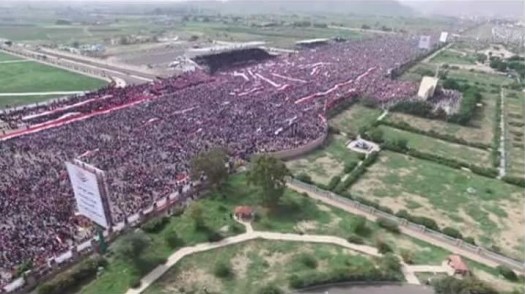
On Saturday tens of thousands of Yemenis rallied in the capital to show support for the Houthi-led bloc as the head of the group’s new governing council vowed to form a full government in the coming days.
Yemen’s former President Ali Abdullah Saleh says the new government in the country is ready to cooperate with Russia against terrorism by allowing Russian access to Yemeni military bases.
“Russia is the closest to us and we extend our hand to Russia to cooperate in the field of combating terrorism,” Saleh said in an interview with state-run Russia 24 TV channel on Sunday.
He said Yemen was ready to open the country’s military bases to Russia.
“We provide all the facilities in our bases, airports and sea ports. We are ready to provide all facilities to the Russian Federation,” he said.
He said, however, that such cooperation would not mean Russia would be fighting alongside Yemeni forces against Saudi forces waging war on Yemen.
‘Iran has no presence in Yemen’
Saleh also rejected claims that Iran is interfering in Yemen’s internal affairs.
He said Saudi Arabia has launched the war on Yemen under the pretext of defending Saudi national security against Iran, emphasizing that the pretext is “baseless.”
“Iran has no presence in Yemen at all,” he said, adding that, “The international intelligence services know that Iran is not present in Yemen.”
“We are not against Iran; Iran is an Islamic brotherly country. We don’t have any agreement or coalition with her currently,” he said, referring to Iran.
Yemen has seen almost daily military attacks by Saudi Arabia since late March 2015, with internal sources putting the toll from the bloody aggression at about 10,000.
In late July, Yemen’s Houthi Ansarullah movement and Saleh’s General People’s Congress party decided to establish the Supreme Political Council to run the country. It was formally launched on August 6, when the Houthis and Saleh’s faction announced that they both had an equal share in the 10-member body.
Iranian President Hassan Rouhani on Sunday unveiled the country’s long-awaited Bavar-373 air defense missile system with characteristics similar to Russia’s S-300, according to the local media reports.
On the National Defense Industry Day, which is celebrated in Iran on August 21, Rouhani, accompanied by Defense Minister Brigadier General Hossein Dehqan, visited the exhibition at the Iran Aviation Industries Organization (IAIO) at the Defense Ministry, which showcased the latest achievements in the air defense industry, including the domestically-built Bavar-373 air defense system.
The Iranian president inaugurated the Bavar-373 (meaning ‘Belief’), which was commissioned in February 2010 amid the suspension of a deal with Russia on deliveries of five S-300 systems over the adoption of UN Security Council sanctions on Iran.
The long-range mobile Bavar-373 air defense system has been designed and constructed by Defense Ministry scientists and experts in cooperation with the country’s Khatam al-Anbia Air Defense Base and other scientific and investigative centers.
The home-grown system was successfully test-fired in August 2014. It is similar to the Russian S-300 and is capable of hitting targets at a high altitude.
The new system uses a phased array radar like Russian 96L6 radar for tracking aerodynamic targets and ballistic missiles in medium to long ranges, mounted on the ZAFAR heavy truck.
In May, Dehghan announced that Iran had completed development of the domestically-produced Bavar-373 air defense system, with mass production expected to be launched later in 2016.
Hassan Rouhani also observed the latest achievements and developments in air defense technology, including fighter and transport aircraft, helicopters and unmanned aerial vehicles (UAVs).
The president was also briefed on the progress in the designing and manufacturing of the first national Turbojet engine.
On Saturday, Iranian Defense Minister Brigadier General Hossein Dehqan said the country is not going to purchase the Russian-made S-400 air defense missile system, though Moscow has offered to sell it to Tehran.
During his press conference in Tehran, the defense minister confirmed that Russia has offered Iran “S-400 and some other systems,” but Tehran currently has no plans to order them.
He also commented on the S-300 system, which Moscow had undertaken to sell to Tehran under a 2007 contract.
Dehqan said Iran has voluntarily terminated a lawsuit against Russia after the delivery of the missile system to Iran began.
However, he added, Iran reserves the right to legally pursue the case if the full implementation of the deal runs into any problems.
Iran has received the bulk of the S-300 missile system, the minister noted, adding that the remaining parts are expected to be delivered within a month.
In exceptionally assertive remarks on Saturday, Iranian Defence Minister Gen. Hossein Dehqan said in Tehran that more numbers of Iranian military bases could be made available to Russia, depending on operational requirements, in addition to the use of the Hamadan air base by Russian bombers currently.
He added that there is no time limit set to the access given to Russian aircraft to operate out of Hamadan military base. Dehqan disclosed:
Russian jets and bombers are free to undertake repairs and load ordnance in the Iranian base;
Iran’s military cooperation with Russia in this respect is “strategic” in nature;
The cooperation stems from a defence pact to upgrade military cooperation “so as to act in more harmony, particularly in the fight against terrorism”;
The use of Iranian military bases by Russia is a topic that is beyond the purview of the Majlis (implying it is based on decision by the Supreme Leader);
The Iran-Russia alliance aims to bring an early end to the Syrian conflict.
The big question will be whether an Iran-Russia mutual security alliance could be in the making – something akin to the Indo-Soviet Treaty of 1971.
A Moscow pundit Prof. Dmitry Yevstafyev tiptoed around the explosive theme in the weekend. He made the following key points in an opinion-piece that is presumably intended for the Western audience:
There is “still no talk of a full-fledged military union” between Russia and Iran;
However, the use of Hamadan is not a stand-alone event, either;
Nor is it to be seen as a mere tactical tie-up with the narrow objective of liberating Aleppo;
On the contrary, it rests on a solid foundation that has been laid carefully in political, military and economic terms in the Russian-Iranian relations through recent period, which in turn is predicated on a cool assessment by Moscow that the US-Iran ‘honeymoon’ has become a thing of the past;
Russia and Iran have created together a “completely new context” in the region and aspire to be “decisive players”;
Russia has signalled to Washington that: a) its partnership with Iran is a “strategic priority”; b) Moscow is no longer bound by US’ ‘red lines’ as regards strategic ties with Iran; c) if Hamadan tie-up is successful, “moves that will lead to an unprecedented convergence between Iran and Moscow are also possible in future”; and, d) Washington cannot stop Moscow in its tracks in the priority task of “destroying the Syrian opposition in Aleppo”;
Russia’s tie-up with Iran has emboldened Beijing to shed its reticence and to move to “expand its assistance” to the Syrian regime with the intention to “participate in future political and economic processes”.
To my mind, the above is an accurate assessment of the trends that have surfaced. This can only mean that the balance of power in the Middle East is phenomenally shifting.
India needs to take serious note even as Minister of State MJ Akbar arrives today in Damascus on a rare visit by an Indian dignitary. (Where China goes, can India be far behind?)
To be sure, Moscow is moving speedily to create new facts on the ground before the next US president takes over the reins of the US’ Middle East policies. Moscow aims to bolster Iran’s defence capability to a point that a military strike on that country becomes a non-option for the US and/or Israel.
Conceivably, we cannot rule out that there would have been some discussions already between Moscow and Tehran regarding a mutual security alliance in the event of a military threat from a new US administration dominated by neoconservative ideologues (which could be the case in a Hillary Clinton presidency.)
Russia is speeding up the delivery of the S-300 missile system to Iran. Reports from Tehran say that the delivery will be completed within a month from now.
The Israeli military intelligence sources have been cited by Debka as claiming that Russia has deployed the formidable S-400 missile system as well in Hamadan. (Despite Iranian denials, this should not cause surprise since pictures show an unspecified number of Tu-22M3 strategic ‘Backfire’ bombers – capable of carrying nuclear missiles – and Su-34 strike fighters parked in the Hamadan air base; and it is inconceivable that a solid Russian air defence system is not deployed alongside.)
The import of the Russian-Iranian strategic congruence is sinking in regionally. Over the weekend, for the first time Syrian jets attacked Kurdish forces in northern Syria (which are protected by the US Special Forces) despite American warnings to stay clear. (Reuters )
Equally, Turkish Foreign Minister Mavlut Cavusoglu had a 5-hour meeting with his Iranian counterpart Mohammad Zarif in Tehran on August 18 to follow up on Zarif’s talks with the Turkish leadership in Ankara on August 12. Cavusoglu’s hurried trip to Tehran aimed at Turkish-Iranian coordination in the move against Kurds.
Ankara will be pleased with the prospect of Damascus taking on the Kurds, finally. In remarks Saturday in Ankara, Prime Minister Binaldi Yildirim strongly hinted at Turkey moving on the ground to prevent the emergence of a Kurdistan enclave in northern Syria (with tacit US backing). Turkey has shared interest in this regard with Tehran and Damascus.
If so, Ankara, Tehran and Damascus may find themselves on the same page sooner than one would have expected. Moscow cannot but be pleased with this prospect.(Sputnik)
People living in the West don’t need their governments to tell them who their enemy is. Not when they have an obliging intelligentsia to do it for them.
A quick browse of the non-fiction shelves in your local UK high street bookshop offers prospective customers a banquet of anti-Russian books in which no superlative or pejorative is spared when it comes to depicting Russia as the epitome of evil and with its President, Vladimir Putin, a composite of every Bond villain the decades-long movie franchise has given us. Just consider some of the titles.
The New Tsar: The Rise and Reign of Vladimir Putin
Red Notice: How I Became Putin’s No. 1 Enemy
Putin’s Kleptocracy: Who Owns Russia?
The Invention of Russia: The Journey from Gorbachev’s Freedom to Putin’s War
Winter is Coming: Why Vladimir Putin and the Enemies of the Free World Must be Stopped
2017 War With Russia
By now you should get the idea: Russia is the contemporary bête noire of Western liberal commentators and an intelligentsia that has extended itself in parroting the views of their own governments, happily abandoning their critical faculties in the process.
While conformity may be the enemy of critical and independent thought, for such people it is a religion. Acceptance and respectability, after all, requires nothing less. How else are they to secure those newspaper columns, book deals, and invites to dinner parties and literary functions without life wouldn’t be worth living?
The history of Western colonialism and wars of conquest is replete with its cheerleaders in the form of newspaper columnists, novelists, and writers.
During the high water mark of the British Empire, Rudyard Kipling was its unofficial chronicler. His most famous poem is White Man’s Burden, which he wrote as a celebration of the takeover of the Philippines by the United States in 1898.
“Take up the White Man’s burden-
Send forth the best ye breed-
Go bind your sons to exile
To serve your captives’ need;
To wait in heavy harness,
On fluttered folk and wild-
Your new-caught, sullen peoples,
Half-devil and half-child.”
In modern times the now departed British writer and journalist Christopher Hitchens was perhaps most prominent when it came to carrying on the tradition of providing literary and journalistic muscle for the projection of Western imperial power. From a withering critic of the West and Western foreign policy in the 70s and 80s, Hitchens underwent a slow but sure metamorphosis throughout the nineties. It reached its apogee after 9/11, when he enthusiastically embraced the wars unleashed by George W Bush.
For him, and other members of the liberal literati, US imperialism and militarism was suddenly a force for good and human progress in the world. The Stealth bombers, Abrams tanks, battleships, aircraft carriers and legions of kevlar-helmeted marines which at one time stood for death and destruction in the name of US hegemony, now constituted the vanguard of a neo-enlightenment, spreading civilization and democracy to the dark peoples of the world.
Here was Hitchens’ advice to the US and British military leaderships, published in the pages of the UK’s Daily Mirror newspaper, just before the 2003 invasion of Iraq:
“The best case scenario is a rapid attack by precision-guided weapons, striking Saddam’s communications in the first hours and preventing his deranged orders from being obeyed. Then a massive landing will bring food, medicine and laptop computers to a surging crowd of thankful and relieved Iraqis and Kurds. This could, in theory, all happen.”
After the invasion, with the resulting slaughter and carnage at its height, Hitchens had this to say this during a speech he gave at Kenyon College, Ohio in 2004 on the destruction of Fallujah, “The death toll is not nearly high enough… too many have escaped.”
As the Australian journalist and documentary makes John Pilger wrote:
“Many journalists now are no more than channelers and echoers of what George Orwell called the ‘official truth’. They simply cipher and transmit lies.”
The problem is, of course, that those lies are being told in pursuit of a very dangerous attitude when it comes to Russia and its government. Allied to the increasingly bellicose stance of NATO in Eastern Europe, we are talking the prospect of direct military conflict, the consequences of which you would think would be self-evidently too awful to contemplate. But then this assumes reasoned and rational minds, the kind clearly absent in the case of a large section of the aforementioned Western liberal intelligentsia.
It really does defy belief that Putin and Russia are being depicted as a threat to the West when there are no Russian military bases on America’s border; no troops stationed in either Mexico or Canada, no Russian navy ships patrolling the Gulf of Mexico, and no missile defense shields either. Nor are there Russian troops deployed within striking distance of the UK, France, or Germany.
Yet such details are of trifling importance compared to the more important task of raising the Russian bogeyman as a convenient catch-all when it comes to explaining everything that’s wrong with the world.
But then again, they do say that if you can’t beat them join them. So with my bank balance and the prospect of mainstream acceptance in mind, I think I should add my own offering to the list. And given that sensationalism is the order of the day, the title will be: Vladimir Putin ate my hamster.
After three Americans from the US embassy were accused of espionage and tossed out of Nicaragua, a protest was lodged in Managua against this «unwarranted» decision, and the Nicaraguan government was warned that the relationship between the two countries would suffer inevitable damage in tourism, trade, and investment from the US. The State Department issued notice that Americans might face threats in Nicaragua. The war of propaganda waged against Daniel Ortega’s regime has become so ferocious that political commentators are drawing conclusions about Washington’s plans to «end the dictatorship» in Nicaragua once and for all.
The Democratic Initiative of Spain and the Americas (IDEA), an international forum, was created in April of 2015 in order to launch attacks on Ortega and other Latin American «populist» leaders, and Washington was responsible for choosing its members: the chosen favorites include – Álvaro Uribe of Colombia, Alejandro Toledo of Peru, Lucio Gutiérrez of Ecuador, Felipe Calderón of Mexico, Óscar Arias of Costa Rica, José María Aznar of Spain, and others. These politicians work closely with the United States and continue to defer to Washington, even after leaving office.
IDEA released a statement in August that was highly critical of Nicaragua and which reads like something out of the Cold War: «The international community finds the violation of the democratic system in Nicaragua so worrisome that the former Ibero-American heads of state and of government have decided to ask the OAS and the EU to maintain critical oversight of these serious violations of democratic and constitutional order». And it goes on to say that statements by the members of IDEA «may be preceded by certain political and diplomatic actions, as provided by international law … in order to defend democracy and reestablish it where it has been compromised, as in the current example of Nicaragua».
In its attacks on the Nicaraguan government, the US National Security Agency uses materials obtained over the course of years of electronic surveillance of President Ortega, as well as his family and inner circle. Its deft use of such materials makes it possible to circulate all sorts of drivel that is designed to defame politicians who have been marked for public retaliation. Almost every «populist bloc» leader in Latin America is currently up against such cheap shots – Inácio Lula da Silva, Dilma Rousseff, Cristina Fernández de Kirchner, Rafael Correa, Nicolás Maduro, Evo Morales, and others.
Daniel Ortega has led his country for 13 years. He has been elected three times: in 1985, 2006, and 2012, and no one is predicting that he will have any opponents in the upcoming Nov. 6 election. Ortega’s political rivals are feuding amongst themselves. Despite the behind-the-scenes efforts of the US embassy, is has not been possible to consolidate the opposition in the run-up to the election. For this reason, the US has launched a blitzkrieg of propaganda against Daniel Ortega, his wife Rosario Murillo, and their grown children. The leitmotif of these «revelations» is a familiar one – some hogwash about the abuse of power, corruption, multi-million-dollar accounts in overseas banks, and the ownership of foreign real estate. The US continues to harp on the supposed parallels with the family of the dictator Anastasio Somoza; «Somoza García amassed a huge fortune, making him and his family some of the richest people in all of Latin America. By the time of his death in 1956 he left his children $200 million, which they managed to triple within a few years. His son, Anastasio Somoza DeBayle, owned 130 real estate holdings, as well as estates, residences, and tracts of land. He was owner of an airline (Líneas Aéreas de Nicaragua), a television station (Televisora de Nicaragua), the San Uribe and San Albino gold mines, and more».
One might well ask, what does Somoza’s wealth have to do with Ortega and his family? Nevertheless, the author of the article writes: «As is usual for totalitarian regimes of the past, there is no reliable information about the finances of the Nicaraguan president and his wife. That knotty question is top secret». Although there is no «reliable information», he goes on to claim that the family owns the Distribuidora Nicaragüense de Petróleos chain of gas stations, plus media outlets including four TV channels, radio stations, newspapers, websites, etc. In addition, Ortega has control over the project to build a transoceanic canal that would link the Pacific and Atlantic oceans, the cost of which is estimated at $50 billion. That mega-project has the backing of the Chinese entrepreneur Wang Jing.
Naturally of course the Chinese-Nicaraguan canal mega-project was met with hostility by Washington. They don’t want anything competing with the updated Panama Canal. And as for the company Distribuidora Nicaragüense de Petróleos, that is a model for energy-sector cooperation between Venezuela and Nicaragua – not some private racket that is allegedly being used by Ortega’s friends for their personal enrichment.
During the years when the Sandinistas were in the opposition, Ortega was constantly faced with the problem of getting access to the media. His attempts to communicate his views to the public invariably ran up against an information boycott. But now the situation has changed drastically. Ortega has turned the tide to his own advantage. The government controls hundreds of Internet websites, as well as the news services Nicaragua Triunfa and Nicaragua Comovamos. Dozens of provincial radio stations work on the side of the government, as do influential national stations like Radio Sandino, La Nueva Radio Ya, Radio Nicaragua, and Radio Primerísima. The work of the government and the president gets favorable coverage by TV channels that are managed by members of the Ortega family – Canal 13, Multinoticias Canal 4, Canal 8, and Telenica Canal 10. The pro-government channels also include Canal 23, Canal Extra Plus, 100 % Noticias, and others. None of the «leftist» Latin American presidents enjoy such an effective mouthpiece for information and propaganda as Ortega.
Yet despite the accusations that it is a dictatorship, the country has no censorship restrictions. The opposition and, consequently, the US embassy have every opportunity to proselytize there. Popular newspapers like La Prensa and El Nuevo Diario and the weekly Confidencial are employed with particular vigor toward this goal. Ortega responds immediately, using fiercely anti-imperialist and anti-American terminology. Nor does he keep silent when Washington directs attacks against Nicaragua’s allies. Ortega’s speeches in support of Russia, Cuba, and friendly governments in Ecuador, Bolivia, and other countries resonate far and wide.
The ideological underpinnings of Ortega’s international policy have remained unchanged throughout recent years: they consist of a fundamental rejection of American hegemony, coupled with patriotism, nationalism, and «socialism with a Nicaraguan face», plus support for the Latin American path to a true people’s democracy. This 70-year-old politician has never altered his revolutionary convictions. That said however, he is a flexible strategist who understands that a superpower can strike at any time and that the US is still unpredictable and dangerous. As the leader of a small country he has no choice but to maneuver, and he manages to do so without compromising his principles.
In December 2015 the CIA launched into yet another act of provocation against Nicaragua. Under the influence of inflammatory media reports about the Obama administration’s possible suspension of the preferential treatment Cuban migrants receive upon entering the US, hundreds rushed to emigrate from that island nation. The route suggested by the «well-wishers» from Miami: first by air from Havana to Ecuador (no visa needed), then by bus across several borders into Mexico, and from there into the US. Nothing to worry about, or so it would seem. However, Nicaraguan counter-intelligence got its hands on some information about CIA plans to use those migrants to stir things up. After arriving in Nicaragua from Costa Rica, their onward path – through Honduras, Guatemala, and Mexico – was to be closed, and the Cuban migrants would find themselves stranded in Nicaragua for a long time. As envisioned by the CIA, they were supposed to be the fuse to the ticking bomb of the country’s destabilization. Therefore, Daniel Ortega’s decision was emphatic: there should be no back doors, and the ones who came up with the whole migrant scheme should be the ones to deal with the mess! Demands that the migrants be admitted were hurled at that «inhumane regime» from all manner of human rights organizations patronized by American foundations. The members of the Central American Integration System (SICA) went public with their criticism of Ortega’s decision. The migrants themselves, as if on cue, tried to crash through the Nicaraguan border, with children and pregnant women planted in their forward ranks. The Nicaraguan government needed time to force the fugitives into Costa Rica. Tensions eased by February-March 2016. Ortega’s government refused to be blackmailed, and Washington had to quietly furnish its ally Costa Rica with financial assistance in order to provide for the migrants and evacuate them by air…
As the date of the Nicaraguan presidential election nears, new acts of provocation should be expected from US intelligence agencies and the American embassy. Ambassador Laura Dogu works assiduously with the Nicaraguan business community, persuading them that the ongoing Sandinista administration and its policy of «socialism with a Nicaraguan face» can only hurt their business interests.
The US embassy has conspicuously stepped up its work with the media and activists from NGOs and indigenous organizations, as well as the country’s youth. US intelligence agencies, diplomats, staffers with USAID (which is in reality a branch of the CIA), and Peace Corps volunteers are pinning their main hopes on Nicaragua’s youth, viewing that demographic as the most promising in the struggle against the Nicaraguan regime.
The Constitution offers no barriers to President Ortega’s reelection. He has been accused of taking control of executive, legislative, and judicial power, but the main factor ensuring his re-election is his broad popular support, which Ortega enjoys thanks to the social programs established during his years in office. Despite his socialist, anti-imperialist views, the president has many supporters in the country’s business community.
The November election forecasts don’t look too auspicious for the conspirators in the US embassy: Daniel Ortega is once again going to be elected president.
Brazil’s suspended President Dilma Rousseff has pledged to hold early elections if she survives a vote on her removal from office in an impeachment trial that is expected to conclude this month.
Rousseff, accused of illegally manipulating finances to hide a growing public deficit ahead of her reelection in 2014, is due to stand trial in the Senate on August 25, four days after the Rio Olympics end.
The Globo news organization reported that the actual judgment vote could take place between August 30 and 31.
In a letter to the federal Senate and Brazilian people that she read out on Tuesday, Rousseff said Brazil’s political and economic problems could only be resolved “through popular vote in direct elections.”
“The full restoration of democracy requires that the population be the one to decide what is the best way to expand governability and perfect the Brazilian political and electoral system,” Rousseff said.
“It’s the only way out of the crisis,” she wrote.
Rousseff admitted she had made mistakes, but said she had done nothing worthy of impeachment.
“I have listened to the tough criticisms of my government, for the errors committed,” she said. “I accept these criticisms with humility and determination so that we can build a new way forward.”
Rousseff further said that forcing her out through impeachment amounts to “an unequivocal coup.”
Rousseff impeachment: A timeline
October 9, 2015: Brazil’s federal audit court rules that Rousseff broke the law while managing the 2014 budget, paving the way for opposition groups to argue that the leader should be impeached.
December 2, 2015: Eduardo Cunha, the president of the Chamber of Deputies, agrees to start anti-Rousseff impeachment proceedings.
December 11, 2015: Rousseff presents a petition before the Supreme Court to stop the process.
March 17, 2016: The Chamber of Deputies, the lower house of the Brazilian National Congress, elects a special impeachment commission, which has a majority derived from the ruling coalition, including the Workers’ Party and the Democratic Movement Party (PMDB).
March 29, 2016: The PMDB leaves the ruling coalition, in a split that hurts Rousseff’s chances of derailing impeachment proceedings.
April 6, 2016: The special impeachment commission publishes a report recommending Rousseff’s impeachment.
April 11, 2016: The impeachment commission decides, in a 38 to 27 vote, to let the Chamber of Deputies vote on the president’s impeachment.
April 15, 2016: The Brazilian Supreme Court rejects Rousseff’s motion to stop the process.
April 17, 2016: A total of 367 out of 513 legislators in the parliament’s lower house vote in favor of Rousseff’s impeachment.
May 12, 2016: Senators vote 55 to 22 to suspend the president for 180 days and hold an impeachment trial in the Senate, the upper house of National Congress, with Rousseff slamming the vote and saying she was “being judged unfairly.”
Michel Temer becomes interim president and announces his new cabinet.
May 24, 2016: The interim government is rattled by a leaked audio tape suggesting a plot against Rousseff, a scandal that forces a number of key ministers in the new cabinet to resign.
June 28, 2016: An investigation by a team of independent auditors, comprised of career Senate budget technicians, concludes there is no evidence that Rousseff participated in budget manipulation.
July 18, 2016: Cunha resigns less than three months after he orchestrated the impeachment.
August 16, 2016: The Senate votes to hold an impeachment trial for Rousseff, pushing her one step closer to dismissal from office. Her trial is due to take place in the week after the Olympics closing ceremony.
A week ago, the Brazilian Senate voted to hold an impeachment trial for the country’s first female president.
A two-thirds majority of the Senate, or 54 votes, would be needed to see her permanently removed from office.
If the trial acquits Rousseff, she will be allowed to serve out her term until 2018. But if it removes her permanently, then acting President Temer will become the full-fledged president until the next election in 2018.
Rousseff is also under fire over a graft scandal at state oil company Petrobras, where she was the manager before taking office as president in 2010.
The embattled leader has denied the allegations and repeatedly asserted that she has fallen victim to a plot by the extreme right.
In recent months, Brazilians have held numerous counter rallies in support of and against the impeachment process.
The US Democratic Party has embraced a transgender agenda that amounts to “the normalization of sadism,” author A.J. Rice has said, warning that radical trans policies would return if the party is allowed to regain power.
Speaking to RT’s America First host Scotty Nell Hughes about his new book, ‘The Curse of the Bearded Lady: How the Trans Mafia Whacked American Sanity’, Rice argued that activists have gained significant influence in schools, medicine, and corporate America while people who questioned the agenda have faced pressure to stay silent.
The author described the “trans mafia” as the sprawling network of people and institutions that have helped the movement gain influence. He singled out parts of academia, wealthy backers, and corporations, and stated that providers of transition-related treatment also have a financial incentive to keep young people in their care indefinitely.
Rice argued that the consequences of these policies ultimately fall on children who are being drawn toward gender-affirming medical treatments and on girls who are expected to share locker rooms or compete in sports with biological males.
He noted that while voters rejected the Democrats’ approach to gender in 2024, the party, which has been “captured by madness,” has since only doubled down and is seeking what is effectively “the normalization of sadism.” … Full report
This site is provided as a research and reference tool. Although we make every reasonable effort to ensure that the information and data provided at this site are useful, accurate, and current, we cannot guarantee that the information and data provided here will be error-free. By using this site, you assume all responsibility for and risk arising from your use of and reliance upon the contents of this site.
This site and the information available through it do not, and are not intended to constitute legal advice. Should you require legal advice, you should consult your own attorney.
Nothing within this site or linked to by this site constitutes investment advice or medical advice.
Materials accessible from or added to this site by third parties, such as comments posted, are strictly the responsibility of the third party who added such materials or made them accessible and we neither endorse nor undertake to control, monitor, edit or assume responsibility for any such third-party material.
The posting of stories, commentaries, reports, documents and links (embedded or otherwise) on this site does not in any way, shape or form, implied or otherwise, necessarily express or suggest endorsement or support of any of such posted material or parts therein.
The word “alleged” is deemed to occur before the word “fraud.” Since the rule of law still applies. To peasants, at least.
Fair Use
This site contains copyrighted material the use of which has not always been specifically authorized by the copyright owner. We are making such material available in our efforts to advance understanding of environmental, political, human rights, economic, democracy, scientific, and social justice issues, etc. We believe this constitutes a ‘fair use’ of any such copyrighted material as provided for in section 107 of the US Copyright Law. In accordance with Title 17 U.S.C. Section 107, the material on this site is distributed without profit to those who have expressed a prior interest in receiving the included information for research and educational purposes. For more info go to: http://www.law.cornell.edu/uscode/17/107.shtml. If you wish to use copyrighted material from this site for purposes of your own that go beyond ‘fair use’, you must obtain permission from the copyright owner.
DMCA Contact
This is information for anyone that wishes to challenge our “fair use” of copyrighted material.
If you are a legal copyright holder or a designated agent for such and you believe that content residing on or accessible through our website infringes a copyright and falls outside the boundaries of “Fair Use”, please send a notice of infringement by contacting atheonews@gmail.com.
We will respond and take necessary action immediately.
If notice is given of an alleged copyright violation we will act expeditiously to remove or disable access to the material(s) in question.
All 3rd party material posted on this website is copyright the respective owners / authors. Aletho News makes no claim of copyright on such material.