Russian Manipulation of Reactor Fuel Belies U.S. Iran Argument
By Gareth Porter | IPS | May 19 2014
WASHINGTON – In the stalemated talks between the six powers and Iran over the future of the latter’s nuclear programme, the central issue is not so much the technical aspects of the problem but the history of the Middle Eastern country’s relations with foreign suppliers – and especially with the Russians.
The Barack Obama administration has dismissed Iran’s claim that it can’t rely on the Russians or other past suppliers of enriched uranium for its future needs. But the U.S. position ignores a great deal of historical evidence that bolsters the Iranian case that it would be naïve to rely on promises by Russia and others on which it has depended in the past for nuclear fuel.
Both Iran and the P5+1 are citing the phrase “practical needs”, which was used in the Joint Plan of Action agreed to last November, in support of their conflicting positions on the issue of how much enrichment capability Iran should have. Limits on the Iranian programme are supposed to be consistent with such “practical needs”, according to the agreement.
Iran has argued that its “practical needs” include the capability to enrich uranium to make reactor fuel for the Bushehr nuclear power plant as well as future nuclear reactors. Iranian officials have indicated that Iran must be self-sufficient in the future with regard to nuclear fuel for Bushehr, which Russia now provides. It announced in 2008 that another reactor at Darkhovin, which is to be indigenously constructed, had entered the design stage.
Former senior State Department official on proliferation issues Robert Einhorn has transmitted the thinking of the Obama administration about the negotiations in recent months. In a long paper published in late March, he wrote that Iran had “sometimes made the argument that they need to produce enriched uranium indigenously because foreign suppliers could cut off supplies for political or other reasons.”
The Iranians had “even suggested,” Einhorn wrote, “that they could not depend on Russia to be a reliable supplier of enriched fuel.” This Iranian assertion ignores Russia’s defiance of the U.S. and is allies in having built Bushehr and insisting on exempting its completion and fuelling from U.N. Security Council sanctions, according to Einhorn.
Einhorn omits, however, the well-documented history of blatant Russian violations of its contract with Iran on Bushehr – including the provision of nuclear fuel – and its effort to use Iranian dependence on Russian reactor fuel to squeeze Iran on its nuclear policy as well as to obtain political-military concessions from the United States.
Rose Gottemoeller, now Under Secretary of State for Arms Control and International Security, described the dynamics of that Russian policy when she was director of the Carnegie Moscow Center from early 2006 through late 2008. She recounted in a 2008 paper how the Russians began working intensively in 2002 to get Iran to end its uranium enrichment programme.
That brought Russia’s policy aim in regard to Iran’s nuclear programme into line with that of the George W. Bush administration (2001-2009).
Russia negotiated an agreement with Iran in February 2005 to supply enriched uranium fuel for the reactor and to take back all spent fuel. Later in 2005, Moscow offered Iran a joint uranium enrichment venture in Russia under which Iran would send uranium to Russia for enrichment and conversion into fuel elements for future reactors.
But Iran would not gain access to the fuel fabrication technology, which made it unacceptable to Tehran but was strongly supported by the Bush administration.
Bush administration officials then began to dangle the prospect of a bilateral agreement on nuclear cooperation – a “123 Agreement” – before Russia as a means of leveraging a shift in Russian policy toward cutting off nuclear fuel for Bushehr. The Russians agreed to negotiate such a deal, which was understood to be conditional on Russia’s cooperation on the Iran nuclear issue, with particular emphasis on fuel supplies for Bushehr.
The Russians were already using their leverage over Iran’s nuclear programme by slowing down the work as the project approached completion.
A U.S. diplomatic cable dated Jul. 6, 2006 and released by WikiLeaks reported that Russ Clark, an International Atomic Energy Agency (IAEA) nuclear safety official who had spent time studying the Bushehr project, said in a conversation with a U.S. diplomat, “[H]e almost feels sorry for the Iranians because of the way the Russians are ‘jerking them around’.”
Clark said the Russians were “dragging their feet” about completing work on Bushehr and suggested it was for political reasons.
The IAEA official said it was obvious that the Russians were delaying the fuel shipments to Bushehr because of “political considerations,” calculating that, once they delivered the fuel, Russia would lose much of its leverage over Iran.
In late September 2006, the Russians changed the date on which they pledged to provide the reactor fuel to March 2007, in anticipation of completion of the reactor in September, in an agreement between the head of Russia’s state-run company Atomstroyexport, and the vice-president of Iran’s Atomic Energy Organisation.
But in March 2007, the Russians announced that the fuel delivery would be delayed again, claiming Iran had fallen behind on its payments. Iran, however, heatedly denied that claim and accused Moscow of “politicising” the issue.
In fact, Russia, with U.S. encouragement, was “slow rolling out the supply of enriched uranium fuel,” according to Gottemoeller. Moscow was making clear privately, she wrote, that it was holding back on the fuel to pressure Iran on its enrichment policy.
Moscow finally began delivering reactor fuel to Bushehr in December 2007, apparently in response to the Bush administration’s plan to put anti-missile systems into the Czech Republic and Poland. That decision crossed what Moscow had established as a “red line”.
Obama’s election in November 2008, however, opened a new dynamic in U.S.-Russia cooperation on squeezing Iran’s nuclear programme. Within days of Obama’s cancellation of the Bush administration decision to establish anti-missile sites in Central Europe in September 2009, Russian officials leaked to the Moscow newspaper Kommersant that it was withholding its delivery of S-300 surface-to-air missile systems for which it had already contracted with Iran.
Iran needed the missiles to deter U.S. and Israeli air attacks, so the threat to renege on the deal was again aimed at enhancing Russian leverage on Iran to freeze its uranium enrichment programme, while giving Moscow additional influence on U.S. Russian policy as well.
The Russian attempt to exploit Iran’s dependence on Moscow for its reactor fuel for political purposes was not the first time that Iran had learned the lesson that it could not rely on foreign sources of enriched uranium – even when they had legal commitments to provide the fuel for Iran’s nuclear reactor.
After the Islamic revolution against the Shah in 1979, all of the foreign suppliers on which Iran had expected to rely for nuclear fuel for Bushehr and its Tehran Research Reactor reneged on their commitments.
Iran’s permanent representative to the IAEA, Ali Asghar Soltanieh, sent an official communication to IAEA Director General Yukiya Amano on Mar. 1, 2010, stating that specific contracts with U.S., German, French and multinational companies for supply of nuclear fuel had been abruptly terminated under pressure from the U.S. government and its allies.
Soltanieh said they were “examples [of] the root cause of confidence deficit vis-à-vis some Western countries regarding the assurance of nuclear supply.”
The earlier experiences led Iran to decide around 1985 to seek its own indigenous enrichment capability, according to Iranian officials.
The experience with Russia, especially after 2002, hardened Iran’s determination to be self-reliant in nuclear fuel fabrication. The IAEA’s Clark told the U.S. diplomat in mid-2006 that, if the Russians did cut off their supply of fuel for Bushehr, the Iranians were prepared to make the fuel themselves.
It is not clear whether the Obama administration actually believes the official line that Iran should and must rely on Russia for nuclear fuel. But the history surrounding the issue suggests that Iran will not accept the solution on which the U.S. and its allies are now insisting.
~~~
Gareth Porter, an investigative historian and journalist specialising in U.S. national security policy, received the UK-based Gellhorn Prize for journalism for 2011 for articles on the U.S. war in Afghanistan. His new book “Manufactured Crisis: the Untold Story of the Iran Nuclear Scare”, was published Feb. 14.
Russia disappointed over additional EU sanctions
RT | May 13, 2014
Moscow expressed disappointment over the EU’s newly imposed sanctions against Russia, stressing that it is not worthy of the European Union.
“Instead of trying to solve the situation through de-escalation, disarmament of the Right Sector, improvement of dialogue between Kiev’s authorities and Ukrainian regions, EU colleagues are demonstrating a one-sided and one-dimensional policy, not worthy of the European Union,” Itar-Tass quoted Deputy Foreign Minister Sergey Ryabkov as saying.
Further sanctions were introduced on Monday following the results of referendums that have been announced in Donetsk and Lugansk Regions, showing the majority of voters support self-rule, amid an intensified military operation by Kiev which resulted in several deaths.
EU foreign ministers have expanded their sanctions over Russia’s actions in Ukraine, adding two Crimean companies and 13 people to the bloc’s blacklist, EU diplomats stated.
The sanctions will come into effect Tuesday. Earlier, 48 Russians and Ukrainians were targeted by EU asset freezes and visa bans over Crimea joining Russia in March.
Among the individuals banned entry to the EU are the chief prosecutor of Crimea and Internet sensation Natalia Poklonskaya and her colleague from Sevastopol, Igor Shevchenko. Also the list includes influential individuals such as the deputy head of the presidential administration, Vyacheslav Volodin, the Commander of airborne troops Vladimir Shamanov, State Duma deputy Vladimir Pligin, Crimean administration chiefs and six pro-autonomy activists in eastern Ukraine, reported Itar-Tass.
Following the referendum results, Donetsk People’s Republic has proclaimed itself a sovereign state and has asked Moscow to consider its accession into Russia, the Republic’s council said.
Russia is taking its time before reacting to Donetsk People’s Republic’s plea while calling for dialogue between Kiev and the eastern regions.
Moscow not in rush to respond Donetsk People’s Republic’s plea of accession
RT | May 12, 2014
Russia is taking its time before reacting to Donetsk People’s Republic’s plea to consider its accession into Russia while calling for dialogue between Kiev and the eastern regions.
The Russian president’s spokesman Dmitry Peskov has told Kommersant newspaper Russia does not yet have a response to the plea.
Earlier on Monday the Kremlin’s press service issued a statement, saying: “Moscow respects the will of the people in Donetsk and Lugansk and hopes that the practical realization of the outcome of the referendums will be carried out in a civilized manner.”
It stressed the necessity of a “dialogue between representatives of Kiev, Donetsk and Lugansk.”
On Monday, Donetsk People’s Republic proclaimed itself a sovereign state and asked Moscow to consider its accession into Russia, the Republic’s council said.
Earlier in the day, the results of referendums were announced in Donetsk and Lugansk Regions, showing the majority of voters support self-rule, amid an intensified military operation by Kiev which resulted in several deaths.
Experts on the issue have weighed in with their view on Russia’s response.
International legal expert Alexander Mercouris told RT that Moscow’s reaction was consistent with its previous policy on Ukraine.
“Moscow is following what has been its consistent policy right from the start, right from the moment when the coup took place in Kiev in February, which has been pressing for negotiations between Kiev and the actual true democratic representatives of the eastern regions in order to achieve constitutional change,” Mercouris told RT. “I do not think Moscow’s position has changed. But I think Moscow’s position may change in the future.”
International relations expert and senior lecturer at Moscow State University Mark Sleboda also told to RT that he does not view Moscow’s reaction as contradicting its previous stance.
“Moscow’s reaction to the referendum – they of course recommended that it be postponed, and they had a somewhat tepid reaction to it. But at the same time they did not completely disown it either,” Sleboda said.
“The first statement out of Moscow this morning that it looked forward to a dialogue between Donetsk, Lugansk and Kiev to resolve the situation and implement the people’s will was a very strong indication that Russia is still really trying for dialogue with Kiev,” Sleboda added.
Professor of History and Politics in Berlin Ronald Suni noted that Russia’s slow response will indeed provide room for international dialogue, which may help the situation.
“Vladimir Putin and his advisors decided a few days ago that we’ve got to pull back, that we’ve got to slow things down. That all these people acting in their own interest, out of their own emotions and passions could lead to some very dangerous situations – civil war or international war,” Suni told RT.
“So, why not postpone the referendum, which of course the locals did not want to do, recognize the May 25 elections, which part of Ukraine probably won’t do, and pull troops back from the frontier, which Putin did. Even so, these actions have not led to a response, on both sides it would allow for some kind of international negotiation,” he added.
Mercouris also explained the referendum results are a valid statement of opinion. “Yes, they were organized in great haste, in civil war, revolutionary conditions, but even people who are present, who are hostile to these referendums, from the Western media now accept that these are in fact representative of the powerful mass movement,” he said.
Sleboda stated that when examining Donetsk and Lugansk referendums, one must pay attention to three things. “One, the extremely large turnout, which is nearly impossible to deny. The overwhelming landslide victory – since the vote was essentially public with the glass ballot boxes and the Western journalists who served in place of international monitors, we could say, who clearly informally polled on the ground the strength of support for the independence vote.”
“And three, we have to remember that this did indeed happen under the barrel of a gun – but not the barrel of the gun of the self-defense forces, but under the barrel of the gun of this Kiev regime who was actually killing voters as they tried to vote against it on the referendum day,” he argued.
Syria says France, Germany to bar expats from voting
Al-Akhbar | May 12, 2014
The foreign ministry said Monday that France and Germany intend to prevent Syrians living in their countries from voting in Syria’s presidential election, expected to return President Bashar al-Assad to power.
Germany and France are “preventing Syrians living in their territory from voting,” the foreign ministry said.
“France… is carrying out a hostile press campaign” against next month’s election, it said in a statement carried by state news agency SANA.
“It has officially informed our embassy in Paris of its opposition to the holding of the vote on French territory, including the Syrian embassy.”
French foreign ministry spokesman Romain Nadal implicitly confirmed the decision.
“The organization of foreign elections on French soil is covered by the Vienna Convention on Consular Relations of April 24, 1963,” he told AFP.
“As we are authorized by this convention, French authorities have the right to oppose the holding of this election anywhere on French territory.”
He reiterated France’s demand for a “political solution” to conflict in Syria as well as a transition process and Assad’s departure from office.
“Bashar al-Assad, who is responsible for the death of 150,000 people, cannot represent the future of the Syrian people,” Nadal said.
The foreign ministry said Germany had “joined the countries trying to block the presidential elections in Syria.”
It accused Berlin of “supporting, funding and arming terrorist groups in a bid to destroy Syria,” referring to the anti-Assad opposition.
“It is not surprising that these countries have taken the decision to prevent Syrian citizens living in their territory from exercising their constitutional right to vote in the embassies of their country,” the ministry added.
Damascus has set the presidential election for June 3, with expatriate voting to take place on May 28.
(AFP)
Donetsk People’s Republic asks Moscow to consider its accession with Russia
RT | May 12, 2014
Donetsk People’s Republic has proclaimed itself a sovereign state and has asked Moscow to consider its accession with Russia, the Republic’s council said.
“We, the people of Donetsk, based on results of the May 11 referendum and the declaration of sovereignty of the Donetsk People’s Republic, declare that from now on DPR is now a sovereign state,” Republic Co-Chairman Denis Pushilin said.
Earlier on Monday the results of referendums were announced in Donetsk and Lugansk Regions, showing the majority of voters support self-rule, amid an intensified military operation by Kiev which resulted in several deaths.
Almost 90 percent of voters in Donetsk Region have endorsed political independence from Kiev, the head of the Central Election Commission of the self-proclaimed ‘Donetsk People’s Republic’, Roman Lyagin, announced.
“Counting the ballots proved to be surprisingly easy – the number of people who said ‘no’ was relatively small and there appeared to be only a tiny proportion of spoiled ballots, so we managed to carry out counting quite fast. The figures are as follows: 89.07 percent voted ‘for’, 10.19 percent voted ‘against’ and 0.74 percent of ballots were rendered ineligible,” Lyagin told journalists.
In Lugansk Region 96.2 percent of voters supported the region’s self-rule, according to the final figures announced by the local election commission.
DETAILS TO FOLLOW
U.S. Bill Proposing Sanctions on Venezuela Passes House Foreign Affairs Committee
By Z.C. Dutka | Venezuelanalysis | May 9, 2014
Santa Elena de Uairen – A Human Rights bill proposed by Florida Republican Congresswoman Ileana Ros-Lehtinen, which includes sanctions on the Venezuelan government, cleared its first legislative hurdle this morning after passing the House Foreign Affairs Committee.
Individual Sanctions
The bill, known as the Venezuelan Liberty and Democratic Solidarity Act, will sanction individuals responsible for “serious human rights abuses” against those participating in the anti-government protests that have received widespread media attention since February. It also includes those individuals who have supported those acts, whether financially or otherwise, and those officials who called for the arrest of those “legitimately exercising their freedom of expression and assembly.”
The most recent draft presented to the Committee listed asset blocking and inadmissibility to the US as types of individual sanctions. It also included the possibility of a presidential waiver of the application of sanctions, if the U.S. president should consider national security interests call for it, or conditions in Venezuela have improved.
Democracy Promotion
Section 7 of the bill outlines a “Comprehensive Strategy to Promote Internet Freedom and Access to Information,” including the expansion of activities to “train HR, civil society, and democracy activists” and the expansion of proxy servers for said activists, as well as access to “uncensored news sources.”
Section 8 asks that US Secretary of State, John Kerry, submit a “comprehensive strategy outlining how the US is supporting the citizens of Venezuela” in seeking basic civil liberties, development of an independent civil society, and free and transparent elections.
Section 9 offers refugee status or political asylum in the US to Venezuelan political dissidents if requested, and a direct effort on behalf of the US state department to identify cases of “prisoners of conscience and HR abuses in Venezuela.”
The bill ends with Section 10, the Authorization of Appropriations for Assistance to Support Civil Society in Venezuela, which pledges a minimum of $5 million through USAID, and finally, a Sunset Clause of two years after the date of enactment of the legislation.
Response
Venezuelan president Nicolas Maduro has accused possible sanctions of being “encouragement to extremist groups,” those protestors who he believes have sparked violence in their widespread call for regime change. Members of the Venezuelan opposition coalition, the Democratic Unity Roundtable (MUD), have also expressed their misgivings at the prospect of sanctions.
This morning Roberta Jacobson, Assistant Secretary of State for Western Hemisphere Affairs, heard testimonies from Venezuelan opposition representatives regarding the alleged use of extreme force on behalf of Venezuelan security forces. She admitted to hearing a “diversity of opinions,” from “different oppositional factions” but that the majority asked that the U.S. not impose sanctions “yet.”
“They have asked us not to introduce sanctions at this time,” Jacobson said.
A caravan of Venezuelans, residents of South Florida, traveled to Washington D.C. yesterday to show support for the bill.
Only two committee representatives, Gregory Meeks and Karen Bass, voted against the bill this morning. In recent weeks, many Latin American leaders have expressed their distaste for the possibility of US interference in Venezuela.
Uruguayan president Pepe Mujica said, “When the entire world asks the U.S. to shelve its economic blockade policy against Cuba, voices emerge from within that government threatening sanctions against Venezuela. Are the lessons of history never learned? (…) the first thing that Venezuela and all of Latin America need is to be respected.”
Many sources believe the bill will reach the House floor the week of May 12th, and will likely be approved with little resistance. A number of organizations, including the Alliance for Global Justice, have organized petitions in attempts to prevent this from taking place.
Venezuelan Policeman Killed by Sniper While Clearing Protest Barricade in Caracas
By Z.C. Dutka | Venezuelanalysis | May 9, 2014
Santa Elena de Uairen – In the early hours of Thursday morning, Jorge Tovar, 24, a Venezuelan national police officer was shot dead in the neck by a sniper, according to official sources. The shooting occurred as police attempted to clear an encampment that blocked traffic set up by hardline anti-government protestors, or guarimberos, in the upperclass neighborhood of Los Palos Grandes, in eastern Caracas.
Injuries were sustained on both sides as protestors clashed with security forces. Two other police officers suffered bullet wounds, albeit nonfatal, allegedly by the same sniper. Justice Minister Miguel Rodriguez Torres reported that police have evidence of where the shots were fired shot from, but the shooter’s identity remains unknown, while a full investigation is being launched.
The police and national guard had organized that morning with the intention of clearing out the four remaining barricades in the Eastern area of Caracas.
Minister Torres said it was imperative these four guarimba camps be eliminated, “given the evidence that it was from these places that the most violent terrorist acts were committed: the torching of Metro trains and police vehicles, confrontations with molotovs and weapons against security forces.”
Some 243 barricaders were apprehended for questioning, although 12 were released hours later due to their juvenile status. A variety of weapons, including guns and homemade bombs, as well as illegal drugs, were found among protestors.
Among the arrested was a young man responsible for the burning of a National Guard vehicle, according to Rodriguez.
Later that day, near the scene of Tovar’s death, more hardline protestors attacked the Public Fund for Micro Finance Development (Fondemi) with explosives and stones.
Yesterday Venezuelan president Nicolas Maduro pledged a medal of bravery to the bus driver, Jonathon Jimenez, whose bus was assaulted by protestors wielding molotov cocktails last week. Jimenez still remains in the hospital with severe burns.
“Can it be called protest to throw a molotov at a worker? That’s something we should reflect on,” said Maduro yesterday afternoon.
Another worker, Victor Yajure, of the United Socialist Party (PSUV), was kidnapped by unknown assailants in front of his home in Iribarren, Lara state. According to those who reported the crime, Yajure was previously aware of a plot designed by anti-government student protestors to frame him for arson of the local university.
Colleagues of Yajure are convinced the kidnapping had political motives, and condemn oppositional governor Henry Falcon of “abetting violent acts” by permitting the protestors to “control the area” for three months, under the alleged protection of local police.
2 southeast Ukrainian regions to hold referendum May 11 as planned
RT | May 8, 2014
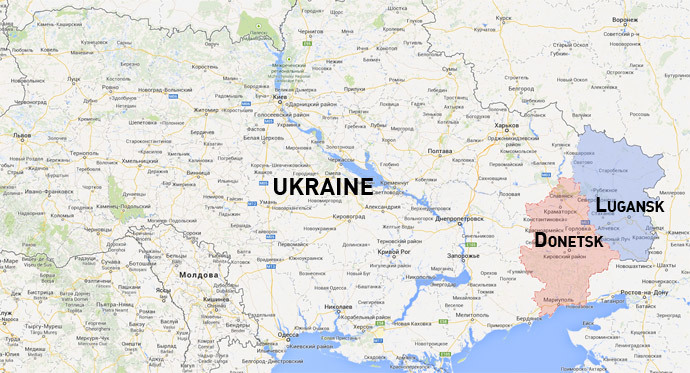
The councils of the People’s Republics of two southeastern cities of Donetsk and Lugansk won’t postpone the referendums on their regions’ future as part of Ukraine and will hold them as planned on May, 11, the cities’ anti-government activists said.
“This is not our decision [of the politicians] , this is the decision of people of Donbas region,” said Andrey Purgin, one of the leaders of the self-proclaimed Donetsk People’s Republic, “People of Donbas [Region] got their chance to make a heroic deed and we can’t deprive them from this chance.”
The decision of holding a referendum as scheduled was approved on the council of People’s Republic of Donetsk unanimously.
“People don’t trust Kiev authorities,” Miroslav Rudenko, one of the Donbas self-defense leaders, told Interfax, “Also the reaction of [coup-appointed PM Arseny] Yatsenyuk to the proposal of Russian President [calling for an end to Kiev’s military operation] was inadequate.”
According to another self-defense leader Denis Pushilin, “the region’s people are determined to organize the referendum.”
“There are millions of people who are ready to cast their votes,” he added.
Meanwhile, the council of the People’s Republic of another eastern Ukrainian city, Lugansk, has decided not to postpone the upcoming referendum and to organize it on May 11, said Vasily Nikitin, from the press service which is organizing the referendum.
“The referendum will take place as planned. The ballots have been already arrived at the polling stations,” said Nikitin.
According to him, at the referendum people will be asked if they “support the state independence of People’s Republic of Lugansk.”
He also added that the results of the referendum on the region’s future will be announced Monday.
Leonid Slutsky, the Chairman of the Russia’s State Duma Committee on the Commonwealth of Independent States, said that the refusal of Donetsk and Lugansk regions to postpone the upcoming referendums is their sovereign right.
Russia by proposing to postpone the referendums wanted only to “solve the conflict peacefully and not to allow further escalation of crisis in Ukraine,” he said.
He added that Russia won’t send observers to Donetsk and Lugansk as these referendums are “their internal affair.”
Meanwhile, the Kremlin will analyze the situation on eastern Ukraine’s refusal to postpone the referendum, said President Vladimir Putin’s spokesman, Dmitry Peskov.
He added that Kremlin hasn’t yet received any proposals from the Organization for Security and Cooperation in Europe (OSCE) on Ukraine’s crisis.
Google Maps
In April, activists in the Donetsk and Lugansk regions, announced they were planning to hold a referendum on their regions’ future as part of Ukraine on Sunday, May 11.
On Wednesday, Russian President Vladimir Putin called on anti-government protesters in southeastern Ukraine to postpone their May 11 federalization referendums.
“We are calling for southeast Ukraine representatives, supporters of federalization of the country, to postpone the May 11 referendum to create the necessary conditions for dialogue,” Putin said at a press conference with OSCE Chairperson-in-Office and Swiss President Didier Burkhalter in Moscow.
Ukraine’s coup-appointed PM Arseny Yatsenyuk criticized Putin’s proposal to postpone the referendum.
“The fact that Russia asks to postpone some referendum? Then we need to inform the Russian president that Ukraine hasn’t planned any referendum on May 11. And if terrorists and separatists, who are supported by Russia, were ordered to postpone what wasn’t planned, then it’s their internal affairs,” he said.
Kiev on Thursday said the military operation in the south-east of Ukraine will continue, regardless of the decision made on the regional referendum.
Earlier Thursday, the head of Ukrainian National Security and Defense Committee, Andrey Parubiy, said that the military operation in the southeast of Ukraine will continue, regardless of the decision made on the Donetsk regional referendum.
“The counter-terrorist operation will continue unhindered, despite the presence of terrorist and insurgent groups in the Donetsk region,” he said.
Putin – Burkhalter talks: an eluding chance for Ukraine
ORIENTAL REVIEW | May 8, 2014
A couple of brief remarks on today’s meeting in Kremlin between Russian President Vladimir Putin and OSCE Chairperson-in-Office Didier Burkhalter:
1. The elaborated framework of the road map for de-escalation in Ukraine consists of four basic provisions: ceasefire, deescalation (withdrawal of troops and disarmament of illegal armed groups), initiation of national reconciliation dialogue and holding elections. The ball is obviously on Kiev’s side. Any further attempt to repress the protest in the South-East will definitely close this narrow window of opportunity.
2. Putin’s request to postpone referenda on independence in Donetsk and Lugansk is an act of good will. Being aware of the public mood in these regions it is very unlikely that the ballot will be held off. People there are counting days to have a legal foundation to get rid of Kiev’s dictate. By the way, such development would undermine traditional Western claims that Putin is manipulating the protests in the South-East of Ukraine.
3. The Russian President emphasized again that “the blame for the crisis… lies with those who organised the coup d’etat in Kiev and have not yet taken the trouble to disarm right-wing radical and nationalist groups.” That means that prior to such disarmament there would be no dialogue and no elections.
4. It was also stressed that the draft new constitution of Ukraine should be discussed during this national reconciliation dialogue and again, prior to the elections.
5. The situation on the ground suggests that this road-map would take at least 6 months to be implemented and require a substantial participation of the legitimate Ukrainian president Victor Yanukovych.
This is the last (and rather unexpected) chance to retain a united federative Ukraine. Taking into account highly contradicting interests of the international centers of power which dominate over the current Kiev administration, it would be almost impossible to keep this narrow window open for this term. But apparently Hope will be the last victim of the ongoing Ukrainian crisis…
Putin calls for end to Kiev’s military operation, postponing referendum in E. Ukraine
RT | May 7, 2014
Ukrainian right-wing groups are behind the recent events in the country, Russian President Vladimir Putin said, adding that Kiev has not disarmed them. He also called on anti-Kiev protesters to postpone a May 11 federalization referendum.
“Russia believes that the crisis, which originated in Ukraine and is now actively developing in accordance with the worst-case scenario, is to be blamed on those who organized the coup in Kiev on 22-23 February and still do not care to disarm the right-wing and nationalist elements,” the president said.
Direct dialogue between Kiev and anti-government protesters in southeast Ukraine is key to ending the crisis, Putin said.
It is now essential “to create the necessary conditions for this dialogue,” he added.
This, however, would require rescheduling the referendum, which anti-government activists scheduled on May 11 to determine the fate of southeast Ukraine.
“We are calling for southeast Ukraine representatives, supporters of federalization of the country, to postpone the May 11 referendum to create the necessary conditions for dialogue,” Putin said at a press conference with Organisation for Security and Cooperation in Europe (OSCE) Chairperson-in-Office and Swiss President Didier Burkhalter in Moscow.
In response to Putin’s offer, one of the leaders of the self-proclaimed Donetsk People’s Republic, Denis Pushilin, said the possibility would be discussed Thursday.
“We respect Putin’s position. He is a balanced politician. So we will submit this proposal tomorrow to the people’s council,” he said.
‘Russia withdraws troops from Ukrainian border’
President Vladimir Putin also said that Russia has withdrawn its troops from the Ukrainian border.
“We have been told that our troops on the Ukrainian border are a concern – we have withdrawn them. They are now not on Ukrainian territory, but at locations where they conduct regular drills at ranges,” he said.
Earlier, German Chancellor Angela Merkel suggested holding “roundtable discussions,” a proposal that Moscow fully supports, Putin added.
Moscow and the OSCE agree substantially on the approach to resolving the situation in Ukraine, Putin said, adding that negotiations had made it clear.
“Moscow is interested in a swift resolution of the crisis in Ukraine, taking into consideration the interests of all people of the country,” he said.
OSCE drafting Ukraine road-map
In the coming hours, OSCE will offer a “roadmap” on Ukraine, Burkhalter said.
“Our offer now is the following: literally in the next few hours we would like to offer a road-map for the four signatories of the Geneva agreements,” Burkhalter said, adding that the roadmap lays out “concrete steps” to resolve the Ukrainian crisis.
There are four major points, he said: “These are the ceasefire, the de-escalation of tensions, the dialogue and elections.” Burkhalter added that the roadmap had been discussed earlier in Vienna.
It comes as a “more pragmatic” alternative to the so-called Geneva-2 peace talks on Ukraine, which Burkhalter said for now are not being planned to be held.
Burkhalter also believes that dialogue between Kiev and southeast Ukraine is a “realistic prospect.”
“As for the probability of a national dialogue in Ukraine, I think it’s quite a realistic prospect, because only Ukrainian people need to be involved in determining their own destiny,” he said.
On behalf of OSCE, Burkhalter said that the organization is ready to take responsibility for coordination the “roadmap” and negotiations with the US and the EU will be taking place soon.
Ukrainian army attacks eastern towns of Mariupol, Konstantinovka
RT | May 3, 2014
The Ukrainian military has started an operation against pro-autonomy activists in the city of Mariupol, southeastern Ukraine, as well as the town of Konstantinovka, according to local self-defense activists.
The troops have moved into Mariupol and have surrounded an administrative building held by anti-government protesters.
There are a few hundred activists inside the building. They told RT that the army is warning them that if they do not leave the building in the coming minutes, they will be fired at and the building will be seized.
“I am in the center of the city, there are a lot of ambulances outside the local administration building, gunfire is being heard, armored vehicles have entered the city and are moving towards the center,” witness Tatyana told RT by phone. “People are going there as well, to prevent the soldiers form shooting. We are hoping they won’t shoot at civilians, though from what we’ve seen before, we are not sure anymore.”
Mikhail Krutko from the self-defense headquarters told Interfax news agency: “Residents are unarmed, they blocked roads in the city center, built up barricades from tires and other things not to let hardware pass. They set tires on fire.”
People on the ground told RT’s Paula Slier that there are 300-500 anti-Kiev protesters there and they are unarmed. There have so far been no reports of injuries.
A bank building has been set ablaze in Mariupol, local news website 0629 reported.
“There is no fatalities so far, but I can’t say anything about the number of injured. Right now police have returned from the scene, but people in dark uniforms can be seen in other parts of the city,” another witness named Dmitry told RT.
At the same time, a convoy of Ukrainian APCs has forced its way through self-defense checkpoints near the Donetsk Region town of Konstantinovka. Shots and alarm can be heard inside the city.
There are reports that at least two people have been killed, Paula Slier says. The TV building has reportedly been seized by the army and all transmissions are currently off-air, she adds.
Self-defense units earlier seized the security services headquarters in the town.
Ukraine’s acting interior minister, Arsen Avakov, has confirmed that a special operation is underway in the town of Konstantinovka, adding that several soldiers have been injured.
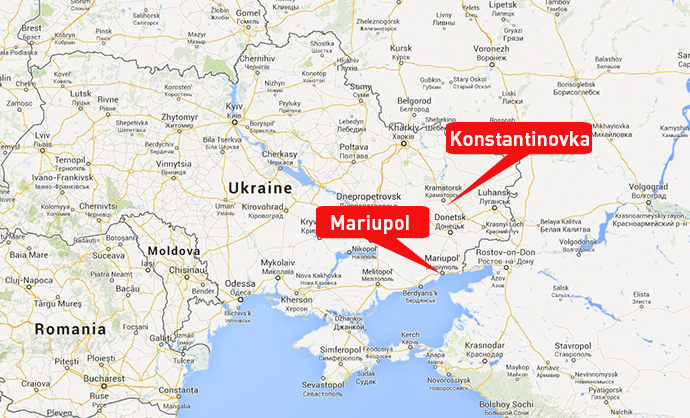
Image from maps.google.com
Menawhile National Security Council secretary Andrey Parubiy has said that Kiev is planning to begin special military operations in other regions of Ukraine after it completes its current operations in Slavyansk and Kramatorsk.
Over the past few days, Ukraine has stepped up its military operations in southeastern Ukraine against pro-autonomy activists. The main opposition strongholds include Kramatorsk, Slavyansk, Lugansk, and others.
In Lugansk, self-defense forces have declared a state of emergency and full mobilization amid Kiev’s punitive military operation in the region on Saturday.
At the same time, outraged residents of Kramatorsk have lashed out at troops entering the city’s streets. The Ukrainian military is currently occupying the city of Kramatorsk following an assault early on Saturday, a local self-defense unit said. Activists said that 10 people died in fighting overnight and two others were “killed by snipers.”
Meanwhile, clashes between pro-nationalist radicals and anti-Kiev activists have intensified. On Friday, more than 45 anti-Kiev protesters were killed in Odessa; some died in clashes, while others died from burns or suffocation after being trapped inside the House of Trade Unions building by the ultra-nationalist Right Sector group.
Gerry Adams’ arrest politics of the dead
By Finian Cunningham | Press TV | May 1, 2014
There seems little doubt that the arrest of Irish republican leader Gerry Adams this week over alleged involvement in a tragic murder 44 years ago is politically motivated.
The political interests pushing this agenda have no respect for victims of Ireland’s recent 30-year conflict. These interests are being selective in their focus on victims, cynically vying for political gain, and in particular to damage the rise of Sinn Fein, the Irish republican party.
Later this month, Ireland is heading into European Parliamentary elections, which up to now was promising to see major electoral gains for Sinn Fein, the party of which Adams has been president of since 1983.
In recent years, Sinn Fein has emerged has the fastest growing political party in both the British-occupied north and the independent southern state. It has become the second biggest party in the Northern Ireland Assembly, while in the southern legislative chamber, Dail Eireann, Sinn Fein has seen its number of parliamentarians expand three-fold over the past three elections to become an increasingly pivotal force there.
Sinn Fein can rightly claim to be the only all-Ireland party with representatives and organizational structure that transcend the British-imposed border, which partitions the island into northern and southern jurisdictions. Sinn Fein is distinguished from all other political parties by its manifesto calling for a united, independent country.
That manifesto not only threatens the British interest of maintaining its political presence in the North of Ireland; the so-called Irish political parties in the South of Ireland also see their establishment interests challenged by the growing popular support for Sinn Fein and its calls to shake-up the stagnant status quo on both sides of the border.
This is the important context in which the Sinn Fein leader was taken into custody this week by police in Northern Ireland. Adams has not been charged but his arrest over the murder took many observers by surprise, coming seemingly out of the blue. The allegations will revive memories of a dark episode in Ireland’s 30-year conflict.
The murder in question is that of a Belfast woman, Jean McConville, who was abducted and killed by the Provisional IRA in 1972. McConville was a widow and mother of 10 children, aged 38 when she died. The IRA claimed that the woman was an informer to the British army during the conflict that saw Belfast plunged into chaos and violence for nearly three decades. The McConville family always vehemently denied their mother was an informer, and a police investigation conducted years later cleared the deceased woman of any such activity.
Sinn Fein is the political wing of the IRA, and Gerry Adams has long been alleged to be a senior member of the guerrilla organization, which laid down its arms as part of the Irish peace settlement signed in 1998. As an alleged commander of the IRA during the 1970s in Belfast, Adams is accused of overseeing the assassination of Jean McConville.
The Sinn Fein president denies any involvement in the abduction and murder. This week, before his arrest, Adams described the allegations as “malicious” and aimed at damaging his party politically, especially on the eve of European-wide elections.
Certainly, the accusations against Adams are not new. In recent years, two former senior IRA members, Brendan Hughes and Dolores Price, made separate claims that Adams ordered the execution of Jean McConville. Female IRA member Dolores Price said before her own death last year that she abducted McConville on direct orders from Adams and drove the mother to the place of her execution.
McConville’s body was found in August 2003, nearly 31 years after her murder. Her remains had been buried on a beach in Shelling Hill, County Louth, across the border in the South of Ireland. The IRA had already admitted to the murder in 1999, while still maintaining that McConville was an informer. It offered an apology to the family and provided information to locate her burial site.
The grief of the McConville family is surely poignant. Ten young children were left without a mother and the family was subsequently split up and taken into social care.
But there are thousands of other such family tragedies during the conflict that engulfed Northern Ireland between 1968-1998. Fathers, mothers, sons and daughters were shot dead by British army soldiers and pro-British paramilitaries who were directed by London’s military intelligence to instil terror in the civilian population and to deter its right to Irish freedom. Thousands of lives were ruined and traumatized by a conflict that the British government bears a heavy responsibility for but for which it has always evaded.
The southern Irish political establishment has a lot to answer for too. It largely turned its back on the plight of many citizens in the north when they were being subjected to ruthless British militarism.
Indeed, the southern Irish ruling class collaborated with Britain to suppress the freedom movement that re-emerged in the British-occupied northern state during the 1960s.
Today, the South of Ireland jurisdiction – which pompously and fraudulently refers to itself as “the Republic of Ireland” – is the apotheosis of the Irish republic that generations of Irish people have fought and died for.
It is a bankrupt state of huge social inequality and poverty, overseen by crony political parties who made their peace with British imperialism when the island was partitioned in 1920 – thus betraying the cause of Irish republicanism that sought to set up a unified, independent state free from British domination.
Sinn Fein, the original party that led Irish independence more than a century ago, is again in the ascendancy, both north and south. It is this political threat that most probably explains the sudden rekindling of interest in the tragic murder of Jean McConville more four decades ago. The place where her remains were found 10 years ago, County Louth, is the electoral constituency that Gerry Adams represents today in the southern parliament, having been elected to the seat in 2011.
Jean McConville’s family deserve the truth and justice. So do thousands of other Irish families. But for these other families, the British and Dublin governments and their lickspittle media show little interest towards. Both the London and Dublin governments continue to refuse the setting up an independent truth commission into all conflict-related deaths. The selective focus on one victim strongly suggests manipulation of a single family’s grief for cynical political purposes. That’s not justice. It’s grubby politicking.
Featured Video

Trita Parsi: Middle East Unraveling — Are We on the Path to World War?
or go to
Aletho News Archives – Video-Images
From the Archives
Why Saudi Ties to 9/11 Mean U.S. Ties to 9/11
By Kevin Ryan | Dig Within | September 27, 2015
Media interest in Saudi Arabian connections to the crimes of 9/11 has centered on calls for the release of the 28 missing pages from the Joint Congressional Inquiry’s report. However, those calls focus on the question of hijacker financing and omit the most interesting links between the 9/11 attacks and Saudi Arabia—links that implicate powerful people in the United States. Here are twenty examples. … continue
Blog Roll
 Aletho News
- Neria Leiter Was A Legitimate Military Target
- Integrity Initiative: UK-funded network framed dissent as Russian disinformation for years
- ‘We don’t seek permission to defend our country’: Snippets from President Pezeshkian’s UNGA address
- NATO chief wants Europeans to fight American wars [for Israel]
- German chemicals giant reveals details of downsizing
- Refaat Al-Areer Was The Canary In The Coal Mine In Israel’s War On The Truth
- Israeli election committee bars candidate from Knesset race over Gaza war opposition
- French-Lebanese man files war crimes complaint over Israeli attacks
- Mahan Air Flight Lands in China Despite US Threat against Iranian Airlines
- US eyes $10bn fund to rebuild war-battered Gulf infrastructure
- If Americans Knew
- Caught on Tape: AIPAC CEO Boasted of Controlling Trump’s National Security Officials
- Why Hamas Attacked Israel in October 2023 – Israeli professor Ilan Pappé
- They see them, then kill them: Israeli quadcopters track, deliberately target civilians in Gaza
- Winter could turn Gaza’s treacherous, war-damaged buildings into deathtraps
- Majority of Democratic Voters Want to Prosecute Both Biden and Trump Administration Officials Over Gaza
- As Gaza languishes, world leaders gather at the UN – Daily Update
- Sanctions are collective punishment: immoral and self-defeating
- Phosphorus Munitions Fired by Israel Burn Groves, Orchards in Southern Lebanon
- Israel Carries Out New Ceasefire Violations Across Gaza
- AI – Emphasis on the ‘I’: Israel Is Funding AI Chatbot Propaganda
- No Tricks Zone
- New Study: Earth And Venus Surface Warmth Largely Explained By Convection And Lapse Rate, Not CO2 Or Radiation
- 2025 Nature Paper Claiming Worsening Global Drought Gets RETRACTED …Heavily Flawed
- New Study: ‘Global Drought Shows No Detectable Recent Acceleration Under Climate Warming’
- Economic Masterminds: German Socialists Suggest Taxing Productivity Gains Stemming From Using AI
- The South China Sea Has Not Been Cooperating With The Climate Change Narrative
- Energy Crisis: Germany Enters Heating Season With Historically Low Gas Reserve Fill Levels
- New Study: The Antarctic Ice Sheet Gained Mass From 2020-2024 Due To Staggering Snow And Ice Accumulation
- Study: Ocean Heating Rates From Thousands Of Years Ago ‘Dwarf’ Modern Ocean Heating Rates
- Climate Extremists Target, Attack Large-Scale Power Grid Infrastructure In Germany!
- New Study: Antarctic Ice Melt Has Contributed Less Than 1 Centimeter To Sea Level Rise In The Last 30 Years

