2 southeast Ukrainian regions to hold referendum May 11 as planned
RT | May 8, 2014
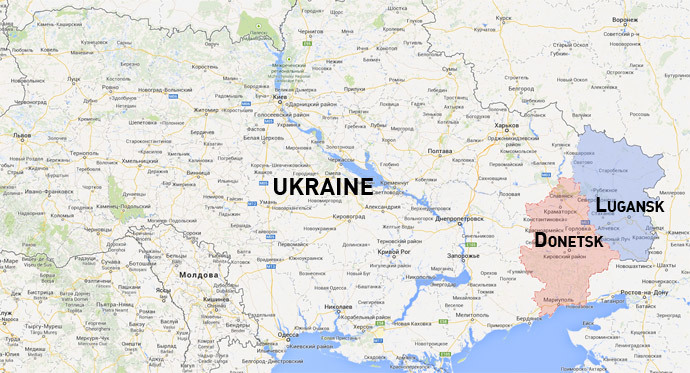
The councils of the People’s Republics of two southeastern cities of Donetsk and Lugansk won’t postpone the referendums on their regions’ future as part of Ukraine and will hold them as planned on May, 11, the cities’ anti-government activists said.
“This is not our decision [of the politicians] , this is the decision of people of Donbas region,” said Andrey Purgin, one of the leaders of the self-proclaimed Donetsk People’s Republic, “People of Donbas [Region] got their chance to make a heroic deed and we can’t deprive them from this chance.”
The decision of holding a referendum as scheduled was approved on the council of People’s Republic of Donetsk unanimously.
“People don’t trust Kiev authorities,” Miroslav Rudenko, one of the Donbas self-defense leaders, told Interfax, “Also the reaction of [coup-appointed PM Arseny] Yatsenyuk to the proposal of Russian President [calling for an end to Kiev’s military operation] was inadequate.”
According to another self-defense leader Denis Pushilin, “the region’s people are determined to organize the referendum.”
“There are millions of people who are ready to cast their votes,” he added.
Meanwhile, the council of the People’s Republic of another eastern Ukrainian city, Lugansk, has decided not to postpone the upcoming referendum and to organize it on May 11, said Vasily Nikitin, from the press service which is organizing the referendum.
“The referendum will take place as planned. The ballots have been already arrived at the polling stations,” said Nikitin.
According to him, at the referendum people will be asked if they “support the state independence of People’s Republic of Lugansk.”
He also added that the results of the referendum on the region’s future will be announced Monday.
Leonid Slutsky, the Chairman of the Russia’s State Duma Committee on the Commonwealth of Independent States, said that the refusal of Donetsk and Lugansk regions to postpone the upcoming referendums is their sovereign right.
Russia by proposing to postpone the referendums wanted only to “solve the conflict peacefully and not to allow further escalation of crisis in Ukraine,” he said.
He added that Russia won’t send observers to Donetsk and Lugansk as these referendums are “their internal affair.”
Meanwhile, the Kremlin will analyze the situation on eastern Ukraine’s refusal to postpone the referendum, said President Vladimir Putin’s spokesman, Dmitry Peskov.
He added that Kremlin hasn’t yet received any proposals from the Organization for Security and Cooperation in Europe (OSCE) on Ukraine’s crisis.
Google Maps
In April, activists in the Donetsk and Lugansk regions, announced they were planning to hold a referendum on their regions’ future as part of Ukraine on Sunday, May 11.
On Wednesday, Russian President Vladimir Putin called on anti-government protesters in southeastern Ukraine to postpone their May 11 federalization referendums.
“We are calling for southeast Ukraine representatives, supporters of federalization of the country, to postpone the May 11 referendum to create the necessary conditions for dialogue,” Putin said at a press conference with OSCE Chairperson-in-Office and Swiss President Didier Burkhalter in Moscow.
Ukraine’s coup-appointed PM Arseny Yatsenyuk criticized Putin’s proposal to postpone the referendum.
“The fact that Russia asks to postpone some referendum? Then we need to inform the Russian president that Ukraine hasn’t planned any referendum on May 11. And if terrorists and separatists, who are supported by Russia, were ordered to postpone what wasn’t planned, then it’s their internal affairs,” he said.
Kiev on Thursday said the military operation in the south-east of Ukraine will continue, regardless of the decision made on the regional referendum.
Earlier Thursday, the head of Ukrainian National Security and Defense Committee, Andrey Parubiy, said that the military operation in the southeast of Ukraine will continue, regardless of the decision made on the Donetsk regional referendum.
“The counter-terrorist operation will continue unhindered, despite the presence of terrorist and insurgent groups in the Donetsk region,” he said.
Putin – Burkhalter talks: an eluding chance for Ukraine
ORIENTAL REVIEW | May 8, 2014
A couple of brief remarks on today’s meeting in Kremlin between Russian President Vladimir Putin and OSCE Chairperson-in-Office Didier Burkhalter:
1. The elaborated framework of the road map for de-escalation in Ukraine consists of four basic provisions: ceasefire, deescalation (withdrawal of troops and disarmament of illegal armed groups), initiation of national reconciliation dialogue and holding elections. The ball is obviously on Kiev’s side. Any further attempt to repress the protest in the South-East will definitely close this narrow window of opportunity.
2. Putin’s request to postpone referenda on independence in Donetsk and Lugansk is an act of good will. Being aware of the public mood in these regions it is very unlikely that the ballot will be held off. People there are counting days to have a legal foundation to get rid of Kiev’s dictate. By the way, such development would undermine traditional Western claims that Putin is manipulating the protests in the South-East of Ukraine.
3. The Russian President emphasized again that “the blame for the crisis… lies with those who organised the coup d’etat in Kiev and have not yet taken the trouble to disarm right-wing radical and nationalist groups.” That means that prior to such disarmament there would be no dialogue and no elections.
4. It was also stressed that the draft new constitution of Ukraine should be discussed during this national reconciliation dialogue and again, prior to the elections.
5. The situation on the ground suggests that this road-map would take at least 6 months to be implemented and require a substantial participation of the legitimate Ukrainian president Victor Yanukovych.
This is the last (and rather unexpected) chance to retain a united federative Ukraine. Taking into account highly contradicting interests of the international centers of power which dominate over the current Kiev administration, it would be almost impossible to keep this narrow window open for this term. But apparently Hope will be the last victim of the ongoing Ukrainian crisis…
Putin calls for end to Kiev’s military operation, postponing referendum in E. Ukraine
RT | May 7, 2014
Ukrainian right-wing groups are behind the recent events in the country, Russian President Vladimir Putin said, adding that Kiev has not disarmed them. He also called on anti-Kiev protesters to postpone a May 11 federalization referendum.
“Russia believes that the crisis, which originated in Ukraine and is now actively developing in accordance with the worst-case scenario, is to be blamed on those who organized the coup in Kiev on 22-23 February and still do not care to disarm the right-wing and nationalist elements,” the president said.
Direct dialogue between Kiev and anti-government protesters in southeast Ukraine is key to ending the crisis, Putin said.
It is now essential “to create the necessary conditions for this dialogue,” he added.
This, however, would require rescheduling the referendum, which anti-government activists scheduled on May 11 to determine the fate of southeast Ukraine.
“We are calling for southeast Ukraine representatives, supporters of federalization of the country, to postpone the May 11 referendum to create the necessary conditions for dialogue,” Putin said at a press conference with Organisation for Security and Cooperation in Europe (OSCE) Chairperson-in-Office and Swiss President Didier Burkhalter in Moscow.
In response to Putin’s offer, one of the leaders of the self-proclaimed Donetsk People’s Republic, Denis Pushilin, said the possibility would be discussed Thursday.
“We respect Putin’s position. He is a balanced politician. So we will submit this proposal tomorrow to the people’s council,” he said.
‘Russia withdraws troops from Ukrainian border’
President Vladimir Putin also said that Russia has withdrawn its troops from the Ukrainian border.
“We have been told that our troops on the Ukrainian border are a concern – we have withdrawn them. They are now not on Ukrainian territory, but at locations where they conduct regular drills at ranges,” he said.
Earlier, German Chancellor Angela Merkel suggested holding “roundtable discussions,” a proposal that Moscow fully supports, Putin added.
Moscow and the OSCE agree substantially on the approach to resolving the situation in Ukraine, Putin said, adding that negotiations had made it clear.
“Moscow is interested in a swift resolution of the crisis in Ukraine, taking into consideration the interests of all people of the country,” he said.
OSCE drafting Ukraine road-map
In the coming hours, OSCE will offer a “roadmap” on Ukraine, Burkhalter said.
“Our offer now is the following: literally in the next few hours we would like to offer a road-map for the four signatories of the Geneva agreements,” Burkhalter said, adding that the roadmap lays out “concrete steps” to resolve the Ukrainian crisis.
There are four major points, he said: “These are the ceasefire, the de-escalation of tensions, the dialogue and elections.” Burkhalter added that the roadmap had been discussed earlier in Vienna.
It comes as a “more pragmatic” alternative to the so-called Geneva-2 peace talks on Ukraine, which Burkhalter said for now are not being planned to be held.
Burkhalter also believes that dialogue between Kiev and southeast Ukraine is a “realistic prospect.”
“As for the probability of a national dialogue in Ukraine, I think it’s quite a realistic prospect, because only Ukrainian people need to be involved in determining their own destiny,” he said.
On behalf of OSCE, Burkhalter said that the organization is ready to take responsibility for coordination the “roadmap” and negotiations with the US and the EU will be taking place soon.
Ukrainian army attacks eastern towns of Mariupol, Konstantinovka
RT | May 3, 2014
The Ukrainian military has started an operation against pro-autonomy activists in the city of Mariupol, southeastern Ukraine, as well as the town of Konstantinovka, according to local self-defense activists.
The troops have moved into Mariupol and have surrounded an administrative building held by anti-government protesters.
There are a few hundred activists inside the building. They told RT that the army is warning them that if they do not leave the building in the coming minutes, they will be fired at and the building will be seized.
“I am in the center of the city, there are a lot of ambulances outside the local administration building, gunfire is being heard, armored vehicles have entered the city and are moving towards the center,” witness Tatyana told RT by phone. “People are going there as well, to prevent the soldiers form shooting. We are hoping they won’t shoot at civilians, though from what we’ve seen before, we are not sure anymore.”
Mikhail Krutko from the self-defense headquarters told Interfax news agency: “Residents are unarmed, they blocked roads in the city center, built up barricades from tires and other things not to let hardware pass. They set tires on fire.”
People on the ground told RT’s Paula Slier that there are 300-500 anti-Kiev protesters there and they are unarmed. There have so far been no reports of injuries.
A bank building has been set ablaze in Mariupol, local news website 0629 reported.
“There is no fatalities so far, but I can’t say anything about the number of injured. Right now police have returned from the scene, but people in dark uniforms can be seen in other parts of the city,” another witness named Dmitry told RT.
At the same time, a convoy of Ukrainian APCs has forced its way through self-defense checkpoints near the Donetsk Region town of Konstantinovka. Shots and alarm can be heard inside the city.
There are reports that at least two people have been killed, Paula Slier says. The TV building has reportedly been seized by the army and all transmissions are currently off-air, she adds.
Self-defense units earlier seized the security services headquarters in the town.
Ukraine’s acting interior minister, Arsen Avakov, has confirmed that a special operation is underway in the town of Konstantinovka, adding that several soldiers have been injured.
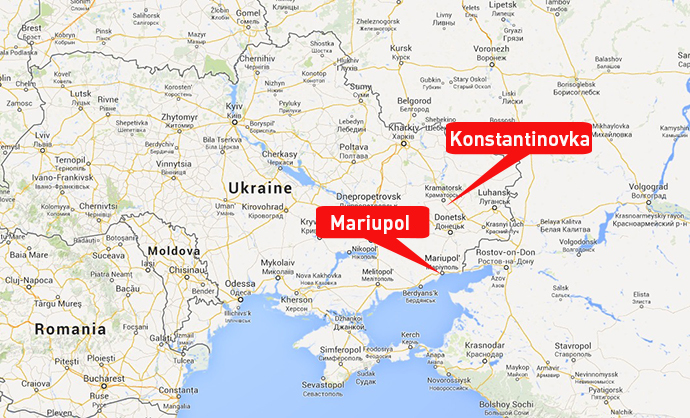
Image from maps.google.com
Menawhile National Security Council secretary Andrey Parubiy has said that Kiev is planning to begin special military operations in other regions of Ukraine after it completes its current operations in Slavyansk and Kramatorsk.
Over the past few days, Ukraine has stepped up its military operations in southeastern Ukraine against pro-autonomy activists. The main opposition strongholds include Kramatorsk, Slavyansk, Lugansk, and others.
In Lugansk, self-defense forces have declared a state of emergency and full mobilization amid Kiev’s punitive military operation in the region on Saturday.
At the same time, outraged residents of Kramatorsk have lashed out at troops entering the city’s streets. The Ukrainian military is currently occupying the city of Kramatorsk following an assault early on Saturday, a local self-defense unit said. Activists said that 10 people died in fighting overnight and two others were “killed by snipers.”
Meanwhile, clashes between pro-nationalist radicals and anti-Kiev activists have intensified. On Friday, more than 45 anti-Kiev protesters were killed in Odessa; some died in clashes, while others died from burns or suffocation after being trapped inside the House of Trade Unions building by the ultra-nationalist Right Sector group.
Gerry Adams’ arrest politics of the dead
By Finian Cunningham | Press TV | May 1, 2014
There seems little doubt that the arrest of Irish republican leader Gerry Adams this week over alleged involvement in a tragic murder 44 years ago is politically motivated.
The political interests pushing this agenda have no respect for victims of Ireland’s recent 30-year conflict. These interests are being selective in their focus on victims, cynically vying for political gain, and in particular to damage the rise of Sinn Fein, the Irish republican party.
Later this month, Ireland is heading into European Parliamentary elections, which up to now was promising to see major electoral gains for Sinn Fein, the party of which Adams has been president of since 1983.
In recent years, Sinn Fein has emerged has the fastest growing political party in both the British-occupied north and the independent southern state. It has become the second biggest party in the Northern Ireland Assembly, while in the southern legislative chamber, Dail Eireann, Sinn Fein has seen its number of parliamentarians expand three-fold over the past three elections to become an increasingly pivotal force there.
Sinn Fein can rightly claim to be the only all-Ireland party with representatives and organizational structure that transcend the British-imposed border, which partitions the island into northern and southern jurisdictions. Sinn Fein is distinguished from all other political parties by its manifesto calling for a united, independent country.
That manifesto not only threatens the British interest of maintaining its political presence in the North of Ireland; the so-called Irish political parties in the South of Ireland also see their establishment interests challenged by the growing popular support for Sinn Fein and its calls to shake-up the stagnant status quo on both sides of the border.
This is the important context in which the Sinn Fein leader was taken into custody this week by police in Northern Ireland. Adams has not been charged but his arrest over the murder took many observers by surprise, coming seemingly out of the blue. The allegations will revive memories of a dark episode in Ireland’s 30-year conflict.
The murder in question is that of a Belfast woman, Jean McConville, who was abducted and killed by the Provisional IRA in 1972. McConville was a widow and mother of 10 children, aged 38 when she died. The IRA claimed that the woman was an informer to the British army during the conflict that saw Belfast plunged into chaos and violence for nearly three decades. The McConville family always vehemently denied their mother was an informer, and a police investigation conducted years later cleared the deceased woman of any such activity.
Sinn Fein is the political wing of the IRA, and Gerry Adams has long been alleged to be a senior member of the guerrilla organization, which laid down its arms as part of the Irish peace settlement signed in 1998. As an alleged commander of the IRA during the 1970s in Belfast, Adams is accused of overseeing the assassination of Jean McConville.
The Sinn Fein president denies any involvement in the abduction and murder. This week, before his arrest, Adams described the allegations as “malicious” and aimed at damaging his party politically, especially on the eve of European-wide elections.
Certainly, the accusations against Adams are not new. In recent years, two former senior IRA members, Brendan Hughes and Dolores Price, made separate claims that Adams ordered the execution of Jean McConville. Female IRA member Dolores Price said before her own death last year that she abducted McConville on direct orders from Adams and drove the mother to the place of her execution.
McConville’s body was found in August 2003, nearly 31 years after her murder. Her remains had been buried on a beach in Shelling Hill, County Louth, across the border in the South of Ireland. The IRA had already admitted to the murder in 1999, while still maintaining that McConville was an informer. It offered an apology to the family and provided information to locate her burial site.
The grief of the McConville family is surely poignant. Ten young children were left without a mother and the family was subsequently split up and taken into social care.
But there are thousands of other such family tragedies during the conflict that engulfed Northern Ireland between 1968-1998. Fathers, mothers, sons and daughters were shot dead by British army soldiers and pro-British paramilitaries who were directed by London’s military intelligence to instil terror in the civilian population and to deter its right to Irish freedom. Thousands of lives were ruined and traumatized by a conflict that the British government bears a heavy responsibility for but for which it has always evaded.
The southern Irish political establishment has a lot to answer for too. It largely turned its back on the plight of many citizens in the north when they were being subjected to ruthless British militarism.
Indeed, the southern Irish ruling class collaborated with Britain to suppress the freedom movement that re-emerged in the British-occupied northern state during the 1960s.
Today, the South of Ireland jurisdiction – which pompously and fraudulently refers to itself as “the Republic of Ireland” – is the apotheosis of the Irish republic that generations of Irish people have fought and died for.
It is a bankrupt state of huge social inequality and poverty, overseen by crony political parties who made their peace with British imperialism when the island was partitioned in 1920 – thus betraying the cause of Irish republicanism that sought to set up a unified, independent state free from British domination.
Sinn Fein, the original party that led Irish independence more than a century ago, is again in the ascendancy, both north and south. It is this political threat that most probably explains the sudden rekindling of interest in the tragic murder of Jean McConville more four decades ago. The place where her remains were found 10 years ago, County Louth, is the electoral constituency that Gerry Adams represents today in the southern parliament, having been elected to the seat in 2011.
Jean McConville’s family deserve the truth and justice. So do thousands of other Irish families. But for these other families, the British and Dublin governments and their lickspittle media show little interest towards. Both the London and Dublin governments continue to refuse the setting up an independent truth commission into all conflict-related deaths. The selective focus on one victim strongly suggests manipulation of a single family’s grief for cynical political purposes. That’s not justice. It’s grubby politicking.
Three Ukraine elite Alpha group agents captured in Donetsk region
RT | April 27, 2014
Three members of Ukraine’s special anti-terrorist unit Alpha have been detained during a covert mission in Donetsk region, amid the buildup of Kiev’s military near the cities controlled by pro-federalization forces.
Commander of the “Donetsk Republic” self-defense forces, Igor Strelkov, has confirmed reports that three members of the Alpha special tactical assault group of the Ukrainian Security Service (SBU) have been detained in the city of Gorlovka, in Donetsk region.
Their task reportedly was to abduct one of the self-defense force leaders, Igor Bezler, whose group is controlling the local police department in Gorlovka, but instead they were captured themselves. The prisoners were searched and blindfolded and brought to nearby Slavyansk, where their guns, documents and IDs as well as other belongings were demonstrated to the media during a press conference.
During questioning, the detained officers revealed that a special unit that has infiltrated the city comprised of seven men.
The captives claimed they had no time for any wrongdoing as they “just arrived” in the city and were getting acquainted with it and investigating approaches for fulfilling their mission, which they admitted was “invariably impossible.”
They did not say however who authorized the operation and was in control of it. They also did not tell where the rest of the group went after they split, or how many similar groups could be operating in the region.
One of the detainees hinted that they were afraid for the well being of their families. “If I did something wrong,” he said, “I think nothing good would happen to my family.” Although there were no direct threats to their families, he said that was because the “mechanism was not launched” as they were abiding by orders.
The members of the Ukrainian armed forces will now receive the status of prisoners of war, Strelkov said, after which an attempt will be made to exchange the commandos for members of pro-federalization activists detained by Kiev.
The SBU confirmed Sunday that the detainees are indeed its officers. The agency claimed that they were deployed to the Donetsk region to detain an unnamed Russian citizen suspected of killing Vladimir Rybak, a local MP, who had been found dead near Slavyansk this week by local militia.
Rybak’s apparent murder is yet another point of conflict between Kiev and the anti-government protesters in eastern Ukraine. The central government said members of the militia must have killed the MP, who spoke against their resistance. Protest leaders said it would make no sense for them to make the discovery of the body public in that case and point fingers to the radical Right Sector, saying the murder was a provocation to frame the militia.
The agents’ capture came amid an attack on a checkpoint near the neighboring Soledar city, where a group of unidentified gunmen was flown-in by a helicopter and in a blitz attack captured one of the self-defenders, forcing others to temporary retreat.
Earlier on Friday, self-defense forces in Slavyansk detained eight foreign military observers, which they are calling “NATO spies.” At the time of the detention the “people’s mayor” of Slavyansk, Vyacheslav Ponomaryov said, the group had “cards with marks of all checkpoints” which he says “serve as proof of their intelligence activities under the guise of the OSCE mission.”
The detained team is indeed “not OSCE monitors” as widely reported, but instead was sent by OSCE member states in accordance with the 2011 Vienna Document on military transparency, the organization explained on Friday.
Despite the plea from Moscow and the international community to release the four Germans, a Bulgarian, Czech, Dane and a Pole, Ponomaryov has not acceded to the request yet, as he has not ruled out that the group could be used in prisoner exchange for anti-government activists, dozens of whom have been arrested by Kiev’s coup-installed authorities over the last month.
‘Russian agents captured in Ukraine? Show them!’ – Lavrov
RT | April 25, 2014
Russian Foreign Minister Sergey Lavrov has dismissed as “not serious” reports of Russian agents captured in Ukraine. He accused US politicians of distorting facts and wrongfully interpreting the Geneva agreement on de-escalation.
Lavrov lashed out at western politicians while speaking at a young diplomats’ forum in Moscow. The minister accused his counterparts in the EU and the US of making unsubstantiated statements.
“Kerry has many times mentioned that Ukrainian intelligence captured Russian agents,” Lavrov said. “So, show them to the people, have them on TV. Kerry says they don’t want to disclose the identities of those people who are engaged in the captures. This is not serious.”
While the west is accusing Russia of not following through on the Geneva agreement, Lavrov believes the attitude stems from misinterpretation of the de-escalation agreement.
“Representatives of the US State Department, Victoria Nuland in particular, claim that in Geneva we agreed upon ‘separatists’ leaving the occupied buildings,” Lavrov said. “This is a lie, this could not have been written, because we were promoting the approach that ensures the simultaneity of processes and equal responsibilities of the sides when it comes to vacating illegally occupied buildings and disarming illegal groups.”
Lavrov said that Russia would not allow the distortion of the text of the Geneva agreement. He also questioned assertions made by John Kerry a day earlier concerning Kiev’s full compliance with the Geneva agreement. Kerry said authorities in the Ukrainian capital were “removing the barricades in the Maidan and cleaning up the square.”
“Instead of tires, they are now setting up concrete blocks there,” Lavrov said. “No one is going to clear the place.”
Lavrov complained that his western counterparts were not abandoning the language of slogans, even in one-on-one telephone conversations.
“If you think that when John Kerry, William Hague or Laurent Fabius call me, they speak differently in those personal contacts and say something you don’t know from their public speeches, you are mistaken,” Lavrov said, adding that he was still making attempts to have a real constructive dialogue with the officials he mentioned.
All kinds of sanctions against Russia are a sign of Western states having “got lost in their own game,” he said.
“The West generally wants – and the whole thing started with that – to capture Ukraine, with the intention being solely based on geopolitical ambition, not on the interests of the Ukrainian people.”
When the West realized it couldn’t get it its own way, it grew frustrated, Lavrov said. The frustration has been revealed in the “hard efforts on the sanctions trackway.”
Israel rejects Abbas’ conditions for extending talks
Ma’an – 22/04/2014
JERUSALEM (AFP) — President Mahmoud Abbas said Tuesday that he would extend faltering peace talks with Israel only if it agreed to conditions, including a settlement freeze, which it promptly rejected.
Abbas listed his demands during a meeting with Israeli journalists at his headquarters in Ramallah just a week before a nine-month target for a peace deal.
His comments came as US envoy Martin Indyk went into a new meeting with Israeli and Palestinian negotiators in a bid to save the US-sponsored talks from collapse.
Abbas said he would agree to an extension of negotiations beyond the April 29 deadline if Israel frees a group of prisoners as previously earmarked for release and discusses the borders of a future Palestinian state.
“There must be a total freeze of settlements,” by Israel in the occupied West Bank including annexed East Jerusalem, Abbas said.
“The borders between Israel and the state of Palestine must also be defined within a month, two or three,” if the talks are to be extended, he said.
The PLO and the international community have long viewed Israeli settlement construction as a major obstacle to peace talks.
The peace process was engulfed by crisis last month after Israel refused to free a fourth and final group of 26 veteran Palestinian prisoners which would have completed an agreement that brought the sides back to negotiations last July.
“He who makes such conditions does not want peace,” a senior Israeli official told AFP on condition of anonymity.
The official said that settlement building in Jerusalem would not be frozen and that Israel had never agreed to discuss the border issue separately from other core issues.
These include Palestinians refugees, the fate of Jerusalem, security and mutual recognition.
“It is impossible to define borders before an agreement on the other issues,” the Israeli official said.
He also reiterated that Israel planned on expelling to the Gaza Strip, or abroad, some of the last batch of prisoners that Abbas wants freed.
“This has been clearly explained to the Palestinians. Never has Israel committed not to carry out expulsions,” he said.
Israel has announced plans for thousands of illegal settler homes in the occupied West Bank and killed over 60 Palestinians since peace talks began in July.
Israeli officials have also refused to discuss withdrawing Israeli soldiers and settlers from the occupied Jordan Valley, which forms around a third of the West Bank.
Ma’an staff contributed to this report
The Coming US-Iran legal battle at the UN
By Kaveh Afrasiabi | Press TV | April 19, 2014
The Islamic Republic of Iran and the United States have now locked horns at the United Nations in the dispute over Iran’s next ambassador to UN, Hamid Aboutalebi, in light of the US refusal to issue a visa for him and Iran’s stern reaction of lodging a complaint with the relevant authorities at the UN.
By all indications, the coming battle will be fought hard by both sides and may turn out to be time-consuming and involve a lengthy arbitration process. Objectively speaking, Iran’s chance of winning this battle is fair to excellent, because Iran has the weight of international law on its side.
As stated in Iran’s letter of April 14, 2014, addressed both to the UN Secretary General and the permanent representative of Cyprus, the current chair of the UN Committee on Relations with the Host Country, the US is now in breach of its international obligations by refusing to issue an entry visa to Mr. Aboutalebi.
Specifically, the US is now in contempt of its obligation under the US-UN treaty known as the “Headquarters Agreement,” which was signed in 1947. Section 11 of this Agreement expressly prohibits the US from imposing any restrictions on travel to the UN by representatives of UN member states.
Not only that, even the US’s own law, enacted in 1947, which imposes certain restrictions with respect to foreign officials who may pose a security risk to the US, does not give the US government the right to a blanket exclusion.
Section 6 of the US legislations states, “Nothing in the agreement shall be construed as in any way diminishing, abridging, or weakening the right of the United States to safeguard its own security and completely to control the entrance of aliens into any territory of the United States other than the headquarters district and its immediate vicinity.”
Clearly, this section simply does not permit the US to deny entry completely to any individual who has a right of entry, particularly the designated permanent representative of a UN member state.
What lies ahead, then, is a potentially lengthy arbitration process. Section 21 of the Headquarters Agreement provides a specific arbitration mechanism for such disputes between the US and the UN. If the negotiations between Iran, UN, and US at the above-said committee, scheduled for April 22nd, fail, then the matter would be referred to a tribunal of three arbitrators, one to be named by the UN Secretary General, one to be named by the United States, and the third to be chosen by the two, or, if they should fail to agree upon a third, then by the President of the International Court of Justice.
Legally speaking, US’s stated unhappiness with Mr. Aboutalebi over his alleged role with the Iranian students who took over the US embassy in 1979 does not suffice to warrant his exclusion from the UN. As a veteran Iranian diplomat for the past quarter of century, serving in several Western countries, Aboutalebi, who holds a degree from the prestigious Sorbonne University, is well-suited for the designated position at the UN and his credential simply nullifies any lame US excuse that he poses a “security risk.”
Besides, the US and Iran have signed an agreement known as the Algiers Accord in 1981, which has specific provisions regarding the settlement of disputes arising out of the US embassy ‘crisis’ and which are relevant to Iran’s defense of its choice for the top position at the UN. The US is beholden to the terms of the Algiers Accord, which precludes the US from punishing Iran one way or another for the embassy situation.
Clearly, this is a vexing issue for not only Iran but also many other UN member states, particularly those who may have a past or present dispute with the US, in light of the new US legislation that opens a Pandora’s Box by enhancing US free hand to screen foreign diplomats and impose restrictions on them based on criteria that violate the terms of the Headquarters Agreement, thus jeopardizing the future of “multilateral diplomacy” as correctly stated in Iran’s letter to UN mentioned above; as result, the Non-Aligned Movement, comprising the largest UN grouping at the General Assembly, may intervene on Iran’s behalf.
This may be why US President Obama has not yet acted on this legislation, which is Iranophobic through and through and was initiated by the hawkish members of US Congress who are on record opposing the recent nuclear agreement between Iran and the world powers. But, sooner or later, the US has to furnish a detailed and official explanation as to why it refuses a visa for Mr. Aboutalebi. But once it does, it will inevitably make more clear the already glaring fact that the US is in contempt of its international obligations.
The fact that Mr. Aboutalebi has entered the US in the past, as part of Iran’s delegation to the UN General Assembly, represents another strike against the US, which would have to be taken into consideration by the UN officials and the arbitration panel, the argument being that if he did not pose any security risk in the past, why should he be so regarded now?
With respect to any US argument that Aboutalebi has violated international law in the past by acting as a US “hostage-taker,” this is not convincing either due to the following: (a) by his own admission, Aboutalebi was not among the hostage-takers and played a limited role as an interpreter; (b) the embassy take-over was in part a response to a prior US violation of international law by engineering the 1953 coup in Iran and then supporting a ruthless dictatorship for a quarter of century; (c) those events are now remote in time and have been followed by the Algiers Accord that, as stated above, implicitly if not explicitly precludes the US from imposing punishments on Iran over the “hostage crisis.”
Henceforth, the US is likely to lose the legal battle with Iran at the UN, which in turn raises the question of what happens if the US ignores the adverse opinion of the arbitration panel. This case has striking similarities with the (PLO Chairman) Yasser Arafat visa affair, when the US showed callous disrespect for the bounds of its UN host agreement in 1988, which completely backfired and led to the General Assembly’s decision to hold its next annual gathering at the UN headquarter in Geneva.
If the US loses the legal bout, as it logically should given the above-stated reasons, then Iran has the option of seeking a similar move by the General Assembly.
For now, however, Tehran is keen on resolving this matter amicably through in-house negotiation at the UN, and hopefully reason will prevail and Mr. Aboutalebi will be able to assume his position in the near future, irrespective of how certain groups and individuals in the host country feel about it.
Lavrov: Russia, US, EU, Ukraine agree on de-escalation roadmap
RT | April 17, 2014
Russia, the US, the EU and Ukraine have adopted a joint document on the de-escalation of the Ukraine crisis, Russian Foreign Minister Sergey Lavrov said, after talks in Geneva. It calls for all illegal armed groups to lay down arms and a wide amnesty.
The document calls for an “immediate start of a nationwide national dialogue within the framework of the constitutional process, which must be inclusive and accountable,” Lavrov said.
The most important agreement reached during the talks, according to Lavrov, states that the Ukrainian crisis “must be resolved by the Ukrainians themselves concerning an end to the conflict” including those related to “detaining protesters, occupying buildings” and, in the long run “the start of true constitutional reform.”
“Among the steps that have to be taken are: the disarmament of all the illegal armed groups, and the return of all the occupied administrative buildings,” Lavrov told journalists at the Thursday briefing.
“An amnesty for all the protesters must take place, except of those who committed grave crimes,” the Foreign Minister added.
The issue of illegal armed groups and seized buildings concerns all the regions of Ukraine, Lavrov stressed.
“It is impossible to solve the problem of illegally seized buildings in one region of Ukraine when the illegally seized buildings are not freed in another,” he said.
“Those who took power in Kiev as a result of a coup – if they consider themselves as representing the interests of all the Ukrainians – must show the initiative, extend a friendly hand to the regions, listen to their concerns, and sit down with them at the negotiation table,” Lavrov said.
Lavrov said the document does not give any guidelines on the future political system of Ukraine.
“We did not use any terms… There are federations where the rights of the regions are limited, and there are unitary states in name only where the regions have broad authority,” he explained.
The goal of the meeting was to send a signal to the Ukrainians that they are responsible for stability in the country and must ensure that “each region can protect its history and language,” Lavrov stressed.
“Only then will Ukraine be a strong state, a proverbial bridge between the East and the West,” Lavrov said.
The Russian side on Thursday provided US and EU representatives with documents passed on from south-eastern Ukrainians, which contain “a thorough vision of how their interests should be reflected in the new [Ukrainian] constitution.”
The OSCE’s (Organization for Security and Co-operation in Europe) monitoring mission must play “the leading role” in assisting the Ukrainian authorities to resolve the crisis, Lavrov stressed, adding that Russia “will support” the mission’s work.
The Geneva meeting has given Russia “hopes” that “the US and the EU are genuinely interested in a trilateral cooperation with Russia aimed at convincing the Ukrainian to sit down at the negotiation table,” Lavrov said.
According to the Russian top diplomat, the Americans now have a “decisive influence” on the Kiev authorities, which should be used for resolving the crisis.
Russia “does not want to send any troops to Ukraine,” Lavrov stressed, answering journalists’ questions. Moscow’s chief concern is that the rights of all the Ukrainian regions, including those with Russian-speaking majorities, must be taken into account in the constitutional reform.
“We have absolutely no wish to send our troops to Ukraine, to the territory of a friendly state, to the land of a brotherly nation. This is against the fundamental interests of the Russian Federation,” Lavrov said.
Calling the recent NATO statements on Ukraine’s neutrality “unacceptable,” Lavrov stressed that pushing for changes in the country’s non-aligned status will “undermine the efforts to resolve the crisis” in Ukraine.
“The fact that Ukraine has chosen non-aligned status and enshrined it in its law must be respected by all and there should not be any attempts to doubt it or to erode its meaning,” the Russian Foreign Minister stressed.
Ahead of the quadrilateral talks, Lavrov met US Secretary of State John Kerry, while EU foreign affairs chief Catherine Ashton saw Ukraine’s acting Foreign Minister Andrey Deshchytsa. Both meetings were held behind closed doors.
Iran complying with interim nuclear accord: IAEA
Press TV – April 17, 2014
The United Nations’ nuclear monitoring body says Iran is complying with the terms of an interim nuclear agreement struck between the Islamic Republic and six world powers late last year.
In its monthly report released on Thursday, the International Atomic Energy Agency (IAEA) said Tehran has diluted half of its uranium earlier enriched to the 20-percent purity to a lower grade to power reactors.
The other half of the stockpile is to be converted into a form that would be relatively difficult to be reconverted to the 20 percent level.
On Wednesday, IAEA head Yukiya Amano said, “I can tell you, these measures [by Iran] are being implemented as planned.”
Iran and the six world powers – the United States, France, Britain, Russia, China and Germany – sealed an interim deal in Geneva on November 24, 2013 to pave the way for the full resolution of the decade-old dispute with Iran over the country’s nuclear energy program. The deal came into force on January 20.
Under the Geneva deal, dubbed the Joint Plan of Action, the six countries have undertaken to provide Iran with some sanctions relief in exchange for the Islamic Republic agreeing to limit certain aspects of its nuclear activities during a six-month period.
Iran and the six powers are scheduled to resume expert-level talks on Tehran’s nuclear energy program in New York May 5-9.
The negotiations will be held ahead of a fresh round of high-level nuclear talks between Iran and the P5+1 group, scheduled to begin in the Austrian capital, Vienna, on May 13.
Tehran and the six countries wrapped up their latest round of high-level nuclear talks in Vienna on April 9.
Bolivia takes Chile to ICJ over coast claim
Press TV – April 15, 2014
Bolivia’s President Evo Morales has submitted legal documents to the International Court of Justice (ICJ) in a bid to gain an access to the Pacific coast for his land-locked country through Chile.
“The Bolivian people hope that the historic wrong that took place will be repaired as soon as possible,” Morales said at the Bolivian Embassy in the Netherlands after personally handing over the documents to the ICJ in The Hague.
Morales was accompanied at The Hague by a strong delegation, including Foreign Minister David Choquehuanca.
Landlocked Bolivia, which still maintains a navy, seeks to force its neighbor to give back a Pacific Ocean passage that it lost in a war with Chile at the end of the 19th Century.
“We have come here to make a historic demand, for Bolivia to regain sovereign access to the sea,” he added.
Bolivia and Chile have had only limited diplomatic relations since 1978. Unfruitful negotiations with Santiago over the issue prompted La Paz to lodge a complaint to the ICJ for the first time in April 2013.
Chilean President Michelle Bachelet said last month that the court case had closed the door on any hopes of a bilateral deal.
“We are very clear that we respect international treaties… but we are going to first analyze the Bolivian case in order to decide how we proceed,” Bachelet said shortly before Morales submitted the documents to the ICJ on Tuesday.
Chile says its border with Bolivia was fixed by a treaty signed by the two countries in 1904, which cost Bolivia some 120 kilometers (75 miles) of coast and 120,000 square kilometers (46,332 square miles) of arid land where many of the world’s top copper reserves are located.
Featured Video

Ivermectin and iodine
or go to
Aletho News Archives – Video-Images
From the Archives
UN declares war on ‘dangerous’ conspiracy theories
‘World is not secretly run by elites’
Free West Media | August 5, 2022
UNESCO says it is seriously concerned about the increase in “disinformation” and “conspiracy theories”. And they plan to put an end to it through a network of informants.
“Conspiracy theories can be dangerous,” the UN agency warned. “Often they ignore scientific evidence and polarize society with dire consequences. This has to stop.”
Unesco’s director-general warned that “conspiracy theories” could cause damage to people as well as to their health. “They reinforce misconceptions about the pandemic, reinforcing stereotypes that can fuel violence and violent, extremist ideologies,” said Audrey Azoulay.
The UN agency has launched a campaign to help people identify, debunk and report “conspiracy theories” to prevent them from spreading further.
This campaign is being carried out in collaboration with the European Commission, Twitter and the World Jewish Congress. The UN has created a toolkit to “debunk” such theories and smear anyone who dares to claim that governments are not fair and transparent.
The UN also warned that George Soros, the Rothschilds and Israel should not be linked to “alleged conspiracies”.
World events “are not secretly manipulated behind the scenes by powerful players with malicious intent,” the UN agency maintained.
And if anyone therefore comes across someone who believes that the world elite is plotting to consolidate power or direct events, then that person needs to take action. According to the UN agency, when meeting a “conspiracy theorist”, under no circumstances should one enter into a discussion. … continue
Blog Roll
 Aletho News
- Ivermectin and iodine
- Congratulations climate skeptics — you are a ‘Hybrid weapon of war’ and a growing public health threat
- ‘The Arab Vote’: How Israeli Racism Has Ruined Their Elections
- Israel forces Palestinians in Gaza to choose between assassination alone or death with their families: Report
- US Approves Sale of 500 Patriot Missiles to Ukraine, Deliveries May Take Years
- German Imperialism: An Urgent Explainer
- Backed by AAP, West Virginia Proposal Would Allow Dental Hygienists to Give HPV Vaccine to 9-Year-Olds
- Poland Is the Symptom and Europe Is the Patient
- UAE security forces tortured, killed journalist for opposing Israel normalization: Report
- They Compared the Spice to the Drug. The Spice Won — Again. (Part 2)
- If Americans Knew
- DAILY UPDATE: Latest essential news on Palestine, Israel, & region
- 1,300 will gather in Palo Alto on Nov. 1 for Z3 Conference on Zionism
- DAILY UPDATE: Latest essential news on Palestine, Israel, & region
- The Long Arm of AIPAC
- Genocidal intent behind Hebron assault, rights group says
- This week, Israel killed 8-year-old who survived bombing that wiped out her family
- DAILY UPDATE: Latest essential news on Palestine, Israel, & region
- Israeli soldier poses at damaged Lebanon church, sparking anger
- New Report. Manufacturing the Great Replacement: Is Israel behind one of the largest racist influence campaigns ever documented?
- ‘Arab voice doesn’t count’: Jewish Israeli blocs reject Palestinian support
- No Tricks Zone
- Germany’s Green Energy Transition Becoming Increasingly Expensive…Another 6 Trillion Euros!
- Sudden Stratospheric Warming, Powerful El Niño Combination May Lead To Extreme Europe Cold, Energy Crisis!
- Two New Studies Find Thwaites Glacier Melt Cannot Be Driven By Human Activity Or A Warming Ocean
- E-Cars Reduce CO2 Emissions By Only 41% Compared To Internal Combustion Engine Vehicles
- Predictions Made By Renowned Climate Professor Over Past Decades Have Been Proven To Be Poor
- New Study Suggests Large Regions Of The Pacific Ocean Have Been Cooling For The Last 80 Years
- Germany’s Green Energy Debacle: High Energy Costs Force Kahla Porzellan to Close After 182 Years!
- New Study: 50 Years Of The Most Aggressive ‘Net Zero’ Policies Can Only Affect The Global Climate By 0.03°C
- US September “Heat” Was No Record…Many Records Set Decades Ago
- Latest European Green Energy Debacle; Portugal’s Largest Flagship Solar Park Insolvent!

